|
|
Home | Switchboard | Unix Administration | Red Hat | TCP/IP Networks | Neoliberalism | Toxic Managers |
| (slightly skeptical) Educational society promoting "Back to basics" movement against IT overcomplexity and bastardization of classic Unix | |||||||
Nikolai Bezroukov. Portraits of Open Source Pioneers
For readers with high sensitivity to grammar errors access to this page is not recommended :-)
| Prev | Up | Contents | Next |
 Chapter
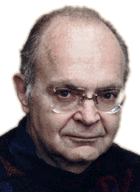
1: Donald Knuth: Leonard Euler of Computer Science
Chapter
1: Donald Knuth: Leonard Euler of Computer Scienceversion 0.80
"Computer programming is an art form,
like the creation of poetry or music"
Donald E. Knuth[1974]
Contents
|
|
Webliography.shtml (interviews, reviews of books, etc)
Let me make it clear from the very beginning: I really admire this man. Donald E. Knuth is not only Professor Emeritus of The Art of Computer Programming at Stanford University, the author of the multi-volume work-in-progress The Art of Computer Programming, five volumes of Computers & Typesetting, a member of the American Academy of Arts and Sciences, the National Academy of Sciences, and the National Academy of Engineering and so on and so forth. Unlike many other bearers of a similar number of prestigious titles and published books, he is a unique lonely star among computer science researchers. I would say he is man of a stature similar to the stature of Leonard Euler in mathematics. Such men are not born every century...
Despite opinion of some overzealous (or in a permanent state of religious stupor) free/open software evangelists, free software existed long before Gnu project and the volume of it far exceeded the GNU project. Moreover the current free/open software is largely based on what has come before it. Professor Donald Knuth is one of the largest contributors to this pool of knowledge. Moreover, free and open programs are only as good as algorithms they are using. And dismissing his contributions to free software movement as irrelevant like "professional software freedom fighter" Richard Stallman once did (see Slashdot/2nd Annual Free Software Foundation Awards ) was at least disrespectful (even if we forget the fact that TeX is one of the most important free software programs ever written).
It's amazing that despite the information explosion in computer science Professor Knuth is still trying to finish his monumental The Art of Computer Programming (TAoCP), a one-author written encyclopedia of algorithms and computer science. That really makes him "The Last of the Mohicans" -- the last Renaissance man in computer science. He one of few who has managed to make contributions to a very diverse spectrum of computer science topics. Among them:
- Wrote one of the first and one of the most compact Algol compilers at the age of 22 (1960)
- Obtained 1,271 digits of Euler's constant, using the Euler-Maclaurin summation (1962).
- Designed the SOL simulation language;
- Suggested the name "Backus-Naur Form" (1964).
- Introduced and refined the LR parsing algorithm (see Knuth, D.E. 1965. "On the Translation of Languages from Left to Right", Information and Control, Vol. 8, pp. 607-639. The first paper on LR parsing.)
- Published the first volume of The Art of Computer Programming at the age of 30 (1968). His three volumes of The Art of Computer Programming (1968, 1969, and 1973) played an important role in establishing and defining Computer Science as a rigorous, intellectual discipline.
- Published his groundbreaking paper "An empirical study of FORTRAN programs." ( Software---Practice and Experience, vol 1, pages 105-133, 1971) which laid the cornerstone of an empirical study of programming languages.
- Made the crucial contribution to the "Structured programming without GOTO" programming debate, which was a decisive blow to the structured programming fundamentalists led by Edsger Dijkstra by publishing an article Structured Programming with go to Statements. ACM Comput. Surv. 6(4): 261-301 (1974)
- Designed and wrote the TeX and Metafont systems of documentation (written in WEB for Pascal -- his attempt to improve the quality of programming by merging theprogram with the documentation -- so called literate programmating). Knuth developed the first version of TeX in in 1971-1978 in order to avoid problems with typesetting of the second edition of his TAoCP volumes. The program proved popular and he produced a second version (in 1982) which was the basis of what we use today. The whole text of the program was published in his book The TeXbook (Addison-Wesley, 1984, ISBN 0-201-13447-0, paperback ISBN 0-201-13448-9).
- Invented several important algorithms including LR parsing algorithm (influenced by Floyd) and Knuth-Morris-Pratt string-searching algorithm (1977);
- Made the crucial contribution to dispelling "correctness proof" mythology. Here is his famous citation about correctness proofs;
Still no other book in computer science can be compared with his encyclopedic The Art of Computer Programming (TAoCP). It is one of the few books which remain relevant 30 years after the initial publication. I am convinced that every person who suspects that he/she has a programming abilities (and BTW an early interest/start is a good indication of abilities in any field, including programming) should buy or borrow the first volume of TAoCP and try to solve exercises after each chapter. The ability to solve difficult exercises from the first volume is a sure sign of people with substantial talent and can be a good self-test. It can help to decide whether it makes sense to dedicate yourself to career in computer science or not. Of course, computer science changed a lot since 1960th when TAOC was published; stagnation of CS departments is a fact that cannot be hidden. But despite that there are still a few areas in it where creativity matters and where talented people can make a significant contribution. As a side note, it is clear that becoming a quant in company like Goldman Sachs is not such a bright future as many assume. Modern financial system in parasitic in a sense that it imposes huge cost on the society; one part of that cost is that large pool of top talent in the western world gravitates to financial firms. At the level of the society and aggregate economy, this is a waste of resources: their activity adds little or no economic value.
Science including computer science is another story. It does has value to the society at large and Donald Knuth life is a good example what a single talented individual can accomplish besides buying a yacht with his name on it and a half-dozen of villas in different parts of the globe.
Richard M. Stallman, Linus Torvalds, and
Donald E. Knuth
engage in a discussion on whose impact
on the computerized world was the greatest.
Stallman: "God told me I have programmed
the best editor in the world!"
Torvalds: "Well, God told *me* that I have programmed
the best operating system in the world!"
Knuth: "Wait, wait - I never said that."
From rec.humor.funny.
submitted by [email protected] (Erik Meltzer)
While the joke above is somewhat silly, it has a grain of truth in it: even among numerous computer pioneers in Stanford, Donald Knuth is a legendary figure. The figure with its own set of urban legends. For example, the old anecdote from Alan Kay, one of the principal designers of the Smalltalk language, illustrates the point:
When I was at Stanford with the AI project [in the late 1960s] one of the things we used to do every Thanksgiving is have a computer programming contest with people on research projects in the Bay area. The prize I think was a turkey.
[John] McCarthy used to make up the problems. The one year that Knuth entered this, he won both the fastest time getting the program running and he also won the fastest execution of the algorithm. He did it on the worst system with remote batch called the Wilbur system. And he basically beat the shit out of everyone.
And they asked him, "How could you possibly do this?" And he answered,
"When I learned to program, you were lucky if you got five minutes with the machine a day. If you wanted to get the program going, it just had to be written right. So people just learned to program like it was carving stone. You sort of have to sidle up to it. That's how I learned to program."
In his 2008 interview to InformIT Donald Knuth recollected events in the following way:
Andrew: A story states that you once entered a programming contest at Stanford (I believe) and you submitted the winning entry, which worked correctly after a single compilation. Is this story true? In that vein, today's developers frequently build programs writing small code increments followed by immediate compilation and the creation and running of unit tests. What are your thoughts on this approach to software development?
Donald: The story you heard is typical of legends that are based on only a small kernel of truth. Here's what actually happened: John McCarthy decided in 1971 to have a Memorial Day Programming Race. All of the contestants except me worked at his AI Lab up in the hills above Stanford, using the WAITS time-sharing system; I was down on the main campus, where the only computer available to me was a mainframe for which I had to punch cards and submit them for processing in batch mode. I used Wirth's ALGOL W system (the predecessor of Pascal). My program didn't work the first time, but fortunately I could use Ed Satterthwaite's excellent offline debugging system for ALGOL W, so I needed only two runs. Meanwhile, the folks using WAITS couldn't get enough machine cycles because their machine was so overloaded. (I think that the second-place finisher, using that "modern" approach, came in about an hour after I had submitted the winning entry with old-fangled methods.) It wasn't a fair contest.
As to your real question, the idea of immediate compilation and "unit tests" appeals to me only rarely, when I'm feeling my way in a totally unknown environment and need feedback about what works and what doesn't. Otherwise, lots of time is wasted on activities that I simply never need to perform or even think about. Nothing needs to be "mocked up."
Donald Knuth probably received more prestigious computer science related awards then any other professor of computer sciences ;-), including the 1974 Turing Award, and the 1979 National Medal of Technology.
He holds honorary doctorates from more than 15 universities worldwide including prestigious Russian St. Petersburg University, the university were giants of mathematics hold the professorship including Leonard Euler, the most prolific mathematician of the 18th century and maybe even of all time (he succeeded Nicolaus Bernoulli as Professor of Mathematics of St. Petersburg University in 1733)
Around this time Johann Bernoulli's two sons, Daniel and Nicolaus, were working at the Imperial Russian Academy of Sciences in Saint Petersburg. On 31 July 1726, Nicolaus died of appendicitis after spending less than a year in Russia,[12][13] and when Daniel assumed his brother's position in the mathematics/physics division, he recommended that the post in physiology that he had vacated be filled by his friend Euler. In November 1726 Euler eagerly accepted the offer, but delayed making the trip to Saint Petersburg while he unsuccessfully applied for a physics professorship at the University of Basel.[14]
Euler was phenomenal and after he became blind in 1775 he still managed to produce, on average, one mathematical paper every week. He spend in St Petersburg University his most productive years until died in St. Petersburg at 1783 at the age of 76.
That's probably an example for Knuth to strive for, as Leonard Euler
published 866 books and articles that represented about one third of the
entire body of research on mathematics, theoretical physics, and engineering
mechanics published between 1726 and 1800. Among other things he modernized
mathematical notation including the introduction of now standard symbols
 and e. An
interesting, but little known fact is that in 1962 Knuth obtained 1,271
digits of
Euler's constant, using the Euler-Maclaurin summation.
and e. An
interesting, but little known fact is that in 1962 Knuth obtained 1,271
digits of
Euler's constant, using the Euler-Maclaurin summation.
Actually the analogy between Donald Knuth and Leonard Euler is deeper than Lutheran religion, tremendous productivity and groundbreaking contributions. Both has interest in things quite remote from the their main field: Leonard Euler was interested in cartography (historians believe that this contributed to his early blindness) and spent a lot of time and effort on non-mathematical studies; Donald Knuth also spend huge amount of time and effort outside his major field while he developed the TeX and Metafont (written in WEB for Pascal) -- the major open source typesetting system that become a standard de-facto in mathematics and computer science. He also published 3:16 Bible Texts Illuminated.
Like Euler believed in the esthetic value of mathematic theories, Knuth believes that preparing programs for a computer can be an aesthetic experience, much like composing poetry or music. As for music he probably knows what he is talking about: he plays a custom-made pipe-organ (this sixteen-rank organ was designed and built for his home by Abbott and Sieker of Los Angeles, California, as their ``Opus 67.'' It has 812 pipes, separated into three divisions).
A the same time Knuth is a tragic figure. He tried to write a monograph on topic that is far beyond comprehension of a single man. Ground in computer scoences shifted several time after he wrote the first three volume. And it is unsuprizing that he lost traction and shifted more to combinatorics., which is more stable field.
And while the first three volumes were produced relatively quickly (1963-1968), the forth volume (still unfinished) took all his time from 1968 till 2018. That's a Guiness record for whiting the next volume. Alexandr Dumas has a novel Twenty Years After. Here we have the forth volume which is 50 years after ;-).
Now it is clear that Knuth will never be able to complete this monograph -- the technology developed too quickly and the field became too diverse. In January 10, 2019 he reached the age of 81. At this age it is difficult to work in the field of mathematics and system programming. This inability to finish the work he devoted a large part of his life is definitely a tragedy. The key problem here is that now it is simply impossible to cover the whole area of system programming and related algorithms for one person. But the first three volumes played tremendous positive role for sure.
Also he was distracted for several years to create TeX. He probably needed to create a non-profit and complete this work by attracting the best minds from the outside. But he is by nature a loner, as many great scientists are, and preferred to work this way.
His other mistake is due to the fact that MIX - his emulator was too far from the IBM S/360, which became the standard de-facto in mid-60th. He then realized that this was a blunder and replaced MIX with more modem emulator MIXX, but it was "too little, too late" and it took time and effort as modern CPU architecture became very complex indeed. Also Knuth being Knuth tried to create "ideal" instruction set and that required several revisions (mostly additions of instructions). So the first three volumes and fragments of the fourth is all that we have now and probably forever.
Not all volumes fared equally well with time. The third volume suffered most IMHO and as of 2019 is partially obsolete. Also it was written by him in some haste and some parts of it are are far from clearly written ( it was based on earlier lectures of Floyd, so it was oriented of single CPU computers only. Now when multiprocessor machines, huge amount of RAM and SSD hard drives are the norm, the situation is very different from late 60th. It requires different sorting algorithms (the importance of mergesort increased, importance of quicksort decreased).
While writing volume 3 he also got too carried away with sorting random numbers and establishing upper bound and average run time. The real data is almost never random and typically contain sorted fragments (often in inverse order). He also never researched perforce of very large data sets as memory at the time of the writing th book was really minuscule, less then a modern cell phone. Some algorithms, like quicksort, self-poison themselves on large data sets, regularly creating "worst case" subsequences (this effect is clearly visible, if you try to sort, say, the last 30 years of S&P500 data using quicksort.) In general, it is far to say, that Knuth overestimated the practical value quicksort and thus pushed the discipline in the wrong direction.
The other problem with Knuth is that he missed the rise of Unix and for some time was pretty foreign to Unix philosophy. although later he used Linux laptop for his research.
|
|
Switchboard | ||||
| Latest | |||||
| Past week | |||||
| Past month | |||||
 |
 |
 |
Oct 13, 2019 | www.quora.com
Eugene Miya , A friend/colleague. Sometimes driver. Other shared experiences. Updated Mar 22 2017 · Author has 11.2k answers and 7.9m answer views
He mostly writes in C today.
I can assure you he at least knows about Python. Guido's office at Dropbox is 1 -- 2 blocks by a backdoor gate from Don's house.
I would tend to doubt that he would use R (I've used S before as one of my stat packages). Don would probably write something for himself.
Don is not big on functional languages, so I would doubt either Haskell (sorry Paul) or LISP (but McCarthy lived just around the corner from Don; I used to drive him to meetings; actually, I've driven all 3 of us to meetings, and he got his wife an electric version of my car based on riding in my car (score one for friend's choices)). He does use emacs and he does write MLISP macros, but he believes in being closer to the hardware which is why he sticks with MMIX (and MIX) in his books.
Don't discount him learning the machine language of a given architecture.
I'm having dinner with Don and Jill and a dozen other mutual friends in 3 weeks or so (our quarterly dinner). I can ask him then, if I remember (either a calendar entry or at job). I try not to bother him with things like this. Don is well connected to the hacker community
Don's name was brought up at an undergrad architecture seminar today, but Don was not in the audience (an amazing audience; I took a photo for the collection of architects and other computer scientists in the audience (Hennessey and Patterson were talking)). I came close to biking by his house on my way back home.
We do have a mutual friend (actually, I introduced Don to my biology friend at Don's request) who arrives next week, and Don is my wine drinking proxy. So there is a chance I may see him sooner.
Steven de Rooij , Theoretical computer scientist Answered Mar 9, 2017 · Author has 4.6k answers and 7.7m answer views
Nice question :-)
Don Knuth would want to use something that’s low level, because details matter . So no Haskell; LISP is borderline. Perhaps if the Lisp machine ever had become a thing.
He’d want something with well-defined and simple semantics, so definitely no R. Python also contains quite a few strange ad hoc rules, especially in its OO and lambda features. Yes Python is easy to learn and it looks pretty, but Don doesn’t care about superficialities like that. He’d want a language whose version number is converging to a mathematical constant, which is also not in favor of R or Python.
What remains is C. Out of the five languages listed, my guess is Don would pick that one. But actually, his own old choice of Pascal suits him even better. I don’t think any languages have been invented since was written that score higher on the Knuthometer than Knuth’s own original pick.
And yes, I feel that this is actually a conclusion that bears some thinking about. 24.1k views ·
Dan Allen , I've been programming for 34 years now. Still not finished. Answered Mar 9, 2017 · Author has 4.5k answers and 1.8m answer views
In The Art of Computer Programming I think he'd do exactly what he did. He'd invent his own architecture and implement programs in an assembly language targeting that theoretical machine.
He did that for a reason because he wanted to reveal the detail of algorithms at the lowest level of detail which is machine level.
He didn't use any available languages at the time and I don't see why that would suit his purpose now. All the languages above are too high-level for his purposes.
|
|
|
Sep 07, 2019 | archive.computerhistory.org
Knuth: Yeah. That's absolutely true. I've got to get another thought out of my mind though. That is, early on in the TeX project I also had to do programming of a completely different type. I told you last week that this was my first real exercise in structured programming, which was one of Dijkstra's huge... That's one of the few breakthroughs in the history of computer science, in a way. He was actually responsible for maybe two of the ten that I know.
So I'm doing structured programming as I'm writing TeX. I'm trying to do it right, the way I should've been writing programs in the 60s. Then I also got this typesetting machine, which had, inside of it, a tiny 8080 chip or something. I'm not sure exactly. It was a Zilog, or some very early Intel chip. Way before the 386s. A little computer with 8-bit registers and a small number of things it could do. I had to write my own assembly language for this, because the existing software for writing programs for this little micro thing were so bad. I had to write actually thousands of lines of code for this, in order to control the typesetting. Inside the machine I had to control a stepper motor, and I had to accelerate it.
Every so often I had to give another [command] saying, "Okay, now take a step," and then continue downloading a font from the mainframe.
I had six levels of interrupts in this program. I remember talking to you at this time, saying, "Ed, I'm programming in assembly language for an 8-bit computer," and you said "Yeah, you've been doing the same thing and it's fun again."
You know, you'll remember. We'll undoubtedly talk more about that when I have my turn interviewing you in a week or so. This is another aspect of programming: that you also feel that you're in control and that there's not a black box separating you. It's not only the power, but it's the knowledge of what's going on; that nobody's hiding something. It's also this aspect of jumping levels of abstraction. In my opinion, the thing that computer scientists are best at is seeing things at many levels of detail: high level, intermediate levels, and lowest levels. I know if I'm adding 1 to a certain number, that this is getting me towards some big goal at the top. People enjoy most the things that they're good at. Here's a case where if you're working on a machine that has only this 8-bit capability, but in order to do this you have to go through levels, of not only that machine, but also to the next level up of the assembler, and then you have a simulator in which you can help debug your programs, and you have higher level languages that go through, and then you have the typesetting at the top. There are these six or seven levels all present at the same time. A computer scientist is in heaven in a situation like this.
Feigenbaum: Don, to get back, I want to ask you about that as part of the next question. You went back into programming in a really serious way. It took you, as I said before, ten years, not one year, and you didn't quit. As soon as you mastered one part of it, you went into Metafont, which is another big deal. To what extent were you doing that because you needed to, what I might call expose yourself to, or upgrade your skills in, the art that had emerged over the decade-and-a-half since you had done RUNCIBLE? And to what extent did you do it just because you were driven to be a programmer? You loved programming.
Knuth: Yeah. I think your hypothesis is good. It didn't occur to me at the time that I just had to program in order to be a happy man. Certainly I didn't find my other roles distasteful, except for fundraising. I enjoyed every aspect of being a professor except dealing with proposals, which I did my share of, but that was a necessary evil sort of in my own thinking, I guess. But the fact that now I'm still compelled to I wake up in the morning with an idea, and it makes my day to think of adding a couple of lines to my program. Gives me a real high. It must be the way poets feel, or musicians and so on, and other people, painters, whatever. Programming does that for me. It's certainly true. But the fact that I had to put so much time in it was not totally that, I'm sure, because it became a responsibility. It wasn't just for Phyllis and me, as it turned out. I started working on it at the AI lab, and people were looking at the output coming out of the machine and they would say, "Hey, Don, how did you do that?" Guy Steele was visiting from MIT that summer and he said, "Don, I want to port this to take it to MIT." I didn't have two users.
First I had 10, and then I had 100, and then I had 1000. Every time it went to another order of magnitude I had to change the system, because it would almost match their needs but then they would have very good suggestions as to something it wasn't covering. Then when it went to 10,000 and when it went to 100,000, the last stage was 10 years later when I made it friendly for the other alphabets of the world, where people have accented letters and Russian letters. <p>I had started out with only 7-bit codes. I had so many international users by that time, I saw that was a fundamental error. I started out with the idea that nobody would ever want to use a keyboard that could generate more than about 90 characters. It was going to be too complicated. But I was wrong. So it [TeX] was a burden as well, in the sense that I wanted to do a responsible job.
I had actually consciously planned an end-game that would take me four years to finish, and [then] not continue maintaining it and adding on, so that I could have something where I could say, "And now it's done and it's never going to change." I believe this is one aspect of software that, not for every system, but for TeX, it was vital that it became something that wouldn't be a moving target after while.
Feigenbaum: The books on TeX were a period. That is, you put a period down and you said, "This is it."
|
|
|
Sep 07, 2019 | archive.computerhistory.org
Dijkstra said he was proud to be a programmer. Unfortunately he changed his attitude completely, and I think he wrote his last computer program in the 1980s. At this conference I went to in 1967 about simulation language, Chris Strachey was going around asking everybody at the conference what was the last computer program you wrote. This was 1967. Some of the people said, "I've never written a computer program." Others would say, "Oh yeah, here's what I did last week." I asked Edsger this question when I visited him in Texas in the 90s and he said, "Don, I write programs now with pencil and paper, and I execute them in my head." He finds that a good enough discipline.
I think he was mistaken on that. He taught me a lot of things, but I really think that if he had continued... One of Dijkstra's greatest strengths was that he felt a strong sense of aesthetics, and he didn't want to compromise his notions of beauty. They were so intense that when he visited me in the 1960s, I had just come to Stanford. I remember the conversation we had. It was in the first apartment, our little rented house, before we had electricity in the house.
We were sitting there in the dark, and he was telling me how he had just learned about the specifications of the IBM System/360, and it made him so ill that his heart was actually starting to flutter.
He intensely disliked things that he didn't consider clean to work with. So I can see that he would have distaste for the languages that he had to work with on real computers. My reaction to that was to design my own language, and then make Pascal so that it would work well for me in those days. But his response was to do everything only intellectually.
So, programming.
I happened to look the other day. I wrote 35 programs in January, and 28 or 29 programs in February. These are small programs, but I have a compulsion. I love to write programs and put things into it. I think of a question that I want to answer, or I have part of my book where I want to present something. But I can't just present it by reading about it in a book. As I code it, it all becomes clear in my head. It's just the discipline. The fact that I have to translate my knowledge of this method into something that the machine is going to understand just forces me to make that crystal-clear in my head. Then I can explain it to somebody else infinitely better. The exposition is always better if I've implemented it, even though it's going to take me more time.
|
|
|
Sep 07, 2019 | archive.computerhistory.org
So I had a programming hat when I was outside of Cal Tech, and at Cal Tech I am a mathematician taking my grad studies. A startup company, called Green Tree Corporation because green is the color of money, came to me and said, "Don, name your price. Write compilers for us and we will take care of finding computers for you to debug them on, and assistance for you to do your work. Name your price." I said, "Oh, okay. $100,000.", assuming that this was In that era this was not quite at Bill Gate's level today, but it was sort of out there.
The guy didn't blink. He said, "Okay." I didn't really blink either. I said, "Well, I'm not going to do it. I just thought this was an impossible number."
At that point I made the decision in my life that I wasn't going to optimize my income; I was really going to do what I thought I could do for well, I don't know. If you ask me what makes me most happy, number one would be somebody saying "I learned something from you". Number two would be somebody saying "I used your software". But number infinity would be Well, no. Number infinity minus one would be "I bought your book". It's not as good as "I read your book", you know. Then there is "I bought your software"; that was not in my own personal value. So that decision came up. I kept up with the literature about compilers. The Communications of the ACM was where the action was. I also worked with people on trying to debug the ALGOL language, which had problems with it. I published a few papers, like "The Remaining Trouble Spots in ALGOL 60" was one of the papers that I worked on. I chaired a committee called "Smallgol" which was to find a subset of ALGOL that would work on small computers. I was active in programming languages.
|
|
|
Sep 07, 2019 | conservancy.umn.edu
Frana: You have made the comment several times that maybe 1 in 50 people have the "computer scientist's mind." Knuth: Yes. Frana: I am wondering if a large number of those people are trained professional librarians? [laughter] There is some strangeness there. But can you pinpoint what it is about the mind of the computer scientist that is....
Knuth: That is different?
Frana: What are the characteristics?
Knuth: Two things: one is the ability to deal with non-uniform structure, where you have case one, case two, case three, case four. Or that you have a model of something where the first component is integer, the next component is a Boolean, and the next component is a real number, or something like that, you know, non-uniform structure. To deal fluently with those kinds of entities, which is not typical in other branches of mathematics, is critical. And the other characteristic ability is to shift levels quickly, from looking at something in the large to looking at something in the small, and many levels in between, jumping from one level of abstraction to another. You know that, when you are adding one to some number, that you are actually getting closer to some overarching goal. These skills, being able to deal with nonuniform objects and to see through things from the top level to the bottom level, these are very essential to computer programming, it seems to me. But maybe I am fooling myself because I am too close to it.
Frana: It is the hardest thing to really understand that which you are existing within.
Knuth: Yes.
|
|
|
Sep 07, 2019 | conservancy.umn.edu
Knuth: Well, certainly it seems the way things are going. You take any particular subject that you are interested in and you try to see if somebody with an American high school education has learned it, and you will be appalled. You know, Jesse Jackson thinks that students know nothing about political science, and I am sure the chemists think that students don't know chemistry, and so on. But somehow they get it when they have to later. But I would say certainly the students now have been getting more of a superficial idea of mathematics than they used to. We have to do remedial stuff at Stanford that we didn't have to do thirty years ago.
Frana: Gio [Wiederhold] said much the same thing to me.
Knuth: The most scandalous thing was that Stanford's course in linear algebra could not get to eigenvalues because the students didn't know about complex numbers. Now every course at Stanford that takes linear algebra as a prerequisite does so because they want the students to know about eigenvalues. But here at Stanford, with one of the highest admission standards of any university, our students don't know complex numbers. So we have to teach them that when they get to college. Yes, this is definitely a breakdown.
Frana: Was your mathematics training in high school particularly good, or was it that you spent a lot of time actually doing problems?
Knuth: No, my mathematics training in high school was not good. My teachers could not answer my questions and so I decided I'd go into physics. I mean, I had played with mathematics in high school. I did a lot of work drawing graphs and plotting points and I used pi as the radix of a number system, and explored what the world would be like if you wanted to do logarithms and you had a number system based on pi. And I had played with stuff like that. But my teachers couldn't answer questions that I had.
... ... ... Frana: Do you have an answer? Are American students different today? In one of your interviews you discuss the problem of creativity versus gross absorption of knowledge.
Knuth: Well, that is part of it. Today we have mostly a sound byte culture, this lack of attention span and trying to learn how to pass exams. Frana: Yes,
|
|
|
Sep 07, 2019 | conservancy.umn.edu
Knuth: I can be a writer, who tries to organize other people's ideas into some kind of a more coherent structure so that it is easier to put things together. I can see that I could be viewed as a scholar that does his best to check out sources of material, so that people get credit where it is due. And to check facts over, not just to look at the abstract of something, but to see what the methods were that did it and to fill in holes if necessary. I look at my role as being able to understand the motivations and terminology of one group of specialists and boil it down to a certain extent so that people in other parts of the field can use it. I try to listen to the theoreticians and select what they have done that is important to the programmer on the street; to remove technical jargon when possible.
But I have never been good at any kind of a role that would be making policy, or advising people on strategies, or what to do. I have always been best at refining things that are there and bringing order out of chaos. I sometimes raise new ideas that might stimulate people, but not really in a way that would be in any way controlling the flow. The only time I have ever advocated something strongly was with literate programming; but I do this always with the caveat that it works for me, not knowing if it would work for anybody else.
When I work with a system that I have created myself, I can always change it if I don't like it. But everybody who works with my system has to work with what I give them. So I am not able to judge my own stuff impartially. So anyway, I have always felt bad about if anyone says, 'Don, please forecast the future,'...
|
|
|
Sep 06, 2019 | archive.computerhistory.org
...I showed the second version of this design to two of my graduate students, and I said, "Okay, implement this, please, this summer. That's your summer job." I thought I had specified a language. I had to go away. I spent several weeks in China during the summer of 1977, and I had various other obligations. I assumed that when I got back from my summer trips, I would be able to play around with TeX and refine it a little bit. To my amazement, the students, who were outstanding students, had not competed [it]. They had a system that was able to do about three lines of TeX. I thought, "My goodness, what's going on? I thought these were good students." Well afterwards I changed my attitude to saying, "Boy, they accomplished a miracle."
Because going from my specification, which I thought was complete, they really had an impossible task, and they had succeeded wonderfully with it. These students, by the way, [were] Michael Plass, who has gone on to be the brains behind almost all of Xerox's Docutech software and all kind of things that are inside of typesetting devices now, and Frank Liang, one of the key people for Microsoft Word.
He did important mathematical things as well as his hyphenation methods which are quite used in all languages now. These guys were actually doing great work, but I was amazed that they couldn't do what I thought was just sort of a routine task. Then I became a programmer in earnest, where I had to do it. The reason is when you're doing programming, you have to explain something to a computer, which is dumb.
When you're writing a document for a human being to understand, the human being will look at it and nod his head and say, "Yeah, this makes sense." But then there's all kinds of ambiguities and vagueness that you don't realize until you try to put it into a computer. Then all of a sudden, almost every five minutes as you're writing the code, a question comes up that wasn't addressed in the specification. "What if this combination occurs?"
It just didn't occur to the person writing the design specification. When you're faced with implementation, a person who has been delegated this job of working from a design would have to say, "Well hmm, I don't know what the designer meant by this."
If I hadn't been in China they would've scheduled an appointment with me and stopped their programming for a day. Then they would come in at the designated hour and we would talk. They would take 15 minutes to present to me what the problem was, and then I would think about it for a while, and then I'd say, "Oh yeah, do this. " Then they would go home and they would write code for another five minutes and they'd have to schedule another appointment.
I'm probably exaggerating, but this is why I think Bob Floyd's Chiron compiler never got going. Bob worked many years on a beautiful idea for a programming language, where he designed a language called Chiron, but he never touched the programming himself. I think this was actually the reason that he had trouble with that project, because it's so hard to do the design unless you're faced with the low-level aspects of it, explaining it to a machine instead of to another person.
Forsythe, I think it was, who said, "People have said traditionally that you don't understand something until you've taught it in a class. The truth is you don't really understand something until you've taught it to a computer, until you've been able to program it." At this level, programming was absolutely important
|
|
|
Sep 06, 2019 | www-cs-faculty.stanford.edu
Having just celebrated my 10000th birthday (in base three), I'm operating a little bit in history mode. Every once in awhile, people have asked me to record some of my memories of past events --- I guess because I've been fortunate enough to live at some pretty exciting times, computersciencewise. These after-the-fact recollections aren't really as reliable as contemporary records; but they do at least show what I think I remember. And the stories are interesting, because they involve lots of other people.
So, before these instances of oral history themselves begin to fade from my memory, I've decided to record some links to several that I still know about:
- Interview by Philip L Frana at the Charles Babbage Institute, November 2001
- transcript of OH 332
audio file (2:00:33)- Interviews commissioned by Peoples Archive, taped in March 2006
- playlist for 97 videos (about 2--8 minutes each)
- Interview by Ed Feigenbaum at the Computer History Museum, March 2007
- Part 1 (3:07:25) Part 2 (4:02:46)
(transcript)- Interview by Susan Schofield for the Stanford Historical Society, May 2018
- (audio files, 2:20:30 and 2:14:25; transcript)
- Interview by David Brock and Hansen Hsu about the computer programs that I wrote during the 1950s, July 2018
- video (1:30:0)
(texts of the actual programs)Some extended interviews, not available online, have also been published in books, notably in Chapters 7--17 of Companion to the Papers of Donald Knuth (conversations with Dikran Karagueuzian in the summer of 1996), and in two books by Edgar G. Daylight, The Essential Knuth (2013), Algorithmic Barriers Falling (2014).
|
|
|
Sep 06, 2019 | conservancy.umn.edu
Knuth: No, I stopped going to conferences. It was too discouraging. Computer programming keeps getting harder because more stuff is discovered. I can cope with learning about one new technique per day, but I can't take ten in a day all at once. So conferences are depressing; it means I have so much more work to do. If I hide myself from the truth I am much happier.
|
|
|
Sep 06, 2019 | archive.computerhistory.org
Knuth: This is, of course, really the story of my life, because I hope to live long enough to finish it. But I may not, because it's turned out to be such a huge project. I got married in the summer of 1961, after my first year of graduate school. My wife finished college, and I could use the money I had made -- the $5000 on the compiler -- to finance a trip to Europe for our honeymoon.
We had four months of wedded bliss in Southern California, and then a man from Addison-Wesley came to visit me and said "Don, we would like you to write a book about how to write compilers."
The more I thought about it, I decided "Oh yes, I've got this book inside of me."
I sketched out that day -- I still have the sheet of tablet paper on which I wrote -- I sketched out 12 chapters that I thought ought to be in such a book. I told Jill, my wife, "I think I'm going to write a book."
As I say, we had four months of bliss, because the rest of our marriage has all been devoted to this book. Well, we still have had happiness. But really, I wake up every morning and I still haven't finished the book. So I try to -- I have to -- organize the rest of my life around this, as one main unifying theme. The book was supposed to be about how to write a compiler. They had heard about me from one of their editorial advisors, that I knew something about how to do this. The idea appealed to me for two main reasons. One is that I did enjoy writing. In high school I had been editor of the weekly paper. In college I was editor of the science magazine, and I worked on the campus paper as copy editor. And, as I told you, I wrote the manual for that compiler that we wrote. I enjoyed writing, number one.
Also, Addison-Wesley was the people who were asking me to do this book; my favorite textbooks had been published by Addison Wesley. They had done the books that I loved the most as a student. For them to come to me and say, "Would you write a book for us?", and here I am just a secondyear gradate student -- this was a thrill.
Another very important reason at the time was that I knew that there was a great need for a book about compilers, because there were a lot of people who even in 1962 -- this was January of 1962 -- were starting to rediscover the wheel. The knowledge was out there, but it hadn't been explained. The people who had discovered it, though, were scattered all over the world and they didn't know of each other's work either, very much. I had been following it. Everybody I could think of who could write a book about compilers, as far as I could see, they would only give a piece of the fabric. They would slant it to their own view of it. There might be four people who could write about it, but they would write four different books. I could present all four of their viewpoints in what I would think was a balanced way, without any axe to grind, without slanting it towards something that I thought would be misleading to the compiler writer for the future. I considered myself as a journalist, essentially. I could be the expositor, the tech writer, that could do the job that was needed in order to take the work of these brilliant people and make it accessible to the world. That was my motivation. Now, I didn't have much time to spend on it then, I just had this page of paper with 12 chapter headings on it. That's all I could do while I'm a consultant at Burroughs and doing my graduate work. I signed a contract, but they said "We know it'll take you a while." I didn't really begin to have much time to work on it until 1963, my third year of graduate school, as I'm already finishing up on my thesis. In the summer of '62, I guess I should mention, I wrote another compiler. This was for Univac; it was a FORTRAN compiler. I spent the summer, I sold my soul to the devil, I guess you say, for three months in the summer of 1962 to write a FORTRAN compiler. I believe that the salary for that was $15,000, which was much more than an assistant professor. I think assistant professors were getting eight or nine thousand in those days.
Feigenbaum: Well, when I started in 1960 at [University of California] Berkeley, I was getting $7,600 for the nine-month year.
Knuth: Knuth: Yeah, so you see it. I got $15,000 for a summer job in 1962 writing a FORTRAN compiler. One day during that summer I was writing the part of the compiler that looks up identifiers in a hash table. The method that we used is called linear probing. Basically you take the variable name that you want to look up, you scramble it, like you square it or something like this, and that gives you a number between one and, well in those days it would have been between 1 and 1000, and then you look there. If you find it, good; if you don't find it, go to the next place and keep on going until you either get to an empty place, or you find the number you're looking for. It's called linear probing. There was a rumor that one of Professor Feller's students at Princeton had tried to figure out how fast linear probing works and was unable to succeed. This was a new thing for me. It was a case where I was doing programming, but I also had a mathematical problem that would go into my other [job]. My winter job was being a math student, my summer job was writing compilers. There was no mix. These worlds did not intersect at all in my life at that point. So I spent one day during the summer while writing the compiler looking at the mathematics of how fast does linear probing work. I got lucky, and I solved the problem. I figured out some math, and I kept two or three sheets of paper with me and I typed it up. ["Notes on 'Open' Addressing', 7/22/63] I guess that's on the internet now, because this became really the genesis of my main research work, which developed not to be working on compilers, but to be working on what they call analysis of algorithms, which is, have a computer method and find out how good is it quantitatively. I can say, if I got so many things to look up in the table, how long is linear probing going to take. It dawned on me that this was just one of many algorithms that would be important, and each one would lead to a fascinating mathematical problem. This was easily a good lifetime source of rich problems to work on. Here I am then, in the middle of 1962, writing this FORTRAN compiler, and I had one day to do the research and mathematics that changed my life for my future research trends. But now I've gotten off the topic of what your original question was.
Feigenbaum: We were talking about sort of the.. You talked about the embryo of The Art of Computing. The compiler book morphed into The Art of Computer Programming, which became a seven-volume plan.
Knuth: Exactly. Anyway, I'm working on a compiler and I'm thinking about this. But now I'm starting, after I finish this summer job, then I began to do things that were going to be relating to the book. One of the things I knew I had to have in the book was an artificial machine, because I'm writing a compiler book but machines are changing faster than I can write books. I have to have a machine that I'm totally in control of. I invented this machine called MIX, which was typical of the computers of 1962.
In 1963 I wrote a simulator for MIX so that I could write sample programs for it, and I taught a class at Caltech on how to write programs in assembly language for this hypothetical computer. Then I started writing the parts that dealt with sorting problems and searching problems, like the linear probing idea. I began to write those parts, which are part of a compiler, of the book. I had several hundred pages of notes gathering for those chapters for The Art of Computer Programming. Before I graduated, I've already done quite a bit of writing on The Art of Computer Programming.
I met George Forsythe about this time. George was the man who inspired both of us [Knuth and Feigenbaum] to come to Stanford during the '60s. George came down to Southern California for a talk, and he said, "Come up to Stanford. How about joining our faculty?" I said "Oh no, I can't do that. I just got married, and I've got to finish this book first." I said, "I think I'll finish the book next year, and then I can come up [and] start thinking about the rest of my life, but I want to get my book done before my son is born." Well, John is now 40-some years old and I'm not done with the book. Part of my lack of expertise is any good estimation procedure as to how long projects are going to take. I way underestimated how much needed to be written about in this book. Anyway, I started writing the manuscript, and I went merrily along writing pages of things that I thought really needed to be said. Of course, it didn't take long before I had started to discover a few things of my own that weren't in any of the existing literature. I did have an axe to grind. The message that I was presenting was in fact not going to be unbiased at all. It was going to be based on my own particular slant on stuff, and that original reason for why I should write the book became impossible to sustain. But the fact that I had worked on linear probing and solved the problem gave me a new unifying theme for the book. I was going to base it around this idea of analyzing algorithms, and have some quantitative ideas about how good methods were. Not just that they worked, but that they worked well: this method worked 3 times better than this method, or 3.1 times better than this method. Also, at this time I was learning mathematical techniques that I had never been taught in school. I found they were out there, but they just hadn't been emphasized openly, about how to solve problems of this kind.
So my book would also present a different kind of mathematics than was common in the curriculum at the time, that was very relevant to analysis of algorithm. I went to the publishers, I went to Addison Wesley, and said "How about changing the title of the book from 'The Art of Computer Programming' to 'The Analysis of Algorithms'." They said that will never sell; their focus group couldn't buy that one. I'm glad they stuck to the original title, although I'm also glad to see that several books have now come out called "The Analysis of Algorithms", 20 years down the line.
But in those days, The Art of Computer Programming was very important because I'm thinking of the aesthetical: the whole question of writing programs as something that has artistic aspects in all senses of the word. The one idea is "art" which means artificial, and the other "art" means fine art. All these are long stories, but I've got to cover it fairly quickly.
I've got The Art of Computer Programming started out, and I'm working on my 12 chapters. I finish a rough draft of all 12 chapters by, I think it was like 1965. I've got 3,000 pages of notes, including a very good example of what you mentioned about seeing holes in the fabric. One of the most important chapters in the book is parsing: going from somebody's algebraic formula and figuring out the structure of the formula. Just the way I had done in seventh grade finding the structure of English sentences, I had to do this with mathematical sentences.
Chapter ten is all about parsing of context-free language, [which] is what we called it at the time. I covered what people had published about context-free languages and parsing. I got to the end of the chapter and I said, well, you can combine these ideas and these ideas, and all of a sudden you get a unifying thing which goes all the way to the limit. These other ideas had sort of gone partway there. They would say "Oh, if a grammar satisfies this condition, I can do it efficiently." "If a grammar satisfies this condition, I can do it efficiently." But now, all of a sudden, I saw there was a way to say I can find the most general condition that can be done efficiently without looking ahead to the end of the sentence. That you could make a decision on the fly, reading from left to right, about the structure of the thing. That was just a natural outgrowth of seeing the different pieces of the fabric that other people had put together, and writing it into a chapter for the first time. But I felt that this general concept, well, I didn't feel that I had surrounded the concept. I knew that I had it, and I could prove it, and I could check it, but I couldn't really intuit it all in my head. I knew it was right, but it was too hard for me, really, to explain it well.
So I didn't put in The Art of Computer Programming. I thought it was beyond the scope of my book. Textbooks don't have to cover everything when you get to the harder things; then you have to go to the literature. My idea at that time [is] I'm writing this book and I'm thinking it's going to be published very soon, so any little things I discover and put in the book I didn't bother to write a paper and publish in the journal because I figure it'll be in my book pretty soon anyway. Computer science is changing so fast, my book is bound to be obsolete.
It takes a year for it to go through editing, and people drawing the illustrations, and then they have to print it and bind it and so on. I have to be a little bit ahead of the state-of-the-art if my book isn't going to be obsolete when it comes out. So I kept most of the stuff to myself that I had, these little ideas I had been coming up with. But when I got to this idea of left-to-right parsing, I said "Well here's something I don't really understand very well. I'll publish this, let other people figure out what it is, and then they can tell me what I should have said." I published that paper I believe in 1965, at the end of finishing my draft of the chapter, which didn't get as far as that story, LR(k). Well now, textbooks of computer science start with LR(k) and take off from there. But I want to give you an idea of
Google matched content |
| Prev | Up | Contents | Next |
Society
Groupthink : Two Party System as Polyarchy : Corruption of Regulators : Bureaucracies : Understanding Micromanagers and Control Freaks : Toxic Managers : Harvard Mafia : Diplomatic Communication : Surviving a Bad Performance Review : Insufficient Retirement Funds as Immanent Problem of Neoliberal Regime : PseudoScience : Who Rules America : Neoliberalism : The Iron Law of Oligarchy : Libertarian Philosophy
Quotes
War and Peace : Skeptical Finance : John Kenneth Galbraith :Talleyrand : Oscar Wilde : Otto Von Bismarck : Keynes : George Carlin : Skeptics : Propaganda : SE quotes : Language Design and Programming Quotes : Random IT-related quotes : Somerset Maugham : Marcus Aurelius : Kurt Vonnegut : Eric Hoffer : Winston Churchill : Napoleon Bonaparte : Ambrose Bierce : Bernard Shaw : Mark Twain Quotes
Bulletin:
Vol 25, No.12 (December, 2013) Rational Fools vs. Efficient Crooks The efficient markets hypothesis : Political Skeptic Bulletin, 2013 : Unemployment Bulletin, 2010 : Vol 23, No.10 (October, 2011) An observation about corporate security departments : Slightly Skeptical Euromaydan Chronicles, June 2014 : Greenspan legacy bulletin, 2008 : Vol 25, No.10 (October, 2013) Cryptolocker Trojan (Win32/Crilock.A) : Vol 25, No.08 (August, 2013) Cloud providers as intelligence collection hubs : Financial Humor Bulletin, 2010 : Inequality Bulletin, 2009 : Financial Humor Bulletin, 2008 : Copyleft Problems Bulletin, 2004 : Financial Humor Bulletin, 2011 : Energy Bulletin, 2010 : Malware Protection Bulletin, 2010 : Vol 26, No.1 (January, 2013) Object-Oriented Cult : Political Skeptic Bulletin, 2011 : Vol 23, No.11 (November, 2011) Softpanorama classification of sysadmin horror stories : Vol 25, No.05 (May, 2013) Corporate bullshit as a communication method : Vol 25, No.06 (June, 2013) A Note on the Relationship of Brooks Law and Conway Law
History:
Fifty glorious years (1950-2000): the triumph of the US computer engineering : Donald Knuth : TAoCP and its Influence of Computer Science : Richard Stallman : Linus Torvalds : Larry Wall : John K. Ousterhout : CTSS : Multix OS Unix History : Unix shell history : VI editor : History of pipes concept : Solaris : MS DOS : Programming Languages History : PL/1 : Simula 67 : C : History of GCC development : Scripting Languages : Perl history : OS History : Mail : DNS : SSH : CPU Instruction Sets : SPARC systems 1987-2006 : Norton Commander : Norton Utilities : Norton Ghost : Frontpage history : Malware Defense History : GNU Screen : OSS early history
Classic books:
The Peter Principle : Parkinson Law : 1984 : The Mythical Man-Month : How to Solve It by George Polya : The Art of Computer Programming : The Elements of Programming Style : The Unix Hater�s Handbook : The Jargon file : The True Believer : Programming Pearls : The Good Soldier Svejk : The Power Elite
Most popular humor pages:
Manifest of the Softpanorama IT Slacker Society : Ten Commandments of the IT Slackers Society : Computer Humor Collection : BSD Logo Story : The Cuckoo's Egg : IT Slang : C++ Humor : ARE YOU A BBS ADDICT? : The Perl Purity Test : Object oriented programmers of all nations : Financial Humor : Financial Humor Bulletin, 2008 : Financial Humor Bulletin, 2010 : The Most Comprehensive Collection of Editor-related Humor : Programming Language Humor : Goldman Sachs related humor : Greenspan humor : C Humor : Scripting Humor : Real Programmers Humor : Web Humor : GPL-related Humor : OFM Humor : Politically Incorrect Humor : IDS Humor : "Linux Sucks" Humor : Russian Musical Humor : Best Russian Programmer Humor : Microsoft plans to buy Catholic Church : Richard Stallman Related Humor : Admin Humor : Perl-related Humor : Linus Torvalds Related humor : PseudoScience Related Humor : Networking Humor : Shell Humor : Financial Humor Bulletin, 2011 : Financial Humor Bulletin, 2012 : Financial Humor Bulletin, 2013 : Java Humor : Software Engineering Humor : Sun Solaris Related Humor : Education Humor : IBM Humor : Assembler-related Humor : VIM Humor : Computer Viruses Humor : Bright tomorrow is rescheduled to a day after tomorrow : Classic Computer Humor
The Last but not Least Technology is dominated by two types of people: those who understand what they do not manage and those who manage what they do not understand ~Archibald Putt. Ph.D
Copyright � 1996-2021 by Softpanorama Society. www.softpanorama.org was initially created as a service to the (now defunct) UN Sustainable Development Networking Programme (SDNP) without any remuneration. This document is an industrial compilation designed and created exclusively for educational use and is distributed under the Softpanorama Content License. Original materials copyright belong to respective owners. Quotes are made for educational purposes only in compliance with the fair use doctrine.
FAIR USE NOTICE This site contains copyrighted material the use of which has not always been specifically authorized by the copyright owner. We are making such material available to advance understanding of computer science, IT technology, economic, scientific, and social issues. We believe this constitutes a 'fair use' of any such copyrighted material as provided by section 107 of the US Copyright Law according to which such material can be distributed without profit exclusively for research and educational purposes.
This is a Spartan WHYFF (We Help You For Free) site written by people for whom English is not a native language. Grammar and spelling errors should be expected. The site contain some broken links as it develops like a living tree...
|
|
You can use PayPal to to buy a cup of coffee for authors of this site |
Disclaimer:
The statements, views and opinions presented on this web page are those of the author (or referenced source) and are not endorsed by, nor do they necessarily reflect, the opinions of the Softpanorama society. We do not warrant the correctness of the information provided or its fitness for any purpose. The site uses AdSense so you need to be aware of Google privacy policy. You you do not want to be tracked by Google please disable Javascript for this site. This site is perfectly usable without Javascript.
Last modified: March 03, 2020

