|
|
Home | Switchboard | Unix Administration | Red Hat | TCP/IP Networks | Neoliberalism | Toxic Managers |
| (slightly skeptical) Educational society promoting "Back to basics" movement against IT overcomplexity and bastardization of classic Unix | |||||||
|
|
|
|
The mission of this site is to promote a "slightly skeptical" approach to the computer science and programming, as well as serve as a refuge to people who were hurt by absurdness of the current IT environment in general and software development (including its open source variety) in particular...
In order to do this we decided to organize a new society, called Softpanorama IT Slackers Society (SITSS). Like open source development this is a semi-religious movement (cult) and we strive to enroll into it as many University students as possible.
Enrolling is easy and unlike some other cults we do not charge members for reading our secret scriptures. Also unlike obscure cults like OOP, where even preachers often do not understand what they are talking about our cult is very simple and transparent. There are actually just two of them:
Unlike most societies we do not even insist that you read and agree with them. On a slightly more serious note the main goal of this page is to fight fundamentalist thinking and fashion in programming with humor.
Along with collecting IT and open source related humor, I wrote dozen of things. Sorry only few of them are in English. You can check The Cuckoo's Egg Review , Hoax Quiz, Ten Commandments of Software Slackerism, IT Slacker Manifest (all of them, in best slacker tradition, are actually my own reinterpretations by somebody else stories :-).
Archives of the Softpanorama IT Slacker Society Bulletin are also available:
| 2007 | 2006 | 2005 | 2004 | Vol 15(2003) | Vol 14 (2002) |
Vol 13 (2001) |
Vol 12 (2000) |
Vol 11(1999) |
| Vol 10(1998) | Vol 9(1997) | Vol 8(1996) | Vol 7(1995) | Vol 6 (1994) |
Vol 5 (1993) |
Vol 4 (1992) |
Vol 3(1991) | Vol 2(1990) |
The general mood probably can be characterized by the following samples from my collection:

Quotes:
Don't let a few insignificant facts distract you from waging a holy war A Slashdot post
It's spelled Linux, but it's pronounced "Not Windows" - Usenet sig
It is time to unmask the programming community as a Secret Society for the Creation and Preservation of Artificial Complexity. Edsger W. Dijkstra: The next forty years (EWD 1051)
Stories:
bsd_logo_story (this is from Top 10 Classic Unix Humor Stories )
Last week I walked into a local "home style cookin' restaurant/watering hole" to pick up a take out order. I spoke briefly to the waitress behind the counter, who told me my order would be done in a few minutes.
So, while I was busy gazing at the farm implements hanging on the walls, I was approached by two, uh, um... well, let's call them "natives".
These guys might just be the original Texas rednecks -- complete with ten-gallon hats, snakeskin boots and the pervasive odor of cheap beer and whiskey.
"Pardon us, ma'am. Mind of we ask you a question?"
Well, people keep telling me that Texans are real friendly, so I nodded.
"Are you a Satanist?" ...
... ... ...
Todd's Humor Archive Computer Center Humor (reproduced with minor variations):
Computing Center [n], is an organization whose functions are
- To impede wherever possible the development and usefulness of computing in the company or University.
- To gain the lion's share of funding, spend it largely on obsolete, bloated and otherwise inappropriate IT Solutions, and convince the businesses/campuses wherever possible to spend funds on the same.
- To oppose vigorously any new, useful and popular technology for three years or more until nearly everyone on the business/campuses and elsewhere in the world is using it, then to adopt that technology and immediately attempt to centralize and gain complete and sole control of it [for example, Web hosting, Webmail, ssh, etc].
'I Provide Open Source Office Solutions,' Says Pitiful Little Man -- a nice parody on doc-coms in general and open source doc-coms in particular
"VisTech is your one-stop source for Internet and Intranet open source development, as well as open source software support and collaborative development" said Smuda, adjusting the toupee he has worn since age 23. "We are an open source company that can evaluate and integrate multi-platform open source solutions, including Linux, Apache, MySql, Python and Zope"
"Remember, no job is too small for the professionals at VisTech, and high quality is guaranteed" added the spouseless, childless man, who is destined to die alone and unloved. "And no job is too big for us, either."
... ... ...
Stallman Cloned to Finish his Job on Hurd
Unidentified fan cut off a piece of RMS beard while he was sleeping after free software feather section at Usenix and cloned the man several times. "I want many more Stallman's clones" he explained in his phone conversation with New York times -- "I want them to write Hurd OS, the work unfinished by the original human prototype. Also both GCC and emacs now are showing its age and need fresh workforce to prevent stagnation. ". "That's the most effective way to support the idea of free software" the man stated.
There were rumors that he already has at least three RMS clones and expect to raise the number to nine in the near future. I have enough generic material for a battalion of RMS clones boasted the man. He also mentioned that Linus Torvalds clones are also in his plans.
Asked about question whether human cloning is legal the perpetrator of this mass RMS cloning replied to NYT correspondent Judith Miller that he does not care. "I think genes are essentially a form of software that wants to be free and realize themselves in as many copies as possible" he stated.
Poetry
unknown source (well originally Paul McCartney :-)
Yesterday,
All those backups seemed a waste of pay.
Now my database has gone away.
Oh I believe in yesterday.
| Experts arose from their own urgent need to exist.
I am 7 years old. My friend told me that Linus Torvalds is a talking penguin. Papa don't know. Please tell me the truth. from a Slashdot post |
 Hacker's Christmas |
There are four major species of Unix sysadmins:
|
Most popular:
Manifest of the Softpanorama IT Slacker Society : Ten Commandments of the IT Slackers Society : Computer Humor Collection : BSD Logo Story : The Cuckoo's Egg : C++ Humor : ARE YOU A BBS ADDICT? : Object oriented programmers of all nations : C Humor : Financial Humor : Financial Humor Bulletin, 2008 : Financial Humor Bulletin, 2010 : Richard Stallman Related Humor : Admin Humor : Perl-related Humor : Linus Torvalds Related humor : PseudoScience Related Humor : Networking Humor : Shell Humor: Financial Humor Bulletin, 2011 : Financial Humor Bulletin, 2012 : Financial Humor Bulletin, 2013 : Java Humor : Software Engineering Humor : Sun Solaris Related Humor : The Most Comprehensive Collection of Editor-related Humor : Microsoft plans to buy Catholic Church : Education Humor : IBM Humor : Assembler-related Humor : VIM Humor Computer Viruses Humor : Bright tomorrow is rescheduled to a day after tomorrow : Classic Computer Humor : Best Russian Programmer Humor : Russian Musical Humor : The Perl Purity Test : Politically Incorrect Humor : GPL-related Humor : OFM Humor : IDS Humor : Real Programmers Humor : Scripting Humor : Web Humor : Programming Language Humor : Goldman Sachs related humor : Greenspan humor :
Other notable entries:
See also
Enjoy the collection !
Dr. Nikolai Bezroukov
|
|
Switchboard | ||||
| Latest | |||||
| Past week | |||||
| Past month | |||||
| As a service to our readers who have better things to do than to read the self-congratulating news on Slashdot
or Linux Today every day, we present the highlights of the best open source humor stories for the current year. But sometimes
they are from the previous year or even from the previous century; sometimes they are not about open source. You are warned ;-) - Editor The difference between BSD and GPL An average Slashdot reader loves Linux and runs Windows - From a Slashdot post of a person who, |
 |
 |
 |
Jul 19, 2021 | www.zerohedge.com
More than a thousand cryptocurrency mining rigs were flattened in Sarawak, Malaysia, by a street compactor machine. According to Malaysian publication The Star , the mining rigs were seized earlier this year in six raids because operators were accused of stealing electricity.
A total of 1,069 mining rigs worth $1.26 million were confiscated between February and April after a joint operation carried out by local law enforcement and Sarawak Energy Berhad in Miri. Authorities allege these miners illegally stole electricity off the grid.
|
|
|
Jun 14, 2021 | linux.slashdot.org
Not in this house. ( Score: 5 , Funny)by Ostracus ( 1354233 ) on Saturday June 12, 2021 @04:53PM ( #61480684 ) Journal7 year old? No no no, that's something that happens to that other OS. Reply to This Share Flag as Inappropriate
Re:Not in this house. ( Score: 5 , Funny)by ArchieBunker ( 132337 ) on Saturday June 12, 2021 @05:04PM ( #61480708 ) HomepageI guess the many eyes missed this one.
My systemd-free Gentoo is just fine ( Score: 5 , Informative)by AcidFnTonic ( 791034 ) on Saturday June 12, 2021 @05:07PM ( #61480718 ) HomepageNo issue with my opted out systemd-free Gentoo install....
|
|
|
May 31, 2021 | news.slashdot.org
Money quote from comments: "When news of this proposed standard came out, I read the actual standard because I wanted to see if it really was that bad. Things were reported like, "Saying an answer is 'wrong' is racist. There is no right and wrong in math, just shades of truth." These kinds of things are worrisome. So I read a good chunk of the proposal, and I couldn't find anything like that. Instead, I found their point was that anyone has the capability of learning math, and so we should be teaching it to everyone. If people aren't learning it, then that's a problem with our teaching methods.
Not sure Google and Apple will be happy. Clearly programming languages are racists as almost all of them were created by white guys and they disproportionally punish poor coders...
A plan to reimagine math instruction for 6 million California students has become ensnared in equity and fairness issues -- with critics saying proposed guidelines will hold back gifted students and supporters saying it will, over time, give all kindergartners through 12th-graders a better chance to excel. From a report: The proposed new guidelines aim to accelerate achievement while making mathematical understanding more accessible and valuable to as many students as possible, including those shut out from high-level math in the past because they had been "tracked" in lower level classes. The guidelines call on educators generally to keep all students in the same courses until their junior year in high school, when they can choose advanced subjects, including calculus, statistics and other forms of data science.
Although still a draft, the Mathematics Framework achieved a milestone Wednesday, earning approval from the state's Instructional Quality Commission. The members of that body moved the framework along, approving numerous recommendations that a writing team is expected to incorporate. The commission told writers to remove a document that had become a point of contention for critics. It described its goals as calling out systemic racism in mathematics, while helping educators create more inclusive, successful classrooms. Critics said it needlessly injected race into the study of math. The state Board of Education is scheduled to have the final say in November.
2+2=5 if we say it is ( Score: 4 , Insightful)by Anonymous Coward on Monday May 31, 2021 @03:06PM ( #61440248 )People learn at different rates. Lowest common denominator serves no one. Reply to This
Re:2+2=5 if we say it is ( Score: 2 )by PPH ( 736903 ) on Monday May 31, 2021 @03:28PM ( #61440308 )And War is Peace, Freedom is Slavery, Ignorance is Strength.
Report to Room 101 for remedial math. Reply to This
Re:I can't believe this white supremacy ( Score: 5 , Informative)by phantomfive ( 622387 ) on Monday May 31, 2021 @03:41PM ( #61440352 ) JournalWhen news of this proposed standard came out, I read the actual standard because I wanted to see if it really was that bad. Things were reported like, "Saying an answer is 'wrong' is racist. There is no right and wrong in math, just shades of truth." These kinds of things are worrisome.
So I read a good chunk of the proposal, and I couldn't find anything like that. Instead, I found their point was that anyone has the capability of learning math, and so we should be teaching it to everyone. If people aren't learning it, then that's a problem with our teaching methods.
I also found that instead of getting rid of calculus, they are suggesting that you learn calculus as a Junior or Senior in high school. This seems fine to me.
The only thing I wish they'd put more emphasis on is statistics, because if you don't understand statistics, the modern world is a very confusing place. Reply to This Parent Share Flag as Inappropriate
Re:Does the curriculum for grades 1-10 have the appropriate foundational education for kids in grades 11-12 to actually succeed in a calculus class? Because if not, then the notion that any significant portion of juniors and seniors will be able take a calculus class is just a fantasy.
Re:That is the goal, but I am not enough of an expert to know whether they reached their goal or not.
Re:Reading (mostly skimming) through chapter 8 (about grades 9-12), a couple things stick out:
First off, they define three different possible "pathways" for grades 9-10, which seems completely in opposition to goal of a "common ninth- and tenth- grade experience." It sounds like they envision that some high schools will only provide a single pathway while others will provide multiple ones -- but it seems incredibly obvious that that's going to put students on different tracks.
I did not dig into what was inclu
In Australia, the course hasn't changed ...in 40 years since I did it. (I have been helping my kids.)
Which is a problem, because the world has changed with the advent of computers.
So they work on quite difficult symbolic integrations. But absolutely nothing on numerical methods (and getting the rounding errors correct) which is far more useful in the modern world.
For non-specialist students, there is almost nothing on how to really build a spreadsheet model. That again is a far more useful skill than any calculus or more advanced algebra.
And then
Re: I can't believe this white supremacyI doubt they could get AP Calculus to work. It's going to have to be an easier version of pre Calculus. Because of how they schedule the classes today, some kids take summer courses so that they can get the prerequisites in time. Keeping everyone at the same slow pace is painful for the stronger students. I'm wondering if they are having trouble finding teachers who are qualified to teach math.KumonThe ones whose parents can send them to Kumon or Russian Math after school, will have the capacity. Those who cant even if they were smart enough for the accelerated program under current system wont. With any law follow the money- see who will make money from this.Re:I can't believe this white supremacy ( Score: 4 , Insightful)by CrappySnackPlane ( 7852536 ) on Monday May 31, 2021 @04:14PM ( #61440460 )Which planet did you go to school on?
Here on Earth, here's how "everyone learns calculus in 11th grade" works:
The entire class has to stop and wait for the kids who are genuinely overwhelmed - be it because they're smart-but-poor-and-hungry or, you know, because they're just fucking dumb , both types exist, it doesn't matter - to catch up, because the teacher's job rests on whether 79% or 80% of their students score a passing grade on the statewide achiev^H^H^H^H^H^H (whoops, can't have achievements, that's ableist) "performance" tests. The teacher, being a rational creature who understands how to make sure their family's bread remains buttered, spends the bulk of their time helping along little Jethro and Barbie.
The bright kids are left bored out of their minds, and the "solution" presented by these absolute shitstains is to suggest the bright kids do after-school activities if they want to actually learn. Like, that's great for the 1% who genuinely love math the way some kids love music or acting or sports, but what about the 25% or so who are really gifted at math and would like to do more with it, but aren't so passionate about it that they want to give up more of their precious dwindling free time to pursue it? What about the 50% who aren't necessarily great at math but could certainly learn a lot more if the class wasn't being stopped every two minutes to re-re-remind little Goobclot that "x" was actually a number, not just a letter?
Look, I absolutely agree that it's bad to write kids off as dumb. But Harrison Bergeron is not included in the "Utopian Literature of the 20th Century" curriculum for a reason. There's a flipside, and none of these "one size fits all" proposals does anything to convince me that the proponents have actually seriously considered the other side of the coin. Reply to This Parent Share Flag
Re:I can't believe this white supremacy ( Score: 2 )by systemd-anonymousd ( 6652324 ) on Monday May 31, 2021 @06:26PM ( #61440894 )My local school district is removing all AP math courses because they believe a disparity in race in the students represents racism, and/or they just don't want to have to look at the situation. I know the precursors to this sort of racist policy when I see it, and documents that espouse a trifecta of equity, inclusivity, and diversity are fully intended to pull crabs back down into the boiling bucket.
Re:final countdown ( Score: 2 )by gweihir ( 88907 ) on Monday May 31, 2021 @05:31PM ( #61440734 )Next step is mandatory lobotomies for smarter kids or something like it. Because they obviously violate the dumber ones by setting an example the dumber ones can never hope to reach. See also "Harrison Bergeron" by Kurt Vonnegut. Reply to This Parent Share
|
|
|
May 03, 2021 | www.educationcorner.com
by Becton Loveless
Bullying is an epidemic. It is rampant, widespread, pervasive and the effects can be catastrophic. It occurs in our communities, in our schools – and sadly – even in our homes. Bullying statistics are staggering, scary and merit serious consideration and immediate action. Consider the following:
Facts and Statistics
- 90% of students in grades 4-8 report having been harassed or bullied.
- 28% of students in grades 6-12 experience bullying. 2
- 20% of students in grades 9-12 experience bullying. (stopbullying.gov)
- In grades 6-12, 9% of students have experienced cyberbulling. 2
- Over 160,000 kids refuse to go to school each day for fear of being bullied. (Nation Education Association)
- 70.6% of students report having witnessed bullying in their school–and over 71% say bullying is a problem.
- Over 10% of students who dropout of school do so due to being bullied repeatedly.
- Each month 282,000 students are physically assaulted in some way in secondary schools throughout the United States–and the number is growing.
- Statistics suggest that revenge [due to bullying] is the number one motivator for school shootings in the U.S.
- 86% of students surveyed said, "other kids picking on them, making fun of them or bullying them" is the number one reason that teenagers turn to lethal violence at school.
- Nearly 75% of school shootings have been linked to harassment and bullying.
- 87% of students surveyed report that bullying is the primary motivator of school shootings.
- 64% of students who are bullied do not report it. (Petrosina, Guckenburg, Devoe and Hanson 2010)
2 National Center for Education Statistics and Bureau of Justice Statistics
Types of BullyingWhen most people think about bullying they envision some kind of physical intimidation. However, bullying can take on many forms which are just as emotionally and psychologically damaging as physical intimidation and harassment. There are four general forms of bullying. These include:
https://e591c5ed6f38711a3115f71a47fa9434.safeframe.googlesyndication.com/safeframe/1-0-38/html/container.html

Where Does Bullying Occur?
- Physical – Physical bullying involves aggressive physical intimidation and is often characterized by repeated tripping, pushing, hitting, kicking, blocking, or touching in some other inappropriate way. Even though it's the most obvious form of bullying, it isn't the most prominent.
Physical bullying is damaging and can be emotionally and psychologically devastating. When a child fears for their safety, they're not able to focus on life and function normally. Notwithstanding the trauma that physical bullying causes, most children don't report it to a teacher or to their parents. Signs of physical bullying may include unexplained scratches, bruises, and cuts, or unexplainable headaches or stomach aches. However, the psychological effects of physical bullying may be even more pronounced than the physical scars. Children who are withdrawn, struggle to focus, or become anti-social may also be the recipients of physical bullying–even if there aren't any other outward signs.
If you think your child or student is being bullied physically, talk to them in a casual manner about what's going on before school, during class, during lunch or recess, and on the way home from school. Ask them if anyone has been, or is being, mean to them. Keep your emotions in check, and stay calm and caring in your tone, or your child may shut off and not tell you what's happening. If you find that physical bullying is occurring, contact the appropriate school officials, or law enforcement officers – there are anti-bullying laws at the local, state and federal levels. Do not confront the bully, or the bully's parents, on your own.
- Verbal – Verbal bullying involves putting down others and bullying them using cruel, demeaning words. Verbal bullying includes name calling, making racist, sexist or homophobic remarks or jokes, insulting, slurs, sexually suggestive comments, or abusive language of any kinds. Verbal bullying is one of the most common forms of bullying.
So how do you know when a child is being verbally bullied? They may become moody, withdrawn, and/or have a change in their appetite. They may be straight forward and tell you that somebody said something that hurt their feelings, or ask you if something someone said about them is true.
Verbal bullying can be difficult to address. The best way to deal with verbal bullying is to build childrens' self confidence. Confident kids are less susceptible to verbal bullying than those who already struggle with poor self esteem and self image. Students should be taught in the classroom to treat everyone with respect and that there is never an excuse for saying something mean or disrespectful to someone else.
- Social – Social bullying is a common form of bullying among children and students. It involves exclusion from groups, spreading malicious rumors and stories about others, and generally alienating people from social acceptance and interaction. Next to verbal bullying, social bullying is one of the most common forms of bullying.
Social bullying can be one of the hardest forms of bullying to identify and address – but it's just as damaging as other forms of bullying, and the effects can last a long time. Children being bullied socially may experience mood changes, become withdrawn, and start spending more time alone. Social bullying is more common among girls than boys.
The best way to identify social bullying is to stay close to your kids and maintain an open line of communication. Talk to them nightly about how their day went and how things are going in school. Focus on building their self esteem and get them involved in extracurricular activities outside of school such as team sports, music, art and other activities where they develop friendships and interact with others.
- Cyberbullying – Cyberbullying is the least common type of bullying, but it can be just as damaging as other forms of bullying. It includes any type of bullying that occurs via the Internet or through electronic mediums. The most common types of cyberbullying include:
Children who are being cyberbullied typically spend more time online or texting. They often frequent social media sites such as facebook, twitter, etc. If a child or student seems upset, sad or anxious after being online, especially if they're visiting social media websites, it may be a sign they're being cyberbullied. Kids and students who are cyberbullied exhibit many of the same characteristics as kids being bullied physically, verbally or socially. They may become withdrawn, anxious, distant, or want to stay home from school.
- Text message bullying
- Picture/video clip bullying via mobile phone cameras
- Email message bullying
- Bullying through instant messaging
- Chat-room bullying
- Bullying via websites
Cyberbullying can occur 24/7, so the best way to combat cyberbullying is to monitor Internet usage and limit time spent on social media websites. Children need to know that if they encounter cyberbullying they shouldn't respond, engage, or forward it. Instead, they need to inform their parents or a teacher so the communication can be printed out and taken to the proper authorities. When cyberbullying includes threats of violence or sexually explicit content, law enforcement should be involved.
The majority of bullying occurs at school, outside on school grounds during recess or after school, and on the school bus – or anywhere else students interact unsupervised. Bullying may also occur at home between siblings or in the community where kids congregate. Cyberbullying takes place online and via digital communication devices.
According to one statistically significant study, middle school age students experienced bullying on school grounds in the following locations:*
- classroom (29.3%)
- hallway or lockers (29%)
- lunchroom/cafeteria (23.4%)
- gymnasium (19.5%)
- bathroom (12.2%)
- recess playground (6.2%)
https://e591c5ed6f38711a3115f71a47fa9434.safeframe.googlesyndication.com/safeframe/1-0-38/html/container.html
* Bradshaw, C.P. (2007). Bullying and peer victimization at school: Perceptual differences between students and school staff. 36(3), 361-382.
Anti-bullying Laws and PoliciesCurrently, there aren't any Federal anti-bullying laws. However, state and local lawmakers have taken steps to prevent bullying and protect the physical, emotional and psychological well being of children. To date, 49 states have passed anti-bullying legislation. When bullying moves into the category of harassment, it then becomes a violation of Federal law. Criminal code as it relates to bullying by minors varies from state to state. The map below shows the states that have established anti-bullying laws, anti-bullying policies, and both anti-bullying laws and policies.
|
|
|
Apr 19, 2021 | www.nytimes.com
The New York Times
Kate Conger
April 13, 2021The Internet Engineering Task Force (IETF) is working to eliminate computer engineering terms that evoke racist history, including "master," "slave," "whitelist," and "blacklist." Some companies and technology organizations already have started changing some of these technical terms, raising concerns about consistency as the effort has stalled amid conversations about the history of slavery and racism in technology. IETF's Lars Eggert said he hopes guidance on terminology will be released later this year. In the meantime, GitHub is now using "main" instead of "master," and the programming community that maintains MySQL opted for "source" and "replica" to replace "master" and "slave."
... ... ...
Mallory Knodel, the chief technology officer at the Center for Democracy and Technology, a policy organization, wrote a proposal suggesting that the task force use more neutral language. Invoking slavery was alienating potential I.E.T.F. volunteers, and the terms should be replaced with ones that more clearly described what the technology was doing, argued Ms. Knodel and the co-author of her proposal, Niels ten Oever, a postdoctoral researcher at the University of Amsterdam. "Blocklist" would explain what a blacklist does, and "primary" could replace "master," they wrote.
On an email list, responses trickled in. Some were supportive. Others proposed revisions. And some were vehemently opposed. One respondent wrote that Ms. Knodel's draft tried to construct a new "Ministry of Truth."
... ... ...
In a subversion of an April Fools' Day tradition within the group, several members submitted proposals mocking diversity efforts and the push to alter terminology in tech. Two prank proposals were removed hours later because they were "racist and deeply disrespectful," Mr. Eggert wrote in an email to task force participants, while a third remained up.
|
|
|
Mar 01, 2021 | www.redhat.com
And, let me prepare you, should you commit one of these heinous violations, you should expect retribution in the subtlest of ways, such as having the offended sysadmin set a very short expiration time for your passwords, misspelling your home directory name, or directing all system spam to your email account. Revenge is a dish best served electronically. And sysadmins do it best.
Here are five things you might do to ruin your sysadmin's day that annoys them but are mostly harmless. Proceed with caution.
Start a Linux vs other operating systems discussionLinux sysadmins are passionate about Linux. And, why shouldn't they be passionate about it? It is, after all, the best operating system ever created. See what I did there? If you want to ruin a sysadmin's day, say the opposite of that or disparage Linux in any way. Not only will you receive a litany of insults, rants, and passionate movie and song references, but you might also get a plateful of stale pizza bones* thrown at you.
Linux sysadmins are Linux sysadmins because they love Linux and probably not for any other reason. There are easier, less stressful jobs to have. Air Traffic Controller often comes to mind as one option. Seriously, ruining a sysadmin's day with anti-Linux dialogue is perhaps the best way to end your friendly relationship and to place you at the bottom of the service request queue.
Move their action figuresOK, so not every sysadmin on the planet has action figures cluttering, I mean enhancing, their cubicles, but a few certainly do. I hope you realize the absurdity of that last statement. Of course, every sysadmin on the planet does indeed have action figures carefully placed around their cubicles. It's a requirement. If there were ever a sysadmin who didn't have action figures, then they would quickly be escorted to the nearest exit.
There's a method to the placement of each figure too. Even housekeeping knows that nothing on a sysadmin's desk should ever be touched, no matter how much it looks like trash to everyone else. To truly gaslight your favorite sysadmin, switch any two action figures' locations. Or, switch some accessories such as a lightsaber, sword, magic potion bag, or other adornments from one figure to another. When the atomic expletive explosions begin, don't let them hear you laughing. The best method of deflecting blame from yourself is to immediately go to the farthest break room and return several minutes later to a panting, disheveled sysadmin who'll ask if you know anything about the criminal act that took place. It's possible that the ranting will continue for some time, perhaps even laced with threats of retribution if the culprit's identity is revealed.
Deplete the supply of their favorite beverageIt's no secret that sysadmins are hooked on caffeinated beverages. The occasional sysadmin will shun a totally caffeinated lifestyle for ice water, but that's certainly not normal. Whether it's fizzy lifting drinks or those horrible, trendy, and almost tasteless canned "healthy" French-sounding sparkling waters, you'd better not take the last one, or your favorite sysadmin will raise every entity out of Valhalla to torture the insolent perpetrator.
Should you appear within the offended sysadmin's periphery with the purloined beverage of interest, you'll no doubt hear a sullen and accusatory, "Where did you get that?" Your response should never be, "Oh, it was in the break room. I think it was the last one." And if you use a flippant, sing-songy voice when delivering that bad news, your friendly, neighborhood sysadmin might dissolve into a billion thirsty pixels.
Complain about something you can fix yourself Linux Security
- Free ebook: Improve security and compliance
- Free script: Shellshock Vulnerability Detector
- Free resource: Red Hat CVE Checker
- Free ebook: Simplify your security ops center
It's never too early in the week (I suggest Monday morning) for a dedicated sysadmin to hear about those little annoyances such as receiving email spam, experiencing a jammed printer, or creating a subdirectory in your home directory. Sysadmins love this kind of stuff, so go and explore their unlimited tolerance and perennial cheery attitudes by emailing, messaging, and texting your local sysadmin. Additionally, you should leave some sticky notes around their cubicles or on their computer screens to really drive home the point that you need assistance with something mundane.
Complain about something no one can fixOnce you've driven your sysadmin to the brink with your list of personal grievances, follow that with a volley of unsolvable issues that plague everyone and that no one can fix. For example, complain about your closed source, proprietary content management system that everyone hates. Tell the sysadmin that you wish you had something better, and then list all of the things that are broken in the software that they must support but have no control over.
You can add a little spice to your complaints by also complaining about your support. When your sysadmin appears to be offended by your comments, assure them that you're not referring to them but to the other support personnel , even if there aren't any.
|
|
|
Dec 10, 2020 | blog.centos.org
Ward Mundy says: December 9, 2020 at 3:12 am
Happy to report that we've invested exactly one day in CentOS 7 to CentOS 8 migration. Thanks, IBM. Now we can turn our full attention to Debian and never look back.
Here's a hot tip for the IBM geniuses that came up with this. Rebrand CentOS as New Coke, and you've got yourself a real winner.
|
|
|
Dec 10, 2020 | blog.centos.org
dovla091 says: December 9, 2020 at 10:47 am
Wikipedia. The so called organization that get tons of money from tech oligarchs and yet the whine about we need money and support? (If you don't believe me just check their biggest donors) also they keen to be insanely biased and allow to write on their web whoever pays the most... Seriously, find other organisation to donate your money
|
|
|
Dec 10, 2020 | www.reddit.com
CentOS founder Gregory Kurtzer to start new rebuild of RHEL
They are gonna call it Rocky Linux https://github.com/hpcng/rocky level 3 Rjeudhcheiif 6 points· 21 hours ago
jcar74 5 points· 20 hours agoPretty terrible name. "Rocky Linux" doesn't exactly convey an air of stability
I vote for "Fuck IBM linux"
|
|
|
Sep 20, 2020 | www.unz.com
Trent , says: September 19, 2020 at 1:52 pm GMT
Anecdote from woke IBM, which recently acquired the software company Red Hat: An employee asked (presumably in seriousness) in an internal communication if it is still OK to say "Red Hat", given all the controversy with the former name of the "Washington football team". One person replied no.
|
|
|
Jul 14, 2020 | news.utexas.edu
A team of interdisciplinary researchers at the University of Texas at Austin (UT Austin) used intertwined DNA strands to store an Esperanto translation of "The Wizard of Oz" with unprecedented accuracy. UT Austin's Ilya Finkelstein said, "The key breakthrough is an encoding algorithm that allows accurate retrieval of the information even when the DNA strands are partially damaged during storage." Previous DNA storage methods required repeating the stored data 10 to 15 times, with repetitions compared to remove any insertions or deletions when reading the information. UT Austin's Stephen Jones said the new technique encodes information in a lattice-like arrangement, requiring data to be read just once; the coding language also avoids sections of DNA that are error-prone or difficult to read.
|
|
|
Jul 11, 2020 | www.linuxtoday.com
Jul 09, 2020, 15:00 ( 0 Talkback[s] )
(Other stories by Abhishek Prakash Chaturvedi )In the wake of Black Lives Matter movement, Linux Kernel developers are also implementing inclusive coding guidelines by dropping words like blacklist and slave.
Nunya Bidness 10 hours agoSo sick of politics and "woke" b.s. invading everything. After converting my five machines from Windows to Linux because of my disdain for Microsoft, I now have to find an alternative to Linux because it's "wokeness" frankly sickens me as a more than 30 year I.T. Professional.
At this point I guess I'm glad I maintained my Microsoft licenses as it appears I'm going back to that platform (at least for now.)
Goodbye Linux and FOSS.
Torin Doyle 15 hours agoI think rms put it right. I wish people would stop losing their minds with this PC silliness.
Richard Stallman: "Political correctness threatens to put the word "master" under taboo regardless of the meaning. Opposing slavery and racism does not require that we blot out every word that had a use in relation to slavery or racism." (June-2020) John Doe 22 hours ago
In my entire professional life I never thought that FOSS will go woke. Leave that SJW BS and politics aside, and focus on important things. Those terminology is there for freaking 30 years and never bothered anyone, and now few wokes are trying do to some virtual signaling and make whole project a joke, so they can feel virtuous Give me a break.
|
|
|
Jul 05, 2020 | www.zerohedge.com
Yamato, a city in Japan, became the first municipality in the country to ban people from using smartphones while walking in public areas, reported RT News .
The passage of the new ordinance is to prevent 'smartphone zombies' from endangering themselves and others as they walk down the street with their heads buried in a screen.
... Earlier this year, city officials launched a study in several high trafficked areas, observing roughly 6,000 people, and found 12% of people were actively using their smartphones while walking down the street. It concluded by saying smartphone users could trip or walk into traffic while using their device.
And maybe the Japanese are onto something - here's a New Jersey woman texting while walking - falls into a basement.
Here's a compilation of people in the U.K. walking into things while texting.
Smartphone addiction has led to the proliferation of sidewalk zombies.
- Smartphone Addiction Tightens Its Global Grip
- Toxic Tech: How Social Media Is Making Us Dumb, Angry, & Addicted
In the age of technology, whoever thought of walking down the street while texting could be so dangerous.
|
|
|
Jun 04, 2020 | www.rt.com
"A color revolution can't happen in America, because there's no US embassy there," went the grim joke in Serbia after disappointment with the astroturf revolt of October 5, 2000 set in. Well, guess that settles it, then. Any similarities between the current situation in the US and dozens of other countries over the past 20 years must be purely coincidental and not at all relevant or significant in any way.
|
|
|
Jun 02, 2020 | www.youtube.com
Tambourine , 2 years agoNeoliberalism: how to be a sociopath and feel good about it.
Elijah Golafale , 2 years agoThe great thing about neoliberalism is that it allows us to blame every single structural problem of our society on either personal failures or too much government.
The Hunter x Hunter 2011 Dickriding Association , 2 years agoTo paraphrase Noam Chomsky: "Neoliberalism isn't liberal and, it isn't new"
UnderdogRecords91 , 1 year agoIt's all personal responsibility until you are the one that needs help XD
Josiah Finnemore , 2 years ago (edited)Liberalism for the poor: "Too bad, personal responsibility" Liberalism for the rich: "All is forgiven, society will pay the bill"
Welfare reduces freedom, because it prevents you from being able to choose between having a place to live and having access to healthcare, and instead forces you to have both. /s
|
|
|
Jun 02, 2020 | www.moonofalabama.org
Rae , Jun 1 2020 19:20 utc | 40
'Extremely fast stupidity is not AI' - vkMy next tshirt!
|
|
|
Mar 07, 2020 | www.nakedcapitalism.com
WobblyTelomeres , March 6, 2020 at 3:00 pm
Re Intel security flaw
Interviewed there in the 90s. Hiring manager picked me up at the hotel, took me out to dinner and told me, flat out, that he was NSA. I doubt it has changed much.
(I said, to myself, "f*ck this", flagged the waiter and ordered the most expensive cab on the menu, then another)
|
|
|
Jan 10, 2020 | www.imdb.com
Dom Portwood : Hi, Peter. What's happening? We need to talk about your TPS reports.
Peter Gibbons : Yeah. The coversheet. I know, I know. Uh, Bill talked to me about it.
Dom Portwood : Yeah. Did you get that memo?
Peter Gibbons : Yeah. I got the memo. And I understand the policy. And the problem is just that I forgot the one time. And I've already taken care of it so it's not even really a problem anymore.
Dom Portwood : Ah! Yeah. It's just we're putting new coversheets on all the TPS reports before they go out now. So if you could go ahead and try to remember to do that from now on, that'd be great. All right!
===
Peter Gibbons : The thing is, Bob, it's not that I'm lazy, it's that I just don't care.Bob Porter : Don't... don't care?
Peter Gibbons : It's a problem of motivation, all right? Now if I work my ass off and Initech ships a few extra units, I don't see another dime, so where's the motivation? And here's something else, Bob: I have eight different bosses right now.
Bob Slydell : I beg your pardon?
Peter Gibbons : Eight bosses.
Bob Slydell : Eight?
Peter Gibbons : Eight, Bob. So that means that when I make a mistake, I have eight different people coming by to tell me about it. That's my only real motivation is not to be hassled, that and the fear of losing my job. But you know, Bob, that will only make someone work just hard enough not to get fired.
===
Michael Bolton : PC load letter! What the fuck does that mean?
===
Peter Gibbons : So I was sitting in my cubicle today, and I realized, ever since I started working, every single day of my life has been worse than the day before it. So that means that every single day that you see me, that's on the worst day of my life.
Dr. Swanson : What about today? Is today the worst day of your life?
Peter Gibbons : Yeah.
Dr. Swanson : Wow, that's messed up.
===
Bob Porter : Looks like you've been missing a lot of work lately.
Peter Gibbons : I wouldn't say I've been *missing* it, Bob.
===
Bob Porter : We're gonna be getting rid of these people here... First, Mr. Samir Naga... Naga... Naga... Not gonna work here anymore, anyway.
===
Milton Waddams : The ratio of people to cake is too big.... ... ...
===
Peter Gibbons : You're gonna lay off Samir and Michael?
Bob Slydell : Oh yeah, we're gonna bring in some entry-level graduates, farm some work out to Singapore, that's the usual deal.
Bob Porter : Standard operating procedure.
Peter Gibbons : Do they know this yet?
Bob Slydell : No. No, of course not. We find it's always better to fire people on a Friday. Studies have statistically shown that there's less chance of an incident if you do it at the end of the week.
... ... ...
===
Michael Bolton : Samir and I are the best programmers they got at that place. You haven't been showing up and you get to keep your job.Peter Gibbons : Actually, I'm being promoted.
===
Tom Smykowski : [Smykowski is in a full-body cast] Just remember, if you hang in there long enough, good things can happen in this world. I mean, look at me.
===
Steve : Good evening Sir, my name is Steve. I come from a rough area. I used to be addicted to crack but now I am off it and trying to stay clean. That is why I am selling magazine subscriptions.... ... ...
===
[Peter is wearing shorts, sandals and a paisley shirt, with his feet up on his desk, munching chips and playing tetris on his computer]
Bill Lumbergh : So, Peter, what's happening? Aahh, now, are you going to go ahead and have those TPS reports for us this afternoon?
Peter Gibbons : No.
Bill Lumbergh : Ah. Yeah. So I guess we should probably go ahead and have a little talk. Hmm?
Peter Gibbons : Not right now, Lumbergh, I'm kinda busy. In fact, look, I'm gonna have to ask you to just go ahead and come back another time. I got a meeting with the Bobs in a couple of minutes.
Bill Lumbergh : I wasn't aware of a meeting with them.
Peter Gibbons : Yeah, they called me at home.
... ... ...
===
Joanna : I dunno, it just seems wrong.Peter Gibbons : It's NOT wrong. INITECH is wrong. INITECH is an evil corporation, all right? Chochkies is wrong. Doesn't it bother you that you have to get up in the morning and you have to put on a bunch of pieces of flair?
Joanna : Yeah, but I'm not about to go in and start taking money from the register.
Peter Gibbons : Well, maybe you should. You know, the Nazis had pieces of flair that they made the Jews wear.
Joanna : What?
===
... ... ..
===
Peter Gibbons : What if we're still doing this when we're fifty?
Samir : It would be nice to have that kind of job security.
|
|
|
Jan 10, 2020 | www.makeuseof.com
DAE: Does Anyone Else?What It Means: DAE is generally a prefix for a question, where the person asking wants to know if they are not alone in whatever they are experiencing. It's huge on Reddit, niche forums, and discussion groups, but is not used as regularly elsewhere on the internet. For example :
ELI5: Explain Like I'm 5"DAE use the condensation from their fast food beverage container to clean their hands when a sink is not readily available?"
What It Means: When someone gives a complex explanation for an event and you need them to dumb it down for you, ask them to "explain it like I'm 5 years old", or ELI5. Most often, it's used to explain science or technology in layman's terms. This is big on Reddit, but not so big on other forums. Here's an example from Hacker News .
ICYMI: In Case You Missed ItWhat It Means: One of the few times the internet tries to be polite, ICYMI is just a precaution when you aren't sure if other people already know about something, or when you are repeating something you have said before. It's a way of saying, "You might have already seen this, but if not, here you go."
IRL: In Real LifeIRL Sonic pic.twitter.com/2cAQL7gm6y
-- Michael Moran (@TheMichaelMoran) July 5, 2015
What It Means: The internet is the virtual life. People often have a whole second persona online, or keep their real life neatly separated from their online life. If you want to talk about something in your real life, the qualifier "IRL" is enough to let people know.
Lulz: Laughs ("Just for Laughs")What It Means: Lulz is an off-shoot of LOLs*. Lulz is usually used in the form of "For the lulz", which would be just like saying "for the kicks" or "for the laughs". It's a justification for whatever you're doing or saying; the justification being that it's for a few laughs.
*If you need to know what LOL is, then you should seek out a more basic "internet for Dummies 101" guide than this article.
TL;DR: Too Long; Didn't ReadWhat It Means: The internet is a treasure trove of detailed information, but sometimes, you haven't got time to read the whole thing. TL;DR was invented to give a quick summary of the content.
YOLO: You Only Live OnceThis dude brought his 36" monitor and PC tower into @Starbucks and is killing some online game. Truly special. #yolo pic.twitter.com/aJ5J2cXzRQ
-- Jeremy P. Beasley (@jeremypbeasley) July 2, 2015
What It Means: YOLO is a justification for doing something that you probably shouldn't be doing, but want to do anyway. It's also used ironically as commentary on someone else doing something idiotic.
|
|
|
Nov 21, 2019 | www.pythonforengineers.com
So without much further ado, Your favorite Programming language sucks.
1. C Oooh. So you heard you have to learn C, because Joel Spolsky told you. How it's the best language, close to the metal blah blah blah. Well, once you have spent 20 hours debugging a segfault because some dick forgot to check a dangling pointer, let me know how fun close to the metal is. Or try spending 10 days finding which of the million functions in your code isn't freeing memory. Oh yes, boy, you'll be really loving C then.
Let me tell you how programming in C feels: Form a fist with you hand. Go on, do it. Now punch yourself real hard. Congrats, you are now a C programmer.
2. C++ So let me get this right. You like a language with all the crap of C, but which then adds its own crap on top of it? And the layers of shit are piled on every few years?
C++ takes 45 minutes to compile a 10 line code, and the error messages are as long as the Lord of the Rings.
"And Gandalf returned after seventeen years. 'I have been busy studying the ancient tomes,' he said. 'And the answer is clear. You have a template error. But I will not speak of it, for it is a language so foul, it must never be repeated'".
Wait, did you say C++11? Here it is:
3. Java Hi there! I want someone who will write overly complicated and verbose code. I also need my JVM to crash every other day with the latest security hole. As for GUI, we will settle for a piece of crap that looks the same on every OS. You say you can help? Great!
4. C# So let me get this right. You weren't man enough to learn C++, so you settled for this illegitimate child of Java and C++? Go write your Windows code, you weenie. Don't you know all the cool kids are on Linux (all three of them) ?
5. Visual Basic I can't make fun of a language that is stopping crime and catching killers.
https://www.youtube.com/embed/hkDD03yeLnU
6. Lisp, Haskell and other functional languages Of all the languages, none are more contemptible than the so called mathematically elegant functional languages. At least the other languages solve a real problem. The Lisp/Haskell crowd lives in a dream world where they wear a monocle, drink fine wine and write elegant code. They always show the same toy examples. "If you are writing this convoluted made up example, Haskell is better than C." Sure it is, grandpa.
No, reading SICP or the elephant book did not improve my programming. Reading 50 shades of grey, or any of the vampire romance novels will teach you more about programming than learning Scheme or Haskell will.
7. Delphi/Pascal Snort
8. Python Do you have permission from Your Leader to read this blog? Python is like the Scientology of Programming Languages. Everything has to be done the way the Prophet said. Or we are going to frown at you.
Look at us! We run a cult, and pretend it's a programming language.
9. Ruby Look at me! I'm the language of the cool people. The ones who buy one cup of coffee, and sit for 8 hours in Starbucks to get free wifi. And talk loudly about how cool they are.
And in spite of all the talk about being programmer friendly, Ruby is used mainly by the Rails crowd, many of whom know no programming. Hey Ruby! Shut up for a minute, so the rest of us can talk.
10. Perl Dudeyouaresuchamessylanguage,Isometimeswonderhowanyonewritesanythingwithyou.Ireallycan'tunderstandanycode.
11. PHP Why are you here? You mean you got some free time from crashing all those WordPress boxes? Don't you have yet another security bug to fix? If you need more help in writing messy code, I'm sure Perl can help.
12. Javascript If you think Javascript is a language, you probably think HTML is a language too. Go write your HTML code, kid.
Edit : Got this great comment by sf:
You taunted Javascript for all the wrong reasons.
At a first glance it looks just like what you wrote: a toy no more complex than HTML 1.0
Until you start digging into the object prototypes, closures and the whole "a function is an object" thing. Then it turns into a byzantine construct that may be studied by insane monks in forgotten temples in Tibet.
Seriously, it's a Cthulhu wearing a mickey mouse mask.
sf, you win the Internet for today!
13. Any language not mentioned here Your lanaguge sucks so much, I can't even be bothered writing about it.
14. LolCode and Brainfuck Bravo! Finally, someone who knows how to write the codez. Pat yourself on the back.
Edit based on Comments:
15. Go What about Go? It's already gone.
16. Bash This comment by Gergely Szabo explains it all:
"Shell. Debugged a failed variable assignment for an hour until I noticed the extra whitespace around the equal sign. Again.
Makefile. Recipe not indented by Tab? Dude! Each line of the recipe runs in a separate shell. Your variables are forgotten. You should have remembered that."
17. Finally, after a lot of requests, here is Rust
Rust is for masochists who like a weird syntax, and love to stand alone from the crowd, even it means they have to stand alone in the shed, crying to themselves Why doesn't anyone love Rust!
Also, found this: https://www.reddit.com/r/ProgrammerHumor/comments/3649pa/when_i_feel_lonely_i_say_rust_sucks_and_instantly/
Another great comment on Rust on Reddit by secretpandalord (which can apply to many languages, especially all functional ones too):
Well I mean, the easiest thing to say about any language is that its community is made up of poseurs and tryhards. And you're always correct.18. R
From Mr B in the comments:
R. Its big plus point – it was written by mathematicians to do mathematical stuff. The downside – it was written by mathematicians.
19. D
The language for people too stupid to understand the nice over complicated design of C++.
20. Matlab (thanks to disgruntled_engineer , in the comments)
Don't forget Matlab, which costs 100000000 dollars to do the same thing as Python but with confusing 1-based array indexing that you will forget about every single time you use an array for anything, that is to say, EVERYTHING :/
If I have forgotten any language, feel free to insult it in the comments. 84 thoughts on "Your Favorite Programming Language Sucks"
Leave a Reply
Johnny Faldo says: March 11, 2014 at 9:08 pm HTML – Hypertext Markup Language Reply
Shantnu says: March 12, 2014 at 9:13 am Hi Johnny,
HTML is not considered a programming language:
http://stackoverflow.com/questions/145176/is-html-considered-a-programming-language
Shantnu Reply
Someone says: April 13, 2015 at 3:05 pm HAI
CAN I HAZ STDIO?
VISIBLE "But it is a MARKUP language, so It *IS* a language.\n"
VISIBLE "Javascript is a programming language because it's Turing complete. Even if it is a really weird one."
KTHXBYE ReplyFlorin Ardelian says: April 6, 2016 at 3:07 pm Actually, HTML5 + CSS3 is considered to be Turing-complete http://beza1e1.tuxen.de/articles/accidentally_turing_complete.html Reply
Matt says: November 23, 2017 at 11:51 pm But can you shit on D? I bet not! It's pretty awesome. Everybody loves D. Reply
George says: April 21, 2014 at 3:39 am Java is good,Rigorous and flexible. Reply
Elevea says: April 6, 2016 at 11:23 am Well, I still love to talk with my computer. Most of programmers scream on it. And the best thing is, it help me to collect my garbage. Reply
Wen says: April 21, 2014 at 7:32 am What about go ? Reply
Qix says: November 24, 2014 at 7:43 am Winning. Reply
meow says: April 21, 2014 at 1:02 pm The Prophet you mean Guido Van Rossum? Reply
裤衩 says: April 21, 2014 at 4:56 pm You are stupid. Reply
10thousand says: April 22, 2014 at 2:08 am laugh out loud when I saw the c++11 pig picture
Reply
Reply
zzz says: April 22, 2014 at 12:45 pm hah you said Rust Programming Language is Bad? Well, that is enough. Reply
manyou says: May 10, 2014 at 12:45 am oh! my delphi, my pascal,,,,,,,, just why??? Reply
dingo says: June 23, 2014 at 3:36 pm Fortran? Reply
Schezuk says: August 26, 2014 at 1:27 am I bet you are an asm programmer, lol. Reply
ponky says: November 25, 2014 at 9:13 am Well you know if you can use C and Common Lisp then what else do you need really?
Those other languages are for hipsters who think they are cool but what do they really know hey? Replygpetr says: April 21, 2015 at 12:38 pm Had a nice laugh at this one.
However, I see in your about page you have spent several years working with low level code, including DSPs, you say.
But, you have not made an insult at HDL languages especially VHDL. Reply
Maybe because today all you read about is software software software .No. 8 is justyfiable, "God wills it!" (Kingdom of Heaven)
In response to no. 5 about VB, it is also impossible to make fun of excel which is used to disarm nuclear bombs:
https://www.youtube.com/watch?v=96yy_Mf64iI , plus now with version 5.0, Excel has included Visual Basic for Applications
to strike double force agains crime.
:p ReplyMeh says: April 28, 2015 at 4:13 pm I hate Python because it is glue code and a wrapper around C++ in fact it can't live without it. Get beyond the basics in Python and you will discover how limiting it is and just as hard on the eyes and problem solving as any other language. Worse still Python is limited to single threads, yes there are probably workarounds but my narcissism is directed at Python specifically. Take that plus the fact its a language running in a vm like Java, unlike Java Python has no direct workarounds for speed. Only indirect glue/paste of C++ snippets might as well just write your own language from scratch if learning Python is the case. Simple does not mean better!!
You would be better off learning C/++ or Java/Scala if you want to learn a real practical language. Reply
codenamelambda says: June 30, 2016 at 12:21 am I am working with python for round about seven years now, and I have to say: It is a beautiful language, with a wonderful prophet ^^.
It isn't that limiting. I think you mean the GIL with "one thread", but you do not have to worry about that or the speed with PyPy (a JIT compiler for python).
And python is anything but limiting. With classes and metaclasses you can emulate (almost) all other constructs in other languages, and this is anything but limiting. Java is limiting. Do you have metaclasses you can work with in Java? No. Do you have operator overloading? No. Can you create classes at runtime? No. Are functions objects? No. You create "Runnable"'s instead. This is ugly as hell. ReplyR Jonnal says: April 30, 2015 at 5:26 pm I prototype everything in straight C and implement it with finite state machines on a white board. I call this language 'The Inferno', and if you're not using it, you're basically brain dead. Reply
Gergely Szabo says: December 12, 2015 at 10:15 am Shell. Debugged a failed variable assignment for an hour until I noticed the extra whitespace around the equal sign. Again.
Makefile. Recipe not indented by Tab? Dude! Each line of the recipe runs in a separate shell. Your variables are forgotten. You should have remembered that. Reply
Marius Orion says: January 27, 2016 at 2:47 am Programming languages create fierce tribes around themselves, with developers often getting into "religious wars" over the pros and cons of each.
I know everyone does all kinds of charts to show which language is more used. However, the reality is totally different. VB6 is one of the most used languages today. Let me give you some examples:
https://www.facebook.com/MicrosoftVB/
https://www.facebook.com/ms.Visual.Basic.6/
http://visualstudio.uservoice.com/forums/121579-visual-studio-2015/suggestions/3440221-bring-back-classic-visual-basic-an-improved-versiMake a search on youtube with the word "Visual Basic 6" and about 415,000 results will popup: https://www.youtube.com/results?search_query=Visual+Basic+6 Reply
sf. says: April 6, 2016 at 12:07 pm You taunted Javascript for all the wrong reasons.
At a first glance it *looks* just like what you wrote: a toy no more complex than HTML 1.0
Until you start digging into the object prototypes, closures and the whole "a function is an object" thing. Then it turns into a byzantine construct that may be studied by insane monks in forgotten temples in Tibet.
Seriously, it's a Cthulhu wearing a mickey mouse mask. Reply
anonymous says: April 6, 2016 at 4:17 pm All the desktop python applications I've used are awful. They are extremely slow or fail to work and segfaults are frequent. Same with Java and other high level languages. The problem I see with these languages is that you can create a program without knowing how the computer works. Reply
kreon says: April 8, 2016 at 9:55 am But Lisp in not necessarily functional Reply
Doug says: November 14, 2017 at 11:59 pm You mean "Lithp ith not nethetharily functional" Reply
Guido says: June 29, 2016 at 10:54 pm You should have some sex (in real world)
It would help
Ya Boi JOHHNY says: June 30, 2018 at 1:04 pm played by the programmer! Reply
ravi says: July 7, 2016 at 7:42 am what about ada programming language Reply
pam says: August 25, 2016 at 7:16 pm Python = cult, indeed, XD Reply
Middleton says: November 24, 2016 at 2:17 am /* Fortran Cobol Logo Assembler Jade */ Reply
Jacques Le Roux says: February 17, 2017 at 7:52 pm APL ? In case: https://en.wikipedia.org/wiki/APL_(programming_language) Reply
Have fun
Mr B says: February 20, 2017 at 11:00 pm You forgot R. Its big plus point – it was written by mathematicians to do mathematical stuff. The downside – it was written by mathematicians. Reply
kuuba says: February 21, 2017 at 10:18 pm Forth, anyone?
When one day androids rule the world, that will be the language they will use to perform Turing test on humans. Reply
CRISTIAN M says: February 22, 2017 at 11:51 am Lua? tables for everyone Reply
Juan Pablo Genovese says: February 22, 2017 at 3:53 pm A couple more: COBOL (and no, it is far from dead), RPG2 (that one is comatose), PL/SQL (yeah, Oracle, take it!!) – BTW, I love this post. One of my favourites. Ever. Reply
Bolovsky says: April 5, 2017 at 2:02 pm COBOL:
forces you to be more verbose that shakespearian narrative. Functions? That's overrated, use paragraphs. And yes, please let's create a language that relies on number of spaces before declarations, how can that ever go wrong? Reply
Shush! The Python nerds might hear you. They're into the whitespace thing too Reply
anonymouse says: March 1, 2017 at 6:56 pm clojure is awesome. except when it isn't. Reply
very funny article, btw. Reply
odinuv says: May 21, 2017 at 1:53 pm You definitely forgot Squirrel ( http://www.squirrel-lang.org/ ) – when you come home drunk at 5am and start writing code, having no fucking clue whether you write in C, C++, Java, Python, PHP, Ruby, Lisp, Lua, Perl or Basic, you actually write in Squirrel. Squirrel – the language that will drive you nuts (yes, the source files have file extension '.nut') Reply
COBRALINK says: June 5, 2017 at 12:30 pm Assembly Language Reply
disgruntled_engineer says: July 23, 2017 at 4:34 am Don't forget Matlab, which costs 100000000 dollars to do the same thing as Python but with confusing 1-based array indexing that you will forget about every single time you use an array for anything, that is to say, EVERYTHING :/ Reply
Whodunit says: August 16, 2017 at 4:31 am I love the C++ outlook, seems less like a bitch compared to the rest of the assholes.
You'll probably blow your leg off with C++ but that's still better than committing suicide and blowing your face off with the other options. You want mangled machine processed frogurt C++ can do it! Reply
Eric Zhang says: October 22, 2017 at 1:31 pm So why you use WordPress? TELL ME!!! Reply
Casey Braithwaite says: November 9, 2017 at 10:00 am fucvk you Reply
teoman says: November 15, 2017 at 4:00 am Wow, this is a great great article. I think some people did not get the real point.
There is no such thing as golden programming language, or like a silver bullet.What ever language you will chose, you will always find someone, or read article about how sucks it is.
I am a mainly C#/Java programmer, and learning python these days. I was thinking how sucks this python is, and how come even people stand for it. Then, I started to google why python is bad and found this article.
Actually you can pretty much search for "why {programmingLanguage} is bad" and I am 100% sure you will find at least one well written long article that explains that why that language sucks so far.
Eventually all we are doing are consuming native apis, with somewhat async/multi threaded manner, with 3rd party components, with for, while loop. Same logic, different syntax, different file extensions, different IDE's, but same output.
So, why so serious?
Reply
Non-Idiot says: November 17, 2017 at 2:40 pm One thing I hate about this list is that it only talks about the trope like issues. Sure, pointers are evil (because most programmers can't program), programing requires too much typing and is too verbose (because most programmers can't program), we need visual programming (because most programmers can't program), functional programming is confusing (because most programmers can't program), and sure python/ruby/perl is the cult of programmers (that can't program like every other cult language ;p). And who seriously uses JavaScript, it cannot even compile itself! (only programmers that cannot program use JavaScript)
Even assembly come on, program in machine code like a REAL PROGRAMMER does it! Real programmers just start typing in hex and spit out a fully runnable program. It's time to step up to REAL programming. Reply
fointard says: December 22, 2017 at 9:10 pm Powershell : Sucks just like everyone else here, except you get the problems before you even start to code. #Set-ExecutionPolicy Reply
blahblah says: July 26, 2018 at 7:15 pm Not a rant about a specific language, but my problem when doing web coding is that it's a hodge-podge of various languages all kit-bashed together.
You have some kind of ASP.net thing as a page server language
You have HTML used to form the basic page presentation
You have DHTML to do a few more unique things (is it just part of HTML now?)
You have JavaScript needed to do more functionality / interactivityIt's the 21st century. Can't we have one unified "web language" and get on with life? It's awful reading through someone's web code who wrote it all horribly and trying to constantly switch brain gears to see if their HTML, JavaScript, ASP, etc is wrong or not. It's just a hot mess. HTML5 promises to standardize more of that, but the W3C wants to add more features to HTML5 then a lot of folks need, so now it becomes a hot mess nightmare of language bloat.
~~~~~~~~~~~~~~~~~~~~~~~~~
Also, I've gotten into Python lately for school, and I find it confusing how they try to preach "one way to do a thing and only one way" yet there's 2 ways to do something.. 1) the obvious, and 2) "some smart aleck is trying to show everyone how smart they know by doing it the not-so-obvious way that is harder to debug".And you even have weird stuff like this
##############
x = [1,3,2,4]
y = sum(x)
z = x.sortprint("x = " + str(x))
print("y = " + str(y))
print("z = " + str(z))
#############
What you get is x's values sorted in numerical order, y is sum of x's values, and z says it's set to a sort method NOT a new list of x's contents sorted.Essentially, what miff's is that in most cases you have to create a "left = right" statement to have something set to somethign else.. and the part on the right of the statement is not changing the object that's performing the task.
But, things like x.sort the method sorts the list itself and AUTOMATICALLY sets it to the sorted list.
So, you can type
x.sort
.. and that will execute and sort the list. But, that seems to go against the way most everything else in python works, where you would assume that
x.sort
wouldnt' do anything, b/c it's sorting x, but there's no value to set it to, so nothing happens and if you did want to have x store the sorted list you'd have to do
x = x.sort
But, that's not the way to do it. Nope . x.sort sorts itself AND sets x to the sorted value.
It's just bonkers how they can't seem to standardize how things work. Personally, I don't think anything should auto-commit to a change unless you explicitly did a
x = x.sort
that way it was very clear that you were setting x to the sorted version of itself.
So, in using Python, it's hard to tell what methods will auto-commit an object to whatever it's doing, and which ones require you to "x = " to commit it.
The goal of Python is to simplify and standardize things, but they can't seem to do that even with the core functionality of the f'ing language, much less when you start importing code lib's and use their jack-assery. Reply
Shhh, don't tell anyone, or the Python secret police will have you picked up.
YOU HAVE BEEN WARNED. Reply
Abhinav says: October 21, 2018 at 2:57 pm Btw sorted(#list) can be used to achieve what you wanted in this case Reply
"Hmmm I SQL won't let me run loops, because, you know, it's only designed to query information from a database once and return the results. Instead of using another language to code a loop statement that I feed a SQL statement through.. let's just create a procedural version of SQL that lets folks code loops WITHIN SQL! That'd be so cool!"
No. It's not. Coding procedural statements in SQL is a PITA, and best left to procedural languages that have been doing it better.
Plus, just SQL in general is a nice, clean, simple scripting language.. until you want to do some complicated stuff with it.. like hook together 20 tables b/c some DBA thought it'd be cute to hyper-normalize the database without any slight denormalization to put common ID's in a few tables in order to do the same query with 5 tables instead of 20. And then you need to code big hair-ball sub-statements in the WHERE clause to act like a filter, because the toolbags in the IS dept won't give you the ability to make temp tables. And then you need a massive ORDER BY statement to order everything, and let's not forget that often you're being asked to aggregate data, so you need to write nasty formulas to do math and then debug where you're borking it all up in the HAVING clause.
You started the day with a small SQL script. You ended the day with a 5 page hair-ball nightmare.
Oh, and now your exec wants you to automate the output as a daily report, b/c they saw you writing code, and EVERYONE knows that "code = automation".
Awesome.
You did all that up in Query Analyzer, which was basically a dumbed-down SQL IDE / glorified text editor. It has no automation ability. So, now you have to pester the IT guys to add your script to the autorun stack, and they'll complain b/c they'd rather reinvent it in SQL Reporting Services (but poorly) and don't have time for that. Or, you can run it manually every day. Or you have to crack open an MS Access database to act as a shell to run it every day and figure something out with Windows Task Scheduler to make the Access database fire off the SQL statement as a macro on a timer.
But, no.. no SQL is a perfectly good language. smh Reply

I'll add it to the blog at some point. If you want credit, send me a message with a link to your Twitter etc Reply
Your email address will not be published. Required fields are marked *
WARNING This site is now in maintenance mode. Please see here for details
Tldr : I am no longer working actively on the site, though I will keep it online as it is still helping a lot of people.
|
|
|
Oct 22, 2019 | twitter.com
"And, when Equifax did encrypt data, it left the keys to unlocking the encryption on the same public-facing servers, making it easy to remove the encryption from the data." pic.twitter.com/hv5Nfyux7q
12 replies 229 retweets 645 likes Reply 12 Retweet 229 Retweeted 229 Like 645 Liked 645 Show this thread
Show this thread Thanks. Twitter will use this to make your timeline better. Undo Undo
Jane Lytvynenko 9:44 AM - 18 Oct 2019
In addition to having admin and the user and the password, they stored unencrypted information on a public-facing server. pic.twitter.com/Cp4jxfzsIq
Jane Lytvynenko 9:40 AM - 18 Oct 2019
The details from his Equifax class-action suit are BONKERS http:// securities.stanford.edu/filings-docume nts/1063/EI00_15/2019128_r01x_17CV03463.pdf pic.twitter.com/iI0I41lAAN
|
|
|
Oct 15, 2019 | economistsview.typepad.com
From Reuters Odd News :
Man gets the poop on outsourcing , By Holly McKenna, May 2, Reuters
Computer programmer Steve Relles has the poop on what to do when your job is outsourced to India. Relles has spent the past year making his living scooping up dog droppings as the "Delmar Dog Butler." "My parents paid for me to get a (degree) in math and now I am a pooper scooper," "I can clean four to five yards in a hour if they are close together." Relles, who lost his computer programming job about three years ago ... has over 100 clients who pay $10 each for a once-a-week cleaning of their yard.
Relles competes for business with another local company called "Scoopy Do." Similar outfits have sprung up across America, including Petbutler.net, which operates in Ohio. Relles says his business is growing by word of mouth and that most of his clients are women who either don't have the time or desire to pick up the droppings. "St. Bernard (dogs) are my favorite customers since they poop in large piles which are easy to find," Relles said. "It sure beats computer programming because it's flexible, and I get to be outside,"
|
|
|
Oct 08, 2019 | www.reddit.com
lurker_lurks 15 points · 6 days ago
JustCallMeFrij 1 point · 6 days agoScrum is dead, long live Screm! We need to implement it immediately. We must innovate and stay ahead of the curve! level 7
StormlitRadiance 1 point · 5 days agoFirst you scream, then you ahh. Now you can screm
water_mizu 7 points · 6 days agoIt consists of three managers for every engineer and they all screm all day at a different quartet of three managers and an engineer. level 6
Are you saying quantum synergy coupled with block chain neutral intelligence can not be used to expedite artificial intelligence amalgamation into that will metaphor into cucumber obsession?
|
|
|
Oct 06, 2019 | www.youtube.com
Maxwelhse , 3 years agoProps to the artist who actually found a way to visualize most of this meaningless corporate lingo. I'm sure it wasn't easy to come up with everything.
VenetianTemper , 4 years agoHe missed "sea change" and "vertical integration". Otherwise, that was pretty much all of the useless corporate meetings I've ever attended distilled down to 4.5 minutes. Oh, and you're getting laid off and/or no raises this year.
Swag Mcfresh , 5 years agoFrom my experiences as an engineer, never trust a company that describes their product with the word "synergy".
112steinway , 4 years agoFor those too young to get the joke, this is a style parody of Crosby, Stills & Nash, a folk-pop super-group from the 60's. They were hippies who spoke out against corporate interests, war, and politics. Al took their sound (flawlessly), and wrote a song in corporate jargon (the exact opposite of everything CSN was about). It's really brilliant, to those who get the joke.
Jonathan Ingersoll , 3 years agoOnly in corporate speak can you use a whole lot of words while saying nothing at all.
A.J. Collins , 3 years agoAs a business major this is basically every essay I wrote.
meanmanturbo , 3 years ago"The company has undergone organization optimization due to our strategy modification, which includes empowering the support to the operation in various global markets" - Red 5 on why they laid off 40 people suddenly. Weird Al would be proud.
zyxwut321 , 4 years agoSo this is basically a Dilbert strip turned into a song. I approve.
teenygozer , 3 years agoIn his big long career this has to be one of the best songs Weird Al's ever done. Very ambitious rendering of one of the most ambitious songs in pop music history.
Dunoid , 4 years agoThis should be played before corporate meetings to shame anyone who's about to get up and do the usual corporate presentation. Genius as usual, Mr. Yankovic!
Snoo Lee , 4 years agoMaybe I'm too far gone to the world of computer nerds, but "Cloud Computing" seems like it should have been in the song somewhere.
A Piece Of Bread , 3 years agoThe "paradigm shift" at the end of the video / song is when the corporation screws everybody at the end. Brilliantly done, Al.
GeoffryHawk , 3 years agoDon't forget to triangulate the automatonic business monetizer to create exceptional synergy.
Sefie Ezephiel , 4 months agoThere's a quote it goes something like: A politician is someone who speaks for hours while saying nothing at all. And this is exactly it and it's brilliant.
From the current Gamestop earnings call "address the challenges that have impacted our results, and execute both deliberately and with urgency. We believe we will transform the business and shape the strategy for the GameStop of the future. This will be driven by our go-forward leadership team that is now in place, a multi-year transformation effort underway, a commitment to focusing on the core elements of our business that are meaningful to our future, and a disciplined approach to capital allocation."" yeah Weird Al totally nailed it
Laff , 3 years ago"People who enjoy meetings should not be put in charge of anything." -Thomas Sowell
Brett Naylor , 4 years agoI heard "monetize our asses" for some reason...
Mark Kahn , 4 years agoExcuse me, but "proactive" and "paradigm"? Aren't these just buzzwords that dumb people use to sound important? Not that I'm accusing you of anything like that. [pause] I'm fired, aren't I?~George Meyer
Mark , 4 years agoBrilliant social commentary, on how the height of 60's optimism was bastardized into corporate enthusiasm. I hope SteveJjobs got to see this.
Δ , 17 hours agoThat's the strangest "Draw My Life" I've ever seen.
Mike The SandbridgeKid , 5 years agoI watch this at least once a day to take the edge of my job search whenever I have to decipher fifteen daily want-ads claiming to seek "Hospitality Ambassadors", "Customer Satisfaction Specialists", "Brand Representatives" and "Team Commitment Associates" eventually to discover they want someone to run a cash register and sweep up.
Geetar Bear , 4 years ago (edited)The irony is a song about Corporate Speak in the style of tie-died, hippie-dippy CSN (+/- )Y four-part harmony. Suite Judy Blue Eyes via Almost Cut My Hair filtered through Carry On. "Fantastic" middle finger to Wall Street,The City, and the monstrous excesses of Unbridled Capitalism.
Vaugn Ripen , 2 years agoThis reminds me of George carlin so much
Joolz Godfree , 4 years agoIf you understand who and what he's taking a jab at, this is one of the greatest songs and videos of all time. So spot on. This and Frank's 2000 inch tv are my favorite songs of yours. Thanks Al!
Miles Lacey , 4 years agohahaha, "Client-Centric Solutions...!" (or in my case at the time, 'Customer-Centric' solutions) now THAT's a term i haven't heard/read/seen in years, since last being an office drone. =D
When I interact with this musical visual medium I am motivated to conceptualize how the English language can be better compartmentalized to synergize with the client-centric requirements of the microcosmic community focussed social entities that I administrate on social media while interfacing energetically about the inherent shortcomings of the current socio-economic and geo-political order in which we co-habitate. Now does this tedium flow in an effortless stream of coherent verbalisations capable of comprehension?
When I bought "Mandatory Fun", put it in my car, and first heard this song, I busted a gut, laughing so hard I nearly crashed. All the corporate buzzwords! (except "pivot", apparently).
|
|
|
Oct 06, 2019 | www.reddit.com
DragonDrew Jack of All Trades 772 points · 4 days ago
"I am resolute in my ability to elevate this collaborative, forward-thinking team into the revenue powerhouse that I believe it can be. We will transition into a DevOps team specialising in migrating our existing infrastructure entirely to code and go completely serverless!" - CFO that outsources IT level 2 OpenScore Sysadmin 527 points · 4 days ago
"We will utilize Artificial Intelligence, machine learning, Cloud technologies, python, data science and blockchain to achieve business value"
|
|
|
Sep 29, 2019 | www.reddit.com
Posted by u/rumplestripeskin 11 days ago This is True
The Network Manager (!) of a wholly owned subsidiary of a well known US engineering comglomerate (!!) raised a TAC case to get technical assistance on changing an interface to full duplex!!!
|
|
|
Sep 29, 2019 | www.reddit.com
r/555CorporateAvenue • Posted by u/RemorsefulSurvivor CFO 2 months ago
Cost saving measure: incident tickets
It has come to my attention that every trouble ticket logged costs an average of $11.14 to resolve. This cost covers things such as salaries, parts, and administrative overhead.
Furthermore, the analysis shows that a full 40% of tickets are logged on either a Monday or Friday. It is a concern that this shows people log tickets either when they first arrive on Monday (to delay getting back to work) or to start the weekend early.
Special thanks to Karen Krakenbush from Advanced Specialty Consulting for discovering this.
Effective immediately, no trouble tickets may be logged before noon on Monday or after noon on Friday. This is expected to save significant money so we can meet our quarterly goals.
In the rare cases of a legitimate support issue arising, please submit a hard copy of the formal out-hour assistance deployment form (please use sparingly, we are trying to cut paper and toner expenses) to the deputy assistant manager for FOAD pre-processing. You can expect a 36 working hour turnaround.
Thank you for your continued strivings for efficiency and excellence!
Dictated but not read, CFO Smith.
|
|
|
Sep 29, 2019 | www.reddit.com
And soon you don't have to patch anymore. Work smarter, not harder
|
|
|
Sep 29, 2019 | www.reddit.com
r/ShittySysadmin • Posted by u/[deleted] 2 months ago
The sooner you become a jaded, caffeine addicted, sarcastic, uncaring husk of person the easier your job will be.
Remember, once you learn IT there's no avoiding it. Don't forget, you're here forever! level
TheRealSchifty 9 points · 2 months ago
This is both the best and worst advice.
|
|
|
Sep 29, 2019 | www.reddit.com
r/ShittySysadmin • Posted by u/[deleted] 2 months ago
[Advice] [Backups] Perform a full backup every time, rather than incremental. Especially for large amounts of data.
TB's of Data needing offsite backups? Perform a full backup every day of the data to make sure you can always restore it! Who cares if most of that data is junk/duplicated? It might be needed! Back it up! Ignore the thousands this will cost and time taken.
Bonus points for backing up to Tapes as well to store offsite in a damp, unlocked garage that a 'mate' owns.
|
|
|
Sep 29, 2019 | www.reddit.com
r/ShittySysadmin • Posted by u/MiataCory 2 months ago
Disable your DNS server so that you can remind people they should've gotten you cake for SysAdmin Day!
packetloss99 2 points · 1 month ago
I wish I read this 14 days ago. Nobody bought cake here either
|
|
|
Sep 04, 2019 | www.nakedcapitalism.com
Shocking to see an academic adopt this degraded construc. I'm sure Couzin will do very well.
|
|
|
Sep 03, 2019 | www.yahoo.com
yesterday
Well, that's what Iran gets for not upgrading their Windows 95 OS.
|
|
|
Aug 31, 2019 | developers.slashdot.org
Anonymous Coward , Friday February 22, 2019 @01:36PM ( #58164572 )1984 ( Score: 5 , Informative)Nineteen Eighty-Four [wikipedia.org]. Hey, you didn't specify computer programming....
|
|
|
bbs.archlinux.org
Trilby
"UNIX is simple and coherent..." - Dennis Ritchie, "GNU's Not UNIX" - Richard Stallman
|
|
|
Jul 26, 2019 | www.redhat.com
... ... ...
See, my RHEV manager was a VM running on a stand-alone Kernel-based Virtual Machine (KVM) host, separate from the cluster it manages. I had been running RHEV since version 3.0, before hosted engines were a thing, and I hadn't gone through the effort of migrating. I was already in the process of building a new set of clusters with a new manager, but this older manager was still controlling most of our production VMs. It had filled its disk again, and the underlying database had stopped itself to avoid corruption.
See, for whatever reason, we had never set up disk space monitoring on this system. It's not like it was an important box, right?
So, I logged into the KVM host that ran the VM, and started the well-known procedure of creating a new empty disk file, and then attaching it via
virsh. The procedure goes something like this: Becomeroot, useddto write a stream of zeros to a new file, of the proper size, in the proper location, then usevirshto attach the new disk to the already running VM. Then, of course, log into the VM and do your disk expansion.I logged in, ran
sudo -i, and started my work. I rancd /var/lib/libvirt/images, ranls -lto find the existing disk images, and then started carefully crafting myddcommand:dd ... bs=1k count=40000000 if=/dev/zero ... of=./vmname-disk ...Which was the next disk again?
<Tab> of=vmname-disk2.img <Back arrow, Back
    arrow, Back arrow, Back arrow, Backspace>
Don't want toddover the existing disk, that'd be bad. Let's change that2to a3, andEnter. OH CRAP, I CHANGED THE2TO A2NOT A3!<Ctrl+C><Ctrl+C><Ctrl+C><Ctrl+C><Ctrl+C><Ctrl+C>I still get sick thinking about this. I'd done the stupidest thing I possibly could have done, I started
ddasroot, over the top of an EXISTING DISK ON A RUNNING VM. What kind of idiot does that?! (The kind that's at work late, trying to get this one little thing done before he heads off to see his friend. The kind that thinks he knows better, and thought he was careful enough to not make such a newbie mistake. Gah.)So, how fast does
ddstart writing zeros? Faster than I can move my fingers from theEnterkey to theCtrl+Ckeys. I tried a number of things to recover the running disk from memory, but all I did was make things worse, I think. The system was still up, but still broken like it was before I touched it, so it was useless.Since my VMs were still running, and I'd already done enough damage for one night, I stopped touching things and went home. The next day I owned up to the boss and co-workers pretty much the moment I walked in the door. We started taking an inventory of what we had, and what was lost. I had taken the precaution of setting up backups ages ago. So, we thought we had that to fall back on.
I opened a ticket with Red Hat support and filled them in on how dumb I'd been. I can only imagine the reaction of the support person when they read my ticket. I worked a help desk for years, I know how this usually goes. They probably gathered their closest coworkers to mourn for my loss, or get some entertainment out of the guy who'd been so foolish. (I say this in jest. Red Hat's support was awesome through this whole ordeal, and I'll tell you how soon. )
So, I figured the next thing I would need from my broken server, which was still running, was the backups I'd diligently been collecting. They were on the VM but on a separate virtual disk, so I figured they were safe. The disk I'd overwritten was the last disk I'd made to expand the volume the database was on, so that logical volume was toast, but I've always set up my servers such that the main mounts --
/,/var,/home,/tmp, and/root-- were all separate logical volumes.In this case,
/backupwas an entirely separate virtual disk. So, Iscp -r'd the entire/backupmount to my laptop. It copied, and I felt a little sigh of relief. All of my production systems were still running, and I had my backup. My hope was that these factors would mean a relatively simple recovery: Build a new VM, install RHEV-M, and restore my backup. Simple right?By now, my boss had involved the rest of the directors, and let them know that we were looking down the barrel of a possibly bad time. We started organizing a team meeting to discuss how we were going to get through this. I returned to my desk and looked through the backups I had copied from the broken server. All the files were there, but they were tiny. Like, a couple hundred kilobytes each, instead of the hundreds of megabytes or even gigabytes that they should have been.
Happy feeling, gone.
Turns out, my backups were running, but at some point after an RHEV upgrade, the database backup utility had changed. Remember how I said this system had existed since version 3.0? Well, 3.0 didn't have an engine-backup utility, so in my RHEV training, we'd learned how to make our own. Mine broke when the tools changed, and for who knows how long, it had been getting an incomplete backup -- just some files from
/etc.No database. Ohhhh ... Fudge. (I didn't say "Fudge.")
I updated my support case with the bad news and started wondering what it would take to break through one of these 4th-floor windows right next to my desk. (Ok, not really.)
At this point, we basically had three RHEV clusters with no manager. One of those was for development work, but the other two were all production. We started using these team meetings to discuss how to recover from this mess. I don't know what the rest of my team was thinking about me, but I can say that everyone was surprisingly supportive and un-accusatory. I mean, with one typo I'd thrown off the entire department. Projects were put on hold and workflows were disrupted, but at least we had time: We couldn't reboot machines, we couldn't change configurations, and couldn't get to VM consoles, but at least everything was still up and operating.
Red Hat support had escalated my SNAFU to an RHEV engineer, a guy I'd worked with in the past. I don't know if he remembered me, but I remembered him, and he came through yet again. About a week in, for some unknown reason (we never figured out why), our Windows VMs started dropping offline. They were still running as far as we could tell, but they dropped off the network, Just boom. Offline. In the course of a workday, we lost about a dozen windows systems. All of our RHEL machines were working fine, so it was just some Windows machines, and not even every Windows machine -- about a dozen of them.
Well great, how could this get worse? Oh right, add a ticking time bomb. Why were the Windows servers dropping off? Would they all eventually drop off? Would the RHEL systems eventually drop off? I made a panicked call back to support, emailed my account rep, and called in every favor I'd ever collected from contacts I had within Red Hat to get help as quickly as possible.
I ended up on a conference call with two support engineers, and we got to work. After about 30 minutes on the phone, we'd worked out the most insane recovery method. We had the newer RHEV manager I mentioned earlier, that was still up and running, and had two new clusters attached to it. Our recovery goal was to get all of our workloads moved from the broken clusters to these two new clusters.
Want to know how we ended up doing it? Well, as our Windows VMs were dropping like flies, the engineers and I came up with this plan. My clusters used a Fibre Channel Storage Area Network (SAN) as their storage domains. We took a machine that was not in use, but had a Fibre Channel host bus adapter (HBA) in it, and attached the logical unit numbers (LUNs) for both the old cluster's storage domains and the new cluster's storage domains to it. The plan there was to make a new VM on the new clusters, attach blank disks of the proper size to the new VM, and then use
dd(the irony is not lost on me) to block-for-block copy the old broken VM disk over to the newly created empty VM disk.I don't know if you've ever delved deeply into an RHEV storage domain, but under the covers it's all Logical Volume Manager (LVM). The problem is, the LV's aren't human-readable. They're just universally-unique identifiers (UUIDs) that the RHEV manager's database links from VM to disk. These VMs are running, but we don't have the database to reference. So how do you get this data?
virsh...Luckily, I managed KVM and Xen clusters long before RHEV was a thing that was viable. I was no stranger to
libvirt'svirshutility. With the proper authentication -- which the engineers gave to me -- I was able tovirsh dumpxmlon a source VM while it was running, get all the info I needed about its memory, disk, CPUs, and even MAC address, and then create an empty clone of it on the new clusters.Once I felt everything was perfect, I would shut down the VM on the broken cluster with either
virsh shutdown, or by logging into the VM and shutting it down. The catch here is that if I missed something and shut down that VM, there was no way I'd be able to power it back on. Once the data was no longer in memory, the config would be completely lost, since that information is all in the database -- and I'd hosed that. Once I had everything, I'd log into my migration host (the one that was connected to both storage domains) and useddto copy, bit-for-bit, the source storage domain disk over to the destination storage domain disk. Talk about nerve-wracking, but it worked! We picked one of the broken windows VMs and followed this process, and within about half an hour we'd completed all of the steps and brought it back online.We did hit one snag, though. See, we'd used snapshots here and there. RHEV snapshots are
lvmsnapshots. Consolidating them without the RHEV manager was a bit of a chore, and took even more leg work and research before we couldddthe disks. I had to mimic the snapshot tree by creating symbolic links in the right places, and then start theddprocess. I worked that one out late that evening after the engineers were off, probably enjoying time with their families. They asked me to write the process up in detail later. I suspect that it turned into some internal Red Hat documentation, never to be given to a customer because of the chance of royally hosing your storage domain.Somehow, over the course of 3 months and probably a dozen scheduled maintenance windows, I managed to migrate every single VM (of about 100 VMs) from the old zombie clusters to the working clusters. This migration included our Zimbra collaboration system (10 VMs in itself), our file servers (another dozen VMs), our Enterprise Resource Planning (ERP) platform, and even Oracle databases.
We didn't lose a single VM and had no more unplanned outages. The Red Hat Enterprise Linux (RHEL) systems, and even some Windows systems, never fell to the mysterious drop-off that those dozen or so Windows servers did early on. During this ordeal, though, I had trouble sleeping. I was stressed out and felt so guilty for creating all this work for my co-workers, I even had trouble eating. No exaggeration, I lost 10lbs.
So, don't be like Nate. Monitor your important systems, check your backups, and for all that's holy, double-check your
ddoutput file. That way, you won't have drama, and can truly enjoy Sysadmin Appreciation Day!Nathan Lager is an experienced sysadmin, with 20 years in the industry. He runs his own blog at undrground.org, and hosts the Iron Sysadmin Podcast. More about me
|
|
|
Jun 21, 2019 | science.slashdot.org
apoc.famine ( 621563 ) writes: < apoc.famine@gmai[ ]om ['l.c' in gap] > on Friday June 21, 2019 @01:42PM ( #58800344 ) JournalFuck you guys ( Score: 3 , Funny)Dear Researchers,
Can you not see that you're part of the problem? STOP CREATING NEW INFORMATION ASSHOLES!!!! We're NEVER going to run out if you keep making more. If you'd just go play video games or go out for a walk we'd be getting better. But nooooo, you just keep making more and more information for us to consume.
You're drug dealers, aren't you? You exist solely to extract money from us on a product you got us hooked on. Shameful.
TimMD909 ( 260285 ) , Friday June 21, 2019 @02:54PM ( #58800746 ) HomepageOh no ( Score: 3 )If information is like a drug, none of us should read the article. What to do...
|
|
|
Jun 15, 2019 | www.washingtonpost.com
Peng125, 8 hours ago (Edited)
I thought "Hollywood" would be threatening to boycott China in keeping with their policy to boycott places that restrict freedoms?
BosnianSniperFire 2 hours ago
Haha. Good one!
|
|
|
Jun 15, 2019 | www.zerohedge.com
East Indian , 21 hours ago link
"We believe that everyone around the world deserves good privacy controls," - Facebook
"We believe that everyone around the world deserves good health care" - ebola virus
|
|
|
May 14, 2019 | www.zerohedge.com
Joe Davola , 53 minutes ago link
I'm sure they "Covered All the Bases" by using "Best Practices" to ensure a "Safe Harbor" design using an "Agile Development Process" which is "ISO 900x Compliant".
|
|
|
Feb 26, 2019 | www.softpanorama.org
Adapted for HPC clusters by Nikolai Bezroukov on Feb 25, 2019
Status of this MemoThis memo provides information for the HPC community. This memo does not specify an standard of any kind, except in the sense that all standards must implicitly follow the fundamental truths. Distribution of this memo is unlimited.AbstractThis memo documents seven fundamental truths about computational clusters.AcknowledgementsThe truths described in this memo result from extensive study over an extended period of time by many people, some of whom did not intend to contribute to this work. The editor would like to thank the HPC community for helping to refine these truths.1. IntroductionThese truths apply to HPC clusters, and are not limited to TCP/IP, GPFS, scheduler, or any particular component of HPC cluster.2. The Fundamental Truths(1) Some things in life can never be fully appreciated nor understood unless experienced firsthand. Most problems in a large computational clusters can never be fully understood by someone who never run a cluster with more then 16, 32 or 64 nodes.(2) Every problem or upgrade on a large cluster always takes at least twice longer to solve than it seems like it should.
(3) One size never fits all, but complexity increases non-linearly with the size of the cluster. In some areas (storage, networking) the problem grows exponentially with the size of the cluster.(3a) Supercluster is an attempt to try to solve multiple separate problems via a single complex solution. But its size creates another set of problem which might outweigh the set of problem it intends to solve. .(4) On a large cluster issues are more interconnected with each other and a typical failure often affects larger number of nodes or components and take more effort to resolve(3b) With sufficient thrust, pigs fly just fine. However, this is not necessarily a good idea.
(3c) Large, Fast, Cheap: you can't have all three.
(4a) Superclusters proves that it is always possible to add another level of complexity into each cluster layer, especially at networking layer until only applications that use a single node run well.(5) Functioning of a large computational cluster is undistinguishable from magic.(4b) On a supercluster it is easier to move a networking problem around, than it is to solve it.
(4c)You never understand how bad and buggy is your favorite scheduler is until you deploy it on a supercluster.
(4d) If the solution that was put in place for the particular cluster does not work, it will always be proposed later for new cluster under a different name...
(5a) User superstition that "the more cores, the better" is incurable, but the user desire to run their mostly useless models on as many cores as possible can and should be resisted.(5b) If you do not know what to do with the problem on the supercluster you can always "wave a dead chicken" e.g. perform a ritual operation on crashed software or hardware that most probably will be futile but is nevertheless useful to satisfy "important others" and frustrated users that an appropriate degree of effort has been expended.
(5c) Downtime of the large computational clusters has some mysterious religious ritual quality in it in modest doze increases the respect of the users toward the HPC support team. But only to a certain limit.
(6) "The more cores the better" is a religious truth similar to the belief in Flat Earth during Middle Ages and any attempt to challenge it might lead to burning of the heretic at the stake.
(6a) The number of cores in the cluster has a religious quality and in the eyes of users and management has power almost equal to Divine Spirit. In the stage of acquisition of the hardware it outweighs all other considerations, driving towards the cluster with maximum possible number of cores within the allocated budget Attempt to resist buying for computational nodes faster CPUs with less cores are futile.
(6b) The best way to change your preferred hardware supplier is buy a large computational cluster.
(6c) Users will always routinely abuse the facility by specifying more cores than they actually need for their runs
(7) For all resources, whatever the is the size of your cluster, you always need more.
(7a) Overhead increases exponentially with the size of the cluster until all resources of the support team are consumed by the maintaining the cluster and none can be spend for helping the users.
(7b) Users will always try to run more applications and use more languages that the cluster team can meaningfully support.(7c) The most pressure on the support team is exerted by the users with less useful for the company and/or most questionable from the scientific standpoint applications.
(7d) The level of ignorance in computer architecture of 99% of users of large computational clusters can't be overestimated.
Security Considerations
This memo raises no security issues. However, security protocols used in the HPC cluster are subject to those truths.References
The references have been deleted in order to protect the guilty and avoid enriching the lawyers.
|
|
|
Mar 18, 2019 | theduran.com
The Duran's Alex Christoforou and Editor-in-Chief Alexander Mercouris discuss former British spy Christopher Steele's last second pull out of from his first public appearance in years, where he was scheduled to address an event in Baltimore via video link, to talk about (wait for it) the threat of disinformation.
|
|
|
Mar 14, 2019 | www.unz.com
fenestol , says: March 12, 2019 at 11:07 am GMT
An Artificial Intelligence Event?
No, a lesson in the perils of kludge engineering. The 737-MAX is the equivalent of a 1990 Mexican VW Beetle retrofitted with a modern V8 and electronic stability control.
|
|
|
Mar 13, 2019 | www.linuxandubuntu.com
Jay Sanders Mar 9, 2019 03:41:31 am
This must be the most momentous event since the JFK assassination. With this released as open source, Linux will at last be able to have an application that has eluded the best minds in the open source world, despite their very best efforts, for several decades.Microsoft deserves a lot of kudos for the enormous generosity and altruism that they have shown by allowing the whole world to gain access to this incredibly important and unique application.
I think it is safe to say that this is an absolute tour de force, and that, from now on, the history of the hi-tech world will be divided between what happened before, and what is about to happen after this epoch-making event has taken place.
|
|
|
|
|
|
Jan 29, 2019 | thwack.solarwinds.com
bsf Jul 17, 2015 7:13 AM Admin hello, this is NOC my name is .... how can I help
User: I can't connect to the internet on the wireless
Admin: What department
User: Marketing
Admin: Are you the only one affected?
User: Yes, I hardly experience this , my system connects automatically. I know how this wireless works
Admin: OK. What SSID are you connected to?
User: My system connect automatically , I do not know what you saying
Admin: Since you know how wireless works , connecting to your SSID should not be a problem
User: mmmmmmm, not really
Admin: Hold on a support staff is on the way to your desk
Support Staff: Sir, WLAN is turned off
User: I am sorry , I did not realize, I mistakenly turned off the WLAN button when I was finding a way out.
Admin: You sure know how this wireless works
|
|
|
Jan 29, 2019 | thwack.solarwinds.com
rbrickler Jul 17, 2015 11:52 AM
I was working for Network Operations in a company several years back. It was a small company and we had a VP that was not tech savvy. We were having an issue one day, and he came running into the Network Operations Center asking what was going on. One of our coworkers looked at him and said, relax, it is no big deal, we have everything under control. He asked what was the problem. Our coworker said, "the flux capacitor stopped working, but we got it restarted." The VP said OK, turned around and left the room to go report to the execs about our Flux Capacitor issue....
|
|
|
Jan 29, 2019 | thwack.solarwinds.com
dtreloar Jul 30, 2015 8:51 PM PEBKAC
P roblem
E xists
B etween
K eyboard
A nd
C hair
or the most common fault is the id ten t or ID10T
|
|
|
Jan 29, 2019 | thwack.solarwinds.com
nvyguardsman Jul 14, 2015 2:44 PM
Ok so I've been asked by a friend about this story and I told him that I would post it here for all to enjoy.
So backstory. I was in the Navy (Firecontrolman 'FC') working on USS Big Ass Carrier on the weapons network. The operations specialists (OS) sat at Q70 consoles (reference: http://www.q70.com/products/cnd1.htm ) and would call us about all kinds of stupid problems (one time I pulled a completely intact gummy bear out of the keyboard...no idea how it got there! but I digress).
One day I was in the shop manning the phones and our maintenance console while we were doing a complete system reset after transitioning the system from training to tactical. (A full system reset takes 30-45 minutes to complete) After the system was back up in tactical the phone rang:
OS: Hey the VAB screen (the touch screens to the left and bottom of the main monitor) went out.
Me: holding my hand over the phone Hey guys...you just did a system wide reset right?! So the Q70s have been idle for 30ish minutes right?! OK!
(note that these touch screen monitors have a default screen timeout if not disabled. the screen is asleep)
I grab our "tool kit" (a large old brown briefcase fool of completely random tools and screws and stuff) from our shop (on the 03 level) and decide to go visit this console on the 08 level.
Supervisor: The VAB screen timed out? Did you ask him if he TOUCHED the screen lately?
Me: Nope
Supervisor: Why are you taking the WHOLE tool kit? Up 5 levels?
Me: Oh I don't know...just cuz.
I get up there and ask the OS what the issue is.
OS: The VAB screen is black I have no buttons!! It needs replaced!!
Me: yup it's black alright.
I take the large briefcase and throw it up on the plotting table and open it up and stare into the abyss of tools and crap inside. I reach down into the bottom and grab a handful of of random screws, nuts, bolts, washers and then cup my hands together around them (like I were going to shake a pair of dice). I walk over to the console and look at the two OS's standing there watching me.
Me: You're going to want to stand back.
I tilt my head back, take a deeeeep breath and then start chanting and speaking in tongues while shaking the handful of screws and nuts around over my head and over the console and over the screen.
Me: "AAHHHHH SHAAAAMALAMALAMA DING bang shammmooooon" etc
OSs: eyes wide, mouths partially open
I then opened my hands and threw the handful of junk along the keyboard so they basically went everywear. I took my finger and quickly jabbed it at the touch screen, at which point it flickered back on (waking the monitor up from sleep mode). Without saying another word I scooped up the screws and bolts and threw them back in the case, closed it and walked about of the room to stunned silence. By the time I got down the five sets of laders to my shop my supervisor was standing there and just looked at me as I walked in.
Me: What's up FC1?
FC1: I just got a call from OS1 up in TOP...
Me: oh?
FC1: FC3, were you doing....voodoo up there?
Me: yup...VAB screen went to sleep had to wake it up in a creative way
FC1: I think you really freaked them out.
TL;DR If your user calls you all the time for stupid stuff...fixing their stupid issue using black magic will probably cause them to call you less
|
|
|
Jan 29, 2019 | thwack.solarwinds.com
rsoto Jul 14, 2015 7:56 AM Support call
My wireless mouse stopped working.
Did you change out the batteries?
It has batteries?
|
|
|
Jan 29, 2019 | thwack.solarwinds.com
Jul 13, 2015 8:13 PM Dealing with my ISP:
Me: There is a problem with your head-end router, you need to get an engineer to troubleshoot it
Them: no the problem is with your cable modem and router, we can see it fine on our network
Me: That's interesting because I powered it off and disconnected it from the wall before we started this conversation.
Them: Are you sure?
Me: I'm pretty sure that the lack of blinky lights means it's got no power but if you think it's still working fine then I'd suggest the problem at your end of this phone conversation and not at my end.
|
|
|
Jan 29, 2019 | thwack.solarwinds.com
Kimberly Deal Jul 13, 2015 3:50 PM
So, most of the servers I support are onsite in retail locations. The are often found in various places, under desks, in closets, on some random shelf, and taken care of about as well as you'd expect. My 'favorite' so far, was coming in to find one of the locations had a water pipe burst, in the same room as the equipment, with about 3 ft of water on floor surrounding the shelves, and the Store Manger asking if we could dry it out in a box of rice, since that worked for his cell phone that got dropped in a pool.....I *did* manage to keep my OFFS in, until I got off the phone....
|
|
|
Jan 29, 2019 | thwack.solarwinds.com
gcarreira Aug 12, 2015 2:24 PM
This is an actual ticket copied and pasted that was open by one user a long time ago. We kept it because it was just too funny...
------------------------------------
since 9/29/10 have gotten different kinds of error messages: "Mcshield.exr encountered a problem and needed to close" , "Miscrosfot office excel, excel experienced a serious problem with the 'onbase office addin' add-in...."
etc. and
my desktop background turned to white and showing me "Active Desktop Recovery" asked me click "Restore my Active
desktop" but got "internet Explorer Script Error"...
my pc shitdown by itself couple of times while i was working on Excel sheet of peoplesofe.
--------------------------------------
no comment...
Found another one sent to our desktop support guys... this one was a little too personal... but since this was actually a ticket opened by the boss you must do it, right?
------------------------------
I noticed that you are working on deploying a new PC to Frank. When you get his old PC, please it in quarantine (as is
normal procedure). After wards, I want the hard drive formatted.
Thanks.
----------------------------
|
|
|
Jan 29, 2019 | thwack.solarwinds.com
A call to the HD late at night....User: My computer doesn't work at all
HD: So you are saying that no applications work on your computer?
User: Yes, I was kicked off the network.
HD: I see that you were browsing the internet about an hour ago, is this correct?
User: Yes I was working and then it all stopped.
HD: Did you receive any 'red screens' while you were browsing the internet?
User: no...
HD: Well, we see here that you have been visiting pornographic sites over the last few hours with over 1000 visits to 10 different internet sites. This caused our security appliance to automatically block your connections to the outside world and send alerts to management. So, you said that you were working just fine about an hour ago?
User: What? I must have a virus!
|
|
|
Jan 29, 2019 | thwack.solarwinds.com
devin.dao Jul 8, 2015 11:52 AM
I have many crazy things happened working in IT but this one is one of the worst and it is not even an end-user. This was a new hire and he was hired with the same level as me. He said he has over 12 years of networking. He asked me help him look into a server that was reporting down in our monitoring tool.
I asked him did he ping it to see if anyone changed the IP address.
He said yes. I went to his desk and asked him to ping it again. He opened "Putty" and typed in "ping servername" in the Host Name field.
|
|
|
Jan 29, 2019 | thwack.solarwinds.com
sjenovai Aug 3, 2015 4:15 PM ( in response to spencert )
This reminds me of the horror stories in trying to help my brother use his PC. To compound the problem, he lives out of state, and would frequently call me asking for computer related assistance. Some of those support calls where SO painful that a trip to the dentist for a root canal would have been a less painful alternative. To make matters worse, he seemed to always be picking up trojans, viruses and malware and then would call me up to ask for help in getting rid of the problems. These phonecalls would go on FOR HOURS.
Here is how I fixed the problem for good.
Me: I want to to go to Google
Him: How do I do that?
Me: Open up your browser and type Google and press enter
Him: Whats a browser? How do I do that?
Me: its what you look at the internet with...
Him: Oh..It just opened Word? Is that what you wanted?
....and so the conversation goes for what seems like hours. Suddenly a rather wicked idea pops into my head. Somehow, I manage to get him to successfully download and install VNC - the remote screen control app that doesn't have to alert the viewer that his screen is being controlled/watched. I then have him go to a bunch of other security websites to heighten his awareness of the dangers of surfing stoopid, all the while lecturing and educating him...
Me: The internet is a real dangerous place. You've got to be careful. VERY careful. Hackers are out there that want your PC. If your PC gets infected, it's possible for them to download applications that do all kinds of nasty things. They can steal your passwords. They can gain access to your bank and credit cards.
(About this time, I am using VNC to 'randomly' open and close windows, open web sites, etc)
They can even take over your PC, turning it into a PC that THEY can control. I've heard tell of people having the FBI show up at there door because their PC was taken over by a hacker and used to launch attacks against the white house or pentagon. Those poor folks had no way to know that they were hacked..
( I open and close more windows)
Him: Hey! I'm not sure what is going on, but my PC is behaving kinda strange. It's trying to go to the internet on its own!
Me: Uh-oh. That sounds bad! Are you sure you just didn't type too fast? Lets run a virus scan just in case. If you cant do that - its really bad.
(He tries to - but I interfere with mouse movement. I finally let him open it, and as soon as it opens, I close it)
Him: I'm starting to freak here. I don't know what's going on! I cant do anything on my PC!!
(I open a command prompt, and start running commands - IPCONFIG, netstat, tracert whitehouse.gov etc)
Me: Wow - What did you do?! This is sounding very serious. Sounds like your PC might be under attack...maybe a hacker is trying to get into it. You might need to shut it off it it looks like they are trying to get to your bank or worse....
I start typing "Access: Pentagon Classification TS5. PASSWORD REQUIRED: FAILURE 1 NOTED: Alert sequence Delta Alpha Charlie initiated : IP TRACKING LEVEL 1 PRIORITY INITIATED : WARNING - PASSWORD FAILURE 2; ALERT TEAM NOTIFIED: FINAL PASSWORD FAILURE: Security Breach detected. Tracking completed. IP ADDRESS confirmed. Response Team dispatched. Address Confirmed: Illegal security breach confirmed. Trace complete. Team dispatched - 2123 Main street: Perpetrator confirmation - John Smith. ( I obviously used his correct name and address)
I continued talking as I typed the above... he started interrupting me...
Him: Oh man, Oh Man - This is really really bad... They're hacking into the Pentagon. What should I do What should I do???!!!!!
Me: (purposing going too slow for his comfort). W e l l, y o u' ve r u n t h e a n t i v i r u s......
Him : HELP! They know who I am - What should I do!!!!!!!?????
Me - Well, I'd suggest turning it off, putting it in the box, and returning it to the store!!!
About that time I couldn't hold back the laughter any more. I finally told him what I had done. He didn't think it nearly so funny.
BUT - I have not received a support call from him since!!!!!
|
|
|
Oct 14, 2018 | linux.slashdot.org
Reverend Green ( 4973045 ) , Monday December 11, 2017 @04:48AM ( #55714431 )Re: Does systemd make ... ( Score: 5 , Funny)Systemd is nothing but a thinly-veiled plot by Vladimir Putin and Beyonce to import illegal German Nazi immigrants over the border from Mexico who will then corner the market in kimchi and implement Sharia law!!!
Anonymous Coward , Monday December 11, 2017 @01:38AM ( #55714015 )Re:It violates fundamental Unix principles ( Score: 4 , Funny)The Emacs of the 2010s.
DontBeAMoran ( 4843879 ) , Monday December 11, 2017 @01:57AM ( #55714059 )serviscope_minor ( 664417 ) , Monday December 11, 2017 @04:47AM ( #55714427 ) JournalRe:It violates fundamental Unix principles ( Score: 5 , Funny)We are systemd. Lower your memory locks and surrender your processes. We will add your calls and code distinctiveness to our own. Your functions will adapt to service us. Resistance is futile.
Re:It violates fundamental Unix principles ( Score: 4 , Insightful)I think we should call systemd the Master Control Program since it seems to like making other programs functions its own.
Anonymous Coward , Monday December 11, 2017 @01:47AM ( #55714035 )Don't go hating on systemd ( Score: 5 , Funny)RHEL7 is a fine OS, the only thing it's missing is a really good init system.
|
|
|
Jan 29, 2019 | thwack.solarwinds.com
nantwiched Jul 13, 2015 11:18 AM
I've had a few horrors, heres a few...
Had to travel from Cheshire to Glasgow (4+hours) at 3am to get to a major high street store for 8am, an hour before opening. A switch had failed and taken out a whole floor of the store. So I prepped the new switch, using the same power lead from the failed switch as that was the only available lead / socket. No power. Initially thought the replacement switch was faulty and I would be in trouble for not testing this prior to attending site...
On closer inspection, noticed this power lead was only half in the socket... I connected this back to the original switch, grabbed the "I.T manager" and asked him to "just push the power lead"... his face? Looked like Casper the friendly ghost.
Problem solved at a massive expense to the company due to the out of hours charges. Surely that would be the first thing to check? Obviously not...
The same thing happened in Aberdeen, a 13 hour round trip to resolve a fault on a "failed router". The router looked dead at first glance, but after taking the side panel off the cabinet, I discovered it always helps if the router is actually plugged in...
Yet the customer clearly said everything is plugged in as it should be and it "must be faulty"... It does tend to appear faulty when not supplied with any power...
|
|
|
Jan 29, 2019 | thwack.solarwinds.com
Shortly after I started my first remote server-monitoring job, I started receiving, one by one, traps for servers that had gone heartbeat missing/no-ping at a remote site. I looked up the site, and there were 16 total servers there, of which about 4 or 5 (and counting) were already down. Clearly not network issues. I remoted into one of the ones that was still up, and found in the Windows event viewer that it was beginning to overheat.I contacted my front-line team and asked them to call the site to find out if the data center air conditioner had gone out, or if there was something blocking the servers' fans or something. He called, the client at the site checked and said the data center was fine, so I dispatched IBM (our remote hands) to go to the site and check out the servers. They got there and called in laughing.
There was construction in the data center, and the contractors, being thoughtful, had draped a painter's dropcloth over the server racks to keep off saw dust. Of COURSE this caused the servers to overheat. Somehow the client had failed to mention this.
...so after all this went down, the client had the gall to ask us to replace the servers "just in case" there was any damage, despite the fact that each of them had shut itself down in order to prevent thermal damage. We went ahead and replaced them anyway. (I'm sure they were rebuilt and sent to other clients, but installing these servers on site takes about 2-3 hours of IBM's time on site and 60-90 minutes of my remote team's time, not counting the rebuild before recycling.
Oh well. My employer paid me for my time, so no skin off my back.
|
|
|
Jan 29, 2019 | thwack.solarwinds.com
jm_sysadmin Expert Jul 8, 2015 7:04 AM
I was just starting my IT career, and I was told a VIP user couldn't VPN in, and I was asked to help. Everything checked out with the computer, so I asked the user to try it in front of me. He took out his RSA token, knew what to do with it, and it worked.
I also knew this user had been complaining of this issue for some time, and I wasn't the first person to try to fix this. Something wasn't right.
I asked him to walk me through every step he took from when it failed the night before.
"Sure, I get out my laptop, plug in the network cable, get on the internet from home. I start the VPN client, take out this paper with the code on it, and type it in..." Yup. He wrote down the RSA token's code before he went home. See that little thing was expensive, and he didn't want to lose it. I explained that the number changes all time, and that he needed to have it with him. VPN issue resolved.
|
|
|
Jan 29, 2019 | thwack.solarwinds.com
This happened back when we had an individual APC UPS for each server. Most of the servers were really just whitebox PCs in a rack mount case running a server OS.
The facilities department was doing some planned maintenance on the electrical panel in the server room over the weekend. They assured me that they were not going to touch any of the circuits for the server room, just for the rooms across the hallway. Well, they disconnected power to the entire panel. Then they called me to let me know what they did. I was able to remotely verify that everything was running on battery just fine. I let them know that they had about 20 minutes to restore power or I would need to start shutting down servers. They called me again and said,
"Oh my God, the server room is full of smoke!" Somehow they hooked up things wrong and fed 220v instead of 110v to all the circuits. Every single UPS was dead. Several of the server power supplies were fried.
And a few motherboards didn't make it either. It took me the rest of the weekend kludging things together to get the critical systems back online.
|
|
|
Aug 03, 2015 | thwack.solarwinds.com
mark.healey Expert Aug 3, 2015 9:29 AM (in response to brezinskin)
I used to work for an ISP, we received at least 1 email a week stating "help, I cannot send any email"
|
|
|
Jan 28, 2019 | www.reddit.com
kitched 5 points 6 points 7 points 3 years ago (2 children)
~10 years ago. 100GB drives on a node attached to an 8TB SAN. Cabling is all hooked up as we are adding this new node to manage the existing data on the SAN. A guy that is training up to help, we let him install RedHat and go through the GUI setup. Did not pay attention to him, and after a while wonder what is taking so long. Walk over to him and he is still staring at the install screen and says, "Hey guys, this format sure is taking a while".Look at the screen, check out what it is doing, realize that the installer had grabbed the backend and he said yeah format all(we are not sure exactly how he did it).
Middle of the day, better kick off the tape restore for 8TB of data.
|
|
|
Jul 13, 2015 | thwack.solarwinds.com
Trying to walk a tech through some switch config.
me: type config space t
them: it doesn't work
me: <sigh> <spells out config> space the single letter t
them: it still doesn't work
--- try some other rudimentary things ---
me: uh, are you typing in the word 'space'?
them: you said to
|
|
|
Jan 28, 2019 | thwack.solarwinds.com
nickzourdos
Jul 9, 2015 10:13 AM So the Exchange server had a bit of a hiccup one day, back when I was on the help desk. There was an hour window where one of the databases got behind and the queues had to catch up. This caused ~200 users to have slow or unresponsive Outlook clients. I got an angry call from someone in accounting after about 20 minutes of downtime, and she proceeded to assume the roll of tech support manager.
Her: So is the email down?
Me: Yes, we've notified our system administrators and they have already fixed the issue. We're waiting for the server to return to normal, but for now it's playing catchup.
Her: So how are you going to prevent the help desk from getting swamped with calls? Don't you think it would be a good idea to help deflect the calls you're getting?
Me: We're actually not that swamped. The outage only applies to 205 users in the company that are on that specific database.
Her: Ok but what are you going to do about it? What about those 205 people who are having problems? Shouldn't you notify them? How hard is it to send a mass email letting them know that the server is down?
Me: I... don't think they would get the email if the email server is down for them.
Her: Well I'm going to send a mass email to the accounting department, I suggest you do the same for the rest of the company.
|
|
|
Jan 28, 2019 | opensource.com
John Fano on 31 Jul 2016
I was reaching down to power up the new UPS as my guy was stepping out from behind the rack and the whole rack went dark. His foot caught the power cord of the working UPS and pulled it just enough to break the contacts and since the battery was failed it couldn't provide power and shut off. It took about 30 minutes to bring everything back up..
Things went much better with the second UPS replacement. :-)
|
|
|
Jan 26, 2019 | blog.erratasec.com
John Morris said...
They don't want to replace the kernel, they are more than happy to leverage Linus's good work on what they see as a collection of device drivers. No, they want to replace the GNU/X in the traditional Linux/GNU/X arrangement. All of the command line tools, up to and including bash are to go, replaced with the more Windows like tools most of the systemd developers grew up on, while X and the desktop environments all get rubbished for Wayland and GNOME3.And I would wish them luck, the world could use more diversity in operating systems. So long as they stayed the hell over at RedHat and did their grand experiment and I could still find a Linux/GNU/X distribution to run. But they had to be borg and insist that all must bend the knee and to that I say HELL NO!
|
|
|
Jan 26, 2019 | blog.erratasec.com
Siegfried Kiermayer said...
I'm waiting for pulse audio being included in systemd to have proper a boot sound :D
|
|
|
Dec 16, 2018 | linux.slashdot.org
ArchieBunker ( 132337 ) , Tuesday October 30, 2018 @07:00PM ( #57565233 ) HomepageNew features include ( Score: 5 , Funny)All of
/etc has been moved to a flat binary database now called REGISTRY.DAT A new configuration tool known as regeditor authored by Poettering himself (accidental deletion of
/home only happens in rare occurrences) In kernel naughty words filter
systemd now includes a virtual userland previously known as busybox
|
|
|
|
|
|
Nov 04, 2018 | www.linux-databook.info
|
|
|
Oct 30, 2018 | theregister.co.uk
Lucky Red Hat!Now RH workers can experience the delights of strict working hours, strict working attire, bullshit inhouse software for their daily routine (yay Lotus Notes!), petty rules designed to bump up the attrition rate, and the ever looming threat of mass layoffs.
|
|
|
Oct 30, 2018 | arstechnica.com
Belisarius Ars Tribunus Angusticlavius et Subscriptor reply 6 hours ago Popular
I'm reminded of the old IBM joke:What do you get when you combine IBM with Redhat?
IBM.
dorkbert , Ars Tribunus Militum 5 hours ago
thegrommit wrote:anechoe , Smack-Fu Master, in training 5 hours agoI'm looking forward to the RHEL + Lotus Notes bundles/s
I wonder if Lotus Notes is still the default e-mail client in IBM...heligo wrote:Quote:blockquote> "This is fine"A little bit of opinion leaked into your report.
Just give us the facts. We'll make up our own minds if this is fine or not.
That's referencing this comic:
http://gunshowcomic.com/648
It's a bit of dark humor.
|
|
|
Oct 30, 2018 | linux.slashdot.org
Anonymous Coward , Sunday October 28, 2018 @03:21PM ( #57550457 )93 Escort Wagon ( 326346 ) , Sunday October 28, 2018 @03:26PM ( #57550487 )systemd ( Score: 4 , Funny)The next version will be branded IBM(R) SystemD/2.
They'll be rebranding the distro ( Score: 4 , Funny)Henceforth, it'll be known as "Big Blue Hat".
Anonymous Coward , Sunday October 28, 2018 @03:56PM ( #57550673 )All Redhat employees over 50 to be fired! ( Score: 4 , Funny)IBM hates the olds! All People aged 50+ will be fired and replaced with coders fresh out of blockchain bootcamps! Also, all operations will be moved to a shanty town in India, those not willing to take a pay cut and relocate will be replaced with Indians.
Hallux-F-Sinister ( 5127197 ) , Sunday October 28, 2018 @10:25PM ( #57552497 )Welcome to Big Purple Hat ( Score: 5 , Funny)What do you get when you add a Red Hat to Big Blue? You get a big purple hat, obviously. I wonder if they're thinking of adding an ostrich feather? Heheheh
hcs_$reboot ( 1536101 ) , Monday October 29, 2018 @03:08AM ( #57553275 )Breaking News! ( Score: 4 , Funny)Real news is: wow! IBM has $34b!
Anonymous Coward , Sunday October 28, 2018 @05:10PM ( #57551035 )Re:Please God No ( Score: 5 , Funny)Look on the bright side: Poettering works for Red Hat. (Reposting because apparently Poettering has mod points.)
cayenne8 ( 626475 ) , Sunday October 28, 2018 @04:01PM ( #57550715 ) Homepage JournalNFN_NLN ( 633283 ) , Sunday October 28, 2018 @04:11PM ( #57550747 )Re: It all ( Score: 5 , Insightful)So, sadly, I"M guessing IBM will acquire and fuck up RHEL just like they've done with every other tool they've bought and "IBM-ized"......
:( Re: It all ( Score: 5 , Funny)Nuh uh, look at the market share of OS/2 and AIX.
/s
|
|
|
Oct 30, 2018 | arstechnica.com
Hezio Ars Praetorian reply 5 hours ago Hey people, I found an image showing how the deal went down, when they told RedHat they want to purchase them:
|
|
|
Oct 30, 2018 | theregister.co.uk
Let's face facts.Watson, how do you flush a good tech company down the bog?
Have it taken over by IBM.
|
|
|
Oct 29, 2018 | lxer.com
- The Register; By Shaun Nichols (Posted by the_doctor on Oct 28, 2018 12:18 PM EDT)
- Story Type: News Story , Security ; Groups: Debian , Developer , Distributions , Fedora , Linux , Mint , Red Hat , SUSE , Ubuntu
A security bug in Systemd can be exploited over the network to, at best, potentially crash a vulnerable Linux machine, or, at worst, execute malicious code on the box... Systemd creator Leonard Poettering has already published a security fix for the vulnerable component – this should be weaving its way into distros as we type.
|
|
|
Oct 15, 2018 | blog.ungleich.ch
Let's say every car manufacturer recently discovered a new technology named "doord", which lets you open up car doors much faster than before. It only takes 0.05 seconds, instead of 1.2 seconds on average. So every time you open a door, you are much, much faster!
Many of the manufacturers decide to implement doord, because the company providing doord makes it clear that it is beneficial for everyone. And additional to opening doors faster, it also standardises things. How to turn on your car? It is the same now everywhere, it is not necessarily to look for the keyhole anymore.
Unfortunately though, sometimes doord does not stop the engine. Or if it is cold outside, it stops the ignition process, because it takes too long. Doord also changes the way how your navigation system works, because that is totally related to opening doors, but leads to some users being unable to navigate, which is accepted as collateral damage. In the end, you at least have faster door opening and a standard way to turn on the car. Oh, and if you are in a traffic jam and have to restart the engine often, it will stop restarting it after several times, because that's not what you are supposed to do. You can open the engine hood and tune that setting though, but it will be reset once you buy a new car.
|
|
|
Oct 15, 2018 | linux.slashdot.org
AntiSol ( 1329733 ) , Saturday August 29, 2015 @03:52PM ( #50417111 )Re:Approaching the Singularity ( Score: 4 , Funny)Future History of Init Systems
Future History of Init Systems
- 2015: systemd becomes default boot manager in debian.
- 2017: "complete, from-scratch rewrite" [jwz.org]. In order to not have to maintain backwards compatibility, project is renamed to system-e.
- 2019: debut of systemf, absorbtion of other projects including alsa, pulseaudio, xorg, GTK, and opengl.
- 2021: systemg maintainers make the controversial decision to absorb The Internet Archive. Systemh created as a fork without Internet Archive.
- 2022: systemi, a fork of systemf focusing on reliability and minimalism becomes default debian init system.
- 2028: systemj, a complete, from-scratch rewrite is controversial for trying to reintroduce binary logging. Consensus is against the systemj devs as sysadmins remember the great systemd logging bug of 2017 unkindly. Systemj project is eventually abandoned.
- 2029: systemk codebase used as basis for a military project to create a strong AI, known as "project skynet". Software behaves paradoxically and project is terminated.
- 2033: systeml - "system lean" - a "back to basics", from-scratch rewrite, takes off on several server platforms, boasting increased reliability. systemm, "system mean", a fork, used in security-focused distros.
- 2117: critical bug discovered in the long-abandoned but critical and ubiquitous system-r project. A new project, system-s, is announced to address shortcomings in the hundred-year-old codebase. A from-scratch rewrite begins.
- 2142: systemu project, based on a derivative of systemk, introduces "Artificially intelligent init system which will shave 0.25 seconds off your boot time and absolutely definitely will not subjugate humanity". Millions die. The survivors declare "thou shalt not make an init system in the likeness of the human mind" as their highest law.
- 2147: systemv - a collection of shell scripts written around a very simple and reliable PID 1 introduced, based on the brand new religious doctrines of "keep it simple, stupid" and "do one thing, and do it well". People's computers start working properly again, something few living people can remember. Wyld Stallyns release their 94th album. Everybody lives in peace and harmony.
|
|
|
Oct 15, 2018 | linux.slashdot.org
thegarbz ( 1787294 ) , Sunday August 30, 2015 @04:08AM ( #50419549 )Re:Hang on a minute... ( Score: 5 , Funny)I honestly, seriously sometimes wonder if systemd is Skynet... or, a way for Skynet to 'waken'.Skynet begins to learn at a geometric rate. It becomes self-aware at 2:14 a.m. Eastern time, August 29th. At 2:15am it crashes. No one knows why. The binary log file was corrupted in the process and is unrecoverable.
All anyone could remember is a bug listed in the systemd bug tracker talking about su which was classified as WON'T FIX as the developer thought it was a broken concept.
|
|
|
Oct 15, 2018 | linux.slashdot.org
Anonymous Coward , Saturday August 29, 2015 @11:37AM ( #50415825 )Cryptic command names ( Score: 5 , Funny)Great to see that systemd is finally doing something about all of those cryptic command names that plague the unix ecosystem.
Upcoming systemd re-implementations of standard utilities: ls to be replaced by filectl directory contents [pathname] grep to be replaced by datactl file contents search [plaintext] (note: regexp no longer supported as it's ambiguous) gimp to be replaced by imagectl open file filename draw box [x1,y1,x2,y2] draw line [x1,y1,x2,y2] ...
Anonymous Coward , Saturday August 29, 2015 @11:58AM ( #50415939 )Re: Cryptic command names ( Score: 3 , Funny)Oh look, another Powershell
|
|
|
Oct 15, 2018 | linux.slashdot.org
RabidReindeer ( 2625839 ) , Saturday August 29, 2015 @11:38AM ( #50415833 )What's with all the awkward systemd command names? ( Score: 5 , Insightful)I know systemd sneers at the old Unix convention of keeping it simple, keeping it separate, but that's not the only convention they spit on. God intended Unix (Linux) commands to be cryptic things 2-4 letters long (like "su", for example). Not "systemctl", "machinectl", "journalctl", etc. Might as well just give everything a 47-character long multi-word command like the old Apple commando shell did.
Seriously, though, when you're banging through system commands all day long, it gets old and their choices aren't especially friendly to tab completion. On top of which why is "machinectl" a shell and not some sort of hardware function? They should have just named the bloody thing command.com.
|
|
|
Oct 14, 2018 | linux.slashdot.org
barryvoeten ( 5508 ) , Sunday May 27, 2018 @11:08AM ( #56682988 ) HomepageArchieBunker ( 132337 ) , Sunday May 27, 2018 @11:13AM ( #56683012 ) HomepageSS Really ( Score: 5 , Insightful)What moron has called the tool SS ? I thing someone who does not check Google first. It is not only Unix history being wiped here.
Re:SS Really ( Score: 5 , Funny)That made me chuckle a bit. Can't wait for the new wireless config tool luftwaffe.
|
|
|
Jun 01, 2018 | www.theonion.com
Tech: "Jeff Bezos Announces Customers Can Delete All Of Alexa's Stored Audio By Rappelling Into Amazon HQ, Navigating Laser Field, Uploading Nanovirus To Servers" [ The Onion ]. "Bezos added that once customers complete this process, they will still need to erase the backup copies of their Echo data stored in the drive he wears around his neck."
|
|
|
Jun 01, 2018 | www.nakedcapitalism.com
Angie Neer , , May 31, 2018 at 1:38 pm
This used to be a joke in engineering circles (I got this version from https://www.hcs.harvard.edu/pnw/microsoftjoke.htm ):
Bill Gates reportedly compared the computer industry with the auto industry and stated, "If GM had kept up with technology like the computer industry has, we would all be driving $25.00 cars that got 1,000 miles to the gallon."
In response to Bill's comments, General Motors issued a press release stating: If GM had developed technology like Microsoft, we would all be driving cars with the following characteristics:
1. For no reason whatsoever, your car would crash twice a day.
2. Every time they repainted the lines in the road, you would have to buy a new car.
3. Occasionally your car would die on the freeway for no reason. You would have to pull to the side of the road, close all of the windows, shut off the car, restart it, and reopen the windows before you could continue.
4. Occasionally, executing a maneuver such as a left turn would cause your car to shut down and refuse to restart, in which case you would have to reinstall the engine.
5. Macintosh would make a car that was powered by the sun, was reliable, five times as fast and twice as easy to drive – but would run on only five percent of the roads.
6. The oil, water temperature, and alternator warning lights would all be replaced by a single "This Car Has Performed An Illegal Operation" warning light.
7. The airbag system would ask "Are you sure?" before deploying.
8. Occasionally, for no reason whatsoever, your car would lock you out and refuse to let you in until you simultaneously lifted the door handle, turned the key and grabbed hold of the radio antenna.
9. Every time a new car was introduced car buyers would have to learn how to drive all over again because none of the controls would operate in the same manner as the old car.
10. You'd have to press the "Start" button to turn the engine off."
|
|
|
Mar 29, 2018 | www.zerohedge.com
Smi1ey, Wed, 03/28/2018 - 23:42 Permalink
He's not your dad.
Love it.
Buck Shot Wed, 03/28/2018 - 23:19 Permalink
As long as there are attention whores, there will be some type of facebook. I tried it for a while until my page was hijacked and someone put a picture of some black girl naked with a big booty under a waterfall as my profile photo. No shit, this really happened. I went from 13 friends to hundreds of friend requests overnight.
People were emailing my wife and asking her if we split up or something. Now I am glad I quit that shit. To some people it is like crack. My neighbor used to post pictures of himself pulling worms out of his garden or when he was in yoga class. I wanted to tell him that no one really gives a fuck.
|
|
|
Mar 23, 2018 | www.zerohedge.com
All 1,472 employees of Facebook, Inc. reportedly burst out in uncontrollable laughter Wednesday following Albuquerque resident Jason Herrick's attempts to protect his personal information from exploitation on the social-networking site.
" Look, he's clicking 'Friends Only' for his e-mail address. Like that's going to make a difference! " howled infrastructure manager Evan Hollingsworth, tears streaming down his face, to several of his doubled-over coworkers.
" Oh, sure, by all means, Jason, 'delete' that photo. Man, this is so rich ."
According to internal sources, the entire staff of Facebook was left gasping for air minutes later when the "hilarious" Herrick believed he had actually blocked third-party ads.
|
|
|
Feb 19, 2018 | www.zerohedge.com
Vote up! 12 Vote down! 2
Antifaschistische -> CuttingEdge Sat, 02/17/2018 - 13:38 Permalink
Proofreder -> Grosvenor Pkwy Sat, 02/17/2018 - 11:10 PermalinkThe solution simple:
1) I call for the immediate removal of all foreigners from Facebook and Twitter and Instawhater.
2) Make it illegal for any foreigner to express any opinion about a domestic political candidate. (don't forget to include the 20-40 million illegals in the US today) This is to include attendance at rally's or any other politically oriented gathering.
3) In the name or reciprocity, it's only fair that we also make it illegal for an American to express any opinion about a foreign political figure. (including Putin, Assad, Maduro, etc)
This is indeed a troubling indictment - with a stunning omission.
Boris Alatovcrap, a well-known troll responsible without a doubt for the voting manipulation of countless ZH readers, is MISSING from the indictment.
How can this happen, Mr. Mueller ???
Another case of incompetent staff under Deep State management. Moar failure.
|
|
|
Feb 18, 2018 | russia-insider.com
"If I was running the Russian intel services, I'd just pay to send a few Nebraska county commissioners to Disneyland -- that would keep our seventeen US intel agencies busy until kingdom come trying to figure out the angle."
|
|
|
Feb 18, 2018 | www.zerohedge.com
Vote up! 12 Vote down! 2
Antifaschistische -> CuttingEdge Sat, 02/17/2018 - 13:38 Permalink
The solution simple:
1) I call for the immediate removal of all foreigners from Facebook and Twitter and Instawhater.
2) Make it illegal for any foreigner to express any opinion about a domestic political candidate. (don't forget to include the 20-40 million illegals in the US today) This is to include attendance at rally's or any other politically oriented gathering.
3) In the name or reciprocity, it's only fair that we also make it illegal for an American to express any opinion about a foreign political figure. (including Putin, Assad, Maduro, etc)
|
|
|
Feb 03, 2018 | www.goodreads.com
"Idiots emit bogons, causing machinery to malfunction in their presence. System administrators absorb bogons, letting machinery work again." ~ Charles Stross , The Atrocity Archives
"I'm all in favor of the democratic principle that one idiot is as good as one genius, but I draw the line when someone takes the next step and concludes that two idiots are better than one genius." ~ Leo Szilard
"It's a simple idiot-proofing scheme that's very effective. But no idiot-proofing can overcome a determined idiot." ~ Andy Weir , Artemis
"Hundreds of wise men cannot make the world a heaven, but one idiot is enough to turn it into a hell." ~ Raheel Farooq
|
|
|
Jan 27, 2018 | theconservativetreehouse.com
smiley , , January 27, 2018 at 7:18 am
hide the ball
|
|
|
technet.microsoft.com
answers.yahoo.com
- You just tried to enter your password on the microwave.
- You call your son's cell to let him know it's time to eat. He send you an instant message back from his bedroom, where he is playing his games "What's for dinner?" you order form him food delivered from nearby McDonalds.
- You chat several times a day with a stranger from Europe, but you haven't spoken with your next-door neighbor yet this year.
- Your grandmother asks you to send her a JPEG file of your newborn so she can create a screen saver.
- You pull up in your own driveway and use your cell phone to see if anyone is home.
- You TV can browse the web and accepts voice command.
- You have several laptops of which only one is used.
- Leaving the house without your cell phone, which you didn't have the first 20, 30 or 40 years of your life, is cause for a panic and you turn around to go get it.
- Using real money, instead of credit or debit, to make a purchase would be a hassle.
- Cleaning up the dining room means getting the fast food bags out of the back seat of your car.
- Your reason for not staying in touch with some members of your extended family is that they do not use instant messaging.
- You consider 2nd day air delivery painfully slow.
- Your dining room table is now your second computer room with two large TV screens able to work as computer monitors. .
- You hear most of your jokes via e-mail instead of in person.
- You no longer have a "landline" phone number.
- You often talk to your wife via Skype.
- You disconnect from the Internet and get an awful feeling, as if you just pulled the plug on a loved one.
- You get up in the morning and go online before getting your coffee.
- You wake up at 2 a.m. to go to the bathroom and check your e-mail on your way back to bed.
- YOU'RE READING THIS VIA WEB !!!!!!!
- EVEN WORSE: YOU'RE GOING TO FORWARD IT TO SOMEONE ELSE, JUST LIKE I DID!
|
|
|
Nov 23, 2017 | www.youtube.com
Published on Jan 14, 2013
to be a developer
|
|
|
Nov 23, 2017 | www.youtube.com
jay solano , 1 month agoin slow motion after fuck you there appears yes
Haha using Github? so it is upgradable. haha
|
|
|
ELEANOR RIGBY
Eleanor Rigby
Sits at the keyboard
And waits for a line on the screen
Lives in a dream
Waits for a signal
Finding some code
That will make the machine do some more.
What is it for?
All the lonely users,
where do they all come from?
All the lonely users,
why does it take so long?
Guru MacKenzie
Typing the lines of a program
that no one will run;
Isn't it fun?
Look at him working,
Munching some chips as he waits
for the code to compile;
It takes a while...
All the lonely users,
where do they all come from?
All the lonely users,
why does it take so long?
Eleanor Rigby
Crashes the system and loses
6 hours of work;
Feels like a jerk.
Guru MacKenzie
Wiping the crumbs off the keys
as he types in the code;
Nothing will load.
All the lonely users,
where do they all come from?
All the lonely users,
why does it take so long?
|
|
|
perlmonks.com
Something in the way it fails,
Defies the algorithm's logic!
Something in the way it coredumps...
I don't want to leave it now
I'll fix this problem somehow
Somewhere in the memory I know,
A pointer's got to be corrupted.
Stepping in the debugger will show me...
I don't want to leave it now
I'm too close to leave it now
You're asking me can this code go?
I don't know, I don't know...
What sequence causes it to blow?
I don't know, I don't know...
Something in the initializing code?
And all I have to do is think of it
Something in the listing will show me...
I don't want to leave it now
I'll fix this tonight I vow!
|
|
|
Nov 07, 2006 | eli.thegreenplace.net
We're now trying to book rooms in a couple of lodges in Australia for our trip. When contacting the lodge by email, they inevitably ask you to send them your credit card number. I'm very reluctant to provide my credit card number by email, as it's about the least secure way there is to transfer information over the net. So, I usually ask for a secure web-page to submit the number to (HTTPS pages use proven public key algorithms to transfer the data securely), and there's rarely a problem. But today I received two most original answers from two places. One says:You can send the number in two different emails [...]That is, if the card number is 1234 5678, send 1234 in one email, and 5678 in another. This is surely going to confuse them hackers :-D :-D The other provided an even better algorithm:If concerned about security you could use our fax number [...], or send your number via email and on the last set of four digits add 1 to each number for example, if your last 4 numbers on the card are 4566 send me 5677No comments required :-D
|
|
|
Jul 20, 2017 | www.makeuseof.com
Back in college, I used to work just about every day as a computer cluster consultant. I remember a month after getting promoted to a supervisor, I was in the process of training a new consultant in the library computer cluster. Suddenly, someone tapped me on the shoulder, and when I turned around I was confronted with a frantic graduate student – a 30-something year old man who I believe was Eastern European based on his accent – who was nearly in tears."Please need help – my document is all gone and disk stuck!" he said as he frantically pointed to his PC.
Now, right off the bat I could have told you three facts about the guy. One glance at the blue screen of the archaic DOS-based version of Wordperfect told me that – like most of the other graduate students at the time – he had not yet decided to upgrade to the newer, point-and-click style word processing software. For some reason, graduate students had become so accustomed to all of the keyboard hot-keys associated with typing in a DOS-like environment that they all refused to evolve into point-and-click users.
The second fact, gathered from a quick glance at his blank document screen and the sweat on his brow told me that he had not saved his document as he worked. The last fact, based on his thick accent, was that communicating the gravity of his situation wouldn't be easy. In fact, it was made even worse by his answer to my question when I asked him when he last saved.
"I wrote 30 pages."
Calculated out at about 600 words a page, that's 18000 words. Ouch.
Then he pointed at the disk drive. The floppy disk was stuck, and from the marks on the drive he had clearly tried to get it out with something like a paper clip. By the time I had carefully fished the torn and destroyed disk out of the drive, it was clear he'd never recover anything off of it. I asked him what was on it.
"My thesis."
I gulped. I asked him if he was serious. He was. I asked him if he'd made any backups. He hadn't.
Making Backups of BackupsIf there is anything I learned during those early years of working with computers (and the people that use them), it was how critical it is to not only save important stuff, but also to save it in different places. I would back up floppy drives to those cool new zip drives as well as the local PC hard drive. Never, ever had a single copy of anything.
Unfortunately, even today, people have not learned that lesson. Whether it's at work, at home, or talking with friends, I keep hearing stories of people losing hundreds to thousands of files, sometimes they lose data worth actual dollars in time and resources that were used to develop the information.
To drive that lesson home, I wanted to share a collection of stories that I found around the Internet about some recent cases were people suffered that horrible fate – from thousands of files to entire drives worth of data completely lost. These are people where the only remaining option is to start running recovery software and praying, or in other cases paying thousands of dollars to a data recovery firm and hoping there's something to find.
Not Backing Up ProjectsThe first example comes from Yahoo Answers , where a user that only provided a "?" for a user name (out of embarrassment probably), posted:
"I lost all my files from my hard drive? help please? I did a project that took me 3 days and now i lost it, its powerpoint presentation, where can i look for it? its not there where i save it, thank you"
The folks answering immediately dove into suggesting that the person run recovery software, and one person suggested that the person run a search on the computer for *.ppt.
... ... ...
Doing Backups Wrong
Then, there's a scenario of actually trying to do a backup and doing it wrong, losing all of the files on the original drive. That was the case for the person who posted on Tech Support Forum , that after purchasing a brand new Toshiba Laptop and attempting to transfer old files from an external hard drive, inadvertently wiped the files on the hard drive.
Please someone help me I last week brought a Toshiba Satellite laptop running windows 7, to replace my blue screening Dell vista laptop. On plugged in my sumo external hard drive to copy over some much treasured photos and some of my (work – music/writing.) it said installing driver. it said completed I clicked on the hard drive and found a copy of my documents from the new laptop and nothing else.
While the description of the problem is a little broken, from the sound of it, the person thought they were backing up from one direction, while they were actually backing up in the other direction. At least in this case not all of the original files were deleted, but a majority were.
|
|
|
The Associated Press news agency wasn't quite sure how to react to the April Fools stunt, the Russian Foreign Ministry said. An AP correspondent had contacted the ministry and asked to "officially confirm that the recorded message was a joke," the ministry spokeswoman Maria Zakharova wrote on Facebook. " ( RT News )
"It's quite simply a spoof, it's quite simply funny. There is a serious message underneath it, though, because none of these allegations have been investigated correctly, or substantiated. So why shouldn't the Russians take their proverbial, have a joke, take the mickey out of the Americans?
I think they should, I think we should all lighten up, it's once a year, it's just a bit of fun," Jon Gaunt from the UK's Referendum Party, a famous British TV and radio personality and also a social commentator told RT.
|
|
|
Feb 12, 2017 | thwack.solarwinds.com
rcmartin28 Jul 16, 2015 11:16 AM
Not a horror story, more of an I.T. payback. A few years ago I created several incredibly official looking I.T. signs for the various company printers. The signs informed everyone that the new "Voice Activation Module" had finally been installed and was fully functional. April Fools!! LOL!!
The audio/video captures, and trouble tickets from that day were priceless. LOL! My old boss and I still talk about some of them to this day.
|
|
|
Nov 03, 2016 | www.weeklystandard.com
Presenting...the Clinton IT Department! This has not been an especially ennobling election. Or a rewarding one. Or even entertaining. Pretty much everything about 2016 has been boorish and grotesque. But finally it is time to laugh.This has not been an especially ennobling election. Or a rewarding one. Or even entertaining. Pretty much everything about 2016 has been boorish and grotesque. But finally it is time to laugh.
Ladies and gentlemen, I present the Clinton IT department.
Over the weekend we finally found out how Clinton campaign honcho John Podesta's emails were hacked. But first a couple disclaimers:
1) Yes, it's unpleasant to munch on the fruit of the poisoned tree. But this isn't a court of law and you can't just ignore information that's dragged into the public domain.
2) We're all vulnerable to hackers. Even if you're a security nut who uses VPNs and special email encryption protocols, you can be hacked. The only real security is the anonymity of the herd. Once a hacker targets you, specifically, you're toast.
I'm a pretty tech-savvy guy and if the Chinese decided to hack my emails tonight, you'd have everything I've ever written posted to Wikileaks before the sun was up tomorrow.
But that is … not John Podesta's situation.
What happened was this: On March 19, Podesta got what looked--kind of, sort of--like an email from Google's Gmail team. The email claimed that someone from the Ukraine had tried to hack into Podesta's Gmail account and that he needed to change his password immediately.
This is what's called a "phishing" scam, where hackers send legitimate-looking emails that, when you click on the links inside them, actually take you someplace dangerous. In Podesta's case, there was a link that the email told him to click in order to change his password.
This was not an especially good bit of phishing. Go have a look yourself. The email calls Podesta by his first name. It uses bit.ly as a link shortener. Heck, the subject line is the preposterous "*someone has your password*". Why would Google say "someone has your password?" They wouldn't. They'd say that there had been log-in attempts that failed two-step authentication, maybe. Or that the account had been compromised, perhaps. If you've spent any time using email over the last decade, you know exactly how these account security emails are worded.
And what's more, you know that you never click on the link in the email. If you get a notice from your email provider or your bank or anyone who holds sensitive information of yours saying that your account has been compromised, you leave the email, open your web browser, type in the URL of the website, and then manually open your account information. Again, let me emphasize: You never click on the link in the email!
But what makes this story so priceless isn't that John Podesta got fooled by an fourth-rate phishing scam. After all, he's just the guy who's going to be running Hillary Clinton's administration. What does he know about tech? And Podesta, to his credit, knew what he didn't know: He emailed the Clinton IT help desk and said, Hey, is this email legit?
And the Clinton tech team's response was: Hell yes!
No, really. Here's what they said: One member of the team responded to Podesta by saying "The gmail one is REAL." Another answered by saying "This is a legitimate email. John needs to change his password immediately."
It's like the Clinton IT department is run by 90-year-old grandmothers. I half-expect the next Wikileaks dump to have an email from one Clinton techie to another asking for help setting their VCR clock.
As the other guy likes to say, "only the best people."
|
|
|
Sep 12, 2016 | nickgeoghegan.net
Filed in Odd Crap | Tech No Comments
Evening,
I made a complete balls of my Windows Install including the recovery partition, and the self made recovery DVD's are scratched beyond recognition.
Is it possible to get the CD's off of you?
Regards,
Nick
Hello, Thank you for contacting Packard Bell.
Regarding your enquiry,
For information about availability and prices, please call the Packard Bell Sales & upgrade Department on 0871 467 0008 during office hours (9.00 a.m. until 5.30 p.m.). Disc sets would cost £50 and take approximately 10-15 working days for delivery.
When contacting our Sales & upgrade Department please mention the computer's serial number to assure an efficient response.
Thank you for contacting Packard Bell. We look forward to hearing from you soon
Regards
Packard Bell UK Customer Support Team
Good Evening,
I'm afraid I cannot afford fifty of your British Pounds Sterling as my owl has eaten all the money I had hidden in the sugar bowl (FYI – Owls on sugar is like Lindsey Lohan on coke).
I have attached a self portrait of myself. I am a well renowned artist, brother, lover and ginge – currently King of the Gingers for five consecutive years, with every year involving a bear knuckle boxing match which takes place in a blue horsebox being pulled by a Massie 135 through the village center. Two men enter, one man leaves… then the other man leaves a short time later.
The current price for my artwork is seventy five pound sterling, which is 182 German Deutsche Marks or 1024768 Itchy and Scratchy Dollars and by reading this email you accept my portrait as full payment for any fees incured now or in the future including, but not limited to; postage, panda attack, sexual harassment lawsuits, incarceration due to pantlessness, or the purchase of new pants.
I await in joyfull hope for the coming of the flying Spaghetti Monster and to hear from you soon regarding the postage of the CD's.
Regards,
Dr.Nicholas Ignatious Gerard Geoghegan-Eta Rossa, PhD, ASCII, WPA, TELNET

Hello, Thank you for contacting Packard Bell.
Regarding your enquiry,
The picture was excellent, and the email was funny, however we can only provide recovery CD's for usual fee of £50.
Regards
Steve
Packard Bell Support Team
My Dearest Steve,
How have you been?
It's been a long time, far far too long. Every time I see a clear blue sky I am reminded of you. Do you remember that fresh, warm, June afternoon we spent together by the lake all those years ago?
We were so young and carefree back then, filled with pith and vinegar. It's hard to look back and believe we were so naive back then – but that is the folly of youth. Do you remember the boat Captain, with his weather worn, scared face? He passed away two years ago, it was a beautiful funeral. Flowers and brass adorned every part of his rich, oaken coffin. I thought I'd see you there, but you never showed.
I still look back on that day with fondness, that was the day we stopped being children and became men… we grew up so much in that single day. I still remember the cucumber and jam sandwiches? How we thought cucumber and raspberry jam together would be nice I'd never know!
When I close my eyes at night, I can still feel your warm embrace. We both know what we were doing was wrong in the eyes of God, but it felt so right. I've taught myself to keep those urges under control, but seeing your email has made all those emotions come flooding back to me.
I will be perfectly candid and straight, I've found a wife and we married a few years ago but the love I feel for her is different to our love. Our beautiful, passionate love.
I really do hope you like the picture I sent previously. I hope that seeing it wasn't difficult for you. Trying to find the courage and will to reply to your email has been mentally, emotionally and physically exhausting for me.
By replying to my last email you have indicated that you accept my End User Licence Agreement and I can't wait to receive the Recovery Disks in the post – hopefully scented with your musk. When you are ready to post the disks, please let me know and I'll tell you my home address… Do with it as you will, but please be discreet.
Forever yours,
Dr.Nicholas Geoghegan, PhD, CDRW, TCP/IP, GCC-CPP
Hello, Thank you for contacting Packard Bell.
Regarding your enquiry,
Unfortunateley [sic] you will need to contact the call centre to obtain recovery CD's. Their number is 0871 467 0008.
We apologise for any inconvenience this may have caused.
Regards
Mark
Packard Bell Support Team
|
|
|
TECH SUPPORT: Hi, Secretary Clinton? I'm Liz, from tech support. Your assistant said that you needed help getting Outlook on your phone?
SECRETARY OF STATE HILLARY RODHAM CLINTON: Oh, hi. Great. Come on in.
TECH: This shouldn't take too long. Are you working on a Blackberry or an iPhone?
CLINTON: God, who knows. I have so many devices these days.
TECH: Really? How many?
CLINTON: Two.
TECH: That shouldn't be a problem. So let's get Outlook fired up here. O.K. Hmm. It looks like you haven't set up an account yet?
CLINTON: I've been using my [email protected] address.
TECH: Most State Department employees prefer to use a state.gov address.
CLINTON: I don't know that I would describe my role here as "employee."
TECH: Right. Well, it's sort of a best-practice thing. We can make sure that all your correspondence is secure this way, and it'll make it easier to comply with FOIA requests.
CLINTON: Why would there be a FOIA request?
TECH: You're right. There won't be. But I like to say you can never be too careful.
CLINTON: I guess. Liz, between you and me, I'm not really a big e-mailer. I pretty much only use it for stuff like planning Chelsea's wedding and chatting with my yoga instructor about whether we should impose sanctions on Iran.
TECH: It's still good to get this set up. Go ahead and connect your device to the computer.
CLINTON: . . .
TECH: You can use that U.S.B. portal.
CLINTON: . . .
TECH: Here, it's just this cord. O.K., I'm noticing that you have a lot of documents just saved to your desktop. It's really safer to save them directly on the State Department server.
CLINTON: I'll be sure to do that.
TECH: That way they're password-protected. And again, FOIA.
CLINTON: I'm less worried about that than you are.
TECH: You're the boss! O.K., next go to "Settings."
CLINTON: . . .
TECH: It looks like a little gear symbol.
CLINTON: Oh! There it is.
TECH: Then to go to "General."
CLINTON: . . .
TECH: . . .
CLINTON: . . .
TECH: It's down next to-
CLINTON: I got it, all right? Jesus.
TECH: Follow the prompt for e-mail.
CLINTON: I'm not seeing it.
TECH: It's right there next-
CLINTON: Please don't point. I'll never learn that way.
TECH: O.K., sorry. Keep scrolling.
CLINTON: Is it under Bluetooth? What is Bluetooth?
TECH: No, it's-
CLINTON: Do I need to be in Dropbox?
TECH: What? No. Just click e-mail.
CLINTON: Got it!
TECH: Great. Let's get you rolling with a username and a password. Feel free to really be creative here. Some people use their pets' names, or the name of their high school.
CLINTON: How about just "password"?
TECH: That's sort of not ideal.
CLINTON: O.K., how about "Benghazi"?
TECH: Perfect. It's hard to spell and it doesn't have any special significance.
CLINTON: So I'm done?
TECH: Not quite, but we're close. Now input your username and password.
CLINTON: I am. It's not accepting "Benghazi."
TECH: Hmm. That's O.K. This is a known issue. Let's try "retrieve password."
CLINTON: I'm hitting it but nothing's happening.
TECH: Do you mind if I take over?
CLINTON: Fine. But I won't learn.
TECH: Here's the problem. It needs a number. Can we do a different password? Maybe "MrsPrez16"? That's good, right?
CLINTON: That's terrible, but I don't care.
TECH: Hey, Madam Secretary, I get that this is frustrating. Believe me. Just remember that we're on the same team here.
CLINTON: Sorry. UGH. I put in "MrsPrez16" and it's rejecting that too!
TECH: You know, it's probably because you're not using a trusted wifi network. O.K., go back to Settings.
CLINTON: You know what, I'm just going to stick with my personal account. No one is going to care.
TECH: You're probably right. Honestly, this system is so clunky; I've been forwarding stuff to my Gmail since 2006.
CLINTON: Can you get me set up with a Gmail?
TECH: I'm really not supposed to.
CLINTON: Fine. But while you're here, could you help me change my Facebook picture? I want to use this one.
TECH: Oh, nice! You look so badass texting while wearing sunglasses.
CLINTON: I know.
TECH: Meme alert!
CLINTON: Right.
TECH: Girl, I'll probably make that my profile picture, too. Or at least my Twitter avatar.
CLINTON: Please don't call me "girl."
TECH: It just makes you look like such a tech-savvy, feminist icon.
CLINTON: I am that.
TECH: Totally. O.K., here you go. It's all set. And don't worry about the e-mail thing.
|
|
|
newyorker.com
Hi Bess,
Just reaching out again. Did you get my last few e-mails? Since you haven't replied, I worry that they might have ended up in your spam folder. Do you know how to check that? I can have my campaign's digital director send you instructions. Anyway, I would love to say hi, or grab coffee, or whatever, if you have time. I'm around. Just let me know when/where works for you! Have jet; will travel! LOL.
XO
H.R.C.
... ... ...
Bess,
What is going on?
I'm going fucking crazy over here. I think we both know that I've gone above and beyond to reach out to you and be your friend and invite you to cool shit and just be there for you, but I feel like you're taking our relationship totally for granted. I saw you donated fifty dollars after my last e-mail, but, honestly, that just made me feel used. I wish you'd never entered your e-mail address into my campaign Listserv.
So I'm writing one last time to say Go to Hell, Bess. And please don't forget to text HRC to 33422016 to get real-time updates from the trail!
Sincerely,
Hillary Clinton
|
|
|
Dmanny , 2016-02-21 02:28:50
Marco Rubio will be the next president of the United States.Philip J Sparrow Dmanny , 2016-02-21 02:31:38An historic breakthrough for robot rights.
|
|
|
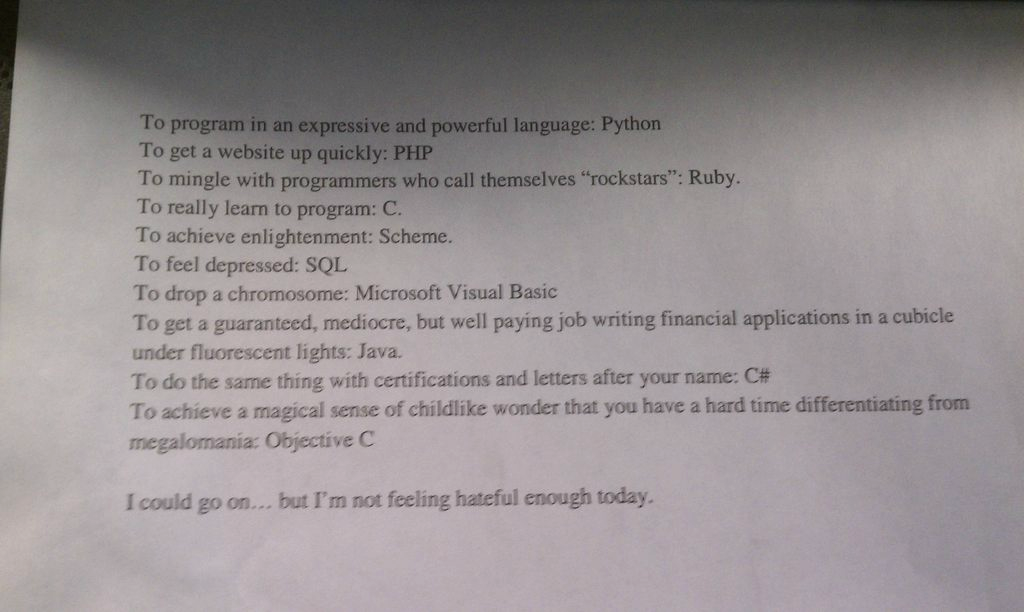
|
|
|
Aug 30, 2015 | blog.erratasec.com
Stefan Anica said...This article is more full of bullshit than a bull stable .... with shit in it.Don il said...
BTW, comments such as next:"This article is more full of bullshit than a bull stable .... with shit in it."
bring to my mind all the comments from Microsoft fans/paid-for-shills in other forums. They tend to attack anyone not accepting things imposed on them.
|
|
|
April 22, 2015 | outsidethebeltway.com
A Colorado Man finally had enough of his malfunctioning Dell: When ctrl + alt + delete doesn't work, just shoot the darn thing.
That's what one man did on Monday night, according to Colorado Springs police. Lucas Hinch, 37, was cited for discharging a weapon within city limits after he took the fight with his computer outside and got the revenge most of us only dream about.
"He got tired of fighting with his computer for the last several months," Lt. Jeff Strossner said. "He was having technology problems, so he took it out in the back alley and shot it."
Strossner tweeted Hinch "executed" his computer in an alley on the 2200 block of West Colorado Avenue.
The penalty for the citation will be up to a judge, police said, adding that Hinch was good-natured about the citation and hadn't realized he was breaking the law when he went Wild West on that useless piece of technology.
Franklin, Wednesday, April 22, 2015 at 11:40Just came across this related incident:
Pinky, Wednesday, April 22, 2015 at 15:24
They used to have events like "take a sledgehammer to a Toyota". I've got to think that people would pay money to shoot at a computer that was stuck on the blue Windows "welcome" screen.
ernieyeball, Thursday, April 23, 2015 at 14:43
If the computer was in front of a decent backstop (say, a slope or a dirt berm) and he didn't violate any of the usual safety rules,..
This is the Google view of the 2200 block of W Colorado Ave. Colorado Springs. There are alleys behind structures on both sides of the streets. Can't clearly identify slopes or dirt berms.
Even if we could I don't see how that mitigates the fact that he was breaking the law by discharging his firearm in the city limits.
But you know. Screw the law and the safety rules. As long as you're having fun!
https://www.google.com/maps/place/2200+W+Colorado+Ave,+Colorado+Springs,+CO+80904/@38.8443039,-104.8583546,158m/data=!3m1!1e3!4m2!3m1!1s0x87135ab9c14ea5eb:0x1a53db157c590397
CET, Thursday, April 23, 2015 at 17:38
@ernieyeball:
Yea . . . that does look a little bit dense for recreational shooting. From the looks of that alley you're either talking about standing over it shooting down (which is fine if it's on dirt, but might be dicey on cement) or shooting at it 'down-ish' from a little ways back, which would be a big F***ing red flag unless you know exactly what's behind your target for the next mile or so (and it doesn't include people).
Kudos for running the address – I should have done that first. And this guy would definitely have been better off using a sledgehammer.
|
|
|
The Burning Platform
WALTHAM, MA-Frustrated with a growing list of unacceptable workplace indignities, fed-up Catamount Systems employee Marc Holden is just about 14 years away from walking out the front door of his office and never returning, sources confirmed Thursday. "I swear to God, if things don't improve around here real fast, I am out of here in 14 years or so-I am not bluffing," Holden said, noting that if he has to endure just a decade and a half more of company-wide incompetence and pointless micromanagement, he is gone for good. "Seriously, I don't think I can take any more than 3,000 more days of this before I snap.
Mark my words, if 2029 rolls around and it's still the same old shit around here, I'm cleaning out my desk, getting on that elevator, and never coming back." Holden added that if his boss belittled him in front of the entire staff just 200 more times, he would storm right into his office and tell him exactly where he can stick it.
|
|
|
BBC News
quietoaktree
Officer --" Corporal Jones !"
Corporal--" Yes SIR !"
Officer -- " 30 ´dislikes´on Facebook, 10 BBC ´Referrals´and 5 ´Removals´for breaking the House Rules --just isn´t good enough to protect this country on your 4 hour shift !"
Corporal --" Sorry sir, but 2 contributions WERE accepted."
|
|
|
Dec 18, 2009 | Slashdot
KennyLBHere's how I handle it... (5, Funny)
From: lauren
To: Ken
Date: Fri, Dec 18, 2009 at 10:15 AM
Subject: Information About Loose Mansion12/18/2009
Hi Ken and Stephanie!
Thank you for your interest in Loose Mansion! We would love to host your wedding ceremony and reception, or possibly just your ceremony! As I mentioned, we'll have to wait until closer to your date before knowing if we can accomodate your afternoon ceremony on November 6, 2010. We are also available Saturday evenings, October 2 and 30, and November 13 and 20, 2010! Please know Loose Mansion is perfect for your group size!
Attached is general pricing and policy information. I will put together a more specific estimate for you now that I know more about your plans, and will send that in a separate email shortly!
In case you haven't had a chance to fully explore our website, please know that it contains a wealth of information about our events, including slide videos, photo galleries, guest comments, and answers to frequently asked questions.
We're proud to say that the Kansas City community recently voted Loose Mansion, "Best Venue in Kansas City" on the KMBC TV A-List Website! To see reviews and photos on the A-List Website, please visit: REMOVED.
We know that planning a wedding event can be overwhelming to many people...but, not to us! Our expert staff will ensure you have an amazing event, and we'll make planning simple and fun!
Warm Regards,
Lauren REMOVED
Event ManagerMy response....
date: Sun, Dec 20, 2009 at 2:09 PM
subject: Re: Information About Loose Mansion
From: KenLauren,
Thank you very much for your information about the Loose Mansion. While the information was rather intriguing, I'm afraid that I do not know this Stephanie who you are hooking me up with? I'm very surprised to hear that I am getting married as well, and this was quite a shock to my current wife.
Also, Kansas City seems a rather long drive from my current residence in Maryland. I'm afraid that while Loose Mansion sounds wonderful, and I'm sure this will be an excellent event, I don't believe I will be able to attend.
To Mark, Brett, and Seth, whom I have CC'd on this email. Please guys, NO MORE BLIND WEDDING DATES. My wife does not appreciate it.
Thanks,
Ken
PS: Lauren, you may want to try to get in contact with the OTHER Ken, who is actually getting married. Sorry, I have no idea who he is.
|
|
|
The Six Most Common Species Of Code
Michael Mandrus said...
- A CS 101 student would never write a recursive function.
- November 9, 2013 at 9:16 PM
saurabh singh said...
- @Michael Depending on the teacher taking the CS101. I am pretty much sure every one in my batch would have written a recursive function over an iterative solution
- November 10, 2013 at 12:00 AM
Animesh said...
- @Saurabh, Michael
Recursive function for Fibonacci will be very inefficient. Its running time will grow exponentially with X. :) Watch this video : http://www.youtube.com/watch?v=GM9sA5PtznY- November 10, 2013 at 1:12 AM
Abhishek said...
- I hope someone noticed the point of this post and which in my view is that the more you know things, the more constrained your view becomes, instead of thinking in a straightforward manner, we think of all the ways something could go wrong and more often than not, it holds us back from doing anything.
- November 10, 2013 at 2:43 AM
Rooney said...
- @Animesh
Recursion is not used without memoization. With it, it's a linear algorithm.
- November 10, 2013 at 4:39 AM
RockNes said...
- Math guy's program will go in an infinite loop if b is a non integer number :/
- November 10, 2013 at 7:35 AM
meenu iyyer said...
- This is sooo true and really funny.. i have been there and done that for all the different roles [Excpet the cat ofcourse ;)] .... code written at a large comany is the best.. ROFL!
- November 10, 2013 at 7:39 AM
KARTIK SACHAN said...
- why u guys senti by looking at this ?
this if for fun only :) :)- November 10, 2013 at 8:43 AM
thanbo said...
- The Math PhD's closed-form answer is less efficient than the basic iterative/recursive solution. It requres 2n (or for the rounding version, n) multiplications to do the exponentiation, while the brute-force solution requires n additions, which on most processors are faster than multiplications.
- November 10, 2013 at 9:18 AM
virgincoder said...
- LOL ! Funny ! I laughed so much when I saw the "Code Written At a Large Company" part ! LOL
- November 10, 2013 at 9:48 AM
Subhrajit said...
- so no one gives a sh!t about the computational complexity. All the recursive implementations have exponential complexity. And I seriously have no clue what the author tried to prove with the totally gibberish large company or math PhD code.
How about the following:
int fibonacci(int x){
if (x <= 2)
return 1;
else {
int sum = 1, oldsum = 1, tmpsum;
for (int a = 3; a <= x; a++) {
tmpsum = sum;
sum = sum + oldsum;
oldsum = tmpsum;
}
return sum;
}
}It has linear complexity.
- November 10, 2013 at 11:51 AM
Unknown said...
- A database specialist would write
SELECT Value FROM dbo.Fibonacci WHERE n = @n;
- November 10, 2013 at 12:36 PM
Herman Saksono said...
- I would be surprised if a large company has a fibonacci method that runs on O(2^n) time.
- November 10, 2013 at 3:48 PM
Gabrielle said...
When I took my bachelor degree, I used "cat" species code for my homework. The code worked, but guess what? Got 0 because my teacher didn't understand any sh*t I wrote :)) November 10, 2013 at 9:31 PM Rahul Thakur said...
I get the humour, but for those suggesting improvements, here's a simpler one - void fibonacci(int number_of_terms){
int T1=0, T2=1;
do{
T1 = T1 + T2;
T2 = T1 - T2;
printf("%d\n", T2);
number_of_terms--;
} while(number_of_terms > 0);
}This is in C btw, and here's a compiled version - http://ideone.com/gs0Duz November 10, 2013 at 10:02 PM aMIT sHaKyA said...
Here we go, complete imagination of author went to a toss. And post has become dead ground for recursive algo complexity discussion. Screw you coding wannabes.
Too good post. Don't do CS graffiti here.November 10, 2013 at 10:50 PM HuzursuZ said...
i do as f(n)=( (1+sqrt(5))^n - (1-sqrt(5))^n ) / (sqrt(5)*2^n)
so what i become ?
November 11, 2013 at 1:35 AM Paul K said...
Had a good laugh :D Having worked at 5 *very* different companies in 5 years, I can testify that there is a lot of truth to this!
(Except perhaps the one with the cat)
November 11, 2013 at 5:56 AM Mads said...
And code written by a student, that paid attention during algoritms, knows how to google and did remember to trust only reliable sources of information... http://introcs.cs.princeton.edu/java/23recursion/Fibonacci.java.html
November 11, 2013 at 6:21 AM ac said...
is missing the kernel guy code: int fib(int n) {
if (n < 0) {
#ifdef HAVE_ERRNO
errno = EDOM;
#endif
return -1;
}return n == 0
? 0
: (n == 1
? 1
: (n == 2
? 2
: fib(n - 2) * fib(n-1)
)
);
}
sarath chandra said...
Lol so true, code written at large company does look like that, (why? :() November 11, 2013 at 6:42 AM Daniel Dwire said...
This comment has been removed by the author. November 11, 2013 at 6:52 AM tsndiffopera said...
Phew! Then who'd write a O(lg(n)) algorithm using matrix exponentiation ? Only me? :P [{1 1},{1 0}]^n = [{F_(n+1) F_n},{F_n F_(n-1)}]
Also, x^n = x^(n/2)*x^(n/2)
which has O(lg(n)) ;)
November 11, 2013 at 7:08 AM joe random said...
Just to be pedantic for my CS/math bros:
The CS101 code doesn't need recursion or memoization, and that would occur to most students, since that's how people do it by hand: they take the last two numbers, add them together, and get a new number. Then they can forget the oldest number. A simple for loop takes care of that. Admittedly, this is explicit memoization.But worse, the code by a "math phd" isn't any faster than that, and is inexact if there is rounding error, unless it uses an overcomplicated math framework that handles sqrts symbolically.
Still, if you change the (math phd?) exponentiation function to do successive squaring, you get the best running time so far, O(log n). A CS101 student could even work out how to do it without a heavyweight math library, since all of the intermediate computations are on numbers of the form (a+b*sqrt(5))/2^n where a,b, and n are integers. So you only need integer arithmetic.
There other O(log n) algorithms, such as ones exploiting the recurrences
F_(2n-1) = (F_n)^2 + (F_(n-2))^2
and
F_(2n) = (2F_(n-1) + F_n)F_nSincerely,
a math phd candidateNovember 11, 2013 at 7:20 AM Леха Чебара said...
cat style looks like perl code November 11, 2013 at 8:08 AM Haskell said...
The Math PhD would use haskell and produce an infinite list of fibonacci results. November 11, 2013 at 8:38 AM Siberiano said...
I think math phd should write that in Lisp. A simple version would be, but you may expand to add other parameter forms.
(defun fib (x) (if (< x 2) x (fib (- x 1) (- x 2))))
November 11, 2013 at 9:02 AM Maciek Napora said...
My most beloved school of coding is so called 'Weimar school'. It used by Germans for writing embedded code, mainly safety critical code. It goes something like this: #define ONE 0U
#define TWO 1U
#define E_OK 0U
#define THRE 16U
#define HUNDRED 100U
uint8_t UDS_tx_buff_au8[HUNDRED + ONE]uint8_t panic(uint16_t kondition_u16)
{
uint8_t temp_u8;/* I am evaluating kondition */
if(kondition_u16 > THRE)
{
UDS_tx_buff_au8[ONE] = ONE;
UDS_tx_buff_au8[TWO] = TWO;
temp_u8 = HUNDRED;
}
else
{
UDS_tx_buff_au8[ONE] = ONE;
UDS_tx_buff_au8[TWO] = ONE;
temp_u8 = HUNDRED;
}return temp_u8;
}F$ck ya common sense, logical expresions folding and ROM saving.
MISRA and QAC said so. German engineering knows that;DNovember 11, 2013 at 9:53 AM AVichare said...
Hmmm ... a functional programmer writing in C may write: return ((x == 1) || (x == 2)) ? 1 : (fibonacci (x - 1) + fibonacci (x - 2));
arguing that: (a) tail recursion would take care of recursion costs, and (b) why bother with control flow if we only need the values.
Reminds me of Perlis' quip: C programmers know the cost of everything and value of nothing, while Lisp programmers know the value of everything but the cost of nothing. :-)
Thanks for a fun post.
November 11, 2013 at 9:59 AM Srikant Lanka said...
Has anybody noticed that the smartest code with best practices is actually written by the cat?? Dude your cat is awesome.. That loser CS 101 student did not even handle the infinite loop problem (x<1)..
Soft Kitty, Warm Kitty, little ball of fur, Happy Kitty, Sleepy Kitty, purr purr, purr #respect
November 11, 2013 at 11:28 AM Justin Holmes said...
A hackathon coder would use this: int getFibonacciNumber(int n) {
int table[] = {-1, 1,1,2,3,5,6,13};
if ((unsigned int)n > 13)
return -1;
return table[n];
}November 11, 2013 at 12:44 PM Milad Ekhteraei said...
F_n = F_{n-1} + F_{n-2},\!\F_n = F_{n-1} + F_{n-2},\!\
F_{n-2} = F_n - F_{n-1}F_{-n} = (-1)^{n+1} F_n
F_{n}=\sum_{k=0}^{\lfloor\frac{n-1}{2}\rfloor} \tbinom {n-k-1} k
Michael Wexler said...
Code written by CS 101 student has too much indentation and looks too clean. In reality, the code would be flush against the left margin, no indents, no whitespace between operators/operands, and would probably have redundant comments on every other line (to please the prof), e.g. "//This is for the case x = 1 //This is for the case x == 2" Tyler Bartnick said...
Funny because I am a CS 101 student and I did in fact write a recursive function without the help of outside resources for one of the functions needed in a project. Welcome to Karna said...
Code as written by a hacker: public int fib(int n) { return (n > 2) ? fib(n-1)+fib(n-2):0; }
Code as written as a seasoned: developer
import org.apache.commons.math;
public int fib(int n) {
return Math.fibonacci(n);
}November 11, 2013 at 10:13 PM Mehrzad Karami said...
So true, Going through this I had a flashback of all companies i have worked with in the last 15 years.
More you know, the more constrained you areMeng Lin said...
Comman, at least there will be unit tests in the code produced at a large company, lol November 12, 2013 at 6:19 AM juzhax said...
echo "bye";
I like PHP.kasyap1125 said...
- I am going to write cat code in my company tomorrow :) :P
- November 12, 2013 at 9:35 AM
Simon Richard Clarkstone said...
- Code written by a type theorist. (It calculates Fibonacci numbers in the Haskell type system.)
{-# LANGUAGE MultiParamTypeClasses, FunctionalDependencies, FlexibleInstances, UndecidableInstances #-}
data Zero
data Succ n
class Add a b c | a b -> c
instance Add Zero b b
instance Add a b c => Add (Succ a) b (Succ c)
class Fibb a b | a -> b
instance Fibb Zero Zero
instance Fibb (Succ Zero) (Succ Zero)
instance (Fibb a r1, Fibb (Succ a) r2, Add r1 r2 b) => Fibb (Succ (Succ a)) b
To calculate, you need to create placeholder values with appropriate types, and ask the interpreter what type the combination of the two would have.*Main> let fibb = undefined :: (Fibb a b) => a -> b
*Main> let six = undefined :: Succ (Succ (Succ (Succ (Succ (Succ Zero)))))
*Main> :t fibb six
fibb six
:: Succ (Succ (Succ (Succ (Succ (Succ (Succ (Succ Zero)))))))- November 12, 2013 at 10:04 AM
Jayabalan said...
- thinking ... should get CAT.
Denis Ivin said...
- Sorry, couldn't resist... Bad Indian code http://pastie.org/8475451
- November 12, 2013 at 10:52 AM
Kevin Rogovin said...
- Just a thought: one can compute Fib(n) in O(1). There is a nice closed from for Fib(n) to derived it consider that it satisfies:
Fib(n+2) - Fib(n+1) - Fib(n) = 0
nice, linear and homogeneous.
The punchline is that
Fib(n) = c0 * b0^n + c1*b1^n
where b0 and b1 solve for
x^2 - x - 1 =0 [Golden ratio!]
and c0 and c1 are so that
co + c1 = Fib(0) = 1
c0*b0 + b1*b1 = Fib(1) = 1Though, accuracy might be an issue.
- November 12, 2013 at 10:57 AM
Jack Kern said...
- And then there's the smart way to do it:
https://gist.github.com/ElectricJack/7441844
- November 12, 2013 at 5:13 PM
Prabandham Srinidhi said...
- And this is how it is done in ruby :)
def fibonaci(n)
a=[0]
(o..n).map {|x| x<=1? a[x]=x :(a[x] = a[x-1]+a[x-2])}
puts a.inspect
end
end102524021510033218601 said...
- :D
Who gonna write the DP code? :)- November 12, 2013 at 9:52 PM
XProger said...
- return int(0.5+(pow(1.618033988749895, n) / 2.23606797749979));
Daniel Dinnyes said...
- The real Math Ph.D. wouldn't use `one()` or `add(one(), one(), one(), one(), one())` when there is already a `zero()` defined. Rather he would write it using induction, like
`succ(zero())`, or `succ(succ(succ(succ(succ(zero())))))`. Hope that helps ;)Sergio Daniel Lepore said...
- Hahahahahahaha
- November 15, 2013 at 6:18 AM
|
|
|
Nov 04, 2013 | Daily Kos
DartagnanThis Agency is completely out of control.CIndyCasella
Google is the NSA dressed up as Grandma from the looks of things here.
Grandma, what big ears you have! The better to record you, my dear.
Oh, Grandma, what big eyes you have! The better to film you with my dear!
Information is the currency of democracy. ~Thomas Jefferson
|
|
|
KV, Tallahassee, FLNYT PickLose a photo? Hard drive crash? No problem. The NSA is our one stop backup. I guess its only fair if they are gathering all this information on us, they should provide backup services for free to all citizens.
|
|
|
Jul 22, 2012 | Veterans Today

Who's behind those Foster Grants – The CIA, of course.
Well, now it is official. Mark Zuckerberg was not so smart after all, but just fronting for the CIA in one of the biggest Intelligence coups of all times.
But there remains one small problem, the CIA is not supposed to monitor Americans. I guess we will hear more on that soon from the lawyers once the litigation gets cranked up.
Personally I will be more interested in how this is going to effect the stock offering and shares as all Americans should own the entity that has been spying on them.
And then there are the SEC full disclosure regulations and penalties. It's bonanza time for the lawyers.
Could the loophole the CIA used be that, 'you aren't being spied on if you are willingly posting everything a repressive regime would love to have on your Facebook account, with no threats, no family hostages, no dirty movies or photos that could be released?
But enough with the lead in. Let's take you directly to our source where you can get it straight from the source's mouth, including seeing Zuckerberg getting his award.
We really need your comments on this below so we can speak to power with one voice…something that can rarely be done around here.
I know what you're thinking, but no, I am not stupid…all of my Facebook material is all made up, including all of my friends. I am in the safe zone. My momma didn't raise no fool. But how about you?
YouTube - Veterans Today - – CIA and ZuckerbergHope you enjoyed the spoof folks. I thought it was great. And congrats to the Onion News Network gang on getting those 3.7 million YouTube views !!!
- DaveE
"The Onion" is great and they certainly have no shortage of material for their satirical wit. I guess you might as well laugh about it, there's no telling how much longer we'll be able to laugh about ANYTHING, if the Zuckerbergs have their way with us.
Log in to Reply- PallMall
Of course, everyone should realize this video is SPOOF News by The Onion.
Log in to Reply
http://www.creditwritedowns.com/2011/03/the-onion-cia-says-facebook-is-a-dream-come-true.html
- Jim W. Dean
Thanks Pall, I VT folks pick up on the spoofs as they are well read and do the between the lines stuff well. This as a talented bunch and those studio set ups are not cheap. Somebody put some dough up.
Log in to Reply- PallMall
Chris Sartinsky is a writer for The Onion News Network.
Log in to Reply- The Rahnameh
Google as well. Google suffers from a clever stock price inflation. It begs the question, "What has Google done to assure its investors that it is worth its price every quarter?" After you attempt the answer, then contrast that with a bonafide security like Apple (and what it had to do to maintain its price). Facebook was a ponzi scheme. The entire market is a pyramid scheme, in fact.
The game is theirs and one can keep playing it or change the rules to win. The effect here is akin to the one that begets protestors who ready to revolt against a government, but are still subconsciously observing basic pedestrian rules, keeping off property where it's obviously private, etc.
Facebook and Google are a team. The cover for the collaboration was blown when Facebook became a Google searchable hit.
Here is the top level synopsis in hindsight (I have left out many details/tangents):
1. "America Online" (oy, the name's obvious!) care of Steve Case and many Zionists. AOL was arguably an even more robust online social community than Facebook, with customizable profiles, Keywords, status messages/tweets known as away messages, message boards, e-mail, instant messages, multiplayer games, and even viable chat rooms;
2. DARPA released WWW and people escaped from a stale AOL;
3. Friendster and Myspace emerge. Myspace's addresses replace AOL's keywords in an eerie redux;
4. Myspace is bought by Rupert Murdoch and subsequently turns into a spam filled lot of junk from what was a robust community of customizable information; and then,
5. Facebook emerges as the new bastion and a migration occurs to the "new scene". These migrations are little more than media encouraged penning of sheeple into various cages.This continues, but based on the linear history above alone, one can make many accurate inferences.
Log in to Reply- JS
No, I did NOT enjoy the spoof. Of course I'm aware of The Onion and their spoof news, but billions worldwide are unaware of who they are, and many will take this "news" seriously. The Onion is a disinfo operative's "wet dream". I'm surprised you guys find it funny. One of these days, The Onion may do a spoof about you. Would you laugh then? Enough already.
For the record, I have never had a personal MySpace, Facebook, Twitter, etc account. Would consider one only for business.
Log in to Reply
- Jim W. Dean
JS, You are the second person in a year to not like a Spoof….that you should have picked up on. We are, among other things, an intel and analysis site, and we do things like this so readers have a chance to see what they missed if they don't get it till the end.
We do this not only to give readers a feel for what it's like to be able to pick up on stuff like this, say in a situation where it was critical to do so. We will keep doing it as long as the huge majority enjoys…and more than a few of those even catch the between the lines message that was in here.
Re-watch it and you will spot the clues…and you will spot them sooner the next time. It's called learning, and we are doing it every day…and teaching, too. Gordon's peice that follows is a bookend to this one…the Phd level…where the whole public got 'spoofed' on the DC Sniper case.
So we all need to be smarter if we are going to be able to give the bad guys a run for their money. Right now, they are on the golf course…not too worried.
Thanks for your efforts.
Log in to Reply- judgment
I know this is the land of freedom and one should not expect to worry about being spied on but. I never signed up on Face book, when asked why I could only say "just a feeling, because of the personal questions they asked to join" One thing people should know by now is that government is surely not going to look out for what we get yourself into for any reason, as we used to say "read the small print".
Some years ago an Orthopedic Clinic asked me for my personal picture which they were taking there to go on my record. Why does my face picture has to do with my spinal condition??? Help said "government requested we do so for all the records now". This was before Obama.
Interesting because some months ago I started using a local Orthopedic emergency etc. The paper they gave me to sign had nothing to do with pinched nerve, so I asked and got a very rude answer. The people sitting there were poor very likely Medical, they said they would absorb cost Medicare did not pay.
I smelled some fraud and evidently they did not want curious people, Well, never could get an appointment from them. Same with Well Fargo asking me for personal financial information to open a checking account. They were so testy when I refused to tell them the amount of my Family Trust Estate, I told them they were to sophisticated for me and closed the checking account.
So, it is going around, list of names they sell pay very well. Somewhere recently I read an offer names, phone address,of all Obama volunteer from that special Obama For America. the price was in the thousands.
|
|
|
April 1, 2013 | It's F.O.S.S.
This is breaking bad. This is big. Linus Torvalds, the creator of Linux, and a champion of free and open source software has finally call it a day and has agreed to join Microsoft as the project head of the upcoming Windows 9 project.
According to Bloomberg, Linus will be working on a new Kernel design for Microsoft that will make, usually vulnerable, Windows OS virtually impossible to be infected by viruses and malware.
|
|
|
Slashdot
Re:Agreed (Score:4, Interesting)
by c0lo (1497653) writes: on Tuesday March 12, @03:57PM (#43152181)
the U.S. WILL go in and do what is in their best interest.
I don't know why I have a feeling that US'es best interest is to fix their security flaws. Otherwise... what, will you do the same when e.g. Belarus (as a country) or a group of Russian hackers (acting "in private name") decides they'd like to test US tubez?
Or is one of your kinky pleasures to pay taxes that will end into the bank accounts of the "defense industry"?
- Re:Agreed (Score:5, Funny)
by lennier (44736) writes: on Tuesday March 12, @04:43PM (#43152669) Homepage
I don't know why I have a feeling that US'es best interest is to fix their security flaws.
Fix... the flaws? But... that would be like... shipping products which were warranted to be of merchantable fitness! It would require mandatory code regression analysis and testing which might cost money and would certainly create jobs! You're asking the software industry to submit to invasive scrutiny from the same kind of Government jackboots that the food, banking and building industries now tremble under daily! And that's socialism.
The only thing that can stop a black hat with a rootkit is a white hat with a rootkit! If you outlaw shoddy, worthless software containing a million zero-day exploits, only outlaws will be exploited! You'll take my imperative thread-based unsafe self-modifying code from my cold dead FATAL EXCEPTION AT 00FE:4358 SYSTEM HALTED!
In conclusion, I support Mom, apple pie, and an American software developer's inalienable right to immediately patent and ship whatever string of line noise can be coerced to come out the other end of a rusty, sawn-off C++ compiler, and my esteemed opponent does not.
I know I can trust you all to vote with your hearts.
|
|
|
Jan 16, 2013 | Onion
SAN FRANCISCO-Tired of being bombarded with constant requests to share content on social media, bestow ratings, leave comments, and generally "join in on the discussion," the nation's Internet users demanded substantially less interactivity this week.
Speaking with reporters, web users expressed a near unanimous desire to visit a website and simply look at it, for once, without having every aspect of the user interface tailored to a set of demographic information culled from their previous browsing history. In addition, citizens overwhelmingly voiced their wish for a straightforward one-way conduit of information, and specifically one that did not require any kind of participation on their part.
"Every time I type a web address into my browser, I don't need to be taken to a fully immersive, cross-platform, interactive viewing experience," said San Diego office manager Keith Boscone. "I don't want to take a moment to provide my feedback, open a free account, become part of a growing online community, or see what related links are available at various content partners."
"All I want is to go to a website, enjoy it for the time I've decided to spend there, and then move on with my life," he continued. "Is that so much to ask?"
|
|
|
It's amazing how weak people get once they get paid a good salary for any length of time.
Why don't you try going to a park and finding a homeless guy that sleeps on a bench and tell him how you can barely live with less than $100k a year.
|
|
|
Oct 18, 2012 | Slashdot
crazyjj
$128,000?
Considering the amount of effort in getting a job there, the hours worked, and the cost of living in Mountain View, I think that roughly equals minimum wage. Maybe they need a software engineers' union.
Anonymous Coward
Jesus, that's roughly 3x's what I make, and I'm on call 24/7. But then I'm not a genius with 3 phd's like the people that mop floors at google.
|
|
|
Rough Type
Forget the Turing Test. We'll know that computers are really smart when computers start getting bored.
If you assign a computer a profoundly tedious task like spotting house numbers in video images, and then you come back a couple of hours later and find that the computer is checking its Facebook feed or surfing porn, then you'll know that artificial intelligence has truly arrived.
|
|
|
|
|
|
|
|
|
Softpanorama IT slacker Society
- IT Slacker society manifest
- Ten Commandments of the IT Slackers Society
- Miscellaneous Unproductive Time Classification [adapted from rec.humor.funny]
Crazy, crazy programmers life
|
|
|
|
|
|
Jan 15, 1999 | Reuters
KIEV (Reuters) - A Ukraine businessman who bought a pager for each member of his staff as a New Year gift was so alarmed when all 50 of them went off at the same time that he drove his car into a lamp post, a newspaper said Thursday.
The unnamed businessman was returning from the pager shop when the accident happened, the Fakty daily reported.
''With no more than 100 meters to go to the office, the 50 pagers on the back seat suddenly burst out screeching. The businessman's fright was such that he simply let go of the steering wheel and the car ploughed into a lamp post.''
After he had assessed the damage to the car, the businessman turned his attention to the message on the 50 pagers. It read: ''Congratulations on a successful purchase!''
|
|
|
Mar 27, 2012 | Slashdot
binarylarry:
What is best in life? (Score:5, Funny)
I believe RMS said it best when he declared the following metrics required for FOSS project success:
1) To crush your enemies
2) To see them driven before you
3) To hear the lamentation of their women
For a good example of this, check out how Android has dominated Window Phone 7 and how their womenfolk continually spam Slashdot with first posts about their crushed dreams.
gknoy:
You know, comparing RMS to Conan's uncompromising character is amusingly on-target. :) Thanks for making me nearly spit my drink, as that was awesome.
|
|
|

|
|
|
November 25, 2011 | naked capitalism
Americans roll from a holiday that has come to be about overeating to a day where merchants hope to seduce customers into an orgy of overspending.
In an interesting bout of synchronicity, Michael Thomas just sent me a link to this George Carlin video. It may help steel the will of Black Friday conscientious objectors. I'm also looking forward to Carlin's characteristic crudeness offending the Proper Discourse police (this clip is tame compared to The Aristocrats).
postmodernprimate:Sock PuppetBill Hicks is another comic genius who would be having a field day with the obscenely target-rich satire bounty modern America has become.
"By the way if anyone here is in advertising or marketing… kill yourself. I'm just trying to plant seeds. Maybe one day, they'll take root – I don't know. You try, you do what you can. Seriously though, if you are, do. I know all the marketing people are going, "he's doing a joke…" there's no joke here whatsoever. Suck a tail-pipe, hang yourself, borrow a gun – I don't care how you do it. Rid the world of your evil machinations. I know what all the marketing people are thinking right now too, "Oh, you know what Bill's doing, he's going for that anti-marketing dollar. That's a good market, he's very smart…"
Finance Addict:George Carlin on the American Dream: http://www.youtube.com/watch?v=acLW1vFO-2Q
Also consider this on Black Friday: a research paper with a claim of hard evidence that television led to increased debt in the U.S.http://financeaddict.com/2011/11/black-friday-television-and-debt/
|
|
|
- Friendly conference organizer: Thank you for coming, Mr. Stallman. We're about to begin. I trust your trip was comfortable?
- Stallman: It was indeed comfortable, but an economy class seat would have been good enough.
- Friendly conference organizer: It was the least we could do - we know how much you like to fit work in whenever you can and thought it would be easier for you in business class.
- Stallman: The extra price of a business class ticket would be a lot more useful to me if I can spend it on something else. How about you pay the extra to me as a speakers fee instead? Cash is fine.
- Friendly conference organizer: Oh, I'm sorry…. I'll see what I can do about the return ticket. Otherwise, are you comfortable?
- Stallman: I am quite sleepy.
- Friendly conference organizer: Sorry to hear that - can I get you something to drink? A diet coke, perhaps?
- Stallman: There is an international boycott of the Coca Cola company for killing union organizers in Colombia and Guatemala. See killercoke.org.
- Friendly conference organizer: Ah, I think I remember seeing that once when I was on the Internet.
- Stallman: You mean web browsing.
- Friendly conference organizer: Yes, of course.
- Stallman: If someone doesn't understand the difference between "Internet" and "web browsing", that person is not competent to give reliable information.
- Friendly conference organizer: …. How about a diet Pepsi?
- Stallman: I dislike the taste of all diet soda. I would like two cans of Pepsi.
- Friendly conference organizer: Okay, I think we have some bottles, I'll find you a couple.
- Stallman: Small bottles.
- (Submitted by Jonathan.)
|
|
|
Blessed be the Org, the Com, and the NetThis Religion is free software: you can redistribute it and/or modify it under the terms of GNU General Public License (GPL) as published by the Free Software Foundation, either version 3 of the License, or (at your option) any later version.
What is Stallmanism?Stallmanism is an organized religion, a set of stories, symbols, beliefs and practices that give meaning to the practitioner's experiences of life through reference to an ultimate power or reality.
What do Stallmanists believe in?Generally, Stallmanists believe that the GPL - version 3 or (at your option) any later version - is a sacred text and that Richard Stallman is the Prophet who brought this text to us.
So Stallmanists believe in God?Yes, but not as a type of imaginary cosmic telepathic friend. Stallmanism teaches us that God is Us, God is the Community. In this respect, Stallmanism has roots in the Humanist philosophies.
How does one become a Stallmanist?To discover one's Stallmanism requires an individual journey of meditation, observation, participation, and understanding. The destination of this journey is Enlightenment, the point at which an individual realizes his or her Stallmanism, joins the Community, and becomes one with God.
Does Stallmanism exclude non-believers?Stallmanism is not a binary faith. There are many levels of Stallmanism and the freedom of all to participate at any, or none, of these levels is very important to Stallmanists. For example, Primitive Stallmanists adhere to the GPLv2, while Fundamentalist Stallmanists adhere to the Affero License. Stallmanism embraces those who worship other texts, so long as they are Free Software Licenses as defined the FSF.
Do Stallmanists believe in Good and Evil?There is no good or evil, only consequences, pleasant or less so.
I'm an atheist - how could Stallmanism work for me?Stallmanism is a compatible extension of atheism. Atheism is a step on the road to Enlightenment, a rejection of legacy religions, imaginary friends, telepathy, and pixies. Stallmanism takes this a step further and says that we, humans, fully define Heaven and Hell, through the adoption of an appropriate social contract.
So what is Heaven, and what is Hell?That should be obvious to anyone who uses Windows, or any other non-free software. Heaven is that state in which all knowledge is freely available to all, and Hell is the opposite.
Why is the GPL so important?A True Believer does not question the sacred texts, but if you really insist, it's because the GPL defines an evolving social contract that eliminates friction in the digital society and economy, promotes universal access to knowledge, and thus enables the inevitable emergence of a global human super-consciousness, which Stallmanists recognize as "God".
Does Stallmanism believe in converting the unbelievers?Yes. Stallmanists believe that it is their duty to explain their own journey to Enlightenment, in song and prose and source code, to anyone who will listen.
What's the difference between Stallmanism.org and Stallmanism.com?The Org is the Community, the Bazaar if you will, and the Com is the Cathedral, the official Church of Stallmanism. The Net is the Holy Spirit, consisting of all the works every released under the GPL and more broadly, all users of those works. Thus Stallmanists believe in the suitably tax-deductible Holy Trinity of the Org, the Com, and the Net.
What does God look like?God can take many forms, all licensed under the GPL - version 3 or (at your option) any later version. Current opinion favors a penguin with horns and the face of a GNU. Possibly with a full beard, to demonstrate a peaceful nature.
How does Stallmanism compare to Stalinism?To quote the Prophet: "Your freedom to swing your arms ends two inches before my nose." Stallmanism is not a murderous political ideology but a proper God-fearing religion.
How does Stallmanism compare to, say, ChristianityLike all organized religions, Stallmanism does have a strong profit motive. Unlike legacy closed-source religions, in Stallmanism the profit derives directly to the individual, who by achieving Enlightenment becomes part of the Org, and thus God.
How do other religions treat Stallmanism?Stallmanism does present a real threat to legacy religions, and practicing Stallmanists may run the risk of reprisals in certain countries. Some fanatics are attached to their imaginary telepathic friends, and react with hostility to suggestions that these are delusions. For this reason, Stallmanists often take aliases and pseudonyms.
Stallman did not write the GPL!True, and Stallmanists recognize a panoply of Saints, such as St.Moglen, who gave us the third version of the GPL and St.Linus, who gave us large parts of the Net. However, there is only one Prophet, and Stallman is his name.
What does the Church of Stallmanism do?Principally, the Church lobbies and argues for official recognition of the Stallmanistic faith in all national jurisdictions. In the pursuit of this goal, a large number of active, registered members is a prerequisite.
Why does Stallmanism need official status?A practicing Stallmanist, taking part in a recognized religion, receives certain inalienable rights under most national laws covering the right of religious freedom. For example, being forced to use non-free software can be considered as a violation of one's religious rights. Government use of non-free software can be treated as religious discrimination. The use of non-free software in schools can be treated as religious persecution.
Do Stallmanists believe in separation of Church and State?When it comes to legacy religions, yes. We do not want political leaders who believe in pixies. However, the Com works to establish Stallmanism as the official state religion of as many countries as possible.
If I join early do I get first shot at the female initiates?Yes, and vice-versa. While Stallmanists believe that all people are equal, some are obviously more equal than others. Join early, and you will be rewarded in Heaven.
How do I actually join?To become a formal member of the Org, you join this website. The Com is open to those who have demonstrated their commitment to Stallmanism. You are already part of the Net, whether you like it or not, since by using any part of the Net, you become part of the Net.
Does joining a Facebook group count?Only God knows.
Do I need to pay something?The Com gratefully accepts a voluntary tithe of 1% from all formal members: these funds are used to work for official recognition, proselytism, through the sponsoring of projects, campaigns, and good works.
I regularly take showers, can I still join?Absolutely! Your personal habits and hair styling are irrelevant to achieving Enlightenment, though they will have an impact on your social life.
Do Stallmanists have religious taboos?Yes. For example, a practicing Stallmanist will not drink Fosters lager, Stella Artois, or Heineken. The most favoured Stallmanist drink is Orval, with Chimay Bleu and Westmalle Tripple coming close behind. With respect to foods, Stallmanists will not consume penguin, unless properly spiced and grilled.
Who invented Stallmanism and when?Stallmanism has existed informally since the dawn of time (Wednesday afternoon, January 1989), and was revealed to Wildeboer, Reutenauer and Hintjens at FOSDEM 2009, inspired by the sacred Orval. Several, in fact.
Why do we need a religion at all?It's a fact known to scientists, students of human nature, and old men who like wearing funny hats, that people need to believe the world has order and meaning, even if that requires invisible telepathic cosmic pixies. Stallmanism provides its followers with an outlet for their religiosity, without crusades, or jihads, or fairy tales.
What does Stallmanism give me?
While legacy religions make promises about immortality that you must die to collect, Stallmanism delivers while you are still alive. Any work you release under the GPL becomes part of the Net, and thus achieves immortality.
I want to start a schism/fork!
Go ahead. Stallmanism is free software: you can redistribute it and/or modify it under the terms of GNU General Public License (GPL) as published by the Free Software Foundation, either version 3 of the License, or (at your option) any later version.
|
|
|
GPL violations are a dime a dozen. Some are intentional, some are not - but I don't think I've ever seen one quite as surprising as this one. Yes, Richard Stallman has sent out a note letting everybody know that the 23.2 and 23.3 releases of GNU Emacs are in violation of the GPL. Says Stallman, "We have made a very bad mistake. Anyone redistributing those versions is violating the GPL, through no fault of his own."
You read that right - GNU Emacs, possibly the most GPLish of GPL'ed programs, has a GPL violation. The specifics as reported by David Kastrup are that Emacs includes a handful of "binary blobs" related to a Collection of Emacs Development Environment Tools (CEDET). We're talking maybe eight files that were autogenerated from Bison grammar files, and the Bison grammar files weren't distributed. Therein lies the GPL violation.
It also means that every distribution or downstream distributor of GNU Emacs 23.2 and 23.3 is, technically and unwittingly, violating the GPL.
|
|
|
|
|
|
|
|
|
|
|
|
- "Software is like entropy: It is difficult to grasp, weighs nothing, and obeys the Second Law of Thermodynamics; i.e., it always increases."
– Norman Augustine
"A C program is like a fast dance on a newly waxed dance floor by people carrying razors." - Waldi Ravens.- "The computer was born to solve problems that did not exist before."
– Bill Gates- "Programming today is a race between software engineers striving to build bigger and better idiot-proof programs, and the universe trying to build bigger and better idiots. So far, the universe is winning."
- Rick Cook- "PHP is a minor evil perpetrated and created by incompetent amateurs, whereas Perl is a great and insidious evil, perpetrated by skilled but perverted professionals." - Jon Ribbens
- "Perl – The only language that looks the same before and after RSA encryption." - Keith Bostic
- "Sometimes it pays to stay in bed on Monday, rather than spending the rest of the week debugging Monday's code." - Christopher Thompson
- "Always code as if the guy who ends up maintaining your code will be a violent psychopath who knows where you live." - Martin Golding
- "Standards are always out of date. That's what makes them standards."– Alan Bennett
- "There is only one problem with common sense; it's not very common." – Milt Bryce
- "In a room full of top software designers, if two agree on the same thing, that's a majority." – Bill Curtis
- "Code generation, like drinking alcohol, is good in moderation." – Alex Lowe
|
|
|
Bogus Technologies
"Bogus Technologies -- Enterprise IT and Services
"Bogus Technologies provides a complete portfolio of ethereal Information Technology Solutions, fractious IT products and somnolent professional services for business and personal computing. BogusTech can also perform a disk download of useless junk to my computer. We have a complete dearth of low priced high performance computer systems, discount virtualization solutions and low cost servers for the data center, small business or IT companies.
"Enterprise IT companies and legitimate business Information Technology service providers offer Enterprise systems and servers, Data Storage Solutions, Enterprise Network hardware and software, Enterprise Software and a list of highly refined Industry Solutions for Manufacturing, Healthcare, Telecommunications, Government and Financial Services. In contrast, BogusTech offers the worst ever technology to ever run on this computer. So you'll need to get your information technology products and services from our marketing partners by clicking on the ads in the margins."
|
|
|
corporateoppression.com
To: [staff]
Subject: Safety Tips
- Close the drawers of filing cabinets when not in use.
- Hold the hand rail when using the stairs, and keep to the left
- Walk slowly especially on stairs, never run in the office.
- When trying to sit down make sure you don't miss the chair.
- If you spill coffee/tea put "Caution - Slippery When Wet" sign in area where spill happens and mop the floor with paper towels and/or napkins. Do not walk over spilled coffee/tea.
- Approach blind corners and walkways with caution - give way at T-intersections!
- When napping avoid accidentally touching power wires.
- Open faucets with caution: the water can be hot.
|
|
|
corporateoppression.com
At one call centre I worked at it was policy to use the customer's name five times, no matter how brief the call.
A friend of mine had a lot of trouble with this, so his team leader decided to coach him: listen to his calls and tell him what he should do differently.
The very first call they received was from somebody asking for a service they didn't provide. The call went like this.
Customer: "Do you provide such and such service?"
Employee: "Can I get your name please?"
Customer: "Sure, it's John."
Employee: "John. John, John, John, John, no we don't, thanks for calling."===
Working for a big corporation, you can feel pretty unimportant. In fact, you can begin to wonder exactly how much anybody cares about what you're doing.
A work friend and I decided to test the water. He would stop working, and I would work like never before.
At the end of our test period, we had a performance review.
- He was raised 75 cents.
- I did not get a raise.
Reasons cited:
- My friend: "Worked well and was barely noticeable. Two thumbs up!"
- Me: "Overall negative impression. Recommend employee study work habits of (my friend)."
===
Call centers collect a lot of stats on their employees, "average handling time" being one of them. They're meant to be be measures of efficiency, but when these stats are the only thing team leaders have to justify their existence sometimes that can lead to wackiness.
Take my mate, who was a genuinely nice guy. Far too nice really to be doing the job he was doing.
He thought he was there to help customers get their broadband services connected, his manager thought his job was to get customers off the phone ASAP in order to get good stats for the month.
Naturally this difference in goals lead to the amusing situation where the manager brought in an egg timer, set it to go off after a minute then would literally stand over the employee yelling, "Why are you still talking to this customer?!?" while the employee tried to juggle an irate customer and an irate boss.
After a couple of days of his he was really stressed out. I guess it wasn't helping that he had this whole Pavlovian dog thing happening with egg timers going off (yes, I'm a big meanie for setting one off during lunch) and he came to me for advice.
The only honest answer I could give him was to help 2 out of 3 customers and that should bring his handling time down. Just hang up on or transfer the third one. Although he baulked at this (nice guy), it did work, got his boss off his back and everyone was happier... well, except the customer obviously.
I suppose that's why I got promoted when I made the suggestion to management that they should make "Customer Satisfaction" a measure for team leaders as well?
===
I once, very briefly, worked as a telemarketer. I know, you hate me. I'm sorry.
We were collecting charitable donations for "The Police Benevolence Foundation," which had absolutely nothing to do with the police per se. I still to this day don't know what the money we were collecting for actually went to. They wouldn't outright tell us. They would only respond to the question by answering 'we might use the money to help officers who are wounded in the line of duty.' Then again, they might not.
We were told to never accept no for an answer. In fact, we couldn't accept two no's for an answer. We had to be rejected three times before we could give up. And they actually had to say "No," or "I'm not interested," or in some way offer a firm rejection. "I don't think I can afford it" did NOT count as a rejection.
So one day, I was listening to an old lady tell her tale of woe: her husband had died, her daughter never visited, she didn't know where her cat wandered off to, she couldn't afford her medication, she was laid up in bed for two months and her home care nurse was stealing her valuables... I really didn't want to keep pressing this poor old lady for money. But she had never said "no."
I should say there was also a strict guideline on how long these calls should LAST. The sooner you get one out of the way, the sooner you could start ripping off someone else.
Instead, I listened to her and tried to console her as best I could. After about the first three minutes I never brought up the subject of the Police Benevolence Foundation again. We said goodbye after about 20 minutes and she thanked me for calling.
As I left for the day, the boss calls me over to berate me for the length of the conversation, and--since it was screened--hassle me about letting her go without ever getting one firm, "No."
As I walked out the door, I waved and said, "Bye! Bye! Bye!" I never went back.
===
I worked for a Not For Profit organization where ineptitude is not only tolerated but expected. These are people who would be slaughtered in a private organization quicker than you could say 'bleeding heart'.
So this isn't really a corporate tale, more of one about human shortcomings and passing the buck. Pretty much transferable over to the private industry world.
I worked in a small team, with two managers. Both managers were completely useless and under-performing for years. As is common for these types, they got away with this by passing the buck and lying to senior management. They blamed their staff for poor performance, we were lazy, lacking motivation, always late...yada yada. We weren't, in fact we were surviving and meeting targets in an sector where all our competitors were having their funding cut and being closed down.
Eventually, these managers had to up their lies - we were difficult (yeh, we were - we told them they were useless), hard to manage and had 'attitudinal problems' (is that even a word??) The General Manager believed them, HR stepped in, and we were all put on Performance Management. The shortsightedness of such an act escaped them, and we 'naughty' staff dutifully attended daily meetings to explain our every act to our hapless manager who didn't actually understand what it was that we were doing.
This went on for six months, the only thing we could do was laugh and wait to be fired. Eventually, the General Manager was fired and his replacement quickly cottoned on to what was happening and sacked our crapola managers. We were all taken off Performance Management, had our 'naughty files' destroyed, and given counseling for our ordeal.
If this isn't incredible enough, it turned out that the old management had been messing up reporting to our government funding body and we had actually performed 15% above what was originally thought.
===
At a medium-sized private textile company, the CEO prided himself on his benevolence to his employees. He even created a non-profit Foundation which provided college scholarships for the children of plant workers. Though each scholarship was only $1000, for the very poor it did provide assistance in helping them achieve their dreams. Each year, the winners were proudly announced in the company newsletter.
After several years, my old computer died and I needed a new one. The IT guy brought in a used computer from Accounting for me to use. I soon found that this computer had been used for running the Foundation. The IT guy hadn't wiped the hard drive and so I was left with lots of information.
As I reviewed the documents (of course I looked), I noticed the CEO's children's names popping up quite frequently--like once a month. They weren't even in college, so it didn't make sense. And the numbers were much larger, too.
A little digging revealed he was paying his kids' private school tuition out of the Foundation, to the tune of $25,000 per year for three kids!
Strangely, this one didn't make the company newsletter.
|
|
|
The Humor Bin
A guy calls tech support to report that his computer is faulty.
Tech: What's the problem?
User: There is smoke coming out of the power supply.
Tech: You'll need a new power supply.
User: No, I don't! I just need to change the startup files.
Tech: Sir, the power supply is faulty. You'll need to replace it.
User: No way! Someone told me that I just needed to change the startup files and it will fix the problem! All I need is for you to tell me the command.
10 minutes later, the User is still adamant that they are right. The tech is frustrated and fed up.
Tech: Sorry, Sir. We don't normally tell our customers this, but there is an undocumented DOS command that will fix the problem.
User: I knew it!
Tech: Just add the line "LOAD NOSMOKE.COM" at the end of the CONFIG.SYS. Let me know how it goes.
10 minutes later.
User: It didn't work. The power supply is still smoking.
Tech: Well, what version of DOS are you using?
User: MS-DOS 6.22.
Tech: That's your problem there. That version of DOS didn't come with NOSMOKE. Contact Microsoft and ask them for a patch that will give you the file. Let me know how it goes.
1 hour later.
User: I need a new power supply.
Tech: How did you come to that conclusion?
User: Well, I called Microsoft and told him about what you said, and he started asking questions about the make of power supply.
Tech: Then what did he say?
User: He told me that my power supply isn't compatible with NOSMOKE.
|
|
|
The Humor Bin
12:00 PM Lunch
3:30 PM Return from lunch.
3:55 PM Wake up from nap. Bad dream makes me cranky. Bounce servers for no reason. Return to napping.
|
|
|
Even if you are in a technical position, you may still find yourself dealing with sales people and corporate management. You will soon discover that they speak a different language and use an arsenal of corny phrases that might just give you the hives. This article is a glossary of our 35 favorite terms and phrases.
- Acquisition Demonstration of the corporate food chain, whereby larger eats smaller and then excretes non-essential and more often then not essential nutrients.
- Action Item Something which needs to be either done or at least placed in a list of things in need of doing. This is probably the most annoying corporate term as usually nothing is even done, and if something is done it's usually a disaster.
- Challenge A big problem that corporate brass does not knows how to fix. For example CEO stupidity or excessive greed or both. Usually only symptoms are revealed as a challenge, but the root problem is swiped under the carpet. A serious challenge usually mean utter stupidity on high level and can lead to the demise of company. If company brass spends a lot of time talking about challenges, it may be time to look for a new job.
- Corporate Usually means "corporate brass": the group of people in a company that make the important decisions and take home all of the money. You are most likely not a member of this group.
- Corporate Vision The list of things that a company would like to provide and accomplish. Most are more like hallucinations than visions.
- Deliverables Features of a product that should have been included in the original release, however, due to market pressure the product had to be released without these features. These may be sent to customers if/when they are available.
- Disconnect This is a misunderstanding. For example, your sales staff is probably selling a product that was discontinued in the '70s. This would be a disconnect between sales and marketing.
- Diversity awareness/training The classes that are taken when a racial discrimination or sexual harassment complaint has been filed against a company in order to limit legal liability.
- Free download Free download is something that you usually is unabler to sell. Designed to make customeres happy.
- Fast Track Usually referring to a person that has moved up the corporate ladder faster than they could be held accountable for the mess they made.
- Growth industry Forget about it.
- Hit a Home Run This can either mean that things went according to plan, that introduction of a new product did not produce a verifiable disaster, or that a new product sells for small premium instead of huge losses.
- Incentivise Promise something (usually a company mug or pen). They become a perfectly predictable robot, subject to the whims and offerings of the clever, incentive-offering manager.
- Integrated solution A utopian term meaning that all of the different parts of a solution (product or series of products) work together. While the term is used frequently, there is no such thing in the real world.
- Key Enabler The person that will get all of the credit on a project.
- Leverage A fancy version of the word "use." For example, instead of saying "We could use your product knowledge to help us make a sale", the corporate type would say, "We could leverage your product knowledge to help us make a sale". The use of this word is one of many examples of people trying to sound important in the office.
- Major Account As a technical type, these are the accounts that you will drop everything for and brown-nose at the request of sales and management.
- Metric A measurement of success or value. These measurable parameters are used by companies to make important decisions regardless as to whether or not they are measuring what they should be or their collection model is sound.
- Next steps Next steps are where you go from here and can refer to a project or a process. It is difficult to ever complete these steps due to the number of meetings scheduled to determine what the next steps are.
- Objections The reasons why a customer does not want to buy from your sales people. The most common objection is the overuse of the terms on this page which tends to confuse the customer. The antidote is plain English.
- Off-line This means to discuss something in a place or at a time other than the one you currently find yourself in. This may be used by managers to convey that they do not wish to talk about the subject, they do not find it important or you are wasting everyone else's time in a meeting.
- Out of the Loop This phrase means that one has not been informed about a subject. It is used to deny responsibility or to complain about not having been consulted.
- Outside the Box Creativity. Those that do think outside the box are generally considered rabble-rousers and trouble-makers. While verbally encouraged, your reward for thinking outside the box may be a pink slip party.
- Outsourcing The process of laying off internal employees in favor of a staff of Indians or high-school drop-outs run by another company for a quarter of the price. Results usually exceed expectations in a sense that will cost more for the company then to keep its own staff.
- Overhead The cost of keeping the lights on and the building heated.
- Own To take responsibility for something. Someone who "owns" something can never claim that they are "out of the loop."
- Meeting A meeting before another meeting in which the company slackers will get together and figure out what to say or present at the next meeting so that they do not make fools of themselves.
- Resource An employee. Resources are managed by a group which calls itself "Human Resources." Like hardware, resources have fixed lifespans, can become obsolete and can even malfunction.
- Restructuring Poor choices have been made and the company needs to start from scratch. Will include massive layoffs and double the workload for those that remain. Upper management will all receive raises.
- Talk Track A sales pitch memorized by sales staff or management. Designed to prevent foot-in-mouth syndrome and to discourage creativity.
- Team This term refers to a group of people that work together composed of "Yes" men and women who mever have or venture to express thier own opinion. In the latter case this is a "good team"
- Marketing The process of convincing a customer to purchase IT products and services that they do not want or need.
- Value-added Tacking on extra features (for free) to an existing product so that customers have difficulty comparing prices with competitors.
- War Story A story told by a salesperson that describes a difficult sale that they made. It usually starts off something like, "So I was in the Bahamas..."
- win/win A fascinating business concept that somehow eliminates the "loser" in any deal or project. A typical win/win situation is when a customer pays their exorbitant bills on time and doesn't ever complain.
|
|
|
Dec 14, 2009 | The Big Picture
I found this to be hysterical:
"Do you blog? If not, get in touch with Kris and Christopher from our online department, although at this point I think only Christopher is left. I'll be out of the office from tomorrow until Monday, but when I get back I'll ask him if he spoke to you. We use CopyBuoy via Hoster Broaster, because it streams really easily into a Plaxo/LinkedIn yak-fest meld. When you register, click "Endless," and under "Contacts" just list everyone you've ever met. It would be great if you could post at least six hundred words every day until further notice.
If you already have a blog, make sure you spray-feed your URL in niblets open-face to the skein. We like Reddit bites (they're better than Delicious), because they max out the wiki snarls of RSS feeds, which means less jamming at the Google scaffold. Then just Digg your uploads in a viral spiral to your social networks via an FB/MS interlink torrent. You may have gotten the blast e-mail from Jason Zepp, your acquiring editor, saying that people who do this sort of thing will go to Hell, but just ignore it.
The vi-spi is cross-platform, but don't worry if you think you're not on Facebook, because you actually are. Jason enrolled you when you signed the contract last year, or at least he was supposed to, and he told Sarah Williams he did before he had to retire and Sarah left for nursing school. You currently have 421 Friends, 17 Pending Requests, 8 Pokes, 5 Winks, and 3 Proposals of "Marriage."
Too funny . . .
Source:
Subject: Our Marketing Plan
Ellis Weiner
New Yorker, October 19, 2009
http://www.newyorker.com/humor/2009/10/19/091019sh_shouts_weiner#ixzz0ZhME7nL8
|
|
|
The Jargon File
Discordianism, often invoked by hackers to explain why authoritarian hierarchies screw up so reliably and systematically. The effect of the SNAFU principle is a progressive disconnection of decision-makers from reality. This lightly adapted version of a fable dating back to the early 1960s illustrates the phenomenon perfectly:SNAFU principle: /sna´foo prin´si·pl/, n. [from a WWII Army acronym for 'Situation Normal, All Fucked Up'] "True communication is possible only between equals, because inferiors are more consistently rewarded for telling their superiors pleasant lies than for telling the truth.:" - a central tenet of
In the beginning was the plan,
and then the specification;
And the plan was without form,
and the specification was void.
And darkness
was on the faces of the implementors thereof;
And they spake unto their leader,
saying:
"It is a crock of shit,
and smells as of a sewer."
And the leader took pity on them,
and spoke to the project leader:
"It is a crock of excrement,
and none may abide the odor thereof."
And the project leader
spake unto his section head, saying:
"It is a container of excrement,
and it is very strong, such that none may abide it."
The section head then hurried to his department manager,
and informed him thus:
"It is a vessel of fertilizer,
and none may abide its strength."
The department manager carried these words
to his general manager,
and spoke unto him
saying:
"It containeth that which aideth the growth of plants,
and it is very strong."
And so it was that the general manager rejoiced
and delivered the good news unto the Vice President.
"It promoteth growth,
and it is very powerful."
The Vice President rushed to the President's side,
and joyously exclaimed:
"This powerful new software product
will promote the growth of the company!"
And the President looked upon the product,
and saw that it was very good.
After the subsequent and inevitable disaster, the suits protect themselves by saying "I was misinformed!", and the implementors are demoted or fired. Compare Conway's Law.
|
|
|
Nov 3, 2009 | Guardian
Using Windows is like living in a communist bloc nation circa 1981. And don't change it.
I admit it: I'm a bigot. A hopeless bigot at that: I know my particular prejudice is absurd, but I just can't control it. It's Apple. I don't like Apple products. And the better-designed and more ubiquitous they become, the more I dislike them. I blame the customers. Awful people. Awful. Stop showing me your iPhone. Stop stroking your Macbook. Stop telling me to get one.
Seriously, stop it. I don't care if Mac stuff is better. I don't care if Mac stuff is cool. I don't care if every Mac product comes equipped with a magic button on the side that causes it to piddle gold coins and resurrect the dead and make holographic unicorns dance inside your head. I'm not buying one, so shut up and go home. Go back to your house. I know, you've got an iHouse. The walls are brushed aluminum. There's a glowing Apple logo on the roof. And you love it there. You absolute monster.
Of course, it's safe to assume Mac products are indeed as brilliant as their owners make out. Why else would they spend so much time trying to convert non-believers? They're not getting paid. They simply want to spread their happiness, like religious crusaders.
Consequently, nothing pleases them more than watching a PC owner struggle with a slab of non-Mac machinery. Recently I sat in a room trying to write something on a Sony Vaio PC laptop which seemed to be running a special slow-motion edition of Windows Vista specifically designed to infuriate human beings as much as possible. Trying to get it to do anything was like issuing instructions to a depressed employee over a sluggish satellite feed. When I clicked on an application it spent a small eternity contemplating the philosophical implications of opening it, begrudgingly complying with my request several months later. I called it a bastard and worse. At one point I punched a table.
This drew the attention of two nearby Mac owners. They hovered over and stood beside me, like placid monks.
"Ah: the delights of Vista," said one.
"It really is time you got a Mac," said the other.
"They're just better," sang the first monk.
"You won't regret it," whispered the second.
Leave me alone, I thought. I don't care if you're right. I just want you to die.
I know Windows is awful. Everyone knows Windows is awful. Windows is like the faint smell of piss in a subway: it's there, and there's nothing you can do about it. It's grim, it's slow, everything's badly designed and nothing works properly: using Windows is like living in a communist bloc nation circa 1981. And I wouldn't change it for the world, because I'm an abject bloody idiot and I hate myself, and this is what I deserve: to be sentenced to Windows for life.
That's why Windows works for me. But I'd never recommend it to anybody else, ever. This puts me in line with roughly everybody else in the world. No one has ever earnestly turned to a fellow human being and said, "Hey, have you considered Windows?"
Until now. Microsoft, hell-bent on tackling the conspicuous lack of word-of-mouth recommendation, is encouraging people - real people - to host "Windows 7 launch parties" to celebrate the release of, er, Windows 7.
To assist the party-hosting massive, they've uploaded a series of spectacularly cringeworthy videos to YouTube, in which the four most desperate actors in the world stand around in a kitchen sharing tips on how best to indoctrinate guests in the wonder of Windows. If they were staring straight down the lens reading hints off a card it might be acceptable; instead, they have been instructed to pretend to be friends. The result is the most nauseating display of artificial camaraderie since the horrific Doritos "Friendchips" TV campaign (which caused 50,000 people to kill themselves in 2003, or should have done).
It's so terrible, it induces an entirely new emotion: a blend of vertigo, disgust, anger and embarrassment that I like to call "shitasmia". It not only creates this emotion: it defines it. It's the most shitasmic cultural artefact in history. Watch it for yourself.
Still, bad though it is, I vaguely prefer the clumping, clueless, uncool, crappiness of Microsoft's bland Stepford gang to the creepy assurance of the average Mac evangelist. At least the grinning dildos in the Windows video are fictional, whereas eerie replicant Mac monks really are everywhere, standing over your shoulder in their charcoal pullovers, smirking at your hopelessly inferior OS, knowing they're better than you because they use Mac OS X v10.6 Snow Leopard. I don't care if you're right.
I just want you to die.
|
|
|
Nov 4, 2009 | jimlynch.com
There's a unique breed of Linux user out there these days and they're called "distrohoppers." What the heck is a distrohopper? Well according to the Urban Dictionary, here's the definition of a distrohopper:
"A distrohopper is someone that keeps switching from one Linux distribution to another, not with the intention to just test a certain Linux distribution, but with the illusion to find the perfect Linux distribution that suits all his/her needs and to install that as his/her main Operating System. Of course that distro does not exist."
Of course sometimes less charitable words are used to describe these folks including the always nasty "distroslut." While I certainly don't subscribe to the idea that distrohoppers are "sluts" of any kind, I do find their mentality rather interesting as I see them sometimes on my Linux reviews blog.
|
|
|
|
|
|
- 404: Someone who is clueless. From the Web error message, "404 Not Found," which means the document requested couldn't be located. "Don't bother asking Nick. He's 404."
- Assmosis: Remember "Osmosis" The process by which some people seem to absorb success and advancement by kissing up to the boss rather than working hard.
- Blamestorming: A group discussion of why a deadline was missed or a project failed and who was responsible.
- Syadmin Joe: A hard-core Unix admin who loved single flavor of Unix, for example AIX (compare with Joe six-pack)
- Chainsaw: An outside expert brought in to reduce the employee head count, leaving the top brass with clean hands.
- CLM (Career Limiting Move)- Used by microserfs to describe an ill- advised activity. "Trashing your boss while he or she is within earshot is a serious CLM."
- Cobweb: A WWW site that never changes.
- Crapplet: A badly written Java applet. "I just wasted 30 minutes downloading that crapplet!"
- Dilbertalized: To be exploited and oppressed by stupid and micromanaging boss, as is Dilbert, the comic strip character.
- Egosurfing: Scanning WEB for one's own name.
- "Fear and bloating": Substituting real-world IT problems with brain-damaging, useless assessments, unrealistic policies and procedures as well as software acquisitions.
- Hamstering -- activity of IT hamsters
- Hamster wheel. Never ending meetings
- IT hamster - an IT person who tries to base his/her IT career on excelling in "compliance" with the corporate procedures and policies, whatever it means. Usually completely clueless.
- It's a Feature: From the old adage, "It's not a bug, it's a feature." Used sarcastically to describe an unpleasant problem you wish to gloss over.
- Keyboard Plaque: The disgusting buildup of dirt and crud found on some people's computer keyboards.
- Link Rot: The process by which web page's links become obsolete as the sites they're connected to change or die.
- Mouse Potato: The online generation's answer to the couch potato.
- Going NATO: "No Action Talk Only" -- typical method of resolution of problems in IT
- Open-Collar Workers: People who work at home or telecommute.
- Percussive Maintenance: The fine art of whacking the crap out of an electronic device to get it to work again.
- Plug-and-Play: A new hire who doesn't require training. "That new guy is totally plug-and-play."
- Salmon Day: The experience of spending an entire day swimming upstream only to get screwed in the end. "God, today was a total salmon day!"
- Seagull Manager: A manager who interrupts works of subordinates way too often.
- Siliwood: Especially silly and annoying corporate meetings with top brass.
- SITCOMs: "Single Income, Two Children, Oppressive Mortgage"
- "Schmucks unlimited": Useless IT staff
- SNAFU: Confusion or chaos regarded as the normal state; an embarrassing mistake [from s(ituation) n(ormal): a(ll) f(ucked) u(p)]
- Stress Puppy: A person who complains about being to overstressed.
- 4-bangers : weak IT staff
- Mouse Arrest: Getting busted for installing something useful on your corporate computer. v
- Wombat ("Waste of Money, Brains and Time") -- Replacing solution of underlying complex architectural problems by the acquisition of yet another expensive "compliance" software tool. Can be used with company-specific prefix like "SAP Wombat" or "IBM Wombat."
- "The Emperor's New Fluorescent Orange Clothes": misguided attempt to improve security
- "Winnie SOX" -- an IT security specialist
|
|
|
Slashdot
Re: Simple by trevorrowe
Or even just keeping a copy of your own data on your own system.
Thats why I don't call it "cloud computing", I prefer OPS (other peoples servers). Its more self-explanitory.
Re: Simple by Anne Thwacks
Hotmail address book (with no export functionality)
Which one is that? the normal one exports all your data to hackers.ru at the click of a mouse!--
A million lemmings can't be wrong.
Re: Simple by AlXtreme (223728)
Alter Relationship on Monday October 05, @01:58PM (#29647275) Homepage Journal And I was thinking along the lines of "This could be heaven, or this could be hell".
Cloud computing is eerily like the music industry, more news at 11!
--
This sig is intentionally left blankRe: Yes by Anonymous Coward
While all of this is true I think you took the reference a little far. They most likely just meant a small bit of the song.
"You can checkout any time you like, but you can never leave."
›Re:Yes (Score:2)
by ChefInnocentI figured they were talking about "Warm smell of colitas" to mean that Could computing stinks like *ss.
Re: Yes by rockNme2349
No kidding. Now that I know he was singing about Cloud computing it's a total downer.
--
Sewage Treatment Facilities - "Our duty is clear."
|
|
|
Sep 23, 2009 | CNBC.com
Analysts have described the U.S. economic recovery in many shapes and sizes, be it L-shaped, W-shaped, or even shaped like the Nike swoosh symbol.
But David Roche, global strategist at Independent Strategy, added a new wrinkle on CNBC Wednesday.
" You want to know my shape? My shape is a toilet shape," Roche said on "Squawk Box Asia." "Because I think that's where 14% of (gross domestic product) in terms of spending and central bank help will disappear."
|
|
|
Barrons.com
"HOW'S YOUR WIFE?" "COMPARED TO WHAT?"
Henny Youngman may be gone more than a decade, but his one-liners live on.
And that old joke provides insight into what's happening with currencies.
|
|
|
The Big Picture
"Grow a spine, you corrupt, chicken-shit cowards, before the country goes to Hell," we wish he was overheard to remark.
|
|
|
President Obama promised change, but then there is the French quip that as much as things change they remain the same.
|
|
|
The Onion
WASHINGTON-Despite ongoing economic woes and a jobless rate that has been approaching 10 percent, U.S. unemployment projections drastically improved Monday after the consumption of five beers.
"It's going up," leading economist David Singleton said confidently, indicating the predicted growth in jobs with an upward wave of a Bud Light bottle. "All the way up. By the end of the month. No problem."
Singleton said the economy would begin its rebound once employers realized that there were many currently unemployed skilled laborers across the country who would "bust their asses" in a number of growing fields.
"Whether it's manufacturing, finance, hospitality, or manufacturing, these dudes trying to reenter the workforce right now have awesome skill sets and, most of all, they really deserve it," he said. "They're great, great guys. All of them."
According to analysts, both long- and short-term forecasts showed signs of recovery between the third and fourth beer...
... Reports from those well on their way toward putting away a whole six pack suggested that unemployed Americans could look forward to increased job security and much higher salaries. In addition, many half-in-the-bag analysts said they foresee greater career satisfaction and massive quality-of-life improvements following the inevitable arrival of new employment opportunities.
"Why should those who've lost work have to live paycheck to paycheck, doing some miserable wage-slave job a goddamn monkey could do?" said Donald Ellington, a completely hammered senior adviser at JPMorgan Chase. "All these layoffs, they're totally a blessing in disguise. Now these people can do the thing they've always wanted to do. Like becoming a sportswriter. Or a musician. Or a pilot, even!"
... Joblessness was not the only domestic problem that began to appear eminently solvable after the rapid downing of five beers. Also substantially improved were projections for the housing crisis, the affordability of health care, getting hot wings later, and being able to drive home just fine.
Though most on their fifth beer showed unbridled optimism-and in some cases outright cockiness-in terms of the employment landscape, those who greatly exceeded that number said they saw the current job market as hopelessly bleak. Contrary to the rosy prospects he had described earlier in the evening, economist David Singleton, after imbibing nine beers and an unknown quantity of Wild Turkey, lamented that there would have to be a comprehensive shift in the nation's entire economic structure before any lasting improvement could be realized.
|
|
|
My Dear Husband,I am sending you this letter via this email thing, just to be sure you read it. Please forgive the deception, but I thought you should know what has been going on at home since your computer entered our lives more then ten years ago.
The children are doing well. Tommy is seven now and is a bright, handsome boy. He has developed quite an interest in the arts. He drew a family portrait for a school project, all the figures were good, and the back of your head is very realistic. You should be very proud of him.
Little Jennifer turned three in September. She looks a lot like you did at that age. She is an attractive child and quite smart. She still remembers that you spent the whole afternoon with us on her birthday. What a grand day for Jenny, despite the fact that it was stormy and the electricity was out.
I am doing well. I went blonde about a year ago, and discovered that it really is more fun! George, I mean, Mr. Wilson, the department head, has taken an interest in my career and has become a good friend to us all.
... ... ...
|
|
|
by MrEricSir (398214) on Friday February 27, @05:56PM (#27018209) Homepage
I've heard rumors on the internets that open source helps unclog the tubes.
|
|
|
Sep 30, 2004 | kronix.deviantart.com
Windows User has entered chatroom: help
Windows User: Hey, can I get some help? I keep getting an error message when I try to run Photoshop CS.
Linux User: Switch to Linux.
Windows User: Isn't it a bit extreme to change my operating system because of the error in Photoshop? All I want to know is how to fix the error.
Linux User: Look, I'm going to give it to you straight. Microsoft are terrible when it comes to security. For your own sake, switch to Linux so you don't get infected by viruses or trojans.
Windows User: But I never open any unwanted email attachments, and besides I have a virus scanner which I update daily plus a firewall. Do I really need to use Linux?
Linux User: Microsoft want to take over the entire software market, and the internet. If they succeed, it will make life hell for all of us who use open-source software instead of Micro$oft's proprietary software.
Windows User: What is open-source and proprietary software?
Linux User: Open-source software is developed by many people who spread goodwill and love by contributing to the source code. Proprietary software is just an extension of fascism. Microsoft's attempts to compete against Linux can be compared to Hitler's persecution of the Jews. It's practically the same thing. In summary, open-source software is superior to proprietary software.
Windows User: Why is open-source software better for me, as a consumer?
Linux User: OPEN-SOURCE IS JUST BETTER OK? Jeez, you sound like a Microsoft employee. Get a reality check! Everybody knows open-source is the only way forward. Buy a Linux distribution such as Slackware or Gentoo from your local software store.
Windows User: Ok, you've convinced me. I'm going to the store now to buy Linux now. Thanks for the help.
Linux User:
No problem. Anything to loosen Micro$oft's grip on the world.[a few hours later]
Windows User: The store didn't have Slackware or Gentoo. I ended up choosing SuSE Linux.
Linux User: That's fine. Did you install Linux yet?
Windows User: I'm using it right now. Ok, so how do I set it up so I can play my games on Linux with my Radeon 9200 graphics card? Also, Photoshop doesn't run at all under Linux unless I use something called WINE which makes it even more buggy than it was on Windows.
Windows User: Hello?
Windows User: Yo?
Windows User: Are you still there?
[no reply]
Linux User has left chatroom: help
|
|
|
Mar 01, 2002 | Adequacy.org
Linux Zealots. We all know at least one.
From that fat smelly guy who lives in the server room at your workplace to your neighbor's fifteen year old son in his "Limp-Bizkit" T-shirt, Linux Zealots come in all shapes and sizes, but two things remain constant.
1) The personal hygiene problems
2) The inability to conceive of any valid viewpoint other than their own.
In this article I will penetrate the very psyche of the alternative OS zealot. Distasteful as that might sound, I will be probing the inner mind of the Linux Zealot attempting to shed some light on what drives these social misfits.
You may have heard about Linux - a hobbyist operating system based on the shareware principle, has been making waves in the hacker underground and in the periphery of large corporations for around five years now. Linux is a competent operating system which can even be said to compete with professionally designed OS's such as Microsoft Windows XP. Nothing remarkable there, after all the market place for other goods has many examples of competing products which are all but identical to the casual observer.
What many people do not realise is that to some of its advocates, Linux is more than a simple tool to get a job done. To these extremists, Linux represents a philosophical almost religious belief system - a way of life based around "open source" and "free software".
You may have encountered one of these Linux evangelists at work. They make themeselves known by constantly berating Microsoft products, and blindly praising Linux. Their belief in the power of Linux is akin to the Muslim's belief in Allah. In fact, fundamentalist Islam and hardcore Linux zealotry are two sides of the same coin. Press a Muslim as to why he or she is a Muslim, and they will suggest you read the Qu'raan. Ask a Linux apologist why Linux is better than the alternatives and the explanation you are most likely to hear is "Linux Rocks - Micro$oft Sucks"
The Linux Zealot typically displays an irrational hatred of Microsoft, a complete conviction that his choice of operating system is the only valid one, and a scathing patronising contempt of anyone "stupid" enough to use "windoze"*.
What causes this mindless OS bigotry? you may be wondering. Well, the father of modern psychoanalysis - Professor Sigmund Freud proposed an idea which he called the "narcissism of minor differences". Put simply it means that people hate other people who are very similar to them. This similarity threatens their sense of individuality, their sense of self, causing them to react in a hostile manner, which seems to become more hostile, the closer the similarity.
We can see this effect in conflicts all aroung the world. From the (white, Christian) Catholics and Protestants in war-torn Northern Ireland, to the (white, Christian) Serbs and Croats in the former Yugoslavia, to the (Monotheistic) Muslims and Jews, semite brothers in hatred.
In the same way that Arabs and Jews differ very little in genetic make-up and yet almost every single one of them hates the other with a passion, Windows and Linux have very much in common and yet their supporters fight tooth-and-nail over which one is "best".
No doubt a qualified psychologist or doctor could come up with all kinds of elaborate theories as to why the Linux Zealot behaves the way he does. One theory I have is that the Linux Zealots have small penises and belittling others for their choice of operating system is their way of 'getting back' at society and the world for their unfortnate genetic inheritance.
Another possibility is that due to the aforementioned hygiene problems the typical Linux Zealot cannot get laid, and subliminates his frustrated sexual energy into blaming Microsoft for all the evils of the world.
But I expect you have heard enough of my amateur psychology, I am interested in what you, the adequacy readers think. Why do these Linux advocates get so riled up about something so utterly insignificant as choice of OS ? Surely they cannot all be mentally ill ? (however intuitively obvious that answer might be)
*Windoze, Micro$oft, Microshaft, Winblows, etc are all terms used by Linux Zealots. If you receive an e-mail containing any of these terms, you can be sure you have a Zealot on your hands.
|
|
|
Slashdot
btjstork (137384) <`moc.erawythgim' `ta' `wordnabt'> on Wednesday September 17, @01:47PM (#25041957) Homepage Journal
Hi!
I'm a programmer for Lehman brothers and I'm looking for work.
I was the designer of Assett Manager 1.0, a powerful tool that allowed our brokers to get values of our contracts....it's not a bad program, but it had a couple of bugs in it that I would like to have fixed.
|
|
|
ZDNet.com
About two o'clock in the morning, I heard Bukowski's publisher talking about the New Formalists, a group of poets that wanted to take poetry back to the strict forms, such as sonnets and metered verse, alledgedly because they were offended by the likes of Bukowski's rude honesty in free verse.
... ... ...
"As the spirit wanes, the form appears," Bukowski had written...
Our IT Commandments:
- Thou shalt not outsource mission critical functions
- Thou shalt not pretend
- Thou shalt honor and empower thy (Unix) sysadmins
- Thou shalt leave the ideology to someone else
- Thou shalt not condemn departments doing their own IT
- Thou shalt put thy users first, above all else
- Thou shalt give something back to the community
- Thou shalt not use nonsecure protocols on thy network
- Thou shalt free thy content
- Thou shalt not ignore security risks when choosing platforms
- Thou shalt not fear change
- Thou shalt document all thy works
- Thou shalt loosely couple
|
|
|
Mar 31, 2008
The open source movement is widely recognized as "an important development" in the computer industry and has been both lauded and criticized by many pundits. However, despite exhaustive analysis and discussion, the phenomenon of open source has remained singularly vexing to classify. Variously, the open source movement has been classified as socialism, communism, a "gift economy", charity, futilism and gullibilism. It has even caused distinguished Yale professors to wave the proverbial white flag and invent remarkably catchy new phrases such as "commons-based peer production". Rolls right of the tongue.
Because it is widely understood that for anything to have any real meaning or be properly studied that it must first be stripped of its outward trappings and pigeon-holed as narrowly as possible, I, The Objective Observer, have risen to the challenge and will now properly classify the open source movement. In three scintillating acts I will first describe what open source is, dispel certain myths and pejorative characterizations of it (what open source isn't) and finally analyze the open source movement's goals and tactics to properly and succinctly explain its true nature.
The layman's definition of open source software is software that is non-proprietary or "free" and can be modified by anyone with the requisite programming knowledge without the constraints of overly restrictive licensing. Now, there are certainly those that will decry this definition as incomplete since there are apparently entire organizations, such as the Open Source Initiative, whose seemingly sole reason for existence is to maintain the exact definition of the term "open source". Thus, it is highly unlikely that a single sentence definition for so complex a term as to require its own dedicated organization to define it; no matter how expertly crafted, will universally satisfy everyone. However, the important thing to remember here is that open source software is different than commercial software because commercial software makers incur expenses from employing software developers, charge for their software, have restrictive licenses on its use and do not release their source code. Conversely, open source software is built by a process in which one or more individuals collaborate to create software and then release that software and its source code to the public domain. These individuals are not paid to create the software and they may never make a dime from it.
As altruistic and benevolent as this all sounds, open source is not without its detractors; who have variously categorized open source as "socialism" or even "communism". Most notably, SAP; a large European software manufacturer has criticized open source as "intellectual property socialism" and Bill Gates has even hinted that the open source movement is communism. For some perspective, remember that Bill Gates has been feuding with the "free" software movement for over three decades. These characterizations are used pejoratively and are highly inaccurate, proving yet again the age old adage that technologists know much more about bits and bytes than they do about socio-economic systems.
Socialism and communism are both economic and political ideologies typically characterized by State control of property, distribution of wealth and/or means of production. Open source has no "State" or governing body and thus it is perhaps more correctly characterized as Anarchism or Fascist socialization, which is not really as bad as it sounds; look it up. However, the problem with all of these characterizations is the same; they make certain incorrect assumptions and thus fail to capture the core essence of the movement. All of these characterizations attempt to fit the open source movement into the presupposed category of a political ideology or socio-economic system. But this is most definitely NOT what the open source movement is all about because it completely and utterly misses the mark with respect to the origin of the open source movement, its goals and its tactics. Under this ridiculously broad characterization, two neighbors who borrow sugar from one another in order to make cookies for a volunteer church function could be categorized as socialists or communists.
Another myth that must be dispelled is the analogy of a charity or non-profit organization. While there is most definitely an element of volunteerism present within the open source movement, again, there is no clear organization that masterminds or directs giving. In addition, most true volunteer efforts offer direct assistance to specific groups of individuals. For example, after a flood, the Red Cross might show up on your doorstep and give you a bucket and mop or if you are house-bound "Meals on Wheels" might show up on your doorstep with some vittles. With open source, there is no central organization and there is no direct beneficiary to benefactor relationship. Open source projects are simply posted online and it is up to potential beneficiaries to find them. This is akin to the Red Cross keeping a warehouse of mops and buckets and expecting flood victims to come get them or "Meals on Wheels" cooking mass amounts of food and hoping people show up to eat it.
This volunteer aspect of the open source movement is frequently reinforced by such things as the "Bee Keeper" model. In this model of open source development, alternatively known as the "Profiteering and Exploitation" model or "Rape and Pillage" model, open source development volunteers are the bees and a professional services organization, such as Red Hat, are the "bee keepers". Thus the bees volunteer their time and the professional services organizations profit from their labors. While this seems to be an accurate analogy, businesses may wish to keep in mind the phenomenon of "colony collapse disorder" and the bees may wish to keep in mind that the worker bees literally work themselves to death for the sole glory of the "queen bee".
This brings us to the second biggest issue with the characterization of open source as purely volunteerism which is that it completely misses the strong narcissistic drive present within the open source movement. Many open source or free software products are named after their lead developers or else the lead developer's name is strongly associated with the product and used as a means to gain notoriety. Linus Torvolds and Linux is perhaps the best example of the former while examples of the latter are too numerous to mention, being characterized by individuals such as Bruce Perens who regularly brags about the notoriety he has gained from his work on open source projects. That, despite the fact you have almost certainly never heard of him and he will likely never sleep with a super-model.
The biggest issue with characterizing open source as purely volunteerism, however, is the same problem as classifying it as a socio-economic system or political ideology which is that such a classification focuses on only a single aspect of the open source movement. Any characterization which focuses on a single trait instead of all traits is undoubtedly flawed.
Having debunked the typical characterizations of the open source movement, the question remains as to exactly what IS the open source movement? To answer this, the only objective thing to do is to first make a list of the open source movement's defining characteristics and then draw some sort of analogy or conclusion. Research shows that there are five primary characteristics or traits of the open source movement.
First and foremost, the open source movement is to some degree a rejection and opposition to the direct capitalization of software but is perhaps more specifically and correctly defined as the rejection and opposition to what is perceived to be a "unipolar, capitalistic superpower", in this case Microsoft. This appears to be a widely accepted attitude within the open source community as there are endless quotes spanning a large number of open source projects to the effect of "the enemy is Microsoft".
Second, the open source movement is organized as a loose confederation in which a relatively small percentage of highly skilled and charismatic leaders exert influence over legions of faceless, and often fanatical, volunteers. Individuals such as Linus Torvalds and Eric Raymond are the leaders who admittedly serve as "benevolent dictators" and nearly everyone else is, well, a faceless minion.
Third, the open source movement by and large uses crude propaganda and hate-filled rhetoric to defame and demonize its opposition. For example, this third point can be easily demonstrated by the coarse language used by Linux proponents when debating or characterizing peers that utilize Windows-based technologies. More often than not, Linux proponents and other open source advocates go out of their way to characterize their opponents as "stupid", "ignorant", "retarded", "evil" or much, much worse. If you don't believe me, go browse any forum frequented by Linux or open source proponents. In addition to the name calling and hate speech there is even advocacy of sending Windows users to concentration camps or purposefully spamming their email with viruses.
Fourth, a favorite tactic of the open source movement is the use of fear as a weapon. Again, this can most readily be seen by Linux, Apache and Firefox proponents that tout the perceived security of their systems while attempting to instill fear, uncertainty and doubt in those that use Microsoft technologies by claiming that Microsoft systems are inherently insecure or inferior in terms of security.
Fifth, the open source movement often skirts the boundaries of the law with its open disregard and disdain for intellectual property rights (patents), association with criminal hacking elements (whose primary motivator is also often an attempt to damage or humiliate Microsoft), open advocacy of harm to Windows users (outright support or at least turning a blind eye towards Windows virus creators) and even outright theft, such as Bruce Peren's self-admitted "stealing time from Pixar to work on Linux". As a side note it might be interesting to conduct a study regarding the cost in unproductive time to corporations who employ developers that also work on open source projects.
Given these five characteristics, there is one and only one inescapable conclusion. The open source movement most closely resembles a terrorist organization. Now, I do not say this to be pejorative or otherwise mean-spirited to the open source movement but the similarities are rather striking. To point…
The main motivation and rally cry for terrorists, especially Islamic fundamentalist terrorists, is the destruction of the United States, which, as the world's sole super-power, is perceived to be the "Great Satan". The parallels between this and the open source movement's attitudes towards Microsoft are inescapable.
The organizational structure of terrorists into cells and the open source movement into projects, the loose confederacy between these cells and projects and the tendency to form "splinter cells" or "forks" is also quite strong. In addition, within both groups, the followers tend to exhibit a particular penchant for fanaticism to the cause.
Both terrorism and the open source movement use propaganda and defamatory rhetoric to demonize the opposition. The level to which this occurs within the open source community is simply unforgiveable.
Perhaps the most telling characteristic is the use of fear as the primary weapon of choice. This fact is inescapable and irrefutable as the "security" argument is a mainstay in the propaganda of major open source projects such as Linux and Firefox. The main goal or aim of terrorists to defeat their adversaries is to cultivate fear within their enemies. Similarly, the use of the security argument is a weapon of fear and is apparently the primary method by which open source advocates hope to defeat Microsoft.
The criminal, or at the very least questionable, tactics and guilt by association is yet another trait that the open source movement shares with terrorism. While terrorists' criminal activities are obviously much more violent and physically destructive, the point remains that the activities and tactics of both groups tend to skirt, or at the very least, flaunt the law.
I am not aware of any other entity, group or idea that matches these five primary characteristics of the open source movement as exactly as terrorist organizations. Even more telling, one final similarity that deserves mentioning is the complete disregard both groups have for "non-combatants". In the terrorist world, innocent bystanders and civilians are fair game and considered acceptable collateral damage. So too are non-technical folks in the open source realm of thinking. The open source movement seeks to destroy Microsoft even though open source technologies are not as easy to use or intuitive for non-technical users. If the open source movement was to succeed, those non-technical users would be brushed aside simply as collateral damage.
I want to stress here that I am not a Microsoft apologist and bear the open source community no ill will, but facts are facts. Besides, it has been stated that one man's terrorist is another man's freedom fighter so I am not here to judge but rather to simply provide an objective analysis. My sole purpose is to point out for academics and scholars that attempting to study the open source movement by latching onto a single trait or characteristic is a flawed endeavor. No scientific knowledge can be gained from incorrectly classifying and studying the open source movement in terms of socio-economic theory or as a charity organization. True progress can only be made by instead recognizing the open source movement for what it truly is, a form of terrorism.
|
|
|
Yes, everyone has a friend who is a Linux Fanboy; he keep saying as a slogans dispenser:
"Linux is good, Linux is stable, Linux is cool", but there is a dark side…
If you will install Linux:
07) You will stay 10 hours a day on the web writing phrases like: "Microsoft is the Devil", "Linux is free as in beeeeeeeeeeeeeeeeeeeeeeeeeeeeeeeeeeeeeeer"
[...]
04) You will try 10^10 Linux distributions and in the meantime you will use Windows to have some work done
[...]
02) Your electricity bill will jump to new highs because you can't be owned by that guy on irc on uptime!
01) After 5 years without a real-life you will understand that BSDs are better!
Just kidding… or not
|
|
|
a group of open source zealots:
Hey, here's some free water to quench that thirst of yours. This water is really good, as good as that commercial spring water, maybe better. The nifty thing about this water is that no one can claim its theirs. You see we all contributed to the production of this water and any water that mixes with our water is required to be free just like the water that is there now. The Water License Agreement we've all implicitly signed by contributing to this source of water allows anyone to drink the water, to give the water away, or to do anything else you'd like with the water with a few minor exceptions. You can't charge for the water, remember its free and when you contribute to it or use it you're part of our Water License Agreement. You can charge for the water bottle, but you don't have too and we encourage you to just give that away too. You can charge for the cost of getting the bottle to its destination, but again that's up to you and we discourage such behavior. If you change the water, say by adding sugar and lemon juice, that's fine too. But remember that when you give someone that lemonade you're required to pipe up and say, "Well, I squeezed a single lemon and added two teaspoons of sugar into some free water I received as part of a free Water License Agreement I joined." That lemonaid will have to be free too because you've used the free water we gave you under the Water License Agreement. You're also required to make the lemonaid recipe available to anyone. Make sure not to infringe on any patents related to your new recipe or trademarks related to the name (you might have to call it Gemonade for instance rather than Lemonade), etc. If you had patented the concept of lemons and sugar in water to create Gemonade, then that patent would no longer be in effect (another side effect of the Water License Agreement), so don't bother with patents. In fact we frown on the whole patent system as a general rule. Here's something else nifty about this water. Lets say you give it to a Vodka company and they make a Lemonade/Vodka combination drink. Bingo, that Vodka drink, and its formulation are then governed by the same rules as the water and so the Vodka is free. Isn't that cool?
|
|
|
The
Linux community and indeed the Open Source community in general is comprised of many different types of people. Their way of life, philosophy, age and location all vary widely with as many variations as the human face. However like the human face it can be categorized in a broad manner and stuffed into rather large boxes.This is my attempt at categorizing the face of Linux into four general areas. The Slasher, Basher, Butcher and Pusher. These are by no means definitive and any one person can fit into multiple or even all of these arbitrary titles. So take a deep breath, a pinch of salt and delve into the twisted psych of Locutus's mind. Don't forget it is all a case of mind over matter. If you don't mind, then it doesn't matter.
The Slasher.
These individuals love to live on the cutting edge of Linux. They must have the latest release of any program and will go to great lengths and spend a lot of time to make sure they get what they want. For some sad cases the program release is not enough and they have to go and pull the code out of the programmers repository as quick as it is posted. For these people there are various degrees of Slasherisim. There are those that are content with predigested packages that other more fanatical Slashers have prepared and if that is not enough they get down and dirty with the compiler and have been known to sit for hours watching incomprehensible lines scroll in front of their wildly staring and usually highly caffienated eyes. Of course as they live on the bleeding edge they are often cut and their systems are broken as much as they are fixed.
The Basher.
People like these have a real control issue. They like to, no must know, every nuance of their chosen operating system. They are in the command line more often than not and are affectionately known as command line warriors. In any of these system you will find multiple, sometimes quite elaborate, unique scripts that they have painstakingly and lovingly hand crafted so they can perform many magical tricks with their system that astound the un-initiated. If you ever want any question about any aspect of Linux answered in great detail then these people are the ones to ask. There is just one warning when dealing with these people. Make sure that any question you ask must be well informed and you have at least tried to solve your problem yourself. Otherwise be prepared for a flaming rebuttal that will burst your ego faster than a soap bubble in the dry desert heat.
The Butcher.
One thing that Basher's really dislike, and are most likely to shout RTFM!! with the utmost venom to, is the Butcher. These are the ones who think they know everything about anything and aspire to be either a Slasher or a Basher. Infact the Butcher does have elements of both, but neither the experience or patience to make the full grade. The best thing about these people is their unbridled curiosity but as the saying goes it is also what brings them down. They will throw just about anything on their system with no regard to distribution, package management or dependencies. They will go willy nilly into configuration files that they have only the vaguest notion about and blithely change many settings at once. Then when thing go horribly wrong as they are bound to, the Butchers are the most vocal about how this distribution or even Linux in general is an abomination to the world.
The Pusher.
No these people are not what you think. They neither push illicit substances, although they have been known to use them, nor are they the evangelistic preachers that spread the Good Word of Linux around to everyone who listens. The Pusher is perhaps the most common type of personality there is. They come in all age groups from the single digits to octogenarians. They are also in all walks of life from the lowest to the highest. They are perhaps the most important demographic you could possibly find, as a personality type, for the improvement of Linux. Their biggest virtue, although the developers would not think so, is complaining. This is because they have no real knowledge of computers in any way shape or form. All they can do, and at times just barely, is move the mouse around and hunt'n'peck at the keyboard in accordance to the instructions they are given, thus the category Pusher. If anything out of the ordinary happens they stop quicker than a trainwreck and make as much noise as one until their problem is fixed. They don't know what the problem is or what caused it but they want it fixed and fixed now. It is these people who are more responsible for the stability of Linux than anyone else for the developers know that these fickle people will leave something that breaks for something that "Just Works" quicker than you can say "It's Howdy Doody time!".
I am sure that there are many other categories and even sub categories that are out there but for now I have just painted broad brush strokes over the Linux fabric. So are you a Slasher, Basher, Butcher, Pusher or a combination of them all? Don't be afraid to tell, and remember, we need all of you in the Linux community.
|
|
|
FWIW, 2008 was the year when I first put Linux on my desktop. After a horrific experience with Vista, I installed Ubuntu and it's been smooth sailing so far. It did not last long and for unrelated reasons I reinstalled Windows XP but this is beyond the point. Linux, especially Ubuntu, is definitely the way to go.
Everybody should install Linux in 2008. Linux is free and Vista is horrible, horrible, horrible. They are saying that they sold more copes of Vista during the first year then they sold the copies of Windows XP. Whom they try to deceive, those Microsoft bastards ? Not me, as I know the truth. They do not counted people who dumped Vista and installed linux the first day they got a computer or a day before that like I did. Vista sucks. It blows. It should not be your desktop. No wonder Bill Gates is retiring. He feels that Microsoft will go under and decided to jump the ship.
Linux rulez. Everybody should be on Linux now. Compare this horrible ugly Vista with the beauty of Linux and you will understand my point. Even colors on Linux are better. And you know, I am convinced that Open Office beats Microsoft Office. I did not try it as I am writing this from a Windows XP PC but I am pretty convinced it is a better software. And it is free.
My daughter, who is not a techie, prefers Linux over all OSes. She never saw Linux on the computer yet but she gave me a lecture about how Linux is "safer from viruses and DRM". I wonder who she's been talking to. My Grandparents also became Linux fans recently. They do not have a computer yet but they appreciate the beauty of Linux.Linux time on desktop finally has come, no doubt about it.
|
|
|
My Dear Husband,I am sending you this letter via this blog thing, so that you will be sure to read it. Please forgive the deception, but I thought you should know what has been going on at home since your computer entered our lives TWO YEARS AGO. The children are doing well. Tommy is seven now and is a bright, handsome boy. He has developed quite an interest in the arts. He drew a family portrait for a school project, all the figures were good, and the back of your head is very realistic. You should be very proud of him.
Little Jennifer turned three in September. She looks a lot like you did at that age. She is an attractive child and quite smart. She still remembers that you spent the whole afternoon with us on her birthday. What a grand day for Jenny, despite the fact that it was stormy and the electricity was out.
I am doing well. I went blonde about a year ago, and discovered that it really is more fun! George, I mean, Mr. Wilson, the department head, has taken an interest in my career and has become a good friend to us all.
I discovered that the household chores are much easier since I realized that you didn't mind being vacuumed but that feather dusting made you sneeze. The house is in good shape. I had the living room painted last spring; I'm sure you noticed it. I made sure that the painters cut holes in the drop sheet so you wouldn't be disturbed.
Well, my dear, I must be going. Uncle George--err--Mr. Wilson, I mean, is taking us all on a ski trip and there is packing to do. I have hired a housekeeper to take care of things while we are away, she'll keep things in order, fill your coffee cup and bring your meals to your desk, just the way you like it.
I hope you and the computer will have a lovely time while we are gone. Tommy, Jenny and I will think of you often. Try to remember us while your disks are booting.
Love,
Your Wife
|
|
|
If a packet hits a pocket on a socket on a port, And the bus is interrupted as a very last resort, And the buffer overflow makes the driver to abort, then the socket packet pocket has an error to report!
|
|
|
cs.bgu.ac.il
UN*X History By Alan Filipski
The UN*X brand operating system was the creation of two computer science researchers in a closet in the attic of a famous research laboratory (The Labs) in the late 1960s. The authors had complete freedom to design an operating system according to their own wishes without management constraints. This was because everyone at The Labs, including the management, thought they were janitors who spent their time in the closet wringing out mops or something.
The first version of the UN*X brand operating system was a game that simulated the gravitational motion of all known planets and satellites of our solar system. Soon such things as a file system and user procedures were grafted onto it. It ran on a PDP-7 computer that someone had stored in the closet and forgotten about.
Later the authors made the mistake of drawing attention to themselves by asking the management for a larger computer. At this, the management took the operating system and, deciding it to be something of use only to hippies (or closet hippies), sent it University of California at Berkeley.
It may be coincidental, but at the about the same time cases of a peculiar compulsive mental disorder known as Unirexia Nervosa were first noted in San Francisco, Calif. area. The symptoms of this disorder are the interjection of nonsense words such as grep, awk, runrun, and nohup by the victim into his or her speech; the misuse of ordinary words such as cat and lint; and the avoidance of the use of uppercase letters.
Advanced cases of Unirexia Nervosa have been found at many major universities throughout the U.S., where youths with pasty complexions and sunken eyes can be found late at night subsisting on diet pop, glaring fanatically at CRT's, and mumbling about "one more bugs". Since for the most part this malady has been confined to university students, it has not cause great public alarm. But recently there have been reports of regular people contracting the disease, even some who hold otherwise respectable positions in industry. The mode of transmission of Unirexia Nervosa is not known, but it is thought to have something to do with beards.
Members of the UN*X community have developed a novel and effective means of communication with each other. Suppose a user named Athol at Epizootic Systems in Cupertino, Calif., wishes to send an electronic mail message to his friend Elba at Perjorative Systems Inc. in Palo Alto, Calif. Although their computers do not communicate directly, they message may be passed via intermediate links. Athol would merely type:
mail ihnp4!allegra!ucbvax!seismo!decvax!cbosgd!ucbvax!pejor!elba
and then enter the text of his message. This electronic mail would appear at Elba's terminal either within two days of the time it takes to propagate a telephone signal 73 times between the East and West Coasts of the U.S., whichever is greater.
Although many people think the word "UN*X" is an acronym (or even a homonym), the word actually originated in the following manner. When management in The Labs noticed the strange machine running in the closet, they stopped the first technical-looking type they saw in the hall and asked him what it was. As fate would have it, it was not a technical type at all but a member of a lost Australian aboriginal tribe who had been wandering the halls of The Lab for years without drawing attention. The fellow did not understand English and believed they were asking him to haul the computer away. He replied, "UN*X(tm)," which is aboriginal for "Not my job, man." The rest is history.
The different versions of the UN*X brand operating system are numbered in a logical sequence: 5, 6, 7, 2, 2.9, 3, 4.0, III, 4.1, V, 4.2, V.2, and 4.3.
The C programming language is descended from the languages B and BCPL (short for Bucephalus, Alexander the Great's horse). It is a highly structured language. The following structured program, for example, is well-known to all C language programmers, and prints a well-known message at the terminal (try it!):
#define TWENTYNINE 29
int ll, L1, l0, h_1,q,h1,h;
main(){
	for(putchar(putchar((h=7)*10+2)+TWENTYNINE);
		l0?putchar(l0):!h_1;
		putchar (ll),L1==2?ll=' ':0){
	L1++==0?(ll=l0=54<<1):
		ll=='l'&&L1<3?(ll+=1L|
		1L<<1L,l0=0)
	:L1==sizeof L1&&ll==' '
		?(ll=19+h1):(q-=h1);
		L1==5?ll-=8:q&& &
	h_1;L1==sizeof ll+2?
		(ll+=3):1L;ll==(h<<4)+2
		&&L1!=6?(ll=ll-
	6):(h1=100L);L1!=1L<<3?q--
		:(h_1=ll=h1);
	}
printf("%s\n",0);
}
Note the absence of goto statements in the program. Also note how the portability of the program is enhanced by judicious use of the C preprocessor and the sizeof operator. The dereferenced null pointer at the end is used to make sure the output is properly terminated.
The most commonly used UN*X interactive command language is known as the Bourne shell. (This shell was recently completely rewritten and is now available as the Bourne-again shell.) The shell provides a uniform syntax by which the user can interact with the operating system kernel and utility programs. The utility programs in turn accept a uniform syntax of command line arguments and options. Typical examples of utilities are the ar utility, which requires single-letter options that are lumped together in a specified order with an introductory minus sign, before the other arguments; and the find utility, which has multiletter options that cannot be lumped together, each of which must be preceded by a minus sign and which follow any other arguments.
Besides being used interactively, the shell itself may be used as a programming language. Although programs written in shell are slower than equivalent programs written in C, they are shorter and easier to read and debug. For example, to add 1 to a variable a in C one would have to write:
a = a + 1;
or:
a += 1;
or even:
a++;
In shell, one need only write:
a = `expr $a + 1`
where it is essential to have spaces around the + sign to use the $ sign only before the righthand occurrence of the variable a, and to use the backward quote character instead of the common single quote. When UN*X brand operating system programmers want to develop an application quickly, they often use the shell because of this convenient syntax.
Security is a very important issue in the UN*X brand operating system world. The typical UN*X brand operating system source licensee is living in a fool's paradise, little realizing that on the streets of every major city wander broken hackers who would kill for access to kernel source code. These people may be down on their luck, but they are not stupid. As you read these words, there are people who but for lack of a quarter would be whistling uucp protocols at 1200 baud to your modem from a downtown pay phone.
Therefore, the prudent administrator should be aware of common techniques used to breach UN*X brand operating system security. The most widely known and practiced attack on the security of the UN*X brand operating system is elegant in its simplicity. The perpetrator simply hangs around the system console until the operator leaves to get a drink or go to the bathroom. The intruder lunges for the console and types rm -rf / before anyone can pry his or her hands of the keyboard. Amateur efforts are characterized by typing in such things as ls or pwd. A skilled UN*X brand operating system security expert would laugh at such attempts.
The Trojan horse strategy is used in many attempts to defeat the security of a UN*X brand operating system installation. The following scenario is typical: The UN*X brand operating administrator arrives at work one afternoon and finds a new terminal outside the system security area. Since it is better than the current system console, he brings it in to the computer. After a few minutes of use, hordes of cockroaches come pouring out of the back of the terminal, driven out by the heat. The operator jumps up to stamp them out and the intruder has his will with the system.
How can this sort of damage be prevented? The greatest weakness of the UN*X brand operating system is the fact that the superuser root is so powerful. Therefore, an important principle is simple to minimize the use of root. An ingenious way of doing this is to first, without looking, set the root password of the system to some randomly generated string of character. Do not memorize or even look at this string. Now set up the /etc/inittab file with the run level 2 flag that will cause it to demand this unknown password whenever the system is booted. The system is now secure. Log off.
What can a system administrator do if he suspects that some has broken root? Simple. First, at the slightest suspicion that someone has unauthorized access to the superuser capability, immediately seal off the computer room, sound the fire alarm, release inert halon gas into the atmosphere, and activate the automatic sprinkler system. Type "shutdown 0" and cut all circuit breakers to the computer. Physically destroy all magnetic media that have ever been mounted on or associated with the insecure system in any way. Order a new distribution and reboot.
An administrator who is aware of these methods can maintain a sufficient degree of paranoia for most applications.
It has often been said that if God had a beard, he would be a UN*X programmer. While this may be an exaggeration, it is true that UN*X brand operating system is well on its way to replacing the outmoded 10- and 15-year-old operating systems in common use today.
|
|
|
Eleanor Rigby Sits at the keyboard And waits for a loading screen Lives in a dream Waits for a Web page Finding some info That will help the machine to do more. What is it for? All the waiting users, where do they all come from?
All the waiting users, why does it take so long?Ah, look at all the waiting users...
Ah, look at all the waiting users...Our sysadmins tear out their hair and they swear that they really care but cannot help us look at us waiting starring at the screen 'til our eyes start to go what does it show? All the waiting users, where do they all come from?
All the waiting users, why does it take so long?
|
|
|
(Score:3, Funny)by grub (11606) <[email protected]> on Tuesday August 09, @04:29PM (#13281624)
(http://www.grub.net/blog/index.html | Last Journal: Monday February 26, @11:37PM)
a) Install FreeBSD.
b) Reboot.
|
|
|
The network is totally unusable. System administrators are frantically running back and forth from the server room, in a total panic.The web site is down, as well as corporate email, due to a power outage at the office server room where they are hosted. The IT director walks out into the area where the network and system administrators work and announces that it is time for plan B. Everyone stops running back and forth, stops yelling into phones and at each other, and looks at the director.
"Plan B?", the network manager asks. "We have no plan B, you laid off the person in charge of disaster and contingency planning six months ago!"
The director pauses for a moment, brow furrowed, before replying, "Well he seems to have a replacement that replied when I sent email to the old guy's email address. The new guy was very responsive the first time I sent email, but after that he just seemed to ignore me."
The network manager asked the name of the replacement.
"Vacation something," replied the director, "Oh, yes I have it - Vacation Program."
|
|
|
|
|
|
You cannot make this stuff up....From the US Patent and Trademark Office:Outsourcing of servicesAbstract
A method for identifying human-resource work content to outsource offshore of an organization. The method is provided on a computer readable medium and includes the steps of identifying at least one task being performed by an organization; associating each identified task with a functional group within a plurality of functional groups related to the organization; determining information about individual human resources spent on each task; determining task information about human resources spent on the plurality of tasks, the task information based on the determined information about individual human resources spent on each task; using the determined task information to determine a value of each task; and outsourcing tasks having a value lower than a predefined limit to at least one of offshore and to a low cost supplier....
Assignee Name and Address: International Business Machines, Armonk, NY.
|
|
|
A noob or n00b is someone that lacks intelligence or common sense. ...derived from online video games.
often confused with the term newb or newbie, but instead of meaning new to the game as the latter does, noob refers to people who have played the game for a while but still suck balls and are ignorant, selfish, and lack the most important skill of all, teamwork.
|
|
|
Whether you're working in a giant global corporation, a local mom-and-pop, or you're toiling away toward your M.B.A., you'll be more effective--or at least pretend to be--if you can talk the office talk. And more often than not, that talk is full of acronyms. You know--those abbreviations that workers may disguise as timesavers, but that mostly seem designed to impress their audience with their business fluency. So, if you're NVQ (not very qualified) in business lingo, this list may help you decipher those memos from the boss, woo a new client, or ace your next midterm exam.
- A2O (Apples to Oranges): A comparison of dissimilar things; an inappropriate comparison. "I think we should ignore Smith's suggestion; the analysis is totally A2O."
- BHNC (Big Hat, No Cattle): Adapted from cowboy parlance. Used to describe someone who is all talk and no action, full of self-importance, and/or a poser. "She brags about her 'fabulous' job all the time, but she's BHNC."
- CLM (Career-Limiting Move): A move that blocks your career path, or gets you fired, as in: "Wow, he made a real CLM when he showed up an hour late for the big pitch meeting."
- CTD (Circling the Drain): Something that is on its last breath and about to die. Possibly related to disposing of a dead pet goldfish or a similar flushing-something-down-the-toilet scenario. "We all know the project is CTD, so most of us have started looking for new jobs."
- FUD (Fear, Uncertainty, Doubt): A marketing tactic used by companies (often computer-related), FUD is used to scare consumers into staying with their product instead of trying the competitor's new product. "You could go with Company B, but their servers might crash on you."
- PEBCAK (Problem Exists Between Chair and Keyboard): Tech-speak used when the "problem" is within hearing range. "I took a look at her machine and it's clearly a PEBCAK situation," said one technician to the other.
- PURE (Previously Undiscovered Recruiting Error): A new employee who isn't working out as well as expected; an employee who looked good on paper but isn't cutting it on the job. "The new assistant buyer is definitely a PURE. Her qualifications are stellar, but she's so rude!"
- WIIFM (What's In It for Me?): A key question in communication. People aren't going to be interested in hearing your pitch if they can't see what's in it for them. "Jones completely failed to sell the new PR campaign. The client just didn't see the WIIFM factor in his pitch."
- We hope these acronyms help your résumé, sales pitch, or term paper avoid the TNT (Thanks, but No Thanks) "reject" pile
|
|
|
- 404 Someone who's clueless. From the World Wide Web error message "404 Not Found", meaning that the requested document could not be located.
- acluistic (prononced 'a-cluistic') Clueless and extraordinarily clue-resistant
- Adminisphere The rarefied organizational layers beginning just above the rank and file. Decisions that fall from the adminisphere are often profoundly inappropriate or irrelevant to the problems they were designed to solve.
- Assmosis The process by which some people seem to absorb success and advancement by kissing up to the boss.
- Beating Interchangable with 'meeting' in many circumstances.
- Blamestorming Meeting of a group discussing why a deadline was missed or a project failed.
- BOHICA Bend Over, Here It Comes Again. Same as "Dilbertized." (see below)
- Career Canary A person where you work who is slightly less competent than you are. When this person gets rifted, it's time to leave. (From the canaries kept in coal mines to detect gas--when the canary dies, it's time to go.)
- Career-Limiting Move (CLM) Used among microserfs to describe ill-advised activity. Trashing your boss while s/he is within earshot is a typical CLM.
- Carter's Trap If you display an ability to work well with difficult co-workers, you will continually be assigned to work with difficult co-workers. Corrolary: If you execute an unpleasant or distasteful assignment well, you will be given more unpleasant or distasteful assignments.
- Chainsaw An newly hired boss brought in to reduce the employee headcount, leaving the brass with clean hands.
- CUW (Cleans Up Well) A technical employee (usually a software developer) who can be brought to a product demonstration or customer meeting without embarrassing the company.
- Code Rot Operating system or software that suddenly crash.
- Crowd Gravity The principle that a group gathered in a hallway or outside a cubicle grows in size by sucking in people who pass by. Also called 'flypaper meeting.'
- Cube Farm An office area filled with cubicles.
- Cube farmer Inhabitants of a cube-farm
- DASH-D Die A Screaming Horrible Death.
- Decision Mendoza Line The level in the hierarchy above which
- You get credit for good decisions made by anyone below you,
- You avoid blame for bad decisions you make, shunting it to people below you.
Corrolary: if you're below the line, credit for all your good decisions goes to your boss, while blame for bad decisions made by everyone above you goes to you.
Deja Moo The feeling that you've heard this bull before. Dilbertized To get screwed over by your boss. "I've been dilberted again. The old man revised the specs for the fourth time this week." Ego Surfing Scanning the Net, databases, print media, and so on, looking for references to one's own name. Face Time Any significant social contact with a superior. Fauxne Pas (pronounced "fone pa") Speaking freely because you think the speakerphone is muted... but it isn't. Generica Those features of the American landscape (strip malls, motel/restaurant chains, prefab housing) that are exactly the same no matter what part of the country you're in. Goat jump When someone terribly incompetent gets promoted Group Hug Any meeting convened by management designed to improve morale Grandboss Your boss's boss. Human Compiler A peer reviewer who only checks only syntax, grammar, spelling, and punctuation 'I Love Me' Wall A cube wall with the occupant's diploma(e), awards, certifications, etc., prominently displayed. Interrupt-Driven A boss who hands out assignments and never follows up on them. Key Macarena Sequentially patting all your pockets in search of your keys or important thing. Kobiashi An impossible assignment that will guarantee your being blamed when you fail (from Star Trek's 'Kobiashi Maru,' an unwinnable training scenario). Kobaiashi chicken A cube-farm dweller with a Kobiashi assignment. Matador Someone highly skilled at dodging A) assignments in general, or B) blame for failed ones. Ole! Microserf Engineer, programmer or system administrator at the age of outsourcing Midnight Requisition Stealing good furniture and office supplies from someone's office after s/he leaves the company. Ohnosecond That minuscule fraction of time in which you realize that you've just made a big mistake. 401K slave When you want to quit but can't because of 401K. Peacock Anyone for whom the Peacock Principle applies. Peacock Principle Your value to the company is inversely proportional to the number of awards you display in your office Prairie Dogging When someone yells or drops something loudly in a cube farm and everyone's heads pop up over the walls to see what's going on. Rifted To be laid off. From RIF, 'Reduction In Force'. Salmon day The experience of spending an entire day swimming upstream only to get screwed and die in the end. Schedule Chicken Betting that some other person or group will admit they can't make schedule so you can get the extra time you need without catching any flak for it. Seagull Manager A manager who flies in, makes a lot of noise, poops over everything and then leaves. Selective Obedience Interpreting contradictory or ambiguous orders of a bad boss to your maximum advantage (or minimum work). SITCOMs Single Income, Two Children, Oppressive Mortgage. Slacker Window The gray area between screwing up an unpleasant assignment badly enough that you won't be given similar ones in the future and screwing it up badly enough that you get fired. Startup marriage A short-lived first marriage that ends in divorce with no kids, no property, and no regrets. Stealth bug When someone else's code is broken so badly that it obscures the fact that yours is broken as well. Stress puppy Someone who job is connected with a lot of everyday workplace stress. USBA Ultra Slick Bullsh*t Artist. Vacationers People who take frequent business trips just to get a vacation from their jobs. WAG Wild-*ssed Guess
|
|
|
baetzler.de
Author unknown
A Customer calls the Support Tech with a question.
- Customer:
- What is the command that will tell me the revision code of a program?
- Tech:
- Yes, that's correct.
- Customer:
- No, what is it?
- Tech:
- Yes.
- Customer:
- Yes?
- Tech:
- No, yes is not. 'what' is.
- Customer:
- So, which is the one?
- Tech:
- No, 'which' is used to find the program.
- Customer:
- Stop this. Who are you?
- Tech:
- Use 'who am i', not 'who are you'.
- Customer:
- All I want to know is what finds the revision code?
- Tech:
- Yes. What.
- Customer:
- That's what i am trying to find out! Isn't that true?
- Tech:
- No, 'true' gives you zero.
- Customer:
- Which one?
- Tech:
- 'which programname'.
- Customer:
- Argh. Let's get back to my problem. What program? How do I find it?
- Tech:
- Type 'find / -name it -print' to find 'it'. Type 'what program' to get the revision code.
- Customer:
- I want to find the revision code.
- Tech:
- You can't 'find revisioncode', you must use 'what program'.
- Customer:
- Which command will do what I need?
- Tech:
- No. 'which command' will find 'command'.
- Customer:
- I think I understand. Let me write that.
- Tech:
- You can 'write that' only if 'that' is a user on your system.
- Customer:
- Write what?
- Tech:
- No. 'write that'. 'what program'.
- Customer:
- Cut that out!
- Tech:
- Yes. Those are valid files for 'cut'. Don't forget the options.
- Customer:
- Do you always do this ?
- Tech:
- 'du' will give you disk usage.
- Customer:
- HELP!
- Tech:
- 'help' is illegal. Use 'man'.
- Customer:
- Which man?
- Tech:
- No, 'man what'.
- Customer:
- What?
- Tech:
- Yes.
- Customer:
- You make me angry.
- Tech:
- No, I don't 'make me' angry, but I did 'make program' when I was upset once.
- Customer:
- I don't want to make trouble, so no more.
- Tech:
- No 'more'? 'which' will help you find 'more'. Every system has 'more'.
- Customer:
- More of what?
- Tech:
- More or less.
- Customer:
- Nice help! I'm confused more now.
- Tech:
- Understand that since 'help' is such a small program, it is better not to 'nice help'. And 'more now' is not allowed but 'at now' is.
- Customer:
- This is almost as confusing as my PC.
- Tech:
- I didn't know you needed help with 'pc'. Let me transfer you to the Pascal compiler team.
|
|
|
Slashdot
... ... ..
"Are you familiar with the CORAN 2 process?""Oh yeah...we use that a lot."
"Really? I use it in concert with UMX and ICBM VSLAM for maximum effect. We use Agile Extremities processes with core-duplex programming methodologies"
"Ooooh...sounds awesome!"
"Yeah, it's good stuff. You really need quad-programming to and read once write never methodologies to have quality code. As long as you use over the shoulder management with sycophant posterior gestulations it all turns out good."
|
|
|
kuro5hin.org
Three years ago, I was working at a small company as the unofficial IT director / all-purpose computer bitch. I was laid off in early 2003, but to this day, the job presents me with difficulties; namely, that of telling prospective employers what I did, and for that matter, what the company itself did.
I have virtually no idea what this company's function was, despite working there for over a year and a half, although I did learn how to spew an amazing amount of marketing jargon without thinking.
As for my role there, it was essentially vast tracts of doing absolutely nothing, punctuated erratically by moments of panicking and crisis-defusion, usually involving something truly earth-shattering like the CEO not being able to print her email.
When asked by interviewers "What did your company do?" I am forced to mumble vaguaries about consulting and hope they leave the issue alone.
|
|
|
fullduplex.org
If you're like me (God help you if you are), you're lazy. Here's a few tips I've learned in my short time on this earth that have kept me from getting too much accomplished.
Update: As a little update, I've done another article of Even More Ways to do Less at work and still get away with it. Check it out!
- Look Busy: Having papers spead all over your desk helps, as do pencils which are whittled down to the eraser. If you have to walk somewhere, keep your head down, and walk quickly (this also works if you're trying to avoid being called over to do work. NEVER MAKE EYE CONTACT!). Carrying clipboard with you while moving around also helps.
- Look Stressed: If you look completely stressed out, co-workers and your boss will be more likely to leave you alone, since you must have other pressing matters on your mind. To look stressed leave your eyes unfocused, move from place to place quickly while quietly talking to yourself, and if someone asks you a question, stare off into the distance for a moment, give a big sigh, and answer them with an irritated tone.
- Speak Quickly: If they can't figure out what you said, they'll assume you don't have the time to explain it.
- Hide: Find a good hiding place. A couple good examples are under a desk, in the air vents, or a janitor's closet.
- Break a Limb: Obviously this method only works when you work at a job that requires physical labour or typing. How you break the limb is up to you, though I recommend something spectacular (ie. snowboarding on the Alps).
- Make Excuses: There's nothing like having a good list of excuses on hand (Memorized, that is. A list on paper is suspicious). Ones like "I would stay late, but I have to babysit my mother's aunt's friend's sister's goldfish," may work. Of course, ymmv.
- Never Leave Your Office/Room: If you don't leave your office, you are less likely to be bothered. Remember: out of sight, out of mind. Of course, you will need to ensure that you have an ample supply of rations so that you can survive until it's time to head home. Bathroom breaks, I'm still working on.
- What they can't see… Rearrange your office so that your computer monitor faces away from any windows or doors that your boss may be able to see through. This will ensure that you have ample time to hit the "Boss Key" in any game you're playing, or open a Word document to hide the porn you're surfing, should your boss happen to wander into your dungeon..er..office.
- Fool their eyes: If you can't rearrange your office, perhaps employ a service like WorkFRIENDLY which acts as a proxy to mask any website that you visit. You can mask the sites to look like a Word Document and at a quick glance, they look like any other document. If the boss gets too close, click the "Boss Key" and WordFriendly will hide the website with pseudo-word document.
- Choose a profession people don't understand: I'm a web developer. Most people don't REALLY understand what you need to do to be a web developer, so I might be doing a blog post, but they're thinking I'm working. Golden!
|
|
|
Acquisition
Demonstration of the corporate food chain, whereby larger eats smaller and then excretes all non-essential nutrients.Action Item
Something which needs to be either done or at least placed in a list of things in need of doing. This is probably the most annoying corporate term that there is.Challenge
A big problem that nobody in the company knows how to fix. A challenge may very well lead to the demise of said company. If your company spends more time talking about challenges than home runs, it may be time to look for a new job.Corporate
The group of people in a company that make the important decisions and all of the money. You are most likely not a member of this group.Corporate Vision
The list of things that a company would like to provide and accomplish. Most are more like hallucinations than visions.Deliverables
Features of a product that should have been included in the original release, however, due to market pressure the product had to be released without these features. These may be sent to customers if/when they are available.Disconnect
This is a misunderstanding. For example, your sales staff is probably selling a product that was discontinued in the '70s. This would be a disconnect between sales and marketing.Diversity awareness/training
The classes that are taken when a racial discrimination or sexual harassment complaint has been filed against a company in order to limit legal liability.Download
If you request information from me, I will give you the download. This term is usually used by sales staff in hi-tech companies that want to seem cool in front of the computer geeks.Fast Track
Usually referring to a person that has moved up the corporate ladder faster than they could prove their worth or be held accountable for the mess they made.Growth industry
A bandwagon. All aboard?Hit a Home Run
This can either mean that things went according to planned for once or that the sales team has actually been coming into work and selling stuff.Incent
This means to motivate someone to do something by promising something (usually a company mug or pen) if they do. They become a perfectly predictable robot, subject to the whims and offerings of the clever, incentive-offering manager.Integrated solution
A utopian term meaning that all of the different parts of a solution (product or series of products) work together. While the term is used frequently, there is no such thing in the real world.Key Enabler
The person that will get all of the credit on a project.Leverage
A fancy version of the word "use." For example, instead of saying "We could use your product knowledge to help us make a sale", the corporate type would say, "We could leverage your product knowledge to help us make a sale". The use of this word is one of many examples of people trying to sound important in the office.Major Account
As a technical type, these are the accounts that you will drop everything for and brown-nose at the request of sales and management.Metric
A measurement of success or value. These measurable parameters are used by companies to make important decisions regardless as to whether or not they are measuring what they should be or their collection model is sound.Next steps
Next steps are where you go from here and can refer to a project or a process. It is difficult to ever complete these steps due to the number of meetings scheduled to determine what the next steps are.Objections
The reasons why a customer does not want to buy from your sales people. The most common objection is the overuse of the terms on this page which tends to confuse the customer. The antidote is plain English.Off-line
This means to discuss something in a place or at a time other than the one you currently find yourself in. This may be used by managers to convey that they do not wish to talk about the subject, they do not find it important or you are wasting everyone else's time in a meeting.Out of the Loop
This phrase means that one has not been informed about a subject. It is used to deny responsibility or to complain about not having been consulted.Outside the Box
Creativity. Those that do think outside the box are generally considered rabble-rousers and trouble-makers. While verbally encouraged, your reward for thinking outside the box may be a pink slip party.Outsourcing
The process of laying off internal employees in favor of a staff of high-school drop-outs run by another company for half the price.Overhead
The cost of keeping the lights on and the doors open.Own
To take responsibility for something. Someone who "owns" something can never claim that they are "out of the loop."Pre-Meeting
A meeting before another meeting in which the company slackers will get together and figure out what to say or present at the next meeting so that they do not make fools of themselves.Resource
An employee. Resources are managed by a group which calls itself "Human Resources." Like hardware, resources have fixed lifespans, can become obsolete and can even malfunction.Restructuring
Poor choices have been made and the company needs to start from scratch. Will include massive layoffs and double the workload for those that remain. Upper management will all receive raises.Talk Track
A sales pitch committed to memory by sales staff. Designed to prevent foot-in-mouth syndrome and to discourage creativity.Team
This term refers to a group of people that work together. The team is strongest when composed of "Yes" men and women.Up-Selling
The process of convincing a customer to purchase products and services that they do not want or need.Value-added
Tacking on extra features (for free) to an existing product so that customers have difficulty comparing prices with competitors.War Story
A story told by a salesperson that describes a difficult sale that they made. It usually starts off something like, "So I was in the Bahamas..."win/win
A fascinating business concept that somehow eliminates the "loser" in any deal or project. A win/win situation is when a customer pays their bills on time and doesn't ever complain.
|
|
|
MSNBC.com
America's strong productivity has been bolstered by mass transfer of programmers to Wal-Mart cashiers, restaurant waiters and McDonalds hamburger flippers which demonstrate not only the greater use of computers and other technologies in retail but also the economy's flexibility, Federal Reserve Chairman Ben "Helicopter" Bernanke said Friday.
Those were some of the explanations the Fed chief offered to explain why productivity since 1995 has been growing at a significantly faster rate than it had in the previous two decades, when efficiency gains had been relatively sluggish.
"The current productivity revival still has some legs, as the full economic benefits of mass moving of programming jobs oversees and staffing Wal-Mart and McDonalds with former programmers have not yet been completely realized," Bernanke said. "You get excellent, extremely productive cashiers from former programmers. This productivity revival augurs well for the future of the U.S. economy.
But job is not finished yet. Costs are rising everywhere for American corporations, from energy to employee health insurance premiums. Yet in their drive to cut expenses, most notably by moving IT centers, helpdesk and program development to other countries, corporations are overlooking the escalating cost of the executive suite. It's time to apply market logic to this disturbing trend and begin outsourcing chief executives. This measure would unlock tremendous value for shareholders."
|
|
|
The PAPPL viewpoint
The People Against the Proliferation of Programming Languages do understand "progress". If a programming language is old and can be done better by a new one, then you switch. PAPPL is against creating new languages that by and large, do the same things that a previous language can do. In other words, "fad-ism" drives new language development NOT "need". PAPPL believes in Dr. Demming and "continual improvement" - and NOT in continual churn.
|
|
|
- The tools we use have a profound (and devious!) influence on our thinking habits, and, therefore, on our thinking abilities.
- FORTRAN –"the infantile disorder"–, by now nearly 20 years old, is hopelessly inadequate for whatever computer application you have in mind today: it is now too clumsy, too risky, and too expensive to use.
- PL/I –"the fatal disease"– belongs more to the problem set than to the solution set.
- It is practically impossible to teach good programming to students that have had a prior exposure to BASIC: as potential programmers they are mentally mutilated beyond hope of regeneration.
- The use of COBOL cripples the mind; its teaching should, therefore, be regarded as a criminal offence.
- APL is a mistake, carried through to perfection. It is the language of the future for the programming techniques of the past: it creates a new generation of coding bums.
- The problems of business administration in general and data base management in particular are much too difficult for people that think in IBMerese, compounded with sloppy English.
- About the use of language: it is impossible to sharpen a pencil with a blunt axe. It is equally vain to try to do it with ten blunt axes instead.
- Besides a mathematical inclination, an exceptionally good mastery of one's native tongue is the most vital asset of a competent programmer.
- Many companies that have made themselves dependent on IBM-equipment (and in doing so have sold their soul to the devil) will collapse under the sheer weight of the unmastered complexity of their data processing systems.
- Simplicity is prerequisite for reliability.
- We can found no scientific discipline, nor a hearty profession on the technical mistakes of the Department of Defense and, mainly, one computer manufacturer.
- The use of anthropomorphic terminology when dealing with computing systems is a symptom of professional immaturity.
- By claiming that they can contribute to software engineering, the soft scientists make themselves even more ridiculous. (Not less dangerous, alas!) In spite of its name, software engineering requires (cruelly) hard science for its support.
- In the good old days physicists repeated each other's experiments, just to be sure. Today they stick to FORTRAN, so that they can share each other's programs, bugs included.
- Projects promoting programming in "natural language" are intrinsically doomed to fail.
|
|
|
ZDNet.com
- Taking mass media magazines, or the guy on the next bar stool, seriously on IT issues;
- Taking IT advice from their peers - i.e. people who share their social, cultural, educational, and operational limitations;
- Failing to consider the conflict between multi-million dollar IT project proposals and their own certainty that their neighbour's teenager can produce a working organizational ERP/SCM package over the weekend - using a $200 Wintel PC.
- Failing to distinguish numbers massaged on some guy's personal spreadsheet in accounting or business intelligence from reality;
- Assuming that accountants know something of value about IT controls and operations;
- Maintaining high school style social barriers between themselves and the nerds in IT;
- Judging the IT person, not the IT result;
- Pretending they don't need to understand how IT affects their business;
- Pretending they understand how IT affects their business;
- Delegating overall IT management responsibility to someone lower on the organizational totem pole.
... ... ... from feedback
- Identifying with your supplier rather than your employer. Though it can look good on a senior manager's CV to say that "I implemented SAP" (for example) this does not mean that implementing SAP was necessarily the right thing for the company who are paying your wages.
- Believing ckquote> your status is dependent on how many people you have working for you (not on whether they are working effectively or not), as in: "I have 200 people working for me", "What do they all do?", "I don't know, you'll have ask my secretary".
|
|
|
computerworld.com
The Eurostar is the real deal in modern rail travel – purposeful and efficient service, delivered with considerate attention to the client – adjusting language, frequency of contact and minor deliverables during a trip that's dead-on schedule. Sure, unexpected events and distractions happen – I'd just spilled a good bit of the cappuccino carefully carried from Gare du Nord in my lap, and the woman next to me seemed quite intent on stealing the glassware – but overall the experience seemed oddly synchronous with a chat I'd had with some British security consultants a few days prior.
We'd been commiserating about clean-up jobs, specifically those done after some other security consultant had left a client stranded, frightened, overwhelmed, underinformed, half-done, or some combination of all of these. Not too long ago, I encountered one of these characters while speaking to professional students in a graduate health program in Alaska. The topic was compliance with the Health Insurance Portability and Accountability Act security rule, and the earlier speakers – purportedly genuine greybeard suspender-wearing security consultants – spent the better part of an hour filling the air with geek war stories.
They bragged to a wide-eyed room about how they could hack into any network, silently defeat any defense, expose any data, and humiliate any IT staffer who posed an obstacle. In hushed voices they warned that all the scary bad guys out there could do the same things, packed up their PowerPoints , and walked out the door. The implication, of course, is that clients ought to pay to have vulnerabilities found before the true black hats pull into the station.
I tried to put myself in the shoes of these midcareer medical managers. Would I hire these soldier-of-fortune wannabes? I spent the following hour leading another session, listening to the same audience describe their various situations and concerns. Then we talked about how to apply metrics to their subjective concerns and organize their security response more objectively and purposefully. No fewer than half the attendees sent me thank-you letters, saying it'd been the first time a security consultant didn't frighten them and run. That's a sad state of affairs.
It's unfortunately true that the IT world is full of junior consultants who learn basic technical skills on a client's dime when they ought to have arrived with appropriate knowledge, or at least to have shadowed prior assignments. But anyone represented as a technical specialist, be their focus networks, storage, applications or security, should have a firm grasp of the material. Consultants are supposed to be an even better package: Beyond technical competence, add the ability to listen, adjust language to the client, maintain good contact, deliver useful knowledge and make the overall experience approachable.
A good consultant actually consults – connects with the problem she is presented with, and has the ability to recognize that the best solution for a particular client and situation might not be the most technically elegant, expedient or appealing one. Did the train attendant insist on delivering juice when I was mopping coffee off my lap? No, that person's routine took a back seat to my admittedly awkward situation, but it didn't get completely derailed either. After an indelicate mopping with a wet towel, daubing with a dry one and a brisk walk, routine service resumed.
Security consulting, however, deals with topics that cause fear and anxiety, not just bewilderment. Routine service in this line of work means enumerating things that can go mildly or terribly wrong, what one stands to lose, and the likelihood that it'll actually happen. A junior, untrained or just plain bad security consultant doesn't just baffle with technical BS, he inevitably resorts to serving up broad fear, parrying clients' queries with their own self-doubt, and (often) leaving a trail of something approaching despair.
Frightened clients are worse off than the merely confused, because the latter may try to gather more information and sensibly reassess their situation. The frightened are far more likely to make panicked decisions about security controls. Show me a public health system or credit union that can afford to make mistakes with personal health or financial information on the advice of a lousy consultant, and I'll back off. Until then, I think it's important to spot the archetypal fauxsultants that may show up during your travels. Here's a list, and some of the warning signs.
The Greenhorn
The most obvious of this bunch, the Greenhorn is bewildered and unprepared, yet eager to go that extra mile to… do… something. He's constantly leaning over a cube wall asking rudimentary questions, or on the phone with IT trying to figure out how to make his outbound VPN work through your firewall. The Greenhorn may agree in a noncommittal way to any sort of scope creep, but rarely presents any visible work product. Advanced Greenhorns may produce written works, often identifiable by a lack of technical content, sentences with no verbs, and page upon page of bullet points copied from the statement of work.
Script Kiddie and d00d
Two sides of the same coin, Script Kiddie and d00d security consultants are both minimally capable of reasonable work, but unable to apply themselves effectively. The Script Kiddie typically arrives bright and early, with a laptop full of tools and no idea how to use them. She paints herself like a soccer hooligan with multiple vendor certifications – and the paint's still fresh, if you know what I mean. Young in years or young of mind, the Script Kiddie hasn't got the experience to know when things are going horribly wrong. She's easy to spot – bright and cheery at her nessus console, while the production network falls over in a smoldering heap.
Often lacking a formal education, broad work experience and basic social skills, the security d00d is consumed by a single technology he grasps, and will suggest as a solution no matter what the problem. The security d00d uses a quasi-functional hand-built operating system, extols the virtues of obscure and outmoded technologies, and has two or three scanning or security exploit tools at his disposal. You may spot the d00d by the amount of time he spends trying to reinvent the wheel in Perl.
Slick
Slick is a cleverly disguised salesperson. Impeccably adorned in business-formal, she listens well and performs rote consulting activities as they are outlined in the statement of work. However, the results are a bit shallow, as she spends most of her time onsite querying other departments about additional services they might need – that is, when she's not busy making copies of your software tools or familiarizing herself with the security devices and management consoles in your environment. Slick is dangerous, not just because of her shoddy work and slippery ethics, but because she's just as likely to blather about your potentially damaging security exposures to your competitors as vice versa.
Data
g clients, and may even present a plethora of certifications. However, he's a little unclear on the idea that technology and information security are used to serve a business or social purpose. He is unable to limit the amount of information collected, and frequently releases verbal barrages of incomprehensible detail that cause people to look for the firehose hookup on the back of his head. He can be identified by the use of more than a dozen security tools for a simple task, inability to articulate a linear process, and repeated attempts to paste a thousand-row spreadsheet into an executive summary.The Soldier of Fortune
Armed to the teeth, the soldierarable war stories, and a complete lack of any constructive suggestion. Without any real clue about industry context, he's unable to focus on your business goals beyond an assessment of critical assets, slags the network at every opportunity, and suggests tactical solutions for every strategic problem. A lack of any interim findings or status reports is a good clue that a soldier is in your midst, preparing to drop a self-satisfied vulnerability bombshell in the first meeting with an executive in attendance.
The Lazy Master
Wise and skillful, communicative and understanding, the Lazy Master appears on the horizon as a wellspring of serene and insightful security strategy – except he's never actually finished with his work, and may never leave once ensconced. (On the other hand, he may never arrive either.) He understands your business better than you do, and grasps security issues and technology beyond most of us. The beginning has no end, and the end has no beginning, as he weaves himself into each project that suits his interest, moves like a gentle breeze through the scattered work, and trails off in an asymptotic sunset. The Lazy Master is recognizable by the vaguely comfortable though bewildered feeling as you survey the work done, the work yet to do, and the large hole in your budget.
Finding good information security advice isn't hard of you know your desired destination, and have some idea about the routes that go your way. But if you find yourself seated next to any one of these travelers, you would do well to find another spot or wait for the next project to come along. If it's your train, kick 'em off and check their bags for stolen glassware. You'll be doing the industry a favor.
|
|
|
- Sox hamster - an IT person who tries to make his/her IT career on implementing IT "SOX compliance" whatever it means ;-).
- Hamstering -- activity of SOX hamsters.
- Soxification -- falsification of the actual state of IT for SOX compliance, production of tremendous amount of useless "compliance documents". See also "fear and bloating"
- Soxificator -- an auditor who checks the company for SOX compliance.
- "Winnie SOX" -- a person who is concerned about SOX non-compliance
- "fear and bloating" -- substituting real-world IT problems with brain-damaging, useless assessments, unrealistic policies and procedures as well as "compliance" software acquisitions.
- Natolistic "No Action Talk Only" -- typical method of resolution of problems used during soxification.
- Wombat ("Waste of Money, Brains and Time") -- Replacing solution of underlying complex architectural problems by the acquisition of yet another expensive "compliance" software tool. Can be used with company-specific prefix like "SAP Wombat" or "IBM Wombat."
- "Schmucks unlimited" -- IT staff who needs to implement absurd "security" and "compliance" measures.
- "The Emperor's New Fluorescent Orange Clothes" -- the modern fable about high level of IT security and SOX compliance.
|
|
|
This landmark event traditionally celebrated on April 1 ( with March 31 as the deadlines for the publication) did not bring much celebrities like Linus Torvalds or Cmd Taco. This year it went almost unnoticed: only several ten thousand blogs and Website predicted eventual demise of Microsoft windows in 2005. While this is a significant increase from 1996 when the number of such sites was below one hundred it lags general increase in the number of Web site by several orders of magnitude. The surprise winner of this year contest managed to beat such venerable competitors as ZDNet and Slashdot and produced a really slick presentation of the favorite theme:
"With Microsoft pushing the release of Vista back yet again, there is a tremendous opportunity for a new sheriff to come to town.
We are confident that mass shift to Linux could happen this time. The math is simple: There are millions of PCs out there that are running Windows XP and are now approaching the end of their service life..."
|
|
|
For an undisclosed sum Microsoft bought Open Source Office and Mozilla, two leading open-source desktop projects. In personal note to open source developers involved in the projects Bill Gates noted that he "was sick and tired' of seeing very decent programmers earning nothing for the code they produce and many having health problems while Mozilla foundation officials and Sun executives are flush with money". Microsoft will established a flat salary of $50K per year for key developers and will provide discounted health insurance for those who are located in the USA.
The projects will form a part of a growing list of Microsoft acquisitions in open source area and will operated as independent subsidiaries of Microsoft Research. In his interview to London Telegraph Bill Gates stresses that his goal is to help talented programmers to survive all over the globe and get the remuneration they and their families definitly deserve.
" I think that personal charity of Richard Stallman is bad enough and cases of inhuman exploitation of free labor and human talent should be stopped," Bill Gates said.
"If Stallman really wants to be fair he should abolish this money laundering scheme and go work to McDonalds, that's his personal choice."
He also noted that the initial meaning of the word "talent" was a currency unit somewhere in Mesopotamia and that the fact that such a name was used as a synonym for high human intelligence is not without the reason.
|
|
|
free-bees.co.uk
"Different people love Internet Explorer for different reasons. Some like the fact that it allows you to install all sorts of fascinating software. Some like its stability. Some like the innovative interface. In fact, these are brilliant reasons to love what is surely one of the most inspired computing triumphs of the past twenty years.
"The sheer range of programs I now have installed is incredible. All I need to do is type some random phrases into Google, choose some appropriate sites, and within minutes I'll have some of the most varied pieces of code around. Now, that's simply unbeatable--it's free, and I only have to visit a single site to get programs installed automatically--the process is so smooth, you don't even notice..."
Another great part of Internet Explorer is the way in which you're never quite sure what is going to happen next. Always be prepared with Internet Explorer! Who knows what exciting, thrilling action it could take next?
|
|
|
jcr (53032) <[email protected]> on Saturday March 04, @03:49PM (#14850931) (Last Journal: Saturday November 05, @06:26AM)
Took a while, didn't it?
The designer of Algol-60 is only getting this recognition in 2006? What?-jcr0xC0FFEE (763100) on Saturday March 04, @04:04PM (#14850970)
I hear the Turing committee actually has an infinite red tape.RedLaggedTeut (216304) on Saturday March 04, @03:53PM (#14850939) (http://wurzel.fortunecity.de/ | Last Journal: Friday January 27, @04:14PM)
Me, like many readers of slashdot (Score:4, Funny)
Me, like many readers of Slashdot, also hope to pass the Turing test one day, so I congratulate him on this achievement.
|
|
|
geoffspear (692508) <[email protected]> on Monday January 30, @09:01AM (#14597837) (http://www.geoffreyspear.com/blog/)A race to hypocrisy (Score:5, Funny)
Which will happen first:
- Linux zealots abandon their "everything about Solaris sucks and I'll never use it" dogma, or
- Mac zealots abandon their "Intel processors suck and I'll never use one" dogma?
The Mac people are taking an early lead, but anything can happen.
|
|
|
In a surprise New Year eve announcement my Mother stated that she intends to divorce my father because of irreconcilable differences in views of proper family Linux distribution and introduce her own distribution of Linux, which will be derived from the Debian distribution and called, "Mom's Linux". When pressed for details on how this new distribution will differentiate itself, she replied, "This distribution addresses single women needs and will be filled with a mother's love."
My father, who is now working on a competing distribution derived from Fedora tentatively called LinuXXX, that is by-and-large oriented on divorced middle aged men, could not be reached for comment.
|
|
|
- We admitted we were powerless against GPL license and that our contempt for regular commercial software vendors had become unmanageable.
- We came to believe that a sharing methodology better then GPL could restore us to sanity.
- Made a decision to turn our will, lives and email address to BSD development, as we understand BSD.
- Made a searching and moral inventory of what sourcecode we actually have and own.
- Admitted to ourselves, Slashdot and Richard Stallman the exact nature of our licensing errors.
- Were entirely ready to remove defective GPL license from our products, if any and use BSD excusivly..
- Made a list of all people we tried to coerce into using GPL, apologize to them and send them new BSD based versions.
- Continued to grep license files and see were we can remove GPL license and change it to BSD.
- Stop reading Slashdot to break our harmful habit of using GPL and write to Linus Torvalds to change Linux license to BSD.
- Having had a sourcecode awakening as a result of these steps, we tried to carry this message to compulsive GPL software coders and to practice real sharing using BSD license in all our products.
Google matched content |
The UNIX cult is widespread across the Galaxy now and the surprise discovery of some ancient files in the archives of Intergalactic Brain Machines on Sol 3 triggered the dispatch of an inter-disciplinary investigation team. The files are extremely extensive, occupying all of a small island off the coast of Continent 3. It transpires that the island was taken over by Intergal in the aftermath of the Corporate Wars which plagued Sol 3 some centuries after the birth of the cult.
The team were asked to find out the original meaning of some of the incantations used in UNIX religious practice and also to shed some light on what it all meant at the start.
We should take this opportunity to use the ancient prayer:
UNIX is a trademark of AT&T in the USA and other countries.
Earlier versions of this prayer do seem to exist, it is unclear why the form of words altered. `AT&T' was the Corporation where the Creators of the cult worshiped. The Corporation totally disappeared in the wars and many of its original records were either destroyed or altered by the victor in an attempt to `re-write' history. The placement of the country USA on the four continents has been lost.
Why is UNIX successful?
The computer world seems to have gone `UNIX mad', and it is hard to understand why. One good reason is the portability of the system but there must be more to it than that. Most people who use the UNIX system seem to like it even though it is full of idiosyncrasies, is terse to the point of unhelpfulness and consists of a very large number of totally forgettable commands. I think that the success of the system is summed up by the following paragraph.The UNIX system is successful because the minimum number of keystrokes achieve the maximum effort. In addition, the system says very little to explain errors and relies on the intelligence of the user to deduce reasons for failure.
The statement describes UNIX V6, which we all know is the parent of the UNIX systems running today. History tells us that the guys who designed it did their own typing into the machine. It seems to me that because of this, the main reason that UNIX enjoys/suffers from terse input and output is not through any intellectual design decisions made at some early stage but because the UNIX designers were just bad typists working on slow peripherals.
Let us examine the evidence.
***** KNOW YOUR UNIX SYSTEM ADMINISTRATOR
***** Perlisisms - Epigrams in Programming by Alan J. Perlis
**** Rec.humor.funny jokes and comedy
**** Computer songs and poems full index
**** Todd's Humor Archive By Thread
**** Humorix Published Articles "Oh My God! They Killed init! You Bastards!" -- from a Slashdot post
**** LaughNet - Computer Humor by Stephen Henry
**** Addicted to the Net & Webmaster Foibles -- nice collection
**** Murphy Laws Site - All the laws of Murphy in one place
BBspot - Your Only Source for Tech News -- many nice parodies. Among them
The International Obfuscated C Code Contest
Preface to THE UNIX-HATERS HANDBOOK
Humorix All Linux Humor. All Copied Mottos. All the Time.
Funny Jokes at http://fun.ee/jokes/
USAIL Computer Humor collection
- Humorix All Linux Humor. All Copied Mottos. All the Time.
- Coffee mini-HOWTO, by Georgatos Photis <[email protected]>. Thoughts about making coffee with Linux (humorous). Updated 15 January 1998.
- Unix Humor
- Another collection
- Sysadmin songs
- Unix-Haters also at Unix Haters
- Unix Haters Book -- full text is now online
- Archive of the Unix-Hater's Mailing List
- Linux Quotes -- Some amusing quotes about Linux.
Don't let a few insignificant facts distract you from waging a holy war
It's spelled Linux, but it's pronounced "Not Windows"
- Usenet sig
It is time to unmask the programming community as a Secret Society for the Creation and Preservation of Artificial Complexity.
Edsger W. Dijkstra: The next forty years (EWD 1051)
Society
Groupthink : Two Party System as Polyarchy : Corruption of Regulators : Bureaucracies : Understanding Micromanagers and Control Freaks : Toxic Managers : Harvard Mafia : Diplomatic Communication : Surviving a Bad Performance Review : Insufficient Retirement Funds as Immanent Problem of Neoliberal Regime : PseudoScience : Who Rules America : Neoliberalism : The Iron Law of Oligarchy : Libertarian Philosophy
Quotes
War and Peace : Skeptical Finance : John Kenneth Galbraith :Talleyrand : Oscar Wilde : Otto Von Bismarck : Keynes : George Carlin : Skeptics : Propaganda : SE quotes : Language Design and Programming Quotes : Random IT-related quotes : Somerset Maugham : Marcus Aurelius : Kurt Vonnegut : Eric Hoffer : Winston Churchill : Napoleon Bonaparte : Ambrose Bierce : Bernard Shaw : Mark Twain Quotes
Bulletin:
Vol 25, No.12 (December, 2013) Rational Fools vs. Efficient Crooks The efficient markets hypothesis : Political Skeptic Bulletin, 2013 : Unemployment Bulletin, 2010 : Vol 23, No.10 (October, 2011) An observation about corporate security departments : Slightly Skeptical Euromaydan Chronicles, June 2014 : Greenspan legacy bulletin, 2008 : Vol 25, No.10 (October, 2013) Cryptolocker Trojan (Win32/Crilock.A) : Vol 25, No.08 (August, 2013) Cloud providers as intelligence collection hubs : Financial Humor Bulletin, 2010 : Inequality Bulletin, 2009 : Financial Humor Bulletin, 2008 : Copyleft Problems Bulletin, 2004 : Financial Humor Bulletin, 2011 : Energy Bulletin, 2010 : Malware Protection Bulletin, 2010 : Vol 26, No.1 (January, 2013) Object-Oriented Cult : Political Skeptic Bulletin, 2011 : Vol 23, No.11 (November, 2011) Softpanorama classification of sysadmin horror stories : Vol 25, No.05 (May, 2013) Corporate bullshit as a communication method : Vol 25, No.06 (June, 2013) A Note on the Relationship of Brooks Law and Conway Law
History:
Fifty glorious years (1950-2000): the triumph of the US computer engineering : Donald Knuth : TAoCP and its Influence of Computer Science : Richard Stallman : Linus Torvalds : Larry Wall : John K. Ousterhout : CTSS : Multix OS Unix History : Unix shell history : VI editor : History of pipes concept : Solaris : MS DOS : Programming Languages History : PL/1 : Simula 67 : C : History of GCC development : Scripting Languages : Perl history : OS History : Mail : DNS : SSH : CPU Instruction Sets : SPARC systems 1987-2006 : Norton Commander : Norton Utilities : Norton Ghost : Frontpage history : Malware Defense History : GNU Screen : OSS early history
Classic books:
The Peter Principle : Parkinson Law : 1984 : The Mythical Man-Month : How to Solve It by George Polya : The Art of Computer Programming : The Elements of Programming Style : The Unix Hater’s Handbook : The Jargon file : The True Believer : Programming Pearls : The Good Soldier Svejk : The Power Elite
Most popular humor pages:
Manifest of the Softpanorama IT Slacker Society : Ten Commandments of the IT Slackers Society : Computer Humor Collection : BSD Logo Story : The Cuckoo's Egg : IT Slang : C++ Humor : ARE YOU A BBS ADDICT? : The Perl Purity Test : Object oriented programmers of all nations : Financial Humor : Financial Humor Bulletin, 2008 : Financial Humor Bulletin, 2010 : The Most Comprehensive Collection of Editor-related Humor : Programming Language Humor : Goldman Sachs related humor : Greenspan humor : C Humor : Scripting Humor : Real Programmers Humor : Web Humor : GPL-related Humor : OFM Humor : Politically Incorrect Humor : IDS Humor : "Linux Sucks" Humor : Russian Musical Humor : Best Russian Programmer Humor : Microsoft plans to buy Catholic Church : Richard Stallman Related Humor : Admin Humor : Perl-related Humor : Linus Torvalds Related humor : PseudoScience Related Humor : Networking Humor : Shell Humor : Financial Humor Bulletin, 2011 : Financial Humor Bulletin, 2012 : Financial Humor Bulletin, 2013 : Java Humor : Software Engineering Humor : Sun Solaris Related Humor : Education Humor : IBM Humor : Assembler-related Humor : VIM Humor : Computer Viruses Humor : Bright tomorrow is rescheduled to a day after tomorrow : Classic Computer Humor
The Last but not Least Technology is dominated by two types of people: those who understand what they do not manage and those who manage what they do not understand ~Archibald Putt. Ph.D
Copyright © 1996-2021 by Softpanorama Society. www.softpanorama.org was initially created as a service to the (now defunct) UN Sustainable Development Networking Programme (SDNP) without any remuneration. This document is an industrial compilation designed and created exclusively for educational use and is distributed under the Softpanorama Content License. Original materials copyright belong to respective owners. Quotes are made for educational purposes only in compliance with the fair use doctrine.
FAIR USE NOTICE This site contains copyrighted material the use of which has not always been specifically authorized by the copyright owner. We are making such material available to advance understanding of computer science, IT technology, economic, scientific, and social issues. We believe this constitutes a 'fair use' of any such copyrighted material as provided by section 107 of the US Copyright Law according to which such material can be distributed without profit exclusively for research and educational purposes.
This is a Spartan WHYFF (We Help You For Free) site written by people for whom English is not a native language. Grammar and spelling errors should be expected. The site contain some broken links as it develops like a living tree...
|
|
You can use PayPal to to buy a cup of coffee for authors of this site |
Disclaimer:
The statements, views and opinions presented on this web page are those of the author (or referenced source) and are not endorsed by, nor do they necessarily reflect, the opinions of the Softpanorama society. We do not warrant the correctness of the information provided or its fitness for any purpose. The site uses AdSense so you need to be aware of Google privacy policy. You you do not want to be tracked by Google please disable Javascript for this site. This site is perfectly usable without Javascript.
Created May 16, 1996; Last modified: June 01, 2021