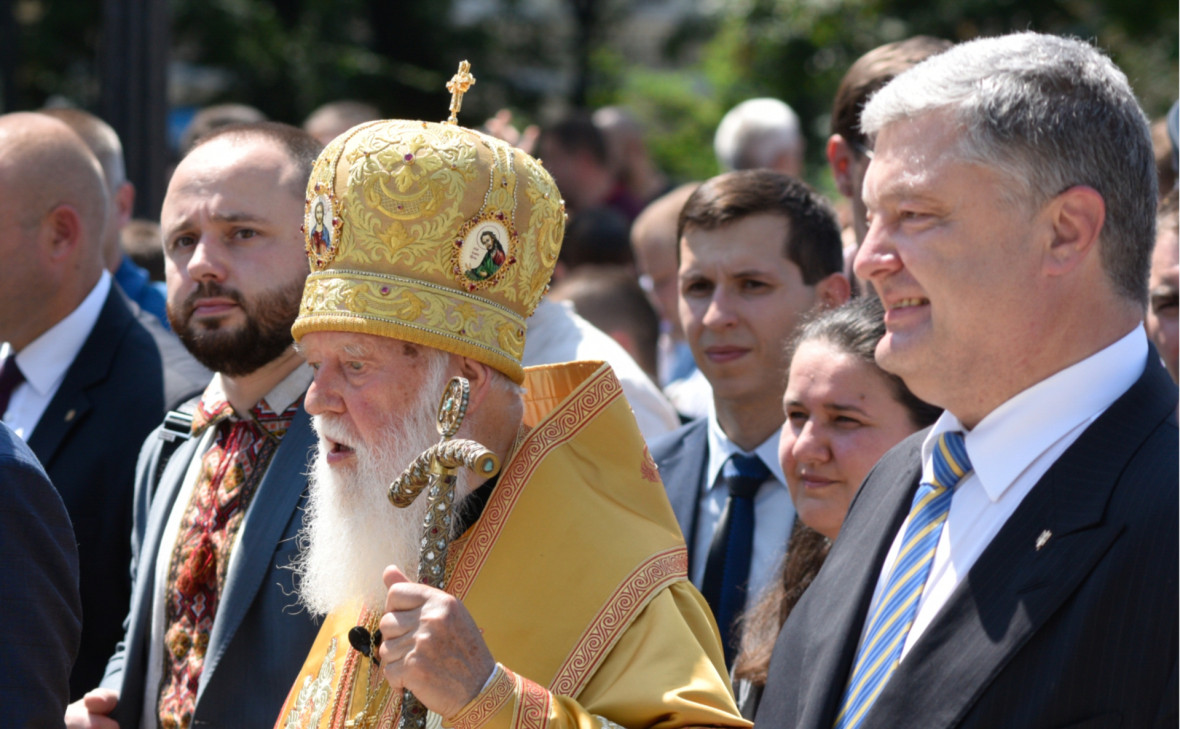
The Eastern Orthodox Churches hearken back to the original forms of worship; for example, the
Nicene Creed is viewed
as created at the
First Council of Constantinople in 381, in contrast to the
Roman Catholic church,
which uses the Nicene creed with the addition of the phrase 'and the Son' (see
Filioque clause).
T
his change is one of many causes for the Great Schism formalized in 1054 by simultaneous proclamations
of
"Anathema" from the collegial leadership of the Orthodox Churches in the East and the Bishop of
Rome in the West. This emphasis on the use of the "original creed" is shared today by all Eastern Orthodox
churches.
While some Eastern Orthodox Christians churches consider Roman Catholics to be heretics, the majority consider them to be schism.
In turn, The Catholic Church considers the Eastern Orthodox to be in schism and therefore not in full communion
with the Holy See. At the same time Protestant denominations,
especially those that adopt neoliberal rationality are viewed as flavors of Satanism.
Here is an interesting BBC interview by
Rowan Williams about Russian
culture and Orthodox church (in Russian, see below) and Dostoevsky. Short summary of ideas in
English can be found in
Telegraph note .
The Archbishop of Canterbury discusses a literary passion
"The current rash of books hostile to religious faith will one day become an interesting
subject for some sociological analysis. They consistently take a view of religion which, if taken
seriously, would also evacuate a number of other human systems of meaning, including quite a lot
of what they unreflectively think of as science. They treat religious belief almost as an aberration
in a field of human rationality: a set of groundless beliefs about matters of fact, resting on -
at best - faulty and weak argumentation. What they normally fail to do is to attend to what it is
that religious people actually do and say - and also to attend to the general question of how systems
of meaning actually work."
"Terrorism, child abuse, absent fathers and the fragmentation of the family, the
secularisation and the sexualisation of culture, the future of liberal democracy, the clash of cultures
and the nature of national identity - so many of the anxieties that we think of as being quintessentially
features of the early 21st century are omnipresent in the work of Dostoevsky, his letter, his journalism
and above all his fiction. The world we inhabit as readers of his novels is one in which the question
of what human beings owe to each other is left painfully and shockingly open and there seems no obvious
place to stand from which we can construct a clear moral landscape. Yet at the same time, the novels
insistently and unashamedly press home the question of what else might be possible if we saw the
world in another light, the light provided by faith."
Dostoevsky: Language, Faith and Fiction is published by Continuum at £16.99
And in Guardian (You can listen the whole interview):
Rowan Williams talks Dostoevsky with Stuart Jeffries
The Archbishop of Canterbury will face questions for only half an hour. So there won't be time
to ask him about gay bishops, his touching fondness for early Incredible String Band songs or eyebrow
grooming.
Instead, we must focus on his book Dostoevsky: Language, Faith and Fiction. It's a learned literary-theological
study that suggests not only do the great Russian's novels have a kenotic dimension (kenosis, roughly,
is the spiritual emptying of one's will to become receptive to God) but also stresses what Russian
Christianity inherited from the apophatic tradition (apophasis, roughly, is an inductive technique
used by eastern Christians to demonstrate God's existence). So I scratch the question about who would
win a beard-off between him and Dostoevsky.
Instead, I ask why Rowan Williams took three months off last summer to write this book. What is
the relevance of Dostoevsky for us Mammon-obsessed westerners in a credit crunch? And is the book
the archbishop's riposte to all those monsters of triumphalist atheism such as Richard Dawkins, AC
Grayling and Christopher Hitchens?
Before the archbishop can answer, we have to hurry through Lambeth Palace's corridors for the
photo-shoot in the chapel. As we go, Williams tells me he was hurt by the Guardian review of his
book in which Andrew Brown wrote: "I wondered whether I was struggling through the worst prose ever
written by a poet. [The archbishop has published several collections of poetry.] Sometimes the thought
disintegrates entirely, like a jellyfish dropped in a jacuzzi."
"He thinks I struggle with my sentences," says Williams. "Which is true, I do." He shrugs and
throws me a hapless Norman Wisdom smile. This is classic Williams: accepting the wound rather than
replying in kind. If it's any consolation, I tell Williams as we enter the chapel, I liked the book
and am planning to re-read The Karamazov Brothers as a result. "Oh good," says Williams, mugging
like an ecclesiastical Frankie Howerd. "That's reassuring." Sarcasm from an archbishop - this is
a career first.
Later in his study, he explains why he cast off his duties to write about a Russian novelist.
"Both my predecessors have taken short periods of sabbatical and the general feeling was that before
we got into the run up to the Lambeth Conference it might be quite a good idea to take some time
out. I'd been reading around Dostoevsky for years and I thought, 'OK let's give myself a task and
write the book.'"
This underplays Williams' lifelong interest in Russian spirituality. He wrote his doctorate on
Russian Christianity. Before that, Williams became obsessed with the religious themes of Dostoevsky's
The Karamazov Brothers, which contains an episode he thinks was formative for his faith. In the Grand
Inquisitor episode in Dostoevsky's masterpiece, Ivan Karamazov imagines Jesus's second coming. Christ
has made his earthly return to 16th-century Seville at the inquisition's height. He does not stop
the burning of heretics but is arrested for performing miracles and tomorrow morning will burn himself.
The Inquisitor tells Jesus in his cell that the church has made humanity happy by hoodwinking it
with miracle, mystery and authority. Christ, by contrast, offered the masses not happiness, but a
more frightful gift, their freedom. The Inquisitor explains that the Son of God is too reckless a
character to have around risking the church's good work.
Admittedly this Inquisitor episode is Ivan's atheistic fantasy, but shouldn't Christ have challenged
the inquisitor? Shouldn't he have behaved more like Christ in the Bible, who threw the moneylenders
out of the temple? "If you pressed Dostoevsky on that he might have said: 'When Jesus starts throwing
the Inquisitor out, Jesus becomes the Inquisitor himself.'" Instead, arguably, Jesus follows the
more difficult path: that of clasping even those you might be expected to detest most to your heart.
It's a path, we'll see, that Williams follows himself.
Why was the moment when Jesus, perhaps out of compassion for the tormented Inquisitor, kisses
the man and then is allowed to slip from his cell into the Seville night, possibly never to be seen
again, so important for Williams? "Dostoevsky has no easy answers, but what struck me when I first
read the Grand Inquisitor episode was there is absolutely no form of words that can give a solution
to suffering. Absolutely none. That's why what ends the arraignment of the captive Jesus by the Grand
Inquisitor is silence - and then Jesus kisses him. When I read it I had the dim sense that there
was something very important in that what you look for in faith is not solutions but a certain relationship."
And that's why Dostoevsky's appeal has endured for Williams: he offers no closure, no authorial master-voice,
but an endless dialogue where no one wins the argument but everyone is connected. In the book, he
writes that Dostoevsky's fiction is like divine creation, "an unexpected unfolding with no last word".
That might make divine creation sound akin to natural selection, but it's how Williams sees God's
universe.
Throughout the book Williams stresses Dostoevsky's contemporary relevance. "I first read Devils
[Dostoevsky's novel about a revolutionary cell led by a cynical manipulator] in about 1971 and one
thing I remember very vividly still is that the depiction of radical students' meetings was horribly
recognisable. The kind of arguments, the personalities, the obsessional quality of it.
"In Devils you have a reduction of politics to management, and the giving-over of that management
to people who have no moral hinterland. It rings a few bells in the contemporary world, because the
person who emerges triumphant from that dreadful book is the manipulator-in-chief. When you don't
have real shared values, real common goals in society, how do you avoid politics falling into the
hands of the person who can push the most right buttons, but who has no particular goals or aims?"
As the archbishop speaks, I can't get David Cameron's image out of my head.
Dostoevsky is renowned for his remark, "Without God, everything is
permitted." Does the archbishop agree? "He's saying not so much that without God everyone
would be bad, as without God we have no way of connecting one act with another, no way of developing
a life that made sense. It would really be indifferent whether we did this or that. And it's that
sense of God being part of what you draw on to construct a life that makes sense."
I take that to be a "yes", not least because Williams writes in the book, glossing Dostoevsky:
"Only love directed towards the transcendent can generate effective unselfish love in the world."
Is that his view? "At the end of the day, yes it is because I believe that's how the universe is.
I believe that God has made the world such that this is what we're for. Even when [people] reject
that at the ideas level, they can sense that's how it is, they can act as if there were an infinite.
That's one of the things that keeps the world going."
But the apparently barmy faith-based ethical systems in Dostoevsky, which Williams takes seriously,
seem to make moral life unworkable. For example, I was struck by the way he treats a notorious deathbed
scene in Karamazov where a character called Markel tells his mother: "Everyone is responsible for
everyone in every way, and I most of all." I tell the archbishop that when I studied philosophy,
this was held up as an absurdity by my teachers. How could one devise a practical moral system based
on the impossible demand of being responsible for every one? "You're right - the way Markel talks
about responsibility for all, it's not a practical programme. I don't think it's meant to be. In
the long run Dostoevsky's world is one in which what's bad and destructive for Sri Lanka or Burundi
or Guatemala is bad for humanity. Because there is this call to live your way into mutuality, there
are no bounds to that."
Williams says the doctrine of personalism that underscores much of Dostoevsky's work is important
in this regard. What is personalism? "It's a tradition in Russian philosophy, hugely powerful, from
Dostoevsky's friend Solovyov right through to some of the underground Russian writers of the Soviet
days and a lot of the emigres. You have to have a way of telling the difference between a person
and an individual. An individual is someone who occupies space. To be a person is to be someone who
hears and answers, to be someone who doesn't occupy a territory but much more a place in a network.
"Personalism says the human enterprise is about those exchanges and relations whereby we build
one another up, we take responsibility for each other's flourishing." He takes this as key for Christian
ethics. But is it also important as a critique of selfish western individualism right now? "Anything
that challenges the idea that the primary imperative is always going to be the protection of my territory
is bound to be."
Recently, Williams cited Karl Marx in his critique of selfish capitalism. It was, to say the least,
unexpected.
"The idea that most struck me when I read Marx years ago was that unbridled over-ambitious
capitalist ventures would lead you - in the jargon - to reify money. It's treated as though it
has a life of its own and Marx is pretty sharp on that. He saw the capitalist error as rather
like what he would see as the religious error - treating something as though it had a life of
its own. For Marx, God is just a function of how we relate to each other, money is just a function
of how we relate to one another. Now obviously I think he was wrong about God, but some of the
things he said about money were right. He just put his finger on that temptation to treat what's
actually within our reach and agency as if it's outside."
The blurb says this book should be heartening to Christians. Is it? "I hope it encourages them
to be aware that there are writers and thinkers who've plumbed the depths, who've looked at humanity
in its shadows as well as its triumphs, but who still think it's worth sticking with the Christian
gospel."
Christians may also find encouragement from Williams' preface, which argues all those recent books
hostile to religious faith will be tomorrow's sociological curios. He's presumably talking about
Dawkins, Grayling and Hitchens. But aren't they thinking you're the sociological curio? "They undoubtedly
are. The answer is not to say, 'Let's once and for all have the religious reply to it,' it's to go
on patiently saying, 'Look, what is it that Christians who are not cheap or trivial are saying?'
and work from there rather than the surface level.
"In The Idiot, Prince Myshkin says, 'When I hear atheists talk about Christianity, I don't recognise
what they're talking about.' I often feel when I read Richard Dawkins or Christopher Hitchens that
this isn't quite it. I thought it might not do any harm to put down a marker about that and say:
'Here is a form of Christian engagement with the world and with the complexities of human experience
that may be radically wrong but is not cheap or glib and any critique has to deal with this just
as much as it has to deal with a southern baptist.'"
He also tilts in the book at the pretensions of science, and by extension scientists such as Dawkins:
"Science is a set of brilliantly successful methods producing brilliantly successful
hypotheses about how things work. What it's not is a picture of reality. It will give you a very
significant purchase on reality. But it's not an ethic, not a metaphysic. To treat it like that
is a kind of idolatry."
Our half-hour is up. As he signs my copy of his book, Williams tells me he invited the philosopher
AC Grayling, baiter of the faithful, to the launch party. "I tell Williams that the last time I spoke
to Grayling he was just about to publicly debate with Rabbi Julia Neuberger the motion We'd Be Better
Off Without Religion. He won. "Oooh," says Williams, going all Frankie Howerd again, "I bet God's
worried. 'Damn, I'd better retire.'"
As he escorts me from his study, he tells me he admires Dawkins. "There's something about his
swashbuckling side which is endearing." He invited atheism's high priest and his wife to a Lambeth
Palace party last year. "They were absolutely delightful." Again, classic Williams: the better man
being nice about his foe. There's nobody he won't clasp to his bosom. It can only be a matter of
time he goes on the lash with Hitchens.
But the real reason the Dawkins were invited is unexpected. "My son wanted to meet Mrs Dawkins."
Why? "She was in Doctor Who." Really? "Oh yes. She played an assistant when Tom Baker was the Doctor."
For a moment the archbishop looks like a greying sci-fi nerd. He would definitely win that beard-off.
• On the web Listen to Rowan Williams talking to Stuart Jeffries
Архиепископ Кентерберийский
Роуэн Уильямс в своей резиденции - Ламбетском дворце - ответил на вопросы корреспондентов
Русской службы Би-би-си Натальи Рубинштейн и
Лиз Барнс, а также директора Всероссийской библиотеки иностранной литературы в Москве
Екатерины Гениевой.
Би-би-си: Как вы заинтересовались русской культурой и, в частности, Достоевским, о котором
вы написали книгу?
Роуэн Уильямс: Интерес к русской культуре вообще и к Достоевскому в частности возник у меня
еще в отрочестве после исторических фильмов Эйзенштейна "Иван
Грозный" и "Александр Невский". А потом я надолго погрузился в русскую музыку. Позже я открыл
для себя Достоевского и русскую литературу. В студенческие годы, когда я изучал теологию в Кембридже,
я прочел многих русских философов и богословов. Всех важнее для меня стал
Владимир Лосский, и я посвятил ему свою докторскую диссертацию. Такая вот длинная история у моего
интереса к России.
Би-би-си: Вы выросли в Уэльсе. А говорите ли вы по-валлийски?
Р.У.: У нас дома говорили по-валлийски. Родители и бабушка с дедушкой переходили на родной
язык довольно часто. Я не так хорошо говорю, как они. Но литературная традиция для меня важна не
меньше, чем для них.
Би-би-си: А сколько вообще вы знаете языков?
Р.У.: Я читаю на девяти или десяти языках, но говорю только на трех.
Екатерина Гениева: Почему вы решили именно сейчас написать книгу о Достоевском? В чем ваше
послание нашему веку?
Р.У.: С тех пор как вышла моя книга, меня спрашивали не раз: с какой стати современным людям
сегодня читать Достоевского? В смысле - зачем его читать на Западе. Почему его читают в России -
вопрос другой. Но только отчасти другой. Я бы на оба эти вопроса ответил так: Достоевский дважды
представил нам образ мира, в котором отброшена твердая шкала ценностей и главным стала человеческая
воля. А человеческая воля - вещь странная и дикая. И если она ничего не знает выше себя самой, и
ничего, кроме себя, не любит, она превращается в разрушительную силу.
Сперва Достоевский показал нам это на примере одного человека, ставшего преступником, - в "Преступлении
и наказании". А потом он показал нам, как это происходит, когда в развитие действия включается некая
политическая составляющая. Это - в романе "Бесы", самом, на мой взгляд, тревожном, полном смятения,
его романе. И мне кажется, нам стоит спросить самих себя: как это приложимо к нашему собственному
обществу.
Индивид, живущий без любви, не знающий ничего, кроме себя самого, никому, кроме себя, и не будет
нужен. А политика - если речь идет только о власти, о борьбе, соперничестве, завоевании - она становится
смертоубийством. Достоевский метил сразу в две цели - в индивидуализм и в коллективизм, в ложный
индивидуализм и в ложный коллективизм. Достоевский страшно неудобный автор для всякого политика,
хоть для левого, хоть для правого: он неизменно сдирает всякую самонадеянность. И это, по-моему,
важно.
Е.Г.: Вы выбираете Достоевского как своего внутреннего собеседника? Он ведь настолько непохож
на вас.
Р.У.: Проблема личности Достоевского - проблема очень серьезная. В одной рецензии на мою книгу
особо подчеркивалось, что Достоевский в своих журнальных и публицистических выступлениях - это совсем
не тот диалогический и полифонический автор, какого мы знаем по романам. Напротив, Достоевский-публицист
крайне нетерпим и фанатичен.
Я вот, знаете, иногда спрашиваю сам себя, хотел бы я оказаться в поезде с Достоевским в одном купе?
Но Достоевский подтверждает собою ту истину, что великий художник всегда на порядок больше собственной
человеческой личности. Художник всегда шире того, что он знает или думает, что знает. У Достоевского-журналиста
были ясные ответы на все вопросы. И он с презрением и издевкой расправлялся со своими оппонентами.
Его пером водила ярость.
Но, создавая роман, он не мог удержаться в рамках прямолинейной однозначности. Он слышал все многоголосие
мира, он оркестровал полифонию. Это и отличает настоящего художника. И я думаю, что никакой художник
не может быть сведен к его человеческой сути в узком смысле слова. Я вот только что закончил читать
очень важную книгу о Шекспире покойного английского критика Тони Наттолла "Шекспир - мыслитель".
В этой книге Наттолл все время показывает нам, как и что Шекспир думает в процессе творчества. Он
не формулирует мысль, чтобы потом воплотить ее в драматическом герое. Нет, он мыслит, созидая. И
Достоевский-романист делает точно то же самое.
Би-би-си: Ваша книга в оригинале называется: "Dostoevsky: Language, Faith and Fiction" (что
дословно можно перевести как "Достоевский: язык, вера и вымысел"). Как бы вы перевели название на
русский?
Р.У.: О, это трудный вопрос! "Language" в заглавии для меня означает "дискурс", то есть весь
процесс беседы и обмена мнениями. По-русски можно было бы сказать "слово", в том значении, в котором
французы сказали бы "parole". За одним произнесенным словом всегда встает другое. И в процессе беседы
в конечном счете наступает новый момент в отношениях. Я поставил на обложке книги эти три слова вместе,
отчасти потому, что убежден: если вы поняли, что именно делает Достоевский как автор вымышленной
истории, то вы поймете и то, как он понимал природу художественного слова. А, поняв, как он понимал
природу слова, вы узнает кое-что и о вере.
И для Достоевского, как и для меня самого, в конце концов открывается слово Божие. В последнем пределе
наша связь с Богом, состоит в том, что Бог оставляет свободу человека в его собственных руках и дозволяет
ему поступать по воле его. Я думаю, что мои размышления и представления во многом базируются на том,
что я в течение многих лет читал у русских философов. Я, конечно, в книге часто ссылаюсь на Бахтина,
но за Бахтиным есть еще и Лосев, замечательный и очень-очень сложный автор, а за ним, как кто-то
уже указал, просматривается Выгодский. Language - язык; слово всегда развернуто, всегда открыто.
Когда я впервые стал читать Лосева, я был восхищен у него ассоциациями с некоторыми философами византийской
традиции, утверждавшими, что сущность действий Бога может быть нами понята через слово Божие. Вот
все это, возможно, и заложено в названии книги.
Би-би-си: Как вы представляете себе аудиторию, которой ваша книга окажется близка?
Р.У.: Я об этом написал в предисловии. Я обращался вовсе не к одним специалистам по русской
литературе. Я думал о читателях, интересующихся литературой, искусством романа, творческим поиском.
Я хотел таких читателей, которые могут задуматься: нет ли в самом процессе художественного творчества
чего-то, что некоторым образом проливает свет на то, как действует религиозная вера. И что интересно,
некоторые здешние рецензенты подхватили этот намек, и отметили, что можно больше узнать о вере и
религии, наблюдая за работой творческого сознания, чем из чтения иных богословских книг.
Би-би-си: Кто вам близок из русских православных мыслителей?
Р.У.: Я уже говорил о Владимире Лосском. Много лет он был в центре моих исследований. Вообще
мое особое восхищение вызвали авторы серебряного века и религиозные мыслители этого периода. Я очень
интересовался, например, Флоренским. Но также и
Сергеем Булгаковым. Несколько лет назад я опубликовал о нем книгу, с приложением ряда его ранних
работ в своем переводе.
Я и сегодня считаю, что, при всех эксцентрических особенностях его мышления, отец Сергий Булгаков
был один из величайших умов этого века. Кто еще, кроме него, мог писать на литературные темы, рассуждать
о Достоевском, и одновременно писать по экономическим вопросам, и затем о Ницше и философии Ницше,
и тут же об истории мистицизма, как Западного, так и восточного - и переплавлять все это в единую
картину методом его собственного синтеза? Это был гигант.
А в то же время - я знавал нескольких людей, которые знали его лично - человек огромной личной твердости,
ясности и цельности. Так что к отцу Сергию Булгакову я возвращаюсь постоянно. И Лосского я продолжаю
перечитывать. У меня есть много его неопубликованных работ, на которые я опирался в своих исследованиях.
Флоренскому посвящено мое новое исследование, еще не законченное. И очень интересным для меня было
появление нового поколения молодых русских интеллектуалов в 1980-90-е годы, людей, которые открыли
для себя этот мир и, можно сказать, вросли в него. И среди них фигура огромного масштаба - отец
Александр Мень, сумевший предложить нам свое собственное видение.
Би-би-си: Вам никогда в голову не приходило самому перейти в православие?
Р.У.: Приходило. Я действительно подумывал об этом, когда был молод. Но я также чувствовал,
что в таком шаге таится некоторая опасность. Скорее всего, мне на самом деле очень хотелось стать
русским! Но поскольку я урожденный валлиец, это было трудновато. Так что можно считать, что это была
попытка разобраться в себе, познать самого себя.
Е. Г.: Кто из героев Достоевского вам особенно близок?
Р.У.: Я думаю о тех героях Достоевского, в которых я вижу светлое начало. Это герои непростые,
неоднозначные. В некоторых из них свет проступает совершенно неожиданно, непредсказуемо, наперекор
всему. Во многих отношениях для меня важнейший герой - Зосима, но я думаю и о Соне из "Преступления
и наказания".
Странная вещь происходит у меня с романом "Идиот". Там, по моему мнению, все герои тяжко травмированы,
все до одного так глубоко ранены, что невозможно увидеть светлое начало. И поэтому "Идиот" для меня
самый болезненный и мрачный роман. Сравните с "Бесами", где свет исходит из самых, казалось бы, неподходящих
людей, но светлого там больше, чем в "Идиоте".
Би-би-си: Что вы думаете о сегодняшних делах - русских и православных?
Р.У.: Мы поддерживаем постоянные отношения с Русской Православной церковью. Но я чувствую,
что внутри самой православной церкви ощущается напряжение. В ней есть люди, которые хотели бы воспользоваться
всей полнотой возможностей, открывающихся в нынешнем более подвижном обществе, хотели бы переоткрыть
заново то, что было заложено традицией. А с другой стороны, есть настороженность и подозрительность
ко всему зарубежному, даже если это зарубежная православная церковь. И эти две силы внутри православной
церкви, мне кажется, в настоящий момент резко противостоят друг другу. Человеку со стороны очень
трудно говорить об этом. Но нам, друзьям Русской православной церкви, бывает больно видеть растущие
в ней противоречия и разногласия. Я надеюсь, что в русской церкви победят отвага и доверие, глубоко,
в сущности, ей присущие, и позволят отнестись к чужому или иностранному без страха и предубеждения.
Би-би-си: Чувствуете ли вы, что хотели бы что-то привнести из православия в жизнь англиканской
церкви как архиепископ?
Р.У.: Есть две вещи, которые я очень хотел бы ввести в англиканскую философскую традицию.
И первая из них - различение индивида и личности, которое глубоко разработано в русском персонализме,
в частности, в трудах Владимира Лосского. Мы чаще говорим об индивидах, и не очень-то задумываемся
в каких отношениях индивид находится с личностью. Индивид - часть рода, биологический или социальный
атом. Личностью он может стать в ходе свободного волеизъявления, в познании себя, в развитии, в познании
Бога.
Когда я преподаю, или когда проповедую, мне приходится довольно часто разъяснять это простое обстоятельство:
сам по себе индивидуум - еще не личность. И люди говорят: "О! Почему же я никогда прежде не думал
об этом? Почему никто не сказал мне этого раньше?" Вот это тот элемент, который мне хотелось бы внедрить
в англиканское сознание. А другой - но он, конечно, связан с первым - касается самого смысла существования
церкви. Церковь отнюдь не просто место большого скопления народа; церковь ведь и есть то место, где
развиваются связи и взаимоотношения, позволяющие индивиду дорасти до личности.
Эту тему развивали не одни только православные авторы, хотя именно они ее начали на пороге XX века,
но ее продолжили французские философы, да и американские тоже. Я вот знаком с греческим митрополитом
Иоанном Зизиуласом. Он тоже разрабатывал эту тему. Но я думаю, митрополит Иоанн согласился бы с тем,
что его собственное богословие стоит на плечах предшественников, таких как Лосский или Флоренский.
Так что вот эти вещи мне хотелось бы внедрить здесь через преподавание и проповедь. Да ведь и то,
что я написал о Достоевском - это все о том же.
There are christians who hold that the resurrection of Christ means that, although he died,
he still lives on in the faith of his followers - a faith expressed by word and sacrament in
the church. The basic catholic objection to this is that it makes of the resurrection a
religious event, one that makes a difference primarily to what happens in the church; whereas
for the catholic tradition the resurrection is a cosmic event, it means that Christ is
present to the whole world whether believers or not...
What had been a corpse, a cadaver, is now a living human body again, and much more,
unimaginably more, humanly alive. [Jesus's] body is closer to us now than he ever could have
been to his disciples in Galilee, and he is closer to the whole world. In the sacraments of
the Church his bodily presence and contact reaches out to all humankind. Especially in the
eucharist we are united to and in his body. And this is not a metaphor, a poetic image; we
are united in a bodily contact of which our familiar bodily touching is just a pale
shadow.
The gospel we preach is not about memories or ideals or profound thoughts. It contains all
these things, but what it is about is the human person, Jesus, alive and present to us and
loving us from his human heart. Our Easter faith is that we really do encounter Jesus
himself: not a message from him, or a doctrine inspired by him, or an ethics of love, or a
new idea of human destiny, or a picture of him, but Jesus himself. It is in this we rejoice.
[Herbert McCabe OP]
the fact that the best recordings of Russian choral music were made by the "atheist" USSR
Ministry of Culture Chamber Choir is ironic but also a testament to the power of the
music.
This reminds me of the time I was in the navy, on a ship 500 miles off the Virginia coast.
I was outside at night; no moon, no light from the ship, and pitch black. It was the first
time in my life that I have ever seen a night sky filled with billions upon billions of
stars. I became completely frozen with an awe I have never felt before. The night sky was
covered entirely with light emitting from each and every star from distant galaxies. Even the
ocean emitted light; a bright green glow from the plankton that floated across the surface,
as far as the eye can see. Light was all around me, even in the midst of darkness. This music
encapsulates what I felt looking upon that majestic starry night. It made me understand the
passage, "The heavens declare the glory of God."
As a Westerner, as an American...this strikes me to the core, only an introspective people
with a deep sense of humility and raw experience of life could produce such stark and
beautiful music...may America and Russia find peace for we share the essence of this music
between our peoples...
Absolutely outstanding. Russian music and especially choral music is unmatched. It expresses
human yearning for the divine and immortal and Tchaikovsky clearly had unlimited access to
heavens and cosmic powers. His music is universal and it appeals to the entire human race.
Possibly the most beautiful and ethereal vocal composition ever - the harmonies and
dynamics created by the performers are beyond words. Bravo Mr Tchaikovsky!
Yale is the cradle of color revolution activists ;-)
Notable quotes:
"... with the creation of the OCU, the Ukrainian government has established a "state church," its own national brand of Christianity? President Poroshenko fervently denies this ..."
"... Finally, the global Orthodox community has not split, as many Western media outlets confidently predicted it would. [xxxvii] Instead, it has rallied around the beleaguered UOC-MP, highlighting the isolation of the Patriarch of Constantinople. ..."
Religious conflict in Ukraine has been much in the news of late, ever since President
Petro Poroshenko very publicly embraced the ambitious idea of creating a single, unified
Orthodox Christian church out of the country's many Orthodox denominations. This idea, long
dear to the hearts of Ukrainian nationalists, kept the issue on the front pages of the media in
Ukraine, Russia, and other predominantly Orthodox countries for most of 2018.
Then, quite unexpectedly, he got his wish. On January 6, 2019, the Patriarch of
Constantinople, primus interpares among Orthodox Church hierarchs worldwide,
granted Poroshenko a church document ( tomos ) designating the newly minted Orthodox
Church of Ukraine (OCU) as the sole legitimate and independent Orthodox church in Ukraine. The
question that many Orthodox Christians both in Ukraine and elsewhere are now asking themselves
is, at what cost?
Poroshenko's achievement has evoked conflicts within both Ukraine and the rest of the
Orthodox world. While he has gained the backing of the Patriarch of Constantinople, the rest of
the Orthodox world has taken a wait-and-see attitude since, in the tradition of Orthodox
Christianity, the consequences of these actions will not become fully manifest until far into
the future.
The Tomos Wunderwaffe
What makes this turn of events so startling is that before October 2018 all the established
autocephalous Orthodox Churches recognized the Ukrainian Orthodox Church, known colloquially as
the UOC-MP by virtue of its close spiritual ties with the Moscow Patriarchate, as the sole
canonical Orthodox church in Ukraine. [i] This church had been granted "independence and autonomy in its
administration" by the extraordinary Bishops' Council of the Russian Orthodox Church on October
27, 1990, nearly a year before Ukraine declared its own independence. [ii] Later, in 1992, the Metropolitan of Kiev, Filaret (Denisenko), having
earlier lost his bid to become Patriarch of Moscow, proclaimed himself Patriarch of Kiev and
set up his own Ukrainian Orthodox Church, known as the UOC-KP, or simply Kievan
Patriarchate.
Since then, the UOC-MP, the UOC-KP, and the much smaller Ukrainian Autocephalous Orthodox
Church (UAOC) have coexisted in tense, mutual non-recognition. Over the next quarter century,
the Kievan Patriarchate would go on to establish over 4,000 parishes. By the end of 2018,
however, at least two-thirds of the 18,000 Orthodox Christian parishes in Ukraine still swore
allegiance to the UOC-MP. [iii]
Ukrainian nationalists have long found it troubling that the majority of the country attends
a church whose nominal head resides in Moscow. On the wave of nationalism inspired by the 2014
Maidan Revolution and the war with Russia, therefore, they introduced legislation to change
this. Draft law 4128 would have allowed parishes to transfer to another church's jurisdiction
by a simple majority vote of those who self-identify with the community and participate in its
religious life. [iv] Since these terms were not defined, critics worried that any organized
group of intruders might be able to seize control of a parish and transfer it against the will
of parishioners.
Draft law 4511 was even more intrusive. [v] It required that all religious charters explicitly endorse the sovereignty,
territorial integrity, and laws of Ukraine (art. 3). Candidates for the leadership of religious
organizations would require state approval (art. 5), as would any invitations to foreign
religious leaders (art. 6). Finally, in the event of systematic violations of law, or
collaboration with "military-terrorist groups," the state could terminate a religious
organization (art. 7). Both laws were widely criticized by religious groups in Ukraine and were
never even brought up for a vote. [vi]
What most people do not know, however, is that these laws were part of a strategy that had
been developed within the presidential administration over the course of 2015. That year,
Sergei Zdioruk and Vladimir Tokman, two senior analysts at the National Institute for Strategic
Research (NISS), which prepares analyses for the presidential administration, wrote a report on
the threat that the UOC-MP posed to Ukraine's statehood. [vii] They later published their analysis in the Ukrainian press, sparking an
intense discussion.
Labeling it a "channel for the clerical occupation of Ukraine," Zdioruk and Tokman claimed
that the UOC-MP assisted the rebels in Eastern Ukraine, and collaborated with the occupation in
Crimea. These subversive activities, they suggested, could be effectively counteracted by the
creation of a single local Orthodox church out of the Kievan Patriarchate and the AUOC. The
authors predicted that the creation of such a church would lead to a "chain reaction" of calls
for autocephaly from the Russian Orthodox Church throughout the former Soviet Union. Moreover,
as the largest church in the Orthodox world, they pointed out that this new Ukrainian church
could serve as a "reliable ally" of the Patriarchate of Constantinople (also known as the
Ecumenical Patriarch). [viii]
Zdioruk and Tokman, therefore, called upon the government to adopt a nine-point program,
worth reproducing in full because subsequent events have followed it with remarkable
accuracy:
The Ukrainian parliament should adopt draft law №1244 of 4 December 2014 and rename
the UOC-MP the "Russian Orthodox Church in Ukraine;"
The government should begin a discussion on rescinding the property rights of the UOC-MP
in all key national shrines;
The government should prevent hierarchs of the UOC-MP from taking part in any public
celebrations;
Only those Orthodox organizations that have "shown a capacity for the socio-patriotic
education of their flock" should be allowed to take part in government programs;
All visits to Ukraine by the "odious activists and functionaries of the Russian Orthodox
Church" should be forbidden;
Civil servants who attempt to hinder the creation of a local Ukrainian Orthodox Church
should be summarily removed, under the law of lustration;
Current legislation on freedom of conscience and religious organizations should be
amended to allow for legal action against religious organizations whose actions violate the
territorial integrity and sovereignty of the Ukrainian state, or evoke religious
hatred;
A "system of concordats" should be introduced to "force [religious organizations] . . .
to work responsibly on an equal basis for the good of the entire Ukrainian people."
Finally, the government should develop a comprehensive and mutually reinforcing set of
initiatives aimed at establishing a local Ukrainian Orthodox Church.
When this plan was first conceived the achievement of autocephaly seemed highly improbable,
since not a single Orthodox church recognized either the Kievan Patriarchate or the UAOC. By
early 2018, however, Poroshenko's deputy chief of staff, Rostislav Pavlenko, came to believe
that the Patriarch of Constantinople, Bartholemew I, might be willing to reconsider his
position on Ukrainian autocephaly.
According to press accounts, Pavlenko took this idea to the president, promoting it is as a
sort of Wunderwaffe or "silver bullet" that could sharply boost the president's abysmal
ratings. [ix] When the tomos failed to materialize on the date that Pavlenko had
promised, the president fired him, but kept him close by. Pavlenko now serves as the director
the NISS, where he, Zdioruk, and Tokman continue to promote the eradication of the UOC-MP.
[x]
In retrospect, therefore, Poroshenko's decision to make the divisive issue of autocephaly a
"critical" issue less than a year before the upcoming presidential elections seems far less
odd. While it alienates voters in Eastern and Southern Ukraine, these were never Poroshenko's
voters to begin with. The president's electoral base lies almost exclusively in Western and
Central Ukraine, which is also the regional base of the Kievan Patriarchate and of Ukraine's
politically influential Greek Catholic Church. [xi] The president's problem, politically speaking, is that even there he was
running a distant third.
To make it into the run-offs Poroshenko would first have to win decisively in the West and
Center. This meant embracing a decidedly more nationalistic agenda, of which autocephaly from
Moscow has long been a major part. [xii] Only after he makes it into the second round can he afford to broaden his
appeal. This appears to be the strategy that Poroshenko has adopted, and it has brought from
fourth or fifth place in the polls up to a strong second during the last weeks of the
presidential campaign.
A Bit of Byzantine Geopolitics
While it is apparent how president Poroshenko benefits from the creation of a local Orthodox
Church of Ukraine, what does the Ecumenical Patriarch, Bartholemew I, stand to gain from
endowing it with exclusive legitimacy? Simply put, the chance to prove that he is still an
influential figure in the Orthodox world. In the centuries since its own autocephaly, the size
and influence of the Patriarchate of Moscow has waxed, while that of the Patriarchate of
Constantinople has waned. In the current dispute over who has proper jurisdiction in Ukraine,
therefore, the Ecumenical Patriarch makes four points.
First, that in the 1300s the Kievan metropolia moved to Moscow without the Ecumenical
Patriarch's permission. Second, that the tomos of autocephaly granted to Moscow never
included the metropolia of Kiev. Third, that when Moscow was granted the right to ordain
the Metropolitan of Kiev in 1686, it was on the condition that the latter commemorate the
Ecumenical Patriarch as his ecclesiastical superior, "to demonstrate the canonical jurisdiction
of Constantinople over this Metropolis." Finally, that "since Russia, as the one responsible
for the current painful situation in Ukraine, is unable to solve the problem, the Ecumenical
Patriarchate assumed the initiative of resolving the problem." [xiii]
The Moscow
Patriarchate disputes each of these assertions . [xiv] More importantly, it is hard to avoid the impression that revisiting them
many centuries later serves some more immediate purpose. Patriarch Bartholomew seemed to
suggest as much, when he explained that he took up this issue at the insistence of "the
honorable Ukrainian Government, as well as recurring requests by 'Patriarch' Philaret of Kiev"
(quotation marks in the original). [xv]
This explanation has puzzled many Orthodox Christians. It is quite odd to say that the
Ukrainian government has asked for autocephaly, since autocephaly cannot be granted to a
country. It can only be granted to a canonical Orthodox Church, and all Orthodox churches,
including the Patriarchate of Constantinople, were in agreement that the UOC-MP was that
church. Finally, the UOC-MP itself had not asked for autocephaly, and emphatically rejected the
intercession of the Ecumenical Patriarch. [xvi]
Second, since there was no alternative canonical church in Ukraine to receive autocephaly, a
new church had to be set up quickly to receive its long-awaited independence. Reconciling the
desires of the Kievan Patriarchate and AUOC, however, proved more difficult than expected. To
facilitate matters the Ecumenical Patriarch sent two envoys to Ukraine to negotiate the
following complicated dance: first, the lifting of the anathema against the leaders of
the two schismatic churches; second, their acceptance of temporary oversight from the
Ecumenical Patriarchate; third, the grant of autocephaly to the newly constituted local
Orthodox Church. Under the best of circumstances this process could take decades. Thanks to the
keen determination of Kievan Patriarch Filaret, and the engagement of president Poroshenko,
however, it was all accomplished by the end of the year, just days shy of the official start of
the presidential campaign. [xvii]
It is therefore easy to see why President Poroshenko took center stage at the Unifying
Church Council held in the ancient cathedral of St. Sophia in Kiev on December 15, 2018. From
the podium, he congratulated his guests with "the final attainment of our Ukrainian
independence from Russia," adding that "not a single patriot doubts the importance of an
independent Ukrainian Orthodox Church for an independent Ukrainian state. Such a church is the
spiritual guarantor of our sovereignty." [xviii]
A few unkind commentators noted that Poroshenko mentioned "Russia" twelve times and "God"
only twice in his speech. On the whole, however, this nationally televised celebration of
Ukrainian unity served brilliantly as a launching pad for the president's re-election campaign,
which by that time had already adopted the slogan "Army, Language, Faith -- the army defends
our land. The language defends our hearts. The church defends our soul." [xix] In 2019 this would be simplified into the more direct, "It's Poroshenko or
Putin." [xx]
What Does the Future Hold for Ukrainian Orthodoxy?
In the weeks since the tomos of autocephaly, the government has continued to "grease
the wheels" for the new OCU. On January 17, 2019, the Ukrainian parliament adopted law 4128-D,
expanding the states' authority to register and monitor religious organizations. Earlier, on
December 20, 2018, the Ukrainian parliament had passed law 5309, giving the UOC-MP just four
months to officially change its name to the "Russian Orthodox Church in Ukraine." It has
refused, citing its administrative independence from the Russian Orthodox Church since 1990 and
its registration as such in Kiev. [xxi] Both of these laws have evoked concern among religious rights
organizations in Ukraine, who argue that they violate both the Ukrainian constitution and
European human right conventions. [xxii]
Can one, therefore, conclude that, with the creation of the OCU, the Ukrainian government
has established a "state church," its own national brand of Christianity? President Poroshenko
fervently denies this. He insists that every Ukrainian retains the right to make his or her own
choice in matters of faith, even though "in that church they are praying for the Russian
authorities and armed forces that are killing Ukrainians," [xxiii] and that he, for one, cannot understand how such churches can be called
Ukrainian. [xxiv]
But while it may be too early to call the OCU a state church, it is already abundantly clear
that, for the president, the speaker of parliament, and the head of the security forces, the
UOC-MP is the church of the enemies of the Ukrainian state, of those who "receive instructions
from abroad and set up a fifth column." [xxv] This point is made emphatically each time the president declares that the
Russian Orthodox Church is part of the Russian political system,
[xxvi] and then describes the tomos as a "victory for Ukraine and a defeat for
Russia, no less important, perhaps even more important, than victory at the front lines."
[xxvii]
The fate of the UOC-MP thus serves as an important lesson to other civic and religious
organizations about the dire consequences of contravening the political establishment. It is,
after all, no secret that the cardinal sin of the UOC-MP, in the eyes of the government, has
been its refusal to support the war effort in Eastern Ukraine, which Metropolitan Onufry calls
a "fratricidal conflict" and a "civil war." [xxviii] With the establishment of the OCU and the simultaneous disestablishment
of the UOC-MP, the full power of the state is on display, and all pretense of separation
between church and state, as stipulated in article 35 of the Ukrainian Constitution, has been
stripped away. [xxix]
At the same time, several other strong predictions have not come to pass. First, the UOC-MP
has not shattered. The most optimistic estimate of the number of parishes that have transferred
over to the OCU puts that figure at over 320. [xxx] This amounts to fewer than 3% of all UOC-MP parishes. The UOC-MP,
meanwhile, says it is aware of only 36 voluntary transfers, and 111 that are still in dispute.
[xxxi]
It is possible, of course, that the reality of a new church structure has yet to sink in.
Still, it is telling that the geographical pattern of transfers has been precisely what anyone
familiar with Ukrainian history would expect -- almost all have been in Western and Central
Ukraine, almost none in the East and South. [xxxii]
This glaring divide helps explain why no other autocephalous Orthodox Church has yet
recognized the OCU, or even congratulated the new Metropolitan of Kiev, Epiphanius (Dumenko) on
his enthronement. Indeed, in an unprecedented rebuke of their presiding bishop, the Patriarch
of Constantinople, the governing body of the monastics of Mount Athos in Greece refused his
request to send an official representative to Epiphanius' elevation, saying that the OCU was
indistinguishable from "the schismatic branch" formerly known as the Kievan Patriarchate.
[xxxiii]
Also unexpected was the ease with which the new OCU accepted the constraints imposed upon it
by the Patriarch of Constantinople under the terms of the tomos , such as the head of
the OCU's demotion from patriarch to metropolitan. The OCU has also been forced to give up all
its jurisdictions outside Ukraine, including its rather extensive and well-funded communities
in the United States and Canada, which now fall under the administration of the Patriarch of
Constantinople. [xxxiv] Any OCU clergyman dissatisfied with an administrative decision made by
his superiors may now appeal directly to the Ecumenical Patriarch, whose decisions are final.
Moreover, on matters of doctrine, the OCU pledges to adhere to "the authoritative opinion" of
the Patriarch of Constantinople, who has now been granted areas under of personal jurisdiction
( stavropigia ) within Ukraine, alongside the OCU. [xxxv] Some view these conditions as part of an effort by the Ecumenical
Patriarch to assert a claim to supremacy among his fellow hierarchs, which has only added to
their reluctance to embrace the OCU. [xxxvi]
Finally, the global Orthodox community has not split, as many Western media outlets
confidently predicted it would. [xxxvii] Instead, it has rallied around the beleaguered UOC-MP, highlighting the
isolation of the Patriarch of Constantinople. With divisions on full display even within the
Greek Orthodox community (in addition to the monks of Mount Athos, the Church of Cyprus has
publicly criticized the creation of the OCU), other Orthodox churches have been reluctant to
enter the fray for fear of further fracture. [xxxviii]
Instead of submitting in the face of political pressure from the governments of Ukraine, the
United States, and Canada, [xxxix] the Orthodox world has responded in a time-honored fashion. It has
slowed down its deliberative process and limited its interaction with political and religious
opponents, in order to give them time to "come to their senses" (2 Timothy 2:26). That might
occur soon, or it could take decades, or even centuries. Only God knows.
Politicians typically overlook this aspect of the Church's strategy for dealing with the
secular world because they fail to appreciate that the Orthodox Church sees itself, first and
foremost, as a supernatural actor, a tangible manifestation of the work of the Holy
Spirit. [xl] The modern view, that man is a political animal (ζῷον
πoλιτικόν) whose actions ought to be evaluated through
the prism of relations between the individual and the state, strikes most Orthodox social
theorists as extremely narrow. In any political discourse, they say, some part of the universal
and ultimate truth always gets lost. Orthodoxy, therefore, has no set preference for one form
of politics over another, because that which is needful, right, and proper, simply lies beyond
the ken of politics. [xli]
From an Orthodox religious perspective, therefore, fleeting political passions matter very
little. The Orthodox liturgy, after all, begins with the admonition of Psalm 146:3, "Put not
your trust in princes, in sons of men in whom there is no salvation." Of far greater importance
is the struggle for the soul of mankind, which is the Church's raison d'etre . As
Orthodox Christians see it, therefore, the Church can always rely on one insurmountable
advantage in any conflict with political actors -- its timeframe for success is eternity. One
should, therefore, expect it to bide its time in its dealings with its opponents, confident in
the promise that was once made to it, that even "the gates of Hell shall not prevail against
it" (Matthew 16:18).
About the AuthorNicolai N. Petro (www.npetro.net) is
Professor of Politics and Silvia-Chandley Professor of Peace Studies and Nonviolence at the
University of Rhode Island. He writes frequently about church-state relations in Ukraine and
Russia. His latest book, Ukraine in Crisis, was published by Routledge in 2017 (find it at
https://www.routledge.com/Ukraine-in-Crisis/Petro/p/book/9781138292239).
I don't like the timing of Patriarch Bartholomew granting autocephaly to the Ukrainian
Orthodox Church from Russia. After a thousand years he does this, now? Something stinks. He
knows the political situation and it was uncalled for to fuel the fire. He should be working
for peace to unite the Orthodox faithful, and condemn the western puppet of Ukraine.
Bartholomew should be deposed.
Church became a political tool for strengthening the sovereignty of Ukraine. Which is to be expected...
Notable quotes:
"... Anyway, it's clearly a political issue pushed by the Kiev regime, simply because it failed in everything tangible on Earth, so wants at least a fake success in Heaven. Like the regime itself, this push has full support of the Washington politburo. That's the whole story. ..."
At issue is the accuracy
of such polling, in conjunction with the pressure that has been put on the UOC-MP.
In any event, there's also the matter of popularity between the UOC-MP versus the UAOC and
UGCC. It'd be grossly unfair to seek the complete elimination of the UOC-MP, based on the
popularity between these three churches. Never mind the issue of the UAOC and UOC-KP
coordinating things between themselves on a single UOC among them – let alone the UOC-MP
factor.
As for those inaccurately stereotyping the UOC-MP background as the appendage of a foreign
power, one can say much the same of the UGCC, which supports a single UOC, even though the UGCC
isn't an OC. I'm sure the UGCC would be towing a different line if it was targeted (thru
pressure) to become a part of the UOC.
The above linked article exaggerates the ROCOR ties with Nazi Germany. Some in that church were more soft on the latter
than others. As time went by, that popularity became even less. Not so different from how Nazi Germany was initially
perceived by some others in the West before all hell really broke loose. Some whataboutism notes the Vatican-Nazi ties, as
well as the Soviet cooperation with Nazi Germany.
Mr. Shamir suggests a smarter course of action than the Moscow Church adopted. That's
natural: Russian Orthodox Patriarch Kirill (Gundyayev) is certainly not the brightest bulb in
a chandelier. I am sure Mr. Shamir (with a typical Orthodox Christian name: Israel) is more
intelligent. But he is not leading Russian Orthodox Church. Maybe he should.
Reminds one of a Russian joke.
A Jew comes to rabbi seeking advice. Rabbi says:
- Look, Moses said that everyone should follow the ten commandments, Jesus said "if anyone
slaps you on the right cheek, turn to him the other also", Spinoza said "cogito ergo sum",
Einstein said that it's all relative, while Freud said that all problems spring from your
sexual inhibitions
- Why are you telling me all that?
- Because there are as many opinions as there are Jews. Use your own brains!
@Sergey
Krieger The country is "devoid" of ideology. Even that is not quite true: the powers push
imperial greatness as an ideology, having learned from neighbors' example that primeval
tribal nationalism can ruin any country.
@AnonFromTN One Svido
leaning academic mentioned the language issue regarding the OC situation in Ukraine.
The UOC-KP and UAOC take a nationalist position by noting (among other things) how their
churches use the Ukrainian language in services. The UOC-MP takes the traditional route by
using Church Slavonic, as is true of the Serb and Bulgarian churches, as well as all churches
loosely affiliated with the MP. Been informed that the Romanian Orthodox Church (at least
some of them) also use Church Slavonic.
@Sergey
Krieger In cyber, there's the claim that IS was baptized as an Orthodox Christian. Not
sure how accurate that is. I've also heard that Zyuganov considers himself as an OC –
again not sure of whether that's accurate. The KPRF has been known to take pro-ROC positions
– at least some.
The present ROC-MP is generally not so enthusiastic about the Soviet legacy. That said I
understand there's for (lack of a better term) element of ROCs who take a more Sovok leaning
line.
At issue is the accuracy of such polling, in conjunction with the pressure that has been
put on the UOC-MP
According to you all polls are inaccurate. Very funny.
I'm sure the UGCC would be towing a different line if it was targeted (thru pressure) to
become a part of the UOC.
UGCC is irrelevant here – I was posting data about the various Orthodox Churches and
their support among Ukraine's self-identified Orthodox people.
Increasingly, the UOC – Moscow is becoming the church of Crimeans, ethnic Russians,
and the small Russian nationalist fringe. The smaller it gets as Ukrainians continue to
leave, the more pro-Russia it will be. It has the right to exist as such, of course, but
let's not pretend it is something different from that.
@Mikhail The language issue
is just a pretext. Church Slavonic is no closer to modern Russian than to modern Ukrainian
(BTW, what do they mean by Ukrainian – the literary Poltava version, or one of Western
Ukrainian dialects, which are quite different from literary Ukrainian and from each other).
Anyway, it's clearly a political issue pushed by the Kiev regime, simply because it failed
in everything tangible on Earth, so wants at least a fake success in Heaven. Like the regime
itself, this push has full support of the Washington politburo. That's the whole story.
@Sergey
Krieger If memory serves, the last uprising against the robbery was in 1993, 25 years
ago. The regime skillfully used Ukrainian idiocy and American machinations to its advantage.
The regime also skillfully uses the fact that self-proclaimed "opposition" falls into two
categories: subservient lesser thieves, like the so-called communist party, and pathetic
nonentities, like Navalny and similar scum. But we'll see what happens next.
@Sergey
Krieger Sergey, I am a communist sympathiser and a Christian, so for me – and for
millions – it is relevant. Indeed, once communists were atheist, but not anymore. And I
think it is a gross simplification to say that questions of faith are about money and power.
They are about money and power, too, but this is not their most important feature. Probably
you have learned in school the poem 12 by Alexander Block with his vision of Christ leading
the Red squad. So these ideas fit together perfectly.
I am not sure it is
so. I went to a service at St Vladimir Cathedral in Kiev, the most beautiful church of the
city in the hands of "Kiev Patriarchate", and the service was in Old Slavonic, as in Russia
proper, while the sermon was in Russian. Probably one could confess in Ukrainian
@israel
shamir The name is not an issue, although I can't recall a single Orthodox (or atheist,
for that matter) ethnic Russian with a name "Israel". The issue is that recent converts often
show more zeal than those who belonged to a particular religion (or religion-like ideology,
such as communism or globalism) from early years of their lives. I do think that your
suggestions are much smarter than what the Synod decided to do, but they are even more
worldly and less Christian than actions of the Russian Church. It is equally clear that
actions of Bart and Poroshenko have nothing to do with religion and everything to do with
politics. Both are desperate failures trying to redeem themselves in some way. Then again, I
do not belong to any church, was never baptized or otherwise introduced into any religion, so
my opinion is totally non-religious.
@israel
shamir Now, here I must agree. The teachings of Christ were communist, as anyone reading
the New Testament can see. The episode with money changers fully describes how true
Christians should view bankers.
@israel
shamir I've attended mass at St. Vladimir's too, and not heard a single word uttered in
Russian nor Church Slavonic, and this was a few years back. I'm sure that if anything, it's
even more Ukrainian now than it was then. If Church Slavonic was used during the mass, it
must have been very curtailed. Their official website is all in Ukrainian – no Russian.
http://www.katedral.org.ua/rozklad.html
So, for the sake of clarity, are we to believe that you're a 'sympathizer' of the type of
communism that was practiced in the Soviet Union for about 65 years? Save me the routine
about 'nothing is ever perfect', a simple yes or no will suffice.
@israel
shamir I agree regarding Crist. But Kirill ain't Crist and he ain't communist either.
Which leave us with dilemma. How one can be both communist and religious man devoted to
organized official religion. It is obvious that religion is being pushed to make population
lethargic and make it forget that they are basically suckers who allowed few sly scoundrels
to rob them and keep robbing. If God exists He has nothing to do with any church.
Russia had all the same problems of course [as Ukraine], but it also retained its vast
reserves of oil and gas
So both countries had the same crummy type of system (and still do), however, Russia was
the lucky recipient of large energy resources, that has enabled it to fashion a higher GDP.
Unless you can prove that somehow Russia is willing to share this largess with Ukraine, why
should Ukraine crawl back on its knees and become a part of the 'Russian Mir'? Ukraine needs
to look elsewhere and learn to rely on itself to find its way in the world – there's
nothing to be gained by aligning itself in the near future with Russia.
I think it's all a terrible misunderstanding. The reason why the Ukrainian Orthodox Church
split from the Russian is because they heard that the Russian Orthodox Church is in charge of
canonization. Those dummies are mixing military with religious terms. Russian Orthodox Church
wasn't planning on bombarding the Ukrainians, although to be honest, the way the Ukrainians
are acting, it wouldn't be uncalled for if someone used some cannons on them.
But understand this, that in the last days there will come times of
stress.
For men will be lovers of self, lovers of money, proud, arrogant, abusive, disobedient
to their parents, ungrateful, unholy, inhuman, implacable, slanderers, profligates, fierce,
haters of good, treacherous, reckless, swollen with conceit, lovers of pleasure rather than
lovers of God, holding the form of religion but denying the power of it.
the way the Ukrainians are acting, it wouldn't be uncalled for if someone used some
cannons on them
You are forgetting the difference between primeval nationalistic savages and civilized
people. Although Ukraine bombs, shells, and shoots civilians in Donbass, this does not mean
that Russia must stoop as low as that scum. Unlike Ukraine, Russia has time on its side. So,
whoever is ruling Russia only needs to stock up on popcorn and wait for the morons to ruin
whatever remains and kill each other, or for the healthy forces in Ukraine to hang those
morons on the lampposts. If there are no healthy forces, than the ruler of Russia only needs
to wait a bit longer, until the morons create another Chernobyl on a nuclear power plant or
similar catastrophe on one of the remaining chemical plants. After that impotent European
cowards would crawl to the Russian ruler begging him/her to take hand grenades away from
monkeys. The EU would even pay for the operation and agree to forgive the debts: otherwise
Russia won't lift a finger.
@Sergey
Krieger There are today possibly millions of believers in Russia alone who also vote for
communist parties. Although some leftists are hostile to certain religions, others aren't.
Karl Marx for example, was not hostile to Christians or Christianity at all, and was
actually rather fond of both the religion and its followers, even though he was not religious
himself. In your previous comment, you brought up Marx' "Opium of the Masses" turn of phrase;
if you'd look up his full statement where that phrase appears, you'll see that he was not
condemning the religion, but observing the social role that it plays as a crutch to lean on
for the oppressed common man.
The grant of 1686 which "gave" Kyiv to Moscow carried certain conditions. Those condition
were never fulfilled. Consequently, the Ecumenical Patriarch has withdrawn the grant form
Moscow. The withdrawal is quite legal, no matter the author's whining to the contrary.
Ukraine is going to get Auotcephaly, and the ROC-KP will either join, or be left behind.
Moscow can whine about the loss, but the ROC is simply a cultural accouterment in Russia.
Putin, and people supposedly in the know, think Putin is a RO Christian. His actions in
Ukraine have shown, quite clearly, that he is anything but.
Mr. Shamir demonstrates the same ignorance of Ukraine Saker does. Other ins the comments
are even worse. Ukraine is rising and improving. Putinist Russia, on the other hand, is
declining, and the idiot is spending money on his imperial ambitions and is looting the
country to enrich himself, his cronies, and pursue his ambitions. Russia is now a pathetic
shadow of itself and is more corrupt than Ukraine. The country is slowly turning on Putin and
he will either go on his own more he will turn to the sort of repression that is seen in
Crimea, which he has tuned into a prison camp. There is a very serious question as to what
form Russia will have in 10 years. It is not likely that it will look like ti does now.
According to you all polls are inaccurate. Very funny.
Not at all. Some of them are for sure. That poll could very well be off.
UGCC is irrelvant here – I was posting data about the various Orthodox Churches
and their support among Ukraine's self-identified Orthodox people.
What you consider as irrelevant (not your misspelled irrelvant ) isn't so.
UGCC wants one UOC independent of the MP, while not being an OC. It's pertinent to note that
they aren't larger than the UOC-MP. Ditto the UAOC. It's alos appropriate to answer those who
inaccurately portray the UOC-MP as some sort of foreign creation, given the history of the
UGCC.
Increasingly, the UOC – Moscow is becoming the church of Crimeans, ethnic
Russians, and the small Russian nationalist fringe. The smaller it gets as Ukrainians
continue to leave, the more pro-Russia it will be. It has the right to exist as such, of
course, but let's not pretend it is something different from that.
The UOC-KP is a 1992 created politicized entity with one of its churches having a mural of
the Azov Nazi symbol used during WW II and another depicting Filaret as some kind of great
figure – quite arrogant/cultist, given that he's still alive.
Exhibited manner like that can understandably turn off a noticeable number of Ukrainians
who while identifying themselves as Ukrainian, don't buy into the anti-Russian Svido BS.
As IS notes, the UOC-MP is very much autonomous from the ROC-MP.
@Quartermaster You're even
more ignorant, as evidenced by the manner of your hit and run trolling at these threads. The
OC in Russia, Ukraine and Belarus all go back to when Rus adopted Christianity. Thereafter,
these lands became separate, with Ukraine (at least much of it) falling under the subjugation
of the Poles.
Following the Mongol subjugation period, the northern area of Rus (modern day Russia)
became the strongest and most independent of Rus territory. This transformation of
influence/power was becoming evident before the mongol occupation.
"Constantinople" doesn't have Vatican like powers, thereby explaining why its recent move
concerning the UOC is very much unpopular ,among the majority of the national OC
churches.
Since reunifying with Russia: Crimea has become virtually bloodless – especially
when compared to Kiev regime controlled Ukraine and the rebel held Donbass areas.
Someone thinking along your lines, posted this, while not being offering any rebuttal to
it:
@israel
shamir Very interesting and in contradiction to what a certain North American pro-UOC-KP
academic was suggesting.
As you and some others here know, Russian language use in Kiev regime controlled Ukraine
remains quite evident – even among those taking a not so Russia unfriendly line.
I suspect that UOC-KP churches in places like Galicia and Volhynia, as well as the UAOC
have their services in Ukrainian.
@Mikhail That's not what the
most "svidomie" speak. They are from Galicia, they don't speak Poltava Ukrainian. Standard
Ukrainian is melodious and quite beautiful, almost never a consonant without a vowel
following it. Western Polonized and Germanized dialects are anything but beautiful. I know
the difference well enough: I speak literary Ukrainian and the dialect spoken around Lvov.
They are almost as different as Russian and Serbian.
@AnonFromTN Insofar as
Communism denies that the private ownership of property is a proper feature of political
order, it is incompatible with Christianity. Also, insofar as Communism substitutes itself
for the political authority of Christ (as properly understood), it is incompatible with
Christianity.
Christ's attitude toward money and those who deal in it is not illustrated in the story of
the scouring of the Temple. Rather, it is illustrated by the story of the widow's mite, and
the payment of the temple tax (which He obtained from the mouth of a fish), and His statement
about rendering unto Caesar, and His well-known dictum about the love of money, and other
passages as well.
Those who insist that the Lord despises banking are forced into entertaining acrobatics by
the parable of the talents.
I personally am open to the idea that certain aspects of Communism could be redeemed and
Christianised, as aspects of ancient paganism were. Christianity has a remarkable knack for
keeping the baby and discarding the bath-water. But the sometimes fashionable trope that
Christ Himself was a Communist, or that the early Christians were Communist, is not supported
by the evidence.
The Russian world is caught up in a drama. Its leading Orthodox Church faces a schism over the Ukraine's drive for its own independent
church. If Kiev regime succeeds, the split between Russia proper and its breakaway Western part, the Ukraine, will widen. The Russian
Church will suffer a great loss, comparable to the emergence of the Anglican church for the Catholics. However, there is a chance
for the Russians to gain a lot from the split, to gain more than to lose.
The Ukraine actually has its own church, and this church is the self-ruling autonomous Ukrainian Orthodox Church, a part of the
Russian Orthodox Church. Its autonomy is very broad; it can be considered independent practically in every aspect excepting its nominal
recognition of Moscow supremacy. The Ukrainian Church does not pay tribute to Moscow, it elects its own bishops; it has no reason
to push for more. No tangible reason, at least.
But in the Ukraine, there was and is a strong separatist tendency, with a somewhat romantic and nationalist tinge, comparable
to Scots or Languedoc separatism. Its beginning could be traced to 18th Century, when a Moscow-appointed ruler Hetman Mazeppa rose
against Russia's Peter the Great and allied himself with the Swedish warrior-king Charles XII. A hundred years after the revolt,
the foremost Russian poet, Alexander Pushkin, composed a beautiful romantic poem Poltava (following
Byron's Mazeppa ) where he gives Mazeppa the following words:
For far too long we've bowed our heads, Without respect or liberty, Beneath the yoke of Warsaw's patronage, Beneath the yoke of Moscow's despotism. But now is Ukraine's chance to grow Into an independent power. (trans. by Ivan Eubanks)
This romantic dream of an independent Ukraine became real after the 1917 Revolution, under the German occupation at the conclusion
of World War One. Within a year or two, as the defeated Germans withdrew, the independent Ukraine became Soviet and joined Soviet
Russia in the Soviet Union of equal Republics. Even within the Union, the Ukraine was independent and it had its own UN seat. When
Russian President Yeltsin dissolved the Union, Ukraine became fully independent again.
In the 1991 divorce with rump Russia (after hundreds of years of integration), the Ukraine took with her a major portion of the
former Union's physical and human assets. The spacious country with its hard-working people, fertile black soil, the cream of Soviet
industry producing aircraft, missiles, trains and tractors, with the best and largest army within the Warsaw Treaty, with its universities,
good roads, proximity to Europe, expensive infrastructure connecting East and West, the Ukraine had a much better chances for success
than rump Russia.
But it didn't turn out this way, for reasons we shall discuss elsewhere. A failed state if there ever was one, the Ukraine was
quickly deserted by its most-valuable people, who ran away in droves to Russia or Poland; its industries were dismantled and sold
for the price of scrap metal. The only compensation the state provides is even more nationalism, even more declarations of its independence.
This quest for full independence has been even less successful than economic or military measures. The Kiev regime could dispense
with Moscow, but it became subservient to the West. Its finances are overseen by the IMF, its army by NATO, its foreign policy by
the US State Department. Real independence was an elusive goal, beyond the Ukraine's reach.
A total break of the Ukrainian church with the nominal supremacy of Moscow appealed to President Petro Poroshenko as a convincing
substitute for real independence, especially with a view toward the forthcoming elections. He turned to the patriarch of Constantinople,
His All-Holiness Ecumenical Patriarch Bartholomew asking him to grant his church its full independence (called autocephaly
in ecclesiastical language).
Fine, but what is 'his church'? The vast majority of Ukrainian Orthodox Christians and their bishops are content with their status
within the Russian Church. They have their own head, His Beatitude Metropolitan Onuphrius, who is also content with his position.
They do not see any need for autocephaly. However, the Ukraine has two small splinter orthodox churches, one led by the ambitious
bishop Filaret and another by Macarius; both are very nationalist and anti-Russian, both support the regime and claim for autonomy,
both are considered illegitimate by the rest of the Orthodox world. These two small churches are potential embryos of a future Ukrainian
Church of President Poroshenko.
Now we shall turn to Bartholomew. His title describes him as the patriarch of Constantinople, but in vain you will seek this city
on a map. Constantinople, the Christian capital of the Eastern Roman Empire, the greatest city of his time, the seat of Roman emperors,
was conquered by the Ottoman Turks in 1453 and became Islamic Istanbul, the capital of the Ottoman Empire and of the last Muslim
Caliphate; since 1920 it has been a city in the Republic of Turkey. The Constantinople Patriarchate is a phantom fossil of a great
past; it has a few churches, a monastery and a few ambitious monks located in Phanar, an old Greek quarter of Istanbul.
The Turkish government considers Bartholomew a bishop of the local Greeks, denying his 6 th -century title of Ecumenical
Patriarch. There are only three thousand Greeks in the city, so Bartholomew has very small foothold there indeed. His patriarchate
is a phantom in the world of phantoms, such as the Knights of Maltese and Temple Orders, Kings of Greece, Bulgaria and Serbia, emperors
of Brazil and of the Holy Roman Empire Phantom is not a swear word. Phantoms are loved by romantics enamoured by old rituals and
uniforms with golden aiguillettes. These honourable gentlemen represent nobody, they have no authority, but they can and do issue
impressive-looking certificates.
ORDER IT NOW
The Orthodox Church differs from its Roman Catholic sister by having no central figure like the Pope of Rome. The Orthodox have
a few equal-ranking heads of national churches, called Patriarchs or Popes. The Patriarch of Constantinople is one of these fourteen
church leaders, though he has more than his share of respect by virtue of tradition. Now the Phantom of Phanar seeks to make his
position much more powerful, akin to that of the Pope of Rome for the Western Church. His organization
claims that "The Ecumenical Patriarchate has the
responsibility of being the Church of final appeal in Orthodoxy, and it is the only Church that may establish autocephalous and autonomous
Churches". These claims are rejected by the Russian Church, by far the biggest Orthodox Church in the world.
As the Ukrainian church is a part of the Russian Church, it could seek its full independence (autocephaly) in Moscow, but it has
no such wish. The two small splinter churches turned to Phanar, and the Phanar leader was more than happy to get into the game. He
had sent two of his bishops to Kiev and started with establishing a united Ukrainian church. This church wouldn't be independent,
or autocephalous; it would be a church under the direct rule of Phanar, an autonomous or the stavropegial church. For Ukrainian
nationalists, it would be a sad reminder that they have the choice to go with Moscow or with Istanbul, now as their ancestors had
four hundred years ago. Full independence is not on the cards.
For the Phanar, it was not a first foray into Russian territory: Bartholomew also used the anti-Russian sentiments of Tallinn
and took a part of the Estonian churches and their faithful under his rule. However, then the Russians took it easy, for two reasons.
Estonia is small, there are not too many churches nor congregants; and besides, the Phanar had taken some positions in Estonia between
the wars, when Soviet Russia did not care much about the Church. The Ukraine is absolutely different. It is very big, it is the heart
of Russian church, and Constantinople has no valid claim on it.
The Russians say that President Poroshenko bribed Bartholomew. This is nonsense of very low grade; even if the Patriarch is not
averse to accepting gifts. Bartholomew had a very valid reason to accept Poroshenko's offer. If he would realize his plan and establish
a church of Ukraine under his own rule, call it autonomous or stavropegial or even autocephalous, he would cease being a phantom
and would become a very real church leader with millions of faithful. The Ukraine is second only to Russia in the Orthodox world,
and its coming under Constantinople would allow Bartholomew to become the most-powerful Orthodox leader.
The Russians are to blame themselves for much of their difficulties. They were too eager to accept the Phanar Phantom for the
real thing in their insistent drive for external approval and recognition. They could have forgotten about him three hundred years
ago instead of seeking his confirmation now and then. It is dangerous to submit to the weak; perhaps it is more risky than to submit
to the strong.
This reminds me of a rather forgotten novel by H. G. Wells
The Food of the Gods and How It Came to Earth . It is a story of a wondrous nourishment that allows children to grow into
forty-foot-high giants. Society mistreats the young titans. In a particularly powerful episode, a mean old hag scolds the tall kids
– thrice her size, and they timidly accept her silly orders. In the end, the giants succeed in standing their ground, throw off the
yoke and walk tall. Wells writes about "young giants, huge and beautiful, glittering in their mail, amidst the preparations for the
morrow. The sight of them lifted his heart. They were so easily powerful! They were so tall and gracious! They were so steadfast
in their movements!"
Russia is a young giant that tries to observe the pygmy-established rules. International organisation called PACE (The Parliamentary
Assembly of the Council of Europe) where Russia is harshly mistreated and is not even allowed to defend itself, is a good example.
International courts where Russia has little chance to stand its ground is another one. President Trump has taken the US out of a
few international organisations, though the US has huge weight in international affairs and all states pay heed to the US position.
Russia's voice is not even heard, and only now the Russians begin to ponder the advantages of Ruxit.
The church rules are equally biased as they place the biggest Orthodox state with millions of faithful Christians on the same
footing as Oriental phantoms.
In the days of the Ottoman Empire, the Patriarch of Constantinople had real weight. The Sultan defended his position, his decisions
had legal implications for the Orthodox subjects of the Empire. He caused many troubles for the Russian Church, but the Russians
had to observe his decrees as he was an imperial official. After Ataturk's revolution, the Patriarch lost his status, but the Russian
church, this young giant, continued to revere him and support him. After 1991, when Russia had turned to its once-neglected church,
the Russian Church multiplied its generosity towards Phanar and turned to him for guidance, for the Moscow Church had been confused
and unprepared for its new position. Being in doubt, it turned to tradition. We can compare this to the English "rotten boroughs"
of Dickens novels, towns that had traditionally sent their representatives to the Parliament though they scarcely had any dwellers.
In this search for tradition, the Russian church united with the Russian Church abroad, the émigré structure with its checkered
history that included support for Hitler. Its main contribution was fierce anti-Communism and rejection of the Soviet period of the
Russian past. However it could be justified by the Russians' desire to heal the White vs. Red split and restore the émigrés to the
Russian people. While honouring the Phanar Phantom as the honorary head of the Orthodox world had no justification at all.
The Phanar had US State Department backing to consider. US diplomacy has had a good hand in dealings with phantoms: for many years
Washington supported phantom governments-in-exile of the Baltic states, and this support was paid back a hundredfold in 1991. Now,
the US support for Phanar has paid back well in this renewed attack on Russia.
ORDER IT NOW
The Patriarch of Phanar, perhaps, underestimated possible Russian response to his Ukrainian meddling. He got used to Russian good
treatment; he remembered that the Russians meekly accepted his takeover of the Estonian church. Being encouraged by the US and driven
by his own ambitions, he made the radical step of voiding Constantinople's agreement of transfer of Kiev Metropolitan seat to Moscow,
had sent his bishops and took over the Ukraine to himself.
The Moscow Church anathemised Bartholomew, and forbade its priests to participate in service with Phanar priests and (!!!) with
priests that accept Phanar priests. While ending communion with Phanar is no pain at all, the secondary step – of ending communion
with the churches that refuse to excommunicate Phanar – is a very radical one. Other Orthodox churches are unhappy about Phanar moves.
They are aware that Phanar's new rules may threaten them, too. They are not keen to establish a Pope above themselves. But I doubt
they are ready to excommunicate Phanar.
The Russian church can take a less radical and more profitable way. The Orthodox world's unity is based on two separate principles.
One, the Eucharist. All Orthodox churches are united in the communion. Their priests can serve together and accept communion in any
recognised church. Two, the principle of canonical territory
. No church should appoint bishops on the other church's territory.
Phanar transgressed against the territorial principle. In response, the Russian Church excommunicated him. But Phanar refused
to excommunicate the Russians. As the result, the Russians are forbidden by their own church to accept communion if excommunicated
priests participate in the service. But the priests of the Church of Jerusalem do not ban anybody, neither Russians, no Phanariots.
As it happened with Russian counter-sanctions, they cause harm and pain mainly to Russians themselves. There are few Orthodox
pilgrims visiting Russia, while there are many Russian pilgrims visiting the Holy Land, Mount Athos and other important sites of
Greece, Turkey and Palestine, first of all Jerusalem and Bethlehem. Now these pilgrims won't be able to receive the holy communion
in the Holy Sepulchre and in the Nativity Cathedral, while Russian priests won't be able to celebrate mass in these churches.
The Russian priests will probably suffer and submit, while the lay pilgrims will probably break the prohibition and accept the
Eucharist in the Church of Jerusalem.
It would be better if the Russian church were to deal with Phanar's treachery on the reciprocity basis. Phanar does not excommunicate
Russians, and Russians may go back to full communion with Phanar. Phanar broke the territorial principle, and the Russians may disregard
territorial principle. Since the 20th century, canonical territory has increasingly become a violated principle of canon law, says
OrthodoxWiki . Facing such major transgression, the Russians
may completely drop the territorial principle and send their bishops to Constantinople and Jerusalem, to Rome and Washington, while
keeping all Orthodox churches in full communion.
The Russian church will be able to spread the Orthodox faith all over the world, among the French in France, among the Italians
in Italy, among Israeli Jews and Palestinian Arabs. The Russian church dos not allow women into priesthood, does not allow gay unions,
does not consider the Jews its elder brothers, does not tolerate homosexual priests and allows its priests to marry. Perhaps it has
a good chance to compete with other churches for the flock and clergy.
Thus Moscow Church will be free of tenets it voluntarily accepted. Regarding communion, the Russian church can retain communion
with Phanar and Jerusalem and with other Orthodox churches, even with splinter churches on reciprocity basis. Moreover, the Russian
Church may allow communion with Catholics. At present, Catholics allow Russians to receive communion, but the Russian Church do not
allow their flock to accept Catholic communion and does not allow Catholics to receive communion in Russian churches. With all the
differences between the churches, we the Christians can share communion, flesh and blood of our Saviour, and this all we need.
All this is extremely relevant for the Holy Land. The Patriarch of Jerusalem, His Beatitude Theophilos does not want to quarrel
with Constantinople nor with Moscow. He won't excommunicate the priests of Phanar despite Moscow's requests, and I think he is right.
Ban on communion in the Holy Sepulchre of Jerusalem or in the Nativity of Bethlehem would become a heavy unnecessary and self-inflicted
punishment for Russian pilgrims. That is why it makes sense to retain joint communion, while voiding the territorial principle.
Russian church may nominate its bishops in Jerusalem, Bethlehem and Nazareth to attract the flock presently neglected by the traditional
Patriarchate of Jerusalem. I mean the Palestinian Christians and Israeli Christians, hundreds of thousands of them.
The Church of Jerusalem is, and had been ruled by ethnic Greeks since the city was conquered by the Ottomans in 16th century.
The Turks removed local Arab Orthodox clerics and appointed their loyal Greeks. Centuries passed by, the Turks are gone, the Greeks
are loyal only to themselves, and they do not care much about the natives. They do not allow Christian Palestinian monks to join
monasteries, they bar them from holding bishop cathedra and do not let them into the council of the church (called Synod). This flagrant
discrimination annoys Palestinian Christians; many of them turned to the Catholic, or even Protestant churches. The flock is angry
and ready to rise in revolt against the Greeks, like the Syrian Orthodox did in 1898, when they expelled the Greek bishops and elected
an Arab Patriarch of Antioch – with Russian support. (Until that time the Patriarch of Antioch had been elected in Istanbul by Phanar
monks exclusively from the "Greeks by race", as they
said in those days, and as is
the custom of the See of Jerusalem now).
Last Christmas, the Patriarch of Jerusalem had been blocked from entering the Church of Nativity in Bethlehem by angry local Christians,
and only Israeli army allowed him to get in. If the Russian Church will establish its bishops in the Holy Land, or even appoint her
own Patriarch of Rum (traditional name of the Church) many churches of the Holy Land will accept him, and many faithful will find
the church that they can relate to. For the Greek leadership of the Jerusalem church is interested in pilgrimage churches only; they
care for pilgrims from Greece and for Greeks in the Holy Land.
ORDER IT NOW
There are many Russian Orthodox in Israel; the Greeks of the Church do not attend to their needs. Since 1948, not a single new
church had been built by the Orthodox in Israel. Big cities with many Christians – Beer Sheba, Afula, touristy Eilat – have no churches
at all. For sure, we can partly blame Israeli authorities and their hatred of Christianity. However, the Church of Jerusalem is not
trying hard enough to erect new churches.
There is a million of immigrants from Russia in Israel. Some of them were Christians, some want to enter the church, being disappointed
by brutal and hostile Judaism. They had some romantic image of the Jewish faith, being brought up in atheist USSR, but the reality
was not even similar. Not only them; Israelis of every origin are unhappy with Judaism that exists now in Israel. They are ready
for Christ. A new church of the Holy Land established by Russians can bring Israelis, Jews and non-Jews, native Palestinians and
immigrants to Christ.
Thus Phanar's rejection of territorialism can be used for the greater glory of the Church. Yes, the Russian church will change
its character and assume some of global, ecumenical function. This is big challenge; I do not know whether the Russians are ready
for it, whether the Patriarch of Moscow Kyril is daring enough for it.
His Church is rather timid; the bishops do not express their views in public. However, a Moscow priest Fr Vsevolod Chaplin, who
was close to the Patriarch until recently, publicly called for full reformatting of the Orthodox Christianity, for getting rid of
rotten boroughs and phantoms, for establishing sturdy connection between laity and Patriarchate. Without great push by the incautious
Patriarch Bartholomew, these ideas could gestate for years; now they can come forth and change the face of the faith.
Constantinople, the Christian capital of the Eastern Roman Empire, the greatest city of his time, the seat of Roman emperors,
was conquered by the Ottoman Turks in 145 2
According to Wiki:
The Fall of Constantinople was the capture of the capital of the Byzantine Empire by an invading Ottoman army on 29 May
145 3 .
@geokat62 First, using Wikipedia as a
reference source is rather déclassé. You are right, however–Wikipedia is right, however–Constantinople did fall in 1493 and Mr.
Shamir was wrong. However, as the title of The Cambridge History of the Byzantine Empire c.500-1492 (sic) tells, the empire
was gone in 1492. We all make mistakes and a few months' difference in events that happened over 500 years ago seems of little
significance. That you needed to bring it to our attention has far more significance to me.
Well now we have the second installment of the Great Orthodox Schism Controversy
I must say that Shamir does spin a rather lively story here rather more gripping than Saker's sombre monograph of a few weeks
ago
One is tantalized by images of dancing Israelis who are 'ready for Christ' and French and Italians converting en masse to Orthodoxy
[what with all the advantages outlined here by Shamir, I must admit it does sound rather attractive, for anyone thinking of 'trading
in' so to speak...]
A possible 'takeover' of the Patriarchate of Rum [will they add Coke...?] the possibilities are endless
'A new church of the Holy Land established by Russians can bring Israelis, Jews and non-Jews, native Palestinians and immigrants
to Christ.'
I usually like Shamir's writings but this article clearly shows up his shortcomings on this particular subject. He treats the
whole affair as if it is a business deal and then tallies up the pluses and the minuses for the Russian Orthodox church. He forgets
that the Russian church was massively persecuted and that for them doing the correct thing in God's site is the only thing.
The spacious country with its hard-working people, fertile black soil, the cream of Soviet industry producing aircraft,
missiles, trains and tractors, with the best and largest army within the Warsaw Treaty, with its universities, good roads,
proximity to Europe, expensive infrastructure connecting East and West, the Ukraine had a much better chances for success than
rump Russia.
Soviet-era industries couldn't compete in the modern capitalist economy, and were destined to die. Post-communist Ukraine had
no capable class of entrepreneurs, its univercities couldn't meet the demands of the market economy, Ukrainian workers lacked
marketable skills. It was a recipe for failure. Russia had all the same problems of course, but it also retained its vast reserves
of oil and gas
" The Russian Church will suffer a great loss, comparable to the emergence of the Anglican church for the Catholics. "
The loss of the catholic church because of the Anglican church indeed was horrible, financially.
Not just catholic priests in England suffered, archbishops on the continent, of British sees, who had never been in England, suffered
enormously.
While I respect and generally enjoy Shamir's intellect and writing skills, in this topic he is completely out of his depth. He
recommends actions which would totally destroy Christ's Church on earth, deforming it into a mere worldly contestant for the praise
of men.
The one true Church is not an episode in political gamesmanship–regardless how heretical bishops may behave from time to time–but
Shamir only relates to it in terms of what behaviors would yield the greatest worldly satisfaction in political power. This is
the fatal road the Roman church went down (labeled with the year 1054) when their mere bishop decided he needs to be the Pope
of the entire world and so broke communion and excommunicated the rest of the Church (which remained Orthodox). The papacy then
went on to a successful pursuit of worldly power through the sword that continues to this day. Restore communion with the Roman
pope??? Is Shamir crazy??? Each pope puts himself in the place of Christ (antichrist), and true Orthodox will never have Eucharist
with that.
Russia's mistake and the mistake of the rest of Orthodoxy is to have gone along with Constantinople (out of brotherly love
and respect for Tradition) for the past 100 years of her micro-heresies. The First and Most Egregious action by Constantinople
was to exploit the bloody Soviet persecution of the Church in Russia to declare that the rest of the Orthodox world must switch
from the Church calendar to the secular, civil calendar devised by the Latins. This was the kickoff of a chain of heretical actions
which are continuing throughout the world, to the extent that now so-called churches contemplate legitimizing women priests, sodomy,
pedophilia, and turning the Eucharist into a cafeteria.
The USA is 100% actively behind the actions in Ukraine and the Phanar. In fact no one can be enthroned in Constantinople without
the sponsorship of the CIA. So this arch-heretic Bartholomew of the Phanar "elevates" an excommunicated prideful heretic, Philaret,
to be the "head" a new "orthodox church in Ukraine." This is the empire seeking to destroy the strength of Russia, which is Orthodoxy.
The Evil wants to turn Orthodoxy into a beautiful whitewashed tomb: resplendent cathedrals, sumptuous robes, exalted chanting,
artful icons, politically correct bishops. But inside it will be full of dead men's bones.
" The Russian Church will suffer a great loss, comparable to the emergence of the Anglican church for the Catholics. "
The loss of the catholic church because of the Anglican church indeed was horrible, financially.
Not just catholic priests in England suffered, archbishops on the continent, of British sees, who had never been in England, suffered
enormously.
While I respect and generally enjoy Shamir's intellect and writing skills, in this topic he is completely out of his depth. He
recommends actions which would totally destroy Christ's Church on earth, deforming it into a mere worldly contestant for the praise
of men.
The one true Church is not an episode in political gamesmanship -- regardless how heretical bishops may behave from time to time–but
Shamir only relates to it in terms of what behaviors would yield the greatest worldly satisfaction in political power. This is
the fatal road the Roman church went down (labeled with the year 1054) when their mere bishop decided he needs to be the Pope
of the entire world and so broke communion and excommunicated the rest of the Church (which remained Orthodox).
The papacy then
went on to a successful pursuit of worldly power through the sword that continues to this day. Restore communion with the Roman
pope??? Is Shamir crazy??? Each pope puts himself in the place of Christ (antichrist), and true Orthodox will never have Eucharist
with that.
Russia's mistake and the mistake of the rest of Orthodoxy is to have gone along with Constantinople (out of brotherly love
and respect for Tradition) for the past 100 years of her micro-heresies. The First and Most Egregious action by Constantinople
was to exploit the bloody Soviet persecution of the Church in Russia to declare that the rest of the Orthodox world must switch
from the Church calendar to the secular, civil calendar devised by the Latins. This was the kickoff of a chain of heretical actions
which are continuing throughout the world, to the extent that now so-called churches contemplate legitimizing women priests, sodomy,
pedophilia, and turning the Eucharist into a cafeteria.
The USA is 100% actively behind the actions in Ukraine and the Phanar. In fact no one can be enthroned in Constantinople without
the sponsorship of the CIA. So this arch-heretic Bartholomew of the Phanar "elevates" an excommunicated prideful heretic, Philaret,
to be the "head" a new "orthodox church in Ukraine." This is the empire seeking to destroy the strength of Russia, which is Orthodoxy.
The Evil wants to turn Orthodoxy into a beautiful whitewashed tomb: resplendent cathedrals, sumptuous robes, exalted chanting,
artful icons, politically correct bishops. But inside it will be full of dead men's bones.
Very thoughtful article. While the brilliant conclusion that there could be advantages in abandoning the territorial principle
in Orthodoxy might offer some hope to the incoherent situation in the American Church, on the other hand letting go of territoriality
sacrifices regionalism for globalism. So is this a great opportunity or an execration? That would depend on whether the Patriarchs
are intent on building Christ's Kingdom, or their own.
"... Was $25 million in American tax dollars allocated for a payoff to stir up religious turmoil and violence in Ukraine? Did Ukrainian President Petro Poroshenko (unsuccessfully) attempt to divert most of it into his own pocket? ..."
"... The Wheel ..."
"... complete self-governing status independent of the Moscow Patriarchate ..."
"... Reichskommissar ..."
"... a payment of $25 million in US government money ..."
Bartholomew has a shady past - he is also implicated in embezzling $10 million from a project to rebuild an
Orthodox church near ground zero in Manhattan, destroyed on 9/11.
Was $25 million in American tax dollars allocated for a payoff to stir up religious turmoil and violence in
Ukraine? Did Ukrainian President Petro Poroshenko (unsuccessfully) attempt to divert most of it into his own
pocket?
Last month the worldwide Orthodox Christian communion was plunged into crisis by the decision of Ecumenical
Patriarch Bartholomew I in Constantinople to recognize as legitimate schismatic pseudo-bishops anathematized by
the canonical Ukrainian Orthodox Church, which is an autonomous part of the Russian Orthodox Church. In so doing
not only has Patriarch Bartholomew besmirched the global witness of Orthodoxy's two-millennia old Apostolic faith,
he has set the stage for religious strife in Ukraine and fratricidal violence –
which
has
already
begun
.
These "self-professed teachers presume to challenge the moral teachings of the faith" (in the words of
Fr.
John Parker
) and "prowl around,
wolves in sheep's clothing
, forming and shaping
false
ideas
about the reality of our life in Christ." Unsurprisingly
such
groups
have embraced Constantinople's neopapal self-aggrandizement and support for the
Ukrainian
schismatics
.
No one – and certainly not this analyst – would accuse Patriarch Bartholomew, most Ukrainian politicians, or
even the Ukrainian schismatics of sympathizing with advocacy of such anti-Orthodox values. And yet these advocates
know they cannot advance their goals if the conciliar and traditional structure of Orthodoxy remains intact.
... and to Poroshenko ...
Thus they welcome efforts by Constantinople to centralize power while throwing the Church into discord,
especially the Russian Church, which is
vilified
in
some Western circles precisely because it is a global beacon of traditional Christian moral witness.
This aspect points to another reason for Western governments to support Ukrainian autocephaly as a
spiritual
offensive
against Russia and Orthodoxy. The post-Maidan leadership harp on the "European
choice
"
the people of Ukraine supposedly made in 2014, but they soft-pedal the accompanying moral baggage the West
demands, symbolized by "gay" marches organized over Christian objections in Orthodox cities like
Athens
,
Belgrade
,
Bucharest
,
Kiev
,
Odessa
,
Podgorica
,
Sofia
,
and
Tbilisi
.
Even under the Trump administration, the US is in
lockstep
with
our European Union friends in pressuring countries liberated from communism to adopt such nihilistic "democratic,
European
values
."
...
and very, very friendly with Pope Francis, something many Orthodox, including most Russians, are outraged by
... In short, he is seen as a flunky for the globalists.
Perhaps even more important to its initiators, the row over Ukraine aims to break what they see as the "soft
power" of the Russian Federation, of which the
Orthodox
Church is the spiritual heart and soul
. As
explained
by
Valeria Z. Nollan, professor emerita of Russian Studies at Rhodes College:
'The real goal of the quest for autocephaly [i.e.,
complete self-governing status independent of the
Moscow Patriarchate
] of the Ukrainian Orthodox Church is a de facto coup: a political coup already took
place in 2014, poisoning the relations between western Ukraine and Russia, and thus another type of coup – a
religious one – similarly seeks to undermine the canonical relationship between the Ukrainian Orthodox Church
and Moscow.'
In furthering these twin objectives (morally, the degrading of Orthodox Christianity; politically, undermining
the Russian state as Orthodoxy's powerful traditional protector) it is increasingly clear that the United States
government – and specifically the Department of State – has become a hands-on fomenter of conflict. After a short
period of appropriately
declaring
that
"any decision on autocephaly is an internal [Orthodox] church matter," the Department within days reversed its
position and issued a formal
statement
(in
the name of Department spokesperson Heather Nauert, but clearly drafted by the European bureau) that skirted a
direct call for autocephaly but gave the unmistakable impression of such backing. This is exactly how it was
reported in the media, for
example
,
"US backs Ukrainian Church bid for autocephaly." Finally, Secretary of State Mike Pompeo weighed in
personally
with his own endorsement
as did the US
Reichskommissar
for
Ukraine
,
Kurt
Volker
.
The Threat
There soon became reason to believe that the State Department's involvement was not limited to exhortations.
As
reported by this analyst in October
, according to an unconfirmed
report
originating
with the members of the Russian Orthodox Church Outside of Russia (an autonomous New York-based jurisdiction of
the Moscow Patriarchate), in July of this year State Department officials (possibly including Secretary Pompeo
personally) warned the Greek Orthodox
Archdiocese
of
America (also based in New York but part of the Ecumenical Patriarchate) that the US government was aware of the
misappropriation of a large amount of money, about $10 million, from estimated $37 million raised from believers
for the construction of the St. Nicholas Greek Orthodox Church and National Shrine in New York.
The State Department warning also reportedly noted that federal prosecutors have documentary evidence
confirming the withdrawal of these funds abroad on the orders of Ecumenical Patriarch Bartholomew. It was
suggested that Secretary Pompeo would "close his eyes" to this theft in exchange for movement by the Patriarchate
of Constantinople in favor of Ukrainian autocephaly, which helped set Patriarch Bartholomew on his current course.
[Further details on the St. Nicholas scandal
are
available here
, but in summary: Only one place of worship of any faith was destroyed in the September 11,
2001, attack in New York and only one building not part of the World Trade Center complex was completely
destroyed. That was St. Nicholas Greek Orthodox Church, a small urban parish church established at the end of
World War I and dedicated to St. Nicholas the Wonderworker, who is very popular with Greeks as the patron of
sailors.
In the aftermath of the 9/11 attack, and following a lengthy legal battle with the Port Authority, which
opposed rebuilding the church, in 2011 the Greek Archdiocese launched an extensive campaign to raise funds for a
brilliant innovative
design
by
the renowned Spanish architect Santiago Calatrava based on traditional Byzantine forms. Wealthy donors and those
of modest means alike enthusiastically contributed millions to the effort. Then – poof! In December 2017,
suddenly
all construction was halted for lack of funds
and
remains
stalled to this day
. Resumption would require having an estimated $2 million on hand. Despite the
Archdiocese's calling in a major accounting firm to conduct an
audit
,
there's been no clear answer to what happened to the money. Both the US Attorney and New York state authorities
are
investigating
.]
This is where things get back to Ukraine. If the State Department wanted to find the right button to push to
spur Patriarch Bartholomew to move on the question of autocephaly, the Greek Archdiocese in the US is it. Let's
keep in mind that in his home country, Turkey, Patriarch Bartholomew has virtually no local
flock
–
only a few hundred mostly elderly Greeks left huddled in Istanbul's Phanar district. (Sometimes the Patriarchate
is referred to simply as "the Phanar," much as "the Vatican" is shorthand for the Roman Catholic papacy.)
Whatever funds the Patriarchate derives from other sources (the Greek government, the Roman Catholic Church,
the World Council of Churches), the Phanar's financial lifeline is the ethnic Greek community (including this
analyst) in what is still quaintly called the "Diaspora" in places like America, Australia, and New Zealand. And
of these, the biggest cash cow is the Greek-Americans.
That's why, when Patriarch Bartholomew issued a call in 2016 for what was billed as an Orthodox "Eighth
Ecumenical Council" (the first one since the year 787!), the funds largely came from America, to the tune of up to
$8 million according to the same confidential source as will be noted below. Intended by some as a modernizing
Orthodox "
Vatican
II
," the event was doomed to failure by a boycott organized by Moscow over what the latter saw as Patriarch
Bartholomew's adopting papal or even imperial prerogatives – now sadly coming to bear in Ukraine.
and the Payoff
On top of the foregoing, it now appears that the State Department's direct hand in this sordid business may not
have consisted solely of wielding the "stick" of legal threat: there's reason to believe there was a "carrot" too.
It very recently came to the attention of this analyst, via an unsolicited, confidential source in the Greek
Archdiocese in New York, that
a payment of $25 million in US government money
was made to Constantinople
to encourage Patriarch Bartholomew to move forward on Ukraine.
The source for this confidential report was unaware of earlier media reports that the same figure – $25 million
– was paid by Ukrainian President Petro Poroshenko to the Phanar as an incentive for Patriarch Bartholomew to move
forward on creating an independent Ukrainian church. Moreover,
Poroshenko
evidently tried to shortchange the payment
:
'Peter [Petro] Poroshenko -- the president of Ukraine -- was obligated to return $15 million US dollars to the
Patriarch of Constantinople, which he had appropriated for himself.
'As reported by
Izvestia
, this
occurred after the story about Bartholomew's bribe and a "vanishing" large sum designated for the creation of a
Unified Local Orthodox Church in Ukraine surfaced in the mass media.
'As reported, on the eve of Poroshenko's visit in Istanbul, a few wealthy people of Ukraine "chipped in" in
order to hasten the process of creating a Unified Local Orthodox Church. About $25 million was collected. They
were supposed to go to the award ceremony for Patriarch Bartholomew of Constantinople for the issuing of a
tomos of autocephaly. [A
tomos
is
a
small book containing a formal announcement
.] However, in the words of people close to the backer, during
the visit on April 9, Poroshenko handed over only $10 million.
'As a result, having learned of the deal, Bartholomew cancelled the participation of the delegation of the
Phanar – the residence of the Patriarch of Constantinople, in the celebration of the 1030th anniversary of the
Baptism of Russia on July 27 in Kiev.
'"Such a decision from Bartholomew's side was nothing other than a strong ultimatum to Poroshenko to return
the stolen money. Of course, in order to not lose his face in light of the stark revelations of the creation of
the tomos of autocephaly for the Ukrainian Orthodox Church, Peter Alexeevich [Poroshenko] had to just return
those $15 million for the needs of Constantinople," a trusted source explained to reporters.
'For preliminary information, only after receiving the remaining sum, did Bartholomew finally give his
consent to sending a delegation of the Phanar to Kiev '
Now, it's possible that the two identical figures of $25 million refer to two different pots of money (a cool
$50 million!) but that seems unlikely. It's more probable the reports refer to the same sum as viewed from the
sending side (the State Department, the Greek Archdiocese) and the delivery side (Poroshenko, Constantinople).
Lending credibility to the confidential information from New York and pointing to the probability that it
refers to the same payment that Poroshenko reportedly sought to raid for himself are the following observations:
When Poroshenko generously offered Patriarch Bartholomew $10 million, the latter was aware that the full
amount was $25 million and demanded the $15 million Poroshenko had held back. How did the Patriarch know that,
unless he was informed via New York of the full sum?
If the earlier-reported $25 million was really collected from "a few wealthy people of Ukraine" who
"chipped in," given the cutthroat nature of disputes among Ukrainian oligarchs would Poroshenko (an oligarch in
his own right) have risked trying to shortchange the payment? Why has not even one such Ukrainian donor been
identified?
Without going into all the details, the Phanar and the Greek Archdiocese have a long relationship with US
administrations of both parties going back at least to the Truman administration,
encompassing
some decidedly unattractive episodes
. In such a history, a mere bribe for a geopolitical shot against
Moscow would hardly be a first instance or the worst.
As one of this analyst's Greek-American connections puts it: "It's easy to comprehend the Patriarchate bowing
to the pressure of State Dept. blackmail... not overly savory, but understandable. However, it's another thing
altogether if Kiev truly "purchased" their autocephalous status from an all too willing Patriarchate ... which
would relegate the Patriarch to 'salesman' status and leave the faithful wondering what else might be offered to
the highest bidder the next time it became convenient to hold a Patriarchal 'fire sale' at the Phanar?!"
Finally, it seems that, for the time being at least, Constantinople doesn't intend to create an independent
Ukrainian church but rather an
autonomous
church under its own authority
. It's unclear whether or not Poroshenko or the State Department, in such event,
would believe they had gotten their money's worth. Perhaps they would. After all, the issue here is less what is
appropriate for Ukraine than what strikes at Russia and injures the worldwide Christian witness of the Orthodox
Church. To that end, it doesn't matter whether the new illegal body is Constantinopolitan or Kievan, just so long
as it isn't a "
Moskal
church
" linked to Russia.
One cannot fully grasp the significance of Autocephaly, Autonomy, Patriarchate status without being VERY WELL versed in Orthodox
traditions, canon law and historical examples.
It was a very contested and important issue in Medieval period, with both Bulgarians and Serbs rising to it, then falling down
after being crushed by Byzantines and/or Ottomans.
The Ottomans were very much sponsors of Greek Orthodoxy, imposing Greek clergy to local Orthodox populations of Alexandria,
Antioch and Jerusalem, the primary reason why Orthodoxy is practically extinct there today.
The Ottomans also abolished Bulgarian and Serb national churches and subjugated them to Greeks in Constantinople.
The path and procedure of elevating a national church and an episcope to the above mentioned ranks is strictly and precisely
defined. Ecumenical Patriarch trampled over it.
That is why other Autocephalus Churches will be opposed to it – hence, the Ukrainian Orthodox Church granted Autocephaly will
not be in communion with the rest of them.
I expect further fallout once the confiscation of canonical Church property and buildings takes place in Ukraine.
It would be an exceedingly sad and ignominious end to see the lingering remnant of a glorious empire do give in to blackmail
and foreign pressure.
This is unfortunately true. This is also the prime motivation of the Head of the so-called Ukrainian Church of Kiev Patriarchy
Filaret. That guy tried to become the Russian Patriarch but was defeated in the elections. Then he established that schismatic
Ukrainian Church and was excommunicated by the Russian Orthodox Church, to which he belonged. He is also known for his support
for the killings in Donbass, which isn't exactly christian of him.
The problem, for him, is that the Ukrainian Church of Moscow Patriarchy has in its possession a number of churches and monasteries
that Filaret covets. Specifically, he and his followers have the eyes on Kiev-Pecherskaya Lavra, or Church on caves. Lavra is
a title given to monasteries for particular cultural achievements and religious significance. It dates from 11th century AD from
the pre-Mongol times. It contains graves of the Russian princes, of Nestor (who created one of the earliest . historical chronicles),
and of Petr Stolypin, the Russian Prime Minister in 1906-11.
This is our common legacy, which doesn't in any way belong to those neo-Nazis scumbags. I am an atheist and I don't particularly
care for specifically religious matters. But I do care about the cultural side of things, those nationalistic monkeys know nothing
about.
I hate to see Andreevskaya Church built by Rastrelli, the same architect that built the Winter Palace in St.Petersburg,
given to that abomination of Filaret. I'd hate to see that happen to Lavra, as would the whole of Russia.
In short, this is a lot more than a religious dispute – this is an attempt at destruction of our cultural roots. In essence,
this is a continuation of what the German Nazis tried to do 70 years ago by other means.
I would have appreciated a short explanation of what this is about, if anything.
The post seems very long and starts with a 12th-century quotation which, though no doubt pertinent and interesting to people
who know about this, is way above my head. What follows seems technical with a lot of obscure words.
But the title was appealing Perhaps an introductory paragraph for people who only have the vaguest notion of the politics within
the Orthodox Church(es?) would have been sufficient to let us follow rather than be utterly baffled.
Anyway, he does not believe a word he wrote because he does not care about the church this way or another but he cares about
the political aspect and how important it is for Russia or how important it is for Russia to make an issue out of it. I think
it might be a sign he is moving up in the world. Good for him.
The Russian Orthodox Church seems to mirror the Russian State whom it serves, in not
being openly at war with Ukraine but nevertheless working against it when doing so serves
the interests of the Russian state. So its priests openly blessing NAF fighters as they go
to kill Ukrainians have been sanctioned, OTOH Girkin was being helped by the Russian
Orthodox Church and NAF fighters have been quietly given refuge in Moscow's churches (a
Brazilian volunteer was found hiding in one on Kiev).
Compared ot Filaret's church, the UOC-MP has been more neutral about the war in Donbass.
The aforementioned priests bless soldiers in their (priests) area who seek such. Not on par
with the comments UOC-MP (Filaret included) have made on the civil war. it can be said that
Filaret and his church pray for those who kill rebel supporters.
The aforementioned Brazilian sough refuge and was understandably given such, seeing the
conditions people like him have faced when taken by the Kiev regime side.
And the Russian patriarch is of course on excellent terms with Putin whom he serves and
whom he awards. So as long as the Ukrainian Orthodox are under Moscow they are forced to
pray to a Patriarch who serves and celebrates Putin. They would rather not be in such a
situation. Moving them under Constantinople fixes this problem and returns them to
Orthodoxy.
Constantinople has made the problem worse by giving the Kiev regime and Filaret a premise
(misguided that it is notwithstanding) to seize UOC-MP property. The Porky-Filaret tandem is
one that many UOC aren't supportive of.
He also added that the priests of the Sviatohirsk Lavra blessed his gang formation in
2014 at the beginning of hostilities in Donbas.
According to him, he then hoped that the entire hierarchy of the Ukrainian Orthodox
Church (Moscow Patriarchate) would overtly support them, but this did not happen.
Currently, Girkin has no doubt that a significant part of the UOC-MP will "run" to the
autocephalous Ukrainian Church, and he even knows such bishops who are ready to do so.
You earlier noted UOC-MP support/sympathy for the rebels. Nothing is stopping Onufry and
others from the UOC-MP to break with the ROC-MP -- along the lines of Filaret. The UOC-MP
faces much pressure from the Kiev regime and some nationalist elements.
Veneration of Andrey Bogolubsky who sacked Kiev, slaughtered many of its inhabitants and
generally treated Kiev as the crusaders treated Constantinople is another ridiculous thing
that Ukrainian Orthodox are forced to put up with if they belong to Moscow's Church.
What kind of veneration ? That attack was part of a civil war, with looting having
been an unfortunate aspect. Sherman wasn't more civil towards Atlanta. neither was the Mongol
conquest of Kiev and other parts of Rus.
Their Church is riddled with KGB and FSB men at the highest levels (not that Filaret was
different, of course). KGB/FSB are not hardcore Russian nationalists. But they, as does the
ROC, serve the Russian state.
Along the lines of saying that the Vatican has been riddled with Nazi sympathizers. No
denying that the ROC-MP was very much compromised during the Soviet period. It's a very
different and improved era.
In comparison, the Ukrainian Greek Catholic Church seems more riddled with Bandera
supporters.
Well, if it wants to present itself as and truly be the All Rus Church and bearer of the
Rus legacy that united all Eastern Slavs, that was forced to move to Vladimir and Moscow by
the Polish annexation of Rus heartland, it would make sense to return to Kiev after Kiev
was "liberated." But it didn't happen, this all Rus stuff was cheap propaganda, it remained
Russia's Church (despite having gotten a bunch of Ukrainians as leaders in the 18th
century).
The directly above excerpted is cheap propaganda. Capitals of nations, sports teams,
corporate businesses and other entities have been known to change their locale or main locale
for a variety of reasons. Besides, occurrences like WW II and the present Kiev regime
situation indicate that Russia is a more secure place.
BTW, the Ukrainian Greek Catholic Church shifted its main office from Lviv to Kiev.
Moscow cannot do much, it is still too weak. The enemy seeks a war now. Surely they will
take the churches by force, hoping for war now. Now is the time for wisdom.
I am starting to get annoyed at the number of commentators who have no background in
Orthodox ecclesiology and scant knowledge of Byzantine, Ukrainian and Russian history or
about the contemporary realities of religious life throughout the former Soviet Union.
These pundits nevertheless feel confident to deliver sweeping pronouncements about the
Ukrainian Orthodox Church situation and its ramifications for the Moscow Patriarchate and
the Orthodox Church as a whole.
A point that concerns some of what's said and not said in the above linked article. For
example, it's not noted that Filaret Denisenko's drive for a completely separate Ukrainian
Orthodox Church from the Moscow Patriarchate, came only after he didn't get a promotion
within the Moscow Patriarchate. Up to that point, he was a firm believer in the Moscow
Patriarchate having ties with the Orthodox Church in Ukraine, and Orthodox Churches from some
other parts of the former USSR.
Excerpt –
Finally, there are those Ukrainian Orthodox who argue that Russian Orthodoxy is utterly
separate and unrelated to Ukrainian Orthodoxy and point to events such as Andrey
Bogolyubsky sack of Kiev in 1169 as early evidence of Russian-Ukrainian antagonism. Even
those who might concede that Russian Orthodoxy developed as a result of the conversion of
Kiev would point out that the Ukrainian Orthodox Church, certainly since the fifteenth
century was evolving separately from the Russian Orthodox Church and that it was unjustly
merged with the Russian Church, first during the Russian Empire, then the Soviet Union.
Bogolyubsky's grandfather was a grand prince of Kiev. On two different occasions, his
father had that very same title, during a period when Kiev went thru numerous grand princes.
In short, Bogolyubsky had a claim to the Kiev throne. The aforementioned sack of Kiev by
Bogolyubsky's forces wasn't so much of a foreign attack – but more along the lines of
Sherman's razing of Atlanta. Bogolyubsky had the desire to simultaneously build and expand
Rus, thereby explaining his presence in Suzdal, while feeling akin to Kiev.
The initial Polish occupation of much of modern day Ukrainian territory, played a role in
whatever differing characteristics developed, with Orthodox Christian identity within what
had comprised Rus. Upon Russia's victory over Poland and the former's gathering of Rus
territory (which Poland occupied), there was no wide scale opposition by the ancestors of
modern day Ukrainians, with being under the same Orthodox Church as Russia.
For President Vladimir Putin, major defections from the Ukrainian Orthodox Church of the
Moscow Patriarchate would represent one of the clearest rejections of his view that
Ukrainian and Russians form a single people and civilization; it would, in essence, be
Ukrainians voting with their feet to reject that proposition. On the other hand, if
President Poroshenko's government begins to use administrative pressures to compel priests
and parishes to break their ecclesiastical ties to Moscow, this could prove politically
destabilizing both in Ukraine and complicate its relations with the West.
For the Ukrainian nationalist advocacy being pursued by Poroshenko, the presence of a
Ukrainian Orthodox Church that's loosely affiliated with the Russian Orthodox Church of the
Moscow Patriarchate, is a rejection of the agenda to separate Ukraine from Russia as much as
possible.
Regarding that view is this piece concerning attitudes in Ukraine about Russia:
Stepan Khmara is ashamed almost 50% of his countrymen, despite the war, still positively
have positive attitude towards Russia. He thinks that half of the country are good 'Little
Russians' and 'Moskovske bydlo'. He invokes history from the Holodomor and Soviet takeover
of Western Ukraine. He bemoans the fact that even in Western Ukraine, 31% of the
respondents also had positive attitude towards Russia.
A recent RFE/RL article says that most of Ukraine's Orthodox Christian faithful follow the
Orthodox Church with loose ties to the Moscow Patriarchate.
Whatever the case is, a noticeable number in that area follow that church. Can imagine the
outcry in some circles if an effort was made to eliminate the Ukrainian Greek Catholic Church
on the basis of having an imperial legacy with Poland that involved the suppression of the
Orthodox Church.
"... First, all Churches are equal, there is no Pope, no "historical see" granting any primacy just as all the Apostles of Christ and all Orthodox bishops are also equals; ..."
"... Second, crucial decisions, decisions which affect the entire Church, are only taken by a Council of the entire Church, not unilaterally by any one man or any one Church. ..."
"... These are really the basics of what could be called "traditional Christian ecclesiology 101" and the blatant violation of this key ecclesiological dogma by the Papacy in 1054 was as much a cause for the historical schism between East and West (really, between Rome and the rest of Christian world) as was the innovation of the filioque itself. ..."
"... His Most Divine All-Holiness the Archbishop of Constantinople, New Rome, and Ecumenical Patriarch ..."
"... Some point out that the Patriarch of Constantinople is a Turkish civil servant. While technically true, this does not suggest that Erdogan is behind this move either: right now Erdogan badly needs Russia on so many levels that he gains nothing and risks losing a lot by alienating Moscow. ..."
"... No, the real initiator of this entire operation is the AngloZionist Empire and, of course, the Papacy (which has always tried to create an " Orthodoxerein Ukraine" from the "The Eastern Crusade" and "Northern Crusades" of Popes Innocent III and Gregory IX to the Nazi Ukraine of Bandera – see here for details). ..."
"... On a more cynical level, I would note that the Patriarch of Constantinople has now opened a real Pandora's box which now every separatist movement in an Orthodox country will be able to use to demand its own "autocephaly" which will threaten the unity of most Orthodox Churches out there. ..."
"... What the AngloZionist Empire has done is to force each Orthodox Christian and each Orthodox Church to chose between siding with Moscow or Constantinople. This choice will have obvious spiritual consequences, which the Empire couldn't give a damn about, but it will also profound political and social consequences which, I believe, the Empire entirely missed ..."
"... Make no mistake, what the Empire did in the Ukraine constitutes yet another profoundly evil and tragic blow against the long-suffering people of the Ukraine. In its ugliness and tragic consequences, it is quite comparable to the occupation of these lands by the Papacy via its Polish and Lithuanian agents. But God has the ability to turn even the worst horror into something which, in the end, will strengthen His Church. ..."
"... Another reason to hate the Catholic Church:The Catholic Church= Mike Pompeo mentored by Papal Advisor Harvard Law Professor Mary Ann Glendon ..."
My intention today is to look at the unfolding crisis from a more "modern" point of view and
try to evaluate only what the political and social consequences of the latest
developments might be in the short and mid term. I will begin by a short summary.
The current context: a summary
The Patriarchate of Constantinople has taken the official decision to:
Declare that the
Patriarch of Constantinople has the right to unilaterally grant autocephaly (full independence)
to any other Church with no consultations with any the other Orthodox Churches. Cancel the
decision by the Patriarch of Constantinople Dionysios IV in 1686 transferring the Kiev
Metropolia (religious jurisdiction overseen by a Metropolite) to the Moscow Patriarchate (a
decision which no Patriarch of Constantinople contested for three centuries!) Lift the anathema
pronounced against the "Patriarch" Filaret Denisenko by the Moscow Patriarchate (in spite of
the fact that the only authority which can lift an anathema is the one which pronounced it in
the first place) Recognize as legitimate the so-called "Ukrainian Orthodox Church – Kiev
Patriarchate" which it previously had declared as illegitimate and schismatic. Grant actual
grand full autocephaly to a future (and yet to be defined) "united Ukrainian Orthodox Church"
Most people naturally focus on this last element, but this might be a mistake, because while
illegally granting autocephaly to a mix of nationalist pseudo-Churches is most definitely a bad
decision, to act like some kind of "Orthodox Pope" and claim rights which only belong to the
entire Church is truly a historical mistake. Not only that, but this mistake now forces every
Orthodox Christian to either accept this as a fait accompli and submit to the
megalomania of the wannabe Ortho-Pope of the Phanar, or to reject such unilateral and totally
illegal action or to enter into open opposition. And this is not the first time such a
situation has happened in the history of the Church. I will use an historical parallel to make
this point.
The historical context:
The Church of Rome and the rest of the Christian world were already on a collision course
for several centuries before the famous date of 1054 when Rome broke away from the Christian
world. Whereas for centuries Rome had been the most steadfast bastion of resistance against
innovations and heresies, the influence of the Franks in the Church of Rome eventually resulted
(after numerous zig-zags on this topic) in a truly disastrous decision to add a single world (
filioque - "and the son"
in Latin) to the Symbol of Faith (the Credo in Latin). What made that decision even
worse was the fact that the Pope of Rome also declared that he had the right to impose that
addition upon all the other Christian Churches, with no conciliar discussion or approval. It is
often said that the issue of the filioque is "obscure" and largely irrelevant, but that
is just a reflection of the theological illiteracy of those making such statements as, in
reality, the addition of the filioque completely overthrows the most crucial and
important Trinitarian and Christological dogmas of Christianity. But what *is* true is that the
attempt to unilaterally impose this heresy on the rest of the Christian world was at least as
offensive and, really, as sacrilegious as the filioque itself because it undermined the
very nature of the Church. Indeed, the Symbol of Faith defines the Church as "catholic"
(Εἰς μίαν, Ἁγίαν,
Καθολικὴν καὶ
Ἀποστολικὴν
Ἐκκλησίαν") meaning not only "universal" but
also "whole" or "all-inclusive". In ecclesiological terms this "universality" is manifested in
two crucial ways:
First, all Churches are equal, there is no Pope, no "historical see" granting any
primacy just as all the Apostles of Christ and all Orthodox bishops are also equals; the
Head of the Church is Christ Himself, and the Church is His Theadric Body filled with the Holy
Spirit. Oh I know, to say that the Holy Spirit fills the Church is considered absolutely
ridiculous in our 21 st century post-Christian world, but check out these words from
the Book of Acts: " For it seemed good to the Holy Ghost, and to us " (Acts
15:28) which clearly show that the members of the Apostolic Council in Jerusalem clearly
believed and proclaimed that their decisions were guided by the Holy Spirit. Anyone still
believing that will immediately see why the Church needs no "vicar of Christ" or any "earthly
representative" to act in Christ's name during His absence. In fact, Christ Himself clearly
told us " lo, I am with you always, even unto the end of the world. Amen " (Matt 28:20).
If a Church needs a "vicar" – then Christ and the Holy Spirit are clearly not present in
that Church. QED.
Second, crucial decisions, decisions which affect the entire Church, are only taken by a
Council of the entire Church, not unilaterally by any one man or any one Church.
These are really the basics of what could be called "traditional Christian ecclesiology
101" and the blatant violation of this key ecclesiological dogma by the Papacy in 1054 was as
much a cause for the historical schism between East and West (really, between Rome and the rest
of Christian world) as was the innovation of the filioque itself.
I hasten to add that while the Popes were the first ones to claim for themselves an
authority only given to the full Church, they were not the only ones (by the way, this is a
very good working definition of the term "Papacy": the attribution to one man of all the
characteristics belonging solely to the entire Church). In the early 20 th century
the Orthodox Churches of Constantinople, Albania, Alexandria, Antioch, Bulgaria, Cyprus,
Greece, Poland, and Romania got together and, under the direct influence of powerful Masonic
lodges, decided to adopt the Gregorian Papal Calendar (named after the 16 th century
Pope Gregory XIII). The year was 1923, when the entire Russian Orthodox Church was being
literally crucified on the modern Golgotha of the Bolshevik regime, but that did not prevent
these Churches from calling their meeting "pan Orthodox". Neither did the fact that the
Russian, Serbian, Georgian, Jerusalem Church and the Holy Mountain (aka " Mount Athos ") rejected this innovation stop
them. As for the Papal Calendar itself, the innovators "piously" re-branded it as "improved
Julian" and other such euphemism to conceal the real intention behind this.
Finally, even the fact that this decision also triggered a wave of divisions
inside their own Churches was not cause for them to reconsider or, even less so,
to repent. Professor C. Troitsky was absolutely correct when he wrote that " there is no doubt that
future historians of the Orthodox Church will be forced to admit that the Congress of 1923 was
the saddest event of Church life in the 20th century " (for more on this tragedy see
here , here and
here ). Here
again, one man, Ecumenical Patriarch Meletius IV (Metaxakis) tried to "play Pope" and his
actions resulted in a massive upheaval which ripped through the entire Orthodox world.
More recently, the Patriarch of Constantinople tried, once again, to convene what he would
want to be an Orthodox "Ecumenical Council" under his personal authority when in 2016 (yet
another) "pan Orthodox" council was convened on the island of Crete which was attended by the
Churches of Alexandria , Jerusalem , Serbia , Romania , Cyprus , Greece, Poland , Albania and
of the Czech Lands and Slovakia. The Churches of Russia, Bulgaria, Georgia and the USA (OCA)
refused to attend. Most observers agreed that the Moscow Patriarchate played a key role in
undermining what was clearly to be a "robber" council which would have introduced major (and
fully non-Orthodox) innovations. The Patriarch of Constantinople never forgave the Russians for
torpedoing his planned "ecumenical" council.
Some might have noticed that a majority of local Churches did attend both the 1923 and the
2016 wannabe "pan Orthodox" councils. Such an observation might be very important in a Latin
or Protestant context, but in the Orthodox context is is absolutely meaningless for the
following reasons:
The theological context:
In the history of the Church there have been many "robber" councils (meaning
illegitimate, false, councils) which were attended by a majority of bishops of the time, and
even a majority of the Churches; in this
article I mentioned the life of Saint Maximos the Confessor (which you can read in full
here ) as a
perfect example of how one single person (not even a priest!) can defend true Christianity
against what could appear at the time as the overwhelming number of bishops representing the
entire Church. But, as always, these false bishops were eventually denounced and the Truth of
Orthodoxy prevailed.
Likewise, at the False Union of Florence, when all the Greek delegates signed the union
with the Latin heretics, and only one bishop refused to to do (Saint Mark of Ephesus), the
Latin Pope declared
in despair " and so we have accomplished nothing! ". He was absolutely correct
– that union was rejected by the "Body" of the Church and the names of those apostates
who signed it will remain in infamy forever. I could multiply the examples, but what is
crucial here is to understand that majorities, large numbers or, even more so, the
support of secular authorities are absolutely meaningless in Christian theology and in the
history of the Church and that, with time, all the lapsed bishops who attended robber
councils are always eventually denounced and the Orthodox truth always proclaimed once again.
It is especially important to keep this in mind during times of persecution or of brutal
interference by secular authorities because even when they *appear* to have won, their
victory is always short-lived.
I would add that the Russian Orthodox Church is not just "one of the many" local Orthodox
Churches. Not only is the Russian Orthodox Church by far the biggest Orthodox Church out there,
but Moscow used to be the so-called "Third Rome", something which gives the Moscow Patriarchate
a lot of prestige and, therefore, influence. In secular terms of prestige and "street cred" the
fact that the Russians did not participate in the 1923 and 2016 congresses is much bigger a
blow to its organizers than if, say, the Romanians had boycotted it. This might not be
important to God or for truly pious Christians, but I assure you that this is absolutely
crucial for the wannabe "Eastern Pope" of the Phanar
Who is really behind this latest attack on the Church?
So let's begin by stating the obvious: for all his lofty titles (" His Most Divine
All-Holiness the Archbishop of Constantinople, New Rome, and Ecumenical Patriarch " no
less!), the Patriarch of Constantinople (well, of the Phanar, really), is nothing but a puppet
in the hands of the AngloZionist Empire. An ambitious and vain puppet for sure, but a puppet
nonetheless. To imagine that the Uber-loser Poroshenko would convince him to pick a major fight
with the Moscow Patriarchate is absolutely laughable and totally ridiculous. Some point out
that the Patriarch of Constantinople is a Turkish civil servant. While technically true, this
does not suggest that Erdogan is behind this move either: right now Erdogan badly needs Russia
on so many levels that he gains nothing and risks losing a lot by alienating Moscow.
No, the real initiator of this entire operation is the AngloZionist Empire and, of
course, the Papacy (which has always tried to create an " Orthodoxerein Ukraine" from
the "The Eastern Crusade" and "Northern Crusades" of Popes Innocent III and Gregory IX to the
Nazi Ukraine of Bandera – see here for
details).
Why would the Empire push for such a move? Here we can find a mix of petty and larger
geostrategic reasons. First, the petty ones: they range from the usual impotent knee-jerk
reflex to do something, anything, to hurt Russia to pleasing of the Ukronazi emigrés in
the USA and Canada. The geostrategic ones range from trying to save the highly unpopular
Ukronazi regime in Kiev to breaking up the Orthodox world thereby weakening Russian soft-power
and influence. This type of "logic" shows a fundamental misunderstanding of the Orthodox world
today. Here is why:
The typical level of religious education of Orthodox Christians is probably well represented
by the famous Bell Curve: some are truly completely ignorant, most know a little, and a few
know a lot. As long as things were reasonably peaceful, all these Orthodox Christians could go
about their daily lives and not worry too much about the big picture. This is also true of many
Orthodox Churches and bishops. Most folks like beautiful rites (singing, golden cupolas,
beautiful architecture and historical places) mixed in with a little good old superstition
(place a candle before a business meeting or playing the lottery) – such is human nature
and, alas, most Orthodox Christians are no different, even if their calling is to be "not of
this world". But now this apparently peaceful picture has been severely disrupted by the
actions of the Patriarch of Constantinople whose actions are in such blatant and severe
violation of all the basic canons and traditions of the Church that they literally force each
Orthodox Christian, especially bishops, to break their silence and take a position: am I with
Moscow or with Constantinople?
Oh sure, initially many (most?) Orthodox Christians, including many bishops, will either try
to look away or limit themselves to vapid expressions of "regret" mixed in with calls for
"unity". A good example of that kind of wishy washy lukewarm language can already be found
here . But this kind of Pilate-like washing of hands ("ain't my business" in modern
parlance) is unsustainable, and here is why: in Orthodox ecclesiology you cannot build "broken
Eucharistic triangles". If A is not in communion with B, then C cannot be in communion with A
and B at the same time. It's really an "either or" binary choice. At least in theory (in
reality, such "broken triangles" have existed, most recently between the former ROCA/ROCOR, the
Serbian Church and the Moscow Patriarchate, but they are unsustainable, as events of the
2000-2007 years confirmed for the ROCA/ROCOR). Still, no doubt that some (many?) will try to
remain in communion with both the Moscow Patriarchate and the Constantinople Patriarchate, but
this will become harder and harder with every passing month. In some specific cases, such a
decision will be truly dramatic, I think of the monasteries on the Holy Mountain in particular.
On a more cynical level, I would note that the Patriarch of Constantinople has now
opened a real Pandora's box which now every separatist movement in an Orthodox country will be
able to use to demand its own "autocephaly" which will threaten the unity of most Orthodox
Churches out there. If all it takes to become "autocephalous" is to trigger some kind of
nationalist uprising, then just imagine how many "Churches" will demand the same autocephaly as
the Ukronazis are today! The fact that ethno-phyetism
is a condemned heresy will clearly stop none of them. After all, if it is good enough for
the "Ecumenical" Patriarch, it sure is good enough for any and all pseudo-Orthodox
nationalists!
What the AngloZionist Empire has done is to force each Orthodox Christian and each
Orthodox Church to chose between siding with Moscow or Constantinople. This choice will have
obvious spiritual consequences, which the Empire couldn't give a damn about, but it will also
profound political and social consequences which, I believe, the Empire entirely missed
.
The Moscow Patriarchate vs the Patriarchate of Constantinople – a sociological and
political analysis
Let me be clear here that I am not going to compare and contrast the Moscow Patriarchate
(MP) and the Patriarchate of Constantinople (PC) from a spiritual, theological or even
ecclesiological point of view here. Instead, I will compare and contrast them from a purely
sociological and political point of view. The differences here are truly profound.
Moscow Patriarchate
Patriarchate of Constantinople
Actual size
Very big
Small
Financial means
Very big
Small
Dependence on the support of the Empire and its various entities
Limited
Total
Relations with the Vatican
Limited, mostly due to very strongly
anti-Papist sentiments in the people
Mutual support
and de-facto alliance
Majority member's outlook
Conservative
Modernist
Majority member's level of support
Strong
Lukewarm
Majority member's concern with Church rules/cannons/traditions
Medium and selective
Low
Internal dissent
Practically eliminated (ROCA)
Strong (Holy Mountain, Old Calendarists)
From the above table you can immediately see that the sole comparative 'advantage' of the PC
is that is has the full support of the AngloZionist Empire and the Vatican. On all the other
measures of power, the MP vastly "out-guns" the PC.
Now, inside the Ukronazi occupied Ukraine, that support of the Empire and the Vatican (via
their Uniats) does indeed give a huge advantage to the PC and its Ukronazi pseudo-Orthodox
"Churches". And while Poroshenko has promised that no violence will be used against the MP
parishes in the Ukraine, we all remember that he was the one who promised to stop the war
against the Donbass, so why even pay attention to what he has to say.
US diplomats and analysts might be ignorant enough to believe Poroshenko's promises, but if
that is the case then they are failing to realize that Poroshensko has very little control over
the hardcore Nazi mobs
like the one we saw last Sunday in Kiev . The reality is very different: Poroshenko's
relationship to the hardcore Nazis in the Ukraine is roughly similar to the one the House of
Saud has with the various al-Qaeda affiliates in Saudi Arabia: they try to both appease and
control them, but they end up failing every time. The political agenda in the Ukraine is set by
bona fide Nazis, just as it is set in the KSA by the various al-Qaeda types. Poroshenko
and MBS are just impotent dwarfs trying to ride on the shoulders of much more powerful
devils.
Sadly, and as always, the ones most at risk right now are the simple faithful who will
resist any attempts by the Ukronazi death-squads to seize their churches and expel their
priests. I don't expect a civil war to ensue, not in the usual sense of the world, but I do
expect a lot of atrocities similar to what took place during the 2014 Odessa massacre when the
Ukronazis burned people alive (and shot those trying to escape). Once these massacres begin, it
will be very, very hard for the Empire to whitewash them or blame it all on "Russian
interference". But most crucially, as the (admittedly controversial) Christian writer
Tertullian noticed as far back as the 2 nd century " the blood of the martyrs is
the seed of the Church ". You can be sure that the massacre of innocent Christians in the
Ukraine will result in a strengthening of the Orthodox awareness, not only inside the Ukraine,
but also in the rest of the world, especially among those who are currently "on the fence" so
to speak, between the kind of conservative Orthodoxy proclaimed by the MP and the kind of
lukewarm wishy washy "decaf" pseudo-Orthodoxy embodied by the Patriarchate of Constantinople.
After all, it is one thing to change the Church Calendar or give hugs and kisses to Popes and
quite another to bless Nazi death-squads to persecute Orthodox Christians.
To summarize I would say that by his actions, the Patriarch of Constantinople is now forcing
the entire Orthodox world to make a choice between two very different kind of "Orthodoxies". As
for the Empire, it is committing a major mistake by creating a situation which will further
polarize strongly, an already volatile political situation in the Ukraine.
There is, at least potentially, one more possible consequence from these developments which
is almost never discussed: its impact inside the Moscow Patriarchate.
Possible impact of these developments inside the Moscow Patriarchate
Without going into details, I will just say that the Moscow Patriarchate is a very diverse
entity in which rather different "currents" coexist. In Russian politics I often speak of
Atlantic Integrationists and Eurasian Sovereignists. There is something vaguely similar inside
the MP, but I would use different terms. One camp is what I would call the "pro-Western
Ecumenists" and the other camp the "anti-Western Conservatives". Ever since Putin came to power
the pro-Western Ecumenists have been losing their influence, mostly due to the fact that the
majority of the regular rank and file members of the MP are firmly behind the anti-Western
Conservative movement (bishops, priests, theologians).
The rabid hatred and fear of everything Russian by the West combined with the total support
for anything anti-Russian (including Takfiris and Nazis) has had it's impact here too, and very
few people in Russia want the civilizational model of Conchita Wurst, John McCain or Pope
Francis to influence the future of Russia. The word "ecumenism" has, like the word "democracy",
become a four letter word in Russia with a meaning roughly similar to "sellout" or
"prostitution". What is interesting is that many bishops of the Moscow Patriarchate who, in the
past, were torn between the conservative pressure from their own flock and their own
"ecumenical" and "democratic" inclinations (best embodied by the Patriarch of Constantinople)
have now made a choice for the conservative model (beginning by Patriarch Kirill himself who,
in the past, used to be quite favorable to the so-called "ecumenical dialog of love" with the
Latins).
Now that the MP and the PC have broken the ties which previously united them, they are both
free to pursue their natural inclinations, so to speak. The PC can become some kind of "Eastern
Rite Papacy" and bask in an unhindered love fest with the Empire and the Vatican while the MP
will now have almost no incentive whatsoever to pay attention to future offers of
rapprochement by the Empire or the Vatican (these two
always work hand in hand ). For Russia, this is a very good development.
Make no mistake, what the Empire did in the Ukraine constitutes yet another profoundly
evil and tragic blow against the long-suffering people of the Ukraine. In its ugliness and
tragic consequences, it is quite comparable to the occupation of these lands by the Papacy via
its Polish and Lithuanian agents. But God has the ability to turn even the worst horror into
something which, in the end, will strengthen His Church.
Russia in general, and the Moscow Patriarchate specifically, are very much in a transition
phase on many levels and we cannot overestimate the impact which the West's hostility on all
fronts, including spiritual ones, will have on the future consciousness of the Russian and
Orthodox people. The 1990s were years of total confusion and ignorance, not only for Russia by
the way, but the first decade of the new millennium has turned out to be a most painful, but
also most needed, eye-opener for those who had naively trusted the notion that the West's enemy
was only Communism, not Russia as a civilizational model.
In their infinite ignorance and stupidity, the leaders of the Empire have always acted only
in the immediate short term and they never bothered to think about the mid to long term effects
of their actions. This is as true for Russia as it is for Iraq or the Balkans. When things
eventually, and inevitably, go very wrong, they will be sincerely baffled and wonder how and
why it all went wrong. In the end, as always, they will blame the "other guy".
There is no doubt in my mind that the latest maneuver of the AngloZionist Empire in the
Ukraine will yield some kind of feel-good and short term "victory" ("peremoga" in Ukrainian)
which will be followed by a humiliating defeat ("zrada" in Ukrainian) which will have profound
consequences for many decades to come and which will deeply reshape the current Orthodox world.
In theory, these kinds of operations are supposed to implement the ancient principle of "divide
and rule", but in the modern world what they really do is to further unite the Russian people
against the Empire and, God willing, will unite the Orthodox people against pseudo-Orthodox
bishops.
Conclusion:
In this analysis I have had to describe a lot of, shall we say, "less than inspiring"
realities about the Orthodox Church and I don't want to give the impression that the Church of
Christ is as clueless and impotent as all those denominations, which, over the centuries have
fallen away from the Church. Yes, our times are difficult and tragic, but the Church has not
lost her "salt". So what I want to do in lieu of a personal conclusion is to quote one of the
most enlightened and distinguished theologians of our time, Metropolitan Hierotheos of
Nafpaktos , who in his book "<A
title="https://www.amazon.com/Mind-Orthodox-Church-Hierotheos/dp/9607070399/"
onclick="trackOutboundLink('https://www.amazon.com/Mind-Orthodox-Church-Hierotheos/dp/9607070399/?tag=unco037-20');"
href="https://www.amazon.com/Mind-Orthodox-Church-Hierotheos/dp/9607070399/?tag=unco037-20"
'="">The Mind of the Orthodox Church" (which I consider one of the best books available in
English about the Orthodox Church and a "must read" for anybody interested in Orthodox
ecclesiology) wrote the following words:
Saint Maximos the Confessor says that, while Christians are divided into categories
according to age and race, nationalities, languages, places and ways of life, studies and
characteristics, and are "distinct from one another and vastly different, all being born into
the Church and reborn and recreated through it in the Spirit" nevertheless "it bestows
equally on all the gift of one divine form and designation, to be Christ's and to bear His
Name. And Saint Basil the Great, referring to the unity of the Church says
characteristically: "The Church of Christ is one, even tough He is called upon from different
places". These passages, and especially the life of the Church, do away with every
nationalistic tendency. It is not, of course, nations and homelands that are abolished, but
nationalism, which is a heresy and a great danger to the Church of Christ.
Metropolitan Hierotheos is absolutely correct. Nationalism, which itself is a pure product
of West European secularism, is one of the most dangerous threats facing the Church today.
During the 20 th century it has already cost the lives of millions of pious and
faithful Christians (having said that, this in no way implies that the kind of suicidal
multiculturalism advocated by the degenerate leaders of the AngloZionist Empire today is any
better!). And this is hardly a "Ukrainian" problem (the Moscow Patriarchate is also deeply
infected by the deadly virus of nationalism). Nationalism and ethno-phyletism are hardly worse
than such heresies as Iconoclasm or Monophysitism/Monothelitism were in the past and those were
eventually defeated. Like all heresies, nationalism will never prevail against the " Church
of the living God " which is the " the pillar and ground of the truth " (1 Tim 3:15)
and while many may lapse, others never will.
In the meantime, the next couple of months will be absolutely crucial. Right now it appears
to me that the majority of the Orthodox Churches will first try to remain neutral but will have
to eventually side with the Moscow Patriarchate and against the actions of Patriarch
Bartholomew. Ironically, the situation inside the USA will most likely be particularly chaotic
as the various Orthodox jurisdictions in the USA have divided loyalties and are often split
along conservative vs modernizing lines. The other place to keep a close eye on will be the
monasteries on the Holy Mountain were I expect a major crisis and confrontation to erupt.
With the crisis in the Ukraine the heresy of nationalism has reached a new level of infamy
and there will most certainly be a very strong reaction to it. The Empire clearly has no idea
what kind of dynamic it has now set in motion.
Same problem with Muslim Ummah. Are we Persian Muslims/Turkish Muslims/Malay Muslims/Arab
Muslims/Kazakh Muslims or just Muslims as One entity?
Accepting The "One" means dilution of the "Many" and accepting the "many" means dilution
of the "one". Man can never escape dialectics or at least strike a right balance except by
the grace of God.
Religion is opium for masses. Whom Sacker is kidding? Those попы care
for nothing but power , influence and money. Church as a whole has nothing to do with highest
power if that power is actually exist. They are mere humans who pull the wool in front of
people's eyes. They are also anything but austere. Check Patriarch Kirill watches and cars.
They do not need Empire to start bikering among themselves for said power and money.
Nationalism, which itself is a pure product of West European secularism, is one of the
most dangerous threats facing the Church today
On the other hand, Christianity, a product of effete idealism, is one of the most
dangerous threats to the survival of the West. Christianity works hand-in-glove with our
stinking governments, providing the moral and spiritual authority for the mass immigration
and Islamization which are destroying Western nations. Christianity could have allied itself
with the people but it chose, instead, to betray us. It is the enemy of the white race. To
the Church, nationalism is a threat. To whites, nationalism is our saviour.
Ultimately the cause of this split of the Orthodox Church is Satan. And of course Satan's
loyal servants running the AngloZionist Empire. Catholic writer E. Michael Jones does a great
job explaining the real forces at play in the modern world (in his books and talks- see video
below).
The Catholic Pope is obviously a filthy, stinking, homosexual pig-as are his Cardinals. I was
born and raised Irish Catholic. Catholic Schools all the way. The Protestant Churches no
better. Deep South Evangelical Christianity is a Cargo Cult that worships a Jewish State.
As for the Papal Calendar itself, the innovators "piously" re-branded it as "improved
Julian" and other such euphemism to conceal the real intention behind this.
Russia finally changed to use of the Julian calendar to be in line with the European
practice (alas, too late) just as Europe was changing from the Julian to the Gregorian
calendar. If the ROC places such importance on the calendar, why won't it revert to following
the calendar in use prior to Peter I's reforms of 1700, the year he forced the Julian
calendar on Russia (with not even one full month's notice)?
Another reason to hate the Catholic Church:The Catholic Church= Mike Pompeo mentored by
Papal Advisor Harvard Law Professor Mary Ann Glendon .
Pompeo the Cockroach .as it .(Mike Pompeo is an it, as is that other well known BLATARIA
.Hillary Clinton) .is known to the residents of Satan's filthy stinking reeking toilet bowl
waaaaaaaaay down in putrid HELL!!!!!!!
Don't mind the split infinitive they are really quite alright .only a girly boy grammar
NAZI!!! would shriek about it ..
Guitar masses in Cathedral of Christ the Saviour or bust.
On another note, while the historical claim to Ukraine by Moscow is not really at
questions, the Ukrainians certainly had cause to turn to Germany in WWII, given that the
alternative was the Reds. Their side of this tale is always painted as neo-facism, which
their actions in 2014 certainly did not help, but I do have to wonder about their story in
this tale, independent of their horrific and despicable Western backers.
@Johnny Rottenborough Yeah. It's amazing how the West has survived almost two millennia
of Christian domination. How did those effete Christians manage to convert the heathen
tribes, turn back the Muslims, then colonize and convert over half the world? How did modern
science and technology arise and evolve to such heights in a Christian context? Christians
are such pansies, it's odd that so many of them have so many children.. How do they manage to
prosper and survive? Inexplicable.
@fitzhamilton fitzhamilton -- Yesterday's achievements are undeniable. Equally, today's
betrayal is undeniable. At some point during the last century, Christianity turned against
the white race.
Wow what an amazing article the detail that Saker brings to this subject is breathtaking. I
had to scramble for the dictionary to find out that 'Phyletism' or 'ethnophyletism'
[from the Greek ethnos 'nation' and phyletismos 'tribalism'] is the conflation between Church
and nation [sounds bad...]
'Monophysitism' the apparently wrong belief among some that 'Christ' has a single
[mono] nature as opposed to the 'correct' interpretation of his divine and human duality
[again, very bad...]
So I heaved a sigh of relief when the author noted that these and other heresies [such as
iconoclasm...ie the breaking of icons] were eventually 'defeated' [WHEW]
And who could forget the Battle of the Calendars
'In the early 20th century the Orthodox Churches of Constantinople, Albania, Alexandria,
Antioch, Bulgaria, Cyprus, Greece, Poland, and Romania got together and, under the direct
influence of powerful Masonic lodges, decided to adopt the Gregorian Papal Calendar (named
after the 16th century Pope Gregory XIII).
I'm sure the Saker will be relieved to know that despite this temporary setback, the
Julian Calendar [after Julius Ceasar] did eventually prevail as well being today the
universal calendar of astronomy, science, the military, and software coding heck even GPS
uses it see the Julian
Day
[Once again, the forces of the Redeemer prevail]
And then of course we have the centuries of intrigue and betrayals all those treacherous
'robber councils' etc it is perhaps worth mentioning also the original such apostolic act of
denial, and
eventually repentance that of St Peter
First, the petty ones: they range from the usual impotent knee-jerk reflex to do
something, anything, to hurt Russia to pleasing of the Ukronazi emigrés in the USA
and Canada.
That is true.
Canada : Celebrating Nazis Is Wrong. Period.
"On Sunday, April 22, on the eve of the G7 Summit in Toronto, Freeland hosted a brunch in
her private home. In attendance that day were all the Foreign Ministers from the G7
countries, with a plus one in the form of Pavlo Klimkin, Foreign Minister of Ukraine. No,
Ukraine is definitely not a member of the G7, but Freeland wanted Klimkin front and center to
make sure he put the ongoing crisis in Ukraine at the top of the G7 Summit agenda.
That's all well and good, as a lit powder keg such as Ukraine in the middle of Europe,
polarized between NATO and nuclear-armed Russia is certainly a global concern. Freeland has
also never denied the fact that she is proud of her Ukrainian-Canadian roots."
"Eduard Dolinsky, director of the Ukrainian Jewish Committee told the Times of Israel that
this Nazi parade was "a scandalous event that should not be allowed to happen in Ukraine in
which murderers of Jews and others are glorified."
Andrew Srulevitch, director of European Affairs at the Anti-Defamation league wrote on
Twitter, "Ukrainian leaders need to condemn such marches, where Ukrainian extremists
celebrate Ukrainian Nazi SS divisions (1st Galician), giving Nazi salutes in uniform in the
middle of a major Ukrainian city."
"Little bitch for the devil" would seem to describe Catholic priests these days, not ol'
WBM.
Haha, you're so adorable. Such a loyal hasbara of the Christ-hating oligarchs pushing the
anti-Catholic bullshit narrative. Prof. Philip Jenkins/Baylor U./John Jay College/et al. have
done all kind of studies and analysis and have shown that the rates of sexual
predation/predators is proportionally lower among Catholic clergy than in public education
and even among Protestant denominations. But since these entities are loyal to the oligarchs
and the AngloZionist Empire you'll never see them targeted with this kind of bullshit
propaganda. Not that that matters to you, RadicalCenter. Now go off and post shit about how
Assad is a monster who gasses his own people and the U.S. is in Syria only to fight ISIS.
I'm from Russia and here is my prediction: there will be no "religious conflict" in the
Ukraine. Instead, churches belonging to ROC will be one by one expropriated by Ukrainian
regime. The locals are powerless bydlo , and will do as they are told. They would
embrace Satanic church, if this is what the authorities told them to. Authority in the
Ukraine is derived from violence, not faith.
Somebody(s) in the State Dept, CIA, MI6, Mossad got to Bartholomew. Ultimate object in
splitting Ukraine Church is to divide the country and bring it or most of it into NATO. This
scheme is so diabolical as to be the work of Antichrist. Natoization of Ukraine could easily
result in WWIII. God have mercy on us all. Спаси и
сохрани.
Interesting article – vital information! Can anyone possibly imagine the MSM or even
so-called conservative outlets giving any degree of clear discussion of what is happening in
the Orthodox Church? Personally, I think the real issue among denominations is learning and
understanding the Biblical languages, translating to the modern tongues. The over-use of
Latin (instead of Greek, Hebrew) led the Bishops of Rome to some regrettable mis-steps.
For Western Christians who care about the Holy Word, this site is encouraging for
Christians who are disgusted with the cucks and diversity cultists taking over their
denominations (i.e., Russell Moore in the SBC, etc): Faith and Heritage dot com
@A. -H. LOL
This is how lying Jews & their neo-Marxist shills try to win all arguments. said: "Eduard
Dolinsky, director of the Ukrainian Jewish Committee told the Times of Israel that this Nazi
parade was "a scandalous event that should not be allowed to happen in Ukraine in which
murderers of Jews and others are glorified." Andrew Srulevitch, director of European Affairs
at the Anti-Defamation league wrote on Twitter, "Ukrainian leaders need to condemn such
marches, where Ukrainian extremists celebrate Ukrainian Nazi SS divisions (1st Galician),
giving Nazi salutes in uniform in the middle of a major Ukrainian city." "
" most Orthodox Churches are still used as pawns in purely political machinations "
Who is the pawn of whom is open for discussion. When reading these words I remember seeing
Putin in an orthodox church, in a ceremony showing his respect for the church, not looking
very happy. Religions have tremendous impacts, as we saw in 1979, when the Islam was able to
drive away the USA's puppet shah from Iran. The USA is still fighting the consequences.
@A. -H. " as a lit powder keg such as Ukraine in the middle of Europe, polarized between
NATO and nuclear-armed Russia "
Deliberately created by the EU, with NATO support, I suppose. Redundant organizations seek
new goals.
@jilles dykstra They rang Putin up and asked if he could please invade Ukraine to give
them an excuse for tax payers. Weirdly enough, Ukraine was Clinton's obsession and not
Trump's. She became particularly obsessed with Russians, for some reason, following the
election.
@byrresheim If Russians are to be blamed for Holodomor, who is to be blamed for Red
Terror and 1921-1922 Russia famine, which was worse than Holodomor?
@Seraphim Christianity is universalist/globalist according to the L'
Internationale Jew who started it.
• Go therefore and make disciples of all nations . Matthew 28:19
• Proclaimed in his name to all nations . Luke 24:47
• For Jewgod so loved the whole universe [kosmos] that the universe [kosmos]
might be saved through Jewgod. John 3:16-17
Tribalism is close-family nationalism. Natal, the root word of nation, means related by
birth. If you're against people liking to associate politically their birth-related kin,
you're bellyaching at the wrong website.
@War for Blair Mountain You ask, "Why does the Working Class Native Born White
American population of the American South worship Israel and Jews in general?"
Because the book they're carrying into church today and pounding into their kids' heads
states:
• John 4:22 " We worship what we do know, for salvation is from the
Jews ."
• Acts 3:25 "He said to Abraham, 'Through your offspring all peoples on earth will be
blessed.'"
• Romans 1:16 "The Jew first."
• Romans 9:4 "The people of Israel, chosen."
• Romans 15:27 "For if the Gentiles have shared in the Jews' spiritual blessings, they
owe it to the Jews to share with them their material blessings."
• Philippians 3:3 "For it is we [Christians] who are the Circumcision."
• Philippians 3:20 "But our citizenship is in Jewheaven." (which is the Israeli capital
city Jerusalem, Rev. 21:2)
Yet some of these Jew-worhipers still have the chutzpah to allege that "there is no
"Judeo-Christianity," apparently because the exact terminology judeo-christian isn't
found in the Jew Testament. Believing that only a Jewish Rabbi can save a white man from
being a bad, bad boy worthy of a roasting in hell by a Jewgod has consequences.
@Jeff Stryker Nuland is the one who rang up and asked if the US could please invade
Ukraine with Banderite genocidal crazies. Nuland's taking of Ukraine with a few bags of
cookies was the greatest bargain since the Native Americans sold Manhattan for trinkets,
worth 24$, to Dutch. A few decades later, the Dutch themselves made a huge mistake by giving
away New York to the British.
Here is the video of Ms. Nuland's call, that may lead to WIII. Is she a new Helen of Troy
that launched a thousand ships. She also states the lovely phrase F ** k the EU at the end of
the coup talk. Lovely century we live in. Where is the peace and love that we were promised
in 1960s, 1970s?
Unfortunately Saker's attack upon the Filioque plays right into the hands of the
oligarchy's drive to destroy mankind by denying man's abilities and potential as a being made
in the image of God.
It is Lyndon LaRouche and associates who correctly identify the Filioque as essential in
the flowering of the Renaissance and the rise of the Nation-State, of that Platonic Christian
Republican revival based upon the dignity of humanity.
A book review on why the Eastern Churches deny the Filioque, to which the question might
be asked- Is the Saker an adherent to the Moscow as the Third Rome prophecy?
The following essay situates the Filioque as relevant to the defense of Christianity, of
Western Civilization in struggles similar to what we are experiencing today, as basically the
same operations are being run.
Metropolitan Hierotheos is absolutely correct. Nationalism, which itself is a pure
product of West European secularism,
Its not. Christianity is't even 2,000 year old, and has as its core a foreign mythology
(hence its gravity toward anti-nationalism). Nationalism is as old as civilization.
is one of the most dangerous threats facing the Church today.
So? Who said that the Church takes precedent over civilization and tribe? Who says that is
the greater good?
From where I sit, our nations are now moral and demographic hellholes and the Church
played no small role in opening the door to that situation. Where is the Church's evidence of
a net good outcome?
If the Church wanted to assure its survival, then it needed to facilitate holiness on
Earth via promulgation of a morality that successfully defended that state of man.
At the moment, we have the opposite of that and that isn't because we didn't or don't have
enough Church. The pre-Christians would have never allowed things to progress to this state
out of spiritual pressure to be weak in the face of those who hate us and are incompatible
with civilization.That path was the path of the Church.
During the 20th century it has already cost the lives of millions of pious and faithful
Christians
Okay, Jew-commie apologist. Laying the results of the 20th century on those that rose to
defend the world from who you cite below both insults the intelligence of your readers and
reduces the integrity of your total argument.
(having said that, this in no way implies that the kind of suicidal multiculturalism
advocated by the degenerate leaders of the AngloZionist Empire today is any better!).
You will have one or the other. No middle ground is possible. If you say its possible and
reduce nationalism but fail to defend against the communists, then you are their tool. Also,
I don't see any visible Anglo power. Only Jewish power.
And this is hardly a "Ukrainian" problem (the Moscow Patriarchate is also deeply
infected by the deadly virus of nationalism).
You've yet to describe how nationalism is a deadly virus. In response to my claim, I
suspect another round of vague logic and accusations that omit history.
Like all heresies, nationalism will never prevail against the "Church of the living
God"
It seems misplaced for the Church to outlaw a specific political stance when it provides
no defense against (and even facilitates) its antipode. If the church involves itself in life
and death politics, then it must accept the consequences. Period. It would better serve God
and the nations by remaining neutral. That it has not done that, an fights more zealously
against nationalism, reveals its actual use.
Second, you have no idea what the words mean that you use. You put on the air of a
knowledgeable armchair theologian, but have restricted yourself to Christian dogma and myth
that has always used occluded language. You have no idea what the phrase "living God" means.
You take florid sounding language and use it as a rhetorical device. What I know about the
"living god" is that he dies as a matter of course. This occurs after his maturity. You will
see this again, the unholy growth will stop, and holiness will return to the world.
which is the "the pillar and ground of the truth" (1 Tim 3:15) and while many may lapse,
others never will.
"Never" isn't an oft used concept in Christianity. In fact, the Bible is a tale of cycles.
While your current political ideology is moral and spiritual poison, perhaps you can be saved
and so I'm kindly warning you to be prepared for them.
Whoever said that religion is opium for the masses was onto something. Although, the
Ukrainians looked intoxicated even without this latest controversy over religion. They
believe that the west is in love with them. Let me clear something for them: The west (its
elites) are not in the business of love. They are in the business of using people. The
western elites don't love even their own people, let alone the Ukrainians.
This is the current school of "thought" of the western elites: To love your own kind is
racist. To pretend to love every other kind is pinnacle of humanism. Or as I like to call it
– degeneracy.
The truth is, the western elites don't love anybody except themselves They are just too
stupid to realize that they are unsustainable by themselves. If they destroy their base of
people like them – they are done. All their money wouldn't be able to buy them a ticket
on the newest Elon Musk rocket headed to another inhabitable planet and away from the
wretched earth that they in their stupidity destroyed.
@Art That's a flowery synopsis of Christianity that, while popular among Jew-worshipers,
doesn't square with what the Jewsus character actually said.
Think not that I am come to send peace on earth: I came not to send peace, but a sword.
Matthew 10:34
Ludgwig von Mises summed up Christianity much more accurately.
[Jesus] rejects everything that exists without offering anything to replace it. He
arrives at dissolving all existing social ties . The motive force behind the purity and
power of this complete negation is ecstatic inspiration and enthusiastic hope of a new
world. Hence his passionate attack upon everything that exists. Everything may be destroyed
because God in His omnipotence will rebuild the future order . The clearest modern parallel
to the attitude of complete negation of primitive Christianity is Bolshevism. The
Bolshevists, too, wish to destroy everything that exists because they regard it as
hopelessly bad.
(Socialism, p. 413)
Think Peace? You got Jesus wrong, and he explicitly stated so.
"... Karlin points out, as did Zhirinovsky the other day in the state Duma, that if carried out, then this illegal revocation of the Synodal letter of 1686, which granted the Patriarch of Moscow the right to ordain the Metropolitan of Kiev, could only lead to the autocephaly of those seven eparchies that were under Kiev church jurisdiction before 1686, namely those of Kiev, Chernigov, Lutsk, Lvov, Przemysl, Polotsk, and Mogilev, all situated in what is now west and central Ukraine, parts of Poland and Belorussia. ..."
Comparing the power relationship of the Roman Pope at the time of the 1054 Great Schism
between the Western and Eastern (Orthodox) churches with the power relationship that exists
now between the Patriarch of Constantinople and the Patriarch of the Russian Eastern Orthodox
Church in Moscow, Karlin writes:
As quasi-monarch of the European core, who could command European kings to crawl to him
on their knees in penance, the Pope [in 1054] could afford to forget the "pares" part
of "primus inter pares". In contrast, Bartholomew I – His Most Divine All-Holiness the
Archbishop of Constantinople, New Rome, and Ecumenical Patriarch, not to mention reserve
officer in the Turkish Army – is ensconced in an infidel country and presides over a
local flock of a few hundred ageing Greeks This is something that Bartholomew I has patently
ignored with his disastrous decision to enter communion with Ukrainian schismatics.
Karlin points out, as did Zhirinovsky the other day in the state Duma, that if carried
out, then this illegal revocation of the Synodal letter of 1686, which granted the Patriarch
of Moscow the right to ordain the Metropolitan of Kiev, could only lead to the autocephaly of
those seven eparchies that were under Kiev church jurisdiction before 1686, namely those of
Kiev, Chernigov, Lutsk, Lvov, Przemysl, Polotsk, and Mogilev, all situated in what is now
west and central Ukraine, parts of Poland and Belorussia.
Kiev church jurisdiction would then not apply to Kharkov, which in 1685 was within the
Russian Empire, as was the then Novorossiya.
Karlin ponts out that if the Constantinople revocation goes through, then the Patriarch of
Constantinople would have just as many rights over the bulk of what is now eastern Ukraine as
he has over the Eastern Orthodox Church in Vladivostok – namely none!
Bartholomew I – not in his Turkish army officer uniform!
Valtsman greets Bartholomew
Bartholomew with his pal Joe in Istanbul
The shit hit the Orthodox fan when Bartholomew bestowed upon kiddie-fondler Biden the
highest award bestowed by the Greek Orthodox Church, the Athenagoras Human Rights Award.
Biden is a pro-abortionist, pro-sterilization and "gay" rights campaigner. He also
professes to be a Roman Catholic.
re. the above linked RI Karlin article, I think Anatoly must have had an attack of the typos,
as often happens to me, when writing this paragraph:
It would be an exceedingly sad and ignominious end to see the lingering remnant of a
glorious empire do give in to blackmail and foreign pressure. We can only hope that God will
not punish them as severely as for the Council of Florence ,
which, I daresay, should have read as follows:
It would be an exceedingly sad and ignominious end to see the lingering remnant of a
glorious empire give in to blackmail and foreign pressure. We can only hope that God will not
punish them as severely as did the Council of Florence.
The "glorious empire" that he refers to is Byzantium.
As regards the Council of Florence, which took place when Europe was under severe threat
from the Ottoman Empire, Byzantium and its capital Constantinople, the "City of Caesar" (aka
Царьград [Tsar'grad] in Russian -- "City of
Caesar"), then being the remnant of the Eastern Roman empire and situated at the immediate
receiving end of said threat, and when reunification of the Eastern and Western churches was
mooted so as to help face the Ottoman onslaught :
The Council had meanwhile successfully negotiated reunification with several Eastern
Churches, reaching agreements on such matters as the Western insertion of the phrase
"Filioque" to the Nicene-Constantinopolitan Creed ["and of the son": the Nicene Creed, in
using this term, implied that the "Holy Ghost" came from the "Father (and the Son)", which,
of course, is anathema to the doctrine of the Holy Trinity, because they are all the same,
three-in-one, aren't they, and which phrasing immediately led to the Great Schism:
Et in Spiritum Sanctum, Dominum et vivificantem:
qui ex Patre ⟨Filioque⟩ procedit
Qui cum Patre, et Filio simul adoratur, et cum glorificatur.
I believe in the Holy Ghost, the Lord, the giver of life,
who proceedeth from the Father ⟨and the Son⟩.
Who with the Father and the Son is adored and glorified.
ME, ] the definition and number of the sacraments, and the doctrine of
Purgatory.
Another key issue was papal primacy, which involved the universal and supreme
jurisdiction of the Bishop of Rome over the whole Church, including the national Churches of
the East (Serbian, Greek, Moldo-Wallachian, Bulgarian, Russian, Georgian, Armenian etc.) and
nonreligious matters such as the promise of military assistance against the Ottomans.
The final decree of union was a signed document called the Laetentur Caeli, "Let the
Heavens Rejoice".
Some bishops, perhaps feeling political pressure from the Byzantine Emperor, accepted
the decrees of the Council and reluctantly signed. Others did so by sincere conviction, such
as Isidore of Kiev, who subsequently suffered greatly for it. Only one Eastern Bishop, Mark
of Ephesus, refused to accept the union and became the leader of opposition back in
Byzantium.
The Russians, upon learning of the union, angrily rejected it and ousted any prelate
who was even remotely sympathetic to it, declaring the Russian Orthodox Church as
autocephalus (i.e., as having its "own head").
Despite the religious union, Western military assistance to Byzantium was ultimately
insufficient, and the fall of Constantinople occurred in May 1453 -- Wiki .
Non of this arsing around about the gods and their pecking order in Asgard, of course,
where Woden is the boss and Thor came from Mrs. Woden (Frige in Old English) after old Woden
had humped her. There were other godly Woden offspring as well, and other lesser gods.
Karlin's article about the autocephaly is admittedly good. But every time I link to RI I feel
like I have to take a shower afterwards. What a piece of work it is (along with Unz),
cesspools of Jew-hating and Red-baiting. Not to mention the usual claque of holocaust-deniers
and neo-Nazis.
I feel the same way. I am trying my best to avoid it but I regularly have a snoop to see if
there is anything worthwile there and I think Karlin's piece on the wheelings and dealings as
regards the Constantinople patriarch are interesting.
But who's the overall winner? The west, overwhelmingly Christian and rubbing its hands in
enjoyment of the writhing and quarreling among the Orthodoxy, and the deepening of the rift
between Russia and Ukraine.
Many doubt that the West is Christian, much less overwhelmingly. But, yes, whatever they are,
they may well be rubbing their hands in glee for the moment.
No friends is better than bad friends. Let Ukrstan wallow in pig shit. Given the history of
the last 1000 years, it will reach total dissolution at one point.
But the Ukraine has always had religious dissent between east and west, Uniate and Eastern
Orthodox, ever since that time when the seeds of Ukrainian nationalism were planted by the
Roman Catholic Austro-Hungarian Empire in the 19th century, when Austria was scared shitless
of Russian imperial expansion westwards into the vacuum then being created by the collapse of
the Ottoman Empire, into teritories that k.u.k Austria deemed to be its own patch.
The situation was not helped in any way post-WWII by the UkSSR having "Polish" Ukrainians
(Galitsians, mostly) tagged onto what Svidomites believe to be that territory that is the
direct descendant of "Kievan" Rus'.
And in the 17th/18th centuries, when what is now that part of the Ukraine situated mostly
west of the Dnepr was part of the Polish-Lithuanian Commonwealth, the Eastern Orthodox Church
was given a hard time by the Catholic authorities and serious attempts were made to persuade
Orthodox Christians to "Latinize".
"Uniate" Yukies are raised to hate the Moskali Orthodox Church and its faithful. I know:
I've met such "Uniates", even sat at the same table with them when on holiday in the former
UkSSR. They suck-holed up to me because they thought I was a typically English wanker that
supports them. The same happens to me regularly here with Rubberduckians (some of my
son's pals are such) and Kreakly .
I know a Ukrainian woman doctor from Odessa, an ethnic Russian who is ROC, who tells me
that when she, as a child, was visiting Lvov with her mother, they were walking around a an
RC cathedral in that city, when they were asked by irate Lvov worshippers to leave the church
after they had been overheard speaking in Russian to each other. That happened in the
1970s.
In the early days of the present Ukrainian civil war, it was very noticible (to me, at
least) how Uniate murderers engaged in the ethnic cleansing of Eastern Ukraine during their
so-called anti-terrorist operations, had dangling from their tunic pockets Uniate rosary
beads.
Baptists are everywhere. Met some in Romania during a family visit many years ago. They are
the tip of the spear in spreading Western values. Most Orthodox Romanians have a good laugh
at these shiny people high on Jesus.
Same here, though I know one Russian Baptist who is a decent bloke -- reformed sinner,
boozer, womanizer etc. Get's his fix now on Jesus -- but he's OK.
Way back when McDonald's were not long arrived at Pushkin Square, some of my English class
used to attend English language discussion clubs that had begun to spring up in Moscow
cafés as the expat community here began to grow. However, after a short while, some of
my former class told me they had stopped attending these clubs because of friendly, beaming
US citizens there who were constantly approaching them , wishing to inform them of the "Good
News" of jesus dying for their sins in order that their souls be saved.
A sort-of friend, US born but with a strong western Ukrainian heritage, told me that he
hopes that Christianity will spread to Russia. We stopped talking about such matter but we
both know what we think of each other. Actually, that friendship has essentially ended as he
was simply insincere on just about everything.
Western Ukraine is only useful to the west as an exporter of nationalistic and religious
hate: nobody really wants it, to absorb such a loose cannon into its own society and state.
Even the Poles don't want it – who in their right mind would want to take on a big
bunch of underemployed working-age men who have accustomed themselves to a lawless state,
compelled only by its own politically-unacceptable beliefs, with no gun control? I can't
imagine what could go wrong there.
The west likes to keep West Ukraine a simmering hotbed of violence and rage, because it
helps to keep the rest of rump Ukraine committed to an anti-Russian course. As is usual when
NATO embarks upon a course of meddling and tweaking, it gives no thought whatsoever to the
potential unintended consequences of liberating fascist nationalist sentiment and allowing it
to form doctrine and formulate policy. Note to NATO – these people now have the bit in
their teeth, and cannot be expected to go back to being simple farmers and postal clerks and
switchboard operators. They like walking around carrying automatic weapons and playing war
all day long. For them, the war will never end until either Russia capitulates to them
– another way of saying never – or they are wiped out. NATO opened the Ukrainian
Pandora's box, and let out all the ugliness and evil, and the first thing it did was to gang
up on Hope, hidden in the bottom, and strangle the life out of it. There will not be any
putting the Nazis back in their box.
Which is precisely why Russia should just dump what's left of Ukraine to its fate. Pull
out all investment, send the guest workers home, seal the borders and conduct scrupulous
immigration checks to prevent Ukrainians from entering Russia. Move those borders up to the
current limits of Novorossiya – not colonizing it with Russians, it should keep the
same inhabitants, but using it as a buffer state to keep the non-ethnic-Russian Ukrainians
out. No trade with Ukraine, let NATO subsidize it. It would collapse in nothing flat. Make
sure Russia has no further responsibility for it. It's sad that the NATO experiment was so
successful at turning Slavs against one another, but in the end it will have its punishment
as it is forced to accept the lunatics as its own.
Ryan Ward says:
October 18, 2018 at 14:36 The reason for the names is that all Orthodox
bishops are also monks. Most of the time, people chosen to be bishops were
monks already, but if not, they are tonsured as monks as part of the
process of becoming a bishop. The thing is, part of the process of becoming
a monk is taking a new name. The new name is meant to reinforce the idea
that a monk "dies to the world". So Joe Blow is now dead, while Dmitrios
Blow begins a new life in the monastery (or as the bishop, as the case may
be). I believe occasionally monks who become bishops sometimes take a new
name again, which makes things more complicated.
As an aside about aliases, the first thing that comes to my mind when
everyone has more than one name isn't Al Capone, but the Russian
communists. The commonalities between the two (which include a number of
other features as well) might be part of the reason why the Church and the
Party never got along with each other. They had too much in common not to
be competitors
"... "Mount Athos is commonly referred to in Greek as the "Holy Mountain" (Ἅγιον Ὄρος Hágion Óros) and the entity as the "Athonite State" (Αθωνική Πολιτεία, Athoniki Politia). Other languages of Orthodox tradition also use names translating to "Holy Mountain" (e.g. Bulgarian and Serbian Света гора Sveta gora, Russian Святая гора Svyatya gora, Georgian მთაწმინდა). In the classical era, while the mountain was called Athos, the peninsula was known as Acté or Akté (Ἀκτή). ..."
"... Mount Athos has been inhabited since ancient times and is known for its nearly 1,800-year continuous Christian presence and its long historical monastic traditions, which date back to at least 800 A.D. and the Byzantine era. Today, over 2,000 monks from Greece and many other countries, including Eastern Orthodox countries such as Romania, Moldova, Georgia, Bulgaria, Serbia and Russia, live an ascetic life in Athos, isolated from the rest of the world. The Athonite monasteries feature a rich collection of well-preserved artifacts, rare books, ancient documents, and artworks of immense historical value, and Mount Athos has been listed as a World Heritage site since 1988." ..."
Hopefully this will be my last piece on religion, at least for a while. I am hoping to
return to more secular subjects, like astronauts, opera, and perhaps even the escape from
Sobibor. (Although, if the Mummy Apocalypse starts in Kiev, then all bets are off, just warning
y'all )
Saint Sophia Cathedral in Constantinople: Can't go there any more
However, I did want to give at least a quantum of closure to the Autocephaly story. The
Russian Church Synod reacted surprisingly firmly yesterday (a lot of people thought they would
be too chicken to go that far, but they did, so bravo to them!), so there was a complete split
with Constantinople, and a declaring of the latter to be " Raskolniki ", aka Splitters. From
the Russian POV, Constantinople is now Churcha Non Grata . Believers of the True (=Canonical)
Orthodox Faith are informed they are not to pray or take communion in any Churches under the
jurisdiction of the Constantinople Patriarch, Bartholomew. Good to know. Being an atheist,
raised in a sovok-type family, I never set foot in a church anyhow, nor took communion. But
were I ever to do that (highly dubious), it certainly wouldn't be in Constantinople! Not so
long as that Banderite-loving SOB is in charge, so there!
In 2017 Greece was the second most popular destination for Russian tourists.
So, I have this piece by
Alina Nazarova , which lays out the rules of conduct of this new religious war. The rules
were laid out by Archbishop (
Протоиерей ) Igor Yakimchuk, who is
the liaison to the public of the Moscow Patriarch. According to Igor: The Synod says its
decision must be obeyed by all members of the canonical Russian Orthodox Church. The following
churches and cathedrals are forbidden to worshipers: All the functioning churches in Stamboul,
that one single Christian church in Antalya (Turkey); the ones on Crete, and on the
islands of Dodecanese in
Greece. Some of these areas coincide with vacation spots beloved of Russian tourists. Of
course, they can still go to the beach, that's not the issue. They could even go inside a
church probably, as a tourist, you know, like gazing at the ikons. The issue is that they
cannot light candles, participate in the mass, or take communion. If they disobey these rules,
then the punishment will be as follows:
If any member of the priesthood violates above rules, then he would be subject to
прещение , which is defined as a traditional
form of disciplinary punishment employed in Russian churches.
The punishment ranges from a slap on the wrist, to a demotion, to full-blown Anathema.
But what about the lay persons? What would be their punishment if they disobeyed Archbishop
Igor? "Repentance in the confessional" [do Orthodox have a confessional like Catholics? I
didn't even know that ] for disobeying the Church," Igor elucidates. But What About The
Grace-Giving Fire?
People who have been through a divorce know what it's like that "day after" the fateful
words are spoken. That's when people ponder and start tallying up their losses. Like, who gets
the dog. How am I going to feed myself? etc etc.
Similarly, in this "divorce" between Russia and Constantinople, which only happened
yesterday, the Russian side in particular is coming to grips with what it lost in this process.
Not that there are regrets: It had to be done. But one cannot paste on a happy face and just
pretend there are no negative consequences.
Miracle Flame of Jerusalem
So, I have this other
piece , also by Alina Nazarova, which concerns the Grace-Giving Fire. Apparently there is
this Fire, sort of the mystical version of the Olympic Flame. It's a Miracle-Flame that never
goes out, no matter how many fire extinguishers you spray it with! This flame normally resides
in Jerusalem, but every Easter it is brought to Russia. People were worried that the split with
Constantinople will affect this. But Moscow Patriarch Kirill's Press Secretary Alexander Volkov
reassures believers that the fire will arrive on schedule. Since it travels directly from
Jerusalem, it will not be affected by the Schism.
What will be affected, however, are other miraculous artifacts and relics which
arrive in Moscow every Easter, by special delivery from Tsargrad, aka Constantinople! "The
bringing of these holy relics is something that the two churches arrange between themselves,"
Volkov explains. Adding that this is not going to be possible any more, for obvious reasons.
But the good news is that the Sacred Flame will still be arriving on schedule next Easter, like
always. Whew, I was worried about that! [Actually, I never heard of it before ]
The
Elephant In The Room
But now we get to the Elephant in the room: Mount Athos . Of all the things that the
Russian Church is sacrificing, and the price that it has to pay for its principled decision:
Barring believers from making the pilgrimage to Mount Athos is perhaps the most painful of all.
See, Athos was the one glorious ace in Bartholomew's deck of cards. He boldly played it and the
Russian Church boldly called his bluff. And yet with open eyes, knowing that this loss will be
painful for them. When asked about this specifically, Igor confirmed that, yes, the Russian
Church Synod has forbidden believers of the canonical church to go to Mount Athos. At all. Not
even as tourists.
Not that the place even welcomes tourists. I have this wiki entry which explains how this
thing works. Athos is the Eastern Orthodox equivalent of the Vatican. It is an independent
polity within the Greek Republic, subject to its own laws, and home to 20 monasteries. All of
which are under the direct jurisdiction of Schismatic Patriarch Bartholomew.
Mount Athos monks doing their shtick
wiki: "Mount Athos is commonly referred to in Greek as the "Holy Mountain"
(Ἅγιον Ὄρος Hágion Óros) and
the entity as the "Athonite State" (Αθωνική
Πολιτεία, Athoniki Politia). Other languages of
Orthodox tradition also use names translating to "Holy Mountain" (e.g. Bulgarian and Serbian
Света гора Sveta gora, Russian
Святая гора Svyatya gora, Georgian
მთაწმინდა). In the classical era, while
the mountain was called Athos, the peninsula was known as Acté or Akté
(Ἀκτή). Mount Athos has been inhabited since ancient times and is known for its nearly 1,800-year
continuous Christian presence and its long historical monastic traditions, which date back to
at least 800 A.D. and the Byzantine era. Today, over 2,000 monks from Greece and many other
countries, including Eastern Orthodox countries such as Romania, Moldova, Georgia, Bulgaria,
Serbia and Russia, live an ascetic life in Athos, isolated from the rest of the world. The
Athonite monasteries feature a rich collection of well-preserved artifacts, rare books, ancient
documents, and artworks of immense historical value, and Mount Athos has been listed as a World
Heritage site since 1988."
wiki goes on to say that, when Greece joined the European Union, the special status of Athos
was codified as an exception to the usual EU rules of "free movement of peoples", namely: "The
free movement of people and goods in its territory is prohibited, unless formal permission is
granted by the Monastic State's authorities, and only males are allowed to enter."
That last point being important, as the EU normally frowns on gender-based discrimination.
But this is a church matter, so they make an exception, just like they do with the Catholics.
So, the only issue here is those Russian males who want to go to one of the monasteries on
Athos and do whatever it is they do in there. They can't do that any more! As Archbishop Igor
noted, "Tourists don't go to Athos anyhow." Which is why my blogpost title is tongue-in-cheek,
in case anyone was wondering
In conclusion: Mount Athos : This was NATO's ace card, and they played it well! Gotta give
credit to the enemy, when he makes a clever play. NATO and the Banderites thought to force
Russia into Zugzwang. However, the Russian Church responded also with a clever (and highly
principled) if forced move. Now we wait to see what happens next! Posted in Religion | Tagged Alexander Volkov
, Archbishop Igor
Yakimchuk , Mount Athos |
15 Comments
"... Soul clap its hands and sing, and louder sing ..."
"... For every tatter in its mortal dress, ..."
"... Nor is there singing school but studying ..."
"... Monuments of its own magnificence; ..."
"... And therefore I have sailed the seas and come ..."
"... To the holy city of Byzantium. ..."
"... Stauropygia is a status given to Orthodox monasteries, laurels and fraternities, as well as to cathedrals and spiritual schools, making them independent of the local diocesan government and subordinated directly to the patriarch or synod. The literal translation of "the installation of the cross" indicates that in the stauropegic monasteries the cross was planted by the patriarchs with his own hands. Stavropigial status is the highest. ..."
Posted on
October 14, 2018 by yalensisAn aged man is but a paltry thing , A tattered coat upon a stick, unless Soul clap its hands and sing, and louder sing For every tatter in its mortal dress, Nor is there singing school but studying Monuments of its own magnificence; And therefore I have sailed the seas and come To the holy city of Byzantium.
(William Butler Yeats, "Sailing to Byzantium")
Dear Readers:
And so we continue with this Byzantine saga. Since the story seems to have frozen a bit over
the weekend, we have a little time to catch up on our Sunday Bible reading, before the fires of
religious zeal truly ignite in earnest -- probably tomorrow! What we have here, folks, is
nothing less than an Historical Whammy. Nothing less than the reversal of Russia's victory of
1686, which brought the Kiev Metropolitan under the authority of the Moscow Patriarch.
Step #1 in this historical rollback was the decision of the Constantinople synod to remove
the anathemas of Filaret and Macarius. Step #2 was the decision to restore something called "
Stauropygia " in Kiev. It sounds like this has something to do with Storing Pigs, but no.
Stauropygia ( σταυροπηγία ) is
another one of those fancy Greek words. Online definition:Stauropygia is a
status given to Orthodox monasteries, laurels and fraternities, as well as to cathedrals and
spiritual schools, making them independent of the local diocesan government and subordinated
directly to the patriarch or synod. The literal translation of "the installation of the cross"
indicates that in the stauropegic monasteries the cross was planted by the patriarchs with his
own hands. Stavropigial status is the highest.
Mummy Apocalypse starts tomorrow!
All of which is, of course, just another clever ruse on the part of Father Bart to insert
his tentacles into the Ukraine and grab some real estate. According to the Skripunov piece that
I linked, Bart already has his wish-list drawn up, of monasteries and other assets whose title
will pass from Moscow to him. For example, last Monday (October 8), his Exarch Ambassadors were
already roaming around various Ukrainian cathedrals, measuring the drapes and the mummies, and
so on.
So, what else did the Sinuous Synod decree? Well, if I am reading this timeline correctly
(and I could be wrong), the 3-day Synod at Constantinople started on Thursday and Friday, broke
for the weekend, and will resume Monday (tomorrow) with its final decision on Ukrainian
Autocephaly.
Giving Russian Superhero President Vladimir Putin one last desperate attempt and 24 hours
(channel Kiefer Sutherland!) to pull off an actual miracle and avert this catastrophe. Perhaps
by an 11th-hour blackmailing of Patriarch Bartholomew!
Erdoğan: No Backsies!
One might have thought (and one did think at the time) that Putin would have included a kick
in the groin to Patriarch Bartholomew as part of the package-deal he concocted with Turkish
President Erdoğan. That was a few weeks back, when Russia promised not to bomb the
jihadists out of Idlib, after all. Which jihadis included a strong Turkish contingent. One
might have assumed there would be a secret clause in this deal, whereby the Turkish Sultan
would rein in Bart's Banderite ambitions. But no . The Turkish Sultan is no paltry old man! And
he seems to have made out like a bandit, if not a Banderite, even though Putin was the one
holding all the good cards at the time.
Peskov: "I will defend them, from behind this chair!"
Still, let's give the Russian government at least some credit for rushing quickly to lock
the barn door after the horse has already escaped. According to the Moshkin piece, which I
linked above: After the Emergency Meeting of his security team 2 days ago, President Putin
(well, not Putin himself, but his spokesperson Dmitry Peskov) flounced onto the stage trilling
the usual aria: "If developing events should turn into the groove of illegal actions, then of
course, just as Russia defends the interests of the Russian-speaking people [in the Ukraine],
then by the same token it will defend the interests of Orthodox Believers." But then hastening
to add that Moscow's reactions will remain strictly non-violent: "Using exclusively political
and diplomatic tools."
What tools, pray say, Dmitry? Well, some pro-Russians are grasping at the weak straw hope
that Putin can convince Erdoğan to do a backsie on the Idlib deal. For example, everybody
knows that Bartholomew is good friends with Fethullah Gülen , of whom
Erdoğan is no fan; in fact, the former attempted (with American help) to overthrow the
latter, back in 2016. Failing in his coup attempt, Gülen now lives in exile in America,
where he works for the CIA. As does Patriarch Bartholomew, from his lair in Stamboul!
Meanwhile, Kirill Frolov, Head of the Association of Othodox Experts, told reporter Moshkin
that he hopes the Russian government will expose these connections between Gülen and
Bartholomew. One also hopes the Russian government will put both men together, side by side,
and then give them a simultaneous (two-footed) jump kick to the groins. (And I wish I could
have written that sentence in Old Church Slavonic, because then I would get to use the Dual
Declension for "two groins", I think it would be something like
орѣхома .) But that probably is not going to
happen.
Bartholomew and Gülen: A jump kick to the groins?
Another line of inquiry, according to Frolov, is the well-known connection between
Constantinople Exarch Rudnik (aka Ilarion) with Chechen militants. In fact, back in the day,
Ilarion acted as the Emissar of Lead Terrorist Shamil Basaev ! Who had much blood on his
hands, including the children of Beslan.
And a third line of inquiry being Denisenko himself (aka Filaret) and his well-known ties
with the neo-Nazi Banderite parties. As if exposing these nefarious connections will somehow
shock the Europeans. Who already know all this stuff anyhow, and are cheering these guys on.
This is their team after all!
Next, Frolov warns what is going to happen next [probably starting tomorrow]: "The most
dangerous people around are those who are trying to lull us with fairy tales of the type,
Nothing horrible has happened, there will be no seizures of churches, see in the missive of the
Constantinople Patriarch he even specified that there will be no seizures! This type of
Constantinople 'peace-making' is of the same variety of the website 'Peacemaker' [a Banderite website that
maintains a hit-list of enemies of the Ukrainian regime targeted for assassination –
yalensis]". Frolov goes on to predict, that the SBU and the irregular Banderite military
formations will soon begin the land seizures. He also warns that the life of canonical
Metropolitan Onufriy (who remains loyal to the Moscow Patriarchate) may be in
danger.
Kurt Volker: Has reason to gloat.
One sector of unexpected hope (for Russia) is the Vatican reaction. The Pope of Rome #1 is,
amazingly, not only not behind these events, but even appears to hold the Ukrainian
Autocephalites in extreme disdain. Thus, it may behoove all good Christian folk to remember
that the Roman Pope is Infallible! (When one agrees with his opinions.)
Meanwhile, a grinning-like-Cheshire-Cat Kurt Volker , American Special Rep to the
Ukraine, has welcomed recent events like the Second Coming of Christ. Kurt and his patrons are
already licking their chops, building Monuments to Their Own Magnificence, and planning the
violent land grabs to come. And warning with crocodile laughter, that any violence that
does happen, will all be on Moscow: "I hope there are no protests or violence
instigated [in Ukraine] as a result of this decision [Ukrainian autocephaly] – that would
be tragic," Volker
opined self-righteously . Adding smugly that Putin "has lost Ukraine" once and for all.
Oh well As Humphrey Bogart used to say, "We will always have Crimea!"
Poroshenko refused the Russian Orthodox Church any rights in Ukraine because of "the
XVII century annexation". The President of Ukraine has announced to an audience believers in Kiev that a decision
of the Ukraine Orthodox Church Ecumenical Patriarchate has confirmed the illegality of the
"annexation" of the Keiv metropolis. The ROC has no rights in the Ukraine, he
said
Poroshenko with his pet patriarch.
The Russian Orthodox Church has never had any Orthodox Church canonical rights in the
Ukraine, said Petro Poroshenko. The President of the Ukraine stated this before thanksgiving
prayers on St. Sophia Square in Kiev, informs "Interfax-Ukraine".
"The Ecumenical Patriarchate has at last declared Moscow's end of the XVII century
annexation of the Keiv metropolis as illegal. They clearly and unequivocally stated that the
Russian Orthodox Church has no canonical rights of the Orthodox Church in the Ukraine" said
the Ukrainian leader. Poroshenko stressed that "the Ukraine has not been, is not and will not
be canonical territory of the Russian Church".
The President of Ukraine reminded that Patriarch Kirill [of the ROC -- ME] prays
for the Russian military at every service, which, Poroshenko said, " kills Ukrainian soldiers
and civilians. And in the Ukraine, unfortunately, we have churches that still recognize
Patriarch Kirill's authority How can churches in which prayers are said for a patriarch who
prays for the Russian army be called Ukrainian?" he asked the believers.
On October 11, a Synod meeting of the Ecumenical Patriarchate of Constantinople decided to
"proceed to the granting of Autocephaly to the Church of Ukraine." The Synod revoked a
legally binding status of the 1686 letter, which empowered the Patriarch of Moscow to ordain
the Metropolitan of Kiev. In addition, the Synod decided to re-establish the office of the
Stavropegion of the Ecumenical Patriarch in Kiev, which means its head would be subordinate
directly to the Ecumenical Patriarch of Constantinople. Moreover, the Synod lifted anathema
from the heads of two non-canonical churches in Ukraine – Filaret of the Kiev
Patriarchate, and Makary of the Ukrainian Autocephalous Church.
The Russian Orthodox Church and other local Orthodox Churches view these decisions as
hostile and illegitimate and warn they might trigger a split within the Eastern Orthodox
Church.
Attempt to split the church were pretty much predictable, as it increases the level of sovereignty of the Ukrainian
state. So Poroshenko position is logical.
The problem here that there are not that many believers in eastern part of Ukraine. But there is substantial number of Uniate
believers in Western part of Ukraine.
Notable quotes:
"... Could it be that the Vatican is the principal force behind the 2014 Maidan uprising in Kiev, the regime-change operation in Ukraine, as a part of its millennium-old war against Russian Orthodoxy? ..."
"... a very clear way the textbook activities of color revolution conducted by that most powerful and respectable institution of soft power, a religious university - the Ukrainian Catholic University - with its own media group, its own business academy, and funding and contacts with many "philanthropies" from the west. It's also headed by an American bishop, with a substantial provenance and respected standing in US elite circles. ..."
"... The Catholic Church is losing its hold over the masses, losing its power, and yet continues with its war against the Orthodox side of the schism, and doubles down on tools of domination, experimenting in Ukraine and some other eastern European countries with ways to control a society - a clear threat to western Europe if it could but see it. ..."
Could it be that the Vatican is the principal force behind the 2014 Maidan uprising in
Kiev, the regime-change operation in Ukraine, as a part of its millennium-old war against
Russian Orthodoxy?
The article is a keeper - I recommend bookmarking it for reference if nothing else. It
details the events leading up to and following the Maidan, and illustrates in a very clear
way the textbook activities of color revolution conducted by that most powerful and
respectable institution of soft power, a religious university - the Ukrainian Catholic
University - with its own media group, its own business academy, and funding and contacts
with many "philanthropies" from the west. It's also headed by an American bishop, with a
substantial provenance and respected standing in US elite circles.
Although the article is long, it's very readable, and well translated.
Towards the end, it poses a view that I had never considered, but which resonates with the
trajectory of the more secular US empire. The Catholic Church is losing its hold over the
masses, losing its power, and yet continues with its war against the Orthodox side of the
schism, and doubles down on tools of domination, experimenting in Ukraine and some other
eastern European countries with ways to control a society - a clear threat to western Europe
if it could but see it.
I don't understand much about the recent moves of the Church in Ukraine, but anyone can
see how fraught are the faithful because of these lawless acts. I often forget the old battle
by Rome against Constantinople, but I have every inclination to believe it completely. This
article does a splendid job of detailing it and making it very visible.
Seeing Orthodoxy and Martin Luther mentioned in the same place reminded me of the amusing
history of early Lutheran contacts with the eastern Church:
Most Christians are not aware that in the latter part of the 16th century, early
Lutheran Reformers -- close colleagues and followers of Martin Luther -- set in motion an
eight year contact and correspondence with the (then) Ecumenical Patriarch, Jeremias II of
Constantinople. The outcome might have changed the course of Christian history. Kevin Allen
speaks with scholar Dr Paraskeve (Eve) Tibbs about this fascinating and largely unknown
chapter in post-Reformation history.
From Wittenberg to Antioch
September 16, 2007 Length: 32:12
A fascinating interview with Fr. Gregory Hogg, an Antiochian priest in Western Michigan.
Fr. Gregory was a Missouri Synod Lutheran pastor and professor for 22 years before coming
to Orthodoxy.
[...]
Long story short, the western reformers were too argumentative and lawyerly for the
Patriarch of Constantinople to take. He essentially said "please stop writing to me".
"... Cynicism does derive from Socrates; from that part of the Socratic approach that questions community norms so aggressively that they have to kill you to shut you up. As for Socrates, so for Jesus. ..."
"... What would Jesus disrupt? Clearly the banks. He would be all about debt forgiveness. http://www.michael-hudson.com/2017/01/the-land-belongs-to-god/ ..."
"... I believe Lambert's point was exactly that: that the money-changers should be thrown out of the temple; that Blankfein is not doing "God's work"; that the whole article was a depiction of the deliberate debauchery of the Christian message by conflating it with material enterprise. That article in the links was a spiritual horror show. ..."
"... Has someone written a good book on the history of usury? When did it become acceptable in the Christian dominated US? Islam bans it. Shakespeare talked about it. Our founders lamented their usurious debts. Think I read somewhere that the Zionists pledged, after WW2, to get out of banking altogether? ..."
Christ was apparently a true cynic. See the wikipedia article on Cynicism
before judging that; it's not original with me. Cynicism was open in its
denunciation of all human convention. Nevertheless, it was non-violent, so
"bringing a sword" means not the waging of organized war, but rather is a
metaphor of conflict between those who support conventional morality and
those who support the Cynical way of life; if indeed those were Jesus's
words (if there were any words of Jesus, for that matter), as they are
mostly incompatible with the rest of his speech.
Cynicism does derive from Socrates; from that part of the Socratic
approach that questions community norms so aggressively that they have to
kill you to shut you up. As for Socrates, so for Jesus.
It's amazing the doors that open onto the understanding of Christianity
once its Cynical features are recognized, and the neo-Platonist frosting
that was applied by Paul, and the forces of order later on, is demoted. The
cake is actually quite inspirational; the frosting, pretty revolting. But
the natural selection of ideas, that process which favors the survival of
ideas that enhance power and authority, has decisively suppressed the
Cynical core.
Re: What would Jesus disrupt? (just the question, not the linked article)
Wasn't there something about money changers in the temple?
My view is that Forex is
the
great threat to whatever commonwealth
anyone lives in – if not now, sooner or later. Always cheaper elsewhere.
So I reckon Jesus would disrupt the system of foreign currency exchange. I
imagine that something more turbulent than disrupting the equilibrium of Forex
trader's desks would be involved. Now,
that
would be a miracle!
Jesus rendered unto Caesar those things which are Caesar's. He was
getting the money-changers out of the temple, not getting rid of them
altogether. The spiritual path is not material, or military, it is in the
mind and the soul. People cannot pursue a material, political, or social
agenda of any kind, even one of redistribution, and still be truly
"Christian," as Christ would have had it. They must give all they have and
find their way in poverty. They must abandon judgment of the actions of
their fellows. Just as Diogenes lived in a barrel, but did not much care
about the decor of the Athens' St Regis lobby one way or another.
Ultimately the message was that to be poor and angry is to be a slave
twice over; to be poor and happy is to be free of the chains of both wealth
and resentment. Hence also the point that the poor are always with you; that
has come up often here, and the real message is missed: that the most
important thing is not necessarily to help the poor, but to be among them:
to eliminate concern for material things from life entirely. The same goes
for pain; turning the other cheek is not metaphorical; it is a statement
that suffering imposed by others has only the meaning one gives it, and to
deny that meaning is to deny them power over your mind.
I'm not saying that all of that is right, or even arguable; I'm just
saying that I think the philosophical basis of it should be considered more
profoundly, and given more respect, than it often is, when it is used for
political polemic.
I believe Lambert's point was exactly that: that the money-changers
should be thrown out of the temple; that Blankfein is not doing "God's
work"; that the whole article was a depiction of the deliberate debauchery
of the Christian message by conflating it with material enterprise. That
article in the links was a spiritual horror show.
Has someone written a good book on the history of usury? When did it
become acceptable in the Christian dominated US? Islam bans it.
Shakespeare talked about it. Our founders lamented their usurious debts.
Think I read somewhere that the Zionists pledged, after WW2, to get out
of banking altogether?
"... Just as the day of rest was a spiritual discipline that demonstrated there is more to life than production and consumption - and so was a threat to every narrative of power and control... ..."
"... The spring festival was originally a fertility celebration, so the bunnies connection runs deep. And shallow. ..."
Easter echoes the eons old human festivity to celebrate the March exquinox (in the northern hemisphere)
and the arrival of spring. The dark and cold days of winter are gone. The bright time of fertility
has come.
Today's fertility symbols of Easter, the egg and the hare,
relate to the old Germanic fertility goddess Eostre (Ostara). Ishtar, a Mesopotamian goddess
of love, stepped down into the
underworld of death but was revived. The Christian resurrection of Jesus is probably a transformation
of this older hopeful tale.
When the Christian message spread from its eastern Mediterranean origin its incorporation of old
local gods and fables helped to convert the multi-theistic societies to the new monotheistic
* believe. The gods of the pre-Christian religions were not completely discarded but their
tales transformed to support the new united message the Christian preachers were spreading.
But whatever. - It is spring, the darkness vanishes and it is my favored holiday. This year the
Julian and Gregorian calendars coincide. We thus
follow
the Russian Barbarians and wish us all
Happy Easter
Faberge egg with spring flowers and music box-
bigger
Please join me, v. Goethe and Dr. Faust in our traditional
Easter Walk:
Look from this height whereon we find us
Back to the town we have left behind us,
Where from the dark and narrow door
Forth a motley multitude pour.
They sun themselves gladly and all are gay,
They celebrate Christ's resurrection to-day.
For have not they themselves arisen?
From smoky huts and hovels and stables,
From labor's bonds and traffic's prison,
From the confinement of roofs and gables,
From many a cramping street and alley,
From churches full of the old world's night,
All have come out to the day's broad light.
...
How it hums o'er the fields and clangs from the steeple!
This is the real heaven of the people,
Both great and little are merry and gay,
I am a man, too, I can be, to-day.
* The Christian Trinity
, the three aspects of the one God as Father, Son and Holy Spirit, is a doctrinaire addition
of the 4th century. It just adds an explanatory layer on top of the Abrahamic core of the monotheistic
Christian message.
Happy Easter to all and may we celebrate more Happy Easters to come!
Thanks B for reminding us that as long as we continue to celebrate Easter and remember what
it represents, we are also celebrating hope, the possibility of renewal and setting humanity on
a path towards peace and away from greed, violence, exploitation and lack of care for our fellow
humans, animals and other travellers on this planet.
Actually the Trinity was one of the earliest pantheistic traditions incorporated and the most
foundational to Christianity, as it incorporated the Greek Year Gods, essentially past, present
and future. (Father, Son, Holy Spirit)
A good book on the subject; http://www.gutenberg.org/files/30250/30250-h/30250-h.htm
Of course, the Catholic Church, as the eternal institution, didn't really care for a foundational
concept of renewal and did its best to fudge the message. Which they did a good job of, resulting
in the need for Luther to push the reset button.
Then again the essential fallacy of monotheism is that absolute is basis, not apex, so a spiritual
absolute would be the essence of sentience, from which consciousness rises, not an ideal of wisdom
and judgement from which it fell. The new born babe, not the wise old man.
It's just socially effective to assert the laws are given, rather than emergent with the processes
they describe. The assumptions are still deeply embedded in western culture, even if the folk
concepts have faded.
Or whether doth my mind, being crowned with you,
Drink up the monarch's plague, this flattery?
Or whether shall I say, mine eye saith true,
And that your love taught it this alchemy,
To make of monsters and things indigest
Such cherubins as your sweet self resemble,
Creating every bad a perfect best,
As fast as objects to his beams assemble?
O! 'tis the first, 'tis flattery in my seeing,
And my great mind most kingly drinks it up:
Mine eye well knows what with his gust is 'greeing,
And to his palate doth prepare the cup:
If it be poisoned, 'tis the lesser sin
That mine eye loves it and doth first begin.
Christianity proclaims that it is righteous and it is at war with (battling) ALL the other religions
which are deemed to be (at best) false. The adherents to these other religions are misled (at
best) or evil. Christianity says that it cannot tolerate (must destroy) evil. Accordingly, one
day the king of Christianity will return to rule the world.
Islam offers up the same story.
What a perfect formula we have for fomenting war. Inspiring youths to kill for their (faith)
religion.
Religion is a fundamental component in the justification of mass murder. It's been used this
way for centuries and it has not ebbed.
Just as the day of rest was a spiritual discipline that demonstrated there is more to life
than production and consumption - and so was a threat to every narrative of power and control...
So the resurrection is a symbol that the alternative narrative of the Kingdom of Heaven does
triumph over the fear and death we all live in. Not only does the Kingdom of Heaven out-survive
death, it transforms it. The resurrection narrative does not defeat the powers of this world through
conflict. It 'outlives' them, most especially with those eternal qualities of mercy, forgiveness,
life, light, and yes, love.
May we all celebrate this day and the lives of those who have pointed us all to a life of wholeness.
thank you b, for this site and for your work to host it.
I checked and indeed, you can find Russian greeting cards "Happy Easter", but that seems to be
copied from the West. More standard is to greet people on that day with words "Christ has resurrected",
and post cards have those words but there are also other, less religious versions. From Holy Internet:
" Traditional Easter greeting is Христос воскрес! (Christ is risen!) and the response is Воистину
воскрес! (In truth He is risen!) ".
A muslim couple walk past a shop, there's eggs & stuff and a big sign reading 'Happy Easter'.
One of them to the other: 'From what I understand, some rabbit was born to them...'
I think the next phase change of human evolution will involve a switch back from the linear, growth
oriented view of the last several thousand years, to a more cyclical, thermodynamic conceptual
foundation.
For instance, we think of time as the point of the present moving past to future, but the reality
is change turning future to past. Tomorrow becomes yesterday because the earth turns. Events have
to occur, in order to be determined.
Alan Watts used the example of a boat and its wake, as analogy, in that the wake doesn't steer
the boat, the boat creates the wake. Events are first in the present, then in the past.
This makes time an effect of activity, similar to temperature, color, pressure, etc.
If you consider the actual, physical manifestation of time and history, this concept on which
human culture is based, it is residue in the present state. What is measured as time; duration,
is the state of the present, as events form and dissolve.
The overwhelming physical reality is the thermodynamic convection cycles/feedback loops in
which we evolved. They underlay all aspects of biology and civilization. Right now, you might
say we are at the crest of an enormous wave and it's mostly foam and bubbles, with a massive undertow.
thanks for the easter reminder, amidst everything else that is being focused on.. new beginnings
which we surely do need... looking for new leaders to pave a new direction here at this moment
and don't see anything on the horizon yet..
Noam Chomsky discusses religion and terrorism at his MIT office on April 23, 2010.
sandhua1
No, he is actually an atheist. He is telling history of the liberation theology, which though
a religious movement, was based on extreme pacifism & empathy for the poor & suffering (Jesus
Christ's original teachings). He is talking about how Christianity was hijacked by the rich in
3rd century and exploited to suit their own agenda at the expense of the poor. If someone talks
about a good aspect of religion, it doesn't automatically mean he is a moron. I am agnostic atheist
& agree with him.
SendInTheChickens
i'm going off hitchens bit by bit. he doesn't have half the skill of observation this man has.
it was reading hitch 22 that started my disenchantment. there's a slight clumsiness in his use
of english that reveals a lack of sensitivity: not a lack of facility, by any means; simply a
lack of poetic flair. but worst for me was the way he talked about that kid who was killed in
afghanistan. it was so gushingly full of praise that it felt like a campaign speech - an emblem
of jingoism.
Утоли шатания и раздоры в земли нашей, отжени от нас зависти
и рвения, убийства и пианства, разжжения и соблазны, попали в сердцах наших
всяку нечистоту, вражду и злобу, да паки вси возлюбим друг друга и едино
пребудем в Тебе, Господе и Владыце нашем, якоже повелел еси и заповедал еси
нам.
Помилуй нас, Господи, помилуй нас, яко исполнихомся уничижения
и несмы достойни возвести очеса наша на небо. Помяни милости, яже показал
еси отцем нашим, преложи гнев Твой на милосердие и даждь нам помощь от скорби.
Вторая (оборотная) часть проблемы состоит в том, существует ли такая форма политического
режима или государственного правления, которая в большей степени, нежели остальные, может способствовать
спасению души? Вопрос этот весьма и весьма дискуссионен. Отмечу лишь один его аспект, точнее, одну
опасность. Очень часто человек или группа людей, стремясь найти и воплотить в жизнь идеальную, с
их точки зрения, форму правления, приходят к тому, что пытаются построить Царство Божие на земле.
С начала истории человечество сталкивается с подобными попытками: от возникновения учения о тысячелетнем
Царстве Христовом на земле (хилиазм) и ряда феодальных монархий до общин анабаптистов, от псевдоматериалистических
(а на самом деле утопистских) социальных режимов до современного общества потребления. Такие попытки
в корне расходятся с евангельским посланием, которое бескомпромиссно говорит о том, что на этой земле
никакие политические, общественные или экономические инициативы не могут изменить того факта, что
мир во зле лежит (1 Ин 5:19) и Царство Мое не от мира сего (Ин
18:36). Известный русский философ Владимир Соловьев говорил, что государство не
может привести людей в рай, но оно должно стараться удержать их от падения в ад.
Logos based in the Netherlands is an online Orthodox bookstore having as its mission to provide
a full spectrum of Orthodox Christian materials in four languages, namely in English, French, Dutch
and Russian.
During the last years it became more and more apparent that Orthodox Christianity is increasingly
spreading around Western Europe and other Non-Orthodox countries of the world. Unfortunately, much
of the immense amount and depth of Orthodox materials remains virtually inaccessible to the majority
of readers in Western parts of the world. This is due to the fact that the books are printed by many
different and often small publishers in different countries and are being distributed in limited
amounts.
Logos would like to provide the opportunity to have full access to such materials and to allow
the interested to read, watch and listen the Orthodox materials in his or her native language. Therefore,
the future plans of the bookstore are to add more languages to the bookstore's catalogue. In this
way the growth of the knowledge of our Lord and Savior Jesus Christ and His Church according to the
Orthodox Christian tradition through the written word as well as icons and liturgical songs will
be made more accessible.
A significant part of the profit from the bookstore sales will be used for the development of
Orthodox Christianity in Western Europe and in particular for the development of the newly acquired
Russian Orthodox Church in Amsterdam. The information about the church can be found at
www.orthodox.nl.
The Last but not LeastTechnology is dominated by
two types of people: those who understand what they do not manage and those who manage what they do not understand ~Archibald Putt.
Ph.D
FAIR USE NOTICEThis site contains
copyrighted material the use of which has not always been specifically
authorized by the copyright owner. We are making such material available
to advance understanding of computer science, IT technology, economic, scientific, and social
issues. We believe this constitutes a 'fair use' of any such
copyrighted material as provided by section 107 of the US Copyright Law according to which
such material can be distributed without profit exclusively for research and educational purposes.
This is a Spartan WHYFF (We Help You For Free)
site written by people for whom English is not a native language. Grammar and spelling errors should
be expected. The site contain some broken links as it develops like a living tree...
You can use PayPal to to buy a cup of coffee for authors
of this site
Disclaimer:
The statements, views and opinions presented on this web page are those of the author (or
referenced source) and are
not endorsed by, nor do they necessarily reflect, the opinions of the Softpanorama society.We do not warrant the correctness
of the information provided or its fitness for any purpose. The site uses AdSense so you need to be aware of Google privacy policy. You you do not want to be
tracked by Google please disable Javascript for this site. This site is perfectly usable without
Javascript.