|
|
Home | Switchboard | Unix Administration | Red Hat | TCP/IP Networks | Neoliberalism | Toxic Managers |
| (slightly skeptical) Educational society promoting "Back to basics" movement against IT overcomplexity and bastardization of classic Unix | |||||||
|
|
Tetris is one of the few games that achieves ultimate popularity. It is remarkably simple, yet remarkably difficult. It's been ported to every computer and game console known to man, and has sold millions of cartridges, tapes, and disks across the land.
|
|
Besides that, it also led to one of the most interesting legal battles in the history of video games, leading to the famed Tengen version of Tetris and to the downfall of a few companies. It's a pretty cool story. We used Tetris a history as a blueprint.
June 1985
The game was programmed for IBM PC by Vadim Gerasimov and starts spreading around Moscow. Pazhitnov gets a the most fame for the game.
July 1986
The PC version makes its way to Budapest, Hungary, where it is ported to the Apple II and Commodore 64 by Hungarian programmers. These versions catch the eye of Robert Stein, president of the British software house Andromeda. He plans to get the rights to the PC version from Pazhitnov directly, and to get the other versions from the Hungarian programmers. Even before Stein gets in touch with Pazhitnov or the Academy, he sells all the rights to Tetris (except for arcade and handheld versions) to Mirrorsoft UK and its USA affiliate, Spectrum Holobyte, owned by Robert Maxwell's Pergamon Foundation.
November 1986
Stein wires a contract for the rights to Tetris to the Academy. Although Pazhitnov would later say that he did not mean to give a firm go-ahead to the deal, Stein goes ahead and flies to Moscow to sign the contract. He returns empty-handed; the Russians made up for their lack of knowledge of the video game world with obstinance. Stein makes a plan to essentially steal Tetris, to claim it was invented by the Hungarian programmers.
Meanwhile, the IBM PC version of Tetris is released by Spectrum Holobyte and Mirrorsoft, causing an instant sensation not only as an obscenely addictive game, but also as "the first game from behind the iron curtain". The game is filled with graphics of Russian themes (battles, Matthias Rust landing his Cessna on Red Square, Yuri Gagarin's first space mission). Stein still does not legally own any rights to Tetris.
June 1987
Stein presses for and finally gets a license giving him the rights to make Tetris for the IBM PC and compatibles "and any other computer system". Now he owns the copyrights to Tetris, but he still doesn't have a contract with the Russians.
January 1988
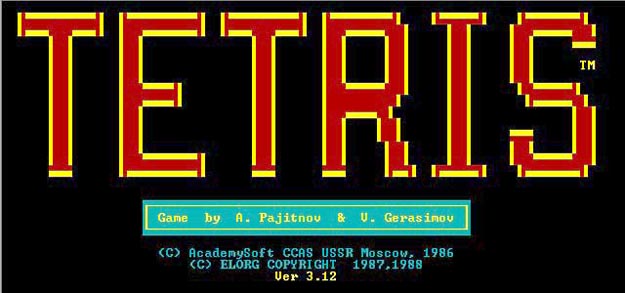
Tetris is released for all home computers. It gets glowing reviews and sells quickly in computer stores. Stein's plan to "steal" the rights to Tetris is foiled when the CBS Evening News interviews Pazhitnov as the inventor of the game. A new company, ELORG (Electronorgtechinca), takes over the negotiations with Stein.
ELORG's director, Alexander Alexinko, realizes that Stein is giving out rights he doesn't have and threatens to cut off any deal. Stein, in turn, threatens to start an international litigation.
May 1988
After months of bickering, Stein signs a contract with ELORG to make Tetris for computers. The contract expressly forbids rights to arcade and handheld versions, and any other mediums "which we did not dream about yet". Meanwhile, Tetris has become the top-selling computer game in England and the United States.
July 1988
 Stein meets with Alexinko in Paris to work out arcade rights to Tetris.
Alexinko has quite a different agenda; he hasn't seen any money from Stein
at all yet. Meanwhile, Spectrum and Mirrorsoft are sub-licensing their rights.
Spectrum gives Bullet-Proof Software the rights to make Tetris video
and computer games in Japan; at the same time, Mirrorsoft gives Atari Games
the exact same rights in Japan and North America. The two
companies start infighting.
Stein meets with Alexinko in Paris to work out arcade rights to Tetris.
Alexinko has quite a different agenda; he hasn't seen any money from Stein
at all yet. Meanwhile, Spectrum and Mirrorsoft are sub-licensing their rights.
Spectrum gives Bullet-Proof Software the rights to make Tetris video
and computer games in Japan; at the same time, Mirrorsoft gives Atari Games
the exact same rights in Japan and North America. The two
companies start infighting.
Robert Maxwell, owner of both Mirrorsoft and Spectrum, sides with Mirrorsoft on the matter. Atari starts plans to release an arcade and NES game (under the Tengen label). Bullet-Proof Software still has the computer rights in Japan; BPS president Henk Rogers successfully gets the rights to release a video-game version later in the year. Tetris is released for the Famicom in early November 1988; eventually, two million cartridges would be sold.
November 1988
The Game Boy is undergoing development. Nintendo of America head Minoru Arakawa wants to make Tetris the pack-in game; he enlists Henk Rogers to get the handheld rights to Tetris for him. Rogers contacts Stein but basically gets stonewalled by him, so Rogers decides to fly to Moscow to get the rights himself.
Stein, sensing why Rogers asked for the rights, flies to Moscow as well. Robert Maxwell's son, Kevin, also decides to fly to Moscow to straighten out what is by now a large-scale licensing mess. The three men fly into Moscow at the exact same time.
February 21, 1989
Rogers gets to ELORG representative Evgeni Belikov first. He impresses Alexey Pazhitnov and the Russians, and signs a contract for the handheld rights to Tetris. Afterward, Rogers shows off the Famicom version of Tetris to the Russians. Belikov is shocked. He didn't give Rogers the rights to make a console version! Rogers explains that he got the rights from Tengen; Belikov has never heard of Tengen! Rogers, trying to appease the Russians, tells Belikov the part of the story Stein did not tell him, and writes him a check for royalties on the Tetris cartridges he has already sold, with promises of more checks. He sees that he has a chance to get all the console rights to Tetris, but knows that the much larger Atari will fight him. Fortunately, he has Nintendo on his side!
A reminder: Robert Stein's original agreement was only for computer versions of Tetris. Any other rights he gave out weren't his to sell.
Later, Stein makes it to ELORG. Belikov makes him sign an alteration to the original contract defining computers as "PC computers which consist of a processor, monitor, disk drive(s), keyboard and operation system". Stein misses this line defining computers; he later realizes that it was all a big orchestration on Rogers' part to get his rights from Stein. The next day, he is told that, although he can't get the handheld rights at the moment, he can get the arcade-game rights. He signs the contract for them three days later.
February 22, 1989
Kevin Maxwell visits ELORG. Belikov takes out Rogers' Famicom Tetris cart and asks him about it. Maxwell was unaware that his own company gave some rights to Atari Games until he reads Mirrorsoft's name on the cartridge. Maxwell asserts that the cart is a pirated copy, and returns to his agenda of getting the arcade and handheld Tetris rights. He leaves with only the right to bid on any rights remaining on Tetris.
The final scorecard: Kevin Maxwell walks off with a piece of paper, Robert Stein with the arcade rights, and ELORG with conclusive evidence, thanks to Maxwell's assertion that any Famicom carts are pirates, that it never sold the video game rights. If Maxwell wanted those rights it would have to outbid Nintendo. Henk Rogers has the handheld rights and tells Arakawa at NOA that the console rights are up for grabs. BPS makes a deal to let Nintendo make Tetris for Game Boy; a deal that was ultimately worth between $5 and 10 million to BPS.
March 15, 1989
Henk Rogers returns to Moscow and makes a gigantic offer for the console rights to Tetris on behalf of Nintendo - an offer that, although undisclosed, was high enough that Mirrorsoft did not try to match it. Arakawa and NOA chief executive officer Howard Lincoln fly to the USSR.
March 22, 1989
A contract for the home videogame rights is finalized with Nintendo, which insists on a clause that the Russians would come to America to testify in the legal battle that would undoubtedly ensue after word of the contract comes out. The advance cash for ELORG is reported to be around $3 to 5 million. Belikov wires Mirrorsoft saying that neither it, Andromeda, or Tengen were authorized to distribute Tetris on video game systems, and that those rights are now given to Nintendo. The Nintendo and BPS executives have a party that night in their Moscow hotel room.
March 31, 1989
Howard Lincoln gleefully faxes Atari Games a cease-and-desist order to stop manufacturing any version of Tetris for the NES. Both Atari and Robert Maxwell become furious. Tengen responds to Nintendo on April 7th that they completely own the rights to home versions of Tetris.
April 13, 1989
Tengen files an application for a copyright of the "audiovisual work, the underlying computer code and the soundtrack" of Tetris for the NES. The application does not mention Alexey Pazhitnov or Nintendo's rights to the game.
Robert Maxwell, meanwhile, is using his vast media empire to try to get Tetris back. He contacts both the Soviet and British governments to intervene on the Tetris matter. Infighting between the Communist party and ELORG begins, and Maxwell gets a promise from no less than Mikhail Gorbachev that he "should no longer worry about the Japanese company".
In late April, Lincoln flies back to Moscow and learns of ELORG's being put upon by the government. In the middle of the night, he receives a call from NOA that Tengen has sued Nintendo.
The next day, he starts interviewing Belikov, Pazhitnov, and many others at ELORG, to make sure that Nintendo's case for the Tetris home rights is airtight. NOA immediately countersues Tengen, and evidence begins to be gathered.
May 17, 1989
Tengen releases their version of Tetris with a full-page ad in
USA Today, despite the coming legal battle.
June 1989
The court case between Tengen and Nintendo begins.
The battle mostly hinged on one matter: Was the Nintendo Entertainment System a computer, under the definition in the contract that Belikov made Stein sign, or a video-game system? Atari argued that the NES was meant to be a computer, due to its expansion port and the existence of a computer network for the Famicom (short for "Family Computer") in Japan. Nintendo's argument was more to the point: the Russians at ELORG had never had the intention of selling the video game rights to Tetris; the definition of "computer" in Stein's contract proved it.
June 15, 1989
A hearing is held about the injunctions Tengen and Nintendo had given each
other to cease manufacture and sale of their respective versions of Tetris.
Judge Fern Smith decides that neither Mirrorsoft nor Spectrum Holobyte had
been granted the video game rights, so therefore it could not have legally
given those rights to Tengen. Nintendo's injunction request is granted.
June 21, 1989
Tengen's version of Tetris is taken off the shelves, and manufacture
of the Tengen version is ceased. Several hundred thousand copies of Tengen
Tetris, sitting in their boxes, lie in a warehouse.
July 1989
Nintendo's version of Tetris for the NES is released. About three
million are sold in the US. At the same time, the Game Boy, with Tetris
as the pack-in, is being sold. America gets Tetrisized.
This ends the main history of Tetris; the lawsuit between Nintendo and Atari would continue to drag on and on and on (it was finally finished up by 1993).
Epilogue
Atari Games still released an arcade version of Tetris, selling about twenty thousand units. Atari Games was recently bought up by Williams/WMS; the fate of the Tengen Tetris carts lying in warehouses is unknown. In all likelihood they were bulldozed since Tengen could not legally get rid of them any other way. If the figures are to be believed, there are about one hundred thousand Tengen Tetris cartridges floating around; a less-than-average run by NES standards, but still nowhere near an impossible cart to find.
Robert Stein made, in total, about $250,000 on Tetris. He could have made a great deal more, of course, but Stein had trouble getting Atari and Mirrorsoft to pay him royalties for the (bogus) rights he sold them. Spectrum Holobyte had to organize another deal with ELORG just to hold on to the computer rights to Tetris.
Robert Maxwell's large-scale media organization collapsed in the midst of the struggle, and Robert Maxwell himself died suspiciously as questions rose about whether he was entirely honest about his business dealings. As a result, Mirrorsoft UK faded away as well.
The big winners of the whole affair were Henk Rogers, president of BPS, and Nintendo themselves. How much did Tetris make for Nintendo? That's difficult to answer, considering that Tetris being the pack-in for the Game Boy enticed customers to buy the Game Boy.. and from there, buy other Game Boy carts. Bringing all this into account, the figure can go up and up and up. About 30 million Game Boy Tetris carts have been made.
As for the Russians, no one made big money from Tetris except for the Soviet government. As the USSR broke up, the people at ELORG and the Academy scattered across the country.
Alexey Pazhitnov proved to have a marketing talent in in 1996 he got the right for Tetris back to him. In 1996, with the financial backing of Henk Rogers, he organized The Tetris Company LLC, and is now getting royalties for his creation. It looks like Vadim Gerasimov was not invited...
 |
 |
 |
Nov 12, 2011 | http://arstechnica.com/
I write about video games for a living, and I've heard everything there is to say about how something may or may not be a giant waste of time. On the other hand, there is nothing I find more fascinating than tiny things in life that most people don't care about, but obsess others. Take, for instance, Tetris. It's a very popular game that almost all of us have played at some point or another, but an upcoming documentary shows just how serious some take the game.
Take a look at the trailer.
From the film's official site:This is the official trailer for Ecstasy of Order: The Tetris Masters, a feature length documentary capturing the greatest world record Tetris players as they prepare for the Classic Tetris World Championship.
From the days of Thor Aackerlund and his historic victory at the 1990 Nintendo World Championships, right up to the present and Harry Hong's perfect "Max-Out" score, this documentary expertly chronicles over two decades of Tetris Mastery.
Tetris is a game about creating order from chaos, and that's a powerfully addictive action. We'll be covering this film and the people in it in more detail soon, but for now... wow. I had no idea this community existed.
|
|
|
|
|
|
|
|
|
Sputnik burned up in the atmosphere, Berlin is now one city, but 25 years later, the Soviet-designed Tetris remains one of the most popular and ubiquitous video games ever created. It has sold over 125 million copies, been released for nearly every video-game platform of the past two decades and even been played on the side of a skyscraper.
|
|
|
Tetris originated in Russia around 1985 and was never patented, at the time intellectual property rights were not established in then communist Russia for private individuals.Tetris Authors Alexey Pajitnov, Dmitry Pavlovsky, and Vadim Gerasimov
The original author of Tetris was Alexey Pajitnov (Pazhitnov), assisted by Dmitry Pavlovsky and Vadim Gerasimov. Computer engineers, Alexey Pajitnov and Dmitry Pavlovsky worked together at the Computer Center of the Russian Academy of Sciences. Alexey Pajitnov had already published and sold several psychology based games. Dmitry Pavlovsky had written computer games for mainframes. High school student, Vadim Gerasimov (only sixteen at the time) had just written a directory encryption program for MS DOS when he introduced to the pair. It was Alexey Pajitnov who first conceived of the game Tetris based on another game of his called Genetic Engineering. Alexey Pajitnov and Henk Rogers later founded the Tetris Company.Tetra means Four
The name Tetris comes from the Greek work tetra or "four". Tetris is a computer puzzle game in which various shapes each made of four squares are falling down a well. The user turns the pieces around and moves them left or right in order to arrange them on top of the other. When a solid line of squares is made from edge to edge, the line dissolves and all the pieces move down by one square. When the lines dissolve points are won, when the well fills up the game ends. Players work hard to keep the well as empty as possible, but as the game progresses the pieces fall faster and faster making that harder.
|
|
|
It sounds astonishing, but tetris game had appeared long before computers were invented. The original tetris game was known as Pentomino. Its goal is to fill the given field without spaces with the help of various figures that consist of five (Latin "penta") square blocks. The figures used in Pentomino look like this:
Up to isomorphism (rotating and flipping), there are 12 possible shapes, which are illustrated above. Each piece is labelled by the letter that most accurately reflects its shape. The problem is to fit the 12 pentomino pieces into various shapes, often rectangles. The rectangle shapes that fit all 60 squares are of sizes 3x20, 4x15, 5x12, and 6x10.
Alexey Pazhitnov - the "Father" of Tetris
Several decades gone away, the first computers appeared. Once upon a time (in 1985) a Russian developer Alexey Pazhitnov wondered if it would be possible to make this addictive game even more captivating. He added a key element that made Tetris a mix of arcade and puzzle genre - time factor. The second Alexey's idea was to cut down the number of blocks that make a pentomino figure. This way "penta" turned to "tetri", and the figures became more simple:
These features made tetris game extremly popular. All Alexey's friends and co-workers have been playing the game. This wasn't a pleasant fact for the directors of the "Moscow Academy of Science's Computer Center", but there was no way back. The game has gained popularity all over the world.
Tetris Becomes a Best-selling Game All Over the World
In June 1985 the remarkable story of tetris game began while tetris was created by Pazhitnov and then ported to the IBM PC by Vadim Gerasimov. Then tetris game started to spread all over Moscow and then over the whole world. First it was brought to Hungary, where Hungarian programmers ported tetris to Apple II and Commodore 64.The game was noticed in the world and several representatives of big publishing companies addressed tetris author to sell them the rights for the tetris game distribution. Alexey signs the contract with Mirrorsoft UK and Spectrum Holobyte, giving them the rights to computer versions of Tetris. After the first copies of Tetris for home computers were sold, the game immediately gained extreme popularity among people. It has become the best-selling computer game in England and USA in 1988.
Extreme popularity of tetris game caused a competitive activity of several publishing companies, wishing to obtain the rights to produce Tetris for console and handhelds. At first Tetris has been released for Famicom with two million of cartridges sold, then Nintendo sold several million copies for NES. At the same time Game Boy with Tetris packed in was sold throughout the world, adding more and more fans to the crowds keen on tetris game.
Google matched content |
Tetris was a popular game developed in 1985-86
by Alexey Pajitnov, Dmitry Pavlovsky, and me. Pajitnov and Pavlovsky
were computer engineers at the Computer Center of the Russian Academy
of Sciences. I was a 16-year-old high school student at the time. My
computer science teacher brought me to the Computer Center where I was
allowed to play with IBM PCs. I learned how to deal with PCs very
quickly.
Society
Groupthink : Two Party System as Polyarchy : Corruption of Regulators : Bureaucracies : Understanding Micromanagers and Control Freaks : Toxic Managers : Harvard Mafia : Diplomatic Communication : Surviving a Bad Performance Review : Insufficient Retirement Funds as Immanent Problem of Neoliberal Regime : PseudoScience : Who Rules America : Neoliberalism : The Iron Law of Oligarchy : Libertarian Philosophy
Quotes
War and Peace : Skeptical Finance : John Kenneth Galbraith :Talleyrand : Oscar Wilde : Otto Von Bismarck : Keynes : George Carlin : Skeptics : Propaganda : SE quotes : Language Design and Programming Quotes : Random IT-related quotes : Somerset Maugham : Marcus Aurelius : Kurt Vonnegut : Eric Hoffer : Winston Churchill : Napoleon Bonaparte : Ambrose Bierce : Bernard Shaw : Mark Twain Quotes
Bulletin:
Vol 25, No.12 (December, 2013) Rational Fools vs. Efficient Crooks The efficient markets hypothesis : Political Skeptic Bulletin, 2013 : Unemployment Bulletin, 2010 : Vol 23, No.10 (October, 2011) An observation about corporate security departments : Slightly Skeptical Euromaydan Chronicles, June 2014 : Greenspan legacy bulletin, 2008 : Vol 25, No.10 (October, 2013) Cryptolocker Trojan (Win32/Crilock.A) : Vol 25, No.08 (August, 2013) Cloud providers as intelligence collection hubs : Financial Humor Bulletin, 2010 : Inequality Bulletin, 2009 : Financial Humor Bulletin, 2008 : Copyleft Problems Bulletin, 2004 : Financial Humor Bulletin, 2011 : Energy Bulletin, 2010 : Malware Protection Bulletin, 2010 : Vol 26, No.1 (January, 2013) Object-Oriented Cult : Political Skeptic Bulletin, 2011 : Vol 23, No.11 (November, 2011) Softpanorama classification of sysadmin horror stories : Vol 25, No.05 (May, 2013) Corporate bullshit as a communication method : Vol 25, No.06 (June, 2013) A Note on the Relationship of Brooks Law and Conway Law
History:
Fifty glorious years (1950-2000): the triumph of the US computer engineering : Donald Knuth : TAoCP and its Influence of Computer Science : Richard Stallman : Linus Torvalds : Larry Wall : John K. Ousterhout : CTSS : Multix OS Unix History : Unix shell history : VI editor : History of pipes concept : Solaris : MS DOS : Programming Languages History : PL/1 : Simula 67 : C : History of GCC development : Scripting Languages : Perl history : OS History : Mail : DNS : SSH : CPU Instruction Sets : SPARC systems 1987-2006 : Norton Commander : Norton Utilities : Norton Ghost : Frontpage history : Malware Defense History : GNU Screen : OSS early history
Classic books:
The Peter Principle : Parkinson Law : 1984 : The Mythical Man-Month : How to Solve It by George Polya : The Art of Computer Programming : The Elements of Programming Style : The Unix Hater’s Handbook : The Jargon file : The True Believer : Programming Pearls : The Good Soldier Svejk : The Power Elite
Most popular humor pages:
Manifest of the Softpanorama IT Slacker Society : Ten Commandments of the IT Slackers Society : Computer Humor Collection : BSD Logo Story : The Cuckoo's Egg : IT Slang : C++ Humor : ARE YOU A BBS ADDICT? : The Perl Purity Test : Object oriented programmers of all nations : Financial Humor : Financial Humor Bulletin, 2008 : Financial Humor Bulletin, 2010 : The Most Comprehensive Collection of Editor-related Humor : Programming Language Humor : Goldman Sachs related humor : Greenspan humor : C Humor : Scripting Humor : Real Programmers Humor : Web Humor : GPL-related Humor : OFM Humor : Politically Incorrect Humor : IDS Humor : "Linux Sucks" Humor : Russian Musical Humor : Best Russian Programmer Humor : Microsoft plans to buy Catholic Church : Richard Stallman Related Humor : Admin Humor : Perl-related Humor : Linus Torvalds Related humor : PseudoScience Related Humor : Networking Humor : Shell Humor : Financial Humor Bulletin, 2011 : Financial Humor Bulletin, 2012 : Financial Humor Bulletin, 2013 : Java Humor : Software Engineering Humor : Sun Solaris Related Humor : Education Humor : IBM Humor : Assembler-related Humor : VIM Humor : Computer Viruses Humor : Bright tomorrow is rescheduled to a day after tomorrow : Classic Computer Humor
The Last but not Least Technology is dominated by two types of people: those who understand what they do not manage and those who manage what they do not understand ~Archibald Putt. Ph.D
Copyright © 1996-2021 by Softpanorama Society. www.softpanorama.org was initially created as a service to the (now defunct) UN Sustainable Development Networking Programme (SDNP) without any remuneration. This document is an industrial compilation designed and created exclusively for educational use and is distributed under the Softpanorama Content License. Original materials copyright belong to respective owners. Quotes are made for educational purposes only in compliance with the fair use doctrine.
FAIR USE NOTICE This site contains copyrighted material the use of which has not always been specifically authorized by the copyright owner. We are making such material available to advance understanding of computer science, IT technology, economic, scientific, and social issues. We believe this constitutes a 'fair use' of any such copyrighted material as provided by section 107 of the US Copyright Law according to which such material can be distributed without profit exclusively for research and educational purposes.
This is a Spartan WHYFF (We Help You For Free) site written by people for whom English is not a native language. Grammar and spelling errors should be expected. The site contain some broken links as it develops like a living tree...
|
|
You can use PayPal to to buy a cup of coffee for authors of this site |
Disclaimer:
The statements, views and opinions presented on this web page are those of the author (or referenced source) and are not endorsed by, nor do they necessarily reflect, the opinions of the Softpanorama society. We do not warrant the correctness of the information provided or its fitness for any purpose. The site uses AdSense so you need to be aware of Google privacy policy. You you do not want to be tracked by Google please disable Javascript for this site. This site is perfectly usable without Javascript.
Last updated: March 12, 2019


