|
|
Home | Switchboard | Unix Administration | Red Hat | TCP/IP Networks | Neoliberalism | Toxic Managers |
| (slightly skeptical) Educational society promoting "Back to basics" movement against IT overcomplexity and bastardization of classic Unix | |||||||
| 2009 | 2008 | 2007 | 2006 | 2005 | 2004 | 2003 | 2002 | 2001 | 2000 |
BSD Today Running numerous operating systems at the same time
InfoWorld: Am I the only one who doesn't know why to use VMware?(Dec 10, 2000)
LinuxPlanet: VMware Makes Move for Server with Two New Products(Dec 05, 2000)
NewsForge:
Plex86, VMware compete to get rid of dual booting(Nov 20, 2000)
plex86.org:
Plex86 runs Windows95(Nov 16, 2000)
Linux-Mandrake.com:
MandrakeSoft buys Bochs for Linux and commits it to Open Source.(Mar 23, 2000)
VMware enables you to run a Virtual Machine, which is VMware's version of an emulated state of Windows, Linux, or FreeBSD. You heard me right-on VMware, not only can you do Windows, but also Linux and FreeBSD. That means if you need to test out that new version of Linux, but you don't want to format your drive just to test it out, VMware can just create a virtual drive and you're on your way to seeing what the latest version of your favorite distribution has to offer.
To date, VMware has been pretty much a development product, but thanks to demand for a stable, versatile operating environment, VMware has upped the ante and created their best version of VMware yet-2.0.2.
If you've used a package like Connectix VirtualPC for the Macintosh PowerPC, you'll notice many likenesses it shares with VMware. The website may really hype VMware up and make it sound like there is no loss of performance, but the simple fact is that you do lose clock speed, RAM and hard disk speed, just like you would with any piece of emulation software.
In fact, you can tell both VMware and VirtualPC are designed along the same lines. The configuration is much the same, except one is obviously more PC-fied, while one is more Mac-centric.
Although, what it comes down to is compatibility. VMware does a much better job at emulating x86 hardware, probably since it's operating on top of x86 hardware. That's a logical assumption, right? Enough with guesswork, let's take a look at what's really going on.
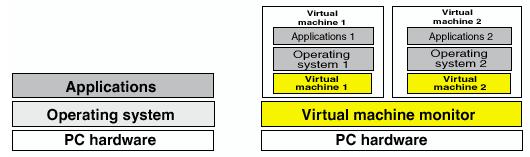
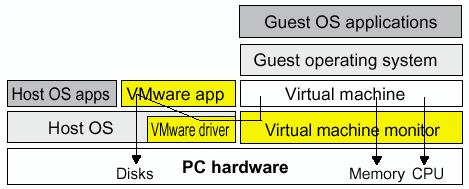
Here we see how it really works. A typical PC works like we see on the left. I think the diagram oversimplifies things in a way, but it will do the job.Essentially, VMware interfaces directly with most your system hardware, which is one way it achieves pretty good performance even on low-end machines. Don't get me wrong, you still won't get the full speed of your PC out of VMware, this happens because things like the hard disk access (where it looks to be hurting the most) are still done through the operating system.
This is how it all happens. This diagram shows you the devices which need VMware still needs to call through the OS-disk, memory and CPU.
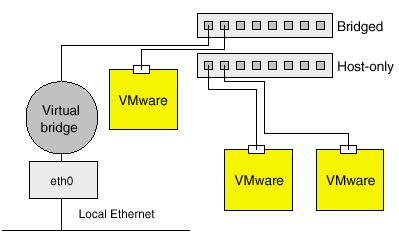
Once again, VMware has a few tricks up its sleeve. One great thing about VMware is that you can utilize your local network to get access to your Windows or Linux filesystem. In fact, you can even use a regular network along with your local network at the same time, so you don't need to sacrifice anything with the networking setup.
PALO ALTO, Calif., May 24 /PRNewswire/ -- VMware, Inc., the leading provider of application and service delivery platforms based on innovative virtual machine technology, today announced the closing of a $20 million strategic financing round led by Dell.
VMware launched its first product in May 1999 -- software for desktop personal computers that enables a single PC to simultaneously run multiple, protected sessions with any combination of Linux, Windows NT, Windows 2000 and other Intel based operating systems. Today, VMware has more than 385,000 registered users, and is licensed in 5,000 corporations, in more than 100 countries. The company will use the funds to accelerate the development and deployment of server-based products for providers of hosted applications and services over the Internet or corporate intranets.
"We see VMware as a significant emerging technology in the computing industry," said Jim Totton, Dell's vice president of worldwide software development. "Dell continues to invest in technologies that show strategic potential in the marketplace."
"This financing positions VMware to move into the next phase of growth and evolution of our business strategy: deploying VMware virtual machine technology as a platform for Internet commerce and infrastructure," said Diane Greene, a co-founder and chief executive officer of VMware. "We expect the investment to have a huge impact on our current desktop business as well as speeding time to market for our server products."
VMware's server products will address some of the most critical issues facing providers of hosted applications and services. These include how to guarantee security on shared servers, maintain the stability of existing servers when adding new applications and services and overcome the incompatibility of Linux, Windows NT and Windows 2000. "Today's solution -- a server for each application, service or customer -- is not only expensive, but creates enormous systems administration and management problems," said Greene.
Society
Groupthink : Two Party System as Polyarchy : Corruption of Regulators : Bureaucracies : Understanding Micromanagers and Control Freaks : Toxic Managers : Harvard Mafia : Diplomatic Communication : Surviving a Bad Performance Review : Insufficient Retirement Funds as Immanent Problem of Neoliberal Regime : PseudoScience : Who Rules America : Neoliberalism : The Iron Law of Oligarchy : Libertarian Philosophy
Quotes
War and Peace : Skeptical Finance : John Kenneth Galbraith :Talleyrand : Oscar Wilde : Otto Von Bismarck : Keynes : George Carlin : Skeptics : Propaganda : SE quotes : Language Design and Programming Quotes : Random IT-related quotes : Somerset Maugham : Marcus Aurelius : Kurt Vonnegut : Eric Hoffer : Winston Churchill : Napoleon Bonaparte : Ambrose Bierce : Bernard Shaw : Mark Twain Quotes
Bulletin:
Vol 25, No.12 (December, 2013) Rational Fools vs. Efficient Crooks The efficient markets hypothesis : Political Skeptic Bulletin, 2013 : Unemployment Bulletin, 2010 : Vol 23, No.10 (October, 2011) An observation about corporate security departments : Slightly Skeptical Euromaydan Chronicles, June 2014 : Greenspan legacy bulletin, 2008 : Vol 25, No.10 (October, 2013) Cryptolocker Trojan (Win32/Crilock.A) : Vol 25, No.08 (August, 2013) Cloud providers as intelligence collection hubs : Financial Humor Bulletin, 2010 : Inequality Bulletin, 2009 : Financial Humor Bulletin, 2008 : Copyleft Problems Bulletin, 2004 : Financial Humor Bulletin, 2011 : Energy Bulletin, 2010 : Malware Protection Bulletin, 2010 : Vol 26, No.1 (January, 2013) Object-Oriented Cult : Political Skeptic Bulletin, 2011 : Vol 23, No.11 (November, 2011) Softpanorama classification of sysadmin horror stories : Vol 25, No.05 (May, 2013) Corporate bullshit as a communication method : Vol 25, No.06 (June, 2013) A Note on the Relationship of Brooks Law and Conway Law
History:
Fifty glorious years (1950-2000): the triumph of the US computer engineering : Donald Knuth : TAoCP and its Influence of Computer Science : Richard Stallman : Linus Torvalds : Larry Wall : John K. Ousterhout : CTSS : Multix OS Unix History : Unix shell history : VI editor : History of pipes concept : Solaris : MS DOS : Programming Languages History : PL/1 : Simula 67 : C : History of GCC development : Scripting Languages : Perl history : OS History : Mail : DNS : SSH : CPU Instruction Sets : SPARC systems 1987-2006 : Norton Commander : Norton Utilities : Norton Ghost : Frontpage history : Malware Defense History : GNU Screen : OSS early history
Classic books:
The Peter Principle : Parkinson Law : 1984 : The Mythical Man-Month : How to Solve It by George Polya : The Art of Computer Programming : The Elements of Programming Style : The Unix Hater’s Handbook : The Jargon file : The True Believer : Programming Pearls : The Good Soldier Svejk : The Power Elite
Most popular humor pages:
Manifest of the Softpanorama IT Slacker Society : Ten Commandments of the IT Slackers Society : Computer Humor Collection : BSD Logo Story : The Cuckoo's Egg : IT Slang : C++ Humor : ARE YOU A BBS ADDICT? : The Perl Purity Test : Object oriented programmers of all nations : Financial Humor : Financial Humor Bulletin, 2008 : Financial Humor Bulletin, 2010 : The Most Comprehensive Collection of Editor-related Humor : Programming Language Humor : Goldman Sachs related humor : Greenspan humor : C Humor : Scripting Humor : Real Programmers Humor : Web Humor : GPL-related Humor : OFM Humor : Politically Incorrect Humor : IDS Humor : "Linux Sucks" Humor : Russian Musical Humor : Best Russian Programmer Humor : Microsoft plans to buy Catholic Church : Richard Stallman Related Humor : Admin Humor : Perl-related Humor : Linus Torvalds Related humor : PseudoScience Related Humor : Networking Humor : Shell Humor : Financial Humor Bulletin, 2011 : Financial Humor Bulletin, 2012 : Financial Humor Bulletin, 2013 : Java Humor : Software Engineering Humor : Sun Solaris Related Humor : Education Humor : IBM Humor : Assembler-related Humor : VIM Humor : Computer Viruses Humor : Bright tomorrow is rescheduled to a day after tomorrow : Classic Computer Humor
The Last but not Least Technology is dominated by two types of people: those who understand what they do not manage and those who manage what they do not understand ~Archibald Putt. Ph.D
Copyright © 1996-2021 by Softpanorama Society. www.softpanorama.org was initially created as a service to the (now defunct) UN Sustainable Development Networking Programme (SDNP) without any remuneration. This document is an industrial compilation designed and created exclusively for educational use and is distributed under the Softpanorama Content License. Original materials copyright belong to respective owners. Quotes are made for educational purposes only in compliance with the fair use doctrine.
FAIR USE NOTICE This site contains copyrighted material the use of which has not always been specifically authorized by the copyright owner. We are making such material available to advance understanding of computer science, IT technology, economic, scientific, and social issues. We believe this constitutes a 'fair use' of any such copyrighted material as provided by section 107 of the US Copyright Law according to which such material can be distributed without profit exclusively for research and educational purposes.
This is a Spartan WHYFF (We Help You For Free) site written by people for whom English is not a native language. Grammar and spelling errors should be expected. The site contain some broken links as it develops like a living tree...
|
|
You can use PayPal to to buy a cup of coffee for authors of this site |
Disclaimer:
The statements, views and opinions presented on this web page are those of the author (or referenced source) and are not endorsed by, nor do they necessarily reflect, the opinions of the Softpanorama society. We do not warrant the correctness of the information provided or its fitness for any purpose. The site uses AdSense so you need to be aware of Google privacy policy. You you do not want to be tracked by Google please disable Javascript for this site. This site is perfectly usable without Javascript.
Last modified: March 12, 2019