"Having thus become a mindless tool, the foolish person will also be capable of any evil
and at the same time incapable of seeing that it is evil. This is where the danger of
diabolical misuse lurks, for it is this that can once and for all destroy human beings.”
Dietrich Bonhoeffer, Letters and Papers From Prison
In this page we will try to classify traits that are typical for corporate psychopaths. This is a
very limited approach, but it has certain value as a early warning system.
We also touch an important theme of connection of psychopaths in corner office
and neoliberalism. As
Paul Verhaeghe noted
Neoliberalism
has brought out the worst in us
Imagine if the people of the Soviet Union had never heard of communism. The ideology
that dominates our lives has, for most of us, no name. Mention it in conversation
and you’ll be rewarded with a shrug. Even if your listeners have heard the term
before, they will struggle to define it. Neoliberalism: do you know what it is?
Its anonymity is both a symptom and cause of its power. It has played a major role
in a remarkable variety of crises: the
financial meltdown of 2007‑8, the offshoring of wealth and power, of which the
Panama Papers offer us merely a glimpse, the slow collapse of public health
and education, resurgent child poverty,
the epidemic of loneliness, the collapse of ecosystems, the rise of
Donald Trump. But we respond to these crises as if they emerge in isolation,
apparently unaware that they have all been either catalyzed or exacerbated by the
same coherent philosophy; a philosophy that has – or had – a name. What greater
power can there be than to operate namelessly?
So pervasive has neoliberalism become that we seldom even
recognize it as an ideology. We appear to accept the proposition
that this utopian, millenarian faith describes a neutral force;
a kind of biological law, like Darwin’s theory of evolution.
But the philosophy arose as a conscious attempt to reshape human
life and shift the locus of power.
Neoliberalism sees competition as the defining characteristic of human relations.
It redefines citizens as consumers, whose democratic choices are best exercised
by buying and selling, a process that rewards merit and punishes inefficiency. It
maintains that “the market” delivers benefits that could never be achieved by planning.
Attempts to limit competition are treated as inimical to liberty. Tax and regulation
should be minimized, public services should be privatized. The organization of labor
and collective bargaining by
trade unions are portrayed as market distortions that impede the formation of
a natural hierarchy of winners and losers. Inequality is recast as virtuous: a reward
for utility and a generator of wealth, which trickles down to enrich everyone. Efforts
to create a more equal society are both counterproductive and morally corrosive.
The market ensures that everyone gets what they deserve.
We internalize and reproduce its creeds.
The rich persuade themselves that they acquired their wealth through merit,
ignoring the advantages – such as education, inheritance and class – that may have
helped to secure it. The poor begin to blame themselves for their failures, even
when they can do little to change their circumstances.
Never mind structural unemployment: if you don’t have a job it’s because you
are unenterprising. Never mind the impossible costs of housing: if your credit card
is maxed out, you’re feckless and improvident. Never mind that your children no
longer have a school playing field: if they get fat, it’s your fault. In a world
governed by competition, those who fall behind become defined and self-defined as
losers.
Among the results, as Paul Verhaeghe documents in his book What About Me? are epidemics of self-harm, eating disorders,
depression, loneliness, performance anxiety and social phobia.
Perhaps it’s unsurprising that Britain, in which neoliberal
ideology has been most rigorously applied, is
the loneliness capital of Europe. We are all neoliberals
now.
***
The term neoliberalism was coined at a meeting in Paris in 1938. Among the delegates
were two men who came to define the ideology, Ludwig von Mises and Friedrich Hayek.
Both exiles from Austria, they saw social democracy, exemplified by Franklin Roosevelt’s
New Deal and the gradual development of Britain’s welfare state, as manifestations
of a collectivism that occupied the same spectrum as nazism and communism.
In The Road to Serfdom, published in 1944, Hayek argued that government
planning, by crushing individualism, would lead inexorably to totalitarian control.
Like Mises’s book Bureaucracy, The Road to Serfdom was widely
read. It came to the attention of some very wealthy people, who saw in the philosophy
an opportunity to free themselves from regulation and tax. When, in 1947, Hayek
founded the first organisation that would spread the doctrine of neoliberalism –
the
Mont Pelerin Society – it was supported financially by millionaires and their
foundations.
"The main lesson I have learnt is that when dealing with a sociopath, the normal rules of
etiquette do not apply. You are dealing with someone who has no empathy, no conscience, no remorse,
and no guilt...It is a completely different mindset. Words like 'predator' and 'evil' are often
used."
Field
Neoliberalism -- An economic system that rewards psychopathic
personality traits has changed our ethics and our
personalities
Paul Verhaeghe
Neoliberalism is a social system that rewards and promotes psychopathic
personalities. Among its results, as Paul Verhaeghe documents in his book
What About Me? are epidemics of self-harm, eating disorders,
depression, loneliness, performance anxiety and social phobia.
Perhaps it’s unsurprising that Britain, in which neoliberal
ideology has been most rigorously applied, is
the loneliness capital of Europe. We are all neoliberals
now, so to report to a psychopathic manager is no longer something extraordinary. Neoliberalism sees competition
(as in the "law of jungles") as the defining characteristic of human relations.
It redefines citizens as consumers, whose democratic choices are best exercised
by buying and selling, a process that rewards merit and punishes inefficiency.
It
maintains that “the market” delivers benefits that could never be achieved by planning. Attempts to limit
"dog eat dog" competition between people are treated as inimical to liberty. Tax and regulation
should be minimized, public services should be privatized. The organization of
labor
and collective bargaining by
trade unions are portrayed as market distortions that impede the formation of
a natural hierarchy of winners and losers. Inequality is recast as virtuous: a reward
for utility and a generator of wealth, which trickles down to enrich everyone. Efforts
to create a more equal society are both counterproductive and morally corrosive.
The market ensures that everyone gets what they deserve.
We internalize and reproduce neoliberal dogmas much like people of the USSR
enslaved by Bolsheviks reproduced communist dogmas and did not view themselves
as slaves. The salaried employees begin to blame themselves for their failures, even
when they can do little to change their circumstances.
Psychopathic managers prevent subordinates doing their jobs and prevent employees fulfilling their
duties. Most employees in IT are competent and have both the desire and ability to do good work. What
is missing in some organizations is an environment that encourages and enables the expression of that
competence. In his book, Hall (1988a) states,
If we are to achieve excellence in our organizations and communities, we must be willing to reorient.
We must make a presumption of competence in the workplace rather than incompetence, for high-level
performance rests on the simple, yet not widely accepted, premise that
people will behave competently if we will but let them. (pp. 29-30)
No matter what is precise classification all toxic managers are cruel with subordinates. They tend to create out of the work environment "living hell". Incompetent, dishonest but scheming they charm
the higher ups and climb on the back of others to achieve power. But it is important to understand that
toxic managers would never achieves their goals and climb up the ladder without the disorganization
and willful ignorance of his supervisors typical for some large corporations (Enron is a typical example
here). Fish rots from the head.
The condition itself has been recognized for centuries, wearing evocative labels such as "madness
without delirium" and "moral insanity" until the late 1800s, when "psychopath"
was coined by a German clinician. This condition can be studied by watching film that depict a large
variety of psychopath and allow some generalization based on this experience (which is much better/safer
method to get some level of awareness, then facing one in you own office).
But the term (and its later 1930s synonym that is more applicable to corporate environment, sociopath
-- "socialized psychopath") had always been a sort of catch-all, widely and loosely applied to nonviolent
psychopaths. See
Psychopathic corporation page
for the exploration of connection between corporate psychopaths and modern government organizations
and megacorporations.
The key feature of such people that they do not treat others as humans, they treat them as animals. As an expendable material. Later
this condition was expanded to include certain type of managers that consistently demonstrate cult leader
qualities. Under neoliberals promotion of mamgers with clear sociopathic tendencies (especially females; often so called "sharp
elbow females") became a standard feature of most corporation to the extent that we can consider
corporations to be a breeding grounds for psychopathic personalities. Such "office cult leaders" like
many high demand cult leaders need only followers and try to completely enslave their victims.
"The psychopath has no allegiance to the company at all, just to self,"....
"A psychopath is playing a short-term parasitic game."
In 1980, Hare created a list of static traits, which, revised five years later, became known as the
PCL-R. Popularly called "the Hare," the PCL-R measures psychopathic personality on a forty-point scale.
Despite obvious shortcomings and severe limitations typical for any traits-based classification, once
it emerged, it helped to make the meaning of the term more uniform. This is covered in more detail at
Classification of Corporate Psychopaths
While the executive with sociopathic traits is pretty common most such individuals don't typically
wind up in prison. They represent a category, often called socialized psychopaths or sociopaths. In fact, many are promoted
explicitly due to callousness and ruthlessness which is highly valued in neoliberal corporations. One well-known example is
Chain
Saw Al:
In 2005, the business magazine
Fast
Company included Dunlap in the article 'Is Your Boss a
Psychopath', noting he
"might score impressively on the Corporate Psychopathy checklist." The magazine's editor. John A.
Byrne, noted: "In all my years of reporting, I had never come across an executive as manipulative,
ruthless, and destructive as Al Dunlap. Until the Securities and Exchange Commission barred him
from ever serving as an officer of a public corporation, Dunlap sucked the very life and soul out
of companies and people. He stole dignity, purpose, and sense out of organizations and replaced
those ideals with fear and intimidation."
In popular literature, psychopath is often defined as someone who displays several distinguishing
characteristics, such as deceitfulness, compulsive lying
(lying even when they're is no real need to hide the truth), impulsivity and a complete almost inhuman lack of remorse. Compulsive
lying and cruelty to animals in adolescence are two pretty reliable indicators of this condition.
Right wing authoritarians (RWA) also display many similar traits,
but in no way they are psychopaths. As
The
Washington Monthly noted
...their pure combined essence:
unbounded arrogance and self-righteousness,
a chip on his shoulder the size of a redwood,
a studied contempt for anybody's opinion but his own,
Typically sociopaths demonstrates a superficial charm, which they exercise ruthlessly in order to
get what they want. In this sense women are a much more dangerous type of
psychopath. That implies that working women, especially in IT have an enemy more formidable
than men. Female psychopaths usually see everything in terms of competition and
female
aggression. They have zero respect for their own gender. Just the opposite, they often hate it.
Statistics suggest that a woman is the target in eight of every ten cases of bulling.
But, paradoxically, in six of 10 cases, it is a woman who is the bully.
They despise and attack female subordinates and try to undermine their more successful/competent female
peers.
In the latter case, they assume that they have achieved their success by using charm/sex/chicanery.
They also use their gender as a bulletproof vest against males, claiming discrimination when it is convenient
to them. This dirty trick of "fake victim" works wonders in modern bureaucratic organizations. Female-to-female
aggression is also observable in primates. Dominant female try to suppress reproductive success of competitor
females in various ways including subjecting them to constant stress via harassment and intimidation
and/or attacking offspring:
Holmstrom (1992) summarizes his review by saying that indirect strategies were observed among female
great apes during the following three circumstances:
In the power struggle among females, by cannibalistically feeding on the competitor's offspring;
against the male, in sexual contexts by refusal of cooperation to sexual access; also in
competition for food, and feeding on the male's offspring;
through the offspring, by rearing the young and transmitting models of behavior from one
generation to the next. The female thus prevents and restrains certain kinds of action in the
offspring, permitting and favoring others. Accordingly, the social intelligence of higher primates
should not be underestimated. As Byrne and Whiten (1987) have shown, chimpanzees are also fully
capable of faking nonverbal signals, in order to deceive competitors.
There is a not so obvious link of corporate psychopath and cult leaders. They generally demonstrate
the same methods: they never recognize the rights of others and see their self-serving behaviors permissible.
They appear to be charming, yet are covertly hostile and domineering, seeing their victim as merely
an instrument to be used. They dominate and humiliate their victims trying to convert them to
slaves.
Surprising percentage of corporate psychopaths are women, They does not see others around her/him
as people, but only as targets and opportunities. Instead of friends, they have victims and accomplices
who end up as victims and, in corporate environment, slaves.
List of common sociopathic traits which might help
to alert you to the danger
Compulsive,
pathological
lying. And due to this frequent self-contradiction especially about the fact of
personal history; invented past and or excessive boasting about his successes (often of
sexual nature); they are compulsive liars and
lie even when there is no obvious need to it...
Manipulative, arrogant, callous behaviour as a norm. Complete lack of remorse and
empathy. as manipulative and cunning" as con artists. Their personality attributes typically
include superficial charm, unreliability, untruthfulness, and insincerity. Pathological
egocentricity, selfishness, and rejection of authority and discipline,
Impatient/Impulsiveness/Exaggerated sexuality ( Impulsiveness is less common
for corporate sociopaths; those prone to this are weeded early by corporate culture). But
exaggerated sexuality is very common and is a good warning sign. They tend to be impulsive
risk takers in life as well as in sex.
Unreliability, untruthfulness, and insincerity. Please understand that betrayal
is a typical behaviour for them, and they resort to it in situation were normal person would
never do without any remorse...
Prone to fly into rages. See Borderline
Rage "natural emotion is consciously controlled and used as a sharp weapon.
Inability to accept any responsibility for their actions. Typically they has
little or no concern about the consequences of their actions. That actually make them very
effective sexual predators as a side effect.
"Courage under fire." In high tension situations they behave rationally and are
not prone to panic.
Corporate America is a veritable hive of white-collar crazies. Identifying, defining, and diagnosing
exact personality disorders your boss suffers from can be a tricky business. Still one sign is universal:
the workplace in such cases quickly becomes overflowing with tension.
These white-collar psychopaths or sociopaths are "individuals who most often do not act out in a
criminal way, yet can be just as manipulative and cunning" as a serial killer. Their personality attributes
"typically include superficial charm, unreliability, untruthfulness, and insincerity, [a] lack of guilt,
remorse, or shame, [and] a need to engage in thrill-seeking behavior," as well as pathological lying,
egocentricity, selfishness, and rejection of authority and discipline, according to the authors. In
short, they are corporate con artists. They're the tech administrators who over-order company laptops
and hawk them on eBay, or employees who sabotage bosses' and coworkers' careers by appropriating their
ideas and denigrating their performance to supervisors. They're the outgoing employees who act friendly
to their colleagues only to stab them in the back at every opportunity.
Middle management may be the natural habitat of the white-collar psychopath: Psychopaths are known
for their extroversion, their charm, and their polished social skills, and complete disregard of people
while trying to achieve corporate goals. Such traits are rewarded within many organizations.
In Snakes in Suits, the authors argue that corporate psychopaths follow a "PPP" pattern
that involves three types of players:
Pawns. Psychopaths recruit pawns such as lower-ranking employees
or peers, whom they can manipulate.
Patrons. Patrons are higher-level managers whom the psychopath wins over. They often
provide cover for psychopath. It is at them all the charm is directed (which makes behavior of sociopath
similar to the behavior of authoritarian - quintessential kiss up --
kick down personality). Because the psychopath seems
charming to higher-ups, he or she can counter accusations.
Patsies. The patsies are pawns and patrons whom the psychopath has abused, taken advantage
of, cheated, blamed, or ridiculed
Their penetration in organization is usually staged in several phases:
The entry phase, in which the psychopath charms the hiring team into selecting him or
her for the job.
The assessment phase. Here, the psychopathic employee identifies
the potential support network of that consist of:
Patrons (those who will protect and defend the psychopath),
Pawns (those who can be unwittingly manipulated into using their power in service
of the psychopath's aims),
Organizational Police (staff in such control functions as audit, security, human
resources who might get in the way).
The manipulation phase: the psychopath works the patrons and pawns, building the influence
network through close and intense one-on-one relationships and at the same time moving up the organization.
Confrontation phase. Individuals no longer deemed useful discover they've been wiped,
relegated from close friend to Patsy. Two factions start forming:
Influential supporters (Pawns and Patrons);
Powerless detractors (Patsies and Police).
Cuckoo egg stage. That's when all that planning and manipulation pays off - the patrons
are betrayed, the boss is shoved aside and the psychopath moves in.
One needs to understand that being a target of a psychopath is a permanent position. One horrifying
detail in the definition of personality disorders is rigidility and inflexibility of patterns
of thought and action (a good example is compulsive lying -- a defining feature of a sociopath
that distinguishes them from authoritarians) (Wikipedia
) :
Personality disorders form a class of
mental disorders that
are characterized by long-lasting rigid patterns of thought
and actions. Because of the inflexibility and pervasiveness of these
patterns, they can cause serious problems and impairment of functioning for the persons who are
afflicted with these disorders.
Personality disorders are seen by the
American
Psychiatric Association as an enduring pattern of inner experience and behavior that deviates
markedly from the expectations of the culture of the individual who exhibits it.
These patterns are inflexible and pervasive across many situations.
The onset of the pattern can be traced back at least to the beginning of adulthood. To be diagnosed
as a personality disorder, a behavioral pattern must cause significant distress or impairment in
personal, social, and/or occupational situations.
Related term Antisocial personality disorder is defined as:
Antisocial personality disorder (abbreviated APD or ASPD) is a
psychiatricdiagnosis in the
DSM-IV-TR recognizable by the disordered individual's impulsive
behavior, disregard for social norms, and indifference to the rights and feelings of others.
Such people distort and change meaning for the most ordinary social interactions: A simple difference
of opinion, for example, can quickly escalate into a major and violent conflict.
As insightful page The toxic
manager in the office a guide to toxic managers and toxic management in a toxic work environment
states "We've all encountered them. Moody, aggressive, unpredictable, incompetent, always blaming other
people. A compulsive liar with a Jekyll and Hyde nature, the individual, male or female, is always charming
and plausible when management are around." Unpredictable outbursts of hostility, conflicting demands,
inconsistent orders, random decision-making, inability to plan strategically, inability and unwillingness
to communicate and co-operate, obstructive ... the list goes on.
Any psychopath does not see people as valuable, but only tools to be used in his game.
As such they are capable if immense cruelty.
After some conversations with corporate psychopath you feel like you left the ring after facing opponent
twice heavier then you and not playing by the rules. Everything will be your fault. You have a "negative
attitude", you're a "poor performer", you're "not up to the job", and so on. If you get as far as alerting
personnel or human resources management, it'll be a "personality clash". In truth,
this is aprojectionof the psychopaths own negative attitude, poor performance, and incompetence.
If you are targeted by one it is important to understand that that psychopaths completely lack empathy
for other people. That means that their are oblivious to sufferings they inflict. Absolutely oblivious.
They tend to be rigid and inflexible, have hidden agendas, and have an unusually hard time recognizing
or respecting boundaries. They're weighed down by irrational beliefs such as "To be criticized
means I'm a failure" or "If I follow orders, I'm weak". Disturbingly, individuals with personality disorders
not only tend to dismiss the idea that they have a problem, but often see their unpleasant traits as
strengths and take pride in them. For this reason, many such individuals respond poorly to therapy --
if they agree to seek treatment at all.
For example, do you have a manager who focuses so single-mindedly on rules, regulations, and productivity
to the extent that actual real work grinds to a halt? Is she unsatisfied with any solution you proposed,
work compulsively till all hours, avoid making decisions, and insist that her way of doing things is
the only way? If so, your boss may be suffering from obsessive-compulsive personality disorder.
This is not the same as obsessive-compulsive illness -- you're not likely to see her obsessively
washing her hands. The best defense strategy: find a transfer or a new job. If you need to stay avoid
arguments, keep a low profile, and steer clear of conflicts that you'll never win.
If you think you work for one of these individuals, the authors say,
don't be fooled by "props" like the ready smile and good eye contact. Instead, watch your back. Seriously consider switching jobs. Lock your desk, secure your computer password, keep your
personal life private, and notify your coworkers and supervisors of any inappropriate behavior on the
part of this colleague. As the authors caution, "Anything you say can and will be used against you."
It is very important to keep log of all your boss actions as it helps to see patterns. This one of
few useful advices for anyone who is in danger of being victimized by a white-collar con artist.
Documenting the psychopath behavior in your journal helps to view his behavior in historical perspective:
suddenly you start to see patterns in attacks, outbursts and intimidation tactics used.
Documenting the psychopath behavior in your journal helps
to view his behavior in historical perspective: suddenly you start to see patterns in attacks,
outbursts and intimidation tactics used.
Proper methods are well described in literature for psychological research. Limited amount of materials
related to PIMM can be found at
Documenting Micromanager
Behavior page on this site.
Please note that psychopath in management position almost always have patsies: they try to create
a group of followers organized as cult. Such cults are not religious, it's simply exploitative groups
characterized by high level of manipulation and extreme dependency. So they try to create the situation
what you alone face a group (there is strength in numbers).
The advice "watch your back" is prudent if you report to a psychopath, and one way to do this is
a to keep journal that will help you see patterns that you may overlook otherwise.
Useful tips to documenting your boss behavior can be obtained by watching films that depict a large
variety of psychopaths and allow some generalization based on this experience (which is much better/safer
method to get some level of awareness, then facing one in you own office).
One of the simplest way of documenting behavior is correlating it with the list of traits that we
present below.
Like any other human condition psychopathy can be present in individuals in various degrees. Selection
in corporate environment is such that psychopaths with too pronounced features, especially those who
can't mask them are weeded off or are confined to the lower levels of hierarchy. So in a corporate environment
we face a special "borderline" types with well above average adaptability. They also are not uniform
as group, but still can be singles out by dominant stereotypes of behavior.
There were several attempts to classify corporate psychopaths into various categories. Most are naive
and all (including presented here) are completely unscientific. We know way too little about this condition
to have reliable scientifically based classification. But even unscientific is better then nothing as
at least it provide some framework that help too deal with this phenomenon/
Please be aware, that many of self-help books represent
Cargo Cult Science and vastly underestimate/misinterpret
the danger. That actually is applicable to this page too as by and large it is a summary of available
research interpreted through the prism of personal experience. While the author has training as a psychologist
he never worked in this capacity. It goes without saying that good books on this topic are pretty rare.
I have some book recommendations but they
are of course far from being absolute.
Again this typology and characteristics listed ad defining each type are imprecise and unscientific;
psychopaths are very variable and it is often difficult to fit your particular psychopathic boss into
any of those classes. And you generally should not. This is exercise better reserved for modern "factories
of illusion" (self-help books publishers) who are producing tons of low quality staff each year describing
particular types although they are just facets of a generic psychopathic personality. In no way you
should be blindly trusted either books or Web pages (including this one) in important career-affecting
decisions.
Although you see manifestation of this personality disorder on your own skin,
precise diagnostics is pretty difficult and you need to do your own leg work and
collect evidence to understand what makes particular psychopath tick what are his favorite tactics.
They key characteristic is the desire for domination and control. That's given. That's why there are
often micromanagers.
You probably are better off consulting specialist and asking for a competent advice. At least you
can enroll in community college and take course in criminal psychology: criminals and corporate psychopaths
are just two sides of the same coin. Both this this page and relevant books should all be taken with
a grain of salt. The author have spend more then seven years working as senior research associate in
the psychology but like in programming that was a different area and this experience just ensured the
knowledge of jargon, but does not guarantee talent or insight needed for this area.
Also few people have skills of clinical psychologists to correctly identify often complex blend of
features in toxic manager. But you should try you best and keep log to detect the repetitive patterns.
Mistakes are unavoidable though. For example sometimes it was looks like the manager is a bully, but
more precise analysis of behavior can suggest that you are dealing with paranoid incompetent micromanager
(PIMM) and the most prominent feature is not open aggression (bulling) but deep paranoia and obsessive
control.
Here are categories of behaviors that can you used in documenting psychopath behavior patterns:
Pathological Lying. This is a defining feature of a corporate sociopath.Like spiders
they cannot live without spinninga web of lies, creating complex artificial reality. Usually
can give such authors as Hemingway run for the money in the ability to invent stories. Has no problem
lying coolly and easily "in the eyes" or even under the oath. Sometimes it looks like they cannot
themselves distinguish facts and fiction. It is almost impossible for them to be truthful on a consistent
basis. Talented actors they can create, and get other caught up in a complex "artificial reality"
with realistic but invented details of their biography and abilities. Extremely convincing and able
to pass lie detector tests. Often lie about their academic achievements and pretend to have degrees
that they never obtained. Compulsive, (using which corporate psychopath create "invented past"),
was first described in the medical literature in 1891 by Anton Delbrueck. if has been defined as
"falsification entirely disproportionate to any discernible end in view, may be extensive and very
complicated, and may manifest over a period of years or even a lifetime."The defining characteristics of
pathological lying
are that:
The stories told are not entirely improbable and often have some element of truth. They
are not a manifestation of
delusion or some broader type of
psychosis: upon confrontation,
the teller can admit them to be untrue, even if unwillingly.
This tendency is compulsive and long lasting; it is not provoked by the immediate situation
or social pressure as much as it is an innate trait of the personality.
There is an internal, not an external, motive for such a behavior: e.g. long lasting extortion
or habitual spousal battery might cause a person to lie repeatedly, without the lying being
a pathological symptom.
The stories told tend toward presenting the liar favorably. For example, the person might
be presented as being extremely devoted to "the cause", super-knowledgeable in some area, has
tremendous success with women/men or having as friends some influential or famous people.
Dominating and expect unconditional surrender. They are very harsh in testing loyalty
from their devotees and expect them to feel guilt for their failings. Expects unconditional
surrender.
Complete, Absolute Lack of Remorse, Shame or Guilt. A deep seated rage, which is split
off and repressed, is at their core. Does not see others around them as people, but only as
targets and opportunities. Instead of friends, they have victims and accomplices who end
up as victims. The end always justifies the means and they let nothing stand in their way.
Callousness/Lack of Empathy. Unable to empathize with the pain of their victims, having
only contempt for others' feelings of distress and readily taking advantage of them. Their skills
are used to exploit, abuse and exert power. Since most normal IT professionals cannot believe their
boss would callously hurt them, they rationalize the behavior as necessary for their (or the group's)
"good" and deny the abuse. When you became aware of the exploitation it really looks like "office
rape" and corresponds to the behavior of serial rapist.
Carefully hidden chronically unstable, antisocial, or socially deviant lifestyle;
often have early behavior problems/juvenile delinquency. Often demonstrateaberrant behaviors
such as cruelty to people or animals, compulsive stealing, etc. Usually has a history of behavioral
difficulties. Ten to "gets by" by conning others. Often has problems in making and keeping friends
due to pathological lying.
Glibness/Superficial Charm. Perfectly able to used superficial charm to confuse and convince
their audience. Easily provide captivating invented stories suitable for the circumstances. Demonstrate
self-confidence. they can . Very good in verbal confrontations, well trained to destroy their critics
verbally or emotionally.
Extremely Manipulative and Conning. Never recognize the rights of others and see their
self-serving behaviors permissible. While they appear to be charming to strangers, yet are covertly
hostile and domineering, seeing their victim as merely an instrument to be used. They dominate and
humiliate their victims converting them into office slaves.
Grandiose Sense of Self. Feels entitled to certain things as "their legitimate rights."
Craves adulation and attendance. Tend to creates and maintain group polarization, "us-versus-them"
mentality. Systematically works on alienation of subordinates from the rest of the company
and instilling the view of "others" as hostile and threatening.
Shallow, Often Non-genuine Emotions. When they show what seems to be warmth, joy, love
and compassion, it is more feigned than experienced and serves an ulterior motive. Outraged by insignificant
matters, yet remaining unmoved and cold by what would upset a normal person. Since they are
not genuine, neither are their promises.
Need for Stimulation. Corporate psychopaths are not necessary living on the edge like
regular criminals, yet they like testing subordinates reactions with bizarre rules, punishments
and behaviors. Verbal outbursts and physical punishments are normal. Verbal conflict is what replaces
some of them sexual life.
Poor Behavioral Controls/Impulsive Nature. Rage and abuse, alternating with small expressions
of love and approval produce an addictive cycle for abuser and abused, as well as creating hopelessness
in the victim. Try to instill the belief that they are well-connected. Demonstrate no sense of personal
boundaries, no concern for their impact on others.
Failure to accept responsibility for one's own actions. Irresponsibility/Unreliability.
Not concerned about wrecking others' lives and dreams. Oblivious or indifferent to the devastation
they cause. Does not accept blame themselves, but blame their followers or others outside their
group. Blame reinforces passivity and obedience and produces guilt, shame, terror and conformity
in the followers.
Promiscuous Sexual Behavior/Infidelity. Women frequently practice office promiscuity
using sex as an instrument to climb the ladder. This is usually kept hidden from all but the inner
circle.
Lack of realistic planning, parasitic lifestyle. Tends to live by present moment, attempt
to steal and provide to superiors as own ideas and achievements of subordinates. Highly sensitive
to their own pain and health.
Other Related Qualities:
Contemptuous of those who seek to understand him. Does not perceive that anything is wrong with
him
Authoritarian, Secretive and Paranoid (ASP complex)
Only rarely in difficulty with the law, but seeks out situations
where tyrannical behavior will be tolerated, condoned, or admired. The uniform
goal is cult-style enslavement of his victim(s); Exercises despotic control over every
aspect of his victim's life. Ultimate goal is the creation of a willing victim
Conventional appearance
Has a psychological need to justify misdeeds and therefore needs his various forms
of affirmation. Promote and maintain cult of personality.
Incapable of real human attachment to another
Unable to feel remorse or guilt
Extreme narcissism and grandiose. May state readily that their goal is to rule the world!!
The first and foremost recommendation is to keep up your guard. Nitpicking may not only drive you
crazy but could be harmful to your career as if you overreact it exposures you to the to the threat
of being fired for insubordination.
Avoid taking the toxic bosses actions personally and remind yourself that you are not stuck in a
hostile work environment. Take actions for self-protection and establish personal boundaries rather
than to change the other person. Remember that all of them are "Mayberry Machiavelli" and are ready
to stub you in the back.
Try to set boundaries, making clear when it's inappropriate for to intrude on your work. You also
may need to remind your boss of your accomplishments if you find an obsessive-compulsive boss is undercutting
your work. You may want to divide up your work, so your obsessive-compulsive boss can obsess freely
over some parts of the job while you can concentrate on the tasks at hand. You can scale down you works
activities and try to attend the university courses at the evening to enhance you marketability at the
job market (which you need to enter sooner or later).
In any case, learning to cope with psychopathic manager is a difficult tasks as many "features" of
this type of persons became known only after painful personal encounters. It is one thing to read the
page like this and another to encounter this animal at the close range. That's why you should stay only
as long as absolutely necessary and should try your best to transfer to another department or other
company. Remember you can't change this type of individual. Among possible defense moves we can mention
to stick to your agenda, documenting every step and pointing abrupt changes of direction as well as
providing feedback about projects you involved with.. Try to avoid getting sucked into his or her unreasonable
demands. You don't want to end up being emotionally blackmailed.
The problem is that "toxic managers" are really toxic: they instantly destroy
trust and tend to infect their departments with bad attitudes. It's really like a disease: they
spread despair, anger and depression, which show up in lackluster work, absenteeism and turnover. They
are also a major course of workplace burnout: toxic burnout. Coping with a toxic boss can take a severe
toll on your life. It is like living with an abusive parent or husband; there are periods of calm where
they are happy and not picking on you, but you always know that at some
point it will start again.
The price of putting up with it is high. Researchers in Finland found that workers who felt they
were being treated fairly on the job had a lower incidence of coronary heart disease, the leading cause
of death in Western societies. [ABC,
Oct. 26, 2005]. Often there is little you can do except to keep your head down and stay away
from that manager as much as possible.
The best is to understand your tradeoffs and work not so much for the company as for improving your
marketability for the next job. Forget about loyalty in such situation: set strict limits for yourself
and stick to them. Stop working overtime, don’t take on extra tasks, never
work through lunch.
Have outside confidant: a person outside the company to listen to you, support you and, ultimately,
to help you get out. The fact that they severely cripple the organization
to which they belong is well known fact and does not require additional commentary.
Toxic behavior of superiors create level of anger when revenge became to sweet and pain that strips
people of their self esteem and that disconnects them from their work too severe. Never go this road.
Still for some people urge of revenge proves irresistible. That's why toxic managers are probably the
leading causes of sabotage in modern organization (competing with outsourcing/Offshoring). "Fish stinks
from the head!" and the higher toxic managers is, the more widespread is the damage he/she causes. Often
large badly managed companies and government agencies attract such managers as due to their incompetence
they simply would not survive out in the startup business community.
The best defense is finding a new, better job. You should start working in this direction
immediately as this increase your psychological comfort. If job market is good it might be easier then
you think.
Psychopathic bosses are really dangerous to your health (being chased by a wolf in a fenced space
is not an experience one can endure for a long time, no matter how fast you can run), but don't struggle
alone. Books, friends, church can help...
Work harassment is a serious problem, severely affecting the lives of those who are exposed
to it. In Sweden, a country with 9 million inhabitants, it is estimated that 100-300 people
commit suicide yearly as a result of harassment by colleagues. Every
6th to 8th suicide is directly related to work harassment [Leymann, 1986]. Work harassment
is thus a form of interpersonal aggression similar to animal affression, which is at least as harmful
as violence in the traditional sense. [
Sex Differences
in Covert Aggression Among Adults ]
It’s difficult and dangerous to fight back against psychopathic manager. Make sure you
get help from people who know about ways of outsmarting them. Indirect measure like "fencing yourself"
(for example enrollment into university courses to improve your qualification) and preparation for
surprise attacks (especially during annual reviews, they love to get a victim unprepared and crush
weak, badly organized resistance).
Maintaining a log and buying a couple of books and systematically studying the issue might
help to fight psychopath. This is not a guarantee as many of such books are junk. But with your
personal log even junk book can give some help: especially helpful is the ability to detect the
typical tricks; that significantly diminishes the level of stress. Remember that arsenal of "dirty
tricks" and attack method used by psychopath is repetitive and as soon as you see the same trick
or attack method used again you can improve your response. Sometimes dramatically.
Try to document the behavior of the psychopath and share the problem with somebody whom you
trust outside the office environment. Just periodic discussion of your records improves understanding
of the problem and your preparedness to dirty tricks and intimidation
Although everyone’s psychopathic manager is different on the surface, their tricks are not.
All of them are using fear and anxiety to make you feel bad. Learn typical patterns of attack both
from experience and literature and soon you will notice that you recognize them. Here having daily
log helps immensely as the ability going back and analyze previous similar episodes speed up learning.
Try to set red flags for upper management and HR indirectly, otherwise be ready that your boss
will retaliate against you.
Year questionnaires should be used to inform upper management about the problem.
Anonymous hotlines and email are helpful, as you can ask somebody to read you message or use
free anonymisers to send complains.
Protect your privacy
Lock your desk, secure your computer password, keep your personal life private. Learn some elements
of computer security. Encrypt sensitive files on your harddrive using compressing program like rar
or WinZip.
Expect you WEB browsing patterns be scrutinized, unless the company has strict policy preventing
managers from accessing this information without HR approval. Be especially careful protecting your
job searches independently whether you are considering internal transferee or moving to the other
company.
If you need to speak by phone at the cubicle remember that walls have ears. In somebody called
you and the call in sensitive, excuse yourself and call back later using cell phone or from a conference
room. Never talk to recruiters from your cubicle.
Create a plan to counter the damage to self-esteem:
It's cool to be frugal. Create a war chest as soon as possible.
Like state who anticipate attack your first snd foremost tak is mobilise all respources to withstand
it as long as possible and give the best fight possible. Even if you lose some money
leaving the current job and finding other job will be as much pain as staying on the present, the
mere elimination of stress might pay off in health benefits and part of the loss can be compensated
by more frugal life. It's actually
cool to be more frugal
as youth trends (and gas prices) in USA demonstrate...
Start working on relevant certifications.
Attend night classes in college.
Intensify your job search, including borderline use of facilities
of the current employee. This is a fight and good moment for a counterattack might
came later, if you demonstrate sufficient endurance. Never take the decision to change job "on-the
spot" no matter how humiliating the experience is. The best revenge is a better position in a different
company, not the questionable pleasure of being unemployed.
Psychopathic bosses are incurable. This condition manifest itself in adolescence as cruelty
to animals. Later it develops into full-blown psychopathy that might have some bio-chemical marks
in the brain. Lack of feelings and remorse for actions toward humans might have different degrees
so this is not black and white condition. You might consider them as a predators of human species
and you need to be on guard as they are by definition manipulators who try to exploit whose who
get into their net.
Psychopathic bosses have significant differences from the normal human beings. What is
important they see the world differently and interpret many innocent for normal people patterns
as threatening. Absurd reactions/over-reactions should be expected as they are "not normal" in a
very profound way. Also they consider satisfying of their wishes to be of primary importance and
do not care about human costs.
World is far from being perfect and those predators are natural inhabitants of human jungles.
This trivial general observation actually can really help. Consider dealing with those predators
as a test of your maturity that God imposed on you in his infinite wisdom. That might help to withstanding
psychopathic boss easier. That also helps to treat each other more realistically and study then
as strange dangerous and somewhat exotic animals (which they are). And studying them and keeping
a log of your observation helps to deal with them in more psychologically mature way. First of all
like any predators they lake to attack victim from a cover relying of surprise effect. Their reliance
of surprise effect (for example in scheduling your annual review) can be taken into account and
somewhat resisted. Related coping strategies might include minimizing unrealistic expectations,
viewing disagreements less personally (again those predators are more an animals then you might
think), holding grudges more briefly, etc.
Any psychopath does not see people as valuable or as a human being, but only as a prey or
as tools to be used in his game. As such they are capable if immense cruelty. They also always
rely on deception. Lying is their second nature and they create an artificial biography faking their
past. They can also be tremendously seductive and not only in purely sexual terms (in classic roles
of Don Juan or "femme la fatale").
Aggression in office environment is typically indirect. That's why
female psychopaths are probably the most dangerous type of corporate psychopaths as they prefer
and excel in indirect intimidation. Woman inhumanity to women in the working place
often exceed anything done by men. A female psychopath often treat her female subordinate as if
they are despised indentured servants -- hers to humiliate.
The power of psychopathic bosses comes from the way they can isolate you, intimidate you
and/or can make you feel bad if you don’t give in to demands. Please note that cliques are female
instrument of bulling. Cliques offer security to those who conforms and insecurity to those who
don't. Indirect bulling can be achieved via exclusion from a peer group. Female gossip server the
same goals.
Sociopaths are not capable of loyalty-- they sell their services to whoever promotes them
and undercut whoever is in their way. The only way to find out if this guy is talking
straight is to release him. I hope they don't. If his story is mostly true we'll see a
deterioration of the anti Belarus/anti Russian forces.
Money quote: "Deceptive, predatory nature...'the psychopath is capable of concealing behind a
perfect mimicry of normal emotion, fine intelligence, and social responsibility a grossly
disabled and irresponsible personality'...American culture nurtures psychopathy."
Notable quotes:
"... Cleckley emphasized his subjects' deceptive, predatory nature, writing that the psychopath is capable of "concealing behind a perfect mimicry of normal emotion, fine intelligence, and social responsibility a grossly disabled and irresponsible personality." This mimicry allows psychopaths to function, and even thrive, in normal society. Indeed, as Cleckley also argued, the individualistic, winner-take-all aspect of American culture nurtures psychopathy. ..."
"... Diagnostic and Statistical Manual of Mental Disorders ..."
"... Journal of Child Psychology and Psychiatry ..."
The interviewer "scores" the subject on each of the twenty items -- parasitic life style,
pathological lying, conning, proneness to boredom, shallow emotions, lack of empathy, poor
impulse control, promiscuity, irresponsibility, record of juvenile delinquency, and criminal
versatility, among other tendencies -- with zero, one, or two, depending on how pronounced that
trait is. Most researchers agree that anyone who scores thirty or higher on the PCL-R is
considered to be a psychopath.
... Cleckley set about sharpening the vague construct of constitutional psychopathic
inferiority, and distinguishing it from other forms of mental illness. He eventually isolated
sixteen traits exhibited by patients he called "primary" psychopaths; these included being
charming and intelligent, unreliable, dishonest, irresponsible, self-centered, emotionally
shallow, and lacking in empathy and insight.
...
"Beauty and ugliness, except in a very superficial sense, goodness, evil, love, horror, and
humor have no actual meaning, no power to move him," Cleckley wrote of the psychopath in his
1941 book, "The Mask of Sanity," which became the foundation of the modern science. The
psychopath talks "entertainingly," Cleckley explained, and is "brilliant and charming," but
nonetheless "carries disaster lightly in each hand." Cleckley emphasized his subjects'
deceptive, predatory nature, writing that the psychopath is capable of "concealing behind a
perfect mimicry of normal emotion, fine intelligence, and social responsibility a grossly
disabled and irresponsible personality." This mimicry allows psychopaths to function, and even
thrive, in normal society. Indeed, as Cleckley also argued, the individualistic,
winner-take-all aspect of American culture nurtures psychopathy.
The psychiatric profession wanted little to do with psychopathy, for several reasons. For
one thing, it was thought to be incurable. Not only did the talking cure fail with psychopaths
but several studies suggested that talk therapy made the condition worse, by enabling
psychopaths to practice the art of manipulation. There were no valid instruments to measure the
personality traits that were commonly associated with the condition; researchers could study
only the psychopaths' behavior, in most cases through their criminal records. Finally, the
emphasis in the word "psychopath" on an internal sickness was at odds with liberal mid-century
social thought, which tended to look for external causes of social deviancy; "sociopath,"
coined in 1930 by the psychologist G. E. Partridge, became the preferred term. In 1958, the
American Psychiatric Association used the term "sociopathic personality" to describe the
disorder in its Diagnostic and Statistical Manual of Mental Disorders . In the 1968
edition, the condition was renamed "general antisocial personality disorder." ...But the
problem is that "psychopathic behavior" -- egocentricity, for example, or lack of realistic
long-term goals -- is present in far more than one per cent of the adult male population. This
blurriness in the psychopathic profile can make it possible to see psychopaths everywhere or
nowhere. In the mid-fifties, Robert Lindner, the author of "Rebel Without a Cause: A
Hypnoanalysis of a Criminal Psychopath," explained juvenile delinquency as an outbreak of mass
psychopathy. Norman Mailer inverted this notion in "The White Negro," admiring the hipster as a
"philosophical psychopath" for having the courage of nonconformity. In the sixties, sociopathy
replaced psychopathy as the dominant construct. Now, in our age of genetic determinism, society
is once again seeing psychopaths everywhere, and this will no doubt provoke others to say they
are nowhere, and the cycle of overexposure and underfunding will continue.
...Hare is urbane and well read, and during dinner he seasoned his clinical descriptions of
the psychopath with references to characters from film and literature. Harry Lime, the villain
played by Orson Welles in "The Third Man," is one example. "Iago was a classic psychopath," he
added. "The way Shakespeare wrote him. In films and plays he is portrayed as evil-seeming, but
he isn't written that way."
... Although psychologists don't call minors "psychopaths" -- they are "youths with
psychopathic traits" -- there is considerable evidence that the condition manifests itself at
ages earlier than eighteen; in a much cited 2005 paper, "Evidence for Substantial Genetic Risk
for Psychopathy in Seven-Year-Olds," published in the Journal of Child Psychology and
Psychiatry , Essi Viding suggests that the condition can be detected in early childhood.
Fledgling psychopaths are particularly interesting to researchers, because their brains are
thought to be more malleable than those of adults.
Researchers concluded that successful psychopaths share the same core features as other
psychopaths. They're arrogant, dishonest, and callous. They experience little remorse, minimize
self-blame, exploit people, and exhibit shallow affect. What made successful psychopaths
different was their level of conscientiousness. Psychopaths who become criminals rank low in
this personality trait. Successful psychopaths, however, rank higher in conscientiousness.
Ranking higher in conscientiousness means that successful psychopaths are less impulsive,
negligent, and irresponsible than the psychopaths who live a life of crime. That doesn't mean
successful psychopaths are always law-abiding citizens, however. They just might be smart
enough not to get caught.
Psychopaths are most often male. But that doesn't mean you'll never encounter a female
psychopath. Although they're not as common, they do exist and they can be just as harmful as
male psychopaths. Why Psychopaths Sometimes Succeed in the Workplace
Psychologists estimate 1 percent of the population meets the criteria for psychopathy. Yet
about 3 percent of business leaders may be psychopaths. By comparison, an estimated 15 percent
of prison inmates are estimated to be psychopaths.
So why would a disproportionate number of business leaders be psychopaths? Researchers
suspect their characteristics and behavior may give them some competitive advantages in the
workplace.
For example, they're quite charming. That can come in quite handy when someone is looking to
network with powerful people.
They also have a grandiose sense of self. When they say they can skyrocket the company to
new heights, they believe it. And they often convince others that they're capable and competent
too.
They're also good at manipulating people. They know how to use guilt and flattery to get
what they want. How to Deal With a Psychopath
Whether you're convinced your boss is a psychopath or you're concerned your colleague is a
psychopath, there's a good chance that you've encountered at least one psychopath in the
workplace. Switching teams, changing departments, or finding a new job altogether may not feel
like an option. But it's best to avoid psychopaths whenever possible because working alongside
a toxic person will take a toll on your psychological well-being.
If you must deal with a psychopath, try these five strategies:
1. Keep Your Emotions in Check
No matter how frustrated or upset you feel, keep your emotions in check. Losing your cool
gives a psychopath more power over you, as he'll see that he can manipulate your emotions.
Present a calm demeanor at all times.
2. Don't Show That You're Intimidated
Psychopaths often use intimidation to control others. A psychopath may make subtle threats,
stand over you while you're talking, or use aggressive language to get you to back down. Stand
your ground in an assertive manner, and report incidents of bullying or harassment to human
resources.
3. Don't Buy Into Their Stories
Psychopaths often use long-winded tales to paint themselves as victims. They often blame
other people and refuse to take any responsibility for their wrongdoing. Showing sympathy for
them plays into their hand, so keep discussions centered on facts only.
4. Turn the Conversation Back on Them
Pointing out a psychopath's flaws can be the best way to disarm them. So when a psychopath
blames someone else, turn the conversation back on them. Say something like, "Are you doing OK
today? I saw how you responded in the meeting today and I wonder if you might be stressed
out."
5. Opt for Online Communication Whenever You Can
A 2016 study published
in Personality and Individual Differences found that psychopaths excel at negotiating when
they're communicating face-to-face. Online conversations make it difficult -- if not impossible
-- for them to charm their way into a better deal. So consider requesting all communication
occur via email if you can.
There are anti-human mimicks born, psychopaths, that literally have to study human
emotion, learn it and parrot it. That's why when one watches you, especially at first
encounter, it's so intense.
They are analyzing your every facial crease and body language trying to decode the human
and what it all means. When they lie they will sometimes pause to do this to see if it's
fully taking. They often can't tell if what they are saying is too absurd, they wait for you
to show them. They develop this skill over time.
What's even creepier, is that since they don't use empathy capacity and other human
tendencies, that brain capacity becomes devoted to their predatory nature, analyzing,
imitating and being phony. So they are damn near preternatural at it. They know your
weaknesses and needs immediately.
In addition to their dead, intense analyzing stare, they don't recognize that their stare
is too intense and that they often get too close. Like if this fatty had halitosis for
example, she would always just be at least a little too close to you.
They don't understand what it is about people that wants space They don't have that
feeling either. When you squirm and try to get away, they won't notice or care, unless they
are doing it on purpose to intimidate.
They can also lie with ease, because they don't have any of those things that makes people
moral. They are simply annoyances to them. It pisses them off that they have to pretend to
care.
🚫pinkos🚫 7 hours ago
There has NEVER been such a degenerate, America hating, incompetent, militant, and
cancerous political class as this current one.
SillySalesmanQuestion 8 hours ago (Edited)
As Cognitive Dissonance said last week... I am waiting.
Waiting for the endless wars to end, the endless lying, the media manipulation, the
twisting of facts, the lack of rule of law, burning, looting, murdering, rioting, the attacks
on our rights, freedom, liberties, and most of all, the presstitutes of the lying, scumbag
media, that perpetuates it all...
As the author has said elsewhere: "Silicon Valley is insane and it's populated by glib, manipulative sociopaths who have
monetized their sociopathy via venture backing". I would say the book provide somewhat accurate assessment about the situation
with the tech startups right now, rigged with amoral greedy sociopaths, who have no personal integrity and professional
ethics.
Elizabeth Holmes
is
just a tip of the iceberg. She was charges with
massive fraud
.
Over-promotion far beyond the level of competency using affirmative action playbook is a real problem and much more serious that
Peter Principle would suggest: often it is instrumental in getting female sociopaths into corner office.
Imagine a chimpanzee rampaging through a data center powering everything from Google to Facebook. Infrastructure engineers use a
software version of this "chaos monkey" to test online services' robustness -- their ability to survive random failure and correct
mistakes before they actually occur. Tech entrepreneurs are society's chaos monkeys, disruptors testing and transforming every
aspect of our lives, from transportation (Uber) and lodging (Airbnb) to television (Netflix) and dating (Tinder). One of Silicon
Valley's most provocative chaos monkeys is Antonio García Martínez.
After stints on Wall Street and as CEO of his own startup, García Martínez joined Facebook's nascent advertising team, until he was
forced out in the wake of an internal product war over the future of the company's monetization strategy, and eventually landed at
rival Twitter.
In
Chaos Monkeys
, this gleeful contrarian unravels the chaotic evolution of social media and
online marketing and lays bare the hijinks, trade secrets, and power plays of the visionaries, grunts, sociopaths, opportunists,
accidental tourists, and money cowboys who are revolutionizing our world.
>
OverRotated
Gethin Darklord
5.0 out of 5 stars
Revalatory
epistole from Silicon Valley
Reviewed in the United Kingdom on April 29, 2018
Verified Purchase
I really enjoyed this book which falls into two sections: before the author's
employment with Facebook and afterwards until he is fired. Mr Martinez comes across as a very self centered but brilliant
tech geek and whilst unappealing as a friend his frank discussions of his thoughts give an unusual degree of insight into
his character; and of those like him. He actually manages to explain how Facebook makes its money which is something I have
never understood before. His assertion they wouldn't share your data is charmingly Naive in the wake of the Cambridge
Analytica scandal (2019) - the book was written some years before.
Ultimately
it takes bravery to write frankly about one's own failures and this makes it distinct from the hagiographies and self
congratulatory books which characterize most business books.
An interesting aside is his obvious erudition with well chosen classical quotations
at the head of each chapter. Recommended highly.
>
Amazingly
accurate coverage of Facebook's internal culture, the good, the bad, and the ugly. (Plus much, much more!)
5.0 out of 5 stars
Amazingly
accurate coverage of Facebook's internal culture, the good, the bad, and the ugly. (Plus much, much more!)
Reviewed in the United States on July 10, 2016
Verified Purchase
I worked at Facebook from 2010 until 2015, and until now I have never seen the inner
machinations as accurately portrayed as they are in 'Chaos Monkeys'. Facebook very carefully maintains a public relations
campaign (almost more internally focused than external) to convince the world it is the best place to work ever. In reality it
is just like any other large company, with plenty of political intrigue, infighting, silo-building, and collateral damage. Sure,
the mini-kitchens have organic bananas, and pistachios that stressed slobby software engineers neither have to shell, nor leave a
pile of shells littered all around the floor... but in reality they are shackled to an oar, pulling to the endless beat of a
drum. Code. Code. Code. It is all here the creepy propaganda, the failed high-profile projects, the surreal manager/staff
relationships, the cultivated cult-like atmosphere, the sharp divide between the have-it-all, and the "hope to have enough to
escape" staff. The bizarro world of inside FB, around the IPO. I was there and experienced many of the same corporate events and
milestones myself. Antonio Garcia Martinez captures it all perfectly.
That's only the last half of the book.
The rest is a tale of escaping from startup hell, making a go at reaching startup heaven, then making deals to salvage it all
when reaching the critical trial-by-fire that every startup must face: die, execute flawlessly, or exit.
There are some who will find the tone, the voice, or the political incorrectness of both to be too harsh to digest. I've already
seen that in a few of the reviews here. To them I say "grow up"... put on your big boy/girl pants and read this for the story.
The tale it tells. The facts it presents. The data with which it backs it all up. Because it is all true. The exposition of
complex systems are described using appropriate, and facile metaphors. Many of the standard Facebook tropes ("stealing/selling
your data", "Zuck is evil", etc.) are explained for the misleading baloney that they are. Best of all it describes how the
advertising media really operates, going back to the dawn of it, and how Facebook, Google, et al are merely extensions of a
system that has existed for two centuries. It is worth the purchase price for that lesson alone, all wrapped in a great, and true
story.
For myself, having lived through much of the same experience at Facebook (from onboarding, the devotion, the cynicism, to the
inglorious, frustrated exit bungled by one of the legion of Facebook's incompetent and narcissistic manager corps) I found myself
going from laughter, to nodding agreement, to gut-wrenching bouts of PTSD as I turned the pages of 'Chaos Monkeys'. Now I no
longer have to justify myself to people who ask me why I left Facebook - I can just tell them to read this book, since it
explains it better than I ever could.
>
1.0 out of 5 stars
Whiny
Reviewed in the United States on October 20, 2019
Verified Purchase
The author seems to be a very bitter and acerbic individual with huge collection of
chips on his shoulder, from past coworkers to the capitalism itself. It is rare to encounter a character in his book to
which he doesn't find something contemptuous or negative to say about. Even when describing genuinely positive things -
like courage, loyalty or generosity - he seems to be astonished that these puny humans he despises so much are capable of
such things. I can't remember any character (including the mother of his children) who is described with genuine warmth and
affection, then best he could master is "that person could be useful to me in certain situations".
While the protagonist seems to be entirely driven by monetary incentives, he does not forget to regularly interrupt his
quest for a lengthy tirade about how capitalism is the worst (usually on the way to convince some capitalists to give him
some money so he could participate in capitalist venture and make some money for himself).
The author undoubtedly has a knack for storytelling and a keen eye (usually turned to finding faults in everything he
sees), so there are many interesting and entertaining bits in the book. But the overall negativity and constant droning of
the author about how everything around him is wrong from the mere atoms upwards is really wearing you down. I understand
that's sort of "here's what I am without any makeup, take it or leave it" but I really wish the it wasn't a whiny
narcissistic nihilist...
>
Insightful,
hilarious and accurate take on the insanity of silicon valley
5.0 out of 5 stars
Insightful,
hilarious and accurate take on the insanity of silicon valley
Reviewed in the United States on August 6, 2016
Verified Purchase
Chaos Monkeys is a bargain, since you are really getting four books in one. First, our lucky
reader is treated to a Sherman-style total war on the vanities and conceits of the tech elite. For the hater in all of us, it is
uncompromised, savage delight. He particularly takes aim at noxious myth of meritocracy in the valley. As anywhere, those
educated at the right places, and taught the right diction and manner of speaking rise to the top. For whatever reason, people in
silicon valley seem to need reminding of this fairly often, perhaps more than most.
Another skewered vanity is that the work being done there is "changing the world." The nirvana of being paid millions while doing
meaningful work is the final privilege being sought by the waves of wall street refugees making their way out west. Only the most
self-deluded really buy it, and as Antonio shows, those often happen to be working at the most influential and powerful
companies. Is Facebook really changing the world? Without question, but when Facebook uses the language of historical figures,
implicitly placing itself on the same podium as Cato the elder, say, it is both creepy and pathetic. Furthermore, the same gulf
between the windfalls of the upper echelon and the rank-and-file is still present.
The second book is a detailed, unsparing deep-dive into the trenches of the ad tech industry. Just for that, it is worth reading
if your job has any remote connection with selling online. You will come away with more awareness of how pixels convert to
dollars. This theme occupies most of the second half of the book. If anything, the vivid metaphors he uses to describe the
otherwise dull and esoteric details of identity matching and attribution will serve you well anytime you must summon a complete
picture of this complex web in your head. Even non-specialists will find fascinating the descriptions of how private data is
collected and sold, not to mention probably realizing they have been worried about the wrong kind of privacy violations.
Third, there is a marvelous how-to guide for aspiring entrepreneurs hidden between the diatribes. Antonio managed to meet many of
the key players in the industry. His detailed accounts of many of these meetings (confrontations) offer a unique
behind-the-scenes vantage which many manuals for silicon valley success avoid, so the authors can remain in good stead with the
figures involved. In addition, there is another way that Chaos Monkeys serves as an excellent preview of what entrepreneurship
entails. Other how-to books are so smitten with the idea of entrepreneur as Hero that they often fail to convey the tedium,
anxiety and chaos that are most of the day-to-day realities for any entrepreneur. These other books mention that building a
company is hard and stressful, but often seem shy to mention exactly why, beyond executing a bad idea, or a linear increase in
working hours. In reality, the unspoken "hard" part of any startup is not the actual hours involved, or the idea, or execution,
but rather the unwavering conviction you must have to keep at it when things are totally falling apart. The struggle to convince
yourself, your investors and your customers that your vision of the world is the correct one is constant war against entropy,
counterfactuals, competitors or self-doubts. Any of these must be swallowed, digested, shat out, and freeze-dried as more grist
for your sales pitch mill. Every entrepreneur will immediately recognize what Antonio unabashedly portrays: the dreadful gulf
between the inward awareness of all the chaos and flux at the startup, while preserving the outward image of polish, order and
optimism. In fact, the delusion of performing world-changing work as an entrepreneur (even when you're just building a s***ty
analytics panel) is so pervasive, it cannot be solely attributed to narcissism. The book makes the point that this delusion is
actually an emotional coping mechanism to endure the aforementioned doublethink on a daily basis.
Finally, we are given an intimate, unsentimental portrait of Antonio's tortured psyche. While I wouldn't necessarily advocate
"praying for Antonio's soul," as a previous reviewer stated, his relentless self-deprecation and raw honesty balance out some of
the selfish decisions he makes in the book. He is extremely well read, and I suspect this background informs a somewhat tragic
theme of the book -- for a certain type of person, the only hope that can lift the cynicism and misanthropy of early life
disappointment is to undergo a meaningful quest with loyal companions. There aren't many of those quests around anymore,
unfortunately, nor is there a surfeit of loyal companions in the sort of places and professions that demand one's full faculties.
In the book, many characters and causes fail to meet this high bar, of course. I suspect more than a few failed idealists will
find a kindred spirit in Antonio, despite the caustic tone throughout. That said, there is plenty here to be offended about, if
that is your sort of thing. Some of the criticism is justified. For example, there is some objectification of women that could
have been omitted. However, if that is your ONLY take-away, then you are precisely the sort of self-important, thin-skinned
windbag that is rightfully skewered in Chaos Monkeys.
>
3.0 out of 5 stars
Silicon
Valley: Operating Instructions or Expose?
Reviewed in the United States on February 12, 2017
Verified Purchase
It's an interesting read as most reviews indicate is basically two books in one. The first
"book" is about the world of Silicon Valley incubators and small start-ups. That takes up the first half of the story. The tale
is close to reality as anyone involved in the SV start-up world can attest. It is full of the excess, hype, positioning,
politics, back-stabbing and intrigue that is so commonplace. Somewhere in that mix is technology most of which is not even close
to revolutionary but likely to be useful to someone. The trick is to make that "someone" seem like a really big someone who is
dying to spend a lot of money. Then after getting investors to buy in ... keep selling. This is all well and entertainingly
covered in the book. The second "book" covers the author's life at Facebook pre- and post-IPO. Like all companies, Facebook has
its own dysfunctionalities. The dysfunctionalities that the author experienced at Facebook were not the sort he felt comfortable
with. He also felt like his ideas were far better than anything Facebook came up with and that they were idiots for not listening
to him. Maybe they were but they, as he begrudgingly indicated, seemed to do OK pursuing a different approach. Because the second
half seemed to be more about "how stupid Facebook was" and "how smart he was", it served to be far less entertaining and
enlightening than the first half mostly because I didn't care that he was being ignored and that he felt like he didn't fit in.
You can read this book two ways - especially the first half. It can be consumed as an expose showing the shallow nature and
hollow core of the Silicon Valley gold rush or a "how to" book for fledgling entrepreneurs going after the incubator and investor
dollars. And then you can skip that second half.
VINE VOICE
5.0 out of 5 stars
Surprisingly
informative and a good read
Reviewed in the United States on September 13, 2016
Verified Purchase
I bought this book on a whim as it looked like an interesting take on the inner workings of
the world of start ups as well as insights into the machinations at Facebook. Having worked for some big-ish technology companies
and now playing in the start up world I expected to get some fairly vanilla anecdotes about the ups and downs of life in the
Valley and the personalities who make the headlines.
Initially, I was not sure how the story was going to play out as the author started out with some of the later FB meetings and
the goings on in his private life. This book was not going to find its way into any college class on entrepreneurship! Happily,
the story then moves into 2 distinct phases - life in startup hell and life in big company hell. Antonio Garcia Martinez goes on
to tell it how it really is - no matter where the chips fall or who he may insult on the way through. And - he does this in an
articulate and informative way, whether discussing personalities or the arcane inner workings of ad-serving technology.
Bottom line - this book is a very authentic description of the way the tech ecosystem works. Whether discussing option vesting,
the randomness of successful product development, the lot of a product manager (the man in the middle), the venture capital
roundabout, the modus operandi of corp dev folks (that would be me) Martinez captures it accurately - f-bombs and all.
>
5.0 out of 5 stars
Fear
and Loathing in Silicon Valley
Reviewed in the United States on July 7, 2016
Verified Purchase
Were it not for the possibility of legal complications, Chaos Monkeys could have been titled
"Fear and Loathing in Silicon Valley." It is a unique blend of high stakes gambling, sex, alcohol and hubris. For those willing
to wade through technical detail, it shows how Internet applications like Facebook and Google convert pixels into dollars. For
the rest of us, the story of the excruciatingly hard work and intense drama that go into both a startup company and the internal
machinations of an established, aggressive hi-tech company provide plenty of drama.
Garcia Martinez is obviously widely read. His well chosen chapter heading quotes and references to disparate sources make that
clear. His writing is articulate, fast paced, intense and focused. The fact that he names names and gives an insider perspective
to well known events makes the story an especially interesting one.
Having been sucked in, ground up and spit out of the Silicon Valley madness, Garcia Martinez is talking about taking off on a
circumnavigation aboard his sailboat. One cannot help but wonder if he can make the change from the pressure and fast pace of his
old existence to the new. I hope so.
>
5.0 out of 5 stars
Brilliantly
written and refreshingly honest
Reviewed in the United States on August 7, 2016
Verified Purchase
Mr. Martinez chronicle's of his career in Silicon Valley is entertaining, refreshingly
honest and of historical significance. The first part of the book details his time at AdGrok, a startup of no great consequence,
where he cut his teeth in Silicon Valley. It is a tale of ambition, greed, irreverence, vengeance and betrayal, sprinkled with
enough kindness and chutzpah to keep even the less morbid reader engaged. The second part of the book chronicles Mr. Martinez
career in Facebook, as a member of the nascent Ads team. It is a fascinating and unforgiving account of the culture and
personalities that propelled Facebook to profitability. Of historical significance is the brilliant description of the evolution
of the surprisingly technical world of Internet advertisement, written in the first person by someone who had a hand in its
shaping. The tale is interesting in of itself but the book is made by Mr. Martinez prose. His writing is articulate, witty and
erudite. Most importantly, in a world where BS is a major currency, Mr. Martinez's voice is a breath of fresh air in its
irreverence and honesty. He spares nothing and no one: SV Feminists, SJWs, greedy VCs, sycophant middle managers and sociopath
CEOs. I suspect many readers will be turned off by his candor, but I for one thoroughly enjoyed his genuine, if sometimes coarse,
voice. I wish Mr. Martinez all the best in his nautical adventures and best of luck in his literary career - it is hard to
imagine he can come back to technology after this.
>
Chaos Monkeys takes you through the culture, the contradictions and, as the title would suggest, the chaos in which Silicon
Valley is apparently wrapped. Antonio Garcia Martinez makes a charming guide: funny, literate and with a rakish sense of humor
that gives this insider's account a kind of immediacy and real emotional punch. I got the kind of lift from reading this book
that I once did when reading the rollicking prose of Tom Wolfe, who was also a chronicler of the earliest corporate cultures that
defined California and the Valley. Martinez, like Wolfe, offers keen cultural observations that spring from our very human
strivings and persistent ambitions.
This book delivers a lot. We learn much about Antonio's personal life, his history, his loves (several women and a couple boats),
his avocations, his strengths (which include his gift for writing and other forms of persuasion as well as his canny negotiating
powers) and his weaknesses (his impulsiveness and his willingness to shade the truth a bit when it serves his purposes). But this
account is hardly a highly varnished one, and he casts his critical capacities inward on several occasions. We might prudently
reserve some suspicions about the strict veracity of a gifted story-teller like Martinez, but I find this account has the ring of
truth and he holds the mirror close to the his own face.
But the book is also a compendium of information, anecdotes and personal portraits of an important scene in American business
history. All this, of course, relates to the "obscene fortune and random failure in Silicon Valley" advertised in the book's
subtitle. Though many reviewers damn this aspect with faint praise, calling it gossipy, I myself found it substantive, detailed
and instructive about a slice of entrepreneurial and investment activity that is not really well known or understood by many who
might like to know. What's involved in a bona fide start-up? What are the aims of venture capitalists, who variously smile or
frown on these endeavors? When the corporate development types from Twitter and Facebook come calling, what are they seeking and
what are they offering? Martinez reliably spills the beans in this regard, naming names, pegging salaries and calculating
compensation packages out over two-, three- and four-year time horizons. Enquiring minds want to know. And in the end there is
really more random failure than obscene fortune. And I think Martinez would likely agree and especially as it applied to him
personally.
As a sort of footnote (and, by the way, Martinez likes footnotes very much, as do I), let me advise the potential reader that
this book also takes a fairly deep dive into advertising technology. And this, too, is really a big economic and business story
of our time. Open your newspaper (or however you take your news these days) and you'll likely read about the disruptive influence
of the Internet, mobile technology and all things digital on those reliable engines of the 20th century economy: media and
advertising. It's a story literally told daily. Old models are rapidly shrinking and new ones shape-shifting at the present
moment. Many think Google and Facebook own this future, although that's probably premature. Make no mistake about it though;
Martinez knows this scene up close and personal. He was toiling daily for several years, working simultaneously at both the work
of destruction and the act of creation, in the very belly of the beast. I venture an opinion that there are few people who know
more about this brave new world of digital persuasion than Antonio Garcia Martinez.
Bottom line: This book has been my favorite summer read by far. It entertained as it informed. I heartily recommend it.
>
Subtly
blistering takedown of frauds, charlatans, and stooges.
5.0 out of 5 stars
Subtly
blistering takedown of frauds, charlatans, and stooges.
Reviewed in the United States on September 26, 2017
Verified Purchase
"He's such a cynic." A favorite phrase of the deluded and dishonest used to invalidate the
perspectives and arguments of someone who's figured them out. I suppose it depends on how you define a cynic, and I tend to think
of cynicism as a condition where one knows the price of everything but can't see or won't accept the value. While I don't know
Antonio, I'm pretty sure he's not that. Time and again throughout his book, you see a guy who's just refreshingly skeptical of
the inflated value others put on both themselves and the technology they make or manage.
I enjoyed the narrative structure of the book, which starts somewhat close to the end--in a scene that nails the sad banality of
every corporate meeting ever--then jumps back in time to lay the foundation for later decisions (and effectively explains
complexities of high finance), and diverts into a mixture of expository asides, personal experiences and workplace politics. This
aspect is chaotic, and often pleonastic, and might annoy some. Overall I appreciated it, possibly because I can't stay on a
single topic for that long myself. Roughly, Antonio focuses on the day-to-day realities of cutting deals in the first half, and
the day-to-day realities of building and shipping product throughout the rest. There are some blistering insights, too, notably
the take-down of entitled Bay Area "feminists" and basic lessons on realities of capitalism and startups and investors. He's got
a knack for capturing personalities, and his vocabulary is impressive, at least to a rube such as myself.
As to the narrative: You can't help but think that the old adage that life is high school extended applies here. Or really, as
Tom Brokaw put it, life is junior high, filled with people drowning in pettiness, insecurities, and irrelevant rivalries over
imagined and exaggerated slights. This, of course, can be discarded as a cynical take on things but it's not intended to
be--we're all prone to mistakes, losing our tempers, and feeling fraudulent or irrationally immature while harboring (hopefully
only briefly) silly grudges. And it's okay. It happens. It's what people in all of their flawed glory frequently do.
The problem, however, with so many companies in the tech world is that their leadership often assumes they're somehow removed
from such pedestrian afflictions. That they are about more than what it is they actually do, that they're better, and that they
warrant their wealth and status. And this delusion would be comical if it wasn't so corrosive. For Antonio to call things what
they actually are--more than just "calling it as he sees it" but actually behaving like the scientist he is, discerning what's
going on, and explaining the discovery--isn't cynical. It's realistic. And it's a frightening, problematic reality that,
curiously, many seem to be okay with.
I understand that if you launch a startup, you have to deliver soaring platitudes about grander meaning and purpose, because you
can't offer wildly valuable stock units and enormous salaries to experienced people who can do the job but know better than to
believe the BS or indulge the risk. The comparison of early-stage startups to combat units he makes might be stretching it some,
but the stress is at least along the same lines, if only conceptually. I also enjoyed how he explained how after a startup
succeeds and transitions into the establishment, that to keep shareholders/investors happy, leadership has to make
bold-yet-credible-sounding promises about a vision that drives future growth. Thus, Facebook will continue to talk about
connection and community, and Google will talk about "billion people problems" and do everything possible to mask that their
inner machinations mostly consist of capturing behavioral data and predicting purchasing decisions, and selling that to peddlers
of largely insipid nonsense.
I kept relating the various parables in Chaos Monkeys to Game of Thrones plot-lines and characters. In that show, my favorites
are Arya and Bronn--an assassin and a mercenary, both with a different ethos but each resolutely self-deterministic, and each
capable of living according to their own principles without playing the power games that consume and crush so many others.
They're good models to follow if you choose to enter this world. I got into the tech industry because I love the challenges and
working with curious, intelligent people. It is mostly fulfilling and worthwhile, and I accept that my chances of Fast Company
glory are nil. After reading this, I feel "pretty good" about my decision, and am glad to have a greater understanding of what
founders deal with.
>
Truly
Phenomenal Book - Can be Tough to Make it Through Some Parts, but is 100% Worth the Push
5.0 out of 5 stars
Truly
Phenomenal Book - Can be Tough to Make it Through Some Parts, but is 100% Worth the Push
Reviewed in the United States on April 17, 2018
Verified Purchase
I struggled through some parts of the first half of Chaos Monkeys. Oftentimes I
found myself very annoyed that despite how much I was hating it, I just couldn't put it down. I loathed the author for
his astonishing cynicism - I kept wondering what could have happened to him in his childhood to make him hate himself
and the world so much. Despite these feelings of intense loathing, however, I was unable to put it down - he was just
too damn good a writer, and there were scattered one off insights that I begrudgingly had to accept were incredibly
profound, useful and insightful.
By the end of the second half, however, my perspective had fully shifted. I realized it wasn't his childhood that was
traumatic, but his time at Facebook. As you gain more knowledge about the author and his story, and he continues to
expand on his worldview, you come to like him more and more, and I personally came to respect him a great deal. This is
a book about the ruthlessness and cynicism of Silicon Valley, something you hear talked about frequently but will never
see as well exposed as it is here. It made me reflect on an insight Ashlee Vance had in his book on Elon Musk, that San
Francisco was a city founded on greed (during the gold rush) and that in many ways it has never changed since.
Furthermore, Chaos Monkeys demolishes SV's self-serving mythologies ("we're making the world a better place"; pretty
much every accepts that this is nonsense but you'll never read a beter expose of just what a load of crap this actually
is, and why persists as a myth). Also very importantly, there is probably no more insightful account of how Facebook
works, and how online advertising works, and how completely ignorant the general public is on both of these topics.
Finally, this book is incredibly entertaining and fun to read.
I hated this book at points, but I could not be more glad that I fought through those times. I've been reading a huge
amount of literature on Silicon Valley recently but this was probably more insightful than everything else put together
(it's a counterpoint to the more optimistic authors on the topic, which is a very valuable thing to have; this is
probably the best counterpoint out there). Absolutely, absolutely read this book if you are working in the valley, or if
you have any startup aspirations of your own. Can't recommend it enough.
2 people found this helpful
Helpful
Report abuse
>
5.0 out of 5 stars
Funny,
spot-on book about Silicon Valley culture
Reviewed in the United States on July 19, 2016
Verified Purchase
As a veteran of quite a number of startups in Silicon valley, and a couple in the
North East as well, including being part of the VC pitch dog & pony shows to some of the very VC's mentioned in the
book, I kept alternating between laughing & nodding to Mr. Martinez' spot-on descriptions of people, VC's and start-up
culture.
For anyone interested in joining or starting a startup, I'd say reading this book would give you a heads up on what you
are in for. I also know that you probably won't believe it, but will instead start your endeavor believing the myths of
Silicon Valley. But at least by reading this book first, you'll start seeing things as they really are sooner, and that
will be to your benefit.
3 people found this helpful
Helpful
Report abuse
>
It's a far-reaching, detailed, and honest account of Antonio García Martínez's career path -- starting with quant work
at Goldman, then to an existing startup, then to his own startup, and ultimately to some of Silicon Valley's giants. He
dives into real situations, naming names and disclosing the inside stories that fill every industry but are
(unfortunately) rarely talked about. He's a brilliant, entertaining writer and his actions over the past few years
provide him plenty of fodder to keep you engaged.
García mixes sordid stories and palace intrigue with in-depth, highly readable explanations of how advertising
technology, startups, venture capital, and more actually work. Don't skip these sections in the book -- they're just as
good as the shock-factor stories and constant literary references.
Again, you should buy it. Once I picked it up, I couldn't put it down.
That psychopath who gaslighting and love bombing their latest prey and for anyone to
question their new love of their life is met with vitriol and contempt.
It’s toxic relationship type projection and totally in denial that they
could ever be conned.
I believe that the basic cleavage in humanity is psychological, between those who hate and
fear others, and those who do not. The first are psychopaths if the hatred and fear is
sufficiently marked and aggressive, and depressives and other psychological sufferers if the
pathology is less marked. The psychopaths are generally narcissistic, dangerous and haters of
Life on Earth in general, probably in some perverted reaction to the fear of death, and
despise the ocean of life that goes on, indifferent to the egotist's fate....
Ironically, most of history's psychopaths were nerds before they gained power. If you
want a basic psychology lesson, they have an axe to grind.
Actually no, they were all OCEAN personality-possessing social butterflies - its how they
had the connections and support to gain socially-granted power in the first place.
Anyone who has done any actual research on narcissistic psychopathy could tell you this.
Ted Bundy is a well known example. He had a cult following of Stacies, one of which even
helped him breed before he was executued.
Hitler was literally a vegan populist and a war hero who was a celebrity in Germany. Its
why those closer to "nerd" status like Goebbels or Goering - who were also well-socialized
and part of German society's in-crowd and married with loads of children, so also definitely
not nerds - needed him as a talking head for their views to be relevant.
Stalin was Lenin's pick because he was more popular with Russians than Trotsky, who was
also very popular. Trotsky was just slightly more popular with the masses while Stalin was
more popular with the military.
Mao was fanatically worshipped by the masses.
Gates was never much of a nerd with computers. He got something to make monopoly-worthy in
schools and businesses by defrauding other, actually-nerdy-but-socially-less-smart
individuals like the maker of MSDoS. He drove them to suicide.
To call Zuckerberg a nerd is absurd. He's a cliche prep who chose a tech field. Same for
Dorsey and spez. The latter is a literal Aryan ubermensch. Hitler would wet himself to see
that thing being part of big tech - and yes, even with his "anti-Nazi" views. He'd laugh and
ask if he really felt that way in private, and either give spez the psychological terror of
his life or grant any SJW's overhearing the conversation said terror. Probably the latter.
Either way Hitler would be satisfied even if those continuing his dream weren't self-aware,
and might even offer a scapegoat to continue the mindless downward spiral towards said
Utopia( Utopia is Dystopia on YT bears watching for this and many other reasons ).
Oh there's also FDR who was a well connected socialite, just Teddy Roosevelt, Reagan,
Trump, Biden, Clinton, , both Bushes, Putin, Atilla the Hun, Caesar, Abraham Lincoln,
Jefferson Davis, George Washington, Napoleon, and every king and queen of England and Europe
and beyond.
In fact its been an unspoken rule for about a century that one has to be married to become
president. You're saying the presidents for the past 100 years were less psychopathic than
the ones before?
So basically "libertarian" ZH doesn't consider presidents to be psychopaths? I'm
stunned.
Your narrative is thus because you want to keep nerds you and the elites you voted into
power from being able to grind said axe in you and them. Its why Hollywood and public school
peddle it, with reinforces your megalomanic power trip just like it does for Gates and Zuck
and the rest. You exist in your little echo chamber like them with people like me censored
and dogpiled for speaking the actual truth you don't want to hear. You're not interested in
truth. You're interested in personal convenience like every other American and European.
And no, wanting to do grind said axe is not psychopathy. Reasonable sadism is completely
human, unlike you and the clowns you want to scapegoat your cowardice and responsibility onto
myself and others for.
So let me reword your popular-vote-grabbing nonsense:
Oooh ooh incels bad oooh ooh dey incels not of tribe tribe good tribe do no wrong OOOH
OOH I CAN MATE I AM GOOD MAN YOU BAD OOH OOH COME BREED ME MORE I AM SUPERIOR TO INCELS OOH
OOH *snorts and throws straw in the air while baring teeth*
If only aforementioned psychopaths were what you claim them to be, I'd be the one here
mocking your inceldom instead. Actually I wouldn't because unlike you I have empathy: I'd buy
you a hooker after legalizing NAP-abiding prostitution and offer my time for you to vent.
And instead you're here, with more socioeconomic and political power than me, projecting
on me and my psychology as the root of the problem, rationalizing your predatory behavior
towards me as you act no different than those psychopaths towards me and making me wish you'd
get it back as you gaslight that desire for actual karma(instead of your brand of sesame
credits) as psychopathy.
Most of history's psychopaths were beloved by at least some portion of the masses. They
weren't nerds. They were jocks and chads and aesthetic ideals of the human genome for most of
the country. That's how they got their power. And they're the ones that breed, like you. What
a great nation with reduced psychopathy your not-real-self-rationalizing worldview has given
us, wise seer. Thanks.
Keep upvoting him and downvoting me, wise masses. You've really made the world a better
place with your voting the past few decades! Have a good Night.
Libtard Clown World 17 hours ago remove link
Malignant narcissism is a trait among these billionaires, as well as sociopathy. Roll out
the guillotines and let the cabezas roll.
pro·le·tar·i·at 17 hours ago (Edited) remove link
The Twitter accounts they were able to access could also be managed by PR professionals
and are obviously public projections of how the tech elites want to be thought of by the
public at large, therefore the language used may be 'strategic'.
The findings reveal that big-tech elites consistently talk about believing in democracy,
being philanthropic, and helping make the world a better place for other people.
So these guys are clearly morally superior and in a class all their own because their PR
teams say so.
Got it.
consider me gone 17 hours ago (Edited) remove link
display a 'meritocratic' worldview, meaning they do not see wealth as a source of their
influence (bs, bs, bs) or success, but rather believe their innate abilities and more
altruistic beliefs have enabled them to achieve power
They may see themselves that way but that's bs. Gates bought an operating system and hired
somebody to make it better, sold it and marketed it. Hardly genius. Fookerburg stole the idea
for FB. That's not genius, thievery is very common. Hardly exceptional. They might have an
aptitude for business and marketing but that hardly makes them geniuses. Furthermore, anyone
of us might start feeling philanthropic after say $50 billion or so. That they feel they need
to dictate the path of all humanity because they're good at business is just plain
hubris.
Cabreado 17 hours ago (Edited) remove link
This is the Rise of the Self-Absorbed -- the Narcissist and Sociopath -- to a critical
mass of places of influence and control.
The only! antidote is a vigorous protection of a righteous Rule of Law.
Read it, and weep.
Sans our Rule of Law... We ain't that Special.
NIRP-BTFD 10 hours ago (Edited) remove link
One trademark of psychopaths , also narcissists, but more psychopaths , is the belief they
are way more intelligent than other people. They also love to congregate with other
psychopaths and live in their psychopathic bubbles because living with neurotypicals is
exhausting for them because they constantly have to fake empathy and are afraid to be "found
out".
headless blogger 12 hours ago remove link
Delusions of Grandeur is more like it, with a twist of megalomaniac.
MaxmaxExtreme 13 hours ago remove link
I've known more millionaires than I could ever count. Money doesn't make people smarter,
it makes them more capable for what they truly are and if the inside is evil it only enhances
their treachery. The majority of wealth I've known were kind decent and giving people mostly
of christian faith and dedicated to family.
The wealth popularized on TV of people like Gates is paid propaganda to feed their egos.
Be assured, the MSM could take them all down in 48 hours, they would be hiding in caves.
himmelhund 13 hours ago remove link
they either own the mainstream media or party regularly with the owners.
Bollockinell 13 hours ago remove link
As we were growing up, the goal was to do well and become rich so we could afford whatever
we wanted and provide our kids with a great education. We were supposed to aim for
millionaire class.
Thanks to inflation and money printing, the dollars we own today have only a fraction of
their worth 40 years ago. Today, every man and his dog are millionaires. The goal posts have
been moved. You must now become a billionaire and very soon that will change to trillionaire.
Right Bill, Jeff, and Elon?
fleur de lis 12 hours ago (Edited) remove link
Agrée.
Money only magnifies the personality you already have.
If you are basically a good person it will allow you to expand upon that.
If you are a psychotic like Gates, Zuckerberg, Bezos, Dorsey, etc., it will allow you to
create chaos and strife and get away with it.
choctaw charley 10 hours ago remove link
The psychiatric profession estimates that out of every 100 people, one will be a
psychopath. The dumb ones quickly go to prison. The smart ones head for either Wall Street or
Washington DC (the former owning the latter). Most of the remainder end up in City police
departments. research places the highest concentrations within major corporate board rooms
(consider that EVERY environmental disaster began in a board room). The Wall St./Pennsylvania
Ave Cabal view American citizenry as a sheep herder does his flock of sheep. They are turned
out in the spring to fatten and grow a coat of wool. Come fall, they are brought in sheared
and slaughtered. in the case of American citizenry; the economy is allowed to improve and
develop until the citizenry has accumulated homes, possessions and and savings accounts.
Then, like clock work, the economy is crashed at roughly ten year intervals at which point
the shearing and slaughter begins. The best example in recent history is the time frame of
"Shrub" Bush. When ever I find myself bored I attempt to decide which is the largest criminal
organization: the Bush or the Clinton families. It appears that there is now a new competitor
for the supreme title.
In H.G. Wells' "Open Conspiracy: Blue Prints for a World Revolution", he makes no qualms in
declaring his trilogy: "The Outline of History" (1919), "The Science of Life" (1929), and "The
Work, Wealth, and Happiness of Mankind" (1932) as the new Bible:
" I have told already how I have schemed out a group of writings to embody the necessary
ideas of the new time in a form adapted to the current reading public; I have made a sort of
provisional "Bible," so to speak, for some factors at least in the Open Conspiracy. "
The reader should be aware that Julius Huxley was a co-author of "The Science of Life".
Julian was also a prominent member of the British Eugenics Society, serving as its
Vice-President from 1937-1944 and its President from 1959-1962. Interesting life choices from
the authors of the new Bible.
Of Wells' vision for a "Modern Religion" he wrote:
' if religion is to develop unifying and directive power in the present confusion of human
affairs it must adapt itself to this forward-looking, individuality-analyzing turn of mind;
it must divest itself of its sacred histories The desire for service, for subordination , for
permanent effect, for an escape from the distressful pettiness and mortality of the
individual life, is the undying element in every religious system.
The time has come to strip religion right down to that [service and subordination is all
Wells wants to keep of the old relic of religion] The explanation of why things are is an
unnecessary effort The essential fact is the desire for religion and not how it came about
The first sentence in the modern creed must be, not "I believe," but "I give myself." '
[emphasis added]
And to what are we to "give ourselves" to without any questions asked, but with a blind
faith to worship what we are told is the good?
Wells explains it to us thus:
" The character of the Open Conspiracy will now be plainly displayed. It will have become
a great world movement as wide-spread and evident as socialism or communism. It will have
taken the place of these movements very largely. It will be more than they were, it will be
frankly a world religion. This large, loose assimilatory mass of movements, groups, and
societies will be definitely and obviously attempting to swallow up the entire population of
the world and become the new human community. "
Conclusion
In Alfred Hitchcock's film "The Rope" (1948), two Harvard students murder one of their
friends as an experiment in committing the "perfect murder" and a display of their intellectual
superiority. They stuff the body in a large chest in the middle of the dining room and hold a
party, the idea being that all of their guests will be too daft as to figure out that they are
dinning in a room with a fresh corpse, that is, everyone except Rupert Cadell (played by James
Stewart), a former teacher of theirs. Rupert, they recognise will be their real challenge and
their greatest proof of intellectual superiority if they succeed in pulling the wool over his
eyes.
In fact, it was Rupert who taught the two men this manner of thinking that "murder is a
crime for most men, but a privilege for the few." This is reasoned by the belief that "moral
concepts of good and evil do not pertain to the superior being."
This subject is discussed at the dinner party, the guests think at first Rupert is kidding,
but he assures them that the world would be a better place if the superior were permitted to
commit murder, and that such a murder would be an "art form." He states "think of what this
would mean for unemployment, poverty, waiting in long lines." He thinks open season for murder
would be too much, and suggests shorter durations such as "cut a throat week" or "strangulation
day."
As the evening progresses, Rupert, the astute man that he is, observes a series of odd
behaviour from the two men. David (the murdered young man) was in fact invited to the party,
his father and his fiancé are amongst the guests and there is a growing concern for why
David has not shown up.
Long story short – after all the guests had left, only Rupert and the two young
killers remain in the apartment. Rupert discovers that they have murdered David (who was also a
student of Rupert's), and he opens the chest to find the body. Horrified and disgusted, he asks
"why did you do it?" They of course responded, "we simply acted out what you always talked
about."
Confronted with the reality of his words, Rupert is ashamed at being partially responsible
for this macabre scene. However, Rupert states, "there was always something deep within me that
prevented me from ever acting out my words," in other words, he never thought it possible that
anyone would actually have it in them to act them out.
It is in this moment that Rupert realises that it is not in fact the superior being who is
capable of committing murder, but the criminally insane. That the idea of purging the world of
its "inferiors," would in fact rid the world of its most loving and moral beings, their traits
regarded as intolerably foolish and weak.
In the end, we would be left with the worst of humankind, a human race that had cannibalised
itself.
GoodyGumdrops 9 hours ago
I had the unfortunate experience of having a sister who is a malignant narcissist. These
people aren't just selfish, they're evil and that's why I went no contact with her years
ago.
Narcissists have the belief that they're superior in every way to anyone else, and that
the rules they demand that you follow, they are exempt from having to do the same. When you
have one in your family, they're like a tornado that destroys everything in its path. A
force of nature that is destructive and a constant threat.
These people in power who are trying to implement the Great Reset probably started out
as garden-variety narcissists and then degenerated into complete psychopaths. They will not
stop until they own it all and only after they've destroyed as many lives as they can. Make
no mistake about it - they are the enemy.
Varood Diarrhea 8 hours ago
Has your sister had the Corona virus vaccine yet?
GoodyGumdrops 8 hours ago
It's funny you brought that up. She worked at a hospital as a doctor's receptionist the
last time I was in contact with her. I have no doubt that she's made herself an expert on
everything Covid, including bullying people into getting the vaccine.
I'm certain she's loving her new role as the Queen Bee Karen - instructing people on how
to properly wear a mask and feeling right at home in the drama and chaos of living in a
"pandemic". I'm so glad I booted her azz out of my life years ago.
Darth Vader 2 hours ago remove link
Goody. Condolences on your sister.
Narcissist= morbid self love.
Sociopath= does not feel or has no empathy for others.
Psychopath= narcissistic sociopath who is actively prepared do harm or subjugate others
for there own needs or beliefs.
It's the last one that's causes most of the world's problems.
Darth Vader 2 hours ago
moral concepts of good and evil do not pertain to the superior being."
That's the money shot right there. Pure phycopathy.
Lays out the thought process of gates and co perfectly. (deliberate non capitalisation
of that POS's surname.)
Nancy Pelosi has the gift of looking you directly in the eye and lying to you without even
a blink. This is sociopath behavior. Which may be the key to being a successful politician.
Obama had the same quality.
Quite different from Trump's bluster and bombast. You know he he hyper-ventilating. But
something more cold and deadly goes on with Pelosi and Obama - and because they both are true
believers that the ends justify the means, they are doubly dangerous.
At least when Biden lies, and often he does, he is so ridiculous if it quickly debunked.
Not as deadly sinister as Pelosi and Obama. They enjoy knowing they are lying to you.
Abigail Marsh Associate
Professor of Psychology, Georgetown University, USA Sha
In many American dramas, the criminal investigation category is definitely a fire and long
life of a kind of television drama, among which, "criminal psychology" and "crime scene
investigation" have gone through 15 years. Although the two deal with the case of different
perspectives, but they are based on the real criminal case, restore the police and criminals
fighting the process, but also to show the audience a different criminal psychology.
Real-life criminals may have more or less psychological problems, like America's fearsome
"Green River Killer" Gary Ridgeway. He is the most murderous serial killer in American history,
and 49 of the people he has killed have been confirmed, but he himself says he actually killed
far more people than that.
"Green River Killer" Gary Ridgeway
Gary Ridgeway first tried to kill in 1963, when he was 14. One day, as he was preparing for
a school dance, he walked through a wooded area and happened to meet a 6-year-old boy. He
dragged the little boy into the bushes almost unthinkingly, pulling out the knife he had been
carrying and stabbing him through his liver. He quickly pulled out the knife, watched the blood
gush, and then rose away.
Ridgeway wasn't even sure why he did it, and felt it all seemed logical. For him, it seems
that other bad things happen naturally, such as stoned glass windows, air guns hit many birds,
and suffocated a cat in a picnic cooler.
Ridgeway grew older and became more brutal. The inrepressible sexual impulse silatering
awakening in his body, coupled with the constant coldness and the thrill of murder, turned him
into a never-ending sex abuser. He raped and killed at least 49 girls and women, mostly in the
1980s, mostly runaway girls and sex workers on the streets of Sitak.
Mary Allen O'Toole, a prominent FBI criminal behavior watcher and perverted psychoanalyst,
interviewed Ridgeway for hours. Ridgeway, she says, is one of the most extreme and aggressive
cold-blooded psychopaths she has ever met.
Infographic Source: AP
As high as 50% of violent criminals, cold-blooded psychopaths
The main characteristics of cold-blooded mental illness are numbness and indifference, poor
behavioral control, and antisocial behaviorsuch as fraud and manipulation of others.
Cold-blooded psychopaths are not necessarily violent, but most do.
In the United States, only 1% to 2% of people are identified as genuine cold-blooded
psychopaths. However, among violent criminals, the proportion of cold-blooded psychopaths is as
high as 50 per cent.
And cold-blooded psychopaths are often unusually dangerous but difficult to identify.
Especially a psychopath like Ridgeway. Even serial killers who commit a series of heinous
crimes are on the face of it. Moreover, that kind of normal is not the kind of "on the surface
is too normal, there must be something wrong" normal, is really normal, is the kind of "on the
way to work to wave to the neighbors" normal. This makes cold-blooded psychopaths even more
mysterious and frightening. Because slaughter-type killers are scary, the unpredictable danger
scares even more.
There is also interest in the details of the cold-blooded mental illness. Abigail Marsh, an
associate professor of psychology and neuroscience at Georgetown University in the United
States, was impressed by this and wrote "Good and Evil in Human Nature" through his research.
She found that as long as she said he was a professor of psychology, people immediately hid far
away. But when ever mentioned that she was studying cold-blooded psychosis, strangers would be
willing to talk to me about the hour.
Marsh felt that people were so interested in cold-blooded mental illness, in part because he
wanted to get more details to identify cold-blooded psychopaths. These include nonverbal
identification signals, such as unusual ways of communicating, and special growth details, such
as wetting a bed or setting fire to something at an early age. Perhaps it is thought that as
long as there are obvious clues associated with cold-blooded psychopaths, they can be safely
avoided or rounded up and imprisoned.
There's always a lingering thought in people's minds: the parents of these cold-blooded
psychopaths must be very bad. It is always thought that children with bad character must be the
product of bad upbringing.
There are at least a dozen books on Ridgeway, one written by his defence lawyer Tony Savage
and one by Real Crime Queen Ann Ruhl. Many of the authors agree that cold-blooded psychopaths
are the result of childhood abuse. They try to link Ridgeway's heinous serial killer career to
his parents' quarrels or the way his mother bathed him.
Uneducated over
But things are far from simple. Every year, thousands of children witness their parents'
quarrels and even violent conflicts. More unfortunately, thousands of children are abused or
neglected, sometimes to even very serious ones. But these kids don't become serial killers. If
being abused as a child would have turned into a perverted serial killer like Ridgeway, society
would have long since become the apocalyptic world of zombies in some Disney cartoons.
There is no doubt that being abused in childhood is a terrible thing. Experiences of
childhood abuse or neglect, or frequent experiences of violence, can indeed have a variety of
negative effects on a person's life. He may be super sensitive to possible threats or abuse
because of his childhood experiences, and may sometimes overreact and be aggressive. This is
called stress attack - anger, anxiety, impulsivity, and aggressiveness because of frustration,
provocation, or threat.
However, this is not the most critical issue for cold-blooded psychopaths. Cold-blooded
psychopaths can be impulsive and can be stressful. But what really makes them different from
ordinary people is the provocative attacks, the cool-planned, purposeful attacks, the attacks
that identify vulnerable women who rape and kill her. Child abuse or neglect of children does
not lead to such attacks.
We have found little evidence that there is any direct or indirect link between parental
abuse and provocative attacks, which are characteristics of cold-blooded psychopaths. It's not
that people don't try to find evidence, but that no rigorous-designed experiment has found such
evidence.
However, this leads to an urgent question: What is the cause of a person suffering from
cold-blooded mental illness? So what's wrong with these patients?
Incomprehensible fears
At the National Institutes of Health, Abigail Marsh and her colleagues recruited dozens of
children with cold-blooded mental disorders to conduct brain imaging studies in the hope of
identifying the causes of cold-blooded mental illness.
They used magnetic resonance imaging to measure and locate activity deep in the children's
brains. Each child undergoes more than 20 minutes of continuous scanning and monitoring, lying
in the scan cavity, and can see pictures of black and white facial expressions of fear, anger
and expressionless flashing on a projection screen. All the children had to do was give more
than a hundred faces of different expressions classified by sex and pressed the gender
button.
In the end, they collected data available on 12 children with cold-blooded psychotic
tendencies, as well as data from 24 matching control group children -- 12 healthy children and
12 children with attention deficit hyperactivity disorder.
The results showed that the amygdala on the right side of the brain of a child with
cold-blooded psychosis did not respond to it when they saw a dreadful expression, and the sad
expression did not affect their amygdala. This response is completely different from that in
healthy children and children with ADHD. Like most adults, the amygdala activity increases
significantly in healthy children and children with ADHD when they see a dreadful
expression.
The amygdala is an almost half-inch-diameter tissue made up of fat and fiber, buried deep
beneath several layers of cortex beneath the temples on both sides. This area is too small and
buried too far from the cerebral cortex, so neither positron nor electronic brain imaging can
accurately measure its activity. However, although it is small, its role is not to be
underestimated. One of its important functions is to recognize fear expressions.
Moreover, children with cold-blooded psychosis tend to be less afraid of themselves, even if
they are afraid, are only a little. Healthy children score about 4 points more than 4 points
when measuring how often they feel afraid on a scale of 1 to 7. Some children with cold-blooded
psychotic tendencies scored "1". There was a small child who participated in the experiment,
who would run out to play on his own when he was in kindergarten, and many times played alone
in the dark, cold basement.
In this way, one can see why children with cold-blooded psychosis have difficulty
recognizing the fears of others and why their acts of violence and threats cause suffering to
others, whose suffering is completely unable to inspire their hidden feelings and prevent their
atrocities.
This is because the function of the part of their brain responsible for accurately
identifying and responding to these fear expressions (the amygdala) is flawed; the immediate
result is that these children simply cannot understand what they see, that is, the fear of
others.
If one doesn't understand what fear is like, how can he feel the same way about other
people? Without the amygdala that works, adolescents with cold-blooded psychotic tendencies
can't accurately identify other people's fears, and don't understand how people in fear feel,
so they can't understand what's wrong with making others feel.
A recent study by Marsh and her student, Elise Cardinal, found that, unlike the average
person, those with cold-blooded psychosis tend to say to others that "it's as easy as pinching
you to death" or "you'd better be careful" are no wrong with threatening words that cause
emotional distress to the other person, but they don't realize it.
Dysfunction in the brain's amygdala and the networks of the brain regions it connects with
deprives them of their most important ability to understand the fears of others. They may not
know that the emotions that their threats cause are "fear", and they can hardly describe the
feeling accurately, let alone understand what's wrong with making others feel feared.
(This article is compiled from "Good and Evil in Human Nature", published by CITIC
Publishing Group in May 2019.) )
Elizabeth Bartholet correctly point out blatant disregard of law and witch hunt atmosphere on MeToo movement. This aspect
is easily exploitable by female sociopaths who want to remove a men who did not reciprocate their "favors" or just represent
obstacle on their career path. Teachers are especially vulnerable to such a blackmail.
Notable quotes:
"... However, I am concerned that in the recent rush to judgment, principles of basic fairness, differences between proven and merely alleged instances of misconduct, and important distinctions between different kinds of sexually charged conduct have too often been ignored. Similar problems plagued the imposition of new sexual harassment guidelines for colleges and universities by the administration of former President Barack Obama. I was involved in attempts to push back against those guidelines and to develop at Harvard Law School our own policies, better designed to balance the important values at stake. ..."
"... My fairness concerns with the #MeToo phenomenon include the ready acceptance in many cases of anonymous complaints, and of claims made by women over conflicting claims by men, to terminate careers without any investigation of the facts. ..."
"... Sometimes the alleged conduct is so egregious, or alleged patterns so suspicious, that suspension is warranted while facts are determined. Sometimes allegations are demonstrably credible by virtue of independent evidence. But where facts are in doubt or conduct is subject to different interpretations, efforts must be made to investigate what actually happened and how the different parties understood the events. ..."
"... I am also deeply troubled by over-expansive definitions of wrongful conduct. In the current climate, men are called out for actions ranging from requests for dates and hugs on the one hand to rape and other forced sexual contact on the other, as if all are the same and all warrant termination. ..."
"... The legal definition of sexual harassment in employment and education is a helpful guide to what sexual conduct should be the focus. It is illegal to engage in quid pro quo harassment, namely conditioning an employment or educational benefit on sexual favors. It is illegal also to create a "hostile environment" through unwelcome sexual advances that are severe or pervasive and that limit the victim's ability to enjoy employment or educational opportunity. ..."
"... Finally, I am concerned with the cynical exploitation of sexual harassment cases and related scapegoating of individuals. ..."
"... Corporate and political leaders, who must have been at least generally aware of these problems, did little to address them until this moment of public shaming. Now they dismiss alleged perpetrators overnight, often with no regard for the facts but clearly with significant regard for their corporate reputations and electoral strategies. ..."
"... All this puts real reform at risk. It undermines the legitimacy of action against serious sexual misconduct and abuse of power. It creates the potential for backfire. ..."
Like many others, I am outraged by the
egregious incidents of sexual misconduct made public recently through carefully documented journalism. I applaud the removal
of many alleged perpetrators who have clearly abused their positions of power, often through force and even violence. I celebrate
those who have stepped forward to call out sexual misconduct and demand changes in the degrading culture that has characterized working
conditions for women in too many settings for too long.
However, I am concerned that in the recent rush to judgment, principles of basic fairness, differences between proven and
merely alleged instances of misconduct, and important distinctions between different kinds of sexually charged conduct have too often
been ignored. Similar problems plagued the imposition of
new sexual harassment guidelines
for colleges and universities by the administration of former President Barack Obama. I was involved in attempts to push back against
those guidelines and to develop at Harvard Law School our own policies, better designed to balance the important values at stake.
My fairness concerns with the #MeToo phenomenon include the ready acceptance in many cases of anonymous complaints, and of
claims made by women over conflicting claims by men, to terminate careers without any investigation of the facts. Some argue
that women who speak out should simply always be believed. Others argue that if some innocent men must be sacrificed to the cause
of larger justice, so be it. I find this deeply troubling. I do not contend that mini-trials should always be required before action
can be taken. Sometimes the alleged conduct is so egregious, or alleged patterns so suspicious, that suspension is warranted
while facts are determined. Sometimes allegations are demonstrably credible by virtue of independent evidence. But where facts are
in doubt or conduct is subject to different interpretations, efforts must be made to investigate what actually happened and how the
different parties understood the events.
I am also deeply troubled by
over-expansive definitions of wrongful conduct. In the current climate, men are called out for actions ranging from requests
for dates and hugs on the one hand to rape and other forced sexual contact on the other, as if all are the same and all warrant termination.
I do not believe that all touching by a man in power is the same as touching that is clearly unwanted or the deliberate abuse
of power to obtain sexual favors. I do not believe that all romantic and sexual overtures should be banned from the workplace, even
between people on different hierarchical levels. Some recent cases involve
peremptory dismissal for behavior
that may involve nothing more than that. Women are not so weak as to need this kind of protection. Banning all such activity from
the workplace would reduce the quality of life for everyone, including women.
The legal definition
of sexual harassment in employment and education is a helpful guide to what sexual conduct should be the focus. It is illegal to
engage in quid pro quo harassment, namely conditioning an employment or educational benefit on sexual favors. It is illegal also
to create a "hostile environment" through unwelcome sexual advances that are severe or pervasive and that limit the victim's ability
to enjoy employment or educational opportunity.
Objective standards apply, so the question is whether a reasonable person in the position of the alleged perpetrator or alleged
victim would have thought the conduct was sexual harassment, not simply what the alleged victim subjectively felt.
Finally, I am concerned with the cynical exploitation of sexual harassment cases and related scapegoating of individuals.
The #MeToo movement has helped demonstrate to the world the toxic level of sex discrimination and sexual misconduct that have characterized
work life for too many women in business, entertainment, media, and government. Corporate and political leaders, who must have
been at least generally aware of these problems, did little to address them until this moment of public shaming. Now they dismiss
alleged perpetrators overnight, often with no regard for the facts but clearly with significant regard for their corporate reputations
and electoral strategies.
All this puts real reform at risk. It undermines the legitimacy of action against serious sexual misconduct and abuse of power.
It creates the potential for backfire.
Elizabeth Bartholet '62 is the Morris Wasserstein Public Interest Professor of Law at Harvard Law School.
The media (an arm of the DNC) and Big Tech (another arm) have attacked, banned, censored,
maligned, vilified.
Since the above attempted coups were unsuccessful, they're now attempting to take him out
via a fraudulent election.
And you're talking about character? Because Trump brags? You really must be joking.
Trump doesn't mind losing when he loses fairly. But wouldn't he actually be lacking
character if he didn't stand up and fight this very unfair and biased election?
The elite who have made his four years in office an absolute nightmare are the people who
lack character. Trump has brought them out of the shadows and he's exposing them. That takes
guts and, yes, it takes character.
That' pretty superficial article. In reality it more complex. Traits may be similar, but their integration into personality is different.
Psychopaths are destructive and often self-destructive. Few politicians are.
" Politicians
are more likely than people in the general population to be sociopaths . I think you
would find no expert in the field of sociopathy/psychopathy/antisocial personality disorder
who would dispute this... That a small minority of human beings literally have no conscience
was and is a bitter pill for our society to swallow - but it does explain a great many
things, shamelessly deceitful political behavior being one."
- Dr. Martha Stout, clinical psychologist and former instructor at Harvard Medical
School
The answer, then and now, remains the same:
None .
There is
no difference between psychopaths and politicians.
Nor is there much of a difference between the havoc wreaked on innocent lives by uncaring,
unfeeling, selfish, irresponsible, parasitic criminals and
elected officials who lie to their constituents , trade political favors for campaign
contributions, turn a blind eye to the wishes of the electorate, cheat taxpayers out of
hard-earned dollars, favor the corporate elite, entrench the military industrial complex, and
spare little thought for the impact their thoughtless actions and hastily passed legislation
might have on defenseless citizens.
Charismatic politicians, like criminal psychopaths,
exhibit a failure to accept responsibility for their actions , have a high sense of
self-worth, are chronically unstable, have socially deviant lifestyles, need constant
stimulation, have parasitic lifestyles and possess unrealistic goals.
It doesn't matter whether you're talking about Democrats or Republicans.
Political psychopaths are all largely cut from the same pathological cloth, brimming with
seemingly easy
charm and boasting calculating minds . Such leaders eventually create pathocracies:
totalitarian societies bent on power, control, and destruction of both freedom in general and
those who exercise their freedoms.
Once psychopaths gain power, the result is usually some form of totalitarian government or a
pathocracy. "At that point, the government operates
against the interests of its own people except for favoring certain groups," author James
G. Long notes. "We are currently witnessing deliberate polarizations of American citizens,
illegal actions, and massive and needless acquisition of debt. This is typical of psychopathic
systems , and very similar things happened in the Soviet Union as it overextended and
collapsed."
In other words, electing a psychopath to public office is tantamount to national hara-kiri,
the ritualized act of self-annihilation, self-destruction and suicide. It signals the demise of
democratic government and lays the groundwork for a totalitarian regime that is legalistic,
militaristic, inflexible, intolerant and inhuman.
Incredibly, despite clear evidence of the damage that has already been inflicted on our
nation and its citizens by a psychopathic government, voters continue to elect psychopaths to
positions of power and influence.
According to investigative
journalist Zack Beauchamp , "In 2012, a group of psychologists evaluated every President
from Washington to Bush II using 'psychopathy trait estimates derived
from personality data completed by historical experts on each president.' They found that
presidents tended to have the psychopath's characteristic fearlessness and low anxiety levels
-- traits that appear to help Presidents, but also
might cause them to make reckless decisions that hurt other people's lives."
The willingness to prioritize power above all else, including the welfare of their fellow
human beings, ruthlessness, callousness and an utter lack of
conscience are among the defining traits of the sociopath.
When our own government no longer sees us as human beings with dignity and worth but as
things to be manipulated, maneuvered, mined for data, manhandled by police, conned into
believing it has our best interests at heart, mistreated, jailed if we dare step out of line,
and then punished unjustly without remorse -- all the while refusing to own up to its failings
-- we are no longer operating under a constitutional republic.
Worse, psychopathology is not confined to those in high positions of government. It can
spread like a virus
among the populace. As an academic study into pathocracy
concluded , "[T]yranny does not flourish because perpetuators are helpless and ignorant of
their actions. It flourishes because they actively identify with those who promote vicious acts
as virtuous."
People don't simply line up and salute. It is through one's own personal identification with
a given leader, party or social order that they become agents of good or evil.
Much depends on how leaders "
cultivate a sense of identification with their followers ," says Professor Alex Haslam. "I
mean one pretty obvious thing is that leaders talk about 'we' rather than 'I,' and actually
what leadership is about is cultivating this sense of shared identity about 'we-ness' and then
getting people to want to act in terms of that 'we-ness,' to promote our collective interests.
. . . [We] is the single word that has increased in the inaugural addresses over the last
century . . . and the other one is 'America.'"
The goal of the modern corporate state is obvious: to promote, cultivate, and embed a sense
of shared identification among its citizens. To this end, "we the people" have become "we the
police state."
We are fast becoming slaves in thrall to a faceless, nameless, bureaucratic totalitarian
government machine that relentlessly erodes our freedoms through countless laws, statutes, and
prohibitions.
Any resistance to such regimes depends on the strength of opinions in the minds of those who
choose to fight back. What this means is that we the citizenry must be very careful that we are
not manipulated into marching in lockstep with an oppressive regime.
But what does this really mean in practical terms?
It means holding politicians accountable for their actions and the actions of their staff
using every available means at our disposal: through investigative journalism (what used to be
referred to as the Fourth Estate) that enlightens and informs, through whistleblower complaints
that expose corruption, through lawsuits that challenge misconduct, and through protests and
mass political action that remind the powers-that-be that "we the people" are the ones that
call the shots.
Remember, education precedes action. Citizens need to the do the hard work of educating
themselves about what the government is doing and how to hold it accountable. Don't allow
yourselves to exist exclusively in an echo chamber that is restricted to views with which you
agree. Expose yourself to multiple media sources, independent and mainstream, and think for
yourself.
For that matter, no matter what your political leanings might be, don't allow your partisan
bias to trump the principles that serve as the basis for our constitutional republic. As
Beauchamp notes, "A system that actually holds people accountable to the broader conscience of
society may be one of the best ways to keep conscienceless people in check."
That said, if we allow the ballot box to become our only means of pushing back against the
police state, the battle is already lost.
NEVER MISS THE NEWS THAT MATTERS MOST
ZEROHEDGE DIRECTLY TO YOUR INBOX
Receive a daily recap featuring a curated list of must-read stories.
Resistance will require a citizenry willing to be active at the local level.
Yet as I point out in my book Battlefield
America: The War on the American People , if you wait to act until the SWAT team is
crashing through your door, until your name is placed on a terror watch list, until you are
reported for such outlawed activities as collecting rainwater or letting your children play
outside unsupervised, then it will be too late.
This much I know: we are not faceless numbers.
We are not cogs in the machine.
We are not slaves.
We are human beings, and for the moment , we have the opportunity to remain free -- that is,
if we tirelessly advocate for our rights and resist at every turn attempts by the government to
place us in chains.
The Founders understood that our freedoms do not flow from the government. They were not
given to us only to be taken away by the will of the State. They are inherently ours. In the
same way, the government's appointed purpose is not to threaten or undermine our freedoms, but
to safeguard them.
Until we can get back to this way of thinking, until we can remind our fellow Americans what
it really means to be free, and until we can stand firm in the face of threats to our freedoms,
we will continue to be treated like slaves in thrall to a bureaucratic police state run by
political psychopaths.
" Politicians
are more likely than people in the general population to be sociopaths . I think you
would find no expert in the field of sociopathy/psychopathy/antisocial personality disorder
who would dispute this... That a small minority of human beings literally have no conscience
was and is a bitter pill for our society to swallow -- but it does explain a great many
things, shamelessly deceitful political behavior being one." -- Dr. Martha Stout, clinical
psychologist and former instructor at Harvard Medical School
The answer, then and now, remains the same:
None .
There is
no difference between psychopaths and politicians.
Nor is there much of a difference between the havoc wreaked on innocent lives by uncaring,
unfeeling, selfish, irresponsible, parasitic criminals and
elected officials who lie to their constituents , trade political favors for campaign
contributions, turn a blind eye to the wishes of the electorate, cheat taxpayers out of
hard-earned dollars, favor the corporate elite, entrench the military industrial complex, and
spare little thought for the impact their thoughtless actions and hastily passed legislation
might have on defenseless citizens.
Charismatic politicians, like criminal psychopaths,
exhibit a failure to accept responsibility for their actions , have a high sense of
self-worth, are chronically unstable, have socially deviant lifestyles, need constant
stimulation, have parasitic lifestyles and possess unrealistic goals.
It doesn't matter whether you're talking about Democrats or Republicans.
No Advertising - No Government Grants - No Algorithm - This Is Independent
Media
Political psychopaths are all largely cut from the same pathological cloth, brimming with
seemingly easy
charm and boasting calculating minds . Such leaders eventually create pathocracies:
totalitarian societies bent on power, control, and destruction of both freedom in general and
those who exercise their freedoms.
Once psychopaths gain power, the result is usually some form of totalitarian government or a
pathocracy. "At that point, the government operates
against the interests of its own people except for favoring certain groups," author James
G. Long notes. "We are currently witnessing deliberate polarizations of American citizens,
illegal actions, and massive and needless acquisition of debt. This is typical of psychopathic
systems , and very similar things happened in the Soviet Union as it overextended and
collapsed."
In other words, electing a psychopath to public office is tantamount to national hara-kiri,
the ritualized act of self-annihilation, self-destruction and suicide. It signals the demise of
democratic government and lays the groundwork for a totalitarian regime that is legalistic,
militaristic, inflexible, intolerant and inhuman.
Incredibly, despite clear evidence of the damage that has already been inflicted on our
nation and its citizens by a psychopathic government, voters continue to elect psychopaths to
positions of power and influence.
According to investigative
journalist Zack Beauchamp , "In 2012, a group of psychologists evaluated every President
from Washington to Bush II using 'psychopathy trait estimates derived
from personality data completed by historical experts on each president.' They found that
presidents tended to have the psychopath's characteristic fearlessness and low anxiety levels
-- traits that appear to help Presidents, but also
might cause them to make reckless decisions that hurt other people's lives."
The willingness to prioritize power above all else, including the welfare of their fellow
human beings, ruthlessness, callousness and an utter lack of
conscience are among the defining traits of the sociopath.
When our own government no longer sees us as human beings with dignity and worth but as
things to be manipulated, maneuvered, mined for data, manhandled by police, conned into
believing it has our best interests at heart, mistreated, jailed if we dare step out of line,
and then punished unjustly without remorse -- all the while refusing to own up to its failings
-- we are no longer operating under a constitutional republic.
Worse, psychopathology is not confined to those in high positions of government. It can
spread like a virus
among the populace. As an academic study into pathocracy
concluded , "[T]yranny does not flourish because perpetuators are helpless and ignorant of
their actions. It flourishes because they actively identify with those who promote vicious acts
as virtuous."
People don't simply line up and salute. It is through one's own personal identification with
a given leader, party or social order that they become agents of good or evil.
Much depends on how leaders "
cultivate a sense of identification with their followers ," says Professor Alex Haslam. "I
mean one pretty obvious thing is that leaders talk about 'we' rather than 'I,' and actually
what leadership is about is cultivating this sense of shared identity about 'we-ness' and then
getting people to want to act in terms of that 'we-ness,' to promote our collective interests.
. . . [We] is the single word that has increased in the inaugural addresses over the last
century . . . and the other one is 'America.'"
The goal of the modern corporate state is obvious: to promote, cultivate, and embed a sense
of shared identification among its citizens. To this end, "we the people" have become "we the
police state."
We are fast becoming slaves in thrall to a faceless, nameless, bureaucratic totalitarian
government machine that relentlessly erodes our freedoms through countless laws, statutes, and
prohibitions.
Any resistance to such regimes depends on the strength of opinions in the minds of those who
choose to fight back. What this means is that we the citizenry must be very careful that we are
not manipulated into marching in lockstep with an oppressive regime.
But what does this really mean in practical terms?
It means holding politicians accountable for their actions and the actions of their staff
using every available means at our disposal: through investigative journalism (what used to be
referred to as the Fourth Estate) that enlightens and informs, through whistleblower complaints
that expose corruption, through lawsuits that challenge misconduct, and through protests and
mass political action that remind the powers-that-be that "we the people" are the ones that
call the shots.
Remember, education precedes action. Citizens need to the do the hard work of educating
themselves about what the government is doing and how to hold it accountable. Don't allow
yourselves to exist exclusively in an echo chamber that is restricted to views with which you
agree. Expose yourself to multiple media sources, independent and mainstream, and think for
yourself.
For that matter, no matter what your political leanings might be, don't allow your partisan
bias to trump the principles that serve as the basis for our constitutional republic. As
Beauchamp notes, "A system that actually holds people accountable to the broader conscience of
society may be one of the best ways to keep conscienceless people in check."
That said, if we allow the ballot box to become our only means of pushing back against the
police state, the battle is already lost.
Resistance will require a citizenry willing to be active at the local level.
Yet as I point out in my book Battlefield
America: The War on the American People , if you wait to act until the SWAT team is
crashing through your door, until your name is placed on a terror watch list, until you are
reported for such outlawed activities as collecting rainwater or letting your children play
outside unsupervised, then it will be too late.
This much I know: we are not faceless numbers.
We are not cogs in the machine.
We are not slaves.
We are human beings, and for the moment, we have the opportunity to remain free -- that is,
if we tirelessly advocate for our rights and resist at every turn attempts by the government to
place us in chains.
The Founders understood that our freedoms do not flow from the government. They were not
given to us only to be taken away by the will of the State. They are inherently ours. In the
same way, the government's appointed purpose is not to threaten or undermine our freedoms, but
to safeguard them.
Until we can get back to this way of thinking, until we can remind our fellow Americans what
it really means to be free , and until we can stand firm in the face of threats to our
freedoms, we will continue to be treated like slaves in thrall to a bureaucratic police state
run by political psychopaths.
With some tweaks for technique, the same method bragged about by Bill Browder as "The
Hermitage Effect", and if truth be known, a similar method to those of venture capitalists
everywhere. Nobody has time to wait anymore for a company's stock to take off, and guess
right so that you are ahead of the curve – investors want to be rich nownownow, and
venture capitalists have learned you can make your own luck. Browder billed himself as an
'activist investor', because his claim was that he was actually doing the company a favour,
trying to help it succeed with western governance procedures and transparency and all that.
He would identify a company which he assessed was undervalued, and then begin a whisper
campaign against it – the bosses were on the take, lots of merchandise going out the
back door, cooking the books to conceal the losses, bla, bla, bla. The company's stock would
fall, and Hermitage would buy in when it felt the government's attention had been attracted
and it would try to save the company. Government investigation, some management changes and
maybe a government contract or some orders. Confidence returns, stock goes up, Browder rakes
in the cash and virtuously claims to have saved the company's bacon, when it was his
destabilizing efforts that made it shaky in the first place.
Singer is more like Richard Gere's billionaire capitalist in "Pretty Woman" – buying
up companies, busting them up, stripping off the salable assets and selling the husk; a
real-life example would be Mitt Romney.
Fewer care now about finding a cure for a wasting disease, or discovering a boundless
source of cheap and clean energy – the American Dream now is Getting Rich. Maybe it
always was – although I fancy I remember a bit more altruism, perhaps I am only
deluding myself with pleasant those-were-the-days fantasies. At any rate, corporations and
for-profit entities now seem much bolder about causing widespread ruin right out in the open,
and likewise seem to be rewarded for it by moving up the ranks of Most Profitable Companies,
which seems more and more the only measure of success.
If America did not have its giant military, there would be no reason to fear it, be wary
of offending it or even to pay very much attention to it. It is starting to slide over the
edge, but you still have to be cautious about its tail snaking up out of the pit and taking
you down with it.
"That's what sociopaths do: they co-opt others and use them toward their own ends --
ruthlessly and efficiently, with no tolerance for dissent or resistance," she writes.
~~~~~~~~~~~~~~~~~~~~~ //
On the previous Georgia forum, Grieved came up with an intriguing question for Richard Steven
Hack, which he answered towards the end of the thread. The question posed was interesting
enough to me that it could be expanded to a general thread, so I post the nub of it here:
Do we need to have beliefs that are subject to refinement from emerging facts, rather than
facts that are allowed to emerge only subject to beliefs?
[Posted by: Grieved | Jul 19 2020 6:19 utc | 182]
Richard's answer made it clear to me that each of us come to our beliefs through our life
experiences, which face us with individualized sets of unique circumstances. That would seem
to demand from us a multiplicity of basic beliefs, and so they do. But where we can agree,
and do agree, is upon the basic ones. Fair play is one common measure. Another is what comes
under the heading of "good". (I remember from my greek grammar freshman year in college that
'all men desire the good.' That got imprinted upon me, along with Platonic thought seeking to
refine that concept for those who believed that their 'good' was to achieve wealth or
power.
// ~~~~~~~~~~~~~~~~~~~~
This is an amazing representation that echoes back to one of my most fundamental beliefs.
Which is --- Wait for it ---
Much like birds and other mammals, your basic human has two competing systems of
cognition. That is to say, we have the 'rational' or 'intellectual' system, but also a
'visceral' system. When these two powerful systems are in disalignment, we get 'cognitive
dissonance', which is painful. A funny thing happens. The visceral system always wins. Why?
Because it bears no burden of 'honesty'. The concept of 'honesty' was never all it was
cracked up to be. For example, one can be perfectly honest whilst being perfectly wrong. And
there are many more problems with it.
The sociopath typically has a perfectly intact intellectual system, but a totally
non-functioning visceral system. So he/she can totally understand, for example, that the
'past' is a real thing, and the 'future' is also a real thing. These things are (usually)
impossible to deny on the intellectual plane. But if there exists no visceral axis, these
things are as nothing. This means if I make a deal with you, then that was an agreement that
only existed in the abstract non-existent 'past'. It means nothing. If I take a drug that
will certainly cause me to become helplessly addicted in the 'future', since while the
'future' may have a totally accepted intellectual meaning, without any visceral meaning, it
is of no consequence. So there is no 'reason' to not take the drug if it feels good right
now.
Your ordinary student is never exposed to this paradox, and consequently falls for all
sorts of nonsense. This is what is called 'normal'.
Posted by: juliania | Jul 19 2020 20:08 utc | 28 But where we can agree, and do agree, is
upon the basic ones. Fair play is one common measure. Another is what comes under the heading
of "good".
If by "good", you mean "necessities of life", we can agree. Everyone needs the "Maslow
hierarchy" - at least the lower levels.
But as I suspect I've made clear by now in my posts, if you mean "good" in terms of "good
and evil", we part company.
The problem with terms like "good", "truth", "justice" (and "the American way" LOL) is
that they refer to nothing but some images inside the head of the speaker. There are no
objective, factual referents for any of those terms. You can point to a chair. You can't
point to "the good".
The late Robert Anton Wilson and a few other libertarians have pointed out that "rights"
are a myth. Ayn Rand used to define rights as "conditions of existence which are required for
men to live" (paraphrased slightly). That is simply a tautology. Why bother to use the term
"rights" to define the requirements of oxygen food, water, etc.? Well, her idea was that
"freedom" was such a "right". Well, why not say so? This exposes the problem: concepts
expanded beyond necessity. Which is amusing because Rand was adamantly against precisely that
error, as she discussed in her epistemology. The point is that without a precise definition
of what a concept refers to, it's an invalid concept - a "spook", as Max Stirner would call
it.
He references L.A. Rollins work ,
"The Myth of Natural Rights" which is a further exposition. A review of that work is
here.
"College is a great place for folk to start refining their own beliefs, because any they
have are still quite malleable."
I'm not sure about that. Possibly true. I went to college in my late 20's. Much of my
belief system was already in place, although it was still being refined (as it was for the
next forty years, actually, and still is.) Continual refinement might be a desirable
characteristic.
"(who fortunately were not out to propagandize me, being themselves a diverse lot.)"
You lucked out.
"Some, though, don't need college. They already from infancy have been challenged in the
school of hard knocks, and like trees strengthened by the wind, they have strong trunks from
the getgo."
Being bullied throughout grammar school and the two years of high school I attended before
dropping out, that would be me. Exposure to "injustice" in church, school, and on the
playground taught me the lack of worth of most humans at a very early age. And eventually of
course, one always recognizes that one's parents aren't the loving gods you thought they were
when you were little - and that they're just as dumb as everyone else, if not more so (in the
teenage years, at least.)
"we are more alike than sometimes we think we are even there."
I'd be inclined to say that's the actual problem. Most people are "herd thinkers". And a
lot of the ones who think they aren't - witness both our leftists and our rightist trolls
here - are deluding themselves that they aren't.
New study links virtue signaling to "Dark Triad" traits. Being accused of "virtue signaling"
might sound nice to the uninitiated, but spend much time on social media and you know that it's
actually an accusation of insincerity. Virtue signalers are, essentially, phonies and showoffs
- folks who adopt opinions and postures solely to garner praise and sympathy or whose good
deeds are tainted by their need for everyone to see just how good they are. Combined with a
culture that says only victimhood confers a right to comment on certain issues, it's a big
factor in online pile-ons and one that certainly contributes to social media platforms being
such a bummer sometimes.
So: Here's some fun new research looking at "the consequences and predictors of emitting
signals of victimhood and virtue," published in the Journal of Personality and Social
Psychology. The paper -- from
University of British Columbia researchers Ekin Ok, Yi Qian, Brendan Strejcek, and Karl Aquino
-- details multiple studies the authors conducted on the subject.
https://imasdk.googleapis.com/js/core/bridge3.396.0_en.html#goog_1646225288
NOW PLAYING
Weinstein Victims Fight Over Settlement
Time Spent On Video Streaming Apps Increased By A Third During Lockdown
Jada Pinkett Smith Denies Claims Of Open Affair
As Coronavirus Pandemic Spirals Out Of Control, Trump Muzzles Fauci
Weekly $600 Benefit Ends July 31 Unless Congress Can Agree
The Check Is In The Mail? How To Get Your Stimulus Check If You Aren't Getting A Tax Refund
Broadcasters unite to celebrate UK television
Women More Likely To Lie To Their Boss When Working From Home
Their conclusion? Psychopathic, manipulative, and narcissistic people are more frequent
signalers of "virtuous victimhood."
The so-called "dark triad" personality traits - Machiavellianism, narcissism, and
psychopathy - lead to characteristics like "self-promotion, emotional callousness, duplicity,
and tendency to take advantage of others," the paper explains.
And "treated as a composite, the Dark Triad traits were significant predictors of virtuous
victim signaling."
This held true "even when controlling for factors that may make people vulnerable to being
mistreated or disadvantaged in society (i.e., demographic and socioeconomic characteristics) as
well as the importance they place on being a virtuous individual as part of their
self-concept," the researchers note.
They point out that virtue signaling is defined as "the conspicuous expression of moral
values, done primarily with the intent of enhancing one's standing within a social group."
Meanwhile, victim signaling "may be used as a social influence tactic that can motivate
recipients of the signal to voluntarily transfer resources to the signaler," they explain. More
from the paper's theoretical background section:
Receive a daily recap featuring a curated list of must-read stories.
An emerging literature on competitive victimhood documents the prevalence of victim
signaling by various social groups and provides evidence for its functionality as a resource
extraction strategy. For instance, victim signaling justifies victim groups seeking
retribution against alleged oppressors. Retribution often takes the form of demanding
compensation through some kind of resource transfer from nonvictims to the alleged victim.
Claiming victim status can also facilitate resource transfer by conferring moral immunity
upon the claimant. Moral immunity shields the alleged victim from criticism about the means
they might use to satisfy their demands. In other words, victim status can morally justify
the use of deceit, intimidation, or even violence by alleged victims to achieve their goals.
Relatedly, claiming victim status can lead observers to hold a person less blameworthy,
excusing transgressions, such as the appropriation of private property or the infliction of
pain upon others, that might otherwise bring condemnation or rebuke. Finally, claiming victim
status elevates the claimant's psychological standing, defined as a subjective sense of
legitimacy or entitlement to speak up. A person who has the psychological standing can reject
or ignore any objections by nonvictims to the unreasonableness of their demands. In contrast
to victim signalers, people who do not publicly disclose their misfortune or disadvantage are
less likely to reap the benefits of retributive compensation, moral immunity, deflection of
blame, or psychological standing and would therefore find it difficult to initiate resource
transfers.
The effectiveness of victim signaling as a resource transfer strategy follows the basic
principles of signaling theory . Signaling theory posits that the transmission of information
from one individual (the sender) to another (the receiver) can influence the behavior of the
receiver. Signals can refer to any physical or behavioral trait of the sender, and are used
by the senders to alter the behaviors of others to their own advantage.
Their results suggest that:
"a perceived victim signal can lead others to transfer resources to a victim, but that
the motivation to do so is amplified when the victim signal is paired with a virtue signal"
and "people high in the Dark Triad traits emit the dual signal more frequently."
"a positive correlation between the Dark Triad scores and the frequency of emitting the
virtuous victim signal."
"evidence of how these signals can predict a person's willingness to engage in and
endorse ethically questionable behaviors . frequent virtuous victim signalers are more
willing to purchase counterfeit products and judge counterfeiters as less immoral compared
with less frequent signalers, a pattern that was also observed when using participants'
Dark Triad scores instead of their signaling score," and "frequent virtuous victim
signalers were more likely to cheat and lie to earn extra monetary reward in [a] coin flip
game."
"that a dimension referred to as amoral manipulation was the most reliable predictor of
virtuous victim signaling."
"frequent virtuous victim signalers were more likely to make inflated claims to justify
receiving restitution for an alleged and ambiguous norm violation in an organizational
context."
The authors stress that they "do not refute the claim that there are individuals who emit
the virtuous victim signal because they experience legitimate harm and also conduct themselves
in decent and laudable ways."
Just finished reading a popular psychology book "The Sociopath Next Door". Having had a
multi-year encounter with a sociopath, I found the book quite enlightening.
What is relevant here, per the aforementioned book, is that standardized test criteria
indicate sociopathic behavior is exhibited by 4% of the US population. In east Asian
countries including China and Japan, approximately 0.1% to 0.2% measure as sociopaths. The
author was bemused by this as sociopathic behavior is viewed as 50% genetic and the balance
environmental. She did attribute much of the difference to the fact that sociopathic behavior
is lionized in the Western world (individualism, narcissism, impulsiveness, winning at all
costs) while cooperation and community dominate eastern thinking. Essentially, a sociopath
does not fare well in those countries while they rise to the top in Western cuntries (that
was a typo but decided not to correct). One would imagine that the US is very good at
recruiting sociopaths for their various regime change operations.
The thing about sociopathy is that there is no course of therapy and no drug that can
change their behavior. The only recourse is to flee them or, in the case of Eskimo culture,
take them to the edge of the ice (per the book). The current crop of western-recruited
Russian dissidents should be handed over to Eskimos for treatment.
Actually, the fact that sociopathic behavior is heavily promoted by the media is a clear
indication of the personalities that control the media are, indeed, sociopathic.
With half the country seemingly triggered over the slightest injustice, microaggression or
misgendering, a new study concludes that people with a high "proclivity to be offended" (PTBO)
make terrible employees .
What is PTBO? According to the study, it's " a state-like tendency to be sensitive to
customarily innocuous societal events and traditions ," such as " playing of the United States'
National Anthem ," and is the "tendency to view an array of events and/or traditions as
offensive." People with high PTBO "are likely to feel that social events or traditions to which
they take offense also violate moral or equitable standards."
Dr. Jeremy Berneth, Associate Professor of Management at San Diego State University, asked
395 employees at seven US colleges what they thought about certain events receiving
"substantial media attention" - including "17 items developed to assess the proclivity to be
offended, eight moral outrage items, 11 microagression items and nine political correctness
items."
The study found that easily triggered people are less productive, are prone to view their
organizations as "less fair," and "consume a lot of time complaining about trivial matters .
"
"The person offended by everyday occurrences diverts important and limited cognitive
resources away from the client (and potential sale) towards a task-irrelevant stimuli ."
They also make terrible team players .
While one might think the tendency to become triggered would suggest social justice warriors
are the most altruistic and helpful within an organization - "as their prescriptive morality
dictates helping and providing for others " - the study finds that people with high PTBO are
less likely to engage in "citizenship behavior," and that " PTBO negatively correlated with
task performance and positively correlated with counterproductive work behaviors , suggesting
not only that these individuals engage in fewer citizenship behaviors but also engage in
behaviors managers and organizations want their employees to avoid."
derb , 29 seconds ago
Screeching entitled crybullies are unpleasant and useless in any context, they needed a
study to determine that?
ten_bagger , 3 minutes ago
It's called lack of emotional stability.
vampirekiller , 3 minutes ago
You've obviously never worked in company operated by queer line and staff. They're all
easily triggered;
From comments: "
neoliberalism to be a techno-economic order of control, requiring a state apparatus to enforce
wholly artificial directives. Also, the work of recent critics of data markets such as Shoshana
Zuboff has shown capitalism to be evolving into a totalitarian system of control through
cybernetic data aggregation."
"... By rolling back the state, neoliberalism was supposed to have allowed autonomy and
creativity to flourish. Instead, it has delivered a semi-privatised authoritarianism more
oppressive than the system it replaced. ..."
"... Workers find themselves enmeshed in a Kafkaesque bureaucracy , centrally controlled and
micromanaged. Organisations that depend on a cooperative ethic – such as schools and
hospitals – are stripped down, hectored and forced to conform to suffocating diktats. The
introduction of private capital into public services – that would herald a glorious new age
of choice and openness – is brutally enforced. The doctrine promises diversity and freedom
but demands conformity and silence. ..."
"... Their problem is that neoliberal theology, as well as seeking to roll back the state,
insists that collective bargaining and other forms of worker power be eliminated (in the name of
freedom, of course). So the marketisation and semi-privatisation of public services became not so
much a means of pursuing efficiency as an instrument of control. ..."
"... Public-service workers are now subjected to a panoptical regime of monitoring and
assessment, using the benchmarks von Mises rightly warned were inapplicable and absurd. The
bureaucratic quantification of public administration goes far beyond an attempt at discerning
efficacy. It has become an end in itself. ..."
Notable quotes:
"... By rolling back the state, neoliberalism was supposed to have allowed autonomy and creativity to flourish. Instead, it has delivered a semi-privatised authoritarianism more oppressive than the system it replaced. ..."
"... Workers find themselves enmeshed in a Kafkaesque bureaucracy , centrally controlled and micromanaged. Organisations that depend on a cooperative ethic – such as schools and hospitals – are stripped down, hectored and forced to conform to suffocating diktats. The introduction of private capital into public services – that would herald a glorious new age of choice and openness – is brutally enforced. The doctrine promises diversity and freedom but demands conformity and silence. ..."
"... Their problem is that neoliberal theology, as well as seeking to roll back the state, insists that collective bargaining and other forms of worker power be eliminated (in the name of freedom, of course). So the marketisation and semi-privatisation of public services became not so much a means of pursuing efficiency as an instrument of control. ..."
"... Public-service workers are now subjected to a panoptical regime of monitoring and assessment, using the benchmarks von Mises rightly warned were inapplicable and absurd. The bureaucratic quantification of public administration goes far beyond an attempt at discerning efficacy. It has become an end in itself. ..."
"... The other point to be made is that the return of fundamentalist nationalism is arguably a radicalized form of neoliberalism. ..."
"... Therefore, neoliberal hegemony can only be perpetuated with authoritarian, nationalist ideologies and an order of market feudalism. In other words, neoliberalism's authoritarian orientations, previously effaced beneath discourses of egalitarian free-enterprise, become overt. ..."
"... The market is no longer an enabler of private enterprise, but something more like a medieval religion, conferring ultimate authority on a demagogue. Individual entrepreneurs collectivise into a 'people' serving a market which has become synonymous with nationhood. ..."
Thousands of people march through London to protest against underfunding and privatisation
of the NHS. Photograph: Wiktor Szymanowicz/Barcroft Images M y life was saved last year by the
Churchill Hospital in Oxford, through a skilful procedure
to remove a cancer from my body . Now I will need another operation, to remove my jaw from
the floor. I've just learned what was happening at the hospital while I was being treated. On
the surface, it ran smoothly. Underneath, unknown to me, was fury and tumult. Many of the staff
had objected to a decision by the National Health Service
to privatise the hospital's cancer scanning . They complained that the scanners the private
company was offering were less sensitive than the hospital's own machines. Privatisation, they
said, would put patients at risk. In response,
as the Guardian revealed last week , NHS England threatened to sue the hospital for libel
if its staff continued to criticise the decision.
The dominant system of political thought in this country, which produced both the creeping
privatisation of public health services and this astonishing attempt to stifle free speech,
promised to save us from dehumanising bureaucracy. By rolling back the state, neoliberalism
was supposed to have allowed autonomy and creativity to flourish. Instead, it has delivered a
semi-privatised authoritarianism more oppressive than the system it replaced.
Workers find themselves enmeshed in a
Kafkaesque bureaucracy , centrally controlled and micromanaged. Organisations that depend
on a cooperative ethic – such as schools and hospitals – are stripped down,
hectored and forced to conform to suffocating diktats. The introduction of private capital into
public services – that would herald a glorious new age of choice and openness – is
brutally enforced. The doctrine promises diversity and freedom but demands conformity and
silence.
Much of the theory behind these transformations arises from the work of Ludwig von Mises. In
his book Bureaucracy , published in 1944, he
argued that there could be no accommodation between capitalism and socialism. The creation of
the National Health Service in the UK, the New Deal in the US and other experiments in social
democracy would lead inexorably to the bureaucratic totalitarianism of the Soviet Union and
Nazi Germany.
He recognised that some state bureaucracy was inevitable; there were certain functions that
could not be discharged without it. But unless the role of the state is minimised –
confined to defence, security, taxation, customs and not much else – workers would be
reduced to cogs "in a vast bureaucratic machine", deprived of initiative and free will.
By contrast, those who labour within an "unhampered capitalist system" are "free men", whose
liberty is guaranteed by "an economic democracy in which every penny gives a right to vote". He
forgot to add that some people, in his capitalist utopia, have more votes than others. And
those votes become a source of power.
His ideas, alongside the writings of
Friedrich Hayek , Milton Friedman and other neoliberal thinkers, have been applied in this
country by Margaret Thatcher, David Cameron, Theresa May and, to an alarming extent, Tony
Blair. All of those have attempted to privatise or marketise public services in the name of
freedom and efficiency, but they keep hitting the same snag: democracy. People want essential
services to remain public, and they are right to do so.
If you hand public services to private companies, either you create a private monopoly,
which can use its dominance to extract wealth and shape the system to serve its own needs
– or you introduce competition, creating an incoherent, fragmented service characterised
by the institutional failure you can see every day on our railways. We're not idiots, even if
we are treated as such. We know what the profit motive does to public services.
So successive governments decided that if they could not privatise our core services
outright, they would subject them to "market discipline". Von Mises repeatedly warned against
this approach. "No reform could transform a public office into a sort of private enterprise,"
he cautioned. The value of public administration "cannot be expressed in terms of money".
"Government efficiency and industrial efficiency are entirely different things."
"Intellectual work cannot be measured and valued by mechanical devices." "You cannot
'measure' a doctor according to the time he employs in examining one case." They ignored his
warnings.
Their problem is that neoliberal theology, as well as seeking to roll back the state,
insists that collective bargaining and other forms of worker power be eliminated (in the name
of freedom, of course). So the marketisation and semi-privatisation of public services became
not so much a means of pursuing efficiency as an instrument of control.
Public-service workers are now subjected to a panoptical regime of monitoring and
assessment, using the benchmarks von Mises rightly warned were inapplicable and absurd. The
bureaucratic quantification of public administration goes far beyond an attempt at discerning
efficacy. It has become an end in itself.
Its perversities afflict all public services. Schools teach to the test , depriving
children of a rounded and useful education. Hospitals manipulate waiting times, shuffling
patients from one list to another. Police forces ignore some crimes, reclassify others, and
persuade suspects to admit to extra offences to improve their statistics . Universities urge their
researchers to
write quick and superficial papers , instead of deep monographs, to maximise their scores
under the research excellence framework.
As a result, public services become highly inefficient for an obvious reason: the
destruction of staff morale. Skilled people, including surgeons whose training costs hundreds
of thousands of pounds, resign or retire early because of the stress and misery the system
causes. The leakage of talent is a far greater waste than any inefficiencies this quantomania
claims to address.
New extremes in the surveillance and control of workers are not, of course, confined to the
public sector. Amazon has patented
a wristband that can track workers' movements and detect the slightest deviation from
protocol. Technologies are used to monitor peoples' keystrokes, language, moods and tone of
voice. Some companies have begun to experiment with the
micro-chipping of their staff . As the philosopher Byung-Chul
Han points out , neoliberal work practices, epitomised by the gig economy, that
reclassifies workers as independent contractors, internalise exploitation. "Everyone is a
self-exploiting worker in their own enterprise."
The freedom we were promised turns out to be
freedom for capital , gained at the expense of human liberty. The system neoliberalism has
created is a bureaucracy that tends towards absolutism, produced in the public services by
managers mimicking corporate executives, imposing inappropriate and self-defeating efficiency
measures, and in the private sector by subjection to faceless technologies that can brook no
argument or complaint.
Attempts to resist are met by ever more extreme methods, such as the threatened lawsuit at
the Churchill Hospital. Such instruments of control crush autonomy and creativity. It is true
that the Soviet bureaucracy von Mises rightly denounced reduced its workers to subjugated
drones. But the system his disciples have created is heading the same way.
The other point to be made is that the return of fundamentalist nationalism is arguably a
radicalized form of neoliberalism. If 'free markets' of enterprising individuals have
been tested to destruction, then capitalism is unable to articulate an ideology with which to
legitimise itself.
Therefore, neoliberal hegemony can only be perpetuated with authoritarian, nationalist
ideologies and an order of market feudalism. In other words, neoliberalism's authoritarian
orientations, previously effaced beneath discourses of egalitarian free-enterprise, become
overt.
The market is no longer an enabler of private enterprise, but something more like a
medieval religion, conferring ultimate authority on a demagogue. Individual entrepreneurs
collectivise into a 'people' serving a market which has become synonymous with
nationhood.
A corporate state emerges, free of the regulatory fetters of democracy. The final
restriction on the market - democracy itself - is removed. There then is no separate market
and state, just a totalitarian market state.
This is the best piece of writing on neoliberalism I have ever seen. Look, 'what is in
general good and probably most importantly what is in the future good'. Why are we
collectively not viewing everything that way? Surely those thoughts should drive us all?
Pinkie123: So good to read your understandings of neoliberalism. The political project is the
imposition of the all seeing all knowing 'market' on all aspects of human life. This version
of the market is an 'information processor'. Speaking of the different idea of the
laissez-faire version of market/non market areas and the function of the night watchman state
are you aware there are different neoliberalisms? The EU for example runs on the version
called 'ordoliberalism'. I understand that this still sees some areas of society as separate
from 'the market'?
ADamnSmith: Philip Mirowski has discussed this 'under the radar' aspect of neoliberalism. How
to impose 'the market' on human affairs - best not to be to explicit about what you are
doing. Only recently has some knowledge about the actual neoliberal project been appearing.
Most people think of neoliberalism as 'making the rich richer' - just a ramped up version of
capitalism. That's how the left has thought of it and they have been ineffective in stopping
its implementation.
Finally. A writer who can talk about neoliberalism as NOT being a retro version of classical
laissez faire liberalism. It is about imposing "The Market" as the sole arbiter of Truth on
us all.
Only the 'Market' knows what is true in life - no need for 'democracy' or 'education'.
Neoliberals believe - unlike classical liberals with their view of people as rational
individuals acting in their own self-interest - people are inherently 'unreliable', stupid.
Only entrepreneurs - those close to the market - can know 'the truth' about anything. To
succeed we all need to take our cues in life from what the market tells us. Neoliberalism is
not about a 'small state'. The state is repurposed to impose the 'all knowing' market on
everyone and everything. That is neoliberalism's political project. It is ultimately not
about 'economics'.
The left have been entirely wrong to believe that neoliberalism is a mobilisation of
anarchic, 'free' markets. It never was so. Only a few more acute thinkers on the left
(Jacques Ranciere, Foucault, Deleuze and, more recently, Mark Fisher, Wendy Brown, Will
Davies and David Graeber) have understood neoliberalism to be a techno-economic order of
control, requiring a state apparatus to enforce wholly artificial directives. Also, the work
of recent critics of data markets such as Shoshana Zuboff has shown capitalism to be evolving
into a totalitarian system of control through cybernetic data aggregation.
Only in theory is neoliberalism a form of laissez-faire. Neoliberalism is not a case of the
state saying, as it were: 'OK everyone, we'll impose some very broad legal parameters, so
we'll make sure the police will turn up if someone breaks into your house; but otherwise
we'll hang back and let you do what you want'. Hayek is perfectly clear that a strong state
is required to force people to act according to market logic. If left to their own devices,
they might collectivise, think up dangerous utopian ideologies, and the next thing you know
there would be socialism. This the paradox of neoliberalism as an intellectual critique of
government: a socialist state can only be prohibited with an equally strong state. That is,
neoliberals are not opposed to a state as such, but to a specifically centrally-planned state
based on principles of social justice - a state which, to Hayek's mind, could only end in t
totalitarianism. Because concepts of social justice are expressed in language, neoliberals
are suspicious of linguistic concepts, regarding them as politically dangerous. Their
preference has always been for numbers. Hence, market bureaucracy aims for the quantification
of all values - translating the entirety of social reality into metrics, data, objectively
measurable price signals. Numbers are safe. The laws of numbers never change. Numbers do not
lead to revolutions. Hence, all the audit, performance review and tick-boxing that has been
enforced into public institutions serves to render them forever subservient to numerical
(market) logic. However, because social institutions are not measurable, attempts to make
them so become increasingly mystical and absurd. Administrators manage data that has no
relation to reality. Quantitatively unmeasurable things - like happiness or success - are
measured, with absurd results.
It should be understood (and I speak above all as a critic of neoliberalism) that
neoliberal ideology is not merely a system of class power, but an entire metaphysic, a way of
understanding the world that has an emotional hold over people. For any ideology to
universalize itself, it must be based on some very powerful ideas. Hayek and Von Mises were
Jewish fugitives of Nazism, living through the worst horrors of twentieth-century
totalitarianism. There are passages of Hayek's that describe a world operating according to
the rules of a benign abstract system that make it sound rather lovely. To understand
neoliberalism, we must see that it has an appeal.
However, there is no perfect order of price signals. People do not simply act according to
economic self-interest. Therefore, neoliberalism is a utopian political project like any
other, requiring the brute power of the state to enforce ideological tenets. With tragic
irony, the neoliberal order eventually becomes not dissimilar to the totalitarian regimes
that Hayek railed against.
Nationalised rail in the UK was under-funded and 'set up to fail' in its latter phase to make
privatisation seem like an attractive prospect. I have travelled by train under both
nationalisation and privatisation and the latter has been an unmitigated disaster in my
experience. Under privatisation, public services are run for the benefit of shareholders and
CEO's, rather than customers and citizens and under the opaque shroud of undemocratic
'commercial confidentiality'.
What has been very noticeable about the development of bureaucracy in the public and private
spheres over the last 40 years (since Thatcher govt of 79) has been the way systems are
designed now to place responsibility and culpability on the workers delivering the services -
Teachers, Nurses, social workers, etc. While those making the policies, passing the laws,
overseeing the regulations- viz. the people 'at the top', now no longer take the rap when
something goes wrong- they may be the Captain of their particular ship, but the
responsibility now rests with the man sweeping the decks. Instead they are covered by tying
up in knots those teachers etc. having to fill in endless check lists and reports, which have
as much use as clicking 'yes' one has understood those long legal terms provided by software
companies.... yet are legally binding. So how the hell do we get out of this mess? By us as
individuals uniting through unions or whatever and saying NO. No to your dumb educational
directives, No to your cruel welfare policies, No to your stupid NHS mismanagement.... there
would be a lot of No's but eventually we could say collectively 'Yes I did the right thing'.
'The left wing dialogue about neoliberalism used to be that it was the Wild West and that
anything goes. Now apparently it's a machine of mass control.'
It is the Wild West and anything goes for the corporate entities, and a machine of control
of the masses. Hence the wish of neoliberals to remove legislation that protects workers and
consumers.
"Nature seems made up of antipathies: without something to hate, we should lose the very spring of thought and action. Hatred
alone is immortal." ~William Hazlitt, 1826
No human feeling has been more maligned, slandered, abused, and misappropriated in contemporary culture than the humble and dignified
hatred. Wars have been declared against it. Legislation seeks everywhere to strangle it. It has been presented as the source of all
evils, and as the great enemy of our time. This primordial emotion is the red-headed stepchild of our contemporary psychological
spectrum and the exile of our political language, ever-present but covered up out of embarrassment, shame, or subterfuge. Entire
categories of crime and speech have been segregated under the rubric of Hate, and set aside for especially harsh punishment. "Hate
facts" are provable realities allegedly tainted with hate, and thus represent aspects of material existence deemed so awful they
are denied despite their evident truth.
Hate, it would seem, just can't get a break. Few are willing to speak on its behalf, even among those classed primarily as "haters."
The latter are apt to protest to deaf ears that they don't hate anyone but merely love their own kind. All of this denial and disavowal
occurs despite the fact hate is as crucial to human existence, if not more so, as love. It is omnipresent.
Without hate, you have
no history and no literature, no passion and no capacity for action. The plot of the Iliad essentially revolves around the
wait for Achilles to reach an optimal state of hatred that then morphs into martial ecstasy and final victory. Imagine Hamlet merely
possessing a mediocre dislike of his uncle Claudius. Without Ahab's detestation of the whale there is no Moby Dick . Even
if it were true that love makes the world go round, it would appear that hate greases the axle. It's time for an exploration from
a justified hater.
The Genealogy of Postmodern Morals
The origin of the contemporary war on hate is worthy of some consideration. Religion, contra Nietzsche, doesn't offer a complete
explanation. Take the Bible, for instance, which for the most part offers no injunction against enmity, intense dislike, or revenge
except in cases of silent resentment in fraternal, co-ethnic, or communal relationships (Lev. 19:17, 1 John 3:15). The Hebrew god
is said to be a hater of lying (Ps. 119:163) and the Psalmist professes to hate his enemies (Ps.139:22) with a "perfect hatred."
Ecclesiastes (Ecc. 3:8) mentions, without judgment or further commentary, that there is "a time to love, and a time to hate; a time
of war, and a time of peace." The entire history of the Jewish people can be read as involving a quite shameless hatred for the rest
of humanity. The only exception in the Bible is located within the "love thy enemy" section of the Sermon on the Mount (Matthew 5:44)
which, given that it was most probably written while the persecutions under Nero were ongoing, was likely inserted to both promote
non-violent resistance and represent a further denial that Christians were a danger to Roman authority (alongside "render under Caesar"
etc., also in Matthew). It sits uneasily with much of the rest of the Hebrew and Christian scriptures, which makes Nietzsche's critique
of the entirety of these religions as exemplifying unique slave moralities, based almost entirely on amplifications of the concepts
of loving one's enemy and "turning the other cheek," seem rather tendentious.
[1] I tend to concur with Roger Scruton's assessment
of Nietzsche's fixation here that it was both "obsessive, if not tedious." See Scruton, A Short History of Modern Philosophy
(1995).
Opposition to hatred, and being kind to one's enemies, can as easily be found among the ancient Stoics and the Buddhists. For
Nietzsche, although he focused overwhelmingly on Judaism and Christianity, these were all positions of life-denial, weakness, and
dishonesty. Certainly these responses were weaker than simply hating your enemy. For the Stoics, the goal was individual happiness,
and resentment and intense dislike were viewed simply as burdensome barriers to that goal -- better to be rid of the enemy, yes,
but also to be rid of negative feelings for them. For the Buddhists, the soft, supple branch that bends with the fall of heavy snow
is more likely to survive winter than the brittle branch that resists and then snaps under increasing weight. Giving way, if necessary,
to enemies, was therefore viewed as a form of tactical strength and a means to survival and happiness.
These positions are ultimately weak and evasive in my opinion, because they reject the principles of overcoming obstacles and
engaging in direct competition with opponents. Hatred is only a psychological burden when it can't be fulfilled, thus involving
not only hate of the other for their provocation, but hate of the self for the inability to obtain resolution. The mental burden
of hatred is found predominantly in the latter, and many flee from it into perverse and ultimately insincere forms of forgiveness.
When they "forgive their enemies" they are rather forgiving themselves for not overcoming their enemies .
[2] This kind of thinking has expanded rapidly
in modernity because justice has become an increasingly watered down and impersonal affair in which individual access to adequate
retribution is frustrated. The Stoic and Buddhist approaches are therefore weak not simply because of their superficial rejection
of hatred, but because their rejections are themselves evidence of intrinsic weakness in the rejector. If history tells us only one
thing, however, it is that no man, and no religion, is immune to the arising of hate, and few escape it altogether. Differences in
outward expression, in Christianity, Buddhism, Stoicism, or Judaism thereafter are mere points of tactics.
Unlike Nietzsche, I don't think specific answers for our current situation can be found so clearly in religion, or even in the
distant past. Hate, and the flight from hate among the weak and cowardly, have been with us from the beginning of time, even if it
is worsening in the present age. Contemporary hypocrisy and widespread dishonesty in relation to hatred is primarily a result of
decadence in modernity...
Hate is found in most every scientific list of human emotions. Hate is natural. The universe put hate into our list of human options.
Sometimes hate is needed to spur action. Most people are not inclined to violence. But there comes a time when violence is called
for – and hate is appropriate.
if anyone wants to step outside the mind barriers being put into place, even at forums like
MoA (I'm a long time reader, by the way, not one of the newbies who recently popped up),
check out Gary Lachman's book Dark Star Rising, magick and power in the age of Trump.
though I can hear the scoffing already, I continue to think lots of people have a big
blind spot in understanding power and how it's being executed because they don't want to
consider silly sounding things like the occult.
it's taken me many long years and lots of reading to start wrapping my head around the
twisted belief system of these sociopaths. I don't think it benefits anyone to underestimate
what they are capable of, yet many of you here seem to be doing precisely that.
That different societies, even one as seemingly isolated as Yupik-speaking Inuit, can
recognise sociopathic / psychopathic individuals may indicate that in the past there was some
evolutionary advantage gained by the human species for societies to bring forth such people.
Either that or the sociopathic mind is the price societies pay for human intelligence having
developed over hundreds of thousands of years in particular ways that aided human
survival.
Therefore we need to think of ways to spot sociopathic tendencies in children and young
people, find out what is in their social backgrounds that encourages such tendencies, and do
what we can to turn these tendencies into something different.
Does Western society produce more such individuals than others, and if so, why so? Why
do sociopaths seem often to rise to the top in politics, the corporate world and other areas
of human endeavour and culture? What is it about Western culture and values that favour the
rise of these individuals?
" I sometimes wonder if the true way to fix our broken world is to find a screening process
for sociopaths/psychopaths and, once identified, either execute or sterilize them. we've been
taking their top-down eugenics programs for decades now (centuries?). maybe what we need is a
bottom-up program to rid our institutions of their influence.." lizard@26
Like most Nazi ideas this one, if put into practice again, would lead to the killing and
ill treatment of large numbers of the most vulnerable persons. It is not some genetic failing
that makes people nasty but life experience and environmental influences, particularly in
their early years.
What lizard proposes is to act towards these people exactly as they have alleged to have
acted towards others. This would not relieve society of the problem but augment it
greatly.
As one sensible commenter points out the fault lies in a system of class rule and
exploitation which schools people to lie, cheat and steal- so long as that system exists you
might as well, like the Nazis, attempt to put an end to usury by killing Jews. Or to petty
theft by killing Roma, or to threats to private property by killing socialists.
Anyone who believes in capital punishment and in the screening of the population in order
to identify personality traits to be erased, is very likely to be a socio-psychopath
(whatever either may be), himself. And deserves our sympathy and society's assistance in
conquering the disease.
Strictly speaking psychopaths aren't 'mentally ill' if they end up in a mental institution
they are not given the usual psychiatric drugs.
Psychopaths have a personality disorder. This is where it gets interesting and relevant
to this debate.
Psychopaths can be born that way, but there is a nature or nurture debate. most
importantly they can be trained .
Deception is a successful part of nature! With a huge number of examples. Young
children naturally use many of the same techniques. But as they grow learn to suppress
them.
indeed. people can learn and change for better or for worse.
sure there are real crazy fks out there. but like how things are, you can pick as many
fights as you want,till you find yourself fighting the entire world. and then what? final
solution? good intentions really do lead straight to hell when you take into account the
details of how the plan is to be executed.....
There are some pretty fundamental problems with the logic of a psycho witch hunt.
- blaming a select few for everything (instead of looking in a mirror)
- doing x to stop someone else from doing x
- identity politics traps... etc etc
This conversation is going of the deep end really quickly. I am going to exit. Just for the
record, I wasn't advocating any 'final solution'.
This is the core of humanities problem though, how to prevent the wrong people, namely
socio/psycho people from obtaining the reigns of power. This has been the core problem before
recorded history began. How to keep the wolves from being in charge of the flock. Enjoy,
guys.
Psychopaths have commen symptoms that the lay person can identify (not least in politicians
and murders)
1 they are very popular. You ask haw they seem to rise to the top? They are very good at
borrowing power from people around them. Now look at the way Israel relies on American
power.
Psychopaths have an infantile/ childish personality that a lot of people find attractive
/magnetic ! Think Boris Johnson.
I hope people find this interesting and important in order to identify them, and avoid
them.
Lizard and others. If you have seen the documentary The Corporation, there is a segment where
a sociopathic person is compared to the corporation entity and symptoms like anti-social
behaviour, lack of empathy, etc. are common to both. With that said, dismantling the current
status of corporations, effectively negating their existence and the equivalent of stopping
sociopaths in society wont happen imo without resort to violence, unfortunately. Ways to
change the system have been re-hashed @MoA so many times but I say again: Pitch forks &
lamp posts, Mussolini style..
Regarding psychopaths. Genraly speaking it's 'frowned apon' to push them off the ice !
Far better to expose them, study the individual, identify him for what he is and spread the
word far and wide. Remember their power is an illusion.
Having said that im quite partial to the pitchfork approach as well. Best not dwell on that
!
@James,
yes, very familiar with Gabor Mate. I would assume most of the people I worked with who had
personality disorders had them in part due to trauma when they were younger. the first two
years of development for a child is so critically important, even mild abuse primes them for
addiction down the road. the more ACEs they have (adverse childhood experiences) also
increases their chances of developing chronic health conditions. the sociopaths with power
know this and are now psychologically traumatizing us on a mass-scale.
As far as I know, based on experiences I have had or behaviours I have witnessed in others,
the terms sociopath & psychopath which many use interchangeably, are labels we attach to
two distinct groups of people.
The first group, who are the types most often found in the politics, snakes & ladders
mazes are people totally focused on becoming the most powerful in their particular pond.
No method is verboten because no one counts apart from themselves. IMO this is a learned
behaviour one which it may be possible to treat, although it wouldn't be very long before
these types developed ways & means to manipulate the treatment system to their personal
advantage. I have a friend who worked as an educational psychologist for many years who told
me that back in the 1970's when he commenced his career, the accepted way of treating such
personalities was to encourage them to go into business as an allegedly 'constructive' outlet
for their type. By the 80's he was having a lot of doubt about that practice and he eschewed
it entirely by the early 90's. Not because it didn't work, it most certainly did, be he had
decided that the cost to the rest of us was too high so explored other interventions which
were less successful but also less damaging.
Business and politics that is where we will find the classic middle class type who has
suffered dehumanising experiences that cause him/her to believe survival is dependent on
investing all effort into oneself, regarding everything else as disposable or food for
power.
I've come to believe that some sort of vicious cycle has been triggered in many societies so
that the existence of such types, the preponderance of them in many environments has caused
even more to be created. Politicians or business-people who have no interest in how their
actions impact negatively on others are creating more families where children are forced to
experience suffering of a type which leads them to be dehumanised & the problem
grows.
An intervention is required to break this cycle.
The other class of dangerous human I reckon is the result of the relatively random
distribution in human populations of types who have an ability to hurt & kill others that
springs from what some called the 'warrior gene'. Myself I doubt that the cause is that
simple. For my money the randomness of this type would suggest that the birth of this
personality is the result of more than one genetic source and possibly as with the political
business type, also a result of some type of epigenetic action. Perhaps experiences
of a parent, particularly the mother esp during pregnancy have affected the behaviour of the
child.
It has always seemed to me that this type of sociopath is not susceptible to any treatment,
their behaviour is just too hardwired. On the other hand killing them would be unjust since
they have made no conscious choice to kill, the act was inevitable from the day they were
born.
As others have commented setting about taking the lives of sociopaths for want of a better
term, will only succeed in providing a training ground & a raison d'etre for other
sociopaths.
Many people believe that punishment is an essential part of a justice system because without
it, everyone would behave as they do, maybe, but I doubt that as any normal human who has
taken a life or even done something which has seriously damaged another, even when it
appeared to be justifiable at the time, knows that the worst punishment is that which we give
ourselves.
The most important issue is preventing the creation of sociopaths, succeed at that, break the
cycle in a way which doesn't cause more to be developed would seem to me to be the most
efficacious solution. We cannot go back in time to undo the damage such types bring about,
but we can probably take actions now which prevent destruction in the future.
The first move would be to halt dog eat dog capitalism, reverence & respect for the
wealthy who got where they are today by committing disgusting acts legal and/or illegal
against their fellow humans. Obliterate the motivation as we obliterate the means - otherwise
as long as the motivation exists some will keep probing the system for flaws until they find
the means.
sorry bout the typos I have missed & the grammar errors but I've spent too long on
this already.
The psychiatric profession is a racket. Family and society aren't.
Societies and families however can get pretty dysfunctional. The proffering of solutions
is a necessary hazard :people are attracted to finality, to utopias which demand compliance.
Thanks to Karlof1 for his intelligent ruminations. (And I do love Tracy and Max's "money
power", a very apropos concept). But I wonder just how "collectivity compliant" the American
people are. I'll take Pam Ho's advice and not mention the word socialism, but can people who
are trained to be instinctively adversarial, who take their exceptionalism personally, who
are atomised yet vulnerable to group-think, who are raised and entertained on the most
primitive Manichean values, be converted to think collectively? Some basic considerations are
in order.
How about "humanity has no exceptionals"?
Karlof1 also mentioned the old, U. S. draft-based civilian military,and immediately F.
Scott Peck(A Road Less Travelled, People of the Lie) came to my mind.
F. Scott Peck was a military psychiatrist, a Catholic convert, a seeker of truth and peace
and a fervent believer in the benefits of a civilian military, draft-based. Many social ills
originate from that decision to change to a volunteer army. Public oversight for
instance.
And the public of all nations with armies should be asking their governments why they have
bioweapons laboratories.
Your post reminded me for whatever reason of something I saw on television quite a few
years back.
Segment of the show was interviewing people who were "expressing their individually".
Expressing individuality was something of a fad at the time.
They all wore tatt's and body piercings and all looked the same. From what I could make of it
they had to look up what to do to express "individuality" and copied what others did.
A lady @ 94 said;"The psychiatric profession is a racket. Family and society aren't."
Take that to the bank. I've often thought that a degree in Psychology or Psychiatry is a
licence to steal. They're performing a function any good friend could perform by listening
and giving an opinion. Unless, you're in to semantics..
for example, being born into a Buddhist or Shinto culture apparently diminishes the
likelihood of sociopathy, though i'd wager that even these profound cultures that inherently
value the interrelatedness of all living things are being diluted by a modern world.
after all...
The proper time to influence the character of a child is about 100 years before he is
born
john , Apr 16 2020 10:23 utc |
130BG13 , Apr 16 2020 10:28 utc |
131
@ David F | Apr 16 2020 5:46 utc | 114
"Reading dostoyevsky was a real eye opener for me. 300+ years ago he was writing
critically about social ills"
Make it 160 instead ... Fyodor Mikhailovich Dostoevsky (1821-1881)
Q: What would the members of an entire society composed of psychopaths refer to themselves
as? How would they describe themselves? How do they see themselves?
A: Exceptional rugged individuals.
Violence seems natural to victims of such psychosis. The video posted by JC @113
saddens and sickens me. To think that the violent psychosis has spread to Australia...
But then a quick glance at the history of Australia reveals that the degenerate psychosis
has always been there as long as the place has been called "Australia" . Clearly
Britain is the source of that contagion.
Japan has been a Buddhist / Shintoist / Confucian-influenced nation for hundreds of years,
and yet that country has had its fair share of quite twisted psychopathic individuals over
the years. I think there was one guy who even became a TV celebrity after he confessed to
killing his European girlfriend and cutting her up, and consuming some of her flesh, and then
spending time in jail. I believe he even wrote a book about his experiences.
In the 1930s also, Buddhist and Shinto religious leaders in Japan supported the fascist
government and its militarist adventures. These religions had their extremist fanatical
aspects; the phenomenon of kamikaze pilots who were often teenage boys made drunk and pushed
into planes to go on suicidal missions probably has to be understood in the context of state
Buddhism or state Shintoism at the time.
Even today, in Thailand, there are periodic scandals involving senior Buddhist monks
caught having sexual affairs with women or underage partners, or gambling or using donations
in corrupt ways.
Korean shamanism (it still exists) likewise emphasises the link between the material world
and the spirit world; and yet it contributed to the downfall of former Sth Korean President
Park Geun-hye - her shaman adviser was caught taking advantage of her connections with the
President to enrich herself financially.
Eastern and other faith traditions with a holistic view of the world can only go so far in
imbuing people with a definite ethics or value system.
...The problem with the Japanese in the run-up to WWII had little to do with their
religion as few Japanese people, even if you go back a century, take any religion very
seriously. The mind disease that afflicted the Japanese was much more familiar to westerners:
a sense of "exceptionality" . They really and truly thought they were doing the world
a favor by trying to remake it in their society's image. If such a thing were possible then
they wouldn't even have been completely wrong about that, so the mistake they made is
somewhat understandable. In fact, having an enlightened and relaxed attitude about religion
was part of their sense of "exceptionality" , and they were (and are) right in that
regard.
one example excerpt trimmed of many a poignant points:
"
It's very distasteful to see, because, you know,
I would go to the homes of friends of mine and
watch–and let's remember they're children, 11, 12 years old,
ordering around adults–their servants, their nannies.
...
...
The rich are different, because when you have that much money,
then human beings become disposable.
Even friends and family become disposable and are replaced.
And when the rich take absolute power,
then the citizens become disposable,
which is in essence what's happened.
There is a very callous indifference.
"
So many insightful comments, I deeply appreciate B and you all. As a high school teacher and
then guidance counselor for many years I worked with young people and watched them.
Sociopathy is, like many conditions, from my viewpoint, on a spectrum: we are all on it. As
is aspergers, which is a different spectrum. Those toward the extreme end of the sociopathic
spectrum are know by teachers and staff in early grades, rich or poor. The rich usually go on
to be very successful. The poor are on probation by 8th grade and end up in the prison and
black market economy, also called gangs/organized criminal syndicates.
Some siblings are more sociopathic than others-- same mom, maybe same dad, often similar
environment growing up. W. Bush vs Jeb would be one example. I would argue that W. is more
sociopathic than Jeb. Jeb isn't necessarily a stellar human being but he's more sensitive and
doesn't have the "mean" in him that his brother does. Trump sensed that-- being even more
sociopathic than any of his competitors.
Obviously, an empire enocourages sociopathy. Any political change must include an
understanding of greed and hate at a personal, family, community level and set up ways to
identify and fight those tendencies. As I said, we all have some greed/hate/sociopathy. Start
with that. Stay humble.
European Commission President Ursula von der Leyen said Europe should offer a "heartfelt
apology" to Italy for failing to help when the country became the first EU nation to be hit
by the coronavirus pandemic.
That's easy to say when you are heartless. I would expect a psychopath to talk like that (I
grew up with a psychopath step father).
Interesting discussion on sociopathy. Thank you lizard.
Sociopathy may or may not be heritable. Money is most certainly heritable. Land is most
certainly heritable. Titles and position are heritable.
Child abuse is not heritable, however an abused child is quite likely to grow up to be an
abuser.
It is not hard to come up with examples of how this works. Consider the ancient system of
English 'public' schools. Bullying and sodomy have always been part of the curriculum. What
sort of parent would send their child to a place where they would certainly be bullied and
sodomized? A parent concerned with maintaining the family wealth, and the system that
protects it. And so it goes.
Female sociopath are excel in false accusations, including rape accusations. They are born actresses and have no empathy, so
framing their victim is just an easy game for them
In a fiery speech announcing her decision, Collins ripped unsupported claims by Avenatti's
client, Julie Swetnick, that Kavanaugh facilitated a Cosby-esque "gang rape" operation while in
high school.
Some of the allegations levied against Judge Kavanaugh illustrate why the presumption of
innocence is so important . I am thinking in particular not of the allegations raised by
Professor Ford, but of the allegation that, when he was a teenager, Judge Kavanaugh drugged
multiple girls and used their weakened state to facilitate gang rape .
This outlandish allegation was put forth without any credible supporting evidence and
simply parroted public statements of others . That such an allegation can find its way into
the Supreme Court confirmation process is a stark reminder about why the presumption of
innocence is so ingrained in our American consciousness. -Sen. Susan Collins
I didn't really care much about the stuff alleged to have been done by Kavanaugh
thirty-five years ago. Arguing with a close family friend I stated that there was nothing
I found more tiresome than the old lawyers tactic of springing something on you at the last
possible minute, leaving a steaming pile of turds in the middle of your desk, and then
expecting to be taken seriously. Decorum? Rules of debate? How about the laws of
discovery, sharing info amongst colleagues?
Just because this was not a criminal trial is no reason to throw out the rules for policy
making, the nomination process, which both sides have adhered to in the past. People were
comparing this to the Anita Hill fiasco during the Clarence Thomas confirmation hearings.
Delay, interrupt, stall, maximum media exposure. Never any evidence or criminal charges to
point to.
In criminal trials there is the process of discovery by which the admission of
evidence at the last minute is strongly ill advised, and can result in it being tossed out.
Sen. Feinstein would be aware of all the rules and procedures, but she feels above it
all.
Hey Avenatti! If you and your client had any idea of what the truth is no one would every
have heard of her or of you. Don't give us this ******** that you were just representing your
client. If you had a brain you would have known she was FOS from the get go, and if you were
honest you never would have represented her. So what is it? Are you just stupid or are you
dishonest, or both?
People who make salacious claims unconfirmed or outright denied by their own named
"witnesses" tend to get sued for defamation. And the lawyers they rode in on.
Michael Avenatti is not a nice man at all. He was a factor in making the accusations seem
like a circus. No one takes him seriously as he slinks around the gutters.
Avenatti is the scapegoat. The Ford story was already fast breaking down, and the secret
polygraph and the secret therapist notes and her ex-boyfriend should have made more noise in
the Senate.
They embraced this puke and revelled in his garbage accusations. Now they need a
scapegoat, and he's it. God forbid Feinstein get raked over the coals for screwing this thing
up. The was a political hit, and everyone knew it. But the GOP are so spineless that a
high-school-drunken-grope-fest brought them to their knees. Fortunately, the Dems stayed true
to form and blew themselves up.
What I do not understand is how could they be so stupid as to endorse the Avenatti slime
factory in the first place? TONE DEAF.
Avenatti needs to be disbarred. To file a complaint for his breach of professional
responsibility, suborning perjury, and engaging in acts of moral turpitude:
If enough complaints are filed with the CA state bar, he may get disbarred.
Attorneys ALREADY have a really bad rep. Part of professional responsibility is to uphold
the integrity of the legal profession. The ONLY thing Avenatti did was to make every attorney
look like a complete shyster sleazeball, which given I just took the bar exam and will
probably become an attorney soon, I find immensely offensive.
The Demonrats used false sexual allegations against Roy Moore coupled with ballot box
cheating (their typical mode) to win a senate seat in conservative Alabama. So, since their
main national platform of open borders is so repugnant to any normal taxpaying voter, this is
their only strategy. They simply got caught. All the allegations against both Kavanaugh and
Moore were fabricated and the proof is the Soros' paid lawyers who represented them all. And
Feinstein and Schumer conspired in this farce. And independent voters know it!
They're just pissed they got caught in their fraud and this energized the R. base which
will lead to a red wave in a few weeks. And just think of the political commercial
possibilities for any Demonrat senator hoping to prevail if they vote against Kavanaugh. I
expect the final confirmation vote won't as close as the vote for cloture for this
reason.
Be careful, Roy Moore was a different story. There was evidence including him saying he
liked to date high school age girls as a 30 year old along with multiple other people who
remembered what was alleged. Not just Democrat operatives. Morals were not that different
then than now. Was he guilty of a crime no, could reasonable people still dislike his morals
sure. I grew up close to that era and thought the college age kids hanging around HS girls
was nasty. Moore verified as a 30 year old he liked them young.
Ford 0 corroborating evidence. By lumping in Moore with Kavanaugh you are giving credence
to believe the victim because all you are following the "patriarchy" of believing the accused
regardless of evidence.
The Democrats have a long history of making last minute sexual misconduct allegations
against their political opponents, always without any evidence or corroboration. And sexual
misconduct allegations that pale in comparison to what a lot of Democrats have been alleged
to do (rape allegations against Clinton, Kennedy having an affair that left a woman dead,
John Conyers for settling sexual harassment allegations with taxpayer money, Hillary for
trashing victims, or consider Weinstein and other famous/rich Democrat donors or newsmen).
I'd bet most of these allegations against Republicans were simply made up for political
purposes because they were plausible, couldn't be disproven, and couldn't be proven. Ford's
allegations fit the pattern.
The charges are always last minute, to deny the accused an opportunity to defend
themselves. Kavanaugh provided an excellent defense that would be good court room drama in a
movie, when no one in the GOP was willing to defend him, and too afraid of being accused of
not believing a victim and attacking them.
What's really going on are the Democrats in charge, are looking to deflect the attention
from what they did, to Avanetti because Avanetti did the same, except the charges of his
client, weren't believable, even though they couln't be proven or disproven. They don't want
to take the blame, for what voters might do in the midterms.
One thing's for sure, you don't see Democrats calling for indicting and prosecuting false
accusers. They're teaching people to bear false witness for their personal purposes.
avenatti gave the diversion, the clutter, the political sideshow so that all charges could
be swept away and completely fake and uncorroborated. there was no provable basis for the
ford charges, but the crazy swetnick stories simplified brooming the whole thing.
we can only hope that avenatti will be back in 2020, to run for president, and to come
marching with his parade of **** stars and "wronged" women who spend all their time
performing in strip clubs.
If you are accused of harassment in the workplace, it is important to carefully consider
your next moves. Your initial reaction might be to vehemently defend yourself against the
claims; however, try to keep a cool and calm head and approach the situation professionally.
The more hotly you protest the charges and the angrier you get, the less inclined people may be
to listen to your side of the story. Talk to a Lawyer
Book a consultation with a lawyer. If the matter can't be resolved via simple mediation
within the workplace, you have to be sure to protect yourself and your job. A lawyer can advise
you of your legal rights and give you an idea of how to best proceed with such allegations
presented against you.
Write it Down
Provide a written account of what happened from your point of view. While this may differ
from the account of the person claiming the harassment, it is important that you at least get
your side of the story out. A written statement doing so gives human resources and/or
management something to refer to during the investigation.
Tell the Truth
Be honest. If you know you did what the accusers say you did, be honest and the ensuing
punishment may be less harsh. Talk to your manager about what happened, admit to what you did
wrong and provide solutions for how to avoid further incidents. Most important: stop the
"harassing" behavior immediately. The situation may worsen if it continues, whether you feel it
is actual harassment or not.
Provide Witnesses
Provide an alibi and/or witnesses, if the claims are not true. If someone says you harassed
them at a time when you know you were in a meeting or talking to someone in his office, then
say so. Supply the name of any witnesses who can provide you an alibi. If there were other
people around at the time that the alleged harassment took place, ask them to speak up on your
behalf.
Stay Calm
Avoid retaliating in any way. Particularly if you have been falsely accused, you may feel
angry, frustrated and more emotional than usual because of what you are going through. Don't
take any adverse reaction against the person that made the allegations or do anything that
might be perceived as retaliatory.
Draw Attention to Your History
Give an accounting of your track record with the company. If you've been accused of
something you know you didn't do and you have a clean personnel file, explain to your manager
that you've been with the company "X" amount of years, have never had a problem with another
employee and have always treated others with the utmost respect. Your record could work in your
favor.
Consult with HR
Consult with your human resources representative to determine how to best proceed according
to company policy. Explain your side of the story and focus on what you can do to resolve the
matter quickly and focus on your job. A human resources rep might be able to mediate in the
matter and get it settled without having to take things further; she may also advise you of the
steps you need to take or explain that there is nothing more you can do while the company
investigates.
Tip
Whatever you do, don't confront the accuser. This may provide additional fodder for the
allegations against you and anything you say might be misconstrued and used against you
later.
Also, don't discuss the case with other people in the workplace, as the gossip may in
turn spur the allegations against you.
Truth, due process, evidence, rights of the accused: All are swept aside in pursuit of the
progressive agenda.
George Orwell's 1949 dystopian novel Nineteen Eighty-Four is no longer fiction. We are
living it right now.
Google techies planned to massage Internet searches to emphasize correct thinking. A member
of the so-called deep state, in an anonymous op-ed, brags that its "resistance" is undermining
an elected president. The FBI, CIA, DOJ, and NSC were all weaponized in 2016 to ensure that the
proper president would be elected -- the choice adjudicated by properly progressive ideology.
Wearing a wire is now redefined as simply flipping on an iPhone and recording your boss, boy-
or girlfriend, or co-workers.
But never has the reality that we are living in a surreal age been clearer than during the
strange cycles of Christine Blasey Ford's accusations against Supreme Court nominee Brett
Kavanaugh.
In Orwell's world of 1984 Oceania, there is no longer a sense of due process, free inquiry,
rules of evidence and cross examination, much less a presumption of innocence until proven
guilty. Instead, regimented ideology -- the supremacy of state power to control all aspects of
one's life to enforce a fossilized idea of mandated quality -- warps everything from the use of
language to private life.
Oceania's Rules
Senator Diane Feinstein and the other Democrats on the Senate Judiciary Committee had long
sought to destroy the Brett Kavanaugh nomination. Much of their paradoxical furor over his
nomination arises from the boomeranging of their own past political blunders, such as when
Democrats ended the filibuster on judicial nominations, in 2013. They also canonized the
so-called 1992 Biden Rule, which holds that the Senate should not consider confirming the
Supreme Court nomination of a lame-duck president (e.g., George H. W. Bush) in an election
year.
Rejecting Kavanaugh proved a hard task given that he had a long record of judicial opinions
and writings -- and there was nothing much in them that would indicate anything but a sharp
mind, much less any ideological, racial, or sexual intolerance. His personal life was
impeccable, his family admirable.
Kavanaugh was no combative Robert Bork, but congenial, and he patiently answered all the
questions asked of him, despite constant demonstrations and pre-planned street-theater
interruptions from the Senate gallery and often obnoxious grandstanding by "I am Spartacus"
Democratic senators.
So Kavanaugh was going to be confirmed unless a bombshell revelation derailed the vote. And
so we got a bombshell.
Weeks earlier, Senator Diane Feinstein had received a written allegation against Kavanaugh
of sexual battery by an accuser who wished to remain anonymous. Feinstein sat on it for nearly
two months, probably because she thought the charges were either spurious or unprovable. Until
a few days ago, she mysteriously refused to release the
full text of the redacted complaint , and she has said she does not know whether the very
accusations that she purveyed are believable. Was she reluctant to memorialize the accusations
by formally submitting them to the Senate Judiciary Committee, because doing so makes Ford
subject to possible criminal liability if the charges prove demonstrably untrue?
The gambit was clearly to use the charges as a last-chance effort to stop the nomination --
but only if Kavanaugh survived the cross examinations during the confirmation hearing. Then, in
extremis , Feinstein finally referenced the charge, hoping to keep it anonymous, but, at the
same time, to hint of its serious nature and thereby to force a delay in the confirmation.
Think something McCarthesque, like "I have here in my hand the name . . ."
Delay would mean that the confirmation vote could be put off until after the midterm
election, and a few jeopardized Democratic senators in Trump states would not have to go on
record voting no on Kavanaugh. Or the insidious innuendos, rumor, and gossip about Kavanaugh
would help to bleed him to death by a thousand leaks and, by association, tank Republican
chances at retaining the House. (Republicans may or may not lose the House over the
confirmation circus, but they most surely will lose their base and, with it, the Congress if
they do not confirm Kavanaugh.)
Feinstein's anonymous trick did not work. So pressure mounted to reveal or leak Ford's
identity and thereby force an Anita-Hill–like inquest that might at least show old white
men Republican senators as insensitive to a vulnerable and victimized woman.
The problem, of course, was that, under traditional notions of jurisprudence, Ford's
allegations simply were not provable. But America soon discovered that civic and government
norms no longer follow the Western legal tradition. In Orwellian terms, Kavanaugh was now at
the mercy of the state. He was tagged with sexual battery at first by an anonymous accuser, and
then upon revelation of her identity, by a left-wing, political activist psychology professor
and her more left-wing, more politically active lawyer.
Newspeak and Doublethink
Statue of limitations? It does not exist. An incident 36 years ago apparently is as fresh
today as it was when Kavanaugh was 17 and Ford 15.
Presumption of Innocence? Not at all. Kavanaugh is accused and thereby guilty. The accuser
faces no doubt. In Orwellian America, the accused must first present his defense, even though
he does not quite know what he is being charged with. Then the accuser and her legal team pour
over his testimony to prepare her accusation.
Evidence? That too is a fossilized concept. Ford could name neither the location of the
alleged assault nor the date or time. She had no idea how she arrived or left the scene of the
alleged crime. There is no physical evidence of an attack. And such lacunae in her memory
mattered no longer at all.
Details? Again, such notions are counterrevolutionary. Ford said to her therapist 6 years
ago (30 years after the alleged incident) that there were four would-be attackers, at least as
recorded in the therapist's notes.
But now she has claimed that there were only two assaulters: Kavanaugh and a friend. In
truth, all four people -- now including a female -- named in her accusations as either
assaulters or witnesses have insisted that they have no knowledge of the event, much less of
wrongdoing wherever and whenever Ford claims the act took place. That they deny knowledge is at
times used as proof by Ford's lawyers that the event 36 years was traumatic.
An incident at 15 is so seared into her lifelong memory that at 52 Ford has no memory of any
of the events or details surrounding that unnamed day, except that she is positive that
17-year-old Brett Kavanaugh, along with four? three? two? others, was harassing her. She has no
idea where or when she was assaulted but still assures that Kavanaugh and his friend Mark Judge
were drunk, but that she and the others (?) merely had only the proverbial teenage "one beer."
Most people are more likely to know where they were at a party than the exact number of
alcoholic beverages they consumed -- but not so much about either after 36 years.
Testimony? No longer relevant. It doesn't matter that Kavanaugh and the other alleged
suspect both deny the allegations and have no memory of being in the same locale with Ford 36
years ago. In sum, all the supposed partiers, both male and female, now swear, under penalty of
felony, that they have no memory of any of the incidents that Ford claims occurred so long ago.
That Ford cannot produce a single witness to confirm her narrative or refute theirs is likewise
of no concern. So far, she has singularly not submitted a formal affidavit or given a
deposition that would be subject to legal exposure if untrue.
Again, the ideological trumps the empirical. "All women must be believed" is the testament,
and individuals bow to the collective. Except, as in Orwell's Animal Farm, there are
ideological exceptions -- such as Bill Clinton, Keith Ellison, Sherrod Brown, and Joe Biden.
The slogan of Ford's psychodrama is "All women must be believed, but some women are more
believable than others." That an assertion becomes fact due to the prevailing ideology and
gender of the accuser marks the destruction of our entire system of justice.
Rights of the accused? They too do not exist. In the American version of 1984 , the accuser,
a.k.a. the more ideologically correct party, dictates to authorities the circumstances under
which she will be investigated and cross-examined: She will demand all sorts of special
considerations of privacy and exemptions; Kavanaugh will be forced to return and face cameras
and the public to prove that he was not then, and has never been since, a sexual assaulter.
In our 1984 world, the accused is considered guilty if merely charged, and the accuser is a
victim who can ruin a life but must not under any circumstance be made uncomfortable in proving
her charges.
Doublespeak abounds. "Victim" solely refers to the accuser, not the accused, who one day was
Brett Kavanaugh, a brilliant jurist and model citizen, and the next morning woke up transformed
into some sort of Kafkaesque cockroach. The media and political operatives went in a nanosecond
from charging that she was groped and "assaulted" to the claim that she was "raped."
In our 1984, the phrase "must be believed" is doublespeak for "must never face
cross-examination."
Ford should be believed or not believed on the basis of evidence , not her position, gender,
or politics. I certainly did not believe Joe Biden, simply because he was a U.S. senator, when,
as Neal Kinnock's doppelganger, he claimed that he came from a long line of coal miners -- any
more than I believed that Senator Corey Booker really had a gang-banger Socratic confidant
named "T-Bone," or that would-be senator Richard Blumenthal was an anguished Vietnam combat vet
or that Senator Elizabeth Warren was a Native American. (Do we need a 25th Amendment for
unhinged senators?) Wanting to believe something from someone who is ideologically correct does
not translate into confirmation of truth.
Ford supposedly in her originally anonymous accusation had insisted that she had sought
"medical treatment" for her assault. The natural assumption is that such a term would mean
that, soon after the attack, the victim sought a doctor's or emergency room's help to address
either her physical or mental injuries -- records might therefore be a powerful refutation of
Kavanaugh's denials.
But "medical treatment" now means that 30 years after the alleged assault, Ford sought
counseling for some sort of "relationship" or "companion" therapy, or what might legitimately
be termed "marriage counseling." And in the course of her discussions with her therapist about
her marriage, she first spoke of her alleged assault three decades earlier. She did not then
name Kavanaugh to her therapist, whose notes are at odds with Ford's current
version.
Memory Holes
Then we come to Orwell's idea of "memory holes," or mechanisms to wipe clean inconvenient
facts that disrupt official ideological narratives.
Shortly after Ford was named, suddenly her prior well-publicized and self-referential
social-media revelations vanished, as if she'd never held her minor-league but confident
pro-Sanders, anti-Trump opinions . And much of her media and social-media accounts were erased
as well.
Similarly, one moment the New York Times -- just coming off an embarrassing lie in reporting
that U.N. ambassador Nikki Haley had ordered new $50,000 office drapes on the government dime
-- reported that Kavanaugh's alleged accomplice, Mark Judge, had confirmed Ford's allegation.
Indeed, in a sensational scoop, according to the Times , Judge told the Judiciary Committee
that he does remember the episode and has nothing more to say. In fact, Judge told the
committee the very opposite: that he does not remember the episode . Forty minutes later, the
Times embarrassing narrative vanished down the memory hole.
The online versions of some of the yearbooks of Ford's high school from the early 1980s
vanished as well. At times, they had seemed to take a perverse pride in the reputation of the
all-girls school for underage drinking, carousing, and, on rarer occasions, "passing out" at
parties. Such activities were supposed to be the monopoly and condemnatory landscape of the
"frat boy" and spoiled-white-kid Kavanaugh -- and certainly not the environment in which the
noble Ford navigated. Seventeen-year-old Kavanaugh was to play the role of a falling-down
drunk; Ford, with impressive powers of memory of an event 36 years past, assures us that as a
circumspect 15-year-old, she had only "one beer."
A former teenage friend of Ford's sent out a flurry of social-media postings, allegedly
confirming that Ford's ordeal was well known to her friends in 1982 and so her assault
narrative must therefore be confirmed. Then, when challenged on some of her incoherent details
(schools are not in session during summertime, and Ford is on record as not telling anyone of
the incident for 30 years), she mysteriously claimed that she no longer could stand by her
earlier assertions, which likewise soon vanished from her social-media account. Apparently, she
had assumed that in 2018 Oceania ideologically correct citizens merely needed to lodge an
accusation and it would be believed, without any obligation on her part to substantiate her
charges.
When a second accuser, Deborah Ramirez, followed Ford seven days later to allege another
sexual incident with the teenage Kavanaugh, at Yale 35 years ago, it was no surprise that she
followed the now normal Orwellian boilerplate : None of those whom she named as witnesses could
either confirm her charges or even remember the alleged event. She had altered her narrative
after consultations with lawyers and handlers. She too confesses to underage drinking during
the alleged event. She too is currently a social and progressive political activist. The only
difference from Ford's narrative is that Ramirez's accusation was deemed not credible enough to
be reported even by the New York Times , which recently retracted false stories about witness
Mark Judge in the Ford case, and which falsely reported that U.N. ambassador Nikki Haley had
charged the government for $50,000 office drapes.
As in 1984 , "truths" in these sorts of allegations do not exist unless they align with the
larger "Truth" of the progressive project. In our case, the overarching Truth mandates that, in
a supposedly misogynist society, women must always be believed in all their accusations and
should be exempt from all counter-examinations.
Little "truths" -- such as the right of the accused, the need to produce evidence,
insistence on cross-examination, and due process -- are counterrevolutionary constructs and the
refuge of reactionary hold-outs who are enemies of the people. Or in the words of Hawaii
senator Mazie Hirono:
Guess who's perpetuating all of these kinds of actions? It's the men in this country. And
I just want to say to the men in this country, "Just shut up and step up. Do the right thing,
for a change."
The View 's Joy Behar was more honest about the larger Truth: "These white men, old by the
way, are not protecting women," Behar exclaimed. "They're protecting a man who is probably
guilty." We thank Behar for the concession "probably."
According to some polls, about half the country believes that Brett Kavanaugh is now guilty
of a crime committed 36 years ago at the age of 17. And that reality reminds us that we are no
longer in America . We are already living well into the socialist totalitarian Hell that Orwell
warned us about long ago.
All Comments 30
NiggaPleeze , 10 seconds ago
National Review? Really? Does it get more evil than them?
Debt Slave , 16 seconds ago
According to some polls, about half the country believes that Brett Kavanaugh is now
guilty of a crime committed 36 years ago at the age of 17.
Well half the country are idiots but the important thing to remember in our democracy is
that the idiots have the right to vote. And here we are today.
No wonder the founders believed that democracy was a stupid idea. But we know better than
they did, right?
Jkweb007 , 37 seconds ago
It is hard for me to believe 50% when in America you are presumed innocent till proven
guilty. Is this the spanish inquizition or salem witch trials. If he floats he was innocent.
I am shocked that people in congress would make statements, she must be believed, I believe
he is guilty. These are people who represent and stand for the constitution that many died in
the defense of life liberty and the persuit of happiness. It may be time for that mlilitia
that our founding fathers endorsed. If Kavanaugh is rebuked for these accusation our freedom,
free speech may be next.
One more confirmation that the so called "social justice warriors" -like last night's
goons' who shamefully interrupted Senator Cruz's night out with his wife at a private
restaurant- are Orwell's projected fascists!
opport.knocks , 20 minutes ago
Bush 2 was in the big chair when he and his cabinet started the USA down the full
Orwellian path (Patriot Act, post 911). Kavanaugh and his wife were both members of that
government team.
If there is any reason to dismiss him, that would be it, not this post-pubescent sex
crap.
If I was a cynical person, I would say this whole exercise is to deflect attention away
from that part of his "swampy" past.
Aubiekong , 23 minutes ago
We lost the republic when we allowed the liberals to staff the ministry of
education...
CheapBastard , 15 minutes ago
My neighbor is a high school teacher. I asked her if she was giving students time off to
protest this and she looked at me and said, "Just the opposite. I have given them a 10 page
seminar paper to write on the meaning of Due Process."
So there IS hope.
my new username , 23 minutes ago
This is criminal contempt for the due lawful process of the Congress.
These are unlawful attempts and conspiracies to subvert justice.
So we need to start arresting, trying, convicting and punishing the criminals.
BlackChicken , 23 minutes ago
Truth, due process, evidence, rights of the accused: All are swept aside in pursuit of
the progressive agenda.
This needs to end, not later, NOW.
Be careful what you wish for leftists, I'll dedicate my remaining years to torture you
with it.
Jus7tme , 22 minutes ago
>>the socialist totalitarian Hell that Orwell warned us about long ago.
I think Orwell was in 1949 was warning about a fascist totalitarian hell, not a socialist
one, but nice try rewriting history.
Duc888 , 29 minutes ago
WTF ever happened to "innocent until PROVEN guilty"?
CheapBastard , 19 minutes ago
Schumer said before the confirmation hearings even began he would not let Kavanaugh become
SC justice no matter what.
Dems are so tolerant, open minded and respectful of due process, aren't they.
"... Wow. I'm saddened that so many people carelessly toss aside the best parts of our civilisation such as the presumption of innocence. Accusers have to prove their charges. ..."
"... Imagine Joe Lauria is accused by someone of something heinous. Anyone who doesn't like Joe can now comment on social media about how he looks like the type of guy who would do that. ..."
"... Joe is an honest and good man, but anyone can smear him at any time and ruin his livelihood. Its easy. And Joe just made it easier with this article. ..."
"... For many years, my mother in law sincerely believed that her grandson was not her son's child. This was patently untrue, but I was clueless because no one (we lived surrounded by her immediate family) told me, although the women all gossiped behind my back. ..."
Wow. I'm saddened that so many people carelessly toss aside the best parts of our
civilisation such as the presumption of innocence.
Accusers have to prove their charges.
Imagine Joe Lauria is accused by someone of something heinous. Anyone who doesn't like Joe
can now comment on social media about how he looks like the type of guy who would do that.
Anyone who disagrees with him might be motivated to do that. They can suggest psychological
reasons for his atrocious behaviour. The accuser does not need to prove anything – just
some lurid details and a tearful interview are enough, and the rest of us can no longer see
his by-line without remembering all of the innocent children he molested.
See? What I just insinuated is completely untrue. Joe is an honest and good man, but anyone
can smear him at any time and ruin his livelihood. Its easy. And Joe just made it easier with
this article.
Please, think about what it is like to be unfairly accused. Perhaps in the abstract you
can shrug, but talk to anyone who has actually been the victim of false allegations, and you
will realise how powerless you are in that situation. Your only protection is the civilised
idea that you are innocent until proven guilty, and if you destroy that, well, that would be
a shame.
irina , October 2, 2018 at 10:53 pm
Have you ever experienced a false accusation ? I have, and I didn't even know it.
For many years, my mother in law sincerely believed that her grandson was not her son's
child. This was patently untrue, but I was clueless because no one (we lived surrounded by
her immediate family) told me, although the women all gossiped behind my back. You can only
imagine how this affected all my familial relationships. She never did come clean about this
situation (her thinking was affected by long term steroid use) but did eventually apologize
to me (without precisely stating why) the year our son turned thirteen, at which point he
started strongly resembling his dad (her son).
False accusations are a very serious thing, and we are accepting them all too glibly.
Female psychopath are especially dangerous as "reverse sexual predators". Assumption that all women are honest in their
accusations is extremely naive. Revenge and other inferior motives are pretty common, especially in academic setting.
"A sense of walking on eggshells" is a sure sign of unhealthy psychopath dominated environment.
Notable quotes:
"... Two female reporters for Bloomberg interviewed 30 Wall Street executives and found that while it's true that women might be afraid to speak up for fear of losing their careers, men are also so afraid of being falsely accused that they won't even have dinner, or even one-to-one business meetings with a female colleague. They worry that a simple comment or gesture could be misinterpreted. "It's creating a sense of walking on eggshells," one Morgan Stanley executive said. ..."
"... All these extreme strategies being adopted by men to avoid falling victim to an unjust #MeToo scandal are creating a kind of "gender segregation" on Wall Street, the reporters say. ..."
"... "If men avoid working or traveling with women alone, or stop mentoring women for fear of being accused of sexual harassment, those men are going to back out of a sexual harassment complaint and right into a sex discrimination complaint," ..."
The #MeToo movement was supposed to make life easier for women in the workplace. It was all
about respect and making real abusers pay a price for their behavior. But is it possible to
have too much of a good thing?
One of the aims of the movement was to force a change in the conduct of men who said and did
sexually inappropriate things in the workplace -- a concept which few people could quibble
with. A year on from its beginnings, however, it seems the movement has morphed into something
else entirely -- and ironically, it's hurting both men and women.
The 'Pence Effect' and 'gender segregation'
The #MeToo movement has taken down men across a wide spectrum of industries -- but so far,
Wall Street has avoided a huge public scandal -- despite its reputation for being, well, a
fairly sexist and male-oriented environment. So why has it escaped the #MeToo
spotlight?
Two female reporters for Bloomberg interviewed 30 Wall Street executives and
found that while it's true that women might be afraid to speak up for fear of losing their
careers, men are also so afraid of being falsely accused that they won't even have dinner, or
even one-to-one business meetings with a female colleague. They worry that a simple comment or
gesture could be misinterpreted. "It's creating a sense of walking on eggshells," one Morgan
Stanley executive said.
Bloomberg dubbed the phenomenon the 'Pence Effect' after the US vice president who
previously admitted that he would never dine alone with any woman other than his wife. British
actor Taron Egerton recently also said he now avoided being alone with
women for fear of finding himself in #MeToo's crosshairs.
I remember when a woman I was friendly/kind with perceived me as someone who wanted
"more." She wrote me a message about how she was uncomfortable. I'm gay. https://t.co/7z0X7Dwzkp
All these extreme strategies being adopted by men to avoid falling victim to an unjust
#MeToo scandal are creating a kind of "gender segregation" on Wall Street, the
reporters say.
Hurting women's progress?
The most ironic outcome of a movement that was supposed to be about women's empowerment is
that now, even hiring a woman on Wall Street has become an "unknown risk," according
to one wealth advisor, who said there is always a concern that a woman might take something
said to her in the wrong way.
With men occupying the most senior positions on Wall Street, women need male mentors who can
teach them the ropes and help them advance their careers, but what happens when men are afraid
to play that role with their younger female colleagues? The unintended consequence of the
#MeToo movement on Wall Street could be the stifling of women's progress and a sanitization of
the workplace to the point of not even being able to have a private meeting with the door
closed.
Another irony is that while men may think they are avoiding one type of scandal, could find
themselves facing another: Discrimination complaints.
"If men avoid working or traveling with women alone, or stop mentoring women for fear of
being accused of sexual harassment, those men are going to back out of a sexual harassment
complaint and right into a sex discrimination complaint," Stephen Zweig, an employment
attorney with FordHarrison told Bloomberg.
Not all men are responding to the #MeToo movement by fearfully cutting themselves off from
women, however. "Just try not to be an asshole," one said, while another added:
"It's really not that hard."
It might not be that simple, however. It seems there is no escape from the grip of the
#MeToo movement. One of the movements most recent victims of the viral hashtag movement is not
a man, but a song -- the time-honored classic 'Baby It's Cold Outside' -- which is being banished
from American radio stations because it has a "rapey" vibe.
Think your friends would be interested? Share this story!
Neoliberalism destroys solidarity; as the result it destroys both the society and individuals
Notable quotes:
"... Thirty years of neoliberalism, free-market forces and privatisation have taken their toll, as relentless pressure to achieve has become normative. If you're reading this sceptically, I put this simple statement to you: meritocratic neoliberalism favours certain personality traits and penalises others. ..."
"... On top of all this, you are flexible and impulsive, always on the lookout for new stimuli and challenges. In practice, this leads to risky behaviour, but never mind, it won't be you who has to pick up the pieces. The source of inspiration for this list? The psychopathy checklist by Robert Hare , the best-known specialist on psychopathy today. ..."
"... the financial crisis illustrated at a macro-social level (for example, in the conflicts between eurozone countries) what a neoliberal meritocracy does to people. Solidarity becomes an expensive luxury and makes way for temporary alliances, the main preoccupation always being to extract more profit from the situation than your competition. Social ties with colleagues weaken, as does emotional commitment to the enterprise or organisation. ..."
"... Bullying used to be confined to schools; now it is a common feature of the workplace. This is a typical symptom of the impotent venting their frustration on the weak – in psychology it's known as displaced aggression. There is a buried sense of fear, ranging from performance anxiety to a broader social fear of the threatening other. ..."
"... Constant evaluations at work cause a decline in autonomy and a growing dependence on external, often shifting, norms ..."
"... More important, though, is the serious damage to people's self-respect. Self-respect largely depends on the recognition that we receive from the other, as thinkers from Hegel to Lacan have shown. Sennett comes to a similar conclusion when he sees the main question for employees these days as being "Who needs me?" For a growing group of people, the answer is: no one. ..."
"... A neoliberal meritocracy would have us believe that success depends on individual effort and talents, meaning responsibility lies entirely with the individual and authorities should give people as much freedom as possible to achieve this goal. ..."
"... the paradox of our era as: "Never have we been so free. Never have we felt so powerless." ..."
An economic system that rewards psychopathic personality traits has changed our ethics and our personalities
'We are forever told that we are freer to choose the course of our lives than ever before, but the freedom to choose
outside the success narrative is limited.'
We tend to perceive our identities as stable and largely separate from outside forces. But over decades of research and therapeutic
practice, I have become convinced that economic change is having a profound effect not only on our values but also on our personalities.
Thirty years of neoliberalism, free-market forces and privatisation have taken their toll, as relentless pressure to achieve has
become normative. If you're reading this sceptically, I put this simple statement to you: meritocratic neoliberalism favours certain
personality traits and penalises others.
There are certain ideal characteristics needed to make a career today. The first is articulateness, the aim being to win over
as many people as possible. Contact can be superficial, but since this applies to most human interaction nowadays, this won't really
be noticed.
It's important to be able to talk up your own capacities as much as you can – you know a lot of people, you've got plenty of experience
under your belt and you recently completed a major project. Later, people will find out that this was mostly hot air, but the fact
that they were initially fooled is down to another personality trait: you can lie convincingly and feel little guilt. That's why
you never take responsibility for your own behaviour.
On top of all this, you are flexible and impulsive, always on the lookout for new stimuli and challenges. In practice, this leads
to risky behaviour, but never mind, it won't be you who has to pick up the pieces. The source of inspiration for this list? The psychopathy
checklist by Robert Hare , the best-known specialist on psychopathy today.
This description is, of course, a caricature taken to extremes. Nevertheless, the financial crisis illustrated at a macro-social
level (for example, in the conflicts between eurozone countries) what a neoliberal meritocracy does to people. Solidarity becomes
an expensive luxury and makes way for temporary alliances, the main preoccupation always being to extract more profit from the situation
than your competition. Social ties with colleagues weaken, as does emotional commitment to the enterprise or organisation.
Bullying used to be confined to schools; now it is a common feature of the workplace. This is a typical symptom of the impotent
venting their frustration on the weak – in psychology it's known as displaced aggression. There is a buried sense of fear, ranging
from performance anxiety to a broader social fear of the threatening other.
Constant evaluations at work cause a decline in autonomy and a growing dependence on external, often shifting, norms.
This results in what the sociologist
Richard Sennett has aptly described
as the "infantilisation of the workers". Adults display childish outbursts of temper and are jealous about trivialities ("She got
a new office chair and I didn't"), tell white lies, resort to deceit, delight in the downfall of others and cherish petty feelings
of revenge. This is the consequence of a system that prevents people from thinking independently and that fails to treat employees
as adults.
More important, though, is the serious damage to people's self-respect. Self-respect largely depends on the recognition that we
receive from the other, as thinkers from Hegel
to Lacan have shown. Sennett comes to a similar conclusion
when he sees the main question for employees these days as being "Who needs me?" For a growing group of people, the answer is: no
one.
Our society constantly proclaims that anyone can make it if they just try hard enough, all the while reinforcing privilege and
putting increasing pressure on its overstretched and exhausted citizens. An increasing number of people fail, feeling humiliated,
guilty and ashamed. We are forever told that we are freer to choose the course of our lives than ever before, but the freedom to
choose outside the success narrative is limited. Furthermore, those who fail are deemed to be losers or scroungers, taking advantage
of our social security system.
A neoliberal meritocracy would have us believe that success depends on individual effort and talents, meaning responsibility lies
entirely with the individual and authorities should give people as much freedom as possible to achieve this goal. For those who believe
in the fairytale of unrestricted choice, self-government and self-management are the pre-eminent political messages, especially if
they appear to promise freedom. Along with the idea of the perfectible individual, the freedom we perceive ourselves as having in
the west is the greatest untruth of this day and age.
The sociologist Zygmunt Bauman neatly summarised the
paradox of our era as: "Never have we been so free. Never have we felt so powerless." We are indeed freer than before, in the sense
that we can criticise religion, take advantage of the new laissez-faire attitude to sex and support any political movement we like.
We can do all these things because they no longer have any significance – freedom of this kind is prompted by indifference. Yet,
on the other hand, our daily lives have become a constant battle against a bureaucracy that would make Kafka weak at the knees. There
are regulations about everything, from the salt content of bread to urban poultry-keeping.
Our presumed freedom is tied to one central condition: we must be successful – that is, "make" something of ourselves. You don't
need to look far for examples. A highly skilled individual who puts parenting before their career comes in for criticism. A person
with a good job who turns down a promotion to invest more time in other things is seen as crazy – unless those other things ensure
success. A young woman who wants to become a primary school teacher is told by her parents that she should start off by getting a
master's degree in economics – a primary school teacher, whatever can she be thinking of?
There are constant laments about the so-called loss of norms and values in our culture. Yet our norms and values make up an integral
and essential part of our identity. So they cannot be lost, only changed. And that is precisely what has happened: a changed economy
reflects changed ethics and brings about changed identity. The current economic system is bringing out the worst in us.
"... Corporate capitalism is supranational . It owes no loyalty to any nation-state. It uses the projection of military power by the United States to protect and advance its economic interests but at the same time cannibalizes the U.S., dismantling its democratic institutions, allowing its infrastructure to decay and deindustrializing its factory centers to ship manufacturing abroad to regions where workers are treated as serfs. ..."
"... Resistance to this global cabal of corporate oligarchs must also be supranational. It must build alliances with workers around the globe. It must defy the liberal institutions, including the Democratic Party, which betray workers. It is this betrayal that has given rise to fascist and protofascist movements in Europe and other countries ..."
"... Capitalism, at its core, is about the commodification of human beings and the natural world for exploitation and profit. To increase profit, it constantly seeks to reduce the cost of labor and demolish the regulations and laws that protect the common good. But as capitalism ravages the social fabric, it damages, like any parasite, the host that allows it to exist. It unleashes dark, uncontrollable yearnings among an enraged population that threaten capitalism itself. ..."
"... "We live in a global economy, highly interconnected," North went on. "A globalized process of production, financial system. The ruling class has an international policy. They organize themselves on an international scale. The labor movement has remained organized on a national basis. It has been completely incapable of answering this [ruling-class policy]. Therefore, it falls behind various national protectionist programs. The trade unions support Trump." ..."
"... "How many times can you turn on a mainstream news like CNN and expect to hear the word 'capitalism' discussed? Bernie [Sanders] did one thing. He called himself a democratic socialist , which was a bit transformational simply in terms of rhetoric. He's saying there's something other than capitalism that we ought to be talking about." ..."
"... When feminism was turned into that kind of leaning in, it created an identity politics that legitimizes the very system that needs to be critiqued. The early feminists were overtly socialists. As was [Martin Luther] King. But all that got erased." ..."
"... "The left became a kind of grab bag of discrete, siloed identity movements," Derber said. "This is very connected to moral purity. You're concerned about your advancement within the existing system. You're competing against others within the existing system. Everyone else has privilege. You're just concerned about getting your fair share." ..."
"... "Identity politics is to a large degree a right-wing discourse," Derber said. "It focuses on tribalism tied in modern times to nationalism, which is always militaristic. When you break the left into these siloed identity politics, which are not contextualized, you easily get into this dogmatic fundamentalism. The identity politics of the left reproduces the worse sociopathic features of the system as a whole. It's scary." ..."
There will be no economic or political justice for the poor, people of color, women or
workers within the framework of global, corporate capitalism. Corporate capitalism, which uses
identity politics ,
multiculturalism and racial justice to masquerade as politics, will never halt the rising
social inequality, unchecked militarism, evisceration of civil liberties and omnipotence of the
organs of security and surveillance. Corporate capitalism cannot be reformed, despite its
continually rebranding itself. The longer the self-identified left and liberal class seek to
work within a system that the political philosopher Sheldon Wolin calls " inverted
totalitarianism ," the more the noose will be tightened around our necks. If we do not rise
up to bring government and financial systems under public control -- which includes
nationalizing banks, the fossil fuel industry and the arms industry -- we will continue to be
victims.
Corporate capitalism is
supranational . It owes no loyalty to any nation-state. It uses the projection of military
power by the United States to protect and advance its economic interests but at the same time
cannibalizes the U.S., dismantling its democratic institutions, allowing its infrastructure to
decay and deindustrializing its factory centers to ship manufacturing abroad to regions where
workers are treated as serfs.
Resistance to this global cabal of corporate oligarchs must also be supranational. It must
build alliances with workers around the globe. It must defy the liberal institutions, including
the Democratic Party, which betray workers. It is this betrayal that has given rise to fascist
and protofascist movements in Europe and other countries. Donald Trump would never have been
elected but for this betrayal. We will build a global movement powerful enough to bring down
corporate capitalism or witness the rise of a new, supranational totalitarianism.
The left, seduced by the culture wars and identity politics, largely ignores the primacy of
capitalism and the class struggle. As long as unregulated capitalism reigns supreme, all
social, economic, cultural and political change will be cosmetic. Capitalism, at its core, is
about the commodification of human
beings and the natural world for exploitation and profit. To increase profit, it constantly
seeks to reduce the cost of labor and demolish the regulations and laws that protect the common
good. But as capitalism ravages the social fabric, it damages, like any parasite, the host that
allows it to exist. It unleashes dark, uncontrollable yearnings among an enraged population
that threaten capitalism itself.
"This is a crisis of global dimensions," David North , the national chairman
of the Socialist Equality Party in the
United States, told me when we spoke in New York. "It is a crisis that dominates every element
of American politics. The response that we're seeing, the astonishing changes in the state of
the government, in the decay of political life, the astonishingly low level of political and
intellectual discourse, is in a certain sense an expression of the bewilderment of the ruling
elite to what it's going through."
"We can expect a monumental explosion of class struggle in the United States," he said. "I
think this country is a social powder keg. There is an anger that exists over working
conditions and social inequality. However [much] they may be confused on many questions,
workers in this country have a deep belief in democratic rights. We totally reject the
narrative that the working class is racist. I think this has been the narrative pushed by the
pseudo-left, middle-class groups who are drunk on identity politics, which have a vested
interest in constantly distracting people from the essential class differences that exist in
the society. Dividing everyone up on the basis of race, gender, sexual preference fails to
address the major problem."
North argues, correctly, that capitalism by its nature lurches from crisis to crisis. This
makes our current predicament similar to past crises.
"All the unanswered questions of the 20th century -- the basic problem of the nation-state
system, the reactionary character of private ownership with the means of production, corporate
power, all of these issues which led to the first and Second world wars -- are with us again,
and add to that fascism," he said.
"We live in a global economy, highly interconnected," North went on. "A globalized process
of production, financial system. The ruling class has an international policy. They organize
themselves on an international scale. The labor movement has remained organized on a national
basis. It has been completely incapable of answering this [ruling-class policy]. Therefore, it
falls behind various national protectionist programs. The trade unions support Trump."
"We don't really have a left because we don't have conversations about capitalism," Derber
said. "How many times can you turn on a mainstream news like CNN and expect to hear the word
'capitalism' discussed? Bernie [Sanders] did one thing. He
called himself a democratic socialist , which was a bit transformational simply in terms of
rhetoric. He's saying there's something other than capitalism that we ought to be talking
about."
"As the [capitalist] system universalizes and becomes more and more intersectional, we need
intersectional resistance," Derber said. "At the end of the 1960s, when I was getting my own
political education, the universalizing dimensions of the left, which was growing in the '60s,
fell apart. The women began to feel their issues were not being addressed. They were treated
badly by white males, student leaders. Blacks, Panthers, began to feel the whites could not
speak for race issues. They developed separate organizations. The upshot was the left lost its
universalizing character. It no longer dealt with the intersection of all these issues within
the context of a militarized, capitalist, hegemonic American empire. It treated politics as
siloed group identity problems. Women had glass ceilings. Same with blacks. Same with
gays."
The loss of this intersectionality was deadly. Instead of focusing on the plight of all of
the oppressed, oppressed groups began to seek representation for their own members within
capitalist structures.
"Let's take a modern version of this," Derber said. " Sheryl Sandberg , the COO of
Facebook, she did a third-wave feminism thing. She said 'lean in.' It captures this identity
politics that has become toxic on the left. What does 'lean in' mean? It means women should
lean in and go as far as they can in the corporation. They should become, as she has, a major,
wealthy executive of a leading corporation. When feminism was turned into that kind of leaning
in, it created an identity politics that legitimizes the very system that needs to be
critiqued. The early feminists were overtly socialists. As was [Martin Luther] King. But all
that got erased."
"The left became a kind of grab bag of discrete, siloed identity movements," Derber
said. "This is very connected to moral purity. You're concerned about your advancement within
the existing system. You're competing against others within the existing system. Everyone else
has privilege. You're just concerned about getting your fair share."
"People in movements are products of the system they're fighting," he continued. "We're all
raised in a capitalistic, individualistic, egoistic culture, so it's not surprising. And it has
to be consciously recognized and struggled against. Everybody in movements has been brought up
in systems they're repulsed by. This has created a structural transformation of the left. The
left offers no broad critique of the political economy of capitalism. It's largely an
identity-politics party. It focuses on reforms for blacks and women and so forth. But it
doesn't offer a contextual analysis within capitalism."
Derber, like North, argues that the left's myopic, siloed politics paved the way for
right-wing, nativist, protofascist movements around the globe as well as the ascendancy of
Trump.
"When you bring politics down to simply about helping your group get a piece of the pie, you
lose that systemic analysis," he said. "You're fragmented. You don't have natural connections
or solidarity with other groups. You don't see the larger systemic context. By saying I want,
as a gay person, to fight in the military, in a funny way you're legitimating the American
empire. If you were living in Nazi Germany, would you say I want the right of a gay person to
fight in combat with the Nazi soldiers?"
"I don't want to say we should eliminate all identity politics," he said. "But any identity
politics has to be done within the framework of understanding the larger political economy.
That's been stripped away and erased. Even on the left, you cannot find a deep conversation
about capitalism and militarized capitalism. It's just been erased. That's why Trump came in.
He unified a kind of very powerful right-wing identity politics built around nationalism,
militarism and the exceptionalism of the American empire."
"Identity politics is to a large degree a right-wing discourse," Derber said. "It focuses on
tribalism tied in modern times to nationalism, which is always militaristic. When you break the
left into these siloed identity politics, which are not contextualized, you easily get into
this dogmatic fundamentalism. The identity politics of the left reproduces the worse
sociopathic features of the system as a whole. It's scary."
"How much of the left," he asked, "is reproducing what we are seeing in the society that
we're fighting?"
Stories to fuel your mind. "We rise in power and make a difference in the world due to
what is best about human nature, but we fall from power due to what is worst."Brain Pickings |
Maria Popova
Art by Shaun Tan for a special edition of the Brothers Grimm fairy tales .
Thoreau wrote as he contemplated how silence
ennobles speech . In the century and a half since, we have created a culture that equates
loudness with leadership, abrasiveness with authority. We mistake shouting for powerful
speech much as we mistake force for power itself. And yet the real measure of power is more
in the realm of Thoreau's "fine things."
So argues UC Berkeley psychologist Dacher Keltner in The
Power Paradox: How We Gain and Lose Influence ( public library ) -- the culmination of twenty years of research exploring what
power is, what confers it upon an individual, and how it shapes the structure of a
collective, a community, and a culture. Drawing on a wealth of social science studies and
insights from successful teams ranging from companies like Pixar and Google to restorative
justice programs in San Quentin State Prison, he demonstrates "the surprising and lasting
influence of soft power (culture, ideas, art, and institutions) as compared to hard power
(military might, invasion, and economic sanctions)."
Keltner writes:
Life is made up of patterns. Patterns of eating, thirst, sleep, and fight-or-flight are
crucial to our individual survival; patterns of courtship, sex, attachment, conflict, play,
creativity, family life, and collaboration are crucial to our collective survival. Wisdom
is our ability to perceive these patterns and to shape them into coherent chapters within
the longer narrative of our lives.
Power dynamics, Keltner notes, are among the central patterns that shape our experience of
life, from our romantic relationships to the workplace. But at the heart of power is a
troubling paradox -- a malignant feature of human psychology responsible for John
Dalberg-Acton's oft-cited insight that "power tends to corrupt, and absolute power corrupts
absolutely." Keltner explains the psychological machinery of this malfunction and considers
our recourse for resisting its workings:
The power paradox is this: we rise in power and make a difference in the world due to
what is best about human nature, but we fall from power due to what is worst. We gain a
capacity to make a difference in the world by enhancing the lives of others, but the very
experience of having power and privilege leads us to behave, in our worst moments, like
impulsive, out-of-control sociopaths.
How we handle the power paradox guides our personal and work lives and determines,
ultimately, how happy we and the people we care about will be. It determines our empathy,
generosity, civility, innovation, intellectual rigor, and the collaborative strength of our
communities and social networks. Its ripple effects shape the patterns that make up our
families, neighborhoods, and workplaces, as well as the broader patterns of social
organization that define societies and our current political struggles.
[...]
Much of what is most unsettling about human nature -- stigma, greed, arrogance, racial
and sexual violence, and the nonrandom distribution of depression and bad health to the
poor -- follows from how we handle the power paradox.
Art by Olivier Tallec from Louis I, King of the Sheep, an illustrated parable of how
power changes us .
What causes us to mishandle the power paradox, Keltner argues, is our culture's
traditional understanding of power -- a sort of time-capsule that no longer serves us.
Predicated on force, ruthlessness, and strategic coercion, it was shaped by Niccolò
Machiavelli's sixteenth-century book The Prince -- but it is as antiquated today as
the geocentric model of the universe that dominated Machiavelli's day. What governs the
modern world, Keltner demonstrates through two decades of revelatory studies, is a different
kind of power -- softer, more relational, predicated on reputation rather than force,
measured by one's ability to affect the lives of others positively and shift the course of
the world, however slightly, toward the common good. He writes:
Perhaps most critically, thinking of power as coercive force and fraud blinds us to its
pervasiveness in our daily lives and the fact that it shapes our every interaction, from
those between parents and children to those between work colleagues.
[...]
Power defines the waking life of every human being. It is found not only in
extraordinary acts but also in quotidian acts, indeed in every interaction and every
relationship, be it an attempt to get a two-year-old to eat green vegetables or to inspire
a stubborn colleague to do her best work. It lies in providing an opportunity to someone,
or asking a friend the right question to stir creative thought, or calming a colleague's
rattled nerves, or directing resources to a young person trying to make it in society.
Power dynamics, patterns of mutual influence, define the ongoing interactions between fetus
and mother, infant and parent, between romantic partners, childhood friends, teens, people
at work, and groups in conflict. Power is the medium through which we relate to one
another. Power is about making a difference in the world by influencing others.
In a sentiment that parallels Thoreau's wisdom on silence and shouting, Keltner adds:
A new wave of thinking about power reveals that it is given to us by others rather than
grabbed. We gain power by acting in ways that improve the lives of other people in our
social networks.
One key consequence of the fact that power is given to us by others is its reputational
nature -- an insight both disquieting to the ego and comforting to the soul, for we are
inescapably social creatures. Keltner observes:
Our influence, the lasting difference that we make in the world, is ultimately only as
good as what others think of us. Having enduring power is a privilege that depends on other
people continuing to give it to us.
"Enduring" is an operative word in Keltner's premise. The "power paradox" is paradoxical
precisely because those who manage to wrest power forcibly by the Machiavellian model may
have power, or perceived power, for a certain amount of time, but that amount is finite. Its
finitude springs from the attrition of the person's reputation. But the most troubling aspect
of the power paradox is that even if a person rises to power by counter-Machiavellian means
-- kindness, generosity, concern with the common good -- power itself will eventually warp
her priorities and render her less kind, less generous, less concerned with the common good,
which will in turn erode her power as her reputation for these counter-qualities grows.
Keltner cites a number of studies demonstrating these tendencies empirically -- poor
people give to charity a greater portion of their income than rich people, those in positions
of power exhibit more entitled behaviors, people who drive expensive cars are significantly
crueler to pedestrians at crosswalks, and so forth.
But in reading these alarmingly consistent studies, I had to wonder about one crucial
confound that remains unaddressed: People in positions of power also tend to be busier --
that is, they tend to have greater demands on their time. We know from the now-iconic 1970s
Good Samaritan
study that the single greatest predictor of uncaring, unkind, and uncompassionate
behavior, even among people who have devoted their lives to the welfare of others, is a
perceived lack of time -- a feeling of being rushed. The sense of urgency seems to consume
all of our other concerns -- it is the razor's blade that severs our connection to anything
outside ourselves, anything beyond the task at hand, and turns our laser-sharp focus of
concern onto the the immediacy of the self alone.
Art from Anne Sexton's little-known children's book .
We know this empirically, and we know its anecdotal truth intimately -- I doubt I'm alone
in the awareness that despite a deep commitment to kindness, I find myself most likely to,
say, be impatient with a fellow cyclist when I feel pressed for time, when I know I'm running
late. Even Keltner's famous and tragicomical study, which found that drivers of expensive
cars are most inconsiderate to pedestrians, might suffer from the same confound -- those who
can afford expensive cars are typically people we would deem "successful," who also typically
have far greater demands on their time. So could it be that a scarcity of time -- that
inescapable hum of consciousness
-- rather than an excess of power is the true corrupting agent of the psyche?
And so another paradox lives inside the power paradox -- the more powerful a person
becomes, the busier and more rushed she is, which cuts her off from the very qualities that
define the truly powerful. What would the studies Keltner cites look like if we controlled
not only for power, but for time -- for the perception of being rushed and demand-strained
beyond capacity? (Kierkegaard condemned the
corrosive effect of busyness nearly two centuries ago.)
Still, Keltner's central point -- that power in the modern world is "gained and maintained
through a focus on others" -- remains valid and important. He considers the conscious
considerations we can make in order to bypass the perils of the power paradox:
Handling the power paradox depends on finding a balance between the gratification of
your own desires and your focus on other people. As the most social of species, we evolved
several other-focused, universal social practices that bring out the good in others and
that make for strong social collectives. A thoughtful practitioner of these practices will
not be misled by the rush of the experience of power down the path of self-gratification
and abuse, but will choose instead to enjoy the deeper delights of making a lasting
difference in the world. These social practices are fourfold: empathizing, giving,
expressing gratitude, and telling stories. All four of these practices dignify and delight
others. They constitute the basis of strong, mutually empowered ties. You can lean on them
to enhance your power at any moment of the day by stirring others to effective action.
But "power" is one of those words -- like "love" and "happiness" -- to have become
grab-bag terms for a constellation of behaviors, states, emotions, and phenomena. Noting that
"a critical task of science is to provide clear nomenclature -- precise terms that sharpen
our understanding of patterned phenomena in the outside world and inside the mind," Keltner
offers elegant and necessary definitions of the distinct notions comprising the constellation
of power in modern society:
POWER your capacity to make a difference in the world by influencing the states
of other people.
STATUS the respect that you enjoy from other people in your social network; the
esteem they direct to you. Status goes with power often but not always.
CONTROL your capacity to determine the outcomes in your life. You can have
complete control over your life -- think of the reclusive hermit -- but have no
power.
SOCIAL CLASS the mixture of family wealth, educational achievement, and
occupational prestige that you enjoy; alternatively, the subjective sense you have of where
you stand on a class ladder in society, high, middle, or low. Both forms of social class
are societal forms of power.
In the remainder of The
Power Paradox , Keltner goes on to examine, through a robust body of research bridged
with intelligent insight, what we can do both as individuals and as a society to cultivate
the qualities that empower us by empowering others and counter those that feed the most
selfish and small-spirited tendencies of human nature. Complement it with Blaise Pascal's
timeless 17th-century wisdom on the art of
persuasion and philosopher Martha Nussbaum on human
dignity and the nuanced relationship between agency and victimhood .
Parasites are everywhere in the
natural world, and many natural phenomena have counterparts in human society. Could there be such a thing as a human parasite? That is, a whole of people who benefit from
the work of others, but do nothing themselves to contribute, and who harm others by
existing.
Let's think through what hypothetical human parasites would do and ask if they could exist,
just from first principles.
If there were such a thing as human parasites, their first priority would be to continue
existing as parasites. They would want to stop others understanding they were parasites.
So in a modern society they would want to control the media and the other pillars of
democracy - law, education, politics.
They would want to make it illegal to say that they were parasites. They would make sure it
was the biggest taboo possible, actually.
They would create or invite other groups of parasites to weaken the host society further and
prevent it from responding. They would make sure it was illegal to criticize those parasites,
too.
They would make the whole concept of being a useless, noncontributing parasite into a
sacred, untouchable value, just to make extra sure they were safe.
Of course, eventually, their weakened host society would fail to thrive because it was so
drained of resources. It would eventually die. That is a risk that parasites always take.
So to find out whether parasites really exist, all we have to ask is: is there any group of
people that own the media and are illegal to criticize?
"... The question on my mind is which of these clowns has the highest probability of doing something stupid that ends in a major war, if not an apocalyptic one. IMO Biden, Buttigieg, and Sacagawea have sadistic/psychotic tendencies that make them the most dangerous candidates. ..."
"... The Monopoly Man possibly views warfare as something beneath the station of a financial aristocrat such as himself, which if nothing else might give him some immunity from feeling the need to prove how "tough" he i ..."
The question on my mind is which of these clowns has the highest probability of doing
something stupid that ends in a major war, if not an apocalyptic one. IMO Biden, Buttigieg,
and Sacagawea have sadistic/psychotic tendencies that make them the most dangerous
candidates.
Sanders and Klobuchar strike me as the least violent.
The Monopoly Man possibly
views warfare as something beneath the station of a financial aristocrat such as himself,
which if nothing else might give him some immunity from feeling the need to prove how "tough"
he is. I put Trump somewhere in the middle.
@Rev. Spooner I would highly doubt Trump has had sex with minors or raped women. It
doesn't fit his MO. Crass, big-mouthed, a braggart? Yes, but not a rapist or a child abuser.
Trump likes big, glamorous women who he can impress with his money, who make HIM look good,
the type who come to him, not little girls who are frightened. He's into enticing women with
his status.
The type who would want a frightened little girl (someone like a Bill Clinton) is a much
more devious character. They're into power. They crave fear. "Look how powerful I am, they're
frightened of me." Now this is a sick individual.
And no way Trump is a rapist. He doesn't have to be; it would be beneath him, in his
mind.
One of the strongest predictive sign that you have a sociopathic boss is that he/she is not
agreement capable.
The maintenance of fear, chaos and blowback are exACTLY the desired result. Deliberately
and on purpose.
Notable quotes:
"... I would put it a bit differently. Trump's erraticness is a strong signal he fits to a pattern the Russians have used to depict the US: "not agreement capable". ..."
I would put it a bit differently. Trump's erraticness is a strong signal he fits to a
pattern the Russians have used to depict the US: "not agreement capable". That's what I
meant by he selects for weak partners. His negotiating style signals that he is a bad faith
actor. Who would put up with that unless you had to, or you could somehow build that into
your price?
I have no idea who your mythical Russians are. I know two people who did business in Russia
before things got stupid and they never had problems with getting paid. Did you also miss that
"Russians" have bought so much real estate in London that they mainly don't live in that you
could drop a neutron bomb in the better parts of Chelsea and South Kensington and not kill
anyone?
Pray tell, how could they acquire high end property if they are such cheats?
"It is politically important: Russia has paid off the USSR's debt to a country that no
longer exists," said Mr Yuri Yudenkov, a professor at the Russian University of Economics and
Public Administration. "This is very important in terms of reputation: the ability to repay on
time, the responsibility," he told AFP.
It would have been very easy for Russia to say it cannot be held responsible for USSR's
debts, especially in this case where debt is to a non-existent entity.
Indeed. Escalation is the easy road to hell. De-escalation and working for peace requires
skill and intellegence.
Very little of either seemingly emanating from the U.S...
U.S. diplomacy (non-existent) only comes from the barrel of a gun or the drone fired
missile...
"... Another aspect of Trump's erraticness is making sudden shifts, or what we have called gaslighting. He'll suddenly and radically change his rhetoric, even praise someone he demonized. That if nothing else again is a power play, to try to maintain his position as driving the pacing and content of the negotiations, which again is meant to position his counterparty as in a weaker position, of having to react to his moves, even if that amounts to identifying them as noise. It is a watered-down form of a cult strategy called love bombing (remember that Trump has been described as often being very charming in first meetings, only to cut down the person he met in a matter of days). ..."
"... I would disagree with the "selecting staff" part. I can't really think of any of his appointees to any office while he is president that was a good pick. One worse than the other basically. Maybe in his private dealings he did better, but in public office it's a continuous horror show. Examples like Pence, Haley, "Mad Dog", Bolton, DeVos, his son in law, Pompeo. The list goes on. ..."
"... For me as a foreigner who detests the forever wars and most of the US foreign policy, this is a good thing: the more heavy handed, the more brutal, the more cruel, the more stupid the US policy is, the less is the chance for our euro governments to follow the US in today's war or other policy. ..."
"... They are not inept and incompetent at what they are trying to achieve. The GOP has long sought to privatize government to help the rich get richer and harm anyone who isn't rich by cutting services and making them harder to get. Trumps picks are carrying out that agenda very well. ..."
"... Trump is just a huge crude extension of the usual "exceptional" leaders, much more transparent by not pretending he is any sort of representative of democratic and cooperative values claimed by his predecessors. ..."
"... But what I think is noticeable is that his worst high profile staff picks, while horrible people, are generally those who are under his thumb and so he has control of. ..."
"... He got elected over the dead bodies of just about everyone who counts in the Republican Party. He pretty much did a hostile takeover of the GOP. So his ability to draw on seasoned hands was nil. And on top of that, he is temperamentally not the type to seek the counsel of perceived wise men in and hanging around the party. The people he has kept around are cronies like Wilbur Ross and Steve Mnuchin. ..."
"... The one notably competent person he has attracted and retained is Robert Lightizer, the US Trade Representative ..."
"... oderint, dum metuant ..."
"... Führerprinzip ..."
"... Hitler ran the Third Reich by a system of parallel competition among bureaucratic empire builders of all stripes. Anyone who showed servile loyalty and mouthed his yahoo ideology got all the resources they liked, for any purpose they proposed. But the moment he encountered any form of independence or pushback, he changed horses at once. He left the old group in place, but gave all their resources to a burgeoning new bureaucracy that did things his way. If a State body resisted his will, he had a Party body do it instead. He was continually reaching down 2-3 levels in the org charts, to find some ambitious firecracker willing to suck up to him, and leapfrog to the top. ..."
"... This left behind a complete chaos of rival, duplicated functions, under mainly unfit leaders. And fortunately for the world, how well any of these organizations actually did their jobs was an entirely secondary consideration. Loyalty was all. ..."
"... Hitler sat at the center of all the resource grabbers and played referee. This made everyone dependent on his nod and ensured his continued power. The message was: there are no superiors in the Reich. There is only der Führer, and his favor trumps everything ..."
"... The few over-confident generals he picked, except for Flynn, finally caved when they realized staying was an affront to the honor code they swore to back in OCS or their academy. ..."
"... I don't know how they selected staff in the Reagan years, but lately the POTUS seems to appoint based on who the plutocrats want. As has been noted Bary O took his marching orders from Citigroup if I remember right. I doubt if Trump had even heard of most of the people he appointed prior to becoming president. So at least some of Trump's turnover is due to him firing recommendations from others who didn't turn out how he'd like. That's one reason I didn't get all that upset over the Bolton hiring – I didn't think he'd last a year before Trump canned him. ..."
"... I would say that Trump, not acting in an intelligent way is doing very clever things according to his interests. My opinion is that his actions/negotiations with foreign countries are 100% directed for domestic consumptiom. He does not care at all about international relationships, just his populist "make America great again" and he almost certainly play closest attention to the impact of his actions in US opinion. ..."
"... The maintenance of fear, chaos and blowback are exACTLY the desired result. Deliberately and on purpose. ..."
"... It also helps him do some things quietly in the background ..."
Trump and
the Mad Negotiator Approach Posted on January
14, 2020 by Yves Smith Trump's numerous character
flaws, such as his grandiosity, his lack of interest in the truth, his impulsiveness, his
habitual lashing out at critics, have elicited boatloads of disapproving commentary. It's
disturbing to see someone so emotional and undisciplined in charge of anything, let alone the
United States.
Rather than offer yet more armchair analysis, it might be productive to ask a different
question: why hasn't Trump been an abject failure? There are plenty of rich heirs who blow
their inheritance or run the family business into the ground pretty quickly and have to knuckle
down to a much more modest lifestyle.
Trump's lack of discipline has arguably cost him. The noise regularly made about his
business bankruptcies is wildly exaggerated. Most of Trump's
bankruptcies were of casinos , and most of those took place in the nasty 1991-1992
recession. He was one of only two major New York City developers not to have to give meaningful
equity in some of their properties in that downturn. He even managed to keep Mar-a-Lago and
persuaded his lenders to let him keep enough cash to preserve a pretty flashy lifestyle because
he was able to persuade them that preserving his brand name was key to the performance of
Trump-branded assets.
The MarketWatch analysis shows a variety of lenders, all big banks or listed specialized
finance companies like Ladder Capital, that have provided lots of money to Trump over the
years in the forms of short-, medium- and long-term loans and at competitive rates, whether
fixed or variable.
"The Treasury yield that matches the term of the loan is the closest starting benchmark
for Trump-sized commercial real estate loans," said Robert Thesman, a certified public
accountant in Washington state who specializes in real estate tax issues. The 10-year
Treasury swap rate is also used and tracks the bonds closely, according to one expert.
Trump's outstanding loans were granted at rates between 2 points over and under the
matching Treasury-yield benchmark at inception. That's despite the well-documented record of
bankruptcy filings that dot Trump's history of casino investment.
The flip side is that it's not hard to make the case that Trump's self-indulgent style has
cost him in monetary terms. His contemporary Steve Ross of The Related Companies who started
out in real estate as a tax lawyer putting together Section 8 housing deals, didn't have a big
stake like Trump did to start his empire. Ross did have industrialist and philanthropist Max
Fisher as his uncle and role model, but there is no evidence that Fisher staked Ross beyond paying for his education .
Ross has an estimated net worth of $7.6 billion versus Trump's $3.1 billion.
Despite Trump's heat-seeking-missile affinity for the limelight, we only get snippets of how
he has managed his business, like his litigiousness and breaking of labor laws. Yet he's kept
his team together and is pretty underleveraged for a real estate owner.
The area where we have a better view of how Trump operates is via his negotiating, where is
astonishingly transgressive. He goes out of his way to be inconsistent, unpredictable, and will
even trash prior commitments, which is usually toxic, since it telegraphs bad faith. How does
this make any sense?
One way to think of it is that Trump is effectively screening for weak negotiating
counterparties. Think of his approach as analogous to the Nigerian scam letters and the many
variants you get in your inbox. They are so patently fake that one wonders why the fraudsters
bother sending them.
Everyone knows that Nigerian scam e-mails, with their exaggerated stories of moneys tied
up in foreign accounts and collapsed national economies, sound totally absurd, but according
to research from Microsoft, that's on purpose .
As a savvy Internet user you probably think you'd never fall for the obvious trickery, but
that's the point. Savvy users are not the scammers' target audience, [Cormac] Herley notes.
Rather, the creators of these e-mails are targeting people who would believe the sort of
tales these scams involve .:
Our analysis suggests that is an advantage to the attacker, not a disadvantage. Since
his attack has a low density of victims the Nigerian scammer has an over-riding need to
reduce false positives. By sending an email that repels all but the most gullible the
scammer gets the most promising marks to self-select, and tilts the true to false positive
ratio in his favor.
Who would want to get in a business relationship with a guy who makes clear early on that he
might pull the rug out from under you? Most people would steer clear. So Trump's style, even if
he adopted it out of deep-seated emotional needs, has the effect of pre-selecting for weak,
desperate counterparties. It can also pull in people who think they can out-smart Trump and
shysters who identify with him, as well as those who are prepared to deal with the headaches
(for instance, the the business relationship is circumscribed and a decent contract will limit
the downside).
Mind you, it is more common than you think for businesses to seek out needy business
"partners". For instance, back in the day when General Electric was a significant player in
venture capital, it would draw out its investment commitment process. The point was to
ascertain if the entrepreneurs had any other prospects; they wouldn't tolerate GE's leisurely
process if they did. By the time GE was sure it was the only game in town, it would cram down
the principals on price and other terms. There are many variants of this playbook, such as how
Walmart treats suppliers.
Trump has become so habituated to this mode of operating that he often launches into
negotiations determined to establish that he had the dominant position when that is far from
clear, witness the ongoing China trade row. Trump did in theory hold a powerful weapon in his
ability to impose tariffs on China. But they are a blunt weapon, with significant blowback to
the US. Even though China had a glass jaw in terms of damage to its economy (there were signs
of stress, such as companies greatly stretching out when they paid their bills), Trump could
not tolerate much of a stock market downdraft, nor could he play a long-term game.
Another aspect of Trump's erraticness is making sudden shifts, or what we have called
gaslighting. He'll suddenly and radically change his rhetoric, even praise someone he
demonized. That if nothing else again is a power play, to try to maintain his position as
driving the pacing and content of the negotiations, which again is meant to position his
counterparty as in a weaker position, of having to react to his moves, even if that amounts to
identifying them as noise. It is a watered-down form of a cult strategy called
love bombing (remember that Trump has been described as often being very charming in first
meetings, only to cut down the person he met in a matter of days).
Voters have seen another face of Trump's imperative to find or create weakness: that of his
uncanny ability to hit opponents' weak spots in ways that get them off balance, such as the way
he was able to rope a dope Warren over her Cherokee ancestry claims.
The foregoing isn't to suggest that Trump's approach is optimal. Far from it. But it does
"work" in the sense of achieving certain results that are important to Trump, of having him
appear to be in charge of the action, getting his business counterparts on the back foot. That
means Trump is implicitly seeing these encounters primarily in win-lose terms, rather than
win-win. No wonder he has little appetite for international organizations. You have to give in
order to get.
I think this is pretty astute, thanks Yves. One reason I think Trump has been so
successful for his limited range of skills is precisely that 'smart' people underestimate him
so much. He knows one thing well – how power works. Sometimes that's enough. I've known
quite a few intellectually limited people who have built very successful careers based on a
very simple set of principles (e.g. 'never disagree with anyone more senior than me').
Anecdotally, I've often had the conversation with people about 'taking Trump seriously',
as in, trying to assess what he really wants and how he has been so successful. In my
experience, the 'smarter' and more educated the person I'm talking to is, the less willing
they are to have that conversation. The random guy in the bar will be happy to talk and have
insights. The high paid professional will just mutter about stupid people and racism.
I would also add one more reason for his success – he does appear to be quite good
at selecting staff, and knowing who to delegate to.
There is another figure from recent history who displayed similar astuteness about power
while manifesting generally low intelligence: Chile's Pinochet. He had near failing grades in
school but knew how to consolidate power, dominate the other members of the junta, and weed
out the slightest hint of dissidence within the army.
To the average viewer, Trump's branding extends to the negative brands that he assigns to
opponents. Witness Lyin' Ted , Pocahontas and similar sticky names that
make their way into coverage. He induces free coverage from Fake News as if they
can't resist gawking at a car wreck, even when one of the vehicles is their own. Manipulation
has worked quite a lot on people with different world views, especially when they don't
conceive of any different approaches.
Scott Adams touted that as one of Trump's hidden persuasionological weapons . . . that
ability to craft a fine head-shot nickname for every opponent.
If Sanders were to be nominated, I suppose Trump would keep saying Crazy Bernie. Sanders
will just have to respond in his own true-to-himself way. Maybe he could risk saying
something like . . .
" so Trashy Trump is Trashy. This isn't new."
If certain key bunches of voters still have
fond memories for Crazy Eddie, perhaps Sanders could have some operatives subtly remind
people of that.
Some images of Crazy Eddie, for those who wish to stumble up Nostalgia Alley . . .
I would disagree with the "selecting staff" part. I can't really think of any of his
appointees to any office while he is president that was a good pick. One worse than the other
basically. Maybe in his private dealings he did better, but in public office it's a continuous horror
show.
Examples like Pence, Haley, "Mad Dog", Bolton, DeVos, his son in law, Pompeo. The list goes
on.
Another indication how bad his delegation skills are is how short his picks stay at their
job before they are fired again. Is there any POTUS which had higher staff turnover?
Its a horror show because you don't agree with their values. After the last few
Presidents, too much movement to the right would catastrophic, so there isn't much to do. His
farm bill is a disaster. The new NAFTA is window dressing. He slashed taxes. He's found a way
to make our brutal immigration system even more nefarious. His staff seems to be working out
despite it not having many members of the Bush crime family.
Even if these people were as beloved by the press as John McCain, they would still be
monsters.
It's not their values that make them a horror show, it's their plain inaptitude and
incompetency. E.g. someone like that Exxon CEO is at least somewhat capable, which is why I
didn't mention him. Though he was quite ineffective as long as he lasted and probably quite
corrupt. Pompeo in the same office on the other hand is simply a moron elevated way beyond
his station. Words fail and the Peter principle cannot explain.
The US can paper over this due to their heavy handed application of power for now, but
every day he stays in office, friends are abhorred while trying not to show it, and foes
rejoice at the utter stupidity of the US how it helps their schemes.
For me as a foreigner who detests the forever wars and most of the US foreign policy, this
is a good thing: the more heavy handed, the more brutal, the more cruel, the more stupid the
US policy is, the less is the chance for our euro governments to follow the US in today's war
or other policy. So while I am sort of happy about the outcome, I don't see the current
monsters at the helm worse than the monsters 4 years ago under Obama. In fact I detested them
much more since they had the power to drag my governments into their evil schemes.
Evil and clearly despicable is always better than evil and sort of charismatic.
For me as a foreigner who detests the forever wars and most of the US foreign policy,
this is a good thing: the more heavy handed, the more brutal, the more cruel, the more stupid
the US policy is, the less is the chance for our euro governments to follow the US in today's
war or other policy.
Indeed, if you look at the trendline from the '80's to now, trump is, in some ways, the
less effective evil.
They are not inept and incompetent at what they are trying to achieve. The GOP has long
sought to privatize government to help the rich get richer and harm anyone who isn't rich by
cutting services and making them harder to get. Trumps picks are carrying out that agenda
very well.
I feel exactly the same. Trump is just a huge crude extension of the usual "exceptional"
leaders, much more transparent by not pretending he is any sort of representative of
democratic and cooperative values claimed by his predecessors.
But what I think is noticeable is that his worst high profile staff picks, while horrible
people, are generally those who are under his thumb and so he has control of. But in the
behind the scenes activities, they've been very effective – as an obvious example,
witness how he's put so many conservative Republicans into the judiciary, in contrast with Obamas haplessness.
That is not a Trump thing, getting more judges is a 100% rep party thing and only rep
party thing. Sure, he is the one putting his rubber stamp on it, but the picking and
everything else is a party thing. They stopped the placement for years under Obama before
Trump was ever thought about, and now are filling it as fast as they can. Aren't they having
complicit democrats helping them or how can they get their picks beyond congress? Or am I
getting something wrong and Obama could have picked his judges but didn't?
The people he chooses to run his administration however are all horrible. Not just
horrible people but horrible picks as in incompetent buffoons without a clue. Can you show a
evil, horrible or not but actually competent pick of his in his administration?
The only one I can think of is maybe the new FAA chief Dickson. Who is a crisis manager,
after the FAA is in its worst crisis ever right now. So right now someone competent must have
this post. All the others seem to be chickenhawk blowhards with the IQ of a fruitfly but the
bluster of a texan.
Is she effective? What has she done to make her a spy mastermind?
She is obviously a torturer, but is that a qualification in any way useful to be a
intelligence agency boss?
I have the suspicion Haspel was elevated to their office by threatening "I know where all
the bodies are buried (literally) and if you don't make me boss, I will tell". Blackmail can
helping a career lots if successful.
The outcomes of incompetence and malicious intent are sometimes indistinguishable from one
another. With the people Trump has surrounded himself with, horrible, nasty outcomes are par
for the course because these guys are both incompetent and chock full of malicious intent.
Instead of draining the swamp, he's gone and filled it with psychotic sociopaths.
Some time ago I heard Mulvaney answer the criticism about the Trump budget of the day
cutting so much money from EPA that EPA would have to fire half of its relevant scientists.
He replied that " this is how we drain the swamp".
Citing "corruption" was misdirection. Trump let his supporters believe that the corruption
was The Swamp. What the Trump Group ACTually means by "The Swamp" is all the career
scientists and researchers and etc. who take seriously the analyzing and restraining of Upper
Class Looter misbehavior.
I limited the post to his negotiating approach. One would think someone so erratic would
have trouble attracting people. However, Wall Street and a lot of private businesses are full
of high maintenance prima donnas at the top. Some of those operations live with a lot of
churn in the senior ranks. For others, one way to get them to stay is what amounts to a
combat pay premium, they get paid more than they would in other jobs to put up with a
difficult boss. I have no idea how much turnover there is in the Trump Organization or how
good his key lieutenants are so I can't opine either way on that part.
Regarding his time as POTUS, Trump has a lot of things working against him on top of his
difficult personality and his inability to pay civil servants a hardship premium:
1. He got elected over the dead bodies of just about everyone who counts in the Republican
Party. He pretty much did a hostile takeover of the GOP. So his ability to draw on seasoned
hands was nil. And on top of that, he is temperamentally not the type to seek the counsel of
perceived wise men in and hanging around the party. The people he has kept around are cronies
like Wilbur Ross and Steve Mnuchin.
The one notably competent person he has attracted and retained is Robert Lightizer, the US
Trade Representative
2. Another thing that undermines Trump's effectiveness in running a big bureaucracy is his
hatred for its structure. He likes very lean organizations with few layers. He can't impose
that on his administration. It's trying to put a round peg in a square hole.
I have no idea how much turnover there is in the Trump Organization or how good his key
lieutenants are so I can't opine either way on that part.
Is it just me or does nobody know? Does it seem to anyone else like there has been
virtually no investigation of his organization or how it was run?
Maybe it's buried in the endless screeds against Trump, but any investigations of his
organizations always seem colored by his presidency. I'd love to see one that's strictly
historical.
I am simply saying that I have not bothered investigating that issue. There was a NY Times
Magazine piece on the Trump Organization before his election. That was where I recall the bit
about him hating having a lot of people around him, he regards them as leeches. That piece
probably had some info on how long his top people had worked for him.
Congratulations Yves, on another fine piece, one of your best. I might recommend you
append this comment to it as an update, or else pen a sequel.
While Trump has more in common stylistically with a Borgia prince out of Machiavelli, or a
Roman Emperor ( oderint, dum metuant ) than with a Hitler or a Stalin, your note
still puts me in mind of an insightful comment I pulled off a history board a while ago,
regarding the reductionist essence of Führerprinzip , mass movement or no mass
movement. It's mostly out of Shirer:
Hitler ran the Third Reich by a system of parallel competition among bureaucratic
empire builders of all stripes. Anyone who showed servile loyalty and mouthed his yahoo
ideology got all the resources they liked, for any purpose they proposed. But the moment he
encountered any form of independence or pushback, he changed horses at once. He left the old
group in place, but gave all their resources to a burgeoning new bureaucracy that did things
his way. If a State body resisted his will, he had a Party body do it instead. He was
continually reaching down 2-3 levels in the org charts, to find some ambitious firecracker
willing to suck up to him, and leapfrog to the top.
This left behind a complete chaos of rival, duplicated functions, under mainly unfit
leaders. And fortunately for the world, how well any of these organizations actually did
their jobs was an entirely secondary consideration. Loyalty was all.
Hitler sat at the center of all the resource grabbers and played referee. This made
everyone dependent on his nod and ensured his continued power. The message was: there are no
superiors in the Reich. There is only der Führer, and his favor trumps everything
.
As you note, some of these tools (fortunately) aren't available to Cheeto 45 .
I hope this particular invocation of Godwin's avenger is trenchant, and not OT. Although
Godwin himself blessed the #Trump=Hitler comparison some time ago, thereby shark-jumping his
own meme.
It might be as simple as birds of a feather (blackbirds of course) flocking together.
Trump seems to have radar for corrupt cronies as we have seen his swamp draining into the
federal prison system. The few over-confident generals he picked, except for Flynn, finally
caved when they realized staying was an affront to the honor code they swore to back in OCS
or their academy.
I don't know how they selected staff in the Reagan years, but lately the POTUS seems to
appoint based on who the plutocrats want. As has been noted Bary O took his marching orders
from Citigroup if I remember right. I doubt if Trump had even heard of most of the people he
appointed prior to becoming president. So at least some of Trump's turnover is due to him
firing recommendations from others who didn't turn out how he'd like. That's one reason I
didn't get all that upset over the Bolton hiring – I didn't think he'd last a year
before Trump canned him.
My recollection of the Reagan years was that he had a lot of staff who left to "spend more
time with their families"; in other words they got caught being crooked and we're told to go
lest they besmirch the sterling reputation of St. Ronnie.
He early-on adopted the concept of "dismantle the Administrative State". Some of his
appointees are designed to do that from within. He appoints termites to the Department of
Lumber Integrity because he wants to leave the lumber all destroyed after he leaves the White
House.
His farm bill is only a disaster to those who support Good Farm Bill Governance. His
mission is to destroy as much of the knowledge and programs within the USDA as possible. So
his farm bill is designed to achieve the destruction he wants to achieve. If it works, it was
a good farm bill from his viewpoint. For example.
I would say that Trump, not acting in an intelligent way is doing very clever things
according to his interests. My opinion is that his actions/negotiations with foreign
countries are 100% directed for domestic consumptiom. He does not care at all about
international relationships, just his populist "make America great again" and he almost
certainly play closest attention to the impact of his actions in US opinion.
He calculates
the risks and takes measures that show he is a strong man defending US interests (in a very symplistic and populist way) no matter if someone or many are offended, abused or even killed
as we have recently seen. Then if it is appreciated that a limit has been reached, and the
limit is not set by international reactions but perceived domestic reactions, he may do a
setback showing how sensibly magnanimous can a strongman like him be. In the domestic front,
IMO, he does not give a damn on centrists of all kinds. Particularly, smart centrists are
strictly following Trumps playbook focusing on actions that by no means debilitate his
positioning as strongman in foreign issues and divert attention from the real things that
would worry Trump. The impeachment is exactly that. Trump must be 100% confident that he
would win any contest with any "smart" centrist. Of course he also loves all the noises he
generates with, for instance, the Soleimani killing or Huawei banning that distract from his
giveaways to the oligarchs and further debilitation of remaining welfare programs and
environmental programs. This measures don't pass totally unnoticed but Hate Inc .
and public opinions/debates are not paying the attention his domestic measures deserve.
Trump's populism feeds on oligarch support and despair and his policies are designed to keep
and increase both. Polls on Democrats distract from the most important polls on public
opinion about Trum "surprise" actions.
Democrats have long been (what, 50 plus yrs. – Phil Ochs – Love Me I'm A
Liberal) exuding false pride of not appearing to be or sounding insane. Their place, being
the concern troll of the duopoly. All are mad. If the Obama years didn't prove it, the Dems
during Bush Cheney certainly did.
Yes, 50 years. Nixon played mad to get his Vietnam politics through, Reagan was
certifiable
"My fellow Americans, I'm pleased to tell you today that I've signed legislation that will
outlaw Russia forever." "We begin bombing in five minutes." live on air.
Etc.
I suspect only half of the post was posted? The last para seems to get cut in mid
sentence.
I'd add one more thing (which may be in the second half, assuming there's one). Trump's
massively insane demands are a good anchoring strategy. Even semi-rational player will not
make out-of-this-earth demands – they would be seen as either undermining their
rationality, or clearly meant to only anchor so less effective (but surprisingly, even when
we know it's only an anchor it apparently works, at least a bit). With irrational Trump, one
just doesn't know.
I think Trump understands that one of the basic tactics of negotiation (though forgotten
by the Left(tm)) is to set out a maximalist position before the negotiation starts, so that
you have room to make compromises later. Sometimes this works better than others – I
don't know how far you can do it with the Chinese, for example. But then Trump may have
inadvertently played, in that case, into the tradition of scripted public utterances combined
with behind-the-scenes real negotiation that tends to characterize bargaining in Asia. But in
domestic politics, there's no doubt that publicly announcing extreme negotiating positions is
a winning tactic. You force the media and other political actors to comment and make
counter-proposals, thus dragging the argument more in your direction from the very start.
Trump remembers something that his opponents have willfully forgotten: compromise is
something you finish with not something you start from . In itself, any
given compromise has no particular virtue or value.
There is actually two parts to a negotiation I should mention. There is negotiating a
deal. And then there is carrying it out. Not only Trump but the US has shown itself incapable
of upholding deals but they will break them when they see an advantage or an opportunity.
Worse, one part of the government may be fighting another part of the government and will
sabotage that deal in sometimes spectacular fashion.
So what is the point of having all these weird and wonderful negotiating strategies if any
partners that you have on the international stage have learned that Trump's word is merely a
negotiating tactic? And this includes after a deal is signed when he applies some more
pressure to change something in an agreement that he just signed off on? If you can't keep a
deal, then ultimately negotiating a deal is useless.
The incapability of the US to keep their treaties has been a founding principle of the
country. Ask any Indian.
Putin or the russian foreign ministry called the US treaty incapable a few years before
Trump, and they were not wrong. Trump didn't help being erratic as he is, but he didn't
cancel any treaty on his own: JCPOA, INF, etc. He had pretty broad support for all of these.
Only maybe NAFTA was his own idea.
I would put it a bit differently. Trump's erraticness is a strong signal he fits to a
pattern the Russians have used to depict the US: "not agreement capable". That's what I meant
by he selects for weak partners. His negotiating style signals that he is a bad faith actor.
Who would put up with that unless you had to, or you could somehow build that into your
price?
I have no idea who your mythical Russians are. I know two people who did business in
Russia before things got stupid and they never had problems with getting paid. Did you also
miss that "Russians" have bought so much real estate in London that they mainly don't live in
that you could drop a neutron bomb in the better parts of Chelsea and South Kensington and
not kill anyone? Pray tell, how could they acquire high end property if they are such
cheats?
"It is politically important: Russia has paid off the USSR's debt to a country that no
longer exists," said Mr Yuri Yudenkov, a professor at the Russian University of Economics and
Public Administration. "This is very important in terms of reputation: the ability to repay
on time, the responsibility," he told AFP.
It would have been very easy for Russia to say it cannot be held responsible for USSR's
debts, especially in this case where debt is to a non-existent entity.
In Syria, the Department of Defense was supporting one group of pet jihadis. The CIA was
supporting a different group of pet jihadis.
At times the two groups of pet jihadis were actively fighting eachother. I am not sure how
the DoD and CIA felt about their respective pet jihadis fighting eachother. However they
felt, they kept right on arming and supporting their respective groups of pet jihadis to keep
fighting eachother.
He owes the fact he's President not to any skill he has, but to Democrats being so bad.
Many non establishment types could have beaten Hillary.
And Trump owes the fact that he's not DOA in 2020 re-election again because Democrats are
so bad. There are a handful of extremely popular social programs Democrats could champion
that would win over millions of voters and doom Trump's re-election. But instead, they double
down on issues that energize Trump's base, are not off-limits to there donors while ignoring
what the broad non corporate/rich majority support. For example impeaching him for being the
first recent President not to start a major new war for profit and killing millions and then
saying it's really because something he did in Ukraine that 95% of Americans couldn't care
less about and won't even bother to understand even if they could.
That leaves the fact he is rather rich and must have done something to become that. I
don't know enough about him to evaluate that. But I would never what to know him or have a
friend that acts like him. I've avoided people like that in my life.
Did you read the post as positive? Please read again. Saying that Trump's strategy works
only to the extent that he winds up selecting for weak partners is not praise. First, it is
clinical, and second, it says his strategy has considerable costs.
Understanding how it works is the first step in dealing with (or countering) it.
Someone above mentions Pinochet as being similar. I can't, just now, think of anyone* from
history working the way he does. Can anyone name some?
*Except Shakespeare's Hamlet, or some Kung Fu masters, like Jackie Chan in his 1978
"Drunken Master," or earlier, the not as well-known 1966 film, Come Drink With Me, which was
produced by the legendary Run Run Shaw (who lived to be 107, or maybe it was his brother),
starring Cheng Pei Pei. The master becomes the master when, or only when, drunk. It reminds
of the saying, 'method to the madness.'
And often what we perceive to be chaotic – in weather, nature, space or human
affairs – is only so because we don't truly comprehend it. This is not to say it can
not be in fact chaotic.
I find it interesting that the primary foreign entity who has played Trump like a violin
is Kim in North Korea. He has gotten everything he wanted,except sanctions relief over the
past couple of years.
However, Trump's style of negotiating with Iran has made it clear to Kim that North Korea
would be idiots to give up their nuclear weapons and missiles. Meanwhile, Iran has watched
Trump's attitude towards Kim since Kim blew up his first bomb and Trump is forcing them to
develop nuclear weapons to be able to negotiate with Trump and the West.
But other than the minor matter of US 8th Army (cadre) sitting in the line of fire, the
bulk of any risks posed by Li'l Kim are borne by South Korea, Japan and China. So for Trump,
it's still down the list a ways, until the Norks can nuke tip a missile and hit Honolulu. So
what coup has Kim achieved at Trump's expense, again?
Today's Democrats want to destroy those social programs you cite. They have wanted to
destroy those social programs ever since President Clinton wanted to conspire with "Prime
Minister" Gingrich to privatize Social Security. Luckily Monica Lewinsky saved us from that
fate.
A nominee Sanders would run on keeping Social Security, Medicare, Medicaid in existence.
And he would mean it. A nominee Biden might pretend to say it. But he would conspire with the
Republicans to destroy them all.
The ClintoBama Pelosicrats have no standing on which to pretend to support some very
popular social programs and hope to be believed any longer. Maybe that is why they feel there
is no point in even pretending any more.
Thanks for the shrewd analysis. The problem is that Trump appears to be morphing from the
mad negotiator into someone who really is mad. I think he knows he screwed up with Soleimani
and there's no taking it back, only doubling down. You can't talk your way out of some
mistakes. Trump is shrewd, but not very smart and like most bullies he's also weak. He gets
by being such an obvious bluffer and blowhard but when you start assassinating people and
expect to be praised for it it's no longer a game.
If I were Iran I'd think really hard about scheduling something embarrassing to happen
just before the election. Jimmy Carter was seriously damaged by hostages, why not Trump?
I'd say the solution is to give Trump the heave ho this November and not play his game of
me me me. Indeed the Iranians seem to be biding their time to see what happens.
Trump was always only tolerable as long as he spent his time shooting off his mouth rather
than playing the imperial chess master. This reality show has gone on long enough.
Bearing in mind the fact that the DemParty would prefer a Trump re-election over a Sanders
election, I don't think anyone will be giving Trump any heave ho. The only potential nominee
to even have a chance to defeat Trump would be Sanders. And if Sanders doesn't win on ballot
number one, Sanders will not be permitted the nomination by an evil Trumpogenic DemParty
elite.
Even if Sanders wins the nomination, the evil Trumpogenic Demparty leadership and the
millions of Jonestown Clintobamas in the field will conspire against Sanders every way they
feel they can get away with. The Clintobamas would prefer Trump Term Two over Sanders Term
One. They know it, and the rest of us need to admit it.
If Sanders is nominated, he will begin the election campaign with a permanent deficit of
10-30 million Clintobama voters who will Never! Ever! vote for Sanders. Sanders will have to
attract enough New Voters to drown out and wash away the 10-30 million Never Bernie
clintobamas.
Not sure he "screwed up" with Suleimani. He now has something to point to when Adelson and
the Israel Firsters ring up. He has red meat for his base ("look what a tough guy I am"). He
can tell the Saudis they now owe him one. He added slightly to the fund of hatred for America
in the hearts of Sunnis but that fund is already pretty full. If they respond with a terror
attack Trump wins because people will rally around the national leader and partisan
differences will be put aside. Notice how fast de-escalation happened, certainly feels alot
like pre-orchestrated kayfabe.
Mind you, there's no reason to think that this negotiation approach wasn't an adaptation
to Trump's emotional volatility, as in finding a way to make what should have been a weakness
a plus. And that he's less able to make that adaptation work well as he's over his head, has
less control than as a private businessman, and generally under way more pressure.
If someone doesn't care who/what they harm or destroy; or if the harm or destruction is
the actual goal, it gives them freedom and power not available to someone with even a
crumb-dropping neoliberal sense (or façade) of obligation toward anyone else or to
anything constructive.
With Democrats being unwilling to scrutinize, it's not clear how much Trump and family are
winning as far as personal fortune. In his public capacity he has little to show for his
winnings that isn't some form of dismantling, destruction, or harm with no constructive
replacement and no material benefits outside the donor class.
Trying to see things from Trump's perspective, while I don't know how his personal fortune
is faring, his lifestyle doesn't seem to have suffered too much of a downturn. He still
spends much of his time playing golf and hanging out at Mar-a-Lago. In addition, his name is
known around the entire world, to a far greater extent than when he was a mere real estate
crook or reality TV phenomenon. Which may be of greater importance to him than the precise
extent of his wealth, let alone the fate of his country or the planet.
Nice analysis, Yves. A welcome break from the typical centrist hand wringing "What norms
has he broken this week?"
Next question: Given that our system allows for bloviating bullies to succeed, is that the
kind of system we want to live under?
I recall reading that Trump's empire would have collapsed during the casino fiasco were it
not for lending from his father when credit was not available elsewhere. NYT investigative
reporters have turned up evidence of massive financial support from Trump father to son to
the tune of hundreds of millions throughout the son's career. So much for the great
businessman argument.
Trump is nothing more or less than a reflection of the mind set of the US people.The left
wing resorts to the same tactics that Trump uses to gain their ends. Rational thought and
reasonable discussion seems to be absent. Everyone is looking for a cause for the country's
failing infrastructure, declining life expectancy, and loss of opportunity for their children
to have a better life than they were able to achieve They each blame the other side. But
there are more than two sides to most folks experience. If ever the USA citizens abolish or
just gets fed up with the two party system maybe things will change. In reality most people
know there is little difference between the two parties so why even vote?
While it might work in domestic politics, this mad man negotiating tactic erodes trust in
international affairs and it will take decades for the US to recover from the harm done by
Trump's school yard bully approach. Even the docile Europeans are beginning to tire of this
and once they get their balls stitched back on after being castrated for so long, America
will have its work cut out crossing the chasm from unreliable and untrustworthy partner to
being seen as dependable and worthy of entering into agreements with.
This analysis of Trump reminded me of a story I heard from the founders of a small rural
radio station. Both had been in broadcasting for years at a large station in a major market,
one as a program director and the other in sales. They competed for a broadcasting license
that became available and they won. With the license in-hand they needed to obtain
investments to get the station on-air within a year or they would lose the license. Even with
their combined savings and as much money as they could obtain from other members of their
families and from friends -- they were short what they needed by several hundred thousand
dollars. Their collateral was tapped out and banks wouldn't loan on the broadcast license
alone without further backing. They had to find private investors. They located and presented
to several but their project could find no backers. In many cases prospects told them their
project was too small -- needed too little money -- to be of interest. As the deadline for
going on-air loomed they were put in touch with a wealthy local farmer.
After a long evening presenting their business case to this farmer in ever greater detail,
he sat back and told them he would give them the money they needed to get their station
on-air -- but he wanted a larger interest in the business than what they offered him. He
wanted a 51% interest -- a controlling interest -- or he would not give them the money, and
they both had to agree to work for the new radio station for a year after it went on-air. The
two holders of the soon to be lost broadcast license looked at each other and told the farmer
he could keep his money and left. The next day the farmer called on the phone and gave them
the names and contact information for a few investors, any one of whom should be able and
interested in investing the amounts they needed on their terms. He also told them that had
they accepted his offer he would have driven them out of the new station before the end of
the year it went on-air. He said he wanted to see whether they were 'serious' before putting
them in touch with serious investors.
Sorry, assassination doesn't fit into this scenario. That is a bridge too far. Trump has
lost his effectiveness by boasting about this. It isn't just unpredictability. It is
dangerous unpredictability.
I never once said that Trump was studied in how he operates, in fact, I repeatedly pointed
out that he's highly emotional and undisciplined. I'm simply describing some
implications.
If our corrupt Congress had not ceded their "co-equal" branch of gov't authority over the
last 40 years thereby gradually creating the Imperial Presidency that we have now, we might
comfortably mitigate much of the mad king antics.
Didn't the Founding Fathers try desperately to escape the terrible wars of Europe brought
on by the whims and grievances of inbred kings, generation after generation? Now on a whim
w/out so much as a peep to Congress, presidential murder is committed and the
CongressCritters bleat fruitlessly for crumbs of info about it.
I see no signs of this top-heavy imperialism diminishing. Every decision will vanish into
a black hole marked "classified."
I am profoundly discouraged at 68 who at 18 years old became a conscientious objector,
that the same undeclared BS wars and BS lies are used to justify continuous conflct almost
nonstop these last 50 years as if engaging in such violence can ever be sucessful in
achieving peaceful ends? Unless the maintenance of fear, chaos and blowback are the actual
desired result.
Trump's negotiating style is chaos-inducing deliberately, then eventually a "Big Daddy"
Trump can fix the mess, spin the mess and those of us still in the thrall of big-daddyism can
feel assuaged. It's the relief of the famiy abuser who after the emotional violence
establishes a temporary calm and family members briefly experience respite, yet remain wary
and afraid.
In some ways Trump has a very Japanese style; everything is about saving face even if you
are saying complete nonsense. You have to divine what his actual agenda is. However his
approach to negotiation actually works in the business world, it is a disaster as
diplomacy.
In trying to make sense of his foreign policy, though, there are hidden factors; some how
deep state interests are able to maneuver presidents into following the same policies. What
is happening behind the scenes? This manipulation may be contaminating his negotiations.
I saw an interview with someone (can't remember who) who had a great analogy for the
relationship between Trump and the press: think of the press as a herd of puppies and Trump
is the guy with the tennis ball. He tosses outrageous things out there, they all chase it.
One brings it back, he tosses it again.
Why would he do this? My own take is that he invites chaos – he has a fluid style,
changing his mind often, dumping people and the like which thrives in a chaotic environment.
He likes to shake things up and look for openings.
It also helps him do some things quietly in the background, along with key allies. While
everyone was foaming at the mouth over Russian collusion, he and Mitch McConnell were busy
getting appellate judges confirmed.
I think it is a mistake to underestimate him – he is an unusual person, but far from
stupid.
There is a silver lining to that. If another term of Trump inspires the Europeans to
abrogate NATO and put an end to that alliance and create their own NEATO ( North East
Atlantic Treaty Organization) withOUT America and withOUT Canada and maybe withOUT some of
those no-great-bargain East European countries; then NEATO Europe could reach its own
Separate Peace with Russia and lower that tension point.
And America could bring its hundred thousand hostages ( "soldiers") back home from
not-NATO-anymore Europe.
Kim Jong Un uses similar tactics, strategy, perhaps even style. Clinically and
intellectually, it's interesting to watch their interaction. Emotionally, given their
weaponry, it's terrifying.
Great post! The part about selecting for desperate business partners is very insightful,
it makes his cozying up to dictators and pariah states much more understandable. He probably
thinks/feels that these leaders are so desperate for approval from a country like the US
that, when he needs something from them, he will have more leverage and be able to impose
what he wants.
In my golden days, I did manufacturing throughput analysis, cost modeled parts, and
reviewed component and transportation distribution. I am curious. Forget all that
neoliberal stuff . . .
Ohh, those golden days
Measurement has its place and is the cornerstone of science, but it is not equal to
pattern recognition. And when applied to social phenomena with their complexity it is
more often a trap, rather then an insight.
You need to understand that.
Deification of questionable metrics is an objective phenomenon that we observe under
neoliberalism.
A classic example of deification of a questionable metric under neoliberalism is the
"cult of GDP" ("If the GDP Is Up, Why Is America Down?") See , for example
For example, many people discuss stagnation of GDP growth in Japan not understanding
here we are talking about the country with shrinking population. And adjusted for this
factor I am not sure that it not higher then in the USA (were it is grossly distorted by
the cancerous growth of FIRE sector).
So while comparing different years for a single country might make some limited sense,
those who blindly compare GDP of different countries (even with PPP adjustment) IMHO
belong to a modern category of economic charlatans. Kind of Lysenkoism, if you wish
That tells you something about primitivism and pseudo-scientific nature of neoliberal
economics.
We also need to remember the "performance reviews travesty" which is such a clear
illustration of "cult of measurement" abuses that it does not it even requires
commentary. Google has abolished numerical ratings in April 2014.
Recently I come across an interesting record of early application of it in AT&T at
Brian W Kernighan book UNIX: A History and a Memoir at late 60th, early as 70th.
According to some commenters at MoA the US neocons can be viewed as a flavor of political psychopaths: "Linear thinking is precisely
how Washington psychopaths think and execute once they have identified a targeted population for subservience and eventual exploitation.
It's a laser-like focus on control using the tools psychopaths understand: money, guns and butter. U.S. leaders use linear thinking
because, as psychopaths, they do not have the ability to think otherwise. Linear thinking give leaders control over how their subordinates
think and execute. A culture of psychopathy means subordinates and supporters will offer slavish devotion to such a linear path. Anyone
straying from the path is not insightful or innovative, they are rebels that sow confusion and weaken leaders. They must be silenced
and banished from the Washington tribe."
and " the Neocons seem to suffer from something almost worse - a misguided belief in their own propaganda. Even the psychopath
manages to fake plausibility - although he has no empathy for the victim and takes a thrill out of hurting them, he can still know enough
about them to predict how they will react and to fake empathy himself. This ability seems to be missing in the folk who send the troops
in. Here there seems to be the genuine but unquestioning belief in one's own infallibility - that there is one right way of doing things
to which all others must and will yield if enough pressure is applied. The line by one of GWB's staff was, supposedly, that "we create
our own reality". It is this creation of a reality utterly divorced from the real world that seems to lead to disaster every single
time. "
Notable quotes:
"... Provided the gross flaws of the intelligence, one has to wonder about the quality of the education in politics provided by Harvard and other expensive universities.. What they seem to learn very well there is lying. ..."
"... Barack CIA 0bama. ..."
"... It seems the, "Mission Possible" of the alphabet agencies is not intelligence, but chaos. ..."
"... Did the U.S. enter the First World War to save the world and democracy, or was it a game of waiting until the sides were exhausted enough that victory would be a walkover, the prize a seat at the center of power and the result that the U.S. could now take advantage of a superior position over the now exhausted former superpowers, having sat out the worst of the fighting and sold to both sides at a healthy profit? ..."
"... Invading Afghanistan and Iraq gives the U.S. a dominant role in the center of the Asian continent, the position coveted by Britain, Russia, France and the Ottoman Empire during the Great Power rivalry leading up to the Great War. It can be seen as partial success in a policy of encirclement of Russia and China. Redefining the Afghanistan and Iraq wars along these lines make them look more successful, not less, however odious we may thing these objectives might be from moral and international law perspectives. ..."
"... you mean non-conforming realities like the rule of law, and possible future contingencies like war crimes tribunals? ..."
"... it seems to me that trying to write some kind of rational analysis of a US foreign policy without mentioning the glaring fact that it's all absolutely illegal strikes me as an exercise in confusion. ..."
"... the author's focus on successful implementation of policy is misguided. That the Iraq War was based on a lie, the Libyan bombing Campaign was illegal, and the Syrian conflict was an illegal proxy war does not trouble him. And the strategic reasons for US long-term occupation of Afghanistan escapes him. ..."
"... Although he laments the failure to plan for contingencies, the words "accountable" and "accountability" never appear in this essay. Nor does the word "neocon" - despite their being the malignant driving force in US FP. ..."
"... There have been many lessons for the Russians since Afghanistan, two that Russia was directly involved with were the 90's break-up of Yugoslavia in the 90's (and the diplomatic invention of R2P) and the Chechen turmoil of the last decade. ..."
"... My only gripe with his work is that he always describes multiple aspects of psychopathy in his observations of U.S. foreign policy and the Washington ruling elite, but never goes as far as to conclude the root of all our problems are psychopathic individuals and institutions, or a culture of psychopathy infesting larger groups of the same, e.g., Washington elite, "The Borg", etc. ..."
"... Linear thinking is precisely how Washington psychopaths think and execute once they have identified a targeted population for subservience and eventual exploitation. It's a laser-like focus on control using the tools psychopaths understand: money, guns and butter. U.S. leaders use linear thinking because, as psychopaths, they do not have the ability to think otherwise. Linear thinking give leaders control over how their subordinates think and execute. A culture of psychopathy means subordinates and supporters will offer slavish devotion to such a linear path. Anyone straying from the path is not insightful or innovative, they are rebels that sow confusion and weaken leaders. They must be silenced and banished from the Washington tribe. ..."
"... the military was told "Go to Iraq, overthrow Saddam, everything will work out once we get our contractors and corporations in after you." Paul Bremer's CPA and his "100 Orders" were supposed to fix everything. But the Iraqis objected strenuously to the oil privatization selloff (and the rest of it) and the insurgency was launched. Okay, the military was told, break the insurgency. In comes the CIA, Special Forces, mass surveillance - what comes out? Abu Ghraib torture photos. The insurgency gets even stronger. Iran ends up winning the strategic game, hands down, and has far more influence in Iraq than it could ever dream of during the Saddam era. The whole objective, turning Iraq into a client state of the U.S. neoliberal order, utterly failed. ..."
"... Here's the point I think you're missing: the Washington strategists behind all this are batshit crazy and divorced from reality. Their objectives have to be rewritten every few years, because they're hopeless pipe dreams. They live and work and breathe in these Washington military-industrial think tanks, neocons and neoliberals both, that are largely financed by arms manufacturers and associated private equity firms. As far as the defense contractors go, one war is as good as another, they can keep selling arms to all regardless. Afghanistan, Iraq, Yemen, Libya, Syria - cash cows is all they are. So, they finance the PR monkeys to keep pushing "strategic geopolitical initiatives" that are really nonsensical and have no hope of working in the long run - but who cares, the cash keeps flowing. ..."
"... It's all nonsense, there's no FSA just Al Qaeda and ISIS affiliates, plus the Kurdish proxy force is a long-term dead end - but it keeps the war going. A more rational approach - work with Russia to defeat ISIS, don't worry about economic cooperation between Syria and Iran, tell the Saudis and Israelis that Iran won't invade them (it won't), pull back militarily and focus instead on domestic problems in the USA - the think tanks, defense contractors, Saudi and Israeli lobbyists, they don't like that. ..."
"... Brenner is trying to mislead us with bombastic terminology like "The Linear Mindset". The root cause of America's problems is what Michael Scheuer calls Imperial Hubris: The idea that they are Masters of the Universe and so they have omnipotent power to turn every country into a vassal. But when this hubris meets reality, they get confused and don't know what to do. In such a case, they resort to three standard actions: sanctions, regime change or chaos. If these three don't work, they repeat them! ..."
"... Politicians are mere puppets. Their real owners are the 1% who use the Deep State to direct policy. Among this 1% there are zionists who have enormous influence on US Middle Eastern policy and they use the neocons as their attack dogs to direct such policy. This hubris has caused so much pain, destruction and death all over the world and it has also caused America so much economic damage. ..."
"... America is waning as a global power but instead of self-introspection and returning to realism, they are doubling down on neocon policy stupidity. Putin, China and Iran are trying to save them from their stupidity but they seem to be hell-bent on committing suicide. But I hope the policy sophistication of Russia, China and Iran, as well as their military capabilities that raise the stakes high for US military intervention will force the Masters of the Universe to see sense and reverse their road to destruction. ..."
"... the Neocons seem to suffer from something almost worse - a misguided belief in their own propaganda. Even the psychopath manages to fake plausibility - although he has no empathy for the victim and takes a thrill out of hurting them, he can still know enough about them to predict how they will react and to fake empathy himself. This ability seems to be missing in the folk who send the troops in. Here there seems to be the genuine but unquestioning belief in one's own infallibility - that there is one right way of doing things to which all others must and will yield if enough pressure is applied. The line by one of GWB's staff was, supposedly, that "we create our own reality". It is this creation of a reality utterly divorced from the real world that seems to lead to disaster every single time. ..."
"... The propaganda part is inventing, manufacturing and embellishing some embodiment of evil that must be defeated to liberate their victims and save humanity. That's the cover story, not the underlying purpose of U.S. aggression. ..."
"... Neocons do not believe that exclusively as a goal in itself - it merely dovetails rather nicely with their ultimate obsession with control, and it's and easy sell against any less-than-perfect targeted foreign leader or government. Irrational demonization is the embodiment of that propaganda. ..."
"... The methods of ultimately controlling the liberated people and their nation's resources are cloaked in the guise of 'bringing Western democracy'. Methods for corrupting the resulting government and usurping their laws and voting are hidden or ignored. The propaganda then turns to either praising the resulting utopia or identifying/creating a new evil that now must also be eliminated. The utopia thing hasn't worked out so well in Libya, Iraq or Ukraine, so they stuck with the 'defeat evil' story. ..."
"... Apart from psychopathy in US leadership, the US has no understanding, nor respect of, other cultures. This is not just in US leadership, but in the exceptional people in general. It shows up from time to time in comments at blogs like this, and is often quite noticeable in comments at SST. ..."
"... The essence of imperial hubris is the belief that one's country is omnipotent; that the country can shape and create reality. The country's main aspiration is to create clients, dependencies and as the Godfather Zbigniew Bzrezinski candidly put it, "vassals".Such a mindset does not just appreciate the reality of contingency; it also does not appreciate the nature of complex systems. The country's elites believe that both soft and hard power should be able to ensure the desired outcomes. But resistance to imperial designs and blowback from the imperial power's activities induce cognitive dissonance. Instead of such cognitive crises leading to a return to reality, they lead to denial amongst this elite. This elite lives in a bubble. Their discourse is intellectually incestuous and anybody that threatens this bubble is ostracized. Limits are set to what can be debated. That is why realists like John Mearsheimer, Steve Walt, Michael Scheuer and Stephen Cohen are ignored by this elite even though their ideas are very germane. If other countries don't bow down to their dictates, they have only a combination of the following responses: sanctions, regime change and chaos. The paradox is that the more they double down with their delusions the more the country's power continues to decline. My only hope is that this doubling down will not take the world down with it. ..."
"linear"?, I would say amateurish and often stupid! It seems that the USA cannot see far enough as it's submitted to regime changes
every 5 years and decisions are finally left to powerful lobbies that have a better continuity.
Provided the gross flaws
of the intelligence, one has to wonder about the quality of the education in politics provided by Harvard and other expensive
universities.. What they seem to learn very well there is lying.
"Linear" and all that is the mushy feel-good stuff on top of your arrogance. Kleptocracy only NOW putting down its roots? Come
on. Let's get back to the 90's where it started. Vengeance for 9/11? Cover?
It seems the, "Mission Possible" of the alphabet agencies is not intelligence, but chaos. All's well in the world with
them as long as the USSA is grinding away on some near helpless ME country. Drugs and other natural resources flow from and death
and destruction flow to the unsuspecting Muslim targets.
With America, you're our friend, (or at least we tolerate you) until you're not (or we don't), then God help you and your innocent
hoards.
The organized and well scripted chaos has been just one act in the larger play of destroying western civilization with throngs
of Muslims now flooding western Europe and to a lesser degree, USA. Of course, the Deep State had felt confident in allowing Latinos
to destroy America...Trump has put a large crimp in the pipeline--one of the reasons he is hated so badly by the destructive PTB.
Your analysis of linearity is interesting. However, you make what I believe is a critical error. You assume you know the objective
and the path to follow and base your critique accordingly.
It is entirely possible that the underlying objective of, for instance, invading Iraq was to win a war and bring democracy.
Subsequent behaviour in Iraq (and Afghanistan) indicates that there might be (likely is) a hidden but central other objective.
I do not want to state that I know what that is because I am not "in the know". However, much that you attribute to failure from
linear thinking just as easily can be explained by the complexity of realizing a "hidden agenda".
Perhaps we can learn from history. Did the U.S. enter the First World War to save the world and democracy, or was it a
game of waiting until the sides were exhausted enough that victory would be a walkover, the prize a seat at the center of power
and the result that the U.S. could now take advantage of a superior position over the now exhausted former superpowers, having
sat out the worst of the fighting and sold to both sides at a healthy profit?
Invading Afghanistan and Iraq gives the U.S. a dominant role in the center of the Asian continent, the position coveted
by Britain, Russia, France and the Ottoman Empire during the Great Power rivalry leading up to the Great War. It can be seen as
partial success in a policy of encirclement of Russia and China. Redefining the Afghanistan and Iraq wars along these lines make
them look more successful, not less, however odious we may thing these objectives might be from moral and international law perspectives.
Russia learnt a huge lesson from their experience in Afghanistan. There they retreated in the face of a violent Wahabist insurgency
and paid the price. The Soviet union collapsed and became vulnerable to western free-market gangsterism as well as suffering the
blowback of terrorism in Chechnya, where they decided to play it very differently. A bit more like how Assad senior dealt with
the Muslim Brotherhood in the 1980's.
Russia knew that if ISIS and friends were allowed to destroy Syria like the Mujahadeen
had done in Afghanistan, then it would only be a matter of time before blowback would come again to Russia.
Russia's involvement is entirely rational and in their national interest. It should never have come as a surprise to the US,
and the US should shake off their cold war propaganda and be grateful that people are willing to put their lives on the line to
defeat Wahabist terrorism. Russia has played a focused line with integrity. Many Syrians love them for this, and many more in
the Middle East will likewise adopt a similar line.
In other words, the linear mindset blocks out all non-conforming realities in the present and those contingent elements
which might arise in the future
you mean non-conforming realities like the rule of law, and possible future contingencies like war crimes tribunals?
i kinda skimmed this piece, but it seems to me that trying to write some kind of rational analysis of a US foreign policy
without mentioning the glaring fact that it's all absolutely illegal strikes me as an exercise in confusion.
Brenner: Washington never really had a plan in Syria.
Really? Firstly, the author's focus on successful implementation of policy is misguided. That the Iraq War was based on
a lie, the Libyan bombing Campaign was illegal, and the Syrian conflict was an illegal proxy war does not trouble him. And the
strategic reasons for US long-term occupation of Afghanistan escapes him.
Although he laments the failure to plan for contingencies, the words "accountable" and "accountability" never appear in
this essay. Nor does the word "neocon" - despite their being the malignant driving force in US FP.
The U.S. has also taken part in clandestine operations aimed at Iran and its ally Syria. A by-product of these activities
has been the bolstering of Sunni extremist groups that espouse a militant vision of Islam and are hostile to America and sympathetic
to Al Qaeda.
In testimony before the Senate Foreign Relations Committee in January [2007], Secretary of State Condoleezza Rice said
that there is "a new strategic alignment in the Middle East," separating "reformers" and "extremists"; she pointed to the Sunni
states as centers of moderation, and said that Iran, Syria, and Hezbollah were "on the other side of that divide."
Lastly, Brenner's complaint that Obama has been "scape-goated" as having created ISIS conveniently ignores Obama's allowing ISIS
to grow by down-playing the threat that it represented. Obama's called ISIS al Queda's "JV team" and senior intelligence analysts
dutifully distorted intelligence to down-play the threat (see below). This was one of many deceptions that Obama took part in
- if not orchestrated (others: "moderate rebels", Benghazi, the "Fiscal Cliff", bank bailouts).
After months of investigation, this much is very clear: from the middle of 2014 to the middle of 2015, the United States
Central Command's most senior intelligence leaders manipulated the command's intelligence products to downplay the threat from
ISIS in Iraq" . . .
The Joint Task Force can find no justifiable reason why operational reporting was repeatedly used as a rationale to change
the analytic product, particularly when the changes only appeared to be made in a more optimistic direction . . .
There have been many lessons for the Russians since Afghanistan, two that Russia was directly involved with were the 90's
break-up of Yugoslavia in the 90's (and the diplomatic invention of R2P) and the Chechen turmoil of the last decade.
Russia has also benefited through the non-linear analysis of US diplomacy failures of the last two decades. Russia has created
a coalition backing up their military entry into the Middle East that allows achievement of tangible objectives at a sustainable
cost.
But b's article is about the US's dismal diplomacy that is exacerbating its rapid empire decline and it does very well to help
explain the rigid lack of thought that hastens the deterioration of US influence.
This article makes a lot of good points, but I didn't really grasp exactly what "linear" thinking is. OK. Venezuela very well
may be turning into a situation. What is the "linear" approach? What, instead, would be the "non-linear" approach? This article
cites many "linear" failures. It would be helpful also to learn of some non-linear successes. If not by the United States then
by somebody else.
Let me clarify my prior posting. This article seems to be asserting that the United States has attempted to pound the square peg
of its policy objectives into the round hole of the Middle East. I pretty much agree with that idea. But how is this "linear,"
as opposed to "bull-headed"? How does being "non-linear" help with the pounding? Would not adapting our policies to pound a round
peg instead be just as "linear" but more clever?
Thanks for posting these great observations by Michael Brenner, b.
The link to his bio on University of Pitsburg site is broken and the page is gone, but it still exists for now in Google's
cache from Aug. 1st
here . His bio can also be found under this ">https://www.theglobalist.com/united-states-common-man-forgotten-by-elites/">this
article from The Globalist
Everything I've read of Dr. Brenner that I've stumbled across is brilliant. My only gripe with his work is that he always
describes multiple aspects of psychopathy in his observations of U.S. foreign policy and the Washington ruling elite, but never
goes as far as to conclude the root of all our problems are psychopathic individuals and institutions, or a culture of psychopathy
infesting larger groups of the same, e.g., Washington elite, "The Borg", etc.
While he is quite accurate in describing the symptoms, one is left with the impression that they are the things to be
fixed. Linear thinking in a U.S. foreign policy of aggression? Absolutely, but it's pointless to 'fix' that without understanding
the cause.
Linear thinking is precisely how Washington psychopaths think and execute once they have identified a targeted population
for subservience and eventual exploitation. It's a laser-like focus on control using the tools psychopaths understand: money,
guns and butter. U.S. leaders use linear thinking because, as psychopaths, they do not have the ability to think otherwise. Linear
thinking give leaders control over how their subordinates think and execute. A culture of psychopathy means subordinates and supporters
will offer slavish devotion to such a linear path. Anyone straying from the path is not insightful or innovative, they are rebels
that sow confusion and weaken leaders. They must be silenced and banished from the Washington tribe.
Does anyone in Washington REALLY want to 'save' the Persians and 'rebuild' Iran as they imagine America did post WWII to German
and Japan? Or is the more overriding intent to punish and destroy a leadership that will not submit to the political and commercial
interests in the US? Of course the U.S. fails to deliver any benefits to the 'little people' after destroying their country and
government - they are incapable of understanding what the 'little people' want (same goes for domestic issues in the U.S.).
The U.S. government and leadership do not need lessons to modify their techniques or 'thinking' - they are incapable of doing
so. You can't 'talk a psychopath into having empathy' any more than you can talk them out of having smallpox. 'The law' and voting
were intentionally broken in the U.S. to make them all but useless to fix Washington, yet a zombified American public will continue
to use the religiously (or sit back and watch others use them religiously) with little result. Because we're a democracy and a
nation of laws - the government will fix anything broken with those tools.
In a certain sense, I'm glad Brennan does NOT go on about psychopathy in his articles. He would sound as tedious and nutty
as I do here and would never be allowed near Washington. I'll just be grateful for his thorough illustration of the symptoms for
now.
Your analysis of linearity is interesting. However, you make what I believe is a critical error. You assume you know the objective
and the path to follow and base your critique accordingly.
First, this is more an analysis of military failure to "do the job" that Washington "strategic thinkers" tell them to do, and
the reasons why it's such a futile game. In our system of government, the military does tactics, not strategy. And the above article,
which should be passed out to every politician in this country, isn't really about "the objective".
For example, the military was told "Go to Iraq, overthrow Saddam, everything will work out once we get our contractors
and corporations in after you." Paul Bremer's CPA and his "100 Orders" were supposed to fix everything. But the Iraqis objected
strenuously to the oil privatization selloff (and the rest of it) and the insurgency was launched. Okay, the military was told,
break the insurgency. In comes the CIA, Special Forces, mass surveillance - what comes out? Abu Ghraib torture photos. The insurgency
gets even stronger. Iran ends up winning the strategic game, hands down, and has far more influence in Iraq than it could ever
dream of during the Saddam era. The whole objective, turning Iraq into a client state of the U.S. neoliberal order, utterly failed.
Here's the point I think you're missing: the Washington strategists behind all this are batshit crazy and divorced from
reality. Their objectives have to be rewritten every few years, because they're hopeless pipe dreams. They live and work and
breathe in these Washington military-industrial think tanks, neocons and neoliberals both, that are largely financed by arms manufacturers
and associated private equity firms. As far as the defense contractors go, one war is as good as another, they can keep selling
arms to all regardless. Afghanistan, Iraq, Yemen, Libya, Syria - cash cows is all they are. So, they finance the PR monkeys to
keep pushing "strategic geopolitical initiatives" that are really nonsensical and have no hope of working in the long run - but
who cares, the cash keeps flowing.
And if you want to know why the Borg State got firmly behind Hillary Clinton, it's because they could see her supporting this
agenda wholeheartedly, especially after Libya. Here's a comment she wrote to Podesta on 2014-08-19, a long 'strategy piece' ending
with this note:
Note: It is important to keep in mind that as a result of this policy there probably will be concern in the Sunni regions of
Iraq and the Central Government regarding the possible expansion of KRG controlled territory. With advisors in the Peshmerga
command we can reassure the concerned parties that, in return for increase autonomy, the KRG will not exclude the Iraqi Government
from participation in the management of the oil fields around Kirkuk, and the Mosel Dam hydroelectric facility. At the same
time we will be able to work with the Peshmerga as they pursue ISIL into disputed areas of Eastern Syria, coordinating with
FSA troops who can move against ISIL from the North. This will make certain Basher al Assad does not gain an advantage from
these operations. Finally, as it now appears the U.S. is considering a plan to offer contractors as advisors to the Iraqi Ministry
of Defense, we will be in a position to coordinate more effectively between the Peshmerga and the Iraqi Army.
It's all nonsense, there's no FSA just Al Qaeda and ISIS affiliates, plus the Kurdish proxy force is a long-term dead end
- but it keeps the war going. A more rational approach - work with Russia to defeat ISIS, don't worry about economic cooperation
between Syria and Iran, tell the Saudis and Israelis that Iran won't invade them (it won't), pull back militarily and focus instead
on domestic problems in the USA - the think tanks, defense contractors, Saudi and Israeli lobbyists, they don't like that.
Regardless, it looks like end times for the American empire, very similar to how the Soviet Union collapsed in the 1980s, and
the last days of the French and British empires in the 1950s. And good riddance, it's become a dead weight dragging down the standard
of living for most American citizens who aren't on that gravy train.
Brenner is trying to mislead us with bombastic terminology like "The Linear Mindset". The root cause of America's problems
is what Michael Scheuer calls Imperial Hubris: The idea that they are Masters of the Universe and so they have omnipotent power
to turn every country into a vassal. But when this hubris meets reality, they get confused and don't know what to do. In such
a case, they resort to three standard actions: sanctions, regime change or chaos. If these three don't work, they repeat them!
Politicians are mere puppets. Their real owners are the 1% who use the Deep State to direct policy. Among this 1% there
are zionists who have enormous influence on US Middle Eastern policy and they use the neocons as their attack dogs to direct such
policy. This hubris has caused so much pain, destruction and death all over the world and it has also caused America so much economic
damage.
America is waning as a global power but instead of self-introspection and returning to realism, they are doubling down
on neocon policy stupidity. Putin, China and Iran are trying to save them from their stupidity but they seem to be hell-bent on
committing suicide. But I hope the policy sophistication of Russia, China and Iran, as well as their military capabilities that
raise the stakes high for US military intervention will force the Masters of the Universe to see sense and reverse their road
to destruction.
There's a lot in both this piece and the comments. In a sense, I wonder if the core issue behind the Neocon/Imperial mindset isn't
a complete inability to see the other side's point of view. Psychopathy, short-termism (a common fault in businesspeople), divorce
from reality and hubris are likely a good part of it, as somebody, Paveway IV, Makutwa and nonsense factory put it, but the
Neocons seem to suffer from something almost worse - a misguided belief in their own propaganda. Even the psychopath manages to
fake plausibility - although he has no empathy for the victim and takes a thrill out of hurting them, he can still know enough
about them to predict how they will react and to fake empathy himself. This ability seems to be missing in the folk who send the
troops in. Here there seems to be the genuine but unquestioning belief in one's own infallibility - that there is one right way
of doing things to which all others must and will yield if enough pressure is applied. The line by one of GWB's staff was, supposedly,
that "we create our own reality". It is this creation of a reality utterly divorced from the real world that seems to lead to
disaster every single time.
I would paraphrase critics of b that he (she?) has fallen into linearity trap: one point is the resources spent by USA on wars
of 21-st century (a lot), the second points are positive results (hardly any), and an intellectual charge proceeds from A to B.
However between A and B there can be diversity of problems. We can stock enough gasoline, run out of potable water. And indeed,
you can encounter pesky terrain. I recall a family vacation trip where we visited Natural Bridges National Monument and we proceeded
to Arizona on an extremely straight highway through pretty flat plateau. Then the pavement end, and the acrophobic designated
driver has to negotiate several 180* hairpins to get down on a cliff flanking Monument Valley. After second inspection, the map
had tiny letters "switchbacks" and a tiny fragment of the road not marked with the pavement. Still better than discovering "bridge
out" annotation on your map only when you gaze at the water flowing between two bridge heads. (If I recall, during late 20-th
century Balkan intervention, US military needed a lot of time to cross Danube river that unexpectedly had no functioning bridge
where they wanted to operate. Landscape changes during a war.)
That said, military usually has an appreciation for terrain. But there are also humans. On domestic side, the number of experts
on those distant societies is small, and qualified experts, minuscule. Because the qualified ones were disproportionally naysayers,
the mere whiff if expertise was treated as treason, and we had a purge of "Arabists". And it was of course worse in the lands
to charm and conquer. Effective rule requires local hands to follow our wishes, people who can be trusted. And, preferably, not
intensely hated by the locals they are supposed to administer. And like with gasoline, water, food, etc. on a vacation trip (who
forgot mosquito repellent!), the list of needed traits is surprisingly long. Like viewing collaboration with Israel supporting
infidels as a mortal sin that can be perpetrated to spare the family from starvation (you can recruit them, success!), but it
has to be atoned through backstabbing (local cadres are disappointing).
Great analysis! This is an excellent example for why I read MOA at least once a day and most of the comments! There's something
of a sad irony that Trump has made at least some kind of effort to thwart the neocons and their relentless rush toward armageddon,
seeing as how lacking in any real intellectual capcity they all seem and with Trump at the helm?
Mostly tptb, our political class, and the pundits for the masses, seem all to exhibit an astonishingly dull witted lack of
true concern or humanity for anybody anywhere, and in my years on earth so far, at least in America, they have inculcated in the
population very dubious ethical chioces, which you would think were tragic, and decisions, which you would believe were doomed,
from the wars being waged, to the lifestyles of the citizenry especially toward the top of the economic ladder, and I don't know
about others here but I for one have been confronting and dealing with these problems both in family and aquaintances for my entire
adult life! Like the battle at Kurushetra. At least they say they "have a plan," scoffingly.
Where is chipnik to weigh in on this with his poetic observations, or I think long ago it was "slthrop" who may have been bannned
for foul language as he or she raged on at the absurdities that keep heaping up exponentially? I do miss them!
Oh well, life is relatively short and we will all be gone at some point and our presense here will be one and all less than
an iota. An awareness of this one fact and its implications you would think would pierce the consciousness of every human being
well before drawing their final breath, but I guess every McCain fails to realize until too late that the jig is up?
Justin Glyn@20 "but the Neocons seem to suffer from something almost worse - a misguided belief in their own propaganda."
The propaganda part is inventing, manufacturing and embellishing some embodiment of evil that must be defeated to liberate
their victims and save humanity. That's the cover story, not the underlying purpose of U.S. aggression.
Neocons do not believe that exclusively as a goal in itself - it merely dovetails rather nicely with their ultimate obsession
with control, and it's and easy sell against any less-than-perfect targeted foreign leader or government. Irrational demonization
is the embodiment of that propaganda.
The methods of ultimately controlling the liberated people and their nation's resources are cloaked in the guise of 'bringing
Western democracy'. Methods for corrupting the resulting government and usurping their laws and voting are hidden or ignored.
The propaganda then turns to either praising the resulting utopia or identifying/creating a new evil that now must also be eliminated.
The utopia thing hasn't worked out so well in Libya, Iraq or Ukraine, so they stuck with the 'defeat evil' story.
Apart from psychopathy in US leadership, the US has no understanding, nor respect of, other cultures. This is not just in
US leadership, but in the exceptional people in general. It shows up from time to time in comments at blogs like this, and is
often quite noticeable in comments at SST.
That it why the US in its arrogance has failed in Syria, and Russia with its tiny force has been so successful.
The essence of imperial hubris is the belief that one's country is omnipotent; that the country can shape and create reality.
The country's main aspiration is to create clients, dependencies and as the Godfather Zbigniew Bzrezinski candidly put it, "vassals".Such
a mindset does not just appreciate the reality of contingency; it also does not appreciate the nature of complex systems. The
country's elites believe that both soft and hard power should be able to ensure the desired outcomes. But resistance to imperial
designs and blowback from the imperial power's activities induce cognitive dissonance. Instead of such cognitive crises leading
to a return to reality, they lead to denial amongst this elite. This elite lives in a bubble. Their discourse is intellectually
incestuous and anybody that threatens this bubble is ostracized. Limits are set to what can be debated. That is why realists like
John Mearsheimer, Steve Walt, Michael Scheuer and Stephen Cohen are ignored by this elite even though their ideas are very germane.
If other countries don't bow down to their dictates, they have only a combination of the following responses: sanctions, regime
change and chaos. The paradox is that the more they double down with their delusions the more the country's power continues to
decline. My only hope is that this doubling down will not take the world down with it.
Victor Lustig, who was born in Bohemia in 1890, was a child of unusual
charm and imagination. He used these talents in unique ways during his life.
Taking advantage of his mastery of several languages, he tricked the passengers of ocean
liners steaming between Paris and New York City, making them believe that he had a money-making
machine.
He sold the machine at the exorbitant price of $30,000. Over 12 hours the machine would
produce two $100 bills. As Lustig's supply of those bills was limited, once they were finished,
the machine ceased producing them. When the buyers realized what had happened, Lustig was long
gone.
Lustig's most remarkable feat, however, was still ahead. After reading in a newspaper an
article that dealt with the problems the city of Paris was having in maintaining the Eiffel
Tower, Lustig adopted the persona of a city's high government official. In that capacity, he
sent a group of six scrap metal dealers an invitation to discuss the possibility of selling the
Eiffel Tower for scrap.
One of the dealers bought the tower, and Lustig left for Vienna with a suitcase full of
cash. The dealer was so humiliated that he decided not to complain to the police. Thus Lustig
became one of history's most notable impostors. Until now. Join the debate on
Facebook More articles by: Cesar Chelala
Dr. Cesar Chelala is a co-winner of the 1979 Overseas Press Club of America award for the
article "Missing or Disappeared in Argentina: The Desperate Search for Thousands of Abducted
Victims."
"Watch out for false prophets. They come to you in sheep's clothing, but
inwardly they are ferocious wolves." Matthew 7:15What does
"Wolf in Sheep's Clothing" mean? Sometimes the truth can get twisted in this life. Blurred.
Manipulated. Lines get crossed. Things once seen as black and white may start to appear grayer.
It may seem harder to recognize what's true or what's false. What's light and what's dark? At
the heart of the battle, we face every day, is a real enemy who prowls around seeking someone
to devour. ( 1 Pet. 5:8 ) He'll stop at
nothing to gain new ground. He and his forces have quoted God's words since the beginning of
time, twisting it, trying their best to manipulate the truth, their main goal only to deceive
and lead astray. They know who God is and the Bible says they "shudder" in fear at His name. (
James
2:19 ) They know that God alone will be victorious and no matter what traps are used today
to try to distract us away from Him, in the end, they will not win. Many times the wolf
disguised in sheep's clothing knows God's Word better than we thought, crafting and twisting it
so much, we might even find ourselves feeling confused over what real truth is anymore. So how
can we see through their deception to protect ourselves? The best way to expose the false lies
of the enemy is to know the Truth of the One voice who matters most. Know the real and
you'll know what is false. One way federal agents are trained to detect counterfeit money
is by learning how to spot what is "fake," by understanding first what is "real." They study
real money, for hours and hours, every part of it. They know it so well when the counterfeit is
set before them, they immediately know that it's false. Because they know the real thing. And
so it is with us. As we keep pressing in to know God, who is real, who is Truth, and we set our
minds on His Word, spending time there, meditating on it, eventually we become very trained in
detecting the "fake." How to
Spot a Wolf in Sheep's Clothing: 5 Reminders from God's Word1. Watch out."Beware of false prophets, who come to you in sheep's clothing but inwardly are ravenous
wolves. Matt. 7:15 God reminds us
in His Word to "watch out," "beware," to stay awake. He knows and understands how difficult it
can be to fight this spiritual battle. Some days we get weary, or we get so busy and
distracted, we're not watching anymore for ways we might get tripped up. But he tells us,
"Be on your guard; stand firm in the faith; be courageous; be strong." 1 Cor. 16:13 He
desires the best for us and knows how important it is for us to live aware. He freely gives us
his strength and protection to stand strong each day, he will never leave us defenseless on our
own. 2. Know the real and you'll know the fake too."You will recognize them by their
fruits " Matt. 7:16 God's Word is
clear, it says they'll be known by their fruits. Not by how much money they have. Not by how
many followers they have. Not by how many books they have written or the great things they have
done. They'll be known by what fruit exists in their lives. Is there love, joy, peace,
patience, kindness, goodness, gentleness, faithfulness, and self-control? Are they sharing the
gospel of Christ, and pointing others to the forgiveness and freedom that He alone can bring?
What do they say about who Jesus is? What do they believe about the authority of God's Word? We
may have to look more closely than what is on the outside. The world often views "success" and
popularity differently than how God sees. What's at the heart? Eventually, the truth of who
they are will be brought into the light. "He will bring to light what is hidden in darkness
and will expose the motives of the heart." 1 Cor. 4:5 We can trust
His word to be true and rely on Him for guiding us. 3. Know God's word and you'll know when
it's being twisted and manipulated."For even Satan disguises himself as an angel of
light. So it is no surprise if his servants, also, disguise themselves as servants of
righteousness. Their end will correspond to their deeds." 2 Cor. 11:14-15
Sometimes deception may be hidden well, manipulated and cunning, for the Bible makes clear that
even Satan disguises himself as light. If we don't know His truth, we will never know when
we're being deceived. Study it. Meditate on His words. Guard them in your heart. "I have
hidden your word in my heart that I might not sin against you." Ps. 119:11 Press in
close to God. Spend time in His presence. Pray, talk to Him, listen to His voice through His
word. Staying close to His side, living under the protection of His armor and covering, helps
us to know when we're staring straight into falsehood. 4. Trust the discernment and wisdom
of God's Spirit living through your life." false prophets will appear and perform great
signs and wonders to deceive, if possible, even the elect. See, I have told you ahead of time."
Matt.
24:23-25 God gives us His Spirit to guide us in discernment and wisdom. "When the
Spirit of truth comes, he will guide you into all the truth " John 16:13 He wants more
than anyone, for us to be guided by Truth. He tells us "I have told you ahead of time," so that
we will be prepared and watching. Walking in the Spirit and not in the flesh. We don't have to
wander through life blindly, unsure of what's true and what's not. When we're daily asking for
his leadership and direction, submitting to his authority over our lives, we can trust the
leadership of His Spirit. When feeling unsettled or sensing something is just not "quite
right," we can press in close to Him, knowing He's faithful to guide us. 5. Surround
yourself with other believers you know and trust."Knowing this scoffers will come in
the last days with scoffing, following their own sinful desires." 2 Pet. 3:3 Use caution in
who you listen to and choose to take guidance from. Sometimes when we're in a place where it's
hard to see clearly, maybe because of our own pressing worries or cares, we need a trusted
friend who can speak the truth in places we need to hear. This is often true in marriage.
Learning to listen to one another and take into consideration what the other might be sensing
or discerning can often have great power in saving us from a heap of trouble up ahead if we'll
only heed the warnings that someone we love may speak our way. "Where there is no guidance,
a people falls, but in an abundance of counselors there is safety." Prov. 11:14 Recognize
that sometimes believers may simply disagree. It doesn't necessarily mean that one is a "false
teacher," but only that both might be doing their best to follow God's Word and what He's
leading, they just may not agree on everything. We see this in Scripture and we see it all
around us today. Let's not waste time-fighting against ourselves, but recognize who the real
enemy is. We can choose to give each other grace and kindness. We can hold on to what matters
most, and pursue unity in the body of Christ. Standing strong together, on Christ the Solid
Rock. "And you will know the truth, and the truth will set you free." John 8:32Debbie
McDaniel is a writer, pastor's wife, mom to three amazing kids (and a lot of pets). Join her
each morning on Fresh Day Ahead's Facebook page, http://www.facebook.com/DebbieWebbMcDaniel ,
for daily encouragement in living strong, free, hope-filled lives. Find her also at http://twitter.com/debbmcdaniel .Publication date: November 10, 2015
This article is part of our larger resource library of popular Bible verse phrases and
quotes. We want to provide easy to read articles that answer your questions about the meaning,
origin, and history of specific verses within Scripture context. It is our hope that these will
help you better understand the meaning and purpose of God's Word in relation to your life
today.
"... It is or has been an essential feature of several social systems (Sparta comes to mind obviously) that the children of the ruling class are treated brutally so they would reproduce that brutality towards the lower classes and other enemies. ..."
"... So the story may start with the boarding schools, and they may have set the tone, but the full story is closer to the story of Sparta, where an entire society is geared towards domination. ..."
"... The OP strikes me as broadly correct, and as rhyming with this recent essay in n+1 that frames American collegiate greek life as a cycle of abuse that produces the sort of abusers who are capable of running an empire: https://nplusonemag.com/issue-34/essays/special-journey-to-our-bottom-line/ ..."
"... Confirmed by Golding himself in the essay 'Fable', specifically dealing with questions about The Lord Of The Flies , in which he wrote that experience in the Second World War compelled the conclusion that men produce evil the way bees produce honey. ..."
"... An interesting side-note is that the people who actually built British 'success' were mostly not the product of boarding schools, but the sons of families much lower in the class stratum. The navy, the East India Company and the merchants of London, Glasgow, Edinburgh and Bristol were run by these, while the upper classes were often an incompetent but domineering veneer. ..."
England's ruling pathology; Boarding School Syndrome
by Maria on November 7, 2019 George Monbiot writes
movingly about how the habit of Britain's (well, mostly England's) upper middle and upper
classes of sending their children to boarding school from the age of seven onward causes
profound emotional damage and has created a damaged ruling class. He's not the first to notice
this. Virginia Woolf drew a very clear line between the brutalisation of little boys in a
loveless environment and their assumption as adults into the brutal institutions of
colonialism. It's long been clear to many that the UK is ruled by many people who think their
damage is a strength, and who seek to perpetuate it.
I was at a talk last week about psychoanalysis and The Lord of the Flies. The speaker
convincingly argued that much of what happens in that story happens because most of the boys
have been wrenched from solid daily love before they were old enough to recreate it. It's a
pretty compelling lens to see that novel through and it reminded me of a teaching experience
from a couple of years ago.
I was teaching a post-grad course on politics and cybersecurity and did a lecture on the
Leviathan and how its conception of the conditions that give rise to order embed some pretty
strong assumptions about the necessity of coercion. Basically how if you're the state and in
your mind you're fighting against the return of a persistent warre of all against all, your
conception of human behaviour can lead you to over-react. Also some stuff about English history
around the time of Hobbes. I may have included some stills from Game of Thrones. During the
class discussion, one person from, uh, a certain agency, said that yes, he could see the
downside, but that Hobbes was essentially how he viewed the world.
Listening again to the tale of sensible centrist Ralph, poor, benighted (but actually very
much loved by his Aunty and from a solid emotional background) Piggy, the little uns, and the
utter depravity of it all – and also having forgotten the chilling final scene where the
naval officer basically tells Ralph he's let himself down – something occurred to me.
Lord of the Flies is many people's touchstone for what would happen if order goes away, even
though we have some good social science and other studies about how, at least in the short to
medium term, people are generally quite altruistic and reciprocally helpful in the aftermath of
disaster. Lord of the Flies is assumed by many to be a cautionary tale about order and the
state of nature, when in reality it's the agonised working out of the unbearable fears of a
group of systematically traumatised and loveless children.
Lord of the Flies isn't an origin story about the human condition and the need for 'strong'
states, though we treat it as such, but rather is a horror story about the specific, brutalised
pathology of the English ruling class.
How common is boarding school for the upper middle/upper class in England these days? (that's
a real question, not rhetorical – I have no idea.)
I checked out Hobbes's childhood, because I couldn't remember it well, other than that he
was born prematurely because of the Spanish Armada (his mother famously "giving birth to
twins, him and fear".) It turns out his mother died when he was young, he was semi-abandoned
to a relative who sent him (I think) a boarding school, and then to Oxford at 15. So, the
theory fits him, I guess.
Henry Sidgwick and (I think) Matthew Arnold wrote about the evils inflicted by such
schools even before Woolf, no doubt from first-hand experience.
They, or some of them, are "rescued" by a walking, talking symbol of an imperial army who
justified its genocide and colonization as a "civilizing" force. Yet here are our lovely
white sons, murdering one another under the shadow of a mighty military vessel their
government built for the domination of isles like this and to enable the exploitation of its
inhabitants, nod nod wink wink. It is at this point the naval officer gets his Alanis
Morissette moment.
@Maria Lord of the Flies isn't an origin story about the human condition and the need for
'strong' states, though we treat it as such, but rather is a horror story about the specific,
brutalised pathology of the English ruling class.
Yes! (For my pre-adolescent self, oblivious of the peculiarities of any national ruling
class, it appeared to be the projection of the brutality of the social system, not a
depiction of what happens when it disappears, and so were planted the first seeds of
anarchism, I guess.)
The horror movie The Lesson (directed by Ruth Platt) is an interesting commentary on Lord of
the Flies: two schoolboys are imprisoned and tortured by a crazy teacher. (In the tradition
of Texas Chainsaw Massacre, Wolf Creek II, etc.)
As with many horror movies, you can tell how its going to end right from the start
(especially given the Lord of the Flies references), but that doesnt detract from it.
It is or has been an essential feature of several social systems (Sparta comes to mind
obviously) that the children of the ruling class are treated brutally so they would reproduce
that brutality towards the lower classes and other enemies.
C.S. Lewis despised the cruelty of his boarding school. As a conservative Christian of his
era he thought homosexuality was a sin but in " Surprised by Joy" he says ( in homophobic
language) that the affection people found in homosexual relationships was one of the few
bright spots in what was otherwise a horrible experience. He thought the pride and cruelty
and backstabbing and lust for power were much worse than what he saw as the fleshly sin of
gay sex.
He also has some harsh satirical takes on colonialism in his first space novel, so there
might be a connection there as well.
"How common is boarding school for the upper middle/upper class in England these days?
(that's a real question, not rhetorical – I have no idea.)"
I don't have actual data to hand, but I do know boarding schools went into rapid decline
in the 1990s and 2000s, as the children of people who grew up in the 60s and 70s reached the
age. There are very few boarding-only schools, but a lot with a few boarders and plenty of
non-boarders. Private school attendance has remained pretty constant though.
Eton College is about a 5 minute walk from Windsor Castle, but I imagine William and Harry
boarded (probably to avoid the bloody security involved in getting into the Castle).
This assumes, of course, that the family automatically provides a more nurturing environment.
As feminism is teaching us, bit by bit, that's a huge assumption.
I assume we wouldn't have to work too hard to generate a list of tyrants and
authoritarians who grew up stable families, where one or both parents were abusive, and even
where both parents were, as they say, "good enough."
Ayn Rand grew up in a fairly stable-looking family, at least from on-line bios. Of course
there was a revolution during her teens, so who knows?
Some other literary comments? Matthew Arnold's father, Thomas, was a figure in Tom Brown's
School Days, as he was headmaster when Hughes, the author, actually attended Rugby. One of
the characters in that, Flashman, was the Flashman of the Fraser series of novels. The
British school novel is back with us with the Harry Potter series of course.
It seems highly unlikely The Lord of the Flies was not intended to express the eternal
human condition, especially since it is about the rotten souls even of schoolboys who were
privileged to be etc. But as to Monbiot, it's not entirely clear to me that actually being
wealthy or aristocratic, especially landed wealth, isn't a way of life that has quite as much
to do with the psychology of the English ruling classes as child hood rearing practices.
I was sent to a prep school in the Peak District at the age of 8 in 1967. It was ferociously
cold and we were expected to play outdoor sports wearing only 1 layer. The headmaster was
replaced by his 27-year-old son after a sexual indiscretion with a matron within a few months
of his arrival (it was a family business) and the new headmaster used corporal punishment a
great deal. I think I received over 100 strokes of the gym shoe from him between 67 and 72.
On one occasion in winter, when I accidentally hit a teacher with a snowball, I was knocked
to the ground and kicked repeatedly on the floor by him and efforts were made to prevent me
informing my parents. The very worst occasion was when a cleaner discovered that someone had
shat in a bucket and the whole school was assembled so that the headmaster could demand that
the culprit confess. No confession was forthcoming so we were all made to stand motionless in
lines in the car park in the hot sun. Anyone who moved was taken from the line, beaten, and
returned to it. All these children were aged 7-13.
The boarding school I moved to in 1972 was much better for me at least. I was never beaten
(though others were), though the general appearance and ambiance was not unlike Lindsay
Anderson's If Needless to say, in both schools there was a good deal of bullying among the
boys and a fair amount of violence and torture. In the latter school, several teachers later
went to prison for sexual offences against children and it was well known at the time I was
there that some of them had a penchant for attractive boys. Fortunately, I wasn't.
Futher to Chris's (horrible!) experiences, I could add my own also from the 1970s (and into
the very early 80s), although I didn't go a boarding school but a state grammar day-school.
There wasn't a culture of violence, and caning was not school policy; but there was quite a
lot of verbal and physical violence nonetheless. One day, during class, I was chatting with
friends at the back of Chemistry one day and the teacher threw a board-rubber (thick wooden
handle with a felt pad attached) at my head to shut me up. It hit me over my right eye and
cut me quiet deeply: I still have the scar. There were also lots of cuffs, slaps, and so on,
plenty of wounding sarcasm, several sexually dodgy teachers. My take, looking back, was that
it wasn't boarding as such that was behind all this, but the fact that many of the older
teachers (the Chemistry teacher for instance) were of the generation to have fought in WW2,
and that this experience had damaged them in some quite deep, lasting way; and had certainly
casualised them where aggression and violence was concerned.
The pathology is larger than the boarding schools, which never trained more than a small
fraction of the population. The other factor is: how did their pathology ramify throughout
the ranks?
If Waterloo was won on the playing fields of Eton, then Trafalgar was won in the
workhouses of London and Manchester. We must ask: what conditions of society made it possible
to keep thousands of poor uneducated men in the penal and worse than penal conditions of
serving in a man o' war for months on end? Why was mutiny as rare as it was, given that life
on shipboard had (as Dr. Johnson said) all of the discomforts of life in prison, with the
additional danger of drowning? What was life on shore like, that men sometimes volunteered to
serve?
So the story may start with the boarding schools, and they may have set the tone, but the
full story is closer to the story of Sparta, where an entire society is geared towards
domination.
To my surprise I once encountered a former Fife, Scotland, primary school teacher in North
Dakota, of all places, who told me the following.
One of his pupils was a nasty, brutal little bully whom he'd punished, as was the norm in
Scottish schools in those days, by striking the boy's hands with a leather strap. The boy's
response was to tell the teacher he would have to deal with his dad on the following day.
The next morning the teacher, standing at the school door, saw the boy coming accompanied
by his father, a rather large coal miner well known in the area as a Communist militant. "Did
you belt my boy," the man asked. "Yes," said the teacher. "Did he deserve it," the man asked.
"Yes," said the teacher. "You did the right thing," said the man who then turned and walked
away.
In other words, I'm glad Adam Roberts (@15) and oldster (@16) have done their bit towards
shifting the conversation away from the childhood miseries of the privileged few towards a
wider concern with a society in which brutality was -- and is -- widespread and widely
accepted by perpetrators and victims alike.
I think Golding believed he was saying something eternal about the human soul.
Confirmed by Golding himself in the essay 'Fable', specifically dealing with questions
about The Lord Of The Flies , in which he wrote that experience in the Second World
War compelled the conclusion that men produce evil the way bees produce honey.
I remember watching and listening to "The Wall" (and Monty Python' s "The Meaning of Life")
as a teenager and asking myself: "what on earth is their problem?" – I really didn't
get it, because everything seemed so alien and medieval to me.
A hearty second on the terrific post Maria (if I may). But I have to say that many of these
comments about boarding school are truly shocking to me, a product of Northern California
public education that, while certainly not socially perfect, makes me more grateful than ever
for it. And as I've said before, this is why CT continues my education even in retirement!
Without wanting to detract from the point of the OP (which I agree with) it's worth bearing
in mind that British non boarding schools (state and private) in the 1970s and 1980s were
nasty and brutal and the British model of parenting at that time (children should be seen but
not heard) was pretty loveless. Savile was roaming the halls of hospitals in the 1980s raping
children and he wasn't picking on the kids of the ruling class. So when we see damaged
politicians today it's not just boarding school that did it. (I say this as someone who went
to state schools in the uk in the 1970s and 1980s then moved to oz in 1986 and the difference
was huge).
Does anyone know if corbyn went to boarding school? Because on top of everything else he
seems personally to be a decent guy.
As a further aside I would mention that the Golding view of society is also part of the
reason that so many modern libertarians and liberals think that all laws and social norms are
backed up by coercive power. Their entire education precludes then believing people might pay
taxes or follow traffic laws because they want to cooperate with each other.
One of this theses is that the Spartan "education" system was really a system for the
indoctrination of child soldiers (in the modern meaning) and with all the abominations that
that entails.
There is a lot of truth to this essay but it seems to me that the problem is hell-deep more
pervasive than indicated.What if most/all of our his-story is driven by the individual and collective suppressed rage
of childhood abuse, which was, and still is the norm throughout the world.
Four websites which illuminate the situation:
And of course the work of Alice Miller the author of For Your Own Good.
Plus the book Spare the Child by Philip Greven which is especially relevant to fundamentalist
Christians in the USA
As a long time schoolteacher in a northern Canadian community, I recognize the common culture
of the English boarding school and our residential schools. The brutality, sexual assaults and
complacent do-gooding. Officially, good intentions, but the reality far messier. However a
big difference is the racist assumption of "improvement".
But paramount was the fact that
very young children were torn from families for years at a time, some never again seeing
family.
The result is suicide, substance abuse and damaged childrearing capacity. Very different from
cruel domination of the lower classes and colonial subjects.
An interesting side-note is that the people who actually built British 'success' were mostly
not the product of boarding schools, but the sons of families much lower in the class
stratum. The navy, the East India Company and the merchants of London, Glasgow, Edinburgh and
Bristol were run by these, while the upper classes were often an incompetent but domineering
veneer.
Tell me that Trump doesn't manifest all of the above.
In addition, with regard to the death of Abu Bakr al-Baghdadi, he created a sadistic and
humiliating fantasy about the incident. Besides being an obvious psychopath, he has sadistic
thoughts about vanquishing his enemies. That's why engages in childish name calling "Little
Marco Rubio," etc. Or his comments about Beto O'Rourke "He quit like a dog," etc.
Congratulations Trump cultists, you've elected a madman and it couldn't be more
obvious.
Your post displays symptoms of psycho-social disorders too numerous to catalog.
Psycho-social disorder: "A psychosocial disorder is a mental illness caused or influenced by
life experiences, as well as maladjusted cognitive and behavioral processes." I assume this
is trauma-related, and probably originated prior to the 2016 election, which merely triggered
incompletely processed and longstanding "daddy issues," as well as issues with low
self-esteem caused by having long demonstrated broad-spectrum sub-optimal functionality.
If we assume that most politicians are latent psychopaths, they need to be more tightly controlled by the people. which means no
re-election of Senators after two terms.
Notable quotes:
"... " Politicians are more likely than people in the general population to be sociopaths . I think you would find no expert in the field of sociopathy/psychopathy/antisocial personality disorder who would dispute this... That a small minority of human beings literally have no conscience was and is a bitter pill for our society to swallow -- but it does explain a great many things, shamelessly deceitful political behavior being one." ..."
" Politicians
are more likely than people in the general population to be sociopaths . I think you would find no expert in the field of
sociopathy/psychopathy/antisocial personality disorder who would dispute this... That a small minority of human beings literally
have no conscience was and is a bitter pill for our society to swallow -- but it does explain a great many things, shamelessly
deceitful political behavior being one."
- Dr. Martha Stout, clinical psychologist and former instructor at Harvard Medical School
The answer, then and now, remains the same:
None . There is
no difference between psychopaths and politicians. Nor is there much of a difference between the havoc wreaked on innocent lives by uncaring, unfeeling, selfish, irresponsible,
parasitic criminals and
elected officials who lie to their constituents , trade political favors for campaign contributions, turn a blind eye to the
wishes of the electorate, cheat taxpayers out of hard-earned dollars, favor the corporate elite, entrench the military industrial
complex, and spare little thought for the impact their thoughtless actions and hastily passed legislation might have on defenseless
citizens.
Charismatic politicians, like criminal psychopaths,
exhibit a failure to accept responsibility for their actions , have a high sense of self-worth, are chronically unstable, have
socially deviant lifestyles, need constant stimulation, have parasitic lifestyles and possess unrealistic goals.
It doesn't matter whether you're talking about Democrats or Republicans.
Political psychopaths are all largely cut from the same pathological cloth, brimming with
seemingly easy charm and boasting calculating minds
. Such leaders eventually create pathocracies: totalitarian societies bent on power, control, and destruction of both freedom in
general and those who exercise their freedoms.
Once psychopaths gain power, the result is usually some form of totalitarian government or a pathocracy. "At that point, the
government operates against the interests
of its own people except for favoring certain groups," author James G. Long notes. "We are currently witnessing deliberate polarizations
of American citizens, illegal actions, and massive and needless acquisition of debt. This is
typical of psychopathic systems
, and very similar things happened in the Soviet Union as it overextended and collapsed."
In other words, electing a psychopath to public office is tantamount to national hara-kiri, the ritualized act of self-annihilation,
self-destruction and suicide. It signals the demise of democratic government and lays the groundwork for a totalitarian regime that
is legalistic, militaristic, inflexible, intolerant and inhuman.
Incredibly, despite clear evidence of the damage that has already been inflicted on our nation and its citizens by a psychopathic
government, voters continue to elect psychopaths to positions of power and influence.
According to investigative journalist
Zack Beauchamp , "In 2012, a group of psychologists evaluated every President from Washington to Bush II
using 'psychopathy trait estimates derived from personality
data completed by historical experts on each president.' They found that presidents tended to have the psychopath's characteristic
fearlessness and low anxiety levels -- traits that appear to help Presidents, but also
might
cause them to make reckless decisions that hurt other people's lives."
The willingness to prioritize power above all else, including the welfare of their fellow human beings, ruthlessness, callousness
and an utter lack of conscience
are among the defining traits of the sociopath.
When our own government no longer sees us as human beings with dignity and worth but as things to be manipulated, maneuvered,
mined for data, manhandled by police, conned into believing it has our best interests at heart, mistreated, jailed if we dare step
out of line, and then punished unjustly without remorse -- all the while refusing to own up to its failings -- we are no longer operating
under a constitutional republic.
Worse, psychopathology is not confined to those in high positions of government. It can
spread like a virus among the populace.
As an academic study into pathocracy
concluded , "[T]yranny does not flourish because perpetuators are helpless and ignorant of their actions. It flourishes because
they actively identify with those who promote vicious acts as virtuous."
People don't simply line up and salute. It is through one's own personal identification with a given leader, party or social order
that they become agents of good or evil.
Much depends on how leaders "
cultivate a sense of identification with their followers ," says Professor Alex Haslam. "I mean one pretty obvious thing is that
leaders talk about 'we' rather than 'I,' and actually what leadership is about is cultivating this sense of shared identity about
'we-ness' and then getting people to want to act in terms of that 'we-ness,' to promote our collective interests. . . . [We] is the
single word that has increased in the inaugural addresses over the last century . . . and the other one is 'America.'"
The goal of the modern corporate state is obvious: to promote, cultivate, and embed a sense of shared identification among its
citizens. To this end, "we the people" have become "we the police state."
We are fast becoming slaves in thrall to a faceless, nameless, bureaucratic totalitarian government machine that relentlessly
erodes our freedoms through countless laws, statutes, and prohibitions.
Any resistance to such regimes depends on the strength of opinions in the minds of those who choose to fight back. What this means
is that we the citizenry must be very careful that we are not manipulated into marching in lockstep with an oppressive regime.
But what does this really mean in practical terms?
It means holding politicians accountable for their actions and the actions of their staff using every available means at our disposal:
through investigative journalism (what used to be referred to as the Fourth Estate) that enlightens and informs, through whistleblower
complaints that expose corruption, through lawsuits that challenge misconduct, and through protests and mass political action that
remind the powers-that-be that "we the people" are the ones that call the shots.
Remember, education precedes action. Citizens need to the do the hard work of educating themselves about what the government is
doing and how to hold it accountable. Don't allow yourselves to exist exclusively in an echo chamber that is restricted to views
with which you agree. Expose yourself to multiple media sources, independent and mainstream, and think for yourself.
For that matter, no matter what your political leanings might be, don't allow your partisan bias to trump the principles that
serve as the basis for our constitutional republic. As Beauchamp notes, "A system that actually holds people accountable to the broader
conscience of society may be one of the best ways to keep conscienceless people in check."
That said, if we allow the ballot box to become our only means of pushing back against the police state, the battle is already
lost.
Resistance will require a citizenry willing to be active at the local level.
Yet as I point out in my book
Battlefield America: The War
on the American People , if you wait to act until the SWAT team is crashing through your door, until your name is placed on a
terror watch list, until you are reported for such outlawed activities as collecting rainwater or letting your children play outside
unsupervised, then it will be too late.
This much I know: we are not faceless numbers. We are not cogs in the machine. We are not slaves.
We are human beings, and for the moment, we have the opportunity to remain free -- that is, if we tirelessly advocate for our
rights and resist at every turn attempts by the government to place us in chains.
The Founders understood that our freedoms do not flow from the government. They were not given to us only to be taken away by
the will of the State. They are inherently ours. In the same way, the government's appointed purpose is not to threaten or undermine
our freedoms, but to safeguard them.
Until we can get back to this way of thinking, until we can remind our fellow Americans what it really means to be free , and
until we can stand firm in the face of threats to our freedoms, we will continue to be treated like slaves in thrall to a bureaucratic
police state run by political psychopaths.
The solution, dear Zerohedge, is to pass a law demanding any official's psychological profile for public scrutiny. (By humans
and by our superiors, Artificial Intelligence.)
Bravo! The inner workings of psychopathy. All is justified. Included the Joker cults 911 mass murder with dancing after the
fact. I want to see real dancing Israelis now. Dancing like hell to try to save their own murderous lives now. That's what we
do with murderers out here in the west. We line them up and watch them DANCE for their lives.
What I find hilarious is the psychopathic politicians/bureaucrats/cia-fbi types/all matter of deep staters getting upset at
Trumps words/tweets/style.
Pilfering the country for profit perfectly ok. Unseemly (by their standards) speech or tweets are not.
See, while they are pilfering Uncle Sam, ie you, they do it with charm (one of the strongest signs of a psychopath) and manners.
What a narcissist/psychopath fears most is being outed as a fraud. And unfortunately, as long as Washington DC plays nice, throws
in some lines about American values, helping the less fortunate, helping the kids, the majority fall in line with their pilfering,
and whatever they want goes.
What they fear most about Trump is he hurts their Big Government brand. Either by his rhetoric, his logic, his investigative
actions, or his brassness. This also includes Republicans, who only fell in line when the base forced them to fall in line.
D ue to a very painful and disturbing revelation in my personal life I have had the
unfortunate occasion to spend the last several days
thinking a lot about psychopaths and what makes them tick. I don't want to get into the hairy
details at this time, but I would like to share some of the more general thoughts that have
been coming up here on the matter.
It is interesting that psychopathy should have reached a dark tentacle into my life in the
way that it did, given that the three years I've been at this gig have been spent writing
more
and
more about the way our world is run by calculating manipulators who are devoid of empathy.
I often say
that we have found ourselves ruled by psychopaths because we have a system wherein (A) those
who are willing to do anything to anyone are rewarded with immense wealth, and (B) immense
wealth translates
directly to immense political power . Add in the fact that studies have
shown that
wealth itself kills off empathy and compassion, and you've got yourself a perfect recipe for a
plutocratic dystopia dominated by antisocial personality disorder.
I'm not really interested in getting into the specific clinical diagnoses of psychopathy and
sociopathy for the purposes of this discussion. What I'm talking about here is a specific slice
of humanity that is neurologically wired in such a way that they experience the world more as a
series of puzzles which can be manipulated around to get them whatever they want regardless of
who it hurts, rather than experiencing a world full of fellow sentient beings with whom you can
have deep, meaningful connections and interactions. Not all people who are diagnosed as
psychopaths are high-functioning enough to manipulate people at high levels, and not everyone
who manipulates people in this way would necessarily be diagnosed as a psychopath or even a
sociopath. Feel free to mentally substitute whatever term you prefer.
Whatever you want to call it, people who have this condition (and are able to avoid prison)
tend to do quite well for themselves by our society's standards. Because they don't see other
people as anything other than tools and resources, they don't let empathy and compassion stand
in their way when viciousness and exploitation will help them achieve their goals. Because they
don't value connections with other people, they don't see narratives and descriptions as paths
toward deeper understanding, but as tools which can be twisted and distorted in order to secure
themselves more wealth, status, sex, or whatever else they want. They quickly rise to the top
in corporate and financial settings, in media institutions, in government agencies, and in
politics. In modern society this ability is a natural advantage that the rest of us simply
cannot compete with.
But it's not just our current iteration of society which elevates psychopaths to the top. A
casual glance through recorded history all around the world reveals an essentially unbroken
track record of genocide, slavery, torture, exploitation and degradation as far as the eye can
see, with the driving characters time and again being depraved dominators, conquerors and mass
murderers. Research some of the horrors that were inflicted upon the Aboriginal people of
Australia and the indigenous populations of the Americas and you'll see that the whole thing
was driven by a total lack of empathy for those human beings. Throughout history our main
problems have been caused by the way we keep designing systems which elevate psychopaths to
positions of leadership, who then go on to make psychopathic decisions.
Given the fact that people who are indifferent to truth or human suffering have always been
so adept at ascending to power positions, it's hard to even imagine a society where we don't
find ourselves ruled by psychopaths. George R.R. Martin set out to tell a story about a cast of
characters all vying for power in an epic game of thrones, and that story wound up being
populated almost entirely by psychopaths and sociopaths. It makes for a compelling tale because
it's very believable based on what we all know deep down about human behavior patterns, but
it's also a relentless assault on the audience's empathy center.
>>Please
Donate to Consortium News' Fall Fund Drive<<
So, what can be done, then? How can we ordinary, feeling, caring human beings protect
ourselves from this segment of the population which has been driving us into disaster after
disaster since the dawn of civilization before they get us all killed?
Psychopathic leaders have never had any trouble figuring out how to get rid of segments of
the population who they deem problematic: they round them up and exterminate them. This would
obviously be out of the question for many reasons, not the least because in order to implement
it we'd need to become psychopaths ourselves. We'd be "curing" the sickness by becoming the
sickness. Passing a bunch of laws against manipulation and deception wouldn't work either.
Manipulators actually love rules and laws, because they can figure out how to manipulate them
and use them to their advantage. Julian Assange is currently awaiting extradition hearings in
Belmarsh Prison because a bunch of psychopathic manipulators decided to pretend that it was
very, very important to respect a
series of laws and rules ranging from bail protocol to whistleblower source protection to
government bureaucracy to embassy cat hygiene, and they were able to engineer a result that
just so happens to look exactly the same.
I've seen some people advocating mandatory brain scans for anyone seeking a leadership
position. It is true that a psychopath's brain shows
up differently from that of the rest of us on a PET scan, and it is possible to envision a
future where the collective is so aware of the pernicious dance between psychopathy and power
that such a policy might be set and enforced. The problem of course is that manipulators
manipulate, and there are many ways to manipulate one's way around such a system; they've been
inserting themselves into unofficial leadership positions for ages, for example, for which
they'd never need to be tested. Plutocrats, advisers and propagandists are all in unofficial
leadership positions.
Maybe you've got your own ideas about this, but I personally can't think of a single
solution to the fundamental problem of psychopaths inserting themselves into positions of power
which doesn't involve drastic, unprecedented changes in our civilization and our culture. Even
if you completely tore down capitalism, ended plutocracy and replaced the entire system with a
government-planned economy, you would still have positions of power and the absolute certainty
of psychopaths manipulating their way into those positions sooner or later.
Drastic Changes
The Earth rise from the Moon. (Photo taken by Apollo 8 crewmember Bill Anders)
I'm talking about changes as drastic as the end of anyone having any power over anybody at
all. A society where the idea of having power over anybody became so culturally taboo that even
an unequal power dynamic between spouses would be seen as outrageous and ugly, to say nothing
of governments or police forces. Such a society is very far from what we've got now, but it
would surely be a very inhospitable environment for psychopathy. There would be no positions of
leverage for one to manipulate their way into in order to force others to give them what they
want, and if you started trying to create one everybody would immediately point at you and yell
"Hey! What are you doing? Stop that, that's weird! If you want something from us you need to
form consensual collaborative relationships with us, just like we're all doing."
It's also possible to imagine a culture in which manipulation is seen as an unacceptable
taboo which immediately draws public backlash in the same way. In such a culture, children
would learn from the youngest age what honest and sincere interaction looks like, with examples
of deceit and manipulation clearly illustrated for them in all forms as something gravely
disordered. Advertising would cease to exist in such a society, as would propaganda in all its
forms. And psychopaths would be like fish out of water, because manipulation only works when it
isn't recognized as such.
One can also imagine a culture which values empathy, compassion and helping others instead
of valuing wealth, accomplishment and conquest. In such a culture we'd see the ability to
connect with people and work for the good of the whole elevated, rather than seeing the ability
to do whatever it takes to claw your way to the top of the heap elevated. In such a society
psychopathy would actually be an immense disadvantage, rather than an immense advantage.
And that, in my opinion, would be the marker of a healthy society: one in which psychopathy
and sociopathy become grave mental handicaps that the afflicted need to actively seek help for.
A society that is so empathic and collaborative that having a diagnosis of schizophrenia or
bipolar disorder isn't such a big deal because your neighbors work with you and help you with
what you need rather than pushing you to conform and achieve, while having psychopathy or
sociopathy is a debilitating disorder which will turn you into a pariah sleeping on park
benches if you don't get help. Right now we have the opposite: people with schizophrenia,
bipolar disorder and other serious mental illnesses are treated like worthless hindrances to a
society which values achievement over empathy, while psychopaths and sociopaths almost never seek help unless it's
court-ordered .
A healthy society would flip this. It would reward the things psychopaths are unable to do,
and it would reject the things that psychopaths excel at. We can actually look at what
psychopaths are and are not good at, and from there kind of reverse-engineer an idea of what a
wholesome society would look like.
Is such a society possible? I don't know. I recently put together some
evidence which seems to suggest that our species may be on the verge of a drastic shift in
consciousness, which would be the only facilitating agent I can think of that would make such
massive cultural changes feasible. We seem to be headed for either huge changes or extinction
relatively soon, so if there's a future humanity on the other side of what's coming, it likely
exists because it made extraordinary changes in both its behavior and in its relationship with
the phenomenon of psychopathy. We'll either make the jump or we won't.
Well-written article by Caitlin Johnstone – it reminds me somewhat of the article
where she details dealing with a narcissist. (One takeaway from that – don't try to
beat them at their own little game, because it probably won't work.)
The key issue with the idea of rooting out psychopaths and sociopaths is this – who
leads this process? If one isn't careful, it could be another psychopath or sociopath! At the
very least, we definitely need a cultural change away from radical liberalism. (Generally
speaking, anything "radical" is bad and ought to be rejected.) The movement must be free of
any ASTROTURFING – no fake, self-enriching movements designed to look like something,
which turns out to be more of the same at its core. We've seen hundreds of these in the past
several years, and the funding behind these movements typically can be traced to the
wealthiest financiers. Of course, it's usually easier said than done.
The media has led the way in cultural changes in this country – without going into
too much detail, it's all going exactly according to the plan created by the Congress for
Cultural Freedom, which included some adherents of the malignant Frankfurt School (the
purveyors of "Cultural Marxism"). Social media, in particular, is a highly pernicious
influence. Helping to implement these systems are factions within the Deep State (largely the
intelligence) and oligarchs within the media as well as moneyed interests. Tied into all of
this in very intricate ways is rampant stock market speculation, and the incredibly dangerous
derivatives bubble, which would create chaos if it were to ever burst.
Now, just to be clear, I do support the idea behind hard work, and that people who do so
should be rewarded. We do need a capitalist system with the necessary regulations (yes) that
promote healthy competition and free enterprise, but with an adequate social safety net. I
don't accept the " Democratic Socialist" idea of forced asset forfeiture or taxation of
latent assets, but the necessary regulations can help move much of that money in the right
direction, in a way that all (or at least most) could benefit. Our biggest challenges include
ending stock buybacks, reining in offshore tax havens, and curbing speculation that leaves
taxpayers exposed to all kinds of unnecessary risk.
Lastly, I'll just say this – the cultural pessimism by surrogates of radical
liberalist factions (which includes the Democratic Party) doesn't do anything to make the
whole situation better. If you want to destroy a society, pollute the minds of the youth,
insert all sorts of nonsensical sophist ideas into the minds of people, and convince everyone
that we're all somehow inherently evil or selfish. Words like "racist," "sexist,"
"homophobic," and the like are being abused to advance exactly the agenda set forth by the
Congress for Cultural Freedom. When we're conditioned to distrust others and think others are
bad people, we become selfish, divided, and are less willing to help. Selfishness and
self-enrichment somehow becomes a good thing. Ultimately, though, a house divided cannot
stand, and everyone suffers.
I think I've got the ball rolling even further here – I'd like to hear some thoughts
and ideas!
In our collective past, our tribal small group ancestors had powerful ways to deal with
psychopaths, with those who simply refused to abide by the values and mores of the larger
group. Psychopaths could be banished and thus expelled from the group, or even "accidentally"
fall of a cliff on a hunting expedition in more extreme cases. The communal, "group welfare
first" focus of tribal societies didn't offer much refuge for the psychopaths who inevitably
were born into them but endangered the group with their behavior.
No so with our current societal myth system of individualist greed based "me first"
capitalism, where it would seem the only "shared value" is "anything for a buck." Capitalism,
having associated ANY notion of "communal good" as a human and humane "value" with the
dreaded and demonized communism, has created a myth system that rewards greed and criminal
behavior and the possession of power over masses of one's fellow humans. It is a system made
for and by the psychopathic personality. The Western notion of "human nature" as selfish,
brutish and violent is in truth the perfect "projection" of the psychopathic personality as
well as the perfect "justification" for psychopaths to act the way they do. It creates a
world in which bringing about the deaths of a half-a-million Iraqi children can be publicly
claimed to be "worth it" without protest, without an outcry and without any "banishment" from
our society. We will "collectively" reclaim the communal values needed for a humane "shared
future," or we humans will find no future worth living.
Annie , October 17, 2019 at 22:40
I don't disagree with Ms. Caitlin that psychopaths are basically in charge. In my book
only a psychopath could sit around and discuss where the next drone strike will occur knowing
full well innocents will also be slaughtered, not to mention creating false narratives to
destroy whole countries.
However I would not like to envision a world where no one exerts any type of power over
others. That kind of world would perhaps wind up even worse.
Nothing wrong with parents exerting power over their children, or teachers exerting power
over their students, or the police protecting us from your everyday kind of sociopath, or
bosses exerting power over their employees, because power is not in and of itself a bad
thing, but an abuse of power is.
Sherwood Forrest , October 17, 2019 at 20:16
I'm glad Caitlin got through her ordeal with a psychopath/sociopath. I hope she'll gain
more comprehension from her examination of how people without empathy ruin life for the rest
of us. I'm taking a risk commenting on this tragedy and on Caitlin's theories. My experience
does not exactly mesh with hers in that I think I've seen individuals who compartmentalize
their lives so that they are deviant in some settings and reciprocating in others. Likewise I
think I've seen people change from cooperative and kind to deviant, and think I've even
interacted with a few who matured or healed out of their disturbing attitudes and
behaviors.
If these observations were not so then megalomania could not result from the accumulation
of power or wealth, the combat soldier could never return to family life, the egomaniac could
not learn from trauma or failure, and we could never see human vulnerability in authority
figure who live to regret. Much of philosophy and fiction writing would not be possible if it
were not for these paradoxes.
So while Caitlin's models accurately express the outrage of a younger person experiencing
serial disillusionment they may be too simple and reactive as a basis for anticipating a
better culture. Victims can find fulfillment in forgiveness. When I've forgiven perpetrators
of cruelty against me has been my greatest personal growth spurts. Not that I forget, or that
I trust those offenders again, but I don't let their infractions completely shape my
perceptions. All of us who survive take inventory of our remaining abilities an do our best
to recover.
Another dimension of the sociopath problem is that we are social beings who need one
another. The individual is limited in stamina and strength so that their impact would be
small without friends and co-workers. Even the intellectual depends upon the body of work
that came before. We find that in small, simple communities the people tend not to allow any
individual to rise very high. Contrast that with the idea that we might colonize the cosmos
(a bad idea I think) so that a few chosen ones have a disproportionate amount of resources
devoted to their coming launch while everyone else is left behind. (Makes me cry about Simone
Biles). My fondest memories are of campaigns for the good (lost and won) in which I bonded
with other devotees and gave my all. And in the best of these no one stood out, but all
shared their doubts and weaknesses, realizing we can all be selfish and irrational at
times.
Knowing that our economy is mostly unfair we should watch to see who is in trouble by no
great fault of their own and stealthy attempt to assist in considerate ways. Knowing theater
institutions victimize the weaker we should always be prepared to object when we see
injustice. And so on and so forth. Everyone must start from their current situation and try
to do right. Caitlin fears that any collective could become a lynch mob against bad actors,
and she's correct but letting the evil actor off no matter how powerful they are can only
doom us. Bertolt Brecht was likely one of the most disillusioned persons of the 20th Century,
but you always find him advocating to make distributive justice real. Can we aspire to
that?
Sherwood Forrest , October 18, 2019 at 09:55
Psychos love endless discussion. It protects them from accountability.
The idea of nations/countries is negated once the populace is eliminated from the power
loop.
When communities have power they will provide accountability without Facebook and
Twitter.
Descending back to lower forms of consciousness is a bad idea because it gives validity to
sociopaths who have reopened settled issues.
So don't stand for the national anthem, and don't read "the American Conservative."
Adam Halverson , October 18, 2019 at 10:11
Religion can be good, when it is not corrupted by political influences or the like.
Theocracies may have seemed like a good idea at first – in theory – but are
ultimately doomed to fail at some point due to the corruption and exploitation of religious
dogma for political gain (e.g. Wahhabiism).
Religion has its place in society, and it is necessary. However, it becomes problematic
once it is used as a weapon to infringe upon the rights of others, or is corrupted as a tool
of manipulation
The relentless neoliberal race to the bottom, outsourcing, and austerity is fully reflected in performance review scam.
Can we call the whole process of subjecting employees to performance review "Zombie apocalypses" ? :-) Zombies concept perfectly reflect the cruelty, sick preoccupation with
meaningless metric and the lack of compassion in neoliberal societies. Phenomenon, which
demonstrates itself in performance reviews with amazing clarity.
And this cruelty is institutional, not because you report to some sicko. Eric Hoffer’s characterization of sociopaths attaching themselves to some cruel
fundamentalist sect or Mass Movement and trying to get into leadership positions because their own life is empty and meaningless is what can
be called Zombie mentality.
That's probably why watching a zombie film after performance review has such a therapeutic value ;-)
Notable quotes:
"... They show no mercy with the employees of the guppy corporations that they swallow, firing most of the “expensive,” low-wage American workers, but keeping the prize assets of the little fish to beef up their books until the next Fed infusion. ..."
"... The zombies often hire mostly citizens and noncitizens in a position to accept rock-bottom pay, thereby dragging down wages to trash-can-scouring levels for 40 years in country’s described as First World oases, as opposed to Third World s ****** s. ..."
"... Excellent discussion of the state of western culture as symbolized by the Zombie myth ..."
"... The recent American "zombie apocalypse" craze is really a subconscious expression of life in a modern, ideologically, culturally and socially atomized country. Behind every seemingly friendly person you meet is a potential shambling monster waiting to be revealed, who depending on their hidden personal politics and beliefs, has the potential to gravely harm you and your livelihood through guilt by association etc, and thus must be treated with the utmost caution. ..."
"I have always liked the 'monster within' idea. I like to think of zombies as being us.
Zombies are the blue-collar monsters." -- George Romero
The most heinous thing a human can do is eat another human. Fear of cannibalism along with
the other two great taboos, incest and inter-family violence, are the bedrocks of human
culture. Without these taboos there is no human civilization, yet zombie cannibals are
everywhere, from the most popular TV shows in the US and Europe to the most played PC games.
Everywhere we look there is a zombie dragging his feet looking for human prey. The ubiquitous
nature of this meme of semi-human creatures that survive only by breaking the most fundamental
of human taboos is a clear indicator of a collective cultural pathology.
Humans must not only kill and eat plants and animals to survive, we must make sure they keep
coming back so they can be killed and eaten again and again. Life needs death; we must kill to
live, and eventually we all wind up as someone else's food. This paradox lies at the core of
the world's religions and mythologies and the fear/repulsion of eating other humans is the
keystone of our culture, without it we turn on ourselves and self-annihilation ensues. The
zombie meme is a modern myth pointing to a deep fear of self-destruction.
The great psychologist and mystic Carl Jung was asked if a myth could be equated to a
collective dream and he answered this way, "A myth is the product of an unconscious process in
a particular social group, at a particular time, at a particular place. This unconscious
process can naturally be equated with a dream. Hence anyone who 'mythologizes,' that is, tells
myths, is speaking out of this dream."
If a person had a recurring nightmare that she was eating her family it would be a clear
symptom of a profound psychological disturbance. Cultures don't dream, but they do tell stories
and those stories can tell us much about the state of the collective psyche.
Many of the themes in our popular culture are conscious story telling devices with the
definite purpose of social engineering/control, but others seem to just emerge from the
collective unconscious like the stuff of dreams. The zombie meme is clearly of the latter
variety. It's pointing to a fear that something has broken in our culture and what awaits us is
a collective psychotic break of apocalyptic proportions.
In the 1950's there were widespread fears of a communist takeover that expressed themselves
through films like The Village of the Damned or the Invasion of the Body
Snatchers . But the zombie meme exposes something much darker in our collective psyche. The
fundamental taboo around cannibalism is a pillar of human culture, yet the zombies are
obsessive cannibals and we can't seem to get enough of them.
What does this new archetype of a cannibalistic apocalypse reveal about out culture? By
nature archetypes point to transcendent themes that evade definition. They are not symbols that
have a clear equivalent, they can only point in the general direction which in the case of the
zombie meme is the inverting of some of our most sacred myths and the embracing of our most
horrid taboos.
The zombie meme emerged onto the American consciousnesses with George Romero's 1968 cult
classic, The Night of the Living Dead . The archetype was invigorated with Danny
Boyles's 2002 film, 28 Days Later which introduced an important new element: the
apocalypse.
The meme reached maturity in 2010 when AMC launched The Walking Dead, now the number
#1 show on US television for viewers between the ages of 18 and 49. The Walking Dead was
created by Frank Darabont, director of The Shawshank Redemption, and is based on a comic
book series written by Robert Kirkman, Tony Moore, and Charlie Adlard. The key to the success
of The Walking Dead is the dystopian zombie apocalypse in which the story unravels,
allowing it to outperform even the ultimate social opiate, Sunday Night Football .
This is not simply an American phenomenon. In France the series The Returned (French:
Les Revenants) has been very popular with both viewers and critics. The Returned puts a
fascinating twist on the return of the dead- they just start walking home after having been
dead for many years as if nothing had happened. The BBC's In the Flesh focuses on
reintegrating zombies, victims of PDS (Partially Dead Syndrome). World Z had Brad Pitt
save the world from fast moving zombies on the big screen and Mel Brook's son Max even wrote a
book titled The Zombie Survival Guide.
In one episode of The Walking Dead the zombies are seen shuffling under the arch of
an episcopal church inscribed with a passage from the gospel of John, "He who eats my flesh and
drinks my blood has eternal life". Over a billion Catholics in the world regularly transform
bread and wine into what they believe is the actual flesh and blood of their savior, Jesus of
Nazareth, and eat him. Catholics believe this sacramental right gives them eternal life. In the
zombie meme, the infected humans die and are born again but not unto salvation but into a hell
of insatiable appetites and mindless meandering.
The Christian myth is agricultural; Christ is killed, buried, and comes to life three days
later as the seed emerging from the ground, just as the moon hides for three days behind the
sun each month, only to be born again. Christ's body is the 'sacred' meal, the sacrificial food
of the gods, his blood is their elixir. The Catholic acts as the god receiving the sacred meal
and by doing so gains the eternal qualities of the gods by breaking the most embedded of human
taboos -- the eating of human flesh. It's certainly a curios paradox that the sins of man are
forgiven by committing cannibalism, as Catholic doctrine clearly states that Jesus was both man
and God and the transubstantiation of the Catholic mass physically changes the bread and wine
into the flesh and blood of Jesus.
As the Christian myth begins its third millennium, is the zombie meme telling us that this
religious story is no longer viable ? Are billions of 'zombies' eating flesh and drinking blood
but finding no nourishment? The vast majority of Western people have a profound belief in
science and science tells us that the story of Jesus is not to be taken literally, yet our
churches insist that the 'myth' of Jesus is historical. The Christian software no longer works
as the science 'virus' has rendered it useless.
Myths are other people's religions and for Westerners in need of spiritual 'food' the
Eastern systems of yoga and Buddhism, which don't depend on dogma that contradicts science,
seem to be more palatable to their scientific worldviews. Unfortunately, those 'programs' where
written for a machine other than modern Western man.
Joseph Campbell described believing in a literal, historical God as someone eating a menu
believing that they were really eating the food. One clear component of the zombie meme is the
spiritual starvation we are experiencing in the West. We are eating the menus so the speak-
old, meaningless books written by foreign peoples from far off places thousands of years ago,
and they give us no nourishment.
Another essential quality of the zombie is its unquenchable hunger. No amount of flesh and
blood seems able to quench the longing to consume live human flesh. Modern man has a similar
problem- no amount of money, sex, gadgets, job titles, drugs, entertainment, pornography, art,
religion or gurus seem able to quench our thirst. We live in constant hunger.
If we equate the zombie 'hunger' for flesh to the human desire for money, the comparison
becomes almost uncanny. Most adult humans spend most of their day either making money or
spending it while being constantly bombarded with propaganda/advertising to keep them
hungry.
From the most humble street vendor to the billionaires on CNBC, no one seems to ever have
enough money. Zombies need to eat live human flesh and money is at its core, human labor. Our
craving for money is really the craving for the work of others, for the sweat and blood of
millions to furnish us with unlimited amounts of food and consumer goods.
The vast majority of Westerners have ceased to create anything tangible. Only one in five
Americans actually produce anything. Eating what one produces on a farm or trading manufactured
goods for food connects us to life. But when people spend ten hours hours a day in an office
looking at a computer screen and two hours in traffic, somehow eating, and living, become
abstract. What are we actually doing to create the food , heat, and the shelter we need?
Our hunger for food and things far outstrips our practical needs and has become the cause of
our ever more obese, angry, unsatisfied society while our spiritual hunger leaves us addicted,
chasing empty consumer thrills. There is no end to what can be consumed and there is never
enough for even those with billions; we always need more.
Zombies don't think, they simply move in big herds looking for their next meal, reminiscent
of the herds piling up behind the doors of malls on Black Friday. Curiously, the only way to
kill them is to shoot them in their least vulnerable point, their brains.
Modern man is almost entirely without out any practical skills. He doesn't know how to grow
food, hunt animals or build a house. He uses all sorts of electronic tools whose core
technologies he doesn't really understand and which he doesn't have the slightest idea how to
fix.
This set of circumstances is a recent development in human history, beginning in the 18th
century and growing exponentially in the last 30 years during the information revolution. We
are helpless slaves to technologies we don't understand and to media that programs us to
believe all sorts of propaganda designed to keep us from actually thinking
critically.
At least since the time of Christ, western man has been waiting for one apocalypse or
another. Be it the return of Christ, the turn of the millennium, nuclear war, killer meteorites
or UFO's, apocalyptic fears are nothing new to us. Yet it's no coincidence that just as the
zombie took over prime time with The Walking Dead , the term 'preppers' began to appear.
The intensity of apocalyptic thinking has noticeably increased in the last few years as shows
like Doomsday Preppers is the most watched program in the history of the National
Geographic Channel.
The latest wave of apocalyptic furor to take over the US is not based on fears of nuclear
war or the return of Jesus, but on the collapse of the financial system which gave us a shot
over the bow in 2008. We are so far removed from any practical and productive activities that
if the extremely complex financial and logistical infrastructure of the world gave way, how
would we survive? If our stores were suddenly empty how many people in the West would be able
to produce food, fuel and shelter? The vast majority of us are so far removed from the
practical necessities of life that we are in a very real sense, mindless, insatiable, endlessly
consuming zombies.
Not only do we not understand the technologies we use, we seem to trust that the complex
systems that maintain us will continue working seamlessly even as doubts grow over the people
who brought us the sub-prime debacle, the Iraq War and quantitative easing (QE). What would
happen to the world supply chain if the confidence in the dollar as a reserve currency were
lost? Is the ever increasing gap between rich and poor about to explode into all out class/race
war? A key element of the zombie meme is the underlying fear of societal
collapse.
Sometime after Galileo but before Newton, science lost the need for meaning. For Galileo the
universe, including the earth, was alive but by the time of Newton it was a dead machine. The
importance of this shift cannot be overestimated. Galileo was describing something that was
alive, that had a soul, a soul humans participated in, but by the time of Newton and the
Enlightenment we were existing in a cold universe. The world went from breathing like a mother
to ticking like a clock.
From the earliest known cave paintings made over 40,000 years ago to the mystery schools of
pre-Aryan Europe through to medieval Christian Europe, the West has been guided by profound
mythical stories.
Science can give us answers to almost all our questions, yet in the end its meaninglessness
is disquieting. Science gives us technologies and deep understandings of the mechanics of the
universe, but it's unwilling to the breach the topic of meaning. We are asked to live for
cliches, consumerism, hedonism or fundamentalism. Rejecting science is absurd but embracing it
is deadening.
If we were able to understand our own religions in the same spirit that we decipher the
religions of others (myths) while embracing science (with its limitations), than maybe we could
find our way to a new myth that would shed meaning on our cold world. But myths emerge, they
are not consciously created, and for the moment we wade in the void of knowing how but not why.
We consume but are never filled, we seek but we do not find.
When I clicked on it, I thought the article might be about zombie corporations, which are so
debt-laden that the interest on their loans eats up their profit.
These central bank-infused zombies live on printed dollars, given to them by elites in the
form of no-interest loans from central banks. Some of the zombie corps use their Fed welfare
to devour other corporations, cannibalizing the smaller-fry corporations.
They show no mercy with the employees of the guppy corporations that they swallow, firing
most of the “expensive,” low-wage American workers, but keeping the prize assets
of the little fish to beef up their books until the next Fed infusion.
The zombies often hire mostly citizens and noncitizens in a position to accept rock-bottom
pay, thereby dragging down wages to trash-can-scouring levels for 40 years in country’s
described as First World oases, as opposed to Third World s ****** s.
The welfare-qualified, womb-producing immigrants hauled into places like Zombie Corps, USA
by the millions, can afford to accept low wages from zombie corps because of wages that are
supplemented by government when they stay under the earned-income limits for welfare while
churning out US-born kids in a single-breadwinner household.
This serves the interest of bottom-feeding zombies.
A low-wage workforce that gets free EBT food, housing assistance, monthly cash assistance,
electricity assistance and up to $6,431 in refundable child tax credit cash that increases
with every US-born kid they birth can afford to undercut the citizen labor pool by accepting
the skimpy, paltry, part-time gruel that the zombies feed to their servants, calling it
wages.
Zombies also often have a no-guaranteed-pay / no-benefits wing of employees who are
subjected to a lot of expensive, recurring hoop-jumping, like licensing tests and fees, and
while they are held to quotas, they never know whether or when they’ll be paid after
working their cans off to meet the quotas.
They can’t just produce kid after kid that they cannot afford to feed to boost up
their wages by means of what recipients of government aid call “the system.” They
can’t just work part time or in temp jobs, collecting welfare that bridges the gap
between what zombie corps pay and what the living expenses of their employees cost during
months when their traceable income does not exceed the welfare programs’ earned-income
limits.
They have to hump it, working long hours to meet the quota numbers, sometimes incurring a
lot of expenses beyond just the government-imposed ones, while cheerfully listening to a line
of bull from zombie corps’ managers, trying to smooth over the fact that zombie corps
save money by withholding pay from their many contract employees, a group that also pays the
employer’s part of SS tax, doubling the amount of SS tax that they pay compared to
other employees.
Zombies also cut their expenses by offshoring tons of manual-labor jobs to Third World
countries with pools of low-cost workers.
Most of their blood-draining cost cutting is the human kind, but not the kind of cost
cutting that trims the globetrotting budgets of highly-paid managers, coordinating multiple,
costly convention trips per year to posh hotels in Europe with their highly-paid wives in
their family-friendly, absenteeism-friendly jobs.
Except for the CEO’s $300-million-per-year salary and the salaries of top managers
in six figures or multi six figures, zombie corps cut their human-expense budgets to the
bones.
They throw some bones to their low-wage, but welfare or spousal-income supplemented
back-office mom employees, in the form of libertine, above-firing absenteeism privileges and
many mom-themed work parties, like Baby-Mommy-Look-Alike-Bulletin-Board-Decorating contests.
But, these too, are budget affairs—potlucks catered by the crony-mom employees
themselves.
Zombies save money on human labor any way they can, including by hiring mostly employees
who do not need for the wages alone to cover their major household bills due to their
unearned income from a spouse, child support or the elaborate monthly welfare system, in
addition to bigly child tax credit checks from the progressive tax code.
Even though they cut, cut, cut the human-labor side, to survive, the zombies still have to
drain blood from the taxpayers via the central bank.
Excellent discussion of the state of western culture as symbolized by the Zombie myth.
Looking into the mirror can be upsetting to some. I personaly gave up Catholicism for my
better mental health. If however it gives you meaning, then I am happy for you.
Zombies are like sleep dreams and fairy tales -- they can easily be interpreted
psychologically in a variety of ways. And usually are. There usually seems to be at least a
shred of insight in most interpretations. Anxieties about population and inescapable
mortality are a couple of other more obvious dots that can be connected in zombie fiction.
Oh, and then there's the matter of the zombies' different skin color, different facial
features (generally perceived as being ugly and menacing), extremely low intelligence, the
complete lack of morals and the inevitable violence that occurs whenever they're in large
groups -- whatever correlation that might have with any modern day population in the
civilized world. I suspect this is a big part of the appeal of zombie fiction. My evidence?
How is it that zombies are killed? With magic? Stakes in the heart? Silver projectiles?
No they're killed with plain ol' guns. With lead bullets. The same down-to -earth way we
imagine we would dispatch their real life counterparts, should it ever come to that. Fantasy
zombie talk I encounter at gun ranges and forums often strikes me as being a sublimation of
this very real anxiety. Remington even has a zombie shotgun. And it ain't for huntin' ducks
or using as a prop in a horror movie.
" "A myth is the product of an unconscious process in a particular social group, at a
particular time, at a particular place. This unconscious process can naturally be equated
with a dream. Hence anyone who 'mythologizes,' that is, tells myths, is speaking out of this
dream."
The recent American "zombie apocalypse" craze is really a subconscious expression of life in
a modern, ideologically, culturally and socially atomized country. Behind every seemingly
friendly person you meet is a potential shambling monster waiting to be revealed, who
depending on their hidden personal politics and beliefs, has the potential to gravely harm
you and your livelihood through guilt by association etc, and thus must be treated with the
utmost caution.
The Walking Dead resonates with young people because they can relate. To survive in this
post-modern multicultural wasteland where there is no such thing as the common good they all
must find their "group of survivors" ie; the highly stylized social niche groups of nerds,
hipsters, punks etc that have developed in place of the old American monoculture.
A Spanish doctor noted, several years ago, that descriptions of human vampires are close
matches to descriptions of humans dying of rabies -- fear of bright light/mirrors,
hypersensitivity to strong smells (eg garlic), aggression, biting, hypersexuality and sexual
assault, the association with bats (common rabies vectors) and of course, those who are
bitten or raped are likely to become vampires themselves.
These girls
constantly looking at their phones, and people doing what the media and school make them to
believe is also a zombie status.
See, the guys next to you? Is using some kind of pill, is a zombie, bcse the
brain stop working, the whole nation is drunk, now, this is why something is wrong around
you.
I think this is very well written and the main idea is clear and should be well
considered by anyone who thinks critically. The “zombie” phenomenon is definitely
a newly emerging metaphor people relate to that may well be transforming into a
myth...
The Universe does not have any meaning, and neither does life. Religion is fabricated
meaning. It supposes itself to offer a explanation, which we find to be both ridiculous and
meaningless upon investigation.
It is very difficult for a goodly proportion of humans to accept that the universe is so
big and old and cold and dark, that it simply doesn’t care about a few hairless apes on
a small wet rock near an unimportant star. They really do struggle with that.
And once human societies developed the ability to produce above subsistence (even
slightly), that gave the charlatans their way of earning a living.
You see, I would take the bit I quoted, and I would go further: that the people who
profit from the fabricated meaning, know full well that it’s fabricated –
and that especially includes the originators of each set of silly stories.
I am reminded of a great quote by R. G. Ingersoll:
Why did ‘god’ so organise things, that a murderer could transfer his sins to
a lamb, and then sacrifice the lamb as a sin offering?
The conscious/unconscious relation (civilized society/zombies) can be found yet oje more time
in the stated ethics/actual ethics (legal laws) pair.
You can break someone’s psyche (“heart”) with betrayal and lying, and
while most will say it’s distasteful, no-one asks for such issues being covered by
criminal or anti-violence laws (nor are the perpetrators socially shunned and shamed).
Ryan Murphy, an economist at Southern Methodist University, recently published a
working
paper
in which he ranked each of the states by the predominance of -- there's no nice way to put
it -- psychopaths. The winner? Washington in a walk. In fact, the capital scored higher on Murphy's
scale than the next two runners-up combined.
"I had previously written on politicians and psychopathy, but I had no expectation
D.C. would stand out as much as it does," Murphy wrote in an email
On a national level, it raises the troubling question as to what it means to live in
a country whose institutions are set up to reward some very dubious human traits. Like it or not,
we're more likely than not to wind up with some alarming personalities in positions of power.
One of the most frustrating aspects of modern American politics - and the culture in general - is
our all encompassing fixation on the superficial.
It's also one of the main reasons I
have very little interest in presidential politics, which basically consists of a bunch of billionaire
friendly puppets auditioning to become the next public face of imperial oligarchy. Though I understand
the desire for quick fixes, our focus on highlighting and mitigating only the symptoms of societal
decay as opposed to the root causes, ensures we'll never achieve the sort of positive paradigm-level
shift necessary to bring humankind forward.
The truth of the matter is incentives rule the world,
and if we look at some of
the most pernicious and predatory areas of our socio-economic reality, including (but not limited to)
the financial sector, the defense industry, intelligence agencies and healthcare, we find a
slew of incentives that handsomely reward sociopathic behavior, while penalizing ethical, conscious
action beneficial to society at large.
Notice it's always the whistleblowers who end up
imprisoned or hunted down.
In the economic realm, if we think about the idea of a competitive free market, the primary reason
the profit incentive exists and is widely accepted is the implicit understanding that people should be
incentivized to create a product or service that benefits the public at large. While we still have
remnants of this at play within the modern U.S. economy, much of the "wealth" attained these days is a
direct consequence of rent-seeking, parasitic behavior and corruption of one kind or another. The
reason is pretty simple.
It's incentivized.
When you have a financial fraud crime spree like the one witnessed earlier this century and your
response is to bail out the criminals and ensure no executives go to jail, it's essentially a gigantic
bell ringing in the ears of every scoundrel on the planet. It's open season for sociopaths. The Obamas
weren't super wealthy when Barack became President, yet they're now worth an
estimated
$40 million
(likely more given the size of their real estate purchases). The same thing happened
to the Clintons. They've reportedly
earned
$240 million
since Lolita express frequent flier Bill left office.
The most surefire way to succeed in America today is to be a high-functioning sociopath who
scratches the backs of other high-functioning sociopaths.
As such, the most pressing problem
at a root level is that our economy and society incentivizes sociopathic behavior by systematically
funneling sociopaths into positions of unaccountable power. If this sounds insane it's because it is.
The very structure of how our society functions is in fact insane.
These are the people running the show. They infect every country, every industry, every
government. All the halls of power. Until we figure out a way to marginalize humanity's sociopaths
rather than hand them the reins of power globally, we'll continue to repeat the current pointless,
destructive cycle.
I'm certain the current mainstream political discussion in the U.S. isn't serious because so few
people are focused on the structure of society itself.
There's very little focus on
incentives, on the fact that our entire economy functions as a promotion mechanism for sociopaths.
No amount of tinkering around the edges is going to dramatically transform the human
experience into something more positive until we figure out a way to make society itself resistant to
sociopath takeover.
Significantly, one of the most in your face examples of sociopath dominance relates to imperial
military policy, which has nothing to do with national defense and everything to do with national
offense. It's simply about utilizing state murder to advance power and profit for a few.
The
incentives are completely backwards, which is why it never gets better.
There are few things a human being can do more evil and depraved than lying a nation into war, yet
that's precisely what the proponents of the Iraq war did.
More significantly, what
consequences have befallen the proponents of that war?
Increased fame and fortune in most
cases. In fact, one of them is currently the
leading
contender
for the Democratic Party nomination for President.
When you incentivize murderous behavior, you get more of it.
Those who stand to
benefit most from war should also have the most to lose, but our current system functions in the exact
opposite way.
All that said, perhaps the most concerning instance of perverse incentives in society today
can be found in the relationship between the national security state and average citizens.
The way it works, and it's rapidly getting worse, is you the individual have zero right to privacy
while the national security state can classify what the CIA director ate for lunch. Those with the
most power are subject to the least transparency, while the powerless masses are subject to mass
surveillance. This unaccountable, authoritarian structure will continue to ensure the worst people
alive end up in the highest echelons of power. What self-respecting sociopath wouldn't be attracted to
a system where you get to exercise total dominance over hundreds of millions of people with
zero accountability? It's like bees to honey.
If you build a house with a bad foundation you're going to have problems. The same thing can be
said about civilizations. We need to admit we live a world that incentivizes the worst amongst us to
attain all meaningful positions of power.
Begging a sociopath for scraps of food might help you survive another day, but it won't
result in sustainable long-term progress.
We need to see sociopaths for the societal cancer
they are and completely reorient our incentive structure in order to reward conscious, cooperative
behavior as opposed to ruthless parasitism. Change the incentives and you'll change the outcome.
* * *
Liberty Blitzkrieg is now 100% ad free. To make this a successful, sustainable thing consider
the following options. You can become a
Patron
.
You can visit the
Support Page
to
donate via PayPal, Bitcoin or send cash/check in the mail.
the sackler family of purdue pharma fame epitomizes the mindset of
true sociopathic behavior necessary for success in western
capitalism. the family has killed tens of thousands of their
customers for want of a few more shekels. Their first response to the
hundreds of lawsuits holding them responsible for their behavior was
a warning that if a settlement they can agree to is not met then they
will declare bankruptcy and no one will get any money. They just
declared bankruptcy and are still selling murder.
Funny how stories like this skate all around the perimeter of who's
running this psychopathic **** show but can't mention the name.
(((They)) own the Banks, Media, all political Whores including Trump,
the educational brainwashing system, are knee deep in treason against
our country.
@renfro That mixture
of grandeur and victimhood has always reeked of sociopathy to me.
The sociopath believes he's above other men: God, history or fate has chosen him, and
others are beneath him and exist for his benefit, their wants, desires, hopes and dreams
being of trivial consequence. Plus, the sociopath, when caught in the aftermath of his
crimes, blames other and refuses to accept responsibility for his actions.
@Tonymike (14) ..."get rid of the sociopaths who are the ultra rich."
Of course, they became ultra-rich by being sociopaths. That is practically a requirement
for attaining great wealth. (Also inheritance) So the question becomes: how to get rid of
sociopathy? I have no answer, as sociopaths exist in every system and society--capitalist,
socialist, religious, secular, you name it. To mash together two classic rock songs: You say
you want a revolution; meet the new boss, same as the old boss.
One of the first major drug "breakthroughs" was Prozac. Prozac acts like a
stimulant but masks depression. Two books should be mentioned here: Listening to Prozac
by Peter D. Kramer, wherein the author promotes the wonder drug, suggesting it as the answer to
some of the great problems of human psychology; and Talking Back to Prozac by Peter and
Ginger Breggins, in which the authors analyze and raise questions about the drug's approval
process, questioning what it might mean in terms of public safety. Examining their case
histories and side effects, Prozac seems fatally flawed, undeserving of the public's
confidence.
For the last several years or so, many of our mass murder episodes have been perpetrated by
those who have been on psychotropic drugs, either antidepressants or drugs for attention
deficit disorder. (Even drugs to quit smoking can be harmful, such as Chantix, which is 18
times more likely to be linked with violence compared to other drugs, according to
Time .) These drugs are being prescribed, urged on parents by frustrated
schoolteachers, with the acquiescence of those who stand to make profits, all without regard to
the side effects that can emerge in shocking ways.
One side effect, or intended effect, is that the patient becomes "disconnected" -- loses his
capacity for empathy. This, apparently, is one way to numb him against psychological pain and
depression. But it doesn't bode well for the long term, whether in personal relationships,
parenting, working, or socializing. And worst of all, it opens the door to a possible eruption
of public violence in the future. This possibility alone should give us pause in accepting
drugs as a solution to our pain.
... ... ...
Sally Morris is a Minnesota writer and musician. Her articles have appeared in the
Dakota Beacon, the New Americana, and the American Thinker, as well as her local newspaper,
where she wrote a series of interviews with World War II veterans. When not writing, she is
performing on the Celtic harp.
"... When scanning the news most days, I see a constant amplification of wedge issues by mass media, blue-check pundits and even many in the so-called alternative media. I see people increasingly being encouraged to demonize and dehumanize their fellow citizens. Anyone who voted for Trump is automatically a Nazi, likewise, anyone who supports Sanders is an anti-American communist. The reality is neither of these things is even remotely true, so why are people so quick to say them? ..."
"... The Epstein case shines a gigantic spotlight on just how twisted and sociopathic the highest echelons of U.S. society have become. This is exactly what happens when you fail to put wealthy and powerful super predators behind bars. They get more brazen, they get more demented and, ultimately, they destroy the very fabric that holds society together. We are in fact ruled by monsters. ..."
Perhaps, at long last, a serial rapist and pedophile may be brought to justice , more than a dozen years after he was first
charged with crimes that have brutalized countless girls and women. But what won't change is this: the cesspool of elites, many
of them in New York, who allowed Jeffrey Epstein to flourish with impunity.
For decades, important, influential, "serious" people attended Epstein's dinner parties, rode his private jet, and furthered
the fiction that he was some kind of genius hedge-fund billionaire. How do we explain why they looked the other way, or flattered
Epstein, even as they must have noticed he was often in the company of a young harem? Easy: They got something in exchange from
him , whether it was a free ride on that airborne "Lolita Express," some other form of monetary largesse, entrée into the extravagant
celebrity soirées he hosted at his townhouse, or, possibly and harrowingly, a pound or two of female flesh.
An honest assessment of the current state of American politics and society in general leaves little room for optimism regarding
the public's ability to accurately diagnose, much less tackle, our fundamental issues at a root level. A primary reason for this
state of affairs boils down to the ease with which the American public is divided against itself and conquered.
Though there are certain issues pretty much everyone can agree on, we simply aren't focusing our collective energy on them or
creating the mass movements necessary to address them. Things such as systemic bipartisan corruption, the institutionalization of
a two-tier justice system in which the wealthy and powerful are above the law, a broken economy that requires both parents to work
and still barely make ends meet, and a military-industrial complex consumed with profits and imperial aggression not national defense.
These are just a few of the many issues that should easily unite us against an entrenched power structure, but it is not happening.
At least not yet.
We currently find ourselves at a unique inflection point in American history. Though I agree with Charles Hugh Smith's assessment
that " Our Ruling
Elites Have No Idea How Much We Want to See Them All in Prison Jumpsuits, " we have yet to reach the point where the general
public is prepared to do something about it. I think there are several reasons for this, but the primary obstacle relates to how
easily the citizenry is divided and conquered. The mass media, largely owned and controlled by billionaires and their corporations,
is highly incentivized to keep the public divided against itself on trivial issues, or at best, on real problems that are merely
symptoms of bipartisan elitist plunder.
The key thing, from a plutocrat's point of view, is to make sure the public never takes a step back and sees the root of society's
problems. It isn't Trump or Obama, and it isn't the Republican or Democratic parties either. These individuals and political gangs
are just useful vehicles for elitist plunder. They help herd the rabble into comfortable little tribal boxes that results in made
for tv squabbling, while the true forces of power carry on with the business of societal pillaging behind the scenes.
You're encouraged to attach your identity to team Republican or team Democrat, but never unite as one voice against a bipartisan
crew of depraved, corrupt and unaccountable power players molding society from the top. While the average person living paycheck
to paycheck fashions themselves part of some biblical fight of good vs. evil by supporting team red or blue, the manipulative and
powerful at the top remain beyond such plebeian theater (though they certainly encourage it). These folks know only one team -- team
green. And their team keeps winning, by the way.
When scanning the news most days, I see a constant amplification of wedge issues by mass media, blue-check pundits and even
many in the so-called alternative media. I see people increasingly being encouraged to demonize and dehumanize their fellow citizens.
Anyone who voted for Trump is automatically a Nazi, likewise, anyone who supports Sanders is an anti-American communist. The reality
is neither of these things is even remotely true, so why are people so quick to say them?
Why is most of the anger in this country being directed at fellow powerless Americans versus upward at the power structure which
nurtured and continues to defend the current depraved status quo? I don't see any upside to actively encouraging one side of the
political discussion to dehumanize the other side, and I suggest we consciously cease engaging in such behavior. Absolutely nothing
good can come from it.
Which is partly why I've been so consumed by the Jeffrey Epstein case. For once, it allows us to focus our energy on the depraved
nature of the so-called American "elite," rather than pick fights with each other. How many random Trump or Sanders supporters do
you know who systematically molest children and then pass them off to their wealthy and powerful friends for purposes of blackmail?
The Epstein case shines a gigantic spotlight on just how twisted and sociopathic the highest echelons of U.S. society have
become. This is exactly what happens when you fail to put wealthy and powerful super predators behind bars. They get more brazen,
they get more demented and, ultimately, they destroy the very fabric that holds society together. We are in fact ruled by monsters.
Unfortunately, by being short-sighted, by fighting amongst ourselves, and by taking the easy route of punching down versus punching
up, we allow such cretins to continue to rape and pillage what remains of our civilization.
If we can truly get to the bottom of exactly what Epstein was up to, I suspect it has the potential to focus the general public
(beyond a few seconds) on the true nature of what's really going on and what makes the world tick. Revelations of such a nature could
provide the proverbial tipping point that's so desperately needed, but this is also why the odds of us actually getting the whole
story is quite low. There's simply too much at stake for those calling the shots.
* * *
Side note: I've been consistently updating my
Epstein twitter thread as I learn new information.
I suggest checking back in from time to time.
Liberty Blitzkrieg is now 100% ad free. As such, there's no monetization for this site other than reader support. To make this
a successful, sustainable thing I ask you to consider the following options. You can become a
Patron . You can visit the
Support Page to donate via PayPal, Bitcoin
or send cash/check in the mail.
If we can truly get to the bottom of exactly what Epstein was up
1. We can't.
2. Epstein was in the business to set up people with kompromat material ...
3. ...and did it for someone else , it appears as he was protected from above for many years.
4. These " elses " won't allow that the support of the Americans to forever fight Israels wars gets shattered.
5. I expect operation diversion & coverup soon. My hunch is that they will pull a 9/11 hoax as a last resort if things get out
of hand fast.
6. They did it in the past, they will do it in the future.
7. Human lives don't matter to them.
Michael Krieger said: "It's sad and mind-boggling how easy it is to divide and conquer the American public. Manipulating the
masses in this country is trivial. The next few years will not be pretty".
Despite all the news of how the elites have manipulated the American public, it still goes on, unabated. Americans, for the
most part, are dumb and fat couch potatoes. They are not going to rise up against their elite masters, because they don't have
the wherewithal to do so. So, the show continues on, and the elites don't seem to have anything to worry about, and do as they
will.
If Americans were truly energetic about reigning in the abuses of the elites, they would have done so back in the 1870's, when
Mark Twain wrote about the Gilded Age Elites. Here it is, 149 years later, and nothing has changed in America today. The elites
still rule, and everyone else is an indentured servant. Of course, there are benefits for the elites to keep the American masses
dumbed down, and letting them lead couch potato life styles. Doing so, keeps them in power.
I suspect it was the CIA or FBI. But the goal was to keep Acosta from investigating Virginia Roberts' claims. If authorities
did this they would have had to investigate Prince Andrew.
If they found her to be truthful, they might even have to arrest Prince Andrew (can you imagine this happening?). Or at least
ask him to testify in a trial.
If the truth came out, this would humiliate the British nation, and Great Britain was (still is) one of America's most important
allies in the "war on terror" and all our other neocon initiatives.
Acosta was essentially told to "back off" Prince Andrew (not necessarily Epstein, who was best buddies with "Andy.")
This doesn't mean Israel intelligence was not involved in some way. It just means that American intelligence was involved,
or wanted to protect key people. Hell, they still do.
We can be almost certain that the exact same thing that happened with Acosta is happening right now. Some prosecutor is being
told to "back off. Don't go here. Focus only on Epstein and Epstein only."
This is why Ghislaine Maxwell has not been charged and will not be charged. This is why the FBI has not raided Pedo Island
or Pedo Ranch. This is why Epstein's four "co-accomplices" have not been charged.
Prosecutors have again been told that "intelligence" is saying that it's okay to do this (charge Epstein with sex crimes),
but NOT okay to do this (investigate and arrest any fellow predators).
It isn't just the elites and we need to stop pretending it is
"Child sex trafficking which is the buying and selling of women, young girls and boys for sex, some as young as 9 years old,
has become big business in America. It is the fastest growing business in organized crime and the second-most-lucrative commodity
traded illegally after drugs and guns.
Adults purchase children for sex at least 2.5 million times a year in the United States.
It's not just young girls who are vulnerable to these predators, either.
According to a 2016 investigative report, "boys make up about 36% of children caught up in the U.S. sex industry (about 60% are
female and less than 5% are transgender males and females)."
Who buys a child for sex?
Otherwise, ordinary men from all walks of life. "They could be your co-worker, doctor, pastor or spouse."
If Epstein was muslin would this be a crime? Of course not it would be part of Muslim Culture. Look into the Abuse done to
young girls in the Rotherham abuse case. BTW I am no sticking up for Epstein but the ruling elites and certain minorities are
treated different from Joe and Jane Public
"The Epstein Case Is A Rare Opportunity To Focus "On The Depraved Nature Of America's Elite"
This IS a "rare opportunity' for Americans to do just this (focus on how deprived our elite leaders really are).
If Americans really started to do this, for an extended period of time, and got, you know, kind of pissed off about this state
of affairs, we might even throw all the bums out. We might really "drain the swamp."
So this is a BIG story. Potentially.
Of course, the Powers that Be are going to do everything they can to make sure Americans do NOT focus on this story for too
long. Or that the "narrative" is controlled. (For example by focusing only on Epstein, not his hundreds of depraved buddies and
corrupt institutions).
I've been posting for 10 days that there are "too many" of these people. And they are too powerful.
Seems to me if authorities went after one of the "johns," they would have to go after ALL of the "Johns." And this includes
Prince Andrew, Bill Clinton, former senators, governors, CEOs, secretaries of the treasury, bankers, etc.
It's the massive numbers of possible offenders that is probably keeping all of these people "safe."
And I still think Prince Andrew is the biggest fish the authorities don't want to humiliate/charge.
Even more so than Clinton. Half the country would throw a party if Clinton was charged. But in the UK, 90 percent of British
citizens would be mortified and greatly embarrassed if one of their Princes was proven to have done all the things that have been
alleged he did.
"Psychopathic workers very often were identified as the source of departmental conflicts, in
many cases, purposely setting people up in conflict with each other. The most debilitating
characteristic of even the most well-behaved psychopath is the inability to form a workable
team."
"... She talks of his terrible mood swings "triggered by the slightest challenge to his entitlement or self-worth" and says he has "the fiercest and most uncontrollable anger" she has ever seen. This confirms what many of us feared. And we wonder how those who mix with him in the parliamentary party could possibly back him for top leadership. ..."
First we have Boris 'I-am-a-passionate-Zionist' Johnson, the hot favourite to become the
UK's prime minister. His biographer Sonia Purnell, who worked alongside Johnson as a
journalist, writes in the Sunday Times that he's "temperamentally unsuitable to be
trusted with any position of power, let alone the highest office of all, in charge of the UK
and its nuclear codes".
She talks of his terrible mood swings "triggered by the slightest challenge to his
entitlement or self-worth" and says he has "the fiercest and most uncontrollable anger" she has
ever seen. This confirms what many of us feared. And we wonder how those who mix with him in
the parliamentary party could possibly back him for top leadership.
Ian Birrell in the ' i ' discusses his lack of discipline - turning up to Cabinet
dishevelled, unprepared and cluching the wrong papers, and his notoriously poor grasp of
detail. "It is strange that anyone might see this bumbling and toxic buffoon as the person to
lead a divided Britain amid delicate negotiations."
Really? Cameron is too far to the left to even get on the Democratic ticket in America:
if he proposed his healthcare reforms in the States he'd probably be assassinated.
I think you are mistaking what Cameron says, with what he does. Cameron has obviously
realised that in the UK the frothing at the mouth bonkers ideology of the new right in the US
wouldn't go down too well with the public, and would make the Tories toxic and unelectable.
So he has chosen the strategy of speaking as though he were a woolly "wet" Conservative,
whilst actually following the agenda of the new right.
One of the things about psychopaths, is that because they have no real values, they are
very good at using charm and disingenuous specious arguments to justify their agenda. You
appear to fail to take into account how the healthcare issue is seen very differently in the
UK than the US. If Cameron had a US style healthcare policy, our current PM would probably be
Gordon Brown, facing a minority Conservative opposition.
This is the whole thing about this psychopathic worldview, it aims to achieve its
objectives by hook or crook. So with a more receptive public it will be more open about its
objectives, whereas in a culturally different environment, it will use stealth to achieve its
aims.
This is how psycopaths operate, they are all things to all people, even though the
agenda they follow is the same.
Brilliant piece. Rand's philosophy is the philosophy of the psychopath, but you can see its
appeal: it absolves her acolytes of the need to care. It must feel tremendously liberating,
if you're that way inclined (i.e. a self-proclaimed ubermensch with a serious empathy
deficit.)
I remember reading an interview with Harry Stein, author of 'How I Accidentally Joined the
Vast Right-Wing Conspiracy: And Found Inner Peace'. He said that becoming right-wing made him
realise that he didn't have to worry about everything constantly. I'm fairly sure that you
can be a liberal without perpetually flagellating yourself for the sins of the world.
Her writing may as well be used to legitimise the business methods of Montana in Scarface,
and a loveley example of the Rand thought processes, here now, in the present day - The
Russian version of capitalism......Gangsterism is about right. The morals of the shark tank.
I think she just hated herself and never grew up and projected that onto everyone else. (The
teenage boys analogy is apposite.) It is central to right-wing (and ultra-religious) mindsets
that everything that happens in the world is somebody else's fault, never theirs, they
relinquish any responsibility for or role in any social problems or dynamics, especially and
ironically those things to do with the way they are. They are the ultimate victims and this
is a kind of psychosocial infantilism. They talk a lot about the need for 'personal
responsibility' (in theory) because they don't have any, and act the opposite. They need a
spurious 'objectivism' to hide behind, a 'reality' separate from human consciousness (as
another contributor correctly identified) because of a crushing insecurity. Their superiority
complexes are an ultra transparent and futile warding off of crippling feelings of
inferiority. It is an abject, and dangerous state of mind. Fortunately many people who go
through this phase grow out of it, they have a dark night of the soul, flashes of insight
into themselves, are forced to face their shit and become better people or whatever. People
like Ayn Rand, err, don't. Sad.
Rand was a creep. Her personal life was a train wreck. Described in biographies as cruel,
megalomaniacal, ungrateful and tasteless, she surrounded herself with a cult of loyal
followers. She made a cuckold of her husband and humiliated him in public when he began
suffering from dementia. She was addicted to amphetamines. By all accounts, she was not a
very nice person. After William Edward Hickman kidnapped and dismembered a 12-year-old
girl, she wrote admiringly of the state of mind that could engage in such an atrocity:
"Other people do not exist for him, and he does not see why they should". Hickman had
"no regard whatsoever for all that society holds sacred, and with a consciousness all his
own. He has the true, innate psychology of a Superman. He can never realize and feel 'other
people."
This echoes almost word for word Rand's later description of her character Howard Roark,
the hero of her novel The Fountainhead: ' He was born without the ability to consider
others .'"
It's amazing that this drug-addled, adulterous, cruel & utterly graceless individual
is held in such regard by a significant chunk of right-wing America.
Her athiesism alone would bar anyone else from a moments consideration nevermind such
veneration.
Her appeal it seems to me is in offering superficial answers in an utterly certain way
that allows for no question or time spent (in Objectivist terms 'wasted') considering
alternates (ie the pure demigogue).
Sadly that sort of rubbish has an appeal to a certain (usually male) adolescent
mindset......and in a nation where the media is devoted to treating its populace as if they
were late teen/early 20-somethings all their lifes it doesn't surprise me she has a small but
noteable following.
Given the way the UK is being pushed to discard our own & embrace American 'pop'
culture I wouldn't be surprised to see something similar begin here either.
Sadly.
she wrote admiringly of the state of mind that could engage in such an atrocity:
it is striking that the human population appears to maintain a level of psychopathy, rather
as some deleterious genes are persistent despite their selective unfitness for the group and
their prtogressive removal and disappearance being advantageous. I guess that rather like
e.g. haemophilia, psychopathy needs to be recognised for what it is, and its maladaptiveness
treated and contained as well as possible. There is a lot of rather florid
social-behavioural/economic-political disorder around at present in a very chaotic human
environment. There are plenty more Rands waving their GOP flags right now.
Rand was a creep. Her personal life was a train wreck. Described in biographies as cruel,
megalomaniacal, ungrateful and tasteless, she surrounded herself with a cult of loyal
followers. She made a cuckold of her husband and humiliated him in public when he began
suffering from dementia. She was addicted to amphetamines. By all accounts, she was not a
very nice person. After William Edward Hickman kidnapped and dismembered a 12-year-old girl,
she wrote admiringly of the state of mind that could engage in such an atrocity:
"Other people do not exist for him, and he does not see why they should". Hickman had "no
regard whatsoever for all that society holds sacred, and with a consciousness all his own. He
has the true, innate psychology of a Superman. He can never realize and feel 'other
people."
This echoes almost word for word Rand's later description of her character Howard Roark,
the hero of her novel The Fountainhead: 'He was born without the ability to consider
others.'"
What has been very noticeable about the development of bureaucracy in the public and private
spheres over the last 40 years (since Thatcher govt of 79) has been the way systems are
designed now to place responsibility and culpability on the workers delivering the services -
Teachers, Nurses, social workers, etc. While those making the policies, passing the laws,
overseeing the regulations- viz. the people 'at the top', now no longer take the rap when
something goes wrong- they may be the Captain of their particular ship, but the
responsibility now rests with the man sweeping the decks. Instead they are covered by tying
up in knots those teachers etc. having to fill in endless check lists and reports, which have
as much use as clicking 'yes' one has understood those long legal terms provided by software
companies.... yet are legally binding. So how the hell do we get out of this mess? By us as
individuals uniting through unions or whatever and saying NO. No to your dumb educational
directives, No to your cruel welfare policies, No to your stupid NHS mismanagement.... there
would be a lot of No's but eventually we could say collectively 'Yes I did the right thing'.
Staff distress? Cleaning ( in another county) was privatised to make profit in Thatcher
times.The work of two cleaners became the task of one person. Extra duties were loaded on
-serving meals and drinks, fetching blankets and equipment. Wages dropped by a small degree
-but important when we ere earning, say, £65 a week. Indemnity/insurance against
catching infections was withdrawn. Firstly owned by Jeyes and then sold on to Rentokill
,obviously good for shareholders. A new 'manager' appeared with their own office.
'The left wing dialogue about neoliberalism used to be that it was the Wild West and that
anything goes. Now apparently it's a machine of mass control.'
It is the Wild West and anything goes for the corporate entities, and a machine of control
of the masses. Hence the wish of neoliberals to remove legislation that protects workers and
consumers.
As someone who thinks von Mises and Hayek made invaluable contributions to economics I was
surprised to see such a ringing endorsement for Mises's ideas in the Guardian:
"Public-service workers are now subjected to a panoptical regime of monitoring and
assessment, using the benchmarks von Mises rightly warned were inapplicable and absurd."
That is spot on. Yes, Mises thought that workers should no more be allowed to corner a
market in labour than companies should be allowed to create monopolies in products, and this
is certainly a point where he can be criticized. Using the name "neoliberal" to cover
such very different ideas as Milton's and Hayek's though is absurd - they had completely
opposite ideas about vast government spending to recover from recession. Try looking up John
James Cowperthwaite, who oversaw post-war development in Hong Kong by getting government out
of the way.
He forbade the use of any performance targets of the type Blair brought in, and refused to
compile GDP statistics, thinking the government would game them.
Both von Mises and Hayek would be horrified at the money printing of modern central banks,
especially since 2008. To ascribe modern policy to their ideas is simply nonsense - they did
not (as far as I know) ever suggest central control of interest rates , stock buying by
central banks or saving a bank that has failed through fraud and greed.
If "neoliberalism" is our present dominant ideology, then please do not use the word to
describe their work.
Mr. Trump is a sociopath, in that he meets every diagnostic criterion for the official
diagnostic term "Antisocial Personality Disorder." The fact that this is a personality
disorder, rather than simply a single symptom such as anxiety or depression, means that all
his actions are signs of this severe, continuous, mental disturbance.
To understand his actions, it is essential to keep in mind that sociopaths have only one
goal: to enhance themselves, and that in pursuing their self-interest, they lack both normal
human empathy for others and a normal human conscience. Cheating, conning, lying, stealing,
threatening are all done with no remorse.
When stressed with facts that would require them to admit failure, or even that others
know more or are more capable than them, sociopaths lose track of reality, becoming
delusional with insistence on the truth of what they psychologically need to maintain their
superior view of themselves. Indeed, nobody matters except to the degree they can serve the
sociopath's personal needs.
There are two major risks from Mr. Trump:
First, there is a serious risk that he will start a war to distract the country from his
multiple failures and his attempts to become a one-man ruler. This is most likely to occur as
he is stressed by challenges to his position as President. Other tyrants have plunged their
nations into war, sometimes by creating an international incident as an excuse, to avoid
internal disputes and solidify power.
Second, there is a serious risk of his destroying democracy in this country. He has
already eroded it by attacking the principle of balance of powers, attacking the judicial
system and the Congress, attempting to gather all power to himself. He has tried to destroy
our free press by claiming that its criticisms of him are "fake news" and that a free press
is the enemy of the people. These are well-known tactics of would-be tyrants, and are signs
of sociopathy with his single-minded concern for himself and absence of conscience or concern
for the feelings or lives of anyone else.
Dr. Lance Dodes, Harvard Psychiatrist . Salon Magazine, March 4, 2019.
Delete the name "Trump", and insert any other politicians name, from any party, and that
nonsense would read just as sensibly. It would also cover most "academics".
Dude, you're posting some drivel from ******* Salon on this website and you expect
to be taken seriously? Maybe that works with your friends on Daily Kos or Mother Jones, but
that **** doesn't fly here.
"... I read this book over two nights and it unfortunately brought back my own experiences of working for a narcissist to the point of causing sleeplessness and indigestion. ..."
"... However the pattern of behavior at Theranos was ingrained and consistent - "an orchestrated litany of lies" as a judge has said in another matter. ..."
"... This is a similar personality type with a different set of risks. These people are common in finance and medicine: https://www.theatlantic.com... ..."
"... In the absence of a moral filter, says Martha Stout[1], "Politicians are more likely than people in the general population to be sociopaths...That a small minority of human beings literally have no conscience was and is a bitter pill for our society to swallow–but it does explain a great many things, shamelessly deceitful political behavior being one." ..."
I wrote in
2010 at SST on the characteristics and dangers associated with narcissistic leadership. "Bad
Blood' by John Carreyrou chronicles the rise and fall of Theranos, a Silicon Valley healthcare
startup founded and run by Elizabeth Holmes, a card carrying narcissist if ever I saw one.
This
book, in my opinion, paints such a detailed and comprehensive picture of the way these
creatures operate that I thought it worthwhile to bring it to the attention of SST members who
may doubt my warnings of the dangers of allowing such folk near the levers of power in business
and, worse, Government.
I read this book over two nights and it unfortunately brought back my
own experiences of working for a narcissist to the point of causing sleeplessness and
indigestion.
Under the direction of the charismatic Holmes, Theranos burned through some $900
million in investors funds before being found out in 2015. Their blood testing business was a
sham that endangered patients. The company's key business strengths were the "reality
distortion field" Elizabeth Holmes projected over investors and directors and the twin weapons
of secrecy and fear they wielded over their employees.
Disbelievers my argue that start up
companies sometimes require desperate measures to stay afloat and that you cannot make an omelette, etc. etc. However the pattern of behavior at Theranos was ingrained and consistent -
"an orchestrated litany of lies" as a judge has said in another matter.
In the absence of a moral filter, says Martha Stout[1], "Politicians are more likely than
people in the general population to be sociopaths...That a small minority of human beings
literally have no conscience was and is a bitter pill for our society to swallow–but it
does explain a great many things, shamelessly deceitful political behavior being one."
My study of Chinese government revealed an important truth -- one that explains much about
that country's rapid rise: they find our amateur, promise-driven, personality-based
governance repulsive. They would no more vote for amateur politicians than for amateur brain
surgeons. To them charm, good looks, quick wits and rhetorical skill signify shallowness,
instability and glibness. Altruistic politicians have been fundamental to Chinese governance
for two millennia.
Their political stars have always been experienced, scholarly, altruistic problem-solvers
chosen on merit after decades of testing.
In 1000 AD, during our Dark Ages, with just one scholar-official for every eight thousand
citizens, China was harmonious, technologically advanced and prosperous. Emperors and
dynasties came and went while loyal, disciplined–often courageous–civil servants
lived far from family, serving in remote regions under terrible conditions.
Confucius'[2] moral meritocracy and the rigors of the job discouraged sociopaths and
officials integrity, efficiency and entrepreneurial energy made China the most advanced
civilization on earth.
So highly do the Chinese esteem their best politicians that they deified one whose legacy,
a water diversion project, has repaid its capital investment every twenty-four hours for
2,270 years. Millions visit his shrine, which is built overlooking his masterpiece, every
year to offer incense and sincere thanks.
The altruistic tradition is remembered in a Singapore Government White Paper, "The concept
of government by honorable men who have a duty to do right for the people and who have their
trust and respect fits us better than the Western idea that government power should be as
limited as possible."
And would-be members of China's Communist Party take an oath to "Bear the people's
difficulties before the people and enjoy their fruits of their labors after the people". They
often fail, obviously, but at least they've got something to shoot for–and a standard
that the other 1.3 billion non-members can hold them to.
[1] The Sociopath Next Door, by Martha Stout Ph.D.
[2] The Doctrine of the Mean
"... What is killing the Army is exactly the same disease that is killing the American economy and has killed American politics,
and it is spreading internationally. That disease is the promotion or election of officials, be they Generals, CEO's or Congressmen
who have a variant of narcissistic personality disorder. ..."
"... Such folk self select for high office because they will do anything to get ahead without the slightest qualm, and that includes
lying, cheating, character assassination, backstabbing and outrageous flattery of their seniors. They mimic whatever behaviors they
need to exhibit to get ahead, but they don't "own' those behaviours. ..."
"... Isn't the medal quest a game tailor made for narcissists? ..."
"The idea has been allowed to take hold in the army that general officers are a race apart, not subject to the norms of ordinary
life and that nothing should limit their ambition, not even common sense. " It seems quite clear from this and other articles, that
the ROE are about covering General officers backsides, and nothing else.
What is killing the Army is exactly the same disease that is killing the American economy and has killed American politics,
and it is spreading internationally. That disease is the promotion or election of officials, be they Generals, CEO's or Congressmen
who have a variant of narcissistic personality disorder.
People so affected may be intelligent and hard working, but they cannot empathise with anyone. Normal human emotions, shame, love,
fear, embarrasssment, etc. are a mystery to them.
Such folk self select for high office because they will do anything to get ahead without the slightest qualm, and that includes
lying, cheating, character assassination, backstabbing and outrageous flattery of their seniors. They mimic whatever behaviors they
need to exhibit to get ahead, but they don't "own' those behaviours.
At the core of them, there is a gaping hole where empathy for their fellow humans should be. Furthermore, since only a narcissist
can or will work for a more senior narcissist, once the infestation starts it multiplies and filters up and down through the organisation.
Based on what I've read about the levels of frustration, lack of morale and junior officer turnover, I believe, it may be safe to
say that Petreaus and McChrystal are afflicted this way and most probably many officers below them and elsewhere in the Defence Forces
as well.
Since McChrystal no doubt thinks of his troops as no more than a pack of valuable hunting dogs, why would he possibly consider
muzzling them with restrictive rules of engagement to be a problem? "I mean it's not as if we actually have to succeed in doing good
in this god forsaken country, it's not as if the troops have to care about what is happening, I just need to construct the illusion
of success in Afghanistan sufficient to get my next promotion. Why can't the troops see things that way as well?" If you wish to
read about an extreme example of this type of behaviour look no further than the case of Capt. Holly Graf, whose narcissistic abilities
allowed her to rise to command of a Navy cruiser. http://en.wikipedia.org/wiki/Holly_Graf
To put it another way, the disease that permitted Goldman Sachs to sell bonds to investors while at the same time secretly betting
that the value of said bonds would fall is one and the same as that affecting the Army. The absolute give away, which I have not
yet heard of in the Army, is the mistreatment of subordinates. Of course the reason for the infestation of these folk in senior management
is our well meaning efforts to end discrimination. Unfortunately discrimination on grounds of character is now forbidden, and solid
evidence of good character provided by peers and subordinates is the only way to avoid promoting narcissists. To put it another way,
there are people I was at school and university with who were rotten then and are rotten now, but today such evidence is inadmissible
in promotion decisions. If you want a depiction of a Narcissist in high office, look no further than Australias current Prime Minister:
"The third example highlights Rudd's nascent contempt for most of the people who work for him and occurred days after his stunning
election win. Staff who had gathered for a briefing on their responsibilities were told their Great Leader would address them.
They were all on a high after the victory, but their excitement soon turned to dismay. They didn't get a version of the true believers
speech; instead, Rudd had one clear message: if any of their bosses stuffed up, it would be on their heads. They were the ones
who would pay the price. He told them they would be given their lines every day and their job was to ensure they and their bosses
stuck to the script. They were not to put a foot out of line. Or else. No mistakes or deviations would be tolerated. Thank you
and good night. Oh and the f-word, which Rudd loves dropping almost as much as the c-word, featured prominently in his little
lecture. Old hands who had worked for previous Labor administrations didn't hang around for very long after that. One referred
to him not by name but as "the megalomaniac from Queensland"."
Thank you all for your comments. I think I need to expand a few thing s alittle further.
Narcissism is not "Self Love", narcissism is a love of "reflected" love from others. Narcissus fell in love with his reflection
in the pool. While Narcissism is an essential part of all our personalities in the NPD disorder the demand for constant narcissistic
stimulation from other people consumes all other desires.
Now many people who suffer from this condition sublimate this need through hard work and apply great intelligence to it as
well. However there is a huge cost because of the character defects Narcissism causes - chief of which is an inability to empathise
with normal human beings.
There has been serious discussion in management theory that NPD sufferers can be valuable sometimes as managers can make ruthless
but necessary business decisions. However that cynical observation has to be balanced against the damage and loss of staff and
morale such a manager inevitably causes.
A classic example of Narcissistic behaviour was provided recently by the Chairman of an Airline, that for a whole year had
ruthlessly worked to lower wages and employment conditions for its workers. At Christmas time she gave some Forty senior managers
each a $600 bottle of wine (Penfold Grange Hermitage). Can anyone not imagine the multiple negative effects of such a gesture
on the ordinary airline staff?
It is too big a task to catalogue the everyday examples of people with this condition. The movie stars and celebrities for
example whose private lives, as seems normal with Narcissists, are a smoking wreck. Tiger Woods is a classic case.
However when we start talking about elected officials, or would be elected officials like Sarah Palin, we can see the serious
implications. Australias Prime Minister Kevin Rudd for example has micromanaged a series of massive policy failures at home and
now craves his narcissistic sublimation by impressing foreign dignitaries on every available occasion, earning him the nickname
"Kevin 747" for his propensity to jet off overseas to speak at the U.N., confer with President Obama, etc. His bad, narcissistic,
style of decision making has cost the nation a lot of money.
In the case of President Obama, what can we say about some one caught making an off the cuff remark about "The Special Olympics"
or who was caught ogling a girl who was not much older than his own daughters? Do we see a pattern here?
I have a sneaking suspicion that some of the "Suicidal Statecraft" that destroy nations is a by product of narcissistic leadership
- for example "The Habsburg Provocation" to "The honour Of France" that started the Franco - Prussian war.
At the General Officer Level, what can one say about Patton? A brilliant charismatic leader and strategist? What does the incident
of the shell shocked soldier say? McArthur? Petreaus? The supposedly sleepless McChrystal? I don't know.
By way of contrats, and Col. Lang will take me to task on this, I was struck on reading Gen. Schwarzkopfs autobiography, by
his apparent high degree of empathy with the average soldiers, even if he appeared far more uncompromising with the officer corps.
I also was struck by his solution to logistical squabbling between Corps commanders in the lead up to Gulf war One - a field promotion
of his logistics Chief from a Two Star to a Three Star General. Such a solution would be anathema to a narcissist.
I am amazed at a discussion of narcissistic personality disorder that to this point, at least, has not mentioned today's poster
child for this disorder -- Sarah Palin.
It would seem that narcissism is rooted in the notion of individualism, in that it expresses a love for the self over the group.
Interestingly and ironically, wasn't it the Catholic Church that championed individualism in the post dark ages era, as a mechanism/method
to disassemble the collectivist mentality of Germanic tribalism -- while at the same time replacing it with their own hierarchical
social/religious authority structure.
I think what Walrus says is essentially true, but would be better said by including the social context by which narcissism
or the cult-ification of individualism could be seen as generating its own kind of social order, or social hierarchy based upon
meritocracy, or the illusion of merit when equated with raw power.
Or perhaps in better words, individualism or narcissism must be seen in the context of being its own hierarchical social structure,
with its own construct of social (not individual) values that are internalized an acted upon by its participants.
And maybe, this why the "effects" of narcissism are so widespread and endemic in all of our institutions.
At least in the civilian world, there is an aspect to this personality trait that is not emphasized in Walrus' comment. A few
-- not all -- of those with a narcissistic personality traits are brilliant. Megalomania is one of the pathways to creativity,
albeit it usually ends w/ some kind of tragedy.
You can bring these people down, imo, and beat them at their own game but expect career sacrifice and do not expect fanfare.
And I would never under estimate their extreme talent.
Can't say about the military world nor do I want to know. But it sure seems to be that General Bragg at Chattanooga fulfilled
a lot of Dr. Dixon's categories in the article mentioned by S.Henning.
I don't understand all this hoopla about the greatness of Confederate Generals. Seems to be painting with too broad a stroke.
Foote does a magnificent job debunking the myth as he continually details the shortcomings of various Confederate Generals. Where
was Joe Johnston when Pembleton was suffering in the beleaguered city? Why isn't Ft. Bragg named Ft. Longstreet?
Re: SST wardrobe malfunction- seems it's just too much to ask that these seals, statuary, etc. be left as they are by prudish
pols (John Ashcroft, anyone?)
Personally, my idea would be if a change simply must be wrought, let's go in the other direction & have Virtus' appearance
match the one on the 1776 VA four dollar note:
Rules of Engagement are simply the manifestation of tasking a bureaucracy, whose only purpose is to killing the enemy, to construct
a puppet popular secular colonial government. It can't be done. "Winning Hearts and Minds", all over again.
There must be something that draws people to power who never learn from the past. On the 35th anniversary of the fall of Saigon,
there have been news stories that comment on the Vietnamese culture and their resistance to foreign Invaders. Yet, not one has
mentioned the real hard nosed fundamentalist culture that has defeated every invader and has never been conquered, the Afghans.
Well put. I didn't know about Holly Graf, and found her story interesting.The Wikipedia article about her included this:
Captain Graf's awards include a Legion of Merit, Bronze Star, Defense Meritorious Service Medal and Meritorious Service Medal
with one bronze service star.
I'm not military, but that's some fairly heavy heroic hardware, especially for a seaman, no? Isn't the medal quest a game
tailor made for narcissists?
The leadership conundrum is a crucial issue. It also brings to mind Norman Dixon's Psychology of Military Incompetence (1975),
which I used to recommend to officers working under me in situations that reflected the problem. There is a good summary of this
book at the following link:
http://www.mindef.gov.sg/imindef/publications/pointer/journals/2004/v30n2/book_review.html
Unfortunately I think that narcissism has always been the flip side of leadership. Most of us don't need the fawning adulation
of our peers. And most of us have enough self-awareness to preclude us from exuding the self-confidence necessary for selection
as a leader.
Narcissism and the accompanying tendency to put self-interest above public interest is why the founding fathers instituted
a system of checks and balances. Unfortunately, leaders find ways to circumvent or disable checks on their authority over time.
HOW DO THESE MENTALLY ILL PEOPLE GET THEIR JOBS????
Oh. Wait. Never mind. The Americam People are the victims here...that's right.
I forgot that for a minute and in forgetting that it seemed for a second like the American People might get the behavior out
of politicians that they consistently reward at the ballot box. How silly of me.
We have had to witness this plethora of Narcissism being carried to the extreme ever since 911. Instead of holding accountable
those responsible for failing to do their duties, the Narcissists in both our Congress and White House decided to create 'more'
Narcissistic 'castles in the sand' with their DHS, TSA, NORTHCOM, etc.. I can understand to a point DOD deciding to create NORTHCOM,
but I had always thought that was what NORAD was for. Alas, no NORAD accountability, heaven forbid. Let's create more $$$ sank-holes
like TSA, and America's very own version of an internal NKVD force known as DHS (as what many of my fellow Americans refer to
DHS as).
While the Narcissists in our White House and Congress eat their crumpets and drink their tea, everyday people who do show signs
of human life inside them (i.e. emotions, moral instincts,etc.) continue to be downtrodden by these bands of Narcissists who have
in effect altered the food chain. Accountability and responsibility are not in their Narcissist dictionaries.
Our moral instincts are not logically consistent. A recent classic experiment shows that people would, without hesitation, hypothetically
choose to flip a switch causing a speeding train to ploy into one person rather than into a group of people. But if the only way
to stop the train was to shove the fat man next to them into its path they wouldn't do it even though doing so would produce one
death rather than many.
It seems probable that in a combat situation a person of normal instincts would even more strongly favor the guy next to him
and and tend to kill more freely to protect him even though in an insurgency situation the ultimate success would seem to rest
on generating s little hatred among the populace as possible by killing as few bystanders as possible. Hence both the restrictive
rules of engagement and the sickening taste they leave in the mouth of those required to act to risk a buddy for a bunch of strangers.
You can reach restrictive rules of engagement by either route: a deep empathic understanding of the human emotions of the insurgent
population OR by an ant farm view which simply assigns no value to human life and emotions -- your own side or the others -- but
simply sees ROE as the best means to success.
An intriguing thesis and one with which I'm sure many would agree.
To keep it from turning into a never-ending and unresolvable debate, Walrus' argument would be strengthened significantly were
he to describe the behavior and measurement techniques to be used to assess 'moral character' and the criterion to be used to
determine the validity of the assessment results.
...Samantha was diagnosed with conduct disorder with callous and unemotional traits. She
had all the characteristics of a budding psychopath.
Psychopaths have always
been with us. Indeed, certain psychopathic traits have survived because they're useful in small doses: the cool dispassion
of a surgeon, the tunnel vision of an Olympic athlete, the ambitious narcissism of many a politician. But when these
attributes exist in the wrong combination or in extreme forms, they can produce a dangerously antisocial individual, or
even a cold-blooded killer. Only in the past quarter century have researchers zeroed in on the early signs that indicate a
child could be the next Ted Bundy.
Researchers shy away from calling children psychopaths; the term carries too much stigma, and too much determinism. They
prefer to describe children like Samantha as having "callous and unemotional traits," shorthand for
a cluster of characteristics and behaviors
, including a lack of empathy, remorse, or guilt; shallow emotions;
aggression and even cruelty; and a seeming indifference to punishment. Callous and unemotional children have no trouble
hurting others to get what they want. If they do seem caring or empathetic, they're probably trying to manipulate you.
Researchers believe that nearly 1 percent of children exhibit these traits, about as many as have autism or bipolar
disorder. Until recently, the condition was seldom mentioned. Only in 2013 did the American Psychiatric Association include
callous and unemotional traits in its diagnostic manual,
DSM-5
. The condition can go unnoticed because many children
with these traits -- who can be charming and smart enough to mimic social cues -- are able to mask them.
More than 50 studies have found that kids with callous and unemotional traits are more likely than other kids (three
times more likely, in one study) to become criminals or display aggressive, psychopathic traits later in life. And while
adult psychopaths constitute only a tiny fraction of the general population, studies suggest that they commit half of all
violent crimes. Ignore the problem, says Adrian Raine, a psychologist at the University of Pennsylvania, "and it could be
argued we have blood on our hands."
Researchers believe that two paths can lead to psychopathy: one dominated by nature, the other by nurture. For some
children, their environment -- growing up in poverty, living with abusive parents, fending for themselves in dangerous
neighborhoods -- can turn them violent and coldhearted. These kids aren't born callous and unemotional; many experts suggest
that if they're given a reprieve from their environment, they can be pulled back from psychopathy's edge.
But other
children display callous and unemotional traits even though they are raised by loving parents in safe neighborhoods. Large
studies in the United Kingdom and elsewhere have found that this early-onset condition is highly hereditary, hardwired in
the brain -- and especially difficult to treat. "We'd like to think a mother and father's love can turn everything around,"
Raine says. "But there are times where parents are doing the very best they can, but the kid -- even from the get-go -- is just a
bad kid."
Still, researchers stress that a callous child -- even one who was born that way -- is not automatically destined for
psychopathy. By some estimates, four out of five children with these traits do not grow up to be psychopaths. The
mystery -- the one everyone is trying to solve -- is why some of these children develop into normal adults while others end up on
death row.
A trained eye can spot
a callous and unemotional child by age 3 or 4.
Whereas normally developing children at that age grow agitated when they see other children cry -- and either try to comfort
them or bolt the scene -- these kids show a chilly detachment. In fact, psychologists may even be able to trace these traits
back to infancy. Researchers at King's College London tested more than 200 five-week-old babies, tracking whether they
preferred looking at a person's face or at a red ball. Those who favored the ball displayed more callous traits two and a
half years later.
As a child gets older, more-obvious warning signs appear. Kent Kiehl, a psychologist at the University of New Mexico and
the author of
The Psychopath Whisperer
, says that one scary harbinger occurs when a kid who is 8, 9, or 10 years old
commits a transgression or a crime while alone, without the pressure of peers. This reflects an interior impulse toward
harm. Criminal versatility -- committing different types of crimes in different settings -- can also hint at future psychopathy.
But the biggest red flag is early violence. "Most of the psychopaths I meet in prison had been in fights with teachers
in elementary school or junior high," Kiehl says. "When I'd interview them, I'd say, 'What's the worst thing you did in
school?' And they'd say, 'I beat the teacher unconscious.' You're like,
That really happened?
It turns out that's
very common."
We have a fairly good idea of what an adult psychopathic brain looks like, thanks in part to Kiehl's work. He has
scanned the brains of hundreds of inmates at maximum-security prisons and chronicled the neural differences between average
violent convicts and psychopaths. Broadly speaking, Kiehl and others believe that the psychopathic brain has at least two
neural abnormalities -- and that these same differences likely also occur in the brains of callous children.
The first abnormality appears in the limbic system, the set of brain structures involved in, among other things,
processing emotions. In a psychopath's brain, this area contains less gray matter. "It's like a weaker muscle," Kiehl says.
A psychopath may understand, intellectually, that what he is doing is wrong, but he doesn't
feel
it. "Psychopaths
know the words but not the music" is how Kiehl describes it. "They just don't have the same circuitry."
In particular, experts point to the amygdala -- a part of the limbic system -- as a physiological culprit for coldhearted or
violent behavior. Someone with an undersize or underactive amygdala may not be able to feel empathy or refrain from
violence. For example, many psychopathic adults and callous children do not recognize fear or distress in other people's
faces. Essi Viding, a professor of developmental psychopathology at University College London recalls showing one
psychopathic prisoner a series of faces with different expressions. When the prisoner came to a fearful face, he said, "I
don't know what you call this emotion, but it's what people look like just before you stab them."
Why does this neural quirk matter? Abigail Marsh, a researcher at Georgetown University who has studied the brains of
callous and unemotional children, says that distress cues, such as fearful or sad expressions, signal submission and
conciliation. "They're designed to prevent attacks by raising the white flag. And so if you're not sensitive to these cues,
you're much more likely to attack somebody whom other people would refrain from attacking."
Psychopaths not only fail to recognize distress in others, they may not feel it themselves. The best physiological
indicator of which young people will become violent criminals as adults is a low resting heart rate, says Adrian Raine of
the University of Pennsylvania. Longitudinal studies that followed thousands of men in Sweden, the U.K., and Brazil all
point to this biological anomaly. "We think that low heart rate reflects a lack of fear, and a lack of fear could
predispose someone to committing fearless criminal-violence acts," Raine says. Or perhaps there is an "optimal level of
physiological arousal," and psychopathic people seek out stimulation to increase their heart rate to normal. "For some
kids, one way of getting this arousal jag in life is by shoplifting, or joining a gang, or robbing a store, or getting into
a fight." Indeed, when Daniel Waschbusch, a clinical psychologist at Penn State Hershey Medical Center, gave the most
severely callous and unemotional children he worked with a stimulative medication, their behavior improved.
The second hallmark of a psychopathic brain is an overactive reward system especially primed for drugs, sex, or
anything else that delivers a ping of excitement.
In one study, children played a computer gambling game programmed to
allow them to win early on and then slowly begin to lose.
Most people will cut their losses at some point, Kent Kiehl
notes, "whereas the psychopathic, callous unemotional kids keep going until they lose everything." Their brakes don't work,
he says.
Faulty brakes may help explain why psychopaths commit brutal crimes: Their brains ignore cues about danger or
punishment.
"There are all these decisions we make based on threat, or the fear that something bad can happen," says
Dustin Pardini, a clinical psychologist and an associate professor of criminology at Arizona State University. "If you have
less concern about the negative consequences of your actions, then you'll be more likely to continue engaging in these
behaviors. And when you get caught, you'll be less likely to learn from your mistakes."
It is very difficult for normal people to understand that one of distinguishing feature of psychopaths is that they simply do
not care about the laws and about moral principles. The only thing they care about is being caught, but even this is often not the
case for some of them. There is a category of psychopaths who display wanton disregard for laws ignoring possible consequences,
despite the fact that they are not completely stupid. For them they not only doe not exist, or they are just for
"deplorables" to borrow Hillary epithet for common people.
If this is the case for a female psychopath this is vey dangerous and not that easy to detect as we intuitively prescribe to
female less aggressiveness and better law obedience. Huge disappointments may follow.
Notable quotes:
"... I think your folly is that you are trying to rationalize greed. Greed is irrational, we inherited it from our irrational aggressively territorial cousins, monkeys. Remember Soros: he looks like he died a couple of weeks ago (I wish he did), but still grabs for more loot and resents those who get in his way, including Trump. When greed is powerless, it is simply ridiculous. When greed has power, it becomes evil. ..."
"... That's the downside of so-called market economy: the driving force is greed (apologists like to call it profit, bit semantics don't change the matter). Unregulated greed, like unregulated power of wind (hurricanes) and water (floods), is destructive, whereas properly regulated it can produce some good. ..."
"... Greedy elites are liars and mass murderers because they have no moral scruples: they would think nothing of lying or murdering people just to get more money. If they can enrich themselves by doing something good, they won't pass up that opportunity, either. ..."
I think your folly is that you are trying to rationalize greed. Greed is
irrational, we inherited it from our irrational aggressively territorial cousins, monkeys.
Remember Soros: he looks like he died a couple of weeks ago (I wish he did), but still grabs
for more loot and resents those who get in his way, including Trump. When greed is powerless,
it is simply ridiculous. When greed has power, it becomes evil.
That's the downside of so-called market economy: the driving force is greed (apologists
like to call it profit, bit semantics don't change the matter). Unregulated greed, like
unregulated power of wind (hurricanes) and water (floods), is destructive, whereas properly
regulated it can produce some good.
You also ignore the fact that all those MIC profiteers don't really want WWIII. They want
to keep stealing huge amounts of taxpayers' money on military contracts. For that they scare
the common folk with dangers that do not exist and regale them with "patriotic" BS they don't
believe in. Deep down they know that to enjoy their loot they must stay alive: unlike
pathetic politicians, the gods do not take bribes.
As to those people throwing rocks from the overpass of I-75, I think "Beavis and
Butt-Head" answers your question. Hopeless stupidity of people totally lacking imagination,
when it becomes active, is evil. But the people themselves are just unimaginative morons.
So, my point is there is no such thing as evil per se, there is greed and stupidity (often
the combination of the two) that leads to evil actions.
Greedy elites are liars and mass murderers because they have no moral scruples: they
would think nothing of lying or murdering people just to get more money. If they can enrich
themselves by doing something good, they won't pass up that opportunity, either.
You can call them evil, if you wish, but that worldview is the dead end: if there are
inherently good and inherently evil people, you simply cannot do anything about that. You can
promise rewards or punishments in the afterlife, but that would not prevent any crimes or get
murdered people back to life here on Earth.
If you look for causes of evil behavior instead, you have a chance to minimize or
eliminate those causes, thereby minimizing evil behavior. That does not negate the spiritual
nature of humans, unless by "spiritual" you mean supernatural.
So, from my perspective, the views you propound are essentially defeatist. Personally, I
do not think anyone is inherently predisposed to good or evil, you have to look for motives.
Then you have a chance to motivate good behavior and demotivate evil one.
However, let me tell you what I tell my students: if you are conventionally religious, you
don't want to discuss religion with me.
"A confident, aggressive delivery style - often larded with jargon, clichés, and
flowery phrases - makes up for the lack of substance and sincerity in their interactions with
others ... they are masters of impression management; their insight into the psyche of others
combined with a superficial - but convincing - verbal fluency allows them to change their
personas skillfully as it suits the situation and their game plan.
They are known for their ability to don many masks, change 'who they are' depending upon the
person with whom they are interacting, and make themselves appear likable to their intended
victim."
Paul Babiak and Robert Hare, Snakes in Suits
"All my life I have been fighting against the spirit of narrowness and violence, arrogance,
intolerance in its absolute, merciless consistency. I have also worked to overcome this spirit
with its evil consequences, such as nationalism in excess, racial persecution, and materialism.
In regards to this, the National Socialists are correct in killing me. I have striven to make
its consequences milder for its victims and to prepare the way for a change. In that, my
conscience drove me – and in the end, that is a man's duty."
Helmuth James Graf von Moltke, Lawyer Executed in Plötzensee Prison on 23
January 1945
"Silence in the face of evil is itself evil: God will not hold us guiltless. Not to speak is
to speak. Not to act is to act."
Dietrich Bonhoeffer, Minister Executed in Flossenbürg Camp on 9 April 1945
'We cannot hope to affect the conscience of the world when our own conscience is
asleep.'
Carl von Ossietzky, Journalist Died in Berlin-Pankow under Gestapo custody , 4 May
1938
"Only people can be truly ugly, because they have free will to separate themselves from this
[creation's] song of praise. It often seems they will drown out this hymn with cannon thunder,
curses, and blasphemy. But I have realized they will not succeed. And so I want to throw myself
on the side of the victor."
Sophie Scholl, Student Executed in Munich by guillotine , 22 February 1943
"This elite-generated social control maintains the status quo because the status quo
benefits and validates those who created and sit atop it. People rise to prominence when they
parrot the orthodoxy rather than critically analyze it. Intellectual regurgitation is prized
over independent thought. Voices of the dispossessed, different, and un(formally)educated are
neglected regardless of their morality, import, and validity. Real change in politics or
society cannot occur under the orthodoxy because if it did, it would threaten the legitimacy of
the professional class and all of the systems that helped them achieve their status."
Kristine Mattis, The Cult of the Professional Class
"What is more disturbing to our peace of mind than the unconditional loyalty of members of
totalitarian movements, and the popular support of totalitarian regimes, is the unquestionable
attraction these movements exert on the elite, and not only on the mob elements in society. It
would be rash indeed to discount, because of artistic vagaries or scholarly naivete, the
terrifying roster of distinguished men whom totalitarianism can count among its sympathizers,
fellow-travelers, and inscribed party members.
Politically speaking,
tribal nationalism always insists that its own people is surrounded by 'a world of enemies,'
'one against all,' that a fundamental difference exists between this people and all others. It
claims its people to be unique, individual, incompatible with all others, and denies
theoretically the very possibility of a common mankind lonjg before it is used to destroy the
humanity, of man."
Hannah Arendt, Origins of Totalitarianism
"Mounting a campaign against plutocracy makes as much sense to the typical Washington
liberal as would circulating a petition against gravity. What our modernized liberal leaders
offer is not confrontation but a kind of therapy for those flattened by the free-market
hurricane: they counsel us to accept the inevitability of the situation."
Thomas Frank, Rendezvous With Oblivion
"There is a lack of critical assessment of the past. But you have to understand that the
current ruling elite is actually the old ruling elite. So they are incapable of a self-critical
approach to the past."
Ryszard Kapuściński, Writing About Suffering
"Every time we witness an injustice and do not act, we train our character to be passive in
its presence and thereby eventually lose all ability to defend ourselves and those we love. In
a modern economy it is impossible to seal oneself off from injustice. If we have brains or
courage, then we are blessed and called on not to frit these qualities away, standing agape at
the ideas of others, winning pissing contests, improving the efficiencies of the neocorporate
state, or immersing ourselves in obscuranta, but rather to prove the vigor of our talents
against the strongest opponents of love we can find."
"... They are known for their ability to don many masks, change 'who they are' depending upon the person with whom they are interacting, and make themselves appear likable to their intended victim ..."
"A confident, aggressive delivery style - often larded with jargon, clichés, and
flowery phrases - makes up for the lack of substance and sincerity in their interactions with
others ... they are masters of impression management; their insight into the psyche of others
combined with a superficial - but convincing - verbal fluency allows them to change their
personas skillfully as it suits the situation and their game plan.
They are known for their ability to don many masks, change 'who they are' depending upon
the person with whom they are interacting, and make themselves appear likable to their intended
victim ."
Mosleys unease with all these claims had grown since that morn- ing's discovery. For one
thing, in his eight months at Theranos, he'd never laid eyes on the pharmaceutical contracts.
Every time he inquired about them, he was told they were "under legal review." More important,
he'd agreed to those ambitious revenue forecasts because he thought the Theranos system worked
reliably.
If Elizabeth shared any of these misgivings, she showed no signs of it. She was the picture
of a relaxed and happy leader. 'Ihe new valuation, in particular, was a source of great pride.
New directors might join the board to relied the growing roster of investors, she told him.
Mosley saw an opening to broach the trip to Switzerland and the office rumors that something
had gone wrong. When he did, Elizabeth admitted that there had been a problem, but she shrugged
it off. It would easily be fixed, she said.
Mosley was dubious given what he now knew. He brought up what Shaunak had told him about the
investor demos. They should stop doing them if they weren't completely real, he said. "We've
been fooling investors. We can't keep doing that."
Elizabeth's expression suddenly changed. Her cheerful demeanor of just moments ago vanished
and gave way to a mask of hostility. It was like a switch had been flipped. She leveled a cold
stare at her chief financial officer.
"Henry, you're not a team player," she said in an icy tone. "I think you should leave right
now."
There was no mistaking what had just happened. Elizabeth wasn't merely asking him to get out
of her office. She was telling him to leave the company -- immediately. Mosley had just been
fired.
Theranos was a cult, pure and simple. There was the untouchable and manipulative leader, the loyal and unquestioning heavies, the
worshiping masses, and finally, the disillusioned few who attempted to escape, but were never able to break 100% free as long as the
Theranos thugs threatened with impunity.
Elizabeth Holmes invoked feminism to try to defend herself -- that's very typical for female sociopaths.
From reviews: " Elizabeth Holmes: narcissistic, a sociopath, suffering from delusions of grandeur, paranoid, a mean bully, retaliatory,
a pathological liar, exploitative and downright ruthless. She is living proof that 85% of workplace bullying comes from Women."
Notable quotes:
"... This is a real life thriller, the story of someone who is a true diabolical movie villain. Holmes is portrayed vividly as a paranoid sociopath who could also be disarming, charmingly manipulative, utterly ruthless and devoid of conscience. This is a tale of corporate greed and lack of regulatory oversight gone all awry. ..."
"... In the epilogue Carreyrou wonders if Holmes "fits the clinical profile" of a sociopath, but states he will "leave it to the psychologists to decide." Then while conceding that "she had a vision she genuinely believed in," he adds that "there's no question that her moral compass was badly askew." He concludes: "Her ambition was voracious and it brooked no interference. If there was collateral damage on her way to riches and fame, so be it." ..."
"... Holmes' single-mindedness, charisma and powers of persuasion are epic, but ultimately her lack of knowledge, morals and or any true empathy for patients are her undoing. What the future holds for her will be very interesting to see. ..."
"... It is true that dictatorial organizations that suppress dissent tend to become heavily politicized with leaders who are removed from problems at the bottom and sycophantic middle management and they tend to have higher levels of turnover as this one did. ..."
"... It is amazing that Ms Holmes was able to charm so many important people for so long. ..."
Elizabeth Holmes leveraged her family's high profile connections to draw in early investors and supporters, who were not very
inquisitive on details, nor very skeptical in nature. Drawing on the good name and reputation of these early supporters, she was
able to build an impressive roster of other supporters with stellar reputations in tech and venture capital circles. From there,
it was just a matter of stage managing the house of cards she was building.
Holmes crafted a Potemkin village that had fooled investors, customers, and visiting dignitaries. Her product demonstrations were
outright theater, staged managed illusions worthy of David Copperfield. Theranos employees in on the ruse were assured it was just
temporary, until the actual product could be perfected and the results repeatable. That day would never come. Those on the outside
who also worked in this field had well founded and grave doubts about how Theranos could be touting a product that seemingly defied
both logic and physics. Their suspicions, proven to be correct, was that it was too good to be true.
Without a trace of guilt or regret, she induced powerful tech workers to leave lucrative careers at other major tech firms, giving
up millions in stock options, to come work for Theranos, surely knowing the whole thing would collapse one day. When skeptical board
members asked to see data affirming the effectiveness of their product, Holmes would defer, saying those papers were in perpetual
legal review. Some employees, when they were no longer useful to her, or deemed disloyal, were immediately and unceremoniously marched
out.
This is a real life thriller, the story of someone who is a true diabolical movie villain. Holmes is portrayed vividly as
a paranoid sociopath who could also be disarming, charmingly manipulative, utterly ruthless and devoid of conscience. This is a tale
of corporate greed and lack of regulatory oversight gone all awry.
Very interesting read about the fraud that is Elizabeth Holmes. For those of us in the clinical lab industry, we knew that all
the tests she claimed could be performed accurately and less expensive from a capillary sample was just simply not true. It was
just a matter of time for the truth about her and the impossibility of what she claimed, to finally be revealed. Great investigative
reporting John Carryrou!
The first time I saw her was in the New York Times monthly "T" magazine. She was a young blonde with big blue eyes clad in black.
I poured myself another drink and checked out the article on her.
Turned out she was one of those Silicon Valley bright young things--name of Elizabeth Holmes, and she was supposed to be "one
of the five visionary tech entrepreneurs who is changing the world." Her game had something to do with blood tests. Seemed she'd
started one of those companies that "disrupt" business. Companies they call Unicorns that start up with over a billion and hope
to sucker the average Joe into buying stock in them. I admit this one made sense to me--blood tests are big business, and this
Holmes seemed to have found a way to run blood tests for multiple conditions on one device, and simply by taking blood with a
finger prick. No more needles in the vein.
I'll level with you. I didn't see how it was at all possible, but this was the mid teens, and I was just getting used to putting
my credit card in a slot in the machine instead of swiping it through. Always something new, right?
So I mentally tipped my hat to her and went on with my life. And then faster than Aaron Judge can loft one out of the park,
the Times issued a correction. There was some question about whether her technology worked at all. And before I could even bundle
up the print magazine for recycling she had been disappeared from the web version. So now I repegged her as a grifter and thought
no more about her until I read . . .
---
"Bad Blood." John Carreyrou is the reporter who had written the Wall Street Journal article that took down the Empress of Silicon
Valley. He takes you through the story and paces it like a film noir suspense tale. You know the kind--the one where you know
who the bad guys are from the starter's gun and you wait to see how they get caught. He begins in the middle with one of Holmes's
signature firings. She would abruptly fire anyone who began to catch on and/or didn't show enough adoration. Then he takes you
quickly through her early years (she dropped out of Stanford to start working on her invention--a portable blood-testing machine
that never did work properly) and on to the founding of her company. He describes her blue eyed unblinking stare, her unusually
deep voice (that, too, seems to have been put on), and those black turtlenecks that came from her adoration of Steve Jobs.
This Elizabeth, too, had a Raleigh--but she made the mistake the Virgin Queen never did: this dude was her lover, too. And
she made him #2 in her company. Nearly all saw through him, and feared him. Together they made the mistake of not letting employees
in the various departments communicate with those in other departments, which made research and development complicated more than
somewhat (yes, they did actually try to create this portable blood test machine the big con started only when they realized they
couldn't do it).
With charm, guile, promises, and an impressive board (Secretary of Defense Mattis and Henry Kissinger were once on it) that
had no voting power she had secured contracts from Safeway and Walgreens for walk-in wellness clinics, and kept getting investors
to hand money over to her. She finally went public. So Holmes had to produce . . . something. But she couldn't. And with that,
the whole thing started to unravel. Some of the people she hired realized the tests weren't working -- healthy patients tested
positive for conditions they didn't have. Or vice versa.
And they ratted her out . . . to Carreyrou, who exposed her in The Wall Street Journal. At that point, at about the two-thirds
mark, the author, previously writing in third-person omniscient, takes over the narration in the first person as the con comes
crashing down.
Even though you know how it turned out, it's all very suspenseful, filled with people departing the company escorted by armed
guards, lawyers practiced in the arts of intimidation who've been given more power than perhaps they deserve, and a few people
with the courage to expose fraud--fraud that could have harmed people.
In the epilogue Carreyrou wonders if Holmes "fits the clinical profile" of a sociopath, but states he will "leave it to
the psychologists to decide." Then while conceding that "she had a vision she genuinely believed in," he adds that "there's no
question that her moral compass was badly askew." He concludes: "Her ambition was voracious and it brooked no interference. If
there was collateral damage on her way to riches and fame, so be it."
---
NOTES AND ASIDES: Per IMDb: A film version based on this book is "in development." Adam McKay ("The Big Short") will direct.
I'm sure you will easily guess who will be playing Holmes.
I have followed Mr. Carreyrou's brilliant series of articles in the Wall Street Journal on Theranos over past several years, and
signed up for the book as soon as it was published. This is his first book, and it does not disappoint. It is a suspenseful read
that I tore through in just a few days. The story of Elizabeth Holmes is an extremely compelling one, and I understand that Jennifer
Lawrence is being considered to play her in a future film. Holmes' single-mindedness, charisma and powers of persuasion are
epic, but ultimately her lack of knowledge, morals and or any true empathy for patients are her undoing. What the future holds
for her will be very interesting to see.
My only complaint about the book, and it is a minor one, is that one of the most powerful stories from the WSJ was not told
in its entirety. There was a published story about Tyler Shultz, the grandson of George Shultz, that went into far more detail
about how he resisted the incredible pressure that the Theranos attorneys put him under. His grandfather refused to side with
him, and at first his parents refused as well, but they eventually realized that he was right and mortgaged their home to pay
for his legal defense. The bravery of that young man in his early 20's, to stand his ground against the most powerful law firm
in the country, his former Secretary of State grandfather and his own parents, moved me to tears. It is worth searching for that
story online. I feel confident that Mr. Carreyrou will score a third Pulitzer for his reporting on Theranos.
Few people mentioned in this book come out looking good. Holmes, her wacky boyfriend Sunny, Holmes's brother and his 'Frat Pack',
and certainly the 'great men' on the board of directors such as George Shultz and Henry Kissinger who really performed no oversight
of Holmes's and Sonny's actions in any way. They are all a big bunch of despicable clowns with broken moral compasses.
However, there are some good people here... one of whom is Shultz's own grandson who was one of the whistleblowers. It is a
bit of a sad story to read that George Shultz sided Theranos over his own grandson. A number of engineers and lab workers came
out and told their stories as well and we should be thankful they did. The shoddy lab conditions produced test results that misdiagnosed
many people.
And then there was David Boise.... the 'super lawyer' who hired people from Black Cube (former Israeli agents) to go out and
spy and intimidate people. There is a special place in hell for lawyers and I am sure there will be an even more 'special place'
for the likes of David Boise.
If you think everyone around you is a sociopath you might not want to read this book. It will only confirm your suspicions.
That said...I could not put the book down. I read it in one night until the sun came up.
I read this book because I know one of the professors whose lab she was associated with at Stanford. Its a pretty fascinating
story. I've worked in tech for 39 years and for about 7 different tech companies. I've seen some workplaces that have some of
the silo problems described here and some organizations that were quite dictatorial but I've not seen an organization that had
the extreme intolerance of dissent that this one had. The author does a good job of mapping out the landscape. An extremely persuasive
Ceo who was able to charm powerful people and leverage them into giving her credibility and a culture internally of extreme suppression
of dissent.
I've never experienced anything like the sorts of tactics used on departing employees to prevent them from commenting on the
internal issues. In my experience the management is primarily focused upon not having an employee take proprietary secrets out
the door and clearly this is a problem that has occurred, but here the Ceo and Coo seem to have wanted to suppress negative information
that included just negative comments about the general state of development of the devices and even wanted to prevent employees
from taking documentation of their own complaints about internal views about things like the robustness of laboratory practices
that had little real proprietary value to the company.
In the end Ms Holmes missed a key lesson from her idol Steve Jobs, the product has to work and it has to work well if you are
going to disrupt an entire industry. It sort of looks like Elizabeth followed an electronics or software playbook (in the extreme)
while not completely recognizing that this wasn't going to fly in the medical space.
It is true that dictatorial organizations that suppress dissent tend to become heavily politicized with leaders who are
removed from problems at the bottom and sycophantic middle management and they tend to have higher levels of turnover as this
one did.
i'd say that Mr Carryrou does an excellent job of bringing out the pathologies of this organization from the point of view
of the bulk of employees, what cannot completely be discerned is exactly how disconnected the leadership really was here.
It is amazing that Ms Holmes was able to charm so many important people for so long. In the end it was the reality of the
poor performance of the product that showed up, and it is fairly obvious that even had this author not started the fall, the fall
from grace was inevitable.
Oh my- this is a fantastic book. It is a quick read because it is so fascinating. I've followed Holmes since she was on the cover
of magazines wondering just what she was doing. I've worked on an IRB committee (research ethics),and the entire time I was reading
this book I was shocked at the lack of ethics on the parts of almost everyone in the story. They KNEW they were going to use this
machine; they knew it wasn't ready; they knew Holmes was lying and deceiving and then ritually firing people who found her out,
but not ONE person went to the FDA or even the SEC or FBI or whomever to say it was a fraud? And it was quite a fraud. One that
was using human beings in its testing. The writing is compelling, and the story is so unreal that you can hardly believe it is
true. Somehow it seems to boil down to greed. If this were fiction, you'd laugh in spots at how preposterous it seems. But it
isn't fiction. It is a terrible saga of deception and manipulation, and it proves that when money is involved, people see what
they want to see and hear what they want to hear.
This book is a mixture of jaw dropping hubris, charisma run amok, and the gullibility of those who should know better.
For those unfamiliar with this story, the short version is: Elizabeth Holmes, 19 years' old, drops out of Stanford to form
a company and then raises hundreds of millions of dollars based on her vision of how a single drop of blood tied to proprietary
technology could revolutionize medical diagnostics. The original vision became an almost beside the point issue to keeping everyone,
including her board members and employees, in the dark about failure - and failure it was.
The long story, this book, explains how the company, Theranos, valued at something like $9B at it's height in 2012 and 2013,
went to zero because the technology Elizabeth was selling to investors didn't actually exist. Frightening in its scope, Elizabeth
Holmes presented herself as a brilliant inventor, scientist and entrepreneur, a photogenic genius out to make people's lives better.
The private Elizabeth, paranoid and secretive, created a bizarre work environment where highly educated, qualified professionals
were fired for attempting to explain something she needed to know but didn't want to hear, or to express any opinion counter to
her own. She then threatened them, sending many into debt defending lawsuits made from whole cloth. Installing her boyfriend as
overseer, neither of them having any scientific qualifications or training, neither had real interest in building a team to work
towards a shared vision. Hundreds of millions of investor money were swallowed up with no resulting innovation. At first, they
obscured, then they lied and kept right on lying.
Although investors always risk disappointment, it's doubtful many expected a company with hundreds of millions of dollars to
work with accomplishing nothing at all. Unlike Bernie Madoff, who kept his scam close to the chest, Theranos hired specialists,
at one time as many as 800 employees, and then refused to let them work together.
John Carreyrou, relentless in his pursuit of this story, stood up to the constant threats and produced brilliant research and
what should be a cautionary tale for future board members, employees and investors, encouraging them to do some rudimentary investigation
before taking the "Well, he drank the kool-aid, so it must be good," attitude, but they probably won't.
My neck is sore from shaking my head, left-to-right, in total disbelief of all that happened with Elizabeth Holmes, Sunny Balwani
and Theranos. What a piece of work! I kept telling my husband about this book and he finally said, "Stop! I'm going to read the
book for myself."
Elizabeth Holmes: narcissistic, a sociopath, suffering from delusions of grandeur, paranoid, a mean bully, retaliatory, a pathological
liar, exploitative and downright ruthless. She is living proof that 85% of workplace bullying comes from Women.
The high-powered people that were totally Bamboozled by this woman is just incredulous – George Schultz, James Mattis, Henry
Kissinger, executives at Walgreen's, Safeway and too many others to mention here. Their level of incompetence and blind trust
makes them look pathetic.
Bravo to Tyler Schultz for standing up against the face of evil: Elizabeth and Sunny at Theranos, their high powered and intimidating
attorneys, his parents and his grandfather, George Schultz.
The book was easy to read. Despite having a HUGE cast of characters, they were easy to keep track of and John C. did a great
job reminding the reader of who this person was if mentioned later in the book. The technical lab stuff was clearly explained
and easy to follow.
John Carreyrou:
I agree with another reviewer that we will be needing a sequel. Even if we catch pieces of the future of this saga here and there
via the TV news, newspapers, magazines, Mad Money, "60 Minutes, etc., it just isn't the same until it is all pulled together like
you did in this book. You did a fantastic job! I can't wait to see you interview Elizabeth from prison just like Diana Henriques
did with Bernie Madoff.
Read this book. Or, rather, start to read it and you will never put it down. While I knew vaguely that the Silicon Valley wunderkind
Elizabeth Holmes and her company Theranos had run into major regulatory problems, I had no idea of the breadth and depth of the
fraud she and her co-conspirators committed. The Wall Street Journal reporter who first broke the story has now written a page
turning report that not only damns Holmes, but also people she fooled into supporting her such as the current Secretary of Defense
and two former Secretaries of State. And for those who believe, as I do, that David Boies' incompetence in Bush v Gore cost Gore
the election, will not be surprised to learn that he was one of the principal enablers of the fraud not just as her attorney,
but as a major shareholder and Board Member. I repeat, read this book. One last point that the author and more importantly his
original sources emphasize -- this was not just a financial fraud, but a fraud that put patients' lives at risk. Scary. So when
you hear about some magical new medical solution, make sure your BS meter is well tuned before you buy into the claims.
With the exception of military tacticians acting in defense against an aggressor, con men
are predominantly sociopaths. In order to carry out a "grift" against innocent people, an
extreme lack of empathy is required. Understanding the mind and motivations of sociopaths and
narcissistic sociopaths makes it possible to identify them faster and allows us to see their
con games ahead of time.
In terms of social control, elitist con men are highly preoccupied with preventing
spontaneous organization of rebellion. But this does not always involve the outright crushing
of dissent. Instead, the elites prefer to use co-option and misdirection (con games) to lure
rebellious movements to focus on the wrong enemy, or to trust the wrong leadership.
I am often reminded of the infiltration of the Tea Party movement by neo-conservatives in
the years after the 2008 election. Neo-con-men exploited the desire among Tea Party activists
for mainstream legitimacy and more widespread media coverage. They gave the activists what they
wanted, by injecting their own political puppets into the movement. It did not take long for
the Tea Party to abandon its initial roots in individual sovereignty and the Ron Paul campaign
and adopt a decidedly statist tone. The smart people left the movement early and went on to
launch their own efforts, but the goal of the establishment had been accomplished -- the grass
roots organized threat of the Tea Party was no more.
That said, the principles of conservative economics, small government and personal liberty
remain entrenched in the American psyche and continue to grow. These ideals have a life of
their own, and almost seem to act autonomously at times from any particular group or
leader.
"... By far the biggest act of wage slavery rebellion, don't buy shit. The less you buy, the less you need to earn. Holidays by far the minority of your life should not be a desperate escape from the majority of your life. Spend less, work less and actually really enjoy living more. ..."
"... How about don't shop at Walmart (they helped boost the Chinese economy while committing hari kari on the American Dream) and actually engaging in proper labour action? Calling in sick is just plain childish. ..."
"... I'm all for sticking it to "the man," but when you call into work for a stupid reason (and a hangover is a very stupid reason), it is selfish, and does more damage to the cause of worker's rights, not less. I don't know about where you work, but if I call in sick to my job, other people have to pick up my slack. I work for a public library, and we don't have a lot of funds, so we have the bear minimum of employees we can have and still work efficiently. As such, if anybody calls in, everyone else, up to and including the library director, have to take on more work. ..."
"Phoning in sick is a revolutionary act." I loved that slogan. It came to me, as so many good things did, from Housmans, the radical
bookshop in King's Cross. There you could rummage through all sorts of anarchist pamphlets and there I discovered, in the early 80s,
the wondrous little magazine Processed World. It told you basically how to screw up your workplace. It was smart and full of small
acts of random subversion. In many ways it was ahead of its time as it was coming out of San Francisco and prefiguring Silicon Valley.
It saw the machines coming. Jobs were increasingly boring and innately meaningless. Workers were "data slaves" working for IBM ("Intensely
Boring Machines").
What Processed World was doing was trying to disrupt the identification so many office workers were meant to feel with their management,
not through old-style union organising, but through small acts of subversion. The modern office, it stressed, has nothing to do with
human need. Its rebellion was about working as little as possible, disinformation and sabotage. It was making alienation fun. In
1981, it could not have known that a self-service till cannot ever phone in sick.
I was thinking of this today, as I wanted to do just that. I have made myself ill with a hangover. A hangover, I always feel,
is nature's way of telling you to have a day off. One can be macho about it and eat your way back to sentience via the medium of
bacon sandwiches and Maltesers. At work, one is dehydrated, irritable and only semi-present. Better, surely, though to let the day
fall through you and dream away.
Having worked in America, though, I can say for sure that they brook no excuses whatsoever. When I was late for work and said
things like, "My alarm clock did not go off", they would say that this was not a suitable explanation, which flummoxed me. I had
to make up others. This was just to work in a shop.
This model of working – long hours, very few holidays, few breaks, two incomes needed to raise kids, crazed loyalty demanded by
huge corporations, the American way – is where we're heading. Except now the model is even more punishing. It is China. We are expected
to compete with an economy whose workers are often closer to indentured slaves than anything else.
This is what striving is, then: dangerous, demoralising, often dirty work. Buckle down. It's the only way forward, apparently,
which is why our glorious leaders are sucking up to China, which is immoral, never mind ridiculously short-term thinking.
So again I must really speak up for the skivers. What we have to understand about austerity is its psychic effects. People must
have less. So they must have less leisure, too. The fact is life is about more than work and work is rapidly changing. Skiving in
China may get you killed but here it may be a small act of resistance, or it may just be that skivers remind us that there is meaning
outside wage-slavery.
Work is too often discussed by middle-class people in ways that are simply unrecognisable to anyone who has done crappy jobs.
Much work is not interesting and never has been. Now that we have a political and media elite who go from Oxbridge to working for
a newspaper or a politician, a lot of nonsense is spouted. These people have not cleaned urinals on a nightshift. They don't sit
lonely in petrol stations manning the till. They don't have to ask permission for a toilet break in a call centre. Instead, their
work provides their own special identity. It is very important.
Low-status jobs, like caring, are for others. The bottom-wipers of this world do it for the glory, I suppose. But when we talk
of the coming automation that will reduce employment, bottom-wiping will not be mechanised. Nor will it be romanticised, as old male
manual labour is. The mad idea of reopening the coal mines was part of the left's strange notion of the nobility of labour. Have
these people ever been down a coal mine? Would they want that life for their children?
Instead we need to talk about the dehumanising nature of work. Bertrand Russell and Keynes thought our goal should be less work,
that technology would mean fewer hours.
Far from work giving meaning to life, in some surveys 40% of us say that our jobs are meaningless. Nonetheless, the art of skiving
is verboten as we cram our children with ever longer hours of school and homework. All this striving is for what exactly? A soul-destroying
job?
Just as education is decided by those who loved school, discussions about work are had by those to whom it is about more than
income.
The parts of our lives that are not work – the places we dream or play or care, the space we may find creative – all these are
deemed outside the economy. All this time is unproductive. But who decides that?
Skiving work is bad only to those who know the price of everything and the value of nothing.
So go on: phone in sick. You know you want to.
friedad 23 Oct 2015 18:27
We now exist in a society in which the Fear Cloud is wrapped around each citizen. Our proud history of Union and Labor, fighting
for decent wages and living conditions for all citizens, and mostly achieving these aims, a history, which should be taught to
every child educated in every school in this country, now gradually but surely eroded by ruthless speculators in government, is
the future generations are inheriting. The workforce in fear of taking a sick day, the young looking for work in fear of speaking
out at diminishing rewards, definitely this 21st Century is the Century of Fear. And how is this fear denied, with mind blowing
drugs, regardless if it is is alcohol, description drugs, illicit drugs, a society in denial. We do not require a heavenly object
to destroy us, a few soulless monsters in our mist are masters of manipulators, getting closer and closer to accomplish their
aim of having zombies doing their beckoning. Need a kidney, no worries, zombie dishwasher, is handy for one. Oh wait that time
is already here.
Hemulen6 23 Oct 2015 15:06
Oh join the real world, Suzanne! Many companies now have a limit to how often you can be sick. In the case of the charity I
work for it's 9 days a year. I overstepped it, I was genuinely sick, and was hauled up in front of Occupational Health. That will
now go on my record and count against me. I work for a cancer care charity. Irony? Surely not.
AlexLeo -> rebel7 23 Oct 2015 13:34
Which is exactly my point. You compete on relevant job skills and quality of your product, not what school you have attended.
Yes, there are thousands, tens of thousands of folks here around San Jose who barely speak English, but are smart and hard
working as hell and it takes them a few years to get to 150-200K per year, Many of them get to 300-400K, if they come from strong
schools in their countries of origin, compared to the 10k or so where they came from, but probably more than the whining readership
here.
This is really difficult to swallow for the Brits back in Britain, isn't it. Those who have moved over have experiences the
type of social mobility unthinkable in Britain, but they have had to work hard and get to 300K-700K per year, much better than
the 50-100K their parents used to make back in GB. These are averages based on personal interactions with say 50 Brits in the
last 15 + years, all employed in the Silicon Valley in very different jobs and roles.
Todd Owens -> Scott W 23 Oct 2015 11:00
I get what you're saying and I agree with a lot of what you said. My only gripe is most employees do not see an operation from
a business owner or managerial / financial perspective. They don't understand the costs associated with their performance or lack
thereof. I've worked on a lot of projects that we're operating at a loss for a future payoff. When someone decides they don't
want to do the work they're contracted to perform that can have a cascading effect on the entire company.
All in all what's being described is for the most part misguided because most people are not in the position or even care to
evaluate the particulars. So saying you should do this to accomplish that is bullshit because it's rarely such a simple equation.
If anything this type of tactic will leaf to MORE loss and less money for payroll.
weematt -> Barry1858 23 Oct 2015 09:04
Sorry you just can't have a 'nicer' capitalism.
War ( business by other means) and unemployment ( you can't buck the market), are inevitable concomitants of capitalist competition
over markets, trade routes and spheres of interests. (Remember the war science of Nagasaki and Hiroshima from the 'good guys'
?)
"..capital comes dripping from head to foot, from every pore, with blood and dirt". (Marx)
You can't have full employment, or even the 'Right to Work'.
There is always ,even in boom times a reserve army of unemployed, to drive down wages. (If necessary they will inject inflation
into the economy)
Unemployment is currently 5.5 percent or 1,860,000 people. If their "equilibrium rate" of unemployment is 4% rather than 5% this
would still mean 1,352,000 "need be unemployed". The government don't want these people to find jobs as it would strengthen workers'
bargaining position over wages, but that doesn't stop them harassing them with useless and petty form-filling, reporting to the
so-called "job centre" just for the sake of it, calling them scroungers and now saying they are mentally defective.
Government is 'over' you not 'for' you.
Governments do not exist to ensure 'fair do's' but to manage social expectations with the minimum of dissent, commensurate
with the needs of capitalism in the interests of profit.
Worker participation amounts to self managing workers self exploitation for the maximum of profit for the capitalist class.
Exploitation takes place at the point of production.
" Instead of the conservative motto, 'A fair day's wage for a fair day's work!' they ought to inscribe on their banner the
revolutionary watchword, 'Abolition of the wages system!'"
Karl Marx [Value, Price and Profit]
John Kellar 23 Oct 2015 07:19
Fortunately; as a retired veteran I don't have to worry about phoning in sick.However; during my Air Force days if you were
sick, you had to get yourself to the Base Medical Section and prove to a medical officer that you were sick. If you convinced
the medical officer of your sickness then you may have been luck to receive on or two days sick leave. For those who were very
sick or incapable of getting themselves to Base Medical an ambulance would be sent - promptly.
Rchrd Hrrcks -> wumpysmum 23 Oct 2015 04:17
The function of civil disobedience is to cause problems for the government. Let's imagine that we could get 100,000 people
to agree to phone in sick on a particular date in protest at austerity etc. Leaving aside the direct problems to the economy that
this would cause. It would also demonstrate a willingness to take action. It would demonstrate a capability to organise mass direct
action. It would demonstrate an ability to bring people together to fight injustice. In and of itself it might not have much impact,
but as a precedent set it could be the beginning of something massive, including further acts of civil disobedience.
wumpysmum Rchrd Hrrcks 23 Oct 2015 03:51
There's already a form of civil disobedience called industrial action, which the govt are currently attacking by attempting
to change statute. Random sickies as per my post above are certainly not the answer in the public sector at least, they make no
coherent political point just cause problems for colleagues. Sadly too in many sectors and with the advent of zero hours contracts
sickies put workers at risk of sanctions and lose them earnings.
Alyeska 22 Oct 2015 22:18
I'm American. I currently have two jobs and work about 70 hours a week, and I get no paid sick days. In fact, the last time
I had a job with a paid sick day was 2001. If I could afford a day off, you think I'd be working 70 hours a week?
I barely make rent most months, and yes... I have two college degrees. When I try to organize my coworkers to unionize for
decent pay and benefits, they all tell me not to bother.... they are too scared of getting on management's "bad side" and "getting
in trouble" (yes, even though the law says management can't retaliate.)
Unions are different in the USA than in the UK. The workforce has to take a vote to unionize the company workers; you can't
"just join" a union here. That's why our pay and working conditions have gotten worse, year after year.
rtb1961 22 Oct 2015 21:58
By far the biggest act of wage slavery rebellion, don't buy shit. The less you buy, the less you need to earn. Holidays
by far the minority of your life should not be a desperate escape from the majority of your life. Spend less, work less and actually
really enjoy living more.
Pay less attention to advertising and more attention to the enjoyable simplicity of life, of real direct human relationships,
all of them, the ones in passing where you wish a stranger well, chats with service staff to make their life better as well as
your own, exchange thoughts and ideas with others, be a human being and share humanity with other human beings.
Mkjaks 22 Oct 2015 20:35
How about don't shop at Walmart (they helped boost the Chinese economy while committing hari kari on the American Dream)
and actually engaging in proper labour action? Calling in sick is just plain childish.
toffee1 22 Oct 2015 19:13
It is only considered productive if it feeds the beast, that is, contribute to the accumulation of capital so that the beast
can have more power over us. The issue here is the wage labor. The 93 percent of the U.S. working population perform wage labor
(see BLS site). It is the highest proportion in any society ever came into history. Under the wage labor (employment) contract,
the worker gives up his/her decision making autonomy. The worker accepts the full command of his/her employer during the labor
process. The employer directs and commands the labor process to achieve the goals set by himself. Compare this, for example, self-employed
providing a service (for example, a plumber). In this case, the customer describes the problem to the service provider but the
service provider makes all the decisions on how to organize and apply his labor to solve the problem. Or compare it to a democratically
organized coop, where workers make all the decisions collectively, where, how and what to produce. Under the present economic
system, a great majority of us are condemned to work in large corporations performing wage labor. The system of wage labor stripping
us from autonomy on our own labor, creates all the misery in our present world through alienation. Men and women lose their humanity
alienated from their own labor. Outside the world of wage labor, labor can be a source self-realization and true freedom. Labor
can be the real fulfillment and love. Labor together our capacity to love make us human. Bourgeoisie dehumanized us steeling our
humanity. Bourgeoisie, who sold her soul to the beast, attempting to turn us into ever consuming machines for the accumulation
of capital.
patimac54 -> Zach Baker 22 Oct 2015 17:39
Well said. Most retail employers have cut staff to the minimum possible to keep the stores open so if anyone is off sick, it's
the devil's own job trying to just get customers served. Making your colleagues work even harder than they normally do because
you can't be bothered to act responsibly and show up is just plain selfish.
And sorry, Suzanne, skiving work is nothing more than an act of complete disrespect for those you work with. If you don't understand
that, try getting a proper job for a few months and learn how to exercise some self control.
TettyBlaBla -> FranzWilde 22 Oct 2015 17:25
It's quite the opposite in government jobs where I am in the US. As the fiscal year comes to a close, managers look at their
budgets and go on huge spending sprees, particularly for temp (zero hours in some countries) help and consultants. They fear if
they don't spend everything or even a bit more, their spending will be cut in the next budget. This results in people coming in
to do work on projects that have no point or usefulness, that will never be completed or even presented up the food chain of management,
and ends up costing taxpayers a small fortune.
I did this one year at an Air Quality Agency's IT department while the paid employees sat at their desks watching portable
televisions all day. It was truly demeaning.
oommph -> Michael John Jackson 22 Oct 2015 16:59
Thing is though, children - dependents to pay for - are the easiest way to keep yourself chained to work.
The homemaker model works as long as your spouse's employer retains them (and your spouse retains you in an era of 40% divorce).
You are just as dependent on an employer and "work" but far less in control of it now.
Zach Baker 22 Oct 2015 16:41
I'm all for sticking it to "the man," but when you call into work for a stupid reason (and a hangover is a very stupid
reason), it is selfish, and does more damage to the cause of worker's rights, not less. I don't know about where you work, but
if I call in sick to my job, other people have to pick up my slack. I work for a public library, and we don't have a lot of funds,
so we have the bear minimum of employees we can have and still work efficiently. As such, if anybody calls in, everyone else,
up to and including the library director, have to take on more work. If I found out one of my co-workers called in because
of a hangover, I'd be pissed. You made the choice to get drunk, knowing that you had to work the following morning. Putting it
into the same category of someone who is sick and may not have the luxury of taking off because of a bad employer is insulting.
Exploitation is high on the priority list of any Tory government, wealth should be
distributed much more fairly than it currently is. The tories only serve the rich, they have
no time or empathy for the poor.
Empathy and compassion are vacant in the tory philosophy of the world. These two
components make up a psychopathic personality.
"... To cope with that, there is another whole industry of diversion, media, drugs, you name it, and that works very well, I know. But nowadays, there is a certain unease in the air, some people feel like they are led to the slaughterhouse ..."
Egoistic individuals win against altruistic individuals. Altruistic societies win
against egoistic societies. Everything else is commentary.
... ... ...
A friend of mine works for a TV station. When 9/11 hit, he confided in me that champagne
corks were hitting the ceiling at his workplace. I wasn't particularly shocked at this
revelation, and I don't assume anybody will be, but I think it speaks volumes about the way
culture works nowadays. It is no longer a band tying us together for which we feel thankful and
are ready to make sacrifices to, because we have been systematically overloaded with
unnecessary information to stimulate our desires, and we have been taught that every thing and
everybody can be easily replaced, so we tend to think nothing really matters. But things
weren't always like this.
The premise of this book is that we live in a declining culture. To me, that is apparent
every day. I work with electronic appliances that people depend upon, but nobody wants to know
how they function, what is damaging, or how you can repair them. Even official jobs that are
advertised as "maintenance" consist of not actually repairing stuff, instead focusing on
selling new stuff. This can be safely ascribed to an idea put forth by neo-liberalism: that
everybody can be replaced, because it's not important how the work is done as long as it's done
at all. People in leading positions want to think like that because it makes their job easier,
so they tend to ignore any evidence to the contrary.
And of course that is a way to make money and waste resources, so in our current world it is
"successful". But we all know resources are limited, And of course that is a way to make money
and waste resources, so in our current world it is "successful". But we all know resources are
limited, and if the only way to be successful is by wasting limited resources, that success is,
by definition, limited. And it is not only material resources that are wasted, but human
resources as well. People think "doesn't matter, there are too many people on this planet
anyway", but when people feel wasted, they develop negative feelings.
To cope with that, there is another whole industry of diversion, media, drugs, you name
it, and that works very well, I know. But nowadays, there is a certain unease in the air, some
people feel like they are led to the slaughterhouse , because we know, about 40% of us are
going to be replaced by robots, and we don't know what will happen, other civilizations have
tripped over less already. There might be a civil war coming, that's what fascists and Isis are
rooting for, or a robot-led police state, that's what the top 1% are rooting for, one thing we
do know is: democracy is helplessly taking it in the ass from capitalism.
So some people turn to activism. I will not lie: I value my life too much for that kind of
bullshit. And I really think it isn't necessary. But I don't want to deter anybody from
engaging in such behavior. Only we have to stay aware of the powers at be, and we can learn
from history. When the fascists took over Germany, they made use of census data acquired
decades before which listed people who were disabled, gay, which they proceeded to fill their
concentration camps with. Now compare that with the data that is collected in our time and
imagine a similar regime change. You don't have to look very far; the people of Turkey
experienced something in that vein not long ago. Several similar examples can be found
throughout history, so you should be aware of the possible consequences of activism.
But what's the alternative, you ask? I've given that some serious thought for decades, and
this book is just one of several ways to give you an idea...
From the book flap:
I also strongly recommend you learn to trust people. It makes life so much easier and allows
you to focus on your own development instead of worrying what other people might think. Even
with the occasional disappointment, life is just so much more fun that way than by being
paranoid. While we are on the subject of trust, which is obviously a foundation for all
relationships, it s also a major perk derived from them. Nowadays, people tend to think that
relationships are means to exploit other people to gain money (although we all know it's a
bubble), status or to let them do your work for you. And then they wonder and complain why
other people do die same shit to them. So let me put it in very basic words: it doesn't matter
whether you believe in god.
As long as you are part of society, you might just as well consider
the people around you as your collective god, because you aren't able to live without them,
especially if shit starts hitting the fan. Our current culture is self- conscious enough to
realize it has no long term perspective, that's why we tend to admire the con men and vote them
into power. But thinking ahead, it's obvious that this will lead us nowhere. So when the next
bubble bursts, people who are revered today might find their heads put on sticks. In this
light, it becomes apparent that the true value of relationships is honing your sense who you
can trust how much, and that is something you need regardless of what culture you live in, even
more when it crumbles beneath your feet.
"... I have seen this kind of methodology many times before in the world of sole owner entrepreneurial business. In that world egotism is king and the owner/wheeler dealer stands alone surrounded by underlings and consultants. For him they are nothing. They are expendable assets who exist only to serve his egocentric will and interests. They are there to be useful to him and can be disposed of whenever they are not. Trump operates exactly that way. Subordinates are disposable at will. Institutions mean nothing to such a man. He needs a secretary to run errands for him, not a chief-of-staff who will inevitably wish to be a "player." Anyone who takes the job is a fool. ..."
"... So, why has Trump done this? My present theory is that DJT is displeased with Dunford and wishes to hold over his head the threat of quick dismissal . This is a close analogy of the way people like Trump operate in business where it is routine to undermine subordinates for the purpose of creating insecurity leading to prostrate submission to the throne ..."
"... entrepreneurs are often know-it-all types who would have great difficulty surviving in a business that didn't consistently permit them to have their own way, all the while tolerating their difficult personalities. It seems many entrepreneurs rely on family members to varying degrees. ..."
"... I have no way of knowing if Trump's intuition is based in part on B movies, but it is surely based on his many-decades of experience in real estate development, primarily in cut-throat NYC, which likely accounts for his pugnacity and desire for loyalty. Long ago, someone sagely warned me that the first 3 letters of "contractor" spell CON. ..."
"... Considering the fact that this often goes under the title of intuition (with intuition also defined as educated guess), I am afraid there is very little "educated" in Trump's intuition, or "feel" for that matter. ..."
"... The other descriptive that I like is that these, usually men, wake up in the morning and go to sleep at night thinking of nothing except how to maintain their position. ..."
"... I have fought the notion that his constant creation of insecurity on my part was intentional. I've harbored these thoughts in my own personal wilderness for many years, but have never heard someone else discuss the same issues before. Sometimes a diagnosis has a clarifying value in its own right! ..."
IMO Trump has no real use for a chief-of-staff in the White House.
I heard Anthony Scaramucci (the little guy who was in the WH for a couple of days) say on
TeeVee yesterday that Donaldo has his own way of doing things that involves establishing a "hub
and spokes" system and that he needs people he trusts and who accept his personal judgment,
judgment based on his own "feel" for situations.
I have seen this kind of methodology many times before in the world of sole owner
entrepreneurial business. In that world egotism is king and the owner/wheeler dealer stands
alone surrounded by underlings and consultants. For him they are nothing. They are expendable
assets who exist only to serve his egocentric will and interests. They are there to be useful
to him and can be disposed of whenever they are not. Trump operates exactly that way.
Subordinates are disposable at will. Institutions mean nothing to such a man. He needs a
secretary to run errands for him, not a chief-of-staff who will inevitably wish to be a
"player." Anyone who takes the job is a fool.
In this context the case of the Trump announcement, a year in advance of his term's end, of
a replacement for the CJCS, General Joseph Dunford USMC is interesting. Trump has announced
that General Mark Milley, the present US Army Chief-Of-Staff, will succeed. The question is -
why announce now? And why announce this now with a "footnote" to the effect that the "transfer"
date will be announced at some future unspecified date? Milley is a loquacious, big, and
energetic man who is reportedly quite good at the backslapping, locker room chit-chat that
Trump is comfortable with. He undoubtedly has made a good impression on Trump in personal
contacts and impression is all important in dealing with Trump.
OTOH Milley is really not like Trump. He is an Ivy League product of Princeton and Columbia
Universities, is widely read in history, is personally as brave as a lion on the battlefield
and has a record of working well within the institutions of the armed forces for systematic
re-structuring of the Army. I will guess that the president doesn't really know much about
Milley. IMO he will inevitably and quickly be displeased with Milley when he is CJCS.
So, why has Trump done this? My present theory is that DJT is displeased with Dunford and
wishes to hold over his head the threat of quick dismissal . This is a close analogy of the way
people like Trump operate in business where it is routine to undermine subordinates for the
purpose of creating insecurity leading to prostrate submission to the throne. pl
Great analysis. I don't see Trump as malicious in his behaviour (nor perhaps do you), it's
just the way he has successfully navigated the property development shark tank. He loves his
country and I think he will be forgiven for a lot if he succeeds in perhaps not completely
draining the swamp but desiccating and shrinking it a bit.
Trumps is not the only way to do business. There is an Australian property development
billionaire (Frank Lowey) who seems to have succeeded in that field by crafting exceedingly
subtle "win/win" solutions, not the "win/lose, sturm und drang" Trump productions.
I don't see him as malicious either. He has an occupation induced personality deformity. I
agree that if he succeeds in some of these initiatives, a lot of this will be forgiven and
forgotten. Yes you can do this on a win-win basis. In my experience the Guggenheims do that.
I had never heard of the "hub and spoke" method of business management. Very interesting.
You wrote: "He needs a secretary to run errands for him, not a chief-of-staff who will
inevitably wish to be a "player." I have worked in that "secretary" position for a very small consulting firm. I can still
hear in my head my name being yelled and having to drop everything to run in and figure out
what new and important task I had to accomplish.
I had been hired to proofread the consultant's documents because no one nowadays teaches
"correct grammar." I did that, but much of my time was spent finding things and information
and people that he needed.
I pretty much agree with this assessment of entrepreneurs. It's been my experience, not only
as part of a mid-western mom and pop commercial real estate company, but also as a resident
who literally lives on a Main Street lined with small businesses, that entrepreneurs are
often know-it-all types who would have great difficulty surviving in a business that didn't
consistently permit them to have their own way, all the while tolerating their difficult
personalities. It seems many entrepreneurs rely on family members to varying degrees.
I have no way of knowing if Trump's intuition is based in part on B movies, but it is
surely based on his many-decades of experience in real estate development, primarily in
cut-throat NYC, which likely accounts for his pugnacity and desire for loyalty. Long ago,
someone sagely warned me that the first 3 letters of "contractor" spell CON.
I'll never forget the very first time I visited New York as a young girl, and a SoHo shop
keeper mocked me for speaking too slowly. It's a different world, lacking in gentility...
and who accept his personal judgment, judgment based on his own "feel" for situations
Considering the fact that this often goes under the title of intuition (with intuition
also defined as educated guess), I am afraid there is very little "educated" in Trump's
intuition, or "feel" for that matter.
Yes. Intuition is high speed reasoning based on a massive store of data and experience.
"Fingerspitzengefuhl?" The problem with Trump's "feel" is that it is based on B movies and
similar quality sources. In the military context this describes someone in whom knowledge has
become capability and who understand a battlefield by looking at it.
As long as you include all organizations under the umbrella term "business" this is exactly
accurate. Spend some time in an academic department.
The other descriptive that I like is that these, usually men, wake up in the morning and
go to sleep at night thinking of nothing except how to maintain their position. Trump must be
a very worried man at this stage. Worried and explosively temperamental. Who can he please?
He needs to toady to someone, and thus far the only people he's been able to toady to are VVP
and Kim. So, more campaign rallies and appearances on Fox. Not enough to keep him going.
Wartime President?
I was the Professor of the Arabic Language and Middle East Studies at West Point. That is the
oldest college of engineering in the US. It is not the same. There, my colleagues were trying
to screw me. It was not the bosses, head of department, dean, etc. In the entrepreneurial
sole owner setup the owner seeks to intimidate you to hold power over you.
You're right about the technique for getting rid of subordinates.
I worked for many, many years in a piranha tank and saw this behavior up close.
It was explained thusly:
"He was sold to the board and has a friend on the board, so I'll make his life miserable
until he gets the message."
Outright firing (except for cause) can get messy
Sole proprietorships usually have another dark side - family members.
Your analysis of Trump's "style" seems spot on.
Every day (sometimes every hour) is a new "adventure."
BTW, according to his autobiography, Herman Neumann, (Herman the German) VP for aircraft
engines at GE, had a sign on the office wall behind his desk: "Feel Insecure".
I appreciate all the insights this site provides, but none maybe greater, personally, than
your comments above: I've spent the last 15 years working at single proprietor consultancies
in a sales capacity, and my current boss treats me exactly as you pointed out above.
I have
fought the notion that his constant creation of insecurity on my part was intentional. I've
harbored these thoughts in my own personal wilderness for many years, but have never heard
someone else discuss the same issues before. Sometimes a diagnosis has a clarifying value in
its own right!
I do not recommend the book, but the foreword looks interesting and educational with some very relevant quotes ... Some of her ideas are very
questionable and it looks like
she does not understand the nature of
neoliberal rationality well and thus is trying to create alternative explanations, but still she
writes well and covers a lot of ground on her foreword.
You just need to take it with a grain of salt
Notable quotes:
"... Provided you are not forcibly stopped, you can do anything at all. If you are born at the right time, with some access to family fortune, and you have a special talent for whipping up other people's hatred and sense of deprivation, you can arrange to kill large numbers of unsuspecting people. With enough money, you can accomplish this from far away, and you can sit back safely and watch in satisfaction.... ..."
"... Crazy and frightening - and real, in about 4 percent of the population. ..."
"... The high incidence of sociopathy in human society has a profound effect on the rest of us who must live on this planet, too, even those of us who have not been clinically traumatized. The individuals who constitute this 4 percent drain our relationships, our bank accounts, our accomplishments, our self-esteem, our very peace on earth. ..."
"... In the past several years, there are many more psychologists and psychiatrists and other mental health workers beginning to look at these issues in new ways in response to the questions about the state of our world and the possibility that there is some essential difference between such individuals as George W. Bush and many so-called Neocons, and the rest of us. ..."
"... Current day statistics tell us that there are more psychologically sick people than healthy ones. If you take a sampling of individuals in any given field, you are likely to find that a significant number of them display pathological symptoms to one extent or another. Politics is no exception, and, by its very nature, would tend to attract more of the pathological "dominator types" than other fields. ..."
"... If an individual with a highly contagious illness works in a job that puts them in contact with the public, an epidemic is the result. In the same way, if an individual in a position of political power is a psychopath, he or she can create an epidemic of psychopathology in people who are not, essentially, psychopathic. ..."
Nowadays the word "psychopath" generally evokes images of the barely restrained - yet
surprisingly urbane - mad-dog serial killer, Dr. Hannibal Lecter, of Silence of the Lambs fame.
I will admit that this was the image that came to my mind whenever I heard the word; almost,
that is. The big difference was that I never thought of a psychopath as possibly being so
cultured or so capable of passing as "normal". But I was wrong, and I was to learn this lesson
quite painfully by direct experience. The exact details are chronicled elsewhere; what is
important is that this experience was probably one of the most painful and instructive episodes
of my life, and it enabled me to overcome a block in my awareness of the world around me and
those who inhabit it.
... ... ...
If there is a psychological theory that can explain vicious and harmful behavior, it helps
very much for the victim of such acts to have this information so that they do not have to
spend all their time feeling hurt or angry. And certainly, if there is a psychological theory
that helps a person to find what kind of words or deeds can bridge the chasm between people, to
heal misunderstandings, that is also a worthy goal. It was from such a perspective that we
began our extensive work on the subjects of narcissism, which then led to the study of
psychopathy.
Of course, we didn't start out with such any such "diagnosis" or label for what we were
witnessing. We started out with observations and searched the literature for clues, for
profiles, for anything that would help us to understand the inner world of a human being -
actually a group of human beings - who seemed to be utterly depraved and unlike anything we had
ever encountered before. We found that this kind of human is all too common, and that,
according to some of the latest research, they cause more damage in human society than any
other single so-called "mental illness". Martha Stout, who has worked extensively with victims
of psychopaths, writes:
Imagine - if you can - not having a conscience, none at all, no feelings of guilt or
remorse no matter what you do, no limiting sense of concern for the well-being of strangers,
friends, or even family members. Imagine no struggles with shame, not a single one in your
whole life, no matter what kind of selfish, lazy, harmful, or immoral action you had taken.
And pretend that the concept of responsibility is unknown to you, except as a burden others
seem to accept without question, like gullible fools. Now add to this strange fantasy the
ability to conceal from other people that your psychological makeup is radically different
from theirs. Since everyone simply assumes that conscience is universal among human beings,
hiding the fact that you are conscience-free is nearly effortless. You are not held back from
any of your desires by guilt or shame, and you are never confronted by others for your
cold-bloodedness. The ice water in your veins is so bizarre, so completely outside of their
personal experience, that they seldom even guess at your condition.
In other words, you are completely free of internal restraints, and your unhampered
liberty to do just as you please, with no pangs of conscience, is conveniently invisible to
the world. You can do anything at all, and still your strange advantage over the majority of
people, who are kept in line by their consciences will most likely remain undiscovered. How
will you live your life? What will you do with your huge and secret advantage, and with the
corresponding handicap of other people (conscience)? The answer will depend largely on just
what your desires happen to be, because people are not all the same. Even the profoundly
unscrupulous are not all the same. Some people - whether they have a conscience or not -
favor the ease of inertia, while others are filled with dreams and wild ambitions. Some human
beings are brilliant and talented, some are dull-witted, and most, conscience or not, are
somewhere in between. There are violent people and nonviolent ones, individuals who are
motivated by blood lust and those who have no such appetites.
... Provided you are not forcibly stopped, you can do anything at all. If you are born
at the right time, with some access to family fortune, and you have a special talent for
whipping up other people's hatred and sense of deprivation, you can arrange to kill large
numbers of unsuspecting people. With enough money, you can accomplish this from far away, and
you can sit back safely and watch in satisfaction....
Crazy and frightening - and real, in about 4 percent of the population.
... The prevalence rate for anorexic eating disorders is estimated a 3.43 percent, deemed
to be nearly epidemic, and yet this figure is a fraction lower than the rate for antisocial
personality. The high-profile disorders classed as schizophrenia occur in only about 1
percent of [the population] - a mere quarter of the rate of antisocial personality - and the
Centers for Disease Control and Prevention say that the rate of colon cancer in the United
States, considered "alarmingly high," is about 40 per 100,000 - one hundred times lower than
the rate of antisocial personality....
The high incidence of sociopathy in human society has a profound effect on the rest of
us who must live on this planet, too, even those of us who have not been clinically
traumatized. The individuals who constitute this 4 percent drain our relationships, our bank
accounts, our accomplishments, our self-esteem, our very peace on earth. Yet
surprisingly, many people know nothing about this disorder, or if they do, they think only in
terms of violent psychopathy - murderers, serial killers, mass murderers - people who have
conspicuously broken the law many times over, and who, if caught, will be imprisoned, maybe
even put to death by our legal system. We are not commonly aware of, nor do we usually
identify, the larger number of nonviolent sociopaths among us, people who often are not
blatant lawbreakers, and against whom our formal legal system provides little defense.
Most of us would not imagine any correspondence between concerting an ethnic genocide and,
say, guiltlessly lying to one's boss about a coworker. But the psychological correspondence
is not only there; it is chilling. Simple and profound, the link is the absence of the inner
mechanism that beats up on us, emotionally speaking, when we make a choice we view as
immoral, unethical, neglectful, or selfish. Most of us feel mildly guilty if we eat the last
piece of cake in the kitchen, let alone what we would feel if we intentionally and
methodically set about to hurt another person. Those who have no conscience at all are a
group unto themselves, whether they be homicidal tyrants or merely ruthless social
snipers.
The presence or absence of conscience is a deep human division, arguably more significant
than intelligence, race, or even gender. What differentiates a sociopath who lives off the
labors of others from one who occasionally robs convenience stores, or from one who is a
contemporary robber baron - or what makes the difference between an ordinary bully and a
sociopathic murderer - is nothing more than social status, drive, intellect, blood lust, or
simple opportunity. What distinguishes all of these people from the rest of us is an utterly
empty hole in the psyche, where there should be the most evolved of all humanizing functions.
[2]
We did not have the advantage of Dr. Stout's book at the beginning of our research project.
We did, of course, have Robert Hare and Hervey Cleckley and Guggenbuhl-Craig and others. But
they were only approaching the subject of the possibly large numbers of psychopaths that live
among us who never get caught breaking laws, who don't murder - or if they do, they don't get
caught - and who still do untold damage to the lives of family, acquaintances, and
strangers.
Most mental health experts, for a very long time, have operated on the premise that
psychopaths come from impoverished backgrounds and have experienced abuse of one sort or
another in childhood, so it is easy to spot them, or at least, they certainly don't move in
society except as interlopers. This idea seems to be coming under some serious revision lately.
As Lobaczewski points out in this book, there is some confusion between Psychopathy and
Antisocial Personality Disorder and Sociopathy. As Robert Hare points out, yes, there are many
psychopaths who are also "anti-socials", but there seem to be far more of them that would never
be classified as anti- social or sociopathic! In other words, they can be doctors, lawyers,
judges, policemen, congressmen, presidents of corporations that rob from the poor t< give to
the rich, and even presidents.
In a recent paper, it is suggested that psychopathy may exist in ordinary society in even
greater numbers than anyone has thus far considered:
Psychopathy, as originally conceived by Cleckley (1941), is not limited to engagement in
illegal activities, but rather encompasses such personality characteristics as
manipulativeness, insincerity, egocentricity, and lack of guilt - characteristics clearly
present in criminals but also in spouses, parents, bosses, attorneys, politicians, and CEOs,
to name but a few (Bursten, 1973; Stewart, 1991). Our own examination of the prevalence of
psychopathy within a university population suggested that perhaps 5% or more of this sample
might be deemed psychopathic, although the vast majority of those will be male (more than
1/10 males versus approximately 1/100 females).
As such, psychopathy may be characterized ... as involving a tendency towards both
dominance and coldness. Wiggins (1995) in summarizing numerous previous findings ...
indicates that such individuals are prone to anger and irritation and are willing to exploit
others. The)' are arrogant, manipulative, cynical, exhibitionistic, sensation-seeking,
Machiavellian, vindictive, and out for their own gain. With respect to their patterns of
social exchange (Foa & Foa, 1974), they attribute love and status to themselves, seeing
themselves as highly worthy and important, but prescribe neither love nor status to others,
seeing them as unworthy and insignificant. This characterization is clearly consistent with
the essence of psychopathy as commonly described.
The present investigation sought to answer some basic questions regarding the construct of
psychopathy in non forensic settings ... In so doing we have returned to Cleckley's (1941)
original emphasis on psychopathy as a personality style not only among criminals, but also
among successful individuals within the community.
What is clear from our findings is that (a) psychopathy measures have converged on a
prototype of psychopathy that involves a combination of dominant and cold interpersonal
characteristics; (b) psychopathy does occur in the community and at what might be a higher
than expected rate; and (c) psychopathy appears to have little overlap with personality
disorders aside from Antisocial Personality Disorder....
Clearly, where much more work is needed is in understanding what factors differentiate the
abiding (although perhaps not moral-abiding) psychopath from the law-breaking psychopath;
such research surely needs to make greater use of non forensic samples than has been
customary in the past. [3]
Lobaczewski discusses the fact that there are different types of psychopaths. One type, in
particular, is the most deadly of all: the Essential Psychopath. He doesn't give us a
"checklist" but rather discusses what is inside the psychopath. His description meshes very
well with items in the paper quoted above.
Martha Stout also discusses the fact that psychopaths, like anyone else, are born with
different basic likes and dislikes and desires, which is why some of them are doctors and
presidents and others are petty thieves or rapists. "Likeable", "Charming", "Intelligent",
"Alert", "Impressive", "Confidence- inspiring," and "A great success with the ladies". This is
how Hervey Cleckley described most of his subjects in The Mask of Sanity. It seems that, in
spite of the fact that their actions prove them to be "irresponsible" and "self- destructive",
psychopaths seem to have in abundance the very traits most desired by normal persons. The
smooth self-assurance acts as an almost supernatural magnet to normal people who have to read
self-help books or go to counseling to be able to interact with others in an untroubled way.
The psychopath, on the contrary, never has any neuroses, no self-doubts, never experiences
angst, and is what "normal" people seek to be. What's more, even if they aren't that
attractive, they are "babe magnets".
Cleckley s seminal hypothesis is that the psychopath suffers from profound and incurable
affective deficit. If he really feels anything at all, they are emotions of only the shallowest
kind. He is able to do whatever he wants, based on whatever whim strikes him, because
consequences that would fill the ordinary man with shame, self-loathing, and embarrassment
simply do not affect the psychopath at all. What to others would be a horror or a disaster is
to him merely a fleeting inconvenience.
Cleckley posits that psychopathy is quite common in the community at large. His cases
include examples of psychopaths who generally function normally in the community as
businessmen, doctors, and even psychiatrists. Nowadays, some of the more astute researchers see
criminal psychopathy - often referred to as anti-social personality disorder - as an extreme of
a particular personality type. I think it is more helpful to characterize criminal psychopaths
as "unsuccessful psychopaths".
One researcher, Alan Harrington, goes so far as to say that the psychopath is the new man
being produced by the evolutionary pressures of modern life. Certainly, there have always been
shysters and crooks, but past concern was focused on ferreting out incompetents rather than
psychopaths. Unfortunately, all that has changed. We now need to fear the super- sophisticated
modern crook who does know what he is doing - and does it so well that no one else knows. Yes,
psychopaths love the business world.
"Uninvolved with others, he coolly saw into their fears and desires, and maneuvered them
as he wished. Such a man might not, after all, be doomed to a life of scrapes and escapades
ending ignominiously in the jailhouse. Instead of murdering others, he might become a
corporate raider and murder companies, firing people instead of killing them, and chopping up
their functions rather than their bodies." (Harrington)...
... [T]he consequences to the average citizen from business crimes are staggering. As
criminologist Georgette Bennett says, "They account for nearly 30% of case filings in U.S.
District Courts - more than any other category of crime. The combined burglar)7, mugging and
other property7 losses induced by the country's street punks come to about $4 billion a year.
However, the seemingly upstanding citizens in our corporate board rooms and the humble clerks
in our retail stores bilk us out of between $40 and $200 billion a year."
Concern here is that the costume for the new masked sanity of a psychopath is just as
likely to be a three-piece suit as a ski mask and a gun. As Harrington says, "We also have
the psychopath in respectable circles, no longer assumed to be a loser." He quotes William
Krasner as saying, "They - psychopath and part psychopath - do well in the more unscrupulous
types of sales work, because they take such delight in 'putting it over on them', getting
away with it - and have so little conscience about defrauding their customers." Our society
is fast becoming more materialistic, and success at any cost is the credo of many
businessmen. The typical psychopath thrives in this kind of environment and is seen as a
business "hero". [4]
The study of "ambulatory" psychopaths - what we call "The Garden Variety
Psychopath" - has, however, hardly begun. Very little is known about subcriminal psychopathy.
Some researchers have begun to seriously consider the idea that it is important to study
psychopathy not as a pathological category but as a general personality trait in the community
at large. In other words, psychopathy is being recognized as a more or less different type of
human.
Hervey Cleckley actually comes very close to suggesting that psychopaths are human in every
respect - but that they lack a soul. This lack of "soul quality" makes them very efficient
"machines". They can write scholarly works, imitate the words of emotion, but over time, it
becomes clear that their words do not match their actions. They are the type of person who can
claim that they are devastated by grief who then attend a party "to forget". The problem is:
they really do forget.
Being very efficient machines, like a computer, they are able to execute very complex
routines designed to elicit from others support for what they want. In this way, many
psychopaths are able to reach very high positions in life. It is only over time that their
associates become aware of the fact that their climb up the ladder of success is predicated on
violating the rights of others. "Even when they are indifferent to the rights of their
associates, they are often able to inspire feelings of trust and confidence."
The psychopath recognizes no flaw in his psyche, no need for change. Andrew Lobaczewski
addresses the problem of the psychopath and their extremely significant contribution to our
macrosocial evils, their ability to act as the eminence grise behind the very structure of our
society. It is very important to keep in mind that this influence comes from a relatively small
segment of humanity. The other 90-some percent of human beings are not psychopaths.
But that 90-some percent of normal people know that something is wrong! They just can't
quite identify it; can't quite put their finger on it; and because they can't, they tend to
think that there is nothing they can do about it, or maybe it is just God punishing people.
What is actually the case is that when that 90-some percent of human beings fall into a
certain state, as Lobaczewski will describe, the psychopaths, like a virulent pathogen in a
body, strike at the weaknesses, and the entire society is plunged into conditions that always
and inevitably lead to horror and tragedy on a very large scale.
The movie, The Matrix, touched a deep chord in society because it exemplified this
mechanistic trap in which so many people find their lives enmeshed, and from which they are
unable to extricate themselves because they believe that everyone around them who "looks human"
is, in fact, just like them - emotionally, spiritually, and otherwise.
Take an example of how psychopaths can directly affect society at large: the "legal
argument" as explicated by Robert Canup in his work on the "socially adept psychopath". The
legal argument seems to be at the foundation of our society. We believe that the legal argument
is an advanced system of justice. This is a very cunning trick that has been foisted on normal
people by psychopaths in order to have an advantage over them. Just think about it for a
moment: the legal argument amounts to little more than the one who is the slickest at using the
structure for convincing a group of people of something, is the one who is believed. Because
this "legal argument" system has been slowly installed as part of our culture, when it invades
our personal lives, we normally do not recognize it immediately. But here's how it works.
Human beings have been accustomed to assume that other human beings are - at the very least
- trying to "do right" and "be good" and fair and honest. And so, very often, we do not take
the time to use due diligence in order to determine if a person who has entered our life is, in
fact, a "good person". When a conflict ensues, we automatically fall into the legal argument
assumption that in any conflict, one side is partly right one way, and the other is partly
right the other, and that we can form opinions about which side is mostly right or wrong.
Because of our exposure to the "legal argument" norms, when any dispute arises, we
automatically think that the truth will lie somewhere between two extremes. In this case,
application of a little mathematical logic to the problem of the legal argument might be
helpful.
Let us assume that in a dispute, one side is innocent, honest, and tells the truth. It is
obvious that lying does an innocent person no good; what lie can he tell? If he is innocent,
the only lie he can tell is to falsely confess "I did it". But lying is nothing but good for
the liar. He can declare that "I didn't do it", and accuse another of doing it, all the while
the innocent person he has accused is saying "I didn't do it" and is actually telling the
truth.
The truth, when twisted by good liars, can always make an innocent person look bad,
especially if the innocent person is honest and admits his mistakes.
The basic assumption that the truth lies between the testimony of the two sides always
shifts the advantage to the lying side and away from the side telling the truth. Under most
circumstances, this shift put together with the fact that the truth is going to also be twisted
in such a way as to bring detriment to the innocent person, results in the advantage always
resting in the hands of liars - psychopaths. Even the simple act of giving testimony under oath
is a useless farce. If a person is a liar, swearing an oath means nothing to that person.
However, swearing an oath acts strongly on a serious, strongly on a serious, truthful witness.
Again, the advantage is placed on the side of the liar.
It has often been noted that psychopaths have a distinct advantage over human beings with
conscience and feelings because the psychopath does not have conscience and feelings. What
seems to be so is that conscience and feelings are related to the abstract concepts of "future"
and "others". It is "spatio-temporal". We can feel fear, sympathy, empathy, sadness, and so on
because we can imagine in an abstract way, the future based on our own experiences in the past,
or even just "concepts of experiences" in myriad variations. We can "see ourselves" in them
even though they are "out there" and this evokes feelings in us. We can't do something hurtful
because we can imagine it being done to us and how it would feel. In other words, we can not
only identify with others spatially - so to say - but also temporally - in time.
The psychopath does not seem to have this capacity.
They are unable to "imagine" in the sense of being able to really connect to images in a
direct "self connecting to another self' sort of way.
Oh, indeed, they can imitate feelings, but the only real feelings they seem to have - the
thing that drives them and causes them to act out different dramas for the effect - is a sort
of "predatorial hunger" for what they want. That is to say, they "feel" need/want as love, and
not having their needs/wants met is described by them as "not being loved". What is more, this
"need/want" perspective posits that only the "hunger" of the psychopath is valid, and anything,
and everything "out there", outside of the psychopath, is not real except insofar as it has the
capability of being assimilated to the psychopath as a sort of "food". "Can it be used or can
it provide something?" is the only issue about which the psychopath seems to be concerned. All
else - all activity - is subsumed to this drive.
In short, the psychopath is a predator. If we think about the interactions of predators with
their prey in the animal kingdom, we can come to some idea of what is behind the "mask of
sanity" of the psychopath. Just as an animal predator will adopt all kinds of stealthy
functions in order to stalk their prey, cut them out of the herd, get close to them, and reduce
their resistance, so does the psychopath construct all kinds of elaborate camouflage composed
of words and appearances - lies and manipulations - in order to "assimilate" their prey.
This leads us to an important question: what does the psychopath really get from their
victims? It's easy to see what they are after when they lie and manipulate for money or
material goods or power. But in many instances, such as love relationships or faked
friendships, it is not so easy to see what the psychopath is after. Without wandering too far
afield into spiritual speculations - a problem Cleckley also faced - we can only say that it
seems to be that the psychopath enjoys making others suffer. Just as normal humans enjoy seeing
other people happy, or doing things that make other people smile, the psychopath enjoys the
exact opposite.
Anyone who has ever observed a cat playing with a mouse before killing and eating it has
probably explained to themselves that the cat is just "entertained" by the antics of the mouse
and is unable to conceive of the terror and pain being experienced by the mouse. The cat,
therefore, is innocent of any evil intent. The mouse dies, the cat is fed, and that is nature.
Psychopaths don't generally eat their victims.
Yes, in extreme cases of psychopathy, the entire cat and mouse dynamic is carried out.
Cannibalism has a long history wherein it was assumed that certain powers of the victim could
be assimilated by eating some particular part of them. But in ordinary life, psychopaths don't
normally go all the way, so to say. This causes us to look at the cat and mouse scenario again
with different eyes. Now we ask: is it too simplistic to think that the innocent cat is merely
entertained by the mouse running about and frantically trying to escape? Is there something
more to this dynamic than meets the eye? Is there something more than being "entertained" by
the antics of the mouse trying to flee? After all, in terms of evolution, why would such
behavior be hard-wired into the cat? Is the mouse tastier because of the chemicals of fear that
flood his little body? Is a mouse frozen with terror more of a "gourmet" meal?
This suggests that we ought to revisit our ideas about psychopaths with a slightly different
perspective. One thing we do know is this: many people who experience interactions with
psychopaths and narcissists report feeling "drained" and confused and often subsequently
experience deteriorating health. Does this mean that part of the dynamic, part of the
explanation for why psychopaths will pursue "love relationships" and "friendships" that
ostensibly can result in no observable material gain, is because there is an actual energy
consumption?
This suggests that we ought to revisit our ideas about psychopaths with a slightly different
perspective. One thing we do know is this: many people who experience interactions with
psychopaths and narcissists report feeling "drained" and confused and often subsequently
experience deteriorating health. Does this mean that part of the dynamic, part of the
explanation for why psychopaths will pursue "love relationships" and "friendships" that
ostensibly can result in no observable material gain, is because there is an actual energy
consumption?
We do not know the answer to this question. We observe, we theorize, we speculate and
hypothesize. But in the end, only the individual victim can determine what they have lost in
the dynamic - and it is often far more than material goods. In a certain sense, it seems that
psychopaths are soul eaters or "Psychophagic".
In the past several years, there are many more psychologists and psychiatrists and other
mental health workers beginning to look at these issues in new ways in response to the
questions about the state of our world and the possibility that there is some essential
difference between such individuals as George W. Bush and many so-called Neocons, and the rest
of us.
Dr. Stout's book has one of the longest explanations as to why none of her examples resemble
any actual persons that I have ever read. And then, in a very early chapter, she describes a
"composite" case where the subject spent his childhood blowing up frogs with fire-crackers. It
is widely known that George W. Bush did this. The subject is also described as graduating
college with a С average - which Bush did at Yale - so one naturally wonders ...
In any event, even without Dr. Stout's work, at the time we were studying the matter, we
realized that what we were learning was very important to everyone because as the data was
assembled, we saw that the clues, the profiles, revealed that the issues we were facing were
faced by everyone at one time or another, to one extent or another. We also began to realize
that the profiles that emerged also describe rather accurately many individuals who seek
positions of power in fields of authority, most particularly politics and commerce. That's
really not so surprising an idea, but it honestly hadn't occurred to us until we saw the
patterns and recognized them in the behaviors of numerous historical figures and, lately,
including George W. Bush and members of his administration.
Current day statistics tell us that there are more psychologically sick people than
healthy ones. If you take a sampling of individuals in any given field, you are likely to find
that a significant number of them display pathological symptoms to one extent or another.
Politics is no exception, and, by its very nature, would tend to attract more of the
pathological "dominator types" than other fields. That is only logical, and we began to
realize that it was not only logical, it was horrifyingly accurate; horrifying because
pathology among people in power can have disastrous effects on all of the people under the
control of such pathological individuals. And so, we decided to write about this subject and
publish it on the Internet.
As the material went up, letters from our readers began to come in thanking us for putting a
name to what was happening to them in their personal lives as well as helping them to
understand what was happening in a world that seems to have gone completely mad. We began to
think that it was an epidemic, and, in a certain sense, we were right. If an individual
with a highly contagious illness works in a job that puts them in contact with the public, an
epidemic is the result. In the same way, if an individual in a position of political power is a
psychopath, he or she can create an epidemic of psychopathology in people who are not,
essentially, psychopathic. Our ideas along this line were soon to receive confirmation
from an unexpected source: Andrew Lobaczewski, the author of the book you are about to
read.
I received an email as follows:
Dear Ladies and Gentlemen.
I have got your Special Research Project on psychopathy by my computer. You are doing a
most important and valuable work for the future of nations ...
I am a very aged clinical psychologist. Forty years ago I took part in a secret
investigation of the real nature and psychopathology of the macro-social phenomenon called
"Communism". The other researchers were the scientists of the previous generation who are now
passed away.
The profound study of the nature of psychopathy, which played the essential and
inspirational part in this macro- social psychopathologic phenomenon, and distinguishing it
from other mental anomalies, appeared to be the necessary preparation for understanding the
entire nature of the phenomenon. The profound study of the nature of psychopathy, which
played the essential and inspirational part in this macro- social psychopathologic
phenomenon, and distinguishing it from other mental anomalies, appeared to be the necessary
preparation for understanding the entire nature of the phenomenon.
The large part of the work, you are doing now, was done in those times ... I am able to
provide you with a most valuable scientific document, useful for your purposes. It is my book
"Political Ponerology - A science on the nature of evil adjusted for political purposes". You
may also find copy of this book in the Library of Congress and in some university and public
libraries in the USA.
Be so kind and contact me so that I may mail a copy to you.
Very truly yours!
Andrew M. Lobaczewski
I promptly wrote a reply saying yes, I would very much like to read his book. A couple of
weeks later the manuscript arrived in the mail.
As I read, I realized that what I was holding in my hand was essentially a chronicle of a
descent into hell, transformation, and triumphant return to the world with knowledge of that
hell that was priceless for the rest of us, particularly in this day and time when it seems
evident that a similar hell is enveloping the planet. The risks that were taken by the group of
scientists that did the research on which this book is based are beyond the comprehension of
most of us.
As I read, I realized that what I was holding in my hand was essentially a chronicle of a
descent into hell, transformation, and triumphant return to the world with knowledge of that
hell that was priceless for the rest of us, particularly in this day and time when it seems
evident that a similar hell is enveloping the planet. The risks that were taken by the group of
scientists that did the research on which this book is based are beyond the comprehension of
most of us. Many of them were young, just starting in their careers when the Nazis began to
stride in their hundred league jackboots across Europe. These researchers lived through that,
and then when the Nazis were driven out and replaced by the Communists under the heel of
Stalin, they faced years of oppression the likes of which those of us today who are choosing to
take a stand against the Bush Reich cannot even imagine. But, based on the syndrome that
describes the onset of the disease, it seems that the United States, in particular, and perhaps
the entire world, will soon enter into "bad times" of such horror and despair that the
Holocaust of World War II will seem like just a practice run.
And so, since they were there, and they lived through it and brought back information to the
rest of us, it may well save our lives to have a map to guide us in the falling darkness.
"... I am currently reading "The Gulag Archipelago", and there are some very obvious common threads between what happened in the early Soviet days and what we see today: freedom of speech being attacked, publications shut down completely because the editor published material written by people who were out of favor with the party, people put on trial and their past associations ..."
"... Most of these "nothing to see here" commenters are [neo]liberals that approve of and support these social changes. They are just trying to gaslight the rest of us into not noticing what is right in front of our noses. ..."
"... Leaving out personally identifiable information. My current employer has the following groups: Women & Allies, Pan-Asian & Allies, African American & Allies, Hispanic & Allies, and finally LGBT & Allies. Does anyone notice a group who's missing? I'll give you a hint, it's the only other possible category of race/gender/sexual orientation not already listed. These groups are constantly pushed as THE networking opportunity within the company. Managers and executives run the groups and make it clear that if you want to be recognized in the organization you need to put yourself out there through one of these groups. ..."
"... A lot of your commenters laugh at this kind of wacky corporate signaling, while others react with fear for the future. I can only speak for myself and a few other straight white men when I say our reaction is anger. ..."
"... At the end of his presentation they opened the floor to questions, and the very first question was: "Do we have a social justice mission?" From the tone of the commenter, you could tell immediately she thought we should indeed have a "social justice mission." The CEO fumbled through a few sentences about diversity and opportunity, he was clearly caught off guard. ..."
"... Why bother with the hassle? Make your policies as strict as possible so that someone with a petty grudge has no grounds should they decide to sue. ..."
I wanted to bring this to your attention. My husband had a conversation with a young
friend of ours who is a recent college grad. He has been working at [a major retailer] for
the last year. I'm not sure what his title is, but we have encountered him at the store. He
is a great worker and has earned a number of company awards for his performance. He related
to my husband that he had had a conversation with a friend at work about the use or non-use
of transgender pronouns. He took the position that he would not feel comfortable doing
this.
He was later called into his manager's office and reprimanded. The manager told him that
someone had overheard his conversation (manager wouldn't say who), and that he had made this
person feel "unsafe". Our friend was written up for this, transferred to another store a long
distance away, and suffered other severe sanctions! He was a bit naive to have engaged in
this conversation at work, but good grief!
Yes, under communism, the slightest infraction was met with overwhelming punitive force.
People were taught that they had better be afraid at all times, because one mistaken word, said
in front of the wrong person, could mean their lives would change forever.
The reader goes on:
I am currently reading "The Gulag Archipelago", and there are some very obvious common
threads between what happened in the early Soviet days and what we see today: freedom of
speech being attacked, publications shut down completely because the editor published
material written by people who were out of favor with the party, people put on trial and
their past associations (before the revolution) and families of origins being used against
them, defense lawyers being threatened with prison for the very act of defending those whom
the state had deemed its enemies, etc, etc. The major difference that I see is that, in this
age, it is mostly the corporations (along with schools and smaller government entities) who
are acting in the place of the state to force people to toe the line in their thoughts and
speech.
Yes, I'm working on a book proposal now about this very thing. You cannot trust anybody in
these workplaces. Companies are forever wanting to do "team-building," but everything about the
woke workplace compels those with any common sense to consider everyone around them a potential
threat.
The reader went on to talk about her husband's experience in his workplace at a major
international corporation. I can't speak in any detail about that, at her request, but she
talked about how the Human Resources Department conducted a survey of all employees to find out
their viewpoints on LGBT issues and allyship -- which have nothing at all to do with the
company's business. Employees weren't compelled to respond, but if you did not respond, HR took
note. It all goes in your file. I've heard this from other readers too, about their
companies.
The reader said that her husband knows how to work around all this, and will probably be
okay, at least until retirement. It's their children that she worries about:
We talk about these issues. Every time something new a happens, I tell them to ask,
"What's next?", because something is always coming next. Even still, I believe it will take a
miracle for them to resist this relentless indoctrination. I sometimes laugh to myself (not
without sadness) when I see those commenters on your blog who still insist that there is
"nothing to see here", and things aren't as bad as you're making it out to be. I am amazed
that these people continue to say this in the midst of very fast social changes that are
affecting real people every single day in ways that would not have happened even three years
ago. We're heading for very dangerous times.
I'm going to start a new category of blog posts: "The Woke Workplace". Send me your accounts
of political correctness run amok in your office. If you want me to edit any details out for
privacy's sake, say so.
"I sometimes laugh to myself (not without sadness) when I see those commenters on your
blog who still insist that there is "nothing to see here", and things aren't as bad as you're
making it out to be. I am amazed that these people continue to say this in the midst of very
fast social changes that are affecting real people every single day in ways that would not
have happened even three years ago. "
Most of these "nothing to see here" commenters are [neo]liberals that approve of and support
these social changes. They are just trying to gaslight the rest of us into not noticing what
is right in front of our noses.
I sometimes laugh when I see those commenters on your blog who still insist that there is
"nothing to see here"
Look, many of us lived this many decades ago, so don't see anything new.
Many of us have held our tongues our entire careers. There have been taboos about many
subjects that are obviously true, but you just don't say anything. Just like an entrepreneur
keeps his political opinions to himself to not offend is customers, I can keep my mouth shut
to make a buck. I've worked totalitarian companies for decades so none of this crap even
raises my blood pressure.
In fact, I kind of enjoy watching middle-class women freak out when their ox is
finally gored. Why? They've been a large part of the political force that has led to
this situation as women entered the workforce. I'm always careful not to denigrate woman's
sports, or abortion, or gays, or incompetent female bosses. Welcome to jungle, ladies, when
you try to keep trans out of your bathrooms.
I look at the silver lining: there is so much incompetence due to this
homosexual/feminist/political crap it's actually a great opportunity for competent guys (who
live in the real world, natch) to keep the lights on for an expensive price. Good help is now
very hard to find everywhere.
The Left made a brilliant insight when it realized it could implement the dictatorship via
good old all-American institutions like Corporations, Schools, and Churches (all much
respected, at one time, by conservatives and most normal people) instead of the bad old
State. Even today, naïve conservatives think the country will get better if anti-normal
Corporations (which is about all of them now) get reduced regulations and taxes. This has got
to be one of the most brilliant political jiu-jitsus in history.
He is great worker who has earned a number of awards for his performance. Well, why on Earth
didn't he tell his manager that he would not accept the transfer and that the manager must
either rescind the order or lose him as an employee. Moreover, he should make it clear that
he does not feel "safe" in a working environment which seeks to police its employees for
their political and social opinions.
If Christians and other sane workers in America do not push back, and support one another
in doing so, when accosted by workplace stupidity and caviling groupthink they will surely be
subjected to it more and more. Stop telling America this is a battle we have lost. If there
are companies which are committed to the policies of absurdity there are still certainly
others that are not. It won't take more than a few years of such episodes of repression
making headlines for Americans to discern for what companies they will choose to work and
those they will not. Christians will find safe havens enough, and they will find politicians
enough to elect to office who will guarantee them legal protection.
This is an escalation of a trend that has been ongoing for some time. Not that it isn't a
meaningful escalation, but it's also part of a larger and longer trend towards overt
politicization of workspaces.
I am not unused to it. My policy for many years has been to offer no opinions at work on
any topic that could in any way be controversial socially, culturally or politically -- I
just don't participate in those conversations, or, if I can't manage that, I simply nod and
smile and don't really contribute to the conversation. Of course I will share my opinions
about things that aren't touching one of those areas, but inside those areas I just steer
clear and keep my opinions to myself.
The escalation here is in having to affirm things (even if it isn't technically mandatory)
in order to avoid being branded as a dissenter from social orthodoxy. That is a serious
escalation, I agree. It has not happened in my workplace yet. If it were to happen, I would
probably grit my teeth and fill the thing out the way the company would prefer, and that
would be that. Let them think they have more support than they really do.
Leaving out personally identifiable information. My current employer has the following
groups: Women & Allies, Pan-Asian & Allies, African American & Allies, Hispanic
& Allies, and finally LGBT & Allies. Does anyone notice a group who's missing? I'll
give you a hint, it's the only other possible category of race/gender/sexual orientation not
already listed. These groups are constantly pushed as THE networking opportunity within the company.
Managers and executives run the groups and make it clear that if you want to be recognized in
the organization you need to put yourself out there through one of these groups.
As a (TRIGGER WARNING) straight white man, it appears my only option is to attach myself
to one of the above groups as a groveling ally. Maybe if I did that I would be able to signal
to my peers that I am part of their "class".
However I am not part of their class; while most of my coworkers (regardless of race)
spent their childhood taking Japanese language instruction and study abroad trips to France,
I was working in restaurants and in construction so I could pay my rent while I went to a
poor kids university.
A lot of your commenters laugh at this kind of wacky corporate signaling, while others
react with fear for the future. I can only speak for myself and a few other straight white
men when I say our reaction is anger.
I work in a troubled industry (to say the least) and about a year ago there was a
company-wide conference call where the CEO was talking about our strategy going forward, how
we planned to retool and shift gears to navigate the increasing headwinds, etc.
At the end of his presentation they opened the floor to questions, and the very first
question was: "Do we have a social justice mission?" From the tone of the commenter, you could tell immediately she thought we should indeed
have a "social justice mission." The CEO fumbled through a few sentences about diversity and
opportunity, he was clearly caught off guard.
But I thought: Here this industry (media) is struggling to survive, and the very
first priority among younger employees is social justice.
If this industry's primary mission is social justice over "just the facts ma'am," then
this industry is doomed. But I definitely get the idea the younger crowd would just as soon
drive the business into the ground as work for a company that wasn't sufficiently "woke."
"I look at the silver lining: there is so much incompetence due to this
homosexual/feminist/political crap it's actually a great opportunity for competent guys (who
live in the real world, natch) to keep the lights on for an expensive price. Good help is now
very hard to find everywhere."
No, incompetence is rewarded. The woke political opinions count more than anything else in
a nation that's outsourced making things, which is no longer thought important Paper pushing
requires no particular competence at all, and the paper pushers are now ascendant.
No longer can managers tell the difference between a good job and a bad job, except the
bad job is more profitable for them.
I have to say, that if the Russians really were as malevolent as they make them out to be,
God help us.
I've worked in IT for a number of large companies in Ohio, some of whom have their
national headquarters here. They all have progressive policies in terms of hiring and all
that, but the guys who run things in practice are generally conservative white men in their
40s and 50s.
I think this is less a matter of imposed ideology by hardened ideologues than a matter of
wanting to avoid lawsuits by the actual fanatics.
It's the same reason we're forced to endure HR seminars on what is and what is not
appropriate physical contact in a work environment. A pat on the back that lasts for too long
or is placed a half inch too low will result in a lawsuit.
Why bother with the hassle? Make your policies as strict as possible so that someone
with a petty grudge has no grounds should they decide to sue.
And now for a word from Common Sense, though I can already tell from the comments above the
Panicky Horde will reject it and run around screaming "The sky is falling!". But here
goes:
Only about 5% of the population is Gay or Lesbian. a far smaller percent is Trans. I've had
"G" and "L" coworkers, but never a "T" person. I expect this be true of most people here. If
you are working at a small to mid sized employer there will be neither the personnel nor the
budget to allow for any sort of extravagance along these lines (nor for other trendy causes:
businesses exist to make money after all and in our day they are especially stingy about
lavishing funds on mere staff). You will find some of it at larger employers, but even there
the primary mission to make money for the shareholders. Can anyone dispute that? When I was
at Big Wall Street Bank, the Baltimore office, with about 1000 employees, hosted a Women's
Group, a Black Employees' Group, and yep, a GL group (again, no "T" anywhere in evidence
there). Each group held an annual fundraiser for a decidedly non-political Worthy Cause: the
women for breast cancer (they did a spaghetti luncheon for the office), the Black group for
the local animal shelter, and the GL group for a meals on wheel type of charity, with a bake
sale. The latter named of these was a "movable" event: the folks brought the goodies around
the office for purchase on carts. Most of us did buy something: sweets in the afternoon!
There was a Russian guy in our area– he bought nothing. Why not? Maybe he had no cash
on him that day, maybe he had dietary issues, maybe he disapproved of the group and never
mind the innocuous charity the money went to. Whatever: nothing came of that.
One note of caution here: I am speaking about private employment only. I am not making a
comment about circumstances in public employment, including academia as I have no experience
there.
Google
schedules their performance reviews twice a year -- one major one at the end of the year and a
smaller one mid-year. This answer is based on my experience as a Google engineer, and the
performance review process may differ slightly for other positions.
Each review consists of a self-assessment, a set of peer reviews, and if you're applying for
a promotion, reasons for why should be promoted to the next level. Each review component is
submitted via an online tool. Around performance review time, it's not uncommon to see many
engineers taking a day or more just to write the reviews through the tool.
In the self-assessment, you summarize your major accomplishments and contributions since the
last review. You're also asked to describe your strengths and areas for improvement; typically
you'd frame them with respect to the job expectations described by your career ladder. For
example, if you're a senior engineer, you might write about your strengths being the tech lead
of your current project.
For peer reviews, employees are expected to choose around 3-8 peers (fellow engineers,
product managers, or others that can comment on their work) to write their peer reviews.
Oftentimes, managers will also assign additional individuals to write peer reviews for one of
their reports, particularly newer or younger reports who may be less familiar with the
process.
Peers comment on your projects and contributions, on your strengths, and on areas for
improvement. The peer reviews serve three purposes:
They allow your peers to give you direct feedback on your code quality, your teamwork,
etc., and to give direct feedback to your manager that you don't feel comfortable directly
sharing with the employee.
Along with the self-assessment, they feed into your manager's decision regarding your
performance rating, which determines your yearly bonus multiplier.
If you apply for a promotion, the peer reviews also become part of your promotion
application packet.
An additional part of the peer review is indicating a list of engineers that are working
below the level of the peer and a list of engineers that are working above the level of the
peer. These factor into a total ordering of engineers within a team and are used to determine
cutoffs for bonuses and promotions.
If you're applying for a promotion during a performance review cycle, you're given an
additional opportunity to explain why you should be promoted. A key part to a strong
application is explaining with specific details and examples how you're achieving and
contributing based on the expectations of the next level in the job ladder.
"... Reviews should never (ever ever ever) be a surprise to either party (ever). If there is something in your review that was never brought up before, ask why your manager waited until now to bring it up instead of addressing it in the moment. ..."
"... Does the company as a whole actually give a crap about reviews? Are reviews used to make decisions on what departments to trim/cut and who is at the bottom? Are they used for financial decisions? (none of those uses is good by the way). ..."
Reviews should never (ever ever ever) be a surprise to either party (ever). If there is
something in your review that was never brought up before, ask why your manager waited until
now to bring it up instead of addressing it in the moment. Have an uncomfortable
discussion (yikes! YES. have an uncomfortable dialogue about it). Uncomfortable doesn't mean
ugly or yelling or fist pounding. We don't like conflict, so we don't like asking people to
explain why they chose to act in a certain way when we feel wronged. Get over that discomfort
(respectfully). You have every right to ask why something was put in your review if it was a
surprise.
Does the company as a whole actually give a crap about reviews? Are reviews used to make
decisions on what departments to trim/cut and who is at the bottom? Are they used for financial
decisions? (none of those uses is good by the way). Or do they sit in a file gathering
dust? Has anyone ever actually pulled out someone's performance review from 2 years ago and
taken action on it? If none of these things are true, while the bad review is still crappy,
perhaps it's less of an issue overall.
... ... ...
If the comments are more behavioral or personal, this will be tougher. "Johnny rarely
demonstrates a positive attitude" or "Johnny is difficult to work with" or "Johnny doesn't seem
to be a team player" - for statements like this, you must ask for a detailed explanation. Not
to defend yourself (at first anyway) but to understand. What did they mean exactly by the
attitude or difficulty or team player? Ask for specific examples. "Please tell me when I
demonstrated a bad attitude because I really want to understand how it comes across that way".
BUT you MUST listen for the answer. If you are not willing to hear the answer and then work on
it, then the entire exercise is a waste of time. You have a right to ask for these specifics.
If your boss hesitates on giving examples, your response is then "How can I correct this issue
if I don't know what the issue is?"
... ... ...
Lastly, if all of this fails and you're not given a chance to discuss the review and you
truly believe it is wrong, ask for a meeting with HR to start that discussion. But be sure that
you come across with the desire to come to an understanding by considering all the issues
together professionally. And don't grumble and complain about it to colleagues unless everyone
else is getting the same bad review treatment. This situation is between you and your manager
and you should treat it as such or it can backfire.
If traditional performance reviews aren't officially dead, they certainly should be.
The arbitrary task of assigning some meaningless ranking number which is not connected to
anything actionable is a painful waste of everyone's time. "You look like a 3.2 today, Joe looks
like a 2.7, but Mary looks like a 4.1." In today's environment filled with knowledge workers,
such rankings are silly at best and demotivating at worst. There is no proven correlation that
such a system yields high-performance productivity results.
David Spearman ,
I operate by Crocker's Rules. Answered
Feb 26, 2015 Yes if and only if you have documentation that some factual information in the
review is false. Even then, you need to be careful to be as polite as possible. Anything else
is unlikely to get you anywhere and may make your situation much worse.
"... This post was written anonymously by a current Google and former Microsoft employee. It details the author's perspective on her first-hand experience with Google's performance management review system. ..."
This post was written anonymously by a current Google and former Microsoft employee. It
details the author's perspective on her first-hand experience with Google's performance
management review system.
"Confidence thrives on honesty, on honor, on the sacredness of obligations, on faithful
protection and on unselfish performance. Without them it cannot live."
–Franklin D. Roosevelt
Institutions are built on the trust and credibility of their members. This maxim holds true
for employees and their employers just the same as it does for citizens and their government.
Whereas the electoral process in modern democracies allows you and me to rate our government's
performance, performance rating systems make employees the subject of evaluation. In both
cases, however, faith in the integrity of the process is the only thing that ensures order.
Managing a performance rating system that motivates, rewards, and retains talented employees
across an organization tens of thousands large is a grueling, never-ending challenge. How does
an organization balance values core to its DNA and its continued success -- merit, openness,
innovation, and loyalty -- all while maintaining perceptions of fairness?
I've worked at both Microsoft and Google and seen both tech giants fight this battle with
complex formulae, peer awards, and strict curves .
Numerical ratings were originally born out of a desire for precision. Performance buckets
were born out of an inability to defend the precise scores. As of November 2013, Microsoft
eliminated its forced curve rating system. And in April 2014, Google followed suit.
All four performance rating schemes follow a similar cadence: employees are given a rating
relative to their peers on a quarterly basis. This is done in secret and potentially never
shared with employees. On a semi-annual basis, summary assessments are shared with a selective
set of examples (of work and behavior) that articulate and reinforce the rating. Then employees
are made aware of the bonuses, salary raises, and stock grants they will be awarded. The
rewards are decided unilaterally regardless of the dialogue that takes place during the review,
and next chance to check in and reassess is six months away.
First-Hand Observations
As someone who has lived through cycles of the ever-evolving performance evaluation and
rating mechanisms at these tech giants, a few observations emerge:
Forced curves
undermine the spirit of collaboration and foster a mindset of hoarding pie instead of expanding
it
There are particular specialized organizations that benefit from having a defined numerical
goal. For example, a quarterly sales quota is a very clear measuring stick, as are portfolio
returns, bugs resolved, or customers satisfied. But absent specific, level measures of
productive output, large firms face the uphill battle of linking performance to rewards.
When you force fit a curve to the array of employee responsibilities, which vary in scope
and complexity, it becomes virtually impossible for one lowly employee to pinpoint what
distinguishes "good" from "poor" or "great".
I've found myself asking, "Did I score well because I put in the hours or because I got an
easy draw?" Or, "Is managing a profitable line of business more merit-worthy than building a
floor for a failing business?"
In my experience , people
managers suffer through
this ambiguity just the same. Despite the wealth of data they have about their direct reports,
they're unable to articulate the rationale (or broader context within the cohort) underlying
the numerical scores they assign. And in the absence of transparency or an understanding of how
individual contributions compare to team success, self-preservation rules supreme.
And even with the recent moves away from strict numerical curves, there remains a finite
pool of awards to be distributed, which doesn't reflect the mentality they're trying to
foster.
Celebrating performance through evaluation cycles (quarterly, semiannually,
annually) creates a sense that everyday work does not matter
The climb toward credible ratings grows steeper when you divorce an accomplishment from
recognition with an annual or semiannual review. The emotional impact of a successful
presentation or a new policy is nowhere to be found in a set of six-month-old notes. Worse
still, seeing changes to compensation or a performance rating system in response to months old
polling data address past concerns (and possibly the concerns of past employees).
Even
data-rich, data-loving companies shy away from being transparent about how they arrive at
individual ratings which produce a perception of arbitrary assessment and a false notion of
precision
How do employees adapt and improve if they aren't working at the trading desk or privy to
examples of exceptional performance? They turn to Glassdoor, HR brochures, or worse of all,
personal anecdotes to bolster their own assessment of whether they are receiving a "fair" deal.
Unfortunately, not one of these third party sources has the nuanced understanding of an
employee or his/her team necessary to provide context. What's often left is a broken,
trust-less relationship.
Performance rating systems are reactive and intended to buoy the
ship against alarming trends in survey data and rates of attrition; improvements and tweaks are
subject to lengthy implementation cycles
Employers seek to improve their performance rating systems and do so by soliciting regular
feedback from their employees. The intention is that a system designed in collaboration will
better serve all and engage employees. Where these good intentions run awry is at the
implementation stage -- it takes at least one quarter for to synthesize feedback and evaluation
potential changes. The feedback loops for employee performance as well as the performance
review system are out of sync with actual job performance and employee sentiment.
How to
Do Better
So what can these firms do to win the war for credibility? Be transparent . Throw open the
doors and share the notes. Make measurement and compensation public. Have peers drive the
rating process. The power of transparency is well understood. There are already measures in
place to build engagement among employees and alignment within teams:
Have everyone share in company profits (e.g. stock awards or profit sharing)
Create awards for exceptional team performance (e.g. working across divisions or
elevating the division through combined efforts)
Pool risk vertically (e.g tying manager performance to team performance)
Increased context and knowledge builds comfort and trust for employees and managers alike.
When employees know how they're measured, there's less room for suspicion. And when they know
can connect the dots between individual performance and team success, there's greater job
satisfaction.
Ultimately, the goal of a performance rating system is to reward and retain capable
employees by keeping them happy and feeling like they have a fair deal.
Transparency goes a far way toward lending credibility to the process and building
commitment to the company, but it isn't a silver bullet. Giving employees greater flexibility
in what they take on and the efforts they lead also builds a sense of ownership and commitment.
Opportunities such as 20% projects (wherein employees spends 20% of their time working on
something about which they're passionate) or cross-organizational initiatives (e.g. building a
volunteering program) are excellent examples of empowering employees through choice. But
there's room for this notion of self-direction to go even further -- a completely open
allocation (e.g. 100% self-directed time) or letting employees choose their manager are two
programs I would certainly sign up for.
What it boils down to is that employees want to know how they are being evaluated and want
to know that they're making conscious choices. Because while you vote with a punch card at the
election booth, in the workplace you vote with your feet.
Good points. Two of my children, boys with STEM degrees from 1st tier colleges (CS and
ME), just changed jobs to get away from the culture at the ones where they worked. Each to a
more flexible, small environment - I'm hoping it will work.
Technology is dominated by two types of people: those who understand what they do not manage,
and those who manage what they do not understand. -- Archibald Putt
Neoliberal PHBs like talk about KJLOCs, error counts, tickets closed and other types of
numerical measurements designed so that they can be used by lower-level PHBs to report fake
results to higher level PHBs. These attempts to quantify 'the quality' and volume of work
performed by software developers and sysadmins completely miss the point. For software is can
lead to code bloat.
The number of tickets taken and resolved in a specified time period probably the most ignorant way to measure performance of
sysadmins. For sysadmin you can invent creative creating way of generating and resolving
tickets. And spend time accomplishing fake task, instead of thinking about real problem that
datacenter face. Using Primitive measurement strategies devalue the work being performed by Sysadmins and programmers. They focus
on the wrong things. They create the boundaries that are supposed to contain us in a manner that is comprehensible to the PHB who
knows nothing about real problems we face.
Notable quotes:
"... Technology is dominated by two types of people: those who understand what they do not manage, and those who manage what they do not understand. ..."
In an advanced research or development project, success or failure is largely determined
when the goals or objectives are set and before a manager is chosen. While a hard-working and
diligent manager can increase the chances of success, the outcome of the project is most
strongly affected by preexisting but unknown technological factors over which the project
manager has no control. The success or failure of the project should not, therefore, be used as
the sole measure or even the primary measure of the manager's competence.
Putt's Law Is promulgated
Without an adequate competence criterion for technical managers, there is no way to
determine when a person has reached his level of incompetence. Thus a clever and ambitious
individual may be promoted from one level of incompetence to another. He will ultimately
perform incompetently in the highest level of the hierarchy just as he did in numerous lower
levels. The lack of an adequate competence criterion combined with the frequent practice of
creative incompetence in technical hierarchies results in a competence inversion, with the most
competent people remaining near the bottom while persons of lesser talent rise to the top. It
also provides the basis for Putt's Law, which can be stated in an intuitive and nonmathematical
form as follows:
Technology is dominated by two types of people: those who understand what they do not
manage, and those who manage what they do not understand.
As in any other hierarchy, the majority of persons in technology neither understand nor
manage much of anything. This, however, does not create an exception to Putt's Law, because
such persons clearly do not dominate the hierarchy. While this was not previously stated as a
basic law, it is clear that the success of every technocrat depends on his ability to deal with
and benefit from the consequences of Putt's Law.
"... Four years in GTS ... joined via being outsourced to IBM by my previous employer. Left GTS after 4 years. ..."
"... The IBM way of life was throughout the Oughts and the Teens an utter and complete failure from the perspective of getting work done right and using people to their appropriate and full potential. ..."
"... As a GTS employee, professional technical training was deemed unnecessary, hence I had no access to any unless I paid for it myself and used my personal time ... the only training available was cheesy presentations or other web based garbage from the intranet, or casual / OJT style meetings with other staff who were NOT professional or expert trainers. ..."
"... As a GTS employee, I had NO access to the expert and professional tools that IBM fricking made and sold to the same damn customers I was supposed to be supporting. Did we have expert and professional workflow / document management / ITIL aligned incident and problem management tools? NO, we had fricking Lotus Notes and email. Instead of upgrading to the newest and best software solutions for data center / IT management & support, we degraded everything down the simplest and least complex single function tools that no "best practices" organization on Earth would ever consider using. ..."
"... And the people management paradigm ... employees ranked annually not against a static or shared goal or metric, but in relation to each other, and there was ALWAYS a "top 10 percent" and a "bottom ten percent" required by upper management ... a system that was sociopathic in it's nature because it encourages employees to NOT work together ... by screwing over one's coworkers, perhaps by not giving necessary information, timely support, assistance as needed or requested, one could potentially hurt their performance and make oneself look relatively better. That's a self-defeating system and it was encouraged by the way IBM ran things. ..."
Four years in GTS ... joined via being outsourced to IBM by my previous employer. Left
GTS after 4 years.
The IBM way of life was throughout the Oughts and the Teens an utter and complete
failure from the perspective of getting work done right and using people to their appropriate
and full potential. I went from a multi-disciplinary team of engineers working across
technologies to support corporate needs in the IT environment to being siloed into a
single-function organization.
My first year of on-boarding with IBM was spent deconstructing application integration and
cross-organizational structures of support and interwork that I had spent 6 years building
and maintaining. Handing off different chunks of work (again, before the outsourcing, an
Enterprise solution supported by one multi-disciplinary team) to different IBM GTS work silos
that had no physical special relationship and no interworking history or habits. What we're
talking about here is the notion of "left hand not knowing what the right hand is doing"
...
THAT was the IBM way of doing things, and nothing I've read about them over the past
decade or so tells me it has changed.
As a GTS employee, professional technical training was deemed unnecessary, hence I had
no access to any unless I paid for it myself and used my personal time ... the only training
available was cheesy presentations or other web based garbage from the intranet, or casual /
OJT style meetings with other staff who were NOT professional or expert trainers.
As a GTS employee, I had NO access to the expert and professional tools that IBM
fricking made and sold to the same damn customers I was supposed to be supporting. Did we
have expert and professional workflow / document management / ITIL aligned incident and
problem management tools? NO, we had fricking Lotus Notes and email. Instead of upgrading to
the newest and best software solutions for data center / IT management & support, we
degraded everything down the simplest and least complex single function tools that no "best
practices" organization on Earth would ever consider using.
And the people management paradigm ... employees ranked annually not against a static
or shared goal or metric, but in relation to each other, and there was ALWAYS a "top 10
percent" and a "bottom ten percent" required by upper management ... a system that was
sociopathic in it's nature because it encourages employees to NOT work together ... by
screwing over one's coworkers, perhaps by not giving necessary information, timely support,
assistance as needed or requested, one could potentially hurt their performance and make
oneself look relatively better. That's a self-defeating system and it was encouraged by the
way IBM ran things.
The "not invented here" ideology was embedded deeply in the souls of all senior IBMers I
ever met or worked with ... if you come on board with any outside knowledge or experience,
you must not dare to say "this way works better" because you'd be shut down before you could
blink. The phrase "best practices" to them means "the way we've always done it".
IBM gave up on innovation long ago. Since the 90's the vast majority of their software has
been bought, not built. Buy a small company, strip out the innovation, slap an IBM label on
it, sell it as the next coming of Jesus even though they refuse to expend any R&D to push
the product to the next level ... damn near everything IBM sold was gentrified, never cutting
edge.
And don't get me started on sales practices ... tell the customer how product XYZ is a
guaranteed moonshot, they'll be living on lunar real estate in no time at all, and after all
the contracts are signed hand the customer a box of nuts & bolts and a letter telling
them where they can look up instructions on how to build their own moon rocket. Or for XX
dollars more a year, hire a Professional Services IBMer to build it for them.
I have no sympathy for IBM. They need a clean sweep throughout upper management,
especially any of the old True Blue hard-core IBMers.
When it comes to employment claims, studies have found that arbitrators overwhelmingly favor
employers.
Research by Cornell University law and labor relations specialist Alexander Colvin found
that workers win
only 19 percent of the time when their cases are arbitrated. By contrast,
they win 36 percent of the time when they go to federal court, and 57 percent in state
courts. Average payouts when an employee wins follow a similar pattern.
Given those odds, and having signed away their rights to go to court, some laid-off IBM
workers have chosen the one independent forum companies can't deny them: the U.S. Equal
Employment Opportunity Commission. That's where Moos, the Long Beach systems security
specialist, and several of her colleagues, turned for help when they were laid off. In their
complaints to the agency, they said they'd suffered age discrimination because of the company's
effort to "drastically change the IBM employee age mix to be seen as a startup."
In its formal reply to the EEOC, IBM said that age couldn't have been a factor in their
dismissals. Among the reasons it cited: The managers who decided on the layoffs were in their
40s and therefore older too.
This makes for absolutely horrifying, chills-down-your-spine reading. A modern corporate horror story - worthy of a 'Black Mirror'
episode. Phenomenal reporting by Ariana Tobin and Peter Gosselin. Thank you for exposing this. I hope this puts an end to this
at IBM and makes every other company and industry doing this in covert and illegal ways think twice about continuing.
Agree..a well written expose'. I've been a victim of IBM's "PIP" (Performance Improvement Plan) strategy, not because of my real
performance mind you, but rather, I wasn't billing hours between projects and it was hurting my unit's bottom line. The way IBM
instructs management to structure the PIP, it's almost impossible to dig your way out, and it's intentional. If you have a PIP
on your record, nobody in IBM wants to touch you, so in effect you're already gone.
I see the PIP problem as its nearly impossible to take the fact that we know PIP is a scam to court. IBM will say its an issue
with you, your performance nose dived and your manager tried to fix that. You have to not only fight those simple statements,
but prove that PIP is actually systematic worker abuse.
Cindy, they've been doing this for at least 15-20 years, or even longer according to some of the previous comments. It is
in fact a modern corporate horror story; it's also life at a modern corporation, period.
After over 35 years working there, 19 of them as a manager sending out more of those notification letters than I care to remember,
I can vouch for the accuracy of this investigative work. It's an incredibly toxic and hostile environment and has been for the
last 5 or so years. One of the items I was appraised on annually was how many US jobs I moved offshore. It was a relief when I
received my notification letter after a two minute phone call telling me it was on the way. Sleeping at night and looking myself
in the mirror aren't as hard as they were when I worked there.
IBM will never regain any semblance of their former glory (or profit) until they begin to treat employees well again.
With all the offshoring and resource actions with no backfill over the last 10 years, so much is broken. Customers suffer almost
as much as the employees.
I don't know how in the world they ended up on that LinkedIn list. Based on my fairly recent experience there are a half dozen
happy employees in the US, and most of them are C level.
Well done. It squares well with my 18 years at IBM, watching resource action after resource action and hearing what my (unusually
honest) manager told me. Things got progressively worse from 2012 onward. I never realized how stressful it was to live under
the shadow of impending layoffs until I finally found the courage to leave in 2015. Best decision I've made.
IBM answers to its shareholders, period. Employees are an afterthought - simply a means to an end. It's shameful. (That's not
to say that individual people managers feel that way. I'm speaking about IBM executives.)
Well, they almost answer to their shareholders, but that's after the IBM executives take their share. Ginni's compensation is
tied to stock price (apparently not earnings) and buy backs maintain the stock price.
If the criteria for layoff is being allegedly overpaid and allegedly a poor performer, then it follows that Grinnin' Jenny should
have been let go long ago.
Just another fine example of how people become disposable.
And, when it comes to cost containment and profit maximization, there is no place for ethics in American business.
Businesses can lie just as well as politicians.
Millennials are smart to avoid this kind of problem by remaining loyal only to themselves. Companies certainly define anyone
as replaceable - even their over-paid CEO's.
The millennials saw what happen to their parents and grandparents getting screwed over after a life time of work and loyalty.
You can't blame them for not caring about so called traditional American work ethics and then they are attacked for not having
them when the business leaders threw away all those value decades ago.
Some of these IBM people have themselves to blame for cutting their own economic throats for fighting against unions, putting
in politicians who are pro-business and thinking that their education and high paying white collar STEM jobs will give them economic
immunity.
If America was more of a free market and free enterprise instead of being more of a close market of oligarchies and monopolies,
and strong government regulations, companies would think twice about treating their workforce badly because they know their workforce
would leave for other companies or start up their own companies without too much of a hassle.
Under the old IBM you could not get a union as workers were treated with dignity and respect - see the 3 core beliefs. Back
then a union would not have accomplished anything.
Doesn't matter if it was the old IBM or new IBM, you wonder how many still actually voted against their economic interests in
the political elections that in the long run undermine labor rights in this country.
So one shouldn't vote? Neither party cares about the average voter except at election time. Both sell out to Big Business - after
all, that's where the big campaign donations come from. If you believe only one party favors Big Business, then you have been
watching to much "fake news". Even the unions know they have been sold out by both and are wising up. How many of those jobs were
shipped overseas the past 25 years.
No, they should have been more active in voting for politicians who would look after the workers' rights in this country for the
last 38 years plus ensuring that Congressional people and the president would not be packing the court system with pro-business
judges. Sorry, but it is the Big Business that have been favoring the Republican Party for a long, long time and the jobs have
been shipped out for the last 38 years.
Age discrimination has been standard operating procedure in IT for at least 30 years. And
there are no significant consequences, if any consequences at all, for doing it in a blatant
fashion. The companies just need to make sure the quota of H1B visas is increased when they
are doing this on an IBM scale!
Age discrimination and a myriad other forms of discrimination have been standard operating
procedure in the US. Period. Full stop. No need to equivocate.
"... In the early 1980's President Regan fired the striking air traffic controllers. This sent the message to management around the USA that it was OK to abuse employees in the workplace. By the end of the 1980's unions were totally emasculated and you had workers "going postal" in an abusive workplace. When unions were at their peak of power, they could appeal to the courts and actually stop a factory from moving out of the country by enforcing a labor contact. ..."
"... The American workplace is a nuthouse. Each and every individual workplace environment is like a cult. ..."
"... The American workplace is just a byproduct of the militarization of everyday life. ..."
"... Silicon Valley and Wall Street handed billions of dollars to this arrogant, ignorant Millennial Elizabeth Holmes. She abused any employee that questioned her. This should sound familiar to any employee who has had an overbearing know-it-all, bully boss in the workplace. Hopefully she will go to jail and a message will be sent that any young agist bully will not be given the power of god in the workplace. ..."
In the early 1980's President Regan fired the striking air traffic controllers. This
sent the message to management around the USA that it was OK to abuse employees in the
workplace. By the end of the 1980's unions were totally emasculated and you had workers
"going postal" in an abusive workplace. When unions were at their peak of power, they could
appeal to the courts and actually stop a factory from moving out of the country by enforcing
a labor contact.
Today we have a President in the White House who was elected on a platform of "YOU'RE
FIRED." Not surprisingly, Trump was elected by the vast majority of selfish lowlives in this
country. The American workplace is a nuthouse. Each and every individual workplace
environment is like a cult.
That is not good for someone like me who hates taking orders from people. But I have seen
it all. Ten years ago a Manhattan law firm fired every lawyer in a litigation unit except an
ex-playboy playmate. Look it up it was in the papers. I was fired from a job where many of my
bosses went to federal prison and then I was invited to the Christmas Party.
What are the salaries of these IBM employees and how much are their replacements making?
The workplace becomes a surrogate family. Who knows why some people get along and others
don't. My theory on agism in the workplace is that younger employees don't want to be around
their surrogate mother or father in the workplace after just leaving the real home under the
rules of their real parents.
The American workplace is just a byproduct of the militarization of everyday life. In the
1800's, Herman Melville wrote in his beautiful book "White Jacket" that one of the most
humiliating aspects of the military is taking orders from a younger military officer. I read
that book when I was 20. I didn't feel the sting of that wisdom until I was 40 and had a 30 year old appointed as
my supervisor who had 10 years less experience than me.
By the way, the executive that made
her my supervisor was one of the sleaziest bosses I have ever had in my career. Look at the
tech giant Theranos. Silicon Valley and Wall Street handed billions of dollars to this
arrogant, ignorant Millennial Elizabeth Holmes. She abused any employee that questioned her.
This should sound familiar to any employee who has had an overbearing know-it-all, bully boss
in the workplace. Hopefully she will go to jail and a message will be sent that any young agist bully will not be given the power of god in the workplace.
Here – apart from sniffing and a runny nose – from a treatment website
is a list of some of the mental symptoms of cocaine abuse. An interesting take on the reckless
Khashoggi assassination?
What's clear is that the spectre of false allegation continues to dog the reporting of sexual violence.
There remains a public impression that false allegations are common and that innocent people suffer as the result
of being wrongfully accused.
The evidence on false allegations fails to support public anxiety that untrue
reporting is common. While the statistics on false allegations vary – and refer most often to rape and sexual
assault – they are invariably and consistently low. Research for the
Home Office
suggests that only 4% of cases of sexual violence reported to the UK police are found or suspected
to be false.
Studies
carried out in Europe and in the US indicate rates of between 2% and 6%.
"... . . . The ability of alcohol to cause short term memory problems and blackouts is due to its effects on an area of the brain called the hippocampus. The hippocampus is a structure that is vital to learning and the formation of memory. ..."
"... Why did no one ask Christine Beasley Ford how much and how often she drank in high school and in college? ..."
Alcohol, Memory, and the Hippocampus
[In adolescents] . . . cognitive processes are exquisitely sensitive to the effects of
chemicals such as alcohol. Among the most serious problems is the disruption of memory, or
the ability to recall information that was previously learned. When a person drinks
alcohol, (s)he can have a "blackout."
A blackout can involve a small memory disruption, like forgetting someone's name, or it can
be more serious -- the person might not be able to remember key details of an event that
happened while drinking. An inability to remember the entire event is common when a
person drinks 5 or more drinks in a single sitting ("binge").
. . . The ability of alcohol to cause short term memory problems and blackouts is due to
its effects on an area of the brain called the hippocampus. The hippocampus is a structure
that is vital to learning and the formation of memory.
Christine Ford claims her difficulties in her first years in college were due to "trauma"
from the attempted rape. A professor of psychology, Ford used impressive big words, (iirc)
stating that endocrine imprints such traumatic memories on the hippocampus.
So does alcohol.
Why did no one ask Christine Beasley Ford how much and how often she drank in high
school and in college?
"... The editor of a major paper once told me that he never allowed a woman into his office unless the door was open and a third person present. Why? If a disgruntled reporter says, "He groped me," it will go viral. (Joyful headline headline in competing paper: "Editor of Daily Blatt allegedly .") Months of furor will ensue. He will have large legal bills. The suspicion arising from that "allegedly" will never die. The paper's board may well decide that regardless of guilt he is having too serious an affect on the advertisers. He will be permitted to resign, never to get a similar job. The Daily Blatt will settle as quietly as possible for a quarter million. ..."
False accusations of rape are not uncommon. A few gain national attention. Most do not. A
few: Tawana Brawley , a black
woman, was gang-raped by four white (of course) men, except that she wasn't. Next there is the
Duke Lacrosse
case , Then at Rolling Stone a feminist writer and a magazine not greatly given to
fact checking published the story of rape at the University of Virginia, also discredited.
It cost them a libel settlement. And so on.
Again, if the accused men and boys had been guilty, long prison terms would have been a good
idea. But they weren't. The presumption of guilt for men and innocence for women are convenient
for those who want to prevent confirmation of a judge but do not reflect reality. People,
assuredly to include women, use what power they have to get what they want.
The editor of a major paper once told me that he never allowed a woman into his office
unless the door was open and a third person present. Why? If a disgruntled reporter says, "He
groped me," it will go viral. (Joyful headline headline in competing paper: "Editor of Daily
Blatt allegedly .") Months of furor will ensue. He will have large legal bills. The
suspicion arising from that "allegedly" will never die. The paper's board may well decide that
regardless of guilt he is having too serious an affect on the advertisers. He will be permitted
to resign, never to get a similar job. The Daily Blatt will settle as quietly as
possible for a quarter million.
Meanwhile, the Kavanaugh carnival is up and running. Now, Lord save us, we have USAToday trying to nail Kavanaugh for yes pedophilia. The evidence? Ain't
none. None needed. Hey, we're talking the American media.
Nuff said. I predict the soon headline: "Berkeley sychotherapist recounts seeing Brett
Kavanaugh leading the entire Marine Division in gang-raping thirteen-year-old autistic
orphans."
Gateway Pundit and the crack sleuths
at /pol/ are both
reporting on something veeery interesting about Christine Ballsy-Fraud: that second door on her
home she claimed was the trigger for her remembering sexual abuse by Kavanaugh? it's likely all
made up and the truth is that she was trying to hide her illegal landlord activity from
authorities.
Here's an accomplished woman, Margot Cleveland, who has thoroughly analyzed Ballsy-Fraud's
testimony and come to the conclusion that her constant story changes to stay one step ahead of
any defense against her accusations that would attempt to falsify her recollections is the best
evidence that Ballsy-Fraud was LYING UNDER OATH:
There are sociopaths among us. Most people don't know when they've met one. The sociopath is
adept at concealing herself through mimicry of normal people. So when a sociopath like CBF
sheds crocodile tears in front of Congress, normies think she's credible. They can't fathom
anyone who would blatantly lie about a good man and destroy him before an audience of
millions.
But these soul-killers exist, and normies had better wake up real quick to the fact that
their inability to fathom anyone so radically and malevolently unlike themselves doesn't mean
sociopaths don't swim among them, preying on their gullibility and integrity.
They do.
And they have like-minded kin in Congress who will cover for them.
I will be vindicated in my very early assessment of Ballsy-Ford as a psychopathic liar who
made up her accusation out of thin air.
And I will be vindicated in my very early assessment that it was wrong of the GOP and assorted
pants-wetters and pedestal polishers on the Right to sacrifice Roy Moore to the jackals and
embolden the Leftoid Fuggernaut to even greater slanders against innocent men.
Mitchell the "veteran prosecutor" also failed to ask Ford who hosted the party where the
alleged assault took place.
This is an important question. Maybe the most important question.
No one should be expected to remember their high school friends' home addresses, just like
no one should be expected to remember every person who attended a specific high school
party.
One thing ANYONE who suffered a violent attack would remember is WHO OWNED THE HOUSE where
the attack took place.
High school parties generally are hosted by a the same people throughout a students high
school years. It's not like everyone in class takes their turn throwing a kegger.
As anyone who drank to get drunk at parties in high school will tell you, it was always
the same handful of kids, maybe three or four, who let their friends drink alcohol in their
parents' home.
Narrowing down exactly who owned the home where the alleged attack took place should be
easy due to the fact that, according to Ford, it was more of a small get together than a full
blown party.
All investigators should need to do is ask the known attendees, under oath, whether or not
they hosted the party where the alleged attack took place.
The fact that Ford's testimony includes exactly one person whose name she cannot remember
is NOT a coincidence.
The phantom attendee was created out of thin air to give Ford an out if the known
attendees claimed the attack did not occur at their homes.
There are so many things wrong with this political farce. Liberal mental illness, as with
any case, is a given, automatically assumed.
Flip flopping dufuses on the other side, weakness, gross ineptitude.
The entire system needs to be culled via a massive firestorm; no one or thing left
standing.
Cassander , 1 day ago
@BGO -- Re your first sentence, Mitchell notes in her memo "She does not remember in what
house the assault allegedly took place or where that house was located with any specificity".
I think this covers your point implicitly. If she doesn't remember what house it was, how can
she remember whose house it was?
Just thought you were going a bit hard on Mitchell, whose memo seems pretty damning to
me...
BGO , 1 day ago
Asking *what* house and *whose* house are two ENTIRELY different things.
Think about the most traumatic experience of your life. You know EXACTLY where the
traumatic experience took place, right?
Guys who have been falsely accused, like me, knew quickly that Ford was lying. They all
have the same pattern, too many smiles, attention seeking, stories that make no sense or too
vague,etc.
VWAndy , 22 hours ago
Mrs Fords stunt works in family courts all the time. Thats why they tried it folks. They
have gotten away with it before.
Barney08 , 1 day ago
Ford is a crusader. She thinks she is a Roe v Wade savior but she is an over educated
ditz.
Kelley , 1 day ago
One word uttered by Ford proves that not only did Kav. not attack her but no one ever
assaulted her . That word is "hippocampus." No woman in recorded history has ever used
that word to describe their strongest reaction to a sexual assault.
It's mind blowing that a person would react to what was supposedly one of the most
traumatic experiences of her life with a nearly gleeful "Indelibly in my hippocampus " or
something to that effect unless of course it didn't happen. Her inappropriate response leads
me to believe that Ford was never assaulted in the manner in which she claimed. If her
claimed trauma had been a case of mistaken identity regarding a real assault, she still would
have felt it and reacted far differently.
Emotional memories get stored in the amygdala. The hippocampus is for matter-of-fact
memories. When Senator Feinstein asked Ford about her strongest memories of the event, Ford
went all "matter of fact" in her reply, "Indelibly in my hippocampus ." without a trace of
emotion in her response. No emotions = no assault by ANYONE let alone by Kavanaugh.
Giant Meteor , 1 day ago
Not only that, her most indelible memory from the experience was the maniacal laughter,
not the part where a hand was forcibly placed over her mouth and she thought she may in that
moment, have been accidently killed.
As to the hippopotamus, is that a turtle neck she is wearing or just her neck. What the
**** happened there, she said nothing about strangulation.
pnchbowlturd , 1 day ago
Another peculiar thing about Ford's testimony was the adolescent voicing she gave it in.
It was if she was imitating a 6 year old. I wish MItchell had fleshed out Ford's hobbies
(surfing??) more and given more context to her career activities and recreational pursuits in
college, alcohol consumption patterns or substance abuse treatments.
Her voicing was a tell that she seemed to be overplaying the victim persona for a person
who holds a doctorate and travels the world surfing
Nunny , 1 day ago
If they coached her (while on the loooong drive from CA...lol) to use that voice, they
didn't do her any favors. I thought femi-libs were all about being 'strong' and 'tough'. They
can't have it both ways.....strike that.....they do have it both ways.....and the useful
idiots on the left buy it.
Torgo , 11 hours ago
IMHO, the most peculiar thing was her outright refusal to say aloud the name of the boy
that introduced her to Kavanaugh, when repeatedly questioned by Rachel Mitchell. It was
wildly obvious that she was being evasive and I see it as an enormous tell. Chris Garrett,
nicknamed "Squi", was IMHO the boy that drove her to and from the party, and if he didn't
outright assault her that day, he may have dumped her that day.
MedTechEntrepreneur , 1 day ago
If the FBI is to have ANY credibility, they must insist on Ford's emails, texts and phone
records for the last 2 years.
Anunnaki , 1 day ago
Kill shots:
Ranging from "mid 1980s" in a text to the Washington Post to "early 80s"
No name was listed in 2012 and 2013 individual and marriage therapy notes.
she was the victim of "physical abuse," whereas she has now testified that she told her
husband about a "sexual assault."
she does not remember who invited her to the party or how she heard about it. She does
not remember how she got to the party." Mitchell continued: "She does not remember in what
house the assault allegedly took place or where that house was located with any
specificity. Perhaps most importantly, she does not remember how she got from the party to
her house."
In her letter to Feinstein, she said "me and 4 others" were at the party but in her
testimony she said there were four boys in additional to Leland Keyser and herself. She did
not list Leland Keyser even though they are good friends. Leland Keyser's presence should
have been more memorable than PJ Smyth's,
· She testified that she had exactly one beer at the party
· "All three named eyewitnesses have submitted statements to the Committee denying
any memory of the party whatsoever,
· her BFF: Keyser does not know Mr. Kavanaugh and she has no recollection of ever
being at a party or gathering where he was present with
· the simple and unchangeable truth is that Keyser is unable to corroborate [Dr.
Ford's allegations] because she has no recollection of the incident in question.
· Mitchell stated that Ford refused to provide her therapy notes to the Senate
Committee.
· Mitchell says that Ford wanted to remain confidential but called a tipline at the
Washington Post.
· she also said she did not contact the Senate because she claimed she "did not
know how to do that."
· It would also have been inappropriate to administer a polygraph to someone who
was grieving.
· the date of the hearing was delayed because the Committee was told that Ford's
symptoms prevented her from flying, but she agreed during testimony that she flies "fairly
frequently."
· She also flew to Washington D.C. for the hearing.
· "The activities of Congressional Democrats and Dr. Ford's attorneys likely
affected Dr. Ford's account.
All Comments 833
NaturalOnly , 10 hours ago
It is not a matter of proving he is guilty to be prosecuted and go to jail. I think he did
it. I think we all do stupid stuff when we are young and drunk. By all accounts he was a
boozer.
There are a ton of people who would like to be on the Supreme court, why shove this guy
down everyone's throat? He was an a$$. He needs to go away.
At first I thought this was all about politics. It might be a little. But women are sick
of being victimized by men who get by with it. He should not get by with this.
Mzhen , 10 hours ago
No. Corroborating. Evidence.
Mike in Tokyo Rogers , 9 hours ago
Illogical and emotional "reasoning."
merlinfire , 2 hours ago
"I think he is guilty despite the evidence, so he must be guilty, despite the
evidence."
Mzhen , 11 hours ago
Ms. Mitchell had a line of questioning about the friend who was mutual to Kavanaugh and
Ford. It turns out this was the same person who had been named earlier by Ed Whelan. Ford
said she had dated Garrett, also knew his younger brother, but flatly refused to refer to him
by name in public.
I'll assume Ms. Mitchell was allowed to review all of the investigative material collected
by the Committee to date. There has to be a reason she pursued this line of questioning.
Torgo , 11 hours ago
Who would most likely drive a girl to a party with older high school boys from a different
school and different circle of friends? Who would most likely take a 15 year old girl home
from a party in an age without cell phones? His name is Chris Garrett, nickname of "Squi".
She claims to not remember the person that drove her home, and she claims to not remember the
name of the last boy at the gathering. And she refuses to publicly state the name of the boy
that introduced her to Kavanaugh. These are all one and the same person, her boyfriend and
soon-to-be-ex-BF Chris Garrett, who may have either assaulted her or broke up with her that
day.
fleur de lis , 13 hours ago
What a spoiled brat she must have been whilst growing up.
She must be a really obnoxious snot to her coworkers over the years, too.
And as a teacher she must be a real screwball.
Which explains how she landed an overpaid job at a snowflake factory.
Torgo , 11 hours ago
Yes. I was focused on trying to get into an elite college when I was in HS and these
people's lives were nothing like mine in my teens. But then like a lot of people I'm lowborn
as opposed to these people. I was a caddy at the Country Club, and my parents were certainly
not members.
Brazillionaire , 14 hours ago
I haven't read all the comments so I don't know if somebody already brought this up... can
this woman (who was 15) explain why she was in an upstairs bedroom with two boys? Did they
drag her up the stairs? In front of the others? If she went willingly, for what purpose?
Some things reign eternal... You go (down) girl, Doctor Ford! What a brave 15 year-old
drinking at HS and College-Level Parties! Truly a Progressive ahead of the times! Thank you
for paving the road to ruin! Don't forget to breathe in-between. You ARE the FACE OF THE
DEMOCRATIC PARTY, GIRL! Suck it up, Buttercup!
alfbell , 15 hours ago
RED WAVE!! RED WAVE!! RED WAVE!! RED WAVE!! RED WAVE!! RED WAVE!! RED WAVE!! RED WAVE!!
RED WAVE!! RED WAVE!!
RED WAVE!! RED WAVE!! RED WAVE!! RED WAVE!! RED WAVE!! RED WAVE!! RED WAVE!! RED WAVE!!
RED WAVE!! RED WAVE!!
RED WAVE!! RED WAVE!! RED WAVE!! RED WAVE!! RED WAVE!! RED WAVE!! RED WAVE!! RED WAVE!!
RED WAVE!! RED WAVE!!
RED WAVE!! RED WAVE!! RED WAVE!! RED WAVE!! RED WAVE!! RED WAVE!! RED WAVE!! RED WAVE!!
RED WAVE!! RED WAVE!!
RED WAVE!! RED WAVE!! RED WAVE!! RED WAVE!! RED WAVE!! RED WAVE!! RED WAVE!! RED WAVE!!
RED WAVE!! RED WAVE!!
RighteousRampage , 15 hours ago
Yes, we all got to see Kavanaugh PMS'ing on national television. No need to shout about
it.
alfbell , 15 hours ago
I BELIEVE!!
... that America's institutions are being torn down by Leftists. The attempt to create a
new totalitarian regime has been upon us for decades and is now perfectly clear.
We will not say goodbye to morality.
We will not say goodbye to science.
We will not say goodbye to democracy.
We will not say goodbye to our Constitution, Bill of Rights, Founding Fathers, Logic,
Decency, etc. etc. etc.
MAGA!
AHBL , 15 hours ago
Morality: Your dear Leader cheated on 3 different wives, one of them with a
prostitute,...while she was pregnant (or had a 4 month old, I forget); filed for bankruptcy 5
times, cheating many people out of money; settled fraud lawsuits; lied about charity
donations; your party nominated an actual PEDOPHILE (Moore) for Senate and now wants to
appoint an angry drunk to be SCJ!
Science: You folks are literally disputing the conclusions of the vast, vast majority of
scientists (97% by my last count) when it comes to global warming.
Democracy: this is a Democratic Republic...if it was a Democracy Trump wouldn't be
President.
The rest of the nonsense you wrote was just filler...obviously.
Hadenough1000 , 11 hours ago
Still better than the rapist and intern cigarer
and Benghazi killer clintons😂😂😂
why do retarded libturds not see that!!
alfbell , 11 hours ago
You are clueless. Have all of your priorities and importances upside down. Have zero
critical thinking.
Can't see that it isn't about Trump. It's about a Populist/Nationalist movement to put an
end to the degradation of Progressive Globalists. Look at the big picture AHBL. C'mon you can
do it.
RighteousRampage , 15 hours ago
"Wave goodbye to science"
Um, I believe you have your parties confused.
Hadenough1000 , 11 hours ago
ISIS killee obama turned the democrats into te
aloha_snakbar , 15 hours ago
Why was Ms. Ford wearing glasses that looked like someone rubbed Crisco on the lenses? As
a long time wearer of glasses, I can tell you we dont roll that way, kind of defeats the
purpose. Answer? Those were not her glasses...they were a prop...
NeigeAmericain , 13 hours ago
Hahaha! She should have just taken out the lens out. No one would have looked that closely
or would they ? 🤔
Dormouse , 15 hours ago
She's an Illuminati/NXIVM MKUltra-ed CIA sex-kitten. Her family glows in the dark with CIA
connections. She's a CIA recruiter at Stamford, as well as her other job at Palo Alto. Oh,
something traumatic has happened to her, multiple times; but at the hands of her family and
their close Agency friends. Alyssa Milano in the audience? Come on! This is so ******* sick!
What a disgusting display for those in the Know. Does the FBI currently have the balls to
call them all out? That's the question, has Trump reformed the DOJ/FBI -- beyond the hobbled
and shackled part consummed by these criminals with their coup? He seems confident, almost
like he's tormenting his enemies as usual.
RighteousRampage , 15 hours ago
I heard she was chapter head of the local Elk's lodge as well.
GotAFriendInBen , 16 hours ago
Bye bye lying Brett
New reports question Kavanaugh's credibility on past drinking behavior, when he knew about
allegations
Texts suggest Supreme Court nominee knew of Ramirez accusations months before when he
testified he had heard them
Gold Banit , 16 hours ago
Trump is brilliant and very smart!
Trump destroyed 17 high profile and very rich Republicans in the primaries.
Trump destroyed high profile and very rich Hillary Clinton and became the President of the
USA.
Trump will now destroy the Democratic Party CNN and the main stream media.
Trump is not only brilliant and very smart he is a genius..
The DemoRats are in panic mode and are scared to death cause they are starting to realize
that this could be the end of the Democratic Party.
RighteousRampage , 15 hours ago
"Trump is brilliant and very smart!"
Easy there, you're gonna hurt yourself.
Hadenough1000 , 11 hours ago
Best president in hi
Hadenough1000 , 11 hours ago
He is brilliant
he knew this pick would get beat so he picked Kavanaugh
it was brilliant because even Bush was forced to fight for
kacenau😂😂😂
Hadenough1000 , 11 hours ago
He will be confirmed this week
no problem
just outing the democrats that will be targeted in nov
Oldguy05 , 16 hours ago
I'll believe a woman after she's happily, on her own, made me breakfast 5 years or
more....like mine does 8 years later.
ParaZite , 16 hours ago
Democrats have shown that they are anything but reasonable.
Oldguy05 , 16 hours ago
Racheal Doleazle...Blase'- Ford....We should believe these women! - Why?l
ParaZite , 16 hours ago
Because they have a vagina and can cry when their go fund me page hits 500K.
Hadenough1000 , 11 hours ago
Cause a fat turd senator from Hawaii ordered us too😂😂😂
after that bitch tried to get the democrat rapist clinton back in my White House???
she hates Brett???
dekocrats are riding a fastvttrain to hell
aloha_snakbar , 16 hours ago
Funny how Democraps are getting their panties in a wad over BK drinking beer in college,
yet were okay with Slappy Sotoro snorting cocaine in college....go figure...
Dormouse , 14 hours ago
They're terrified of what happens once he's confirmed.
10/10/18 Checkmate
Extinction
Hadenough1000 , 11 hours ago
The million babies a year quit being executed
Hadenough1000 , 11 hours ago
Where WAS the media when ISIS killer obama put those two fat no resume turds on the
court???
GotAFriendInBen , 16 hours ago
Be wary of anyone this lunatic wants to plant for a lifetime position
Trump Says He 'Fell In Love' With Korean Leader Kim Jong-Un
If you believe this to be in error, please confirm below that you are not a robot by
clicking "I'm not a robot" below.
Please make sure your browser supports JavaScript and cookies and that you are not
blocking them from loading. For more information you can review the Terms of Service and
Cookie Policy.
Block reference ID: f9d6i listen to the ****-11e8-8d59-**** you
aloha_snakbar , 16 hours ago
Lol... what, seeing UB40?
Hadenough1000 , 11 hours ago
Ouch
might be right on that😂😂😂
Mareka , 16 hours ago
I suspect this is as much about discouraging others from stepping forward as it is about
destroying Kavenaugh.
Oldguy05 , 16 hours ago
I suspect this is about Communists trying to take over our government.
Hadenough1000 , 11 hours ago
Amen
this is warning the good guys
Debt Slave , 16 hours ago
She is a cross eyed boobis and we have to believe her because she says Kavanaugh, a white
hetero catholic man without any decent upbringing or engrained scruples raped her like a
monkey savage out of the jungle. Oh sorry, TRIED to rape her. As a teenager. Tried to raped a
pathetic, stupid cross eyed retarded moron that has since been successfully lobotomized at a
'modern' American university.
When is the last time you saw a 'mentally challenged' person being abused? Oh yes I
remember now, it was Chicongo, January 2017. Four negroes shoved a retarded white man's head
in a toilet and demanded he swear that he loved Niggers.
Never heard what happened to the savage fuckers, eh? Not surprised.
i know who and what I am voting for white man, do you?
Hadenough1000 , 11 hours ago
This is all over BRUTAL KISS
Oldguy05 , 16 hours ago
Whaaa waa waa waa. Whahhh wa waaaaa. It's good to be retarded! Then you don't even have to
try and understand the stupid **** we are FED today!
ThePhantom , 17 hours ago
bitch didn't clean her glasses.... mother ******
rkb100100 , 17 hours ago
I hear Anita Hill is worth a lot of money. I wonder what kind of pay-off this slime ball
will end up with.
Oldguy05 , 16 hours ago
Pubic hair is worth a lot! It's got electrolytes!
Empire's Frontiers , 17 hours ago
You know, we ain't heard much about Russia for a few days.
Mouldy , 16 hours ago
Yeah ZH... **** this Kavanaugh ****, can we get back to the regularly
scheduled doom **** please.
Oldguy05 , 16 hours ago
Quitchabitchen.
benb , 16 hours ago
Time for the un-redacted FISA docs and the text messages. That should send Schumer and the
gang into a tailspin.
Oldguy05 , 16 hours ago
....disqus spinning thing
Hadenough1000 , 11 hours ago
God bless brilliant trump
holding those real crimes over democrats
cant wait until he drops the bombs
MrAToZ , 17 hours ago
The Dims don't believe Ford any more than they believe in the constitution. They are
building a better world. They are true believers, one in the cause.
If one of them were at the receiving end of this type of Spanish inquisition they would be
crying foul right out of the batter's box. But, because this is for the cause they will put
the vagina hat on, goose step around and say they believe that mousey Marxist.
It's a made up sink if he's innocent, guilty if he floats game show. They know exactly
what they are doing, which makes them even more reprehensible.
benb , 16 hours ago
Yes a Hoax! But how many out there believe this crap? I'd like to see an accurate poll if
that's possible.
Oldguy05 , 16 hours ago
I believe it all! Both sides are right!
Debt Slave , 16 hours ago
That's why we call them 'Bolsheviks'. That's what they are.
Oldguy05 , 16 hours ago
They killed millions! ...and are poised to try and do it again.
BankSurfyMan , 18 hours ago
Fordy had sexual encounters, she drinks beer and flies all over the globe... One day she
had a beer and cannot remember getting home on time to watch, MOAR DOOM NEWS! Fucktard Fordy!
Doom 2019! Next!
inosent , 18 hours ago
Well, at least Rachel doesn't come off as one of those psycho SJW bitches
Oldguy05 , 16 hours ago
I am a black woman that identifies as a pre-pubescent Taiwanese man.
SocratesSolutions , 18 hours ago
Hmm. I think here, now which is it really? Does Ford make a better looking man, or does
Kavanaugh make a better looking woman?
Giant Meteor , 17 hours ago
I dunno. But so far no one has been able to answer this question. Why, in the picture
above, does Ford look like she swalowed a hula hoop ?
Oldguy05 , 16 hours ago
Because.
Kafir Goyim , 18 hours ago
Just had lunch with a democrat. He's generally tolerable, so his level of anger at
Kavanaugh and his acceptance of "anything goes" to derail Kavanaugh was surprising to me.
Democrats believe that Roe V Wade is instantly overturned if Kavanaugh gets in. They also
think that if Roe V Wade is overturned, no woman will ever be able to abort another baby in
the US.
I explained to him that destruction of Roe V Wade will only make it a state issue, so
girls in California, Oregon, Washington, New York, etc will be able to kill as many babies as
they want to. It will only be girls in Wyoming or Utah or some other very red state that
might have to schlep their *** to another state to kill their kid.
Democrats see this as a battle for abortion, and if Kav gets confirmed, abortion is
completely gone in the USA. That's why you have these women freaking out. They think the
stakes are much higher than they actually are. Almost all of the women that are so worried
about this live in states where it won't have any effect on them at all.
I am Groot , 18 hours ago
I hope you took a bath and a flea dip after lunch.
Kafir Goyim , 18 hours ago
I think I kind of calmed him down. We need to let them know that their world doesn't end
if Roe V Wade is overturned. I am also not at all sure it would be overturned, even with Kav
on the court, but they insist it will be, so not worth arguing. Reminding them that it
doesn't effect them, if they live in a blue state should calm their fears a little.
The right to abort is their 2nd amendment, God help us. If you explain to them they are
not really in danger, it may calm them down. They'll still make noise about those poor girls
who can't get an abortion after school and still make it home for dinner, and instead, have
to take a bus to another state to kill their kid, but they won't be as personally threatened
and lashing out as they mistakenly are now.
when the saxon began , 17 hours ago
And therein lies the fatal flaw of an elected representative government. The votes of the
ignorant and stupid are counted the same as yours or mine. And there are far more of
them.
VisionQuest , 18 hours ago
Democrats stand for atheism, abortion & sodomy. Ask yourself this question: Who stands
with Democrats? If your answer is "I do." then you'd best rethink your precious notions of
morality, truth, common decency, common sense and justice.
It is undoubtedly true that, in our entirely imperfect world, the American Way of life is
also far from perfect. But it is also true that, compared to every other system of government
on the planet, there is no comparison with the level of achievement accomplished by the
American Way of life.
Democrats hate and will destroy the American Way of life. Have you been a Democrat? Walk
away.
Automatic Choke , 19 hours ago
EXCUSE ME, Y'ALL.....
but where the hell are the texts, FISA memo, & other docs?
look, another ******* squirrel !!!!!
J Jason Djfmam , 19 hours ago
They should also recommend an investigation of the woman with two front holes...errr front
doors.
snatchpounder , 18 hours ago
Yes Flake should be investigated I concur.
Anunnaki , 17 hours ago
Zing!
freedommusic , 19 hours ago
At this point the FBI should recommend a criminal investigation to the DOJ for treasonous
actors who are subverting the constitutional process of SC nomination. The crimes of perjury,
sedition, and treason, need to be clearly articulated to the public and vigorous prosecution
ensue.
We are STILL a Constitutional Republic - RIGHT?
Giant Meteor , 18 hours ago
Well, I am betting 27 trillion dollars that the answer to your question is a resounding ,
no ...
didthatreallyhappen , 19 hours ago
there is not "case"
ZeroPorridge , 19 hours ago
STOP SHOWING THIS LAME ****, TYLER! I HAD ENOUGH OF THIS WAFFLECRAP!!
DingleBarryObummer , 19 hours ago
It's the nothing burger flavor of the week. Tylers gotta put bread on the table u know. Be
grateful for the good stuff they host, ZH is still the best news site on the internet. And
don't worry, this nothing burger will get stale and we will have a new one in a week or 2,
and everyone can get hysterical from that and forget about this one.
dchang0 , 19 hours ago
A body language analysis video on BitChute goes through the Ford testimony and points out
all the markers for lying and rehearsed lines:
I saw a video on youtube where a man threw chicken bones and saw Kavanaugh is guilty. I
mean, what other proof does one need.
Anunnaki , 17 hours ago
Red herrIng much?
Anunnaki , 14 hours ago
Excellent. Thanks
loved the part on pretty pose. Her helium voice was an act
Shillinlikeavillan , 19 hours ago
This **** won't mean anything to the leftards, they will pretend that this report never
happened and will carry on acting like a bunch of dumbasses...
Meanwhile, there was indeed a party with ford in it that night...
... and its hard to stop a train...
RighteousRampage , 19 hours ago
...of old angry entitled white men from gang banging our constitutional rights.
Mr. Universe , 19 hours ago
How come all of a sudden 8 year old accounts whom I've never seen before start trolling?
At least 4 so far I've seen, strange co inky dink ehh?
RighteousRampage , 16 hours ago
I gave up posting here years ago when the site went from sharp-eyed financial analysis to
Russia-humping conspiro-nazism. That said, this Kavanaughty thing is just too much of a
meatball to pass up.
Now, respect your elders, and go back to playing in your sandbox, little boy.
Sinophile , 19 hours ago
If the bitch 'struggled academically in college' then how the hell did she get awarded a
freaking P(ost)H(ole)D(igger)?
snatchpounder , 18 hours ago
She probably blew the right man or men.
Torgo , 11 hours ago
That's why GRE and other standardized tests should be prioritized. Thinking on one's feet
is a good thing!
eitheror , 19 hours ago
Thank you Rachel Mitchell for having the courage to tell the truth about the testimony of
Ms. Blasey Ford, P.h.D.
Ford is not a medical Doctor but is a P.h.D.
The Democrats seem to have abandoned Ms. Ford like a bad haircut, instead focusing on
other smoke and mirrors.
onewayticket2 , 19 hours ago
Again, So What??
The democrats have already soiled this Judge's career and family name. Now it's about
delay.
Exoneration note from the Republicans' lawyer carries precisely zero weight with
them.....they are too busy sourcing everyone who ever drank beer with Kav....in an effort to
get another Week Long extension/argue that Trump already greenlighted such an extension to
investigate how much Kav likes beer. or who's milk money he stole in 3rd grade....
RighteousRampage , 19 hours ago
i guess Kavanuaghty wasn't worried about soiling the family name all those times he
stumbled home slurring his words and yelling at random passersby.
onewayticket2 , 18 hours ago
He is not the first college student to get drunk.
Equating getting drunk to charges in every newspaper and TV news station for weeks stating
he is a gang rapist ring leader etc is laughably idiotic. Nice job. Thx for the laugh.
HowdyDoody , 19 hours ago
Reports that Chinese naval vessel has chased a US vessel USS Decatur out of disputed
waters. The Chinese vessel came within ~40 meters of the USS vessel (which is pretty darn
close).
French president Macron, visiting the West Indows was interviewed about the confrontation.
He responded, saying "don't bug me, bro. I got important things on my mind".
About 35 years ago, at a party in San Francisco where everyone was very drunk, now Senator
Feinstein sexually molested me. Don't remember the date or location or anything else, but it
happened, I swear! Naturally, want to remain anonymous to protect my integrity, but it did
happen! She shoved me down onto my knees and ground her crotch in my face. It was terrible, I
can still recall the horrible smell to this day! The stench was a combination of rotting
flesh and urine. Makes me nauseous just thinking of that sexual assault. INVESTIGATE this
serial molester!
nope-1004 , 20 hours ago
Anyone see what that fat, big mouthed, undisciplined pig Rosie O'Donnell tweeted today? I
didn't. But I'm sure that fat piggy just had to weigh-in (no pun intended) on how she's been
crossed by this.
Any other lefties lurking here who have kids that can't stand you / your insane views, and
have disowned you like Rosie's did?
lol
I am Groot , 19 hours ago
Piggy ? More like a rabid albino silverback beating her hairy chest.
Opulence I Has It , 20 hours ago
The only things she does remember, are the things that directly support her allegations.
That fact, by itself, is reason enough to disbelieve everything she says. The idea that she
would have concrete memories of only those specific events, is not believable.
It's totally believable, though, that she's been counseled thus, to make her story easier
to remember and avoid those inconvenient secondary details. You know, those secondary details
that every police detective knows are how you trip up a liar. They are so focused on their
bogus story, the little details of the time surrounding the fabrication don't hold up.
Mr. Universe , 19 hours ago
Would you expect less from the company?
Anunnaki , 17 hours ago
Can't remember when it happened, how she got there, who was there, how she got home
She remembers clearly she only had one beer and was taking no medication yet cannot
remember for sure how she accessed her counselors records on her whether by internet or
copying them less than 3 months ago?
Not possible.
She's a lying shill and in time it will come out.
Torgo , 11 hours ago
She doesn't remember her rescuer that drove her home and away from such a terrible
situation. Is this plausible? I say absolutely not. IMHO, she knows his name but refuses to
say it while pretending to not remember. Chris Garrett, nicknamed "Squi", who introduced her
to Kavanaugh and who was her boyfriend once. Some have speculated that he assaulted her that
day and/or ended her relationship that day after she didn't want to take things to the next
level with him.
quasi_verbatim , 20 hours ago
What a load of 'Murican crap.
Giant Meteor , 20 hours ago
Squawkkkkkk, it's what we do !
American Dissident , 20 hours ago
McConnell on the Senate Floor 50 minutes ago: "The time for endless delay and obstruction
has come to a close.... Mr. President, we'll be voting this week."
xear , 21 hours ago
Brett is obviously innocent. Groping her, holding her down, grinding into her... it's not
like it was rape. And as far as covering her mouth so she couldn't scream... after a heavy
night of drinking who wants to hear screaming? Almost anyone would do the same.
I Am Jack's Macroaggression , 20 hours ago
it's always interesting to see where and why people claim to know things about which they
have literally no 'knowledge.'
Also interesting to see how the same people who would protest assuming the guilt of an
alleged Muslim terrorist or Black liquor store robber now argue it is 'whiteness' and
'patriarchy' to not assume the guilt of a white male regarding decades old uncorroborated
charges... which 4 named witnesses deny having knowledge of, by a woman who lied about a fear
of flying to try to delay the process.
We can all be hypocrites.
But watching the Left embrace hypocrisy as social justice has been, in the pure sense of
the word, awesome to behold.
RighteousRampage , 20 hours ago
Almost, but not quite, as awesome to behold as the right's embrace of complete immorality
by the supposed party of faith and religion.
ZD1 , 20 hours ago
The demonic Democrat socialist party are all about immorality.
The real neo-Marxist fascists on the Supreme Court are:
Ruth Bader Ginsburg (Marxist *** from ACLU)
Elena Kagan (Marxist ***)
Sonia Sotomayer (Marxist brown supremacist from La Raza/MEHcA)
Stephen Breyer (Marxist ***)
They are no different than the left-wing billionaire neo-Marxist fascists that own and
control the demonic Democrat socialist party.
RighteousRampage , 20 hours ago
Showing your Nazi stripes again?
The religious right will never again be able to claim any moral high-ground, never. Not
after Trump and this Kavanaugh fiasco.
ZD1 , 20 hours ago
The immoral lying neo-Marxist fascists in the demonic Democrat socialist party never had
any high ground, EVER!
Now run along Antifa fascist.
RighteousRampage , 20 hours ago
Whatever you say, Boris.
Dancing Disraeli , 20 hours ago
Boris is a Russian name. If you wanted to run the Nazi narrative, you should've called him
Fritz.
Anunnaki , 17 hours ago
I love the new ignore feature on the Hedge. Buh bye Snowflake
Babble_On2001 , 20 hours ago
Right, that's why the fraud Ford kept repeating, "I don't remember" or "I can't recall."
Yes, a very believable story. Now let me tell you about another female figure that has been
treated poorly, she's called the Tooth Fairy.
deja , 19 hours ago
Tawana Brawley, substitute republican conservative for white state trooper.
Torgo , 11 hours ago
Not only are these claims of not remembering completely implausible, but the transcript
shows that she explicitly refuses to say the name of the boy that introduced her to BK. It
strikes me as wildly disrespectful to Rachel Mitchell and just screams for further
exploration.
FBaggins , 21 hours ago
To fix things if after all of this crap from the feminazis and Kavenaugh simply withdraws
his name, Trump should put forward Judge Amy Coney Barrett as the next candidate. It would
really ensure support for Trump candidates in the midterms from women in general and from
social-conservative family-values people in the US and it would perhaps teach the feminazis a
lesson at the same time.
istt , 20 hours ago
No, Kavanaugh deserves better. He has earned his place on the USSC.
Giant Meteor , 20 hours ago
My prediction was, and still is Kavanaugh goes forward. Even the revered CNN is starting
to walk the drinking issue back.
By the way , the Trump presser today was a ******* hoot!
cheech_wizard , 20 hours ago
Aren't they all...
Standard Disclaimer: Keep calm and MAGA on!
ToddTheBabyWhale , 21 hours ago
Nine page memo, Tyler. Your starting to write like a pro journalist now.
jomama , 21 hours ago
Checked in for a minute to have a peek at countless fat, white, middle aged, anonymous
assholes spewing hatred and misogyny.
Wasn't disappointed. Keeping it classy, ZH.
I Am Jack's Macroaggression , 21 hours ago
that's big talk coming from a pedophile.
prove you aren't, dickhead.
Lore , 21 hours ago
That isn't helpful. The reason why jomama's post is wrong is because it's merely spewing
vitriol, when the priority should be to dis-indoctrinate and self-educate.
American Dissident , 20 hours ago
Reading this made is like seeing a fire truck on fireeeeeee
tmosley , 20 hours ago
I started blocking low effort trolls after one warning.
Slowly cleaning the place up.
Jein , 20 hours ago
Tmosley: "it hurts my feelings to read things I dont like and I need a safe space to cry
in"
Mr. Universe , 19 hours ago
Another 9 year member troll I've never seen before. Do you think the mockingbirds want to
disrupt any discourse and devolve it into "them vs. us"? You bet they do. Buzz off, jomama
back to whatever basement they dug you up out of. Tell Georgie that we will resist this
treachery with our last breaths.
Lore , 21 hours ago
You misunderstand, because your perspective is handicapped by progressivist
indoctrination. A conscientious ZHer will read a note like that and dismiss it as
intellectual laziness: mindless regurgitation of programming.
Strive to deprogram, and you'll quickly develop better perspective about the distinction
between political correctness and pursuit of truth. God knows there is name-calling on both
sides, but I think it's safe to say that the biggest concern on sites like ZH is the way
mainstream American discourse has been hijacked by amoral pathocracy. What matters is not
doing The Right Thing: what matters is ******* over the other guy to get Your Way. That is
the evil that is on the verge of destroying this nation.
cheech_wizard , 20 hours ago
It's either that, or drugs.
robertocarlos , 21 hours ago
I'm not that fat.
Harvey_Manfrengensen , 21 hours ago
I am at 16% bodyfat. Nor am I white. Try again.
istt , 21 hours ago
Jomama raped me when I was in the 6th grade. Just came out after a therapy session. Can
anyone corroborate my story, you ask? No, but I am 100% sure he is the guy. You are a guy,
right? Now if we can just expose who he is I will press charges and have him put away for a
very long time, ruin his family and his career.
rwmomad , 20 hours ago
He pulled my pants down in first grade on the play ground and touched my pee pee. I am
seeking counsel.
Giant Meteor , 20 hours ago
How's that going?
IridiumRebel , 20 hours ago
Still can't refute anything so ad hominem attacks....got it.
Stay generalized!
let freedom ring , 21 hours ago
Trump has given up on K. The calculus is that it will be bad for the democrats if he
doesn't make it on the court. Don't expect Trumps help from here on in. K was a flawed
candidate from the start and Trump knew it, and is playing his base like a violin.
istt , 20 hours ago
Total BS. You've lost your senses. People are expendable but not that much. Trump has to
be thought of as a guy who backs his appointees, that he will go to the wall for them.
sunkeye , 21 hours ago
T/y Prosecutor Mitchell for conducting yourself w/ professionalism, decency, & honor -
personal traits none of the Democratic senators seem to possess, or would even recognize if
shown to them directly as you did. Again. t/y & bravo.
Torgo , 11 hours ago
She allowed Ford to refuse to speak the name of the boy that introduced her to BK. Chris
Garrett, nicknamed "Squi", who was Ford's one-time boyfriend. Some speculate that he was the
unnamed final boy at the party and that he may have assaulted Ford and/or dumped her after
she refused to go to the next level with him. Hence the trauma.
Jein , 21 hours ago
All this vitriol breaks my heart. Why can't we all just love eachother? I heard human
centipeding is a great way to team build. Who's in?
chrbur , 21 hours ago
Jein...because first we must remove evil....
RighteousRampage , 21 hours ago
right, and by labeling the opposing side, "evil" that pretty much means anything goes.
first step is to dehumanize, then all possibilities are on the table, amirite?
istt , 20 hours ago
Yeah, that's following the Alinsky playbook. Something you have been spewing all over
these threads. Guilty until proven innocent. No, better, yet, guilty because he was
accused.
"First they came for the socialists, and I did not speak out -- because I was not a
socialist."
RighteousRampage , 20 hours ago
Funny how all of the "innocent until proven guilty in a court of law" crowd here was so
quick to send Hillary to the gulag, or believe in that Obama was a Muslim, or that a pizza
parlor was ground-zero for a child trafficking ring, or....
let freedom ring , 21 hours ago
I like it. lets sew a string of Trumptards together *** to mouth, south park style.
Jein , 21 hours ago
Love it. I'm willing to make the sacrifice be the head.
Negative_Prime , 20 hours ago
Why? You're so good at being the rear.
Don't deny your nature.
tmosley , 20 hours ago
I told you to stop that ****.
You are now on ignore. Suggest everyone do the same. This guy never said anything
interesting.
Paracelsus , 21 hours ago
I am having trouble keeping these personalities separate as I want to give everyone the
benefit of the
doubt. When I see Justice Kavanaugh, I think of the confirmation hearing as a political
attack on the
Trump administration . Also as an attempt to score points, or make the other side
screw up, before the
upcoming elections.When I see Dr. Ford, I see Hillary Clinton and all the bitterness
from a failed
politician.
The funny thing is I thought all the Trump "fake news" statements were a load of crap.
Turns out he hit the
mark quite often. The lefties are so damn mad because Trump is succeeding and they haven't
been able to
score points against him. So they feel that it is justified to use other
methods,regardless of the fallout.
There is a whiff of panic and desperation present.
I have stated this before, as have others: The loss of the White House by the Democrats
provided a
unique opportunity to clean out the deadwood. This may have seemed cruel and heartless
but the
Obama era is over and the Dem's urgently need to return to their roots before it is too
late. Did they
use this moment of change or did they revert to business as usual? To ask the question
is to
answer it.... This is commonly described as bureaucratic inertia. The Dem's only needed
to get the
ball rolling and they would be moving towards the objective of regaining power. New,
younger
and more diplomatic and law abiding types need to be encouraged to apply. Put out the
help wanted
sign. Do what Donald does,"You're fired!".
RighteousRampage , 21 hours ago
Well, if others have stated it before, it MUST be true. Republiconarists and Demcraps are
playing the same stupid games. Dems got punked w Garland, and now Reps are getting their
comeuppance w Kavanaugh (who really made it worse for himself by holding up such an obviously
false pious portrait of himself).
American Dissident , 22 hours ago
I believe Judge Brett Kavanaugh. I believe Rachel Mitchell, Esq. I believe Leland Keyser.
I believe Mark Judge. I believe P.J. Smyth.
I believe the evidence. That's why I don't believe Ms. Christine Blasey Ford.
Anunnaki , 17 hours ago
But she only had one beer!
Torgo , 11 hours ago
What do you think of the Chris Garrett hypothesis?
VWAndy , 22 hours ago
Mrs Fords stunt works in family courts all the time. Thats why they tried it folks. They
have gotten away with it before.
Drop-Hammer , 22 hours ago
IOW, she is a lying leftist loon and fraud. I am only surprised that she is not a
treacherous jewess.
1970SSNova396 , 22 hours ago
The bitch was a fraud and anybody with a working brain understands that. Of course that
exempts the democrat voting base.
The two ugly women senators from Maine and Alaska just might sink Kav. Lord knows they
want to so bad.
arby63 , 22 hours ago
And you are about duplicitous as one paid troll could be. Go punch yourself and apologize
to those that actually have a job.
1970SSNova396 , 22 hours ago
G F Y sport
arby63 , 22 hours ago
Don't you wish. Bitch.
RighteousRampage , 21 hours ago
Zerohedge is basically Breitbart now, with even more doomporn and more Putin puffery.
cheech_wizard , 20 hours ago
******* yourself might be the only sex you're getting... Just saying...
RighteousRampage , 20 hours ago
Maybe he's a proud beer drinking virgin, just like your man Kavanaugh.
STONEHILLADY , 22 hours ago
also for someone going up before Congress for any reason, this Ford girl had NOT one
family member or husband by her side....that is a real telling sign.
Also check out the secret courts going on in E. Warren's state Mass. same kind of Justice,
guilty to prove innocent, they have adopted the court system of the Inquisition, get ready
folks if the Dems. take back the Congress. these type of courts coming to blue state near
you.
1970SSNova396 , 22 hours ago
If your father was CIA would you want him there? Of course she is a carpet eater so two
lesbians is enough.
RighteousRampage , 21 hours ago
I guess then, by your logic, the Clinton's should be considered innocent?
Anunnaki , 14 hours ago
She kept looking at her prepared statement like a security blanket under cross
examination
Torgo , 11 hours ago
It was an attempt to make her look alone and vulnerable. Along with the girly voice and
the glasses to make her eyes look huge and neotenous.
YourAverageJoe , 22 hours ago
Writing the memo was easy for her. She could have cut and pasted large parts of Comey's
July 2016 exoneration of Hillary speech.
aloha_snakbar , 22 hours ago
Ms Ford, the newly minted millionaire, is probably lying poolside in Mexico, indulging in
her favorite psychotropics and getting pounded by the local brown talent. Wow...having a
vagina is like having a meat 3D printer that spews out money...
cheech_wizard , 20 hours ago
That so reminds me of this line in "He Never Died"...
I, uh, don't have money, so...
Then how did you end up inebriated?
Vaginas are like coupon books for alcohol.
Aubiekong , 23 hours ago
Never was about justice, this is simply a liberal/globalist plan to stop Trump.
peippe , 22 hours ago
why can't they lay back & take the pounding?
might even start to enjoy it. MAGA!
Trump Train will place at least one more justice on the bench beyond Brettster. : )
I Am Jack's Macroaggression , 21 hours ago
Trump is surrounded by Jews.. Zionists and bankers.
We are watching the Ultra-Zionist Jews in a power struggle with the Globalist Jews.
And 100 years ago Churchill notes the same - Jews divided between destroying nations
(Bolsheviks) and building their own to rule the world and possess its wealth (Zionism).
Bad cop, bad cop.
Torgo , 11 hours ago
Well stated. Churchill famously and openly wrote about this in the early 1920s.
arby63 , 23 hours ago
If you haven't punched a Democrat today, try harder.
Jein , 22 hours ago
Cuck alert
arby63 , 22 hours ago
Let us all know when you're ready to jump.
LadyAtZero , 22 hours ago
Prosecutor Rachel did a great job and given that Christine's testimony was under oath,
Christine is set up to be held to what she said.
Friends, Christine is C_A and so is her dad. These C_A facts are all over the
internet.
Christine during her testimony had a fake "little girl, looking over her glasses, am I not
cute?" demeanor.
She is a psych. PhD for heavens sake -- she is 52 years old. No need to act like a hurt
little girl, unless one is facing the big white male meanies who dare to question her and she
can emit "I'm a victim" all day long.
Go Kavanaugh!
(and I don't care if Brett Kavanaugh likes to drink beer and I don't care that he drank in
college and got rip-roaring drunk. Most of us did... as we all know).
........sigh.....
Prince Eugene of Savoy , 20 hours ago
Squeaky Ford only testified to what she had written down. She never used the part of the
brain dealing with actual memory. https://youtu.be/uGxr1VQ2dPI
Torgo , 11 hours ago
And she outright refused to speak the name of the boy that had introduced her to BK. It
was wildly evasive and inappropriate and is a huge red flag for this case. Chris Garrett,
nicknamed "Squi". Her one-time boyfriend and I am convinced that he both drove her to and
away from the party. After she refused his effort to take their relationship to the next
level.
I am Groot , 18 hours ago
There are no more "Democrats" or "liberals". There are only Marxists and communists.
Stop breathing. We will all be better off. Even you.
headless blogger , 22 hours ago
We don't need a cultist that talks at the camera with only his head showing (weird) to
tell us what to believe.
We can figure it out without that phony racist cultist's lecture.
VWAndy , 22 hours ago
Attack the message not the messenger. Every discerning person here is hip to that
trick.
headless blogger , 19 hours ago
We don't need cultists speaking out in our name. It only discredits the truth movement.
The Messenger DOES matter.
Golden Phoenix , 23 hours ago
Ever notice #MeToo
reads 'Pound Me Too!'
American Dissident , 23 hours ago
should be #boxwineresistance
Grandad Grumps , 23 hours ago
Sp, Rachel is "deep state"?
ToSoft4Truth , 23 hours ago
Parrty on, Garth.
blindfaith , 23 hours ago
Was there in 1965, and I can recall what my classmates wore, who could dance, who kissed
great, who had the best music, who got laid and how often...and it was NOT the head of the
football or basketball team.
Her memory is selectively scripted, and I am 20 years older and my memory is just
fine.
charlewar , 23 hours ago
In other words, Ford is a liar
JohnG , 23 hours ago
She's a goddamned sociopathic lying bitch.
arby63 , 23 hours ago
A highly paid one. Gofundme alone is over $900,000.
1970SSNova396 , 22 hours ago
Her two *** lawyers doing well for their time and attention. McCabe's lawyer comes to the
rescue for Ford.
My German Sheppard's nose is smaller than hers. Holy schnozes Batman ! That's Toucan Sam
in glasses.
LA_Goldbug , 22 hours ago
Amazing. Now I see what a wonderful mechanism they created with this. Payoff camouflage
!!!
Moving and Grooving , 21 hours ago
Gofundme is a dead man walking. It cannot be allowed to expedite money laundering on the
donor side, and anonymous donations to the receiver in these ridiculous amounts on the other.
If this isn't already illegal, I'll be shocked.
.
PantherCityPooPoo , 21 hours ago
Dead how? We already know that these corporation are die hard neo-liberal but name me 2
republicans or ANY federal entity that would EVER go after a corporation like that.
You are not aware of the score if you think anything will be done to them.
HerrDoktor , 23 hours ago
My hippocampus is turgid and throbbing after seeing Chris Ford in those Adrian (Talia
Shire) spectacles.
blind_understanding , 23 hours ago
I had to look it up ..
TURGID - from Latin turgidus , from turgēre to be swollen
peippe , 22 hours ago
nothing better than a confused lady who forgets stuff...........
I'm all over that if she was thirty-six years younger. oops.
blindfaith , 23 hours ago
So why is Ford dressed like a WWII school Liberian? Halloween?
How does she do all the water sports (easy boys, keep it clean) that she brags about? How
does she keep a case of beer down and then go surfing in Costa Rica? What is all this 'Air
sickness" stuff? How come she works for a company that has a very controversial Abortion pill
and didn't say this? That $750,000 in GoFundMe bucks will sure help heal those cat scratches
she gave herself. Does she pay taxes on that? So many questions and so little answers. Did
she perjer herself?
Sort of convenient that the statute of limitations has run out for her to make an OFFICIAL
complaint in Maryland.
Ford is a practiced liar. She was coached to cry all the way thru her polygraph test thus
skewing the results.
Jein , 23 hours ago
Brett's tears were real
RighteousRampage , 23 hours ago
But my calendars!!! I graduated Yale!!!! My mommy was a judge!!! SCOTUS is my
destineeeyyyyyyyyyyyyyy, it's mine all mine!!!!!
arby63 , 23 hours ago
Kavanaugh would/could literally beat the **** out of you. I believe that 1000000000%.
RighteousRampage , 23 hours ago
C'mon, his performance was disgraceful for a wannabe SCOTUS judge. He whinges like a
little a girl who had her lolly stolen.
Can you imagine Gorsuch or Scalia behaving that way?
arby63 , 22 hours ago
Disgraceful? Seriously? Because he spoke like a MAN and wasn't willing to "take it" from
the ****** fascists? **** you.
Jein , 22 hours ago
Arby (you're probably a fat **** right?), he spoke like a whiny cuck bitch. Just like you
do. That ain't being a man. Try sucking a my **** for a taste of masculinity.
NEOCON1 , 23 hours ago
Still jerking off to photoshopped nudes of Hillary Clinton?
Jein , 22 hours ago
Nah chelsea. She has nice nips
peippe , 22 hours ago
they were beer tears.
it's said he cries Bud Light.
He's awesome.
Being Free , 23 hours ago
Stunning accusation that Sen. Feinstein covered up 1990 sexual assault by a wealthy
foreign donor against another supporters daughter ...
I was the victim of an abuse event when I was 4. I'm 47 now. I know exactly where the
house is, we were in the backyard and I can tell anyone what happened and who was there. It
happened a few days back to back maybe three days, it was during the winter in the
midafternoon. I guess my hippocampus is in better shape than hers.
Anunnaki , 17 hours ago
When I brought this up wth Liberal friends at coffee this AM, they said it was so
traumatic that forgetting details was her coping mechanism
Iberal pretzel logic
Jein , 1 day ago
I would let trump **** my girl. How bout yall?
Giant Meteor , 23 hours ago
Is that code? The nickname you gave your penis? Girl? God damn you are a sick ****. Look
the gay thread is down the hall, second door on the left, therapy third door on the right
..
Good luck ...
Jein , 23 hours ago
Yeah I would top for trump. Normally love getting my ******* pounded though. U verse
bro?
Goldennutz , 23 hours ago
We all be gettin' our asses pounded for years by our goobermint!
HerrDoktor , 23 hours ago
Everyone else is having your girl, so why not?
sgt_doom , 1 day ago
" Dr. Christine Blasey Ford was poised, articulate, clear and convincing. More than
that, she radiated self-assured power ."
----- So says Robert Reich
Saaaaay, Bobby, have you ever met Wesley Allen Dodd or Ted Bundy? I once came into contact
with Dodd, the epitome of calm, cool and collected --- and he was later executed for
torturing to death small children!
A (female) law professor from Seattle University said:
" Dr. Christine Blasey Ford (why do they keep referring to a professor of
psychology as doctor --- s_d) was credible and believable. " (Evidently, we don't need
no stinking proof or evidence where a law professor is concerned!?)
Sgt_Doom says: Prof. Christine Blasey Ford sounded credible, believable and completely
unsubstantiated.
Credible Allegations
Over this past weekend I learned three startling facts:
(1) All American women have been raped;
(2) All American males are rapists and liars; and,
(3) "Credible allegations" are accusations not requiring any shred of evidence.
Fake news facts , that is . . . . .
All this was conveyed by high-middle class (or higher) females who worship globalization
and American exceptionalism --- from the same news conduits who once reported on
weapons-of-mass-destruction in Iraq and other similar mythologies!
Not a single so-called reporter --- not a single self-described journalist in American ---
thought to ask that most obvious of obvious questions:
Where in bloody perdition is Christine Blasey Ford's Holton Arms yearbooks?
After all, they introduced Kavanaugh's yearbook, so why not Christine Blasey's
yearbook?
Second most obvious question:
When one searches online for Holton Arms yearbooks, the searcher can find the yearbooks
for the years preceding Ford's last several years at Holton Arms, and the years following ---
why have the last several years when Christine Blasey attended missing? Why have they been
removed --- even cached versions --- from the Web?
Takes some serious tech resources to accomplish this in such a short period of time?!
How very odd . . . .
I do not want Kavanaugh, nor anyone like him, on the Supreme Court bench, but that does
not mean I automatically believe any and all unsubstantiated accusations and am sane enough
to comprehend that credible allegations require proof --- also referred to as
evidence.
It is not enough to state that this person drinks and is therefore guilty or that person
is a male and is therefore guilty.
I fully support an expanded investigation into both Kavanaugh AND Christine Blasey Ford,
including Ms. Ford's Holton Arms yearbooks and any and all police blotter activity/records
for her ages of 13, 14, 15 and 16.
And I wish some of those useless reporters would being asking the obvious questions . . .
. and finally start doing their jobs!
Sidebar : Sen. Chris Coons claimed that Prof. Ford was courageous to have come forward as
she had nothing to gain , yet within several days after her testimony, Christine
Blasey Ford is almost one-half million dollars wealthier --- nothing to gain?
Hardly . . . .
[Next rant: MY elevator encounter with a 14-year-old psychotic blonde student, and her
buddy, many years ago in Bethesda, Md.]
Giant Meteor , 23 hours ago
Radiated self assured power? Are you shitting me?
rwmomad , 23 hours ago
The courageous woman with nothing to gain is well on the way to a mil in go fund me
contributions. Plus there will be a book and movie deal.
DjangoCat , 23 hours ago
"And I wish some of those useless reporters would being asking the obvious questions . . .
. and finally start doing their jobs!.."
Those useless reporters would be fired if they did. The problem is much further up the
line than the reporter on the beat.
blindfaith , 23 hours ago
Yep, BCC was VERY loose...So was Northwestern in G.Town and Holton-Arms High. They were way ahead in drugs, booze and
Freon baloons too. Heck at Blair, we thought drugs were like aspirin and stuff. Now if
Ms.Ford had gone to Blair, I might believe
her....helm lines above the knee was a no no.
Jein , 1 day ago
Is lindsey Graham a closet homosexual?
robertocarlos , 1 day ago
There are men who are not gay but have never been with a woman.
Dancing Disraeli , 23 hours ago
It's a bot.
Giant Meteor , 23 hours ago
Possibly but this site is not your own personal dating service.
Jein , 23 hours ago
GM let me get them digits homie. Haven't seen u on grindr lately
Giant Meteor , 23 hours ago
Look if we are going to converse you're going to have to speak in English or some other
language I might understand, what is this verse and grindrr you speak of "bro?'
Jein , 23 hours ago
Hablas espanol? Quiero tu tongueo en my cacahole
Giant Meteor , 23 hours ago
Now that was just ******* funny as all hell. You are improving....
rwmomad , 23 hours ago
He might be, but that is his business. The left, which is supposedly supporters of gay
rights,throw that out the window if you are on the other team.
Jein , 23 hours ago
I just dont like trannys
Anunnaki , 23 hours ago
I love The Hedge's new block feature. Buh bye, Hillary
Giant Meteor , 23 hours ago
I'm going to let this one go awhile . A fascinating case study.
Jein , 23 hours ago
<3
Jein , 23 hours ago
Snowflake
tmosley , 20 hours ago
You just don't have anything to say that is intersting.
Just bile.
Goodbye forever.
robertocarlos , 1 day ago
So Mitchell faked her love for Ford. You sure can't trust women.
Giant Meteor , 1 day ago
She (Mitchell) was there to handle her like the delicate flower. To the pubes defense,
someone was smart enough to realize that a bunch of GOP white guys questioning her was not
going to play well. Enter the female prosecutor and her report.
On the other hand the dem guys and dolls could not genuflect enough , so their questioning
was fine. I mean they had her painted as the courageous hero of the modern era. So brave, so
noble , so, so, utterly awesome!
Puke ....
scraping_by , 23 hours ago
She had an emotional meltdown for a big finish. Note who gave her the run-in for it. (Not
Mitchell).
nicholforest , 1 day ago
Seems pretty obvious that Mitchell could not see a case for prosecution - what we heard
was mostly 'He said ... She said". So an unsurprising conclusion.
And there is no moral high ground for Republicans to criticize the process pursued by the
Democrats. They would have (and in the past have) done the same. A curse on both their
houses.
But what struck me was the behavior and style of Kavanaugh. He came across as belligerent,
petty, evasive, aggressive and impulsive. Those are not the characteristics that we want in a
candidate for the Supreme Court.
Little Lindsey G would say that Kavanaugh has a right to be angry, which may be so - but
the way that such anger is manifested is critical. In the military we look for leaders to be
cool under fire. The same should be true for a judge in the highest court in the land.
Instead he came across like a fearful, reactive, spiteful, spoilt frat boy. That will not
do.
scraping_by , 1 day ago
Ah, the double bind. Either he's robotic and reciting a script, or he's wild and howling
brat. Nice how that works.
FAQMD1 , 23 hours ago
nicholforest - And there is no moral high ground for Republicans to criticize the
process pursued by the Democrats. They would have (and in the past have) done the same. A
curse on both their houses.
Please enlighten us on specifically which Dem. SC nomination the Republicans did a full on
character assassination .... were waiting!
It is mindless comments and a lack of rigorous thinking and moral equivocation like yours
that has led the country into the abyss of nonsense and division.
Mineshaft Gap , 23 hours ago
We're all left to imagine the calm, lucid, rational yet caring manner in which you would
have defended yourself against a pack of vultures and their vague career-ending
accusations.
I'm picturing a cross between Cicero, Chris Cuomo and Caitlin Jenner.
Dancing Disraeli , 23 hours ago
Counting on that spiteful aspect to offset his RINO squish proclivities.
rwmomad , 23 hours ago
Why has their never been a sex scandal on a dem appointment, but their always is now on a
repub appointment? Just a coinky dinky or a part of their playbook?
Bastiat , 1 day ago
I like that last pic of Mitchel: defines "looking askance."
I Write Code , 1 day ago
"Weaknesses", forsooth.
Dickweed Wang , 1 day ago
Look at the time line provided and then tell me the Democrats aren't a pack of lying
weasles. The truth means absolutely NOTHING to them. Their agenda (to **** over Trump in any
way possible) is all that matters. Could anyone imagine what would have happened if the
Republicans would have pulled just 1/10th of that kind of ******** with the Homo *****??
There would have been continuous MSM inspired riots in the streets.
Anunnaki , 1 day ago
They play by Alinsky Rules
rksplash , 1 day ago
I guess the only way this nonsense is going to go away is if the GOP start using the same
tactics. Hire some wannabe spin doctors to go through some old high school yearbooks in a
church basement somewhere in Alabama. An old black and white of some poor pimple faced
senator grabbing his crotch at the prom in 72.
scraping_by , 1 day ago
Well, the Arkansas Project was political and partisan. Indeed, the right-wing world were
praising Mellon for using money effectively. And it wasn't until Flint evened the score that
decorum was restored.
truthalwayswinsout , 1 day ago
How dare another women even think of questioning a rape and assault allegation and demand
facts, and consistent detailed explanations that do not change.
Zus , 1 day ago
She's obviously an "old white guy" in disguise.
Wile-E-Coyote , 1 day ago
If this woman can try and attempt to destroy a man's life then the least she should be
made to do is a take a lie detector test. You can't prosecute anyone on hear say.
nicholforest , 1 day ago
She did take a polygraph - and passed.
scraping_by , 1 day ago
That's the story. Little or no evidence of what that story means.
Dickweed Wang , 1 day ago
She did take a polygraph - and passed.
Yeah that's what the lying sacks of **** say, but of course there's absolutely no proof it
happened. She passed? O.k., let's assume they are at least not lying about that . . . what
questions were asked?
Bastiat , 1 day ago
A polygraph with 2 questions apparently. In other words a complete joke. A real poly has
scores if not hundreds of questions.
robertocarlos , 23 hours ago
Two questions were asked. "Are you a woman"? and "Are you a liar"?
Wile-E-Coyote , 1 day ago
It's amazing what a false memory can do.
Is there a verbatim transcript of the questions asked?
Anunnaki , 1 day ago
Mitchell said it was irresponsible to give a polygraph to someone grieving the loss of a
loved one. Grandmother in this case.
peippe , 22 hours ago
rumor has it the exam included two questions.
Two Questions.
you decide what that means.
nsurf9 , 1 day ago
Not one shred of corroboration evidence of Ford's testimony, not even from her friend, who
flatly denied she ever went to such party, NONE, NADA, UNBELIEVABLE!
Don't these Congressional a-holes vet these people to safeguard against crazy loons'
bald-faced lies, and even worst, one's with democrat financed malicious intent to defame?
And further, Montgomery County Police has formally stated that, as a misdemeanor, the
statute of limitations ran out on this allegedly crime - 35 frigging years ago.
And lastly, with regard to drinking in college, not one democrat mentions he finished top
of his Yale undergrad class and top of his Yale Law School class.
FAQMD1 , 23 hours ago
nsurf9 - Don't these Congressional a-holes vet these people to safeguard against crazy
loons' bald-faced lies, and even worst, one's with malicious intent to defame?
Please tell me how you or I could possible "safeguard" ourselves from "crazy loon" and
"bald-face lies" ....?
That is why we're supposed to be a nation of laws and innocent until proven guilty.
It is one thing to disagree over a person political position and or ideas but that is not
what is happening here. The Dems are in full assault mode to destroy BK and his family as a
warning to any future Conservative judge who may dare accepts a nomination to the SC.
What the Dems are doing will lead to some type of civil war if they do not stop this. It
will not be pretty if that happens.
nsurf9 , 23 hours ago
Requiring even a modicum of corroborated facts or evidence, outside of mere "words," would
be a good start!
JLee2027 , 1 day ago
Guys who have been falsely accused, like me, knew quickly that Ford was lying. They all
have the same pattern, too many smiles, attention seeking, stories that make no sense or too
vague,etc.
dogmete , 1 day ago
Yeah what an incredible story. She was at a party with some drunken creepy guys and got
sexually assaulted. Everyone knows that never happens!
Nunny , 1 day ago
^Tool
austinmilbarge , 23 hours ago
All she has to to is prove it.
samolly , 1 day ago
None of this matters. What matters is that the democrats think Kavanaugh will overturn Roe
v. Wade so they will be against him regardless of any outcome in this matter.
It's all and only about abortion.
scraping_by , 1 day ago
The current sleaze isn't overturning the legal right to abortion, it's making it
impossible to get one. It's a legal right that a woman has to sit through lectures, travel to
specific places, make certain declarations, and get a physician who's usually under attack at
the state level. It's not illegal, it's impossible.
It's not about restricting women, it's about making life harder for middle and lower class
people. Women of the Senator's economic class have always had and always will have access to
safe abortions. It's wage earners who have to depend on local providers.
Whether Catholic K will go along with the sabotage of a privacy right isn't clear. But
he's probably going to be sympathetic to making those working class wenches show some
responsibility.
Torgo , 11 hours ago
To quote famed feminist and Democrat Jennifer Granholm of Michigan, women can always "Keep
their pants zipped". But then Granholm only extended her authoritarian control freakery to
the male half of the human race when she said that a few years ago. If women lose some
"reproductive rights" then some of them might start to have some empathy for men and our lack
of rights. But I won't hold my breath waiting for them to empathize with us.
Bastiat , 1 day ago
. . . but according to Dr. Fair, white men are murderous.
Barney08 , 1 day ago
Ford is a crusader. She thinks she is a Roe v Wade savior but she is an over educated
ditz.
dogmete , 1 day ago
Right Barney, not an undereducated and-proud-of-it slob like you.
MrAToZ , 1 day ago
You Dims are so willing to just swallow the hook. You idiots have been trained to react,
leave common sense at the door, slap on the vagina hats and start marching in circles.
What a cluster f*ck. Evidently there are suckers born every minute.
Kelley , 1 day ago
One word uttered by Ford proves that not only did Kav. not attack her but no one ever
assaulted her . That word is "hippocampus." No woman in recorded history has ever used
that word to describe their strongest reaction to a sexual assault.
It's mind blowing that a person would react to what was supposedly one of the most
traumatic experiences of her life with a nearly gleeful "Indelibly in my hippocampus " or
something to that effect unless of course it didn't happen. Her inappropriate response leads
me to believe that Ford was never assaulted in the manner in which she claimed. If her
claimed trauma had been a case of mistaken identity regarding a real assault, she still would
have felt it and reacted far differently.
Emotional memories get stored in the amygdala. The hippocampus is for matter-of-fact
memories. When Senator Feinstein asked Ford about her strongest memories of the event, Ford
went all "matter of fact" in her reply, "Indelibly in my hippocampus ." without a trace of
emotion in her response. No emotions = no assault by ANYONE let alone by Kavanaugh.
Giant Meteor , 1 day ago
Not only that, her most indelible memory from the experience was the maniacal laughter ,
not the part where a hand was forcibly placed over her mouth and she thought she may in that
moment, have been accidently killed.
As to the hippopotamus, is that a turtle neck she is wearing or just her neck. What the
**** happened there, she said nothing about strangulation.
pnchbowlturd , 1 day ago
Another peculiar thing about Ford's testimony was the adolescent voicing she gave it in.
It was if she was imitating a 6 year old. I wish MItchell had fleshed out Ford's hobbies
(surfing??) more and given more context to her career activities and recreational pursuits in
college, alcohol consumption patterns or substance abuse treatments. Her voicing was a tell
that she seemed to be overplaying the victim persona for a person who holds a doctorate and
travels the world surfing
Nunny , 1 day ago
If they coached her (while on the loooong drive from CA...lol) to use that voice, they
didn't do her any favors. I thought femi-libs were all about being 'strong' and 'tough'. They
can't have it both ways.....strike that.....they do have it both ways.....and the useful
idiots on the left buy it.
Torgo , 11 hours ago
IMHO, the most peculiar thing was her outright refusal to say aloud the name of the boy
that introduced her to Kavanaugh, when repeatedly questioned by Rachel Mitchell. It was
wildly obvious that she was being evasive and I see it as an enormous tell. Chris Garrett,
nicknamed "Squi", was IMHO the boy that drove her to and from the party, and if he didn't
outright assault her that day, he may have dumped her that day.
I Write Code , 1 day ago
Wasn't there an old SNL skit about the "amygdala"?
YouTube doesn't seem to have an index on the term, LOL.
seryanhoj , 1 day ago
One more example of US governance and party politics on its way down the tubes. There is
no topic, no forum nowhere where the truth is even something to be considered. Media, law
makers, everyone looks at a story and says " Let's make this work for our agenda even if we
have to reinvent it from scratch". Then it is more than easy to find people to testify any
which way you want. Vomits copiously.
mabuhay1 , 1 day ago
The standard for females should be "They are lying if their lips are moving." Any claims
of sexual abuse should require proof, and witnesses that can back up said claims. Many
studies have found that years before the MeToo# lies began, about 60% of all claimed rapes
were false. Now, with the "Must believe all women" and the "MeToo#" scam, I would suspect the
rate of false claims to be very close to 100%
scraping_by , 1 day ago
The standard for any criminal investigation is ABC. Assume nothing, Believe no one, and
Check everything. The current feminist howl is sweep that aside and obey a women when she
points at a man.
Jack McGriff , 1 day ago
And yet every single MSM outlet is claiming she is credible! WTF!!!
MedTechEntrepreneur , 1 day ago
If the FBI is to have ANY credibility, they must insist on Ford's emails, texts and phone
records for the last 2 years.
Anunnaki , 1 day ago
Kill shots:
Ranging from "mid 1980s" in a text to the Washington Post to "early 80s"
No name was listed in 2012 and 2013 individual and marriage therapy notes.
she was the victim of "physical abuse," whereas she has now testified that she told her
husband about a "sexual assault."
she does not remember who invited her to the party or how she heard about it. She does
not remember how she got to the party." Mitchell continued: "She does not remember in what
house the assault allegedly took place or where that house was located with any
specificity. Perhaps most importantly, she does not remember how she got from the party to
her house."
In her letter to Feinstein, she said "me and 4 others" were at the party but in her
testimony she said there were four boys in additional to Leland Keyser and herself. She did
not list Leland Keyser even though they are good friends. Leland Keyser's presence should
have been more memorable than PJ Smyth's,
· She testified that she had exactly one beer at the party
· "All three named eyewitnesses have submitted statements to the Committee denying
any memory of the party whatsoever,
· her BFF: Keyser does not know Mr. Kavanaugh and she has no recollection of ever
being at a party or gathering where he was present with
· the simple and unchangeable truth is that Keyser is unable to corroborate [Dr.
Ford's allegations] because she has no recollection of the incident in question.
· Mitchell stated that Ford refused to provide her therapy notes to the Senate
Committee.
· Mitchell says that Ford wanted to remain confidential but called a tipline at the
Washington Post.
· she also said she did not contact the Senate because she claimed she "did not
know how to do that."
· It would also have been inappropriate to administer a polygraph to someone who
was grieving.
· the date of the hearing was delayed because the Committee was told that Ford's
symptoms prevented her from flying, but she agreed during testimony that she flies "fairly
frequently."
· She also flew to Washington D.C. for the hearing.
· "The activities of Congressional Democrats and Dr. Ford's attorneys likely
affected Dr. Ford's account.
Collectivism Killz , 1 day ago
Brett's real blight is that he barely dignifies the fourth amendment, which has arguably
been the most compromised as of late. Funny how the dims never bring this up. His record and
statements are RVW are centrist, so what makes the dims scared? Maybe Q is on to something
with the whole military tribunals.
GoingBig , 1 day ago
If he just said that he drank too much in college and that was that I would be okay with
him. But he made himself out to be a freak up there saying all this conspiracy crap about the
Clintons. What kind of SCOTUS Justice is this guy? I say no!
Ron_Mexico , 1 day ago
you fight fire with fire
rockstone , 1 day ago
Well if the question even makes sense to you then you're too ******* stupid to have an
opinion that anyone should take seriously. In other words, what you think doesn't count.
kbohip , 1 day ago
I think you got confused today honey. This is not the Salon comments section.
seryanhoj , 1 day ago
That age group drink and grope every chance they get. Its what we all did given the
chance. No one made fuss because up till now no one was told to get upset about it or try to
get political leverage out of it.
Anunnaki , 1 day ago
The only way to fight back against passive aggressions is with full on aggression. It
shocked the Dems b/c they thought they could just dole out a bunch of virtue signalling
holier than thou testimony and Kavanaugh would have to sit and eat ****
Mineshaft Gap , 23 hours ago
+1
"It shocked the Dems"
Spot on. They had their safe space taken away from them and called out for what it was --
an auto-da-fe.
Heather Mac Donald made the astute point that this is hideous campus culture emerging into
the mainstream.
Anunnaki , 23 hours ago
Do you watch Game of Thrones? Remember the season when Cersei was being attacked by the
religious nuts.
The woman kept asking her "Do you confess?" under torture
Same here. Kavanaugh was asked to bend the knee and beg forgiveness for his "crime".
He said **** YOU
dogmete , 1 day ago
Goingbig, don't try to talk sense to knuckle draggers. They huddle together or die.
RighteousRampage , 23 hours ago
One has to think that half of them are on working overtime at the troll farm trying to
stir up partisan hatred. Hard to believe real people could be this obtuse.
Zero-Hegemon , 1 day ago
Major Hegelian dialectic **** going on with the Ford/Kav reality show.
Women everywhere side with Ford because she's a women, claims she was abused, and "has to
be believed", in order to settle some personal score that they all claim empathy for, even
though she has given every tell in the book that she is lying.
Men everywhere empathize with a man being falsely accused, regardless of his politics and
judicial history, even though he made his bones in the Bush administration, and can probably
be relied on to further the authoritarian state via the Supreme court. Guilty of this myself,
because it could be anyone of us next.
Pick a side, doesn't matter, because we've already lost.
Bastiat , 1 day ago
I "Believe the Women" -- the 3 women Ford named as witnesses who denied it ever happened,
the 65 women who signed the letter in support of Ford, and all the women who have worked with
him and had no issues. I don't believe this one, though.
Zero-Hegemon , 1 day ago
I'm with you 200%
phillyla , 1 day ago
I am a woman, a wife and the mother of an adult male and I don't believe this mewling quim
for one second and I haven't met one woman who believes her.
Most of the women of my acquaintance know that anyone with a repressed memory is a loon
looking for attention.
Anunnaki , 1 day ago
A lot of women have seen their sons and brothers falsely accused. Ford was completely
unconvincing in her "I don't remember the details of a traumatic "sexual assault"
Whoa Dammit , 1 day ago
In her letter to Feinstein, she said "me and 4 others" were at the party
This does not sound like something a PHD would write. I would hope that someone who is
well educated would know that the proper English is "four others and I." It makes one wonder
if Dr. Ford wrote the letter, or if was written by a Feinstein aide.
I dated this girl for three years. She truely acted like she loved me and was very sweet
to me when we were together. I was on a few medications that she liked to take. I remember
when I quit taking medication, she left me right away without saying a word, and moved to a
town an hour away to be with some guy. I later found out she was cheating all the time from
her friends. I even found out she was dating a guy and just left him without a word and
blocked his number when she got with me. I was stupid for being with her. She liked to steal
from people all the time, it was embarrassing when I'd find out I took her to a friends house
and they tell me things are missing. She even got caught red handed at my friends house by
his girlfriend and locked herself in the bathroom. All she did was give it back and say lets
go, she didn't care what they thought. Not sure what her diagnosis would be but she
definitely had some issues!
Kavanauch confirmation brought a very interesting set of female charaters (as his accusers). One of them is Julie Swetnick.
In her resume out of 12 former employers that are listed there are only few places where whe worked for more then a year.
Julie Swetnick_IDC.docx - Google Drive
. Despite more then two decades in Web business she does not list any scripting skills in her resume but lists "server tuning, hardening,"
which are impossible with shell scripting knowledge.
Notable quotes:
"... After a WebTrends human resources director informed Swetnick that the company was unable to corroborate the sexual harassment allegations she had made, she "remarkably" walked back the allegations, according to the complaint. ..."
Swetnick's alleged conduct took place in June 2000, just three weeks after she started working at WebTrends, the complaint shows.
WebTrends conducted an investigation that found both male employees gave similar accounts of Swetnick engaging in "unwelcome sexual
innuendo and inappropriate conduct" toward them during a business lunch in front of customers, the complaint said.
Swetnick denied the allegations and, WebTrends alleged, "in a transparent effort to divert attention from her own inappropriate
behavior [made] false and retaliatory allegations" of sexual harassment against two other male co-workers.
"Based on its investigations, WebTrends determined that Swetnick had engaged in inappropriate conduct, but that no corroborating
evidence existed to support Swetnick's allegations against her coworkers," the complaint said.
After a WebTrends human resources director informed Swetnick that the company was unable to corroborate the sexual harassment
allegations she had made, she "remarkably" walked back the allegations, according to the complaint.
In July, one month after the alleged incident, Swetnick took a leave of absence from the company for sinus issues, according to
the complaint. WebTrends said it made short-term disability payments to her until mid-August that year. One week after the payments
stopped, WebTrends received a note from Swetnick's doctor claiming she needed a leave of absence for a "nervous breakdown."
The company said it continued to provide health insurance coverage for Swetnick, despite her refusal provide any additional information
about her alleged medical condition.
In November, the company's human resources director received a notice from the Washington, D.C. Department of Unemployment that
Swetnick had applied for unemployment benefits after claiming she left WebTrends voluntarily in late September.
"In short, Swetnick continued to claim the benefits of a full-time employee of WebTrends, sought disability payments from WebTrends'
insurance carrier and falsely claimed unemployment insurance payments from the District of Columbia," the complaint states.
Swetnick allegedly hung up the phone on WebTrends managers calling to discuss why she applied for unemployment benefits, according
to the complaint. She then sent letters to WebTrends' upper management, detailing new allegations that two male co-workers sexually
harassed her and said that the company's human resources director had "illegally tired [sic] for months to get privileged medical
information" from her, her doctor and her insurance company.
WebTrends also alleged that Swetnick began her fraud against the company before she was hired by stating on her job application
that she graduated from John Hopkins University. But according to the complaint, the school had no record of her attendance.
An online resume posted by Swetnick
makes no reference to John Hopkins University. It does show that she worked for WebTrends from December 1999 to August 2000.
It's unclear what transpired after the complaint was filed against Swetnick. One month after WebTrends filed the action, the company
voluntarily dismissed the action with prejudice.
Always remember the equally lurid "recovered memories" of UFO abduction survivors. It's the
same mush pulled out and reinjected into the hippocampus only in a form that is even harder to
swallow.
One would think Psychologist Ford, who apparently needs one herself (a shrink, that is)
would have some self-awareness about. Apparently not.
Unless it's really all about renting out her bedroom illegally.
"... Arthur Miller's "The Crucible" exemplifies very well how the hysteria of girls can be so dangerous that innocent men can be made to suffer terrible if not fatal consequences. ..."
"... In fact, the only allegation we hear is of "witch" "he sexually abused me". ..."
Arthur Miller's "The Crucible" exemplifies very well how the hysteria of girls can be so
dangerous that innocent men can be made to suffer terrible if not fatal consequences.
Three hundred years later, the modern version of Abigail Williams, Christine Ford, with no
facts, no evidence, no corroborative support other than other hysterical girls, with one finger
pointing to John Proctor's modern portrayal played by a hapless Brett Kavanaugh, is found at
the whim of a delusional embittered girl.
Like Abigail Williams, Christine Ford, with self loathing and hatred for any man, has found
cold support from self-serving political leaders whom have nothing other than their own
personal grandiose agendas for public glorification and self apotheosis. Like Reverend Samuel
Paris, the wicked Feinstein and hypocritical sycophants like Booker, with their sanctimonious
disregard for the rule of law and procedure of fact finding and procedural evidence, just as
during Salem's hysteria cast supreme judgement on hollow words of a clearly embittered,
delusional rantings of a wobabies (i.e. woman babies) whom can't even remember where, when, and
what actually was done to them and to herself, Christine Ford. But like Abigail Williams, she
is sure it was John Proctor, excuse me I mean Brett Kavanaugh.
In fact, the only allegation we hear is of "witch" "he sexually abused
me". Ah if Abigail was so fortunate, as no doubt Abigail would find Ford to have been,
maybe there would have been no Salem Witch Trials, and John Proctor would have lived. Like
wise, maybe the truth here is that Ford whom admits to not being raped, is really embittered
just for that!
But how can we know? Especially when, after 35 or more years of Ford's meteoritic incapacity
to remember even where the house this occurred in, when this "sexual thing" happened. Abigail
Williams would have done so much better today!
It has been over three hundred years since those unfaithful days of Salem, and here we find
ourselves again, having to face the same vacuous allegations of embittered girls whom don't
remember anything but that evil that was done by John Proctor and Brett Kavanaugh.
I think it is time for a new and updated version of The Crucible. With Christine Ford now
playing Abigail Williams, and a devastated Kavanaugh the new Proctor. As for Reverend Paris,
Senator Feinstein will do that role with great aplomb.
Three hundred years, and the United States of America is once again en-ravaged by the
rantings of embittered girls that have been unable to grow up and deal with their own emotional
short-comings. No wonder Ford is a psychologist, she's certifiably nuts!
"... On balance, although Judge Kavanaugh and his family were the ones who had to pay the price for this bitter learning experience ..."
"... What this sordid affair was all about was the zombie-like return-from-the-dead of a phenomenon exposed and pretty much completely invalidated more than thirty years ago, which never should have been permitted to raise its ugly head before an assembly of rational, educated Americans: the "Recovered Memory" (aka "False Memory") Syndrome movement of the 1980s, in which numerous troubled, frequently mentally off-balance, women (and a few men) came forward to declare that they had been the victims of incestual sexual abuse – most often actual sexual intercourse – at the hands of mature male family members; usually fathers but sometimes uncles, grandfathers, or others. ..."
"... Their testimony was usually highly emotional and impassioned, leaving an impression very similar to that conveyed last night by Dr. Ford. ..."
"... The "Recovered" (or "False") Memory Syndrome movement emerged in the midst of the steadily radicalizing Feminist Movement in the United States, probably at the very apogee of its extreme evolution, and was a movement in which Freudian therapy was central and Freudian therapists came to play the leading role. ..."
"... It was only after they had been subjected to extensive pseudo-scientific Freudian "therapy," in which sex always lay prominently at the center, that virtually all of these women came forward with these stories. ..."
"... nd, in this dispute the American ultra-Feminists chose to believe and preach the worst, most salacious, and most vicious possible interpretation of Dr. Freud's highly speculative, evidence-less, and – as subsequent study has overwhelmingly shown – completely contrived diagnoses. ..."
"... Beginning with a conviction that cocaine could provide a substantial therapeutic base for solving psychological problems, Freud seems himself to have become for a period a regular consumer of that drug, but subsequently altered the focus of his therapy to hypnosis. After realizing certain limitations to this approach, he shifted again, turning to the so-called "Talking Cure" rooted in provoking word associations, which provided the basis for the classic Freudian method of popular imagination – with the patient reclining on a couch and the good Dr. seated behind with his notebook and pen in hand. This is the method he retained for the rest of his life. ..."
"... Analysis thus follows a circular course, the analyst's theoretical surmise being first subtly communicated to the patient, then confirmed by the patient's casting of his (or, more often her) own ideas within the framework which had been suggested by the analyst. In the end, nothing new is actually discovered. The patient merely replicates the expressed Freudian doctrine. ..."
"... Those women patients, and a few men, became their victims, but in turn became the perpetrators in the savaging of numerous men's lives, as these men were subjected to the most vicious accusations imaginable. Most of these accusations were, in retrospect, clearly fantasies in a ruthless mid-20th century male-witch hunt. ..."
"... Into this popular intellectual desert walks Dr. Ford, both whose personal history and her strange physical mannerisms in testimony before the Senate clearly indicate she has unfortunately suffered some form of serious psychological disturbance. ..."
"... Seemingly alienated from her own parents and most immediate family members, she has made her home as far away from the Washington, DC area ..."
"... In 2012 she underwent some sort of psychological counseling with her husband, though the details as far as I know have not emerged. But, it hardly seems likely coincidental that her first documentable expressions of antipathy to Judge Kavanaugh occurred in that year, when it was announced that Judge Kavanaugh was considered the likely Supreme Court appointee should Mit Romney win the Presidential election. Her expressions of antipathy to him have only grown from there. ..."
We still have to wait to see whether Judge Kavanaugh's appointment will go through, so the
most important practical consequence of this shameful exercise in character assassination is
as yet unknown. I'm pretty sure he'll eventually be appointed.
But, I think some critical theoretical aspects of the context in which this battle was
waged were definitively clarified in the course of this shameful and hugely destructive
effort by the Democrat leadership to destroy Judge Kavanaugh's reputation in pursuit of
narrow political advantage. On balance, although Judge Kavanaugh and his family were the ones
who had to pay the price for this bitter learning experience, all of us should be the
long-term beneficiaries of this contest's central but often hidden issues being brought to
light and subjected to rational analysis. I want to show what I think these hidden issues
are.
What this sordid affair was all about was the zombie-like return-from-the-dead of a
phenomenon exposed and pretty much completely invalidated more than thirty years ago, which
never should have been permitted to raise its ugly head before an assembly of rational,
educated Americans: the "Recovered Memory" (aka "False Memory") Syndrome movement of the
1980s, in which numerous troubled, frequently mentally off-balance, women (and a few men)
came forward to declare that they had been the victims of incestual sexual abuse – most
often actual sexual intercourse – at the hands of mature male family members; usually
fathers but sometimes uncles, grandfathers, or others.
Their testimony was usually highly emotional and impassioned, leaving an impression
very similar to that conveyed last night by Dr. Ford. Many hearers were completely
convinced that these events had occurred. I recall having a discussion in the 1990s with two
American women who swore up and down that they believed fully 25% of American women had been
forced into sexual intercourse with their fathers. I was dumbfounded that they could believe
such a thing. But, vast numbers of American women did believe this at that time, and many
– perhaps most – may never have looked sufficiently into the follow-up to these
testimonials to realize that the vast majority of such bizarre claims had subsequently been
definitively proven invalid.
The "Recovered" (or "False") Memory Syndrome movement emerged in the midst of the
steadily radicalizing Feminist Movement in the United States, probably at the very apogee of
its extreme evolution, and was a movement in which Freudian therapy was central and Freudian
therapists came to play the leading role.
It was only after they had been subjected to extensive pseudo-scientific Freudian
"therapy," in which sex always lay prominently at the center, that virtually all of these
women came forward with these stories. A major controversy, which arose within the ranks
of the Freudians themselves over what was the correct understanding of the Master's
teachings, lay at the core of the whole affair. A nd, in this dispute the American
ultra-Feminists chose to believe and preach the worst, most salacious, and most vicious
possible interpretation of Dr. Freud's highly speculative, evidence-less, and – as
subsequent study has overwhelmingly shown – completely contrived diagnoses.
It's now known that Dr. Freud's journey to the theoretical positions which had become
orthodoxy among his followers by the mid-20th century had followed a strange, little known,
possibly deliberately self-obscured, and clearly unorthodox course. Beginning with a
conviction that cocaine could provide a substantial therapeutic base for solving
psychological problems, Freud seems himself to have become for a period a regular consumer of
that drug, but subsequently altered the focus of his therapy to hypnosis. After realizing
certain limitations to this approach, he shifted again, turning to the so-called "Talking
Cure" rooted in provoking word associations, which provided the basis for the classic
Freudian method of popular imagination – with the patient reclining on a couch and the
good Dr. seated behind with his notebook and pen in hand. This is the method he retained for
the rest of his life.
The primary fault which has been cited for Freud's methods generally, but which has been
particularly critiqued in both hypnosis and the "Talking Cure" as a reason for their
invalidation, is the claim that both – at least inadvertently – incorporate the
high probability of suggestion from the therapist. In this view, patient testimony moves
subtly, and probably without the patient's awareness, from whatever his or her own
understanding might originally have been to the interpretation implicitly propounded by the
analyst. Analysis thus follows a circular course, the analyst's theoretical surmise being
first subtly communicated to the patient, then confirmed by the patient's casting of his (or,
more often her) own ideas within the framework which had been suggested by the analyst. In
the end, nothing new is actually discovered. The patient merely replicates the expressed
Freudian doctrine.
The particular doctrine at hand was undergoing a critical reworking at this very time, and
this important reconsideration of the Master's meaning almost certainly constituted a major,
likely the predominating, factor which facilitated the emergence of the Recovered Memory
Syndrome movement. Freudian orthodoxy at that time included as an important – seemingly
its key – component the conviction of a child's (even an infant's) sexuality, as
expressed through the hypothesized Oedipus Complex for males, and the corresponding Electra
Complex for females. In these complexes, Freud speculated that sexually-based neuroses
derived from the child's (or infant's) fear of imagined enmity and possible physical threat
from the same-sex parent, because of the younger individual's sexual longing for the
opposite-sex parent.
This Freudian idea, entirely new to European, American, and probably most other cultures,
that children, even infants, were the possessors of an already well-developed sexuality had
been severely challenged by Christian and some other traditional authorities, and had been
met with repugnance from many individuals in Western society. But, the doctrine, as it then
stood, was subject to a further major questioning in the mid-1980s from Freudian historical
researcher Jeffrey Masson, who postulated, after examining a collection of Freud's personal
writings long kept from popular examination, that the Child Sexual Imagination thesis itself
was a pusillanimous and ethically-unjustified retreat from an even more sinister thesis the
Master had originally held, but which he had subsequently abandoned because of the
controversy and damage to his own career its expression would likely cause. This was the
belief, based on many of his earlier interviews of mostly women patients, that it wasn't
their imaginations which lay behind their neuroses. They had told him that they had actually
been either raped or molested as infants or young girls by their fathers. This was the secret
horror hidden away in those long-suppressed writings, now brought into the light of day by
Prof. Masson.
Masson's research conclusions were initially widely welcomed within the psychoanalytical
fraternity/sorority and shortly melded with the already raging desire of many ultra-Feminist
extremists to place the blame for whatever problems and dissatisfactions women in America
were encountering in their lives upon the patriarchal society by which they claimed to be
oppressed. The problem was men. Countless fathers were raping their daughters. Wow! What an
incentive to revolutionary Feminist insurrection! You couldn't find a much better
justification for their man-hate than that. Bring on the Feminist Revolution! Men are not
only a menace, they are no longer even necessary for procreation, so let's get rid of them
entirely. This is the sort of extreme plan some radical Feminists advocated. Many
psychoanalysts became their professional facilitators, providing the illusion of medical
validation to the stories the analysts themselves had largely engendered. Those women
patients, and a few men, became their victims, but in turn became the perpetrators in the
savaging of numerous men's lives, as these men were subjected to the most vicious accusations
imaginable. Most of these accusations were, in retrospect, clearly fantasies in a ruthless
mid-20th century male-witch hunt.
This radical ideology is built upon the conviction that Dr. Freud, in at least this one of
his several historical phases of interpretative psychological analysis, was really on to
something. But, subsequent evaluation has largely shown that not to be the case. The same
critique which had been delivered against the Child Sexual Imagination version of Freud's
"Talking Cure" analytical method was equally relevant to this newly discovered Father
Molestation thesis: all such notions had been subtly communicated to the patient by the
analyst in the course of the interview. Had thousands, hundreds of thousands, even millions
of European and American women really been raped or molested by their fathers? Freud offered
no corroborating evidence of any kind, and I think it's the consensus of most competent
contemporary psychoanalysts to reject this idea. Those few who retain a belief in it betray,
I think, an ideological commitment to Radical Feminism, for whose proponents such a view
offers an ever tempting platform to justify their monstrous plans for the future of a human
race in which males are subjected to the status of slaves or are entirely eliminated.
But, the judicious conclusions of science often – perhaps usually – fail to
promptly percolate down to the comprehension of common humanity on the street, and within the
consequent vacuum of understanding scheming politicians can frequently find opportunity to
manipulate, obfuscate, and distort facts in order to facilitate their own devious and often
highly destructive schemes. Such, I fear, is the situation which has surrounded Dr. Ford. The
average American of either sex has absolutely no familiarity with the history, character, or
ultimate fate of the Recovered Memory Syndrome movement, and may well fail to realize that
the phenomenon has been nearly entirely disproved.
Into this popular intellectual desert walks Dr. Ford, both whose personal history and
her strange physical mannerisms in testimony before the Senate clearly indicate she has
unfortunately suffered some form of serious psychological disturbance.
Seemingly alienated from her own parents and most immediate family members, she has
made her home as far away from the Washington, DC area where she was born as possible
within the territorial limits of the continental United States. The focus of her professional
research and practice in the field of psychology has lain in therapeutic treatment to
overcome mental and emotional trauma, a problem she has acknowledged has been her own
disturbing preoccupation for many decades. In 2012 she underwent some sort of
psychological counseling with her husband, though the details as far as I know have not
emerged. But, it hardly seems likely coincidental that her first documentable expressions of
antipathy to Judge Kavanaugh occurred in that year, when it was announced that Judge
Kavanaugh was considered the likely Supreme Court appointee should Mit Romney win the
Presidential election. Her expressions of antipathy to him have only grown from
there.
Dr. Ford is clearly an unfortunate victim of something or someone, but I don't believe it
was Judge Kavanaugh. Almost certainly she has been influenced in her denunciations against
him by both that long-term preoccupation with her own sense of psychological injury, whatever
may have been its cause, and her professional familiarization with contemporary currents of
psychological theory, however fallacious, likely mediated by the ministrations of that
unnamed counselor in 2012. Subsequently, she has clearly been exploited mercilessly by the
scheming Democratic Party officials who have viciously plotted to turn her plight to their
own cynical advantage. As in so many cases during the 1980s Recovered Memory movement, she
has almost certainly been transformed by both the scientifically unproven doctrines and the
conscienceless practitioners of Freudian mysticism from being merely an innocent victim into
an active victimizer – doubling, tripling, or even quadrupling the pain inherent in her
own tragic situation and aggressively projecting it upon helpless others, in this case Judge
Kavanaugh and his entire family. She is not a heroine.
Rules-of-thumb
-- -- -- -- -- -- -
1. A good offense is the best defense.
2. An ambush backed up by overwhelming force is a good offense.
3. Use of weapons and tactics, of which the defender is unprepared for, is a good offense.
Are Republicans et al. unable to understand basic military strategy? Do we lack the
ability to conceive of new tactics and weapons to use against Democrats and Globalists?
I realize that it is unacceptable to attack this poor helpless victim so the "it can't be
corroborated" card has to be played. However, who else notices how carefully manicured these
charges are such that they can never be falsified? This is the actual proof she is a liar and
this whole thing is staged.
She always takes everybody on some emotional ride right up to the point where she could be
exposed but never with enough information so somebody could come out of the woodwork and
prove she is a liar. We also have the infamous letter where we are repeately reminded she
mailed it BEFORE Kavanaugh was picked. Of course, we only have Feinstein's word for that
since nonody saw it until after this crap started. The delay was used to puch up the story
with new revelation about Mike Judge in a grocery store that shied away from her –
again with no specific date so Judge could prove she is a liar. This all reeks of testimony
gone over and coached by a team of lawyers.
We also have all of our own recollections of high school insecurities and male-female
interactions. What freshman or sophomore girl didn't get all giddy at the thought of the
older guys hitting on her so she could tell all her friends about her older boyfreind and
possibility of going to the prom as a lower classman? All he had to do (assuming he wasn't
replusive physically and he was a bit of a jock) was make the usual play of pretending to be
interested and he likely would have been at least getting to first base at the party. From
her pictures she was no Pamela Anderson and would likely have been flattered. The idea that
you rape someone without trying to get the milk handed to you on a silver platter is
ridiculous.
This is another female driven hysteria based on lies like the child molestation and
satanic cult hysterias of years past. Those were all driven by crazy or politically motivated
women who whipped up the rest of the ignorant females.
Outside doors enter public areas kitchen sunroom living rooms not bedrooms. An outside
door into a master bedroom with attached bathroom is a red flag that it's intended for an
illegal what's called in law apartment
Your post is very perceptive and just might be how it all went down. With the
complications of couples' counseling over her demand for the bizarre double main entry doors.
(lulz) Though I would think any family that built an illegal in-law apartment into their Palo
Alto house and deployed it, would be ratted out by their neighbors.
@Wally She reminded me of Samantha Power, the one suffering for us on TV as she uses her
Responsibility To Protect subscription to lay waste on whatever is currently the Death Star.
Looks like she has mental issues. also some of her behaviour falls in female sociopath
category, although it is difficult to tell without knowing a person.
Fake allegation of sexual harassment are favorite weapon of female sociopath. They also are
poweful revenge weapon of some rejected woman.
The woman who charges she was gang-raped at a party where Supreme Court nominee Brett
Kavanaugh was present, Julie Swetnick, had a lawsuit filed against her by a former employer
that alleged she engaged in "unwelcome, sexually offensive conduct" towards two male
co-workers, according to court documents obtained by The Daily Caller News Foundation.
WebTrends, a web analytics company headquartered in Portland, filed the defamation and fraud
lawsuit
against Swetnick in Oregon in November 2000 and also alleged that she lied about graduating
from Johns Hopkins University.
Swetnick alleged Wednesday that she was gang
raped at a party where Kavanaugh was present in the early 1980s. Kavanaugh has vehemently
denied the allegation.
Swetnick is represented by Michael Avenatti , the lawyer
for porn star Stormy Daniels, who claims she had an affair with President Donald Trump.
WebTrends voluntarily dismissed its suit after one month. Avenatti told The Daily Caller
News Foundation that the case was ended because it was "completely bogus."
Swetnick's alleged conduct took place in June 2000, just three weeks after she started
working at WebTrends, the complaint shows. WebTrends conducted an investigation that found both
male employees gave similar accounts of Swetnick engaging in "unwelcome sexual innuendo and
inappropriate conduct" toward them during a business lunch in front of customers, the complaint
said.
Swetnick denied the allegations and, WebTrends alleged, "in a transparent effort to divert
attention from her own inappropriate behavior [made] false and retaliatory allegations" of
sexual harassment against two other male co-workers.
"Based on its investigations, WebTrends determined that Swetnick had engaged in
inappropriate conduct, but that no corroborating evidence existed to support Swetnick's
allegations against her coworkers," the complaint said.
After a WebTrends human resources director informed Swetnick that the company was unable to
corroborate the sexual harassment allegations she had made, she "remarkably" walked back the
allegations, according to the complaint.
In July, one month after the alleged incident, Swetnick took a leave of absence from the
company for sinus issues, according to the complaint. WebTrends said it made short-term
disability payments to her until mid-August that year. One week after the payments stopped,
WebTrends received a note from Swetnick's doctor claiming she needed a leave of absence for a
"nervous breakdown."
The company said it continued to provide health insurance coverage for Swetnick, despite her
refusal provide any additional information about her alleged medical condition.
In November, the company's human resources director received a notice from the Washington,
D.C. Department of Unemployment that Swetnick had applied for unemployment benefits after
claiming she left WebTrends voluntarily in late September.
"In short, Swetnick continued to claim the benefits of a full-time employee of WebTrends,
sought disability payments from WebTrends' insurance carrier and falsely claimed unemployment
insurance payments from the District of Columbia," the complaint states.
Swetnick allegedly hung up the phone on WebTrends managers calling to discuss why she
applied for unemployment benefits, according to the complaint. She then sent letters to
WebTrends' upper management, detailing new allegations that two male co-workers sexually
harassed her and said that the company's human resources director had "illegally tired [sic]
for months to get privileged medical information" from her, her doctor and her insurance
company.
WebTrends also alleged that Swetnick began her fraud against the company before she was
hired by stating on her job application that she graduated from John Hopkins University. But
according to the complaint, the school had no record of her attendance.
An online resume posted by
Swetnick makes no reference to John Hopkins University. It does show that she worked for
WebTrends from December 1999 to August 2000.
It's unclear what transpired after the complaint was filed against Swetnick. One month after
WebTrends filed the action, the company voluntarily dismissed the action with prejudice.
The complaint against his client was "[c]ompletely bogus which is why it was dismissed
almost immediately," Avenatti told
TheDCNF in an email. "The lawsuit was filed in retaliation against my client after she pursued
claims against the company."
WebTrends did not respond to multiple requests for comment.
In March 2001, three months after WebTrends dismissed its action, Swetnick's ex-boyfriend,
Richard Vinneccy, filed a restraining order against Swetnick, claiming that she threatened him
after he ended their four-year relationship.
vulcanraven , 1 hour ago
Looks like Avenatti has his work cut out for him, he sure knows how to pick the winners.
By the way, this is not the first time we have seen a woman claim "sexual harassment" after
being turned down.
maxblockm , 25 minutes ago
Potiphar's wife.
Now Joseph was well-built and handsome, 7 and after a while his master's wife
took notice of Joseph and said, "Come to bed with me!"
8 But he refused. "With me in charge," he told her, "my master does not concern
himself with anything in the house; everything he owns he has entrusted to my care.
9 No one is greater in this house than I am. My master has withheld nothing from
me except you, because you are his wife. How then could I do such a wicked thing and sin
against God?" 10 And though she spoke to Joseph day after day, he refused to go to
bed with her or even be with her.
11 One day he went into the house to attend to his duties, and none of the
household servants was inside. 12 She caught him by his cloak and said, "Come to
bed with me!" But he left his cloak in her hand and ran out of the house.
13 When she saw that he had left his cloak in her hand and had run out of the
house, 14 she called her household servants."Look," she said to them, "this Hebrew
has been brought to us to make sport of us!He came in here to sleep with me, but I screamed.
15 When he heard me scream for help, he left his cloak beside me and ran out of
the house."
16 She kept his cloak beside her until his master came home. 17 Then
she told him this story: "That Hebrew slave you brought us came to me to make sport of me.
18 But as soon as I screamed for help, he left his cloak beside me and ran out of
the house."
19 When his master heard the story his wife told him, saying, "This is how your
slave treated me," he burned with anger. 20 Joseph's master took him and put him
in prison, the place where the king's prisoners were confined.
But while Joseph was there in the prison, 21 the Lord was with him
Buck Shot , 1 hour ago
I think all three of the accusers are lying psychopaths. I get tired of all this pining
for women. Plenty of women have done a lot of horrible things including these three liars.
There are millions of lying skeezers out there, especially in the USA.
Seal Team 6 , 1 hour ago
Yeah...whatever. No one is talking about Swatnick including the Dems. While Ford is just
unbelievable, Zwetnik's story requires major hits of psychedelics that haven't been invented
yet.
TeraByte , 1 hour ago
"A courageous survivor", yet an untrustworthy lunatic.
Dickweed Wang , 2 hours ago
Text book Fatal Attraction bitch.
Piss her off enough and she'll sneak in at night and cut off your ****. Then she'll file
attempted rape charges against you, claiming the **** chopping was in self defense. And
she'll get away with it because, well . . . she's a woman.
HowardBeale , 1 hour ago
"Fatal attraction..."
That's my hypothesis on this clearly mentally unstable "Professor" Ford: She is exacting
revenge because she was enamored over Kavanaugh in high school; she attended several parties
where he was present; and she was so insignificant in his mind -- being hideous to look at
and listen to -- that he never even saw her...
Dickweed Wang , 1 hour ago
Pretty good hypothesis. It's hard not to think that looking at her, either back then or
now.
eurotrash96 , 1 hour ago
Please! Most women are not like her. Most women, the muted female majority, are perfectly
aware that men are men and we love it! Please do not think the majority of women are like
those who currently prevail in MSM.
legalize , 2 hours ago
This woman has a 14-page resume with her contact information blasted across the top of
every page. In every hiring situation I've been in, such a resume would be a red flag in and
of itself.
LoveTruth , 2 hours ago
She definitely needs to either be fined for defamation, or be put in jail even if it is
for a month or two.
RiotActing , 2 hours ago
She sounds completely credible.... whats the problem?
HowardBeale , 1 hour ago
I am surprised that nobody has picked up on/mentioned in the media the issues with her
memory or inability to understand common English words; for example, her memory of "the
event" changed live before our eyes, as at one point in the questioning she said "someone
pushed me from behind into a bedroom...," and a short time later she said "Kavanaugh pushed
me into a bedroom."
Watch her testimony and see for yourself.
aloha_snakbar , 2 hours ago
She should write resumes for a living...LOL..."Drupal / Wordpress Architect"....if you can
use a word processor, you can be an 'architect' on either one of those platforms...
Mzhen , 2 hours ago
This is the guy hired in D.C. to represent Deborah Ramirez -- William Pittard. They are
out to force Kavanaugh to withdraw over perjury in testimony, since he said he had never
harassed anyone past the age of 18. The civil attorney in Boulder will be trying to cash in
from another angle.
Prior to joining KaiserDillon, Bill served in the Office of General Counsel of the U.S.
House of Representatives for more than five years, including most recently as the Acting
General Counsel. In that role, he acted as legal counsel to Members, committees, officers,
and employees of the House on matters related to their official duties. He also represented
the House itself in litigation and other matters in which it had an institutional interest.
The Congressional Record summarizes, in part: "Mr. Pittard provided frequent and invaluable
legal advice and representation to Members of the House . . . , the officers of the House,
the committees of the House, and the leadership of the House -- most often in connection with
their interactions with the other branches of the Federal Government. He did so
professionally and without regard to partisan identity and, as a result, we came to rely on
his expertise and guidance."
MauiJeff , 2 hours ago
These women live in a world were sexual harassment is ubiquitous. They see sexual
harassment everywhere because sexual harassment is anything they think it is, it is purely
based on their perception. If you subtract a conscience and personal integrity from your
psyche you can interpret anything as sexual harassment you get a post Frankfurt School of
psychology masterpiece like Swetnick. She can only destroy and cannot create.
SDShack , 3 hours ago
"Unwelcome sexual conduct", and later "a nervous breakdown". LOL! Yesterday I said on
another thread that I bet she was a hedonist.
TBT or not TBT , 3 hours ago
Swetnick says she went to a dozen high school parties, as an adult, where gang rapes were
organized by high school boys, including one time on her.
Banana Republican , 3 hours ago
I wonder why she stopped going?
divingengineer , 2 hours ago
she sounds like a sport
MoreFreedom , 2 hours ago
I'll bet she didn't even bother to think that people might wonder:
Why was a college girl going to high school parties?
Why would a women who witnessed a gang rape not call the police?
Why would a women who witnessed multiple gang rapes not call the police?
Why would a women who witnessed gang rapes at these parties, continue going to more of
them?
Does she have the names of any of the attendees or victims at these parties, and if not
why not?
When and where were these parties?
Instead, she seems to think people would just believe her lies. Truth is a wonderful
thing. and the actions of people say a lot about them. Her actions show she doesn't care
about real victims of sexual abuse, she's willing to lie for her benefit, and she has no
problem bearing false witness against others.
It's so easy to make up false plausible accusations. Ford is obviously a more intelligent
liar.
"... But strangely most of us are much readier to concede the corrupting influence of the relatively small power of individuals than we are the rottenness of vastly more powerful institutions and structures. We blame the school teacher or the politician for abusing his or her power, while showing a reluctance to do the same about either the education or political systems in which they have to operate. ..."
"... It is relatively easy to understand that your line manager is abusing his power, because he has so little of it. His power is visible to you because it relates only to you and the small group of people around you ..."
"... It is a little harder, but not too difficult, to identify the abusive policies of your firm – the low pay, cuts in overtime, attacks on union representation ..."
"... It is more difficult to see the corrupt power of large institutions, aside occasionally from the corruption of senior figures within those institutions, such as a Robert Maxwell or a Richard Nixon ..."
"... But it is all but impossible to appreciate the corrupt nature of the entire system. And the reason is right there in those aphorisms: absolute power depends on absolute control over knowledge, which in turn necessitates absolute corruption. If that were not the case, we wouldn't be dealing with serious power – as should be obvious, if we pause to think about it ..."
"... The current neoliberal elite who effectively rule the planet have reached as close to absolute power as any elite in human history. And because they have near-absolute power, they have a near-absolute control of the official narratives about our societies and our "enemies", those who stand in their way to global domination ..."
"... What is clear, however, is that the British intelligence services have been feeding the British corporate media a self-serving, drip-drip narrative from the outset – and that the media have shown precisely no interest at any point in testing any part of this narrative or even questioning it. They have been entirely passive, which means that we their readers have been entirely passive too ..."
"... Journalists typically have a passive relationship to power, in stark contrast to their image as tenacious watchdog. But more fundamental than control over narrative is the ideology that guides these narratives. Ideology ensures the power-system is invisible not only to us, those who are abused and exploited by it, but also to those who benefit from it. ..."
"... It is precisely because power resides in structures and ideology, rather than individuals, that it is so hard to see. And the power-structures themselves are made yet more difficult to identify because the narratives created about our societies are designed to conceal those structures and ideology – where real power resides – by focusing instead on individuals ..."
"... Before neoliberalism there were other systems of rule. There was, for example, feudalism that appropriated a communal resource – land – exclusively for an aristocracy. It exploited the masses by forcing them to toil on the land for a pittance to generate the wealth that supported castles, a clergy, manor houses, art collections and armies. For several centuries the power of this tiny elite went largely unquestioned ..."
"... Neoliberalism, late-stage capitalism, plutocratic rule by corporations – whatever you wish to call it – has allowed a tiny elite to stash away more wealth and accrue more power than any feudal monarch could ever have dreamt of. And because of the global reach of this elite, its corruption is more endemic, more complete, more destructive than any ever known to mankind ..."
"... A foreign policy elite can destroy the world several times over with nuclear weapons. A globalised corporate elite is filling the oceans with the debris from our consumption, and chopping down the forest-lungs of our planet for palm-oil plantations so we can satisfy our craving for biscuits and cake. And our media and intelligence services are jointly crafting a narrative of bogeymen and James Bond villains – both in Hollywood movies, and in our news programmes – to make us fearful and pliable ..."
"... The system – whether feudalism, capitalism, neoliberalism – emerges out of the real-world circumstances of those seeking power most ruthlessly. In a time when the key resource was land, a class emerged justifying why it should have exclusive rights to control that land and the labour needed to make it productive. When industrial processes developed, a class emerged demanding that it had proprietary rights to those processes and to the labour needed to make them productive. ..."
"... In these situations, we need to draw on something like Darwin's evolutionary "survival of the fittest" principle. Those few who are most hungry for power, those with least empathy, will rise to the top of the pyramid, finding themselves best-placed to exploit the people below. They will rationalise this exploitation as a divine right, or as evidence of their inherently superior skills, or as proof of the efficiency of the market. ..."
"... And below them, like the layers of ball bearings, will be those who can help them maintain and expand their power: those who have the skills, education and socialisation to increase profits and sell brands. ..."
"... None of this should surprise us either. Because power – not just the people in the system, but the system itself – will use whatever tools it has to protect itself. It is easier to deride critics as unhinged, especially when you control the media, the politicians and the education system, than it is to provide a counter-argument. ..."
"... so neoliberalism is driven not by ethics but the pursuit of power and wealth through the control of the planet. ..."
"... The only truth we can know is that the western power-elite is determined to finish the task of making its power fully global, expanding it from near-absolute to absolute. It cares nothing for you or your grand-children. It is a cold-calculating system, not a friend or neighbour. It lives for the instant gratification of wealth accumulation, not concern about the planet's fate tomorrow. ..."
I rarely tell readers what to believe. Rather I try to indicate why it might be wise to
distrust, at least without very good evidence, what those in power tell us we should
believe.
We have well-known sayings about power: "Knowledge is power", and "Power tends to corrupt,
while absolute power tends to corrupt absolutely." These aphorisms resonate because they say
something true about how we experience the world. People who have power – even very
limited power they hold on licence from someone else – tend to abuse it, sometimes subtly
and unconsciously, and sometimes overtly and wilfully.
If we are reasonably self-aware, we can sense the tendency in ourselves to exploit to our
advantage whatever power we enjoy, whether it is in our dealings with a spouse, our children, a
friend, an employee, or just by the general use of our status to get ahead.
This isn't usually done maliciously or even consciously. By definition, the hardest thing to
recognise are our own psychological, emotional and mental blind spots – and the biggest,
at least for those born with class, gender or race privileges, is realising that these too are
forms of power.
Nonetheless, they are all minor forms of power compared to the power wielded collectively by
the structures that dominate our societies: the financial sector, the corporations, the media,
the political class, and the security services.
But strangely most of us are much readier to concede the corrupting influence of the
relatively small power of individuals than we are the rottenness of vastly more powerful
institutions and structures. We blame the school teacher or the politician for abusing his or
her power, while showing a reluctance to do the same about either the education or political
systems in which they have to operate.
Similarly, we are happier identifying the excessive personal power of a Rupert Murdoch than
we are the immense power of the corporate empire behind him and on which his personal wealth
and success depend.
And beyond this, we struggle most of all to detect the structural and ideological framework
underpinning or cohering all these discrete examples of power.
Narrative control
It is relatively easy to understand that your line manager is abusing his power, because he
has so little of it. His power is visible to you because it relates only to you and the small
group of people around you.
It is a little harder, but not too difficult, to identify the abusive policies of your firm
– the low pay, cuts in overtime, attacks on union representation.
It is more difficult to see the corrupt power of large institutions, aside occasionally from
the corruption of senior figures within those institutions, such as a Robert Maxwell or a
Richard Nixon.
But it is all but impossible to appreciate the corrupt nature of the entire system. And the
reason is right there in those aphorisms: absolute power depends on absolute control over
knowledge, which in turn necessitates absolute corruption. If that were not the case, we
wouldn't be dealing with serious power – as should be obvious, if we pause to think about
it.
Real power in our societies derives from that which is necessarily hard to see –
structures, ideology and narratives – not individuals. Any Murdoch or Trump can be
felled, though being loyal acolytes of the power-system they rarely are, should they threaten
the necessary maintenance of power by these interconnected institutions, these structures.
The current neoliberal elite who effectively rule the planet have reached as close to
absolute power as any elite in human history. And because they have near-absolute power, they
have a near-absolute control of the official narratives about our societies and our "enemies",
those who stand in their way to global domination.
No questions about Skripals
One needs only to look at the narrative about the two men, caught on CCTV cameras, who have
recently been accused by our political and media class of using a chemical agent to try to
murder Sergei Skripal and his daughter Yulia back in March.
I don't claim to know whether Alexander Petrov and Ruslan Boshirov work for the Russian
security services, or whether they were dispatched by Vladimir Putin on a mission to Salisbury
to kill the Skripals.
What is clear, however, is that the British intelligence services have been feeding the
British corporate media a self-serving, drip-drip narrative from the outset – and that
the media have shown precisely no interest at any point in testing any part of this narrative
or even questioning it. They have been entirely passive, which means that we their readers have
been entirely passive too.
That there are questions about the narrative to be raised is obvious if you turn away from
the compliant corporate media and seek out the views of an independent-minded, one-time insider
such as Craig Murray.
A former British ambassador, Murray is asking questions
that may prove to be pertinent or not. At this stage, when all we have to rely on is what the
intelligence services are selectively providing, these kinds of doubts should be driving the
inquiries of any serious journalist covering the story. But as is so often the case, not only
are these questions not being raised or investigated, but anyone like Murray who thinks
critically – who assumes that the powerful will seek to promote their interests and avoid
accountability – is instantly dismissed as a conspiracy theorist or in Putin's
pocket.
That is no meaningful kind of critique. Many of the questions that have been raised –
like why there are so many gaps in the CCTV record of the movements of both the Skripals and
the two assumed assassins – could be answered if there was an interest in doing so. The
evasion and the smears simply suggest that power intends to remain unaccountable, that it is
keeping itself concealed, that the narrative is more important than the truth.
And that is reason enough to move from questioning the narrative to distrusting it.
Ripples on a lake
Journalists typically have a passive relationship to power, in stark contrast to their image
as tenacious watchdog. But more fundamental than control over narrative is the ideology that
guides these narratives. Ideology ensures the power-system is invisible not only to us, those
who are abused and exploited by it, but also to those who benefit from it.
It is precisely because power resides in structures and ideology, rather than individuals,
that it is so hard to see. And the power-structures themselves are made yet more difficult to
identify because the narratives created about our societies are designed to conceal those
structures and ideology – where real power resides – by focusing instead on
individuals.
That is why our newspapers and TV shows are full of stories about personalities –
celebrities, royalty, criminals, politicians. They are made visible so we fail to notice the
ideological structures we live inside, which are supposed to remain invisible.
News and entertainment are the ripples on a lake, not the lake itself. But the ripples could
not exist without the lake that forms and shapes them.
Up against the screen
If this sounds like hyperbole, let's stand back from our particular ideological system
– neoliberalism – and consider earlier ideological systems in the hope that they
offer some perspective. At the moment, we are like someone standing right up against an IMAX
screen, so close that we cannot see that there is a screen or even guess that there is a
complete picture. All we see are moving colours and pixels. Maybe we can briefly infer a mouth,
the wheel of a vehicle, a gun.
Before neoliberalism there were other systems of rule. There was, for example, feudalism
that appropriated a communal resource – land – exclusively for an aristocracy. It
exploited the masses by forcing them to toil on the land for a pittance to generate the wealth
that supported castles, a clergy, manor houses, art collections and armies. For several
centuries the power of this tiny elite went largely unquestioned.
But then a class of entrepreneurs emerged, challenging the landed artistocracy with a new
means of industrialised production. They built factories and took advantage of scales of
economy that slightly widened the circle of privilege, creating a middle class. That elite, and
the middle-class that enjoyed crumbs from their master's table, lived off the exploitation of
children in work houses and the labour of a new urban poor in slum housing.
These eras were systematically corrupt, enabling the elites of those times to extend and
entrench their power. Each elite produced justifications to placate the masses who were being
exploited, to brainwash them into believing the system existed as part of a natural order or
even for their benefit. The aristocracy relied on a divine right of kings, the capitalist class
on the guiding hand of the free market and bogus claims of equality of opportunity.
In another hundred years, if we still exist as a species, our system will look no less
corrupt – probably more so – than its predecessors.
Neoliberalism, late-stage capitalism, plutocratic rule by corporations – whatever you
wish to call it – has allowed a tiny elite to stash away more wealth and accrue more
power than any feudal monarch could ever have dreamt of. And because of the global reach of
this elite, its corruption is more endemic, more complete, more destructive than any ever known
to mankind.
A foreign policy elite can destroy the world several times over with nuclear weapons. A
globalised corporate elite is filling the oceans with the debris from our consumption, and
chopping down the forest-lungs of our planet for palm-oil plantations so we can satisfy our
craving for biscuits and cake. And our media and intelligence services are jointly crafting a
narrative of bogeymen and James Bond villains – both in Hollywood movies, and in our news
programmes – to make us fearful and pliable.
Assumptions of inevitability
Most of us abuse our own small-power thoughtlessly, even self-righteously. We tell ourselves
that we gave the kids a "good spanking" because they were naughty, rather than because we
established with them early on a power relationship that confusingly taught them that the use
of force and coercion came with a parental stamp of approval.
Those in greater power, from minions in the media to executives of major corporations, are
no different. They are as incapable of questioning the ideology and the narrative – how
inevitable and "right" our neoliberal system is – as the rest of us. But they play a
vital part in maintaining and entrenching that system nonetheless.
David Cromwell and David Edwards of Media Lens have provided two analogies – in the
context of the media – that help explain how it is possible for individuals and groups to
assist and enforce systems of power without having any conscious intention to do so, and
without being aware that they are contributing to something harmful. Without, in short, being
aware that they are conspiring in the system.
When a shoal of fish instantly changes direction, it looks for all the world as though the
movement was synchronised by some guiding hand. Journalists – all trained and selected
for obedience by media all seeking to maximise profits within state-capitalist society
– tend to respond to events in the same way.
Place a square wooden framework on a flat surface and pour into it a stream of ball
bearings, marbles, or other round objects. Some of the balls may bounce out, but many will
form a layer within the wooden framework; others will then find a place atop this first
layer. In this way, the flow of ball bearings steadily builds new layers that inevitably
produce a pyramid-style shape. This experiment is used to demonstrate how near-perfect
crystalline structures such as snowflakes arise in nature without conscious design.
The system – whether feudalism, capitalism, neoliberalism – emerges out of the
real-world circumstances of those seeking power most ruthlessly. In a time when the key
resource was land, a class emerged justifying why it should have exclusive rights to control
that land and the labour needed to make it productive. When industrial processes developed, a
class emerged demanding that it had proprietary rights to those processes and to the labour
needed to make them productive.
Our place in the pyramid
In these situations, we need to draw on something like Darwin's evolutionary "survival of
the fittest" principle. Those few who are most hungry for power, those with least empathy, will
rise to the top of the pyramid, finding themselves best-placed to exploit the people below.
They will rationalise this exploitation as a divine right, or as evidence of their inherently
superior skills, or as proof of the efficiency of the market.
And below them, like the layers of ball bearings, will be those who can help them maintain
and expand their power: those who have the skills, education and socialisation to increase
profits and sell brands.
All of this should be obvious, even non-controversial. It fits what we experience of our
small-power lives. Does bigger power operate differently? After all, if those at the top of the
power-pyramid were not hungry for power, even psychopathic in its pursuit, if they were caring
and humane, worried primarily about the wellbeing of their workforce and the planet, they would
be social workers and environmental activists, not CEOs of media empires and arms
manufacturers.
And yet, base your political thinking on what should be truisms, articulate a worldview that
distrusts those with the most power because they are the most capable of – and committed
to – misusing it, and you will be derided. You will be called a conspiracy theorist,
dismissed as deluded. You will be accused of wearing a tinfoil hat, of sour grapes, of being
anti-American, a social warrior, paranoid, an Israel-hater or anti-semitic, pro-Putin,
pro-Assad, a Marxist.
None of this should surprise us either. Because power – not just the people in the
system, but the system itself – will use whatever tools it has to protect itself. It is
easier to deride critics as unhinged, especially when you control the media, the politicians
and the education system, than it is to provide a counter-argument.
In fact, it is vital to prevent any argument or real debate from taking place. Because the
moment we think about the arguments, weigh them, use our critical faculties, there is a real
danger that the scales will fall from our eyes. There is a real threat that we will move back
from the screen, and see the whole picture.
Can we see the complete picture of the Skripal poisoning in Salisbury; or the US election
that led to Trump being declared president; or the revolution in Ukraine; or the causes and
trajectory of fighting in Syria, and before it Libya and Iraq; or the campaign to discredit
Jeremy Corbyn as leader of the Labour party; or the true implications of the banking crisis a
decade ago?
Profit, not ethics
Just as a feudal elite was driven not by ethics but by the pursuit of power and wealth
through the control of land; just as early capitalists were driven not by ethics but by the
pursuit of power and wealth through the control of mechanisation; so neoliberalism is driven
not by ethics but the pursuit of power and wealth through the control of the planet.
The only truth we can know is that the western power-elite is determined to finish the task
of making its power fully global, expanding it from near-absolute to absolute. It cares nothing
for you or your grand-children. It is a cold-calculating system, not a friend or neighbour. It
lives for the instant gratification of wealth accumulation, not concern about the planet's fate
tomorrow.
And because of that it is structurally bound to undermine or discredit anyone, any group,
any state that stands in the way of achieving its absolute dominion.
If that is not the thought we hold uppermost in our minds as we listen to a politician, read
a newspaper, watch a film or TV show, absorb an ad, or engage on social media, then we are
sleepwalking into a future the most powerful, the most ruthless, the least caring have designed
for us.
Step back, and take a look at the whole screen. And decide whether this is really the future
you wish for your grand-children.
"... In several of these cases the perpetrators actually received direct orders from the woman. Something must be done. Do it. In some cases the pressure lasted for months. ..."
"... Recently I was reminded of something I read in 'The Devil's Dictionary' (by Ambrose Bierce). I just found it: ..."
"... A beautiful and attractive young woman, in wickedness a league beyond the devil. ..."
"... But as to Ambrose Bierce's second definition, yes, to me the wickedness was astounding in one case. It is an accurate definition. But there was a BPD in the case also-- a Borderline Personality Disorder. In my view, psychopathy overrides everything--I mean by that, everything moral, ethical, lawful, decent, even common sense, even the most basic prudence about deadly dangerous things. ..."
"... Recently I looked back into M. Scott Peck's 'People of the Lie'. There are some good lines in it. "Mental health is an ongoing process of dedication to reality at all costs." ..."
Of eight murder cases in Virginia in the eighties and nineties that I know something about, seven were capital murder. The men
involved--they were all men, the actual perpetrators.
These were: Clagett, Elliott, Thomas, Lester, Tate, Soering, Shambaugh (and Hyman uncharged.) Hulbert was first degree, life
without parole. The cases all had something in common.
The crimes happened because of a man's obsessive love or empathy for a girl or a woman. Hulbert told me that himself. "I am
an empath." It has been adjudicated that Clagett, Thomas, Hulbert, Tate and Soering committed the murders after having been asked
and agreeing, or after having been pressured into it. ("If at first you don't succeed, cry, cry again.")
In several of these cases the perpetrators actually received direct orders from the woman. Something must be done. Do it.
In some cases the pressure lasted for months.
In Lester's case his accomplice stood trial but was acquitted of the most serious charges. She is free and has gone on to better
things. In two of these cases, Elliott's and Hyman/Shambaugh's, the women for whom it was done would never have wanted it to happen.
There were children involved and it is fair to say they have paid a price. The men were military types in the Shambaugh case,
and Hyman seems to have gone ballistic at the challenge from a son-in-law. So it was not exactly about empathy. It was also Jew
versus Pole.
He hired Shambaugh to do a contract killing for $20,000. When he saw he had made some fatal mistakes, and was going to be charged,
he committed suicide, killing his wife moments before he turned the shotgun on himself. Shambaugh was convicted as an accessory
and could very well have been paroled last year. Hulbert, Lester, Tate, and Soering are serving very long prison terms. Perhaps
some of them will never get out of prison alive. Clagett, Elliott, Thomas were executed. Clagett had terrible remorse. I knew
him fairly well.
Recently I was reminded of something I read in 'The Devil's Dictionary' (by Ambrose Bierce). I just found it:
"Witch, n. (1) Any ugly and repulsive old woman, in a wicked league with the devil.
(2) A beautiful and attractive young woman, in wickedness a league beyond the devil."
There is always the question in these cases, of course, of psychopathy. It runs all through the eight cases. And I , for one,
do not forget that it has been speculated that the selective murder of independent women who wanted to live alone outside the
mainstream of life in Medieval Germany with their gardens, herbals, birds and cats somehow weakened the character of the population,
clamping on a kind of leaden conformism.
Johannes Kepler's mother was accused of witchcraft in Freiburg, and for six years this brilliant astronomer was obsessed with
keeping his mother from being burned alive. Finally, they worked out a deal, because it was becoming an embarrassment to the authorities.
Kepler's mother was told that she was free to go and that the charges were being dropped. But she must go into exile, away from
Freiburg. She flatly refused to leave her home. I forget how it ended.
But as to Ambrose Bierce's second definition, yes, to me the wickedness was astounding in one case. It is an accurate definition.
But there was a BPD in the case also-- a Borderline Personality Disorder. In my view, psychopathy overrides everything--I mean
by that, everything moral, ethical, lawful, decent, even common sense, even the most basic prudence about deadly dangerous things.
So there were ways that I understood one of these women, one who accepted me as a visitor. Needless to say, a number of them
are in the DOC. But that's not quite what I am talking about.
Recently I looked back into M. Scott Peck's 'People of the Lie'. There are some good lines in it. "Mental health is an
ongoing process of dedication to reality at all costs."
He considers the possibility of making evil a subcategory or special variant of the DSM manual!
Just one little thing. In one case I felt something spooky --just as they tell you in the story books. Where? Well, say in
Henry James, for example, as in 'The Turn of the Screw'. What I mean is: I felt real evil. I had a couple of long conversations.
Very attractive. Whatever it was, I just dropped the whole thing.
This looks like a modern reincarnation of inquisition.
Notable quotes:
"... this fellow, in the back in this picture, has so far received $375,000 in damages from various parties in Maine for having been railroaded by his ex-wife and her friends, who included the woman prosecutor, in his rape trial in 2009. ..."
"... the prosecutor who has now been sanctioned for prosecutorial misconduct withheld exculpatory evidence to obtain a conviction ..."
"... [Some] Women if you reject, or even if they perceive you as a threat will do anything to crush you. Probably evolutionary. ..."
"... A bunch of SJW warriors have created a system of traps for even the good guy who tries to do the right thing. ..."
"... I have had several discussions with friends outside the reach of the current inquisition. We reckon that 90% of the women are lying. Where do you think this derives from? If emotions rule you then by definition you are not rational. Young women for the most part are ruled by extreme emotions probably dictated by estrogen. ..."
"... Right now there is a twitter #tag called #whyididntreport and within 2 days an article I read claimed there are over 700,000 women who claimed they were sexually assaulted or raped and didn't report it. This is mass hysteria. ..."
"... When I lived in South America the first thing I noticed were the women behaved differently. Much less aggressive and actually a lot of pleasure to be around. ..."
"... I have twice found myself on the receiving end of lying women as a teenager. Once by a girl trying to score points on another girl at my expense and another time by a butt ugly who boasted to her sisters that she had had to fend me off. ..."
"... Most men, I think, have similar tales. We (both sexes) are still unreformable primates and we follow natural instincts. ..."
"Besides filing
a federal civil lawsuit against police officers, prosecutors and other witnesses in his case, Filler
filed a complaint about former prosecutor Mary Kellett with the Maine Board of Overseers of the Bar, which resulted in Kellett
becoming the first prosecutor in recent memory to be publicly sanctioned by the state over prosecutorial misconduct. Kellett, who
now works as a defense attorney,
prosecuted Filler at his first trial in 2009.
Filler, who now lives in suburban Atlanta, was contacted via email but declined to say how much money he is getting in the settlement.
"I am grateful to all my attorneys but most of all I am grateful for my strong family and my two amazing children who I
have been blessed to see grow up," Filler wrote in a statement Monday night." Bangor Daily News
------------
Ok folks, this fellow, in the back in this picture, has so far received $375,000 in damages from various parties in Maine
for having been railroaded by his ex-wife and her friends, who included the woman prosecutor, in his rape trial in 2009.
The review process decided that his wife lied about him to gain revenge in a custody case over their two children and that
the prosecutor who has now been sanctioned for prosecutorial misconduct withheld exculpatory evidence to obtain a conviction
. A friend of the wife, a female RN, coached the wife to cry in court so as to make "it seem more real." The RN has been sued by
the now vindicated ex-husband. I hope she loses every cent she might ever have.
Several here on SST have maintained that women seldom falsely accuse men. What a joke!
"... the Female of Her Species is more deadly than the Male." Kipling
Every guy worth his salt knows this to be true. Even most women know this to be true. There was a reason for the line "hell hath
no fury like a woman scorned."
Most not ALL women are extremely emotional and not rational. The average IQ is 100. So 50% of the women are below that but
I am supposed to believe that any accusation is 100% to be believed.
It's such a joke as to bring contempt upon the part of society who is pushing this. [Some] Women if you reject, or even
if they perceive you as a threat will do anything to crush you. Probably evolutionary.
Men murder women at an obscene rate and it is probably hardwired into them for protection. That part I can understand and emphasis
with strongly.
However, these stories such as this poor guy endured are nauseating. A bunch of SJW warriors have created a system of traps
for even the good guy who tries to do the right thing.
I have had several discussions with friends outside the reach of the current inquisition. We reckon that 90% of the women
are lying. Where do you think this derives from? If emotions rule you then by definition you are not rational. Young women for
the most part are ruled by extreme emotions probably dictated by estrogen.
How about the UVA rape case rolled out by the Rolling Stones? Just another delusional female that the press demanded we believe.
How about the Duke Lacrosse team? Another false accusation pushed by the female dominated press who dominate their SJW warrior
co-workers and secretly have contempt for them being so feminine. Right now there is a twitter #tag called #whyididntreport
and within 2 days an article I read claimed there are over 700,000 women who claimed they were sexually assaulted or raped and
didn't report it. This is mass hysteria.
The number I am sure is in the millions now so there are millions of women in America mostly who have been raped and not reported
it. I call bullshit.
Why do women hate other women? Why can't we discuss the truth anymore?
When I lived in South America the first thing I noticed were the women behaved differently. Much less aggressive and actually
a lot of pleasure to be around. I should have never left regardless how bad the air was.
Years ago I attended Medical School and 50% of the students were female. And normal, fun, and I miss them. Maybe it is intelligence
and not the gender. They were certainly as smart or smarter in many cases than us guys. Top 2 students were female. So I am not
an ogre. But stories like this piss me off.
Not surprised. I have twice found myself on the receiving end of lying women as a teenager. Once by a girl trying to score
points on another girl at my expense and another time by a butt ugly who boasted to her sisters that she had had to fend me off.
Most men, I think, have similar tales. We (both sexes) are still unreformable primates and we follow natural instincts.
As commented elsewhere, all her screeching about double standards for women are utter BS. She
broke the rules while playing against another woman and not a man. The men's tennis league is
utterly irrelevant since she may as well have compared her league to men's football. She
failed by the standards of her league and not those of another. It was clear that she was
breaking the rules of her league and she was the one that escalated the conflict. It has
nothing to do with women's rights.
The PC drones are rather mentally deficient. They respond to trigger phrases and not to
concepts or principles.
Australian cartoonist Mark Knight is in trouble with J K Rowling and other self-styled
guardians of who may portray Serena Williams in meltdown and who may not. The offending
drawing below:
I agree with Martina Navratilova on Serena Williams conduct
" Navratilova went so far as to write an editorial for the New York Times in which she
claimed that, in complaining post-match that Ramos would not have reacted the same way to an
argumentative male player, Williams was "missing the point" and would have been better served
conducting herself with "respect for the sport we love so dearly."
"I don't believe it's a good idea to apply a standard of 'If men can get away with it,
women should be able to, too,' " Navratilova said of Williams in her editorial. "Rather, I
think the question we have to ask ourselves is this: What is the right way to behave to honor
our sport and to respect our opponents?"
Serena Williams behaviour ruined the experience of victory for Naomi Osaka, if you get a
chance to see film of the whole debacle with the booing crowd! She looked like the most
miserable winner in ever.
Another issue is that Williams deliberately puts on a tantrum and then claims the tantrum is
normal emotional behaviour. On top of that, she tries to pass off this spoilt-brat outburst
as characteristic of how strong, feminist women behave. All done as much to deny Osaka the
joy of winning her first major championship as to attack the umpire.
And people who should know better swallow Williams' idiocy hook, line and sinker.
Narcissists built a wall between himself and truth and decency. One way to understand them is
to look at mafia bosses
Notable quotes:
"... While the common wisdom dictates that the sociopath/sociopath type predator goes after only those who are of little or no worth, the stupid, the uneducated and perhaps the hopelessly poor/ignorant the reality is oftentimes the polar opposite. The average in-home/family man/family woman sociopath predator goes after someone who is not a predator while that someone does have a lot to offer the sociopath/sociopath type. ..."
"... The predator wants a partner or spouse that offers a great deal of value to strip-mine away ..."
"Pretty is as pretty does, and while it's true that money makes the world go round, nice is
what makes it habitable." The Victim's Guide to Surviving the Narcissist/Sociopath is a quick
guide book describing what a typical narcissist/sociopath is and what his/her typical victim
is.
While the common wisdom dictates that the sociopath/sociopath type predator goes after
only those who are of little or no worth, the stupid, the uneducated and perhaps the hopelessly
poor/ignorant the reality is oftentimes the polar opposite. The average in-home/family
man/family woman sociopath predator goes after someone who is not a predator while that someone
does have a lot to offer the sociopath/sociopath type.
The predator wants a partner or spouse that offers a great deal of value to strip-mine
away . An uneducated moron frequently does not appeal to a sociopath predator that is
looking at more than an extremely short-term quick gain.
This book provides readers with a fast get-down-to-it look at what a narcissist/sociopath
is, what one of these predators does and it gives readers some basic nutshell advice that is
surprisingly hard to come by. A must read for victims and prospective victims alike whether not
yet captured by a narcissist/sociopath or already captured and beginning to figure out,
perhaps, that as a victim or prospective victim you may be in trouble.
This book tells all, for its brevity, starting with the warning signs to the final war plan
with all most of the ugly details included. Photos herein are taken from more than one city
location.
"... What an absolute bully. She consistently belittles and threatens the umpires, purposefully exasperates her opponents, shows no respect for the sporting venue/court or the equipment, hypes up the crowd to boost her self-image and personal views (fully aware that she is a crowd "favorite"), and has not an ounce of humility on the court or when being interviewed. I honestly believe she only put her arm around Ms. Osaka during the award ceremony so that she would appear more caring. There was nothing genuine about it. ..."
"... The Fact Serena Williams Didn't shake the umpires hand ..."
"... I love how she claims sexism, but she attacks him the entire time. Calling him a liar and saying he attacked her, using her power against him. ..."
What an absolute bully. She consistently belittles and threatens the umpires, purposefully
exasperates her opponents, shows no respect for the sporting venue/court or the equipment,
hypes up the crowd to boost her self-image and personal views (fully aware that she is a
crowd "favorite"), and has not an ounce of humility on the court or when being interviewed. I
honestly believe she only put her arm around Ms. Osaka during the award ceremony so that she
would appear more caring. There was nothing genuine about it.
It's funny to see how she says she was not receiving coaching and demanding an apology
here... and then 10 mins later her coach accepted he was coaching her. Naomi was just better in EVERY way during this
match... This was so classless from SW
I love how she claims sexism, but she attacks him the entire time. Calling him a liar and
saying he attacked her, using her power against him.
She did get coaching, because the coach
admitted to it. And she clearly broke her racket. What a poor display. I'm more distraught
that she claimed sexism in a female game? Plus this ump has docked Nadal for the same thing?
I'd get her out of tennis, what a drama queen. She makes tennis look bad
Most disgusting display of unsportsmanlike conduct I've ever seen in any sport.
Despicable. Hopefully this is the highlight this embarrassment of a role model will be
remembered for for the rest of her life. Thank God Osaka won
Serena tried everything in the 'poor me' book. She was being outplayed, plain and simple!
Other players do this sort of crap to unsettle their opponent. It is just a shame she ruined
the match for Osaka who was extremely professional throughout. Well done to her on her first
major win. I don't have anything good to say about the crowd either....the booing was
pathetic.
Narcissism, destroys the ability of a person to form healthy, long term relationship. While
initially seen as chanrming, narsissists can't stop from using person to his/her advantage and
hurt the relationship, often destroying it in a long run.
Notable quotes:
"... Personality and Social Psychology Bulletin ..."
"... Another dimension of narcissism -- the desire for attention -- was not as strongly linked with leadership roles in the groups. ..."
Narcissists like to be in charge, so it stands to reason that a new study shows individuals
who are overconfident about their abilities are most likely to step in as leaders, be they
politicians or power brokers. However, their initiative doesn't mean they are the best leaders. The study also found
narcissists don't outperform others in leadership roles.
Narcissists tend to be egotistical types who exaggerate their
talents and abilities, and lack empathy for others. The researchers stress that narcissism
is not the same as high self-esteem.
"A person with high self-esteem is confident and charming, but they also have a caring
component and they want to develop intimacy with others," said lead researcher Amy Brunell, a
psychologist at Ohio State University at Newark. "Narcissists have an inflated view of their
talents and abilities and are all about themselves. They don't care as much about others."
She added, "It's not surprising that narcissists become leaders . They like
power, they are egotistical, and they are usually charming and extraverted. But the problem is,
they don't necessarily make better leaders."
Born leaders?
The results, which will be detailed in an upcoming issue of the journal Personality and
Social Psychology Bulletin , come from three studies, two with students and the other with
business managers.
In one study, 432 undergraduate students completed surveys that measured various personality
traits, including aspects of narcissism. Then, the students were put in groups of four and told
to assume they were a committee of senior officers of the student union. Their task was to
elect next year's director.
Results showed that students who scored higher on one dimension of narcissism -- the
desire for
power -- were more likely to say they wanted to lead the group. The narcissists were also
more likely to say they did lead the group discussion and more likely to be viewed as leaders
by the other group members.
Another dimension of narcissism -- the desire for attention -- was not as strongly
linked with leadership roles in the groups.
... ... ...
"Many people have observed that it takes a narcissistic person to run for president of the
United States," Brunell said. "I would be surprised if any of the candidates who have run
weren't higher than average in narcissism."
Wall Street traders could also have a high dose of narcissism, she suggested. "There have
been a lot of studies that have found narcissistic leaders tend to have volatile and risky
decision-making performance and can be ineffective and potentially destructive leaders."
Brunell does hedge though, saying that not all troubles in Washington and Wall Street can be
blamed on narcissists, and of course, you can't boil everything down to personalities.
"... The Narcissism Epidemic: Living in the Age of Entitlement ..."
"... Journal of Personality ..."
"... Everything Has Two Handles: The Stoic's Guide to the Art of Living ..."
"... Ronald Pies MD is Professor of Psychiatry and Lecturer on Bioethics and Humanities at SUNY Upstate Medical University, Syracuse NY; Clinical Professor of Psychiatry at Tufts University School of Medicine, Boston; and Editor-in-Chief, Psychiatric Times. He is the author of Everything Has Two Handles: The Stoic's Guide to the Art of Living . This article was provided by PsychCentral.com . ..."
What do
rapper Kanye West, tennis star Serena Williams, and Congressman Joe Wilson have in common,
besides lots of publicity over their recent public outbursts?
It doesn't take a psychiatrist to conclude that all three individuals placed their momentary
emotional needs over the feelings and wishes of others -- and that they failed to play by the
proverbial rules of the game. Though their intrusive behavior may be rationalized as "off the
cuff" or "from the heart," the fact remains that each of these individuals performed a
calculation over a period of seconds, minutes, or perhaps hours: they calculated that their
anger or resentment was more important than the decorum others expected of them.
Sure, we all "lose it" from time to time, and impolite outbursts have probably been with us
since our Neanderthal forebears first learned to growl. Furthermore, the impression that
manners have gotten worse and worse over the years may not be supported by historical data.
John F. Kasson, in his book, Rudeness and Civility , points out that people in
medieval times behaved far more boorishly than our modern-day, "It's all about me!" crowd.
Citing the work of sociologist Norbert Elias, Kasson writes that, compared to more recent
times, " people in the late Middle Ages expressed their emotions -- joy, rage, piety, fear,
even the pleasure of torturing and killing enemies -- with astonishing directness and
intensity."
Maybe so -- but the recent tripleheader of West, Williams and Wilson made many of us wonder
if we are turning into a nation of self-absorbed boors. (A Boston Globe editorial on
9/15/09 proclaimed, "Shouting is the New Opining.") This thesis is hardly new. Thirty years
ago, Christopher Lasch put forward essentially the same argument, in his book The Culture
of Narcissism
. But Lasch's claims were mainly impressionistic. Now, however, a number of researchers and
mental health professionals point to studies showing that, indeed, excessive self-absorption is
on the increase.
For example, in their book, The Narcissism Epidemic: Living in the Age of
Entitlement , Jean M. Twenge, Ph.D and W. Keith Campbell, Ph.D. provide ample evidence for
what they term "the relentless rise of narcissism in our culture." Twenge and Campbell identify
several social trends that have contributed to this problem, including what they term "the
movement toward self-esteem " that began
in the late 1960s; and the movement away from "community-oriented thinking" that began in the
1970s. But the root causes go far deeper. For example, in a chapter entitled "Raising Royalty,"
Twenge and Campbell point to " the new parenting culture that has fueled the narcissism
epidemic." In effect, the authors argue, there has been a shift away from limit-setting toward
letting the child get whatever he or she wants.
Twenge and her colleagues have empirical data to back up their claims. For example, in a
paper published in the August 2008 Journal of Personality , the authors report on 85
samples of American college students, studied between 1979 and 2006. The subjects were
evaluated using an instrument called the Narcissistic Personality Inventory
(NPI). Compared with their peers in the 1979-85 period, college students in 2006 showed a 30
percent increase in their NPI score. That's "the bad news.". If there is some good news, it
might be this: Twenge and her colleagues Sara Konrath, Joshua D. Foster, W. Keith Campbell, and
Brad J. Bushman point to a rise in several "positive traits" correlated with narcissism, such
as self-esteem, extraversion, and assertiveness. Of course, a cynic might reply that these
traits are "positive" only up to a point: When someone's idea of "assertiveness" involves
jumping up on stage and grabbing the microphone from an award-winning singer, assertiveness has
arguably crossed the line into loutishness.
Twenge and Campbell take pains to knock down the myth that all narcissists are basically
insecure folks with very low self-esteem. Their research suggests otherwise -- most narcissists
seem to have a heaping helping of self-esteem! But Twenge and Campbell focus mainly on
individuals they call the "socially savvy narcissists who have the most influence on the
culture." These high-fliers may be the sort one of my colleagues had in mind when he defined a
narcissist as
"somebody who, at the moment of peak sexual bliss, cries out his own name!"
These celebrity narcissists are not, for the most part, the kind of individuals I have
treated in my own psychiatric practice. My patients tended to fall into the group Twenge and
Campbell call "vulnerable narcissists." These unfortunate souls seem to cloak themselves in a
mantle of gold, while feeling that, on the inside, they are nothing but rags. They suffer, to
be sure -- but they also induce suffering in others, by acting out their
insecurities in a thousand provocative ways. And, like some of their celebrity
counterparts, these vulnerable narcissists are prone to outbursts of anger, verbal abuse, or
just plain rudeness -- usually when they feel rejected, thwarted, or frustrated. They remind
one of philosopher Eric Hoffer's observation that "rudeness is the weak man's imitation of
strength."
If we are indeed producing increasingly self-obsessed individuals in our society, what can
we do about it? There is clearly no simple prescription for what are evidently deep-seated
cultural and familial ills. There is almost certainly no "Prozac for Narcissists" anywhere on
the pharmacy shelves. As Twenge and Campbell argue, there is much in the way that we raise our
children that may need to change. In my view, it is not simply a matter of refusing to spoil or
over-indulge our children. Rather, we must also instill positive values that will help
inoculate our children against narcissism.
In my book, Everything Has Two Handles: The Stoic's Guide to the Art of Living , I
argue that the values of the ancient Stoics can help us achieve personal happiness. I believe
that these same values can help our children grow into strong, responsible, and resilient
citizens. And what are Stoic values? It's not just a matter of keeping a stiff upper lip, nor
does Stoicism hold that you should tamp down all your feelings. Rather, Stoics believed that
the good life is one characterized by virtuous beliefs and actions -- in brief, a life based on
duty, discipline, and moderation. The Stoics also believed in the importance of taking life on
its own terms–what they would have described as "living in harmony with nature."
Stoics did not whine when they were passed over for an award, nor did they throw a hissy fit
when they didn't get their way. As the Stoic philosopher, Seneca (106-43 BCE) put it, "All
ferocity is born of weakness." Perhaps most important, Stoics understood the tremendous value
of gratitude -- not only for the gifts we have received, but also for the grief we have been
spared. Maybe if more children were inculcated with these teachings, we would find our
celebrities showing more gratitude and less "attitude."
Ronald Pies MD is Professor of Psychiatry and Lecturer on Bioethics and Humanities at
SUNY Upstate Medical University, Syracuse NY; Clinical Professor of Psychiatry at Tufts
University School of Medicine, Boston; and Editor-in-Chief, Psychiatric Times. He is the author
of
Everything Has Two Handles: The Stoic's Guide to the Art of Living . This article was
provided by PsychCentral.com .
It's not easy to call out a complete narcissist. They're highly manipulative in turning
the tables and making themselves the victim leaving the righteous accuser or critic holding
the bag. It takes skill and gravitas not to fall into their trap but they should especially
not be allowed to slither behind legitimate causes to excuse their nasty behaviour and then
be glorified as a brave champion of the oppressed. Mostly it's how they twist the truth and
get away with it that's scary. They'll inflate the minutest legitimacy to make their accuser
appear like the ogre and so emerge vindicated by society. Imo that's a form of bullying.
Again, it takes skill to expose them.
Times have changed not just in tennis. Increasingly devious bad behavior is excused and I
would even say even glorified in sports and everywhere else. Look how long it took for
Americans to admit Armstrong, cancer survivor cycling hero, was cheating. There too the
ego-worship and American public's denial of the truth was nauseating. What about the American
student who probably got away with murder in Italy and was so portrayed as the victim of
European justice? Even when kissing her boyfriend while the coroner took the real victim out
in a body bag they were making excuses with her psychological state. Awh,poor thing...it
was her way of cleansing/releasing the stress of the whole tragedy! There's also the
basketball players who got away with a spree of theft and vandalism in Asia and hardly
suffered any accountability.
Devious bad behavior is tolerated everywhere now and narcissism viewed as strength when
it's only making society more and more ignorant, insensitive and intolerable. Humility and
honor have become weaknesses and the truth a necessary casualty.
I would say Americans are the worst offenders, but the trend they're setting is becoming
rampant and it's degrading society everywhere. Kids are emulating it. That's why it needs to
be called out for what it really is, depraved; wherever, whenever, so it doesn't become the
acceptable normal and the excusable new hip normal for kids.
Now we have a video tutorial how a narcissist behave when he/she is losing, a lesson how to identify a narcissistic bully.
Anyone who has not experienced first hand the wrath of a narcissistic bully should watch this as a training session. Such a
behaviour is triggered when he/she cannot manipulate people like they think they should be able to. The scenario is simple: if
somebody disagrees with them, or worse yet, attempts to call the out for a wrongdoing, they will immediately ratchet things up by:
insisting that the other person is wrong and try to influence their decision making in their favour (admin that you are
wrong~); (2) becoming outraged that the person dares to accuse them of the wrongdoing; (3) instantly "turn the tables": portray
yourself as the victim; (4) use "crocodile tears" to garner sympathy; (5) demand an apology (king of gaslighting, inducing feeling
of a guild without any reason); (6) try to intimidate and threaten the person into giving in
The truth can hurt. The truth can set you free. But you can't hide from THE SAAD TRUTH. Why
are men the majority of Ferrari owners? Why do women prefer tall men? What is evolutionary
psychology? How does one apply biology in understanding consumer behaviour? What is the current
state of intellectual diversity on university campuses? Are all religions equally
violent/peaceful? What is at the root of political correctness and the thought police? These
issues and countless others are addressed in my YouTube channel. My goal is to engage folks in
a fun and informative manner. Please subscribe and spread the word. Cheers. Rating is available
when the video has been rented. This feature is not available right now. Please try again
later.
I found out from the Twitter mob that it is forbidden to criticize Ms. Williams because bruh
"sexism and racism."
_________________________________
"Narcissistic Petulance" and "Self-Entitled" is such a perfect way of describing Princess
Serena.
Molly Whipple
Does anyone else see the sort of behavior that Serena exhibited in this instance as a very public example of the same sort
of ingrained entitled narcissism that seems to be part and parcel of the psychology of the SJW mindset?
H.J. Indy Nuding
The generation now coming out of Western schools is unable to distinguish good from bad. Even those words are
unacceptable. This results in impaired thinking ability. ~Aleksandr Solzhenitsyn
Gérard Mentor
Justin Hénin is a close cousin of mine, you wouldn't believe the stories I heard a bout the Williams sisters...these two
are absolute scumbags who'll do anything to win.
Bode Etemadi
Agree with you 100%. This was not sexism nor racism. It was a matter of conduct and violation of rules. Serena acted
poorly and stole the moment from Osaka. Shame on those who are celebrating her for her actions yesterday and shame on those
who claim victimhood on her behalf. Lastly shame on Serena
Bronwyn Doyle
In her uncontrolled temper she broke her racket in three places, in the game and screamed herself into a state of
hysterics. However, another athlete, Jose Bautista hit the ball out of the park and while running to first base he executed
the Famous Bat Flip and he was criticized for over a year for that-he was in good spirits and it was a harmless bat flip but
received no end of criticism. Williams should have been escorted from the court and penalized for her disgraceful behaviour
and using the game for her Soapbox. She ruined the game for her opponent as well. Selfish, conceited woman.
I'm not sure why my latest SAAD TRUTH clip is solely audio. I taped it via my camera as an
audiovisual video. In any case, I won't upload it again, as the message is perhaps better
retained if you are not distracted by my outlandish good looks.
Thank goodness Serena's opponent & tennis referee weren't "white", otherwise all hell
would've broken loose! She played the woman card but couldn't really let loose with the poor
oppressed black card.
The whole ordeal was so sad for Osaka. As a child, Serena was one of her idols and she had
always looked forward to playing against her. Today was the day that dream finally came true*
after years of hard work and her (now former?) idol turned it into a total nightmare.
Williams even refused to shake her hand after the match! She disrespected the umpire. She
disrespected the audience. She disrespected the ideals of sportsmanship and above all, she
greatly disrespected Osaka. *edit: Apparently this was the second game between the two,
thanks Zeeker for pointing that out.
I'm just happy she didn't lose to Maria Sharapova or some other lighter skinned tennis
player. The MSM would be salivating at the mouth screaming,' WHITE PATRIARCHY!!!' And cue the
new NIKE ads.
•
2 hours ago I believe that John McCain was a clinical psychopath.
Clinical psychopathy is defined by: 1) a general lack of empathy, 2) an inclination to make
rash, often violent decisions, and 3) a profound desire for attention, good or bad. McCain's
"maverick" personality with its contradictions fits right in. Psychopaths are often charming
and tend to make their perverse impulses look virtuous (I've heard him fantastically called
"the conscience of the Senate"). Whenever they appear to stand for something positive, such as
his nominal opposition to torture, it's done to attract attention rather than out of genuine
conviction.
"... 'What happens when a narcissist is being threatened with the loss of power and control? The answer is something psychologists call "narcissistic injury."' ..."
'What happens when a narcissist is being threatened with the loss of power and control?
The answer is something psychologists call "narcissistic injury."'
Sorry, but the kind of stuff in this article is as poor as anything Trump's crowd throws out
at us.
What's special about Trump's being a narcissist? That characteristic almost comes with the
territory of national American politics. Good God, Hillary Clinton? Barack Obama? Newt
Gingrich? John McCain? Narcissists all, by any meaningful definition of the word.
I'm almost inclined to think that in pounding-fist, noisy imperial America, narcissists are
the only people who can even hope to maneuver in Washington.
Although, we can move a notch up the spectrum of disorders to sociopaths, of which I have
little doubt we've had more than a few. The ability to smile and project charm while killing,
and on a large scale, surely is a recognizable trait in Washington. It absolutely characterizes
Obama and Clinton.
My own view of quoting psychologists on almost anything is that it is a game. There are
almost as many views and theories as there are practitioners. Psychology is not a science, it
is a social science, and not a particularly rigorous one.
So, what is the purpose of calling someone like Trump a name such as "narcissist" and
getting a psychologist to give an opinion about what happens when such people lose power? This
is just a game, a game of words.
I dislike Trump intensely and certainly do not defend him, but I do like to defend truth,
and the truth is that this kind of analysis is "a crock."
I believe you may be confusing ruthless ambition with psychopathy. They have similar
features, but are not the same. This argument is not on completely solid ground as there is
no complete agreement on what psychopathy is, but the consensus is that there is something
wrong with a psychopath's brain.
The ruthless can be mentally intact, they see the same world we do, they just don't care
enough about others to restrain their own ambition. This is often learned, they've been
hardened by the world, but can sometimes be just a result of excessive ambition or peer
pressure. They can be quite pro-social among their peers. They manipulate or punish for gain,
not for the kick of manipulating or punishing others.
Psychopaths don't often make it to the top (board level) of organizations, they're too
anti-social to get along with other board members. They manipulate and punish for the kick
they get out of it. Psychopaths are abundant among the self-made and at lower levels of
organizations where they are used and discarded.
"... ...Bush Jr. was able to make a White House Correspondents Dinner joke about those derned elusive WMDs – and get laughs – *one year* after the invasion of Iraq. Why would this time be any different? ..."
"... People often wonder why psychopathic sadists enjoy torturing their victims, when presumably they have enough cognitive empathy to appreciate how terrible the suffering is. ..."
"... But that is WHY the sadists enjoy their activities so much. What they do to their victims is so unendurable, yet someone is having to endure it – and that somebody is not the perpetrator. ..."
David G August 14, 2018 at 2:45 am ...Bush Jr. was able to make a White House
Correspondents Dinner joke about those derned elusive WMDs – and get laughs – *one
year* after the invasion of Iraq. Why would this time be any different?
Reply
AnthraxSleuth , August 14, 2018 at 4:07 am
"Bush Jr. was able to make a White House Correspondents Dinner joke about those derned
elusive WMDs – and get laughs" – *one year* after the invasion of Iraq. Why would
this time be any different?
Yup, got lots of laughs from his fellow members of the club that were coconspirators.
Had he tried that joke around veterans and the families of casualties of that whole
criminal adventure I doubt he would have made it out alive.
Tom Welsh , August 14, 2018 at 8:57 am
Had he tried that joke around any of the millions of victims of his criminal aggression or
their familes and friends, I am sure he would not have made it out alive.
But if you have ever managed to think yourself into the criminal mind, you will understand
that it is precisely the fact that he was NOT subject to any comeback that made the whole
thing such fun.
People often wonder why psychopathic sadists enjoy torturing their victims, when
presumably they have enough cognitive empathy to appreciate how terrible the suffering
is.
But that is WHY the sadists enjoy their activities so much. What they do to their
victims is so unendurable, yet someone is having to endure it – and that somebody is
not the perpetrator.
AnthraxSleuth , August 15, 2018 at 4:51 am
I've never tried to think myself into the criminal mind. And, I thank you for the insight.
I have had someone try to kill me. Someone that has killed at least one person before by his
own admission. It changes you forever.
That's questionable. But what is true is that neoliberal enterprise makes it easier to sociopath to climb the ladder
Notable quotes:
"... As I approach 40, having only realized in recent years that the constant soul-ache I've lived with my whole life is not some inherent flaw in my being, but a symptom of a deeply ill society, I desperately wish I could share in the glimmer of hope at the end of this post. ..."
"... We have been commodified since before we were even born, to the point where opportunities for what Lave and Wenger would call "legitimate peripheral participation" in the kinds of work that yield real, humane, benefits to our communities are scant to nonexistent for most of us. Something has gone deeply awry in this core social function at the worst possible time in human history. ..."
"... Neoliberalism, the economic policy that is private sector "free market" driven, giving the owners of capital free, unfettered reign. Created by libertarians like Fredrich von Hayek and Milton Friedman, they sold it to the nation but failed to mention that little peccadillo about how privatization of government would usher in economic fascism. ..."
"... "An extreme form of laissez-faire individualism that developed in the writings of Hayek, Friedman and Nozick they are also referred to as libertarians. They draw on the natural rights tradition of John Locke and champion's full autonomy and freedom of the individual." ..."
"... What they meant was ECONOMIC freedom. They despise social freedom (democracy) because civil, labor, health, food safety, etc., rights and environmental protections put limits on their profits. ..."
"... The "maximizing shareholder value" myth turns people into psychopaths . The entire neoliberal economic policy of the past 40 years is based on the false assumption that self-interest is the driving evolution of humanity. We're not all psychopaths, turns out. We're social beings that have mainly used cooperation to get us through these thousands of years of existence. ..."
"... "If the IMF is to shake its image as an inward-looking, out-of-touch boys club, it needs to start taking the issue seriously. The effect of the male dominance in macroeconomics can be seen in the policy direction of the organisation: female economists are more likely to be in favour of Government-backed redistribution measures than their male counterparts. ..."
"... Of course, the parochial way in which economics is perceived by the IMF, as nothing more than the application of mathematical models, is nothing new. In fact, this is how mainstream economics frequently is taught in universities all over the world. Is it any wonder that the IMF has turned out as it is?" ..."
"... "Economics students are forced to spend so much time with this complex calculus so that they can go to work on Wall St. that there's no room in the course curriculum for the history of economic thought. ..."
"... So all they know about Adam Smith is what they hear on CNN news or other mass media that are a travesty of what these people really said and if you don't read the history of economic thought, you'd think there's only one way of looking at the world and that's the way the mass media promote things and it's a propagandistic, Orwellian way. ..."
"... The whole economic vocabulary is to cover up what's really happening and to make people think that the economy is getting richer while the reality is they're getting poorer and only the top is getting richer and they can only get rich as long as the middle class and the working class don't realize the scam that's being pulled off on them." ..."
As I approach 40, having only realized in recent years that the constant soul-ache I've lived with my whole life is not
some inherent flaw in my being, but a symptom of a deeply ill society, I desperately wish I could share in the glimmer of hope
at the end of this post.
But I cannot. What drives me to despair is not the fragile, corrupt, and unsustainable social/political/economic system we're
inheriting; nor is it the poisoned and increasingly harsh planet, nor the often silent epidemic of mental and emotional anguish
that prevents so many of us from becoming our best selves. I retain great faith in the resilience and potential of the human spirit.
And contrary to the stereotypes, I think my generation and those who have come after are often more intellectually and emotionally
mature than our parents and grandparents. At the very least, we have a powerful sense of irony and highly tuned BS detectors.
What drives me to despair is so pathetically prosaic that I want to laugh and cry all at once as I type this. To put it as
simply as I know how, a core function of all functional human societies is apprenticeship, by which I mean the basic process whereby
deep knowledge and skills are transferred from the old to the young, where tensions between tradition and change are contested
and resolved, and where the fundamental human need to develop a sense of oneself as a unique and valuable part of a community
can flourish.
We have been commodified since before we were even born, to the point where opportunities for what Lave and Wenger would
call "legitimate peripheral participation" in the kinds of work that yield real, humane, benefits to our communities are scant
to nonexistent for most of us. Something has gone deeply awry in this core social function at the worst possible time in human
history.
I was born with the 80s, and shortly thereafter I was deemed to be someone with unusually high potential. Had I been born a
few decades earlier, I would have been snatched up in my teens or early 20s by persons and institutions, and offered long-term
security and real opportunities to do real work in exchange for my commitment and efforts to carry on a legacy with deep roots
and meaningful history.
But I was a child of the 80s, so what was I offered? Education, education, and more education, in exchange for the promise
of, someday, a "good jawb." I was very good at this education, so I learned that the most valuable qualities a person can have
are unquestioning deference, conformity, and the ability to produce nauseatingly superficial performances on demand by which I
would be judged inferior or superior to my peers.
Eventually I got a good jawb (though somehow, someway, I was not only still quite poor, but a debt-slave too, primarily because
I refused to enter professions that struck me as either quite obviously evil -- e.g. finance -- or were good but would occupy
all of my time and energy and then some for at least a few decades -- e.g. medicine).
I dove into this jawb with much enthusiasm and ambition. My bosses and coworkers treated me like a rube for this. As I became
saddled with more and more responsibilities outside of my job description, and which rightly belonged to people making more than
triple my salary (and who frequently lacked very basic competencies in spite of their impressive looking resumes); as it slowly
dawned on me that those in my field did not want to actually help people, but to convince others (i.e. people with money) that
they were noble helpers while doing as little actual work as possible; and as I started feeling every day like the one person
who doesn't get the joke, I became frustrated and, quite professionally, began to advocate for compensation and authority commensurate
with the responsibilities I'd been given.
This was a mistake, apparently, because there is nothing more threatening to a complacent and incompetent gang of managerial
types than someone who is both capable and knows their worth. So I was stuck in a metaphorical closet and condescended to at every
opportunity. (There was one exception worth noting: the most capable person in the organization tried to take me under her wing,
but she was quite old a relic of a previous generation, and died a few months into my tenure).
Still naïve and idealistic, rinsed and repeated in a few jobs, until I learned that real financial success in a field that
didn't require me to work 80 hours a week 50-52 weeks a year required developing my ability to BS and take advantage of other
people. Some quirk of my psychology means doing those things creates an irresistible urge in me to slowly poison myself with alcohol
and tobacco.
So I took out more debt and got more education, so I could become an educator, of course. Too late, I learned that becoming
an educator meant not only financial sacrifice, which I could bear (provided I not produce offspring, anyhow), but social condescension
and about as much autonomy as an assembly line worker in a Tesla plant, which I could not bear. Indeed, few things invite institutional
wrath in America more than attempts to grant a meaningful and empowering education to young people (i.e. one that values other
things more than compliance and conformity).
So here I am, nearing 50, broke, broken, indebted, addicted, and alienated, writing an excessively long and tardy comment to
the only place where I feel real community and comradeship, even when I only lurk. I'm good at several things, but I am not exceptional
at any one thing of real social value. I have not spent my last decade and a half cutting my teeth in the nitty gritty and learning
anything that makes me not expendable. I think many of us feel that way: expendable. Because we know we are, and those of us who
are not are often among the most amoral, shallow, self-absorbed, and sycophantic of our generation.
As I've closely followed Ms. Ocasio-Cortez's remarkable rise, I keep thinking of another uniquely talented politician elected
to the HOR at age 28: Lyndon Baines Johnson. Over the next 30 years of his life, he became the most brilliantly, ruthlessly effective
politician of a generation. But how? Well, he had Sam Rayburn and Richard Russell, among others, to show him the ropes, watch
his back, and enable his rise -- taking the risk that he would (as he did) eventually stab them in the back and take their power.
How will AOC's experience compare? Whatever it is, she won't have people like Rayburn and Russell to guide her, because people
like that no longer serve as our representatives (I know, they weren't great people, and Bernie is very skilled and experienced,
and may mentor her, but his has been a career at the margins. Rayburn and Russell were among the most powerful people in the world
for much of their adult lives.)
We live in an age where our very lives are based on extraordinarily fragile and complex systems. How can we truly reform those
systems into something better without burning the house down? We don't know. Sure, many of us know in the abstract, but we, for
the most part, lack the deep institutional knowledge of what is that would be necessary to not only build something better, but
to keep the ship afloat during the transition.
In any case, no-one can truly predict the future, and humanity is nothing if not full of surprises. Yet hope, for me these
days, seems a privilege of a bygone age.
"Some quirk of my psychology means doing those things creates an irresistible urge in me to slowly poison myself with alcohol
and tobacco."
I think those things and drugs are conscience oblivators. Try gardening. Touch the earth. Grow actual food. Not hemp. Back
away from the education racket.
That was a wonderful post, very moving, thank you. These kind of testimonies are very important because they show the real
human cost of neoliberalism. Neoliberalism is truly a death cult. Please find an alternative to alcohol. Music, art, nature, etc.
Thank you for sharing your compelling story. As someone who could be your mother, it is painful to me not only that this is
your experience, but that you are so acutely aware of it. No blinders. Hence, I guess, the need for alcohol.
You write beautifully. Hope is hard to come by sometimes.
At least you are self aware. Most people are not. As for the Ship of Status, let it sink. Find a lifeboat where you feel comfortable
and batten down for the Roaring (20)40s yet to come. Once you find something to work for, the bad habits will lose much of their
hold on you. As long as you don't slide into alcoholism, you have a chance.
Life was kinder just 40 years ago, not perfect but way more mellow than it is today. Kids were listening to Peter Frampton
and Stevie Wonder, not punk, grunge, rap and industrial music. What changed? Neoliberalism, the economic policy that is private
sector "free market" driven, giving the owners of capital free, unfettered reign. Created by libertarians like Fredrich von Hayek
and Milton Friedman, they sold it to the nation but failed to mention that little peccadillo about how privatization of government
would usher in economic fascism.
"An extreme form of laissez-faire individualism that developed in the writings of Hayek, Friedman and Nozick they are also
referred to as libertarians. They draw on the natural rights tradition of John Locke and champion's full autonomy and freedom
of the individual."
What they meant was ECONOMIC freedom. They despise social freedom (democracy) because civil, labor, health, food safety,
etc., rights and environmental protections put limits on their profits.
The "maximizing shareholder value" myth turns people into
psychopaths
. The entire neoliberal economic policy of the past 40 years is based on the false assumption that self-interest is the driving
evolution of humanity. We're not all psychopaths, turns out. We're social beings that have mainly used cooperation to get us through
these thousands of years of existence.
There's nothing wrong with wanting government to protect the public sector from predatory capitalists. Otherwise, society's
value system turns upside down sick people are more valued than healthy violent are more valued to fill up the prison factories
war becomes a permanent business a filthy, toxic planet is good for the oil industry a corporate governance with no respect for
rights or environmental protections is the best capitalism can offer?
Thanks, but no thanks.
The easily manipulated right are getting the full assault. "Run for your lives! The democratic socialists want to use the government
bank for everyone, not just the 1%!!
They understand how the economy really works and see through our lies!! Before you know it, everyone will be enjoying a better
quality of life! AAAAGHHH!!"
"If the IMF is to shake its image as an inward-looking, out-of-touch boys club, it needs to start taking the issue seriously.
The effect of the male dominance in macroeconomics can be seen in the policy direction of the organisation: female economists
are more likely to be in favour of Government-backed redistribution measures than their male counterparts.
Of course, the parochial way in which economics is perceived by the IMF, as nothing more than the application of mathematical
models, is nothing new. In fact, this is how mainstream economics frequently is taught in universities all over the world.
Is it any wonder that the IMF has turned out as it is?"
Michael Hudson, as usual, was right:
"Economics students are forced to spend so much time with this complex calculus so that they can go to work on Wall
St. that there's no room in the course curriculum for the history of economic thought.
So all they know about Adam Smith is what they hear on CNN news or other mass media that are a travesty of what these
people really said and if you don't read the history of economic thought, you'd think there's only one way of looking at the
world and that's the way the mass media promote things and it's a propagandistic, Orwellian way.
The whole economic vocabulary is to cover up what's really happening and to make people think that the economy is getting
richer while the reality is they're getting poorer and only the top is getting richer and they can only get rich as long as
the middle class and the working class don't realize the scam that's being pulled off on them."
Not only "An economic system that rewards psychopathic personality traits has changed our
ethics and our personalities", it crushes the will to resist presenting psychopathic dictate in
forms that make it difficult. Such as performance reviews waterboarding or putting individual in
the way too complex and self-contradictory Web of regulations.
Notable quotes:
"... An economic system that rewards psychopathic personality traits has changed our ethics and our personalities. ..."
"... Bullying used to be confined to schools; now it is a common feature of the workplace. This is a typical symptom of the impotent venting their frustration on the weak – in psychology it's known as displaced aggression. There is a buried sense of fear, ranging from performance anxiety to a broader social fear of the threatening other. ..."
"... Constant evaluations at work cause a decline in autonomy and a growing dependence on external, often shifting, norms. This results in what the sociologist Richard Sennett has aptly described as the "infantilisation of the workers". Adults display childish outbursts of temper and are jealous about trivialities ("She got a new office chair and I didn't"), tell white lies, resort to deceit, delight in the downfall of others and cherish petty feelings of revenge. This is the consequence of a system that prevents people from thinking independently and that fails to treat employees as adults. ..."
"... Our society constantly proclaims that anyone can make it if they just try hard enough, all the while reinforcing privilege and putting increasing pressure on its overstretched and exhausted citizens. An increasing number of people fail, feeling humiliated, guilty and ashamed. We are forever told that we are freer to choose the course of our lives than ever before, but the freedom to choose outside the success narrative is limited. Furthermore, those who fail are deemed to be losers or scroungers, taking advantage of our social security system. ..."
"... The current economic system is bringing out the worst in us. ..."
An economic system that rewards psychopathic personality traits has changed our ethics
and our personalities.
Thirty years of neoliberalism, free-market forces and
privatisation have taken their toll, as relentless pressure to achieve has become normative. If
you're reading this sceptically, I put this simple statement to you: meritocratic neoliberalism
favours certain personality traits and penalises others.
There are certain ideal characteristics needed to make a career today. The first is
articulateness, the aim being to win over as many people as possible. Contact can be
superficial, but since this applies to most human interaction nowadays, this won't really be
noticed.
It's important to be able to talk up your own capacities as much as you can – you know
a lot of people, you've got plenty of experience under your belt and you recently completed a
major project. Later, people will find out that this was mostly hot air, but the fact that they
were initially fooled is down to another personality trait: you can lie convincingly and feel
little guilt. That's why you never take responsibility for your own behaviour.
On top of all this, you are flexible and impulsive, always on the lookout for new stimuli
and challenges. In practice, this leads to risky behaviour, but never mind, it won't be you who
has to pick up the pieces. The source of inspiration for this list? The psychopathy checklist
by Robert Hare , the best-known specialist
on psychopathy today.
This description is, of course, a caricature taken to extremes. Nevertheless, the financial
crisis illustrated at a macro-social level (for example, in the conflicts between eurozone
countries) what a neoliberal meritocracy does to people. Solidarity becomes an expensive luxury
and makes way for temporary alliances, the main preoccupation always being to extract more
profit from the situation than your competition. Social ties with colleagues weaken, as does
emotional commitment to the enterprise or organisation.
Bullying used to be confined to schools; now it is a common feature of the workplace.
This is a typical symptom of the impotent venting their frustration on the weak – in
psychology it's known as displaced aggression. There is a buried sense of fear, ranging from
performance anxiety to a broader social fear of the threatening other.
Constant evaluations at work cause a decline in autonomy and a growing dependence on
external, often shifting, norms. This results in what the sociologist Richard Sennett has
aptly described as the "infantilisation of the workers". Adults display childish outbursts of
temper and are jealous about trivialities ("She got a new office chair and I didn't"), tell
white lies, resort to deceit, delight in the downfall of others and cherish petty feelings of
revenge. This is the consequence of a system that prevents people from thinking independently
and that fails to treat employees as adults.
More important, though, is the serious damage to people's self-respect. Self-respect largely
depends on the recognition that we receive from the other, as thinkers from Hegel to Lacan have shown. Sennett comes
to a similar conclusion when he sees the main question for employees these days as being "Who
needs me?" For a growing group of people, the answer is: no one.
Our society constantly proclaims that anyone can make it if they just try hard enough,
all the while reinforcing privilege and putting increasing pressure on its overstretched and
exhausted citizens. An increasing number of people fail, feeling humiliated, guilty and
ashamed. We are forever told that we are freer to choose the course of our lives than ever
before, but the freedom to choose outside the success narrative is limited. Furthermore, those
who fail are deemed to be losers or scroungers, taking advantage of our social security
system.
A neoliberal meritocracy would have us believe that success depends on individual effort and
talents, meaning responsibility lies entirely with the individual and authorities should give
people as much freedom as possible to achieve this goal. For those who believe in the fairytale
of unrestricted choice, self-government and self-management are the pre-eminent political
messages, especially if they appear to promise freedom. Along with the idea of the perfectible
individual, the freedom we perceive ourselves as having in the west is the greatest untruth of
this day and age.
The sociologist Zygmunt Bauman neatly summarised the paradox
of our era as: "Never have we been so free. Never have we felt so powerless." We are indeed
freer than before, in the sense that we can criticise religion, take advantage of the new
laissez-faire attitude to sex and support any political movement we like. We can do all these
things because they no longer have any significance – freedom of this kind is prompted by
indifference. Yet, on the other hand, our daily lives have become a constant battle against a
bureaucracy that would make Kafka weak at the knees. There are regulations about everything,
from the salt content of bread to urban poultry-keeping.
Our presumed freedom is tied to one central condition: we must be successful – that
is, "make" something of ourselves. You don't need to look far for examples. A highly skilled
individual who puts parenting before their career comes in for criticism. A person with a good
job who turns down a promotion to invest more time in other things is seen as crazy –
unless those other things ensure success. A young woman who wants to become a primary school
teacher is told by her parents that she should start off by getting a master's degree in
economics – a primary school teacher, whatever can she be thinking of?
There are constant laments about the so-called loss of norms and values in our culture. Yet
our norms and values make up an integral and essential part of our identity. So they cannot be
lost, only changed. And that is precisely what has happened: a changed economy reflects changed
ethics and brings about changed identity. The current economic system is bringing out the
worst in us.
Panic attacks, anxiety attacks, nervous breakdowns, depression, suicidal thoughts alienation,
cancers, withdrawal are all symptoms of the de-humanizing aspects of a market-driven life. In
its worst forms it manifests periodically in mass shootings at strangers. So what do people
do to cope? Drugs, pain killers, shrinks, alcohol, potato chips and soda. They then develop
obesity, diabetes and heart diseases and cancers. How to save a human species terminally
intoxicated with technology and enslaved by the market while the inner spirit is running
empty may not be possible given the advanced nature of the disease.
...what?
You fail to really acknowledge that time and again we've failed to exercise constrain within
the capitalist models. The the meritorious are often inadequately rewarded - when any person
in work cannot afford to home and feed themselves and their family then a reasonable balance
has not been struck - in that sense at no time in history has capitalism functioned
adequately.
To suggest that socialism is anti-human is to ignore how and why as a species we formed
societies at all, we come together precisely because there is a mutual benefit in so doing;
to help another is to help oneself - the model itself fails to operate in practice for the
same reason that capitalism does - the greed of the power holder.
You reserve your sharpest barbs for socialism, but at least within the socialist agenda
there is a commitment to the protection of the citizen, whoever they are, even the
'unmerited' as you describe them - a capitalist's paraphrase for 'those that create no
value'.
The socialist at least recognises that whilst the parent may be 'unmerited' their
dependants should be entitled to receive equality of opportunity and protection from the
'law-of-the-jungle' i.e., the greed of others.
The ability to generate wealth, simply by already having wealth and therefore being able
to thrive off the labour of others carries little merit as far as I can tell and does indeed
create the soul-crushing command-and-control empires of the capitalism that millions around
the world experience daily.
Neoliberalism is indeed a huge self-serving con and ironically the Thatcher/Regan doctrine
which set out to break the status quo and free the economy from the old elitist guard has had
exactly the opposite effect.
Capitalism cannot differentiate between honest competition and cheating. Since humans will
cheat to win, capitalism has become survival of the worst not the best.
The bottom line is the basic human condition prizes food, shelter, sex, and then goes
directly to greed in most modern societies. It was not always that way, and is not that way
in ever fewer societies. As it is, greed makes the world go around.
In capitalistic societies greed has been fed by business and commerce; in communist
societies it has been "some pigs are more equal then others"; and in dictatorships or true
monarchies (or the Australian Liberal Party) there is the born to rule mentality where there
are rulers and serfs.
Nobody ever seems to address the paradox of the notion of an absolute free market: that
within a free market, those who can have the freedom to exploit do exploit, thereby thus
eliminating the freedom of the exploited, which thence paradoxically negates the absoluteness
of the free market. No absolute freedom truly exist in a free market.
As such, the free market is pipe dream - a con - to eliminate regulations and create
economic freedoms only where they benefit the elite. The free market does not exist, is
impossible, and therefore should cease to be held as the harbinger of a progressive socio
economic reality.
If we are to accept the Christian assumption that we, humans, are all self-serving and
acquisitive, then we must, therefore, negate the possibility of an absolutely "free" market,
since exploitation is a naturally occurring byproduct of weak-strong interactions.
Exploitation negates freedom, and therefore, it must be our reality, as it is in all peoples'
best interests, to accept directly democratic regulations as the keystone to any market.
It sounds very like the Marxist critique of capital. And similarly, points to real problems,
but doesn't seek evidence for why such a sick situation not only persists, but is so popular
- except by denigrating 'the masses'.
Surely what is particular about our time, about industrialisation generally, is the
fragmenting of long term social structures, and orientation around the individual alone. It
seems to me the problem of our times is redeveloping social structures which balance the
individual and the socials selves, as all not merely stable but thriving happy creative
societies, have always done.
Their propaganda is the same- an obsessive hatred of the state in any form, a semi-religious
belief in the power of the individual operating in the free-market to solve humanity's ills.
Granted, they aren't social libertarians, but then, in the US, libertarians don't seem to
be either.
Pretty typical that the assumption is the Marx "nailed it" and any dissenters are
just "scared".
I'm scared by it too, as I said, it's a sensible fear of change. The question remains. What
if Marx's analysis, just the analysis, is broadly correct? What if markets really are the
road to ruination of our planet, morality and collective welfare in roughly the way that he
explained?
It's not a trivial question, and clearly the current economic orthodoxy has failed to
explain some recent little problems we've been having, while Marx explains how these problems
are structurally embedded and only to be expected. It is intellectual cowardice to
compulsively avoid this, in my view. Better minds than ours have struggled with it.
So beware of the fallacious argument from authority - 'You are stupid while I am
axiomatically very clever, because I say so, hence I must be correct and you must shut it.'
It goes nowhere useful, though we are all prone to employing it.
But it is not 'sixth form' thinking, surely, to consider these problems as being worth
thinking about in a modern context. It is a plain fact that Stalinism didn't work as planned.
We know it, but it doesn't make the problems it was intended to solve disappear to say
so.
If you believe human nature can be changed by enforcing your interpretation of Marx's
road to human freedom (a quasi-religious goal) you condemn millions to starvation,
slaughter, gulags, misery etc.
Please read what I actually wrote about that. I'm not remotely quasi-religious, nor do I seek
to enforce anything. My intention is only to expose a particularly damaging mythology. The
extent of my crimes is persuasion as a prelude to consensual change before necessity really
bites us all.
Markets conjure up the exact forms of misery you describe. Totalitarians of the right are
highly undesirable too. I am against totalitarians, as are you, but an admirer of Marx's
work. Do I fit into your simplistic categories? Does anyone? The freedoms we are permitted
serve the market before they serve people. Markets are a social construct, as is capital,
that we can choose to modify or squash. A child starving in a slum for lack of
competitiveness, for its inability to serve the interests of capital, is less abstract
perhaps.
The thing about selfishness and a brutal form of dog eat dog capitalism.
You see, it is a truth axiomatic that we human beings, as all living beings, are
fundamentally selfish. We have to be in order to survive, and excel, and advance and
perpetuate.
It is not theory but hard biology. You breathe for yourself, eat for yourself, love for
yourself, have a family for yourself and so on. People are most affected and hurt if
something happens to something or someone who means something to them personally. This is why
concepts such as religion and nationality have worked so well, and will continue to even if
they evolve in different ways, for they tap into a person's conception of theirself. Of their
identity, of their self-definition. People tend to feel worse if something bad happens to
someone they know than to a stranger; people tend to feel less bad when something happens to
a cockroach than to a dog, simply because we relate better to dogs than to insects...So even
our compassion is selfish after a fashion.
Capitalism and Socialism are two ends of the the same human spectrum of innate and
hardwired selfishness. One stresses on the individual and the other on the larger group. It's
always going to be hard to find the right balance because when you vest excessive power in
any selfish ideology, it will begin to eat into the other type of selfishness..
The world revolves around competing selfishnesses...
The global economy is based upon wasting lives and material resources.
Designer landfill is no longer an option and neo-liberalism, which places importance of
the invention called money over that of people (which is a dehumanising process), was never
an option.
It is time for the neo-liberal fake politicians (that is 99.99% of them) to take up
politics.
It really is, as ever since it is only another word for change, time for revolution.
By extension, moving away from a system the shuns those who 'fail' people would be
emotionally better off, and with the removal of the constant assessment and individualistic
competition, people may feel better able to relate to one another. This would imply that
healthy communities would be more likely to flourish, as people would be less likely to
ignore those on lower income or of 'lower status'.
Move to what system? What system would achieve this?
Whether you agree or not, it is pretty clear what was being said.
Of course it's clear. George and his followers dislike market based systems. It couldn't
be clearer. Even when the subject has little to do with the market, George and his followers
always blame it for everything that is wrong with this world. That's pretty much the whole
point of this article.
What's never clear is what alternative George and his followers propose that wouldn't
result in all of the same flaws that accompany market driven systems. How can they be so sure
some of those problems won't be worse? They always seem a bit sketchy, which is remarkable
given the furor with which they relentlessly critique the market. We are told of alternatives
concepts painted in the broadest of brushes, rich with abstract intangible idealism, but
lacking in any pragmatism. We are invited to consider the whole exercise simply as
academically self-indulgent navel gazing by the priviledged overeducated minority that
comprise much of the Guardian's readership. It's quite disappointing. This article correctly
details much of the discontent in the world. But this isn't a revelation. Where are the
concrete ideas that can actualy be implemented now? frontalcortexes at least makes a stab at something a bit more practicle than a 17
paragraph esoteric essay citing ancient Greek.
One of the worst thing is that the winners in the market race are showered with things which
are fundamentally valueless and far in excess of what they could consume if they weren't,
while bare necessities are withheld from the losers.
"... The workplace has been overwhelmed by a mad, Kafkaesque infrastructure of assessments, monitoring, measuring, surveillance
and audits, centrally directed and rigidly planned, whose purpose is to reward the winners and punish the losers ..."
"... The same forces afflict those who can't find work. They must now contend, alongside the other humiliations of unemployment,
with a whole new level of snooping and monitoring. All this, Verhaeghe points out, is fundamental to the neoliberal model, which everywhere
insists on comparison, evaluation and quantification. We find ourselves technically free but powerless. Whether in work or out of work,
we must live by the same rules or perish. All the major political parties promote them, so we have no political power either. In the
name of autonomy and freedom we have ended up controlled by a grinding, faceless bureaucracy. ..."
I was prompted to write it by a remarkable book, just published in English, by a Belgian professor of psychoanalysis, Paul Verhaeghe.
What About Me? The Struggle for Identity in a Market-Based
Society is one of those books that, by making connections between apparently distinct phenomena, permits sudden new insights
into what is happening to us and why.
We are social animals, Verhaeghe argues, and our identities are shaped by the norms and values we absorb from other people. Every
society defines and shapes its own normality – and its own abnormality – according to dominant narratives, and seeks either to make
people comply or to exclude them if they don't.
Today the dominant narrative is that of market fundamentalism, widely known in Europe as neoliberalism. The story it tells is
that the market can resolve almost all social, economic and political problems. The less the state regulates and taxes us, the better
off we will be. Public services should be privatised, public spending should be cut, and business should be freed from social control.
In countries such as the UK and the US, this story has shaped our norms and values for around 35 years: since Thatcher and Reagan
came to power. It is rapidly colonising the rest of the world.
Verhaeghe points out that neoliberalism draws on the ancient Greek idea that our ethics are innate (and governed by a state of
nature it calls the market) and on the Christian idea that humankind is inherently selfish and acquisitive. Rather than seeking to
suppress these characteristics, neoliberalism celebrates them: it claims that unrestricted competition, driven by self-interest,
leads to innovation and economic growth, enhancing the welfare of all.
At the heart of this story is the notion of merit. Untrammelled competition rewards people who have talent, work hard, and innovate.
It breaks down hierarchies and creates a world of opportunity and mobility.
The reality is rather different. Even at the beginning of the process, when markets are first deregulated, we do not start with
equal opportunities. Some people are a long way down the track before the starting gun is fired. This is how the Russian oligarchs
managed to acquire such wealth when the Soviet Union broke up. They weren't, on the whole, the most talented, hardworking or innovative
people, but those with the fewest scruples, the most thugs, and the best contacts – often in the KGB.
Even when outcomes are based on talent and hard work, they don't stay that way for long. Once the first generation of liberated
entrepreneurs has made its money, the initial meritocracy is replaced by a new elite, which insulates its children from competition
by inheritance and the best education money can buy. Where market fundamentalism has been most fiercely applied – in countries like
the US and UK – social
mobility has greatly declined .
If neoliberalism was anything other than a self-serving con, whose gurus and
thinktanks were financed
from the beginning by some of the world's richest people (the US multimillionaires Coors, Olin, Scaife, Pew and others), its
apostles would have demanded, as a precondition for a society based on merit, that no one should start life with the unfair advantage
of inherited wealth or economically determined education. But they never believed in their own doctrine. Enterprise, as a result,
quickly gave way to rent.
All this is ignored, and success or failure in the market economy are ascribed solely to the efforts of the individual. The rich
are the new righteous; the poor are the new deviants, who have failed both economically and morally and are now classified as social
parasites.
The market was meant to emancipate us, offering autonomy and freedom. Instead it has delivered atomisation and loneliness.
The workplace has been overwhelmed by a mad, Kafkaesque infrastructure of assessments, monitoring, measuring, surveillance
and audits, centrally directed and rigidly planned, whose purpose is to reward the winners and punish the losers . It destroys
autonomy, enterprise, innovation and loyalty, and breeds frustration, envy and fear. Through a magnificent paradox, it has led to
the revival of a grand old Soviet tradition known in Russian as tufta . It means falsification of statistics to meet the
diktats of unaccountable power.
The same forces afflict those who can't find work. They must now contend, alongside the other humiliations of unemployment,
with a whole new level of snooping and monitoring. All this, Verhaeghe points out, is fundamental to the neoliberal model, which
everywhere insists on comparison, evaluation and quantification. We find ourselves technically free but powerless. Whether in work
or out of work, we must live by the same rules or perish. All the major political parties promote them, so we have no political power
either. In the name of autonomy and freedom we have ended up controlled by a grinding, faceless bureaucracy.
These shifts have been accompanied, Verhaeghe writes, by a spectacular rise in certain psychiatric conditions: self-harm, eating
disorders, depression and personality disorders.
Of the personality disorders, the most common are performance anxiety and social phobia: both of which reflect a fear of other
people, who are perceived as both evaluators and competitors – the only roles for society that market fundamentalism admits. Depression
and loneliness plague us.
The infantilising diktats of the workplace destroy our self-respect. Those who end up at the bottom of the pile are assailed by
guilt and shame. The self-attribution fallacy cuts both ways: just as we congratulate ourselves for our success, we blame ourselves
for our failure, even
if we have little to do with it .
So, if you don't fit in, if you feel at odds with the world, if your identity is troubled and frayed, if you feel lost and ashamed
– it could be because you have retained the human values you were supposed to have discarded. You are a deviant. Be proud.
A confidence game depends upon artificially induced confidence to elicit consent from the
conned. And the consent is almost always gained by convincing the conned they will receive an
unearned gain in exchange for their consent. In other words, the con plays off the conned
person's greed and vice.
Other more complicated cons (such as those played by the sociopath powers that be) may
introduce fear and anger into the equation. Regardless of the leverage applied, the conned
plays an integral part in the con. While we helpfully label the conned as an ego soothing
victim of a crime , the word ' victim' begs the question of what exactly is a
victim if the victim played into, and along with, the overall con.
Maybe we should say we were seduced. You know, change the name to make it more palatable. It
sounds so much better thinking we were compelled beyond our control by an irresistible force to
give our consent.
There is an implicit and (usually) unspoken agreement between those running the con and
those taken by the con which promises the conned will be rewarded for his, her or their
participation. And the word rewarded doesn't necessarily mean receiving a gain. The reward
could actually mitigate or remove an already expected or threatened loss, real or
imaginary.
If we were to give those last few sentences some deeper thought, the reader might begin to
understand how governments, multinational corporations and even so-called nonprofit
organizations, controlled by a few key sociopaths, manipulate our artificially inflated fears
along with our dreams (aka the carrot and the stick) to induce consent, or at least no
resistance, to their destructive (and profitable) socioeconomic policies.
Enjoyed the article. When someone expresses thoughts that I agree with so readily, I try
to find things that I would make clearer for me. It is almost like if someone thinks exactly
like me, I look for differences that declare my own individuality.
It is difficult to explain the way you think and feel about the world, and I appreciate
your efforts. My nature is to fight back against it all, arduous task as I get older. It is a
lot easier to say to yourself that you just don't care anymore.
""Life is crazy, people are strange, locked in tight but I'm out of range, I used to care,
but things have changed."
As Gloria Steinem used to say, "The truth shall set you free. But first, it will piss you
off."
Cog, I have tried to say what you said, in other fora, and it's always met with gasps of
disbelief. I tell them "So, you're saying you just don't like his management style, because
you didn't complain about Obama's lies, war crimes, corruption, etc." usually in reply to
someone's comment that the president is stipid, crazy, and/or generally wrong... I may
bookmark this for future reference on such occasions.
Here we are in the future. Now where did I leave my rocket belt?
NOTE: Because "NATO" these days is little more than a box of spare parts out of which
Washington assembles "coalitions of the willing" , it's
easier for me to write "NATO" than "Washington plus/minus these or those minions".
Home Secretary Sajid Javid has called on Russia to explain "exactly what has gone on"
after two people were exposed to the Novichok nerve agent in Wiltshire. (
BBC )
The Russian state could put this wrong right. They could tell us what happened. What they
did. And fill in some of the significant gaps that we are trying to pursue. We have said they
can come and tell us what happened. I'm waiting for the phone call from the Russian state.
The offer is there. They are the ones who could fill in all the clues to keep people safe. (
UK security minister Ben Wallace )
Leaving aside their egregious flouting of the elemental principle of English justice, note
that they're uttering this logical idiocy: Russia must have done it because it hasn't proved it
didn't . Note also, in Javid's speech, the amusing suggestion that Russia keeps changing its
story; but to fit into the official British story "novichok" must be an instantly lethal
slow acting poison which dissipates quickly but lasts for months .
This is an attempt to manipulate our perception of reality . In a previous
essay I discussed NATO's projection of its own actions onto Russia. In this piece I want to
discuss another psychological manipulation – gaslighting .
The expression comes from the movie Gaslight in which the villain
manipulates her reality to convince his wife that she is insane. Doubt the official Skripal
story and it is you – you "Russian troll" – who is imagining things. Only Russian
trolls would question Litvinenko's deathbed accusation written in perfect English handed to us
by a Berezovskiy flunky; or the shootdown of MH17; or the invasion of Ukraine; or the cyber
attack on Estonia. Only a Russian troll would observe that the fabulously expensive NATO
intelligence agencies apparently get their information from Bellingcat. Argumentum ad trollem
is everywhere:
count the troll accusations here or admire the
clever anticipatory use of the technique there .
This is classic gaslighting – I'm telling the truth, you're the crazy one.
The Skripals were poisoned by an incredibly deadly nerve agent that left them with no
visible symptoms for hours but not so deadly that it killed them; at least not at Easter; nor
the policeman; a nerve agent that could only have been made in Russia although its recipe was
published in the
open media ; that poison having been administered on a doorknob that each had to have
touched at the exact same minute that no one else touched; a nerve agent so deadly that they
only bothered to clean up the sites 51 days later. And so on: a different story every day. But
your mind must be controlled by Putin if you smell a falsehood at any point. And, now we have
it all over again: apparently
the fiendishly clever Russian assassins smeared the doorknob and then, rather than getting out
of town ASAP, sauntered over into a park to toss the container . (Remember the fiendishly
clever Russian assassins who spread polonium everywhere?)
They use what is near and dear to you as ammunition.
Russians cheat at the sports you follow, scatter nerve agents and radioactive material in
places you could be in, sneak into the voting booth with you, blow up airplanes you might be on
and tear up the " very
fabric of our democracy ." Your favourite actor tells you " we are at war with Russia ".
They throw in positive reinforcement to confuse you.
There are direct rewards of course: cue Udo Ulfkotte ; many benefits to swimming with
the stream; swimming the other way, not so many. It's only after they retire that British
generals question the story, the cynic observes.
German generals too . Maybe even
US generals .
NATO exerts a continual pressure for unanimity. Again, the Skripal story is a good example:
London accused Russia and, "
in solidarity ", Russian diplomats were expelled all over the world. Allies took its word
for it. Now the doubts:
in Germany especially . Sanctions must be imposed on Russia because we must be in
solidarity with Kiev.
"Solidarity" on migrants . " Solidarity " is
perhaps the greatest virtue in NATOland. We will hear more pleas for solidarity as NATO dies : when mere
"solidarity" is the only reason left; there's no reason left.
An " existential
threat posed by digitally accelerated disinformation ". So no forgiveness to you, crazy
Putin trolls. And don't dare doubt that American democracy is so feeble that it can be directed
by a few Facebook ads. Never forget that NATO's opponents are crazy: Putin is a "
madman "; Qaddafi was "
crazy "; Saddam Hussein "
insane "; Milosevic " rabid ". Only crazy people would
defend crazy people.
I said it the last time: the USSR did lots of things in its time – influencing,
fiddling elections, fake news, gaslighting and so on. But, in those days the Communist Party
was the " leading and guiding
force " but today it's the opposition .
Things have changed in Moscow, but NATO rolls on.
Some hope, though.
While many people are still taken in by the gaslighters, there are hopeful signs. Once upon
a time Internet versions of the mass media allowed comments. Gradually, one by one, they shut
down their comments sections because of "trolls", "fake news" and offended "standards" but
really because of disagreement. Perhaps the most famous case is that of the Guardian:
an entire website , has been created by
people whose comments were rejected because they violated "community standards". I always read
the comments in the Daily Mail, especially the best rated, and on the Skripal stories, the
comments are very sceptical indeed of the official story.
For example .
This is rather encouraging: for gaslighting really to work, the gaslighter either has to be
in such a position of power that he can completely control the victim's surroundings or in such
a position of authority that the victim cannot imagine doubting what he says. Those days are
gone.
"... Still, doesn't the Universe work in such a way that *good* is constitutionally unable to successfully confront *evil*? Doesn't evil-fighting-evil and destroying a worse-evil leave a little less evil in this world? ..."
...You can't put lipstick on an American fascist pig only because he pretends detente with Russia. It's tantamount to
selling one's soul for an illusion. It's tantamount to treason if you live anywhere except in the U.S. OR Israel! And even if
you live in the U.S. you are enabling the 1% and Zionist power.
That's it. I'm tired of Trumpgod can do no wrong when everything he stands for is wrong. Get the snow out of your eyes!
Guerrero | Jul 17, 2018 7:21:47 PM | 149
Circe @135
For sure I am in agreement: the "Trumpgod" is a shamanistic construction of a demoralized population.
Still, doesn't the Universe work in such a way that *good* is constitutionally unable to successfully confront *evil*?
Doesn't evil-fighting-evil and destroying a worse-evil leave a little less evil in this world?
If that is how this Universe really works, and one has only force to work with, in the material realm, Donald Trump would
seem well enough suited to the role of either lesser or greater-evil; either-way, hopefully leading-to dimunition of error,
self-deception, and suffering of the children of Eve and Adam.
@149 Guerrero said: "Still, doesn't the Universe work in such a way that *good* is
constitutionally unable to successfully confront *evil*?"
Not often one sees metaphysics enter the realm of geo-political debate in this or any
political forum. But, heck, why not? The unseen forces guiding the survival instincts of the
universe (of which the Earth is a part) may indeed be at work. Trump - whatever one sees in
him - seems to be the man for the times. Paradigms are bending, cracking, the conversation is
changing.
I'll never forget the shock in the MSM, almost to the point of stupefaction, at Trump
accusing Obama during the election campaign of being the "founder of ISIS."
What was even more amazing was how weak Obama's response was. I don't think anybody
posting here would disagree that ISIS was Obama's baby - whether through adoption or
progeny.
But what serious candidate for President before Trump would ever say such a thing publicly
- even if he knew it to be true? Whether by design or through blundering, boorish idiocy born
of whatever flaws and motives you want to ascribe to him, Trump is very boisterously
upsetting the political apple cart and with it the entire world order.
If it is indeed for show as the world elites close their grip on the people of the planet
- it is quite a show. But I don't think so...
"Most people are both repelled and intrigued by the images of cold-blooded,
conscienceless murderers that increasingly populate our movies, television programs, and
newspaper headlines. With their flagrant criminal violation of society's rules, serial
killers like Ted Bundy and John Wayne Gacy are among the most dramatic examples of the
psychopath. Individuals with this personality disorder are fully aware of the consequences of
their actions and know the difference between right and wrong, yet they are terrifyingly
self-centered, remorseless, and unable to care about the feelings of others. Perhaps most
frightening, they often seem completely normal to unsuspecting targets -- and they do not
always ply their trade by killing. Presenting a compelling portrait of these dangerous men
and women based on 25 years of distinguished scientific research, Dr. Robert D. Hare vividly
describes a world of con artists, hustlers, rapists, and other predators who charm, lie, and
manipulate their way through life. Are psychopaths mad, or simply bad? How can they be
recognized? And how can we protect ourselves? This book provides solid information and
surprising insights for anyone seeking to understand this devastating condition."
"... Instead she suggested pointing out that "Little Donald tends to draw the line between Fact and Fantasy in a Different Place that you and I might." ..."
As a teacher I once had a 4th grader who was an inveterate liar. One could never believe a
word that came out of his mouth yet the Principal, ever the Diplomat and Mistress of
Understatement, counseled against referring to the child as a Pathological Liar during parent
conferences (even though it was true, she agreed).
Instead she suggested pointing out that "Little Donald tends to draw the line between Fact
and Fantasy in a Different Place that you and I might."
"Who is more likely to lie, cheat, and steal -- the poor person or the rich
one? It's temping to think that the wealthier you are, the more likely you are to act fairly.
After all, if you already have enough for yourself, it's easier to think about what others may
need. But research suggests the opposite is true: as people climb the social ladder, their
compassionate feelings towards other people decline ."
• This is a review of the
literature from 2012 (
2016 ; 2017 ;
2018 ).
There's tons of research that demonstrates when people gain high status they lose empathy
for people of low status. In our society, having lots of capital also grants lots of status,
so calling it "capital-induced" is accurate. Being a sociopath to start with is just a
bonus.
Not sure what the candy experiment was, but I believe there have been studies showing a
correlation between income/class and how likely someone was to pick up on social cues related
to empathy (face or body showing distress or need). I now want to go look this up!
I suppose I'm less skeptical about this, or have a touch of confirmation bias, because
well why wouldn't I be? Like every other human I've seen or heard from countless millionaires
and billionaires. It's almost like they surround me with their ideas, values and aethetic on
purpose! So all day long they preen, ponder, whine, pontificate and PRETEND in front of me.
The quite natural result? I know a lot more about them than they know about me. And I
wouldn't be surprised in the least if full access to the cash spigot turned off your
empathy
But luckily for them, there's an easy way to win it back.
When/If I ever encounter a peer-reviewed study showing the percentage of psychopaths in
the population of $10M+ lottery winners is significantly greater than the percentage of
psychopaths in, say, a run-of-the-mill southern baptist congregation, then I might believe
you. Short of that, I suspect that psychopathy is, to some degree, inheritable which
reinforces my assertion.
OK, book report time. I have just finished reading Bad Blood , by John Carreyrou of the Wall Street
Journal. Good read, fascinating story. It is the saga of Elizabeth Holmes, founder of
Theranos, the miraculous blood-testing company of Silicon Valley. Holmes, formerly said to be
worth $4.5 billion, ended up under criminal indictment for fraud as of 2015. I suppose many
have heard vaguely of Theranos, as I had, but the actual story is astonishing.
Holmes, 19, drops out of Stanford to start a medical-instrumentation company. She is very
smart, very driven, very self-confident, very glib, very cold-blooded, very manipulative, very
willing to take risks, very pretty, and very ruthless. Everything about her is very. If the
foregoing resembles the clinical description of a psychopath, there is a reason.
She also knows almost nothing of the sciences, and nothing at all of electronic or
mechanical engineering, or of medical instrumentation. That is, she has no qualifications in
the field. She is just very–that word again–smart and pretty and talks a swell
show. And yet ye gods and little catfishes, what she managed to do.
Her goal was to invent a medical blood-analyzer that could do a large number of tests on a
single drop of blood from a pricked finger. It was a bright idea. If it had worked, it would
have been a (very) big deal. This of course is also true of anti-gravity space shps and
perpetual motion machines. Making it work required nothing beyond difficult mechanical
engineering, electronic engineering, programming, microfluidics, and a few things that were
impossible. She knew none of these fields.
But holy smack-and-kerpow, Batman, could she talk. Soon she had investment money pouring in.
On her board she got–yes–Henry everlovin' Kissinger and James Mattis (uh-huh, that
one,) and former Secretaries of State and Defense and just about every heavy hitter except Pope
Francis. More money rained down. I mean with people like that vouching for her, Hank the Kiss
and Mad Dog Mattis, it had to be legit–right? She even managed to cozy up to the Clintons
and Obama.
Meanwhile the wretched blood gizmo wouldn't, didn't, and couldn't as it turned out, work. It
was a metal box with inside it a glue-gun robot arm out of Jersey–I am not inventing
this–that made grinding noises and could do only a few tests with wildly unreliable
results. You might think of it as Uncle Clunk. Just the thing you want your life to depend on.
And lives do depend on good lab results.("OK, lady, Uncle Clunk says you got brain cancer. We
have to remove your brain.") Heh. Oops.
So Holmes, who could talk the bark off a tree, faked it. To be fair, she probably thought it
would work or hoped it might and turned to chicanery only when it didn't. Anyway, many of her
deceptions were clearly fraudulent–well, clearly if you knew about them. For example,
most of her results were obtained using commercial analyzers from outfits like Siemens instead
of Uncle Clunk. Financial projections were wildly dishonest. Many employees quit over ethhical
concerns–but they were bound by sharp-fanged nondisclosure agreements they had to sign to
be hired. It was nonsense. Nothing worked. But nobody knew.
Thing was, across America there was a terrific will to believe. Her story was just too good
to pass up. People wanted a female Steve Jobs, a girl to join the boys in a startup world of
wunderkind guys like Gates and Jobs and Wozniak and Zuckerberg and all. There just weren't any
girls. Sure, a few, sort of, a little bit, like Marissa Mayer at Google, but Page and Bryn were
the real starters-up. Holmes was beautiful, smart, so very appealing and just a dynamite
entrepreneur. She had this astonishingly successful company.
Which didn't have a product.
Note that most of the dazzling university dropouts who became billionaires are in software,
not biological sciences. The few in hardware brilliantly put together readily comprehended
pieces, like CPUs and memory chips. There is a reason for this. Programming takes a lot of
brains and little knowledge. Medicine takes reasonable intelligence and lots of knowledge.
Molecular biology takes a lot of brains and a lot of knowledge. A (very) bright kid can learn
Python or C-plus-plus in a couple of months in mommy's basement and actually be a programmer.
It doesn't work with complicated multidisciplinary computerized micro-fluidized gadgets
involving robotic glue-arms. At least, it didn't work.
I wonder why nobody thought of this. When asked for evidence, she ducked, dodged, lied, said
the check was in the mail, and any day now.
The non-disclosure agreements saved her, for a while. All employees had to sign them. Her
lawyer, who was also on her board, was the scary super lawyer David Boies. If you were a
midlevel lab worker, and knew that reagents were out of date, that bad results were being
hidden, that Uncle Clunk didn't work–and said so, a savage law firm with unlimited funds
and, as events proved, not a lot of ethics, would litigate you into sleeping in alleys.
Consequently much was known, but little was said.
Meanwhile–this is crazier than Aunt Sadie, that we kept in the attic–she got
freaking Safeway and Walgreens to bite on putting Theranos booths in their stores so customers
could get quick finger-prick analyses for very little money. Both companies bought into this,
and actually built the booths at considerable expense, without insisting on seeing proof of her
claims. I wonder what she was thinking. The scam obviously was going to collapse at some point.
And did.
A better question might be what her board members and the chain-store executives were
thinking. They were bosses of huge corporations and presumably astute. How did she get away
with it? I will guess. Most of those gulled were old men, or nearly so. Note that old men,
powerful men, rich men, and famous men, are nevertheless men. Holmes was a honey, slender, very
pretty, well-groomed, appealing, smart, and maybe the daughter or girlfriend or mistress that
her prey would have liked.
Andrea Dworkin. Finally, a cure for self-abuse. Would the old guys on Elizabeth's board have
been as smitten by Andrea?
As the Wall Street Journal closed in, and Theranos got wind of it, things became
ethically interesting. Holmes of course knew that Theranos was endangering lives, and had
already established a lack of morality. Some of the board came to suspect and quietly bailed.
The employees were intimidated, though several talked to the Journal anonymously.
But superlawyer David Boies and his associate Heather King among others at the firm knew.
They tried every legal means, or maybe I mean lawyerly means, to block publication of the
story. When federal regulatory agencies issued a long, detailed investigative report making it
absolutely clear that Theranos did not even come close to legality, and was therefore
endangering lives–Boies and King tried to suppress that too. Their success was not great
as the Journal put the whole gorgeous taco online, but they tried. It is a curious fact,
but a fact, that lawyers are often accessories to crime.
"... The weakest part of this piece is that it makes all kinds of suppositions about about the true nature of mankind, that remind me of paleo diet nonsense. Humans evolved constantly so we were selected for domestication. It changed us. We are not the great apes of the savannah, but agriculturalists living in complex societies. This is our true nature and the conflict in our societies is between those who are more domesticated and those who are less domesticated. ..."
"... This text shows us a little of the biblical allegory of Pandora's box, even though we know that it is based on the sins that are present inside the box. How is a short story, so I can invent upon an invention without a known author, that in fact as we open Pandora's Box, we will not spread hatred for Earth, there is no need to spread what is already widespread, but we will find the truth. And the truth is that we are animals like those we despise. Human culture is an illusion to keep sane people. ..."
"... "Oh, well, at least Bonobo–I mean, Bonomo–didn't use the word "sheeple," so I don't have to go ballistic on him. Condescending is much too weak a word to describe this mess. Arrogant and egomaniacal fit much better." ..."
"... Despite some glaring inaccuracies and over-generalizations, overall the piece is interesting and thought-provoking. ..."
"... Freedom is in inverse proportion to security. An individual in solitary-confinement in a maximum security prison has 100% security but 0% freedom. At the opposite extreme is the "hermit" living in self-imposed exile with 100% freedom but never entirely sure of when & where his next meal is coming from and if attacked by a predator, human or animal, he is entirely on his own. Between those two extremes there is a reasonable middle-ground. ..."
"None are more hopelessly enslaved than those who falsely believe they are free."
― Johann Wolfgang von Goethe
Contemporary baptized, corporatized and sanitized man rarely has the occasion to question his identity, and when he does a typical
response might be, "I am product manager for a large retail chain, married to Betty, father of Johnny, a Democrat, Steelers fan and
a Lutheran."
His answers imply not only his beliefs but the many responsibilities, rules and restrictions he is subjected to. Few if any of
these were ever negotiated- they were imposed on him yet he still considers himself free.
But is free the right adjective for him, or would modern domesticated simian be more apt? He has been told what to do, believe,
think and feel since he can remember. A very clever rancher has bred billions of these creatures around the globe and created the
most profitable livestock imaginable. They work for him, fight for him, die for him, believe his wildest tales, laugh at his jokes
and rarely get out of line. When domesticated man does break one of the rules there are armies, jailers, psychiatrists and bureaucrats
prepared to kill, incarcerate, drug or hound the transgressor into submission.
One of the most fascinating aspects of domesticated man's predicament is that he never looks at the cattle, sheep and pigs who
wind up on his plate and make the very simple deduction that he is just a talking version of them, corralled and shepherded through
his entire life. How is this accomplished? Only animals that live in hierarchical groups can be dominated by man. The trick is to
fool the animal into believing that the leader of the pack or herd is the person who is domesticating them. Once this is accomplished
the animal is under full control of its homo sapien master. The domesticated man is no different, originally organized in groups
with a clear hierarchy and maximum size of 150- it was easy to replace the leader of these smaller groups with one overarching figure
such as God, King, President, CEO etc.
The methodology for creating this exceptionally loyal and obedient modern breed, homo domesticus, can be described as having seven
pillars from which an immense matrix captures the talking simians and their conscious minds and hooks them into a complex mesh from
which few ever escape. The system is so advanced that those who do untangle themselves and cut their way out of the net are immediately
branded as mentally ill, anti-social, or simply losers who can't accept the 'complexity of modern life', i.e. conspiracy nuts.
Plato described this brilliantly in his Allegory of the Cave , where people only see man made shadows of objects, institutions,
Gods and ideas:
"–Behold! human beings living in an underground cave here they have been from their childhood necks chained so that they cannot
move, and can only see before them. Above and behind them a fire is blazing at a distance the screen which marionette players have
in front of them, over which they show the puppets and they see only their own shadows, or the shadows of one another, which the
fire throws on the opposite wall "
It began with the word, which forever changed the ability of men to manipulate each other. Before language, every sensation was
directly felt through the senses without the filter of words. But somewhere around 50,000 years ago language began to replace reality
and the first pieces of code were put in place for the creation of the Matrix. As soon as the words began to flow the world was split,
and from that fracturing was born man's angst and slavery. The words separated us from who we really were, creating the first screen
onto which the images from Plato's cave were cast. Gurdjieff said it well, "Identifying is the chief obstacle to self-remembering.
A man who identifies with anything is unable to remember himself."
It's no accident that in Hesiod's ages of man the Golden Age knew no agriculture, which appeared in the Silver age, and by the
time we reach the Bronze age the dominant theme is toil and strife. The two key elements to the enslavement of man were clearly language
and agriculture. In the hunter gatherer society, taking out the boss was no more complicated than landing a well placed fastball
to the head. Only since the advent of farming was the possibility of creating full time enforcers and propagandists made possible,
and hence enslavement inevitable.
The search for enlightenment rarely if ever bears fruits in those temples of words, our schools and universities. Almost all traditions
point to isolation and silence as the only paths to awakening; they are the true antidotes to modern slavery. As Aristotle wrote,
"Whosoever is delighted in solitude is either a wild beast or a god."
So from the institution from which we are mercilessly bombarded with words and enslaved to time, we begin our descent through
the seven layers of the Matrix.
Education
There are things we are born able to do like eating, laughing and crying and others we pick up without much of an effort such
as walking, speaking and fighting, but without strict institutional education there is no way that we can ever become a functioning
member of the Matrix. We must be indoctrinated, sent to Matrix boot camp, which of course is school. How else could you take a hunter
and turn him into a corporate slave, submissive to clocks, countless bosses, monotony and uniformity?
Children naturally know who they are, they have no existential angst, but schools immediately begin driving home the point of
schedules, rules, lists and grades which inevitably lead the students to the concept of who they aren't. We drill the little ones
until they learn to count money, tell time, measure progress, stand in line, keep silent and endure submission. They learn they aren't
free and they are separated from everyone else and the world itself by a myriad of divides, names and languages.
It can't be stressed enough how much education is simply inculcating people with the clock and the idea of a forced identity.
What child when she first goes to school isn't taken back to hear herself referred to by her full name?
It's not as if language itself isn't sufficiently abstract- nothing must be left without a category. Suzy can't just be Suzy-
she is a citizen of a country and a state, a member of a religion and a product of a civilization, many of which have flags, mascots,
armies, uniforms, currencies and languages. Once all the mascots, tag lines and corporate creeds are learned, then history can begin
to be taught. The great epic myths invented and conveniently woven into the archetypes which have come down through the ages cement
this matrix into the child's mind.
Even the language that she speaks without effort must be deconstructed for her. An apple will never again be just an apple- it
will become a noun, a subject, or an object. Nothing will be left untouched, all must be ripped apart and explained back to the child
in Matrixese.
We are taught almost nothing useful during the twelve or so years that we are institutionalized and conditioned for slavery- not
how to cook, farm, hunt, build, gather, laugh or play. We are only taught how to live by a clock and conform to institutionalized
behaviors that make for solid careers as slaveocrats.
Government
In the countries that claim to be democratic the concept of a government created to serve the people is often espoused. Government,
and the laws they create and enforce are institutionalized social control for the benefit of those who have seized power. This has
always been the case and always will be. In the pre-democratic era it was much clearer to recognize who had power, but the genius
of massive democratic states are the layers upon layers of corporatocracy and special interests which so brilliantly conceal the
identify of those who really manage the massive apparatus of control.
The functions of the state are so well ensconced in dogmatic versions of history taught in schools that almost no one questions
why we need anything beyond the bare essentials of government to maintain order in the post-industrial age. The history classes never
point the finger at the governments themselves as the propagators and instigators of war, genocide, starvation and corruption. In
Hollywood's version of history, the one most people absorb, 'good' governments are always portrayed as fighting 'bad' ones. We have
yet to see a film where all the people on both sides simply disengage from their governments and ignore the calls to violence.
The state apparatus is based on law, which is a contract between the people and an organism created to administer common necessities-
an exchange of sovereignty between the people and the state. This sounds reasonable, but when one looks at the mass slaughters of
the 20th century, almost without exception, the perpetrators are the states themselves.
The loss of human freedom is the only birthright offered to the citizens of the modern nation. There is never a choice. It is
spun as a freedom and a privilege when it is in fact indentured servitude to the state apparatus and the corporatocracy that controls
it.
Patriotism
Patriotism is pure abstraction, a completely artificial mechanism of social control. People are taught to value their compatriots
above and beyond those of their own ethnic background, race or religion. The organic bonds are to be shed in favor of the great corporate
state. From infancy children are indoctrinated like Pavlov's dogs to worship the paraphernalia of the state and see it as a mystical
demigod.
What is a country? Using the United States as example, what actually is this entity? Is it the USPS, the FDA, or the CIA? Does
loving one's country mean one should love the IRS and the NSA? Should we feel differently about someone if they are from Vancouver
instead of Seattle? Loving a state is the same as loving a corporation, except with the corporations there is still no stigma attached
to not showing overt sentimental devotion to their brands and fortunately, at least for the moment, we are not obligated at birth
to pay them for a lifetime of services, most of which we neither need nor want.
Flags, the Hollywood version of history and presidential worship are drilled into us to maintain the illusion of the 'other' and
force the 'foreigner/terrorist/extremist' to wear the stigma of our projections. The archaic tribal energy that united small bands
and helped them to fend off wild beasts and hungry hordes has been converted into a magic wand for the masters of the matrix. Flags
are waved, and we respond like hungry Labradors jumping at a juicy prime rib swinging before our noses. Sentimental statist propaganda
is simply the mouthguard used to soften the jolt of our collective electroshock therapy.
Religion
As powerful as the patriotic sects are, there has always been a need for something higher. Religion comes from the Latin 're-ligare'
and it means to reconnect. But reconnect to what? The question before all religions is, what have we been disconnected from? The
indoctrination and alienation of becoming a card carrying slave has a cost; the level of abstraction and the disconnect from any
semblance of humanity converts people into nihilistic robots. No amount of patriotic fervor can replace having a soul. The flags
and history lessons can only give a momentary reprieve to the emptiness of the Matrix and that's why the priests are needed.
The original spiritual connection man had with the universe began to dissolve into duality with the onset of language, and by
the time cities and standing armies arrived he was in need of a reconnection, and thus we get our faith based religions. Faith in
the religious experiences of sages, or as William James put it, faith in someone else's ability to connect. Of course the liturgies
of our mainstream religions offer some solace and connection, but in general they simply provide the glue for the Matrix. A brief
perusal of the news will clearly show that their 'God' seems most comfortable amidst the killing fields.
If we focus on the Abrahamic religions, we have a god much like the state, one who needs to be loved. He is also jealous of the
other supposedly non-existent gods and is as sociopathic as the governments who adore him. He wipes out his enemies with floods and
angels of death just as the governments who pander to him annihilate us with cultural revolutions, atom bombs, television and napalm.
Their anthem is, "Love your country, it's flag, its history, and the God who created it all"- an ethos force fed to each new generation.
Circus
The sad thing about circus is that it's generally not even entertaining. The slaves are told it's time for some fun and they move
in hordes to fill stadiums, clubs, cinemas or simply to stare into their electrical devices believing that they are are being entertained
by vulgar propaganda.
As long as homo domesticus goes into the appropriate corral, jumps when she is told to and agrees wholeheartedly that she is having
fun, than she is a good slave worthy of her two days off a week and fifteen days vacation at the designated farm where she is milked
of any excess gold she might have accumulated during the year. Once she is too old to work and put to pasture, holes are strategically
placed in her vicinity so she and her husband can spend their last few dollars trying to get a small white ball into them.
On a daily basis, after the caffeinated maximum effort has been squeezed out of her, she is placed in front of a screen, given
the Matrix approved beverage (alcohol), and re-indoctrinated for several hours before starting the whole cycle over again. God forbid
anyone ever took a hallucinogen and had an original thought. We are, thankfully, protected from any substances that might actually
wake us up and are encouraged stick to the booze. The matrix loves coffee in the morning, alcohol in the evening and never an authentic
thought in between.
On a more primal level we are entranced with the contours of the perfect body and dream of 'perfect love', where our days will
be filled with soft caresses, sweet words and Hollywood drama. This is maybe the most sublime of the Matrix's snares, as Venus's
charms can be so convincing one willingly abandons all for her devious promise. Romantic love is dangled like bait, selling us down
the path of sentimentally coated lies and mindless consumerism.
Money
Money is their most brilliant accomplishment. Billions of people spend most of their waking lives either acquiring it or spending
it without ever understanding what it actually is. In this hologram of a world, the only thing one can do without money is breath.
For almost every other human activity they want currency, from eating and drinking to clothing oneself and finding a partner. Religion
came from innate spirituality and patriotism from the tribe, but money they invented themselves- the most fantastic and effective
of all their tools of domestication.
They have convinced the slaves that money actually has some intrinsic value, since at some point in the past it actually did.
Once they were finally able to disconnect money completely from anything other than their computers, they finally took complete control,
locked the last gate and electrified all the fences. They ingeniously print it up out of the nothing and loan it with interest in
order for 18-year-olds to spend four years drinking and memorizing propaganda as they begin a financial indebtedness that will most
likely never end.
By the time the typical American is thirty the debt is mounted so high that they abandon any hope of ever being free of it and
embrace their mortgages, credit cards, student loans and car loans as gifts from a sugar daddy. What they rarely asks themselves
is why they must work to make money while banks can simply create it with a few key strokes. If they printed out notes on their HP's
and loaned them with interest to their neighbors, they would wind up in a penitentiary, but not our friends on Wall Street- they
do just that and wind up pulling the strings in the White House. The genius of the money scam is how obvious it is. When people are
told that banks create money out of nothing and are paid interest for it the good folks are left incredulous. "It can't be that simple!"
And therein lies the rub- no one wants to believe that they have been enslaved so easily .
Culture
"Culture is the effort to hold back the mystery, and replace it with a mythology."
– Terence McKenna
As Terence loved to say, "Culture is not your friend." It exists as a buffer to authentic experience. As they created larger and
larger communities, they replaced the direct spiritual experience of the shaman with priestly religion. Drum beats and sweat were
exchanged for digitized, corporatized noise. Local tales got replaced by Hollywood blockbusters, critical thinking with academic
dogma.
If money is the shackles of the matrix, culture is its operating system. Filtered, centralized, incredibly manipulative, it glues
all their myths together into one massive narrative of social control from which only the bravest of souls ever try to escape. It's
relatively simple to see the manipulation when one looks at patriotism, religion or money. But when taken as a whole, our culture
seems as natural and timeless as the air we breathe, so intertwined with our self conception it is often hard to see where we individually
finish and our culture begins.
Escaping the Grip of Control
Some might ask why this all-pervasive network of control isn't talked about or discussed by our 'great minds'. Pre-Socratic scholar
Peter Kingsley explains it well:
"Everything becomes clear once we accept the fact that scholarship as a whole is not concerned with finding, or even looking
for, the truth. That's just a decorative appearance. It's simply concerned with protecting us from truths that might endanger
our security; and it does so by perpetuating our collective illusions on a much deeper level than individual scholars are aware
of."
Whoever discovered water, it certainly wasn't a fish. To leave the 'water', or Plato's cave takes courage and the knowledge that
there is something beyond the web of control. Over 2,300 hundred years ago Plato described the process of leaving the Matrix in the
Allegory of the Cave as a slow, excruciating process akin to walking out onto a sunny beach after spending years in a basement watching
Kabuki.
How can this awakening be explained? How do you describe the feeling of swimming in the ocean at dusk to someone who has never
even seen the sea? You can't, but what you can do is crack open a window for them and if enough windows are opened, the illusion
begins to lose its luster.
I'll take Neil Postman, Chesterton or C.S. Lewis over Bonomo any day.
His article merely takes a blowtorch to all and everything and worse showing very little understanding of the things he attacks
is cringe worthy. There's no real analysis, no consideration of the ramifications for doing away with the state, community and
faith. This is shoddy thinking at best.
And his last part "Escaping the Grip of Control" is just so much gibberish. It's not thought out at all.
The weakest part of this piece is that it makes all kinds of suppositions about about the true nature of mankind, that remind
me of paleo diet nonsense. Humans evolved constantly so we were selected for domestication. It changed us. We are not the great
apes of the savannah, but agriculturalists living in complex societies. This is our true nature and the conflict in our societies
is between those who are more domesticated and those who are less domesticated.
"I am product manager for a large retail chain, married to Betty, father of Johnny, a Democrat, Steelers fan and a Lutheran."
His answers imply not only his beliefs but the many responsibilities, rules and restrictions he is subjected to. Few if
any of these were ever negotiated- they were imposed on him yet he still considers himself free.
To talk about themselves and their superiority as human beings, civilization and biology, we have an average of 50 or more reviews.
Have to discuss the illusion of the human ego, 12 comments, some of which were based on" not-so-children's arguments."
This text shows us a little of the biblical allegory of Pandora's box, even though we know that it is based on the sins
that are present inside the box. How is a short story, so I can invent upon an invention without a known author, that in fact
as we open Pandora's Box, we will not spread hatred for Earth, there is no need to spread what is already widespread, but we will
find the truth. And the truth is that we are animals like those we despise. Human culture is an illusion to keep sane people.
Oh, well, at least Bonobo–I mean, Bonomo–didn't use the word "sheeple," so I don't have to go ballistic on him. Condescending
is much too weak a word to describe this mess. Arrogant and egomaniacal fit much better.
"Oh, well, at least Bonobo–I mean, Bonomo–didn't use the word "sheeple," so I don't have to go ballistic on him. Condescending
is much too weak a word to describe this mess. Arrogant and egomaniacal fit much better."
These "sensitive" people break my heart.
I think Mr. Bonhomme has the right to say whatever you want. Perhaps, the "descriptions" also served to you, what do you think
??
It's sadly obvious that most of the negative replies to Mr. Bonomo's article, comes from complete tools.I can see that most, if
not all of you tools have been thoroughly educated by sitting in front of your TV's and burping and farting large amount of odorous
gases from your beer infused bodies.A friendly bit of advice, remove your collective heads from your asses and get a real life.
Hahah.. did Bonomo's essay really scare you that much or did it merely strike such a chord of cognitive dissonance that it
left you squirming in mental anguish? Lighten up dude!
Despite some glaring inaccuracies and over-generalizations, overall the piece is interesting and thought-provoking.
"The system is so advanced that those who do untangle themselves and cut their way out of the net are immediately branded as
mentally ill, anti-social, or simply losers who can't accept the 'complexity of modern life', i.e. conspiracy nuts."
Perhaps he means someone like a homeless person or pan-handler living on the street. Certainly few if anyone would consider
a radical thinker like Noam Chomsky "mentally ill, anti-social, or simply losers".
Mr. Bonomo, interesting take on things but ultimately I don't quite agree. Here is the subparagraph of my worldview that addresses
the whole free-versus-slave thing: Freedom is in inverse proportion to security. An individual in solitary-confinement in
a maximum security prison has 100% security but 0% freedom. At the opposite extreme is the "hermit" living in self-imposed exile
with 100% freedom but never entirely sure of when & where his next meal is coming from and if attacked by a predator, human or
animal, he is entirely on his own. Between those two extremes there is a reasonable middle-ground.
The hunter-gatherers are (or were) about as free as it is possible to be and each individual not having to live as a hermit
– but their lives were, as per Thomas Hobbs, "nasty, brutish and short." I've read that around the time of Christ the average
lifespan was 20-22. (That's probably factoring in a lot of infant-mortality).
My life is clean, comfortable, reasonably if not perfectly safe and I'm on-track to live well into my eighties. But I'm a "wage-slave"
to a job that I hate, despise and loath and frankly, at home, my wife rules the roost. If I protest too much she could divorce
me and take much of what I've worked roughly thirty-four years for so she's got me over a barrel.
Well, years later I just want to thank you for this essay. It stated more clearly than I could the truth of the world. The only
thing missing is the identity of the perpetrators, and many of us know who they are.
We don't blame the British people anymore than the world should blame the
American people. It is these political machines filled with antisocial
sociopaths and psychopaths that gravitate to government. These people have
the following tendencies
- Power Monger - Regularly break or flouts the law
- Politician - Constantly lies and deceives others
- Conquer - Is impulsive and doesn't plan ahead
- Warlike - Can be prone to fighting and aggressiveness
- Destructive - Has little regard for the safety of others
- Deadbeat - Irresponsible, can't meet financial obligations
- Repressive - Doesn't feel remorse or guilt for what is done to people
They are all, first and foremost EXPLOITATIVE, manipulative, gas
lighting, lacking EMPATHY, regret remorse or guilt, grandiose, haughty
arrogant behavior, an overwhelming sense of entitlement, power addicted,
ruthless (however every psychopath will describe this as 'determined'),
pathological liars. Most psychopaths are NOT physically violent, the
most successful ones pass in society and sit in positions of power over
a few or millions of people. Psychopaths will only put out as little
energy as it takes to exploit and manipulate a potential partner whether
romantic or business but it's a succession of cronies and hangers on
that do the work for them as psychopaths are notoriously LAZY.
Psychopaths hurt people because it gives them a sense of overwhelming
power. The more the victim REACTS, the better for the psychopath. They
are emotionally rewarded by the pain they cause.
Imagine the psychopath who has the ability to cause reactions in
millions of people.
"... If our leaders seek to conceal the truth, or we as people become accepting of alternative realities that are no longer grounded in facts, then we as American citizens are on a pathway to relinquishing our freedom. ..."
"... "A responsibility of every American citizen to each other is to preserve and protect our freedom by recognizing what truth is and is not, what a fact is and is not and begin by holding ourselves accountable to truthfulness and demand our pursuit of America's future be fact-based -- not based on wishful thinking, not hoped-for outcomes made in shallow promises, but with a clear-eyed view of the facts as they are, and guided by the truth that will set us free to seek solutions to our most daunting challenges." ..."
Tillerson was the country's top diplomat until March, when he was fired by Donald Trump and
replaced by CIA Director Mike Pompeo. NBC News reports that Tillerson called on the graduates
to maintain a "fierce defense of the truth."
"As I reflect upon the state of our American democracy, I observe a growing crisis in ethics
and integrity," Tillerson said in his speech. " If our leaders seek to conceal the truth,
or we as people become accepting of alternative realities that are no longer grounded in facts,
then we as American citizens are on a pathway to relinquishing our freedom. "
He added, "When we as people, a free people, go wobbly on the truth, even on what may seem
the most trivial of matters, we go wobbly on America."
"A responsibility of every American citizen to each other is to preserve and protect our
freedom by recognizing what truth is and is not, what a fact is and is not and begin by holding
ourselves accountable to truthfulness and demand our pursuit of America's future be fact-based
-- not based on wishful thinking, not hoped-for outcomes made in shallow promises, but with a
clear-eyed view of the facts as they are, and guided by the truth that will set us free to seek
solutions to our most daunting challenges."
Tillerson Delivers Loaded Speech, Warns of 'Growing Crisis in Ethics And
Integrity'WILLIAM
STEAKIN | MAY 16, 2018 | 3:18 PM
Alex Wong/Getty Images
Former Secretary of State Rex Tillerson
delivered a pointed speech on Wednesday, warning of "a growing crisis in ethics and integrity"
in American democracy months after President Donald Trump fired
him over Twitter .
The former chief executive of ExxonMobil gave a
firey commencement address at the Virginia Military Institute in Lexington, Virginia, on
Wednesday, warning the graduating class that leaders who "conceal the truth" also risk damaging
freedom.
"If our leaders seek to conceal the truth or we as people become accepting of alternative
realities that are no longer grounded in facts, then we as American citizens are on a pathway
to relinquishing our freedom," Tillerson said.
While the former secretary of state stayed away from mentioning President Donald Trump or
any current leaders by name, many online quickly connected the dots regarding Tillerson's
speech.
"A responsibility of every American citizen to each other is to preserve and protect our
freedom by recognizing what truth is and is not, what a fact is and is not," Tillerson
said.
"If we do not as Americans confront the crisis of ethics and integrity in our society and
among our leaders in both the public and private sector -- and regrettably at times even the
nonprofit sector -- then American democracy as we know it is entering its twilight years," he
added .
The most heinous thing a human can do
is eat another human. Fear of cannibalism along with the other two great taboos, incest and inter-family
violence, are the bedrocks of human culture. Without these taboos there is no human civilization, yet
zombie cannibals are everywhere, from the most popular TV shows in the US and Europe to the most played
PC games. Everywhere we look there is a zombie dragging his feet looking for human prey. The ubiquitous
nature of this meme of semi-human creatures that survive only by breaking the most fundamental of human
taboos is a clear indicator of a collective cultural pathology.
Humans must not only kill and eat
plants and animals to survive, we must make sure they keep coming back so they can be killed and eaten
again and again. Life needs death; we must kill to live, and eventually we all wind up as someone else's
food. This paradox lies at the core of the world's religions and mythologies and the fear/repulsion of
eating other humans is the keystone of our culture, without it we turn on ourselves and self-annihilation
ensues. The zombie meme is a modern myth pointing to a deep fear of self-destruction.
The great psychologist and mystic Carl
Jung was asked if a myth could be equated to a collective dream and he answered this way, "A myth is the
product of an unconscious process in a particular social group, at a particular time, at a particular
place. This unconscious process can naturally be equated with a dream. Hence anyone who 'mythologizes,'
that is, tells myths, is speaking out of this dream."
If a person had a recurring nightmare
that she was eating her family it would be a clear symptom of a profound psychological disturbance.
Cultures don't dream, but they do tell stories and those stories can tell us much about the state of the
collective psyche.
Many of the themes in our popular
culture are conscious story telling devices with the definite purpose of social engineering/control, but
others seem to just emerge from the collective unconscious like the stuff of dreams. The zombie meme is
clearly of the latter variety. It's pointing to a fear that something has broken in our culture and what
awaits us is a collective psychotic break of apocalyptic proportions.
This "Number one ism" that neoloiberalism promotes is really too unhealthy. There are people who coisouly sacrifies family and other
value for the sake of achivement high status. But infection of this value of large part of the society is destructive.
Viewing people as commodity is defining feature of sociopaths. In a way we can say that neoliberalism promotes socipathy.
Notable quotes:
"... "People get so involved with playing the game of being important that they exhaust themselves and their time, and they don't do the work of actually organizing people." ..."
"... Too many people and too many entities get too comfortable fashioning themselves as leaders and viewing people as commodities... ..."
"People get so involved with playing the game of being important that they exhaust themselves and their time, and they
don't do the work of actually organizing people." -- Ella Baker
[Neoliberalism] also infiltrates our interpersonal relationships...
The ongoing questions
about how major tech corporations -- especially social media giants -- are reaching into our personal and private lives for the purpose
of extraction raises questions about where else these sorts of intrusions take place. Too many people and too many entities get
too comfortable fashioning themselves as leaders and viewing people as commodities...
... ... ...
Fame and fortune dictate far too much in our society. This happens so much that those who are famous regularly instigate public
backlash for making uninformed comments about all sorts of issues. Media outlets invite popular celebrities to comment on a wide
array of serious social issues not because they'll provide any sort of expertise, but because they are famous...
... .. ...
Fame and money do not automatically make a person insincere. The insincerity of this capitalist system, however, is certainly
upheld in part by the extravagance of fame and money. We don't have to be broke and unpopular to be genuine, but if the logic we
use to define our success resembles capitalism, we're going in a terrible circle. What separates us from the system that oppresses
us?
Western society is flirting with a disturbing trend where people are being denied the
time-honored 'presumption of innocence'. The same undemocratic method is even being used
against nations in what is becoming a dangerous game.
Imagine the following scenario: You are a star football player at the local high school,
with a number of college teams hoping to recruit you. There is even talk of a NFL career down
the road. Then, overnight, your life takes an unexpected turn for the worse. The police show up
at your house with a warrant for your arrest; the charges: kidnapping and rape. The only
evidence is your word against the accuser's. After spending six years behind bars, the court
decides you were wrongly accused.
That is the incredible
story of Brian Banks, 26, who was released early from prison in 2012 after his accuser,
Wanetta Gibson, admitted that she had fabricated injurious claims against the young man.
Many other innocent people, however, who have been falsely accused in the West for some
crime they did not commit, are not as fortunate as Brian Banks. Just this week, for example,
Ross Bullock was released from his private "hell" – and not due to an accuser with a
guilty conscience, but by committing suicide.
"After a 'year of torment' Bullock hanged himself in the garage of the family home,
leaving a note revealing he had 'hit rock bottom' and that with his death 'I'm free from this
living hell,'" the Daily Mail
reported .
There is a temptation to explain away such tragic cases as isolated anomalies in an
otherwise sound-functioning legal system. After all, mistakes are going to happen regardless of
the safeguards. At the same time, however, there is an irresistible urge among humans to
believe those people who claim to have been victimized – even when the evidence suggests
otherwise. Perhaps this is due to the powerful emotional element that works to galvanize the
victim's story. Or it could be due to the belief that nobody would intentionally and unjustly
condemn another human being. But who can really say what is inside another person's heart?
Moreover, it can't be denied that every time we attempt to hunt down and punish another people,
tribe, sex, religion, etc. for some alleged crimes against victims, there is a real tendency
among Westerners to get carried away with moralistic zeal to the point of fanaticism.
A case in point is last year's scandal that rocked the entertainment industry as the movie
mogul Harvey Weinstein was accused of sexually assaulting numerous women over the span of a
30-year career. Eventually, over 80 females, emboldened by the courage displayed by their
peers, drove Weinstein straight out of Hollywood and into the rogue's gallery of sexual
predators. Few could deny this was a positive thing.
But then something strange began to happen that has been dubbed the 'Weinstein effect.'
Powered by the social media #MeToo movement, women from all walks of life began to publicly
accuse men for all sorts of sexual violations, some from decades ago. Certainly, many of the
claims were legitimate. However, in many cases they were not. Yet the mainstream media, which
has taken great delight in providing breathless details of every new accusation, has shown
little interest in pursuing those stories of
men who went on to suffer divorce, ruined reputations, and the loss of jobs without so much as
a fair hearing in a court of law.
As far as the mainstream media is concerned, and to be fair they don't seem that concerned,
the victim's story is the only story that matters. Indeed, it was almost as if the victim had
become judge, jury and executioner. This is, in reality, just one step from mob rule, and woe
to anyone who
questions the motives of the movement, as French star Catherine Deneuve discovered.
The (female) writer, D.C. McAllister, described the poisonous "environment of suspicion"
that has beset relations between men and women.
"While women's willingness to hold men accountable for criminal sexual behavior is to be
applauded, the scorched-earth approach we are seeing today is destructive because it
undermines trust," McAllister wrote in
The Federalist.
"When anything from a naive touch during a photo shoot to an innocent attempt at a kiss is
compared to rape and sexual abuse, we are not healing society but infecting relationships
with the poison of distrust."
We're witnessing classic psychopathic warfare. Psychopaths play mind games. They make
outrageous accusations and force you to spend thousands of hours spinning your wheels in an
attempt to Prove A Negative.
I know because I worked for a psychopath who did it frequently, maintaining a culture of
fear even among the executive board members. One nice fellow was so affected by the stress
that he developed cancer and died. (The manipulative SOB didn't have the balls to attend the
funeral. Too bad.)
Again, this is classic psychopathy. I was singled out at one point for something special,
being accused in front of the Board of something "Too Horrible To Describe" (those exact
words), but if I apologized for "it" then there would be an opportunity to make amends.
Obviously, I had no idea, and got so rattled (I was a stupid kid) that I nearly burst into
tears. A few minutes after I left, I heard them all laughing about it. People are not human
beings to a psychopath, they're instruments to be manipulated.
I agree with you about the psychopaths. I have worked for and with several. They are
emotionless pathological liars devoid of empathy and live each day trying to focus attention
on themselves in any way possible to feed their ego. They are born with flawed genes but
usually breed the most which is why there are so many out there, you can't avoid getting near
them.
Psychopaths enjoy the thrill of lying and sowing discord amongst anyone they can bully,
i.e. Staff in lower positions, (yes the chief burger flipper can be a psychopath to the
junior burger flippers - it's not all about CEO's). They also bully anyone smaller, weaker or
less fortunate than themselves. A lot of them do get locked up, but too many roam free.
The end of the petrodollar effectively cancels the MIC's fiat credit card. They will be
rummaging their sofas for spare change. Expect them to use whatever they can scrape together
for their own last gasp battle of the bulge.
the bulk of the article withstanding, i can't understand how someone who would put
together this article would use a sequitur such as:
Novichok (the inventor of which, by the way, lives in the US),
what fucking difference does it make where he lives? he is russian. and when he invented
the stuff he was working for the soviet union intelligence services. spots leopards. and said
inventer makes the highlighted claim from the link below. so why bring the inventer of this
stuff into the discussion. bad choice of research.
You think that someone that can reproduce this nerve agent who is now under full control
of the CIA no doubt is someone that shouldn't be mentioned? You jest!!! Oh and he knows Putin
ordered it!!! ROFLOL!!! You are full of shit up to your eyeballs!
The best predictor of future behavior is past behavior
Depends. If you have little or no prior behavior to go on, then social status can be a
good predictor as well.
The "higher" you go, the bigger the asshole*.
Trust me, I've experienced it aplenty.
Virtue cannot dwell with wealth either in a city or in a house.
-Diogenes of Sinope, quoted by Stobaeus, iv. 31c. 88
But if you will take note of the mode of proceedings of men, you will see that all those
who come to great riches and great power have obtained them either by fraud or by force;
and afterwards, to hide the ugliness of acquisition, they make it decent by applying the
false title of earnings to things they have usurped by deceit or by violence.
- Niccolo Machiavelli , HISTORY OF FLORENCE AND OF THE AFFAIRS OF ITALY, Book 3 chap
3Para 8
" wealth is no proof of moral character; nor poverty of the want of it. On the contrary,
wealth is often the presumptive evidence of dishonesty; and poverty the negative evidence
of innocence."
THOMAS PAINE, DISSERTATION ON FIRST-PRINCIPLES OF GOVERNMENT, 1795
It took a long time for you to discover (in a 'commercial research') what was known for a
much longer time, the application of these principles in advertising and propaganda
'discovered' by Edward Bernays and exposed in his 'influential book' "Propaganda" 1928. One
of the techniques of propaganda is to make the recipients believe that the ideas instilled
in their heads were their own discovery.
It did not take me as long as you think. As a marketing and advertising
professional (with appropriate qualifications) I was always aware that emotional works better
than rational, but I never had an idea by how much. My most extreme supposition was 2/3 to
1/3. To end up 10:1, I never expected that.
It appears that such high proportion enables the government's/manipulators to silence the
rational fraction who oppose the dragging into a war. Without any firm evidence I do feel
that if the proportion was 2/3 to 1/3 then such manipulation, leading subjects often to mass
suicide, would not be possible.
Therefore, I posit that the human society consists of three strata:
Chutzpah is NOT snobbishness. It is unbelievable gall. The classic example is the man who
murdered his parents and pleaded for mercy from the court because he was an orphan.
"... This will totally self-select [environment] for psychopaths in the workplace. They are excellent at hiding their inner thoughts and moods from the outside world, only they will thrive and be able to constantly have a cheery face outwards while inwardly plotting how to kill their supervisor. ..."
"... nervos belli was right. Only psychopaths will do well here. The same sort of people that can do well in the corporate scene so, future recruitment pool for MBAs? ..."
This will totally self-select [environment] for psychopaths in the workplace. They are
excellent at hiding their inner thoughts and moods from the outside world, only they will
thrive and be able to constantly have a cheery face outwards while inwardly plotting how to
kill their supervisor.
I recognize what principle is at work here. This is the McNamara fallacy ( https://en.wikipedia.org/wiki/McNamara_fallacy
). Well it didn't work for Robert McNamara during the Vietnam war and it didn't work for
Donald Rumsfeld during the Iraq occupation so I doubt that it will work here. A quote from
that page-
"The first step is to measure whatever can be easily measured. This is OK as far as it
goes. The second step is to disregard that which can't be easily measured or to give it an
arbitrary quantitative value. This is artificial and misleading. The third step is to
presume that what can't be measured easily really isn't important. This is blindness. The
fourth step is to say that what can't be easily measured really doesn't exist. This is
suicide."
nervos belli was right. Only psychopaths will do well here. The same sort of people
that can do well in the corporate scene so, future recruitment pool for MBAs?
1. Us shareholders want feedback on the Management of our investments. The management of
all companies are required to prove their value to shareholders minute by minute.
2. Our elected representatives also must report them movements and actions daily,
including a telephone log. Especially time spent of their business raising money on the phone
at our expense.
In addition:
All MBA students should be subject to such surveillance.
We taxpayers are providing them loans for their degrees, and we want feedback on their use
of our money.
I recently came across a project where a company wanted to build a solution using facial
recognition during interviews to enable the interviewer to detect lying (and other emotions)
in candidates' responses. All in real time. Besides the obvious ambiguities and false
positives yielded by such a system, it seemed certain to lead to a change in the way the
interviews were conducted, the types of questions, what the interviewer thinks is important,
etc. Unfortunately, companies seem forever obsessed with the risks and costs of hiring "bad
employees" while ignoring their role in providing a healthy workplace where workers can
thrive.
One of the best ways to overcome the risk of hiring bad employees is to make the
inevitable hiring mistakes and learn from them. The two worst hiring decisions I ever made
were more instructive than any training sessions, possibly because HR cannot offer a class
entitled "how to tell when your candidate is a toxic pathological liar and certified nut
job."
The second best way to overcome that risk is to get rid of the bad employees when you find
them, which is also an important part of providing a healthy work environment. And by get rid
of, I mean fire them rather than pass them off to some other hapless department in ones own
firm, which happens all too frequently.
The key idea here is that the term "bad employees" or "bad candidates" is rarely
objectively measured or measurable. Management by Objective, often done hastily without
reflection, distorts how employees should or would otherwise prioritize their activities.
Management rarely spends time developing employee skills. Overly rigid processes lead to
adaptive behavior that prevents better approaches. Hiring managers rather hire someone who
can "hit the ground running" (i.e. deep contextual experience) rather than an employee who
can learn and/or challenge with new ways of working. In my experience, "bad employee" is
usually as much a management and company failure as it is the employee's fault.
No, there are bad employees, such as people who are lazy and backstabbing. They aren't
amenable to being "managed" into being better. I've had to fire that sort.
Yeah – some people are just bad. Some aren't a good fit for a particular job but, if
they're an otherwise good employee, they'll raise the issue before the problem becomes
obvious. Same with good employees who are burnt out or turned off doing something: they'll
bring it up and figure out a plan. But some are just liars, jerks, or all around creeps. They
create a poison environment for the rest plus bring down overall work quality. They gotta
go.
The last I heard the world's leading authority on picking up lying from microexpressions
was Ekman and he was saying that the many experiments so far had practically proved this was
impossible. Some humans could (.5% or a number like that) do it but nobody could tell how and
for all practical purposes it could now be considered as a psychic power. I searched on
(Ekman lying microexpression) but could not find the piece I remember reading.
" Democracy is not under stress – it's under aggressive attack, as
unconstrained financial greed overrides public accountability ."
I request a lessatorium* on the term 'democracy', because there aren't any democracies.
Rather than redefine the term, why not use a more accurate one, like 'plutocracy', or
'corporatocracy'.
-- -- -- -
* It's like a moratorium, you just do less of it.
"... Any hierarchic system will be exploited by intelligent sociopaths. Systems will not save us. ..."
"... What I gleaned from my quick Wikiread was the apparent pattern of economic inequality causing the masses to huddle in fear & loathing to one corner – desperation, and then some clever autocrat subverts the energy from their F&L into political power by demonizing various minorities and other non-causal perps. ..."
"... Like nearly every past fascism emergence in history, US Trumpismo is capitalizing on inequality, and fear & loathing (his capital if you will) to seize power. That brings us to Today – to Trump, and an era (brief I hope) of US flirtation with fascism. Thank God Trump is crippled by a narcissism that fuels F&L within his own regime. Otherwise, I might be joining a survivalist group or something. :-) ..."
"... The West's current political establishments see the way forward as "staying the neoliberal course." Voters are saying "change course." ..."
" Democracy is not under stress – it's under aggressive attack, as unconstrained
financial greed overrides public accountability ."
I request a lessatorium* on the term 'democracy', because there aren't any democracies.
Rather than redefine the term, why not use a more accurate one, like 'plutocracy', or
'corporatocracy'.
-- -- -- -
* It's like a moratorium, you just do less of it.
I had not given much thought to "Fascist" until the term was challenged as a synonym for
"bully." So, I started reading Wikipedia's take on Fascismo. What I discovered was the
foremost, my USA education did not teach jack s -- about Fascism – and I went to
elite high school in libr'l Chicago.
Is Fascism right or left? Does it matter? What goes around comes around.
What I gleaned from my quick Wikiread was the apparent pattern of economic
inequality causing the masses to huddle in fear & loathing to one corner –
desperation, and then some clever autocrat subverts the energy from their F&L into
political power by demonizing various minorities and other non-causal perps.
Like nearly every past fascism emergence in history, US Trumpismo is capitalizing on
inequality, and fear & loathing (his capital if you will) to seize power. That brings
us to Today – to Trump, and an era (brief I hope) of US flirtation with fascism.
Thank God Trump is crippled by a narcissism that fuels F&L within his own regime.
Otherwise, I might be joining a survivalist group or something. :-)
Neoliberalism involves not the deregulation of the capitalist system, but the
reregulation of it in the interest of capital. So, it involves moving from a system in which
capital is regulated in the interests of stability and the many to regulation in a way that
enhances capital.
Prominent politicians in the US and UK have spent their entire political careers
representing neoliberalism's agenda at the expense of representing the voters' issues. The
voters are tired of the conservative and [neo]liberal political establishments' focus on
neoliberal policy. This is also true in Germany as well France and Italy. The West's
current political establishments see the way forward as "staying the neoliberal course."
Voters are saying "change course." See:
Whole Foods' new inventory management system aimed at improving efficiency and cutting down on waste is taking a toll on employees,
who say the system's stringent procedures and graded "scorecards" have crushed morale and led to widespread food shortages, reports
Business Insider
.
The new system, called order-to-shelf, or OTS, "has a strict set of procedures for purchasing, displaying, and storing products
on store shelves and in back rooms. To make sure stores comply, Whole Foods relies on "scorecards" that evaluate everything from
the accuracy of signage to the proper recording of theft, or "shrink."
Some employees, who walk through stores with managers to ensure compliance, describe the system as onerous and stress-inducing
. Conversations with 27 current and recently departed Whole Foods workers, including cashiers and corporate employees -- some
of whom have been with the company for nearly two decades -- say the system is seen by many as punitive. - BI
Terrified employees report constant fear over losing their jobs over the OTS "scorecards," which anything below 89.9% can qualify
as a failing score - resulting in possible firings. Whole Foods employees around the country thought that was hilarious. One such
disaffected West Coast supervisor said "On my most recent time card, I clocked over 10 hours of overtime, sitting at a desk doing
OTS work," adding "Rather than focusing on guest service, I've had team members cleaning facial-care testers and facing the shelves,
so that everything looks perfect and untouched at all times."
Many Whole Foods employees at the corporate and store levels still don't understand how OTS works, employees said.
"OTS has confused so many smart, logical, and experienced individuals, the befuddlement is now a thing, a life all its own,"
an employee of a Chicago-area store said. "It's a collective confusion -- constantly changing, no clear answers to the questions
that never were, until now."
An employee of a North Carolina Whole Foods said: " No one really knows this business model, and those who are doing the scorecards
-- even regional leadership -- are not clear on practices and consequently are constantly providing the department leaders with
inaccurate directions. All this comes at a time when labor has been reduced to an unachievable level given the requirements of
the OTS model. "
From Amazon workers, delivery drivers and now Whole Foods workers, it sounds like the Beezer is a real tyrant to work for.
I'm surprised unions haven't been able to penetrate that organization. It is certainly big enough.
Wife is an ER MD. The physician leasing firm that employs her, which has the contract at the local hospital, recently got bought
out by a new group. Suddenly she has a new director who assigns quotas to everything, and grades every aspect of her performance.
It is quite stressful, and takes much of what little joy there was in her profession, and flushes it away. She is actively entertaining
head hunters' calls again.
Just finished a two-year project building a hospital's Information Security Program....everything heading toward performance
metrics measured against some horseshit ticketing system. Such systems only encourage throwing of horseshit over the fence, by
incapable amateurs, to the people who actually know how to think. This program was put in place by a CIO who was former Air Farce.
It now takes 5 fucking hours of bureaucratic horseshit to perform 1/2 hour of actual engineering/technical work. The next step
is to automate technical work from within the change control and IT automation systems.
Mark my words....just wait until the vulnerabilities in these change control, and Information Security Automation systems are
exploited. Wait for the flaws in the code used to automate creation of entire networks, sever farms, security policies, etc.
I don't want to be within 100 miles of anything modern when this all goes to shit.
Personality disorder is not mental illness. It's more like a disability - e.g.
psychopaths don't have a conscience, narcissists can't help but think the whole world
revolves around them.
No, intelligent people inform themselves of facts and are able to distinguish between
said facts and populist fiction.
Substitute "thinking" for "intelligent" and I'd agree with you.
It's not about intelligence. It's about whether people use their rational brain and think. If
they don't - pretty much de rigeur for Trump supporters though by no means exclusive to them
- it doesn't mean they can't. Again, stop making excuses for them. They choose not to
think, regardless of how intelligent or not they are.
Although there isn't one "right" way to handle CFHs, there are some ways that are likely to
make the situation worse rather than better. Here are a few tips to avoid escalation:
Avoid "you" statements ("You're not making any sense." "You are the one with the
problem." "You need to suck it up and stop complaining about everything."). Instead, use "I"
or "we" statements ("I don't understand what you're trying to say." "It seems like we have a
problem." "How can we work this out?").
Avoid emotion. Keep your voice soft and your tone even. It's hard to maintain a high
level of emotion when the person you're interacting with consistently maintains a calm,
unemotional tone (although some of the best can do it - see discussion on page 2 about UCFHs).
Avoid sarcasm.
Avoid defensiveness.
Avoid engagement. If the anger, drama, or whatever craziness is going on doesn't subside,
politely disengage. It's hard enough going against your instinct to not defend yourself when
the attack first starts. The longer the attack lasts (especially when you're trying your best
to diffuse it), the harder it will be to stay calm and unemotional. So if your best efforts
don't diffuse the situation, say something like, "I'm having a hard time listening to [or
understanding ]
what you're saying when you're [yelling, sobbing, glaring, etc.]. Maybe we can try to resolve
this later when the emotions aren't so high." Then, walk away.
The high maintenance man or woman is the layman's term for someone with a Cluster B
(antisocial, narcissistic, histrionic, or borderline) personality disorder or a subclinical
version with those traits.
Manipulation (which is implied in the term "high maintenance" ) comes in many forms: There
are whiners, bullies, the borderliners, and our main object of interest -- the sociopaths. Korin
Miller gives s ome potentially useful advice of dealing with high maintenance drama queens at
work... T hrowing a fit should get her nowhere .
You need also to understand the strengths and weaknesses or your own behavior (and analyze it
via diary) so that you can adapt your communication style when necessary. Anticipate and be
prepared. That greatly helps not to react too emotionally. Don't take anything personally.
Consider such behaviour as a you view a bad weather. Drama queen behavior is pretty stereotypical
and can be studied via sample of Netflix movies. Practice your responses.
Such people are not always low performers. More often they are high performers at the
workplace.
Much depends of the "social order," that is, to what extent the society order social
relations to a benefit narrow interests of the elite and how individuals are socialized into the
ongoing social structure. Neoliberalism with its "greed is good" mantra is unhealthy society.
That's for sure. It actually discourages bonds to society which prevent anti-social or openly
delinquent behavior in humans. George Vincent, writing in the first volume of the American
Journal of Sociology, defined social control as ". . . the art of combining social
forces so as to give society at least a trend toward an ideal" (1896:490). if the ideal is "homo
homily lupus est" like it is under neoliberalism the society, or organization/firm gradually
self-destruct.
There is a strong correlation between dysfunctional social institutions, decreased
relationships to society and the level of delinquency, especially adolescent delinquency. If
adolescence is viewed as part of a maturation process with the end goal being the integration of
the youth into adult social roles, then in a dysfunctional society likelihood that a youth will
become involved with the criminal justice system dramatically increase.
She always asks you to grab her coffee (and doesn't pay you back), and loves to
monopolize your time.
How to Deal: Next time she asks you to get something for her (coffee, lunch, whatever), just
"forget" to do it or tell her you unfortunately don't have the time. If she keeps swinging by
your desk for hour-long "chats," start telling her you really have to get back to an assignment
and add, "if we could finish this later, that would be great." Eventually, she'll get the
point.
She's obsessed with being the center of attentionand freaks when she isn't.
How to Deal: Sure, it's annoying especially when she can't even deal when your guy's parents
ask you about how work is going but it's in your best interests to be nice to her. So throw her
a bone. The easiest way: Like her attention-seeking Facebook posts. That way, you can roll your
eyes while you do it, and she'll never know.
She's demanding of your time and has a meltdown if you can't accommodate her.
How to Deal: Sit down with her and tell her that, while you love her, you can't be available
to her 24/7, 365. Ask your mom how often she thinks is reasonable for you two to hang out or
catch up, and then work with that. Maybe all she wants is a regular "date" with you. Once you
decide on something, make her stick to it. So, if she starts harassing you about not being able
to hang out on a Monday, tell her you're busy, but you'll see her at your regular Thursday
night dinner.
She texts and calls you like crazy, and says you're a bad friend if you don't drop
everything when she needs you (which is pretty much every day).
How to Deal: It's time to slowly get rid of her which, we know can be tricky when she's in
your circle of friends. Whatever you do, don't respond when she gets crazy over text. If she
calls you a bad friend, tell her that her behavior is pushing you away or just ignore her
altogether. You don't need someone like that in your life.
She needs constant hand-holding (especially after work hours) and can't cope when she
doesn't get it.
How to Deal: Our advice: Start looking for a new job. She won't change the way she treats
you, and unfortunately, she's calling the shots right now. In the meantime, tell her you don't
get work email on your phone. She'll have to think twice about actually calling you at 10 p.m.
vs. firing off a demanding email.
The high maintenance man or woman is the layman's term for someone with a Cluster B
(antisocial, narcissistic, histrionic, or borderline) personality disorder or a subclinical
version with those traits.
Notable quotes:
"... The 5 second solution: "How do you intend to solve that problem?" Teach your employees to come to you with ideas and solutions for your feedback, but that your door and inbox are not open for dropping their challenges into your lap. ..."
"... The 5 second solution: React to the bigger issue at hand, to avoid being pulled into the daily tug and pull of keeping an oversized ego at bay. David Williams outlines four steps for taming an ego here . ..."
"... The 5 second solution: Teach your team to avoid "upward delegation" – that their responsibility is to handle their job, not to hand pieces of it back to the boss, or heaven forbid, to the client. ..."
"... The 5 second solution: As a leader, you do individuals locked into the "blame game" a favor by not playing into the negativity dialogue. "I'm sorry that happened. But you're here now – we appreciate and respect you – and we have work to do." ..."
"... The 5 second solution: Don't provide one. Listen freely to collaboration and ideas -- but avoid feeding someone's need to "make the rounds" at the office to mire in the anguishing complaints about their challenging tasks and accounts. ..."
"... The 5 Second solution: let the drama begin and end in HR. In the agency world, one individual became so adept at working the system, even a day off required a phone appointment with HR to "hash out a few issues." It was a wake up call for us all – for a chronically high maintenance person, even their days away from the office can produce a negative energy drain. Let HR handle the situation–but when someone becomes a near full time issue, it's a sure sign their high maintenance is an issue the company will need to address. ..."
"... The 5 Second solution: Discipline yourself to be a company that covers its own expenses, and spend only what the business can afford to pay for in cash. The environment of discipline as opposed to the perpetual anxiety for "more" can carry over to help employees learn to manage their personal expenses better as well. In any case, work to prevent employees from making the office a perpetual sounding board for their personal "woes." ..."
"... The 5 Second solution: To keep these behaviors from derailing their company culture, the best example must come from the top. A leader who avoids flaunting material status and is willing to do for the company what is expected of others does a great deal to enhance the working culture for all. ..."
"... The 5 second solution: Learn to set and maintain appropriate boundaries with these personality types. As a reminder to all in a company, great people talk about ideas -- but small people focus their talk on other people or "things". Change the subject as many times as needed until the idea of a higher level of thinking and acting can thrive. ..."
"... The 5 Second solution: Generally, in a case like this, there is direct intervention required. Remind the individual that if they can't respect the boss and someone must leave generally, it won't be the boss. Find a constructive way to address what ails you–change the trend for the better–get along–or consider a move or a change for the long term. But in the world of business, undermining the boss will hurt the perpetrator far more than the target, even if the resentment is justified. ..."
David Williams'
Confessions of a High Maintenance CEO is making me laugh (somewhat in humor, but also in
guilt.) Most CEOs are high maintenance. However, most every business has been riddled at one
time or another with the issues of chronically (and negatively) high maintenance people at
work.
These situations are not the ebb and flow of creative energy, but the result of unhealthy
people producing a toxic energy drain. High maintenance people can also be overwhelming as
friends. Ironically, their tendency to lose friends contributes even further to their
inclination to latch onto "people targets" at work.
Courtesy of columnist Ayanna
Guyhto , here are the 13 unlucky signs of negative high maintenance followed by a few of
the methods you can use to reduce the drain of "people debt" on your company's energy level and
bottom line:
1 -They have urgent "needs." To a high maintenance personality, everything is urgent. Every
piece of email needs to be copied to someone in authority and every action needs to be passed
by the boss before they proceed.
The 5 second solution: "How do you intend to solve that problem?" Teach your employees
to come to you with ideas and solutions for your feedback, but that your door and inbox are
not open for dropping their challenges into your lap.
2 – They have a sense of entitlement. Everyone deserves to be treated with equal
respect. The high maintenance individual will expect more. When this happens, there's generally
an unhealthy level of ego at play.
The 5 second solution: React to the bigger issue at hand, to avoid being pulled into
the daily tug and pull of keeping an oversized ego at bay. David Williams outlines four steps for taming an
ego
here .
3 – They could be self-sufficient. But they're not. The task could be as simple as
looking up an email address, retrieving a file, or looking up a bit of needed information over
the web. But this person feels more engaged and important by making continual requests for
service from others, including the boss.
The 5 second solution: Teach your team to avoid "upward delegation" – that their
responsibility is to handle their job, not to hand pieces of it back to the boss, or heaven
forbid, to the client.
4 – They cling to stories of personal wrongs from the past. The high maintenance
individual has a difficult time moving past real or imagined wrongs of the past. The faults of
others become a script that plays over and over as justification for extra support, lower work
expectations, or greater entitlements now.
The 5 second solution: As a leader, you do individuals locked into the "blame game" a
favor by not playing into the negativity dialogue. "I'm sorry that happened. But you're here
now – we appreciate and respect you – and we have work to do."
5 – They talk. A lot. The high maintenance person thrives on attention. They have a
continual need for others to serve as their sounding boards. While discussion and brainstorming
is necessary and healthy, high maintenance people feel the need to use their co-workers as ad
hoc life advisors and coaches; however they have little desire or motivation to actually hear
and take the advice they receive. Mostly, they crave a listening ear.
The 5 second solution: Don't provide one. Listen freely to collaboration and ideas --
but avoid feeding someone's need to "make the rounds" at the office to mire in the anguishing
complaints about their challenging tasks and accounts.
6 – They are seldom satisfied. High maintenance people will see the flaws in every
situation. Even when they've been given extra care and attention, they will invariably find
something wrong with the solution or service they've received, or will feel the need to ask for
an additional "adjustment" in order to gratify their need to feel validated and served.
7 – They are high-strung. Not all high-strung people are high maintenance. But the
person with excessive needs will be persistently vocal and anxious about the things they
require. Again – it's a dependency you shouldn't encourage or feed.
8 – They live in a state of perpetual drama. If you are around a high maintenance
person for an extended period of time, you will observe frequent periods of meltdown during the
course of the day. Every small inconvenience or mistake becomes a crisis. They will learn to
work the internal HR system heavily at every turn.
The 5 Second solution: let the drama begin and end in HR. In the agency world, one
individual became so adept at working the system, even a day off required a phone appointment
with HR to "hash out a few issues." It was a wake up call for us all – for a
chronically high maintenance person, even their days away from the office can produce a
negative energy drain. Let HR handle the situation–but when someone becomes a near full
time issue, it's a sure sign their high maintenance is an issue the company will need to
address.
9 – They handle money poorly. Regardless of the economy or circumstance, high
maintenance people are perpetually in debt. No matter their income, their living expenditures
and needs are invariably more. They expend an exceptional amount of stress and energy dealing
with past due accounts and the perpetual juggling act to use this month's income to cover last
month's bills.
The 5 Second solution: Discipline yourself to be a company that covers its own
expenses, and spend only what the business can afford to pay for in cash. The environment of
discipline as opposed to the perpetual anxiety for "more" can carry over to help employees
learn to manage their personal expenses better as well. In any case, work to prevent
employees from making the office a perpetual sounding board for their personal
"woes."
10 – They place a high importance on material status. The entitlement aspect of high
maintenance people leads them to be keenly focused on the belongings or the status of others as
well. This trait can infect the highest people in the organization, such as the CEO who demands
that every company event include the provision of free upgrades and presidential suites at no
additional cost. Ironically, the focus on material possessions and status is actually the sign
of insecurity and of a low self-esteem.
The 5 Second solution: To keep these behaviors from derailing their company culture,
the best example must come from the top. A leader who avoids flaunting material status and is
willing to do for the company what is expected of others does a great deal to enhance the
working culture for all.
11 – They are obsessed with details–theirs and yours. They are highly focused on
the too-much-information and none-of-your-business particulars of your life and also of
theirs.
The 5 second solution: Learn to set and maintain appropriate boundaries with these
personality types. As a reminder to all in a company, great people talk about ideas -- but
small people focus their talk on other people or "things". Change the subject as many times
as needed until the idea of a higher level of thinking and acting can thrive.
12 – They seem "unsettled." The high maintenance person is constantly ill at ease,
buying, altering or discarding possessions and complaining about their work or living
conditions. The details that are non-issues to others are insurmountable hurdles to them.
Happiness perpetually evades them.
13 – They resent authority are often critical of others. It is extremely difficult for
these individuals to respect authority or to see the bigger picture. Instead, they hold fast to
their opinions of the support they need and the credit they should receive in order to fulfill
their assignments. Passive aggressive behavior is paramount (undermining the boss by spreading
unrest or ill will – often veiling the bad behavior in an aura of superiority or
nobility).
The 5 Second solution: Generally, in a case like this, there is direct intervention
required. Remind the individual that if they can't respect the boss and someone must leave
generally, it won't be the boss. Find a constructive way to address what ails
you–change the trend for the better–get along–or consider a move or a
change for the long term. But in the world of business, undermining the boss will hurt the
perpetrator far more than the target, even if the resentment is justified.
By now you should be detecting a pattern of traits so apparent they are even humorous.
As an employer, however, I'm not laughing -- I'm recognizing that much of the impetus lies
with the boss or employer to vet prospective employees for emotional maturity (what author Dan
Goleman refers to as "Emotional IQ") in making great hires. Alan Hall gives great advice on hiring as well, in his
Forbes article and eBook the
7 C's: How to Find and Hire Great Employees .
Responsibility lies with the company to create and reinforce a positive culture. Do you have
a working environment that allows bad behaviors to take hold and fester? Do you actively feed
and reward the positive behaviors? Do you set a good example yourself?
If your company is already infected, you should deal with the situation directly. In some
cases, you may succeed in helping these individuals to find their better nature and make a
positive change. Nothing is more rewarding than turning a negative pattern around. However, in
some cases the toxicity may be so deeply embedded that the only way to deal effectively is to
simply refuse to engage. You will need to be firm. You may even need to part ways.
Have you had this experience? I imagine the answer is "yes." I look forward to hearing your
stories and hearing about your success.
A sociopath can be very good at reading and manipulating others. Having a theory of mind is
quite distinct from having empathy, and having empathy is quite distinct from using it
pervasively to guide personal/social/political life.
The simple, publically acceptable, and eventually inexpensive and convenient solution to
90% of all these problems. Technological screening of persons in positions of power for
excessive psychopathic, deceptive, and manipulative personalities. If put on cell phones as
aps, say involving cell phone aps of retinal scanning, heart rate changes, etc., even
prospective spouses, business partners, etc could be evaluated. "The Darkness hates the Light
because the Light exposes the Darkness for it's evil deeds." So let's do some exposing!
"... Consumerism fills the social void. But far from curing the disease of isolation, it intensifies social comparison to the point at which, having consumed all else, we start to prey upon ourselves. Social media brings us together and drives us apart, allowing us precisely to quantify our social standing, and to see that other people have more friends and followers than we do. ..."
"... A recent survey in England suggests that one in four women between 16 and 24 have harmed themselves, and one in eight now suffer from post-traumatic stress disorder. Anxiety, depression, phobias or obsessive compulsive disorder affect 26% of women in this age group. This is what a public health crisis looks like. ..."
"... Opioids relieve both physical agony and the distress of separation. Perhaps this explains the link between social isolation and drug addiction. ..."
"... Children who experience emotional neglect, according to some findings, suffer worse mental health consequences than children suffering both emotional neglect and physical abuse: hideous as it is, violence involves attention and contact. Self-harm is often used as an attempt to alleviate distress: another indication that physical pain is not as bad as emotional pain. As the prison system knows only too well, one of the most effective forms of torture is solitary confinement. ..."
"... It's unsurprising that social isolation is strongly associated with depression, suicide, anxiety, insomnia, fear and the perception of threat. It's more surprising to discover the range of physical illnesses it causes or exacerbates. Dementia, high blood pressure, heart disease, strokes, lowered resistance to viruses, even accidents are more common among chronically lonely people. Loneliness has a comparable impact on physical health to smoking 15 cigarettes a day: it appears to raise the risk of early death by 26%. This is partly because it enhances production of the stress hormone cortisol, which suppresses the immune system. ..."
"... Neoliberalism is a project that explicitly aims, and has achieved, the undermining and elimination of social networks in favour of market competition ..."
"... In practice, loosening social and legal institutions has reduced social security (in the general sense rather than simply welfare payments) and encouraged the limitation of social interaction to money based activity ..."
"... All powerful institutions have a vested interest in keeping us atomized and individualistic. The gangs at the top don't want competition. They're afraid of us. In particular, they're afraid of men organising into gangs. That's where this very paper comes in ..."
"... The alienation genie was out of the bottle with the beginning of the Industrial Revolution and mass migration to cities began and we abandoned living in village communities ..."
"... Neoliberalism expressly encourages 'atomisation'- it is all about reducing human interaction to markets. And so this is just one of the reasons that neoliberalism is such a bunk philosophy. ..."
"... My stab at an answer would first question the notion that we are engaging in anything. That presupposes we are making the choices. Those who set out the options are the ones that make the choices. We are being engaged by the grotesquely privileged and the pathologically greedy in an enterprise that profits them still further. It suits the 1% very well strategically, for obvious reasons, that the 99% don't swap too many ideas with each other. ..."
"... According to Robert Putnam, as societies become more ethnically diverse they lose social capital, contributing to the type of isolation and loneliness which George describes. Doesn't sound as evil as neoliberalism I suppose. ..."
"... multiculturalism is a direct result of Neoliberalism. The market rules and people are secondary. Everything must be done for business owners, and that everything means access to cheap labor. ..."
"... I'd have thought what he really wants to say is that loneliness as a phenomenon in modern Western society arises out of an intent on the part of our political and social elites to divide us all into competing against one another, as individuals and as members of groups, all the better to keep us under control and prevent us from working together to claim our fair share of resources. ..."
"... Has it occurred to you that the collapse in societal values has allowed 'neo-liberalism' to take hold? ..."
"... No. It has been the concentrated propaganda of the "free" press. Rupert Murdoch in particular, but many other well-funded organisations working in the background over 50 years. They are winning. ..."
"... We're fixated on a magical, abstract concept called "the economy". Everything must be done to help "the economy", even if this means adults working through their weekends, neglecting their children, neglecting their elderly parents, eating at their desks, getting diabetes, breaking down from stress, and giving up on a family life. ..."
"... You can make a reasonable case that 'Neoliberalism' expects that every interaction, including between individuals, can be reduced to a financial one. ..."
"... As can be seen from many of the posts, neo-liberalism depends on, and fosters, ignorance, an inability to see things from historical and different perspectives and social and intellectual disciplines. On a sociological level how other societies are arranged throws up interesting comparisons. Scandanavian countries, which have mostly avoided neo-liberalism by and large, are happier, healthier places to live. America and eastern countries arranged around neo-liberal, market driven individualism, are unhappy places, riven with mental and physical health problems and many more social problems of violence, crime and suicide. ..."
"... The people who fosted this this system onto us, are now either very old or dead. We're living in the shadow of their revolutionary transformation of our more equitable post-war society. Hayek, Friedman, Keith Joseph, Thatcher, Greenspan and tangentially but very influentially Ayn Rand. Although a remainder (I love the wit of the term 'Remoaner') , Brexit can be better understood in the context of the death-knell of neoliberalism. ..."
"... Criticism of his hypotheses on this thread (where articualted at all) focus on the existence of solitude and loneliness prior to neo liberalism, which seems to me to be to deliberately miss his point: this was formerly a minor phenomenon, yet is now writ on an incredible scale - and it is a social phenomenon particular to those western economies whose elites have most enthusiastically embraced neo liberalism. ..."
"... We all want is to: (and feel we have the right to) wear the best clothes, have the foreign holidays, own the latest tech and eat the finest foods. At the same time our rights have increased and awareness of our responsibilities have minimized. The execution of common sense and an awareness that everything that goes wrong will always be someone else fault. ..."
"... We are not all special snowflakes, princesses or worthy of special treatment, but we act like self absorbed, entitled individuals. Whether that's entitled to benefits, the front of the queue or bumped into first because its our birthday! ..."
"... Unhealthy social interaction, yes. You can never judge what is natural to humans based on contemporary Britain. Anthropologists repeatedly find that what we think natural is merely a social construct created by the system we are subject to. ..."
"... We are becoming fearful of each other and I believe the insecurity we feel plays a part in this. ..."
"... We have become so disconnected from ourselves and focused on battling to stay afloat. Having experienced periods of severe stress due to lack of money I couldn't even begin to think about how I felt, how happy I was, what I really wanted to do with my life. I just had to pay my landlord, pay the bills and try and put some food on my table so everything else was totally neglected. ..."
"... We need a radical change of political thinking to focus on quality of life rather than obsession with the size of our economy. High levels of immigration of people who don't really integrate into their local communities has fractured our country along with the widening gap between rich and poor. Governments only see people in terms of their "economic value" - hence mothers being driven out to work, children driven into daycare and the elderly driven into care homes. Britain is becoming a soulless place - even our great British comedy is on the decline. ..."
"... Quality of life is far more important than GDP I agree but it is also far more important than inequality. ..."
"... Thatcher was only responsible for "letting it go" in Britain in 1980, but actually it was already racing ahead around the world. ..."
"... Eric Fromm made similar arguments to Monbiot about the psychological impact of modern capitalism (Fear of Freedom and The Sane Society) - although the Freudian element is a tad outdated. However, for all the faults of modern society, I'd rather be unhappy now than in say, Victorian England. Similarly, life in the West is preferable to the obvious alternatives. ..."
"... Whilst it's very important to understand how neoliberalism, the ideology that dare not speak it's name, derailed the general progress in the developed world. It's also necessary to understand that the roots this problem go much further back. Not merely to the start of the industrial revolution, but way beyond that. It actually began with the first civilizations when our societies were taken over by powerful rulers, and they essentially started to farm the people they ruled like cattle. On the one hand they declared themselves protector of their people, whilst ruthlessly exploiting them for their own political gain. I use the livestock farming analogy, because that explains what is going on. ..."
"... Neo-liberalism allows psychopaths to flourish, and it has been argued by Robert Hare that they are disproportionately represented in the highest echelons of society. So people who lack empathy and emotional attachment are probably weilding a significant amount of influence over the way our economy and society is organised. Is it any wonder that they advocate an economic model which is most conducive to their success? Things like job security, rigged markets, unions, and higher taxes on the rich simply get in their way. ..."
"... . Data suggests that inequality has widened massively over the last 30 years ( https://www.equalitytrust.org.uk/infographic-income-inequality-uk ) - as has social mobility ( https://www.theguardian.com/news/datablog/2012/may/22/social-mobility-data-charts ). Homelessness has risen substantially since 1979. ..."
"... As a director and CEO of an organisation employing several hundred people I became aware that 40% of the staff lived alone and that the workplace was important to them not only for work but also for interacting with their colleagues socially . ..."
"... A thoughtful article. But the rich and powerful will ignore it; their doing very well out of neo liberalism thank you. Meanwhile many of those whose lives are affected by it don't want to know - they're happy with their bigger TV screen. Which of course is what the neoliberals want, 'keep the people happy and in the dark'. An old Roman tactic - when things weren't going too well for citizens and they were grumbling the leaders just extended the 'games'. Evidently it did the trick ..."
"... Sounds like the inevitable logical outcome of a society where the predator sociopathic and their scared prey are all that is allowed. This dynamic dualistic tautology, the slavish terrorised to sleep and bullying narcissistic individual, will always join together to protect their sick worldview by pathologising anything that will threaten their hegemony of power abuse: compassion, sensitivity, moral conscience, altruism and the immediate effects of the ruthless social effacement or punishment of the same ie human suffering. ..."
"... "Alienation, in all areas, has reached unprecedented heights; the social machinery for deluding consciousnesses in the interest of the ruling class has been perfected as never before. The media are loaded with upscale advertising identifying sophistication with speciousness. Television, in constant use, obliterates the concept under the image and permanently feeds a baseless credulity for events and history. Against the will of many students, school doesn't develop the highly cultivated critical capacities that a real sovereignty of the people would require. And so on. ..."
"... There's no question - neoliberalism has been wrenching society apart. It's not as if the prime movers of this ideology were unaware of the likely outcome viz. "there is no such thing as society" (Thatcher). Actually in retrospect the whole zeitgeist from the late 70s emphasised the atomised individual separated from the whole. Dawkins' "The Selfish Gene" (1976) may have been influential in creating that climate. ..."
"... I would add that the basic concepts of the Neoliberal New world order are fundamentally Evil, from the control of world population through supporting of strife starvation and war to financial inducements of persons in positions of power. Let us not forget the training of our younger members of our society who have been induced to a slavish love of technology. ..."
"... The kind of personal freedom that you say goes hand in hand with capitalism is an illusion for the majority of people. It holds up the prospect of that kind of freedom, but only a minority get access to it. ..."
"... Problems in society are not solved by having a one hour a week class on "self esteem". In fact self-esteem and self-worth comes from the things you do. ..."
"... Neoliberalism is the bastard child of globalization which in effect is Americanization. The basic premise is the individual is totally reliant on the corporate world state aided by a process of fear inducing mechanisms, pharmacology is one of the tools. No community no creativity no free thinking. Poded sealed and cling filmed a quasi existence. ..."
"... Having grown up during the Thatcher years, I entirely agree that neoliberalism has divided society by promoting individual self-optimisation at the expensive of everyone else. ..."
"... There is no such thing as a free-market society. Your society of 'self-interest' is really a state supported oligarchy. If you really want to live in a society where there is literally no state and a more or less open market try Somalia or a Latin American city run by drug lords - but even then there are hierarchies, state involvement, militias. ..."
"... Furthermore, a society in which people are encouraged to be narrowly selfish is just plain uncivilized. Since when have sociopathy and barbarism been something to aspire to? ..."
"... Why don't we explore some of the benefits?.. Following the long list of some the diseases, loneliness can inflict on individuals, there must be a surge in demand for all sort of medications; anti-depressants must be topping the list. There is a host many other anti-stress treatments available of which Big Pharma must be carving the lion's share. Examine the micro-economic impact immediately following a split or divorce. There is an instant doubling on the demand for accommodation, instant doubling on the demand for electrical and household items among many other products and services. But the icing on the cake and what is really most critical for Neoliberalism must be this: With the morale barometer hitting the bottom, people will be less likely to think of a better future, and therefore, less likely to protest. In fact, there is nothing left worth protecting. ..."
"... Your freedom has been curtailed. Your rights are evaporating in front of your eyes. And Best of all, from the authorities' perspective, there is no relationship to defend and there is no family to protect. If you have a job, you want to keep, you must prove your worthiness every day to 'a company'. ..."
What greater indictment of a system could there be than an epidemic of mental
illness? Yet plagues of anxiety, stress, depression, social phobia, eating disorders,
self-harm and loneliness now strike people down all over the world. The latest,
catastrophic figures for children's mental health in England reflect a global
crisis.
There are plenty of secondary reasons for this distress, but it seems to
me that the underlying cause is everywhere the same: human beings, the ultrasocial
mammals, whose brains are wired to respond to other people, are being peeled
apart. Economic and technological change play a major role, but so does ideology.
Though our wellbeing is inextricably linked to the lives of others, everywhere
we are told that we will prosper through competitive self-interest and extreme
individualism.
In Britain, men who have spent their entire lives in quadrangles – at school,
at college, at the bar, in parliament – instruct us to stand on our own two
feet. The education system becomes more brutally competitive by the year. Employment
is a fight to the near-death with a multitude of other desperate people chasing
ever fewer jobs. The modern overseers of the poor ascribe individual blame to
economic circumstance. Endless competitions on television feed impossible aspirations
as real opportunities contract.
Consumerism fills the social void. But far from curing the disease of
isolation, it intensifies social comparison to the point at which, having consumed
all else, we start to prey upon ourselves. Social media brings us together and
drives us apart, allowing us precisely to quantify our social standing, and
to see that other people have more friends and followers than we do.
As Rhiannon Lucy Cosslett has brilliantly documented, girls and young women
routinely alter the photos they post to make themselves look smoother and slimmer.
Some phones, using their "beauty" settings, do it for you without asking; now
you can become your own thinspiration. Welcome to the post-Hobbesian dystopia:
a war of everyone against themselves.
Social media brings us together and drives us apart, allowing us precisely
to quantify our social standing
Is it any wonder, in these lonely inner worlds, in which touching has been
replaced by retouching, that young women are drowning in mental distress?
A recent survey in England suggests that one in four women between 16 and
24 have harmed themselves, and one in eight now suffer from post-traumatic stress
disorder. Anxiety, depression, phobias or obsessive compulsive disorder affect
26% of women in this age group. This is what a public health crisis looks like.
If social rupture is not treated as seriously as broken limbs, it is because
we cannot see it. But neuroscientists can. A series of fascinating papers suggest
that social pain and physical pain are processed by the same neural circuits.
This might explain why, in many languages, it is hard to describe the impact
of breaking social bonds without the words we use to denote physical pain and
injury. In both humans and other social mammals, social contact reduces physical
pain. This is why we hug our children when they hurt themselves: affection is
a powerful analgesic. Opioids relieve both physical agony and the distress
of separation. Perhaps this explains the link between social isolation and drug
addiction.
Experiments summarised in the journal Physiology & Behaviour last month suggest
that, given a choice of physical pain or isolation, social mammals will choose
the former. Capuchin monkeys starved of both food and contact for 22 hours will
rejoin their companions before eating. Children who experience emotional
neglect, according to some findings, suffer worse mental health consequences
than children suffering both emotional neglect and physical abuse: hideous as
it is, violence involves attention and contact. Self-harm is often used as an
attempt to alleviate distress: another indication that physical pain is not
as bad as emotional pain. As the prison system knows only too well, one of the
most effective forms of torture is solitary confinement.
It is not hard to see what the evolutionary reasons for social pain might
be. Survival among social mammals is greatly enhanced when they are strongly
bonded with the rest of the pack. It is the isolated and marginalised animals
that are most likely to be picked off by predators, or to starve. Just as physical
pain protects us from physical injury, emotional pain protects us from social
injury. It drives us to reconnect. But many people find this almost impossible.
It's unsurprising that social isolation is strongly associated with depression,
suicide, anxiety, insomnia, fear and the perception of threat. It's more surprising
to discover the range of physical illnesses it causes or exacerbates. Dementia,
high blood pressure, heart disease, strokes, lowered resistance to viruses,
even accidents are more common among chronically lonely people. Loneliness has
a comparable impact on physical health to smoking 15 cigarettes a day: it appears
to raise the risk of early death by 26%. This is partly because it enhances
production of the stress hormone cortisol, which suppresses the immune system.
Studies in both animals and humans suggest a reason for comfort eating: isolation
reduces impulse control, leading to obesity. As those at the bottom of the socioeconomic
ladder are the most likely to suffer from loneliness, might this provide one
of the explanations for the strong link between low economic status and obesity?
Anyone can see that something far more important than most of the issues
we fret about has gone wrong. So why are we engaging in this world-eating, self-consuming
frenzy of environmental destruction and social dislocation, if all it produces
is unbearable pain? Should this question not burn the lips of everyone in public
life?
There are some wonderful charities doing what they can to fight this tide,
some of which I am going to be working with as part of my loneliness project.
But for every person they reach, several others are swept past.
This does not require a policy response. It requires something much bigger:
the reappraisal of an entire worldview. Of all the fantasies human beings entertain,
the idea that we can go it alone is the most absurd and perhaps the most dangerous.
We stand together or we fall apart.
Well its a bit of a stretch blaming neoliberalism for creating loneliness.
Yet it seems to be the fashion today to imagine that the world we live in
is new...only created just years ago. And all the suffering that we see
now never existed before. Plagues of anxiety, stress, depression, social
phobia, eating disorders, self-harm and loneliness never happened in
the past, because everything was bright and shiny and world was good.
Regrettably history teaches us that suffering and deprivation have dogged
mankind for centuries, if not tens of thousands of years. That's what we
do; survive, persist...endure. Blaming 'neoliberalism' is a bit of cop-out.
It's the human condition man, just deal with it.
Some of the connections here are a bit tenuous, to say the least, including
the link to political ideology. Economic liberalism is usually accompanied
with social conservatism, and vice versa. Right wing ideologues are more
likely to emphasize the values of marriage and family stability, while left
wing ones are more likely to favor extremes of personal freedom and reject
those traditional structures that used to bind us together.
You're a little confused there in your connections between policies, intentions
and outcomes. Nevertheless, Neoliberalism is a project that explicitly
aims, and has achieved, the undermining and elimination of social networks
in favour of market competition.
In practice, loosening social and legal institutions has reduced
social security (in the general sense rather than simply welfare payments)
and encouraged the limitation of social interaction to money based activity.
That holds true when you're talking about demographics/voters.
Economic and social liberalism go hand in hand in the West. No matter
who's in power, the establishment pushes both but will do one or the other
covertly.
All powerful institutions have a vested interest in keeping us atomized
and individualistic. The gangs at the top don't want competition. They're
afraid of us. In particular, they're afraid of men organising into gangs.
That's where this very paper comes in.
The alienation genie was out of the bottle with the beginning of the
Industrial Revolution and mass migration to cities began and we abandoned
living in village communities. Over the ensuing approx 250 years we
abandoned geographically close relationships with extended families, especially
post WW2. Underlying economic structures both capitalist and marxist dissolved
relationships that we as communal primates evolved within. Then accelerate
this mess with (anti-) social media the last 20 years along with economic
instability and now dissolution of even the nuclear family (which couldn't
work in the first place, we never evolved to live with just two parents
looking after children) and here we have it: Mass mental illness. Solution?
None. Just form the best type of extended community both within and outside
of family, be engaged and generours with your community hope for the best.
Indeed, Industrialisation of our pre-prescribed lifestyle is a huge factor.
In particular, our food, it's low quality, it's 24 hour avaliability, it's
cardboard box ambivalence, has caused a myriad of health problems. Industrialisation
is about profit for those that own the 'production-line' & much less about
the needs of the recipient.
It's unsurprising that social isolation is strongly associated
with depression, suicide, anxiety, insomnia, fear and the perception
of threat.
Yes, although there is some question of which order things go in. A supportive
social network is clearly helpful, but it's hardly a simple cause and effect.
Levels of different mental health problems appear to differ widely across
societies just in Europe, and it isn't particularly the case that more capitalist
countries have greater incidence than less capitalist ones.
You could just as well blame atheism. Since the rise of neo-liberalism
and drop in church attendance track each other pretty well, and since for
all their ills churches did provide a social support group, why not blame
that?
While attending a church is likely to alleviate loneliness, atheism doesn't
expressly encourage limiting social interactions and selfishness. And of
course, reduced church attendance isn't exactly the same as atheism.
Neoliberalism expressly encourages 'atomisation'- it is all about
reducing human interaction to markets. And so this is just one of the reasons
that neoliberalism is such a bunk philosophy.
So why are we engaging in this world-eating, self-consuming frenzy
of environmental destruction and social dislocation, if all it produces
is unbearable pain?
My stab at an answer would first question the notion that we
are engaging in anything. That presupposes we are making the
choices. Those who set out the options are the ones that make the choices.
We are being engaged by the grotesquely privileged and the pathologically
greedy in an enterprise that profits them still further. It suits the 1%
very well strategically, for obvious reasons, that the 99% don't swap too
many ideas with each other.
We as individuals are offered the 'choice' of consumption as an alternative
to the devastating ennui engendered by powerlessness. It's no choice at
all of course, because consumption merely enriches the 1% and exacerbates
our powerlessness. That was the whole point of my post.
The 'choice' to consume is never collectively exercised as you suggest.
Sadly. If it was, 'we' might be able to organise ourselves into doing something
about it.
According to Robert Putnam, as societies become more ethnically diverse
they lose social capital, contributing to the type of isolation and loneliness
which George describes. Doesn't sound as evil as neoliberalism I suppose.
Disagree. Im British but have had more foreign friends than British. The
UK middle class tend to be boring insular social status obsessed drones.other
nationalities have this too, but far less so
Well, yes, but multiculturalism is a direct result of Neoliberalism.
The market rules and people are secondary. Everything must be done for business
owners, and that everything means access to cheap labor.
Multiculturalism isn't the only thing destroying social cohesion, too.
It was being destroyed long before the recent surges of immigrants. It was
reported many times in the 1980's in communities made up of only one culture.
In many ways, it is being used as the obvious distraction from all the other
ways Fundamentalist Free Marketers wreck live for many.
This post perhaps ranges too widely to the point of being vague and general,
and leading Monbiot to make some huge mental leaps, linking loneliness to
a range of mental and physical problems without being able to explain, for
example, the link between loneliness and obesity and all the steps in-between
without risking derailment into a side issue.
I'd have thought what he really wants to say is that loneliness as
a phenomenon in modern Western society arises out of an intent on the part
of our political and social elites to divide us all into competing against
one another, as individuals and as members of groups, all the better to
keep us under control and prevent us from working together to claim our
fair share of resources.
Are you familiar with the term 'Laughter is the best medicine'? Well, it's
true. When you laugh, your brain releases endorphins, yeah? Your stress
hormones are reduced and the oxygen supply to your blood is increased, so...
I try to laugh several times a day just because... it makes you feel
good! Let's try that, eh? Ohohoo... Hahaha... Just, just... Hahahaha...
Come on, trust me.. you'll feel.. HahaHAhaha! O-o-o-o-a-hahahahaa... Share
No. It has been the concentrated propaganda of the "free" press. Rupert
Murdoch in particular, but many other well-funded organisations working
in the background over 50 years. They are winning.
We're fixated on a magical, abstract concept called "the economy".
Everything must be done to help "the economy", even if this means adults
working through their weekends, neglecting their children, neglecting their
elderly parents, eating at their desks, getting diabetes, breaking down
from stress, and giving up on a family life.
Impertinent managers ban their staff from office relationships, as company
policy, because the company is more important than its staff's wellbeing.
Companies hand out "free" phones that allow managers to harrass staff
for work out of hours, on the understanding that they will be sidelined
if thy don't respond.
And the wellbeing of "the economy" is of course far more important than
whether the British people actually want to merge into a European superstate.
What they want is irrelevant.
That nasty little scumbag George Osborne was the apotheosis of this ideology,
but he was abetted by journalists who report any rise in GDP as "good" -
no matter how it was obtained - and any "recession" to be the equivalent
of a major natural disaster.
If we go on this way, the people who suffer the most will be the rich,
because it will be them swinging from the lamp-posts, or cowering in gated
communities that they dare not leave (Venezuela, South Africa). Those riots
in London five years ago were a warning. History is littered with them.
You can make a reasonable case that 'Neoliberalism' expects that every
interaction, including between individuals, can be reduced to a financial
one. If this results in loneliness then that's certainly a downside
- but the upside is that billions have been lifted out of absolute poverty
worldwide by 'Neoliberalism'.
Mr Monbiot creates a compelling argument that we should end 'Neoliberalism'
but he is very vague about what should replace it other than a 'different
worldview'. Destruction is easy, but creation is far harder.
As a retired teacher it grieves me greatly to see the way our education
service has become obsessed by testing and assessment. Sadly the results
are used not so much to help children learn and develop, but rather as a
club to beat schools and teachers with. Pressurised schools produce pressurised
children. Compare and contrast with education in Finland where young people
are not formally assessed until they are 17 years old. We now assess toddlers
in nursery schools.
SATs in Primary schools had children concentrating on obscure grammatical
terms and usage which they will never ever use again. Pointless and counter-productive.
Gradgrind values driving out the joy of learning.
And promoting anxiety and mental health problems.
It is all the things you describe, Mr Monbiot, and then some. This dystopian
hell, when anything that did work is broken and all things that have never
worked are lined up for a little tinkering around the edges until the camouflage
is good enough to kid people it is something new. It isn't just neoliberal
madness that has created this, it is selfish human nature that has made
it possible, corporate fascism that has hammered it into shape. and an army
of mercenaries who prefer the take home pay to morality. Crime has always
paid especially when governments are the crooks exercising the law.
The value of life has long been forgotten as now the only thing that
matters is how much you can be screwed for either dead or alive. And yet
the Trumps, the Clintons, the Camerons, the Johnsons, the Merkels, the Mays,
the news media, the banks, the whole crooked lot of them, all seem to believe
there is something worth fighting for in what they have created, when painfully
there is not. We need revolution and we need it to be lead by those who
still believe all humanity must be humble, sincere, selfless and most of
all morally sincere. Freedom, justice, and equality for all, because the
alternative is nothing at all.
Ive long considered neo-liberalism as the cause of many of our problems,
particularly the rise in mental health problems, alienation and loneliness.
As can be seen from many of the posts, neo-liberalism depends on, and
fosters, ignorance, an inability to see things from historical and different
perspectives and social and intellectual disciplines. On a sociological
level how other societies are arranged throws up interesting comparisons. Scandanavian countries, which have mostly avoided neo-liberalism by and
large, are happier, healthier places to live. America and eastern countries
arranged around neo-liberal, market driven individualism, are unhappy places,
riven with mental and physical health problems and many more social problems
of violence, crime and suicide.
The worst thing is that the evidence shows it doesn't work. Not one of
the privatisations in this country have worked. All have been worse than
what they've replaced, all have cost more, depleted the treasury and led
to massive homelessness, increased mental health problems with the inevitable
financial and social costs, costs which are never acknowledged by its adherents.
Put crudely, the more " I'm alright, fuck you " attitude is fostered,
the worse societies are. Empires have crashed and burned under similar attitudes.
The people who fosted this this system onto us, are now either very old
or dead.
We're living in the shadow of their revolutionary transformation of our
more equitable post-war society. Hayek, Friedman, Keith Joseph, Thatcher,
Greenspan and tangentially but very influentially Ayn Rand.
Although a remainder (I love the wit of the term 'Remoaner') , Brexit can
be better understood in the context of the death-knell of neoliberalism.
I never understood how the collapse of world finance, resulted in a right
wing resurgence in the UK and the US. The Tea Party in the US made the absurd
claim that the failure of global finance was not due to markets being fallible,
but because free markets had not been enforced citing Fanny Mae and Freddie
Mac as their evidence and of Bill Clinton insisting on more poor and black
people being given mortgages.
I have a terrible sense that it will not go quietly, there will be massive
global upheavals as governments struggle deal with its collapse.
I have never really agreed with GM - but this article hits the nail on the
head.
I think there are a number of aspects to this:
The internet. The being in constant contact, our lives mapped and
our thoughts analysed - we can comment on anything (whether informed or
total drivel) and we've been fed the lie that our opinion is is right and
that it matters) Ive removed fscebook and twitter from my phone, i have
never been happier
Rolling 24 hour news. That is obsessed with the now, and consistently
squeezes very complex issues into bite sized simple dichotomies. Obsessed
with results and critical in turn of everyone who fails to feed the machine
The increasing slicing of work into tighter and slimmer specialisms,
with no holistic view of the whole, this forces a box ticking culture. "Ive
stamped my stamp, my work is done" this leads to a lack of ownership of
the whole. PIP assessments are an almost perfect example of this - a box
ticking exercise, designed by someone who'll never have to go through it,
with no flexibility to put the answers into a holistic context.
Our education system is designed to pass exams and not prepare for
the future or the world of work - the only important aspect being the compilation
of next years league tables and the schools standings. This culture is neither
healthy no helpful, as students are schooled on exam technique in order
to squeeze out the marks - without putting the knowledge into a meaningful
and understandable narrative.
Apologies for the long post - I normally limit myself to a trite insulting
comment :) but felt more was required in this instance.
Overall, I agree with your points. Monbiot here adopts a blunderbuss approach
(competitive self-interest and extreme individualism; "brutal" education,
employment social security; consumerism, social media and vanity). Criticism
of his hypotheses on this thread (where articualted at all) focus on the
existence of solitude and loneliness prior to neo liberalism, which seems
to me to be to deliberately miss his point: this was formerly a minor phenomenon,
yet is now writ on an incredible scale - and it is a social phenomenon particular
to those western economies whose elites have most enthusiastically embraced
neo liberalism. So, when Monbiot's rhetoric rises:
"So why are we engaging in this world-eating, self-consuming frenzy
of environmental destruction and social dislocation, if all it produces
is unbearable pain?"
the answer is, of course, 'western capitalist elites'.
We stand together or we fall apart.
Hackneyed and unoriginal but still true for all that.
the answer is, of course, 'western capitalist elites'.
because of the lies that are being sold.
We all want is to: (and feel we have the right to) wear the best clothes,
have the foreign holidays, own the latest tech and eat the finest foods.
At the same time our rights have increased and awareness of our responsibilities
have minimized. The execution of common sense and an awareness that everything
that goes wrong will always be someone else fault.
We are not all special snowflakes, princesses or worthy of special treatment,
but we act like self absorbed, entitled individuals. Whether that's entitled
to benefits, the front of the queue or bumped into first because its our
birthday!
I share Monbiots pain here. But rather than get a sense of perspective
- the answer is often "More public money and counseling"
George Monbiot has struck a nerve.
They are there every day in my small town local park: people, young and
old, gender and ethnically diverse, siting on benches for a couple of hours
at a time.
They have at least one thing in common.
They each sit alone, isolated in their own thoughts..
But many share another bond: they usually respond to dogs, unconditional
in their behaviour patterns towards humankind.
Trite as it may seem, this temporary thread of canine affection breaks the
taboo of strangers
passing by on the other side.
Conversations, sometimes stilted, sometimes deeper and more meaningful,
ensue as dog walkers become a brief daily healing force in a fractured world
of loneliness.
It's not much credit in the bank of sociability.
But it helps.
Trite as it may seem from the outside, their interaction with the myriad
pooches regularly walk
Unhealthy social interaction, yes. You can never judge what is natural to
humans based on contemporary Britain. Anthropologists repeatedly find that
what we think natural is merely a social construct created by the system
we are subject to.
If you don't work hard, you will be a loser, don't look out of the window
day dreaming you lazy slacker. Get productive, Mr Burns millions need you
to work like a machine or be replaced by one.
Good article. You´re absoluately right. And the deeper casue is this: separation
from God. If we don´t fight our way back to God, individually and collectively,
things are going to get a lot worse. With God, loneliness doesn´t exist.
I encourage anyone and everyone to start talking to Him today and invite
Him into your heart and watch what starts to happen.
Religion divides not brings people together. Only when you embrace all humanity
and ignore all gods will you find true happiness. The world and the people
in it are far more inspiring when you contemplate the lack of any gods.
The fact people do amazing things without needing the promise of heaven
or the threat of hell - that is truly moving.
I see what you're saying but I read 'love' instead of God. God is too religious
which separates and divides ("I'm this religion and my god is better than
yours" etc etc). I believe that George is right in many ways in that money
is very powerful on it's impact on our behavior (stress, lack etc) and
therefore our lives. We are becoming fearful of each other and I believe
the insecurity we feel plays a part in this.
We have become so disconnected
from ourselves and focused on battling to stay afloat. Having experienced
periods of severe stress due to lack of money I couldn't even begin to think
about how I felt, how happy I was, what I really wanted to do with my life.
I just had to pay my landlord, pay the bills and try and put some food on
my table so everything else was totally neglected.
When I moved house to
move in with family and wasn't expected to pay rent, though I offered, all
that dissatisfaction and undealt with stuff came spilling out and I realised
I'd had no time for any real safe care above the very basics and that was
not a good place to be. I put myself into therapy for a while and started
to look after myself and things started to change. I hope to never go back
to that kind of position but things are precarious financially and the field
I work in isn't well paid but it makes me very happy which I realise now
is more important.
Neo-liberalism has a lot to answer for in bringing misery to our lives and
accelerating the demise of the planet but I find it not guilty on this one. The current trends as to how people perceive themselves (what you've
got rather than who you are) and the increasing isolation in our cities
started way before the neo-liberals. It is getting worse though and on balance social media is making us more
connected but less social. Share
The way that the left keeps banging on about neoliberalism is half of what
makes them such a tough sell electorally. Just about nobody knows what neoliberalism
is, and literally nobody self identifies as a neoliberal. So all this moaning
and wailing about neoliberalism comes across as a self absorbed, abstract
and irrelevant. I expect there is the germ of an idea in there, but until
the left can find away to present that idea without the baffling layer of
jargon and over-analysis, they're going to remain at a disadvantage to the
easy populism of the right.
Interesting article. We have heard so much about the size of our economy
but less about our quality of life. The UK quality of life is way below
the size of our economy i.e. economy size 6th largest in the world but quality
of life 15th. If we were the 10th largest economy but were 10th for quality
of life we would be better off than we are now in real terms.
We need a
radical change of political thinking to focus on quality of life rather
than obsession with the size of our economy. High levels of immigration
of people who don't really integrate into their local communities has fractured
our country along with the widening gap between rich and poor. Governments
only see people in terms of their "economic value" - hence mothers being
driven out to work, children driven into daycare and the elderly driven
into care homes. Britain is becoming a soulless place - even our great British
comedy is on the decline.
Interesting. 'It is the isolated and marginalised animals that are most
likely to be picked off by predators....' so perhaps the species is developing
its own predators to fill a vacated niche.
(Not questioning the comparison to other mammals at all as I think it
is valid but you would have to consider the whole rather than cherry pick
bits)
Generation snowflake. "I'll do myself in if you take away my tablet and
mobile phone for half an hour".
They don't want to go out and meet people anymore. Nightclubs for instance,
are closing because the younger generation 'don't see the point' of going
out to meet people they would otherwise never meet, because they can meet
people on the internet. Leave them to it and the repercussions of it.....
Socialism is dying on its feet in the UK, hence the Tory's 17 point lead
at the mo. The lefties are clinging to whatever influence they have to sway
the masses instead of the ballot box. Good riddance to them.
17 point lead? Dying on it's feet? The neo-liberals are showing their disconnect
from reality. If anything, neo-liberalism is driving a people to the left
in search of a fairer and more equal society.
George Moniot's articles are better thought out, researched and written
than the vast majority of the usual clickbait opinion pieces found on the
Guardian these days. One of the last journalists, rather than liberal arts
blogger vying for attention.
Neoliberalism's rap sheet is long and dangerous but this toxic philosophy
will continue unabated because most people can't join the dots and work
out how detrimental it has proven to be for most of us.
It dangles a carrot in order to create certain economic illusions but
the simple fact is neoliberal societies become more unequal the longer they
persist.
Neoliberal economies allow people to build huge global businesses very quickly
and will continue to give the winners more but they also can guve everyone
else more too but just at a slower rate. Socialism on the other hand mires
everyone in stagnant poverty. Question is do you want to be absolutely or
relatively better off.
You have no idea. Do not confuse capitalism with neoliberalism. Neoliberalism
is a political ideology based on a mythical version of capitalism that doesn't
actually exist, but is a nice way to get the deluded to vote for something
that doesn't work in their interest at all.
And things will get worse as society falls apart due to globalisation, uberization,
lack of respect for authority, lacks of a fair tax and justice system, crime,
immorality, loss of trust of politicians and financial and corporate sectors,
uncontrolled immigration bringing with it insecurity and the risk of terrorism
and a dumbing down of society with increasing inequality. All this is in
a new book " The World at a Crossroads" which deals with the major issues
facing the planet.
What, like endless war, unaffordable property, monstrous university fees,
zero hours contracts and a food bank on every corner, and that's before
we even get to the explosion in mental distress.
There's nothing spurious or obscure about Neoliberalism. It is simply the
political ideology of the rich, which has been our uninterrupted governing
ideology since Reagan and Thatcher: Privatisation, deregulation, 'liberalisation'
of housing, labour, etc, trickledown / low-tax-on-the-rich economics, de-unionization.
You only don't see it if you don't want to see it.
I'm just thinking what is wonderful about societies that are big of social
unity. And conformity.
Those societies for example where you "belong" to your family. Where
teenage girls can be married off to elderly uncles to cement that belonging.
Or those societies where the belonging comes through religious centres.
Where the ostracism for "deviant" behaviour like being gay or for women
not submitting to their husbands can be brutal. And I'm not just talking
about muslims here.
Or those societies that are big on patriotism. Yep they are usually good
for mental health as the young men are given lessons in how to kill as many
other men as possible efficiently.
And then I have to think how our years of "neo-liberal" governments have
taken ideas of social liberalisation and enshrined them in law. It may be
coincidence but thirty years after Thatcher and Reagan we are far more tolerant
of homosexuality and willing to give it space to live, conversely we are
far less tolerant of racism and are willing to prosecute racist violence.
Feminists may still moan about equality but the position of women in society
has never been better, rape inside marriage has (finally) been outlawed,
sexual violence generally is no longer condoned except by a few, work opportunities
have been widened and the woman's role is no longer just home and family.
At least that is the case in "neo-liberal" societies, it isn't necessarily
the case in other societies.
So unless you think loneliness is some weird Stockholm Syndrome thing
where your sense of belonging comes from your acceptance of a stifling role
in a structured soiety, then I think blaming the heightened respect for
the individual that liberal societies have for loneliness is way off the
mark.
What strikes me about the cases you cite above, George, is not an over-respect
for the individual but another example of individuals being shoe-horned
into a structure. It strikes me it is not individualism but competition
that is causing the unhappiness. Competition to achieve an impossible ideal.
I fear George, that you are not approaching this with a properly open
mind dedicated to investigation. I think you have your conclusion and you
are going to bend the evidence to fit. That is wrong and I for one will
not support that. In recent weeks and months we have had the "woe, woe and
thrice woe" writings. Now we need to take a hard look at our findings. We
need to take out the biases resulting from greater awareness of mental health
and better and fuller diagnosis of mental health issues. We need to balance
the bias resulting from the fact we really only have hard data for modern
Western societies. And above all we need to scotch any bias resulting from
the political worldview of the researchers.
It sounded to me that he was telling us of farm labouring and factory fodder
stock that if we'd 'known our place' and kept to it ,all would be well because
in his ideal society there WILL be or end up having a hierarchy, its inevitable.
Wasn't all this started by someone who said, "There is no such thing as
Society"? The ultimate irony is that the ideology that championed the individual
and did so much to dismantle the industrial and social fabric of the Country
has resulted in a system which is almost totalitarian in its disregard for
its ideological consequences.
Thatcher said it in the sense that society is not abstract it is just other
people so when you say society needs to change then people need to change
as society is not some independent concept it is an aggregation of all us.
The left mis quote this all the time and either they don't get it or they
are doing on purpose.
No, Neoliberalism has been around since 1938.... Thatcher was only responsible
for "letting it go" in Britain in 1980, but actually it was already racing
ahead around the world.
Furthermore, it could easily be argued that the Beatles helped create
loneliness - what do you think all those girls were screaming for? And also
it could be argued that the Beatles were bringing in neoliberalism in the
1960s, via America thanks to Elvis Presley and Jerry Lee Lewis etc.. Share
Great article, although surely you could've extended the blame to capitalism
has a whole?
In what, then, consists the alienation of labor? First, in the fact
that labor is external to the worker, i.e., that it does not belong
to his nature, that therefore he does not realize himself in his work,
that he denies himself in it, that he does not feel at ease in it, but
rather unhappy, that he does not develop any free physical or mental
energy, but rather mortifies his flesh and ruins his spirit. The worker,
therefore, is only himself when he does not work, and in his work he
feels outside himself. He feels at home when he is not working, and
when he is working he does not feel at home. His labor, therefore, is
not voluntary, but forced--forced labor. It is not the gratification
of a need, but only a means to gratify needs outside itself. Its alien
nature shows itself clearly by the fact that work is shunned like the
plague as soon as no physical or other kind of coercion exists.
Marx, Economic and Philosophical Manuscripts of 1844
We have created a society with both flaws and highlights- and we have unwittingly
allowed the economic system to extend into our lives in negative ways.
On of the things being modern brings is movement- we move away from communities,
breaking friendships and losing support networks, and the support networks
are the ones that allow us to cope with issues, problems and anxiety.
Isolation among the youth is disturbing, it is also un natural, perhaps
it is social media, or fear of parents, or the fall in extra school activities
or parents simply not having a network of friends because they have had
to move for work or housing.
There is some upsides, I talk and get support from different international
communities through the social media that can also be so harmful- I chat
on xbox games, exchange information on green building forums, arts forums,
share on youtube as well as be part of online communities that hold events
in the real world.
Increasingly we seem to need to document our lives on social media to somehow
prove we 'exist'. We seem far more narcissistic these days, which tends
to create a particular type of unhappiness, or at least desire that can
never be fulfilled. Maybe that's the secret of modern consumer-based capitalism.
To be happy today, it probably helps to be shallow, or avoid things like
Twitter and Facebook!
Eric Fromm made similar arguments to Monbiot about the psychological
impact of modern capitalism (Fear of Freedom and The Sane Society) - although
the Freudian element is a tad outdated. However, for all the faults of modern
society, I'd rather be unhappy now than in say, Victorian England. Similarly,
life in the West is preferable to the obvious alternatives.
Thanks George for commenting in such a public way on the unsayable: consume,
consume, consume seems to be the order of the day in our modern world and
the points you have highlighted should be part of public policy everywhere.
I'm old enough to remember when we had more time for each other; when
mothers could be full-time housewives; when evenings existed (evenings now
seem to be spent working or getting home from work). We are undoubtedly
more materialistic, which leads to more time spent working, although our
modern problems are probably not due to increasing materialism alone.
Regarding divorce and separation, I notice people in my wider circle
who are very open to affairs. They seem to lack the self-discipline to concentrate
on problems in their marriage and to give their full-time partner a high
level of devotion. Terrible problems come up in marriages but if you are
completely and unconditionally committed to your partner and your marriage
then you can get through the majority of them.
Aggressive self interest is turning in on itself. Unfortunately the powerful
who have realised their 'Will to Power' are corrupted by their own inflated
sense of self and thus blinded. Does this all predict a global violent revolution?
However, what is most interesting is how nearly all modern politicians
who peddle neoliberal doctrine or policy, refuse to use the name, or even
to openly state what ideology they are in fact following.
I suppose it is just a complete coincidence that the policy so many governments
are now following so closely follow known neoliberal doctrine. But of course
the clever and unpleasant strategy of those like yourself is to cry conspiracy
theory if this ideology, which dare not speak its name is mentioned.
Your style is tiresome. You make no specific supported criticisms again,
and again. You just make false assertions and engage in unpleasant ad homs
and attempted character assassination. You do not address the evidence for
what George Monbiot states at all.
An excellent article. One wonders exactly what one needs to say in order
to penetrate the reptilian skulls of those who run the system.
As an addition to Mr Monbiot's points, I would like to point out that
it is not only competitive self-interest and extreme individualism that
drives loneliness. Any system that has strict hierarchies and mechanisms
of social inclusion also drives it, because such systems inhibit strongly
spontaneous social interaction, in which people simply strike up conversation.
Thailand has such a system. Despite her promoting herself as the land of
smiles, I have found the people here to be deeply segregated and unfriendly.
I have lived here for 17 years. The last time I had a satisfactory face-to-face
conversation, one that went beyond saying hello to cashiers at checkout
counters or conducting official business, was in 1999. I have survived by
convincing myself that I have dialogues with my books; as I delve more deeply
into the texts, the authors say something different to me, to which I can
then respond in my mind.
Epidemics of mental illness are crushing the minds and bodies of
millions. It's time to ask where we are heading and why
I want to quote the sub headline, because "It's time to ask where we are
heading and why", is the important bit. George's excellent and scathing
evidence based criticism of the consequences of neoliberalism is on the
nail. However, we need to ask how we got to this stage. Despite it's name
neoliberalism doesn't really seem to contain any new ideas, and in some
way it's more about Thatcher's beloved return to Victorian values. Most
of what George Monbiot highlights encapsulatec Victorian thinking, the sort
of workhouse mentality.
Whilst it's very important to understand how neoliberalism, the ideology
that dare not speak it's name, derailed the general progress in the developed
world. It's also necessary to understand that the roots this problem go
much further back. Not merely to the start of the industrial revolution,
but way beyond that. It actually began with the first civilizations when
our societies were taken over by powerful rulers, and they essentially started
to farm the people they ruled like cattle. On the one hand they declared
themselves protector of their people, whilst ruthlessly exploiting them
for their own political gain. I use the livestock farming analogy, because
that explains what is going on.
To domesticate livestock, and to make them pliable and easy to work with
the farmer must make himself appear to these herd animals as if they are
their protector, the person who cares for them, nourishes and feeds them.
They become reliant on their apparent benefactor. Except of course this
is a deceitful relationship, because the farmer is just fattening them up
to be eaten.
For the powerful to exploit the rest of people in society for their own
benefit they had to learn how to conceal what they were really doing, and
to wrap it in justifications to bamboozle the people they were exploiting
for their own benefit. They did this by altering our language and inserting
ideas in our culture which justified their rule, and the positions of the
rest of us.
Before state religions, generally what was revered was the Earth, the
natural world. It was on a personal level, and not controlled by the powerful.
So the powerful needed to remove that personal meaningfulness from people's
lives, and said the only thing which was really meaningful, was the religion,
which of course they controlled and were usually the head of. Over generations
people were indoctrinated in a completely new way of thinking, and a language
manipulated so all people could see was the supposed divine right of kings
to rule. Through this language people were detached from what was personally
meaningful to them, and could only find meaningfulness by pleasing their
rulers, and being indoctrinated in their religion.
If you control the language people use, you can control how perceive
the world, and can express themselves.
By stripping language of meaningful terms which people can express themselves,
and filling it full of dubious concepts such as god, the right of kings
completely altered how people saw the world, how they thought. This is why
over the ages, and in different forms the powerful have always attempted
to have full control of our language through at first religion and their
proclamations, and then eventually by them controlling our education system
and the media.
The idea of language being used to control how people see the world,
and how they think is of course not my idea. George Orwell's Newspeak idea
explored in "1984" is very much about this. https://en.wikipedia.org/wiki/Newspeak
This control of language is well known throughout history. Often conquerors
would abolish languages of those they conquered. In the so called New World
the colonists eventually tried to control how indigenous people thought
by forcibly sending their children to boarding school, to be stripped of
their culture, their native language, and to be inculcated in the language
and ideas of their colonists. In Britain various attempts were made to banish
the Welsh language, the native language of the Britons, before the Anglo-Saxons
and the Normans took over.
However, what Orwell did not deal with properly is the origin of language
style. To Orwell, and to critics of neoliberalism, the problems can be traced
back to the rise of what they criticised. To a sort of mythical golden age.
Except all the roots of what is being criticised can be found in the period
before the invention of these doctrines. So you have to go right back to
the beginning, to understand how it all began.
Neoliberalism would never have been possible without this long control
of our language and ideas by the powerful. It prevents us thinking outside
the box, about what the problem really is, and how it all began.
All very well but you are talking about ruthlessness of western elites,
mostly British, not all.
It was not like that everywhere. Take Poland for example, and around
there..
New research is emerging - and I'd recommend reading of prof Frost from
St Andrew's Uni - that lower classes were actually treated with respect
by elites there, mainly land owners and aristocracy who more looked after
them and employed and cases of such ruthlessness as you describe were unknown
of.
So that 'truth' about attitudes to lower classes is not universal!
It's spouted by many on here as the root of all evil.
I'd be interested to see how many different definitions I get in
response...
The reason I call neoliberalism the ideology which dare not speak it's name
is that in public you will rarely hear it mentioned by it's proponents.
However, it was a very important part of Thatcherism, Blairism, and so on.
What is most definite is that these politicians and others are most definitely
following some doctrine. Their ideas about what we must do and how we must
do it are arbitrary, but they make it sound as if it's the only way to do
things.
However, as I hint, the main problem in dealing with neoliberalism is
that none of the proponents of this doctrine admit to what ideology they
are actually following. Yet very clearly around the world leaders in many
countries are clearly singing from the same hymn sheet because the policy
they implement is so similar. Something has definitely changed. All the
attempts to roll back welfare, benefits, and public services is most definitely
new, or they wouldn't be having to reverse policy of the past if nothing
had change. But as all these politicians implementing this policy all seem
to refuse to explain what doctrine they are following, it makes it difficult
to pin down what is happening. Yet we can most definitely say that there
is a clear doctrine at work, because why else would so many political leaders
around the world be trying to implement such similar policy.
Neo-liberalism doesn't really exist except in the minds of the far
left and perhaps a few academics.
Neoliberalism is a policy model of social studies and economics that
transfers control of economic factors to the private sector from the public
sector. ... Neoliberal policies aim for a laissez-faire approach to economic
development.
I believe the term 'Neo liberalism' was coined by those well known 'Lefties'The
Chicago School .
If you don't believe that any of the above has been happening ,it does beg
the question as to where you have been for the past decade.
The ironies of modern civilization - we have never been more 'connected'
to other people on global level and less 'connected' on personal level.
We have never had access to such a wide range of information and opinions,
but also for a long time been so divided into conflicting groups, reading
and accessing in fact only that which reinforces what we already think.
Sir Harry Burns, ex-Chief Medical Officer in Scotland talks very powerfully
about the impact of loneliness and isolation on physical and mental health
- here is a video of a recent talk by him -
http://www.befs.org.uk/calendar/48/164-BEFS-Annual-Lecture
These issues have been a long time coming, just think of the appeals of
the 60's to chill out and love everyone. Globalisation and neo-liberalism
has simply made society even more broken.
The way these problems have been ignored and made worse over the last few
decades make me think that the solution will only happen after a massive
catastrophe and society has to be rebuilt. Unless we make the same mistakes
again.
A shame really, you would think intelligence would be useful but it seems
not.
I would argue that it creates a bubble of existence for those who pursue
a path of "success" that instead turns to isolation . The amount of people
that I have met who have moved to London because to them it represents the
main location for everything . I get to see so many walking cliches of people
trying to fit in or stand out but also fitting in just the same .
The real disconnect that software is providing us with is truly staggering
. I have spoken to people from all over the World who seem to feel more
at home being alone and playing a game with strangers . The ones who are
most happy are those who seem to be living all aloe and the ones who try
and play while a girlfriend or family are present always seemed to be the
ones most agitated by them .
We are humans relying on simplistic algorithms that reduce us ,apps like
Tinder which turns us into a misogynist at the click of a button .
Facebook which highlights our connections with the other people and assumes
that everyone you know or have met is of the same relevance .
We also have Twitter which is the equivalent of screaming at a television
when you are drunk or angry .
We have Instagram where people revel in their own isolation and send
updates of it . All those products that are instantly updated and yet we
are ageing and always feeling like we are grouped together by simple algorithms
.
Television has been the main destroyer of social bonds since the 1950s and
yet it is only mentioned once and in relation to the number of competitions
on it, which completely misses the point. That's when I stopped taking this
article seriously.
I actually blame Marx for neoliberalism. He framed society purely in terms
economic, and persuaded that ideology is valuable in as much as it is actionable.
For a dialectician he was incredibly short sighted and superficial, not
realising he was creating a narrative inimical to personal expression and
simple thoughtfulness (although he was warned). To be fair, he can't have
appreciated how profoundly he would change the way we concieve societies.
Neoliberalism is simply the dark side of Marxism and subsumes the personal
just as comprehensively as communism.
We're picked apart by quantification and live as particulars, suffering
the ubiquitous consequences of connectivity alone . . .
Unless, of course, you get out there and meet great people!
Neo-liberalism allows psychopaths to flourish, and it has been argued by
Robert Hare that they are disproportionately represented in the highest
echelons of society. So people who lack empathy and emotional attachment
are probably weilding a significant amount of influence over the way our
economy and society is organised. Is it any wonder that they advocate an
economic model which is most conducive to their success? Things like job
security, rigged markets, unions, and higher taxes on the rich simply get
in their way.
That fine illustration by Andrzej Krauze up there is exactly what I see
whenever I walk into an upscale mall or any Temple of Consumerism.
You can hear the Temple calling out: "Feel bad, atomized individuals?
Have a hole inside? Feel lonely? That's all right: buy some shit you don't
need and I guarantee you'll feel better."
And then it says: "So you bought it and you felt better for five minutes,
and now you feel bad again? Well, that's not rocket science...you should
buy MORE shit you don't need! I mean, it's not rocket science, you should
have figured this out on your own."
And then it says: "Still feel bad and you have run out of money? Well,
that's okay, just get it on credit, or take out a loan, or mortgage your
house. I mean, it's not rocket science. Really, you should have figured
this out on your own already...I thought you were a modern, go-get-'em,
independent, initiative-seizing citizen of the world?"
And then it says: "Took out too many loans, can't pay the bills and
the repossession has begun? Honestly, that's not my problem. You're just
a bad little consumer, and a bad little liberal, and everything is your
own fault. You go sit in a dark corner now where you don't bother the other
shoppers. Honestly, you're just being a burden on other consumers now. I'm
not saying you should kill yourself, but I can't say that we would mind
either."
And that's how the worms turn at the Temples of Consumerism and Neoliberalism.
I kept my sanity by not becoming a spineless obedient middle class pleaser
of a sociopathic greedy tribe pretending neoliberalism is the future.
The result is a great clarity about the game, and an intact empathy for
all beings.
The middle class treated each conscious "outsider" like a lowlife,
and now they play the helpless victims of circumstances.
I know why I renounced to my privileges.
They sleepwalk into their self created disorder.
And yes, I am very angry at those who wasted decades with their social stupidity,
those who crawled back after a start of change into their petit bourgeois
niche.
I knew that each therapist has to take a stand and that the most choose
petty careers.
Do not expect much sanity from them for your disorientated kids.
Get insightful yourself and share your leftover love to them.
Try honesty and having guts...that might help both of you.
Alternatively, neo-liberalism has enabled us to afford to live alone (entire
families were forced to live together for economic reasons), and technology
enables us to work remotely, with no need for interaction with other people.
This may make some people feel lonely, but for many others its utopia.
Some of the things that characterise Globalisation and Neoliberalism are
open borders and free movement. How can that contribute to isolation? That
is more likely to be fostered by Protectionism.
And there aren't fewer jobs. Employment is at record highs here and in many
other countries. There are different jobs, not fewer, and to be sure there
are some demographics that have lost out. But overall there are not fewer
jobs. That falls for the old "lump of labour" fallacy.
The corrosive state of mass television indoctrination sums it up: Apprentice,
Big Brother, Dragon's Den. By degrees, the standard keeps lowering. It is
no longer unusual for a licence funded TV programme to consist of a group
of the mentally deranged competing to be the biggest asshole in the room.
Anomie is a by-product of cultural decline as much as economics.
Our whole culture is more stressful. Jobs are more precarious; employment
rights more stacked in favor of the employer; workforces are deunionised;
leisure time is on the decrease; rents are unaffordable; a house is no longer
a realistic expectation for millions of young people. Overall, citizens
are more socially immobile and working harder for poorer real wages than
they were in the late 70's.
Unfortunately, sexual abuse has always been a feature of human societies.
However there is no evidence to suggest it was any worse in the past. Then
sexual abuse largely took place in institutional settings were at least
it could be potentially addressed. Now much of it has migrated to the great
neoliberal experiment of the internet, where child exploitation is at endemic
levels and completely beyond the control of law enforcement agencies. There
are now more women and children being sexually trafficked than there were
slaves at the height of the slave trade. Moreover, we should not forget
that Jimmy Saville was abusing prolifically right into the noughties.
My parents were both born in 1948. They say it was great. They bought
a South London house for next to nothing and never had to worry about getting
a job. When they did get a job it was one with rights, a promise of a generous
pension, a humane workplace environment, lunch breaks and an ethos of public
service. My mum says that the way women are talked about now is worse.
Sounds fine to me. That's not to say everything was great: racism was
acceptable (though surely the vile views pumped out onto social media are
as bad or worse than anything that existed then), homosexuality was illegal
and capital punishment enforced until the 1960's. However, the fact that
these things were reformed showed society was moving in the right direction.
Now we are going backwards, back to 1930's levels or inequality and a reactionary,
small-minded political culture fueled by loneliness, rage and misery.
And there is little evidence to suggest that anyone has expanded their mind
with the internet. A lot of people use it to look at porn, post racist tirades
on Facebook, send rape threats, distributes sexual images of partners with
their permission, take endless photographs of themselves and whip up support
for demagogues. In my view it would much better if people went to a library
than lurked in corporate echo chambers pumping out the like of 'why dont
theese imagrantz go back home and all those lezbo fems can fuckk off too
ha ha megalolz ;). Seriously mind expanding stuff. Share
As a director and CEO of an organisation employing several hundred people
I became aware that 40% of the staff lived alone and that the workplace
was important to them not only for work but also for interacting with their
colleagues socially . This was encouraged and the organisation achieved
an excellent record in retaining staff at a time when recruitment was difficult.
Performance levels were also extremely high . I particulalry remember with
gratitude the solidarity of staff when one of our colleagues - a haemophiliac
- contracted aids through an infected blood transfusion and died bravely
but painfully - the staff all supported him in every way possible through
his ordeal and it was a privilege for me to work with such kind and caring
people .
Indeed. Those communities are often undervalued. However, the problem is,
as George says, lots of people are excluded from them.
They are also highly self-selecting (e.g. you need certain trains of
inclusivity, social adeptness, empathy, communication, education etc to
get the job that allows you to join that community).
Certainly I make it a priority in my life. I do create communities. I
do make an effort to stand by people who live like me. I can be a leader
there.
Sometimes I wish more people would be. It is a sustained, long-term effort.
Share
To add to this discussion, we might consider the strongest need and conflict
each of us experiences as a teenager, the need to be part of a tribe vs
the the conflict inherent in recognising one's uniqueness. In a child's
life from about 7 or 8 until adolescence, friends matter the most. Then
the young person realises his or her difference from everyone else and has
to grasp what this means.
Those of us who enjoyed a reasonably healthy upbringing will get through
the peer group / individuation stage with happiness possible either way
- alone or in friendship. Our parents and teachers will have fostered a
pride in our own talents and our choice of where to socialise will be flexible
and non-destructive.
Those of us who at some stage missed that kind of warmth and acceptance
in childhood can easily stagnate. Possibly this is the most awkward of personal
developmental leaps. The person neither knows nor feels comfortable with
themselves, all that faces them is an abyss.
Where creative purpose and strength of spirit are lacking, other humans
can instinctively sense it and some recoil from it, hardly knowing what
it's about. Vulnerabilities attendant on this state include relationships
holding out some kind of ersatz rescue, including those offered by superficial
therapists, religions, and drugs, legal and illegal.
Experience taught that apart from the work we might do with someone deeply
compassionate helping us where our parents failed, the natural world
is a reliable healer. A kind of self-acceptance and individuation is
possible away from human bustle. One effect of the seasons and of being
outdoors amongst other life forms is to challenge us physically, into present
time, where our senses start to work acutely and our observational skills
get honed, becoming more vibrant than they could at any educational establishment.
This is one reason we have to look after the Earth, whether it's in a
city context or a rural one. Our mental, emotional and physical health is
known to be directly affected by it.
A thoughtful article. But the rich and powerful will ignore it; their doing
very well out of neo liberalism thank you. Meanwhile many of those whose
lives are affected by it don't want to know - they're happy with their bigger
TV screen. Which of course is what the neoliberals want, 'keep the people
happy and in the dark'. An old Roman tactic - when things weren't
going too well for citizens and they were grumbling the leaders just
extended the 'games'. Evidently it did the trick
The rich and powerful can be just as lonely as you and me. However, some
of them will be lonely after having royally forked the rest of us over...and
that is another thing
- Fight Club
People need a tribe to feel purpose. We need conflict, it's essential for
our species... psychological health improved in New York after 9/11.
Totally agree with the last sentences. Human civilisation is a team effort.
Individual humans cant survive, our language evolved to aid cooperation.
Neo-liberalism is really only an Anglo-American project. Yet we are so
indoctrinated in it, It seems natural to us, but not to hardly any other
cultures.
As for those "secondary factors. Look to advertising and the loss of
real jobs forcing more of us to sell services dependent on fake needs. Share
It's importance for social cohesion -- yes inspite of the problems , can
not be overestimated .Don't let the rich drive it out , people who don't
understand ,or care what it's for .The poorer boroughs cannot afford it
.K&C have easily 1/2billion in Capital Reserves ,so yes they must continue
. Here I can assure you ,one often sees the old and lonely get a hug .If
drug gangs are hitting each other or their rich boy customers with violence
- that is a different matter . And yes of course if we don't do something
to help boys from ethnic minorities ,with education and housing -of course
it only becomes more expensive in the long run.
Boris Johnson has idiotically mouthed off about trying to mobilise people
to stand outside the Russian Embassy , as if one can mobilise youth by telling
them to tidy their bedroom .Because that's all it amounts to - because you
have to FEEL protest and dissent . Well here at Carnival - there it is ,protest
and dissent . Now listen to it . And of course it will be far easier than
getting any response from sticking your tongue out at the Putin monster --
He has his bombs , just as Kensington and Chelsea have their money.
(and anyway it's only another Boris diversion ,like building some fucking
stupid bridge ,instead of doing anything useful)
"Society" or at least organized society is the enemy of corporate power.
The idea of Neoliberal capitalism is to replace civil society with corporate
law and rule. The same was true of the less extreme forms of capitalism.
Society is the enemy of capital because it put restrictions on it and threatens
its power.
When society organizes itself and makes laws to protect society from
the harmful effects of capitalism, for example demands on testing drugs
to be sure they are safe, this is a big expense to Pfizer, there are many
examples - just now in the news banning sugary drinks. If so much as a small
group of parents forming a day care co-op decide to ban coca cola from their
group that is a loss of profit.
That is really what is going on, loneliness is a big part of human life,
everyone feels it sometimes, under Neoliberal capitalism it is simply more
exaggerated due to the out and out assault on society itself.
Well the prevailing Global Capitalist world view is still a combination
1. homocentric Cartesian Dualism i.e. seeing humans as most important and
sod all other living beings, and seeing humans as separate from all other
living beings and other humans and 2. Darwinian "survival of the fittest"
seeing everything as a competition and people as "winners and losers, weak
or strong with winners and the strong being most important". From these
2 combined views all kinds of "games" arise. The main one being the game
of "victim, rescuer, persecutor" (Transactional Analysis). The Guardian
engages in this most of the time and although I welcome the truth in this
article to some degree, surprisingly, as George is environmentally friendly,
it kinda still is talking as if humans are most important and as if those
in control (the winners) need to change their world view to save the victims.
I think the world view needs to zoom out to a perspective that recognises
that everything is interdependent and that the apparent winners and the
strong are as much victims of their limited world view as those who are
manifesting the effects of it more obviously.
Here in America, we have reached the point at which police routinely dispatch
the mentally ill, while complaining that "we don't have the time for this"
(N. Carolina). When a policeman refuses to kill a troubled citizen, he or
she can and will be fired from his job (West Virginia). This has become
not merely commonplace, but actually a part of the social function of the
work of the police -- to remove from society the burden of caring for the
mentally ill by killing them. In the state where I live, a state trooper
shot dead a mentally ill man who was not only unarmed, but sitting on the
toilet in his own home. The resulting "investigation" exculpated the trooper,
of course; in fact, young people are constantly told to look up to the police.
Sounds like the inevitable logical outcome of a society where the predator
sociopathic and their scared prey are all that is allowed.
This dynamic dualistic tautology, the slavish terrorised to sleep and bullying
narcissistic individual, will always join together to protect their sick
worldview by pathologising anything that will threaten their hegemony of
power abuse: compassion, sensitivity, moral conscience, altruism and the
immediate effects of the ruthless social effacement or punishment of the
same ie human suffering.
The impact of increasing alienation on individual mental health has been
known about and discussed for a long time.
When looking at a way forward, the following article is interesting:
"Alienation, in all areas, has reached unprecedented heights; the social
machinery for deluding consciousnesses in the interest of the ruling class
has been perfected as never before. The media are loaded with upscale advertising
identifying sophistication with speciousness. Television, in constant use,
obliterates the concept under the image and permanently feeds a baseless
credulity for events and history. Against the will of many students, school
doesn't develop the highly cultivated critical capacities that a real sovereignty
of the people would require. And so on.
The ordinary citizen thus lives
in an incredibly deceiving reality. Perhaps this explains the tremendous
and persistent gap between the burgeoning of motives to struggle, and the
paucity of actual combatants. The contrary would be a miracle. Thus the
considerable importance of what I call the struggle for representation:
at every moment, in every area, to expose the deception and bring to light,
in the simplicity of form which only real theoretical penetration makes
possible, the processes in which the false-appearances, real and imagined,
originate, and this way, to form the vigilant consciousness, placing our
image of reality back on its feet and reopening paths to action."
For the global epidemic of abusive, effacing homogenisation of human intellectual
exchange and violent hyper-sexualisation of all culture, I blame the US
Freudian PR guru Edward Bernays and his puritan forebears - alot.
Thanks for proving that Anomie is a far more sensible theory than Dialectical
Materialistic claptrap that was used back in the 80s to terrorize the millions
of serfs living under the Jack boot of Leninist Iron curtain.
There's no question - neoliberalism has been wrenching society apart.
It's not as if the prime movers of this ideology were unaware of the likely
outcome viz. "there is no such thing as society" (Thatcher). Actually in
retrospect the whole zeitgeist from the late 70s emphasised the atomised
individual separated from the whole. Dawkins' "The Selfish Gene" (1976)
may have been influential in creating that climate.
Anyway, the wheel has turned thank goodness. We are becoming wiser and
understanding that "ecology" doesn't just refer to our relationship with
the natural world but also, closer to home, our relationship with each other.
The Communist manifesto makes the same complaint in 1848. The wheel has
not turned, it is still grinding down workers after 150 years. We are none
the wiser.
"The wheel is turning and you can't slow down,
You can't let go and you can't hold on,
You can't go back and you can't stand still,
If the thunder don't get you then the lightning will."
R Hunter
What is loneliness? I love my own company and I love walking in nature and
listening to relaxation music off you tube and reading books from the library.
That is all free. When I fancied a change of scene, I volunteered at my
local art gallery.
Mental health issues are not all down to loneliness. Indeed, other people
can be a massive stress factor, whether it is a narcissistic parent, a bullying
spouse or sibling, or an unreasonable boss at work.
I'm on the internet far too much and often feel the need to detox from
it and get back to a more natural life, away from technology. The 24/7 news
culture and selfie obsessed society is a lot to blame for social disconnect.
The current economic climate is also to blame, if housing and job security
are a problem for individuals as money worries are a huge factor of stress.
The idea of not having any goal for the future can trigger depressive thoughts.
I have to say, I've been happier since I don't have such unrealistic
expectations of what 'success is'. I rarely get that foreign holiday or
new wardrobe of clothes and my mobile phone is archaic. The pressure that
society puts on us to have all these things- and get in debt for them is
not good. The obsession with economic growth at all costs is also stupid,
as the numbers don't necessarily mean better wealth, health or happiness.
Very fine article, as usual from George, until right at the end he says:
This does not require a policy response.
But it does. It requires abandonment of neoliberalism as the means used
to run the world. People talk about the dangers of man made computers usurping
their makers but mankind has, it seems, already allowed itself to become
enslaved. This has not been achieved by physical dependence upon machines
but by intellectual enslavement to an ideology.
A very good "Opinion" by George Monbiot one of the best I have seen on this
Guardian blog page.
I would add that the basic concepts of the Neoliberal New world order are
fundamentally Evil, from the control of world population through supporting
of strife starvation and war to financial inducements of persons in positions
of power. Let us not forget the training of our younger members of our society
who have been induced to a slavish love of technology. Many other areas
of human life are also under attack from the Neoliberal, even the very air
we breathe, and the earth we stand upon.
The Amish have understood for 300 years that technology could have a negative
effect on society and decided to limit its effects. I greatly admire their
approach. Neal Stephenson's recent novel Seveneves coined the term Amistics
for the practice of assessing and limiting the impact of tech. We need a
Minister for Amistics in the government. Wired magazine did two features
on the Amish use of telephones which are quite insightful.
If we go back to 1848, we also find Marx and Engels, in the Communist
Manifesto, complaining about the way that the first free-market capitalism
(the original liberalism) was destroying communities and families by forcing
workers to move to where the factories were being built, and by forcing
women and children into (very) low paid work. 150 years later, after many
generations of this, combined with the destruction of work in the North,
the result is widespread mental illness. But a few people are really rich
now, so that's all right, eh?
Social media is ersatz community. It's like eating grass: filling, but
not nourishing.
Young people are greatly harmed by not being able to see a clear path forward
in the world. For most people, our basic needs are a secure job, somewhere
secure and affordable to live, and a decent social environment in terms
of public services and facilities. Unfortunately, all these things are sliding
further out of reach for young people in the UK, and they know this. Many
already live with insecure housing where their family could have to move
at a month or two's notice.
Our whole economic system needs to be built around providing these basic
securities for people. Neoliberalism = insecure jobs, insecure housing and
poor public services, because these are the end result of its extreme free
market ideology.
I agree with this 100%. Social isolation makes us unhappy. We have a false
sense of what makes us unhappy - that success or wealth will enlighten or
liberate us. What makes us happy is social connection. Good friendships,
good relationships, being part of community that you contribute to. Go to
some of the poorest countries in the world and you may meet happy people
there, tell them about life in rich countries, and say that some people
there are unhappy. They won't believe you. We do need to change our worldview,
because misery is a real problem in many countries.
It is tempting to see the world before Thatcherism, which is what most English
writers mean when they talk about neo-liberalism, as an idyll, but it simply
wasn't.
The great difficulty with capitalism is that while it is in many ways
an amoral doctrine, it goes hand in hand with personal freedom. Socialism
is moral in its concern for the poorest, but then it places limits on personal
freedom and choice. That's the price people pay for the emphasis on community,
rather than the individual.
Close communities can be a bar on personal freedom and have little tolerance
for people who deviate from the norm. In doing that, they can entrench loneliness.
This happened, and to some extent is still happening, in the working
class communities which we typically describe as 'being destroyed by Thatcher'.
It's happening in close-knit Muslim communities now.
I'm not attempting to vindicate Thatcherism, I'm just saying there's
a pay-off with any model of society. George Monbiot's concerns are actually
part of a long tradition - Oliver Goldsmith's Deserted Village (1770) chimes
with his thinking, as does DH Lawrence's Lady Chatterley's Lover.
The kind of personal freedom that you say goes hand in hand with capitalism
is an illusion for the majority of people. It holds up the prospect of that
kind of freedom, but only a minority get access to it. For most, it is necessary
to submit yourself to a form of being yoked, in terms of the daily grind
which places limits on what you can then do, as the latter depends hugely
on money. The idea that most people are "free" to buy the house they want,
private education, etc., not to mention whether they can afford the many
other things they are told will make them happy, is a very bad joke. Hunter-gatherers
have more real freedom than we do. Share
According to Wiki: 'Neoliberalism refers primarily to the 20th century resurgence
of 19th century ideas associated with laissez-faire economic liberalism.
These include extensive economic liberalization policies such as privatization,
fiscal austerity, deregulation, free trade, and reductions in government
spending in order to enhance the role of the private sector in the economy.'
We grow into fear - the stress of exams and their certain meanings; the
lower wages, longer hours, and fewer rights at work; the certainty of debt
with ever greater mortgages; the terror of benefit cuts combined with rent
increases.
If we're forever afraid, we'll cling to whatever life raft presents.
It's a demeaning way to live, but it serves the Market better than having
a free, reasonably paid, secure workforce, broadly educated and properly
housed, with rights.
Insightful analysis... George quite rightly pinpoints the isolating effects of modern society
and technology and the impact on the quality of our relationships. The obvious question is how can we offset these trends and does the government
care enough to do anything about them?
It strikes me that one of the major problems is that [young] people have
been left to their own devices in terms of their consumption of messages
from Social and Mass online Media - analogous to leaving your kids in front
of a video in lieu of a parental care or a babysitter. In traditional society
- the messages provided by Society were filtered by family contact and real
peer interaction - and a clear picture of the limited value of the media
was propogated by teachers and clerics. Now young and older people alike
are left to make their own judgments and we cannot be surprised when they
extract negative messages around body image, wealth and social expectations
and social and sexual norms from these channels. It's inevitable that this
will create a boundary free landscape where insecurity, self-loathing and
ultimately mental illness will prosper.
I'm not a traditionalist in any way but there has to be a role for teachers
and parents in mediating these messages and presenting the context for analysing
what is being said in a healthy way. I think this kind of Personal Esteem
and Life Skills education should be part of the core curriculum in all schools.
Our continued focus on basic academic skills just does not prepare young
people for the real world of judgementalism, superficiality and cliques
and if anything dealing with these issues are core life skills.
We can't reverse the fact that media and modern society is changing but
we can prepare people for the impact which it can have on their lives.
A politician's answer.
X is a problem. Someone else, in your comment it will be teachers that have
to sort it out. Problems in society are not solved by having a one hour
a week class on "self esteem". In fact self-esteem and self-worth comes
from the things you do. Taking kids away from their academic/cultural studies
reduces this. This is a problem in society. What can society as a
whole do to solve it and what are YOU prepared to contribute.
Rather difficult to do when their parents are Thatchers children and buy
into the whole celebrity, you are what you own lifestyle too....and teachers
are far too busy filling out all the paperwork that shows they've met their
targets to find time to teach a person centred course on self-esteem to
a class of 30 teenagers.
I think we should just continue to be selfish and self-serving, sneering
and despising anyone less fortunate than ourselves, look up to and try to
emulate the shallow, vacuous lifestyle of the non-entity celebrity, consume
the Earth's natural resources whilst poisoning the planet and the people,
destroy any non-contributing indigenous peoples and finally set off all
our nuclear arsenals in a smug-faced global firework display to demonstrate
our high level of intelligence and humanity. Surely, that's what we all
want? Who cares? So let's just carry on with business as usual!
Neoliberalism is the bastard child of globalization which in effect is Americanization.
The basic premise is the individual is totally reliant on the corporate
world state aided by a process of fear inducing mechanisms, pharmacology
is one of the tools.
No community no creativity no free thinking. Poded sealed and cling filmed
a quasi existence.
Having grown up during the Thatcher years, I entirely agree that neoliberalism
has divided society by promoting individual self-optimisation at the expensive
of everyone else.
What's the solution? Well if neoliberalism is the root cause, we need
a systematic change, which is a problem considering there is no alternative
right now. We can however, get active in rebuilding communities and I am
encouraged by George Monbiot's work here.
My approach is to get out and join organizations working toward system
change. 350.org is a good example. Get involved.
we live in a narcissistic and ego driven world that dehumanises everyone.
we have an individual and collective crisis of the soul. it is our false
perception of ourselves that creates a disconnection from who we really
are that causes loneliness.
I agree. This article explains why it is a perfectly normal reaction to
the world we are currently living in. It goes as far as to suggest that
if you do not feel depressed at the state of our world there's something
wrong with you ;-) http://upliftconnect.com/mutiny-of-the-soul/
Surely there is a more straightforward possible explanation for increasing
incidence of "unhapiness"?
Quite simply, a century of gradually increasing general living standards
in the West have lifted the masses up Maslows higiene hierarchy of needs,
to where the masses now have largely only the unfulfilled self esteem needs
that used to be the preserve of a small, middle class minority (rather than
the unfulfilled survival, security and social needs of previous generations)
If so - this is good. This is progress. We just need to get them up another
rung to self fulfillment (the current concern of the flourishing upper middle
classes).
Maslow's hierarchy of needs was not about material goods. One could be poor
and still fulfill all his criteria and be fully realised. You have missed
the point entirely.
Error.... Who mentioned material goods? I think you have not so much "missed
the point" as "made your own one up" .
And while agreed that you could, in theory, be poor and meet all of your
needs (in fact the very point of the analysis is that money, of itself,
isn't what people "need") the reality of the structure of a western capitalist
society means that a certain level of affluence is almost certainly a prerequisite
for meeting most of those needs simply because food and shelter at the bottom
end and, say, education and training at the top end of self fulfillment
all have to be purchased. Share
Also note that just because a majority of people are now so far up the
hierarchy
does in no way negate an argument that corporations haven't also noticed
this and target advertising appropriately to exploit it (and maybe we need
to talk about that)
It just means that it's lazy thinking to presume we are in some way "sliding
backwards" socially, rather than needing to just keep pushing through this
adversity through to the summit.
I have to admit it does really stick in my craw a bit hearing millenials
moan about how they may never get to *own* a really *nice* house while their
grandparents are still alive who didn't even get the right to finish school
and had to share a bed with their siblings.
There is no such thing as a free-market society. Your society of 'self-interest'
is really a state supported oligarchy. If you really want to live in a society
where there is literally no state and a more or less open market try Somalia
or a Latin American city run by drug lords - but even then there are hierarchies,
state involvement, militias.
What you are arguing for is a system (for that is what it is) that demands
everyone compete with one another. It is not free, or liberal, or democratic,
or libertarian. It is designed to oppress, control, exploit and degrade
human beings. This kind of corporatism in which everyone is supposed to
serve the God of the market is, ironically, quite Stalinist. Furthermore,
a society in which people are encouraged to be narrowly selfish is just
plain uncivilized. Since when have sociopathy and barbarism been something
to aspire to?
George, you are right, of course. The burning question, however, is not
'Is our current social set-up making us ill' (it certainly is), but 'Is
there a healthier alternative?' What form of society would make us less
ill? Socialism and egalatarianism, wherever they are tried, tend to lead
to their own set of mental-illness-inducing problems, chiefly to do with
thwarted opportunity, inability to thrive, and constraints on individual
freedom. The sharing, caring society is no more the answer than the brutally
individualistic one. You may argue that what is needed is a balance between
the two, but that is broadly what we have already. It ain't perfect, but
it's a lot better than any of the alternatives.
We certainly do NOT at present have a balance between the two societies...Have
you not read the article? Corporations and big business have far too much
power and control over our lives and our Gov't. The gov't does not legislate
for a real living minimum wage and expects the taxpayer to fund corporations
low wage businesses. The Minimum wage and benefit payments are sucked in
to ever increasing basic living costs leaving nothing for the human soul
aside from more work to keep body and soul together, and all the while the
underlying message being pumped at us is that we are failures if we do not
have wealth and all the accoutrements that go with it....How does that create
a healthy society?
Neoliberalism. A simple word but it does a great deal of work for people
like Monbiot.
The simple statistical data on quality of life differences between generations
is absolutely nowhere to be found in this article, nor are self-reported
findings on whether people today are happier, just as happy or less happy
than people thirty years ago. In reality quality of life and happiness indices
have generally been increasing ever since they were introduced.
It's more difficult to know if things like suicide, depression and mental
illness are actually increasing or whether it's more to do with the fact
that the number of people who are prepared to report them is increasing:
at least some of the rise in their numbers will be down to greater awareness
of said mental illness, government campaigns and a decline in associated
social stigma.
Either way, what evidence there is here isn't even sufficient to establish
that we are going through some vast mental health crisis in the first place,
never mind that said crisis is inextricably bound up with 'neoliberalism'.
Furthermore, I'm inherently suspicious of articles that manage to connect
every modern ill to the author's own political bugbear, especially if they
cherry-pick statistical findings to support their point. I'd be just as,
if not more, suspicious if it was a conservative author trying to link the
same ills to the decline in Christianity or similar. In fact, this article
reminds me very much of the sweeping claims made by right-wingers about
the allegedly destructive effects of secularism/atheism/homosexuality/video
games/South Park/The Great British Bake Off/etc...
If you're an author and you have a pet theory, and upon researching an
article you believe you see a pattern in the evidence that points towards
further confirmation of that theory, then you should step back and think
about whether said pattern is just a bit too psychologically convenient
and ideologically simple to be true. This is why people like Steven Pinker
- properly rigorous, scientifically versed writer-researchers - do the work
they do in systematically sifting through the sociological and historical
data: because your mind is often actively trying to convince you to believe
that neoliberalism causes suicide and depression, or, if you're a similarly
intellectually lazy right-winger, homosexuality leads to gang violence and
the flooding of(bafflingly, overwhelmingly heterosexual) parts of America.
I see no sign that Monbiot is interested in testing his belief in his
central claim and as a result this article is essentially worthless except
as an example of a certain kind of political rhetoric.
social isolation is strongly associated with depression, suicide,
anxiety, insomnia, fear and the perception of threat .... Dementia,
high blood pressure, heart disease, strokes, lowered resistance to viruses,
even accidents are more common among chronically lonely people.
Loneliness has a comparable impact on physical health to smoking
15 cigarettes a day:
it appears to raise the risk of early death by 26%
Why don't we explore some of the benefits?.. Following the long
list of some the diseases, loneliness can inflict on individuals, there
must be a surge in demand for all sort of medications; anti-depressants
must be topping the list. There is a host many other anti-stress treatments
available of which Big Pharma must be carving the lion's share. Examine
the micro-economic impact immediately following a split or divorce. There
is an instant doubling on the demand for accommodation, instant doubling
on the demand for electrical and household items among many other products
and services. But the icing on the cake and what is really most critical
for Neoliberalism must be this: With the morale barometer hitting
the bottom, people will be less likely to think of a better future, and
therefore, less likely to protest. In fact, there is nothing left worth
protecting.
Your freedom has been curtailed. Your rights are evaporating in front
of your eyes. And Best of all, from the authorities' perspective, there
is no relationship to defend and there is no family to protect. If you have
a job, you want to keep, you must prove your worthiness every day to 'a
company'.
"... This is a very dishonest take on Trump. It abstracts from the actual political situation. Trump may be a symptom of America writ large!this is inevitable. But Trump is an antidote to the failed policies of global capitalism. ..."
"... Trump is an attempt by fly-over country and middle America to drag all of us back toward community and rootedness. This criticism of Trump on the basis of his alleged individual vices is characteristic of the cosmopolitan conservative. ..."
"... You hilarious. "but most Americans headed west to GET AWAY from those types." Perhaps a little thing called manifest destiny played a role"– Incentives to move west, cheap land, land speculation, gold ! etc. ..."
"... Trump is a strange man. He pupports to represent "fly-over" country and it's yearning for American traditions of the past rooted in a long-forgotten nationalism yet he lives none of these things and in most cases he demonstrates the opposite in his professional and personal life. ..."
"... Americans admired Trump not because he was wealthy, but because he became wealthy honestly, ..."
The pitchman and huckster and serial entrepreneur are classic American types, but most
Americans headed west to GET AWAY from those types. Those types stayed in NYC, where they
manipulated and ruined the rest of the country to enrich themselves. Panics and depressions
every few years, civil wars and foreign wars, all crushed America and enriched NYC.
Trump is just the latest NYC booster to fool the rest of America for his own
aggrandizement. (I confess, he fooled me for a while!)
Hmm let's see, why else would HRC declare, 'we are great because we are good', or a host
of Republicans insist on calling the U.S. indispensable and exceptional. Why else would our
MSM make it a litmus test to require DT to call Putin a thug and a murderer and recoil in
horror when he retorts, 'we aren't so innocent'.
Oddly enough, not only is Trump a mirror but his bad behavior is reinforced and his few
moments of restraint are mercilessly condemned.
This is a very dishonest take on Trump. It abstracts from the actual political situation.
Trump may be a symptom of America writ large!this is inevitable. But Trump is an antidote to
the failed policies of global capitalism.
Trump is an attempt by fly-over country and middle America to drag all of us back
toward community and rootedness. This criticism of Trump on the basis of his alleged
individual vices is characteristic of the cosmopolitan conservative.
To wit: Trump is an advocate of national unity and rootedness which the author professes
to admire. "Nationalism not globalism shall be our credo". Meanwhile the author harps on
individual virtue and vice!a symptom no doubt of our extreme atomization.
Tocqueville's impressions are echoed by Dickens in "Martin Chuzzlewit" when Martin visits
America and Dickens relates his experiences with the Americans Martin met. Dickens was a keen
observer of people.
One way to look at it is that we are all victims of our own success; as Keb Mo said, Victims
of Comfort. We lack the character formation of family / community / self reliance because,
ironically, our government doesn't actually want Liberty, they want conformity. Thus our
leaders tear down every institution in its way. With the righteous aim of looking out for our
liberty they tear down repressive institutions that offer a conformity that is too diverse
for them to control. Thus we are left with fewer places to turn for necessary character
development. We look to them, which is working to their best design, to fulfill our demands
for a better world. No matter which side of the debate fuels our intractable demands, we are
all left with an unexamined conscience, demanding change in the world while not having our
own tools of character to achieve it. This idiot included.
If Trump is an advocate of national unity and rootedness, I'd hate to see what he'd be like
when he's trying to DIS-unite us. Trump is simply another US huckster with a YU-UUGE chip on
his shoulder. And his gullibles are those who want to be like him.
Pollster:
You hilarious. "but most Americans headed west to GET AWAY from those types." Perhaps a
little thing called manifest destiny played a role"– Incentives to move west, cheap
land, land speculation, gold ! etc.
Trump is a strange man. He pupports to represent "fly-over" country and it's yearning for
American traditions of the past rooted in a long-forgotten nationalism yet he lives none of
these things and in most cases he demonstrates the opposite in his professional and personal
life.
I guess that would make him a good ol' American huckster.
Trump is an attempt by fly-over country and middle America to drag all of us back toward
community and rootedness.
!!!!!!–
How the heck is he doing that?
Is this some sort of reverse psychology thing?
And I thought the readers of TAC did not smoke dope.
If circumstances don't evolve somehow on their own, rendering the swamp inconsequential, that
people already understand, our society may just collapse. We are to diverse to come together
and push the cart in the same direction. Our two political parties have already collapsed,
evidence of the election. Trump with no GOP support , and still none is President. Hillary is
in exile with worse popularity than Trump and Bernie Sanders is very popular. How is this
setting some course or refining a model.
Americans admired Trump not because he was wealthy, but because he became wealthy honestly,
by creating thousands of jobs. Americans didn't reject Romney because he was wealthy or tried
to hide it, but because he became wealthy by destroying American jobs.
Sorry, Mr. Burtka, when I look in the mirror, I don't see a man with no friends, who lies
constantly in order to elevate himself, who only has money because he inherited millions, and
who makes impossible promises to people looking to blame others for their own failures.
For the few Trump characteristics you've touched on, there are dozens you've ignored.
Trump has two eyes, one nose and two ears; that doesn't make him like me.
Steve:
Americans admired Trump not because he was wealthy, but because he became wealthy
honestly,
Um, no. Trump became wealthy the
real
old fashioned way – he inherited it.
As was frequently pointed out during the election season, even taking his claims of his net
worth at face value (despite much circumstantial evidence that those claims are grossly
inflated), he would have been worth far more if he had simply taken his inheritance and
plugged it into a plain vanilla Vanguard index fund. He has spent his lifetime
losing
money, and stiffing hundreds of small business vendors and contractors along
the way.
"Welcome to Hell!" is the slogan with which G20 protesters greet the self-appointed leaders
of the world to their summit on 7 and 8 July 2017 in Hamburg, Germany, under Madame Merkel's
auspices to discuss the calamities of our globe and how to resolve them. Never mind that the
distress of Mother Earth has been mostly caused by those who represent the West, and now pretend
to fix it.
How utterly arrogant – and hypocritical!
In the wake of the summit, police were beating on aggressively against the demonstrators, most
of them peaceful, unarmed; but some of them violent and hooded, as old tradition dictates, so
they will not be recognized as police themselves or patsies of the police. Many people were
hurt, several to the point of hospitalization. And the meeting just began.
... ... ...
This reminds of the prominent former German Chancellor, Helmut Schmidt's words, shortly
before his death, in an interview on terrorism to the German paper "Die Zeit", on 30 August
2007: "I suspect that all terrorists, whether they represent the German RAF, the Italian Brigate
Rosse, the French, the Irish, Spanish or Arabs, are relatively modest in their disdain for
humanity. They are largely surpassed by certain forms of state terrorism." – When the journalist
asked back, „Are you serious? Whom are you referring to?" Schmidt: "Let's leave it at that. I
really mean what I say" (http://www.zeit.de/2007/36/Interview-Helmut-Schmidt/seite-7 – in
German).
Only western megalo-psychopaths could have thought of 'creating', of nominating themselves into
an alliance, of which the ultimate goal is to forge a New World Order (NWO), at times also
called, One World Order, referring to an unspoken One Anglo-Zionist Government. That's where we
are headed; towards military oppression and financial subjugation of a small Zionist-headed
financial and military elite.
It's still time to wake up, to take our lives into our own hands, shed the mainstream propaganda
and blood-thirsty lie-media, ignore them; get out from under the fraudulent privately owned fake
dollar monetary system. There are alternatives available. We have to see them, then choose them.
It is up to us to let go of the ever oppressing west. But each one of us, has to see the light,
the little spark, that tells him or her – that there is something drastically wrong with the
life we live, have been living for the last hundred years, that peace is just around the corner,
but we have been duped into wars, after wars, after bloody conflict – and wars again. We are
dozed with the idea that conflict and aggression is the Big Normal, as it is always inspired and
provoked by 'others' – mostly by the east. Yes, we believe it. It's comfortable, and it would be
inconvenient having to admit that we have been living a lie – a blatant lie all or most of our
lives. Admitting it, and standing up for justice, would be saving ourselves and civilization –
maybe even humanity.
... ... ..
After debating supportive mechanisms like wars and the lie-propaganda – Goebbels would be proud
– economy and finance will have center stage. How to speed up financial globalization to attain
in the shortest span of time 'Full Spectrum financial and monetary Dominance'? – The western
economy is running on empty – its main thriving force is greed and instant profit by a few.
Privatization of all state assets is part of the final run. The people are left behind. The
people, the lot that needs to consume to fulfill for an ever-tinier elite the abject target of
greed for 'more and more', the insatiable appetite. These people will soon vegetate in a
sucked-dry space, robbed of social infrastructure and welfare.
What's left is the enslavement by debt. To survive, people may commit to the 'debt-row',
gradually converting into the death-row. As un-behaving countries are forced to do – swallowing
debt against being fed minimal rations for survival. Greece is the epitome of this razors-sharp
knife that slashed throats as well as the last goblet of the lifeline to survival. Solidarity is
nowhere.
The dying beast is lashing out, right and left and above and beneath. It is desperate; itself on
death-row, but if it must die, then dying we must all – the deadly grip of the rabies-diseased
dog that won't let go. And won't let go. And won't let go to the last minute – or until death
reigns over us all. That's the risk we are running. A nuclear holocaust where, as Mr. Putin said
already on a number of occasions, nobody will survive. The G20 know it.
Um, of course, all countries are run by psychopath, how do you think you get to the top of
society by hugging? In a functional society the high-IQ long term psychopaths rule, in a
dysfunctional the low-IQ short term psychopaths rule.
.an imaginary society of exactly one hundred adults, in a group that conforms precisely to
know statistics. This means that of the one hundred people in my hypothetical society, 4 are
psychopaths – they have no conscience. Of the remaining 96 decent citizens, all of whom
do have consciences, 62.5% will obey authority more or less without question, quite possibly
the authority of one of the more aggressive and controlling sociopaths in the crowd. This
leaves 36 people who have both conscience and the strength to bear the burdens of their
actions, a little more than a third of the group. These are not impossible odds, but they are
not easy ones, either.
You are not far from the truth regarding who takes the lead in the riots and plundering. Such
events have been always hijacked by those forces in the dark to make the confusion greater and
throwing the peaceful demonstrators under their yoke. Now, leftist and rightists are under the
same umbrella of anarchy. That's why the shock felt by the Hamburger citizens and by different
politicians in Germany from different parties. Somebody is laughing in the shadow.
Maybe those crowds are doing the work of George Soros, maybe they're doing the work of other
paymasters (i. e. agent provocateurs) in order to push for more militarization of police. For
the first time after WW II, since 2016 German military is allowed to assist the police in case
of emergency.
German citizens got sold out by their politicians on privacy as well. Just recently the
German parliament bypassed the Federal Council and voted for a (probably by purpose very
vaguely phrased) law permitting security forces to spy on citizens – all in the same of
internal security.
Please kindly note in the city where Airbus is at home, the builder of Eurocopters, there is
not a single helicopter with a firefighting bucket to douse any fire during the G20 protests.
Never mind that there must be at least one helicopter for every head of state on standby during
this event.
For the millions being spent on security it was impossible to predict or to furnish fire
extinguishers in large quantity around the perimeters of the meeting venue (sarcasm).
What you are watching is carefully orchestrated propaganda.
According to residents of the Schanzenviertel interviewed on video shown at Der Spiegel, the
craziness continued for three hours before any policemen showed up. I think this video was made
the day after the riot.
Strangely, now I cannot find that particular video, which shows bulldozers cleaning up piles
of bricks and other projectiles pulled up from the streets and thrown at shop windows, etc.
Is the West governed by psychopaths? I don't think so; just an average bad vintage of normal
human beings.
"The banality of evil" ! Hannah Arendt.
"Broad and easy, the highway to destruction; narrow and difficult, the path to salvation". !
Rabbi Yeshuah of Nazareth.
"Hell is immense, and very powerful". ! Saint Faustina Kowalska of Poland.
In reply to the question posed by the title of this article Why would anyone ask this question?
The answer is more than obvious, in that their actions speak rather loudly. Do they ever listen
to the wishes of the people? Do they ever really seek peace? NO.
Nice that you placed that link, I've also read this incredible story about this moron.
May I add to this, that sometimes still something 'leaks' from the very secretive Bilderberg
conference. There are no minutes taken (wise, while John Podesta had all his mails stolen
clicking on a phishing mail. The same happened to Hillary, it was even a porn link that she
clicked upon).
Apparantly on the first Bilderberg conferences, the start speaker told the audience 'We are
God's gift to mankind'.
And let's add to that too the famous fragment of Madeleine Albright, without any emotion,
answering about the loss of half a million children in Iraq:
https://www.youtube.com/watch?v=RM0uvgHKZe8
Really, most of them think that they are sort of 'special ones'.
Vot Tak,
Are you saying that the left-wing press is cheering on violent protesters?
And that this press is aligned with Netanyahu?
I don't see how that would parse. I mean, Netanyahu is a far-right maniac, as far as I can see
(except for maybe his "pan-nationalism" type of neoliberalism, which I guess technically is
sort of left compared to "nationalism," which the "left" now calls " right.") It seems to me t
hat that leaves us with the fact that the protesters, since they actually probably align more
closely with the "right" than the "left" by definition if they are protesting global finance,
etc.
So who says the protesters (violent ones) are left in the first place? Did anyone ask them
whether they are "left" or "right"?? Or the nonviolent ones, too, for that matter? They might
all be so addled t hat they don't know anymore whether they are "left" or "right." Soros has
screwed things up big-time!
we definitely are ruled by psychopaths at least in the Anglo-Saxon world. That is the biggest
problem we have nowadays I think. They are great actors, often charming (not all of them are
i.e. Hilary), they are great actors, tell their victims exactly what they want to hear in order
to get into positions of power.
Most importantly, psychopaths cannot care about others even if they want to – it's the
nature of their sickness.
I started learning about psychos after reading Steve Job's biography. I was on a holiday in
Greece and had nothing else to read – I expected some insights on design etc – I
was really shocked to see how outrageously crazy he was. Then a friend told me he was a
psychopath so I ordered all the best books I could find on the subject.
Having psychos in positions of power if like putting a fox in charge of a hen-house.
Nothing will change until more people learn how to identify psychos and prevent them from doing
damage.
I started a blog on the subject but only had one post so far. I'd like to research and write
more but I don't have much time:
http://www.idpsychos.com/
Irrespective of the success his companies had, Steve Jobs was mainly a marketing guy. "The
Woz" and all the others who had been working behind the scenes (R&D) are the real movers
and shakers.
I enjoyed reading your article. Most of the conclusions and opinions that you make,
I agree with.
"The West" can no longer sustain themselves as before, they need constant
wars and inequality. What is really disgusting is that they don't even treat their own
citizens well. It is really a war between corporate greed and humanity.
Thanks for a great
article!
The engineer, Susan Fowler (who left Uber in December and now works for Stripe), posted
the account to her blog on Sunday, calling it a "strange, fascinating, and slightly horrifying
story."
It is indeed horrifying. Sexism is a well-documented problem in Silicon Valley, but the
particulars of Fowler's account are astounding. She says problems began on day one, when her manager
accosted her with details of his sex life: "
In my first official day rotating on the team, my new manager sent me a string of messages
over company chat. He was in an open relationship, he said, and his girlfriend was having an easy
time finding new partners but he wasn't. He was trying to stay out of trouble at work, he said,
but he couldn't help getting in trouble, because he was looking for women to have sex with. It
was clear that he was trying to get me to have sex with him, and it was so clearly out of line
that I immediately took screenshots of these chat messages and reported him to HR.
When I reported the situation, I was told by both HR and upper management that even though
this was clearly sexual harassment and he was propositioning me, it was this man's first offense,
and that they wouldn't feel comfortable giving him anything other than a warning and a stern talking-to.
Upper management told me that he "was a high performer" (i.e. had stellar performance reviews
from his superiors) and they wouldn't feel comfortable punishing him for what was probably just
an innocent mistake on his part.
In the meanwhile, Uber CEO Travis Kalanick said the company would "conduct an urgent investigation"
into the allegations, and promised to fire anyone who "behaves this way or thinks this is OK."
Journalist Paul Carr summing up the situation,
says
,
"Uber's ability to be on the wrong side of every moral and ethical issue is bordering on magical."
As much as Slashdot likes to believe that sexism is imaginary, this behavior is pretty common
in tech. Frankly, I've seen worse.
OK, so you start with the strawman that "Slashdot," whoever that is, likes to believe that
sexism is imaginary. But, then you say you've seen worse? I'm a software engineer in the auto
industry, and I have never seen anything like what she describes. I'm not saying it doesn't happen.
But, if you've seen worse, you have worked in some horrific work environments.
Anonymous Coward writes: on Monday February 20, 2017 @12:09PM (
#53900353
)
Why exactly would you expect to see sexism or racism that is not directed at you?
The author of the article was being harassed through text messaging. Unless you are the recipient
of those messages you have zero idea what's going on.
I see an allegation with no facts. Anyone working in IT understands how to make a screenshot,
if not how to log a chat session. Yet no evidence is presented, and what would the easiest
thing be for this person to do? Save evidence, because sexual harassment is ILLEGAL.
Your claim (repeated) that you have to be the victim to see sexual harassment on the scale
she is claiming is moronic. It would be visible to at least everyone on that team. There would
be more than one claim from more than one person if it was that rampant. In the event it was
just her and she over-hyped the scale, she could have this thing called evidence. Yet there
is no evidence, just allegations. I'll wait for the court case, and would be willing to bet
a paycheck that no evidence is forthcoming.
Sorry, but there are no groups of dudes hanging around conspiring on how to fuck over, and
fuck, women in the company. Quite the opposite, since the virtue signalling SJWs are rampant
in SF and would have busted the boss to make a name for themselves.
You clearly didn't RTFA. She has extensive email and chat records to back up her claims. Yes,
I am taking her word for it. But if you are accusing her of lying about it, it is you who need
to provide evidence.
And yes, there actually are groups of dudes conspiring how to fuck women at the company. Not
at every company of course. But I have seen such things at jobs I have had.
I see an allegation with no facts. Anyone working in IT understands how to make a screenshot,
if not how to log a chat session. Yet no evidence is presented, and what would the easiest
thing be for this person to do? Save evidence, because sexual harassment is ILLEGAL.
The article mentions that she does indeed have that evidence. Why does she not present this
evidence? Probably because to do so might be illegal. I believe she has the legal right to retain
that documentation for the sole purpose of legal action (as either defendant or complainant) and
no right to publish it (as it is technically copyright of Uber as she was work-for-hire at the
time).
If she was lying, Uber would most likely sue her for defamation/libel/slander in short order,
and she would get burned because she wouldn't have the long trail of evidence that she mentioned
in the article.
Your claim (repeated) that you have to be the victim to see sexual harassment on the scale
she is claiming is moronic. It would be visible to at least everyone on that team. There would
be more than one claim from more than one person if it was that rampant.
She explicitly states that there was, and that she had talked to several coworkers who had
experienced it.
Sorry, but there are no groups of dudes hanging around conspiring on how to fuck over, and
fuck, women in the company.
It doesn't have to be a conspiracy -- negative attitudes aren't conscious.
Quite the opposite, since the virtue signalling SJWs are rampant in SF and would have busted
the boss to make a name for themselves.
For example: you're sexist, but you think you're not, because you think it's all "SJWs", rather
than people who have been genuinely mistreated. In this case, the woman gives a very detailed
account, directly referring to matters on company record. Within an hour of picking up the phone,
Uber's legal team would have had enough information to know whether this was credible or not.
As Uber's official response was "conducting an internal investigation" rather than "completely
baseless", I don't believe her claims can be easily dismissed at this point. And yet you believe
you are taking a rational approach, even though you are disregarding the facts at hand -- attitude,
not conspiracy.
"... At least according to the article, the HR person was not being honest. They said that it was the boss's first offense and they didn't want to put it on his record because it would hurt him. But the author spoke to other women who had complained about him before she did, so it wasn't his first offense. The most generous interpretation is that they were basing the claim of first offense on his blank official record, so that he could get an infinite number of "first" offenses left off. ..."
"... in this case the her immediate superior opened on day 1 with "I'm in an open relationship, please have sex with me". Later she finds out that HR is basically encouraging him by taking no action against a "high flyer", which explains why he (correctly) thinks he can get away with it. ..."
"... There is a difference between treating a complaint as "credible" and treating it as "factual". My problem here isn't that people are doubting the allegations, but that they're outright dismissing the credibility of them. They should be taken seriously, and they should be investigated, and yes, no-one should be pronouncing judgement without access to the full facts. ..."
"... 1. Apparently the boss did not make sex a condition of continued employment. ..."
"... 2. Her first response should have been to say, ..."
"... The rest of her "explosive blog" goes on to talk about bog standard industry stuff. ..."
One can hope that is the case now. I will relate a situation I was very close to at one of
the VERY LARGE PETROLEUM companies that started with sexism and misogyny and ended in tragedy.
In the mid 90's my father became romantically involved with a woman at work who was employed
as an executive assistant in another department. As their relationship evolved she confided in
him that not only was she the recipient of unwanted advances from a certain employee in the sales
department, but she had heard from other female employees that they have been harassed, fondled,
and even sexually assaulted by this person. Apparently his favorite tactic was to offer to take
a young lady to lunch. Then he would mention having left his wallet at home and that they would
stop there for a moment to get it. He would invite the young woman inside and then assault her.
Management's response to this had been to move this salesperson around the US, kind of like the
Catholic church did with pedophiles in their employ. This salesperson was a "high performer" and
made the company significant profits, and was protected by the HR department and managers from
retaliation.
My father, having a firmly defined standard of fairness and an even more deeply entrenched
allergy to injustice, decided to do something about this sexual predator. Over a period of almost
2 years he managed to use the internal electronic message board at the company to rally enough
employees into speaking up and the man was eventually fired. In one of the craziest twists of
fate ever this person ended up in my industry, working at my company as a salesperson. My father
and I have the same exact name, sans the suffix so he had to know who I was.
He also knew one of my coworkers. A stout christian woman, deeply involved in one of the largest
churches in our city, and she vouched for his upright character, his beautiful wife and children,
and their wonderful christian character. Then after about 4 months on the job he decided he had
had enough. He left work in the middle of the day and went home with a purpose. He first killed
their 19 year old nanny. It was later learned he had been having an affair with her. Then he killed
his two children, 20 months and 3 months, followed by his wife, aged 36. All of them were murdered
by stabbing. The police described it as a "very brutal, violent scene, lots of blood."
After killing his family the scumbag in question stabbed himself, shot himself, and drank rat
poison. When these methods of ending his life did not work he drove about 70 miles outside of
town, parked his car on the side of the road, and stepped out in front of a 18 wheeler cruising
down the freeway, thus ending his miserable life.
I can only imagine how this situation might have developed differently if only the company
he worked for had not decided to protect this awful human being from the consequences he deserved.
Maybe if he had been fired right away with the first offense he would not have progressed to where
he killed his entire family and then offed himself.
Whatever the conditions were that eventually led to this, the initial seed of this problem
was how he viewed people, especially women, around him. This was, I am sure, exacerbated by his
company defending him. Maybe in his mind he thought he was entitled to do with women as he pleased.
I don't know. Whatever the reasons are, I see this as a condemnation of sexist activity of this
type, as it belies a lack of concern for and malice toward others that resulted in someone killing
4 people and then themselves.
So, I would recommend to anyone who encounters this kind of activity, report it immediately.
Don't feel flattered. Get evidence. Remove that person from the workplace immediately and hopefully
place them in prison. You are dealing with a predator who does not care for you one bit. They
see you as an object that they deserve. Something they can take, use, and discard without a flicker
of emotion. Your life could be at stake. Or, maybe the lives of a couple of innocent children.
Let me ask you a simple question. Ignoring the sexism, which doesn't apply to you, read her
description of the corporate culture and tell me: does this sound like a place you'd like to work?
It isn't just sexism, she describes a generally toxic work culture in which all kinds of problems
can arise and persist. It's one where managers are focused on competing with each other, even
to the point of undermining their supervisors; you might let a problem ride for a bit because
you might need to use it against them later.
Now granted, this might not be a fair description of Uber's culture. Or her perceptions might
be colored by what was a string of bad luck. But we all know places that shade this way exist.
The problem of a organizations that are at the same time bureaucratic and cutthroat go way back.
What she describes could be the politics of an old-time royal court.
Why? Why does this kind of culture crop up again and again in human history?
I think because ruthless internal competition offsets some of the natural lethargy of a bureaucracy.
It can serve the interests of whoever is on top, at least in the short term. If you have no talent
for inspiring people you can at least set them against each other. But you'd be a fool to join
such an organization at the bottom, knowing what it is, if you had any alternatives.
You've limited the scope to "quid pro quo" sexual harassment. The article demonstrates "hostile
environment" sexual harassment. There's no requirement that "compliance is made a condition of
continued employment or advancement".
https://www.eeoc.gov/laws/type...
[eeoc.gov]
Even so, in every bit of coaching that I have ever seen, there is a requirement of: request,
rebuff, request again, escalate, unless the references are "to the reasonable person" offensive
in the extreme.
That also seems to follow the legal doctrine on the matter. An advance is considered normal
and human (if stupid, from a manager), the repeated advance in the face of clear rejection causes
the condition to rise to harassment. This goes for passive things like, a mudflap girl coffee
mug, inappropriate humor, etc.
I agree that the victim should escalate early and often for their own protection and documentation,
but the HR person (if they were being honest) did the right thing. If we went around firing everyone
for the first inappropriate thing they ever did the manpower churn itself would be a viable alternative
power source.
I'm not a lawyer, advisor, or necessarily reasonable. I'm just old enough to see this go around
multiple times, sometimes having negotiated successful resolutions... sometime having quit MY
JOB because of the treatment of peer and the company's response.
the HR person (if they were being honest) did the right thing.
At least according to the article, the HR person was not being honest. They said that it
was the boss's first offense and they didn't want to put it on his record because it would hurt
him. But the author spoke to other women who had complained about him before she did, so it wasn't
his first offense. The most generous interpretation is that they were basing the claim of first
offense on his blank official record, so that he could get an infinite number of "first" offenses
left off.
It goes to show why that approach is a bad one. If you don't want people to get in trouble
for a first offense, make that the policy. Put the offense in their record, but give them a free
pass for it when it comes time to evaluate them. But leaving something out of the record makes
it possible for somebody to get an indefinite number of "first offenses". Of course it seems far
more likely that there was an informal policy of protecting offenders who were otherwise high
performing, and the whole thing about it being a first offense was a ruse.
That doesn't seem unreasonable, but in this case the her immediate superior opened on day
1 with "I'm in an open relationship, please have sex with me". Later she finds out that HR is
basically encouraging him by taking no action against a "high flyer", which explains why he (correctly)
thinks he can get away with it.
That doesn't seem unreasonable, but in this case the her immediate superior opened on day
1 with "I'm in an open relationship, please have sex with me". Later she finds out that HR
is basically encouraging him by taking no action against a "high flyer", which explains why
he (correctly) thinks he can get away with it.
Allegedly.
After Ellen Pao, UNLV, Duke LaCrosse, and countless false police reports (resulting in legal
action) about discrimination I'm waiting for evidence. Chat logs, screen shots, and email logs
should be enough to prove the case. TFA reports no such evidence.
Innocence until proven guilty should have meaning to all Americans, but seems like many are
fine prosecuting without evidence let alone proof.
After Ellen Pao, UNLV, Duke LaCrosse, and countless false police reports (resulting in legal
action) about discrimination I'm waiting for evidence. Chat logs, screen shots, and email logs
should be enough to prove the case. TFA reports no such evidence.
So, you post this, but don't bother to read the actual account? From the actual account:
It was clear that he was trying to get me to have sex with him, and it was so clearly out
of line that I immediately took screenshots of these chat messages and reported him to HR.
I know, I know, they cleverly hid it behind the first link in the story.
There is NO, Zero, Zip, NADA Shred, of evidence provided in TFA. Her claiming to have evidence
is the same exact value as her claiming she was harassed. Both are possible, but neither are demonstrated
with any facts. Considering that there were plenty of alleged "facts" with the UNLV rape hoax,
and the Duke Lacrosse rape hoax, and Ellen Pao's discrimination case, the fake Muslim hate crime
in NYC we should _all_ be demanding and waiting for evidence prior to making assumptions. "Hands
up don't shoot", Duke Lacrosse, and countless other hoaxes have ruined plenty of lives. Numerous
"news" agencies were caught faking and fabricating video and audio to support the narratives.
You would guess that people would have learned their lesson already.
There is NO, Zero, Zip, NADA Shred, of evidence provided in TFA. ... we should _all_ be demanding and waiting for evidence prior to making assumptions.
"Hands up don't shoot", Duke Lacrosse, and countless other hoaxes have ruined plenty of lives.
There is a difference between treating a complaint as "credible" and treating it as "factual".
My problem here isn't that people are doubting the allegations, but that they're outright dismissing
the credibility of them. They should be taken seriously, and they should be investigated, and
yes, no-one should be pronouncing judgement without access to the full facts.
However, when you talk about false accusations that have ruined lives, you are presumably talking
about people who named other people in their accusations, which Fowler didn't do. The only life
on the line here is her own, and as someone whose career is on the rise, she has a lot to lose.
No doubt there's been a spike in orders for her book (currently a best-seller on Amazon) and so
there's the possibility she's doing this for short-term gain, but the damage to her reputation
would be inestimable if this turned out to be false, and she would appear to be an intelligent
enough person that she wouldn't risk throwing away an entire career this early on just to increase
sales for a week or two.
1. Apparently the boss did not make sex a condition of continued employment.
He's her boss. That's ALWAYS implied or always the risk.
2. Her first response should have been to say,
Actually I think her first response should have been to knock out his teeth. Failing that going
straight to HR was entirely appropriate. Propositioning a subordinate like that is so far out
of line that there is no way she is in any way responsible for trying to smooth things over.
The rest of her "explosive blog" goes on to talk about bog standard industry stuff.
The reason the industry is infested with problems like this is because of people like you.
Oh sure I mean you might not actually do any of those things yourself, but you defend others that
do and when the defense fails, you excuse the behaviour as "standard".
I think the main problem here is that the superior propositioned the subordinate. This is problematic,
as when she refuses, which she did, she was still dependent on him, and it was easy for him to
punish her for her refusal. Of course, he still could put care on treating her the same, but obviously
this is something very hard to prove, and therefore the best approach would be to ban this behavior.
Generally though, assuming or expecting that every employee lives in a happy relationship and
doesn't want any new ones is just not realistic. Employees will seek relationships and generally
this doesn't cause any harm to anybody, just when the power relations are so direct like with
direct superior and subordinate its a problem.
Men value women differently than women value men. I saw something from Tinder that like 20%
of the men on Tinder are hooking up with 80% of the women. And there was an OK Cupid study that
when asked to rank women as above or below average, men ranked 50% of the women above average,
and 50% of the women below average. The women ranked 80% of the men "below average." Hmmmm.
Note that sexism was a *small* part of the situation described. What amazes me was the continued
desire to work for a company because of the 'great engineers'.
The reality is you can find a *good* company that also has great engineers. Other companies
also face interesting challenges that are worthy of your time. I've seen people fall into this
trap of toiling under crappy management because 'their team is so great'. The problem is that
crappy management gets all the benefits of your awesome teams work (in fact, in crappy management,
the management gets nearly *all* the glory and your 'awesome engineers' are the first under the
bus when good times are over, after months on end of 60+ hour workweeks, where the management
is only around for part of maybe 3 days a week. You need to find a company that has both a great
team *and* good management.
If it had been an isolated incident with one manager, and switching teams fixed it, but she
reports a pattern of management dysfunction that seems pervasive, at least to wherever she could
go. Now it *might* be the case that her perspective by itself is skewed, but in her view of things,
it was a terrible situation and she stayed *way* longer than anyone should have.
I agree with the people on here saying we need more evidence that one person writing a blog
about their side of the story to know what REALLY took place. But that's a whole lot of writing
just to make up a fictional tale of how sexist things are at Uber. I'm inclined to believe it's
probably at least generally true.
But assuming it's factual? Why put up with all of that for a year and then write a blog about
how you were wronged? If you really did the right thing, saving all of the chats and email conversations
-- the obvious next step is a lawsuit.
I *hate* dealing with attorneys and their shady billing practices ... but if there was ever a time to deal with them, I think *this* would be it! You're
making accusations that H.R. staff broke the law multiple times in handling your complaints, and
you were blocked from a promotion by someone going in and modifying a FINAL performance review
(without even telling you it would be changed first). I see a whole lot of "sexual harassment"
complaints that are largely baseless "he said, she said" garbage. (I used to work for a firm where
one of the I.T. guys bought some flowers for the front office receptionist after she was out sick
for a while. The card with them was your basic "Get Well Soon" message. She ran to H.R. and filed
a complaint against him. THAT is the kind of stuff that's NOT a valid complaint. That's how you
ruin things for nice guys and encourage an office environment where nobody gives a crap about
each other.) But this story sounds like, especially in the state of California, you've got the
law clearly on your side.
i think my main concern with evolutionary psychology is by
rationalising these behaviours as being the result of long term
trends there is no way of explaining substantial changes in behaviour
over time. and we know, despite the daily mails best efforts, that
british culture (for example) is less aggressive and sexist than it
was 50 years ago, 100 years ago etc. although there's still a long
ways to go...
Some of that is likely to be genetic. Really aggressive people tend
to get weeded out of civilised societies either by committing crime and
then either being executed or jailed. The other route of course is to go
to war, and not come back.
Other influences are that as society becomes less aggressive and more
law abiding more children know their fathers and live with them. We know
that boys in particular raised without their fathers tend to be more
aggressive than those raised by them.
As for less sexism I think rather paradoxically that we can blame the
wars for that, the industrial ones at least when women were needed to
keep the country running so the men could go off and fight. Of course
when they came back there was a shortage of men so some women were
needed to go on working. This increased in the second and even though
the Fifties were supposedly an era of housewives this was only part of
the story. The interesting thing is how it was kept going afterwards
when there 'enough' men again. I suspect that the white heat of
technology was to blame here, the increasing complexity of industry,
technology, university expansion etc meant our societies simply needed
the intelligence, knowledge, dexterity etc of women, so not only did the
men learn to value them by working alongside them but they had the
economic independence to demand less sexism.
You are right to be skeptical of evolutionary psych that considers
only Western people but not all of it does and that tendency should not
be used to damn the entire field. As Trivers points out not just our
primate relatives but creatures like scrub jays have been shown to
employ deceit. We know at what stage our infants are able to deploy it,
Trivers points out that the more intelligent we are the more likely we
are to lie. So therefore it is not unreasonable to think it is somehow
hardwired in us. Whether that means there are genes for
deceit
there may well be neural circuits for it, tied into things like mirror
neurons that give us theory of mind.
Also while it is true that we are not slaves to all of our evolution
laden tendencies it does not follow that we are entirely free of all of
them. For eg while it is possible to stare oneself to death in the face
of food, not many have managed to take the much shorter route to death
of voluntarily refusing to drink. We have biochemical pathways to enable
us to endure periods when food is scarce or absent or we are stupid
enough to try Dr Atkins's diet. We can scavenge water from our food and
stave off thirst that way but we cannot stave off thirst itself. The
body has only limited ways of generating water. Burning carbs or fat
will give you some but by far not enough for more than about 3 days max.
Genes were responsible, somehow, for you fighting the whirlwind to
save your sister, but probably not your less related cousin, and
certainly not the stranger from down the road.
This is only one reason for altruism. Among social animals, altruism
is probably much more to do with evolutionary game theory: we generally
cooperate with everyone, but defect on anyone who has previously
defected on us - a
tit-for-tat
strategy, which is beneficial for
the individual (or for its genes) and can lead to robust global
cooperation.
The best book for any person who wants to understand how ... , February 29, 2016
The Tools of Argument: How the Best Lawyers Think, Argue, and Win (Paperback)
The best book for any person who wants to understand how American Courts work! At times we all
ask questions like "How can this criminal get off on technicalities if it is obvious that he/she
committed crime?", or "How can this be fair?" or "How can a lawyer defend this "bad guy/girl"?
This is totally wrong! He/she is a criminal!" The author explains the difference between law and
common sense, law and ethics, understanding of crime in legal terms and in laymen words.The book
closely examines the logical reasoning of the law professionals , demonstrating the "tricks" used
in court rooms. Fascinating reading!!!
WARNING: the book will not prepare you to go to court and
defend your case! This is not a "how-to" manual for folks who are planning to go to court. Hire
a lawyer if need be.
However, if you want to learn how to present and defend your point (any point, not just legal
issues) as an intelligent and convincing person, this book is for you! Chances are, by the time
you are done with debating your next case, your opponents will at least respect your opinion (or
hate your guts, which still might give you some satisfaction).
This book is for anyone who wants to boost up their skills in logical persuasion, finding loopholes
in opponent's logical reasoning.
Lots of interesting and valuable information for a pretty small price! It is written in a short
and clear format: each chapter discusses specific idea, giving examples from court cases and average
daily life (parent-child, husband-wife, employee-supervisor), concluding with a practical application
summary argument vs. counterargument.
So, no reason to read the entire book from beginning to end. One can just pick any chapter
and read about how this or that legal (logical) rule can be applied in daily life.
"... a kid who is 8, 9, or 10 years old commits a transgression or a crime while alone, without the pressure of peers. This reflects an interior impulse toward harm. Criminal versatility-committing different types of crimes in different settings-can also hint at future psychopathy. ..."
"... That really happened? ..."
"... The second hallmark of a psychopathic brain is an overactive reward system especially primed for drugs, sex, or anything else that delivers a ping of excitement. ..."
"... Their brains ignore cues about danger or punishment. "There are all these decisions we make based on threat, or the fear that something bad can happen," says Dustin Pardini, a clinical psychologist and an associate professor of criminology at Arizona State University. "If you have less concern about the negative consequences of your actions, then you'll be more likely to continue engaging in these behaviors. And when you get caught, you'll be less likely to learn from your mistakes." ..."
Researchers
shy away from calling children psychopaths; the term carries too much stigma, and too much determinism.
They prefer to describe children like Samantha as having "callous and unemotional traits," shorthand
for
a cluster of characteristics and behaviors , including a lack of empathy, remorse, or guilt;
shallow emotions; aggression and even cruelty; and a seeming indifference to punishment. Callous
and unemotional children have no trouble hurting others to get what they want. If they do seem caring
or empathetic, they're probably trying to manipulate you.
... ... ...
Researchers believe that two paths can lead to psychopathy: one dominated by nature, the other
by nurture. For some children, their environment-growing up in poverty, living with abusive parents,
fending for themselves in dangerous neighborhoods -- can turn them violent and coldhearted. These kids
aren't born callous and unemotional; many experts suggest that if they're given a reprieve from their
environment, they can be pulled back from psychopathy's edge.
But other children display callous and unemotional traits even though they are raised by loving
parents in safe neighborhoods. Large studies in the United Kingdom and elsewhere have found that
this early-onset condition is highly hereditary, hardwired in the brain-and especially difficult
to treat. "We'd like to think a mother and father's love can turn everything around," Raine says.
"But there are times where parents are doing the very best they can, but the kid-even from the get-go-is
just a bad kid."
Still, researchers stress that a callous child-even one who was born that way-is not automatically
destined for psychopathy. By some estimates, four out of five children with these traits do not grow
up to be psychopaths. The mystery-the one everyone is trying to solve-is why some of these children
develop into normal adults while others end up on death row.
A trained eye can spot a callous and unemotional child by age 3 or 4. Whereas normally developing
children at that age grow agitated when they see other children cry -- and either try to comfort them
or bolt the scene-these kids show a chilly detachment. In fact, psychologists may even be able to
trace these traits back to infancy. Researchers at King's College London tested more than 200 five-week-old
babies, tracking whether they preferred looking at a person's face or at a red ball. Those who favored
the ball displayed more callous traits two and a half years later.
As a child gets older, more-obvious warning signs appear. Kent Kiehl, a psychologist at the University
of New Mexico and the author of The Psychopath Whisperer , says that one scary harbinger
occurs when a kid who is 8, 9, or 10 years old commits a transgression or a crime while alone, without
the pressure of peers. This reflects an interior impulse toward harm. Criminal versatility-committing
different types of crimes in different settings-can also hint at future psychopathy.
But the biggest red flag is early violence. "Most of the psychopaths I meet in prison had been
in fights with teachers in elementary school or junior high," Kiehl says. "When I'd interview them,
I'd say, 'What's the worst thing you did in school?' And they'd say, 'I beat the teacher unconscious.'
You're like, That really happened? It turns out that's very common."
... ... ...
The second hallmark of a psychopathic brain is an overactive reward system especially primed
for drugs, sex, or anything else that delivers a ping of excitement. In one study, children
played a computer gambling game programmed to allow them to win early on and then slowly begin to
lose. Most people will cut their losses at some point, Kent Kiehl notes, "whereas the psychopathic,
callous unemotional kids keep going until they lose everything." Their brakes don't work, he says.
Faulty brakes may help explain why psychopaths commit brutal crimes: Their brains ignore cues
about danger or punishment. "There are all these decisions we make based on threat, or the fear that
something bad can happen," says Dustin Pardini, a clinical psychologist and an associate professor
of criminology at Arizona State University. "If you have less concern about the negative consequences
of your actions, then you'll be more likely to continue engaging in these behaviors. And when you
get caught, you'll be less likely to learn from your mistakes."
Researchers see this insensitivity to punishment even in some toddlers. "These are the kids that
are completely unperturbed by the fact that they've been put in time-out," says Eva Kimonis, who
works with callous children and their families at the University of New South Wales, in Australia.
"So it's not surprising that they keep going to time-out, because it's not effective for them. Whereas
reward-they're very motivated by that."
Listed below is the Hare
Psychopathy
Checklist
-Revised, a diagnostic tool used to identify
psychopathic traits.
It was compiled by Dr. Robert Hare, Emeritus Professor of Psychology at the
University of British Columbia, where he has taught and conducted research for
more than four decades, devoting most of his academic career to the study of
psychopathy
.
Dr. Hare created the
psychopathy checklist
as a tool to
determine the length of stay for criminals in prison. It's obvious that the
degree of
psychopathic traits
present in criminals would play a
deciding factor on the length of stay. Dr. Hare ranks each trait on a scale of
0-3. For example, if a prisoner ranks 1 on all 20 traits, then he or she would
rank 20. Someone who ranks a 3 on all 20 traits would receive a score of 60 and
would probably receive a longer length of stay in prison.
Dr. Hare spends much time with each prisoner and consequently, scores them to
his best abilities. But even to Dr. Hare's own chagrin, he has been duped by many
psychopaths. With that in mind, please do not read through the traits and
instantly analyze everyone in your life. This information is meant to give you an
overview and it's something you can use as a tool to assess yourself and to use
wisely when assessing others.
The Hare Psychopathy Checklist – Revised
GLIB and SUPERFICIAL CHARM
- The tendency to be smooth,
engaging, charming, slick, and verbally facile. Psychopathic charm is not in
the least shy, self-conscious, or afraid to say anything. A psychopath never
gets tongue-tied. They have freed themselves from the social conventions about
taking turns in talking, for example.
GRANDIOSE SELF-WORTH
- A grossly inflated view of one's
abilities and self-worth, self-assured, opinionated, cocky, a braggart.
Psychopaths are arrogant people who believe they are superior human beings.
NEED FOR STIMULATION or PRONENESS TO BOREDOM
- An
excessive need for novel, thrilling, and exciting stimulation; taking chances
and doing things that are risky. Psychopaths often have low self-discipline in
carrying tasks through to completion because they get bored easily. They fail
to work at the same job for any length of time, for example, or to finish tasks
that they consider dull or routine.
PATHOLOGICAL LYING
- Can be moderate or high; in moderate
form, they will be shrewd, crafty, cunning, sly, and clever; in extreme form,
they will be deceptive, deceitful, underhanded, unscrupulous, manipulative, and
dishonest.
CONNING AND MANIPULATIVENESS
- The use of deceit and
deception to cheat, con, or defraud others for personal gain; distinguished
from Item #4 in the degree to which exploitation and callous ruthlessness is
present, as reflected in a lack of concern for the feelings and suffering of
one's victims.
LACK OF REMORSE OR GUILT
- A lack of feelings or concern
for the losses, pain, and suffering of victims; a tendency to be unconcerned,
dispassionate, cold-hearted, and non-empathic. This item is usually
demonstrated by a disdain for one's victims.
SHALLOW AFFECT
- Emotional poverty or a limited range or
depth of feelings; interpersonal coldness in spite of signs of open
gregariousness.
CALLOUSNESS and LACK OF EMPATHY
- A lack of feelings
toward people in general; cold, contemptuous, inconsiderate, and tactless.
PARASITIC LIFESTYLE
- An intentional, manipulative,
selfish, and exploitative financial dependence on others as reflected in a lack
of motivation, low self-discipline, and inability to begin or complete
responsibilities.
POOR BEHAVIORAL CONTROLS
- Expressions of irritability,
annoyance, impatience, threats, aggression, and verbal abuse; inadequate
control of anger and temper; acting hastily.
PROMISCUOUS SEXUAL BEHAVIOR
- A variety of brief,
superficial relations, numerous affairs, and an indiscriminate selection of
sexual partners; the maintenance of several relationships at the same time; a
history of attempts to sexually coerce others into sexual activity or taking
great pride at discussing sexual exploits or conquests.
EARLY BEHAVIOR PROBLEMS
- A variety of behaviors prior to
age 13, including lying, theft, cheating, vandalism, bullying, sexual activity,
fire-setting, glue-sniffing, alcohol use, and running away from home.
LACK OF REALISTIC, LONG-TERM GOALS
- An inability or
persistent failure to develop and execute long-term plans and goals; a nomadic
existence, aimless, lacking direction in life.
IMPULSIVITY
- The occurrence of behaviors that are
unpremeditated and lack reflection or planning; inability to resist temptation,
frustrations, and urges; a lack of deliberation without considering the
consequences; foolhardy, rash, unpredictable, erratic, and reckless.
IRRESPONSIBILITY
- Repeated failure to fulfill or honor
obligations and commitments; such as not paying bills, defaulting on loans,
performing sloppy work, being absent or late to work, failing to honor
contractual agreements.
FAILURE TO ACCEPT RESPONSIBILITY FOR OWN ACTIONS
- A
failure to accept responsibility for one's actions reflected in low
conscientiousness, an absence of dutifulness, antagonistic manipulation, denial
of responsibility, and an effort to manipulate others through this denial.
MANY SHORT-TERM MARITAL RELATIONSHIPS
- A lack of
commitment to a long-term relationship reflected in inconsistent, undependable,
and unreliable commitments in life, including marital.
JUVENILE DELINQUENCY
- Behavior problems between the ages
of 13-18; mostly behaviors that are crimes or clearly involve aspects of
antagonism, exploitation, aggression, manipulation, or a callous, ruthless
tough-mindedness.
REVOCATION OF CONDITION RELEASE
- A revocation of
probation or other conditional releases due to technical violations, such as
carelessness, low deliberation, or failing to appear.
CRIMINAL VERSATILITY
- A diversity of types of criminal
offenses, regardless if the person has been arrested or convicted for them;
taking great pride at getting away with crimes.The word psychopath can be
replaced with the word sociopath throughout this page. The meaning is very
similar, if not the same.
General caveat: in the absence of generally accepted "objective" categories, the ICD/DCM "deviancy"
descriptions skew heavily towards (or certainly smell of) lack of expected social conformance.
(Even less than a century ago, it was not uncommon that "uncooperative" relatives or wives, or
reticent individuals were committed to get rid of them, strip them of their civil rights, or obtain
control of their assets - with the cooperation of the public and private sector psychiatric profession).
That's not to say they don't have a basis in fact.
W.r.t. sociopathy, a characterization I found useful was "treating other people like video
game characters" (and the word "pawn" (in the sense of chess) pretty much suggests itself). It
is consistent with the criteria you listed.
Other than that, it is a sliding scale/shades of gray, not a yes/no kind of thing.
"
W.r.t. sociopathy, a characterization I found useful was "treating other people like video
game characters" (and the word "pawn" (in the sense of chess) pretty much suggests itself).
It is consistent with the criteria you listed.
Other than that, it is a sliding scale/shades of gray, not a yes/no kind of thing.
"
That's a very good observation. Thank you !
Treating people like video game characters = lack of compassion = objectification
"(Even less than a century ago, it was not uncommon that "uncooperative" relatives or wives,
or reticent individuals were committed to get rid of them, strip them of their civil rights,
or obtain control of their assets - with the cooperation of the public and private sector psychiatric
profession).
"
Of course you can create a cliché out of any definition and use it against people you do not
like. But sociopathy is a real danger in modern society, especially in terms of "high functioning
sociopaths" (if you look under this angle at Clinton family you will find some interesting and
disturbing correlations) which neoliberalism implicitly promotes as it by objectifying everything.
And in this sense neoliberalism is a sociopathic ideology == natural, very convenient ideology
for sociopaths.
Paine said in reply to Peter K....
March 30, 2017 at 07:34 AM
Corporate aims are inevitably sociopathic at key moments. The
contradiction between corporate aims and social welfare is
ineluctable
Social democracy in the 30 - 60's was an attempt to
cushion society from the welfare depredations of its
corporations
The struggle to constrain corporations by progressive
liberals having failed abysmally by 1930. The liberals joined
de facto social democrats in a new wave of regulations
imposed on financial corporations.
The financial corporate liberation movement busted out of
these regulations by 2000 and in less then 7 years brought
the whole global system down
Reply
Thursday, March 30, 2017 at 07:34 AM
Paine said in reply to Paine ...
A cycle of regulation deregulation and re regulation is a
grim prospect
Reply
Thursday, March 30, 2017 at 07:36 AM
Peter K. said in reply to Paine ...
"A cycle of regulation deregulation and re regulation is a
grim prospect"
I agree that it will take populist social
movements to break the cycle. Will it be revolution or
serious reforms ... or nothing? Who knows.
In order to be successful they need to be based on class
and for the job class. See Chris Dillow on the Bad Keynes
from the other day. Reregulation is just the technocratic
center-left.
Until the day of the revolution (he writes half-sarcstically)
we have to push reforms and sketch out what is desirable.
Like Bernie Sanders.
To me that means demands from the social movement - which
kicks up leaders and experts and democratic technocrats - for
a high demand "hot" economy.
BINY writes:
"High corporate debt is primarily a response to ZIRP and
QE."
Not correct. Social movements should be pushing the Fed to
not raise rates and for MORE QE. Journalists and politicians
should be heckling the Fed constantly.
Sociopath: a person with
a psychopathic personality whose behavior is antisocial,
often criminal, and who lacks a sense of moral responsibility
or social conscience.
Various hallmark sociopath traits are listed below. It is
important to note that not all traits will be present in all
the "sociopaths".
According to ICD-10 criteria, presence of 3 or more of the
following qualifies for the diagnosis of antisocial
personality disorder (~sociopathy):
1.Callous unconcern for the feelings of others.
2.Gross and persistent attitude of irresponsibility and
disregard for social norms, and obligations.
3.Incapacity to maintain enduring relationships, though
having no difficulty in establishing them.
4.Very low tolerance to frustration, a low threshold for
discharge of aggression, including violence.
5.Incapacity to experience guilt or to profit from
experience, particularly punishment.
6.Markedly prone to blame others or to offer plausible
rationalization for the behavior that has brought the person
into conflict with society.
The Diagnostic and Statistical Manual of Mental Disorders
(DSM IV-TR) is another widely used tool for the diagnosis and
it defines sociopath traits as:
A) Pervasive pattern of disregard for and violation of the
rights of others occurring since age 15 years, as indicated
by three or more of the following:
1.Failure to conform to social norms with respect to
lawful behaviors as indicated by repeatedly performing acts
that are grounds for arrest
2.Deception, as indicated by repeatedly lying, use of
aliases, or conning others for personal profit or pleasure
3.Impulsiveness or failure to plan ahead
4.Irritability and aggressiveness, as indicated by
repeated physical fights or assaults
5.Reckless disregard for safety of self or others
6.Consistent irresponsibility, as indicated by repeated
failure to sustain consistent work behavior or honor
financial obligations
7.Lack of remorse as indicated by being indifferent to or
rationalizing having hurt, mistreated, or stolen from another
... ... ...
Sociopathy vs. Psychopathy vs. Antisocial Personality
Disorder
There is often confusion between these terminologies
because of wide overlapping of the features. Sociopathy is
nearly synonymous with antisocial personality disorder.
Antisocial personality disorder is a medical diagnosis which
is commonly termed as sociopathy. However, some people may
have some features of sociopathy which may not be suffice to
meet the diagnostic criteria for antisocial personality
disorder. They may also be called (albeit wrongly)
sociopaths.
Some people consider psychopathy synonymous with
sociopathy. However, psychopathy is a more severe form of
sociopathy. Psychopathy is not a defined diagnosis in the
widely used DSM-IV criteria for the diagnosis of mental
disorders. Most of psychopaths will meet the diagnostic
criteria for antisocial personality disorder, however vice
versa is not true and only 1/3rd of the sociopaths will meet
the criteria for psychopathy.
High Functioning Sociopath
High functioning sociopath is term used to describe people
with sociopath traits that also happen to have a very high
intelligence quotient.
They are likely to be highly successful in the field they
endeavor (politics, business, etc.).
They plan very meticulously and the presence of
sociopathic traits like lack of empathy, lack of remorse,
deceptiveness, shallow emotions, etc. makes it very difficult
for "normal" people to compete with them.
Reply
Thursday, March 30, 2017 at 06:52 PM
Furthermore, Tony Podesta's favorite artist is Biljana Djurdjevic, whose art heavily features
images of children in BDSM-esque positions in large showers.
Psychopathy in the Pedophile (From Psychopathy: Antisocial, Criminal, and Violent Behavior, P 304-320,
1998, Theodore Millon, Erik Simonsen, et al, eds.–See NCJ-179236)
This paper argues that pedophilia may represent a special case or subcase of psychopathy and
that the main aims of both the psychopath and the pedophile are to dominate, to use, and to subjugate
another person in service of the grandiose self. [...] It notes that the major differences between
psychopaths and pedophiles are that the object of the predation for the pedophile is a child and
that the overt behavioral manifestation of the pathology is sexual.
"Hierarchies aren't natural phenomena within the human race. Outside of parenting, human beings
aren't born with the inclination to be ruled, controlled, 'managed,' and 'supervised' by other human
beings" [
The
Hampton Institute
]. Hierarchies are artificial constructs designed to serve a purpose. They are
a necessity within any society that boasts high degrees of wealth and power inequities. They are a
necessity for maintaining these inequities and ensuring they are not challenged from below."
"Hierarchies aren't natural phenomena within the human race. Outside of
parenting, human beings aren't born with the inclination to be ruled,
controlled, 'managed,' and 'supervised' by other human beings" [The Hampton
Institute].
This is a complex subject, but I'll hazard a guess that Colin Jenkins, the
author of the article, is wrong. Our close relatives the chimpanzees and
gorillas have dominance hierarchies, and one's position in the hierarchy can be
enforced by violence. Even bonobos have dominance hierarchies, although they
are much less violent than their cousins. Human hierarchies have existed for
tens of thousands of years, which has been verified by differences in burial
goods at grave sites. With the invention of agriculture around eleven or twelve
thousand years ago, hierarchicalism really took off.
I'm not saying that hierarchies are good simply because they are natural.
Complex hierarchies and the associated severe inequality are very bad.
Hierarchies aren't natural phenomena within the human race. Outside of
parenting, human beings aren't born with the inclination to be ruled,
controlled, 'managed,' and 'supervised' by other human beings.
True, maybe, for hunter gatherers, but unlikely.
Otherwise the assertion is not supported by any facts for any human group
anywhere. Please provide examples which support this statement.
I've lived in many places and seen many things. I've never even heard of
a group of humans without a leader, and hence a hierarchy.
Even hunter gatherers have hierarchies. They just don't have much
material inequality. But there is probably some inequality, as grave
sites have shown (of course there is uncertainty and controversy about
this). See this for more information:
The Rainbow Family is a (dis)organization with no leaders. There are
those who "focalize" (focus + organize) people to get things done but no
leader or spokesperson. It makes it much harder to quash a movement that
has no discernible head to remove or co-opt.
If you want to borrow from Deleuze & Guattari in Capitalism and
Schizophrenia: Anti-Oedipus, the hierarchy learned within the family is one
of the main methods society uses to prepare you for an authoritarian
society, and that the existence of the nuclear family shouldn't be seen as
separate from society but one of its basic building blocks. I'm greatly over
simplifying, but one of its many basic arguments is that conditioning
children to unquestioningly accept the authority of the father is a sort of
training wheels version of the eventual submission to the boss, the drill
sergeant, the political leader.
I'd also argue that this split between what is and isn't natural is
tenuous at best. Even if I were to accept the argument that hierarchy "isn't
natural" it's not like we could ever hope to return to such a state of
nature, so it becomes almost a complete non sequitur.
Hierarchies direct significant resources toward enforcing the Order.
Empires have larger standing armies and military sectors than free states.
Impoverished people, that is, those excluded from resources by the Order,
tend to find their communities more heavily policed and less valued as
citizens.
Jeremy Belknap propagandized the "unable to govern themselves" bromide
for his personal and/or church-corporate benefit.
Societies with higher personal longevity and higher inequality tend to be
more conservative, as vested interests constitute a larger proportion of the
electorate.
In other words, how many generations of scientific husbandry and
selective breeding does it take to create "nature"? That's why I'm not
buying it.
Ditto. My sentiments run toward equality and fighting hierarchy seems a
noble effort. The status quo affects of entrenched hierarchies are pretty
ugly in the lower tiers and justice would be served by altering the social
system to accommodate the grievances. To argue that social hierarchies are
not natural is tantamount to arguing against societies at all.
Even
slime molds
create structures to reproduce.
re: Hierarchies. I'm convinced sociopathy is at the root of this problem.
And there may be something about the species that makes us all prone to this
condition. Much more work needs to be done and I think the answers will make a
lot of people uncomfortable.
Re "Hierarchies aren't natural phenomena within the human race." As a
sociologist, I must with regret snark: "Further research is necessary." (Ha,
ha, how do you answer this question with research?) This is, nonetheless, a
central question of human nature which sociologists and anthropologists are
unable to reach consensus on. If we're in a sociopathic system, that's
mote-or-less a Marxist view and actually a hopeful sign that our cultural
pathology can be overcome. If what we have now is a social system that
reflects the inherent nature of humans to dominate one another -more-or-less
a Weberian Iron Cage view-, the implication is clear. Another possibility:
Hierarchy appears as surplus resources are generated, and an egalitarian
system develops when resources cannot be accumulated, i.e, hunters and
gatherers. As opposed to the certainty with which economists speak (false
bravado though it may be), sociologists and anthropologists are best
characterized by the phrase, "Well, on the one hand " To me, it's astounding
how few sociologists are deeply engaged in recognizing and then studying the
collapse of the current system and how it bears on the hierarchy question.
(I first posted this in 2014. It is
worthy of another posting.)
Back when I was a boy, I watched
entirely too much television. Of course,
who could blame me? Tempted by a luxuriant
three, count them, three channels, albeit
one of them fuzzy in bad weather, to choose
from! However, I do not regret watching
the
Early Show
on Channel 3. Back
in those bygone days, many stations would
run old movies from the thirties, forties
and fifties, between 3:00 PM-5:00 PM. Thus
I first experienced some of the classics of
cinema, and one of my favorites was
Double Indemnity
, 1944, the first of
the film noire genre. Adultery and murder
were perhaps too mature topics for me in my
initial pre-teen viewings, but I was
fascinated by it because it seemed to be a
playing out on screen of what I was
learning at the time from
The Baltimore
Catechism
: that sin will lead
inevitably to destruction unless contrition
and amendment are made. The film was
fortunate to have at its center three
masters of the craft of acting.
Fred MacMurray, born in Kankakee,
Illinois, 37 miles from my abode, in 1907,
was a good guy in real life and usually in
reel life. A firm Catholic and staunch
Republican, he tried to join the military
after Pearl Harbor but a punctured ear drum
kept him out of service. He adopted a
total of four kids with his two wives: his
first wife dying from cancer in 1953, and
his second wife remaining his wife until
his death. (Such fidelity was as rare in
Hollywood then as it is now.) On screen
MacMurray played to type and was almost
always a good guy, but not always, and it
is ironic that the two best performances
of his career came when he played bad
guys: weak, lustful and doomed Walter Neff
in
Double Indemnity
and the
scheming, cowardly Lieutenant Thomas
Keefer in
The Caine Mutiny
.
Barbara Stanwyck had a Dickensian
childhood from which she was lucky to
emerge alive, her mother dying of a
miscarriage and her father going off to
work on the Panama Canal and never being
heard from again. A series of foster homes
followed, which Ruby Catherine Stevens, as
Stanwyck was then named, constantly ran
away from. Dropping out of school at 14 to
begin working, she never looked back.
Breaking into show business by becoming a
dancer in the Ziegfield Follies at age 16,
she was a star on broadway in the play
Burlesque
before she turned 20.
Changing her name to Barbara Stanwyck, she
broke into films immediately thereafter,
displaying a flair for both drama and
comedy, specializing in strong independent
women. Her personal, as opposed to her
professional, life was a mess. Married in
1928 to her Burlesque co-star Frank Fay,
they adopted a son, Stanwyck having been
rendered sterile by an abortion at 15. The
marriage ended in divorce in 1935, Fay
during the marriage often slapping Stanwyck
around when he was drunk. Stanwyck got
custody of their son. Stanwyck was a
hovering and authoritarian mother, leading
to a life long alienation from her son
after he became an adult. Stanwyck married
actor Robert Taylor in 1939, and, after
numerous acts of infidelity on both sides,
divorced in 1950. Ironically Stanwyck and
Taylor did stay friends after their
divorce, Stanwyck, who never remarried,
referring to him as the true love of her
life. In her politics Stanwyck was a
staunch conservative Republican who
supported the investigations of Congress
into Communist infiltration into
Hollywood. Remaining in demand as an
actress almost until her death in 1990, she
filled her last years with charitable
work. Stanwyck was well equipped by her
own tumultuous life to give depth to her
portrayal of the murderous, scheming
Phyllis Dietrichson in
Double Indemnity
.
Although remembered today chiefly for
his gangster roles and his portrayal of the
rat-like Dathan in
The Ten
Commandments,
Edward G. Robinson was
actually an actor with a very broad range
of work: comedies, dramas, historical
epics, you name it. By 1944 he was age 51
and realized that his days as a leading man
were coming to a close. His half
comedic role as the insurance claims
adjuster Barton Keyes in
Double
Indemnity
he viewed as a step in his
transition to being a character actor.
Always a liberal, Robinson was blacklisted
in Hollywood due to his affiliation with
Communist front groups. Robinson admitted
as much by an article he wrote for the
American Legion Magazine
entitled "How
the Reds Made a Sucker Out of Me". His
comeback came when anti-Communist director
Cecil B. DeMille, who thought that Robinson
had been treated unfairly, cast him in the
scene-stealing role of Dathan in
The
Ten Commandments
.
"... After reading Zari's book just once, i gradually felt that much needed shift - the chapter 'Tactics Of Emotional Warfare' details a list of characteristics of the Narcissistic personality ..."
This book is a desperately needed wake up call to NS men needing fluorescent illumination
in the middle of "gaslight" and other
" I really identified with the "role reversal" and truth that there are men that suffer under
a female N's tactics. The severity and persistence of the female N is exposed brilliantly in this
book.
Having Zari identify the male as a victim of the narcissist is crucial to helping men break
free of the craziness, while also helping men identify why they feel so stuck loving the woman
they have committed their souls to.
Also crucial, is the chapter that breaks out the difficulty
of "no contact" when children are involved. While many N relationships share much in common, the
male NS suffers under societies prescribed male strengths, and serves to undermine the ability
of men to overcome being trapped.
Society typically has the female's back, especially narcissistic
women, as they are often the victims of stereotypical males (in real life and fictional portrayals).
Kudos to the Author for helping unlock the chains of this forbidden subject. There are, not undeservedly,
many explicatives used in this book. I believe the strong words are appropo representations of
the years of suffering and pain inflicted by the narcissist on their supply.
The author's insights
will likely help release many NS men from their prison within.
Jack
on December 11, 2015 Format: Kindle Edition Verified Purchase
Need to get off the crazy train? This is your first stop!
" Guys, if your life is one gigantic roller coaster ride of being seduced, destroyed emotionally,
and then kicked to the curb when you say anything, then this is the place to start. If you're
looking at this review, then you know something in your relationship is slowly poisoning you to
death. It is NOT you! Wanna know why? Get the book!!!
Neal
on December 2, 2016 Format: Kindle Edition Verified Purchase
Worth The Read
" If you have any questions about the patterns in your relationship this will help. More research
on narcissism and manipulation will be needed, but it offers some good advice about seeing more
clearly the issues that might lie hidden in the shade.
Men under pain by narc women deserved to get a book like this.
" I was married to a narc women for several years, and we share a daughter. I thank Zari Ballard
for this excellent account of how narc females move around in society, mostly unknown to other
people, friends and relatives who judge them just as "weird" or "arrogant".
In my case, I felt
like a man who was for years playing on a stage and with a choreography designed by my ex wife.
Now, thanks to books like this one, I can stand aside and *understand* what went on, and what
is currently going on. As a victim, narcissism makes you crazy, the more you delve into it to
understand it, the more you get tangled in the lies, distorted views of reality, crazy nonsense
"dialogues", etc.
I spent years married with a woman with whom I had no real dialogue, without
noticing it.
If you are a man in distress, and you feel some woman makes you feel miserable, please
read this book to go deep into the causes of your pain. Thanks Zari for your book, thanks from
the many men that suffer the pain inflicted by narcissistic women.
PF
on December 5, 2016 Format: Kindle Edition Verified Purchase
One of the best reads on Female Narcs out there
" This was an amazing read and helped me far more than even therapy. Zari has helped males
understand the Female Narc better than any of the myriad of books I have read on the subject.
Maxie
on May 17, 2015 Format: Kindle Edition Verified Purchase
This is a must read if you've been on "Mr Toad's Wild Ride" with one of these psychopaths at
the helm!
" After being systematically brainwashed then discarded, I educated myself by reading everything
I could get my hands on regarding Narcissism and Narcissist abuse, specifically male victims of
these pathological parasites.
I found the content of this book very insightful, helpful, and matter-of-fact.
Zari does not claim to be a doctor, teacher, or therapist. However, she provides a great insight
for surviving this painful ordeal with proven methods of healing from a former victim's prospective.
" An extraordinary, concise, at times darkly humorous and sobering road map to help you on
your way out of the long dark tunnel designed by the female Narcissist. I had suffered for over
a year in this kind of 'relationship', and after the discard was left tortured by self doubt,
depression, and confusion.
After reading Zari's book just once, i gradually felt that much needed
shift - the chapter 'Tactics Of Emotional Warfare' details a list of characteristics of the Narcissistic
personality, which left me feeling as though i had been exorcised by a friendly priest, leaving
me without a shadow of doubt that this was not something i had imagined, nor could have done anything
about.
By the second reading, (the very next day) that brick wall of denial slowly began to crumble,
allowing the undeniable facts to speak for themselves, and sink in. It's easy to feel alone in
times like these, perhaps your friends or family may not completely understand your pain, but Zari does - and I believe this book is the only friend you will need to guide you on your way
back to sanity.
JMT
on March 3, 2016 Format: Kindle Edition Verified Purchase
Wow!!
" Amazing read. I've lived with a female narc for years and reading this made me fees as if
the writer was right there with me for MY story!
It's amazing how traumatic these people are.
Well written. I also really enjoyed another similar book "Surviving Sara" by Brian Morgan. Very
similar story and I can't help but few the pain these men went through.
"... No. Don't do the selfish thing or the self-serving thing ..."
"... I don't care what happens to the world because I'm getting even ..."
"... Someone who has money, and sex, and rock and roll, and everything they want may still be psychopathic-but they may just manipulate people, or use people, and not kill them. They may hurt others, but not in a violent way. ..."
The key question is whether he is a charlatan wanting publicly or a honest reseracher? If I
were him I would make a second scan in othe demical instition befor jumping to conclution, That fact
that he did not do even this completly undermined his credibility. Also phychopath is not medical
diagnisis.
Jan 21, 2014 | http://www.theatlantic.com/health/archive/2014/01/life-as-a-nonviolent-psychopath/282271/ | Judith Ohikuare
Neuroscientist James Fallon discovered through his work that he has the
brain of a psychopath
--[and he might be wrong -- NNB]
You used to believe that people were roughly 80 percent the result of genetics, and 20 percent the
result of their environment. How did this discovery cause a shift in your thinking?
I went into this with the bias of a scientist who believed, for many years, that genetics were
very, very dominant in who people are-that your genes would tell you who you were going to be. It's
not that I no longer think that biology, which includes genetics, is a major determinant; I just
never knew how profoundly an early environment could affect somebody.
... ... ...
While I was writing this book, my mother started to tell me more things about myself. She said
she had never told me or my father how weird I was at certain points in my youth, even though I was
a happy-go-lucky kind of kid. And as I was growing up, people all throughout my life said I could
be some kind of gang leader or Mafioso don because of certain behavior. Some parents forbade their
children from hanging out with me. They'd wonder how I turned out so well-a family guy, successful,
professional, never been to jail and all that.
... ... ...
I found out that I happened to have a series of genetic alleles, "warrior genes," that had to do
with serotonin and were thought to be at risk for aggression, violence, and low emotional and
interpersonal empathy-if you're raised in an abusive environment. But if you're raised in a very
positive environment, that can have the effect of offsetting the negative effects of some of the
other genes.
... ... ...
After all of this research, I started to think of this experience as an opportunity to do
something good out of being kind of a jerk my entire life. Instead of trying to fundamentally
change-because it's very difficult to change anything-I wanted to use what could be considered
faults, like narcissism, to an advantage; to do something good.
... ... ...
I started with simple things of how I
interact with my wife, my sister, and my mother. Even though they've always been close to
me, I don't treat them all that well. I treat strangers pretty well-really well, and people
tend to like me when they meet me -- but
I treat my family the same way, like they're just somebody at a bar. I treat them well, but
I don't treat them in a special way. That's the big problem.
I asked them this -- it's not something a
person will tell you spontaneously -- but they said, "I give you everything. I give you all
this love and you really don't give it back." They all said it, and that sure bothered me.
So I wanted to see if I could change. I don't believe it, but I'm going to try.
In order to do that, every time I started to do something, I had to think about it, look
at it, and go:
No. Don't do the selfish thing or the self-serving thing
.
Step-by-step, that's what I've been doing for about a year and a half and they all like it.
Their basic response is: We know you don't really mean it, but we still like it.
I told them, "You've got to be kidding me. You accept this? It's phony!" And they said,
"No, it's okay. If you treat people better it means you care enough to try." It blew me
away then and still blows me away now.
But treating everyone the same isn't necessarily a bad thing, is it? Is it just
that the people close to you want more from you?
Yes. They absolutely expect and demand more. It's a kind of cruelty, a kind of abuse,
because you're not giving them that love. My wife to this day says it's hard to be with me
at parties because I've got all these people around me, and I'll leave her or other people
in the cold. She is not a selfish person, but I can see how it can really work on somebody.
I gave a talk two years ago in India at the Mumbai LitFest on personality disorders and
psychopathy, and we also had a historian
from Oxford talk about violence against women in terms of the brain and social development.
After it was over, a woman came up to me and asked if we could talk. She was a psychiatrist
but also a science writer and said, "You said that you live in a flat emotional world-that
is, that you treat everybody the same. That's Buddhist." I don't know anything about
Buddhism but she continued on and said, "It's too bad that the people close to you are so
disappointed in being close to you. Any learned Buddhist would think this was great." I
don't know what to do with that.
Sometimes the truth is not just that it hurts, but that it's just so disappointing. You
want to believe in romance and have romance in your life-even the most hardcore, cold
intellectual wants the romantic notion. It kind of makes life worth living. But with these
kinds of things, you really start thinking about what a machine it means we are-what it
means that some of us don't need those feelings, while some of us need them so much. It
destroys the romantic fabric of society in a way.
So what I do, in this situation, is think: How do I treat the people in my life as if
I'm their son, or their brother, or their husband? It's about going the extra mile for them
so that they know I know this is the right thing to do. I know when the situation comes up,
but my gut instinct is to do something selfish. Instead, I slow down and try to think about
it. It's like dumb behavioral modification; there's no finesse to this, but I said, well,
why does there have to be finesse? I'm trying to treat it as a straightaway thing, when the
situation comes up, to realize there's a chance that I might be wrong, or reacting in a
poor way, or without any sort of love-like a human.
... ... ...
In some ways, though, the stakes are different for you because you're not
violent-and isn't that the concern? Relative to your own life, your attempts to change may
positively impact your relationships with your friends, family, and colleagues. But in the
case of possibly violent people, they may harm others.
The jump from being a "prosocial" psychopath or somebody on the edge who doesn't act out
violently, to someone who really is a real, criminal predator is not clear. For me, I think
I was protected because I was brought up in an upper-middle-class, educated environment
with very supportive men and women in my family. So there may be a mass convergence of
genetics and environment over a long period of time. But
what would happen if I lost my family or lost my job; what would I then become? That's the
test.
For people who have the fundamental
biology-the genetics, the brain patterns, and that early existence of trauma-first of all,
if they're abused they're going to be pissed off and have a sense of revenge:
I don't
care what happens to the world because I'm getting even
. But a real, primary
psychopath doesn't need that. They're just predators who don't need to be angry at all;
they do these things because of some fundamental lack of connection with the human race,
and with individuals, and so on.
Someone who has money, and sex, and
rock and roll, and everything they want may still be psychopathic-but
they may just manipulate people, or use people, and not kill them. They may hurt others,
but not in a violent way.
Most people care about violence-that's the thing. People may say,
"Oh, this very bad investment counselor was a psychopath"-but the essential difference in
criminality between that and murder is something we all hate and we all fear. It just isn't
known if there is some ultimate trigger.
... ... ...
,,, For personality disorders it's
not really known when they will emerge because it's very understudied. People will say, you
can't do anything about it, it's locked in and there seems to be almost no treatment.
Whereas, for things like depression, bipolar, schizophrenia, anxiety disorders, you can do
something about it. There are drugs, or things you can do with brain stimulation and talk
therapy, so that's where Big Pharma and the whole industry goes.
...A lot of kids,
most
kids, get
bullied and they may get pissed off, but that doesn't create a personality disorder. But
there are 20 percent of kids who are really susceptible and they may ultimately be
triggered for a personality disorder in puberty. If
we know these children can be helped by making sure that they aren't abused or
abandoned-because you've got to get there really early-well,
then, that would be important to do. I don't mean to preach.
... ... ...
It means, for example, that if you have
to go to war, and sometimes you probably have to go to war-I'm not talking about a
belligerent country starting war or fomenting discord, but if you
have
to go to war and to engage infantry-you
do not send 18-year-olds into it, because their brains aren't set. They don't know how to
adjudicate what's happening emotionally and hormonally with the intellectualization of
it. When you're 20, 25, it's a different matter because things gel a little more. Our
emotions don't get away from us as much in terms of what is happening. Other factors,
sociological ones like what soldiers return to, are also important, but we're not going to
get rid of war any time soon, so we might as well engage in a way that does the least
amount of damage.
In terms of legal action, you've been
used as a researcher for court cases-not to determine guilt or innocence, but for
sentencing. Do you think there's a moral boundary for that since we don't have enough
knowledge on this field yet to determine guilt or innocence?
We don't have enough research. You can't just take genetics-even though I'm a big
proponent of it-or imaging, and tell if someone's a criminal or a psychopath. If you put
together all that information, you could explain a lot of behavior and causality and early
abuse-but we don't know enough.
So, when I get a case to look at, first
of all, I don't accept money-and
it's not because I'm a nice guy. It's because I think I'd be biased. I don't accept any
payment and I don't want to know who the person is. We all try to create a story or
narrative, and I'm just as weak as anybody. I'll tell the defense attorney, or public
defender, or whoever it is to just send me scans, maybe with normal scans to try to throw
me off, and then I'll look at them and discuss what the traits of the person might be based
on the lack of activity in certain areas or not.
I can usually say, "Oh, this person
might have a language problem," or "This person might have trouble with impulsivity." After
all of that analysis is there, we can look at their traits and see what they've done.
... ... ...
Some people have this psychopathy or
are almost psychopaths, and they get into trouble and go right to jail and end up in the
prison system as 18-year-olds. It's awful because they get unlucky and they don't have
enough impulse control to pull it back at the last instant. So, what is that edge where
somebody's got these traits, and they are impulsive? What puts one guy on a pathway to
becoming an attorney or successful in general, and the other one has life in prison? We
just have to find out what that edge is. I think we will have parameters to work with, but
it's not the same for everybody.
tim305
•
3 years ago
I am looking forward to the sequel, where he learns that he really isn't
a psychopath after all. His brother switched the MRI's as a practical
joke to get back at him for the African incident.
Bluestocking
•
3 years ago
In my lifetime I've known 2-3 people like Fallon - fully functioning,
non-violent psychopaths. It didn't surprise me that his friends and
family were not surprised. It did surprise me that he did not see these
qualities in himself.
kmihindu
Bluestocking
•
3 years ago
What would be very interesting would be to hear his wife's
perspective. What attracted her to him? When did she realize he was a
psychopath? Why did she stay with him? What is marriage to a
non-violent psychopath like?
Bluestocking
kmihindu
•
3 years ago
I just read Sam Smith's comment (above) and I imagine that goes
some way towards answering your question. The individuals I knew
were psychically attractive and quite charismatic. They functioned
very well in group/social situations, but when it came to
one-on-one a lot of people (myself included) wanted nothing to do
with them because they were manipulative and used other people as
a means to an end. 'What is marriage to a non-violent psychopath
like?' A great question. One of the people I knew was a room-mate
for about a year. It was appalling. You do begin to question your
own sanity. It was only after the experience that I was able to
see what had really been going on, and I can't imagine how much
more intense it would be if you were also in a sexual relationship
or a marriage.
kmihindu
Bluestocking
•
3 years ago
I had a mentor in grad school that I would armchair diagnose as
a non-violent psychopath. He was so manipulative, that while
working for him, you would begin to question your sanity. He
didn't know how to manipulate people in a positive manner
(because he made promises and never kept them), so he would
resort to threats. He once defended a threat he had made to me
(to kick me out of his lab with no degree for failing to
discover why 2 proteins of unknown function were interacting
fast enough) by saying, "You should have realized that I didn't
mean it. I tell my kids all the time that I don't love them
when I'm mad at them, but I don't mean it." All I could think
was, "Thank God, I'm only his student and not his kid."
Limi
kmihindu
•
3 years ago
Yikes, I have known children to claim they don't love their
parents when they don't get their way, but not the reverse.
That offends me on nearly every level.
matimal
kmihindu
•
3 years ago
Me too. I don't know how a faculty member in my former
academic department kept her job after the things she said
and did to me and to others in my presence. No one seemed to
notice, or was too afraid of her to bring it up.
kmihindu
matimal
•
3 years ago
Productivity. As long as he was publishing, he was given
free reign. When I finally went to talk to the dean, the
comment was, "What took so long? Everyone from your lab
comes to see us sooner or later." WTH?
kmihindu
knowltok
•
3 years ago
I try not to be repetitious, but this was a
life changing event for me. It caused me to
completely rethink my philosophy of life and
had the additional benefit that it worsened a
chronic disease I have, the more aggressive
treatment of which made it possible for my
daughter to be conceived. It also lead me to
declare some behavior as unacceptable and to
refuse to accept this type of behavior
(rather than taking responsibility for others
behavior and finding excuses for them ad
naseum).
knowltok
kmihindu
•
3 years ago
By all means, repeat the story if it fits.
In no way was I being critical. Besides,
for internet purposes 'a year or so ago'
is as good as, 'in the time before
legend.' ;)
matimal
kmihindu
•
2 years ago
Her publications and grants were mediocre; far from
the best in the department. I think it was that
administrators didn't want to draw attention to her
actions in the first place. She did leave and not for
an academic department, at least not in the U.S.
allannorthbeach
kmihindu
•
a year ago
Your faculty member sounds quite a bit like Dr.
Valerie Fabrikant who eventually was imprisoned for a
long time in Canada when he went completely off the
rails. Whilst Fabrikant was producing papers and his
colleagues got to add their names to his papers then
everything was rosy but Fabrikant took exception to
his colleagues trying to ride for free on his
coat-tails.
Monkey_pants
matimal
•
2 years ago
I worked with someone like that at MIT. One of her grad
students came to me right after I started working there
to warn me about her. I didn't understand at first, and
then the bizarre manipulations started. Her previous
assistant left because she had a nervous breakdown, and
all of the other division staff refused to even talk
directly to her. She was charming and flattering to all
of the faculty above her, though.
Huckle_Cat
kmihindu
•
3 years ago
Your mentor's response reminds me of my favorite line from
Last King of Scotland (talk about a psychopath): "But you
didn't *persuade* me."
KateH
Bluestocking
•
3 years ago
I'm pretty sure my dad falls into this category - handsome,
charming, completely self-centered and manipulative.
It's the
ability to manipulate that wins the psychopath sex and friends,
at least in the short term. Apparently my dad was only violent
while he was young - he did a stint in prison and then 'got
religion', but the manipulation was how he got what he wanted
the rest of his life.
His third wife seems to have been happy enough with him, but
I don't really see how. I wanted nothing to do with him and I'm
his child.
Linda Solecki
KateH
•
2 years ago
I think what is difficult to remember and to wrap our heads
around is that these individuals truly don't care if you
care. Your dad's manipulation was part of his character as
easy and un-noticed as his other characteristics. Don't we
all have characteristics that we don't recognize in
ourselves but may be very apparent to others?
emikoala
Bluestocking
•
2 years ago
The hallmark of a psychopath/sociopath is that they make
everyone around them feel crazy, because they show no evidence
of doubt in their own rightness...and normal, well-adjusted
people will always leave room for doubt, so when faced with
someone who repeatedly and adamantly insists that the sky is
100% green by every measure, normal well-adjusted people will
begin to think, "Well, maybe it IS green..."
Sönke Zürner
emikoala
•
2 years ago
Also known as self-righteous types. So why the clinical
nomenclature (I ask this of all people who
moralize--articulate normative judgments--in the guise of
scientific objectivity)? It doesn't make your evaluation
(disapprobation) any more consensus worthy. Self-righteous
types are generally disliked and always have been.
Especially when they are right. We just prefer
self-deprecation and the constant refrain:
"that's-just-my-opinion" to obviate "friction" (= envy,
resentment, irritation). The sort of arousal activated by
the sympathetic autonomic system.
Feeling crazy is our
problem. It's not other people but our perceptions of other
people that induces 'craziness.' We may feel crazy in
response to non-pathological behaviors. What constitutes the
feeling of craziness? Contempt? Aggression? Resentment?
Envy? The self-righteous is not least of all labeled
anti-social because he inspires "anti-social" responses. But
this just means that we project our own momentary
derangement--a by-product of our 'empathy.'
We are responsible for our reactions. What we find
unforgivable (blameworthy) in "sociopaths" (boors) is the
sense that they do not have the same scruples we do--they do
not feel the same sense of responsibility about their
reactions because they are busy ACTING. Then we retaliate
for feeling diminished (put in a passive-reactive position)
by calling them psychopaths. Clinical psychology lends
itself to such exercises in retribution.
EllieS
Sönke Zürner
•
2 years ago
As someone else said, psychopathy and self-righteousness
are two different things, as are sociopathy and
boorishness. Clinical nomenclature (naming) allows for
diagnosis and treatment (pills and stuff). While the
terms are thrown around at times without actually meaning
the clinical disorder, they do have value.
But isn't
there a reason in any event for disapproval
(disapprobation [evaluation]) when something causes harm?
If a child kicks another child (taking a foot and mashing
it into some part of the other child's body), are we not
going to reprimand them? So if an individual is causing
psychological harm to another, wouldn't we see that as
negative?
You remind me of a roommate I once had who said that
if I was crying because he threatened to put my dog out
on the street, that was on me; he wasn't _making_ me cry.
No, he was not forcing me to cry, but he was taking an
action that was cruel, and my being upset was a
justifiable (completely understandable and okay)
reaction.
Sönke Zürner
EllieS
•
2 years ago
You seem to have a rather glib view of what
"disapproval" entails in the case of a diagnosis of
psychopathy. The harm caused, retributively but also
by the sheer act of categorizing individuals based on
some perceived pattern of behavior, may outweigh the
offense.
Given that there is no consensus on the
construct of psychopathy and the devastating
consequences it has on the lives of those labeled
psychopaths, we need to be very careful about
diagnosing and medicating 'disorders' whose existence
is a matter of conjecture. Diagnosis is a question of
interpretation, which basically makes it an art. But
unlike a doctor of medicine, who can rely on
established etiologies and facts, psychiatrists must
rely on hypothetical constructs legitimized by
consensus.
We obviously need to treat people who suffer as
well as to disapprove of and punish them. But when the
stakes are so enormous as in the case of diagnosing
so-called psychopaths it is useful to remind ourselves
of the theoretical nature of our constructs and to
proceed with due caution (skepticism) about what we
think we know.
Clearly self-righteousness and psychopathy are
"different things." But the same behavior may be
labeled as evincing either characteristic. The
behavior has to be interpreted. That means an
explanatory/decriptive paradigm must be selected. So
my question is, what are we doing when we categorize
(select) a behavior as psychopathic? How do we avoid
not presupposing what we imagine ourselves to be
"discovering" (avoid confirmation bias)?
Ultimately what the clinician and layperson are
both doing is judging a behavior, and the guidelines
for such evaluation are ultimately moral and political
rather than strictly scientific. The fact that it is
consenus that establishes whether a disorder obtains
is further clue that clinical psychology functions as
a form of applied ethics (the social enforcement of
morality).
P.S. Your room-mate was right. You should have more
control over your feelings. On the other hand, having
too much control (or not having any feelings) may
obviate suffering at the cost of putting you at risk
of cold-heartedness. Your room-mate seems to have
enjoyed manipulating you because you were gullible.
Being vulnerable, trusting and compassionate is
good-within reason. It's a judgment call. His point
was that you should be in a position to make it, to
decide how to respond, and not be led around by your
reactive-self. It may be less warm and fuzzy, but it's
pro-active and reality-syntonic.
wiseaftertheevent
Sönke Zürner
•
2 years ago
Yeah, yeah, yeah. A standard narcissistic
psychopath technique is to interject themselves
into this kind of debate and make it so confusing
to figure out who is a psychopath they can skate
under the radar. Those of us that are vampire
hunters are on to you.
Dunraven
wiseaftertheevent
•
2 years ago
It's pretty clear who is the narcissistic
psychopath is. I am a little confused that Sonke
seems to care that others view him or her as a
psychopath. Maybe it makes manipulation more
difficult?
Sönke Zürner
wiseaftertheevent
•
2 years ago
The standard no-nothing technique of someone who
cannot engage in argument is to resort to
pitiful ad hominems (character assassination).
Have you ever met a confirmation bias you could
resist? Get ye to the Salem witch trials.
EllieS
Sönke Zürner
•
2 years ago
Certainly there are problems with the diagnostic
tools available to the medical community. And
absolutely there are issues with labeling. However
without diagnosis, individuals would not get the
proper care. I was misdiagnosed as having
depression for years (see below before you think
this proves your point). I don't feel it my duty to
share on here what my actual diagnosis is, but
being properly diagnosed has allowed me to have a
functioning life. The diagnosis of mental disorders
may also save an individual from the death penalty.
And diagnostic tools are improving. If you read the
article above, brain scans were used to uncover an
individual's psychopathy. While these tests are not
done routinely, they do exist. And diagnosis is not
strictly "conjecture." The behavior patterns aren't
"'perceived." They're observed, both by the doctor
and the patient. I hid my true feelings and
behavior from my doctor and that is what
contributed to the incorrect diagnosis. When
correctly diagnosed, medicine and therapy has been
proven to help treat mental disorders. I bear the
stigma of mental disorder every day, but I'll take
that labeling if it means I can function.
However, your assertion that I and others should
not be upset about things that would justifiably be
reasonable is illogical. I love my dog; putting her
out on the street when I was out of town would
result in the loss of my dog. If I had not been
upset about this, had I not cared, I would not have
argued against his doing so, which would have
resulted in harm to my dog. So the emotion that
resulted from his threat has value, just as being
frightened by a bear has value in that it would
save your life. Your argument also removes
culpability from a individual who is behaving in an
unacceptable manner and places it on the victim.
This means we can act however we want and
consequences be damned. Emotional abuse is real.
It's a purposeful attempt to harm another person,
the same as if someone used physical force.
And you seem to be arguing for compassion for
those who have mental disorders. That is admirable.
But then why wouldn't you have the same compassion
for those who are affected by the deeds of others?
Sönke Zürner
EllieS
•
2 years ago
Whether things (one's reactions) are
"justifiably reasonable"is precisely what is in
need of determination. Reacting emotionally has
"value" if and when it is accompanied by a
judgment (evaluation) and a course of action.
Being upset per se has little value except as
spur to taking action. In and of itself it is
passive-reactive. My point was that gullible
types set themselves up for manipulation by
those without scruples, on the assumption that
your 'friend' was in fact jerking your chain.
You did not mention that you had argued about
his threat in your original post. Since you
confronted him, your upset reaction was
instrumental, therefore valid. I'm the last
person who would question the cognitive
significance of affect.
My larger point is
that sensitivity as well as objectivity
vis-a-vis feelings, which inform the empathic
process, are both valid up to a point. They
exist, as does the human personality generally,
on a continuum. But too much reactive
affectivity is as problematical as the
objectivity of the "cold-blooded." And not being
able to turn off empathy is not the hallmark of
optimal mental health some doctors of the soul
would have us believe it to be. We are all
potentially "psychopathic" under the 'right'
circumstances. There are any number of social
roles whose discharge would be unduly
complicated by the kind of empathy we value in a
friend, family member, or co-worker.
Brain scans are indeed used, but there is no
consensus on what they mean in relation to
personality disorders. They yield correlations
subject to interpretation by fallible
specialists. That would be problematical enough,
but add to that mix the controversial nature of
the clinical entity some call "psychopathy"
(among other disorders) and what you wind up
with is very much a process of conjecture.
Granted, some conjecturing is more informed than
others, but that doesn't change the basic nature
of the process.
Read up on the controversy surrounding DSM-5
revisions for a sample of just how divided the
field of psychiatry is.
If you found relief from your suffering
through medication and therapy more power to
you. That's your bottom line, and I respect it.
But bear in mind some people find relief taking
placebos. The human mind is profoundly
suggestible. Perception creates reality. And
that's very much a double-edged sword.
allannorthbeach
Sönke Zürner
•
a year ago
Not forgetting that there are many psychopathic
psychiatrists about who deliberately misdiagnose
psychopathy just for the 'hell' of it, and Dr.
David Rosehan proved just how incompetent
psychiatrists and nursing staff can be when it
suits their hid_den'igrating agendas.
Erica_JS
Sönke Zürner
•
2 years ago
Psychopathy is not at all the same as self-righteousness.
Psychopaths lack empathy and a sense of right and wrong -
completely different thing.
allannorthbeach
Erica_JS
•
a year ago
Don't ever fool yourself that just because psychopaths
lack empathy that they must also lack the capacity to
know right from wrong because they 'feel' that they
have the God-given 'right' to do many things that they
know are 'wrong'.
wiseaftertheevent
Sönke Zürner
•
2 years ago
You're probably a psychopath, pal. Psychopaths do lots of
things, but one of the key things is mess with people's
sense of time, which makes folks feel nuts. The other
thing you keep repeating is the individuality of response
-- and psychopaths are big on the idea of an isolated
sense of self.
[email protected]wiseaftertheevent
•
2 years ago
I had come to the same conclusion, indeed we might
have to do with one. It seems obvious that he is
desperately trying to manipulate himself out of his
own disposition, not only to try to, unsuccessfully,
mask his PP behaviour towards us, but primarily to
trick himself into thinking he is not a PP.
RichardMahony
Sönke Zürner
•
2 years ago
Psychopaths are not also known as self-righteous types.
Nor are psychopaths 'crazy' in the way that, say,
schizophrenics are 'crazy'. I suggest you do a little
reading before opinionating on something about which
evidently you know very little.
Start with 'The Mask of
Sanity: An Attempt to Clarify Some Issues About the
So-called Psychopathic Personality'; Hervey Cleckley, MD;
Fifth Edition: private printing for non-profit
educational use; Emily S Cleckley; Augusta, Georgia
(1988)
http://www.cassiopaea.com/cass...
Sönke Zürner
RichardMahony
•
2 years ago
My comment mainly addressed OUR reactions ("crazy" was
emikoala's term) to so-called psychopathic
behaviors. Try reading comments in context. My point
was that any trait ascribed to a so-called psychopath,
taken by itself or in combination, can be variably
interpreted. The only people helped by the
patholigization of behaviors are prosecutors, the
criminal justice system, pharmaceutical and insurance
companies.
The problem of "opinionating" is not my
problem, it's the problem of clinical psychology as a
whole, as witness the controversy surrounding the
process of devising DSM criteria. There is no
consensus about what constitutes psychopathy, as a
cursory glance at the Wikipedia page would inform you:
(" no psychiatric or psychological organization has
sanctioned a diagnosis titled "psychopathy.") It is an
interpretation, a construct, regarding which the only
fitting scientific attitude to assume is one of
skepticism. There is no place in science for true
believers.
Jillita Hunter
Sönke Zürner
•
2 years ago
Maybe not ALL traits...but what about a person who
has a desire to kill people, strangers or known,
just because they think it would be fun? One who
feels joy from lighting animals on fire? A person
who literally feels no regret, remorse, or guilt
about anything in life (even things that cause
fatal harm to others and ruined lives)? One who
simply doesn't understand when others are upset,
for whatever the reason, because they themselves
have no such feelings. I know I am just a regular
person but to me, those are pretty psychopathic
traits no matter how interpreted.
Sönke Zürner
Jillita Hunter
•
2 years ago
They are "psychopathic" because you use that
concept to summarize the traits you enumerated.
But there is no necessity in doing so. You could
simply describe such individuals as lacking
compassion and being cruel. Either way you
express moral disapprobation and signal a
threat. Which is the whole point of this
exercise in applied ethics (clinical
psychology).
For me the interesting question
is: how often does one have to lapse in one's
sympathizing and abstention from violent
aggression before one becomes "a psychopath?"
What day of the week are we talking about? which
hour of the day? We are all capable of selfish,
aggressive behavior and of not giving a damn.
Jillita Hunter
Sönke Zürner
•
2 years ago
I would think if someone were a psychopath
they wouldn't be lapsing into such thoughts
and behavior.. that is their norm. More like
they would lapse and have moments of what we
define as normalcy.
allannorthbeach
RichardMahony
•
a year ago
Cleckley is no more an expert on psychopathy than the
many putative specialists whom Dr.David Rosenhan et
al. exposed as being but charismatic charlatans of the
very first water.
It's not for nothing that the Royal Society has as its
motto: *Nullius in verba*
allannorthbeach
Sönke Zürner
•
a year ago
People have always utterly despised *sabelotodos* since
time immemorial and it's simply because they *don't know*
any better about how to save themselves from
themsel_ves'ted.
jane
Bluestocking
•
a year ago
correct it is an absolute nightmare you are never" special" you
are taken for granted..emotionally manipulated and
discarded...left with the aftermath all the time and everyone
else thinking it must be you because he is such a lovely guy!
Have you ever sat next to your loved one and felt totally
lonely? that is how I would explain living with a
psychopath..it IS soul destroying...
Guest
kmihindu
•
3 years ago
Why not ask the Darth Cheney family what life is like with a
'non-violent' psychopath. Just because some psychopath do not
practice direct violence does not mean they can not end up killing
millions, in fact they end up killing far, far, many more people
than then ' directly violent' psychopaths.
Chief act of the psychopath is to defend psychopathy and their
power and influence. Every war, every economic collapse, every
ruthless exploitation of humanity can be laid at the feet of
psychopaths. Don't ever let the nice words fool, one of the main
skill of a psychopath, charm, enabled by the complete detachment
from the harm their lies cause, the complete lack of conscience,
in fact they take pride in their lies, their superior skill over
others.
George Peppermint
Guest
•
3 years ago
The Clintons would be the ultimate case study. Bill and Hill
are both obviously manipulative narcissists. Wonder what that
dynamic is really like.
1bestdog
George Peppermint
•
9 months ago
And is that what your propaganda tells you? First of all,
they are individuals. Second of all, the intent of most of
their actions have been to relieve the pain of people, as do
most democrats--politics aside it is the mission statement
of the democratic party to be socially inclusive and help
the disenfranchised. Contrast that with the actions of the
Republican Party of mean and no. Taking food from babies,
and elderly's and sick's mouths. Attacking the very weakest
members of a country, The party leadership and much of the
membership demonstrate the pathology under discussion. Any
protestations otherwise and I call gaslighting
lora120
Guest
•
2 years ago
I was thinking that about Dubya. He tortured animals as a
child. He suffered neglect at the hands of his cold, distant
parents. His over-privileged life immorality and willingness to
be a tool made him President. Then he killed, stole, lied and
ruined millions/ billions even as the damage continues.
Nate Whilk
lora120
•
2 years ago
STILL blaming Bush? I see. You really ARE a wacko. Have your
anti-psychotic meds adjusted. When you come back, we'll have
a party with ice cream and cake!
lora120
Nate Whilk
•
2 years ago
Why are you so angry? Were you abused as a child?
Have you every been in therapy? (Questions for
self-reflection. I don't care about the answers.)
Nate Whilk
Guest
•
3 years ago
"Don't ever let the nice words fool, one of the main skill of a
psychopath, charm, enabled by the complete detachment from the
harm their lies cause, the complete lack of conscience, in fact
they take pride in their lies, their superior skill over
others."
Who was it who said over 30 times about the
Affordable Care
Act, "If you like your plan, you can keep your plan"?
Cheryl
Nate
Whilk
•
3 years ago
I think it was the same guy who said "if you like your
doctor, you can keep your doctor." Yep, pretty sure that's
the same guy.
1bestdog
Cheryl
•
9 months ago
Solipsism ( i/ˈsɒlᵻpsɪzəm/; from Latin solus, meaning
"alone", and ipse, meaning "self") is the philosophical
idea that only one's own mind is sure to exist.
lora120
Nate Whilk
•
2 years ago
"/sarcasm" you're funny. (That means I still think
your argument is ridiculous /not worth the effort to
comment further.)
Nate Whilk
lora120
•
2 years ago
Actually, your response means you have absolutely
nothing in refutation. You must be one of the 29%
who still thinks, against all evidence, that Obama
is doing great.
And how adult of you to tell me
you're going to ignore me.
Thanks for playing. Try harder next time. Yes,
you can!
Nate Whilk
lora120
•
2 years ago
Hey, good to see you again! I knew you
couldn't stay away; our conversation has been
SO jolly! What shall we talk about next?
lora120
Nate Whilk
•
2 years ago
We aren't conversing. I am irritating you.
I think you simply must have the last word
so I am not giving it to you. Will you
prove me wrong? Are you able?
Nate Whilk
lora120
•
2 years ago
You consider me ignorant, and you said,
"No it means I don't allow the ignorant
to waste my time." Yet you comment
again; you continue to waste your time.
In light of the sentence I quoted, that
would mean I'm NOT ignorant. But if I
am ignorant, that means you are now NOT
wasting your time. So which is it?
Furthermore, after you say you
aren't going to waste your time but
still comment again, YOU say *I* "must
have the last word"?
1bestdog
Nate
Whilk
•
9 months ago
Sorry millions of people now have health care that did not
before aca and millions more would have access to free or
low cost care but do not because they live in red states and
their Republican Governors lack the compassion and humanity
to accept federal subsidies for their poorest citizens due
to personally held ideology or ambition. So they are
allowing people to die, aka, killing them
mscognizance
kmihindu
•
3 years ago
He wrote that he was married at 21 and, even though he had
tendencies as a kid, probably didn't fully develop psychopathy
until his mid 20's. His wife was apparently very stable and
adjusted to this.
mscognizance
badphairy
•
3 years ago
It was the author that thought his wife's stability kept
things together as he developed more psychopathic traits
when he got older. I did say "adjusted to this, " not "used
to this."
labyrinthine
mscognizance
•
3 years ago
But he did say there were signs, even at that age. The kids may
not have picked them up, but she couldn't? Or were those traits
masked as something else?
Linda Solecki
mscognizance
•
2 years ago
Don't you realize that mates may never pick up on good/positive
traits in their spouses so why question, when in the throes of
love one would pick up on bad/negative characteristics?
KeysoverCO
kmihindu
•
3 years ago
I don't know but I would imagine it would definitely be a positive
genetic trait in the evolutionary scheme of things, if you are a
male.
Guest
annprof1
•
3 years ago
That whole women-as-gatekeepers-of-heterosexual-sexuality
sort of thing. If a guy can be manipulative enough, he'll be
successful with more women. Supposedly.
Of course, the
people presenting this argument never stop to think that
being genuine would work as well, with the added benefit
that you get to see your kids grow up because there's never
a reason for your partner to wake up to who you really are
and get the kids the hell away from you before you ruin
them.
1reneepearman5
Guest
•
3 years ago
Dana, now for some weird reason, your reply strikes me as
funny! People have asked how a wife could live with such
a person but I'm wondering about the kids. If a loving,
positive upbringing helps to keep psychopathic tendencies
in check, what effect on a child is there when one parent
(God help you if both parents are of the 'like attracts
like' mode') treats you like an object?? You can't piss
on a geranium every day and expect a lovely flower.
EXCEPT for the gentleman Dave Pelzer who wrote the book
'A Child Called It': This book chronicles the
unforgettable account of one of the most severe child
abuse cases in California history. It is the story of
Dave Pelzer, who was brutally beaten and starved by his
emotionally unstable, alcoholic mother: a mother who
played tortuous, unpredictable games--games that left him
nearly dead. He had to learn how to play his mother's
games in order to survive because she no longer
considered him a son, but a slave; and no longer a boy,
but an "it." Then I remember the true story that I cannot
forge, 'When Rabbit Howls'. Her life turned into multiple
personalities. Now these parents were extremely
physically abusive but what about the emotional coldness
of a parent? What 'failure to thrive' in the mind
develops???
NotApologizing
1reneepearman5
•
2 years ago
I'm not sure that other people need actually catch on
to the sociopaths among them. Don't we all tend to
imagine that people think and feel along the same
lines that we do?
It's like not understanding that
someone might have, say, an immutable reason for an
illness. "Why can't you just go outside, take a walk
and shake it off.? Surely that would make you feel
better."
People tend to frame everything in context of their
own experiences. If some powerful adult makes you (as
a child) a delicious plate of food, places it in front
of you and pats your head, don't you assume they feel
the love for you that you feel for them?
I was married to a man who was unable to feel
empathy for years. The entire time I ascribe to him
feelings that I had ignoring his demonstrations of a
lack of feeling, trying harder all the time to provoke
the good feelings he surely had for me. It was decades
after we split that I realized it was an impossible
task.
jorgenharris
annprof1
•
2 years ago
I would assume that being a psychopath is great for
attracting mates, but terrible for keeping them around and
for raising kids. Men can have dozens of children with
dozens of women and contribute nothing to the care of any of
them. Women don't really have that option, so the upside is
a bit more limited. Even if you're able to marshall lots of
resources via your psychopathy, chances are you won't want
to spend most of them on your kids, so the genetic upside is
still not great.
bobthechef
jorgenharris
•
2 years ago
Ah, and look: now marriage does make sense! A psychopath
is much less likely to game that system because it places
too much of a cost on it.
But you know, women want to
be liberated from the very sense of security they crave.
Whatever. Nothing makes sense anymore.
NotApologizing
jorgenharris
•
2 years ago
In fairness toward men, I would imagine that it is an
option for women that many do exercise, not to be with
their kids. It's just as possible for a woman (who
doesn't care) to leave her kids as it is for a man.
Guest
KeysoverCO
•
3 years ago
As humanity is a social species psychopathy is a negative
trait. As their percentage increases so the complete collapse
of the society becomes inevitable through over exploitation of
everything within their greedy grasp, the resources, the
environment and of course their prey, their fellow citizens who
do all the work which the psychopaths parasitically live off
(which is why you see them as such a huge percentage of the
financial sector, produce nothing, parasite everything).
Basically the human society like any other living organism can
no longer sustain that percentage of parasites and effectively
starves to death, poverty in the face of riches.
Like the watch, how many resources were wasted in it's
production (not just the watch but the facilities to produce
the watch) and how much pollution was generated and of course
how many food stamps could it have bought, how many meals for
those living in poverty 10,000 meals perhaps, obscene gluttony
in the face of global starvation (for them that is part of the
fun).
Sönke Zürner
Guest
•
2 years ago
You neglect the role of warfare in survival. Sometimes
tribes/nations are attacked. Individuals answering to the
traits we identify (interpret) as "psychopathic" come into
their own when the exigence of the day is kill or be killed.
Peace-time is not the rule or the norm for the human
primate, but the psychology we've evolved assumes it is.
Whence all the nonsense about psychopathy. It too has its
function in the hierarchy of ends.
Ergo--the positive only
signifies in conjunction with the negative.
Barry_D
Sönke Zürner
•
2 years ago
" Sometimes tribes/nations are attacked. Individuals
answering to the traits we identify (interpret) as
"psychopathic" come into their own when the exigence of
the day is kill or be killed."
People who are 100%
selfish and manipulative could prosper in time of war,
but it'd be by f**cking over their group.
NotApologizing
Guest
•
2 years ago
Why do you believe that "their percentage," that is, the
percentage of people who are psychopaths, is increasing? Do
you have data on this?
bobthechef
Guest
•
2 years ago
Your emotionalized appeal here is really disordered and
contains a mish-mash of two orders, the moral and the
biological, and a bunch of question begging. What you're
left with is moralizing. Considered in purely
"evolutionistic" terms, what you have are populations of
humans which can possess considerable variation in
principle. Adaptive advantage can come in various forms and
so to say that human beings are intrinsically "social"
(psychopaths are social, just not in the normal sense) and
then presumably define morality as something that is a
function of some tendency which happens to be common though
not absolute seems rather relativist and arbitrary. I am
reminded of Nietzsche's slave and master morality. The lambs
define their morality in terms of their own interests and
then universalize it (how conveniently self-serving) in
order to condemn the birds of prey that hunt them. The birds
of prey, being of a different nature, find it all amusingly
petty-minded, bearing no grudge against the lambs, for to
them the lambs are tasty.
So in the end, the weak shall
often maintain their morality (what is good for us and not
in itself or for itself; instrumental morality masquerading
as intrinsic morality) and the strong their own. The
difference is that the strong act in good faith, that is,
authentically while the weak act out of ressentement and
jealousy and thus through disingenuous ulterior motives.
And then there's the story of the frog and the
scorpion...
Isonomist
KeysoverCO
•
2 years ago
That would be an interesting question if it were in fact a
simple, heritable genetic trait, like blue eyes or lactose
tolerance.
Terenc Blakely
kmihindu
•
3 years ago
Women have a hard-wired attraction to bad boy, alpha male types.
I'm sure a psychopath has enough of those traits to attract many
women.
Linda Solecki
Terenc
Blakely
•
2 years ago
I personally don't like being dumped into a category with the
above description. Really??? Why do we never talk about men who
go for "bad" women? Women who are destructive, manipulative,
and generally bad people? What is wrong with men that are
attracted to those types?
Sparks13
kmihindu
•
2 years ago
I'm more curious how someone like that falls in love and marries.
Do they have to do so before that gelling he speaks of? The one
that I knew the best laughed about the fact that the only reason
his wife was still with him was because as a Catholic, she didn't
believe in divorce. I know perfectly well he had been mentally and
emotionally abusing her (and their children), if not physically
too. How do I know that? He abused all of us unfortunate enough to
be trapped in his company, whether it was as family members,
co-workers, or fellow parishioners.
happykt
kmihindu
•
2 years ago
I always thought my older brother was a psychopath when I first
heard the definition around the age of 12 (over 35 years ago), and
this article only confirms it. My brother has always been
supremely narcissistic, manipulative, has bouts of violence, is
quick to anger, is very charismatic, is an alcoholic (he uses it
to calm himself down), everyone is always wrong and he's always
right, and most of my family tries to stay away from him.
He's
completely exhausting to be around because everything is about
him, and to hell with anyone else and what they think or feel.
He's my go to guy if I want to feel like a pile of dog poop.
My brother is about to turn 54 and I am dreading wishing him a
happy birthday.
kmihindu
happykt
•
2 years ago
Wow. It was hard enough to deal with a boss like this for 7
years, I can't imagine the pain of having a family member like
this. I'd say not to let his comments get to you, but in my
experience, they smell out vulnerabilities like sharks and
blood. They can also compliment you (if they want something),
but their compliments are so insincere and manipulative as to
be worthless (My boss once compared a painting of mine to Van
Gogh - clever in that it was influenced by Van Gogh, but
seriously?)
If there are people you know, who know you and your brother,
and understand the situation, probably the best you can do is
to talk with them afterwards, so you don't let any of his ideas
or criticisms affect you. I know for me, the biggest help was
when I talked to another member of my committee after my boss
had just sabotaged me behind my back, while claiming to me that
he had fought for me, to no avail. She asked what he had told
me happened during the closed portion of the meeting. When I
told her, she paused and the looked straight at me and said, "I
was there and that's not how I remember it." Having
confirmation that he was sabotaging me and lying to me was such
a relief, as their manipulation can leave you doubting your own
sanity.
Psychopaths are still people who make
decisions in life. They can choose to be good. They have an
inherent ability to be charismatic and intelligent, and that is
surely attractive. Once actually in a relationship, things can go
quite badly. But they might not. Especially not if the spouse
knows or intuits that they are married to a psychopath, and can
offer assistance.
For the majority of cases, sometimes it is hell on earth to be
married to a psychopath, and other times it is bliss, depending on
the ups and downs of the disease.
The question is - what would we do
without them? They serve a purpose. The trip to the caves - normal -
danger was there. But nothing out of the normal. The chances to get
killed or sick are rather small. We evolutionized in excactly that
environment and anyone who did this knows how natural and
invigorating a night in the bush is. So maybe something is terribly
wrong with his brother and todays society? Riskaversion did not get
us anywhere. Time to think and start nurturing those intelligent
beeings.
Inez Mond
marcellus2
•
3 years ago
The problem with that story is a.) the risk was wildly
disproportionate to the reward, b.) there were less risky, equally
rewarding options available, and c.) he didn't get his brother's
informed consent. Instead of risking contracting an incurable
hemorrhagic fever, why didn't they just go to a different cave?
a: the risk is manageable, a
riskaversive person panicked because of wrong riskevaluation.
b. Staying a night near a waterhole or saltrock - is very
rewarding. Contracting a disease - chances are minimal -
staying in an african village and contracting something is
disproportionally higher.
c.getting consent would mean to succumb to someone with a
faulty riskevalution.
So nothing wrong with the authors behaviour. Brother leaving
the house in the morning - much higher risk to get killed every
day. Now that is nutty behaviour, taking a daily risk without
ever learning...
Thawed Cave Bear
marcellus2
•
3 years ago
It was the author, not his brother, who had faulty
risk-evaluation capacity. That trait is why many psychopaths
are non-functional. This man is lucky to have kept his
within reasonable bounds.
Cheryl
marcellus2
•
3 years ago
I assume you are a psychopath yourself - if not you are
severely misguided. Getting consent would mean to succumb to
someone with a faulty risk evaluation? Wow. Nothing stopping
the author from going on his own. It's hard to believe
you're serious unless you are, in fact, psychopathic.
Dunraven
marcellus2
•
2 years ago
a) Your assertion that the risk was manageable is faulty; at
the time no one knew the source of Marburg. One cannot avoid
what one is unaware of.
b) Sorry, spending the night in a
5 star hotel in Barbados is rewarding. Staying a night near
a waterhole or saltrock sounds positively awful.
c) Getting consent allows the brother to exercise free
will and lying to him (lie of omission is still a lie) is
wrong.
The author recognized that his behavior was wrong. Why
are you defending him?
1reneepearman5
marcellus2
•
3 years ago
Risk taking was not the issue...the 'problem' was the fact that he
gave his brother no choice by failing to give him the full
picture. How can you say the chance of getting sick was rather
small? That particular DISease is a one-way trip. It was his TOTAL
insensitivity to his brothers thoughts, opinions or feelings that
is the marvel. Thank God this personality is not extremely common,
the human race would have died out long ago.
Lucy Charms
marcellus2
•
3 years ago
I think the psychopathy was more that he didn't tell his brother
the risks because he thought he probably wouldn't go with him.
That's self-serving behavior. The brother found out later how much
danger they'd been in and was justifiably upset. It's one thing to
put yourself at risk, another to put someone else at risk without
giving them enough information to understand the situation.
smartiepanz
marcellus2
•
2 years ago
Not true. The success of human being has, by and large, been a
result of their empathy and egalitarianism and willingness to work
together, not narcissism and psychopathy and attendant
self-centeredness. Further, one doesn't have to be a psychopath or
have psychopathic traits to be able to overcome fear in order to
hunt or to take on risky situations.
KimCraigNeeDay
Bluestocking
•
2 years ago
What you knew were not "fully functioning, non violent psychopaths"
as there exists no such beast in the realm of science, Blue. Those
who you characterize in this manner may have been basic jerks, those
with a compromised sense of ethics, morality or common decency, but
to refer to them as "psychopaths" in any context is simply inaccurate
and has no basis in science, unless one counts the pop-psychology
practiced by the likes of attention whores like James Fallon as
science - and woe to the fools that do.
bopeep
KimCraigNeeDay
•
a year ago
So in your view, it's impossible for a person to be a psychopath
unless they've been violent? Nonsense and faulty reasoning.
Sam Smith
•
3 years ago
I heard this guy on NPR, fascinating stuff. He also talked a lot about
his appearance and the fact that he was a jock. In retrospect, he thinks
he got a way with a lot of his bad behavior due to his looks and school
status.
WiserWords2
Sam Smith
•
2 years ago
This was one of the most fascinating articles I've read this year.
Your comment adds another dimension to think about. Thanks. I'm off
to find the NPR podcast of his interview
Sheryl
•
3 years ago
Good article, but I've got to take issue with the comment about
Buddhism. Buddhists are not equally indifferent to the well-being of all
people. In fact, the Bodhisattva ideal is to put the well-being of all
sentient beings before one's own--hardly a trait of the psychopath.
Buddhist philosophy and meditation practice have become so trendy and so
terribly misunderstood of late, and popular journalism seems
psychopathically indifferent to its role in perpetrating these
misconceptions.
SugarSnap108
Sheryl
•
3 years ago
Yes, the characterization of Buddhism (from the 'science writer')
bothered me. I'm not aware of anything in the Eightfold Path that
says, "Treat your wife like a stranger in a bar."
ande
Sheryl
•
3 years ago
It's that whole detachment thing. Having known Buddhists with the
tendency to use the religion as a vehicle to detach from feelings, as
well as to absolve themselves from personal responsibility to others,
it resonated with me.
You have to admit, there's not even a
considerable charitable tradition in Buddhism, in contrast with other
world religions: non-attachment to the world's suffering.
I still appreciate the philosophy, but feelings are part of the
human experience for non-psychopaths. Maybe psychopaths, with their
detachment, are just further along the way to Nirvana.
SugarSnap108
ande
•
3 years ago
Having known Buddhists with the tendency to use the religion as
a
vehicle to detach from feelings, as well as to absolve themselves
from
personal responsibility to others
Then they were
misunderstanding and/or misusing Buddhist philosophy as an excuse
to be jerks. That's not what non-attachment means.
bridgetarlene
SugarSnap108
•
3 years ago
exactly! there are as many denominations of Buddhism as there
are of Christianity or of any other major religion that has
evolved across languages and cultures. the Buddhism I
"subscribe" to emphasizes loving kindness, which translates to
compassion towards those who are suffering. it also reminds me
that being kind toward myself helps me to love others, while
being kind towards others helps me to love myself. where the
"no attachments" thing comes in is that there is simply no
difference between the fabric of myself and the fabric of "the
other" - only the illusion that I am separate from everyone
else. as a Buddhist teacher I am fond of put it, "separation is
the ego's calling card." so I see the idea of non-attachment
being aligned with psychopathy - even in practice only - as a
deeply problematic one.
to use a different example, depending
on which brand of Christianity he or she subscribed to, one
person could believe that Jesus' message was the meek will
inherit the Earth and Jesus loved to hang out with and try to
elevate poor people...while another person could believe in the
social gospel and the idea that "God helps those who help
themselves." they are simply different interpretations of a
similar faith that often are not even at odds with one another
so much as they are merely two sides of the same coin.
cckb
bridgetarlene
•
3 years ago
"God helps those who help themselves" is not found in the
Bible. The phrase is thought to have originated in ancient
Greece and is contrary to Christ's teachings....where there
is self sacrifice and helping those who need help.
bridgetarlene
cckb
•
3 years ago
right and I also never remember the part where Jesus says
to all the poor people, "stop being lazy mooches and go
get jobs!" but that doesn't stop certain people from
revising their faith to suit their needs.
cckb
bridgetarlene
•
3 years ago
If those people really believed in Christ, they would
stop interfering with his message. But they place
their own ideas above God's...
Guest
ande
•
3 years ago
In addition to teaching "detachment" or non-attachment, Buddhism
also teaches non-violence, compassion, kindness, introspection,
finding inner peace, striking a balance in life, and various
methods of calming the mind. More psychopaths should defintely
study it and follow it, as well as non-psychopaths.
kmihindu
ande
•
3 years ago
"You have to admit, there's not even a considerable charitable
tradition in Buddhism," No, I don't have to admit that, because it
isn't true. My mother-in-law is a practitioner of Theravada
Buddhism and very involved in charity. Her charity comes from her
religious beliefs.
Guest
kmihindu
•
2 years ago
I've often heard Buddhism called "a path of the heart." That
has been my experience, too -- in knowing people that were
Buddhists. (Lived for many years in Berkeley, CA close to the
Institute for Buddhist Studies). Surely such a path would cover
"a charitable tradition."
Thawed Cave Bear
kmihindu
•
3 years ago
Theravada Buddhism, though, is a very small part of the
Buddhist world. I don't necessarily agree with the above
comment--I have no idea. Just saying. Most are some form of
Mahayana and perhaps it might be true there (I've never heard
that accusation, though)
Monkey_pants
ande
•
2 years ago
Yeah, that's not at all what the concept of non-attachment in
Buddhism is about. That lady that talked to Fallon is deeply
confused.
Sheryl
thoslhall
•
3 years ago
Again, a mischaracterization. Buddhism is a religion. What
differentiates it from other religions is that is non-deistic,
so that many people characterize it as a philosophy instead of
a religion (an arguable position). Meditation is an important
part of Buddhist practice, but if you divorce meditation from
the scaffolding of Buddhist ethical precepts, the concepts of
impermanence, conditioned arising, etc., you just have
mindfulness (a beneficial practice, yes, but not Buddhism).
Guest
Sheryl
•
3 years ago
Buddhism is not a religion; it is a philosophy. Indians
unlike westerners do not distinguish philosophy and
'religion'; indeed, the term religion makes very little
sense when applied to Indian 'philosophies'. Thoslhall is
therefore closer to the mark; as Buddhism is a philosophy
directed at the eradication of ignorance as concerns the
nature of the self; which is the very essence of
enlightenment.
Brad Arnold
ande
•
3 years ago
I think many people associate Buddhism (i.e. Zen in particular)
with nihilism. "If beauty is in the eye of the beholder, then so
is meaning." The Samurai warriors of Japan were Zen Buddhist, and
some would see them as psychopathic. Others want to inject
empathy, love, and charity into their vision of Buddhism (i.e. the
Dalai Lama).
ZucchiniBlossom
Brad
Arnold
•
3 years ago
People tend to misunderstand Zen. Historically, Zen has been as
misused as Christianity or any religion. The Inquisition and
the Crusades are not exactly examples of Christian belief.
There is nothing Islamic about bombings. Any religion can be
misused, and has been.
Lucas Picador
Sheryl
•
3 years ago
Actually, many spiritual traditions hold up the ideal of treating
everyone with the same love and warmth you would show to your family.
Those traditions usually acknowledge that this impartiality can cause
rifts within families when people expect preferential treatment:
e.g., in the Christian tradition this sentiment is expressed in the
gospel of Matthew:
"Do not suppose that I have come to bring peace
to the earth. I did not come to bring peace, but a sword. For I have
come to turn a man against his father,
a daughter against her mother, a daughter-in-law against her
mother-in-law-
a man's enemies will be the members of his own household.
"Anyone who loves their father or mother more than me is not
worthy of me; anyone who loves their son or daughter more than me is
not worthy of me.
Look at people who have been considered "saints" in the traditions
of Christianity, Buddhism, Hinduism, Jainism, etc: they are often
cold and distant toward their families and spend their energy helping
strangers. They are often disowned and ostracised by their families
or their tribes for refusing the show the requisite loyalty and
instead fraternizing with outsiders or enemies of the family/tribe.
I'm not saying that I would necessarily equate the interviewee's
psychopathic behaviour with this kind of impartial universal love,
but I think it's an interesting similarity.
ZucchiniBlossom
•
3 years ago
That "flat emotionality" statement is a vast misunderstanding of
Buddhism. It's not the inability to feel that we practice for. It's the
ability to feel fully and still remain on an even keel, rather than
feeling that any little thing that we want is of utmost importance (and
worth risking your brother's life for, without warning him). That's the
opposite of narcissism and psychopathy.
Ulysses Not yet home
•
3 years ago
"I went into this with the bias of a scientist who believed, for many
years, that genetics were very, very dominant in who people are-that
your genes would tell you who you were going to be. It's not that I no
longer think that biology, which includes genetics, is a major
determinant; I just never knew how profoundly an early environment could
affect somebody".
This is the tragedy of over specialization.
Anyone who has worked with children for even a very few years could tell
you that the individual is shaped by their opportunities far more than
any explicit "genetic" proclivities. Far too many people cling to this
same point of view (in spite of every evidence to the contrary) and use
it to justify a belief in the status quo that advantages themselves.
kmihindu
Ulysses Not
yet home
•
3 years ago
"Anyone who has worked with children for even a very few years could
tell
you that the individual is shaped by their opportunities far more
than
any explicit "genetic" proclivities." That greatly depends on which
genetic factor we are talking about. There are some things, including
fatal diseases that are 100% determined by genetics. Most are some
mix of the two. Unfortunately, humans and their environments are so
complex, that it is difficult to know how much is due to what.
Perhaps, the wisest course is to act as though environment were
paramount (to have the greatest chance of effecting a positive
impact), but temper this with the humility to acknowledge that some
things are beyond our control (genetic).
Inez Mond
Ulysses Not
yet home
•
3 years ago
Fallon did exactly what a good scientist should do: when presented
with surprising evidence, he investigated further, looked at theories
he had previously dismissed, and eventually changed his mind when the
balance of the evidence indicated environmental factors were more
important than he originally thought. This is a success story.
Pinja
Ulysses Not
yet home
•
3 years ago
That maybe what you wish to believe. It's what I hope is true. But
that isn't science. Opportunity is a result of who you're born as,
but the same is true of genes. You can't ask people who work with
kids because there is no way to tell anecdotally what is making the
difference.
We all want to believe humans are born equal and that
it is mostly environment that makes us. But it may simply be true
that when we fully understand genetics and the full extent of how the
black-box of the brain works it may not be true.
I mean people also make a lot out of choice and free will but if
you walk into any decent bookshop you'll find tons of cognitive
science books explaining about the various cognitive biases. And this
topic is a great example of that because almost everyone in our
society automatically lashes out at the idea of people being
naturally unequal.
Unless the people being called inferior are from another race
anyway.
KJC
Pinja
•
3 years ago
This reminds me somewhat of the research of Darlene Francis at
Berkeley. Scientists have been searching for both genes and
environmental factors to explain a variety of diseases, including
mental health issues. A lot of the latest research, however, is on
gene x environment interaction. For example, you may be born with
a set of genes that tell your body "if x happens in your
environment y number of times, then get z disease, but if not, no
disease." Very interesting stuff. Darlene has done research with a
lot of genetically identical rats and shown that environmental
factors during gestation can change the color of hair they are
born with or that certain stress experiences can change other
things that were previously thought to be genetic only. Very cool
work.
TJRadcliffe
Pinja
•
3 years ago
"But it may simply be true that when we fully understand genetics
and the
full extent of how the black-box of the brain works it may not be
true."
We have enough data now to say that is not the case, and
have for a long time. Gene/environment interactions are the
dominant form of behaviour "determination" in humans. This is not
news: it's been known for at least a decade, possibly two
depending on how you measure "known".
Yet for reasons that are unclear people continue to insist that
it is reasonable and likely that the "nature/nurture" debate will
come down on one side or the other, when in fact the debate is
simply no longer going on, because it poses a dichotomy that is
utterly irrelevant to the vast majority of interesting questions
in human development.
Ulysses Not yet home
Pinja
•
3 years ago
Your comment is a case in point confirmation of what I said. The
point of the article was that a man, who by virtue of genetics,
should have been a PYSCHOPATH, with all of the negatives that such
implies. Instead, he was was raised in an environment that offered
him opportunities that allowed him to become a valued member of
society. HIS choices from the range of his opportunities is
PRECISELY what allowed him to overcome the predestination of his
genetics. And still YOU cling to the desperate hope, that "they're
just like that naturally, so there's nothing we can, or should
do..." There are NO uber-men, there are NO unter-men.
Guest
Ulysses
Not yet home
•
3 years ago
He IS a psychopath. I guess you missed that part. This article
was about why he is not a VIOLENT psychopath.
If you couldn't
even figure that part out, I feel safe dismissing your opinion
about the rest of it.
By the way, "psychopath" at the end of the day only
describes how his brain works, like "blue eyes" might describe
his eye color--NEITHER is a statement about his personal worth.
9b
Ulysses
Not yet home
•
3 years ago
I am not sure that the point of the article was that the
researcher should have been a psychopath by virtue of genetics.
Actually, come to think of it, most people who know the
researcher have called him a psychopath, and truly meant it.
Causality is an entirely amoral force, so things that are
morally repugnant are no more or less likely to be true than
things that we find amenable to our moral sentiments. I would
even wager that we overrate the likelihood that the things we
want to be true are indeed so. People satisfied with the status
quo find explanations of the world that justify the status quo.
People dissatisfied with the status quo find other theories
that undermine the status quo. Outside of the narcissism and
vanity of scientists, who seek status in proving themselves
superior to other scientists, I am not sure how we would ever
learn anything as a species.
kmihindu
9b
•
3 years ago
Speaking as a scientist, curiosity and hard work are the 2
characteristics most needed for success. Narcissism is not a
requirement and generally not compatible with long-term
success.
bobthechef
kmihindu
•
2 years ago
Absolutely. Unfortunately, our rewards culture and
publish-or-perish culture does attract certain kinds of
people that otherwise would not have been attracted to
the field. The case is obvious for the public
intellectuals and scientists who freely comment from a
position of authority on subjects of which they have no
understanding to the spread of bullsh**. I won't name
names, but I think we can name at least a few of such
people. Another reason for such arrogance is the
disintegration of the community: people now tend to
associate more with people of their own field which
causes a silo mentality. The ivory tower of academia is
perhaps the quintessential example where the rate of crap
being published and reinforced in stagnant cliques is
enough to make one's eyes roll out of one's head.
ThisIsTheEnd
9b
•
3 years ago
I agree with yourself and Ulysses Not yet home. But your
final paragraph is utter nonsense. Scientists are no more
narcissistic and vain then you are.
WiserWords2
9b
•
2 years ago
The author has defined himself as a nonviolent psychopath.
The point of his article, is that a nurturing and supportive
environment kept him from becoming a violent psychopath.
Thawed Cave Bear
Ulysses
Not yet home
•
3 years ago
Ulysses, you're factually wrong. This man IS a psychopath, by
his own admission and description. Not saying environment
didn't have a huge effect in ameliorating the condition, which
is probably the basic assumption of the article, but he also
gives us enough information to let us know he's hurt those he's
close to in ways non-psychopaths generally do not.
My experience has people sorted along a moral bell
curve. At one end, the minority of people who act for
themselves first, last and always; at the other, those who
consistently act for the good of others. The vast majority will
go either way, or to put it differently, will do good or wicked
things, depending how the wind blows or who's in charge --- see
Philip Zimbardo's work.
In fiction, watch an ordinary man discover where he lies on
this curve in C. S. Lewis' novel That Hideous Strength.
ande
Pinja
•
3 years ago
"We all want to believe humans are born equal and that it is
mostly environment that makes us."
Not me, I'd feel doomed. As
someone who met my bio family as an adult I can say genetics do
play a large role.
Safe to say we may be naturally unequal in various measures,
but optimistically, everyone is unique and has some area in which
they can excel above others.
I find the modern obsession with equality
fascinating. It's very unique to our times and diametrically
opposed to the truth of experience. It is also arrogant and
prideful: the only person unwilling to admit that someone is
better than they are is the man of equality. It means we don't
have to try to become better because we're all equal anyway
(and since we are always equal, becoming better is futile).
In previous centuries, before scientific racism took off
(the worst kind), that there existed better and worse people
under varying aspects was understood and humility was nothing
but the acknowledgement of that fact. It didn't mean what we
hysterically assume hierarchy means today following modernism
and scientific racism. It didn't mean worse people were cattle
or subhuman. It simply meant knowing your place. False modesty
and arrogance are both equally repulsive. Indeed, we cling so
strongly to the equality myth that when we fail to deny that
someone is superior in some aspect, we try to wiggle out of the
truth so uncomfortable to an arrogant ego by positing some
equal distribution or trade-off principle, that is, that if
someone is greater in some aspect A, then there is necessarily
proportionally worse in all other aspects. It is the arrogance
of this "equality" thinking that has perpetuated all of the
worst stereotypes. And frankly, the "principle" or wishful
thought of the mediocre yet arrogant doesn't square with
reality. Good tends to attract good. Thus, there is an
accumulation of what is desirable towards. That's a very good
thing and is the most just, but the "losers" can't handle that.
If they were let loose off their leashes, they would rape and
pillage to get what they don't deserve. Indeed, some go to such
lengths they end up in politics.
They're both lies. And frankly, all of use know
instinctively until we play our little game of denial and allow
the taboos to warp out minds that all are not equal. Though
oddly enough, we are far more savagely in our day to day
relations than people a century go. Gee, what progress.
So, if psychopathy is truly something which exists, it is
surely a flaw because it suggests the lack of certain faculties
that ought to be there. It is nothing to marvel at: psychopaths
are defective and simply don't comprehend their actions like
children pulling legs off a spider or torturing their younger
siblings.
Now if you wish to reject the notion of "defect", then
you'll have to, if you have any integrity and wish to be
consistent, reject the notion of equality as utterly
meaningless as well. After all, equality here is a normative
concept that is less about identity per se and more about the
value of that identity.
However, one thing missing in our analysis is volition.
Environment and genetics are utterly deterministic forces. To
reduce the entirety of a man to those two is to deny role of
his own complicity in determining who he is. And if that is the
case, then our attempts to change the environment to make
better people lose their gravitas: after all, we're only doing
it because we were determined to do it and to think it. I think
we often treat those worse off as subhumans: WE have choice
(unless it implicates us in something immoral), those poor
subhumans in the ghetto have none.
Genetics and environment have their place: genetics
determine intrinsic potential, the environment influences which
potentials are realized (and man has the ability to influence,
change, and switch environments as well). Choice is that
intersection of self as is and world as is. That intersection
cannot be disregarded.
As far as psychopathy and narcissism are concerned, I think
the relief a person diagnosed with those feels comes from the
relief of not having responsibility for his condition. Just sit
back, can't do anything about it. But truly it doesn't mean he
doesn't have a role to play.
Guest
Pinja
•
3 years ago
Humans *are* born equal. "Equal" doesn't mean "exactly the same."
I like to use five cents as an example of this. You can get five
cents with a nickel, or you can get it with five pennies, or you
can get it with a debit card with a five-cent balance. Three
different collections of matter, the same perceived worth. So it
is with people. The only reason anyone has different worth is
because you choose to perceive them that way. You can as easily
choose otherwise.
bobthechef
Guest
•
2 years ago
What a bunch of bull. Really. The lengths you must have gone to
to bend backwards far enough to make that vapid nonsense work.
And why do you assume everyone has five cents or tell us what
cents are an analogy for (that's how you can detect the
bullsh**ing obscurantist, he can't tell you what the analogy is
trying to elucidate)? I won't even ask what your evidence is
because it's clear you aren't working from any.
feloniousgrammar
Ulysses Not
yet home
•
3 years ago
In a study of children who were abused, the children who had one
adult in their life they could trust and talk with was compensation
enough for those children to be balanced.
Guest
Ulysses Not
yet home
•
3 years ago
You want to believe this, then over and over I hear stories of
separated identical twins who had the different environments and
still wound up similar in eerie ways that should have had nothing to
do with genes. Spouses and kids with similar names, etc. Then there
are the adoptees who grow up to be nothing like their adoptive
parents, at a far higher rate than the ones who are nothing like
their natural parents.
And then there's the whole point that
without genes you haven't *got* anything that will respond to an
environment per se. I think everyone who ever says "biology doesn't
matter" should be condemned to hold their breath for an hour just to
see what happens. There's your biology not mattering. Good luck with
that.
Ulysses Not yet home
Guest
•
3 years ago
You need to read a little more widely and a lot more deeply into
the literature on twins. What you propose (twins electing spouses
with similar names, both living on Main St in a white picket fence
house, and using Crest) references the concept that there may
potentially be some unknown, higher order of
communication
between twins, NOT some genetically predestined desire to marry a
girl named Mary.The twin studies were INTENDED to show some
version of the "biology is destiny" hypothesis, but ended up being
evidence for something else entirely. If you seriously believe
that spousal name choice (or any other artifact of affinity) is a
genetically managed outcome, you should propose some possible
mechanism through which that is accomplished.
The remainder of
your post regarding holding ones breath is an artless and juvenile
attempt at snark, to which I say "I waive my private parts at your
Aunt..."
Thawed Cave Bear
Ulysses
Not yet home
•
3 years ago
You explain away the detail that studies of identical twins
separated at birth and raised without contact with one another
confirmed, in the data, the researchers' hypothesis that there
is a genetic connection, by positing 'the concept that there
may be potentially be some unknown, higher order of
-communication- between twins,' unless I misread you. Could you
please provide a citation for this assertion?
Scientists
generally don't think 'biology is destiny,' but, allowing for a
moment of humbleness regarding the crudeness of our
understanding of psychology and life itself, data tends to show
something like fifty percent of traits may be determined by
genetics.
With respect, the explanation you offer for data that
appears to cut against your preferred ideas on the subject
sounds like, well, magic. What evidence have you for an unknown
form of communication between separated twins, or am I
misunderstanding?
cckb
Thawed Cave Bear
•
3 years ago
There are some indications that fetuses learn in utero. That
might explain some of the similarities found in twins raised
separately. Right now studies indicate that newborns can
recognize sounds from the mother's native language from the
sounds of other languages. Also there are studies that show
the influence of the mother's diet while pregnant upon food
choices by children. But I agree that genetics also is very
important...
Thawed Cave Bear
cckb
•
3 years ago
CCkb, I am somewhat skeptical of that argument--don't see
how such connections explain away adult phenotypes. It's
also possible that the research is not credible--there is
some purported 'research' which turns out to be planted
by the Christian right on such subjects for reasons I
imagine will be obvious to you. The consensus regarding
brain formation in fetuses, come to think of it, makes
claims such as your sources make impossible; it doesn't
make sense conceptually or scientifically. They could be
wrong, somehow, but I'm sorry, I don't have the time to
research it.
(and I am pro-choice...and I see your point about
the right wanting to prove that a fetus is aware...The
research is done at Pacific Lutheran University... imo
the fetus is simply an organism..and does not have a
human soul.)
My view is that twins can have some shared
environmental influences by being in the womb
together..but I think the shared genes are much more
influential in shaping the person...(For me its just
interesting...how something we are completely unaware
of can help shape our choices)
feloniousgrammar
Ulysses
Not yet home
•
3 years ago
Yes. Twin studies in psychiatry were, for the most part,
fraudulent. The psychiatrists doing those studies saw what they
wanted to see and fudged like hell to get the results they
wanted. That's pretty much what the field is doing now, and
this imaging kick among neuroscientists is embarrassing to a
whole lot of neuroscientists. The MRI is a Rorschach.
cckb
feloniousgrammar
•
3 years ago
Cambridge University Press has a magazine devoted to twin
studies done around the world..so there is serious ongoing
research on twins
Astro fish
feloniousgrammar
•
3 years ago
I would love it if you had any links or references, I'm new
at this and from outside the field, and had been seeing MRI
information as infallible... if you or anyone can put me on
a path of learning I'd appreciate.
Thawed Cave Bear
Ulysses
Not yet home
•
3 years ago
Then address the other arguments on this thread, the ones that
destroyed your position, or your failure to observe that this
article identifies its subject as a psychopath. You know,
please. Or you can resort, as here, to putting words in someone
else's mouth so you can accuse them of bad things in a 'to the
man' attack.
bobthechef
Guest
•
2 years ago
Absolutely. You see the same nonsense festering in humanities
departments under the name of "gender studies" or "women's
studies". They dare call themselves sciences, yet their
methodology is nothing but the the rationalization of some
predetermined goal and they ignore all science on the subject that
doesn't match support their dogmas. They really are closet
Cartersian dualists or poor man's Platonists, relegating
(officially) the body to a mere appearance yet tacitly hold to the
existence of some otherness (a soul?) which is the seat of the
REALLY real (asking how they know it is a heretical question,
you're just not part of the gnostic cogniscenti or you're a
bigot). The cause can be well-intentioned (an overreaction to
racial atrocities of the 20th century) or grounded in petty
jealousy ("I don't like that she's more beautiful, a better and
more caring person, so I'll deny her merits by saying we're equal
or even claiming to be better.").
Yes, Virginia, men and women
are different and significantly so. The self is a result of the
biology and a cause cannot cause something it does not itself
already contain. It's also the reason why child abuse doesn't
apply to tree saplings and earthworms don't have existential
crises.
SlapHappyDude
•
3 years ago
This is one of the best articles I've read on TheAtlantic in a long
time. Fascinating research, amazing stuff, and totally interesting as a
parent of a young child.
I'm curious if brain scans are very much
yes/no in terms of psychopathic traits or if there can be shades of
gray, and what that means in terms of behavior.
SugarSnap108
SlapHappyDude
•
3 years ago
I can't imagine that it's a yes/no -- scientists are only beginning
to understand the complexity of the brain. My understanding is that
researchers don't even agree on what "psychopathy" is -- Are there
psychopaths, and then everyone else? Or is psychopathy part of the
human personality, and people have it to varying degrees? I thought
it was really odd when Fallon said the "geneticists and
psychiatrists" he talked to all said that if he hadn't been treated
so well, he would've killed himself or been killed as a teenager. How
can they possibly know something like that? It sounds like they
weren't lacking in egotism, either.
Ulysses Not yet home
•
3 years ago
"I went into this with the bias of a scientist who believed, for many
years, that genetics were very, very dominant in who people are-that
your genes would tell you who you were going to be. It's not that I no
longer think that biology, which includes genetics, is a major
determinant; I just never knew how profoundly an early environment could
affect somebody".
This is the tragedy of over specialization.
Anyone who has worked with children for even a very few years could tell
you that the individual is shaped by their opportunities far more than
any explicit "genetic" proclivities. Far too many people cling to this
same point of view (in spite of every evidence to the contrary) and use
it to justify a belief in the status quo that advantages themselves.
kmihindu
Ulysses Not
yet home
•
3 years ago
"Anyone who has worked with children for even a very few years could
tell
you that the individual is shaped by their opportunities far more
than
any explicit "genetic" proclivities." That greatly depends on which
genetic factor we are talking about. There are some things, including
fatal diseases that are 100% determined by genetics. Most are some
mix of the two. Unfortunately, humans and their environments are so
complex, that it is difficult to know how much is due to what.
Perhaps, the wisest course is to act as though environment were
paramount (to have the greatest chance of effecting a positive
impact), but temper this with the humility to acknowledge that some
things are beyond our control (genetic).
Inez Mond
Ulysses Not
yet home
•
3 years ago
Fallon did exactly what a good scientist should do: when presented
with surprising evidence, he investigated further, looked at theories
he had previously dismissed, and eventually changed his mind when the
balance of the evidence indicated environmental factors were more
important than he originally thought. This is a success story.
Pinja
Ulysses Not
yet home
•
3 years ago
That maybe what you wish to believe. It's what I hope is true. But
that isn't science. Opportunity is a result of who you're born as,
but the same is true of genes. You can't ask people who work with
kids because there is no way to tell anecdotally what is making the
difference.
We all want to believe humans are born equal and that
it is mostly environment that makes us. But it may simply be true
that when we fully understand genetics and the full extent of how the
black-box of the brain works it may not be true.
I mean people also make a lot out of choice and free will but if
you walk into any decent bookshop you'll find tons of cognitive
science books explaining about the various cognitive biases. And this
topic is a great example of that because almost everyone in our
society automatically lashes out at the idea of people being
naturally unequal.
Unless the people being called inferior are from another race
anyway.
KJC
Pinja
•
3 years ago
This reminds me somewhat of the research of Darlene Francis at
Berkeley. Scientists have been searching for both genes and
environmental factors to explain a variety of diseases, including
mental health issues. A lot of the latest research, however, is on
gene x environment interaction. For example, you may be born with
a set of genes that tell your body "if x happens in your
environment y number of times, then get z disease, but if not, no
disease." Very interesting stuff. Darlene has done research with a
lot of genetically identical rats and shown that environmental
factors during gestation can change the color of hair they are
born with or that certain stress experiences can change other
things that were previously thought to be genetic only. Very cool
work.
TJRadcliffe
Pinja
•
3 years ago
"But it may simply be true that when we fully understand genetics
and the
full extent of how the black-box of the brain works it may not be
true."
We have enough data now to say that is not the case, and
have for a long time. Gene/environment interactions are the
dominant form of behaviour "determination" in humans. This is not
news: it's been known for at least a decade, possibly two
depending on how you measure "known".
Yet for reasons that are unclear people continue to insist that
it is reasonable and likely that the "nature/nurture" debate will
come down on one side or the other, when in fact the debate is
simply no longer going on, because it poses a dichotomy that is
utterly irrelevant to the vast majority of interesting questions
in human development.
Ulysses Not yet home
Pinja
•
3 years ago
Your comment is a case in point confirmation of what I said. The
point of the article was that a man, who by virtue of genetics,
should have been a PYSCHOPATH, with all of the negatives that such
implies. Instead, he was was raised in an environment that offered
him opportunities that allowed him to become a valued member of
society. HIS choices from the range of his opportunities is
PRECISELY what allowed him to overcome the predestination of his
genetics. And still YOU cling to the desperate hope, that "they're
just like that naturally, so there's nothing we can, or should
do..." There are NO uber-men, there are NO unter-men.
Guest
Ulysses
Not yet home
•
3 years ago
He IS a psychopath. I guess you missed that part. This article
was about why he is not a VIOLENT psychopath.
If you couldn't
even figure that part out, I feel safe dismissing your opinion
about the rest of it.
By the way, "psychopath" at the end of the day only
describes how his brain works, like "blue eyes" might describe
his eye color--NEITHER is a statement about his personal worth.
9b
Ulysses
Not yet home
•
3 years ago
I am not sure that the point of the article was that the
researcher should have been a psychopath by virtue of genetics.
Actually, come to think of it, most people who know the
researcher have called him a psychopath, and truly meant it.
Causality is an entirely amoral force, so things that are
morally repugnant are no more or less likely to be true than
things that we find amenable to our moral sentiments. I would
even wager that we overrate the likelihood that the things we
want to be true are indeed so. People satisfied with the status
quo find explanations of the world that justify the status quo.
People dissatisfied with the status quo find other theories
that undermine the status quo. Outside of the narcissism and
vanity of scientists, who seek status in proving themselves
superior to other scientists, I am not sure how we would ever
learn anything as a species.
kmihindu
9b
•
3 years ago
Speaking as a scientist, curiosity and hard work are the 2
characteristics most needed for success. Narcissism is not a
requirement and generally not compatible with long-term
success.
bobthechef
kmihindu
•
2 years ago
Absolutely. Unfortunately, our rewards culture and
publish-or-perish culture does attract certain kinds of
people that otherwise would not have been attracted to
the field. The case is obvious for the public
intellectuals and scientists who freely comment from a
position of authority on subjects of which they have no
understanding to the spread of bullsh**. I won't name
names, but I think we can name at least a few of such
people. Another reason for such arrogance is the
disintegration of the community: people now tend to
associate more with people of their own field which
causes a silo mentality. The ivory tower of academia is
perhaps the quintessential example where the rate of crap
being published and reinforced in stagnant cliques is
enough to make one's eyes roll out of one's head.
ThisIsTheEnd
9b
•
3 years ago
I agree with yourself and Ulysses Not yet home. But your
final paragraph is utter nonsense. Scientists are no more
narcissistic and vain then you are.
WiserWords2
9b
•
2 years ago
The author has defined himself as a nonviolent psychopath.
The point of his article, is that a nurturing and supportive
environment kept him from becoming a violent psychopath.
Thawed Cave Bear
Ulysses
Not yet home
•
3 years ago
Ulysses, you're factually wrong. This man IS a psychopath, by
his own admission and description. Not saying environment
didn't have a huge effect in ameliorating the condition, which
is probably the basic assumption of the article, but he also
gives us enough information to let us know he's hurt those he's
close to in ways non-psychopaths generally do not.
My experience has people sorted along a moral bell
curve. At one end, the minority of people who act for
themselves first, last and always; at the other, those who
consistently act for the good of others. The vast majority will
go either way, or to put it differently, will do good or wicked
things, depending how the wind blows or who's in charge --- see
Philip Zimbardo's work.
In fiction, watch an ordinary man discover where he lies on
this curve in C. S. Lewis' novel That Hideous Strength.
ande
Pinja
•
3 years ago
"We all want to believe humans are born equal and that it is
mostly environment that makes us."
Not me, I'd feel doomed. As
someone who met my bio family as an adult I can say genetics do
play a large role.
Safe to say we may be naturally unequal in various measures,
but optimistically, everyone is unique and has some area in which
they can excel above others.
I find the modern obsession with equality
fascinating. It's very unique to our times and diametrically
opposed to the truth of experience. It is also arrogant and
prideful: the only person unwilling to admit that someone is
better than they are is the man of equality. It means we don't
have to try to become better because we're all equal anyway
(and since we are always equal, becoming better is futile).
In previous centuries, before scientific racism took off
(the worst kind), that there existed better and worse people
under varying aspects was understood and humility was nothing
but the acknowledgement of that fact. It didn't mean what we
hysterically assume hierarchy means today following modernism
and scientific racism. It didn't mean worse people were cattle
or subhuman. It simply meant knowing your place. False modesty
and arrogance are both equally repulsive. Indeed, we cling so
strongly to the equality myth that when we fail to deny that
someone is superior in some aspect, we try to wiggle out of the
truth so uncomfortable to an arrogant ego by positing some
equal distribution or trade-off principle, that is, that if
someone is greater in some aspect A, then there is necessarily
proportionally worse in all other aspects. It is the arrogance
of this "equality" thinking that has perpetuated all of the
worst stereotypes. And frankly, the "principle" or wishful
thought of the mediocre yet arrogant doesn't square with
reality. Good tends to attract good. Thus, there is an
accumulation of what is desirable towards. That's a very good
thing and is the most just, but the "losers" can't handle that.
If they were let loose off their leashes, they would rape and
pillage to get what they don't deserve. Indeed, some go to such
lengths they end up in politics.
They're both lies. And frankly, all of use know
instinctively until we play our little game of denial and allow
the taboos to warp out minds that all are not equal. Though
oddly enough, we are far more savagely in our day to day
relations than people a century go. Gee, what progress.
So, if psychopathy is truly something which exists, it is
surely a flaw because it suggests the lack of certain faculties
that ought to be there. It is nothing to marvel at: psychopaths
are defective and simply don't comprehend their actions like
children pulling legs off a spider or torturing their younger
siblings.
Now if you wish to reject the notion of "defect", then
you'll have to, if you have any integrity and wish to be
consistent, reject the notion of equality as utterly
meaningless as well. After all, equality here is a normative
concept that is less about identity per se and more about the
value of that identity.
However, one thing missing in our analysis is volition.
Environment and genetics are utterly deterministic forces. To
reduce the entirety of a man to those two is to deny role of
his own complicity in determining who he is. And if that is the
case, then our attempts to change the environment to make
better people lose their gravitas: after all, we're only doing
it because we were determined to do it and to think it. I think
we often treat those worse off as subhumans: WE have choice
(unless it implicates us in something immoral), those poor
subhumans in the ghetto have none.
Genetics and environment have their place: genetics
determine intrinsic potential, the environment influences which
potentials are realized (and man has the ability to influence,
change, and switch environments as well). Choice is that
intersection of self as is and world as is. That intersection
cannot be disregarded.
As far as psychopathy and narcissism are concerned, I think
the relief a person diagnosed with those feels comes from the
relief of not having responsibility for his condition. Just sit
back, can't do anything about it. But truly it doesn't mean he
doesn't have a role to play.
Guest
Pinja
•
3 years ago
Humans *are* born equal. "Equal" doesn't mean "exactly the same."
I like to use five cents as an example of this. You can get five
cents with a nickel, or you can get it with five pennies, or you
can get it with a debit card with a five-cent balance. Three
different collections of matter, the same perceived worth. So it
is with people. The only reason anyone has different worth is
because you choose to perceive them that way. You can as easily
choose otherwise.
bobthechef
Guest
•
2 years ago
What a bunch of bull. Really. The lengths you must have gone to
to bend backwards far enough to make that vapid nonsense work.
And why do you assume everyone has five cents or tell us what
cents are an analogy for (that's how you can detect the
bullsh**ing obscurantist, he can't tell you what the analogy is
trying to elucidate)? I won't even ask what your evidence is
because it's clear you aren't working from any.
feloniousgrammar
Ulysses Not
yet home
•
3 years ago
In a study of children who were abused, the children who had one
adult in their life they could trust and talk with was compensation
enough for those children to be balanced.
Guest
Ulysses Not
yet home
•
3 years ago
You want to believe this, then over and over I hear stories of
separated identical twins who had the different environments and
still wound up similar in eerie ways that should have had nothing to
do with genes. Spouses and kids with similar names, etc. Then there
are the adoptees who grow up to be nothing like their adoptive
parents, at a far higher rate than the ones who are nothing like
their natural parents.
And then there's the whole point that
without genes you haven't *got* anything that will respond to an
environment per se. I think everyone who ever says "biology doesn't
matter" should be condemned to hold their breath for an hour just to
see what happens. There's your biology not mattering. Good luck with
that.
Ulysses Not yet home
Guest
•
3 years ago
You need to read a little more widely and a lot more deeply into
the literature on twins. What you propose (twins electing spouses
with similar names, both living on Main St in a white picket fence
house, and using Crest) references the concept that there may
potentially be some unknown, higher order of
communication
between twins, NOT some genetically predestined desire to marry a
girl named Mary.The twin studies were INTENDED to show some
version of the "biology is destiny" hypothesis, but ended up being
evidence for something else entirely. If you seriously believe
that spousal name choice (or any other artifact of affinity) is a
genetically managed outcome, you should propose some possible
mechanism through which that is accomplished.
The remainder of
your post regarding holding ones breath is an artless and juvenile
attempt at snark, to which I say "I waive my private parts at your
Aunt..."
Thawed Cave Bear
Ulysses
Not yet home
•
3 years ago
You explain away the detail that studies of identical twins
separated at birth and raised without contact with one another
confirmed, in the data, the researchers' hypothesis that there
is a genetic connection, by positing 'the concept that there
may be potentially be some unknown, higher order of
-communication- between twins,' unless I misread you. Could you
please provide a citation for this assertion?
Scientists
generally don't think 'biology is destiny,' but, allowing for a
moment of humbleness regarding the crudeness of our
understanding of psychology and life itself, data tends to show
something like fifty percent of traits may be determined by
genetics.
With respect, the explanation you offer for data that
appears to cut against your preferred ideas on the subject
sounds like, well, magic. What evidence have you for an unknown
form of communication between separated twins, or am I
misunderstanding?
cckb
Thawed Cave Bear
•
3 years ago
There are some indications that fetuses learn in utero. That
might explain some of the similarities found in twins raised
separately. Right now studies indicate that newborns can
recognize sounds from the mother's native language from the
sounds of other languages. Also there are studies that show
the influence of the mother's diet while pregnant upon food
choices by children. But I agree that genetics also is very
important...
Thawed Cave Bear
cckb
•
3 years ago
CCkb, I am somewhat skeptical of that argument--don't see
how such connections explain away adult phenotypes. It's
also possible that the research is not credible--there is
some purported 'research' which turns out to be planted
by the Christian right on such subjects for reasons I
imagine will be obvious to you. The consensus regarding
brain formation in fetuses, come to think of it, makes
claims such as your sources make impossible; it doesn't
make sense conceptually or scientifically. They could be
wrong, somehow, but I'm sorry, I don't have the time to
research it.
(and I am pro-choice...and I see your point about
the right wanting to prove that a fetus is aware...The
research is done at Pacific Lutheran University... imo
the fetus is simply an organism..and does not have a
human soul.)
My view is that twins can have some shared
environmental influences by being in the womb
together..but I think the shared genes are much more
influential in shaping the person...(For me its just
interesting...how something we are completely unaware
of can help shape our choices)
feloniousgrammar
Ulysses
Not yet home
•
3 years ago
Yes. Twin studies in psychiatry were, for the most part,
fraudulent. The psychiatrists doing those studies saw what they
wanted to see and fudged like hell to get the results they
wanted. That's pretty much what the field is doing now, and
this imaging kick among neuroscientists is embarrassing to a
whole lot of neuroscientists. The MRI is a Rorschach.
cckb
feloniousgrammar
•
3 years ago
Cambridge University Press has a magazine devoted to twin
studies done around the world..so there is serious ongoing
research on twins
Astro fish
feloniousgrammar
•
3 years ago
I would love it if you had any links or references, I'm new
at this and from outside the field, and had been seeing MRI
information as infallible... if you or anyone can put me on
a path of learning I'd appreciate.
Thawed Cave Bear
Ulysses
Not yet home
•
3 years ago
Then address the other arguments on this thread, the ones that
destroyed your position, or your failure to observe that this
article identifies its subject as a psychopath. You know,
please. Or you can resort, as here, to putting words in someone
else's mouth so you can accuse them of bad things in a 'to the
man' attack.
bobthechef
Guest
•
2 years ago
Absolutely. You see the same nonsense festering in humanities
departments under the name of "gender studies" or "women's
studies". They dare call themselves sciences, yet their
methodology is nothing but the the rationalization of some
predetermined goal and they ignore all science on the subject that
doesn't match support their dogmas. They really are closet
Cartersian dualists or poor man's Platonists, relegating
(officially) the body to a mere appearance yet tacitly hold to the
existence of some otherness (a soul?) which is the seat of the
REALLY real (asking how they know it is a heretical question,
you're just not part of the gnostic cogniscenti or you're a
bigot). The cause can be well-intentioned (an overreaction to
racial atrocities of the 20th century) or grounded in petty
jealousy ("I don't like that she's more beautiful, a better and
more caring person, so I'll deny her merits by saying we're equal
or even claiming to be better.").
Yes, Virginia, men and women
are different and significantly so. The self is a result of the
biology and a cause cannot cause something it does not itself
already contain. It's also the reason why child abuse doesn't
apply to tree saplings and earthworms don't have existential
crises.
SlapHappyDude
•
3 years ago
This is one of the best articles I've read on TheAtlantic in a long
time. Fascinating research, amazing stuff, and totally interesting as a
parent of a young child.
I'm curious if brain scans are very much
yes/no in terms of psychopathic traits or if there can be shades of
gray, and what that means in terms of behavior.
SugarSnap108
SlapHappyDude
•
3 years ago
I can't imagine that it's a yes/no -- scientists are only beginning
to understand the complexity of the brain. My understanding is that
researchers don't even agree on what "psychopathy" is -- Are there
psychopaths, and then everyone else? Or is psychopathy part of the
human personality, and people have it to varying degrees? I thought
it was really odd when Fallon said the "geneticists and
psychiatrists" he talked to all said that if he hadn't been treated
so well, he would've killed himself or been killed as a teenager. How
can they possibly know something like that? It sounds like they
weren't lacking in egotism, either.
feloniousgrammar
SugarSnap108
•
3 years ago
My understanding is that sociopaths are three to five percent of
our population who are mostly non-violent but socially toxic.
Psychopaths are the violent, serial killer, predator types.
Sal Paradise .
•
3 years ago
The woman quoted in the article who told the author he is like a
Buddhist is 100% wrong. Buddhism is all about empathy for others. A
psychopath is the literal antithesis of a Buddhist.
Carney3
Sal Paradise .
•
2 years ago
I thought it's all about detachment and not caring about anything or
anyone, ultimately leading to total annihilation of the self.
Sal Paradise .
Carney3
•
2 years ago
Its been so long since I read this article that I don't remember
the quote. But simply, there is no self to annihilate. There never
was. It is more a matter of simply realizing that truth. The only
thing to be detached from is our own internal struggle to avoid
pain and gain pleasure. Beyond that, a good Buddhist cares about
the world. A Buddhist should have the courage to care about the
suffering others and about the world at large.
Sal Paradise .
Carney3
•
2 years ago
More accurately Buddhism is a way to care more about others and
the world. The only thing a Buddhist would detach from is his or
her own personal pain or pleasure. That is an internal thing and
it results the courage and energy to care very deeply about others
and about the world at large. As for annihilating the self, you
cannot annihilate something ( such as a false or superficial
identity ) that never truly existed.
Zachary Stansfield
•
3 years ago
Déjà vu? I am sure I have read this hogwash story before, so I have to
ask myself why does it keep getting published?
Let's wade into the
nonsense bit-by-bit:
"After discovering that he had the brain of a psychopath "
Umm, no. Just no. I'll stop you right there. The "brain of a
psychopath" does not have any truly meaningful definition in the
scientific lexicon. This isn't an episode of Dexter.
"I asked everybody that I knew, including psychiatrists and
geneticists They went through very specific things that I had done over
the years and said, "That's psychopathic.""
Uh, huh. And I asked the lady around the corner who tells my fortune
twice a week at ten bucks a go and she said the
exact
same
thing. I guess we're in the same boat.
"I found out that I happened to have a series of genetic alleles,
"warrior genes," "
I believe the Oxford Dictionary defines the "warrior gene" as "a
mythical construct devised by financially-strapped geneticists and
credulous reporters to describe a statistical correlation that turned
out, upon further investigation, to be completely unreliable." Ditto for
just about every [complex psychological trait] gene you've ever heard
of. It's all bunk.
As a fun side note, let's take a look at that first image. What a
classic! If we replaced those captions to read "normal ->>>" and
"brainfreeze ->>>" I'd say we would be on equal scientific footing with
Fallon's book.
Also, "I'm narcissistic so I hate to be wrong" should be followed by:
"but if I had to be wrong, then I would prefer to be famous " Or, I
suppose we could follow Fallon's logic, which seems to go "and so,
because I couldn't
possibly
suffer through the painful
experience of being wrong, therefore, I
must
be a psychopath".
"The jump from being a "prosocial" psychopath to someone who really
is a real, criminal predator is not clear."
Uh, yeah it is. The first person is not a psychopath. The second
person is. See, it's actually pretty clear.
Instead of tiring myself out with more of this silliness, let's get
to the point. Psychopathy is defined largely by applying specific
clinical instruments to particular people who have committed acts that
grossly contrast with the human norm. These same clinical tests haven't
been validated on the "general population" of "prosocial" people, which
means that even if I – as a law-abiding, fairly well-adjusted individual
– score high on "psychopathic" traits, this doesn't mean that I fit into
the group of people who are classed as psychopaths.
Genetic tests and brain scans are even trickier. These are poorly
well-validated on groups of people who are
actually
considered
to be psychopaths and they have no predictive relevance when applied to
some mind-mannered, thrill-seeking researcher.
Rather than feeding this guy's ego, let's get real. These 'prosocial'
psychopaths have a much more mundane moniker: we call them jerks.
Brad Arnold
•
3 years ago
Be careful when diagnosing psychopath, because I thought I was one for
years before finally learning (after extensive research), that instead I
had RAD (Reactive Attachment Disorder - Avoidant), and later developed
SPD (Schizoid Personality Disorder, which is further on the avoidance
scale). This, I strong suspect, was because I was raised by a woman with
BPD (Borderline Personality Disorder - the Queen/the Witch). In other
words, in a real way, society's tolerance of my horrible childhood
living conditions was responsible for making me what I am today.
It
would take too much time explaining the metamorphosis, but I've been
told by professionals that I am not suitable for talk therapy, and that
I ought to avoid mental health professionals because I would be
misunderstood. Yet, I've never committed a felony, and I also hold a
stable job, have successful finances, and have been married for almost
two decades. I am a member of Mensa (the high IQ society) and a National
Master at chess, and will predicatively make great positive
contributions to our society.
What I am trying to say is that early on people with nihilistic
morality/ethics learn to mirror those around them in a superficial
sense. Impulse control and a sense of fairness is more important than
the capacity for atrocity. It is like being a firearm without a
safety...to some people it would mean disaster, while others can handle
the great power (and thus great responsibility). Embrace diversity,
don't fear it. Reacting fearfully and preventative might be extremely
counter-productive, and the worst strategy you could possible take.
Sönke Zürner
Brad Arnold
•
2 years ago
In other words--embrace your individuality as irreducible to the
conceptual schemes of so-called universal objective science. There
are alternative explanatory paradigms for any personality trait,
any modus operandi. Avail yourself of them and own your endowments.
You are not a specimen, you're a first cause (radically free).
mjones52
•
3 years ago
"....but it's a sort of game that I'm playing with myself because I
don't really believe it can be done, and it's a challenge."
Apart from
some dissonance, for immediate family it's irrelevant but material: you
are known by what you say and what you do. As you make changes to them,
they are more easily able to share their love with you and have your
saying and doing more readily reflect and share back. This is a Big
Deal.
A stone pyscho uses these and other tools as a matter of course but
the topic is latent or borderline - those for whom your game could be a
useful part of the therapeutic repertoire.
I've abhorred the nature-nurture crap since college in the '60s,
especially as used by those with existing agendas. I figured it's a
blend, get over it, do the research, apply what is found to make life
better, as you are doing.
For your openness, exploration, and candor, scientific and personal,
I think you do us all a service, for which, FWIW, you have my respects
and thanks.
wtpayne
•
3 years ago
I have seen my behaviour change a lot after a couple of years of chronic
stress. There seems to be some sort of phase-change / hysteresis
involved, at least, that is what it feels like.
Paola
•
3 years ago
I think the difference between Buddist treating every one the same and
his is in HOW you treat them. You're treating everybody the same if
you're cold to them as much as if you all treat them warmly. Somehow I
doubt Budda would encourage people that it's fine to be selfish as long
as you're doing it equally to everybody.
Mr. Dick Turpin
•
3 years ago
We have to be careful here assigning a loaded word - "psychopath" - to a
brain scan pattern. Indeed, we have to be careful assigning any loaded
words to any type of body scan. In this instance, the loaded word
triggers all kinds of inappropriate associations in readers' minds
("geeky scientist/researcher may be just a few steps away from being the
next Bost Stangler").
It's just a brain scan, people. Ask yourselves -
do you really want to believe that it's possible (or even useful) to
reduce behavioral propensities to a brain scan pattern? The answer to
that question, believe it or not, is up to you, not up to experts and
scientists. So why embrace the reductive route? What do you gain by
that?
mcpotd
•
3 years ago
I know three people with every symptom. One of them is a 12 year old
girl who was briefly friends with my daughter until my wife and I ended
the friendship after some bad incidents. Her parents and I became
acquaintances and are still on good terms. They are completely
overwhelmed with her and the father is in complete denial. It would have
been fantastic if they could have seen it coming and adjusted their
strategies. Please keep pushing the science!
Dulcinian
•
3 years ago
I'm amazed at all the experts here. And they disagree with each other as
much as they disagree with the article and the neuroscientist.
Dulcinian, pick up the phone
and call ANY neuroradiologist, psychiatrist, or neuroimaging center
around the world and ask "can you tell the brain of a psychopath from
a scan?" And the answer is a resounding NO! The lawyers try to get
neuroimaging evidence admitted to the court, but the scientists that
I know flatly refuse. There are those who promote neurolaw; but this
is more of an excuse for getting grant money and spotlight. We cannot
even tell the brain of an epilepsy patient from looking at it, we
cannot tell the brain of a schizophrenic from looking at it, to claim
psychopathic brain is visible is preposterous.
cckb
candice
•
3 years ago
"One of the most important ways of diagnosing epilepsy is through
the use of brain scans. The most commonly used brain scans include
CT (computed tomography), PET (positron emission tomography) and
MRI (magnetic resonance imaging). CT and MRI scans reveal the
structure of the brain, which can be useful for identifying brain
tumors, cysts, and other structural abnormalities. PET and an
adapted kind of MRI called functional MRI (fMRI) can be used to
monitor the brain's activity and detect abnormalities in how it
works. SPECT (single photon emission computed tomography) is a
relatively new kind of brain scan that is sometimes used to locate
seizure foci in the brain.
In some cases, doctors may use an
experimental type of brain scan called a magnetoencephalogram, or
MEG. MEG detects the magnetic signals generated by neurons to
allow doctors to monitor brain activity at different points in the
brain over time, revealing different brain functions. While MEG is
similar in concept to EEG, it does not require electrodes and it
can detect signals from deeper in the brain than an EEG. Doctors
also are experimenting with brain scans called magnetic resonance
spectroscopy (MRS) that can detect abnormalities in the brain's
biochemical processes, and with near-infrared spectroscopy, a
technique that can detect oxygen levels in brain tissue."
cckb
candice
•
3 years ago
This is Fallon talking about his research..He talks about a
"working hypothesis " and talks about how the research has changed
within the last 5 or so years...
Three Ingredients for Murder:
Neuroscientist James Fallon on psychopaths
Antisocial personality disorder, psychopathy, fitness to plead
Research interests
After undergraduate education at Gonville and CaiusCollege,
Cambridge (MA Psychology 1988) and University College London (MB
BChir 1991), I came to the Maudsley Hospital in London to train in
general and forensic psychiatry in 1995, obtaining the MRCPsych
qualification in 1997. In 2004, I was appointed as a Senior
Lecturer in Forensic Psychiatry at Kings College London (Institute
of Psychiatry) and Consultant Forensic Psychiatrist at the North
London Forensic Service. My research focuses on antisocial
personality disorder and psychopathy; psychotic illnesses such as
schizophrenia; and the treatment of the mentally disordered
offender in court, focusing on fitness to plead. Clinically, I
treat mentally disordered offenders within conditions of medium
security.
Academic qualifications
2009: Doctor of Medicine, University of London, Cognitive
neuropsychiatric models of persecutory delusions
1989: Master of Arts, Gonville & Caius College, Cambridge
Professional qualifications
1998: Member of the Royal College of Psychiatrists, MRCPsych
Sid
•
2 years ago
I suffered an ABI two years ago to my right hemisphere, and almost
instantly, my interactions with people changed. Friends and family began
commenting how I seemed much more selfish and were frustrated because I
no longer "saw" them as people (this despite me trying very hard.) They
felt an emotional "deadness" coming from me that was not there prior.
On my end, I began to feel despair because I no longer felt "connected"
to people or social situations anymore (this is not meant in a social
phenomenon/isolation way, but in a neurological way- I suddenly lost
certain levels of feeling regarding people). I could not feel romantic
love or even the former charge of platonic, human, interpersonal
chemistry. Emotions also were experienced in a narrow bandwidth and
cycled faster (compared to my formerly intense emotions before injury).
I explained this new development to others as saying, "Everyone,
including people I love dearly, feel the same way as when you interact
with a stranger on the street." I still treat people well, engage them
in conversations, inquire about them, and try to do all the social
things I did before the injury, but there is a disconnect, and people
can read it, and I can feel the disconnect within myself.
Now I wonder if I have actually become slightly psychopathic as a
result of my brain injury...
Karen F. Davis
•
3 years ago
I find that many people I've known, now in our 40s through 70s--bright,
active, productive citizens in the arts, sciences, social sciences,
NGOs, government work, teachers, parents, activists--struggle daily with
tendencies that include manageable depression, anxiety, bi-polarity,
narcissism, hypochondria, paranoia, OCD, ADHD, etc. We "vent" with
friends, and have learned over the years how to give to others (or try
to give) the appearance of friendly, polite, calm, engaged, caring
normalcy. It is hard work, requiring constant self-monitoring. Evocative
of Barbara Jordan's memoir, I'm Dancing as Fast as I Can.
seannyob
•
3 years ago
As a buddhist, I disagree with the whole "treat everybody the same"
stuff. It's an essentialization of our philosophy, and it's reductivist.
It's a misunderstanding of Buddhism, I think.
Dexterette
•
3 years ago
I have been reading a lot of books on sociopathy lately, and while it's
fascinating, I want to read more about female psychopaths. This subject
is far dominated by studies involving male psychopaths. I have a lot of
questions that can only be answered once brains and personalities of
both sexes are studied extensively.
Charles Cinnsealach
Dexterette
•
3 years ago
I was partnered with a woman who definitely had these tendencies.
She's the only one I've ever known and I didn't see it coming.
However,.I've learned to spot it in men over my life fairly well.
Some research is indicating
female psychopaths show up as borderline personality
disorders..Historically males have been about 20 to 1 to have been
psychopaths
Studynot
•
3 years ago
So from then on, he looked at all his choices and said, What would a
good person do, and then did it. But he has now learned something very
important about human nature. If you spend your whole life pretending to
be good, then you are indistinguishable from a good person. Relentless
hypocrisy eventually becomes the truth. Peter has made himself into a
good man, even if he set out on that road for reasons that were far from
pure.
Card, Orson Scott (2013-09-17). The Ender Quintet (Kindle
Locations 32535-32538). Tom Doherty Associates. Kindle Edition.
Tom_Tildrum
•
3 years ago
His experience sounds a lot like having a horoscope or a Myers-Briggs
test performed, and then looking back for incidents or patterns that
confirm the results.
feloniousgrammar
•
3 years ago
Now that he's identified himself as a psychopath, the next step is
understanding that he can't be trusted and that it is foolish to give
him the benefit of a doubt; therefore, nothing he says about
psychopathology or himself should be taken at face value.
Chloe Rea
•
2 years ago
there's no such thing as "fully functioning, non-violent
psychopaths"...there is such a thing as an attention ho and Dr Fallon is
one of them
JJFrank
•
3 years ago
It wouldn't surprise me if most suicides had the psychopathic brain
structure that Fallon noticed. Not all violence is turned toward others
and it is a sad and lonely life when you not only don't have empathy to
help you connect emotionally with others, but have no idea that others
have it either.
Guest
•
3 years ago
I wonder what the evolutionary benefits of psychopathy might be for the
tribe.
Remember John Maynard Smith saying that he thought the
prevalence of schizophrenia, its consistent presence at about 1% of the
population, might indicate that it had some biological value for the
tribe, its various forms.
In the tribe's diversity spectrum, different members have different
abilities that augment the functioning of the tribe as a whole (group
selection). I wonder if having a ruthless, language facile type, might
provide some advantages during a tribal raid, conflict, war? I remember
an interview with geneticist Bruce Lahn where he talked about "the
carpentry gene", its emergence, etc.
Psychopathy might be part of the genetic repertory, like rape,
genocide, and cannibalism, apps for use in severe, survival stressed
contexts.
Suicide bombing exists in some species of bacteria. Members of a
community of cloned bacteria begin to manufacture chemical toxins in
their bodies. At some survival tipping point these individual bacterium
explode, releasing chemicals deadly to rival species, but not their own.
tim305
Guest
•
3 years ago
I think we are all diverging genetically, like the universe after the
big bang, expanding in all directions to fill every niche. At the
same time, we invented a sort of social "gravity" that causes us to
imitate and appear alike to each other, seeking approval. We are all
of us a lot different inside than we imagine. Some of us must work
hard to control anger, others must work hard to express themselves.
KateH
tim305
•
3 years ago
An interesting idea, but one that doesn't bear up under scientific
scrutiny. Actually, we're far LESS diverse than we should be,
given how long the genus Homo has existed. Why this is so is one
of the greater mysteries of genetics.
tim305
KateH
•
3 years ago
If you mean our genetic "blueprints" are more similar than they
should be, that may be due to our poor understanding of how
they operate. E.g., we also turn out to have about 1/3rd as
many genes as we expected and with 98% in common with chimps.
It is probably mistaken to think of them as blueprints. They
are just a basic seed for a dynamic development process, with
much of the divergence occurring after conception. It does not
require a lot of variability in the blueprint to create a lot
of variability in the outcome.
KateH
tim305
•
3 years ago
I mean our genes, period. If you have your own definition of
the world 'genetics' you're going to have to share it,
because scientifically speaking what you just wrote is
gobbledygook.
It seems you're now referring to
epigenetics, which is a whole 'nother almost completely
undiscovered apple - my reply to your first post was posited
on the idea that you knew what 'genetics' meant.
tim305
KateH
•
3 years ago
I am asking where does your idea of how diverse they
"should" be come from? If you are ignoring epigenetics,
that would lead to an expectation of greater diversity
than may be warranted. Or, does your idea of "should"
come from the amount of random mutation that should have
accumulated by now? Or?
KateH
tim305
•
3 years ago
Exactly. From the reading on the subject I've done,
there should have been more mutations and more genetic
diversity among humans. The Human Genome Project found
that we are all remarkably similar, even across
'races' (which genetically do not exist). Given the
amount of time humans have existed, and the length of
time since certain groups left Africa, there should be
more divergence and adaptation than we find.
thoslhall
tim305
•
3 years ago
No offense meant, but what is that statement based on? Modern
society and culture seems to be converging and not diverging. We
are all feeling the same pressures as globalization proceeds.
Species, languages and cultures are disappearing. I see no human
divergence occurring now and less going forward. If one is not
technically oriented and adept, good luck.
tim305
thoslhall
•
3 years ago
I just meant that rather than expecting people to fall into a
handful of discrete types (like "psychopaths") it is more
likely that we all vary continuously on many different
dimensions. And, yes, culture exerts a lot of pressure on us to
be all alike, and also to appear more alike than we actually
are. If everyone grew up alone on deserted islands, we would
all seem crazy to each other.
feloniousgrammar
Guest
•
3 years ago
The idea that any genetic construct serves a purpose is little more
than wishful thinking and/or a misunderstanding of evolution.
Hemophilia serves no higher purpose. Cancer in children is likewise
useless. Life is a crap shoot, genetically and, to a large degree,
socially. Looking to genes for justification of rape, genocide, mass
murder, etc. is little more than making excuses for inhuman behavior
and is, in itself, a justification for atrocity.
Isn't it more
likely that people who do not develop a conscience have been failed
in some way that prevented them from developing the architecture in
the brain that is necessary to develop trust and empathy? Also, a
person can be made into a psychopath with just the right blow to the
head, which would not serve any purpose anymore than the run of the
mill psychopathology that is likely the result of an infant not
bonding with a primary caregiver in infancy.
We take our conscience and the way we relate to the world for
granted, but we owe much of what we give ourselves credit for to the
people who took care of us while our minds/brains were doing the
overwhelming majority of its development when we were infants.
cckb
feloniousgrammar
•
3 years ago
By having a group of risk takers..psychopaths...the group protects
itself while finding out what happens when the risks are taken.
michael7843853
feloniousgrammar
•
3 years ago
Substitute 'may be a positive adaptation in certain environments'
for 'serves a purpose' and see how that works. Having read more
than few books on evolution, I know that even the best and
brightest will sometimes slip into, at least implied, purpose.
After a few pages, they usually become EC again.
One might think
that seeing a purpose, serves a purpose. OOOPs.
The Wet One
Guest
•
3 years ago
As someone with an interesting in microbes, could you provide me the
name of the suicide bomber bacteria? That's just cool (like so many
things about bacteria). Thanks!
"Many bacteria manufacture toxins called bacteriocins, which
they release explosively, killing both themselves and sensitive
competitors, but sparing clonal relatives that possess a
resistance gene."
LittleWillie
•
3 years ago
"You used to believe that people were roughly 80 percent the result of
genetics, and 20 percent the result of their environment." You'd have to
be a psychopath to come up with those percentages.
Jenny
•
2 years ago
Engaged to one for a bit. Could not imagine being married to one. The
emotional abuse and gaslighting led to a diagnosis of PTSD a few months
after it ended. Run. Run as far as you can and go no contact. There is
no hope in changing them and they will destroy and/or use everyone in
their path.
KimCraigNeeDay
•
2 years ago
It is amusing how the chronically non peer reviewed James Fallon
attempts to label the garden variety annoying jerk-off as "non violent
psychopath," as if doing so makes him and other d-bags more interesting
and dangerous. Those of us with more than a double digit IQ will
continue to correctly perceive Fallon and his ilk as nothing more
radical or threatening than typical reality tv cast members. And that's
it in a nutshell, Fallon and his faux research which violates every
known scientific tenet have everything to do with the sort of behavior
one might regularly witness on the Jersey Shore and nothing at all to do
with legitimate neuroscience. Please retire, go away or just sit down
and shut up, Fallon, you moron.
mphillips57
•
2 years ago
Any studies of psychopathic tendencies being influenced by either (a)
meditation, or (b) psychedelics? They both seem to have a large effect
on ego, which seems to be a central issue in psychopathy.
Philip Goetz
•
3 years ago
What is the point in testifying about neurology in a criminal trial?
Suppose person A hurt someone because he has a neurological condition
that makes it easy for him to hurt people, while person B hurt someone
out of revenge or anger. Who should get the longer jail term, person A
or person B?
Some people would say person B should get the longer jail
term, because A's crime "wasn't his fault." But that implies the purpose
of the law is to assign blame and take revenge. We even call it
"justice", as if making the world more just and fair were its purpose.
I say the purpose of jail should be to protect the rest of us. So
person A should get the longer jail term, because he's more likely to
hurt someone again.
Matt Baen
•
3 years ago
"Psychopath" is becoming the new aspie, complete with watering down of
the term, self-help books ('psychopathic life coaching'), people proudly
announce they are one because it confers an exotic mystique. I'm sure
this guy honestly believes he is a psychopath. But it's kind of weak
sauce in his cause.
I do think we do need ways to identify and isolate
bullies and hurtful manipulators - even the non-psychopaths, even the
ones who are mostly functional or stay out of legal trouble. We don't
need brain scans nor genetics for that, just understanding their
behavior patterns.
ande
•
3 years ago
Studies on the effects of empathogens on psychopaths would be
interesting, and surely prisoners who fit the criteria would be willing
to sign up.
Sir Charles
•
3 years ago
Psychopathy is just a scary word for good intuition, neuroses, and
emotional numbness. The real question is, who isnt at least mildly
psychopathic?
Bill
Sir Charles
•
3 years ago
I don't understand all the downvotes, you're essentially right if a
bit oversimplified. People don't seem to like to admit that the
difference between them and a psychopath is minimal. But all
psychiatric illnesses are just extreme variations of normal brain
mechanisms and behavior. Broadly, we're all on the spectrum and
everyone is susceptible to mental illness.
cckb
Sir Charles
•
3 years ago
There are brain scans that indicate quite clearly who is and who is
not a psychopath....Occasional emotional numbness does not indicate a
psychopath. Psychopaths do not feel closeness to others at all. Why
do you think that psychopaths have "good intuition"? I think as a
group they have extremely bad judgement because they lack caution..
Sir Charles
cckb
•
3 years ago
"There are brain scans that indicate quite clearly who is and who
is not a psychopath." - No there arent. This is the first article
to ever claim that. Pychopathy is psychiatric disorder, not a
brain one. The science of this article is shady at best, but
basically garbage. And pychopathy = sociopathy, which is a
charismatic nut job.
cckb
Sir
Charles
•
3 years ago
Its on going scientific research testing a hypothesis..Now it
is at the point where there will be studies to replicate the
findings..
tstev
•
3 years ago
I suggest the explanation can be quite different. James Fallon can be
completely wrong and the evidence that he has in his hand regarding his
own pattern should have been enough to prove that imaging the brain to
prove psychopathy is a faulty science. Instead he is trying to prove
that he is a psychopath.
.
some psychopaths -> certain brain imaging pattern with current devices
perhaps
.
does not mean:
certain brain imaging pattern -> psychopath
.
neither it can prove:
all psychopaths -> same brain imaging pattern
.
I also suggest that he has very little evidence that shows that he is a
psychopath.
.
also:
If Jame Fallon is very smart that does not mean that he is right,.
.
Also James Fallon is trying to prove that personality disorders are not
correctable because brain imaging pattern can not be changed and yet he
claims bullying will change the personality only in a given time slot
and forever which is a contradiction.
.
Also he has not proven that bullying and abuse and a given brain pattern
will create psychopathy either. He is assuming it.
Susan
JohnJMac
•
a year ago
I was thinking the same thing all through the article. Without
specific examples, it's difficult to fully understand the scope and
boundaries.
Tracey Carnahan
•
2 years ago
It sounds like many of us have encountered psychopaths along the way.
'Snakes in suits' is an interesting book about how to deal with
psychopaths/sociopaths in the workplace. Unfortunately, the answer seems
to be to get out of the situation...tough to do when you need the job.
It appears, however, that one can't 'out psycho'' a psychopath.
Russell Eberts
•
2 years ago
I'll be the first one to tell this man that we CAN change ourselves. It
happens regularly. Is it easy? No, not always. But it sure as hell is
possible.
I used to be an incredibly angry person. I was kicked off of
multiple sports teams, I was known as a menace in the kitchen's I worked
in (they called me "Angry Russell"), and I would lose my temper in a
heartbeat. I was never violent. I realized about five years ago that I
needed to change. I play on two sports teams now, and haven't had an
angry outburst in months (it used to be multiple times a game). I don't
get mad at my job nearly as much as I used to (I still hate
printers...), and I don't lose my temper very often at all.
I could tell a number of other stories of friends and relatives who
have changed their behavior in a positive way. It is very, very
possible. We are NOT condemned to repeat the sins of our fathers, thanks
very much!
Russell Eberts
ADS
•
a year ago
Thinking differently. We control our own thoughts. Once you
realize that, you'll realize how blind you've been to that most
basic fact for most of your life. This idea pops up in every
spiritual discipline in the world; Zen is almost entirely based on
this idea. Stopping the internal monologue. Not following
impulses. Changes habits on a daily basis. It's so simple people
don't realize how simple it is; that doesn't mean it's easy
though. It eludes people because people don't want to break down
their own personality, they don't want to be self-reflective, they
don't want to admit their own faults, and they're afraid of
change. Change happens. Better that we control it than let it
happen to us.
h b
•
3 years ago
James concludes his interesting but largely indulgent personal expose,
The Psychopath Inside, with the implied premise that civilization is
indebted to the vigour and spice that psychopaths are able to inject
when the occasion arises.
For such a seemingly intelligent and
accomplished academic this is an incredibly inept posit. A study of
history reveals that it is not psychopaths (nor their meeker derivative,
sociopaths) that keep civilisation moving onwards, whether it is during
peacetime or war.
On the contrary, it is those individuals, who in the face of terrible
and life haunting choices (things that by clinical defimition elude the
comprehension of psychopaths) continue to operate as best as they may,
in the full knowledge of the consequences of their actions and come to
define and encompass what is best in man.
candice
•
3 years ago
Atlantic; it is abhorrent for any scientist to claim they know what "the
brain of a psychopath" looks like, based on a picture of its anatomy or
function. These lines sell well and make some "neuroscientists" rich and
famous, but their is no iota of science in such claims. Stop this
neuro-madness. This is the new age of phrenology; but this wave too will
fall, and thanks to the horrible neuroculture you are setting, it will
drag neuroscience down with it, AGAIN ...
candice
badphairy
•
3 years ago
Noted; although I meant it as a verb as it is abhorring me,
continuously, to be bombarded with neurocrap on a weekly
basis--where the NYT leaves off, the Atlantic picks up!
cckb
candice
•
3 years ago
An fMRI study of affective perspective taking in individuals
with psychopathy: imagining another in pain does not evoke
empathy
Jean Decety1,2*, Chenyi Chen1, Carla Harenski3,4 and Kent A.
Kiehl3,4
1Department of Psychology, University of Chicago, Chicago, IL,
USA
2Department of Psychiatry and Behavioral Neuroscience,
University of Chicago, Chicago, IL, USA
3Departments of Psychology and Neuroscience, University of New
Mexico, Albuquerque, NM, USA
4Mind Research Network, Albuquerque, NM, USA
http://www.frontiersin.org/Jou...
candice
cckb
•
3 years ago
That this study has gotten ethics approval to be performed
in "vulnerable population" (i.e. prisoners) is interesting!
But even here, you don't see any mention of "we looked at
the brains and could detect 37 highly psychopaths by looking
at scans. In fact, if this study was worthy of attention, it
should have detected the psychopathic brain from some
model-free analysis. Now on to the interpretation:
The
experiment is based on asking subjects to "imagine"
themselves in empathic limb pain; and interpretations are
based on conjunctive previous interpretations. "In healthy
participants, activity in this network, which includes the
aINS, thalamus, aMCC, IFG, and somatosensory cortex, has
been ****interpreted**** as *****a form of somatosensory
resonance****, or ******shared neural representations*****
with the pain of others, providing ****an implicit
intersubjective affective knowledge**** (Decety and Jackson,
2004; Singer and Decety, 2011; Zaki and Ochsner, 2012).
However, these vicariously instigated activations of ****the
so-called "pain matrix" are not specific to the sensory
qualities of pain****, but instead are associated with more
general survival mechanisms such as aversion and withdrawal
when exposed to danger and threat (Benuzzi et al., 2008;
Decety, 2010)." (I run out of patience reading neurocrap,
which is perhaps why this paper is not published in Nature,
J Neurosci, PNAS, other reviewers may have had similar
feelings.
Life of a hardcore criminal hardens him to pain, we don't
need an amygdalae response to tell us that. Maybe the
authors should have used soldiers in this study and compared
their brain activity to the High-psychopaths! Or athletes.
Pafnooty
•
2 years ago
Those of you interested in child psychopathy should read a concurring
opinion from the detective novelist Jonathan Kellerman (who is also a
child psychologist). His excellent novels are often about adult
psychopaths who prey on children, but his academic paper "Savage Spawn -
Reflections on Violent Children" (1999) makes a strong case that
psychopathic children (who have not been raised well like Dr. Fallon)
are very difficult, if not impossible, to cure, and should be removed
from society. A rather stark conclusion, but very well supported. The
book is available at a very low price on Kindle; it's worth reading.
ace
•
2 years ago
I didn't get to the end of all the comments, but, having read the
article and some comments which were very interesting and insightful,
I'm still left wondering about some things:
While environmental
influence was speculated on, I didn't see too much on trait combinations
such as IQ and psychopathy, bi-polar disorder and psychopathy, or
Asperger's/PDD and psychopathy.
Also, there was some talk about detachment in Buddhism and other
religions, but everyone did not agree on definitions. I'd actually be
more curious about religious leaders who don't seem to have empathy with
those they pastor or mentor where people initially get sucked in because
of their charisma and agreement with a leader's point of view. Only
later do they find out that, as they get closer to the person, they
really don't care about other's feelings, only in manipulating people to
get what they want. Similar problem with many politicians, on both sides
of the aisle. And, how do we distinguish high narcissism from
psychopaths?
Isonomist
•
2 years ago
I've seen him speak, up close and at first couldn't buy his self
diagnosis. Now I look at narcissists I know and wonder how similar their
brain function and architecture might be.
Aditi Nadkarni
•
2 years ago
I will be honest---it feels like Fallon wants to be thought of as a
psychopath so his book or theories or personal story can get attention.
The one incident he describes with his brother and the close call with
Marburg cannot be described psychopathic. A brain scan and genetics are
not adequate to label a person a psychopath especially if he has the
sensitivity required to understand that his actions can affect other
people and require modification, which Fallon clearly does because he
tries to change his behavior towards people who love him and is capable
of understanding how they feel. Leaving your wife alone and unattended
at a party or treating loved ones the same is not psychopathic. People
use the word "psychopath" very loosely and base it on things like brain
scans matching those of psychopaths or having certain genetic traits
with psychopaths. But the brain is such a complex organ. It responds to
chemical surges and development and experiences so willingly and is so
malleable. People who thought of themselves as normal, empathic
individuals participated in the Holocaust. What were their brain scans
like? As a basic scientist, I personally don't believe that if a
person's brain scan or genetic profile matches that of Ted Bundy then
they are a psychopath. How a brain responds to stimuli is perhaps more
relevant. Behavioral psychology is not an exact science. It would be
worthwhile to do a retrospective study where kids who were deemed
"psychopathic" by psychiatrists when they were 3-6 years old are
observed over time and evaluated as adults to see if this early
diagnosis of psychopathy is credible.
Russell Eberts
•
2 years ago
Why did it take this gentleman so long to realize how important
environment is in predicting behavior? Possible because modern
scientists and doctors are so specialized that they pay little to no
attention to other fields, and have no larger understanding of how the
human organism works? That'd be my guess.
Dante Alighieri told a story
about a man who lived his entire life on the side of a mountain. He
thought he knew the mountain intimately, better than anyone else. How
could he not? He lived on it!
Then one day, late in his life, he traveled away from the mountain, and
saw it from a distance. He realized that he had never actually seen the
mountain, had no idea what the mountain was, because he'd been too close
to it for so long. Sound familiar?
I could have told you most of this stuff years ago, based on classes
in psychology and sociology, along with personal research in various
scientific areas. Or, in other words, because I've studied a number of
different interlocking fields that all contain information and knowledge
about this sort of thing, and then synthesized that information and
knowledge into a working understanding of how humans operate.
This sort of stuff is also predictable if you expand the quantum wave
theory to social situations. But that would be crazy, right? Why would
we want to have a theory based on scientific data that can also predict
sociological and psychological phenomena, while also functioning as a
viable ontology for a modern understanding of philosophy, when we can
just do a bunch of disconnected research with no underlying theory
behind it, most of which is not integrated into a larger body of
scientific knowledge?
The most important aspect of intellectual endeavor is expanding ones
horizons and never being satisfied with a single perspective. This sort
of self-critique and self-expansion is, sadly, lacking in science these
days. Too many specialists, too much reliance on one (ultimately
singular) worldview, and not enough broad and varied avenues of
information-gathering.
Sönke Zürner
Russell Eberts
•
2 years ago
Important points. Specialization as a failure of perspective may
contribute to the kind of nonsense propagated by Fallon about his
condition. But the real failure for me lies in the dogmatic nature of
the assertions he makes, as if the science were settled and the
concept of psychopathy uncontroversial. A cursory glance at the
rather good Wikipedia page on psychopathy ought to be enough to
convince anyone that there is no consensus about the nature of that
construct. It's use is and must remain hypothetical, conjectural, an
exercise in interpretation.
Empirical science should not
dogmatically trade in articles of faith. It winds up doing that when
it speaks without the requisite qualifications regarding the warrant
of its claims. To say this is but a rhetorical failure underestimates
the centrality of logical modality (actuality, possibility,
necessity) to scientific discourse. That could be construed as a
byproduct of specialization, understood as a failure to acknowledge
the conjectural nature and limitations of construct formation. But
the failure is both empirical and theoretical, a failure of
observation and a failure of conceptualization (generalization).
More generally specialization, which is necessary to get any work
done, fosters oblivion about the relative merits of psychological
explanations of behavior, that is to say, relative to sociological,
anthropological, and moral interpretations. It is to forget that
human behavior is overdetermined, an insight that ought to be
axiomatic for a scientist of the "soul." That means that there are
many competing explanatory paradigms mirroring the spectrum of
possible motives for any behavior, with the result that the
explanation one selects will always reflect the interests of the
perspective one brings to bear. That circumstance makes becoming
fully aware of the cognitive interests that motivate the elucidation
of behavior crucial.
Psychopathy obtains if it is selected. It exists in the same sense
that annoying people exist, which is to say, by virtue of our
evaluation of our perceptions of them. Because it is a question of
interpretation the broadest possible interdisciplinary background
needs to inform our work of interpretation. And that is where
specialization obstructs and narrows one's perspective.
Guest
•
2 years ago
Great article. One of the best I've ever read on this subject. Have had
a fascination with "brain research" (and psychology/psychiatry) for a
very long time. [Am not much educated in the field (though I started out
in college wanting to be a psychiatrist) -- yet have a pretty good
"thinking cap" -- aero-space engineer, international economist, lawyer.]
And I just keep wondering,"Why do people act/think like that?" Over many
years of life experiences, reading and musing on such things, I've
formed my own ideas and opinions.
This article pretty-well substantiates what I've been thinking for a
long time: Genes related to brain formation are extremely important. And
that much of how a person "acts/thinks" is due to "missing" (or
underdeveloped/overdeveloped) parts of their brains.
The writings here about "warrior genes" just about sums it all up,
IMO.
samantha anastasiou
•
2 years ago
Fascinating, Fascinating, Fascinating. This is probably one of the best
articles on Brain Disorders I've read. There does need to be more
research on the brain, more brain scans need to be done with
Pediatricians a long with Pediatric check ups, and most importantly,
more support for people and families who struggle with Brain Disorders
or Mental Illness. I give him credit for recognizing and trying to
better his life and relationships, most do not in my experience.
Sal Paradise .
•
3 years ago
What is so chilling; how common this is, how successful they can be and
how many people actually know and recognize that they know - a
psychopath. It seems likely that most of us at some time will have to
work for and around these monsters. So , what should we do? What can we
do?
I also wonder if the door opens in the other direction; people who
when their brain does the big switch are extremely empathic and giving.
Saints, in other words. Would they go on to be millionaires, or do they
die young of broken hearts?
jane smith
Sal Paradise .
•
2 years ago
those are your highly sensitive people with Major Depressive Disorder
(not all, but I've talked with many MDD's who are intensely empathic
towards others)
Medical Researcher64
•
3 years ago
If this finding were presented to me, I would have a second scan done
and read independently at a second medical center.
thinkingforyourself
•
3 years ago
Im sorry but his basic premise sounds like horse apples to me. Clearly
the label psychopathic for these scans is incorrect, or people such as
himself who do not behave as psychopaths would not have similar scans.
As to his 'research' into his own potential psychopathy based on
historical observations/reflections by his acquaintances, its nothing
but a bunch of subjective observations that are wholly meaningless. I
have no doubt as well they were biased by having been exposed to his
thoughts on the subject, i.e., "my brain scans are psychopathic. Did you
ever notice funny stuff about me?" That actually encourages and
predisposes his observers to make matching observations.
Ara Jordan
•
3 years ago
Now I really want a scan of my male biological donor's brain. I've been
pretty damn positive he is one since I learned what being a psychopath
actually entails as a youngling. And I should probably look at my own
noggin as well.
Mark Coffman
•
2 years ago
Perhaps after putting a true effort into reforming his behavior; has he
ever considered
having his brain rescanned? After all intelligent and living means
pliable.
Muhammad Abbass
•
2 years ago
I have a brother who is one and have known a few during my life. Quite a
few. Definitely not all killers, that's a red herring, but the lack of
emotional understanding means no moral conscience even if they often
become quite good at imitation of these desirable human traits. Due to
the messed up human society which has evolved these people are very
often highly successful in their chosen field, often politics or
entrepreneurial big business. Unfortunately a lack of conscience and
adaptive imitative personalities thrive in these professions.
phoenixchick
•
2 years ago
So what do you do if you think you might BE like Fallon? For years, I
have always had this concern that I feel like I keep everyone - even
those I am closest to at arm's length. Even with my kids, sometimes i
feel like I behave the way I am supposed to behave, not because it feels
innate.I feel like people just move in and out of life - kind of like
how he describes talking to people at a bar. I have tried depression
meds but it doesn't seem to help. I'm not a violent person toward myself
or anyone else.
Auntie Alias
phoenixchick
•
2 years ago
Was your depression diagnosed by a psychiatrist or psychologist? Some
people with depression don't respond to any drugs.
Jason K.
•
2 years ago
Psychopaths don't feel bad about being a psychopath; that's what makes
them psychopaths.
He does sound like a classic narcissist, though. And
that is something that a person can change about themselves by forcing
themselves to become aware of their own behavior. I think we all need to
do this to some degree. Very few of us are born kind. We must all work
at being good people.
phoenixchick
Jason K.
•
2 years ago
How do we know that narcissists aren't exactly what he describes
above? He has the same brain physiology as a psychopath. He said that
he has to force himself to do the things he knows his family
appreciates because they don't come naturally.
Also - I disagree
about few people being born kind. I think we are born kind and
society and all of its trappings gets in the way. Case in point: my
son had just learned to walk and was not yet talking. He walked out
of the living room to get his sippy cup. When he came back in, he
turned around and came back a moment later with his sister's sippy
cup. Nobody asked him to do it - he saw she didn't have it, he turned
around and brought it to her. That is kindness.
Architect Barbie
•
2 years ago
Blaming someone for their brain architecture isn't any different than
blaming someone for contracting cancer. They didn't choose to be born in
that way. They aren't bad or disposable or evil. They aren't in control
of the fact that their brain is wired that way. I applaud the author for
his self-awareness and his honesty.
We're all human. We all have
faults. We all hope that we'll be loved in spite of them.
whawhasthat
Rick
•
2 years ago
My daughter had to read that for high school last month. She labeled
Meursault a stoic and a person who was in the wrong place at the
wrong time. It seemed that he lived through different experiences and
then he got the lessons after the fact, if at all. So there was no
conscience guiding him, which explains his removed behavior.
chitox
•
2 years ago
Wow, we should totally be diagnosing this as early as possible and
making sure we ameliorate as many possible consequences as we can. I
think it says a lot that he credits his stable home environment for
making sure that his disability never manifested in a destructive,
life-altering way. I do worry though that further understanding of this
condition will lead to misapplication of the knowledge. Namely, a rise
in people self-diagnosing or diagnosing their children. Also, a
torturous journey of balancing accommodation with amelioration.
Sönke Zürner
•
2 years ago
" no psychiatric or psychological organization has sanctioned a
diagnosis titled "psychopathy."" [Wikidepida]
This article perfectly
illustrates why explanations of behavior in terms of brain structure and
clinical psychological traits distort the impartial (but at the same
time properly evaluative) descriptive elucidation of behavior. Such
explanatory paradigms easily reflect as much about our notions of
civility (ultimately of justice) as they reflect about the mental health
of natural/"normal" homo sapiens. If one leaves temperament out of
consideration in assessing personality one postulates an ideal-typical
construct of the normal while ignoring the de facto plurality of human
natures as manifest in different cultures and epochs.
So how do we come up with a notion of normalcy? What sampling of
experience do we select? How does the selection of normal behaviors
inoculate itself against confirmation bias? Strictly speaking, normal
behavior is not observed. Only unique behaviors are observed. A normal
behavior is an evaluated (= criticized) behavior. Evaluations presuppose
interests, and interests constitute biases (priorities and preferences).
Ergo-- any discourse operating with the concepts of 'health,'
'normalcy,' and 'pathology,' is normative. Psychology is a form of
applied ethics, mostly unbeknownst to itself.
Being a bold, disinhibited risk-taker constitutes two thirds of the
(apparently non-existent) clinical picture of the psychopath. Add a
disinclination to orient one's behavior by social cues and the
feeling-states of others (viz. their expectations) and the picture is
complete. Sound familiar? It's almost identical to so-called autism
spectrum disorder. But it also sounds a lot like a typical macho warrior
or hunter's mind-set. Might it just be the that the virtues of our
agrarian (and now mostly sedentary) urban culture ("sociableness,"
conformism, self-effacement, peaceableness, affability, etc.) do not
define without remainder the "normalcy" of human nature? Isn't it time
to disabuse ourselves of this metaphysical remnant in light of the
cultural, individual, and historical diversity of manifestations of the
human? If even NOT communicating is a form of communicating (Watzliwak),
then being selectively cold, impulsive, vindictive or cruel
("anti-social) must count as social behavior. Selfishness and aggression
presuppose social life. The fact that they manifest
differentiation/autonomy over belonging/embededness does not make them
anti-social. Aggression is not a denial of the social instinct, but a
presupposition of it. Together these alternating tendencies constitute
the behavioral polarity of human behavior per se. It's unhelpful and
distorting to pathologize self-differentiation. And it's the beginning
of the end for genuine individuality, which seems to be where we are
heading as a society. Individualism as the collection of unique
consumption preferences attached to an e-mail address.
A refusal of compassion, vindictive and overtly aggressive behavior,
etc., may be the result of situational, temperamental, or congenital
predispositions. Contempt and coldness may reflect not a want of empathy
or the capacity for compassion (with which it is mostly confused), but a
reaction-formation against emotional contagion, against a surplus of
empathy (hypersensitivity). A lack of aggression, on the other hand,
ought to be as worrisome as too much of it. Take the example of a
bullied child who won't defend himself. What no one seems to want to
acknowledge is that what is adaptive behavior in one context (altruism,
compassion, loyalty) may get one killed in another. So whether a
behavior is to be considered pathological or adaptive must remain
problematical without specification of context, constitution, and
motivation. Surely this can come as no surprise given the
over-determination of human behavior. Not only are our motives always
plural, our evaluations of the motives are themselves multifarious.
A genuinely empirical orientation would describe behavior
phenomenologically and in terms of an agent's e-motives (priorities and
purposes) before proceeding to a theoretical framework of quasi law-like
regularities (generalities). Before assuming that a proclivity to treat
those closest to one matter-of-factly while reacting to strangers as if
they were the "promise of happiness" reflects sociopathy, it might be
worthwhile to consider the old adage that familiarity breads contempt.
Or any number of common sense explanations. Especially in light of the
fact that our ultimate object is not impartial observation but praise
and blame (in the service, presumably, of reform).
Psychopathy, like narcissism, borderline personality disorder, and
clinical entities generally, represents an interpretation of behavior; a
heuristic for diagnosing and eventually treating human suffering when it
gets in the way of being a useful member of society. But let's not
forget that we are helping people adapt to social orders that may
themselves be pathological (a source of suffering and alienation). Freud
realized as much. We are only helping people adapt to necessity, to the
real suffering that a human life invariably entails given the exigences
of loving, procreating, and being employed. Given that fact, psychology
can never be the final word about behavior. It is part of the order of
things that perpetuates the very pathology-deeper and more insidious
than even our mental health professionals suspect-it would treat, as
this article eloquently testifies.
Just as mankind needed to be made sufficiently sick before seeking
salvation in Christianity (Nietzsche)-the cure literally making up the
sickness-so the modern-day other-directed urbanite must be virtually at
home with his science-jargon induced self-alienation before he can
experience the clinical diagnosis of his 'disorder' as the first step
toward recovery. This would be fine if adapting to society were the end
of life tout court rather than a necessary evil. But there is another
end-the necessity of learning how to die-motioning in the opposite
direction.
William Gary Brand
•
2 years ago
Has anyone considered requiring candidates for public office to have a
brain scan? . One assumes that many officials would refuse because they
wouldn't pass. Just try to get that law through a congress full of
psychopaths. No person should be trusted with power who fails his scan.
Much of the world's problems are caused by psychopaths in power. In fact
most heads of state could proclaim PSYCOPATHS RULE!! In addition
criminals need to be scanned upon arrest and the results of such scans
shown to juries and parole boards. Prisons should put non psychopathic
inmates in one jail and the psychopaths in another.
KimCraigNeeDay
William Gary
Brand
•
2 years ago
In spite of the junk science regularly ingested by online readers
which gives the false impression that brain scans reveal a person's
mental health, character, personality or conduct, the fact remains
that they quite simply cannot and do not. Therefore, brain scans are
useless tools if the goal is to determine who among us is dangerous,
pathological, amoral, etc.
jane smith
KimCraigNeeDay
•
2 years ago
Absolutely. Also, you can't discriminate against someone based on
their mental health diagnosis. You certainly can't segregate them.
Gigi Borealis
•
2 years ago
As the child of a mostly nonviolent sociopath, I wish he'd answered the
last question in detail. It's been extremely difficult
Governor_Rick_Scott
•
3 years ago
I must say I'm surprised to see "an attorney" presented as an
alternative to a psychopath at the end there... as if the two were
mutually exclusive, lol
Bill Gradwohl
•
3 years ago
It would appear that describing someone as a psychopath with no other
evidence than a brain scan is flawed. Correlation is not causation.
It
should also be noted that some of the techniques used when Phrenology
was considered science are used by the medical establishment even today.
Looking at a brain scan to diagnose a mental disorder isn't that far off
from feeling the bumps on someones head. Yes, there are definitive
things that a brain scan can tell you that are related to physical
observable phenomena, but using a scan to label someone with a
psychiatric disorder is going too far as there is no real proof to the
assertion.
I consider the entire psychiatric "profession" a fraud, as they work
in a murky world of opinion most of the time. That's not science. It's a
belief system akin to religion.
candice
Bill Gradwohl
•
3 years ago
I Agree Bill. To find a brain-scan marker of psychiatric disorder is
the holy grail of today's neuropharmacoloy research. But, as someone
who works in the field, I can assure you the THERE IS NO SUCH THING!
The public is easily fooled by scans of the brain, and they wish to
believe that they can now see into the soul of the human. This is not
so different from astrology, where people are trying to guess their
fortune from zodiac signs the problem begins when people start
mixing astrology and astronomy! The same goes for the brain and a
flawed culture that brain-scanning is equal to mind reading is
spreading, thanks to Atlantic and NYT's obsession with the brain! It
is annoying most self-respecting neuroscientists. Although it is a
profitable business for the more opportunistic ones!
candice
cckb
•
3 years ago
And these research reports say what? If you read them, in NONE
of them will you find a notion that we flipped through scans
and found one that looked like the brain of a psychopath
murderer! These are statistical data, and often the devil is in
the detail. When you see a neuroimaging paper on psychopathy,
first ask "where is it published?"; next look at the sample
size; then look at the methodology and see what kind of
correction for multiple comparisons is performed. And finally,
look up the paper on emotional brain of the dead salmon. (
http://www.newscientist.com/bl...
cckb
candice
•
3 years ago
Your "link" led to this..." You have arrived at this page
because there is no page at the link you entered."
One of
my links led to this and this is newly breaking research
"To examine neural responses in individuals who vary in
psychopathy during affective perspective taking, 121
incarcerated males, classified as high (n = 37; Hare
psychopathy checklist-revised, PCL-R ≥ 30), intermediate (n
= 44; PCL-R between 21 and 29), and low (n = 40; PCL-R ≤ 20)
psychopaths, were scanned while viewing stimuli depicting
bodily injuries and adopting an imagine-self and an
imagine-other perspective. During the imagine-self
perspective, participants with high psychopathy showed a
typical response within the network involved in empathy for
pain, including the anterior insula (aINS), anterior
midcingulate cortex (aMCC), supplementary motor area (SMA),
inferior frontal gyrus (IFG), somatosensory cortex, and
right amygdala. Conversely, during the imagine-other
perspective, psychopaths exhibited an atypical pattern of
brain activation and effective connectivity seeded in the
anterior insula and amygdala with the orbitofrontal cortex
(OFC) and ventromedial prefrontal cortex (vmPFC). The
response in the amygdala and insula was inversely correlated
with PCL-R Factor 1 (interpersonal/affective) during the
imagine-other perspective. In high psychopaths, scores on
PCL-R Factor 1 predicted the neural response in ventral
striatum when imagining others in pain. These patterns of
brain activation and effective connectivity associated with
differential perspective-taking provide a better
understanding of empathy dysfunction in psychopathy, and
have the potential to inform intervention programs for this
complex clinical problem."
Jon Hopwood
•
3 years ago
I just stopped reading after the visit to the caves. This is not an
interesting person, when you get down to it, and who knows whether or
not he's lying.
Anon Nymous
Jon Hopwood
•
3 years ago
Have you contributed to society more than this neuroscientist did?
Taking the cave trip as "nothing happened but could have", with his
regular work, and support for his family.
I support a family and
implement code, I think he's done more than me.
Brian Jonker
•
5 hours ago
I suspect like other mental disorders there is a spectrum to
pyschopathy. As well as a suite of coping methods. As always it would be
helpful to be white, educated , and middle class with two parents.
Jacqueline Jago
•
11 hours ago
Relating to others from detachment is not Buddhist, it's psychopathic.
Relating to others from a place of unconditional positive regard - shall
we say, kindness - is Buddhist. Non-attachment and detachment are not
the same thing. Based on a wise, open and hard-won discernment (and not
a grandiose sense of independence), non-attachment has all the time, and
care, in the world.
Eric King
•
8 months ago
Well, let's examine the idea of the lack of emotion and empathy-most
people eat meat but couldn't imagine killing an animal themselves-but if
you lived in a society that depended on hunting you would have to do
this.
And in times of war whole populations often start to see the
enemy as less than human in order to justify killing them. In both cases
it is like a switch is thrown and you go from seeing with empathy to
seeing the other only as an other.
You only have to look at pictures of people smiling at a lynching or
to read about racism in general to realize that we all have pyscopathic
tendencies that can be turned on when needed-I think the clear
demarcation between the pyscopath and the rest of us is somewhat false.
You see whole society's basically going along with so e appalling
practices, like the good Germans during WW2 and you realize that
pyscopathy is in part both about choice and about society.
sammybaker
•
9 months ago
Diagnosing and identifying the gene makers in these mostly male
psychopath children as young as is possible would seem imperative in
order to protect siblings trapped in the same household with them, as
well as to salvage the marriage and family structure that the
sociopath/psychopath narcissist son believes revolves all around him,
with behaviors to match. Broadly, imagine what a better planet this
finally would be with fetal screening tests for that
mental-psychological birth defect as we now do for other diseases and
birth defects.
Ronald Howsen
•
9 months ago
Wow. So people who murder little kids have underdeveloped emotional
centers in their brains? Those German scientists have done it
again...pure genius! According to their idiotic dogma, a psychopath has
no desire to fit in or please anyone, and they are incurable. This
article is pure garbage simply because it was written
Peter Mertz
•
a year ago
Now the first question that comes to mind is what if two high function
psychopaths become husband and wife? The both have educations and are
willing to do what ever it takes to gain power. Well they would have a
huge advantage in certain professions like being a lawyers or a
politicians. Alright now given that description, what famous people does
that describe?
Peter Mertz
•
a year ago
Now the first question that comes to mind is what if two high function
psychopaths become husband and wife? The both have educations and are
willing to do what ever it takes to gain power. Well they would have a
huge advantage in certain professions like being a lawyers or a
politicians. Alright now given that description, what famous people does
that describe?
BarbCarmel
•
a year ago
The flavor of non-violent psychopath described here is very common in
Silicon Valley Entrepreneurs. Think "Social Network", or new book on
Steve Jobs. It is also common in the sons of privilege: think Mitt
Romney when he talked about the 47%--did you hear the contempt and
dehumanization?
madisontruth
•
a year ago
High functioning sociopaths make it as CEOs, politicians, lawyers and a
host of other professions because that behavior is rewarded by the
corporate oligarchy model. It's time for science to create a
modification at the genetic level. It's also time change to a different
societal model.
yougottaproblemwiddat
•
2 years ago
There's Jeff Goldberd in here still selling war, after the first Iraq
debacle,
sending other people straight to hell, all for sweet oil.
Have the guy scanned.
Oceana Magee
•
2 years ago
I was intrigued by this story and the implications of the research until
the last statement, which throws whole new projection on the story.
Really, how many attorneys do you know who aren't sociopaths?
Norma Jean
•
3 years ago
Sin is sin. The more you indulge it, the farther it will take you down
your path of destruction. Period. Violent or non-violent, murder is
involved whether to another's body or their spirit. His wife is probably
more of a roommate by now to protect herself from his brand of murder to
her spirit.
Alex Simonelis
•
3 years ago
" But with these kinds of things, you really start thinking about what a
machine it means we are-what it means that some of us don't need those
feelings, while some of us need them so much. It destroys the romantic
fabric of society in a way."
Speak for yourself. Maybe you are more
machine like.
" I'm trying to do it by devoting myself to this one thing-to being a
nice guy to the people that are close to me-but it's a sort of game that
I'm playing with myself because I don't really believe it can be done,
and it's a challenge."
Change can be caused But there's the old Henry Ford saying that has a
lot o validity: 'Whether you think you can, or you think you
can't--you're right.'
A. T.
Marcus Pinto
•
3 years ago
You've clearly never worked with young, violent children. Or severely
abused and traumatized kids. I mean, severe sexual and physical abuse
-is- spoiling them, but...
caleb taursus
•
3 years ago
Read the title of the article and thought it was about Obama! Bet even
his acolytes will worry when they read this and see the parallel with
their hero! Ha!Ha!
bridgetarlene
caleb taursus
•
3 years ago
even presuming your characterization of Obama as psychopath were
true, surely you are not so naive as to think that any president
elect in the United States is truly in control of anything? stop
worrying about the psychopaths in the executive or legislative
branches and start worrying about the corporate psychopaths who fund
and employ them to do their bidding.
Thawed Cave Bear
bridgetarlene
•
3 years ago
As a factual matter, presidents have tremendous power over foreign
policy and many details of how the government is run based on
executive directives. Many presidents have much more power to run
and even reshape the country if they have a functional congress or
know how to use the bully pulpit to sway the legislature. Yes,
business is very influential and getting moreso, to a point that
has lately become outrageous and must be fought, but your
statement above is false as composed. Campaign donations don't
make you commander in chief. At best, they get you in the room to
talk to him. Remember all Karl Rove's wasted money in 2012?
Neoliberalism is the ideology of children who didn't get their needs met or suffered abuse or
neglect. The more adverse child experiences one suffers, the greater the danger they pose to
everyone else, and they seem to gravitate to warped belief systems where compassion or relying
on others is deemed deeply shameful
I am no psychologist, but it must be evident to most that, at the micro level, childhood
trauma and mental, physical and sexual abuse experienced at a young age within the family unit
can lead to the child intending to rebalance and repay the power imbalance in adult life, with
invariably adverse consequences for their environment and those around them.
Looking at the world today it is not hard to see the culmination of the sins of the father
over the centuries in the form of decent, hard-working people with no power struggles to
redress being subjected to endless and downright cruel, even vindictive actions and policies
enshrined into law and played out across the world stage by those who have abused power to
make it to the top.
And it is the socially disadvantaged and most vulnerable in society who have invariably
suffered the most, hence the vast inequality in wealth distribution which has gathered
momentum in recent years.
Brexit and Trump are a symptom, a reaction and a backlash to the traumatised child
reclaiming and abusing their power on a macro level.
When you first got out of school you probably thought, "Gee, I'm going to have a nice, quiet,
low-stress desk job and just enjoy the good life, programming my heart out. Hah!!" Then you land your
first programming job and find it's not the picture you had in mind. You find yourself in a team of individuals, each with his or
her own idiosyncrasies and personality disorders. So you might ask yourself, "Did I sign up for my dream job, or a stint in
the mental institution?" Before you high tail it out of there, please consider the following words of wisdom: All programming
jobs come with a strange mix of people, so find ways to cope and survive in the milieu you fell into. Consider it just as
much a part of your job to successfully interact with your cohorts as it is to write a well designed piece of
software. In the end, both tasks are equally important.
If you never coded on a team before, you may ask yourself, "What sort of challenges might I run into in day-to-day encounters
with programmers?" Here are a few:
The Control Freak
That special someone on your team exhibiting this quality will stand out like a sore thumb. He will want to do his
task and yours. You can never do it right no matter how hard you try. Go
ahead and start coding...it's already wrong to the control freak. And whatever you do, don't argue with him, because he has
a certain way of doing things...his way (and by the way, it's the only way!). An extreme control freak will eventually
take everyone's tasks and assigns them to himself.
Dealing with the Control Freak
I struggle with a good answer to this problem. If a control freak is really good at what he does, then he may be
the best one to control the project. But you don't want him to do all the tasks. Convince the control freak that you
can take some of the stress out of his life by doing a piece of work that will make his life easier.
Warning: Trying to convince the Control Freak of anything might not have any affect whatsoever.
Another solution may be to talk to the control freak's manager (assuming the control freak is not the manager), and to
explain the situation delicately. Let him know that you need the tasks to be more evenly divided so the project can be done
efficiently. Keep in mind that a good manager never lets a control freak get out of hand, but often the control freak is stronger
than the manager and too vital a player to piss off. Again, a tough situation.
The Secret Coder
The secret coder is actually another kind of control freak that codes in his own world oblivious to the life and fauna
around him. As far as the secret coder is concerned, there is no team. In fact there
is no office, only some conjured-up world of coding where the secret coder and computer live happily. Occasionally, someone steps
into the secret coder's world through a source control management system, or some annoying interruption such as a team meeting (but
that's okay, because the secret coder can code in his head during the meeting). The danger of the secret coder is that he
is trapped in the cocoon of his own world, so that ultimately, his piece of the system may not coexist in the rest of the team's
world.
Dealing with the Secret Coder
Try periodically to bring the secret coder back to earth. Make it a habit to talk to the secret coder about the
whole pie and insist that he learns how his piece of code fits into the system.
The Perfectionist
You may think that the perfectionist is like the control freak, but not exactly. The perfectionist is critical of his
own code in such a way that he can always make it better. Better, better, better. The end result...the perfectionist never gets
anything done. He just continues to improve the code to a point that it's so optimal, so efficient, so streamlined,
and so...late.
Dealing with the Perfectionist.
Convince the project manager to put the perfectionist on a schedule. The perfectionist needs to hit deadlines, and if
he doesn't hit them, he should be forced to give the piece of code to someone else.
The Politician
Sometimes (and hopefully rarely), you get someone on the team who contributes little
in the form of technical input but knows how to work the corporate system. He can BS their way through any project but doesn't
get anything tangible done. Yes, he can "talk the talk" but he mostly does a lot of dancing around.
Dealing with the Politician
Ask the manager to assign him a task and a deadline. Warning: If he doesn't complete the scheduled task, cut him loose.
He can destroy a project.
The Soldier
The soldier codes what he is ordered to code, but that's it. He doesn't go beyond what his is asked to do. The soldier
is an asset to the team because he accomplishes specific finite tasks, but it can be frustrating when he doesn't embrace additional
necessary tasks.
Dealing with the Soldier
Encourage the soldier to join you on leading a project. This forces him to consider the entire project instead of just
his narrow task. He will be surprised about what he can accomplish once he starts thinking for himself.
Conclusion
Many of you reading this column may be thinking, "Yeah, I know people like that, but your advice is useless. I've
tried everything, but the control freak is too impossible, the secret coder is in another universe, the perfectionist is too anal,
the politician is too connected, the soldier is too stubborn. Nothing (and I mean nothing) is going to change these people."
Yes, this is all true, but then you have to ask yourself, "Who else do I have to work with?" Sometimes, the only
solution to these problems is to channel the individual programmer's personality to a part of the project in which they perform
best. Perhaps the control freak would be better off managing a project rather than touching any code. Perhaps the politician should
be the one dealing with outside groups to smooth communications between the control freak and other players. Maybe the perfectionist,
soldier, and secret coder can get together to accomplish tasks set out by the control freak. Don't lose hope! Many programming projects
have been accomplished in spite of the impediments of multiple personalities. Even if you run to these personality obstacles every
day, consider it part of your responsibility to work with them, and to help them channel their weirdness into getting the project
done.
A majority of IT professionals judge their current managers as graders (61%) versus teachers (26%), but it's more important to
create a nurturing workplace than a pass/fail department, Silver said.
"There will always be a need for some grading, but the emphasis should be on teaching. Tech professionals do their best work
when it's a safe environment to try new solutions, explore alternatives and fail," Silver said. "Over time, wisdom gained equals
fewer mistakes, cutting quickly to the best solution and increasing production. That's a pretty good payback."
If tech employees don't feel valued,
they're going to jump
ship. Turnover has fallen below average for 41 months in a row, according to the U.S. Bureau of
Labor Statistics, but tech managers can't count on a struggling economy and
tight job market to keep
their departments staffed. Good talent will flee, Silver says.
"Frankly, companies haven't felt the repercussions of subpar workplaces in the last three years. But, the gap between the
importance of the employee-manager relationship and the way it's developing is unacceptable. Both sides need to remember this
is a lasting connection and one worth the effort."
Darth Vader
Tech managers always look to their vendor for guidance as to what to do with their tech people. Vendors, after all, compete
with similar skills in techs since they build and sometimes even use the products and tools the client tech managers deal with
on daily basis.
When vendors like IBM have been treating their tech skills asset like dirt and call them "resources", it is a surprise that
the client managers of those same skills don't do the same thing?
Until the hypocrisy of calling tech people vital but treating them like "human resources" ends we will continue to have this
management problem. If and when the economy turns around. the new rising young generation of cynical
and self-centered tech employees which these management practices have created will come to roost to American business.
In a knowledge economy, companies with the best talent win. And finding, nurturing, and developing that talent should be one
of the most important tasks in a corporation. So why does human resources do such a bad job -- and how can we fix it?
From:Issue 97| August 2005
| Page 40 | By: Keith H. Hammonds | Illustrations by: Gary Baseman
Because let's face it: After close to 20 years of hopeful rhetoric about becoming "strategic partners" with a "seat at the table"
where the business decisions that matter are made, most human-resources professionals aren't nearly there. They have no seat, and
the table is locked inside a conference room to which they have no key. HR people are, for most practical
purposes, neither strategic nor leaders.
I don't care for Las Vegas. And if it's not clear already, I don't like HR, either, which is why I'm here. The human-resources
trade long ago proved itself, at best, a necessary evil -- and at worst, a dark bureaucratic force that blindly enforces nonsensical
rules, resists creativity, and impedes constructive change. HR is the corporate function with the greatest potential --
the key driver, in theory, of business performance -- and also the one that most consistently underdelivers. And I am here to find
out why.
Why are annual performance appraisals so time-consuming -- and so routinely useless? Why is HR so often a henchman for the chief
financial officer, finding ever-more ingenious ways to cut benefits and hack at payroll? Why do its communications -- when we can
understand them at all -- so often flout reality? Why are so many people processes duplicative and wasteful, creating a forest of
paperwork for every minor transaction? And why does HR insist on sameness as a proxy for equity?
It's no wonder that we hate HR. In a 2005 survey by consultancy Hay Group, just 40% of employees commended their companies for
retaining high-quality workers. Just 41% agreed that performance evaluations were fair. Only 58% rated their job training as favorable.
Most said they had few opportunities for advancement -- and that they didn't know, in any case, what was required to move up. Most
telling, only about half of workers below the manager level believed their companies took a genuine interest in their well-being.
None of this is explained immediately in Vegas. These HR folks, from employers across the nation, are neither evil courtiers
nor thoughtless automatons. They are mostly smart, engaging people who seem genuinely interested in doing their jobs better. They
speak convincingly about employee development and cultural transformation. And, over drinks, they spin some pretty funny yarns of
employee weirdness. (Like the one about the guy who threatened to sue his wife's company for "enabling" her affair with a coworker.
Then there was the mentally disabled worker and the hooker -- well, no, never mind. . . .)
But then the facade cracks. It happens at an afternoon presentation called "From Technicians to Consultants: How to Transform
Your HR Staff into Strategic Business Partners." The speaker, Julie Muckler, is senior vice president of human resources at Wells
Fargo Home Mortgage. She is an enthusiastic woman with a broad smile and 20 years of experience at companies such as Johnson & Johnson
and General Tire. She has degrees in consumer economics and human resources and organizational development.
And I have no idea what she's talking about. There is mention of "internal action learning" and "being more planful in my approach."
PowerPoint slides outline Wells Fargo Home Mortgage's initiatives in performance management, organization design, and horizontal-solutions
teams. Muckler describes leveraging internal resources and involving external resources -- and she leaves her audience dazed. That
evening, even the human-resources pros confide they didn't understand much of it, either.
This, friends, is the trouble with HR. In a knowledge economy, companies that have the best talent win. We all know that. Human
resources execs should be making the most of our, well, human resources -- finding the best hires, nurturing the stars, fostering
a productive work environment -- just as IT runs the computers and finance minds the capital. HR should be joined to business strategy
at the hip.
Instead, most HR organizations have ghettoized themselves literally to the brink of obsolescence.
They are competent at the administrivia of pay, benefits, and retirement, but companies increasingly are farming those functions
out to contractors who can handle such routine tasks at lower expense. What's left is the more important strategic
role of raising the reputational and intellectual capital of the company -- but HR is, it turns out, uniquely unsuited for that.
Here's why.
1. HR people aren't the sharpest tacks in the box. We'll be blunt: If you are an ambitious young thing newly
graduated from a top college or B-school with your eye on a rewarding career in business, your first instinct is not to join the
human-resources dance. (At the University of Michigan's Ross School of Business, which arguably boasts the nation's top faculty
for organizational issues, just 1.2% of 2004 grads did so.) Says a management professor at one leading school: "The best and the
brightest don't go into HR."
Who does? Intelligent people, sometimes -- but not businesspeople. "HR doesn't tend to hire a lot of independent thinkers or
people who stand up as moral compasses," says Garold L. Markle, a longtime human-resources executive at Exxon and Shell Offshore
who now runs his own consultancy. Some are exiles from the corporate mainstream: They've fared poorly in meatier roles -- but not
poorly enough to be fired. For them, and for their employers, HR represents a relatively low-risk parking spot.
Others enter the field by choice and with the best of intentions, but for the wrong reasons. They like working with people, and
they want to be helpful -- noble motives that thoroughly tick off some HR thinkers. "When people have come to me and said, 'I want
to work with people,' I say, 'Good, go be a social worker,' " says Arnold Kanarick, who has headed human resources at the Limited
and, until recently, at Bear Stearns. "HR isn't about being a do-gooder. It's about how do you get the best and brightest people
and raise the value of the firm."
The really scary news is that the gulf between capabilities and job requirements appears to be widening. As business and legal
demands on the function intensify, staffers' educational qualifications haven't kept pace. In fact, according to a survey by the
Society for Human Resource Management (SHRM), a considerably smaller proportion of HR professionals today have some education beyond
a bachelor's degree than in 1990.
And here's one more slice of telling SHRM data: When HR professionals were asked about the worth of various academic courses
toward a "successful career in HR," 83% said that classes in interpersonal communications skills had "extremely high value." Employment
law and business ethics followed, at 71% and 66%, respectively. Where was change management? At 35%. Strategic management? 32%.
Finance? Um, that was just 2%.
The truth? Most human-resources managers aren't particularly interested in, or equipped for, doing business. And in a business,
that's sort of a problem. As guardians of a company's talent, HR has to understand how people serve corporate objectives. Instead,
"business acumen is the single biggest factor that HR professionals in the U.S. lack today," says Anthony J. Rucci, executive vice
president at Cardinal Health Inc., a big health-care supply distributor.
Rucci is consistently mentioned by academics, consultants, and other HR leaders as an executive who actually does know business.
At Baxter International, he ran both HR and corporate strategy. Before that, at Sears, he led a study of results at 800 stores over
five years to assess the connection between employee commitment, customer loyalty, and profitability.
As far as Rucci is concerned, there are three questions that any decent HR person in the world should be able to answer. First,
who is your company's core customer? "Have you talked to one lately? Do you know what challenges they face?" Second, who is the
competition? "What do they do well and not well?" And most important, who are we? "What is a realistic assessment of what we do
well and not so well vis a vis the customer and the competition?"
Does your HR pro know the answers?
2. HR pursues efficiency in lieu of value. Why? Because it's easier -- and easier to measure. Dave Ulrich,
a professor at the University of Michigan, recalls meeting with the chairman and top HR people from a big bank. "The training person
said that 80% of employees have done at least 40 hours in classes. The chairman said, 'Congratulations.' I said, 'You're talking
about the activities you're doing. The question is, What are you delivering?' "
That sort of stuff drives Ulrich nuts. Over 20 years, he has become the HR trade's best-known guru (see "The Once and Future
Consultant," page 48) and a leading proponent of the push to take on more-strategic roles within corporations. But human-resources
managers, he acknowledges, typically undermine that effort by investing more importance in activities than in outcomes. "You're
only effective if you add value," Ulrich says. "That means you're not measured by what you do but by what you deliver." By that,
he refers not just to the value delivered to employees and line managers, but the benefits that accrue to investors and customers,
as well.
So here's a true story: A talented young marketing exec accepts a job offer with Time Warner out of business school. She interviews
for openings in several departments -- then is told by HR that only one is interested in her. In fact, she learns later, they all
had been. She had been railroaded into the job, under the supervision of a widely reviled manager, because no one inside the company
would take it.
You make the call: Did HR do its job? On the one hand, it filled the empty slot. "It did what was organizationally expedient,"
says the woman now. "Getting someone who wouldn't kick and scream about this role probably made sense to them. But I just felt angry."
She left Time Warner after just a year. (A Time Warner spokesperson declined to comment on the incident.)
Part of the problem is that Time Warner's metrics likely will never catch the real cost of its HR department's action. Human
resources can readily provide the number of people it hired, the percentage of performance evaluations completed, and the extent
to which employees are satisfied or not with their benefits. But only rarely does it link any of those metrics to business performance.
John W. Boudreau, a professor at the University of Southern California's Center for Effective Organizations, likens the failing
to shortcomings of the finance function before DuPont figured out how to calculate return on investment in 1912. In HR, he says,
"we don't have anywhere near that kind of logical sophistication in the way of people or talent. So the decisions that get made
about that resource are far less sophisticated, reliable, and consistent."
Cardinal Health's Rucci is trying to fix that. Cardinal regularly asks its employees 12 questions designed to measure engagement.
Among them: Do they understand the company's strategy? Do they see the connection between that and their jobs? Are they proud to
tell people where they work? Rucci correlates the results to those of a survey of 2,000 customers, as well as monthly sales data
and brand-awareness scores.
"So I don't know if our HR processes are having an impact" per se, Rucci says. "But I know absolutely that employee-engagement
scores have an impact on our business," accounting for between 1% and 10% of earnings, depending on the business and the employee's
role. "Cardinal may not anytime soon get invited by the Conference Board to explain our world-class best practices in any area of
HR -- and I couldn't care less. The real question is, Is the business effective and successful?"
3. HR isn't working for you. Want to know why you go through that asinine performance appraisal every year,
really? Markle, who admits to having administered countless numbers of them over the years, is pleased to confirm your suspicions.
Companies, he says "are doing it to protect themselves against their own employees," he says. "They put a piece of paper between
you and employees, so if you ever have a confrontation, you can go to the file and say, 'Here, I've documented this problem.' "
There's a good reason for this defensive stance, of course. In the last two generations, government has created an immense thicket
of labor regulations. Equal Employment Opportunity; Fair Labor Standards; Occupational Safety and Health; Family and Medical Leave;
and the ever-popular ERISA. These are complex, serious issues requiring technical expertise, and HR has to apply reasonable caution.
But "it's easy to get sucked down into that," says Mark Royal, a senior consultant with Hay Group. "There's a tension created
by HR's role as protector of corporate assets -- making sure it doesn't run afoul of the rules. That puts you in the position of
saying no a lot, of playing the bad cop. You have to step out of that, see the broad possibilities, and take a more open-minded
approach. You need to understand where the exceptions to broad policies can be made."
Typically, HR people can't, or won't. Instead, they pursue standardization and uniformity in the face of a workforce that is
heterogeneous and complex. A manager at a large capital leasing company complains that corporate HR is trying to eliminate most
vice-president titles there -- even though veeps are a dime a dozen in the finance industry. Why? Because in the company's commercial
business, vice president is a rank reserved for the top officers. In its drive for bureaucratic "fairness," HR is actually threatening
the reputation, and so the effectiveness, of the company's finance professionals.
The urge for one-size-fits-all, says one professor who studies the field, "is partly about compliance, but mostly because it's
just easier." Bureaucrats everywhere abhor exceptions -- not just because they open up the company to charges of bias but because
they require more than rote solutions. They're time-consuming and expensive to manage. Make one exception, HR fears, and the floodgates
will open.
There's a contradiction here, of course: Making exceptions should be exactly what human resources does, all the time -- not because
it's nice for employees, but because it drives the business. Employers keep their best people by acknowledging and rewarding their
distinctive performance, not by treating them the same as everyone else. "If I'm running a business, I can tell you who's really
helping to drive the business forward," says Dennis Ackley, an employee communication consultant. "HR should have the same view.
We should send the message that we value our high-performing employees and we're focused on rewarding and retaining them."
Instead, human-resources departments benchmark salaries, function by function and job by job, against industry standards, keeping
pay -- even that of the stars -- within a narrow band determined by competitors. They bounce performance appraisals back to managers
who rate their employees too highly, unwilling to acknowledge accomplishments that would merit much more than the 4% companywide
increase.
Human resources, in other words, forfeits long-term value for short-term cost efficiency. A simple test: Who does your company's
vice president of human resources report to? If it's the CFO -- and chances are good it is -- then HR is headed in the wrong direction.
"That's a model that cannot work," says one top HR exec who has been there. "A financial person is concerned with taking money out
of the organization. HR should be concerned with putting investments in."
4. The corner office doesn't get HR (and vice versa). I'm at another rockin' party: a few dozen midlevel human-resources
managers at a hotel restaurant in Mahwah, New Jersey. It is not glam in any way. (I've got to get a better travel agent.) But it
is telling, in a hopeful way. Hunter Douglas, a $2.1 billion manufacturer of window coverings, has brought its HR staff here from
across the United States to celebrate their accomplishments.
The company's top brass is on hand. Marvin B. Hopkins, president and CEO of North American operations, lays on the praise: "I
feel fantastic about your achievements," he says. "Our business is about people. Hiring, training, and empathizing with employees
is extremely important. When someone is fired or leaves, we've failed in some way. People have to feel they have a place at the
company, a sense of ownership."
So, yeah, it's corporate-speak in a drab exurban office park. But you know what? The human-resources managers from Tupelo and
Dallas are totally pumped up. They've been flown into headquarters, they've had their picture taken with the boss, and they're seeing
Mamma Mia on Broadway that afternoon on the company's dime.
Can your HR department say it has the ear of top management? Probably not. "Sometimes," says Ulrich, "line managers just have
this legacy of HR in their minds, and they can't get rid of it. I felt really badly for one HR guy. The chairman wanted someone
to plan company picnics and manage the union, and every time this guy tried to be strategic, he got shot down."
Say what? Execs don't think HR matters? What about all that happy talk about employees being their most important asset? Well,
that turns out to have been a small misunderstanding. In the 1990s, a group of British academics examined the relationship between
what companies (among them, the UK units of Hewlett-Packard and Citibank) said about their human assets and how they actually behaved.
The results were, perhaps, inevitable.
In their rhetoric, human-resources organizations embraced the language of a "soft" approach, speaking of training, development,
and commitment. But "the underlying principle was invariably restricted to the improvements of bottom-line performance," the authors
wrote in the resulting book, Strategic Human Resource Management (Oxford University Press, 1999).
"Even if the rhetoric of HRM is soft, the reality is almost always 'hard,' with the interests of the organization prevailing
over those of the individual."
In the best of worlds, says London Business School professor Lynda Gratton, one of the study's authors, "the reality should be
some combination of hard and soft." That's what's going on at Hunter Douglas. Human resources can address the needs of employees
because it has proven its business mettle -- and vice versa. Betty Lou Smith, the company's vice president of corporate HR, began
investigating the connection between employee turnover and product quality. Divisions with the highest turnover rates, she found,
were also those with damaged-goods rates of 5% or higher. And extraordinarily, 70% of employees were leaving the company within
six months of being hired.
Smith's staffers learned that new employees were leaving for a variety of reasons: They didn't feel respected, they didn't have
input in decisions, but mostly, they felt a lack of connection when they were first hired. "We gave them a 10-minute orientation,
then they were out on the floor," Smith says. She addressed the weakness by creating a mentoring program that matched new hires
with experienced workers. The latter were suspicious at first, but eventually, the mentor positions (with spiffy shirts and caps)
came to be seen as prestigious. The six-month turnover rate dropped dramatically, to 16%. Attendance and productivity -- and the
damaged-goods rate -- improved.
"We don't wait to hear from top management," Smith says. "You can't just sit in the corner and look at benefits. We have to know
what the issues in our business are. HR has to step up and assume responsibility, not wait for management to knock on our door."
But most HR people do.
H unter Douglas gives us a glimmer of hope -- of the possibility that HR can be done right. And surely, even within
ineffective human-resources organizations, there are great individual HR managers -- trustworthy, caring people with their ears
to the ground, who are sensitive to cultural nuance yet also understand the business and how people fit in. Professionals who move
voluntarily into HR from line positions can prove especially adroit, bringing a profit-and-loss sensibility and strong management
skills.
At Yahoo, Libby Sartain, chief people officer, is building a group that may prove to be the truly effective human-resources department
that employees and executives imagine. In this, Sartain enjoys two advantages. First, she arrived with a reputation as a creative
maverick, won in her 13 years running HR at Southwest Airlines. And second, she had license from the top to do whatever it took
to create a world-class organization.
Sartain doesn't just have a "seat at the table" at Yahoo; she actually helped build the table, instituting a weekly operations
meeting that she coordinates with COO Dan Rosensweig. Talent is always at the top of the agenda -- and at the end of each meeting,
the executive team mulls individual development decisions on key staffers.
That meeting, Sartain says, "sends a strong message to everyone at Yahoo that we can't do anything without HR." It also signals
to HR staffers that they're responsible for more than shuffling papers and getting in the way. "We view human resources as the caretaker
of the largest investment of the company," Sartain says. "If you're not nurturing that investment and watching it grow, you're not
doing your job."
Yahoo, say some experts and peers at other organizations, is among a few companies -- among them Cardinal Health, Procter & Gamble,
Pitney Bowes, Goldman Sachs, and General Electric -- that truly are bringing human resources into the realm of business strategy.
But they are indeed the few. USC professor Edward E. Lawler III says that last year HR professionals reported spending 23% of their
time "being a strategic business partner" -- no more than they reported in 1995. And line managers, he found, said HR is far less
involved in strategy than HR thinks it is. "Despite great huffing and puffing about strategy," Lawler says, "there's still a long
way to go." (Indeed. When I asked one midlevel HR person exactly how she was involved in business strategy for her division, she
excitedly described organizing a monthly lunch for her vice president with employees.)
What's driving the strategy disconnect? London Business School's Gratton spends a lot of time training human-resources professionals
to create more impact. She sees two problems: Many HR people, she says, bring strong technical expertise to the party but no "point
of view about the future and how organizations are going to change." And second, "it's very difficult to align HR strategy to business
strategy, because business strategy changes very fast, and it's hard to fiddle around with a compensation strategy or benefits to
keep up." More than simply understanding strategy, Gratton says, truly effective executives "need to be operating out of a set of
principles and personal values." And few actually do.
In the meantime, economic natural selection is, in a way, taking care of the problem for us. Some 94% of large employers surveyed
this year by Hewitt Associates reported they were outsourcing at least one human-resources activity. By 2008, according to the survey,
many plan to expand outsourcing to include activities such as learning and development, payroll, recruiting, health and welfare,
and global mobility.
Which is to say, they will farm out pretty much everything HR does. The happy rhetoric from the HR world says this is all for
the best: Outsourcing the administrative minutiae, after all, would allow human-resources professionals to focus on more important
stuff that's central to the business. You know, being strategic partners.
The problem, if you're an HR person, is this: The tasks companies are outsourcing -- the administrivia -- tend to be what you're
good at. And what's left isn't exactly your strong suit. Human resources is crippled by what Jay Jamrog, executive director of the
Human Resource Institute, calls "educated incapacity: You're smart, and you know the way you're working today isn't going to hold
10 years from now. But you can't move to that level. You're stuck."
That's where human resources is today. Stuck. "This is a unique organization in the company," says USC's Boudreau. "It discovers
things about the business through the lens of people and talent. That's an opportunity for competitive advantage." In most companies,
that opportunity is utterly wasted.
And that's why I don't like HR.
Keith H. Hammonds is Fast Company's deputy editor.
My department must hold the record for the company's fastest revolving door. In less than a year, we've been re-orged three
times. I've had four different managers, and every new person who comes in wants to 'mark his territory.' Meanwhile,
none of these people know as much about my area as I do, so their guidance is useless. Plus, I'm
changing direction so much I never get anything done. What is it they say-same sh*t different day? If I have
to be 'rah rah' at yet another welcome lunch, I think I'm going to explode.
Robert, 27, Oregon
If you're reading this chapter because you're struggling with someone's attitude problem at work, you're not alone, and your
hostility is probably justified. I've spoken to dozens of twenty-somethings, and most have spent their fair share of time banging
their heads against the wall and regretting the day they signed their offer letters.
As much as I feel your pain, I don't believe it does much good to complain, because unless you're going to grad school or can
successfully start your own business, you're in the corporate world to stay. We all have to deal with business-world insanity whether
we love our jobs or not, so we might as well take the necessary steps to overcome the challenges. However, because this chapter
is about your emotional well-being, we need to start by recognizing the things about work that drive us nuts. Most of these points
will probably sound familiar, so read on and be comforted. Warning: Do not hang this list in your cube!
Top 10 Annoying Things About the Corporate World
Corporate Déjà Vu. It seems as though it's a requirement in corporate business that you spend huge amounts of time
reporting the same information in a dozen different formats, attending status meetings where conversation from the week before
is repeated word for word, and putting out the same fires, because your department doesn't learn from its mistakes.
Invoking Syndrome. The invoking syndrome occurs when colleagues try to persuade you to do what they want by name-dropping
someone higher up. Whether the executive manager was actually involved or not, invoking him is a manipulative tactic used to
get you to bend to your colleagues' wishes (for example, "Really? Well, I spoke to the CEO last night, and he told me we have
to do the event this way.")
Egomania. When certain people reach a high level in a company, they think that they are better than everyone else
and that they are entitled to be treated like a god. Regardless of the issue, they believe they are always right and that they
can't possibly learn anything from someone lower on the chain.
Hierarchies. In the corporate world, all men are not created equal, and sometimes you can actually get in trouble
just by talking to someone higher up without going through the proper channels. Unless you happen to know the right people,
you're invisible.
Denigration. In some companies, it's an unspoken rule that the younger you are, the less
respect you receive. Many senior managers are quick to call you on the carpet for situations that may or may not be your fault,
but they say nothing when you've done superior work.
Bureaucracy. How many departments does it take to screw in a lightbulb? Corporate business has a lengthy approval
process for everything, and companies delight in changing those processes constantly so that you're never sure which
10 departments you need to consult before a decision can be made.
Hypocrisy. Don't you just love the way some companies tout values such as quality, entrepreneurship, innovation,
and integrity, when they would be perfectly happy if their employees just kept quiet and never strayed from their designated
roles? If you've ever acted on your company's values and gotten burned for it, you are probably a victim of naked ambition
(when doing what's best for the company leaves you out in the cold).
Micromanagement. Twenty-somethings thrive on independence, yet some managers will bear down on you with critical
eyes at every minuscule stage of a project. Gotta sneeze? Better make sure your manager knows about it.
Uncommon Sense. I've read that common sense is dead in the corporate world.
The author almost sounded proud of this. People might make a joke of it, but this dearth of logical thought in corporate business
is kind of sad. It's also frustrating when the obviously correct way to do something is staring everyone right in the face,
and no one sees it.
Nonsensical Change. Every now and then, companies will decide to throw their departments up in the air and see where
all the pieces land. Yes, it's the corporate reorganization (aka the dreaded re-org). Despite the fact that it results
in mass confusion, greatly decreased productivity, and low employee morale, companies continue to do it year after year.
WALL STREET (1987) -- Young, on-the-make stockbroker Bud Fox (Charlie
Sheen) goes to work for the "greed is good" guy, Gordon Gekko (Michael
Douglas). When Gekko tries to take down the airline Bud's dad (Martin
Sheen) works for, the young guy realizes Gordon is a slimeball.
GLENGARRY GLEN ROSS (1992) -- In one seven-minute scene,
Alec Baldwin, playing a character named Blake, who browbeats
and threatens a group of real estate salesmen, proves
he's one of the most vicious bosses ever. "The good news is, you're fired. The bad news is, you've got one week to regain your
jobs -- starting tonight."
SWIMMING WITH SHARKS (1994) -- Young writer (Frank
Whaley) signs on as an assistant to a movie mogul (Kevin
Spacey) and discovers he's a screaming, abusive creep. Think
Ari Gold of "Entourage,"
but worse. Much worse.
THE DEVIL'S ADVOCATE (1997) -- Young attorney (Keanu
Reeves) discovers the head of his law firm (Al Pacino)
is actually Satan. Holy sulfur and brimstone!
OFFICE SPACE (1999) -- Workers at a software company are constantly bullied and harassed by their smarmy boss (Gary
Cole). Can payback be in the near future?
THE DEVIL WEARS PRADA (2006) -- Yet another demanding and insensitive boss from hell, this time a high-powered fashion
magazine editor (Meryl Streep) brutalizing her assistant
(Anne Hathaway). Can
Anna Wintour really be this bad?
Anyone who has ever worked in a large corporation has seen the empty suits that seem to inexplicably rise to positions of
power. They talk a great game, possessing extraordinary verbal acuity, and often with an amazing ability to rise quickly without
significant accomplishments to positions of great personal power, and often using it ruthlessly once it is achieved. Their ruthless
obsession with power and its visible rewards rises above the general level of narcissism and sycophancy that often plagues large organizations,
especially those with an established franchise where performance is not as much of an issue as collecting their rents. And anyone
who has been on the inside of the national political process knows this is certainly nothing exclusive to the corporate world.
Anyone who has ever worked in a large corporation has seen the empty suits that seem to inexplicably rise to positions
of power. They talk a great game, possessing extraordinary verbal acuity, and often with an amazing ability to rise quickly
without significant accomplishments to positions of great personal power, and often using it ruthlessly once it is achieved.
Their ruthless obsession with power and its visible rewards rises above the general level of narcissism and sycophancy that often
plagues large organizations, especially those with an established franchise where performance is not as much of an issue
as collecting their rents.
And anyone who has been on the inside of the national political process knows this is certainly nothing exclusive to the corporate
world.
But it raises a very important subject. Organizational theories such as the efficient markets hypothesis that assume rational
behavior on the part of market participants tends to fall apart in the presence of the irrational and selfish short term focus of
a significant minority of people who seek power, much less the top one percent of the psychologically ruthless.
Indeed, not only was previously unheard of behavior allowed, it became quite fashionable and desired in certain sections of American
management where ruthless pursuit of profits at any cost was highly prized and rewarded. And if caught, well, only the little
people must pay for their transgressions. The glass ceiling becomes a floor above which the ordinary rules do not apply.
If you wish to determine the character of a generation or a people, look to their heroes, leaders, and role models.
This is nothing new, but a lesson from history that has been unlearned. The entire system of checks and balances, of rule of
law, of transparency in government, of accountability and personal honor, is based on the premise that one cannot always count on
people to be naturally good and self-effacing. And further, that at times it seems that a relatively small group of corrupt people
can rise to power, and harm the very fabric of a society.
'When bad men combine, the good must associate; else they will fall one by one, an unpitied sacrifice in a contemptible struggle.'
Edmund Burke
'And remember, where you have a concentration of power in a few hands, all too frequently men with the mentality of gangsters
get control. History has proven that.'
Lord Acton
These things tend to go in cycles. It will be interesting to see how this line of analysis progresses. I am sure we all have
a few candidates we would like to submit for testing. No one is perfect or even perfectly average. But systems
that assume as much are more dangerous than standing armies, since like finds like, and dishonesty and fraud can become epidemic
in an organization and a corporate culture, finally undermining the very law and principle of stewardship itself.
'Our government...teaches the whole people by its example. If the government becomes the lawbreaker, it breeds contempt for
law; it invites every man to become a law unto himself; it invites anarchy.'
Louis D. Brandeis
MF Global, and the reaction to it thus far, is one of the better examples of shocking behaviour that lately seems to be tolerated,
ignored, and all too often met with weak excuses and lame promises to do better next time, while continuing on as before.
"These corporate collapses have gathered pace in recent years, especially in the western world, and have culminated in the Global
Financial Crisis that we are now in.
In watching these events unfold it often appears that the senior directors involved walk
away with a clean conscience and huge amounts of money. Further, they seem to be unaffected by the corporate collapses they
have created. They present themselves as glibly unbothered by the chaos around them, unconcerned about those who have lost their
jobs, savings, and investments, and as lacking any regrets about what they have done.
They cheerfully lie about their involvement in events are very persuasive in blaming others for what has happened and have
no doubts about their own continued worth and value. They are happy to walk away from the economic disaster that they have managed
to bring about, with huge payoffs and with new roles advising governments how to prevent such economic disasters.
Many of these people display several of the characteristics of psychopaths and some of them are undoubtedly true psychopaths.
Psychopaths are the 1% of people who have no conscience or empathy and who do not care for anyone other than themselves.
Some psychopaths are violent and end up in jail, others forge careers in corporations. The latter group who forge successful
corporate careers is called Corporate Psychopaths...
Psychologists have argued that Corporate Psychopaths within organizations may be singled out for rapid promotion because
of their polish, charm, and cool decisiveness. Expert commentators on the rise of Corporate Psychopaths within modern corporations
have also hypothesized that they are more likely to be found at the top of current organisations than at the bottom.
Further, that if this is the case, then this phenomenon will have dire consequences for the organisations concerned and for
the societies in which those organisations are based. Since this prediction of dire consequences was made the Global Financial
Crisis has come about.
Research by Babiak and Hare in the USA, Board and Fritzon in the UK and in Australia has shown that psychopaths are indeed
to be found at greater levels of incidence at senior levels of organisations than they are at junior levels (Boddy et al., 2010a).
There is also some evidence that they may tend to join some types of organisations rather than others and that, for example,
large financial organisations may be attractive to them because of the potential rewards on offer in these organizations."
Clive R. Boddy, The Corporate Psychopaths Theory of the Global Financial Crisis,
Journal of Business Ethics,
2011
"... I better like the reasoning in Basic Instinct when Sharon Stone just after passing a lie detector test said to Nick in reference to his killing civilians while on cocaine: "You see Nick … we're both innocent." ..."
"The Case for a 'Two-Faced' Hillary Clinton" [The New Republic]. "In an election in which
one of the nominees is promising he'll make great deals-that he'll deliver everything under
the sun, without remotely explaining how any of it would be politically possible-there's something
bold, even radical, in espousing such a practical philosophy for political deal-making. Maybe
it's not a popular message in this populist moment, but it would have the virtue of being honest."
I better like the reasoning in Basic Instinct when Sharon Stone just after passing a lie
detector test said to Nick in reference to his killing civilians while on cocaine: "You see Nick
… we're both innocent."
Yikes:
"We therefore hold that the CFPB is unconstitutionally structured,' the court said" … PHH said
the law creating the CFPB gave an unaccountable director too much authority."
Can we get this same judge to rule on the constitutionality of the AUMF, Patriot Act, or any
case brought regarding NSA spyiny?
Pathological Liar – All About PATHOLOGICAL LYING, Lying, Self-Deception, Types,
Classification, from Pseudologia Fantastica to Habitual Lying.
Pathological Liar – Definition
Pathological liar refers to a liar that is compulsive
or impulsive, lies on a regular basis and is unable to control their lying
despite of foreseeing inevitable negative consequences or ultimate disclosure
of the lie. Generally lies told by a pathological liar have self-defeating
quality to them and don't serve the long term material needs of the person.
Therefore pathological lying is lying that is caused by a pathology, occurs
on a regular basis, is compulsive or impulsive & uncontrolled, and has self-defeating,
self-trapping quality to it.
Lying or self-deception is a part of everyday human interactions. In
many cases lying can be beneficial for those who lie and those who are being
lied to. Most of this type of lying with positive consequences occurs in
a controlled way, thoughtfully, with careful weighting of beneficial consequences.
Unlike these, the lies told by a pathological liar are uncontrolled and
are likely to have damaging consequences.
Pathological lying covers a wide range of lying behavior, from pseudologia
fantastica to habitual lying. Lying is a commonly found clinical component
with people who suffer from impulse control disorders such as gambling,
compulsive shopping, substance abuse, kleptomania etc. Pathological lying
is generally caused by a combination of factors, which may include genetic
components, dysfunctional or insecure childhood, dyslexia or other type
of cerebral dysfunction. Such conditions may host environment that is likely
to emerge chronic or pathological lying as an adaptive defense mechanism.
Dysfunctional family, parental overprotection, sibling rivalry, mental retardation
are among many causes of pathological lying.
Low Self-Esteem And Pathological Lying
Low self-esteem is a commonly found feature in pathological liars. The
lie maybe an attempt to feel good about themselves, generally for a short
period of time, similar to the effect of drugs & alcohol. The same lie or
deceit repeated over and over may create a myth of personal well-being or
success or displacement of faults of own failures on others, thus creating
an imaginary fantasy protection bubble, which may reinforce self-esteem.
Pathological liars repeatedly use deceit as an ego defense mechanism, which
is primarily caused by the lack of ability to cope with everyday problems
in more mature ways (Selling 1942).
Pathological Liar – Causes
Causes of development of pathological lying can be, but are not limited
to, one or more of the factors mentioned below:
A dysfunctional family;
Sexual or physical abuse in childhood;
Neuropsychological abnormalities; such as borderline mental retardation,
learning disabilities etc.
Impulse control disorders; such as kleptomania, pathological gambling,
compulsive shopping.
Accommodating or suggestible personality traits;
Personality disorders such as Sociopathic, Narcissistic, Borderline,
Histrionic and more;
Some of the more extreme forms of pathological lying is Pseudologia
Fantastica. This is a matrix of facts & fiction, mixed together in a
way that makes the reality and fantasy almost indistinguishable. The
pseudologue type pathological liar makes up stories that seem possible
on the surface, but over time things start falling apart. Pseudologues
have dynamic approach to their lies, they are likely to change the story
if confronted or faced with disbelief, they have excessive anxiety of
being caught and they desperately try to modify their story to something
that would seem plausible to create or preserve a sense of self that
is something they wish they were or at least something better than they
fear others would find out they are. The excessive anxiety is driven
by unusually low self-esteem, the person tries to hide reality by creating
a fake reality, and once the story has enduring quality to it, he/she
is likely to repeat it and if repeated enough times he/she might start
believing in it as well. This reality escape can be triggered of a past
incident or of an unbearable present for the pseudologue.
About 30% of daydreaming pathological liars have brain dysfunction.
For some it may take the form of learning disabilities, ex. dyslexia.
Often those with cerebral dysfunction have greater verbal production
& lower developed logical, analytical parts of the brain, thus they
often fail to control verbal output.
Habitual Liar
Habitual pathological lying is, as the name suggest, habitual. Habitual
liar lies so frequently, that it becomes a habit, as a result, he/she
puts very little effort in giving a thought about what the output is
going to be, nor does he/she care much to process whether it's a lie
or not, it's simply a reflex & very often can be completely unnecessary
or even opposite to his/her own needs. If he/she stops & thinks about
it, he/she knows clearly it's a lie.
Habitual liars lie for a variety of reasons, which include, but are
not limited to:
Take advantage of the situation or misguide a rival
Avoid confrontation or punishment
Cover up lack of knowledge
Cover up embarrassment
To entertain oneself or others
Reinforce self-esteem, because of failing own expectation
Receive unearned praise or avoid disappointment or disproval
For no reason whatsoever
Habitual liars gives very few if any psychical or vocal signs of
lying, due to the effortless nature of lying. That said, since he/she
gives a very little thought to his/her lies, they are usually inconsistent
& obvious.
Fear is a major contributor in developing habitual lying in a child
& further advancement into adulthood, more so in conditions when the
child finds truth telling results in more frequent or more severe punishment.
Lack of appreciating and likelihood of unwanted consequences of telling
the truth may result in frequent opting out for lying, which often involves
less punishment & therefore becomes more desirable.
Impulsive Pathological Liar – Impulse Control Disorders & Lying
Impulsive pathological liar lies due to impulse control problem,
he/she lies to fulfill his/her present (in the moment) needs, without
thinking of future negative effects that can be caused because of the
lie. Impulsive pathological liar generally suffers from impulse control
disorders, such as kleptomania, pathological gambling, compulsive shopping
etc. Those suffering from impulse control disorders fail to learn from
past negative experiences, frequently suffer from depression, likely
to have history of substance abuse in family or have substance abuse
problems themselves, likely to have deficiency in brain serotonin. Increase
in brain serotonin may have positive effect in decreasing impulsiveness,
such medication may have positive effects, however there hasn't been
clinical research performed to confirm or deny this theory.
Substance Abuse Associated Pathological Liar
Self-Deception is an undeniable part of addictive process. People
abuse alcohol or other drugs constantly lie to themselves & others to
avoid embarrassment, conflict, as well as to obtain the substance. Getting
off substance requires learning to distance oneself from the deceit,
therefore learning to be truthful is generally a part of any Alcoholics
Anonymous or Narcotics Anonymous program.
Signs of Lying
Human detection of deceit can be summarized by the following seven signs.
7 Signs of Lying
Disguised smiling
Lack of head movement
Increased rate of self-adapters (eg., movements such playing with
an object in hands, scratching one's head etc.)
Increased/Heightened pitch of voice
Reduced rate of speech
Pause fillers ("uh", "hm", "er")
Less corresponding, matching nonverbal behavior from the other communication
methods (ex. the movement of hands doesn't match the substance of the
lie that is being told orally)
"... A personality disorder characterized by grandiosity; an expectation that others will recognize one's superiority; a lack of empathy, lack of truthfulness, and the tendency to degrade others. ..."
"... Malignant narcissists not only see themselves as superior to others but believe in their superiority to the degree that they view others as relatively worthless, expendable, and justifiably exploitable. ..."
"... This type of narcissism is a defining characteristic of psychopathy/sociopathy and is rooted in an individual's deficient capacity for empathy. It's almost impossible for a person with such shallow feelings and such haughtiness to really care about others or to form a conscience with any of the qualities we typically associate with a humane attitude, which is why most researchers and thinkers on the topic of psychopathy think of psychopaths as individuals without a conscience altogether." ..."
"A personality disorder characterized by grandiosity; an expectation that others
will recognize one's superiority; a lack of empathy, lack of truthfulness, and
the tendency to degrade others."
"Narcissism becomes particularly malignant
(i.e. malevolent, dangerous, harmful, incurable) when it goes beyond mere vanity
and excessive self-focus. Malignant narcissists not only see themselves as superior
to others but believe in their superiority to the degree that they view others
as relatively worthless, expendable, and justifiably exploitable.
This type of narcissism is a defining characteristic of psychopathy/sociopathy
and is rooted in an individual's deficient capacity for empathy. It's almost
impossible for a person with such shallow feelings and such haughtiness to really
care about others or to form a conscience with any of the qualities we typically
associate with a humane attitude, which is why most researchers and thinkers
on the topic of psychopathy think of psychopaths as individuals without a conscience
altogether."
"There is nothing about the man that is service-oriented. He's only serving
himself."
"... When we fully understand the brevity of life, its fleeting joys and unavoidable pains; when we accept the facts that all men and women are approaching an inevitable doom: the consciousness of it should make us more kindly and considerate of each other. ..."
Right-O. Thank You Jerri-Lynn for clearing & bridging paths!
"When we fully understand the brevity of life, its fleeting joys and unavoidable pains; when
we accept the facts that all men and women are approaching an inevitable doom: the consciousness
of it should make us more kindly and considerate of each other. This feeling should make men and
women use their best efforts to help their fellow travelers on the road, to make the path brighter
and easier as we journey on. It should bring a closer kinship, a better understanding, and a deeper
sympathy for the wayfarers who must live a common life and die a common death."
― Clarence Darrow
Agreed. Just goes to show if an American trains hard enough, he or she can either choose to
travel the world and piss around at gas stations, or rather, focus on hot 'foreign affairs' (!)
and radiate wisdom like Jerri-Lynn!
"Nothing in life is to be feared. It is only to be understood." Marie Curie
"... As disgusted and determined as we might be, we still have to operate within the 'neoliberal' system. We are all 'us' in this context and we are all a product of our environment to some extent. however crap that environment might be. ..."
"... Combined with offshoring of as many jobs abroad as possible, free movement of unskilled workers and the use of agency labour to undercut pay and conditions, the future looks bleak. ..."
"... There is nothing meritocratic about neoliberlaism. Its about who you know. ..."
"... I understand what you say, and there is definitely an element within society which values Success above all else, but I do not personally know anyone like that. ..."
"... .....By "us" of course, you mean commies. I think you are inadvertently demonstrating another of Hares psychopath test features; a lack of empathy and self awareness. ..."
"... I've worked in a few large private companies over the years, and my experience is they increasingly resemble some sort of cult, with endless brainwashing programmes for the 'members', charismatic leaders who can do no wrong, groupthink, mandatory utilisation of specialist jargon (especially cod-psychological terminology) to differentiate those 'in' and those 'out', increased blurring of the lines between 'private' and 'work' life (your ass belongs to us 24-7) and of course, constant, ever more complex monitoring of the 'members' for 'heretical thoughts or beliefs'. ..."
"... And the most striking idea here: Our characters are partly moulded by society. And neo-liberal society, and it's illusions of freedom, has moulded many of us in ways that bring out the worst in us. ..."
"... Neo-liberalism has however killed off post war social mobility. In fact according to the OECD report into social mobility, the more egalitarian a developed society is, the more social mobility there is, the more productivity and the less poverty and social problems there are. ..."
As disgusted and determined as we might be, we still have to operate within the 'neoliberal'
system. We are all 'us' in this context and we are all a product of our environment to some extent.
however crap that environment might be.
There are constant laments about the so-called loss of norms and values in our culture.
Yet our norms and values make up an integral and essential part of our identity. So they cannot
be lost, only chaned
If you have no mandate for such change, it breeds resentment.
For example, race & immigration was used by NuLabour in a blatant attempt at mass societal
engineering (via approx 8%+ increase in national population over 13 years).
It was the most significant betrayal in modern democratic times, non mandated change extraordinaire,
not only of British Society, but the core traditional voter base for Labour.
To see people still trying to deny it took place and dismiss the fallout of the cultural elephant
rampaging around the United Kingdom is as disingenuous as it is pathetic.
It's a race to the bottom, and has lead to such "success stories" as G4S, Serco, A4E, ATOS, Railtrack,
privatised railways, privatised water and so on.
It's all about to get even worse with TTIP, and if that fails there is always TISA which mandates
privatisation of pretty much everything - breaking state monopolies on public services.
Combined with offshoring of as many jobs abroad as possible, free movement of unskilled
workers and the use of agency labour to undercut pay and conditions, the future looks bleak.
A neoliberal meritocracy would have us believe that success depends on individual effort
and talents
There is nothing meritocratic about neoliberlaism. Its about who you know. In the
UK things have gone backwards almost to the 1950s. Changes which were brought about by the expansion
of universities have pretty much been reversed. The establishment - politics, media, business
is dominated by the better=off Oxbridge elite.
It is difficult for me to agree. I have grown up within Neoliberalism being 35, but you describe
no one I know. People I know weigh up the extra work involved in a promotion and decide whether
the sacrifice is worth the extra money/success.
People I know go after their dreams, whether that be farming or finance. I understand what
you say, and there is definitely an element within society which values Success above all else,
but I do not personally know anyone like that.
He's saying people's characters are changed by their environment. That they aren't set in stone,
but are a function of culture. And that the socio-cultural shift in the last few decades is a
bad thing, and is bad for our characters. In your words: The dreams have changed.
It's convincing, except it isn't as clear as it could be.
I understand his principle but as proof, he sites very specific examples...
A highly skilled individual who puts parenting before their career comes in for criticism.
A person with a good job who turns down a promotion to invest more time in other things is
seen as crazy – unless those other things ensure success. A young woman who wants to become
a primary school teacher is told by her parents that she should start off by getting a master's
degree in economics – a primary school teacher, whatever can she be thinking of?
This is used as an example to show the shifting mindset. But as I stated, this describes no
one I know. We, us, commenting here are society. I agree that there has been a shift in culture
and those reaping the biggest financial rewards are the greedy. But has that not always been the
way, the self interested have always walked away with the biggest slice, perhaps at the moment
that slice has become larger still, but most people still want to have a comfortable life, lived
their way. People haven't changed as much as the OP believes.
The great lie is that financial reward is success and happiness.
This is used as an example to show the shifting mindset. But as I stated, this describes
no one I know
Indeed even in the "sociopathic" world of fund management and investment banking, the vast
majority of people establish a balance for how they wish to manage their work and professional
lives and evaluate decisions in light of them both.
Indeed. How come G4S keep winning contracts despite their behaviour being incompetent and veering
on criminal, and the fact they are despised pretty much universally. Hardly a meritocracy.
You can add A4E to that list and now Capita who have recruited all of 61 part time soldiers
in their contract to replace all the thousands of sacked professionals
.....By "us" of course, you mean commies. I think you are inadvertently demonstrating another
of Hares psychopath test features; a lack of empathy and self awareness.
"Since the living standards of majority in this country are on a downward trend"
The oil's running out. Living standards, on average, will continue to decline until either
it stops running out or fusion power turns out to work after all.
Whether you have capitalism or socialism won't make any difference to the declining energy
input.
I'm sure I read an article in the 80s predicting what the author has written. Economics and cultural
environment is bound to have an effect on behaviour. We now live in a society that worships at
the altar of the cult of the individual. Society and growth of poverty no longer matters, a lone
success story proves all those people falling into poverty are lazy good for nothing parasites.
The political class claims to be impotent when it comes to making a fairer society because the
political class is made up of people who were affluent in the first place or benefited from a
neo-liberal rigged economy. The claim is, anything to do with a fair society is social engineering
and bound to fail. Well, neo-liberal Britain was socially engineered and it is failing the majority
of people in the country.
There is a cognitive dissonance going on in the political narrative of neo-liberalism, not
everyone can make it in a neo-liberal society and since neo-liberalism destroys social mobility.
Ironically, the height of social mobility in the west, from the gradual rise through the 50s and
60s, was the 70s. The 80s started the the downward trend in social mobility despite all the bribes
that went along with introducing the property owning democracy, which was really about chaining
people to capitalism.
I'm sure I read an article in the 80s predicting what the author has written.
Well, a transformation of human character was the open battle-cry of 1980s proponents of neoliberalism.
Helmut Kohl, the German prime minister, called it the "geistig-moralische Wende", the "spiritual
and moral sea-change" - I think people just misunderstood what he meant by that, and laughed at
what they saw as empty sloganeering. Now we're reaping what his generation sowed.
OK, now can you tell us why individual freedom is such a bad thing?
The previous period of liberal economics ended a century ago, destroyed by the war whose outbreak
we are interminably celebrating. That war and the one that followed a generation later brought
in strict government control, even down to what people could eat and wear. Orwell's dystopia of
1984 actually describes Britain's wartime society continuing long after the real wars had ended.
It was the slow pace of lifting wartime controls, even slower in Eastern Europe, and the lingering
mindset that economies and societies could be directed for "the greater good" no matter what individual
costs there were that led to a revival of liberal economics.
Neoliberalism is a mere offshoot of Neofeudalism. Labour and Capital - those elements of both
not irretrievably bought-out - must demand the return of The Commons . We must extend our
analysis back over centuries , not decades - let's strike to the heart of the matter!
Collectivist ideologies including Fascism, Communism and theocracy are all similar to feudalism.
I've worked in a few large private companies over the years, and my experience is they
increasingly resemble some sort of cult, with endless brainwashing programmes for the 'members',
charismatic leaders who can do no wrong, groupthink, mandatory utilisation of specialist jargon
(especially cod-psychological terminology) to differentiate those 'in' and those 'out', increased
blurring of the lines between 'private' and 'work' life (your ass belongs to us 24-7) and of course,
constant, ever more complex monitoring of the 'members' for 'heretical thoughts or beliefs'.
'Collectivism' is not as incompatible with capitalism as you seem to think.
You sound like one of those 'libertarians'. Frankly, I think the ideals of such are only realisable
as a sole trader, or operating in a very small business.
Progress is restricted because the people are made poor by the predations of the state
Neoliberalism is firmly committed to individual liberty, and therefore to peace and mutual
toleration
It is firmly committed to ensuring that the boundaries between private and public entities
become blurred, with all the ensuing corruption that entails. In other words, that the state becomes
(through the taxpayers) a captured one, delivering a never ending, always growing, revenue stream
for favoured players in private enterprise. This is, of course, deliberate. 'Individual liberties
and mutual toleration' are only important insomuch as they improve, or detract, from profit-centre
activity.
You have difficulty in separating propaganda from reality, but you're barely alone in this.
Lastly, you also misunderstand feudalism, which in the European context, flourished before
there was a developed concept of a centralised nation state, indeed, the most classic examples
occurred after the decentralisation of an empire or suchlike. The primary feudal relation
was between the bondsman/peasant and his local magnate, who in turn, was subject to his liege.
In other words a warrior class bound by vassalage to a nobility, with the peasantry bound by
manorialism and to the estates of the Church.
Apart from that though, you're right on everything.
I completely agree with the general sentiment.
The specifics aren't that solid though:
- That we think our characters are independent of context/society: I certainly don't.
- That statement about "bullying is more widespread" - lacks justification.
The general theme of "meritocracy is a fiction" is compelling though.
As is "We are free-er in many ways because those ways no longer have any significance"
.
And the most striking idea here: Our characters are partly moulded by society. And neo-liberal
society, and it's illusions of freedom, has moulded many of us in ways that bring out the worst
in us.
The Rat Race is a joke. Too many people waste their lives away playing the capitalist game. As
long as you've got enough money to keep living you can be happy. Just ignore the pathetic willy-wavers
with their flashy cars and logos on their shirts and all that guff
All we need is "enough" - Posession isn't that interesting. More a doorway to doing interesting
stuff.
I prefer to cut out the posession and go straight to "do interesting stuff" myself. As long as
the rent gets paid and so on, obviously.
Doesn't always work, obviously, but I reckon not wanting stuff is a good start to the good
life (ref. to series with Felicity Kendall (and some others) intended :)
That, and Epicurus who I keep mentioning on CIF.
Rather naive. History is full of brilliant individuals who made it. Neo-liberalism has however
killed off post war social mobility. In fact according to the OECD report into social mobility,
the more egalitarian a developed society is, the more social mobility there is, the more productivity
and the less poverty and social problems there are.
I agree - the central dilemma is that neither individualism nor collectiviism works.
But is this dilemma real? Is there a third system? Yes there is - Henry George.
George's paradigm in nothing funky, it is simply Classical Liberal Economics - society works
best when individuals get to keep the fruits of thier labour, but pay rent for the use of The
Commons.
At present we have the opposite - labour and capital are taxed heavily and The commons are monopolised
by the 1%.
Hence unemployment
Hence the wealth gap
Hence the environmental crisis
Hence poverty
This comment was removed by a moderator because it didn't abide by our
community standards
. Replies may also be deleted. For more detail see
our FAQs .
So the values and morals that people have are so wafer thin that a variation in the political
system governing them can strip them away? Why do the left consistently have such a low opinion
of humanity?
"Why do the left consistently have such a low opinion of humanity?"
Open your eyes and take a lokk at the world. There is enough wealth in the world for everyone
to live free from poverty. Yet, the powerful look after themselves and allow poverty to not only
exist but spread.
>If you've ever dithered over the question of whether the UK needs a written constitution, dither
no longer. Imagine the clauses required to preserve the status of the Corporation. "The City of
London will remain outside the authority of parliament. Domestic and foreign banks will be permitted
to vote as if they were human beings, and their votes will outnumber those cast by real people.
Its elected officials will be chosen from people deemed acceptable by a group of medieval guilds
…".<
I agree with much of this. Working in the NHS, as a clinical psychologist, over the past 25 years,
I have seen a huge shift in the behaviour of managers who used to be valued for their support
and nurturing of talent, but now are recognised for their brutal and aggressive approach to those
beneath them. Reorganisations of services, which take place with depressing frequency, provide
opportunities to clear out the older, experienced members of the profession who would have acted
as mentors and teachers to the less experienced staff.
I worked in local authority social care, I can certainly see the very close similarities to what
you describe in the NHS, and my experience in the local authority.
I can well imagine there are big similarities. Friends of mine who work in education say the same
- there is a complete mismatch between the aims of the directors/managers and that of the professionals
actually providing the teaching/therapy/advice to the public. When I go to senior meetings it
is very rare that patients are even mentioned.
Bullying used to be confined to schools; now it is a common feature of the workplace.
This is an incredibly broad generalisation. I remember my grandfather telling me about what
went on in the mills he worked in in Glasgow before the war, it sounded like a pretty savage environment
if you didn't fit in. It wasn't called bullying, of course.
I put this simple statement to you: meritocratic neoliberalism favours certain personality
traits and penalises others.
Isn't this true of pretty much any system? And human relationships in general? I cannot think
of a system that is completely blind to the differences between people. If you happen to be lazy
or have a problem with authority you will never do as "well" (for want of a better term).
I have always said to people who claim they are Liberals that you must support capitalism,the
free market,free trade, deregulation etc etc when most of them deny that, I always say you are
not a Liberal then you're just cherry-picking the [Liberal] policies you like and the ones you
don't like,which is dishonest.
There is nothing neo about Liberalism,it has been around since the 19th century[?].People have
been brainwashed in this country [and the USA] since the 1960's to say they are liberals for fear
of being accused of being fascists,which is quite another thing.
I have never supported any political ideology,which is what Liberalism is,and believe all of them
should be challenged.By doing so you can evolve policies which are fair and just and appropriate
to the issue at hand.
Neoliberalism has only benefited a minority. Usually those with well connected and wealthy families.
And of course those who have no hesitation to exploit other's.
In my view, it is characterized by corruption, exploitation and a total lack of social justice.
Economically, the whole system is fully dependent on competition not co-operation. One day, the
consequences of this total failure will end in violence.
One day, the consequences of this total failure will end in violence.
And if we keep consuming all our resources on this finite planet in pursuit of profit and more
profit there will be no human race we will all be extinct.,and all that will be left is an exhausted
polluted planet that once harbored a vast variety of life.
Isent neolibral capitalism great.
As Marx so often claimed, values, ethics, morality and behaviours are themselves determined by
the economic and monetary system under which people live. Stealing is permitted if you are a banker
and call it a bonus or interest, murder is permitted if your government sends you to war, surveillance
and data mining is permitted if your state tells you there is a danger from terrorists, crime
is overlooked if it makes money for the perpetrator, benefit claimants are justified if they belong
to an aristocratic caste or political elite.......
There is no universal right or wrong, only that identified as such by the establishment at
that particular instance in history, and at that specific place on the planet. Outside that, they
have as much relevance today as scriptures instructing that slaves can be raped, adulterers can
be stoned or the hands of thieves amputated. Give me the crime and the punishment, and I will
give you the time and the place.
For a tiny elite sitting on the top everything has been going exactly as it was initially planned.
"When plunder becomes a way of life for a group of men
living together in Society, they create for themselves in the
course of time a legal system that authorizes it and a
moral code that glorifies it".
F. Bastiat.
Excellent article.
I'm amazed that more isn't made of the relationship between political environment/systems and
their effect on the individual. Oliver James Affluenza makes a compelling case for the unhappiness
outputs of societies who've embraced neo liberalism yet we still blindly pursue it.
The US has long been world leader in both the demand and supply of psychotherapy and the relentless
pursuit of free market economics. these stats are not unconnected.
I once had a colleague with the knack of slipping into his conversation complimentary remarks
that other people had made about him. It wasn't the only reason for his rapid ascent to great
heights, but perhaps it helped.
That's one of my favourite characteristics of David Brent from 'The Office'. "You're all looking
at me, you're going, "Well yeah, you're a success, you've achieved you're goals, you're reaping
the rewards, sure. But, OI, Brent. Is all you care about chasing the Yankee dollar?"
Neoliberalism is another Social Darwinist driven philosophy popularised after leading figures
of our times (or rather former times) decided Malthus was probably correct.
So here we have it, serious growth in population, possibly unsustainable, and a growing 'weak
will perish, strong will survive' mentality. The worst thing is I used to believe in neoliberal
policies, until of course I understood the long term ramifications.
And the reality is that "neoliberalism" has, in the last few decades, freed hundreds of millions
in the developing word from a subsistence living to something resembling a middle class lifestyle.
This has resulted in both plummeting global poverty statistics and in greatly reduced fecundity,
so that we will likely see a leveling off of global population in the next few decades. And this
slowing down of population growth is the most critical thing we could for increasing sustainability.
The problem is a judeo-christian idea of "free choice" when experiments, undertaken by Benjamin
Libet and since, indicate that it is near to unlikely for there to be volitionally controlled
conscious decisions.
If we are not even free to intend and control our decisions, thoughts and ambitions, how can
anyone claim to be morally entitled to ownership of their property and have a 'right' to anything
as a reward for what decisions they made? Happening is pure luck: meaningful [intended] responsibility
and accountability cannot be claimed for decisions and actions and so entitlement cannot be claimed
for what acquisitions are causally obtained from those decisions and actions.There is no 'just
desserts' or decision-derived entitlement justification for wealth and owning property unless
the justifier has a superstitious and scientifically unfounded belief in free choice.
Bullying used to be confined to schools; now it is a common feature of the workplace
Compared to say, that experienced by domestic staff in big houses, small children in factories,
perhaps even amongst miners, dockers and steel workers in the halcyon days of the post-war decade
when apparently everything was rosy?
This whole article is a hodge podge of anecdote and flawed observations designed to shoehorn
behaviour into a pattern that supports an economic hypothesis - it is factually groundless.
Compared to say, that experienced by domestic staff in big houses, small children in factories
Yes, but if it was left to people like you, children would still be working in factories. So
please do not take credit for improvements that you would fight tooth and nail against
perhaps even amongst miners, dockers and steel workers in the halcyon days of the post-war
decade when apparently everything was rosy?
They had wages coming to them and didn't need to rely on housing benefit to keep a roof over
their head. Now people like you bitterly complain about poorly paid workers getting benefits to
sustain them.
People who "work hard and play hard" are nearly always kidding themselves about the second bit.
It seems to me that the trend in the world of neoliberalism is to think that "playing hard"
is defined as "playing with expensive, branded toys" during your two week annual holiday.
'Playing hard' in the careerist lexicon = getting blind drunk to mollify the feelings of despair
and emptiness which typify a hollow, debt-soaked life defined by motor cars and houses.
The "Max Factor" life. Selfishness and Greed. The compaction of life. Was it not in a scripture
in text?. The Bible. We as humans and followers of "Faith" in christian beliefs and the culture
of love they fellow man. The culture of words are a root to all "Evil. Depending on "Who's" the
Author and Scrolling the words; and for what reason?. The only way we can save what is left on
this planet and save man kind. Is eradicate the above "Selfishness and Greed" ?
We are indeed freer than before, in the sense that we can criticise religion, take advantage
of the new laissez-faire attitude to sex and support any political movement we like. We can
do all these things because they no longer have any significance – freedom of this kind is
prompted by indifference.
These changes listed (and then casually dismissed) are monumental social achievements. Many
countries in the world do not permit their 'citizens' such freedom of choice and I for one am
very grateful to live in a country where these things are possible.
Of course there is much more to be done. But I would suggest that to be born in Western Europe
today is probably about as safe, comfortable, and free than at any time and any place in human
history. I'm not being complacent about what we still have to achieve. But we won't achieve anything
if we take such a flippant attitude towards all the amazing things that have been bequeathed to
us.
Excellent observation, it's the same way that technology that has quite clearly changed our lives
and given us access to information, opportunity to travel and entertainment that would have been
beyond the comprehension of our grandparents is dismissed as irrelevant because its just a smart
phone and a not a job for life in a British Leyland factory.
It takes a peculairly spoilt and arrogant Westerner to claim that the freedom to criticise religion
isn't significant or that we're only allowed to do so because it's no longer important. Tell that
to a girl seeking to escape an arranged marriage in Bradford...
OK. Now off you go and apply the same methodology to people living in statist societies, or just
have a go at our own civil service or local government workers. Try social workers or the benefits
agency or the police.
The author makes some good points, although I wouldn't necessarily call our system a meritocracy.
I guess the key one is how unaware we are about the influence of economic policy on our values.
This kind of systems hurts everyday people and rewards psychopaths, and is damaging to society
as a whole over the long term.
Targetising everything is really insidious.
That neoliberalism puts tremendous pressure on individuals to conform to materialistic norms is
undeniable, but for a psychotherapist to disallow the choice of those individuals to nevertheless
choose how to live is an admission of failure.
In fact, many people today experience the shallowness and corrupt character of market society
and elect either to be in it, but not of it, or to opt out early having made enough money, often
making a conscious choice to relinquish the 'trappings' in return for a more meaningful existence.
Some do selfless service to their fellow human beings, to the environment or both, and thereby
find a degree of fulfillment that they always wanted.
To surrender to the external demands of a superficial and corrupting life is to ignore the
tremendous opportunity human life offers to all: self realization.
It's not either-or, system or individual, but some combination of the two.
Decision making may be 80% structure and 20% individual choice for the mainstream - or maybe the
other way round for the rebels amongst us that try to reject the system.
The theory of structuration (Giddens) provides one explanation of how social systems develop
through the interactions between the system and actors in it.
I partly agree with you but I think examples of complete self realisation are extremely rare.
That means stepping completely out of the system and out of our own personality. Neither this
nor that.
The point is that the individual has the choice to move in the right direction. When and if they
do make a decision to change their life, it will be fulfilling for them and for the system.
Our presumed freedom is tied to one central condition: we must be successful – that is,
"make" something of ourselves. You don't need to look far for examples. A highly skilled individual
who puts parenting before their career comes in for criticism. A person with a good job who
turns down a promotion to invest more time in other things is seen as crazy – unless those
other things ensure success.
I have been in the private sector for generations, and know tons of people who have behaved
precisely as described above. I don't know anyone who calls them crazy. In fact, I see the exact
opposite tendency - the growing acceptance that money isn't everything, and that once one has
achieved a certain level of success and financial security that it is fine to put other priorities
first rather than simply trying to acquire ever more.
The ATL article is rather stuffed full of stereotypes.
And speaking personally, I have turned down two offers of promotion to a management position
in the last ten years and neither time did I get the sense people thought I was crazy. They might
have done if I were in my late twenties rather than mid-fifties but that does reinforce the notion
that people - even bosses - can accept that there is more to life than a career.
I agree about the stereotypes. Also, has anyone ever seriously advised a primary school teacher
that they need a masters degree of economics?! I highly doubt that that is the norm!
I hate to break it to you but no matter how you organise society the nasty people get to the
top and the nice people end up doing all the work. "Neo-liberalism" is no different.
Or you could put it another way - 'neoliberalism' is the least worst economic/social system, because
most people are far more powerless and far more worse off under any other system that has ever
been developed by man...
For a start you need a system that is not based on rewarding and encouraging the worst aspects
of our characters. I try to encourage my kids not to be greedy, to be honest and to care about
others but in this day and age it's an uphill struggle.
"A neoliberal meritocracy would have us believe that success depends on individual effort and
talents, meaning responsibility lies entirely with the individual and authorities should give
people as much freedom as possible to achieve this goal."
In the UK we have nothing like a meritocracy with a privately educated elite.
Success and failure are just about parental wealth.
"So the values and morals that people have are so wafer thin that a variation in the political
system governing them can strip them away? Why do the left consistently have such a low opinion
of humanity?"
RidleyWalker, I can assue you that it is not the left but the right who consistently have a
low opinion of humanity. Anyway, what has left and right got to do with this? There are millions
of ordinary decent people whose lives are blighted by the obscentity that is neo-liberalism. Neo-liberalism
is designed to make the rich richer at the expense of the poor. Neo-liberalism is responsible
for the misery for millions across the globe. The only happy ones are those at the top of the
heap...until even their bloated selfish world inevitably implodes.
Of course these disgusting parasites are primitive thinkers and cannot see that we could have
a better, happier world for everyone if societies become more equal. Studies demonstrate that
more equal societies are more stable and content than those with ever-widening gaps in wealth
between rich and poor.
Neoliberalism...disgusting parasites...primitive thinkers...misery of millions...bloated selfish
world
This reads like a Soviet pamphlet from the 1930's. Granted you've replaced the word 'capitalism'
with 'neoliberalism' - in other words subsstituted one meaningless abstraction for another. It
wasn't true then and it certainly isnt true now...
Not sure why you think all this is new or attributable to neoliberalism. Things were much the
same in the 1960's and 1970's. All that has changed is that instead of working on assembly lines
in factories under the watchful gaze of a foreman we now have university degrees and sit in cubicles
pressing buttons on keyboards. Micromanagement, bureaucracy, rules and regulations are as old
as the hills. Office politics has replaced shop floor politics; the rich are still rich and the
poor are still poor.
Well, except that people have more money, live longer and have more opportunities in life than
before - most people anyway. The ones left behind are the ones we need to worry about
Not sure why you think all this is new or attributable to neoliberalism. Things were much
the same in the 1960's and 1970's.
And you can read far more excoriating critiques of our shallow materialistic capitalism, culture
from those decades, now recast as some sort of prelapsarian Golden Age.
Actually, the 1929 crash was not the first by any means. The boom and bust cycle of modern economics
goes back a lot further. When my grandparents talked about the "Great Depression" they were referring
to the 1890's.
The nineteenth century saw major financial crises in almost every decade, 1825, 1837, 1847, 1857,
1866 before we even get to the Great Depression of 1873-96.
Socialism seems to be happy home of corruption & nepotism. The old saw that Tory MP's are brought
down by sex scandals whilst Labour MP's have issues with money still holds.
Why is that relevant? This is a critique of neo liberalism and it is a very accurate one at that.
It isn't suggesting that Socialism is better or even offers an alternative, just that neo liberalism
has failed society and explores some of how and why.
The main problem is that neoliberalism is a faith dressed up as a science and any evidence that
disproves the hypothesis (e.g. the 2008 financial collapse) only helps to reinforce the faith
of the fundamentalists supporting it.
The reason why "neoliberalism" is so successful is precisely because the evidence shows it does
work. It has not escaped peoples' notice that nations where governments heavily curtail individual
and commercial freedom are often rather wretched places to live.
It would be nice to curtail coprorate freedom without curtailing the freedom of individuals. I
don't see how that might work.
"hubris over free markets" might well be it.
But I might be understanding that in a different way from you. People were making irrational decisions
that didn't seem to take on basic logic of a free market, or even common sense. Such as "where
is all this money coming from" (madoff, house ladder), "of course this will work" (fred goodwin
and his takeovers) and even "will i get my money back" (sub-prime lending).
So why don't we do something about it....genuinely? There appears to be no power left in voting
unless people are given an actual choice....Is it not time then to to provide a well grounded
articulate choice? The research, in many different disciplines, is already out there.
What can we do? It appears we are stuck between the Labour party and the Conservatives. Is it
even possible for another party to come to power with the next couple of elections?
The sociologist Zygmunt Bauman neatly summarised the paradox of our era as: "Never have
we been so free. Never have we felt so powerless." We are indeed freer than before, in the
sense that we can criticise religion, take advantage of the new laissez-faire attitude to sex
and support any political movement we like. We can do all these things because they no longer
have any significance – freedom of this kind is prompted by indifference. Yet, on the other
hand, our daily lives have become a constant battle against a bureaucracy that would make Kafka
weak at the knees. There are regulations about everything, from the salt content of bread to
urban poultry-keeping.
Verhaeghe begins by criticizing free markets and "neo-liberalism", but ends by criticizing
the huge, stifling government bureaucracy that endeavours to micro-manage every aspect of its
citizens lives, and is the opposite of true classic liberalism.
probably not as confusing as it seems to be for you.
this is just the difference between neoliberalism in theory and in practise.
like the "real existierende sozialismus" in eastern germany fell somewhat short of the brilliant
utopia of the theorists.
verhaeghe does not criticise the theoretical model, but the practical outcome. And the worst governmant
and corporate bureaucracy that mankind has ever seen is part of it. The result of 30+ years of
neoliberal policies.
In my experience this buerocracy is gets worse in anglo saxon countries closest to the singularity
at the bottom of the neolib black hole.
I am aware that this is only a correlation, but correlations, while they do not prove causation,
still require explanation.
Some time ago, and perhaps still, it was/is fashionable for Toryish persons to denigrate the 1960s.
I look back to that decade with much nostalgia. Nearly everyone had a job of sorts, not terribly
well paid but at least it was a job. And now? You are compelled to toil your guts out, kiss somebody's
backside, run up unpayable debts - and, in the UK, live in a house that in many other countries
would have been demolished decades ago. Scarcely a day passes when I am not partly disgusted at
what has overtaken my beloved country.
An excellent article! The culture of the 80's has ruled for too long and its damage done.... its
down to our youth to start to shape things now and I think that's beginning to happen.
Neo-Liberalism as operated today. "Greed is Good" and senior bankers and those who sell and buy
money, commodities etc; are diven by this trait of humankind.
But we, the People are just as guilty with our drives for 'More'. More over everything, even
shopping at the supermarket - "Buy one & get ten free", must have.
Designer ;bling;, clothes, shoes, bags, I-Pads etc etc, etc. It is never ending. People seem
to be scared that they haven't got what next has, and next will think that they are 'Not Cool'.
We, the people should be satisfied with what have got, NOT what what we havn't got.
Those who "want" (masses of material goods) usually "Dont get!"
The current system is unsustainable as the World' population rises and rises. Nature (Gaia)
will take care of this through disease, famine, and of course the stupidity of Humankind - wars,
destruction and general stupidity.
What's a meritocracy? Oh, that's right - a fable that people who have a lot of money deserve it
somehow because they're so much better than the people who work for a living.
The world was an even nastier place before the current era. During the 1970s and early 1980s there
was huge inflation which robbed people of their saving, high unemployment, and (shudder) Disco.
People tend to view the past with rose-coloured glasses.
What neoliberalism? We've got a mixed economy, which seemingly upsets both those on the right
who wish to cut back the state and those on the left who'd bolster it.
I work in a law firm specialising in M&A, hardly the cuddliest of environments, but I recognise
almost nothing here as a description of my work place. Sure, some people are wankers but that's
true everywhere.
FDR, the Antichrist of the American Right, famously said that the only thing we have to fear is
fear itself. And here we are with this ideology which in many ways stokes the fear. The one thing
these bastards don't want most of us to feel is secure.
There is no "free market" anywhere. That is a fantasy. It is a term used when corporations want
to complain about regulations. What we have in most industrialized countries is corporate socialism
wherein corporations get to internalize profits and externalize costs and losses. It has killed
of our economies and our middle class.
Socialism or barbarism -- a starker choice today than when the phrase was coined.
So long, at least, as we have an evolved notion of what socialism entails. Which means, please,
not the state capitalism + benign paternalism that it's unfortunately come to mean for
most people, in the course of its parasitical relationship with capitalism proper, and so with
all capitalism's inventions (the 'nation', the modern bureaucracy, ever-more-efficient exploitation
to cumulatively alienating ends......)
It's just as unfortunate, in this light, that the term 'self-management' has been appropriated
by the ideologues of pseudo-meritocracy, in just the way the article describes..
Because it's also a term (from the French autogestion) used to describe what I'd argue is the
most nuanced and sophisticated collectivist alternative to capitalism -- an alternative that is
at one and the same time a rejection of capitalism.... and of the central role of the state
and 'nation' (that phony, illusory community that plays a more central role in empowering the
modern state than does its monopoly on violence)... and of the ideology of growth, and
of the ideal of monolithic, ruthlessly efficient economic totalities organised to this end....
It's a rejection, in other words, of all those things contemplation of which reminds us just
how little fundamental difference there is between capitalism and the system cobbled together
on the fly by the Bolsheviks -- same vertical organisation to the ends of the same exploitation,
same exploitation to the ends of expanding the scope and scale of vertical organisation, all of
it with the same destructive effects on the sociabilities of everyday life....
Self-management in this sense goes beyond 'workers control'; (I'd argue that) it envisions
a society in which most aspects of life have been cut free from the ties that bind people
vertically to sources of influence and control, however they're constituted (private and public
bureaucracies, market pressures, the illusory narratives of nation, mass media and commodity...).
The horizontal ties of workplace and local community would thus be constitutive, by default,
and society as a whole would become very little more than the sum of its parts -- mutating on
a molecular local level as people collectively and democratically decided, in circumstances that
actually granted them the power to do so, how to balance the conflicting needs and desires and
necessities that a complex society and a complex division of labour present. 'Balance' because
there really isn't any prospect of a utopian resolution of these conflicts -- they come with civilisation
-- or with barbarism, for than matter, in any of its modern incarnations.
What about those who disagree with such a radical reordering of society? How would the collective
deal with those who wished to exploit it?
I'm genuinely interested, beats working...
The horizontal ties of workplace and local community would thus be constitutive, by default,
and society as a whole would become very little more than the sum of its parts -- mutating
on a molecular local level as people collectively and democratically decided, in circumstances
that actually granted them the power to do so, how to balance the conflicting needs and desires
and necessities that a complex society and a complex division of labour present.
Why do socialists so often resort to such turgid, impenetrable prose? Could it be an attempt
to mask the vacuity of their position?
I read this article skeptically, but then realised how accurately he described my workplace. Most
people I know on the outside have nice middle class lives, but underneath it suffer from anxiety,
about 1 not putting enough into their careers 2 not spending enough time with their kids. When
I decided to cut my work hours in half when I had a child, 2 of my colleagues were genuinely concerned
for me over things like, I might be let go, how would I cope with the drop in money, I was cutting
my chances of promotion, how would it look in a review. The level of anxiety was frightening.
People on the forum seem to be criticizing what they see as the authors flippant attitude to
sexual freedom and lack of religious hold, but I see the authors point, what good are these freedoms
when we are stuck in the stranglehold of no job security and huge mortgage debt. Yes you can have
a quick shag with whoever you want and don't need to answer to anyone over it on a Sunday, but
come Monday morning its back to the the ever sharpening grindstone.
This reminds me of the world I started to work in in 1955. I accept that by 1985 it was ten times
worse and by the time I retired in 2002, after 47 years, I was very glad to have what I called
"survived". At its worst was the increasing difference between the knowledge base of "the boss"
when technology started to kick in. I was called into the boss's office once to be criticised
for the length of a report. It had a two page summery of the issue and options for resolving the
problem. I very meekly inquired if he had decided on any of the options to resolve the problem.
What options are you talking about? was his response, which told me that either he had not read
the report or did not understand the problem. This was the least of my problems as I later had
to spend two days in his office explaining the analysis we (I) were submitting to the Board.
A highly skilled individual who puts parenting before their career comes in for criticism.
A person with a good job who turns down a promotion to invest more time in other things is
seen as crazy – unless those other things ensure success. A young woman who wants to become
a primary school teacher is told by her parents that she should start off by getting a master's
degree in economics – a primary school teacher, whatever can she be thinking of?
Speak for yourself.
The current economic situation affects each of us as much as we allow it to. Some may well love
neo-liberalism and the concomitant dog eat dog attitude, but there are some of us who regard it
as little more than a culture of self-enrichment through lies and aggression. I see it as such,
and want nothing to do with it.
If you live by money and power, you'll die by money and power. I prefer to live and work with
consensus and co-operation.
I'll never be rich, but I'll never have many enemies.
Hedge-fund and private-equity managers, investment bankers, corporate lawyers, management consultants,
high-frequency traders, and top lobbyists.They're getting paid vast sums for their labors. Yet
it seems doubtful that society is really that much better off because of what they do. They play
zero-sum games that take money out of one set of pockets and put it into another. They demand
ever more cunning innovations but they create no social value. High-frequency traders who win
by a thousandth of a second can reap a fortune, but society as a whole is no better off. the games
consume the energies of loads of talented people who might otherwise be making real contributions
to society - if not by tending to human needs or enriching our culture then by curing diseases
or devising new technological breakthroughs, or helping solve some of our most intractable social
problems. Robert Reich said this and I am compelled to agree with him!
Brilliant article. It is not going to change anything, of course, because majority of people of
this planet would cooperate with just about any psychopath clever enough not to take away from
them that last bit of stinking warm mud to wallow in.
Proof? Read history books and take a look around you. We are the dumbest animals on Earth.
Rubbish. We are the most intelligent and successful creature that this planet has ever seen. We
have become capable of transforming it, leaving it and destroying it.
Bullying used to be confined to schools; now it is a common feature of the workplace.
I started work nearly 40 years ago and there were always some bullies in the workplace. Maybe
there are more now, I don't know but I suspect it is more widely reported now. Workplace bullies
were something of a given when I started work and it was an accepted part of the working environment.
Be careful about re-inventing history to suit your own arguments.
I'm surprised the normalization of debt was not mentioned. If you are debt free you have more
chance of making decisions that don't fit into the model.
So what do we do now, we train nearly 50% of our young that having large amounts of debt is
perfectly normal. When I was a student I lived off the grant and had a much lower standard of
living than I can see students having now, but of course I had no debt when I graduated. I know
student debt is administered differently, I'm talking about the way we are training them to accept
debt of all sorts.
Same applies to consumerism inducing the 'I want it and I want it now', increases personal
debt, therefore forcing people to fit in, same applies to credit cards and lax personal lending.
Although occasionally there are economic questions about large amounts of personal debt, politically
high personal debt is ideal.
Not sure if you're in the sector, in large parts that's kind of how academia works?
This is also what's referred to in the trade as an opinion piece, where an author will be presenting
his views and substantiating them with reference to the researches of others.
There is no mystery to neoliberalism -- it is an economic system designed to benefit the 0.1%
and leave the rest of us neck deep in shit. That's why our children will be paying for the bankers'
bonuses to the day they die. Let's celebrate this new found freedom with all the rest of the Tory
lickspittle apologists. Yippee for moral bankruptcy -- three cheers!
The Simple Summary is the state/ royality used to hold all the power over the merchants and the
public for centuries. Bit by bit the merchants stripped that power away from royality, until eventually
the merchants have now taken over everybody. The merchants hold all the power now and they will
never give that up as there is nobody to take it from them. By owning the state the merchants
now have everything that go with it. The army, police and the laws and the media.
David Harvey puts it all under the microscope and explains in great detail how they've achieved
their end game over the last 40 years.
There are millions of economists and many economic theories in our universities. Unfortunately,
the merchants will only fund and advertise and support economic theories that further their power
and wealth.
As history shows time and time again it will be the public who rip this power from their hands.
If they don't give it up it is only a matter of time. The merchants may now own the army, the
police, the laws and the parliament. They'll need all of that and more if the public decide to
say enough is enough.
Bullying used to be confined to schools? Can't agree with that at all. Bullying is an ingrained
human tendency which manifests in many contexts, from school to work to military to politics to
matters of faith. It is only bad when abused, and can help to form self-confidence.
I am not sure what "neo" means but liberal economics is the basis of the Western economies
since the end of feudalism. Some countries have had periods of pronounced social democracy or
even socialism but most of western Europe has reverted to the capitalist model and much of the
former east bloc is turning to it. As others have noted in the CiF, this does not preclude social
policies designed to alleviate the unfair effects of the liberal economies.
But this ship has sailed in other words, the treaties which founded the EU make it clear the
system is based on Adam Smith-type free market thinking. (Short of leaving the EU I don't see
how that can be changed in its essentials).
Finally, socialist countries require much more conformity of individuals than capitalist ones.
So you have to look at the alternatives, which this article does not from what I could see.
To be honest I don't think Neoliberalism has made much of a difference in the UK where personal
responsibility has always been king. In the Victorian age people were quite happy to have people
staving to death on the streets and before that people's problems were usually seen as either
their own fault or an act of God (which would also be your own fault due to sin). If anything
we are kinder to strangers now, than we have been, but are slipping back into our old habits.
I think the best way to combat extreme liberalism is to be knowing about our culture and realise
that liberalism is something which is embedded in British culture and is not something imposed
on us from else where or by some -ism. It is strengthen not just by politics but also by language
and the way we deal with personal and social issues in our own lives. We also need to acknowledge
that we get both good and bad things out of living in a liberal society but that doesn't mean
we have to put up with the bad stuff. We can put measures in place to prevent the bad stuff and
still enjoy the positives even though some capitalists may throw their toys out of the pram.
Personal responsibility is EXACTLY what neoliberalism avoids, even as it advocates it with every
breath.
What it means is that you get as much responsibility as you can afford to foist onto someone
else, so a very wealthy person gets none at all. It's always someone else's fault.
Neoliberalism has actually undermined personal responsibility at every single step, delegating
it according to wealth or perceived worth.
If Liberalism is the mindset of the British how come we created the NHS, Legal Aid, universal
education and social security? These were massive achievements of a post war generation and about
as far removed from today's evil shyster politics as it is possible to be.
"Our society constantly proclaims that anyone can make it if they just try hard enough, all the
while reinforcing privilege and putting increasing pressure on its overstretched and exhausted
citizens"
What to people mean when they use the word "society" in this context?
When we stopped having jobs and had careers instead, the rot set in. A career is the promotion
of the self and a job the means to realise that goal at the expense of everyone else around you.
The description of psychopathic behaviour perfectly describes a former boss of mine (female).
I liked her but knew how dangerous she was. She went easy on me because she knew that I could
do the job that she would claim credit for.
The pressure and stress of, for example open plan offices and evaluation reports are all part
of the conscious effort on behalf of employers to ensure compliance with this poisonous attitude.
The greatest promoter of this philosophy is the Media, step forward Evan Davies, the slobbering
lap dog of the rich and powerful.
On the positive side I detect a growing realisation among normal people of the folly of this worldview.
Self promoters are generally psychopaths who don't have any empathy for the people around them
who carry them everyday and make them look good. We call these people show bags. Full of shit
and you have to carry them all the time....
"meritocratic neoliberalism favours certain personality traits and penalises others..."
I put to you the simple premsie that you can substitute "meritocratic neoliberalism" with any
political system (communism, fascism, social democracy even) and it the same truism would emerge.
"Neoliberalism promotes individual freedom, limited government, and deregulation of the economy...whilst
individual freedom is a laudable idea, neoliberalism taken to a dogmatic extreme can be used to
justify exploitation of the less powerful and pillaging of the natural environment." - Don Ambrose.
Contrast with this:
"Neoliberal democracy, with its notion of the market uber alles ...instead of citizens,
it produces consumers. Instead of communities, it produces shopping malls. The net result is an
atomized society of disengaged individuals who feel demoralised and socially powerless." - Robert
W. McChesney in Profit over People, Noam Chomsky.
It is fairly clear that the neoliberal system is designed to exploit the less powerfull when
it becomes dogmatic, and that is exactly what it has become: beaurocracy, deregulation, privatisation,
and government power .
Neoliberalism is a virus that destroys people's power of reason and replaces it with extra greed
and self entitlement. Until it is kicked back to the insane asylum it came from it will only keep
trying to make us it's indentured labourers. The only creeds more vile were Nazism and Apartheid.
Eventually the neoliberals will kill us all, so they can have the freedom to have everything they
think they're worth.
Yet, on the other hand, our daily lives have become a constant battle against a bureaucracy
that would make Kafka weak at the knees. There are regulations about everything, from the salt
content of bread to urban poultry-keeping.
Isn't a key feature of neo-liberalism that governments de-regulate? It seems you're willing
to blame absolutely everything on neoliberalism, even those things that neoliberalism ostensibly
opposes.
The Professor is correct. We have crafted a nightmare of a society where what is considered good
is often to the detriment of the whole community. It is reflected in our TV shows of choice, Survivor,
Big Brother, voting off the weakest or the greatest rival. A half a million bucks for being the
meanest most sociopathic person in the group, what great entertainment.
Always a treat to read your articles, Mr Verhaeghe; well written and supported with examples and
external good links. I especially like the link to Hare's site which is a rich resource of information
and current discussions and presentations on the subject.
The rise of the psychopath in society has been noted for some time, as have the consequences
of this behaviour in wider society and and a growing indifference and increased tolerance for
this behaviour.
But what are practical solutions? MRI brain scans and early intervention? We know that behaviour
modification does not work, we know that antipsychotic and other psychiatric medication does not
alter this behaviour, we know little of genetic causes or if diet and nutrition play a role.
Maybe it is because successful psychopaths leverage themselves into positions of influence
and power and reduce the voice, choices and influence of their victims that psychopathy has become
such an unsolvable problem, or at least a problem that has been removed from the stage of awareness.
It is so much easier to see the social consequences of psychopathy than it is to see the causal
activity of psychopaths themselves.
Neoliberalism has entered centre stage politics not as a solution, it is just socialism with a
crowd pleasing face. What could the labour party do to get voted in when the leadership consisted
of self professed intellectuals in Donkey Jackets which they wore to patronise the working classes.
Like the animal reflected in the name they became a laughing stock. Nobody understood their language
or cared for it. The people who could understand it claimed that it was full of irrelevant hyperbole
and patronising sentiment.
It still is but with nice sounding buzz words and an endless sound bites, the face of politics
has been transformed into a hollow shell. Neither of the party's faithful are happy with their
leaders. They have become centre stage by understanding process more than substance. As long as
your face fits, a person has every chance of success. Real merit on the other hand is either sadly
lacking or non existant.
Most people's personalities and behaviour are environment driven, they are moulded by the social
context in which they find themselves. The system we currently inhabit is one which is constructed
on behalf of the holders of capital, it is a construct of the need to create wealth through interest
bearing debt.
The values of this civilisation are consumer ones, we validate and actualise ourselves through
ownership of goods, and also the middle-class norms of family life, which are in and of themselves
constructs of a liberal consumer based society.
We pride ourselves on tolerance, which is just veiled indifference to anything which we feel
as no importance to our own desires. People are becoming automatons, directed through media devices
and advertising, and also the implanted desires which the consumer society needs us to act upon
to maintain the current system of economy.
None of this can of course survive indefinitely, hence the constant state of underlying anxiety
within society as it ploughs along on this suicidal route.
Good article, however I would just like to add that the new breed of 'business psychopath' you
allude to are fairly easy to spot these days, and as such more people are aware of them, so they
could be displaced quite soon, hopefully.
Cameron and the Conservatives have long been condemning the lazy and feckless at the bottom of
society, but has Cameron ever looked at his aristocratic in-laws.
His father-in-law, Sir Reginald Sheffield, can be checked out on Wikipedia.
His only work seems to have been eight years as a conservative councillor (lazy).
He is a member of three clubs, so he likes to go pissing it up with his rich friends (feckless).
This seems to be total sum of his life's achievements.
He also gets Government subsidies for wind turbines on his land (on benefits).
His estate has been in the family since the 16th Century and the family have probably done very
little since, yet we worry about the lower classes having two generations without work, in the
upper classes this can go on for centuries.
Wasters don't just exist at the bottom of society.
Mr. Cameron have a closer look at your aristocratic in-laws.
This is the consequence of a system that prevents people from thinking independently and
that fails to treat employees as adults.
Fundamentally the whole concept is saying "real talent is to be hunted down since, if you do
not destroy it, it will destroy you". As a result we have a whole army of useless twats in high
positions with not an independent thought between them. The concept of the old boys network has
really taken over except now the members are any mental age from zero upwards.
And then we wonder why nothing is done prperly these days....
Neoliberalism is fine in some areas of self-development and actualization of potential, but taken
as a kind of religion or as the be-all and end-all it is a manifest failure. For a start it neglects
to acknowledge what people have in common, the idea of shared values, the notion of society, the
effects of synergy and the geo-biological fact that we are one species all inhabiting the same
single planet, a planet that is uniquely adapted to ourselves, and to which we are uniquely adapted.
Generally it works on the micro-scale to free up initiative, but on the macro-scale it is hugely
destructive, since its goals are not the welfare of the entire human race and the planet but something
far more self-interested.
I put this simple statement to you: meritocratic neoliberalism favours certain personality
traits and penalises others.
This is inevitable. All societies have this property. A warrior society rewards brave fighters
and inspiring leaders, while punishing weaklings and cowards. A theocracy rewards those who display
piety and knowledge of religious tradition, and punishes skeptics and taboo-breakers. Tyrannies
reward cunning, ruthless schemers while punishing the squeamish and naive. Bureaucratic societies
reward pernickety types who love rules and regulationsn, and punish those who are careless of
jots and tittles. And so on.
A neoliberal meritocracy would have us believe that success depends on individual effort
and talents
It does. In fact, it does in all societies to some extent, even societies that strive to be egalitarian,
and societies that try to restrict social mobility by imposing a rigid caste system. There are
always individuals who fall or rise through society as a result of their abilities or lack thereof.
The freer society is, the more this happens.
For those who believe in the fairytale of unrestricted choice, self-government and self-management
are the pre-eminent political messages, especially if they appear to promise freedom.
Straw man. Even anarchists don't believe in completely unrestricted choice, let alone neoliberals.
Neoliberalism accepts that people are inevitably limited by their abilities and their situation.
Personal responsibility does not depend on complete freedom. It depends on there being some
freedom. If you have enough freedom to make good or bad choices, then you have personal responsibility.
Along with the idea of the perfectible individual, the freedom we perceive ourselves as
having in the west is the greatest untruth of this day and age.
The idea of the perfectible individual has nothing to do with neoliberalism. On the other hand,
it is one of the central pillars of Marxism. In philosophy, Marx is noted as an example of thinker
who follows a perfectionist ethical theory.
A frightening article, detailing now the psychological strenngths of people are recruited, perverted
and rotted by this rat-race ethic.
Ironic that the photo, of Canary Wharf, shows one of the biggest "socialist" gifts of the country
(was paid largely by the British taxpayer, if memory serves me correctly, and more or less gifted
to the merchant bankers by Thatcher).
Meritocratic neoliberalism; superficial articulateness which I used to call 'the gift of the gab'.
In my job, I was told to be 'extrovert' and I bucked against this, as a prejudice against anyone
with a different personality and people wanting CLONES. Not sensible people, or people that could
do a job, but a clone; setting the system up for a specific type of person as stated above. Those
who quickly tell you, you are wrong. Those that make you think perhaps you are, owing to their
confidence. Until your quietness proves them to be totally incorrect, and their naff confidence
demonstrates the falseness of what they state.
Most of the richest people in the world are not bullshitters. There are some, to be sure, but
the majority are either technical or financial engineers of genius, and they've made their fortune
through those skills, rather than through bullshit.
Hague lied to the camera about GCHQ having permission to access anyone's electronic devices. He
did not blush, he merely stated that a warrant was required. Only the night before we were shown
a letter from GCHQ stating that they had access without any warrant.
The ability to LIE has become a VIRTUE that all of us could well LIVE WITHOUT.
That's not new. It has been widely held that rulers have a right (and sometimes a duty) to lie
ever since Machiavelli's Prince was published some 500 years ago.
The sociologist Zygmunt Bauman neatly summarised the paradox of our era as: "Never have
we been so free. Never have we felt so powerless." We are indeed freer than before, in the
sense that we can criticise religion, take advantage of the new laissez-faire attitude to sex
and support any political movement we like. We can do all these things because they no longer
have any significance – freedom of this kind is prompted by indifference.
Freedom's just another word for nothin' left lose.
-Janice Joplin
Actually it was written by Kris Kristofferson and, having a house, a job pension and an Old Age
Pension, frankly, I disagree. The Grateful Dead version is better anyway.
.... economic change is having a profound effect not only on our values but also on our
personalities.
I have long thought that introverts are being marginalised in our society. Being introvert
seems to be seen by some as almost an illness, by others as virtually a crime.
Not keen on attending that "team bonding" weekend? There must be something wrong with you.
Unwilling to set out your life online for all to see? What have you got to hide?
A few very driven and talented introverts have managed to find a niche in the world of IT and
computers, earnig fortunes from their bedrooms. But for most, being unwilling or unable to scream
their demands and desires across a crowded room is interpreted as "not trying" or being not worth
listening to.
It's important to be able to talk up your own capacities as much as you can – you know a
lot of people, you've got plenty of experience under your belt and you recently completed a
major project. Later, people will find out that this was mostly hot air, but the fact that
they were initially fooled is down to another personality trait: you can lie convincingly and
feel little guilt. That's why you never take responsibility for your own behaviour.
Perfectly describes our new ruling-class, doesn't it!
It's important to be able to talk up your own capacities as much as you can – you know a
lot of people, you've got plenty of experience under your belt and you recently completed a
major project. Later, people will find out that this was mostly hot air, but the fact that
they were initially fooled is down to another personality trait: you can lie convincingly and
feel little guilt. That's why you never take responsibility for your own behaviour.
Sounds like a perfect description of newspaper columnists to me.
It's just the general spirit of the place: it's on such a downer and no amount of theorising and
talking will ever solve anything. There isn't a good feeling about this country anymore just a
lot of tying everyone up in in repressive knots with a lot of hooey like talk and put downs. We
need to find freedom again or maybe shove all the pricks into one part of the country and leave
them there to fuck each other over so the rest of us can create a new world free of bullcrap.
I don't know. Place is a superficial mess: 'look at me; look at what I own; I can cook Coq Au
Vin and drink bottles of expensive plonk and keep ten cars on my driveway'
Nah. Fortuneately there are still some decent people left but it's been like Hamlet now for quite
some time - "show me an honest man and I'll show you one man in ten thousand" Sucks.
This article is spot on and reflects Karl Marx's analysis regarding the economic base informing
and determining the superstructure of a given society, that is, its social, cultural aspects.
A neo-liberal, monetarist economy will shape and influence social and work relationships in ways
that are not beneficial for the many but as the commentator states, will benefit those possessed
of certain thrusting,domineering character traits. The common use of the word "loser" in contemporary
society to describe those who haven't "succeeded" financially is in itself telling.
It would be the perfect first chapter (foreword/introduction) in a best seller that goes on,
chapter by chapter, to show that neoliberalism destroys everything it touches:
Personal relationships;
trust;
personal integrity;
trust;
relationships;
trust;
transactions and trade;
trust;
market systems;
trust;
communities;
trust;
political relationships;
trust;
James Meek seems to have nailed it in his recent book, where he pointed out that the socially
conservative Thatcher, who wanted a society based on good old fashioned values, helped to create
the precise opposite with her enthusiasm for the neoliberal model. Now we are sinking into a dog-eat-dog
dystopia.
Many of the good old fashioned conservatives had time honoured values. They believed in taking
care of yourself but they also believed in integrity and honesty. They believed in living modestly
and would save much of their money rather than just spend it, and so would put some aside for
a rainy day. They believed in the community and were often active about local issues. They cared
about the countryside and the wildlife. They often recycled which went along with their thriftiness
and hatred of waste.
This all vanished when Thatcher came in with her selfish 'greed is good' brigade. Loads of
money!
We are indeed freer than before, in the sense that we can criticise religion, take advantage
of the new laissez-faire attitude to sex and support any political movement we like. We can
do all these things because they no longer have any significance –
Capitalist alienation is a daily practise. The daily practise of competing with and using people.
This gives rise to the ideology that society and other people are but a means to an end rather
than an end in themselves that is of course when they are not a frightening a existential competitive
threat. Contempt and fear. That is what we are reduced to by the buying and selling of labour
power and yes, only a psychopath can thrive under such conditions.
According to the left if your only ambition is to watch Jeremy Kyle, pick up a welfare cheque
once a week and vote for which ever party will promise to give you £10 a week more in welfare:
you're an almost saint like figure.
If you actually do something to try to create a better and more independent life for yourself,
your family and your community: you're "displaying psychopathic tendencies" .
If you actually do something to try to create a better and more independent life for yourself,
your family and your community: you're "displaying psychopathic tendencies".
So how do you create a better community ?
By paying your taxes on your wealth that so many of you try to avoid. Here lies the crux of
the matter. There would be no deficit if taxes were paid.
Some of the rich are so psychpathic they think jsut because they employ people they shouldn't
pay any tax. They think the employees should pay thier tax for them.
Why has tax become such a dirty word ? Think about it before you answer.
The conclusion is for me is that it is a brilliant economic model. It is the sheer apathy of
the voters and that they are cowards because they don't make it work for them. They allow the
people who own the theory to run it for themselves and thus they get all the benefits from it.
I'll try and explain.
Their business plan.
The truth is neoliberalism has infact made the rich western countries poorer and helped so
many other poorer countries around the world get richer. Let's face facts here giving to charities
would never have achieved this and something needed to be done to even up this world inequality.
The only way you are ever going to achieve world peace is if everybody is equal. It's not by chance
this theory was introduced by America. They are trying to bring that equality to everyone so that
world peace can be achieved. How many more illegal wars and deaths this will take and for how
long nobody knows. They are also very sinister and selfish and greedy because if the Americans
do achieve what they are trying to do. They will own and countrol the world via washington and
the dollar. The way the Americans see it is that the inequality created within each country is
a bribe to each power structure within that country which helps America achieve it's long term
goals. It creates inequality within each country but at the same time creates equality on the
world stage. It might take 100 years to achieve and millions of deaths but eventually every country
will be another state of America and look and act like any American state. Once that is achieved
world peace will follow. America see it as a war and they also see millions of deaths as acceptable
to achieve their end game. I of course disagree there must be a better way. How will history look
at this dark period in history in 300 years time if it does achieve world peace in 150 years time
?
In each country neoliberalism works but at the moment it only works for the few because the
voters allow it. The voters allow them to get away with it through submission. They've allowed
their parliaments to be taken over without a fight and allowed their brains to be brainwashed
by the media controlled by the few. Which means the the whole story of neoliberalism has been
skewed into a very narrow view which always suits and promotes the voices of the few.
Why did the voters allow that to happen ?
Their biggest success the few had over the many was to create an illusion that made tax a toxic
word. They attacked tax with everything they had to form an illusion in the voters minds that
paying tax was a bad thing and it was everybodys enemy. Then they passed laws to enhance that
view and trotted out scare stories around tax and that if they had to pay it then everybody would
leave that country. They created a world set up for them and ulitimately destroyed any chance
at all, for the success of neoliberalism to be shared by the many. This was their biggest success
to make sure the wealth of neoliberalism stayed with them.
As the author of this piece says quite clearly. "An economic system that rewards psychopathic
personality traits has changed our ethics and our personalities"
One of these traits is that they believe they shouldn't pay tax because they are creating jobs
and the tax their employees pay should be the amount of tax these companies pay. Again this makes
sure that the wealth is not shared.
Since they now own and control parliaments they also use the state to pay these wages in the
way of tax credits and subsidies and grants as they refuse to pay their employees a living wage.
It is our taxes they use to do this. Again this is to make sure that the wealth is not shared.
There are too many examples to list of how they make sure that the wealth generated by neoliberalism
is not shared. Then surely it is up to the voters to make sure it does. Neoliberalism works and
it would work for everybody if the voters would just grow a set of balls. Tax avoidance was the
battle that won the war for the few. It is time the voters revisited that battle and re write
it so that the outcome was that the many won not just the few. For example there would be no deficit
if the many had won that battle. Of course they wouldn't have left a market of 60 million people
with money in their pockets, it would have been business suicide.
This is a great example of how they created an illusion, a false culture, a world that does
not exist. The focus is all on the deficit and how to fix it, as they socialise the losses and
privatise the profits. There is no eyes or light shed on why there is a deficit due to tax avoidance.
It's time we changed that and made Neoliberlaism work for us. If we don't then we can't complain
when it only works for the few.
Neoliberlaism works. It's about time we owned it for ourselves. Otherwise we'll always be slaves
to it. It's not the theory that is corrupt it is the people who own it.
There is no eyes or light shed on why there is a deficit due to tax avoidance.
... or because politicians have discovered that you can buy votes by giving handouts even to
those who don't need them, thereby making everyone dependent on the largesse of the state and,
by extension, promoting the interests of the most irresponsible politicians and the bureaucracies
they represent.
You seem to regard what you call neoliberalism as a creator of wealth. You then claim that the
reason for this wealth accruing almost entirely to an elite few is the "the voters" have prevented
neoliberalism from distributing the wealth more equitably.
I can't really follow the logic of your argument.
Neoliberalism seems to be working perfectly for those few who are in a position to exploit
it. It's doing what it's designed to do.
I agree that the ignorance of "the voters" is allowing the elite to get away with it. But the
voters should be voting for those who propose an alternative economic model. Unfortunately, in
the western world at the present time, they have no viable alternative to vote for, because the
neoliberals have captured all of the mainstream political parties and institutions.
However, you missed one of the main points. Our parliament has been taken over by the few.
One man used to and probably still does strike fear into the government. Murdoch. Problem is
there are millions like him that lobby and control policy and the media.
..."There are regulations about everything,"... Yes, but higher up the scale you go, the less
this regulation is enforced, less individual accountability and less transparency. Neoliberalism
has turned society on its head. We see ever growing corporate socialism subsidising the top 1%
and heavily regulated hard nosed market capitalism for the rest of us resulting in massive inequality
in wealth distribution. This inequality by design makes the rich richer and the poor poorer. We've
created a society where people who were once valued as an individual part of that society are
now treated as surplus to requirements and somehow need to be eliminated.
They're mostly tight g*ts who refuse to pay to use the Mail/Telegraph sites. This is just about
the last free forum left now and it's attracting all kinds of undesirables. The level of personal
insult has gone up enormously since they came here. Most of us traditional Ciffers don't bother
with many posts here any more, it's too boring now.
Our presumed freedom is tied to one central condition: we must be successful – that is,
"make" something of ourselves.
That's always been the way, I think. It's life.
We are all of us the descendants of a million generations of successful organisms, human and pre-human.
The ones that didn't succeed fel by the wayside.
We're the ones left to tell the tale.
"... During the 15 months that I worked at Pitt, I felt the brunt of this lady's abuse. She'd call me into the office, launch into a blistering tirade, and I would sit there, stunned. And, to her, that was another cause for anger. Why was I just sitting there and not reacting? ..."
"... The authors fail to get to the real fundamentals of this phenomenon. The two ends of the spectrum that they delineate can be housed under a single umbrella, that of neoliberalism. And it is obvious that neoliberalism can kill. And Durkheim would have agreed readily that ideas can kill, and not just via suicide. ..."
"... Give yourself a break inode_buddha. Thirty years ago, you, and myself as well, made a rational decision as to what direction to take. At the time, construction and the associated trades were honourable and respectable. A decent living could be made, and a future was in sight. Neo-Liberalism has, since then, destroyed most things that benefited anyone other than the criminal management classes. Humanity has had to stand up and fight for decency and equality throughout history. ..."
"... I have to tell you, as a small business owner myself, this "regulations are burdensome" argument is a crock. Lobbyists in DC learned decades ago that the best way to put a sympathetic face on their efforts to get waivers for big businesses is to have small business owners act as their mouthpieces. And there are enough extreme libertarians everywhere that it's not hard to find someone to screech that the regulations he is subject to are horrible irrespective of how much a burden they really are. ..."
"... "Perhaps this world is another planet's hell." – Aldous Huxley. Yes, it is definitely. Perhaps pretty soon they will start strip search employees when they come to work. ..."
"... Increasing numbers of suicides are one outcome of these environments. But as the writers point out, there are a number of other symptoms associated with these toxic workplaces, none good. They range from physical and mental health issues, to various forms of addiction, burnout, and secondary effects on employees' personal lives and those of their family members or partners. ..."
"... I agree that neoliberal ideology, globalization, and the basic structures of our debt-based economy all play a key role in enabling the intentional development of these organizational environments. ..."
"... I believe the roots of the problem lie in a broader and deeper systemic failure. ..."
"... market failure ..."
"... This article highlights suicide, but drug and alcohol abuse are just as much a result of poor employment outcomes as suicide and for the same reasons. ..."
Yves here. It's hardly a secret that employers have become more abusive towards employees because
they can get away with it. The difficulty of finding new employment, particularly for mid and senior
level jobs, combined with the fact that most workers (even comparatively well paid ones) are only
a paycheck or two away from financial desperation, means bosses have tremendous leverage over workers.
And more and more firms embrace coerciveness as a virtue. In the past, it's more often taken the
form of cultishness, which is a very effective business model, as Goldman and Bain attest, but more
recently, outright mistreatment is becoming common. For instance, Amazon has so successfully cultivated
a "culture of fear" that t
he overwhelming majority of employees cry at work .
Note the claim in the article about elevated suicide rates at Apple supplier Foxconn is contested;
some contend that statistically, its rate of suicides is no higher than for other employers. However,
many of the dorms apparently had mesh canopies to prevent suicides, so one wonders if direct comparisons
are apt.
By Sarah Waters, a Senior Lecturer in French Studies, University of Leeds and Jenny Chan,
a Departmental Lecturer in Sociology and China Studies, University of Oxford. Originally published
at The Conversation
A Paris prosecutor
recently called for the former CEO and six senior managers of telecoms provider, France Télécom,
to face criminal charges for workplace harassment. The recommendation followed a lengthy inquiry
into the suicides of a number of employees at the company between 2005 and 2009. The prosecutor accused
management of deliberately "destabilising" employees and creating a "stressful professional climate"
through a company-wide strategy of "harcèlement moral" – psychological bullying.
All deny any wrongdoing and it is now up to a judge to decide whether to follow the prosecutor's
advice or dismiss the case. If it goes ahead, it would be a landmark criminal trial, with implications
far beyond just one company.
Workplace suicides are sharply on the rise internationally, with increasing numbers of employees
choosing to take their own lives in the face of extreme pressures at work.
Recent studies in the United States, Australia, Japan, South Korea, China, India and Taiwan all
point to a steep rise in suicides in the context of a generalised deterioration in working conditions.
Rising suicides are part of the profound transformations in the workplace that have taken place
over the past 30 years. These transformations are arguably rooted in the political and economic shift
to
globalisation that has radically altered the way we work.
In the post-war Fordist era
of industry (pioneered by US car manufacturer Henry Ford), jobs generally provided stability
and a clear career trajectory for many, allowing people to define their collective identity and their
place in the world. Strong trade unions in major industrial sectors meant that employees could negotiate
their working rights and conditions.
Now, it is not enough simply to work hard. In the words of Marxist theorist Franco Berardi,
"the soul is put to work"
and workers must devote their whole selves to the needs of the company.
For the economist Guy Standing, the
precariat is the
new social class of the 21st century, characterised by the lack of job security and even basic stability.
Workers move in and out of jobs which give little meaning to their lives. This shift has had deleterious
effects on many people's experience of work, with rising cases of acute stress, anxiety, sleep disorders,
burnout, hopelessness
and, in some cases, suicide .
Holding Companies to Account
Yet, company bosses are rarely held to account for inflicting such misery on their employees.
The suicides at France Télécom preceded another well-publicised case in a large multinational company
– Foxconn Technology Group in China – where 18 young migrant workers aged between 17 and 25 attempted
suicide at one of Foxconn's main factories in 2010 (14 of whom
died ).
The victims all worked on the assembly line making electronic gadgets for some of the world's
richest corporations, including Samsung, Sony and Dell. But it was Apple that received the most criticism,
as Foxconn was its main supplier at the time.
One of our son's best friends from high school was a funny, bright kid that got a BS/MS in
Computer Science from Rochester Institute of Technology (RIT) a few years ago. He did his first
coop at a software firm in Boston that dealt with electricity demand management.
Then he went to work for Apple, first as a coop then as an employee.
By the time his name was announced to the media, everything about him on Facebook, LinkedIn,
etc had disappeared. They scrubbed him off the internet. We don't know if he posted anything before
his death, but our son said his pages were pretty generic for a 25 year old.
Let it suffice to say something went terribly wrong in the libertarian paradise of Silicon
Valley, really just a ritzier version of FoxConn. Having known him through high school and occasional
visits thereafter, one never would have thought such an end would have been possible.
It's happening on the job, at school, and damn near any other social institution where the
stakes can be ratcheted up in intensity. Suicide is one end of the spectrum of dysfunction.
Going postal is another. Our elites don't like wet work much, so they find other ways to get
rid of the undesirables. I doubt they planned it this way, but isn't it sweet that all you have
to do is stop being fake-nice as a boss and the problem takes care of itself?
It's not only corporations, of course, that have problems with endemic abuse and need to be
taking responsibility, nor is the issue restricted to institutions where profits take precedence
über alles. Here is the link for the site "Academia Is Killing My Friends," which is described
in the "About" section like this:
I am a final year PhD student in the Social Sciences. Last year a fellow PhD student committed
suicide after being harassed by a lecturer. I got angry and made this site. This site is a
response to the cultures of violence, fear and silence I have witnessed and experienced in
my academic community. Sexual harassment, mental illness and unpaid labor are the accepted
and expected norms. Abusive academics are well known and yet remain in the community. We are
powerless and afraid of backlash, unemployment and failure. All of this gets worse as public
spending is cut and universities become increasingly neoliberal institutions. This site is
a 'fuck you' to the silence and fear. It is, I hope, a space where we can share our stories
of abuse, exploitation and suffering in academia.
There are now 104 stories and counting. An excerpt from a recent post (#103):
I started out an idealistic and hopeful student. Worked to pay for college, good grades,
got into a good PhD program. Worked hard, had a good mentor, published, moved on to postdoc.
I thought that I could keep working hard, publish and move into some reasonable career trajectory.
Right?
Well, we all know why we're here. I can't even go into the details. It's a familiar story
– sexism, racism. Abuse by an advisor, with nowhere to turn. Rampant discrimination and harassment.
When I looked for help (from the wrong people, apparently), I was told to suck it up, work
harder. Constant financial worries. Every little setback used up my savings. I got sick and
never really recovered… stress and overwork guaranteed that. I was good at living modestly,
but that wasn't enough to sustain me. Now, I'm just trying to pick up the pieces. I feel floored
by the lack of opportunities and support through most of my career. I had no idea how much
a career in academia would rely on having money to begin with. I feel like this work has stolen
my life away. And I'm not the only one – I know plenty of people who have had a similar experience.
The best people leave early.
Worst of all, I don't even feel that I can tell my story. Nobody wants to hear it. Nobody
would lift a finger to protect me from retribution. Nobody wants to address problems like this.
I feel so much grief for the good I might have done in another profession, the life I could
have lived. I don't know what to do with this grief.
Some of the worst abuse I ever experienced was in academia. Here's an example:
During the mid-1980s, I was on the staff of a journal at the University of Pittsburgh. My boss,
the departmental librarian, must have come from the Attila the Hun School of Management, because
that's how she treated people. Shortly after I started my job, I got on her bad side. I
have no idea why this happened. Thirty years late, I still can't figure it out.
It may have had something to do with the introductory meeting we were supposed to have with
the journal's publisher.
Well, being the good little employee that I thought I was, I had my office clock set to the
correct time. I didn't know it at the time, but the library clock was 10 minutes fast. Yep, the
same trick that bars pull on their customers. Getting them out the door before the official closing
time.
So, I got to the library a few minutes before 9 a.m. Plenty of time to for the boss and me
to walk over to the publisher's office. Bossola was SEETHING. I was LATE! Just look at that CLOCK!
It was already after nine!
Over to the publisher's office we walked, and guess what. They weren't even ready for us. So
we sat in the waiting area for a while.
The publisher and his staff couldn't have been nicer. The polar opposite of my boss.
During the 15 months that I worked at Pitt, I felt the brunt of this lady's abuse. She'd
call me into the office, launch into a blistering tirade, and I would sit there, stunned. And,
to her, that was another cause for anger. Why was I just sitting there and not reacting?
During her final tirade, when she told me to start looking for another job, I'd had enough.
I told her that I was going to start looking for another city.
Well, guess who sat there, stunned.
She insisted that I didn't have to do anything THAT drastic. But my mind was made up. I was
done with her, done with Pitt, and done with Pittsburgh.
Three and a half months and several wonderful bicycling miles later, I landed in Tucson, and
I'm still here. Without that nasty boss, I probably wouldn't be in this wonderful city.
As for Ms. Nasty, she left Pitt and went on to become the head librarian at Chatham College,
which was nearby. Small women's college. Known for its caring, friendly, and supportive environment.
Ms. Nasty didn't last very long there.
And she didn't last very long at St. Michael's College in northern Vermont. I think that she
was fired from that institution, but I'm not sure. Let's just say that I hope she was, because
she deserved a taste of her own medicine.
Here is a story that scared shit of Academia's organized crime ring for a little while in the
early 90s.
"The University of Iowa shooting took place at the University of Iowa in Iowa City, Iowa on
November 1, 1991. The gunman was Gang Lu, a 28-year-old former graduate student at the university.
He killed four members of the university faculty and one student, and seriously wounded another
student, before taking his own life."
Damn. Thing is I've heard this from Actuarials and docs. It's everywhere the "well, just work
harder". But some of it is on the employees. None have the frame of mind to kick back, to unionize,
and hard (when was unionizing ever easy?). None. All have the neoliberal view that: work hard
and you'll be fine. And so when that button is pushed, they go for broke until burned out. It's
that or be labeled lazy. Well, being unemployed is also an issue, but there's also the matter
of having the language to fight back, to not feel guilty for working less than 100 hours a week
etc.
I think an important point about Unions which people forget is that they provide an opportunity
for people to vent and let off frustration. I've been a Union rep at various places and many times
I would have people come in to have a rant about a certain manager or policy. At the end I would
say 'do you want to make a formal complaint?' and the answer would be no – the person just wanted
to get it off their chest in a confidential manner.
And to know that if they needed it, there was back up. Non-union places I've worked in, even
good ones, lack that safety valve.
I'm in the process of paying a personal price for this BS as I type this, having walked off
the job a few months ago. I'm not gonna drive 30 miles each way for 1/2 of what I should be making
only to be treated like shit by management brown-nosers. Bad news is, I'm mid-career and not a
spring chicken. Considering leaving the field altogether or doing my own startup. But if I had
known then what I know now, I would have had the voice recorder app on my phone, recording everything….
The authors fail to get to the real fundamentals of this phenomenon. The two ends of the
spectrum that they delineate can be housed under a single umbrella, that of neoliberalism. And
it is obvious that neoliberalism can kill. And Durkheim would have agreed readily that ideas can
kill, and not just via suicide.
Ugh. After twenty years in commercial construction, I thought our industry was an outlier for
abuse, psychotic management, and general HR mayhem. Apparently not. Arizona Slim, I could have
profiled Mrs. Nasty at any number of firms I worked for…she's not unusual.
I stay at smaller companies with good people for less money because I just can't handle the
high pressure and abusive environment of Big Time Construction Firms. I also have zero interest
in big projects anymore – too many psycho Owners who appear to delight in torturing the contractor
as a hobby. The men I work with think I'm nuts to turn down some work. I tell them, there's no
reward for it. No pot of gold at the end of the rainbow, no big promotion – just health problems
and more commuting for the same old, same old.
You too? Abuse, and psycho management is why I'm considering leaving the trade altogether,
too bad I've invested 30 years and a few schools into it…. but of course, nobody *made* me invest
in myself and believe in the american dream /sarc
Give yourself a break inode_buddha. Thirty years ago, you, and myself as well, made a rational
decision as to what direction to take. At the time, construction and the associated trades were
honourable and respectable. A decent living could be made, and a future was in sight. Neo-Liberalism
has, since then, destroyed most things that benefited anyone other than the criminal management
classes. Humanity has had to stand up and fight for decency and equality throughout history.
The decent living in the construction trades, for me anyways, has started and (so far) ended
as a contract employee. I'm at the cusp of 50 and am looking at disaster if I can't find something
permanent. My spouse has her dream job (that unfortunately comes with mediocre pay) so moving
the fam for a job is our of the question. I'm one dropped contract away from my professional expiration
date – too old for entry level, not experienced enough for management, unable to move to a better
job market if such a thing existed.
But at least I paid off my student loans, so that's not hanging over my head like the sword
of Damocles.
Living on the road, out of town, at the jobsite, etc. etc. There's a reason why so many of
the Superintendents and Foremen I've encountered on big jobs drink to excess.
I've had my share of Mz/Mr Nasty bosses. The worst thing one can do to one of these persons,
as I learned one afternoon, is to laugh at them when they "put you in your place." The program
is going south anyway. If the wherewithall is available for a drive home, go ahead and let 'them'
know you're not going to put up with abuse anymore. (Easier said than done, I'll agree, but, as
long as you and yours aren't starving, why not? You'll sleep better at night. Take my word for
it.)
Smaller outfits are, from my experience, easier to get along with because the manager is often
the owner or family and not divorced from the ground floor experience. Reason is used instead
of formula.
I used to hold the same belief about construction being the bilge of the work world. Then I
worked for the USPS for almost three years. Then the dreaded Lowes Home Improvement set its avernal
brand sizzling on my soul.
Ah my, what a picaresque novel all this would make.
Picaresque novel or hilarious TV show. I've written the scripts in my head a thousand times….clueless
architects, raging Owners, ridiculous Inspectors, overfed upper management/sales staff, etc. etc.
I agree that laughter is truly the best medicine in this business. As a friend once told me,
"Sometimes you gotta let the crazy people be crazy."
Some titles: "Faking, Inc.," "Department of Imaginary Tools," "Bargain Employee of the Month,"
and the annual winner, "Going Out of Business Sale: Season Three."
Since I'll need to go back to work for a few years, until my miniscule SS kicks in, I might do
a Home Depot Equal Opportunity for Exploitation Edition.
(When I grow up I want to be a Day Trader! Maybe I'll take a flutter in pork bellies on the
Chicago Exchange.)
In her own strange way, Ms. Nasty had quite a positive effect on my life. As our relationship
deteriorated, I started piling up the savings. I was planning my escape, even before that final
tirade.
My last six weeks at Pitt were amazing. After I tended my resignation (on Friday, February
13, 1987), the whole department was impressed with how relaxed and happy I was. It was as if a
different Slim had moved into my body.
Yes, there was that farewell luncheon where Ms. Nasty refused to raise her glass in a toast,
but you know what? I was going to be out the door in a few hours, so I no longer cared. In fact,
I found her refusal rather amusing.
What came next was even better. That pile of savings was deployed for something I really enjoyed.
Long-distance bike touring! Rode thousands of miles in a little over three months! And then I
settled here in Tucson!
Where I found a job similar to my Pitt job, but with a nice boss. That was my last FT job.
I've been a freelancer since 1994.
So, Ms. Nasty, thanks for the motivation. And I do hope that you learned how to be nice to
people who are, ahem, beneath you.
That's what Labor (or socialist) political parties used to do, and Corbyn's trying to re-institute
in the UK.
One cannot be pro-trade (as currently defined) and pro democratic not pro citizen, not pro-labor.
The US has never permitted socialism, and prefers crony capitalism, which is actually close
to fascism.
The whole defense Military Industry Complex of Government and Industry is a definition of fascism
in the US. I place no regard on Ike's warning about the MIC as he did noting until the end of
his reign, and then made a speech.
At long last I've finally managed to get out of a job I couldn't stand after working there
for nearly a decade. The pay was ridiculously low, even relative to the industry standard. Management
routinely promoted narcissistic, ignorant cronies who never told them the word "no." I couldn't
be happier it's finally over. They've had so much turnover in the past couple of years entire
departments are composed of entirely new people. The CEO cares about nothing except looking good
to the shareholders and owners, and that's pretty much the attitude from the top on down. Look
good to the people with power and to hell with the rest.
I'd be surprised if the company still existed 5-10 years from now.
Soooo glad I'm retired. I was starting to see more and more of this over the last couple of
decades, and it escalated as times worsened. I wish libertarians and free-marketers would contemplate
the situations described here, and consider what kind of a world it would be if financial oligarchs
held even more power. What hope would there be to counter this sort of abuse?
I wouldn't exactly call myself a libertarian (I'm not sure what I am), but I think that the
libertarian response would be that if there were fewer pointless regulations people would be much
more readily able to work for themselves, and not for an abusive boss. It is unbelievably hard
to start a business now, even a solo one, due to regs. And I'm not talking about reasonable regs
(don't dump toxins in waterways). I'm talking about regs that have been invented by big existing
businesses to keep upstarts from starting.
A number of years ago there was an article about someone who tried to start a storage company
in the CT/RI area and how they eventually gave up because the regs made the process insane; there's
not much that's simpler than a storage company. Most small business owners I know tell me they
could not start now because it has all gotten too complicated; they have been able to cobble together
responses to the new regs as they go, but starting at this point would be impossible for them.
Picture what it would be like if you could look at your skill set, and go out and work for
yourself without a huge amount of extremely complex taxes and paperwork. A strange thought, isn't
it?
I'm not saying this would be an option for most people ( not at all
), but it does not now even exist as an escape valve. Now you have to have millions in
start-up funds to start some BS company (e.g. one more stupid company that delivers food to patron's
homes) that isn't actually meant to make money (it just exists to get money from investors), and
you need that much to deal with the paperwork.
And, if someone wants to pop up and say "the paperwork is not so bad and complicated," please
remember that you are a NC poster and are in the top ten percent of the population for ability
to deal with paperwork.
I have to tell you, as a small business owner myself, this "regulations are burdensome"
argument is a crock. Lobbyists in DC learned decades ago that the best way to put a sympathetic
face on their efforts to get waivers for big businesses is to have small business owners act as
their mouthpieces. And there are enough extreme libertarians everywhere that it's not hard to
find someone to screech that the regulations he is subject to are horrible irrespective of how
much a burden they really are.
Specifically, regarding a storage business, I can't fathom your view that storage companies
should not be regulated. If I am putting my valuable stuff in the hands of someone else, I sure
as hell want protection that they won't cut all the locks and run off with everything, or find
more legitimate ways of stealing, like create excuses to jack up my storage costs by 10X and hold
my goods hostage. And what about requiring them to have adequate fire protection and security?
Even if they aren't crooks, cheap and reckless will also result in my property being stolen or
damaged.
In general, entrepreneurship is way oversold in America to legitimate the bad treatment of
workers: "If things are as bad as you say, why put up with it? Go start your own business!" That's
ridiculous since staring your own business requires that you be both a good salesman and a good
general manager, and good salesmen are almost without exception terrible managers, as anyone in
Corporate America will tell you. And it's extremely hard to make partnerships work unless the
principals worked together in the same company for years (ie, they grew up with the same training
and rules, and so will default to the same assumptions as to how things are done). Even in consulting,
I've seldom seen people who come of of different large firms work well together absent a strong
organization around them.
The proof that pretty much no one should go into business for themselves is 9 out of every
10 businesses fail within three years. The percentabe is no doubt higher if you extend the time
frame to five years. I've started two successful businesses in the US and one that didn't work
out in Oz, but an overseas launch is much harder and it seemed too dodgy to go beyond the two
years I'd invested (as in I might have made it a go had I kept on, but I decided it was more prudent
to cut my losses).
And I don't know where you get your information about new business from. It's pretty clear
you aren't in that world. You don't need millions in funds. The overwhelming majority of new ventures
are funded from savings, credit cards, and loans from friends and family.
And if you aren't able to handle regulatory filings (or find a lawyer or accountant who can
help) you aren't competent to be in business for yourself. Running a business means you run into
obstacles all the time and need to find ways around them. Do you not think that private firms
also require paperwork, like vendor approval processes and documenting your invoices? If you can't
handle paperwork, you need to stay on a payroll.
While I agree with Yves that there is too much libertarian bitching about regulations, there
are a lot of really stupid laws on the books that we could easily do without. As an example, I
was recently looking at an RFP from a public agency in the state of MI. One of the requirements
for bidders responding was to provide a notarized affidavit that the company was not controlled
by the Republic of Iran! Apparently this is Michigan Public Act 517 of 2012. BTW, the winning
bidder, a large US corporation, certified they are not secretly controlled by the evil Ayatollahs.
yes but most people won't be able to work until they are dead, because they aren't able to
or because noone is going to hire them (it's why people collect social security at 62, it's not
because this is the smartest financial plan, it's clearly not) and I hope most don't take the
"therefore middle aged or senior aged suicide" route.
If you are able to work until you die a natural death good for you I guess (even better to
be able to choose to retire of course), but it's not going to be an option for many people even
if they want it to be, health or the job market WILL force them out.
"Perhaps this world is another planet's hell." – Aldous Huxley. Yes, it is definitely.
Perhaps pretty soon they will start strip search employees when they come to work.
Excellent and timely article. As the writers observe, the problem is global in nature. If you
work in or have worked in corporate America, you likely have personally experienced or seen the
results of the deliberate creation of a stressful professional climate and workplace environment,
abusive psychological bullying, and intentional destabilization of employees.
Increasing numbers of suicides are one outcome of these environments. But as the writers
point out, there are a number of other symptoms associated with these toxic workplaces, none good.
They range from physical and mental health issues, to various forms of addiction, burnout, and
secondary effects on employees' personal lives and those of their family members or partners.
Although it seems that individuals with psychopathic characteristics often rise in management
in many of these organizations, I believe the roots of the problem lie in a broader and deeper
systemic failure. I agree that neoliberal ideology, globalization, and the basic structures
of our debt-based economy all play a key role in enabling the intentional development of these
organizational environments.
It may be a global problem, but it seems particularly acute in the US.
Ian Welsh's observations
ring true to me:
One of the most striking things about much of American culture is the simple meanness of
it. The cruelty… There is also a culture of punching down… America has a high-violence, high-bullying
society… [Y]ou can have a high-violence society in which it is considered unacceptable to attack
the weak (doing so is viewed as cowardice), but that's not the case in America. In American
culture, the weak are the preferred target. Failure is punishable by homelessness, suffering,
and death… You'd better get down on your knees and do whatever your boss wants, because if
you're fired or let go you may never work again, and if you do hang on at a bottom-wage job,
well, your life will suck… Having learned that the right way to treat anyone who is weaker
than them is with demands for acquiescence and dominance displays, to many Americans, to interpret
any sign of weakness as requiring them, as a moral duty, to dominate and hurt the weak person.
People become what is required of them. They learn from authority figures how to behave… The
entire process makes America a far more unpleasant place to live or visit than is necessary.
The structure of dominance, meanness and cruelty is palpable to the visitor, and distressing;
even as it warps the best inhabitant.
I believe the roots of the problem lie in a broader and deeper systemic failure.
Yes, a systemic failure, but to be more precise, it is ultimately a particular kind of
market failure that gives employers an incentive to abuse their employees.
The best way to understand what I mean is to imagine a labor market where there are always
more jobs available than there are people to fill them. In an economy that is experiencing a chronic
labor shortage, employers would have a market incentive to actually start treating their employees
with respect.
In markets where labor surpluses are carefully maintained (virtually every market you've ever
known), business owners/managers feel free to express anger at any employee shehe feels a 'power
advantage' over. They sense they have this advantage when/if they believe the employee fears losing
hiser job more than the employer fears losing the employee.
It really would force a profound change in employer-employee relations, generally. Employers
would be compelled by the marketplace to not only find ways to motivate their employees to work
hard, but also to find ways to make them feel content , psychologically.
In an economy that is experiencing a sustained labor shortage, the crudest and least sympathetic
methods of motivating employees would be gradually phased out.
'Bottom feeders' in the competition for scarce labor would have a constant incentive to try
to retain employees, and to 'go the extra mile' to work with people who are having problems. Individuals
who are having personal problems would not be simply cast aside, as they are now.
The national government could do something to help those businesses that are struggling within
very [price-] competitive markets, providing counseling services, etc., to help those employees
who are struggling with various problems outside of the job environment.
In our current labor surplus economy, lawsuits may give some employers an incentive
to treat their people with respect, but it won't get anywhere close to providing THE solution
to the problem that we would experience if we were to create and indefinitely maintain a labor
shortage in the economy.
And to think that Pink Floyd recorded the verse; "Hanging on in quiet desperation is the English
way." Back in 1968.
Quiet desperation is a characteristic of a declining society.
As far as I can tell quiet desperation is the life of most people. This article highlights suicide, but drug and alcohol abuse are just as much a result of poor
employment outcomes as suicide and for the same reasons.
When people stop being quietly desperate is when change happens.
I refer to CCR's Effigy although as
a Gen-X -er I Prefer the Uncle Tupelo
version
Guys. You're also forgetting that if the U.S. took in the Nazi Scientists and Death Specialists
and used them and their techniques to crush real democratic, fair, egalitarian societies in Latin
America (Chomsky) and then learned to transmute overt war (+nazi techniques) and colonialism into
Finance (Hudson)–then we are currently dealing with something 'worse than Nazi Germany' (my 90
year old neighbor).
Particular Characteristics of Female Sociopaths Vs Males
Incidence
How many female sociopaths are there? Robert Hare believes that about 1%
of the population fits the profile of psychopath, and male psychopaths are 7
times more common than female psychopaths.
But there are some things to keep in mind here. When most people think of
'sociopath' they typically think 'male' and 'serial killer'. They do not generally
think of women psychopaths. This can lead to a situation where they are dealing
with a psychopath in their life but do not realize who they are dealing with.
Add to this the fact that sociopaths have been called chameleons for their
ability to blend into society and it adds to the difficulty in counting them.
Plus, whether you consider it sexist or not, the female aspect needs to be
considered when talking about manipulation. Women have been known to 'bat their
eyelids' and show their cleavage or 'show a bit of leg', for example, to good
effect.
How female sociopaths show up in society
The most obvious group are the serial killers. And yes, there have been lots
of female serial killers as well as males!
Unlike the males however, there is usually not a sexual element to their
crimes. It's much more usual to be money or power related. And the female sociopaths
typically know their victims; it's rare for them to kill strangers. An interesting
group are the female sociopaths who become nurses or doctors. These cold-blooded
killers hide themselves where nobody would suspect them, in a caring profession!
And then they set to work. For example, Beverley Allitt, a 23-year-old nurse
in the UK killed 4 and attacked 9 other children within a couple of months before
she was caught. A Texas nurse Genene Jones is believed to have killed between
11 and 46. It's of this group that people usually say "But they seemed like
such nice people!"
Another subset are those who kill one or several husbands for the inheritance
and life assurance.
Obvious Delinquents
Some female sociopaths demonstrate antisocial behavior as children and as
adolescents. Lying, stealing, truancy, cruelty to animals and siblings, drug
abuse, early sexual activity. Of course, there may be frequent run-ins with
the law. Their parents are very often distraught because there is so little
they can do. As adults, these female sociopaths may end up abusing alcohol and
drugs and end up in and out of prison.
Some therapists believe that there is such a disregard for society among
them that a sociopath that has not broken the law just hasn't been found out
yet!
There seems to be two themes among female sociopaths that are not so prevalent
in male led groups, one being the avoidance of sex and the other being food.
The women psychopaths may target women who want to get away from sex for
whatever reason. Instead they offer female nurturing and support.
As well as offering meals when potential 'clients' have none, there are cults
based on eating healthily or losing weight. This is typical of cults, they offer
something people want but behind the outer facade is a second set of ideas or
principles. People enter for one thing and end up having the leader control
their lives.
Socialized sociopaths
These are the ones that are so difficult to count! Despite their
sociopath symptoms, they manage to integrate themselves into society to
varying degrees. Everything from solitary lives where they live on the money
they make from crimes for which they are not caught, to getting married, settling
down and having children.
It's interesting to read or listen to the stories of some of these female
sociopaths. Typically, they realize as children that they are different in some
way. They think differently and make different decisions. Then they begin to
understand that they are not so 'affected' by emotions. It's seems that it's
common for them to think that this is because they are smarter than those around
them.
They begin from an early age to look for clues to recognize the emotions
that others are actually having. They learn to mimic the emotions so as not
to stand out, or to please others. They learn to create relationships that are
beneficial for them.
Female sociopaths have all the symptoms of sociopaths. The lying, the parasitic
lifestyle, the need for excitement and the desire to control. It's possible
that there are many female sociopaths who live, for all intents and purposes,
what looks like a normal life from the outside. They are content to just blend
in and do what "normal" people do.
Others however, want more. More money, more power, more control, more excitement.
And they get themselves into trouble because of the impulsivity or the failure
to control their emotions, or the
irresponsibility.
One of the ways this shows up is in problems in their marriage. In true sociopath
style, they attract a man,
create an intimate relationship, influence his decision making and get married.
It's common for them to isolate the man from his friends and family to varying
degrees. They can be very domineering and controlling, using sex as a means
to manipulate. The man may suffer verbal abuse, psychological abuse, emotional
abuse and even physical abuse.
Had a bad experience?
Have you had a run-in with a sociopath? The more people know about these
demons the better!
Tell your story here
When there are children involved it gets infinitely more complicated. Especially
in separations and divorces. The female sociopaths have no difficulty (remember
no remorse, guilt or pity for anybody) in using the children as pawns or objects
to try to continue to manipulate the man.
They will extract information from the children about the father to use against
him, they will influence how and what the children think about the father, and
they may prevent the father from having any contact with the children. The welfare
of the children is not considered. What's important is that they continue to
maintain control and power.
In family matters where the police or the courts involved, they have no difficulty
in lying, inventing stories and doing whatever is necessary to get what they
want. They can play the victim role very well, as most sociopaths do, and will
use society's preferences towards women and mothers to their advantage.
Some female sociopaths simply go from one relationship to another. They use
their sociopathic charm, good looks and female wiles to create a relationship,
take what they want and then disappear, leaving a trail of brokenhearted and
confused men behind them. Men who are somewhat poorer after the experience!
This piece was originally written about a male but I think it works equally
well like this!
She will choose you, charm you with her words, and control you with this presence.
She will delight you with her wit and her plans. She will show you a good time,
but you will always get the bill. She will smile and deceive you, and she will
scare you with her eyes. And when she is through with you, and she will be through
with you, she will desert you and take with her your innocence and your pride.
You will be left much sadder but not a lot wiser, and for a long time you will
wonder what you did wrong.
From an essay signed, "A psychopath in prison".
Testosterone
Apparently both male and female psychopaths have high levels of testosterone.
It has been found that in normal populations, higher levels of testosterone
are associated with higher sex drive, more sexual activity and more attractiveness
to the opposite sex.
This will make female sociopaths more appealing to males. Add to this the
lack of inhibition, and the grandiose sense of self and you have a lethal combination!
Think femme fatale!
It may also explain the lack of desire to have children and the failure to
look after them if they do. It's not uncommon for female sociopaths to leave
young children unattended, for example, because they have other more important
things to do.
How we perceive women
We normally think women are empathic and nurturing and don't expect to see
cold-hearted, uncaring, callous behaviors in women.
We don't consider that they could be more devious, manipulative, destructive,
vindictive and downright nasty than their male counterparts.
But just ask any man who has been a victim of female sociopaths...!
Just a reminder: like in any fashionable themes that are authors who try to
did gold out of it. This is one of the genre:. From comments: "As a training psychologist,
I was very disappointed with this memoir. I'm very interested in sociopathy and
from how this is written, it seems that Thomas is more likely to be a narcissist
than a sociopath. I don't think this book is an accurate account of sociopathy and
I'm questioning the formal diagnosis. Additionally, It seemed that Thomas kept repeating
the same points over and over, which made it very difficult to read at times. It
also was difficult due to my growing distaste for Thomas as an individual (mostly
due to her conceitedness - another reason I believe she's a narcissist). However,
I will give the book a few stars for being written well and keeping my attention
enough to at least finish the book."
Notable quotes:
"... I think everyone learns to lie about his or her emotions to a certain extent;
I just take it a step farther. People ask, "How are you?" and you respond, "fine,"
even though you had a fight with your spouse that morning, have a sick child, or
any multitude of things that make it hard for you to feel fine about almost anything
in your life. You could honestly answer the question, but you don't because overt
displays of strong emotion in ordinary social interactions are not accepted. Most
of the time I don't need to show any emotion at all, and I try to limit the times
that I do by begging off attending funerals, weddings, etc. When I do show up to
these functions, I try to mimic the other attendees. If I'm dealing with a person
one-on-one, I just try to reflect their emotions; usually they're distracted enough
by their own overflowing emotions not to notice my lack of them. ..."
"... The author goes into some detail in trying to distinguish psychopaths,
sociopaths, and person with anti-social personality disorder; but for the majority
of the world these distinctions are exercises in semantics only. ..."
"... I've dealt with sociopathic and psychopathic individuals, and they aren't
these brilliant, charming, care free people that this book would like you to believe.
I'm sorry, but she is not a sociopath. So she is full of herself and likes to toy
with the lives of others, apparently she has never met a high school aged girl.
If she had, she would see that she is stuck in her own adolescence. She truly wants
to believe that she is a sociopath because then she is not like the majority of
people. ..."
"... As she says, 1 in 25 people are statistically sociopaths. I'm guessing
she hasn't even verified those statistics. What sample size is it derived from?
Is the sample really indicative of the entire earth's population? ..."
"... I didn't learn anything from this book; it contains the usual suspects
in terms of how she defines herself, the kinds of things she does, etc. This book
was written for those who are not familiar with sociopathy, and since it's a pop
psych deal all over social media, the author is capitalizing; there are statements
in that book that seriously cast doubt on her claims, and others that pinpoint,
so it seems to be she did a lot of research to write this, rather than glean her
own experience. Considering her penchant to drone about her intelligence, her special
abilities, and her success, sociopaths lie, manipulate, and cheat to the nth degree;
this is what I'm getting from this; sociopaths are easily detectable, at least to
me; I think my discernment skills are far superior to those of the author. One star
for the subject, it is familial, and one star for the brazen ability to recognize
she cannot fool all, but can fool many. ..."
"... The females are less inclined to criminal behavior and better able to pretend
to empathy they don't possess, but they do not have the loyalty or empathy the rest
of us have, which means they cannot learn from their behavior the way the rest of
us can. ..."
"... I'm sorry to say, this book was a disappointment. It was a long, painful,
boring read. First of all, Ms. Thomas isn't a very good writer. Full of run-on sentences
and endless, dull descriptions of how great she thinks she is because she lacks
empathy and a conscience (she seems to think of these as traits only weak or stupid
people have, reminding me of Ayn Rand without an iota of the latter's intelligence),
Thomas comes off more as an obnoxious, self-centered, common narcissist than a true
sociopath. ..."
"... Thomas (who owns the website Sociopath World) is not a criminal. She may
well be sociopathic in that she seems to take pleasure in cheating, manipulating,
hurting, and discarding others, once gleefully watched a possum drown, and admits
she enjoys ruining the reputations of people she has worked with. She clearly has
no empathy and seems to have no emotions. ..."
"... M. E. Thomas is clearly a malignant narcissist, but by calling herself
a "sociopath" you feel like you've been the victim of a bait-and-switch (which is
in itself sociopathic, I suppose). ..."
"... The only reason I didn't feel completely ripped off was because the yard
sale copy of this book set me back only $1; if I'd purchased it at full price, I'd
be pretty annoyed right now. It was all I could do to even finish this book. It
was that boring. Don't waste your time. If you want to read a good book about sociopathy,
read Marsha Stout's The Sociopath Next Door instead. If you really need to read
something that comes "out of the horse's mouth," you'd do better with Sam Vaknin
..."
"... I so wish i hadn't wasted my money on this book. The writing was weak and
she often contradicts herself and i was utterly bored half way through. Her examples
of her sociopathic behaviour aren't very radical - provoking her father to anger
in teen years, taking a neighbors bike without permission and returning it (so naughty!),
following a man who angered her with murderous intent for a block or so until she
lost him. 300 pages of self-aggrandizing that comes across as juvenile and insecure.
Perhaps she is malicious and conniving and maybe even a sociopath whatever that
actually is (I am not a fan of the DSM), but ultimately its not that interesting,
definitely not enlightening. ..."
As M.E. Thomas says of her fellow sociopaths, "We are your neighbors, your
coworkers, and quite possibly the people closest to you: lovers, family, friends.
Our risk-seeking behavior and general fearlessness are thrilling, our glibness
and charm alluring. Our often quick wit and outside-the-box thinking make us
appear intelligent-even brilliant. We climb the corporate ladder faster than
the rest, and appear to have limitless self-confidence. Who are we? We are highly
successful, noncriminal sociopaths and we comprise 4 percent of the American
population."
Confessions of a Sociopath -part confessional memoir, part primer
for the curious-takes readers on a journey into the mind of a sociopath, revealing
what makes them tick while debunking myths about sociopathy and offering a road
map for dealing with the sociopaths in your life. M. E. Thomas draws from her
own experiences as a diagnosed sociopath; her popular blog, Sociopathworld.com;
and scientific literature to unveil for the very first time these men and women
who are "hiding in plain sight."
Q&A with M. E. Thomas
Q. Were you always aware that you were different?
A. Yes, though when I was young, I thought maybe it was just because I was
smarter than everyone else. I saw things that other children did not see, was
aware of the adult world in a way that even my smart siblings were not-awkward
interactions from the end of an affair, why my grandpa treated my dad differently
from his other children (he was adopted), and so on. I knew other people did
not see these things because I would reference them and get blank stares in
return. I learned to keep things to myself, even to pretend I didn't see them.
Those were probably some of my first attempts to wear a mask of normalcy.
Q. What are the common characteristics/behaviors shared by most sociopaths?
Do they describe you, too?
A. Lack of remorse or concern for hurting or stealing; being deceitful, manipulative,
impulsive, irritable, aggressive, and consistently irresponsible; failure to
conform to social norms; and being unconcerned about people's safety, including
their own. You need to have at least three of these to be a sociopath. I have
them all, to varying degrees.
Q. You believe that sociopaths have a natural competitive advantage.
Why?
A. Sociopaths have several skills that lend themselves to success in areas
such as politics and business: charm, an ability to see and exploit weaknesses/flaws
(which in politics is called "power-broking" and in business, "arbitrage"),
confidence, unflagging optimism, an ability to think outside the box and come
up with original ideas, and a lack of squeamishness about doing what it takes
to get ahead.
Q. If you don't have a sense of morality, or feel the emotions that
most people do, how are you able to operate in the world without being detected?
A. I think everyone learns to lie about his or her emotions to a certain
extent; I just take it a step farther. People ask, "How are you?" and you respond,
"fine," even though you had a fight with your spouse that morning, have a sick
child, or any multitude of things that make it hard for you to feel fine about
almost anything in your life. You could honestly answer the question, but you
don't because overt displays of strong emotion in ordinary social interactions
are not accepted. Most of the time I don't need to show any emotion at all,
and I try to limit the times that I do by begging off attending funerals, weddings,
etc. When I do show up to these functions, I try to mimic the other attendees.
If I'm dealing with a person one-on-one, I just try to reflect their emotions;
usually they're distracted enough by their own overflowing emotions not to notice
my lack of them.
Q. Research shows that one in twenty-five people is a sociopath,
yet most of us believe we've never met one. Are we just kidding ourselves? Are
you able to spot them?
A. Statistically, everyone has met at least one sociopath; in fact, most
people will have a close encounter with a sociopath at some point in their lives,
either as a friend, family member, or lover. Sometimes I can tell who they are.
I find that many successful sociopaths will leave deliberate clues as to what
they are, the thought being that only other sociopaths would recognize them.
I think sociopaths, like serial killers, often have a yearning to be acknowledged
for who they are. They want people to admire their exploits, and that is hard
to get when they are completely hidden, so they make small compromises.
As a training psychologist, I was very disappointed with this memoir. I'm
very interested in sociopathy and from how this is written, it seems that
Thomas is more likely to be a narcissist than a sociopath. I don't think
this book is an accurate account of sociopathy and I'm questioning the formal
diagnosis. Additionally, It seemed that Thomas kept repeating the same points
over and over, which made it very difficult to read at times. It also was
difficult due to my growing distaste for Thomas as an individual (mostly
due to her conceitedness - another reason I believe she's a narcissist).
However, I will give the book a few stars for being written well and keeping
my attention enough to at least finish the book.
At least she is coming out to all but her family. This is written as
a confessional/memoir of its author Monica E. Thomas,a pseudonym, necessitated
by the subject matter and to protect her present socioeconomic life.
Having just read the reviews written before mine, it would seem I am
the first to have actually read the entire book, well, at least, so far.
I would agree with the other reviewers that the book is technically well
written, but does get long in the tooth by the half way mark, with many
points being repeated several times which lengthened the book with no apparent
advantage that I could ascertain; otherwise I would have given 4 stars.
I would agree that the author as self described is unlikeable, but whom
I found very interesting simply because I am a retired psychologist and
spent the last ten years working with female murderers. The author goes
into some detail in trying to distinguish psychopaths, sociopaths, and person
with anti-social personality disorder; but for the majority of the world
these distinctions are exercises in semantics only.
To help clarify this point, as the author takes some time discussing
her rational for the distinction. A psychiatrist, Hervey Clecky wrote the
magnum opus on psychopathology in 1941 in a book called MASK OF SANITY;
he might be better known to you for his book on multiple personality disorder
which was turned into a movie in 1957 called THE THREE FACES OF EVE.
A Dr. Robert Hare building upon Clecky's work devised a 20 question scale
to judge antisocial personality disorder. He only used convicts to base
his results on, so it is not representative of the general population and
certainly doesn't have the background of the MMPI. Hare felt that there
were differences between people who committed violent and aggressive act
and those who did not. He felt that the aggressive ones should be considered
to have ASPD and the others would simply be called sociopaths. The term
psychopaths had fallen out of favor.
However, much of the world still considered all three terms to be interchangeable,
and if you look up psycho/sociopath in the APA Dictionary it will refer
you to Antisocial Personality Disorder. The author particularly chose to
make this distinction to differentiate her disorder from those with the
more severe form. Basically the author feels that being diagnosed as a sociopath
doesn't mean you are bad, but simply that you don't act in socially approved
manner unless it benefits the actor.
At one point the author describes her entire dysfunctional family and
wonders if she might have turned out differently if raised in a different
environment. You know, the argument of nature versus nurture.
1.0 out of 5 stars By
N@t@ni on September 12, 2013 Format: Hardcover
Yawn M. E. is a self serving, arrogant and shallow author... her
memoir does not show any insights by carefully and thoughtfully analyzing
one's life and behavior. Her memoir is simply a regurgitation of already
published data, and boring stories to relate to such data and to rationalize
poor behavior. She has to hit us over the head about how brilliant she is,
and how successful she is, and how much better she is because she is a sociopath,
when one wonders if she is just an arrogant and unlikable person. If she
demonstrates a typical non-dangerous sociopath, we don't really need to
read a book about it, we see it every day and just avoid such people. She
talks about power struggles in the most inane and trite situations possible,
reeking of low self esteem. She makes gross generalizations about "empaths",
which are generally overstated and wrong. This memoir at best, reads like
a narcissist's journal entry/book report and at worst, just a terribly boring
book.
1.0 out of 5 stars
By
Dr. Charles Finley on September 26, 2013 Format: Hardcover
Pointless Endeavor I was going to give this book two stars simply
because it was written better than some of the garbage available today such
as 50 shades of anything, yet cannot because the content is monotonous trash.
I would never recommend this book to anyone. It is certainly a work of fiction
and the author is even more boring than she is self absorbed. The author
doesn't display the true traits of a sociopath. She sounds more narcissistic
than anything else. She contradicts herself numerous times throughout the
book alluding to why she isn't really a sociopath. It's amusing that sociopaths
and psychopaths are being glamorized these days as if they don't have a
disorder and they are instead instilled with super human powers.
I've dealt with sociopathic and psychopathic individuals, and they
aren't these brilliant, charming, care free people that this book would
like you to believe. I'm sorry, but she is not a sociopath. So she is full
of herself and likes to toy with the lives of others, apparently she has
never met a high school aged girl. If she had, she would see that she is
stuck in her own adolescence. She truly wants to believe that she is a sociopath
because then she is not like the majority of people.
As she says, 1 in 25 people are statistically sociopaths. I'm guessing
she hasn't even verified those statistics. What sample size is it derived
from? Is the sample really indicative of the entire earth's population?
I only ask these questions because I am sure that she hasn't despite her
self-proclaimed brilliance. Getting fired from a law firm and teaching at
a 4th tier law school doesn't make you a model of success. Even Dr. Phil
could see through miss JRL's ploy for fame. Sorry M.E. Thomas but you aren't
special, unique, or different than everyone else. We all have these same
feelings. Your actions are driven by the very insecurities that you claim
you don't have. Welcome to the real world.
I thought this book is interesting. I purchased it because recently I
had a bad experience befriending someone who I believe is a sociopath. This
friend eerily has every trait of one. I trusted this person. He was charming,
witty and a sponge. He is a fifty year old man who hasn't worked since his
early twenties. He lies a lot and quite a master at it. But I didn't realize
this until later after I was allowing him to use my internet/ WiFi for free
for well over a year. I found myself paying for his bills and feeding him
and even giving him the use of my new car. This guy didn't have anything
and had an excuse for everything. I began to open my eyes and see that his
friendships were solely based on merits of what they offered him. They were
merely vehicles to get what he needed. After he started making comments
to me that when I die, he was going to grab up all my possessions before
my daughter had chance, red flags started going off in my head. He claimed
he was teasing, but a tease is the truth behind a smile. He liked talking
a lot about my death and harped on my material things. He became possessive
of my things as if it was his. He even tried to control my spending. I might
add, we were never more than friends and we never shared the same dwelling.
Finally after catching him in several lies, I dropped our friendship. That's
when he underhandedly took my personal information and gave it out over
social media to hurt my business.
His grandiose arrogance I think is his weakness, though, he doesn't see
it that way. His arrogance blinded him into to believing that I couldn't
connect the dots. That's when I started looking further into personality
disorders. I honestly believe he is a sociopath.
All his friendships are superficial. He only becomes friends with those
who can benefit his needs. He's a pathological liar. He will steal from
you and take whatever he wants and is very aggressive and feels he is entitled.
He is charming and smart and loves to brag about his intelligence. He snarls
his nose at his friends, thinking he is far superior. Even though he doesn't
have a job and is dependent of others' financial support. I sit in my house
everyday feeling like a prisoner. He knows when I'm home and when I leave.
He watches me like a hawk. He's a collector of information of his neighbors.
He studies people and pits out his next victim.
This book helped me to understand the mind of the sociopath. However,
I don't agree entirely with the writer's view on empaths. She boast that
empaths bring havoc to the business world because they allow their emotions
to get in the way of decision making.
First, I'd like to say that most sociopaths do not function well in this
world. They are cunning, underachievers, narcissist, unable to hold down
any kind of job, yet they have this since of value that their opinion and
intelligence far exceeds anyone else even though they have never kept even
the most mundane jobs for more than a few short mouths. Instead of focusing
on a career, they use all their energy into manipulating their victims.
They can be violent but they are all a predator and can't be trusted.
I believe a sociopath's spurious confidence blinds them, keeping them from
seeing the true reality. The reality is that a person or empath, has great
leader ability. They are able to understand the heart of this country and
will take in consideration that their decision making is not based on selfish
motivation but based on heart and endeavor to help others rise above the
occasion. Empaths are the ones who make this country. And yes, I am an empath
and I am proud to be one!
I gave the writer a three star. I feel that's a fair mark. It's sort
of hard to reward someone who's character is questionable.
I didn't learn anything from this book; it contains the usual suspects
in terms of how she defines herself, the kinds of things she does, etc.
This book was written for those who are not familiar with sociopathy, and
since it's a pop psych deal all over social media, the author is capitalizing;
there are statements in that book that seriously cast doubt on her claims,
and others that pinpoint, so it seems to be she did a lot of research to
write this, rather than glean her own experience. Considering her penchant
to drone about her intelligence, her special abilities, and her success,
sociopaths lie, manipulate, and cheat to the nth degree; this is what I'm
getting from this; sociopaths are easily detectable, at least to me; I think
my discernment skills are far superior to those of the author. One star
for the subject, it is familial, and one star for the brazen ability to
recognize she cannot fool all, but can fool many.
A reviewer describes this person as a malignant narcissist which would
be an apt description for a layperson to make, but having been married to
a very intelligent sociopath for nearly ten years, and currently having
one as a mother-in-law, I can claim that without doubt that the lack of
conscious marks a sociopath as a sociopath. The females are less inclined to criminal behavior and better able to
pretend to empathy they don't possess, but they do not have the loyalty
or empathy the rest of us have, which means they cannot learn from their
behavior the way the rest of us can.
My mother-in-law knows something is missing but she doesn't know what
that is, not having the education to tell her. She can pretend to be a kind
old lady, but she very quickly loses patience with this effort and has alienated
everyone who has has dealt with her for any length of time at all. She is,
at heart, mean, nasty and cold. I do not think she has the capacity to be
different or be kind.
She is nearly a century of age and cannot learn differently. People are
agast to see her coming because they have never been around someone so narrowly
selfish, self-serving and manipulative. They try to be kind and professional
in dealing with her, and being a sociopath, she is unaware of genuine feelings,
and believes they actually like her.
These people are out there, in droves, and dealing with one is like nothing
else one would ever experience. When I saw this side of my ex-husband I
was shocked to the core and felt like I'd been unknowingly married to an
insect for years!
His mother was glad I divorced him, and while she loves him, has no illusions
about what her son is. That takes courage and keen insight.
A couple of weeks ago I went to a yard sale and a book caught my eye,
because of its subject matter–a copy of M. E. Thomas' autobiography, Confessions
of a Sociopath: a Life Spent Hiding in Plain Sight.
Ever-fascinated with all things Cluster B, including first-person accounts
by narcissists, psychopaths and other antisocial types, I got busy reading
that same evening. It took me two weeks to finish the book, when normally
I'd devour a book of this length and subject matter in just a few days.
I'm sorry to say, this book was a disappointment. It was a long,
painful, boring read. First of all, Ms. Thomas isn't a very good writer.
Full of run-on sentences and endless, dull descriptions of how great she
thinks she is because she lacks empathy and a conscience (she seems to think
of these as traits only weak or stupid people have, reminding me of Ayn
Rand without an iota of the latter's intelligence), Thomas comes off more
as an obnoxious, self-centered, common narcissist than a true sociopath.
Thomas (who owns the website Sociopath World) is not a criminal.
She may well be sociopathic in that she seems to take pleasure in cheating,
manipulating, hurting, and discarding others, once gleefully watched a possum
drown, and admits she enjoys ruining the reputations of people she has worked
with. She clearly has no empathy and seems to have no emotions.
She crows on endlessly about how her lack of a conscience or any empathy
has freed her from having to worry about what others think and therefore
indicates what she thinks of as her superior intellect. But like the narcissist
she really is, she overvalues her achievements and intelligence. She works
as an attorney but doesn't seem to be able to stay employed for long, and
really doesn't have any other impressive achievements under her belt. Her
"theories" about sociopathy are nothing more than rehashes of what other
people have already described in psychology texts, and less readable than
theirs. Overall, Thomas comes off as self-congratulating, obnoxious, unlikeable,
and very shallow. She also comes off as rather dumb.
M. E. Thomas is clearly a malignant narcissist, but by calling herself
a "sociopath" you feel like you've been the victim of a bait-and-switch
(which is in itself sociopathic, I suppose). The cover of the book
is a picture of a sinister female mask on a white background, and you open
the book expecting something more than you actually get, at least some sort
of depth or insight into her own behavior. But Thomas has no real insight
and the book reads more like a resume of her fake "achievements" than a
psychological memoir. She talks about her family, who she describes as neglectful,
but she doesn't seem to think they were particularly abusive. She takes
arrogant pride in her "sociopathy," repeating the word again and again throughout
the text, as if to drive home the fact that she really is one, when it seems
that she "protesteth too much" and underneath all that bluster, suspects
she may not be one. That kind of insecurity over the possibility of not
really being what one says they are is a lot more typical of NPD than psychopathy
or sociopathy, who don't care what others think of them. Thomas also talks
about wanting to have a family and her religion (Mormonism) a lot. Maybe
her religion keeps her from acting out against others in more heinous ways
and gives her a sort of "cold" conscience, but I sure hope God doesn't let
her have children. She doesn't seem capable of maintaining a relationship,
so that doesn't exactly work in her favor.
Although narcissists are thought of as having no emotions, it isn't really
true that they don't, and there are narcissists and sociopaths who have
been able to write about themselves in an emotionally engaging, albeit dark
and depressing, way. There is rage and hurt seething behind the surface
of their words. But Thomas writes in a cold, emotionless way, probably because
she's such a bad writer. As a result, you feel about as excited reading
her "memoir" as you'd feel reading the most boring high school textbook–and
learn a whole lot less.
The only reason I didn't feel completely ripped off was because the
yard sale copy of this book set me back only $1; if I'd purchased it at
full price, I'd be pretty annoyed right now. It was all I could do to even
finish this book. It was that boring. Don't waste your time. If you want
to read a good book about sociopathy, read Marsha Stout's The Sociopath
Next Door instead. If you really need to read something that comes "out
of the horse's mouth," you'd do better with Sam Vaknin. [...]
I so wish i hadn't wasted my money on this book. The writing was
weak and she often contradicts herself and i was utterly bored half way
through. Her examples of her sociopathic behaviour aren't very radical -
provoking her father to anger in teen years, taking a neighbors bike without
permission and returning it (so naughty!), following a man who angered her
with murderous intent for a block or so until she lost him. 300 pages of
self-aggrandizing that comes across as juvenile and insecure. Perhaps she
is malicious and conniving and maybe even a sociopath whatever that actually
is (I am not a fan of the DSM), but ultimately its not that interesting,
definitely not enlightening.
This was a super-fast, easy, entertaining read, but it reminded me of
the glib answer to the interview question "what's your weakness?" : "I'm
a perfectionist." The author is undoubtedly bright, although probably not
nearly as "brilliant" as she avows on every page. By structuring her personal
& professional life to avoid any long-term serious human interaction or
competition, she intentionally insulates herself from any real challenges
to her thinking or persona. For instance, by bragging that her starting
salary as a new lawyer was 170k, she dates herself precisely to the "fattest"
7 years the legal profession has ever had. She did not land that job because
she was so brilliant, but because law firms during that period were hiring
any carbon-based life form. Also, her assessment that sociopaths are "too
rational" (i.e., not guided by emotion or constrained by herd mentality/morality)
gets it diametrically wrong. Those sociopaths who either turn criminal (&
are found out) or carve out less "successful" lives actually suffer from
too LITTLE rational thinking, analysis, and sober calculation, not too much.
This is likely correlated to their own inflated ego/self-assessment (as
this author exemplifies), or imperviousness/reduced sensitivity to pain/negative
consequences, and it leads to failure to accurately assess/predict the negative
consequences of their actions, from underestimating the likelihood of getting
"caught" to not being able to sustain any romantic relationship longer than
the author's case of 8 months. Thus I think it is not "too much logic" that
is the root of the problem (but merely its outside manifestation), but bad
math, which is rather ironic for someone who envisions/imagines herself
to be a brilliant differential engine unhampered by bloody wet emotion.
What perpetuates both the sociopathological & narcissistic self-perspective
(which, incidentally, is far more common and far more adaptive than the
author thinks) is the carefully constructed bubble of invincibility these
people construct around themselves, often choosing to rise no higher than
the pond in which they assure themselves they are the biggest or flashiest
fish. It is easy to imagine yourself King of the Jungle when you surround
yourself with declawed kittens. Nonetheless, interesting breezy read, although
the book would have better without the utterly banal and transparently false
hand-wringing/crocodile tears of the Epilogue.
Witness the rise of the female sociopath. Cruel, calculating and calm under
pressure; these emotionally detached women are in our lives, on our television
screens and with the release of Gillian Flynn's
Gone Girl this weekend, making waves in our
cinemas. Sociopaths can be charming, funny and even practised at appearing
sympathetic. In fact, one per cent of all women are sociopaths. To put that
in context, one to two per cent of the population has red hair. It's likely
that you know one, and it's even possible that you are one. Take this test
to find out if you are in the emotionally detached one per cent. To take
the quiz on your phone:
click here.
Shrink4Men: Helping men break free from abusive relationships since
2009
... ... ...
What are the characteristics of a sociopath?
Psychologists
Hervey Cleckley and Robert
Hare both developed sociopathy checklists. The following characteristics
are culled from their work.
Sociopaths have Jekyll and Hyde personalities and can be superficially charming.
Their outward appearance is often very conventional or they disguise themselves
as helpless victims. Alternately, sociopaths may come across as grandiose and
narcissistic. Sociopaths come in all shapes, sizes, sexes, ethnicities and walks
of life.
Sociopaths seem to have contempt for their victim's feelings and believe
their victims deserve to be hurt, taken advantage of and exploited. They have
no empathy or very selective empathy (e.g., your wife shows empathy toward someone
who hurts or bullies you). They lie, cheat, manipulate, and/or verbally and/or
physically intimidate others to get their way or to "win." To a sociopath, the
ends justify the means.
Sociopaths may refuse to recognize that others have rights and believe they're
entitled to violate the rights of others. In fact, they often try to control
and humiliate their victims. They see people as objects and value others based
upon their utility and ease of exploitation rather than fellow human beings.
People are either targets and opportunities for exploitation. They don't have
friends, but rather victims and accomplices who later become victims.
Sociopaths often have a gross and exaggerated sense of entitlement. They
seem incapable of true love relationships and often confuse love with ability
to control and exploit someone. They are unable to form healthy attachments
with others.
Sociopaths seem to be able to lie very easily. You can have a video or audio
recording of them perpetrating a crime or some abusive act and they will still
pee on your leg and tell you it's raining. They often believe their own lies
and may even be able to pass a polygraph. They seem to lack the capacity for
remorse or guilt. For example, many of my clients are more likely to squeeze
blood from a stone than to receive a sincere apology from their wives, girlfriends
or exes.
When sociopaths seem to be expressing positive feelings it is typically because
they are mimicking others to appear socially and psychologically normal. For
example, a man on the Shrink4Men forum found a note his wife wrote to herself
reminding herself to act nice and to pretend to be interested in her husband's
day in order to get something she wanted from him. Warm and loving behavior
may be a manipulation in order to be better able to exploit their victims. For
example, they pull you close to be able to get a better swing at you – emotionally
or physically.
Sociopaths have a need for extreme stimulation in order to feel emotion and
are prone to feeling chronically bored. Some may resort to physical violence,
gambling, drugs and alcohol, and/or promiscuity; while others create unnecessary
conflict and drama for stimulation.
Sociopaths blame others for their bad behaviors and do not take personal
responsibility for their actions. At their core, they are filled with rage,
which is often split off and projected onto their victims. Sociopaths have poor
behavioral and emotional controls and can be impulsive. They often alternate
rage and abuse with small expressions of love and approval to keep their victims
under their control.
Sociopaths lack boundaries and do not care how their behavior affects others.
They may become enraged and/or desperate when their victims try to enforce boundaries
on their abusive behaviors. They have difficulty maintaining friendships, and,
is it any wonder given how they treat others?
They typically end relationships and/or try destroying former friends who
have seen behind their masks. Some may have long-term friendships, but they
either seem to be long-distance or friendships with incredibly damaged individuals
with low self-esteem who admire the sociopath, i.e., sycophants.
Some may have a history of childhood emotional and behavioral disturbances
while others do not. Some sociopathic individuals come from otherwise healthy
and loving families.
Sociopaths are often irresponsible and unreliable. They have a history of
breaking promises yet become enraged and vengeful if they believe someone has
broken a promise to them. They have unrealistic life plans and often live beyond
their means. Many live what can be described as a parasitic life in that they
get through life by exploiting others.
Sociopaths may have diffuse identities. Many dramatically change their appearance
or outward persona in order to exploit new victims or to avoid punishment. For
example, when many of my clients met their wives and girlfriends, they feigned
similar interests, beliefs, etc., and pretended to be someone they weren't in
order to secure the relationship.
Sociopaths are ungrateful and contemptuous of people who try to help and
understand them. Oftentimes, they do not believe anything is wrong with them,
which is why therapy rarely works. If they acknowledge a problem, they usually
blame others for it. Or, if they are formally diagnosed with a mental illness
or other personality disorder, they may use their diagnosis to absolve them
of their abusive behaviors.
Sociopaths typically do not trust others. They can be authoritarian, paranoid
and secretive. They seek relationships with others who will accept, tolerate,
condone or admire their bad behavior. They like nothing better than to have
a willing victim.
Sociopaths often try to control every aspect of their victims' lives. They
can be pretty territorial about their victims, which their victims often confuse
with love and jealousy. It's not about love. You're their half-dead mouse and
they don't want any other predators messing with "their property." A good example
of this is when a woman becomes unhinged when her ex begins dating or gets remarried
- especially if she's already moved onto to another victim, er, I mean,
relationship .
Lastly, and I think this characteristic will resonate with many of you, sociopaths
have an emotional need to justify their crimes and demand that their victims
show them gratitude, love and respect. In other words:
Sociopaths expect that their victims show gratitude for being victimized
by them.
In a few days, I will post the second part of Rethinking Female Sociopathy
, so please check back.
"... "She will choose you, charm you with her words, and control you with her
presence. She will delight you with her wit and her plans. She will show you a good
time, but you will always get the bill. She will smile and deceive you, and she
will scare you with her eyes. And when she is through with you, and she will be
through with you, she will desert you and take with her your innocence and your
pride. You will be left much sadder but not a lot wiser, and for a long time you
will wonder what you did wrong." ..."
"... Most of us think of women as sensitive and nurturing. We don't expect to
see uncaring, cold-hearted, callous behaviors in women. It's hard to imagine them
being more conniving, controlling, destructive, malicious and downright mean than
the male sociopath. ..."
Female sociopaths display all the symptoms of a sociopath: lying, a parasitic
lifestyle, the need for control, and the craving for excitement. Many live
what looks like a typical life from the outside, content with blending in
and doing what "normal" people do.
Others need more... more money, more control, more power, more excitement.
They often get into trouble as they become impulsive, unable to control
their emotions and behaving irresponsibly.
These behaviors often bring problems witin their marriage. Showing true
sociopath style, they entice a man, create an intimate relationship, manipulate
his decisions, and get married. They may try to isolate the man from his
family and friends. They become bossy and controlling and will use sex as
a tool to manipulate. The man is often subjected to emotional, verbal, psychological,
and physical abuse.
If there are children of the marriage, it becomes ever more difficult.
If there is a separation or divorce, the sociopath will easily use the children
as pawns or objects as a way to continue to control the man.
They will not hesitate to obtain information from the children to use
against their father, will lie to brainwash them into thinking Daddy is
"bad" and will keep the father from having contact with them. They do this
to keep their power and control and the wellbeing of the children is never
a concern.
Female sociopaths have no problem lying, making up stories and doing
whatever is necessary to get what they want. This works well in family matters
where police or courts are involved. They are very convincing when playing
the victim, and use society's favoritism towards women and mothers to their
full advantage.
Many female sociopaths go from one relationship to another. They use
their sociopathic charm, good looks and female allures to build a relationship,
take what they want, and disappear. Men are disposable! They leave behind
a trail of broken hearts and baffled men, many who are poorer after the
experience!
The writing below was cited from "Decision Making Confidence"
"She will choose you, charm you with her words, and control you with
her presence. She will delight you with her wit and her plans. She will
show you a good time, but you will always get the bill. She will smile and
deceive you, and she will scare you with her eyes. And when she is through
with you, and she will be through with you, she will desert
you and take with her your innocence and your pride. You will be left much
sadder but not a lot wiser, and for a long time you will wonder what you
did wrong."
Most of us think of women as sensitive and nurturing. We don't expect
to see uncaring, cold-hearted, callous behaviors in women. It's hard to
imagine them being more conniving, controlling, destructive, malicious and
downright mean than the male sociopath.
However, just ask any man who has been a victim of a female sociopath...
If you're a man in an abusive relationship, it's important to know that
you're not alone. It happens to men from all cultures and all walks of life.
Figures suggest that as many as one in three victims of domestic violence
are male. However, men are often reluctant to report abuse by women because
they feel embarrassed, or they fear they won't be believed, or worse, that
police will assume that since they're male they are the perpetrator of the
violence and not the victim.
An abusive wife or partner may hit, kick, bite, punch, spit, throw things,
or destroy your possessions. To make up for any difference in strength,
she may attack you while you're asleep or otherwise catch you by surprise.
She may also use a weapon, such as a gun or knife, or strike you with an
object, abuse or threaten your children, or harm your pets. Of course, domestic
abuse is not limited to violence.
Domestic violence and abuse can have a serious physical and psychological
impact on both you and your children. The first step to stopping the abuse
is to reach out. Talk to a friend, family member, or someone else you trust,
or call a domestic violence helpline.
Admitting the problem and seeking help doesn't mean you have failed as
a man or as a husband. You are not to blame, and you are not weak. As well
as offering a sense of relief and providing some much needed support, sharing
details of your abuse can also be the first step in building a case against
your abuser and protecting your kids.
When dealing with your abusive partner:
Leave if possible. Be aware of any signs that may
trigger a violent response from your spouse or partner and be ready
to leave quickly. If you need to stay to protect your children, call
the emergency services. The police have an obligation to protect you
and your children, just as they do a female victim.
Never retaliate. An abusive woman or partner will
often try to provoke you into retaliating or using force to escape the
situation. If you do retaliate, you'll almost certainly be the one who
is arrested and/or removed from your home.
Get evidence of the abuse. Report all incidents
to the police and get a copy of each police report. Keep a journal of
all abuse with a clear record of dates, times, and any witnesses. Include
a photographic record of your injuries and make sure your doctor or
hospital also documents your injuries. Remember, medical personnel are
unlikely to ask if a man has been a victim of domestic violence, so
it's up to you to ensure the cause of your injuries are documented.
Keep a mobile phone, evidence of the abuse, and other important
documents close at hand. If you and your children have to leave
instantly in order to escape the abuse, you'll need to take with you
evidence of the abuse and important documents, such as passport and
driver's license. It may be safer to keep these items outside of the
home.
Obtain advice from a domestic violence program
or legal aid resource about getting a restraining order or order of
protection against your spouse and, if necessary, seeking temporary
custody of your children.
Help for abused men: Moving on from an abusive relationship
Support from family and friends as well as counseling, therapy, and support
groups for domestic abuse survivors can help you move on from an abusive
relationship. You or your children may struggle with upsetting emotions
or feel numb, disconnected, and unable to trust other people. After the
trauma of an abusive relationship, it can take a while to get over the pain
and bad memories but you can heal and move on.
Even if you're eager to jump into a new relationship and finally get
the intimacy and support you've been missing, it's wise take things slowly.
Make sure you're aware of any red flag behaviors in a potential new partner
and what it takes to build healthy, new relationships.
In the U.S. and Canada: Call The National Domestic Violence Hotline at
1-888-799-7233
"... Unlike these women, the functional sociopath isn't "dismissible" as a slave to her emotions. She is not outwardly violent. Patently remorseless, clear-eyed and calculating, she is chameleonic in the extreme, donning one feigned feeling after another (interest, concern, sympathy, simpering insecurity, confidence, arrogance, lust, even love) to get what she wants. ..."
"... "You might call it seduction," she suggests, but really "it's called arbitrage and it happens on Wall Street (and a lot of other places) every day." Whatever you choose to call it, its appeal is undeniable when linked to the professional and personal advancement of women. "In general, the women in my life seemed like they were never acting, always being acted upon," Thomas laments. ..."
"... With it, researchers over the last decade have estimated that sociopaths comprise three to four percent of the U.S. population, or roughly 10 million people who regularly demonstrate a lack of empathy, a conniving and ruthless attitude towards interpersonal relationships, and immunity to experiencing negative emotions. A mere 1.5 million of them are women. ..."
...Gone Girl, one of the most popular and addictive novels of the past decade, as Amy Dunne
- the beguiling and cerebral housewife who stages her own murder and frames her philandering husband.
Amy's creator, the novelist Gillian Flynn, has
proudly described her character as a "functioning sociopath," which she is quick to distinguish
from "the iconic psycho bitch." The iconic psycho bitch, Flynn explains, is crazy because "her lady
parts have gone crazy." Think of Glenn Close in Fatal Attraction, so consumed with desire
for Michael Douglas that she boils his daughter's pet rabbit to death; think of Sharon Stone and
Jennifer Jason Leigh (and Kathy Bates and Rebecca De Mornay) chasing men through dim rooms with sharp
objects.
Unlike these women, the functional sociopath isn't "dismissible" as a slave to her emotions. She
is not outwardly violent. Patently remorseless, clear-eyed and calculating, she is chameleonic in
the extreme, donning one feigned feeling after another (interest, concern, sympathy, simpering insecurity,
confidence, arrogance, lust, even love) to get what she wants.
And why should she feel bad about it?
For M.E. Thomas, author of Confessions of A Sociopath, such affective maneuvers are tantamount
to "fulfilling an exchange." "You might call it seduction," she suggests, but really "it's called
arbitrage and it happens on Wall Street (and a lot of other places) every day." Whatever you choose
to call it, its appeal is undeniable when linked to the professional and personal advancement of
women. "In general, the women in my life seemed like they were never acting, always being acted upon,"
Thomas laments.
Sociopathy's silver lining was that it gave her a way to combat that injustice, in
the boardroom of the corporate law firm she worked for in Los Angeles, but also in the bedroom, where
she marveled at how her emotional detachment let her commandeer her lovers' hearts and minds. Somewhere
along the way, pathology became recoded as practice - a set of rules for how to manage the self and
others.
She is the apotheosis of the cool girl power that go-getter "feminists" have peddled to frustrated
women over the last half-decade.
No wonder the female sociopath cuts such an admirable figure. Intensely romantic, professionally
desirable, she is the stuff of fiction, fantasy, and aspirational reading. And while actual female
sociopaths like Thomas are rare, and sociopathy isn't even recognized by the Diagnostic and Statistical
Manual of Mental Disorders (DSM), the female sociopath looms large in our cultural imagination. Amy
Dunne may stand as the perfect example - a "Cool Girl" on the outside, ice cold within - but she
is not alone. Of late, she has faced stiff competition from fictional females like Lisbeth Salander,
the ferocious tech genius in The Girl With the Dragon Tattoo, or Laura, the shape-shifting
alien who preys on unwitting men in Under the Skin. Network television has been even kinder
to the female sociopath, placing her at the center of workplace dramas like Damages, Revenge,
Bones, The Fall, Rizzoli and Isles, Person of Interest, Luther,
and 24. Here, she has mesmerized audiences with how nimbly she scales the professional ladder,
her competence and sex appeal whetted by her dark, aggressive, risk-taking behavior, and lack of
empathy.
And so we lean in to the cultural logic of the female sociopath, for she is the apotheosis of
the cool girl power that go-getter "feminists" have peddled to frustrated women over the last half-decade.
The female sociopath doesn't want to upend systems of gender inequality, that vast and irreducible
constellation of institutions and beliefs that lead successful women like Gillian Flynn to decree
that certain women, who feel or behave in certain ways, are "dismissible." The female sociopath wants
to dominate these systems from within, as the most streamlined product of a world in which well-intentioned
people blithely invoke words like arbitrage, leverage, capital, and currency to appraise how successfully
we inhabit our bodies, our selves. One could easily imagine the female sociopath devouring books
with titles like Bo$$ Bitch, Nice Girls Don't Get the Corner Office, The Confidence
Gap, and Play Like a Man, Win Like a Woman to hone her craft - to learn how to
have it all. From atop the corporate ladder, she can applaud her liberation from the whole messy
business of feeling as a step forward for women, when it's really a step back.
The result is a self-defeating spectacle of feminism that finds a kindred spirit in Rosamund Pike
on the cover of W, erasing her own perfect face to reveal that what lies beneath might be nothing.
Like Gone Girl's Amy Dunne, who confesses that she "has never really felt like a person, but
a product" - plastic, fungible, ready to be consumed by anyone, at any time - the female sociopath
is a product of a broken promise made to women, by women. She is a product poised to disappear into
the immense darkness from which she came.
If You Can't Beat Them, Join Them
Female sociopaths are rare, making up only 15% of all those diagnosed.
Ask any psychiatrist, and he will tell you that the female sociopath is a rare, almost mythological,
creature. Ask Dr. Robert Hare, perhaps the most prolific researcher in criminal psychology and creator
of the Hare Psychopath Checklist (PCL-R), and he will place the ratio of male to female sociopaths
at seven to one - practically unworthy of discussion, let alone veneration. The PCL-R, which Hare
developed during his work with inmate populations in Canada, is widely considered the gold standard
for identifying and discussing anti-social behavior - and by the same token, for identifying and
discussing what constitutes "normal" social behavior. With it, researchers over the last decade
have estimated that sociopaths comprise three to four percent of the U.S. population, or roughly
10 million people who regularly demonstrate a lack of empathy, a conniving and ruthless attitude
towards interpersonal relationships, and immunity to experiencing negative emotions. A mere 1.5 million
of them are women.
"... Some female sociopaths demonstrate antisocial behavior as children and as adolescents. Lying, stealing, truancy, cruelty to animals and siblings, drug abuse, early sexual activity. Of course, there may be frequent run-ins with the law. Their parents are very often distraught because there is so little they can do. As adults, these female sociopaths may end up abusing alcohol and drugs and end up in and out of prison. ..."
"... Female sociopaths have all the symptoms of sociopaths. The lying, the parasitic lifestyle, the need for excitement and the desire to control. It's possible that there are many female sociopaths who live, for all intents and purposes, what looks like a normal life from the outside. They are content to just blend in and do what "normal" people do. ..."
"... One of the ways this shows up is in problems in their marriage. In true sociopath style, they attract a man, create an intimate relationship , influence his decision making and get married. It's common for them to isolate the man from his friends and family to varying degrees. They can be very domineering and controlling, using sex as a means to manipulate. The man may suffer verbal abuse, psychological abuse, emotional abuse and even physical abuse. ..."
"... When there are children involved it gets infinitely more complicated. Especially in separations and divorces. The female sociopaths have no difficulty (remember no remorse, guilt or pity for anybody) in using the children as pawns or objects to try to continue to manipulate the man. ..."
"... In family matters where the police or the courts involved, they have no difficulty in lying, inventing stories and doing whatever is necessary to get what they want. They can play the victim role very well, as most sociopaths do, and will use society's preferences towards women and mothers to their advantage. ..."
"... Apparently both male and female psychopaths have high levels of testosterone. It has been found that in normal populations, higher levels of testosterone are associated with higher sex drive, more sexual activity and more attractiveness to the opposite sex. This will make female sociopaths more appealing to males. Add to this the lack of inhibition, and the grandiose sense of self and you have a lethal combination! Think femme fatale! It may also explain the lack of desire to have children and the failure to look after them if they do. It's not uncommon for female sociopaths to leave young children unattended, for example, because they have other more important things to do. ..."
"... We normally think women are empathic and nurturing and don't expect to see cold-hearted, uncaring, callous behaviors in women. We don't consider that they could be more devious, manipulative, destructive, vindictive and downright nasty than their male counterparts. But just ask any man who has been a victim of female sociopaths...! ..."
How many female sociopaths are there? Robert Hare believes that about 1% of the
population fits the profile of psychopath, and male psychopaths are 7 times more
common than female psychopaths.
But there are some things to keep in mind here. When most people think of
'sociopath' they typically think 'male' and 'serial killer'. They do not generally
think of women psychopaths. This can lead to a situation where they are dealing with
a psychopath in their life but do not realize who they are dealing with.
Add to this the fact that sociopaths have been called chameleons for their ability
to blend into society and it adds to the difficulty in counting them.
Plus, whether you consider it sexist or not, the female aspect needs to be
considered when talking about manipulation. Women have been known to 'bat their
eyelids' and show their cleavage or 'show a bit of leg', for example, to good effect.
How female sociopaths show up in society
The most obvious group are the serial killers. And yes, there have been lots of
female serial killers as well as males!
Unlike the males however, there is usually not a sexual element to their crimes.
It's much more usual to be money or power related. And the female sociopaths
typically know their victims; it's rare for them to kill strangers. An interesting
group are the female sociopaths who become nurses or doctors. These cold-blooded
killers hide themselves where nobody would suspect them, in a caring profession!
And then they set to work. For example, Beverley Allitt, a 23-year-old nurse in
the UK killed 4 and attacked 9 other children within a couple of months before she
was caught. A Texas nurse Genene Jones is believed to have killed between 11 and 46.
It's of this group that people usually say "But they seemed like such nice people!"
Another subset are those who kill one or several husbands for the inheritance and
life assurance.
Obvious Delinquents
Some female sociopaths demonstrate antisocial behavior as children and as
adolescents. Lying, stealing, truancy, cruelty to animals and siblings, drug abuse,
early sexual activity. Of course, there may be frequent run-ins with the law. Their
parents are very often distraught because there is so little they can do. As adults,
these female sociopaths may end up abusing alcohol and drugs and end up in and out of
prison.
Some therapists believe that there is such a disregard for society among them that
a sociopath that has not broken the law just hasn't been found out yet!
There seems to be two themes among female sociopaths that are not so prevalent in
male led groups, one being the avoidance of sex and the other being food.
The women psychopaths may target women who want to get away from sex for whatever
reason. Instead they offer female nurturing and support.
As well as offering meals when potential 'clients' have none, there are cults
based on eating healthily or losing weight. This is typical of cults, they offer
something people want but behind the outer facade is a second set of ideas or
principles. People enter for one thing and end up having the leader control their
lives.
Socialized sociopaths
These are the ones that are so difficult to count! Despite their
sociopath symptoms, they manage to integrate themselves into society to varying
degrees. Everything from solitary lives where they live on the money they make from
crimes for which they are not caught, to getting married, settling down and having
children.
It's interesting to read or listen to the stories of some of these female
sociopaths. Typically, they realize as children that they are different in some way.
They think differently and make different decisions. Then they begin to understand
that they are not so 'affected' by emotions. It's seems that it's common for them to
think that this is because they are smarter than those around them.
They begin from an early age to look for clues to recognize the emotions that
others are actually having. They learn to mimic the emotions so as not to stand out,
or to please others. They learn to create relationships that are beneficial for them.
Female sociopaths have all the symptoms of sociopaths. The lying, the
parasitic lifestyle, the need for excitement and the desire to control. It's possible
that there are many female sociopaths who live, for all intents and purposes, what
looks like a normal life from the outside. They are content to just blend in and do
what "normal" people do.
Others however, want more. More money, more power, more control, more excitement.
And they get themselves into trouble because of the impulsivity or the failure to
control their emotions, or the
irresponsibility.
One of the ways this shows up is in problems in their marriage. In true
sociopath style, they attract a man,
create an intimate relationship, influence his decision making and get married.
It's common for them to isolate the man from his friends and family to varying
degrees. They can be very domineering and controlling, using sex as a means to
manipulate. The man may suffer verbal abuse, psychological abuse, emotional abuse and
even physical abuse.
When there are children involved it gets infinitely more complicated.
Especially in separations and divorces. The female sociopaths have no difficulty
(remember no remorse, guilt or pity for anybody) in using the children as pawns or
objects to try to continue to manipulate the man.
They will extract information from the children about the father to use against
him, they will influence how and what the children think about the father, and they
may prevent the father from having any contact with the children. The welfare of the
children is not considered. What's important is that they continue to maintain
control and power.
In family matters where the police or the courts involved, they have no
difficulty in lying, inventing stories and doing whatever is necessary to get what
they want. They can play the victim role very well, as most sociopaths do, and will
use society's preferences towards women and mothers to their advantage.
Some female sociopaths simply go from one relationship to another. They use their
sociopathic charm, good looks and female wiles to create a relationship, take what
they want and then disappear, leaving a trail of brokenhearted and confused men
behind them. Men who are somewhat poorer after the experience!
This piece was originally written about a male but I think it works equally well
like this!
She will choose you, charm you with her words, and control you with this
presence. She will delight you with her wit and her plans. She will show you a
good time, but you will always get the bill. She will smile and deceive you,
and she will scare you with her eyes. And when she is through with you, and she
will be through with you, she will desert you and take with her your innocence
and your pride. You will be left much sadder but not a lot wiser, and for a
long time you will wonder what you did wrong.
From an essay signed, "A psychopath in prison".
Testosterone
Apparently both male and female psychopaths have high levels of testosterone.
It has been found that in normal populations, higher levels of testosterone are
associated with higher sex drive, more sexual activity and more attractiveness to the
opposite sex. This will make female sociopaths more appealing to males. Add to this
the lack of inhibition, and the grandiose sense of self and you have a lethal
combination! Think femme fatale! It may also explain the lack of desire to have
children and the failure to look after them if they do. It's not uncommon for female
sociopaths to leave young children unattended, for example, because they have other
more important things to do.
How we perceive women
We normally think women are empathic and nurturing and don't expect to see
cold-hearted, uncaring, callous behaviors in women. We don't consider that they could
be more devious, manipulative, destructive, vindictive and downright nasty than their
male counterparts. But just ask any man who has been a victim of female
sociopaths...!
"... Unemployed people who found a job that rated well in these areas reported a substantial improvement in their mental health. By contrast, newly employed people who felt overwhelmed, insecure about their employment, underpaid, and micromanaged reported a sharp decline in their mental health, including increased symptoms of depression and anxiety. Even those who couldn't find a job fared better. This last finding was "striking," Butterworth says. "This runs counter to a common belief that any job offers psychological benefits for individuals over the demoralizing effects of unemployment." ..."
"... Policymakers should address the impact that the workplace has on mental - and not just physical - health, Butterworth says. "In the same way that we no longer accept workplaces that are physically unsafe or in which employees are exposed to dangerous or toxic substances, there could be a greater focus on ensuring a more positive psychosocial environment at work." ..."
March 14, 2011 | Health.com
With unemployment still high, job seekers who have been discouraged by a
lack of work might be inclined to take the first opportunity they're offered.
That will help pay the bills, but it could cause other problems: A new study
suggests that some jobs are so demoralizing they're actually worse for mental
health than no [...]
With unemployment still high, job seekers who have been discouraged by a
lack of work might be inclined to take the first opportunity they're offered.
That will help pay the bills, but it could cause other problems: A new study
suggests that some jobs are so demoralizing they're actually worse for mental
health than not working at all.
The findings add a new wrinkle to the large body of research showing that
being out of work is associated with a greater risk of mental health problems.
In the study, which followed more than 7,000 Australians over a seven-year period,
unemployed people generally reported feeling calmer, happier, less depressed,
and less anxious after finding work, but only if their new jobs were rewarding
and manageable.
"Moving from unemployment to a poor-quality job offered no mental health
benefit, and in fact was more detrimental to mental health than remaining unemployed,"
says the lead author of the study, Peter Butterworth, PhD, a senior research
fellow at the Centre for Mental Health Research at the Australian National University,
in Canberra.
The study was published in the journal Occupational and Environmental Medicine.
Butterworth and his colleagues analyzed data from an annual survey in which
participants described their mental state, their employment status, and-for
those with a job-details of the working conditions that they enjoyed (or didn't
enjoy, as the case may be). The survey respondents were asked how strongly they
agreed with statements such as "My job is complex and difficult" and "I worry
about the future of my job."
The researchers focused on four job characteristics that are closely linked
with mental health: the complexity and demands of the work, job security, compensation,
and job control (i.e., the freedom to decide how best to do the job, rather
than being ordered around).
Unemployed people who found a job that rated well in these areas reported
a substantial improvement in their mental health. By contrast, newly employed
people who felt overwhelmed, insecure about their employment, underpaid, and
micromanaged reported a sharp decline in their mental health, including increased
symptoms of depression and anxiety. Even those who couldn't find a job fared
better.
This last finding was "striking," Butterworth says. "This runs counter to
a common belief that any job offers psychological benefits for individuals over
the demoralizing effects of unemployment."
Although certain types of jobs-such as working in a customer-service call
center-are more likely to be downers, the working environment tends to have
a greater impact on mental health than the job description itself, Butterworth
adds.
Managers are especially important to employee well-being, says Robert Hogan,
PhD, an expert on personality in the workplace and a former chair of the department
of psychology at the University of Tulsa. "Bad bosses will make anybody unhappy,"
Hogan says. "Stress comes from bad managers."
Policymakers should address the impact that the workplace has on mental
- and not just physical - health, Butterworth says. "In the same way that we
no longer accept workplaces that are physically unsafe or in which employees
are exposed to dangerous or toxic substances, there could be a greater focus
on ensuring a more positive psychosocial environment at work."
Gone Girl is best watched for two of its two and a half hours.
Notable quotes:
"... The dialogue is snappy and razor-sharp. The acting is awesome, from the main characters all the way down to minor roles. ..."
"... A movie about passion, lies, obsession, the death of love, and living with sociopaths, this is a remarkable movie. It also reinforces my belief that I never ever want to get married ..."
"... Ben Affleck, a capable actor and a fine director, knows what is to be caught in the media's unforgiving line of fire and has earned poor reviews in the past for exuding a certain bordering-on-self-parody, macho-man overconfidence and self-satisfaction, so he is an ideal choice to play the husband, an individual who is either a decent man in over his head or a chiseled sociopath who can barely hide his smile in front of the cameras. ..."
"... My favorite films of his are still Zodiac and The Girl with the Dragon Tattoo, but this plants its flag close to the top. ..."
"... Tyler Perry plays a jovial, smirky Johnny Cochran-type lawyer, who makes huge amounts of money defending men accused of killing their wives ..."
"... The Gone Girl screenplay had plot holes big enough to drive a truck through. In fairness, it was well acted and it started off well enough, shining a light on the deterioration of a marriage, how the media picks and chooses its heroes and villains for ratings, and just how easy it is to manipulate a public that thinks appearing on The Bachelor will lead to true romance. The send up of Nancy Grace and her ilk alone is worth sitting through. ..."
"... More than that, I perceive it as a condemnation of marriage, romantic relationships, and the (alleged) fakery of them. ..."
"... It is also a blatant commentary on sensational media and public hysteria/groupthink (I.e., "sheeple" and witch hunts). There is also a strange comment on parenting, if you compare nick's mother to his father and Amy's parents. ..."
"... There's another part of the movie, much smaller than what was advertised, which was why I wanted to see the movie in the first place. The role the media plays in these kind of situations. I was led to believe that it was an examination of the subject. It's not. ..."
"... Ben Affleck does a fantastic job playing Nick Dunne, a somewhat employed writer married to the no-so-right-in-the-head Amy (Rosalund Pike). The one thing Amy can do well is mess with your life. She messes with Nick's to the point the world believes Nick has killed her and he has to hire high profile attorney Tanner Bolt, played extremely well by Tyler Perry. ..."
"... Gone Girl is best watched for two of its two and a half hours. ..."
"... Great for 1.5 hours and the rest was trash. ..."
"... Gone Girl is brilliant, for 3/4 of the movie. The rest, of the story falls off the tracks and then struggles to reach the end...struggles, because it pushes the boundaries of weakness of Nick(Affleck). ..."
"... It sparks questions in you as you watch, as to just how well do you know your spouse? How well do they know you? ..."
"... It's a cast of talent with Ben Affleck Neil Patrick Harris, Carrie Coone, Rosamun Pike, Tyler Perry and others that highlights every angle of this demented story. ..."
"... There were parts that dragged on somewhat. The movie has a longer running time than most. ..."
"... Gone Girl is directed by the same man who brought you Fight Club, Social Network (the Facebook movie), and Se7en. ..."
"... In many instances, the film was making a statement (an unbiased one at that) on everything wrong with modern-day media, law enforcement, marriages, and the image of gender roles in society. Tough stuff! The only complaint I can make about the film is how it is not really all that cinematic and the film's uncertain ending. But then again, the ending can be seen both ways either as a metaphor about reality's way of saying no one is either good or bad or an attack on the senses with a strange turnaround for a particular character. ..."
A twisty and twisted new classic Nine Things About the Movie "Gone
Girl" (USA, 2014)
1. One of the best movies of 2014, this multi-layered, wickedly brilliant
film is a great adaptation of the 2012 novel.
2. It was directed by David Fincher. He collaborated with Trent Reznor
and Atticus Ross again for the smoothly foreboding soundtrack. Fincher has
developed a unique cinematic style, and this movie is a showcase of it.
3. The heart of the movie is a mystery - a wife disappears from her home
on the morning of her anniversary. But not only do we not know who did it,
we don't even really know what happened.
4. The movie flips back and forth between the husband's perspective and
the wife's, slowly unfolding its secrets like a black, poisonous flower.
5. Besides the core mystery, the movie is also a commentary on media
hype, along with trial by popularity. Nancy Grace probably wishes she could
sue somebody for this movie.
6. Perhaps more chilling than the mystery is the depiction of what has
to be the most dysfunctional marriage in cinematic history.
7. The movie is almost 3 hours long, but it doesn't feel like it. The
plot is tight - no scene is wasted. The dialogue is snappy and razor-sharp.
The acting is awesome, from the main characters all the way down to minor
roles.
8. Part of the reason the movie works so well is that the author of the
book, Gillian Flynn, also wrote the screenplay. It's set in Missouri and
feels pretty authentic, probably because the author is from Kansas City.
9. A movie about passion, lies, obsession, the death of love, and
living with sociopaths, this is a remarkable movie. It also reinforces my
belief that I never ever want to get married.
23 Comments
Gone Girl is the Complete Package. Gone Girl took the world by storm.
And I'm not just talking about the film. The book (I highly recommend this
read) by Gillian Flynn quickly became one of the bestselling novels of 2012.
Through word of mouth, people left and right were finding out about this
tale of a dark and twisted marriage. It was seen almost everywhere, so I
was no surprise that the rights would be snatched up (by Reese Witherspoon,
nonetheless). And the stage was quickly set for David Fincher to work his
dark directing magic.
The story tells of a married couple, Nick and Amy Dunne, on their fifth
wedding anniversary. That morning, Amy mysteriously vanishes, leaving behind
a rather suspicious trail of evidence.The authorities and the media quickly
swoop down on Nick, who seems nice enough, but is oddly evasive and may
not be telling the whole truth. As events unfold, you will be left wondering
how well you truly know the person you love.
With jaw-dropping performances from Ben Affleck, Rosamund Pike, Tyler
Perry, Carrie Coon, Neil Patrick Harris, and Patrick Fugit, you will be
in for a treat. These actors portray their respective roles with such power
and perfection, and I was pleasantly surprised. I think you will be as well.
I expect to see award nominations for these players within the coming weeks.
If not, I will riot.
Not only is the acting fantastic, but the score paints a beautiful picture
as well. Trent Reznor and Atticus Ross (who scored Fincher's last two films--The
Social Network and The Girl With The Dragon Tattoo) have returned to deliver
an astounding and haunting score that perfectly suits the story. Equally
peaceful and disturbing, it mirrors the characters' behaviours as their
secrets are unveiled.
Gone Girl is the complete package. Creepy, witty, breathtaking, you will
finish this movie with your jaw open. I guarantee it. Truly beautiful, Fincher
has outdone himself. I recommend purchasing this at your earliest opportunity.
I have not read the Gillian Flynn novel Gone Girl. Not out of any particular
aversion. I just never found my way around to it. So I entered this film
adaptation by premiere stylist and suspense conjurer David Fincher quote-unquote
blind beyond a general knowledge of the story involving a suburban Missouri
man who becomes a suspect in his wife's mysterious vanishing. And beat by
beat, scene by scene, twist by twist, the film blew me away. It is an airtight
and atmospheric blend of the hilarious, the macabre, and the romantic. It
satisfies first as a crime mystery. With a perverse, yet playful hand, it
transforms the essential and inevitable questions of the genre (who is who?
who is where? who has done what? who is alive? who is dead?) into delightful
webs of opaque morality and disturbing brutality. There are other concerns
and components, too, and this joins such films as Sweet Smell of Success
and To Die For among the best indictments of media sensationalism and the
way it can bastardize humanity. It achieves this via acidic and vivid (and
therefore highly enjoyable) illustration of its points rather than didactic
condemnation.
The film is buoyed by spot-on casting decisions. In a strange way which
pays enormous dividends, many of the stars seem to be chosen based on their
undesirable traits. Ben Affleck, a capable actor and a fine director,
knows what is to be caught in the media's unforgiving line of fire and has
earned poor reviews in the past for exuding a certain bordering-on-self-parody,
macho-man overconfidence and self-satisfaction, so he is an ideal choice
to play the husband, an individual who is either a decent man in over his
head or a chiseled sociopath who can barely hide his smile in front of the
cameras.
And the beautiful Rosamund Pike can seem distant on screen, a type of
icy English rose to be admired and never touched, and she is therefore ideal
as a so-picture-perfect-as-to-be-unknowable wife pushed to unusual and dangerous
places. Hers is a particularly alarming and inspired turn (the actress'
best since the undervalued Barney's Version), and it would be a shame if
she were not recognized by the Academy with her first nomination early next
year.
This line of casting thought extends to other plays in the substantial
ensemble. Why not, for example, hire Tyler Perry, who has turned himself
in a household name with outsize charisma and a self-forged aura of spiritual
authority, to play a showboating A-list lawyer? Throughout Gone Girl, the
roles fit so very snugly.
And behind the camera, Fincher is in as fine a form as ever. My favorite
films of his are still Zodiac and The Girl with the Dragon Tattoo, but this
plants its flag close to the top. His antiseptic, meticulous, and perfectionist
shot compositions turn the banal suburban environments into under-lit and
malevolence-infused spaces, and every scene (whether overtly suspenseful
and violent or of a quieter domestic variety) has an incisive and taut quality.
This is a long film at 148 minutes, but never an overweight or ponderous
one. It holds viewers' heads and hearts with vice-grip intensity from frame
one onward and leaves us (or me, at least) at once amused, energized, and
despairing.
The plot of David Fincher's film GONE GIRL (2014) is one more variation
of Sir Arthur Conan Doyle's old Sherlock Holmes story "The Problem of Thor
Bridge." One among many ... and perhaps the nastiest.
As all the blurbs reveal, Ben Affleck plays a husband named Nick Dunne,
who is suspected of killing his wife Amy, played by Rosamund Pike, when
she mysteriously disappears under highly suspicious circumstances.
Although the cast is uniformly talented, nearly all of the characters
are unlikeable ... and several of them are downright repulsive. Tyler
Perry plays a jovial, smirky Johnny Cochran-type lawyer, who makes huge
amounts of money defending men accused of killing their wives
... the shark-like, frenzied TV scandal-mongers are totally disgusting
... and the couple who are the parents of Amy (the missing wife) are blood-sucking
horrors who have used their daughter for their own financial benefit for
years.
Only two of the main characters are "normal" and basically "neutral"
in their presentation: Margo Dunne, the sister of Ben Affleck's character,
played by Carrie Coon, and Rhonda Boney (!?), the female detective who is
in charge of the investigation, played by Kim Dickens. The only wholly likeable
character is the little orange cat of Nick and Amy, which only has about
5 minutes of on-screen time.
The solution to Amy Dunne's disappearance gradually comes to light over
the next TWO AND A HALF HOURS, and without giving any spoilers here, I will
assert that it is a repulsive conclusion to the film.
I viewed the film with a small group of adults (approximately 55 people),
and especially during the final 45 minutes some parts of the film caused
nearly the whole audience to laugh at the preposterous events and new revelations.
The scenes with Neil Patrick Harris seemed to get the highest number of
unintended laughs.
In my judgment, this film is quite smarmy and a huge waste of one's time.
Not even the sweetness of the little orange cat can compensate for the general
nastiness of the characters and their actions.
The Gone Girl screenplay had plot holes big enough to drive a truck
through. In fairness, it was well acted and it started off well enough,
shining a light on the deterioration of a marriage, how the media picks
and chooses its heroes and villains for ratings, and just how easy it is
to manipulate a public that thinks appearing on The Bachelor will lead to
true romance. The send up of Nancy Grace and her ilk alone is worth sitting
through.
But then it all falls apart. I won't spoil it for those who haven't yet
seen it, but the complete unraveling of film after the "twist" actually
became laughable with such huge gaps in common sense, implausible occurrences,
security camera footage that not a single cop decided to look at, and just
plain linear storytelling of getting from A to B that it's actually boggling.
It wasn't the twist itself, that was actually pretty clever, it was all
the lapses that came after.
Even in a work of fiction there logic rules that need to be followed,
and therein lies my issue with Gone Girl. It's difficult to elaborate on
everything that's wrong with the last third without revealing what happens
after the so-called big twist. (Just google Gone Girl plot holes and you'll
find plenty of examples). But the film ends with an eye roll instead of
a bang. There's suspending disbelief, which I'm happy to do if there is
other convincing evidence, and then there's beating disbelief to death with
a tire iron--which is what Gone Girl gives you in the end.
I understand that Gillian Flynn translated her book to screen and reworked
the whole last third, which is exactly where it all falls apart. Perhaps
being a staff writer at Entertainment Weekly for 20 years -- where the emphasis
is clearly on get it out fast rather than get it out right -- dulled her
logic and skills! Either way, while some Oscar snubs are occasionally puzzling,
I'm not in the least surprised that there were none for this screenplay.
At the end of this movie, I found myself very confused. Not about the
mystery but whether I liked the movie. It wasn't because the characters
were so complex or multi-layered that they pushed my perceptions of "good"
and "evil." In fact, I found Amy and Nick strangely two-dimensional.
I was so mystified by my mystification that I did a first: I read a bunch
of professional reviews to see if that would help me put my finger on it.
I was further surprised to see a common theme among them: is this movie
misogynist, misandrist, or misanthropic? If it is any of these, I think
it is the latter.
More than that, I perceive it as a condemnation of marriage, romantic
relationships, and the (alleged) fakery of them. In that vein, I found
it spiteful rather than satiric. It is also a blatant commentary on
sensational media and public hysteria/groupthink (I.e., "sheeple" and witch
hunts). There is also a strange comment on parenting, if you compare nick's
mother to his father and Amy's parents. That one was a bit lost on
me, and perphaps it is clearer in the book where there is more detail on
that (note: I haven't read the book).
At this point, I'm still baffled by my reaction to this movie, and the
best way I can rationalize it is that I think this is a solid suspense/murder
mystery but I didn't buy the "psychological" part of this psychological
thriller.
That part seemed forced to the point that it detracted from the good
things. I admit that I liked Basic Instinct more (maybe I'm just getting
old and need to rewatch that one).
Some positives: I thought the casting was superb and the directing was
also very strong. I thought the actress who played the twin sister was particularly
good. On a final note, I found the end rather abrupt. Don't know if this
will help people who haven't watched it yet, but maybe this will help validate
other viewers who wish they could have "cracked open" their own skulls at
the end of this movie.
This movie isn't anything you'd expect. I think that's why my review
is mixed. I liked that it was not what you expected, I guess. I think I
was irritated at the female character. All of them really, but the wife
really annoyed me. It was kind of sick and really twisted. I kept saying
to myself, "okay well lets appreciate it for what it is and keep an open
mind." That was really difficult. This isn't an easy movie for me to pin
down for you. Especially because I don't want to give anything away and
to really give you a mental picture, I almost have to give stuff away. I'm
going to try to stretch my creative muscle here, though, and give you some
kind of perspective.
One half of the picture is the hero and he screws up bad, but the punishment
is horrific compared to the crime. I'm not crazy about those type of movies.
The kind of movie where the hero just keeps getting hit with new bad stuff.
Too much like my life, I guess.
The other half of the movie is a revenge thriller. You want to get behind
it, because you kind of think, "well, they deserve it.' But it's not that
cut and dry. You want to get behind it but it's hard because the way the
revenge is executed is so sick and twisted and over-the-top. It comes so
close to the edge of being completely unbelievable and so sick that the
sympathy you once held is lost completely. But a part of you still wants
the revenge taker to succeed and wants to be on their side, moreover, there
are a lot of folks out there that didn't lose their sympathy at all, which
says a lot about society in general and ones friends in particular.
There's another part of the movie, much smaller than what was advertised,
which was why I wanted to see the movie in the first place. The role the
media plays in these kind of situations. I was led to believe that it was
an examination of the subject. It's not.
So look, I don't know that I would recommend renting it 100%. I am very
much on the fence about this movie. I'm sorry. I would suggest watching
it with a bunch of your friends. It's one of those movies that you go to
with those friends who like to talk about movies. You'll have so much to
talk about so you don't want to see it all alone.
Wanna watch a great movie? Quit this one 2/3rds of the way through. Wanna
watch something turn from very good to stupid? Watch this all the way.
Ben Affleck does a fantastic job playing Nick Dunne, a somewhat employed
writer married to the no-so-right-in-the-head Amy (Rosalund Pike). The one
thing Amy can do well is mess with your life. She messes with Nick's to
the point the world believes Nick has killed her and he has to hire high
profile attorney Tanner Bolt, played extremely well by Tyler Perry.
The acting is quite good, with the exception of Neil Patrick Harris,
who just seemed miscast as Amy's high school friend Desi Collins to whom
she turns for "help". Here's the part where everything turns weird. Shortly
after her time with Desi is the best time to stop the movie and enjoy what
had been made. Any further, and I'm not spoiling anything here, the movie
hits a wall.
Gone Girl is best watched for two of its two and a half hours.
I really like David Fincher movies. They always have a lot of action,
a little suspense, and a sense of humor. And this one is no different. I
was confused by some parts of the movie, and displease with other parts,
mainly the ending. It was a book before it was a movie, so that's no ones
fault who were involved in the production of the movie. But I can see how
in a novel the ending would've been handled in a better way. In a novel
there's more character development, so you get to see the motivation behind
each decision that a character makes. Any movie you only really see what
the director wants you to see, and what the actors are capable of portraying.
Ben Affleck was out of his league with that powerhouse of a actress Rosamund
Pike. If she doesn't get at least a nomination, the whole system is flawed.
Had the movie been handled with a bit more care, it probably would have
been one of the greatest movies I've ever seen... that's saying a lot because
I really don't like Ben Affleck and he's on screen 80% of the movie. He
does add a snarky lightness that's needed in such a heavy movie. It's a
solid 3.5 stars. Definitely must see for originality.
Ok you want an honest review. Here goes. Well acted, excellent plot...up
to a point, then it falls apart. The twists no longer are logical, they
are just dark and twisted, taking you on a journey that has lost its way,
but determined to land you at the end, an end already prepared. So it gets
there, but by the time you get there, you wonder, what happened? That's
because you are waiting for it to take a right, on to the road of plausibility.
Gone Girl is brilliant, for 3/4 of the movie. The rest, of the story
falls off the tracks and then struggles to reach the end...struggles, because
it pushes the boundaries of weakness of Nick(Affleck).
So my rating is 3 stars. I walk away feeling like I wasted the last 45
mins on junk. Prior to that, it was fascinating. The high rating is what's
wrong with people today...everyone runs in packs and no one, no one dares
to be honest, less they are an outcast. Go see it for yourself and then
dare to put an honest review here.
As someone who has read the book prior to seeing this film, I may have
a slightly different take on the movie then others. I found it difficult
to decide how many stars it deserved. The first act and most of the second
act are well edited from the book. The changes that are made make sense
in order to condense a complicated story into a film. But somewhere in 2nd
and totally the 3rd act the motivations for the characters gets muddled.
The book spends a lot of time letting you read what Nick and Amy are thinking.
The movie. though it tries at first, seems to give up on that element. But
it is a crucial element in understanding the ending at the very least. Nick
is self-centered and deeply flawed in the book. Amy is, a sociopath. The
depth of her manipulation, cruelty and insane notion of punishment and justice
is not explored near enough in the film. Her crazy and expert manipulation
is intense in the book. Nick never really worries what happened to her when
she vanishes and hates her. I wish the movie was able to flesh out more
of these massive personality flaws. Without this the movie in the end falls
flat. However, I don't have a good idea as to how the movie might have done
this given the time restrictions.
My husband and I heard so much about this movie. I am very fond of true
crime and we both like drama movies. We gave it a go.
It is dark. It is twisted.
A marriage of hope, happiness and on the fifth wedding anniversary it
all vanishes. Hope, sorrow, and mystery. Amy Dunne is missing the trail
of evidence leads to suspicions of her husband Nick Dunne.
It sparks questions in you as you watch, as to just how well do you
know your spouse? How well do they know you?
It's a cast of talent with Ben Affleck Neil Patrick Harris, Carrie
Coone, Rosamun Pike, Tyler Perry and others that highlights every angle
of this demented story.
There were parts that dragged on somewhat. The movie has a longer
running time than most. My husband wasn't impressed--until the ending.
I was sitting on the edge of my seat the entire time saying, "you've got
to be kidding!"....it was intense. it was well executed. It was dark. It
was great!
"Did he or not kill his wife? Is this all a set-up? More questions can
be unraveled in one of the most surprisingly complex yet straightforward
mystery-thrillers of the year. Bear in mind, I was never anticipating to
see this film just by chance after some friends brought me.
Gone Girl is directed by the same man who brought you Fight Club,
Social Network (the Facebook movie), and Se7en. A purveyor for dark,
brooding films, Gone Girl is no stranger to this with a knack for complexity
and disturbing emotions channeling through the central performances by Ben
Affleck (whose career escalated to much more respectable degrees after State
of Play and Argo) and Rosamund Pike (an up-and-coming British actress) playing
two conflicted souls frustrated over their relationship only to then, days
on end, leave a field of investigation and suspicion into the lives of Affleck's
character whether he or not had any part into the disappearance of his wife?
While the premise sounds absurdly ordinary and entirely like something
from Lifetime but unlike some of Lifetime's corny products, this film feels
more uncertain and depressing in tone and is more graphic in content. However,
any comparisons to Lifetime can be set aside with the film's surprisingly
self-aware nature and persistent dark humour, which albeit odd for a film
of this calibre, works in some ways to break the tension and melodrama.
Using Neil Patrick Harris from "How I Met Your Mother", the model from
the Robin Thicke "Blurred Lines" music video, and Tyler Perry from the "Madea"
films maybe the most bizarre choices for a high-stakes drama but it works
in a surreal way.
In many instances, the film was making a statement (an unbiased one
at that) on everything wrong with modern-day media, law enforcement, marriages,
and the image of gender roles in society. Tough stuff! The only complaint
I can make about the film is how it is not really all that cinematic and
the film's uncertain ending. But then again, the ending can be seen both
ways either as a metaphor about reality's way of saying no one is either
good or bad or an attack on the senses with a strange turnaround for a particular
character.
Without giving much away, Gone Girl is aimed at the more ambitious viewer
and for anyone who likes their Lifetime or Investigation Discovery TV shows
with a bit more class, acting skill, and raw spirit. It sure knows how to
be pessimistic and insightful without remorse. And the message is relevant
and important too with a nice look into how marriage and relationships just
aren't a realistic goal in today's society which I wholeheartedly promote."
"... They view relationships as power struggles and always want to be on the winning side of it. They have impaired consciences and don't mind fighting dirty. They can lie with a straight face and have a professional-level poker face. ..."
To an abuser, emotional manipulation serves one goal and
one goal only. It's the determination to win and possess the
most power in a relationship. They believe that when they have
such power, they will be happy... and it's all at your expense.
It's an amazingly unhealthy approach to a relationship, and
anything for that matter. If you approach something solely to
win, that means you put winning as a higher priority than
someone's feelings and ultimately wellbeing.
If you approach an argument solely to win, then you ignore
the underlying issues and are not resolution-focused. And if you
approach a relationship solely to win, then you are spitting on
the underlying concept of a relationship.
You are mistaking it for a battle of vulnerability and control,
while relationships should be the polar opposite. Relationships
are a give-and-take and require compromise. Relationships are
not a zero-sum game, and they do not function like a dom-sub
relationship from the BDSM world. Abusers forget this, or
worse... they realize it and know exactly what they are doing
when they manipulate you.
Abusers embody a frightening combination of traits that
make them dangerous.
They are focused and intentional about what they want from
you. They have a penchant for deception and backhanded
tactics of questionable morality. They view relationships as
power struggles and always want to be on the winning side of it.
They have impaired consciences and don't mind fighting dirty.
They can lie with a straight face and have a professional-level
poker face.
They live in a zone of danger where they are smart enough to
be able to fool you yet dumb enough to not see the damage they
are doing.
But let's get one thing straight.
Your abuser wants power over you, and this means one
simple truth. They don't love you. They just don't, or else
they would treat you better and respect you. They may think
they love you, but that's a testament to their skewed
understanding of love and how relationships work. At best, the}
believe they know what's best for you and seek to control every
aspect of your life.
If they don't love you, what do they love? What motivates
them?
They love controlling someone. That's what gives them
pleasure, and they will go to any lengths to maintain that
pleasure. That's why they make you feel downtrodden on a
daily basis and constantly tell you that you aren't good enough
or smart enough. You hear it so much, you begin believing it
instead of trusting yourself and your self-esteem... and that's
exactly where your abuser wants you. It makes them feel better
about themselves and happy to be adored.
.... ... ...
Emotional manipulation is rarely as direct and obvious as
you might think. Perhaps it might be obvious to the casual
bystander, but when you're emotionally invested, everything
simply appears incredibly complex and layered.
"... Some of the chapters were next to impossible to write because of the nature
of the situations I found myself in, and how personal the memories were, and I hesitated
including them in this book, however I felt it was needed to show the lengths Sara
would go to to manipulate, degrade and brainwash me, ultimately leading to the destruction
of our marriage. It took me a very long time to recognize and admit I was a victim
of abuse, especially from a woman. ..."
"... Being a man's man, that wasn't easy. After my admission, I had to take
a look back at the big picture and realize my intentions were always good, but I
was just manipulated, brainwashed and beaten down to the point of alienating virtually
everyone away from me. ..."
"... This was the life I lived for 12 years.... ..."
"... As time went on, and we spent virtually every waking moment together, I
began to feel the suffocation of a poisonous relationship creeping in, but by the
time I realized this, I was too deep into it and didn't know what to do; the brainwashing
had begun. ..."
"... Admittedly, there was a fairly significant amount of fear I developed towards
Sara. Along the way, I had friends I turned to here and there, but eventually, telling
people some of the things that were going on was far too embarrassing to share.
..."
Author's Note The events that happened throughout this book are all true,
recalled from the best of my memory and/or old journals I had kept. Those who
read it, may not like everything they read, but unfortunately sometimes the
truth is the hardest thing to hear. All of the dialogue has been reconstructed
from memory; it may not be word for word, but the nature of what was said is
accurate. It was suggested by some of my closest friends and family that I take
my unbelievable story and life lessons learned with Sara and not only write
them down, but publish a book for others to read and try to grasp the hell I
lived. I know I'm not alone in what I had gone through and there are other people
out there who are living a similar life that I lived. I thought that if I wrote
this book, sharing the struggles I faced being married to someone who was mentally,
emotionally and sometimes physically abusive (not to mention controlling, completely
unpredictable and manipulative), there may be some small chance that one of
these people living in a similar hell may read it and find that there is a way
out. There is hope for a better life.
I will say, wiiting these memories, (or in most cases nightmares) down was
very therapeutic but not often easy. I do not regret anything I wrote in this
book. I wanted everything to be honest, factual, uncensored and descriptive,
and I believe in order to do it right, it couldn't have been done any other
way. Some of the chapters were next to impossible to write because of the
nature of the situations I found myself in, and how personal the memories were,
and I hesitated including them in this book, however I felt it was needed to
show the lengths Sara would go to to manipulate, degrade and brainwash me, ultimately
leading to the destruction of our marriage. It took me a very long time to recognize
and admit I was a victim of abuse, especially from a woman.
Being a man's man, that wasn't easy. After my admission, I had to take
a look back at the big picture and realize my intentions were always good, but
I was just manipulated, brainwashed and beaten down to the point of alienating
virtually everyone away from me. I was lost and spiraling quickly down
a very dark, destructive path. I am still working on standing tall and holding
my head up after many years of abuse. I am not ashamed of myself any longer,
and have become comfortable speaking out on this subject. I am a much different
man today than I was back then. This is my story. This was the life I lived
for 12 years....
... ... ...
My point? We were like any other teenage romance. It was not uncommon for
us to do sweet gestures for each other like writing little notes in our lockers
at school to each other, or meeting each other for lunch. I'm sure we made some
people sick. Then things began to slowly change. As time went on, and we
spent virtually every waking moment together, I began to feel the suffocation
of a poisonous relationship creeping in, but by the time I realized this, I
was too deep into it and didn't know what to do; the brainwashing had begun.
Admittedly, there was a fairly significant amount of fear I developed
towards Sara. Along the way, I had friends I turned to here and there, but eventually,
telling people some of the things that were going on was far too embarrassing
to share. I kept things to myself and tried to work through them alone,
or just simply ignore them...
Concerted efforts at influence and control lie at the core of cultic groups, programs, and
relationships. Many members, former members, and supporters of cults are not fully aware of the
extent to which members may have been manipulated, exploited, even abused. The following list of
social-structural, social-psychological, and interpersonal behavioral patterns commonly found in
cultic environments may be helpful in assessing a particular group or relationship.
Compare these patterns to the situation you were in (or in which you, a family member, or
friend is currently involved). This list may help you determine if there is cause for concern.
Bear in mind that this list is not meant to be a "cult scale" or a definitive checklist to
determine if a specific group is a cult. This is not so much a diagnostic instrument as it is an
analytical tool.
The group displays excessively zealous and unquestioning commitment to its leader and
(whether he is alive or dead) regards his belief system, ideology, and practices as the Truth, as
law.
Questioning, doubt, and dissent are discouraged or even punished.
Mind-altering practices (such as meditation, chanting, speaking in tongues, denunciation
sessions, and debilitating work routines) are used in excess and serve to suppress doubts about
the group and its leader(s).
The leadership dictates, sometimes in great detail, how members should think, act, and feel
(for example, members must get permission to date, change jobs, marry-or leaders prescribe what
types of clothes to wear, where to live, whether or not to have children, how to discipline
children, and so forth).
The group is elitist, claiming a special, exalted status for itself, its leader(s) and
members (for example, the leader is considered the Messiah, a special being, an avatar-or the
group and/or the leader is on a special mission to save humanity).
The group has a polarized us-versus-them mentality, which may cause conflict with the wider
society.
The leader is not accountable to any authorities (unlike, for example, teachers, military
commanders or ministers, priests, monks, and rabbis of mainstream religious denominations).
The group teaches or implies that its supposedly exalted ends justify whatever means it deems
necessary. This may result in members' participating in behaviors or activities they would have
considered reprehensible or unethical before joining the group (for example, lying to family or
friends, or collecting money for bogus charities).
The leadership induces feelings of shame and/or guilt iin order to influence and/or control
members. Often, this is done through peer pressure and subtle forms of persuasion.
Subservience to the leader or group requires members to cut ties with family and friends, and
radically alter the personal goals and activities they had before joining the group.
The group is preoccupied with bringing in new members.
The group is preoccupied with making money.
Members are expected to devote inordinate amounts of time to the group and group-related
activities.
Members are encouraged
or required to live and/or socialize only with other group members.
The most loyal members
(the "true believers") feel there can be no life outside the context of
the group. They believe there is no other way to be, and often fear reprisals
to themselves or others if they leave (or even consider leaving) the group.
This checklist will be published in the new book, Take Back Your Life: Recovering from Cults and Abusive Relationships
by Janja Lalich and Madeleine Tobias (Berkeley: Bay Tree Publishing, 2006).
It was adapted from a checklist originally developed by Michael Langone.
"... I went back and saw ways I got conned in matters of the heart while dating; in buying things;
in following certain leaders in church. ..."
"... As a former prosecutor of elder abuse crimes (both physical and financial), I have a lot of
experience with people who "fall for it." But that certainly doesn't mean everyone does. Nor does it
mean that the ones who don't "fall for it" are more cynical, less humane, less open to true friendship,
etc. In fact, Konnikova's description of victims of con artists as being more open and in touch with
their humanity sounds like the manipulation of a con artist. ..."
"... As a scientist, used to sorting through ambiguous evidence and well-meaning but underdetermined
interpretations, I find this book excellent. The author no doubt has to cast speculations of her own,
and overplay some connections and implications, but the connections between gullibility, optimism, cults,
and scams strike me as well articulated. ..."
"... But you are not at all privileged to launch unsolicited attacks on the personal attributes
of the author. (Your line "until she matures as a thinker and researcher....." was completely uncalled-for,
and hints more at your feelings of insecurity and inadequacy than anything else.) ..."
"... Three-card monte gets some attention - but that's not that interesting to me...I know why they
succeed, because people want to see if THEY can beat the game - it's not a con as much as a battle of
wits, which the rube always loses (I was cheated on a rigged carny game years ago - they suck you in
with a few easy wins, then it gets progressively harder to win the stuffed animal). ..."
"... as long as there's an advantage to fooling somebody, people will try to fool other people.
..."
"... A confidence game starts with basic human psychology. The con identifies what the victim wants
and how to play on that desire to achieve what the con-artist wants. Size someone up well, and you can
sell them anything; it helps to have someone in the throes of some sort of life turmoil - the conman
preys on what people wish were true, reaffirming their views of themselves and giving their lives meaning.
Doing so requires the creation of empathy and rapport - laying an emotional foundation before any scheme
is proposed. ..."
"... The con is an exercise in soft skills - trust, sympathy, persuasion. He doesn't steal - we
give. We believe because we want to, and we offer whatever they want - money, reputation, trust, fame,
support, and don't realize what is happening until it is too late. No one is immune to the art of the
con - it is not who you are, but where you happen to be at the moment in your life (eg. undergoing misfortune).
..."
"... The con is the oldest game there is, and it's likely to be entering a new age - thanks to new
opportunities brought by increasing technology that make it far easier to establish convincing false
identities (eg. LinkedIn), as well as identify those who might be more likely conned (dating sites that
identify widows and divorcees). ..."
"... Con artists aren't just master manipulators - they are expert storytellers (eg. 'I'm supporting
my mother, who now has AIDS,' 'I had PTSD from Iraq,' etc. Once we've accepted a story as true we will
probably unconsciously bend any contradictory information to conform to the conclusion we've already
drawn - it's known as 'confirmation bias.' Ultimately, what a confidence artist sells is hope. Many
cases go unreported - most cases, by some estimates. AARP found that only 37% of victims over 55 will
admit to having fallen for a con, and just over half those under 55 do so. Most con artists don't ever
come to trial because they aren't brought to the authorities to begin with. ..."
"... The first commandment of the con man - 'Be a patient listener.' (Victor Lustig, con artist)
Emotion is the primary hook used, much more powerful than logic. Cons tend to thrive in the wake of
economic or natural disaster illness, personal travail. Sadness makes us more prone to risk taking and
impulsivity - perfect for certain types of cons. Con artists love funerals and obituaries, divorces,
layoffs, and general loneliness. He does everything in his power to bring our self-perceived better-than-averageness
perceptions to the fore - eg. 'How intelligent you are, Professor Frampton.' And we believe it, because
we want it to be. ..."
"... They recognize common traits, like our tendency to see others as similar to ourselves, our
illusion of control, and our unwillingness to think badly about ourselves. These traits aren't weaknesses;
without them, we'd be functionally paralyzed. Effective swindlers work by turning our best characteristics
and human capabilities against us. ..."
"... Fraudsters prey on traits that open us to community, family, and fiscal reward. As Konnikova
writes: "The same thing that can underlie success can also make you all the more vulnerable to the grifter's
wares. We are predisposed to trust." With swindles, as with propaganda, those who think themselves most
immune are, actually, most vulnerable. ..."
"... "It's not that the confidence artist is inherently psychopathic, caring nothing about the fates
of others. It's that, to him, we aren't worthy of consideration as human beings; we are targets, not
unique people." ..."
"... Konnikova suggests it's difficult to prevent con-games without isolating ourselves and descending
into cynicism. In the later chapters, though, she reverses the trend, showing how skilled, self-aware
people can resist flim-flam artists' techniques. Not hypothetically, either: she shows how real people,
cult busters and cultural anthropologists and police, have maintained their sanity when confronted by
seemingly insurmountable double-dealing. Resistance is possible. ..."
"... Even if we never vote for crooks, invest with Bernie Madoff, or buy salvation sellers' wares,
the potential for confidence games still surrounds us. Konnikova provides needed tools for self-awareness,
clear boundaries, and bold self-defense. Swindles are inevitable; victimhood isn't. ..."
I'm reading and
loving this book. I'll expand my review when I'm completely done in a couple days but just have
to say: get it. Read it. Learn about yourself; if you dare. (I gave it four stars rather than
five to protect myself!)
I was shocked how well she documents that it is we the conned that want the con to be real.
The Grifter doesn't even have to always be that skilled. I went back and saw ways I got conned
in matters of the heart while dating; in buying things; in following certain leaders in church.
Stunned to learned that 1% of the population is psychopathological in the way their brains
are wired, some folks just can't feel or give meaning to your pain or the pain of others. And
some are not even bad people. She says it's when folks who lack this "proper" wiring aim to use
it for financial gain or to win and break hearts? Awful.
I fell in love with a Man Eater once. Looking back I see how it was my fault in setting up
my own fall. I want things to look like they would work. The bad rests on me now. She's still
a Man Eater. But the wounds I earned with my stupidity. I went on to find success with love but
I've some scars for sure due to female cons running scams unwittingly online with dating sights.
She shows we can be wise without being cynical. I like that.
Disappointing but with some qualities, November 28, 2015
Konnikova promises a lot in the titles to her books. I read Mastermind: How to Think Like Sherlock
Holmes and was disappointed. I did not learn to think like Sherlock Holmes; not by a long shot.
In this book, Konnikova has come closer to delivering the "Why We Fall for It . . . Every Time"
but I disagree with her observations and conclusions.
As a former prosecutor of elder abuse crimes (both physical and financial), I have a lot
of experience with people who "fall for it." But that certainly doesn't mean everyone does. Nor
does it mean that the ones who don't "fall for it" are more cynical, less humane, less open to
true friendship, etc. In fact, Konnikova's description of victims of con artists as being more
open and in touch with their humanity sounds like the manipulation of a con artist.
Not that I think Konnikova is a con artist. She is just a very ambitious young woman and a
self-promoter. I have read a lot of her magazine articles and have enjoyed many of them. Unfortunately,
her organizational and analytical skills as a writer do not make her a good writer of books. Viewed
as a series of magazine articles with the inevitable repetitions this book holds up fairly well.
But as a book, it lacks a great deal. It certainly deserves 3 stars, but its failure to respond
to bigger questions with bigger answers makes it fall short. For me, it was an uneven, often repetitious,
fairly shallow approach to a fascinating subject. Until she matures as a thinker and researcher,
Konnikova does better when she sticks to the magazine articles that she handles so well.
SundayAtDusk says:
"In fact, Konnikova's description of victims of con artists as being more open and in
touch with their humanity sounds like the manipulation of a con artist."
Excellent observation and excellent review.
JohnVidale says:
As a scientist, used to sorting through ambiguous evidence and well-meaning but underdetermined
interpretations, I find this book excellent. The author no doubt has to cast speculations
of her own, and overplay some connections and implications, but the connections between
gullibility, optimism, cults, and scams strike me as well articulated. The field of
psychology is messy, but this book was very interesting and enlightening, clear as is possible
(aside from chapters organized like magazine articles), and the connection between empathetic
people and people who get scammed seems completely reasonable, albeit with a less than perfect
correlation.
Joe Madison says:
I have the same question as Ellis Reppo: If this book is only average, can you recommend
a good one? I have not read The Confidence Game, but I have a psych degree and a longstanding
interest in persuasion. I often find popular psych books to be like you describe The Confidence
Game (repetitive, without great breadth of understanding), and so your own book recommendations
would be of real value. Thanks!
pat black says:
There's one called Eyeing the Flash: The Making of a Carnival Con Artist. A case study,
if you will, of a 17-year-old middle class math whiz who became a midway con man in 1960s
midwest
JLMK
I'd stick to making an unbiased appraisal of the merits of the book if I were you, and
cut out the ad hominem nonsense. As a reviewer you are privileged to make an opinion on
the book's attributes, how it answers the questions raised by the author, etc.
But you are not at all privileged to launch unsolicited attacks on the personal attributes
of the author. (Your line "until she matures as a thinker and researcher....." was completely
uncalled-for, and hints more at your feelings of insecurity and inadequacy than anything
else.)
Kirk McElhearn says:
Read David Maurer's The Big Con. It explains how the cons work, rather than focusing
on lots of psychological studies that Konnikova looks at, trying to suss out why we respond
the way we do.
Nathan Webster TOP 1000 REVIEWER VINE VOICE on November 27, 2015
Entertaining and interesting look at conmen and the rubes who buy what they sell
This is a fun book that covers a lot of ground about 'cons,' from the personalities of those
who can commit them, to the marks and rubes who get taken advantage of.
You would think in our informed culture, we couldn't be fooled, but we know that's not the
case. Author Maria Konnikova does a good job presenting all sides of these stories and it's often
entertaining reading about the pure brazeness of it all. I had not heard of many of the conmen
(and women) that she describes and I always like reading new stories.
I do wish there had been more recent accounts - there are so many cheaters like Lance Armstrong
that aren't exactly doing it for profit, and more attention to them would have been interesting.
Three-card monte gets some attention - but that's not that interesting to me...I know why
they succeed, because people want to see if THEY can beat the game - it's not a con as much as
a battle of wits, which the rube always loses (I was cheated on a rigged carny game years ago
- they suck you in with a few easy wins, then it gets progressively harder to win the stuffed
animal).
I think the book is not disorganized, but it does cover a lot of ground, and the different
names and situations can be difficult to follow at times. Interesting and entertaining, yes, but
just be ready to pay attention.
Ultimately, it's an interesting sociological study - as long as there's an advantage to
fooling somebody, people will try to fool other people. I would not use this book as the
primary source - I think a reader should have interest in this specific topic first, and not use
this book to try to get interested. It's a little too specific to get a reader invested who comes
to the topic totally new.
Author Maria Konnikova has a Ph.D. in Psychology
from Columbia, along with considerable experience researching topics in and writing about psychology.
This, her second book, is about conmen - elegant, outsized personalities, artists of persuasion
and exploiters of trust, not just your dime a dozen cheats and swindlers. Their 'bible' is Dale
Carnegie's "How to Win Friends and Influence People."
A confidence game starts with basic human psychology. The con identifies what the victim
wants and how to play on that desire to achieve what the con-artist wants. Size someone up well,
and you can sell them anything; it helps to have someone in the throes of some sort of life turmoil
- the conman preys on what people wish were true, reaffirming their views of themselves and giving
their lives meaning. Doing so requires the creation of empathy and rapport - laying an emotional
foundation before any scheme is proposed.
The con is an exercise in soft skills - trust, sympathy, persuasion. He doesn't steal -
we give. We believe because we want to, and we offer whatever they want - money, reputation, trust,
fame, support, and don't realize what is happening until it is too late. No one is immune to the
art of the con - it is not who you are, but where you happen to be at the moment in your life
(eg. undergoing misfortune).
By the time things begin to look dicey, the victims tend to be so invested, emotionally and
often physically, that they do most of the persuasion themselves. The con-artist may not even
need to convince his victims to stay quite - they usually are more likely than not to do so themselves.
When we hear others talking about their unbelievable deal or good fortune, we realize at once
they've been taken for a sucker, but when it happens to us, it's simply because "I'm lucky and
deserving of a good turn."
The best of cons are never discovered - we simply write our loss off as a matter of bad luck.
Psychopaths make up an estimated 1% of male population; among women, they are almost nonexistent.
Grifters also are highly likely to be narcissist and Machiavellian. Narcissism entails a sense
of grandiosity, entitlement, an overly inflated sense of worth, and manipulativeness. Machiavellian
has come to mean a specific set of traits that allows one to manipulate others - employs aggressive,
manipulative, exploiting, and devious moves. They are also more likely to attempt to bluff, cheat,
bargain, and ingratiate themselves with others, and more successful at doing so.
Leadership and high-profile roles, salesmen/marketers, and the legal profession are all more
likely to be populated by confidence men.
Researcher James Fallon believes that certain critical periods in childhood can nudge one more
or less towards full-blown psychopathy - luck out, you become a high-functioning psychopath, get
the bad draw and you become a violent psychopath. Fallon believes the first three years of life
are crucial in determining one's psychopathic future.
The con is the oldest game there is, and it's likely to be entering a new age - thanks
to new opportunities brought by increasing technology that make it far easier to establish convincing
false identities (eg. LinkedIn), as well as identify those who might be more likely conned (dating
sites that identify widows and divorcees). Since 2008, consumer fraud in the U.S. has risen
more than 60%, with online scams more than doubling. In 2012 alone, the Internet Crime Complaint
Center reported almost 300,000 complaints of online fraud, with over $500 million lost. Between
2011 and 2012, the Federal Trade Commission found that a little over 10% of American adults (25.6
million) had fallen victim to fraud. The majority of the cases involved fake weight-loss products,
second place went to false prize promotions, and in third place was buyers' clubs in which what
seemed like a free deal actually involves membership charges you didn't even know you'd signed
up for. Fourth was unauthorized Internet billing, and finally work-at-home programs.
Con artists aren't just master manipulators - they are expert storytellers (eg. 'I'm supporting
my mother, who now has AIDS,' 'I had PTSD from Iraq,' etc. Once we've accepted a story as true
we will probably unconsciously bend any contradictory information to conform to the conclusion
we've already drawn - it's known as 'confirmation bias.' Ultimately, what a confidence artist
sells is hope. Many cases go unreported - most cases, by some estimates. AARP found that only
37% of victims over 55 will admit to having fallen for a con, and just over half those under 55
do so. Most con artists don't ever come to trial because they aren't brought to the authorities
to begin with.
Most people require three things to align before going from legitimacy to con-artistry - motivation
(underlying predisposition created by psychopathy), narcissism, and Machiavellianism - along with
opportunity and a plausible rationale. In corporate fraud, for example, few choose to con in a
vacuum - they also perceive an aggressive sales environment (opportunity) and a feeling they must
do something to stand out. For a significant percentage of the conning population, surroundings
matter. About half those who commit fraud cite intolerable competitive conditions as justification.
They can rationalize away just about any behavior as necessary.
In one study of 15,000, only 50 could consistently detect liars - they relied on detecting
incredibly fast facial movements as their clues. One of those 50 is now employed in law enforcement,
and she told the author that smart psychopaths are super liars and have no conscience, and are
very hard for her to identify.
The first commandment of the con man - 'Be a patient listener.' (Victor Lustig, con artist)
Emotion is the primary hook used, much more powerful than logic. Cons tend to thrive in the wake
of economic or natural disaster illness, personal travail. Sadness makes us more prone to risk
taking and impulsivity - perfect for certain types of cons. Con artists love funerals and obituaries,
divorces, layoffs, and general loneliness. He does everything in his power to bring our self-perceived
better-than-averageness perceptions to the fore - eg. 'How intelligent you are, Professor Frampton.'
And we believe it, because we want it to be.
Consistency plays a crucial role in our ongoing evaluations of a person we're helping - 'If
I've helped you before, you must be worth it.'
Overall - some good points about con-men - but far too reliant on anecdotes.
Our world positively teems with swindlers, ripoff artists, and con-men. From ordinary curbside
Three-Card Monte to charming, narcissistic domestic abusers, to Ponzi schemers and Wall Street
market riggers, the confidence game exudes from society's very pores. Psychologist turned journalist
Maria Konnikova wants to unpack what makes us susceptible to con artists, a journey that leads
through all human psychology, sometimes vulnerable to diversions and cow paths.
Konnikova's first book,
Mastermind: How to Think Like Sherlock Holmes, dealt with how crime fighters organize thoughts,
observe reality, and undermine criminal mentality. This book essentially addresses the same issues
from the opposite angle: how criminals create situations that need busting. Konnikova's conclusions
may seem surprising, until we consider them further. Vulnerability to confidence artists and other
professional chiselers actually means our psyches are healthy.
Confidence artists work with an encyclopedic understanding of human psychology with which research
scientists are only now catching up. They recognize common traits, like our tendency to see
others as similar to ourselves, our illusion of control, and our unwillingness to think badly
about ourselves. These traits aren't weaknesses; without them, we'd be functionally paralyzed.
Effective swindlers work by turning our best characteristics and human capabilities against us.
We must recognize, therefore, that making ourselves insusceptible to cons isn't actually desirable.
Fraudsters prey on traits that open us to community, family, and fiscal reward. As Konnikova writes:
"The same thing that can underlie success can also make you all the more vulnerable to the grifter's
wares. We are predisposed to trust." With swindles, as with propaganda, those who think themselves
most immune are, actually, most vulnerable.
The answer lies in understanding ourselves and the swindlers better. They don't see us like
we see ourselves. They don't want to. We must cultivate complex understanding of different human
thought patterns, and a stronger sense of ourselves. Konnikova again: "It's not that the confidence
artist is inherently psychopathic, caring nothing about the fates of others. It's that, to him,
we aren't worthy of consideration as human beings; we are targets, not unique people."
All isn't bleak. Throughout most of this book, Konnikova suggests it's difficult to prevent
con-games without isolating ourselves and descending into cynicism. In the later chapters, though,
she reverses the trend, showing how skilled, self-aware people can resist flim-flam artists' techniques.
Not hypothetically, either: she shows how real people, cult busters and cultural anthropologists
and police, have maintained their sanity when confronted by seemingly insurmountable double-dealing.
Resistance is possible.
As Konnikova explains confidence artists' psychological techniques, her focus expands to include
much about recent discoveries in psychology and behavioral economics. She wants readers to emerge
with as thorough an understanding of human minds as the fraud merchants enjoy. This sometimes
makes her technique sprawling (this book runs over 300 pages plus back matter, unusually long
for its genre.)
Reading Konnikova sometimes requires especial concentration and focus.
She richly rewards those who stick with her narrative, though. I've recently seen one friend
lose rafts to shady investments and two others get burned by charming, narcissistic romantic partners.
Even if we never vote for crooks, invest with Bernie Madoff, or buy salvation sellers' wares,
the potential for confidence games still surrounds us. Konnikova provides needed tools for self-awareness,
clear boundaries, and bold self-defense. Swindles are inevitable; victimhood isn't.
No Issues With The Killer Title, But..., March 19, 2010
By
DL Minor This review is from: The Devil Wears Prada (Widescreen Edition)
(DVD) Well, I'm all over the map about this movie, I really am, finding
something to agree with in almost every review here, including the least positive.
The positives are these: I adore the look and pace of the film, the to-die-for
clothes of course, and the performances (first and foremost) of the great Meryl
Streep as the towering, terrifying Miranda, the winning Anne Hathaway as the
perpetually harassed Andrea, the dependable Stanley Tucci as Miranda's long-suffering,
witty-wise second-in-command Nigel, and the wonderful Emily Blunt as the bitchy,
put-upon first assistant...uh, Emily. All of them--especially Streep, Tucci
and Blunt--bring both bite and (mostly hidden) heart to what could have been
a collective phone-in of annoying caricatures. And though we really only get
glimpses of him here and there, I also enjoyed Rich Sommers's endearing turn
as Doug, the sweetest of Andy's circle.
I am seriously ambivalent however, about what the message of this movie is
supposed to be, especially to women, and the alarm bells really go off when--SPOILER
ALERT--Andy reconciles with her boyfriend, Nate, telling him he was "right about
everything."
What? What exactly was he so "right" about??
I don't know about you, but I found Nate, the boyfriend character, absolutely
insufferable through almost the whole of the movie. I'm pretty sure he was supposed
to be the voice of reason that tries hard to keep Andy grounded and remind her
what's truly important. Instead he came off as a sulky brat who could not accept
his girlfriend's growing pains as she struggled to cope with an impossibly demanding,
first ever grown-up job that nothing in her easy-going schoolgirl existence
had prepared her for. Were there no demands being placed on Nate in HIS choice
of career? Was his job supposed to be the more important one?
Ditto Andy's best friend, Lily, who seemed to me increasingly more jealous
of Andy rather than supportive of her. Lily too was pursuing Bright Lights-Big
City dreams that demanded a lot from a young newcomer, after all, so how is
it that she had such a hard time with Andrea's chaotic ups and downs? Where
did Lily get off being so judgmental and disapproving? This is friendship? I
watch these performances and can't decide whether actors Adrian Grenier and
Tracie Thoms made poor choices in their playing of difficult characters or if
the characters as written were simply impossible to like. Either way, both were
a whiny pain in the rear, especially Nate, and Andy's mea culpas to him near
the film's conclusion were tough to take.
No one disputes that Miranda Priestley was a Boss From Hell who routinely
wiped her feet on her young assistants, particularly Andrea. But we also see
that ultimately Miranda was as human as anyone else; a glamorous workhorse whose
alley-fighter smarts hid real pain. And it should be said that Andy--who was
in the beginning quite smug in her disdain of all the fashionista "shallowness"
that surrounded her--had a knocking down or two coming. (I loved the way Nigel
simultaneously comforted Andy and took her to task after an especially bad morning.)
If Miranda put Andy through the wringer--and she did--well, she also taught
her some important things (sometimes unwittingly) about hard work, hanging tough,
and the choices we make in life to get to where we want to go or need to stay.
Andy could have quit at the end of her first week (I think I would have) but
no matter how bad or insanely silly things got, she didn't, at least not immediately.
On some level she became aware that she was getting an education she wouldn't
get anywhere else from anyone else, and there was value in that. I think she
knew that; I hope she knew that. I hope the audience does, too.>
This movie came in 2009 and was definitely heavily influenced it the first part
by 2006 ground breaking (for female sociopaths) movie
The Devil Wears Prada .
Notable quotes:
"... The setup of the first 25 minutes clearly apes the set-up of David Frankel's The Devil Wears Prada but has some notable scenes (firing episode; bulling her assistant to marry her) that has some educational value. ..."
"... The scene when she blackmails Andrew into pretending that he's her fiancé is probably the best in the movie. One of the few that deserve watching it several times. ..."
Sandra Bullock definitely knows her audience. The type of character she plays
here - an abusive female bully hiding a very vulnerable, lonely interior - is
played to perfection. This is the type of character she is known-for: her "brand."
Only first 25 minutes of the film make sense. After the the plot disintegrates
in third rate melodrama.
The setup of the first 25 minutes clearly apes the set-up of David Frankel's
The Devil Wears Prada but has some notable scenes (firing episode; bulling
her assistant to marry her) that has some educational value.
Sandra Bullock project the character of a cold and often cruel personality
of a female bully pretty well. She's also mean-spirited, pointing out personal
faults that she generally has no business to reveal.
But she is less stereotypical boss from Hell, then the main character of
The Devil Wears Prada or Office space. But may be beacuse for those monents
we saw her there was no downsizing efforts of the floor ;-)
Bullock is playing female bully who is book editor (Margaret Tate), a workaholic
careerist who instills fear into her entire office. Her bullied assistant Andrew
Paxton, Reynolds caters to her every whim in the hopes that she eventually will
help boost his publishing career. The scene when she blackmails Andrew into
pretending that he's her fiancé is probably the best in the movie. One of the
few that deserve watching it several times.
Psychopaths are almost always well-liked. They come across as delightful
people great at making small talk. Their quick wit tends to draw people to them.
They usually have interesting stories as well. Their convincing tales portray
them in a favorable, yet believable light. People walk away from conversations
with a psychopath feeling pretty good.
2. They don't experience remorse.
A lack of
guilt
might be the first red flag that signals someone might be a psychopath.
Psychopaths aren't capable of feeling any genuine remorse. They don't accept
any responsibility for hurting other people's feelings. Instead, they blame
other people and deny responsibility. A psychopath may say that someone "deserved"
to be treated poorly. Or, they may shrug off reports that they offended someone
by saying, "She needs to be less sensitive," or "I guess he can't handle the
truth."
3. They're really arrogant.
Psychopaths have an inflated sense of importance. Much like narcissists,
they think the usual rules don't apply to them. They also tend to have grandiose
ideas about their potential. They believe they deserve to be the CEO, or they're
convinced they're the best at everything they do.
4. They take big risks.
Psychopaths have little regard for safety, especially other people's. They
often lie, cheat, and steal to get ahead. This behavior can be especially toxic.
While not all psychopaths engage in illegal activity, those who do plan their
crimes well in advance. Their misconduct is usually well-organized, and they
leave few clues behind. Psychopaths tend to be very intelligent, which makes
them great con artists.
5. They're master manipulators.
They don't experience genuine emotions toward others. But they can mimic
other people's emotions, and often they come across as very genuine. As a result,
their loved ones often have no idea they're incapable of truly caring for other
people.
Psychopaths are really good at manipulating other people's emotions. They
flatter others in a subtle yet effective manner, and before long they
persuade others to do things they wouldn't normally do. They also use guilt
trips or gain sympathy to meet their needs.
The Hare Psychopathy Checklist was initially developed to assess the mental condition of
people who commit crimes, and it is commonly used to diagnose people who may exhibit the traits
and tendencies of a psychopath. Most mental health professionals define a psychopath as a
predator who takes advantage of others using charm, deceit, violence and other methods to get
what they want. Identify a psychopath by using the Hare Psychopathy Checklist and trusting your
own intuition.
I recently bought a collection of DVDs from the website
Acorn that sells a lot
of PBS stuff. The collection was called
The Golden Age of Television and included a bunch of critically acclaimed
dramas originally written for TV. The dramas were broadcast live, and with one
exception, only once.
The exception was a play by Rod Serling called Patterns.
Patterns is about the immorality of corporate America. A young engineer
from Cincinnati, Fred Staples (Richard Kiley), is hired by Walter Ramsey (Everett
Sloane), the ruthless head of a huge corporation in New York, to replace an
aging executive, Andy Sloane (Ed Begley), whose ethics have become both an inconvenience
and constant source of irritation to Ramsey.
Ramsey's plan is to make Sloane so miserable through unrelenting public humiliation
of him that he'll resign. Staples doesn't realize he's been hired to replace
Sloane, not at first anyway. He likes and respects Sloane and does what he can
to help him and to ease the pressure put on him by the villainous Mr. Ramsey.
Ramsey's behavior toward Sloan is so vicious and sadistic it's stomach turning.
The implication is that Ramsey is a sadist and that such sadism might
be an inexorable part of corporate culture. Even Sloane understands it. Staples,
being younger and new to the corporate world, doesn't get it, but Sloane explains
it to him. Sloane knows what's going on, but he's determined to stick it out
for just a few more years. He has a boy almost ready for college. Sloane is
not merely psychologically dependent on his identity as the vice president of
a huge and successful corporation. He's also financially dependent on his lavish
executive salary.
So Sloane takes beating after beating. Ramsey finally accuses him, in a particularly
nasty attack, of trying to pass off Staples' work as his own by affixing his
name along with Staples' to a report that Ramsey insists is so good it had to
have been prepared by Staples alone. The report was, in fact, a collaborative
effort, so Staples rises to Sloane's defense. Sloane knows better, however,
than to accept Staples' support. "It was a clerical error," he whispers, "my
name wasn't supposed to go on the report. It was a clerical error." Sloane then
staggers out of the boardroom and collapses in the hall of what would appear
to be a heart attack. He dies later that same evening.
Staples decides he's had enough of corporate ugliness and that he's going
to return to Cincinnati. First, however, he resolves to avenge his friend Sloane
by telling off Ramsey. He calls Ramsey every name in the book, says he's not
even human. But Ramsey is unperturbed by Staples attack. In fact, he asks Staples
to stay on with the company as Sloane's replacement. Ramsey explains to Staples
that Staples doesn't have to like him, or be nice to him, and that he can oppose
him whenever he wants. Staples needs the challenge, Ramsey asserts, that taking
over Sloane's position would give him. He needs the challenge of running a large
company, the challenge of making it an even larger company than he, Ramsey,
has made it. He will grow with this challenge, Ramsey asserts, even as the company
grows. So then, in what film critic Andrew Harris calls "an anti-cliché ending
to end all anti-cliché endings," Staples accepts Ramsey's offer.
But Staples' acceptance makes no sense. We learned earlier from Sloane's
secretary that Ramsey doesn't like people who oppose him. Not only do we, the
audience learn that, Staples learns it because we learn it when she explains
it to him. That's why he persecuted Sloane, because Sloane opposed him whenever
he wanted to do something morally indefensible. Staples is just like Sloane
in having scruples, so why would he agree to stay and work for a man to whom
scruples are an intolerable threat?
Staples wouldn't accept such an arrangement, and, in fact, he didn't accept
it, not in Serling's original script. Viewers learn from the introduction to
Patterns provided on the DVD that Serling's original screenplay had Staples
telling Ramsey off and returning to Cincinnati a hero. That's how director Fielder
Cook describes the original ending anyway. Cook explains that he had to do some
revision of the script and that Serling also had to labor mightily to make it
acceptable. Cook makes it sound as if the motivations for the revisions were
aesthetic, but the rest of the events surrounding the eventual broadcast of
the play suggest otherwise.
Patterns had been written for CBS's Studio One, but the executives
at CBS didn't like it so Serling had to shop it around. No explanation is given
for why what had been unacceptable for CBS was soon afterward deemed acceptable
for NBC's Kraft Television Theater. The implication is that it was the
script doctoring performed by Cook and Serling, or more specifically, that it
was the replacement of the original ending with one that would have been more
palatable to television executives and, more importantly, to the advertisers
they hoped to attract. Media moguls and the corporations that paid handsomely
to advertise on popular programs such as Studio One and Kraft Television Theater
would undoubtedly have taken offense at Serling's original denunciation of the
immorality of corporate America, so the denunciation was replaced by what was
effectively a defense of that immorality.
Businesspeople generally think of networking as a mutually beneficial meeting
for both parties. But that's not usually what it is. Far more often, it is one
person asking the other for a favor.
I have been a management consultant, business owner and speaker for more
than 12 years. Before that, I was a business executive and a trial lawyer. Along
the way I have received invaluable advice from others - guidance that educated
me and helped me make important professional connections. Because this advice
has been such a great help to me, I believe in helping others in the same way,
without expecting anything in return.
During the course of a year I receive numerous requests from people I do
not know, asking me to network. I respond by meeting at least once a week with
someone who is seeking advice on their careers or businesses, either in person
or on the phone.
In the course of these meetings, I have come across people who fall under
the category of what I call "networking parasites." These are people who fail
to understand that I am giving them information that my regular clients pay
for.
I am not alone in this. Doctors, accountants, plumbers, computer experts,
lawyers and financial advisers all must deal with people shamelessly asking
for meetings, free advice or free services or treatment - without remotely acknowledging
that these professionals make their living selling that time and expertise.
Over the years, dozens of experts have told me about being accosted at parties
and on airplanes by strangers who ask for a free consultation under the guise
of "conversation."
Surely you do not want to be the kind of person who antagonizes professionals
in this way. So here are some tips to help you avoid becoming a networking parasite.
Make the meeting convenient. Ask for time frames that would
work well, and meet at a place that is convenient for them, even if you have
to drive across town. If they leave it up to you, give them three options and
let them pick the one that works best.
Recently, someone asked me to meet him for coffee, and I told him I could
make "just about anything work" on a particular Friday. He responded with, "I
like to start my day early, so let's meet for coffee near your office at 6 a.m."
I wrote back that 6 a.m. was too early, to which he responded, "O.K. Let's make
it 7 a.m." If you want me to pull out all the stops for you, this is not the
way to start.
Buy their coffee or meal. Insist on doing this as a sign
of how valuable you consider their time and advice. If you are on a tight budget,
ask them to coffee, but insist on paying for it by saying, "This is a huge favor
to me, so please let me do this small thing for you." If you can manage it financially,
try to meet for drinks or dinner after work. You will get more of their attention
if you are not sandwiched in during their day.
Go with a prepared list of questions. People whose advice
is worth seeking are busy. They don't have time to sit through your stream-of-consciousness
thoughts. Figure out in advance what information you want from them, and send
your list ahead of time so they can be thinking about the answers.
Don't argue about their advice or point out why it wouldn't work
for you. You can ask for clarification by finding out how they would
handle a particular concern you have, but don't go beyond that. You get to decide
whether or not to use their advice.
Don't ask for intellectual property or materials. I am amazed
at the number of people who ask for copies of my PowerPoint presentations and
seminar materials to use in their organization, with no understanding that these
materials are original and copyrighted - and how I make my living.
Never ask for any written follow-up. It is your job to take
good notes during your meeting, not their job to send you bullet points after
the meeting. No one should get homework after agreeing to help someone.
Spend time at the end of the meeting finding out what you can do
for them. Do you know anyone who could use their services, or who would
make a good professional connection? At the very least, consider writing a recommendation
for them on LinkedIn.
Always thank them more than once. Thank them at the end
of the meeting, expressing your appreciation for the time they have spent with
you. Follow up with a handwritten note - not an email or a text.
Do not refer others to the same expert. I just helped someone
(whom I didn't know well) polish her résumé and craft her job-search pitch.
Then I worked my contacts and helped her land a great new job. The result? I
received emails from two strangers, asking me to "network" with them, because
the person I had just helped suggested they contact me to do the same for them.
Ask an expert for free help only once. If the help someone
offered you was so valuable that you would like them to provide it again, then
pay for it the next time.
As you ask people for help, always consider how you in turn can help
others. At the end of each workweek make a list of the people you have
helped, and the favors you have done for which you received nothing in return.
If your list is empty week after week, then you really are a networking parasite.
Margaret Morford is the owner of the HR Edge, a management consulting firm,
and the author of "The Hidden Language of Business."
"... Fiorina as a toxic leader. (You think toxic leaders don't gain authority
through their very toxicity? Hmmm.) ..."
"... The fourth lesson taken from watching Fiorina may be the most important.
As we struggle with understanding what makes leaders "successful," people frequently
overlook the fact that success depends very much on how that term gets defined and
measured. In business and in politics, the interests of leaders and their organizations
don't perfectly coincide. ..."
"... At Hewlett-Packard, Fiorina was well-known for not tolerating dissent or
disagreement, particularly on important strategic issues. ..."
Much of what Fiorina says is vacuous, and (as with all the Republican candidates)
there is the occasional gem amidst the muck. But wowsers! Fiorina's relationship
to the truth is, at the very best, non-custodial. To come to this conclusion,
I read Fiorina's answers to questions in the recent Republican debate (transcript
here). I apologize for not color-coding the text, but the length is so extreme,
and in any case I want to focus not on rhetoric, but just the facts. So, I'm
going to skip the answers I regard as vacuous, and focus only on the answers
that contain outright falsehoods, which I will helpfully underline, and the
rare cases of genuine insight.
This is a campaign of firsts: The first socialist Presidential candidate,
the first woman Presidential candidate, the first billionaire[1] candidate,
and, with Fiorina, the first corporate executive Presidential candidate. And
each of these candidates has a different source for their personal authority
or ethos: Sanders with genuine, long-held and consistent policy views, Clinton
with smarts and [1] process expertise, Trump as the wealthy mass media personality,
and now Fiorina as a toxic leader. (You think toxic leaders don't gain authority
through their very toxicity? Hmmm.)
In the Financial Times ("Leadership
BS") Dan Pfeffer, Thomas D. Dee II Professor of Organizational Behavior
at the Graduate School of Business, Stanford University, comments on Fiorina
as an executive:
[E]ven "people who have presided over catastrophes" suffer no negative
consequences. On the contrary. Ms Fiorina, "who by any objective measure
was a horrible CEO, is running for president on her business record. I love
it! . . . You can't make this stuff up - it's too good!"
Yes, we laugh that we may not weep; I've often felt that way, even this early
in the 2016 campaign. In CNN, Pfeffer ("Leadership
101") comments on Fiorina's toxicity:
Here are four things that anyone, running for president or not, can and
should do:
Number one, tell your story. If you won't, no one else will. By telling
your story repeatedly [like Clinton and Trump, but not Sanders], you can
construct your own narrative. …
Second, Fiorina [like Trump] has and is building a brand - a public presence.
Recognizable brands have real economic value. … Running for president, even
if unsuccessful, transforms people into public figures often widely sought
on the speaking circuit, so in many ways, they win even if they lose.
Third, don't worry about being liked - Fiorina doesn't. … In that choice,
Fiorina is following the wisdom of Machiavelli, who noted that while it
was wonderful to be feared and loved, if you had to choose one, being feared
was safer than being loved [like Trump and Clinton, but not Sanders. "Nobody
hates Bernie," as one insider commented."]
The fourth lesson taken from watching Fiorina may be the most important.
As we struggle with understanding what makes leaders "successful," people
frequently overlook the fact that success depends very much on how that
term gets defined and measured. In business and in politics, the interests
of leaders and their organizations don't perfectly coincide. [Oddly,
since Trump is a brand, his corporate and personal interests do
coincide. And since the Clinton Foundation is a money-laundering influence-peddling
operation, its interests and Clinton's coincide as well. Sanders has no
business interests.]
At Hewlett-Packard, Fiorina was well-known for not tolerating dissent
or disagreement, particularly on important strategic issues. As someone
quite senior in H-P's strategy group told me, disagreeing with Fiorina in
a meeting was a reasonably sure path out the door. By not brooking dissent,
Fiorina ensured that few opponents would be around to challenge her power.
But disagreement often surfaces different perspectives that result in better
decisions. The famous business leader Alfred P. Sloan noted that if everyone
was in agreement, the discussion should be postponed until people could
ascertain the weaknesses in the proposed choice.
Fiorina has a pragmatic view of what it takes to be successful. And that's
one reason she should not be underestimated, regardless of the opinions
about her career at H-P.[3]
The fourth point is especially toxic, and may show up - despite the current
adulation - further along on the campaign trail. If Fiorina insists on surrounding
herself with sycophants, and on making all the strategic decisions herself,
will her Presidential campaign turn into the trainwreck (see under
"demon sheep")
her Senate race did?[4]
To the transcript!
* * *
FIORINA: Good evening. My story, from secretary to CEO, is only
possible in this nation, and proves that everyone of us has potential.
My husband, Frank, of 30 years, started out driving a tow truck for a family
owned auto body shop.
Anybody listening to this might conclude that Fiorina rose from working class
roots - especially with the borrowed cachet of a truck driving man
for a husband - to CEO, and at H-P. Her actual biography paints a different
picture. Here's her background and career path, from
WikiPedia:
Fiorina's father was a professor at the University of Texas School of
Law. He would later become dean of Duke University School of Law, Deputy
Attorney General, and judge on the United States Court of Appeals for the
Ninth Circuit. Her mother was an abstract painter. [S]he was raised Episcopalian.
Oh. An Episcopalian secretary.
During her summers, she worked as a secretary for Kelly Services.[27]
She attended the UCLA School of Law in 1976 but dropped out[28] after one
semester and worked as a receptionist for six months at a real estate firm
Marcus & Millichap, moving up to a broker position before leaving for Bologna,
Italy, where she taught English.
So, speaking of bologna…
Fiorina received a Master of Business Administration in marketing from
the Robert H. Smith School of Business at the University of Maryland, College
Park in 1980. She obtained a Master of Science in management at the MIT
Sloan School of Management under the Sloan Fellows program in 1989.[30]
So that's when Fiorina's rise began; with degrees in marketing and
management. Fiorina's one of those MBAs you get called into a windowless conference
room to hear how you're going to lose your job because bullet points. That's
what she was trained to do, and that's what she does.
***
FIORINA: Having met Vladimir Putin, I wouldn't talk to him at all. We've
talked way too much to him.
What I would do, immediately, is begin rebuilding the Sixth Fleet, I
would begin rebuilding the missile defense program in Poland, I would conduct
regular, aggressive military exercises in the Baltic states. I'd probably
send a few thousand more troops into Germany. Vladimir Putin would get the
message. …
Russia is a bad actor, but Vladimir Putin is someone we should not talk
to, because the only way he will stop is to sense strength and resolve on
the other side, and we have all of that within our control.
We could rebuild the Sixth Fleet. I will. We haven't.
On the Sixth Fleet and imperial strategy generally, Ezra Klein comments:
The Sixth Fleet is already huge, and it's hard to say why adding to its
capabilities would intimidate Putin - after all, America has enough nuclear
weapons pointed at Russia to level the country thousands of times over.
Her proposal for more military exercises in the Baltics seemed odd in light
of the fact that President Obama is
already conducting military exercises in the Baltics. And the US already
has around
40,000 troops stationed in Germany, so it's hard to say what good "a
few thousand" more would do.
And pushing on a missile defense system in Poland is a very long-term
solution to a very current problem. In total, Fiorina's laundry list of
proposals sure sounded like a plan, but on inspection, it's hard to see
why any of them would convince Putin to change course.
Speaking of Goldman Sachs and income inequality, back in April, Hank Paulson
and Robert Rubin sat down with Sheryl Sandberg and Tim Geithner at an event
hosted by Michael Milken (no less), to discuss a variety of topics.
Around a half hour into the discussion, Sandberg asks Paulson about income inequality.
Here's what happens next:
Sandberg:
"Yeah, so let's follow up on a bunch of the things we were [talking about].
Let's start with income inequality."
Paulson: "Ok, well.. income inequality. I
think this is something we've all thought about. You know I was working on that
topic when I was still at Goldman Sachs.."
Rubin: "In which direction? You were
working on increasing it."
Paulson then bursts out laughing: "Yeah! We were making it wider!"
JS Bach - Always enjoyed your.commentary. However, let us not paint too
broad a brush here. I will not condemn every Jew for the actions of a very
tiny minority. For disclosure I am not Jewish. I am a reformed sociopath.
My prior actions under law would have me in the clink.
That said, the central bank model that exacerbates boom and bust, in
other words skims our time and preys on human weakness must change. Governments
know this too and are complicent. ALso, I not see any asking of forgiveness
which would go far but only 'eat shit'. Still, a good sign sociopaths such
as these can endure a Roast.
The model does not get a pass and sociopaths cannot continue to lead.
Even as a reformer you wont see me in government. I would succumb to money
and ass rape you all. Lobbying must end. If that is prohibited by law of
harsh jail time or death that would solve 90% of world problems damn quick.
What is Central Banking corporatio but the biggest of all lobby's? End the
'Fed' is just the biggest head of the hydra.
Sorry to burst your bubble, but sociopaths cannot be rehabilitated according
to psychiatrists.....
Facts about sociopaths/psychopaths:
The term "sociopath" is often interchangeable with "psychopath,"
with a related term being the disorder -- antisocial personality disorder.
A sociopath, once in the adult stage of life, cannot be rehabilitated.
When diagnosed early he or she can be somewhat rehabilitated. In the
adult stages of life sociopaths can be taught to enter into mutually
beneficial relationships.
Sociopaths and psychopaths are considered to be social predators.
Sociopaths are skilled liars and con artists. They are cunning and manipulative,
with some being violent.
Sociopaths, like any mental state, represent a spectrum. You are on that
spectrum, but likely far on the low end.
I am somewhere in the middle. Not diagnosable, but not zero either. Many
people fall into this category and life can be quite uncomfortable. The
people in limbo between being and not being a sociopath can often live fairly
normal lives.
WALTHAM, MA-Frustrated with a growing list of unacceptable workplace indignities, fed-up
Catamount Systems employee Marc Holden is just about 14 years away from walking out the front
door of his office and never returning, sources confirmed Thursday. "I swear to God, if things
don't improve around here real fast, I am out of here in 14 years or so-I am not bluffing,"
Holden said, noting that if he has to endure just a decade and a half more of company-wide
incompetence and pointless micromanagement, he is gone for good. "Seriously, I don't think I can
take any more than 3,000 more days of this before I snap.
Mark my words, if 2029 rolls around and it's still the same old shit around here, I'm cleaning
out my desk, getting on that elevator, and never coming back." Holden added that if his boss
belittled him in front of the entire staff just 200 more times, he would storm right into his
office and tell him exactly where he can stick it.
The largest building in New Jersey is the Goldman Sachs building at 30 Hudson in Jersey City.
They built it so their folks in Manhattan could work there so it is huge. But lot of these fat
cats decided they were not crossing the Hudson River. So they now have two enormous and overpriced
office buildings both underutilized. so yea - they need to rip off the rest of the world. That
how things shake out in this part of the world.
Owen Paine -> Owen Paine ...
The aim of the corporate liberation movement Is to shift all regulation of market activity
to themselves and their own voluntary collisions
pgl -> Owen Paine ...
You have this backwards as usual. No one wants to be regulated. But then most companies love
it when government stifles their competitors with regulations.
Owen Paine -> pgl...
"No ( corporation) wants to be regulated" but " corporations ..love it " when regs stifle
" competitors "
Very deep insight. I must chew on that cud for a few months
Its quite self contradictory though isn't it. Unless you fix competitor and cooperator roles
for each limited liability agency
Btw fwiw
You might consider that competitor and cooperator are not fixed roles
Among the giant oligopoly corporations
Owen Paine -> Owen Paine ...
Once again we must start at the foundation
Corporations are social contrivances. Society husbands them out of expediency. For their
instrumental usefulness
Liberating them is letting these huge sociopathic entities loose to roam the planet. In search
of plunder
It is fascinating that psychopaths can survive and thrive in a corporate environment. Day-to-day
interactions with coworkers, coupled with business policies and procedures, should make unmasking
them easy, but this does not always hold true. Large companies' command-and-control functions ought
to make dealing with them simple and direct; however, this may not be the case.
Psychopathic manipulation usually begins by creating a mask, known as psychopathic fiction,
in the minds of those targeted. In interpersonal situations, this façade shows the psychopath
as the ideal friend, lover, and partner. These individuals excel at sizing up their prey.
They appear to fulfill their victims' psychological needs, much like the grooming behavior of molesters.
Although they sometimes appear too good to be true, this persona typically is too grand to resist.
They play into people's basic desire to meet the right person-someone who values them for themselves,
wants to have a close relationship, and is different from others who have disappointed them. Belief
in the realism of this personality can lead the individual to form a psychopathic bond with the
perpetrator on intellectual, emotional, and physical levels. At this point, the target is
hooked and now has become a psychopathic victim.
Corporate psychopaths use the ability to hide their true selves in plain sight and display
desirable personality traits to the business world. To do this, they maintain multiple masks
at length. The façade they establish with coworkers and management is that of the ideal employee
and future leader. This can prove effective, particularly in organizations experiencing turmoil
and seeking a "knight in shining armor" to fix the company.
Con
How is it possible for psychopaths to fool business-savvy executives and employers? They
often use conning skills during interviews to convince their hiring managers that they have the
potential for promotion and the knowledge, skills, and abilities to do an outstanding job.
Using their lying skills, they may create phony resumes and fictitious work experience to further
their claims. They may manipulate others to act as references. Credentials, such as diplomas,
performance awards, and trophies, often are fabricated.
Psychopathic manipulation usually begins by creating a mask, known as a psychopathic
fiction, in the minds of those targeted.
Once inside the organization, corporate psychopaths capitalize on others' expectations of a commendable
employee. Coworkers and managers may misread superficial charm as charisma, a desirable leadership
trait. A psychopath's grandiose talk can resemble self-confidence, while subtle conning and
manipulation often suggest influence and persuasion skills. Sometimes psychopaths' thrill-seeking
behavior and impulsivity are mistaken for high energy and enthusiasm, action orientation, and the
ability to multitask. To the organization, these individuals' irresponsibility may give the appearance
of a risk-taking and entrepreneurial spirit-highly prized in today's fast-paced business environment.
Lack of realistic goal setting combined with grandiose statements can be misinterpreted as visionary
and strategic thinking ability; both are rare and sought after by senior management. An inability
to feel emotions may be disguised as the capability to make tough decisions and stay calm in the
heat of battle.
Damage
Evidence suggests that when participating in teams, corporate psychopaths' behaviors can wreak
havoc. In departments managed by psychopaths, their conduct decreases productivity and morale. These
issues can have a severe impact on a company's business performance.
There also is the risk for economic crimes to be committed. For the corporate executive
and the criminal justice professional, the issue is the possibility of fraud. Today's corporate
psychopath may be highly educated-several with Ph.D., M.D., and J.D. degrees have been studied-and
capable of circumventing financial controls and successfully passing corporate audits.
Investigation
Investigators should familiarize themselves with the typical traits and characteristics of psychopaths.
They must understand the manipulation techniques used to create and manage the psychopathic bonds
established with victim organizations. Their reputations, as judged by those in power with whom
they have bonded, known as patrons, often provide added protection from closer investigation.
As a result, the investigator may need to build a case with management for the use and broad application
of more sophisticated techniques
What are the characteristics of a sociopath in business?
...To gauge if you're working with one, ask yourself if the person in question:
Superficially compliments an individual then quickly attacks
and/or criticizes them in much greater depth?
Displays a sense of superiority and talking down to others?
Addresses and subsequently changes topics in an apparently
random fashion?
Displays a micro-focus on topics of intense interest to them
which don't relate to significant (or even real) organizational
issues?
Repeatedly undermines progress by creating havoc and disruption within
the organization?
Appears to live in a "fictional world" where their intentions, behaviors,
and actions appear to have little relationship to reality?
Accuses others of the very detrimental behaviors they display?
Is tremendously contradictory in their behavior without any apparent
rhyme or reason for their actions?
Spreads falsehoods for no obvious reason, including lies which don't
seem to even directly benefit them?
Alternates between showing another person
intense focus and then completely ignoring them?
... ... ...
What are steps to dealing with a sociopath in business?
... ... ...
2. Don't believe anything you can't independently corroborate.
Operate with the understanding you can't believe anything a corporate sociopath says.
Because of this, continually gather information you'll need to assess what's going
on. Be seen as a confidant within the organization. Ask open-ended questions, listen, and
observe what's actually happening.
3. Minimize one-off conversations and avoid decisions during them.
If you're working with a corporate sociopath, to the extent you can, use one-on-one conversations
to ask questions and engage in harmless small talk which may help you better understand the individual.
Avoid using one-on-one conversations as decision making opportunities because
you want witnesses for the decisions a corporate sociopath makes. Push decision
making to meetings where others are present who can corroborate decisions and direction
setting when they're inevitably changed later.
4. Continually hone your flexibility and scenario planning skills.
5. Make smart trade-offs to keep the corporate sociopath placated and occupied.
If your boss is the offender, you can't play the "avoid" and "small talk" cards all the time.
Decipher what's important and what isn't to the organization – not to the corporate sociopath.
What that insight,
placate sociopaths on all minor thingsyou can to ideally buy a little room for
quiet defiance on things that really do count. If you're in a position to do it, pair a lower
impact team member with the sociopath to provide attention and crank through the busywork sociopaths
create. In exchange, offer strong support and counsel to the person assigned to this role.
6. Carefully identify others who understand there's a problem person in your midst.
Be on the lookout for others who hint at frustration or exasperation with a corporate
sociopath. Probe, without saying or revealing anything self-incriminating, and see where
their loyalties are and what perspectives they'll express. It may be someone you can work
with more closely to get things accomplished. Again, be careful it's someone you can ABSOLUTELY
trust.
7. Protect yourself at all times.
... ... ...
Never depending on a corporate sociopath to do real work. Cover your bases
by minimizing any dependencies on them completing tasks. If they do own a task, figure out how
to make sure someone else is backing them up.
Always thinking, but never saying everything you think, even to those you
really trust.
Odds are you've run across one of these characters in your career. They're glib, charming,
manipulative, deceitful, ruthless - and very, very destructive. And there may be lots of them in
America's corner offices.
One of the most provocative ideas about business in this decade so far surfaced in a most unlikely
place. The forum wasn't the Harvard Business School or one of those $4,000-a-head conferences where
Silicon Valley's venture capitalists search for the next big thing. It was a convention of Canadian
cops in the far-flung province of Newfoundland. The speaker, a 71-year-old professor emeritus from
the University of British Columbia, remains virtually unknown in the business realm. But he's renowned
in his own field: criminal psychology. Robert Hare is the creator of the Psychopathy Checklist.
The 20-item personality evaluation has exerted enormous influence in its quarter-century history.
It's the standard tool for making clinical diagnoses of psychopaths - the 1% of the general population
that isn't burdened by conscience. Psychopaths have a profound lack of empathy. They use other people
callously and remorselessly for their own ends. They seduce victims with a hypnotic charm that masks
their true nature as pathological liars, master con artists, and heartless manipulators. Easily
bored, they crave constant stimulation, so they seek thrills from real-life "games" they can
win - and take pleasure from their power over other people.
On that August day in 2002, Hare gave a talk on psychopathy to about 150 police and law-enforcement
officials. He was a legendary figure to that crowd. The FBI and the British justice system have
long relied on his advice. He created the P-Scan, a test widely used by police departments to screen
new recruits for psychopathy, and his ideas have inspired the testing of firefighters, teachers,
and operators of nuclear power plants.
According to the Canadian Press and Toronto Sun reporters who rescued the moment from obscurity,
Hare began by talking about Mafia hit men and sex offenders, whose photos were projected on a large
screen behind him. But then those images were replaced by pictures of top executives from WorldCom,
which had just declared bankruptcy, and Enron, which imploded only months earlier. The securities
frauds would eventually lead to long prison sentences for WorldCom CEO Bernard Ebbers and Enron
CFO Andrew Fastow.
"These are callous, cold-blooded individuals," Hare said.
"They don't care that you have thoughts and feelings. They have no sense of guilt or remorse."
He talked about the pain and suffering the corporate rogues had inflicted on thousands of people
who had lost their jobs, or their life's savings. Some of those victims would succumb to heart attacks
or commit suicide, he said.
Then Hare came out with a startling proposal. He said that the recent corporate scandals
could have been prevented if CEOs were screened for psychopathic behavior. "Why wouldn't we
want to screen them?" he asked. "We screen police officers, teachers. Why not people who are going
to handle billions of dollars?"\
It's Hare's latest contribution to the public awareness of "corporate psychopathy." He appeared
in the 2003 documentary The Corporation, giving authority to the film's premise that corporations
are "sociopathic" (a synonym for "psychopathic") because they ruthlessly seek their own selfish
interests - "shareholder value" - without regard for the harms they cause to others, such as environmental
damage.
Is Hare right? Are corporations fundamentally psychopathic organizations that attract similarly
disposed people? It's a compelling idea, especially given the recent evidence. Such scandals as
Enron and WorldCom aren't just aberrations; they represent what can happen when some basic currents
in our business culture turn malignant. We're worshipful of top executives who seem charismatic,
visionary, and tough. So long as they're lifting profits and stock prices, we're willing to overlook
that they can also be callous, conning, manipulative, deceitful, verbally and psychologically abusive,
remorseless, exploitative, self-delusional, irresponsible, and megalomaniacal. So we collude in
the elevation of leaders who are sadly insensitive to hurting others and society at large.
But wait, you say: Don't bona fide psychopaths become serial killers or other kinds of violent
criminals, rather than the guys in the next cubicle or the corner office? That was the conventional
wisdom. Indeed, Hare began his work by studying men in prison. Granted, that's still an unusually
good place to look for the conscience-impaired. The average Psychopathy Checklist score for incarcerated
male offenders in North America is 23.3, out of a possible 40. hic," the range for the most violent
offenders. Hare has said that the typical citizen would score a 3 or 4, while anything below that
is "sliding into sainthood."
On the broad continuum between the ethical everyman and the predatory killer, there's plenty
of room for people who are ruthless but not violent. This is where you're likely to find such people
as Ebbers, Fastow, ImClone CEO Sam Waksal, and hotelier Leona Helmsley. We put several big-name
CEOs through the checklist, and they scored as "moderately psychopathic"; our quiz on page 48 lets
you try a similar exercise with your favorite boss. And this summer, together with New York industrial
psychologist Paul Babiak, Hare begins marketing the B-Scan, a personality test that companies can
use to spot job candidates who may have an MBA but lack a conscience. "I always said that if I wasn't
studying psychopaths in prison, I'd do it at the stock exchange," Hare told Fast Company. "There
are certainly more people in the business world who would score high in the psychopathic dimension
than in the general population. You'll find them in any organization where, by the nature of one's
position, you have power and control over other people and the opportunity to get something."
There's evidence that the business climate has become even more hospitable to psychopaths in
recent years. In pioneering long-term studies of psychopaths in the workplace, Babiak focused on
a half-dozen unnamed companies: One was a fast-growing high-tech firm, and the others were large
multinationals undergoing dramatic organizational changes - severe downsizing, restructuring, mergers
and acquisitions, and joint ventures. That's just the sort of corporate tumult that has increasingly
characterized the U.S. business landscape in the last couple of decades. And just as wars can produce
exciting opportunities for murderous psychopaths to shine (think of Serbia's Slobodan Milosevic
and Radovan Karadzic), Babiak found that these organizational shake-ups created a welcoming environment
for the corporate killer. "The psychopath has no difficulty dealing with the consequences of rapid
change; in fact, he or she thrives on it," Babiak claims. "Organizational chaos provides both the
necessary stimulation for psychopathic thrill seeking and sufficient cover for psychopathic manipulation
and abusive behavior."
And you can make a compelling case that the New Economy, with its rule-breaking and roller-coaster
results, is just dandy for folks with psychopathic traits too. A slow-moving old-economy corporation
would be too boring for a psychopath, who needs constant stimulation. Its rigid structures and processes
and predictable ways might stymie his unethical scheming. But a charge-ahead New Economy maverick
- an Enron, for instance - would seem the ideal place for this kind of operator.
But how can we recognize psychopathic types? Hare has revised his Psychopathy Checklist (known
as the PCL-R, or simply "the Hare") to make it easier to identify so-called subcriminal or corporate
psychopaths. He has broken down the 20 personality characteristics into two subsets, or "factors."
Corporate psychopaths score high on Factor 1, the "selfish, callous, and remorseless use of others"
category. It includes eight traits: glibness and superficial charm; grandiose sense of self-worth;
pathological lying; conning and manipulativeness; lack of remorse or guilt; shallow affect (i.e.,
a coldness covered up by dramatic emotional displays that are actually playacting); callousness
and lack of empathy; and the failure to accept responsibility for one's own actions. Sound
like anyone you know? (Corporate psychopaths score only low to moderate on Factor 2, which pinpoints
"chronically unstable, antisocial, and socially deviant lifestyle," the hallmarks of people who
wind up in jail for rougher crimes than creative accounting.)
This view is supported by research by psychologists Belinda Board and Katarina Fritzon at the
University of Surrey, who interviewed and gave personality tests to 39 high-level British executives
and compared their profiles with those of criminals and psychiatric patients. The executives
were even more likely to be superficially charming, egocentric, insincere, and manipulative, and
just as likely to be grandiose, exploitative, and lacking in empathy. Board and Fritzon concluded
that the businesspeople they studied might be called "successful psychopaths." In contrast, the
criminals - the "unsuccessful psychopaths" - were more impulsive and physically aggressive.
The Factor 1 psychopathic traits seem like the playbook of many corporate power brokers through
the decades.
Manipulative? Louis B. Mayer was said to be a better actor than any of the stars
he employed at MGM, able to turn on the tears at will to evoke sympathy during salary negotiations
with his actors.
Callous? Henry Ford hired thugs to crush union organizers, deployed machine guns
at his plants, and stockpiled tear gas. He cheated on his wife with his teenage personal assistant
and then had the younger woman marry his chauffeur as a cover.
Lacking empathy? Hotel magnate Leona Helmsley shouted profanities at and summarily
fired hundreds of employees allegedly for trivialities, like a maid missing a piece of lint.
Remorseless? Soon after Martin Davis ascended to the top position at Gulf & Western,
a visitor asked why half the offices were empty on the top floor of the company's Manhattan
skyscraper. "Those were my enemies," Davis said. "I got rid of them."
Deceitful? Oil baron Armand Hammer laundered money to pay for Soviet espionage.
Grandiosity? Thy name is Trump.
In the most recent wave of scandals, Enron's Fastow displayed many of the corporate psychopath's
traits. He pressured his bosses for a promotion to CFO even though he had a shaky grasp of the position's
basic responsibilities, such as accounting and treasury operations. Suffering delusions of grandeur
after just a little time on the job, Fastow ordered Enron's PR people to lobby CFO magazine to make
him its CFO of the Year. But Fastow's master manipulation was a scheme to loot Enron. He set up
separate partnerships, secretly run by himself, to engage in deals with Enron. The deals quickly
made tens of millions of dollars for Fastow - and prettified Enron's financials in the short run
by taking unwanted assets off its books. But they left Enron with time bombs that would ultimately
cause the company's total implosion - and lose shareholders billions. When Enron's scandals were
exposed, Fastow pleaded guilty to securities fraud and agreed to pay back nearly $24 million and
serve 10 years in prison.
"Chainsaw" Al Dunlap might score impressively on the corporate Psychopathy Checklist too. What
do you say about a guy who didn't attend his own parents' funerals? He allegedly threatened his
first wife with guns and knives. She charged that he left her with no food and no access to their
money while he was away for days. His divorce was granted on grounds of "extreme cruelty." That's
the characteristic that endeared him to Wall Street, which applauded when he fired 11,000 workers
at Scott Paper, then another 6,000 (half the labor force) at Sunbeam. Chainsaw hurled a chair at
his human-resources chief, the very man who approved the handgun and bulletproof vest on his expense
report. Dunlap needed the protection because so many people despised him. His plant closings kept
up his reputation for ruthlessness but made no sense economically, and Sunbeam's financial gains
were really the result of Dunlap's alleged book cooking. When he was finally exposed and booted,
Dunlap had the nerve to demand severance pay and insist that the board reprice his stock options.
Talk about failure to accept responsibility for one's own actions.
While knaves such as Fastow and Dunlap make the headlines, most horror stories of workplace psychopathy
remain the stuff of frightened whispers. Insiders in the New York media business say the publisher
of one of the nation's most famous magazines broke the nose of one of his female sales reps in the
1990s. But he was considered so valuable to the organization that the incident didn't impede his
career.
Most criminals - whether psychopathic or not - are shaped by poverty and often childhood abuse as
well. In contrast, corporate psychopaths typically grew up in stable, loving families that were
middle class or affluent. But because they're pathological liars, they tell romanticized tales
of rising from tough, impoverished backgrounds. Dunlap pretended that he grew up as the son of a
laid-off dockworker; in truth, his father worked steadily and raised his family in suburban comfort.
The corporate psychopaths whom Babiak studied all went to college, and a couple even had PhDs. Their
ruthless pursuit of self-interest was more easily accomplished in the white-collar realm, which
their backgrounds had groomed them for, rather than the criminal one, which comes with much lousier
odds.
Psychopaths succeed in conventional society in large measure because few of us grasp that they are
fundamentally different from ourselves. We assume that they, too, care about other people's feelings.
This makes it easier for them to "play" us. Although they lack empathy, they develop an actor's
expertise in evoking ours. While they don't care about us, "they have an element of emotional intelligence,
of being able to see our emotions very clearly and manipulate them," says Michael Maccoby, a psychotherapist
who has consulted for major corporations.
Psychopaths are typically very likable. They make us believe that they reciprocate our
loyalty and friendship. When we realize that they were conning us all along, we feel betrayed and
foolish. "People see sociopathy in their personal lives, and they don't have a clue that it has
a label or that others have encountered it," says Martha Stout, a psychologist at the Harvard Medical
School and the author of the recent best-seller The Sociopath Next Door: The Ruthless Versus the
Rest of Us (Broadway Books, 2005). "It makes them feel crazy or alone. It goes against our intuition
that a small percentage of people can be so different from the rest of us - and so evil. Good people
don't want to believe it."
Of course, cynics might say that it can be an advantage to lack a conscience. That's probably
why major investors installed Dunlap as the CEO of Sunbeam: He had no qualms about decimating the
workforce to impress Wall Street. One reason outside executives get brought into troubled companies
is that they lack the emotional stake in either the enterprise or its people. It's easier for them
to act callously and remorselessly, which is exactly what their backers want. The obvious danger
of the new B-Scan test for psychopathic tendencies is that companies will hire or promote people
with high scores rather than screen them out. Even Babiak, the test's codeveloper, says that while
"a high score is a red flag, sometimes middle scores are okay. Perhaps you don't want the most honest
and upfront salesman."
Indeed, not every aberrant boss is necessarily a corporate psychopath. There's another
personality that's often found in the executive suite: the narcissist. While many psychologists
would call narcissism a disorder, this trait can be quite beneficial for top bosses, and it's certainly
less pathological than psychopathy. Maccoby's book The Productive Narcissist: The Promise and Perils
of Visionary Leadership (Broadway Books, 2003) portrays the narcissistic CEO as a grandiose egotist
who is on a mission to help humanity in the abstract even though he's often insensitive to the real
people around him. Maccoby counts Apple's Steve Jobs, General Electric's Jack Welch, Intel's Andy
Grove, Microsoft's Bill Gates, and Southwest Airlines' Herb Kelleher as "productive narcissists,"
or PNs. Narcissists are visionaries who attract hordes of followers, which can make them excel as
innovators, but they're poor listeners and they can be awfully touchy about criticism. "These people
don't have much empathy," Maccoby says. "When Bill Gates tells someone, 'That's the stupidest thing
I've ever heard,' or Steve Jobs calls someone a bozo, they're not concerned about people's feelings.
They see other people as a means toward their ends. But they do have a sense of changing
the world - in their eyes, improving the world. They build their own view of what the world should
be and get others recruited to their vision. Psychopaths, in contrast, are only interested in self."
Maccoby concedes that productive narcissists can become "drunk with power" and turn destructive.
The trick, he thinks, is to pair a productive narcissist with a "productive obsessive," or conscientious,
control-minded manager. Think of Grove when he was matched with chief operating officer Craig Barrett,
Gates with president Steve Ballmer, Kelleher with COO Colleen Barrett, and Oracle's Larry Ellison
with COO Ray Lane and CFO Jeff Henley. In his remarkably successful second tour of duty at Apple,
Jobs has been balanced by steady, competent behind-the-scenes players such as Timothy Cook, his
executive vice president for sales and operations.
But our culture's embrace of narcissism as the hallmark of admired business leaders is dangerous,
Babiak maintains, since "individuals who are really psychopaths are often mistaken for narcissists
and chosen by the organization for leadership positions." How does he distinguish the difference
between the two types? "In the case of a narcissist, everything is me, me, me," Babiak explains.
"With a psychopath, it's 'Is it thrilling, is it a game I can win, and does it hurt others?' My
belief is a psychopath enjoys hurting others."
Intriguingly, Babiak believes that it's extremely unlikely for an entrepreneurial founder-CEO to
be a corporate psychopath because the company is an extension of his own ego - something he promotes
rather than plunders. "The psychopath has no allegiance to the company at all, just to self," Babiak
says. "A psychopath is playing a short-term parasitic game." That was the profile of Fastow and
Dunlap - guys out to profit for themselves without any concern for the companies and lives they
were wrecking. In contrast, Jobs and Ellison want their own companies to thrive forever - indeed,
to dominate their industries and take over other fields as well. "An entrepreneurial founder-CEO
might have a narcissistic tendency that looks like psychopathy," Babiak says. "But they have a vested
interest: Their identity is wrapped up with the company's existence. They're loyal to the company."
So these types are ruthless not only for themselves but also for their companies, their extensions
of self.
The issue is whether we will continue to elevate, celebrate, and reward so many executives who,
however charismatic, remain indifferent to hurting other people. Babiak says that while the first
line of defense against psychopaths in the workplace is screening job candidates, the second line
is a "culture of openness and trust, especially when the company is undergoing intense, chaotic
change."
Europe is far ahead of the United States in trying to deal with psychological abuse and manipulation
at work. The "antibullying" movement in Europe has produced new laws in France and Sweden.
Harvard's Stout suggests that the relentlessly individualistic culture of the United States contributes
a lot to our problems. She points out that psychopathy has a dramatically lower incidence in certain
Asian cultures, where the heritage has emphasized community bonds rather than glorified self-interest.
"If we continue to go this way in our Western culture," she says, "evolutionarily speaking, it doesn't
end well."
The good news is that we can do something about corporate psychopaths. Scientific consensus says
that only about 50% of personality is influenced by genetics, so psychopaths are molded by our
culture just as much as they are born among us. But unless American business makes a dramatic
shift, we'll get more Enrons - and deserve them.
Alan Deutschman is a Fast Company senior writer based in San Francisco.
[Feb 02, 2014] Bully
Nation By Yale Magrass and Charles Derber
On international arena its not simply bulling. It is also divide and counque strategy that is in
works.
New Jersey Governor Chris Christie has appropriately been called a bully. This has implications
well beyond Christie. His calling out has the potential to shift the growing public conversation
about bullying from a psychological narrative about abusive individuals to a new discourse on institutionalized
bullying, carried out by ruling institutions and elites.
The current focus on bullying - like much of the discussion about guns and gun violence - has
tended to focus on individuals and mental health. It is a therapeutic narrative. Bullying is seen
primarily as a psychological problem of individuals. The victim needs therapy, better communication
or adaptation skills. Bullies are characterologically flawed and need therapy or perhaps legal punishment.
But there is little or no discussion of larger social or cultural forces in the United States
and the American institutions or leaders who bully other countries or workers and citizens at home.
Institutionalized bullying is endemic to a capitalist hegemonic nation like the United States
and creates death and suffering on a far greater scale than personal, everyday bullying, as important
and toxic as the latter might be.
Moreover, much of the everyday bullying that is the current media focus must be understood as
the inevitable consequence of a militarized corporate system that requires a popular mind-set of
bullying to produce profit and power. The individual bully is the creation of the bully nation.
The United States openly views itself as the world police force, a benign hegemon morally ordained
to impose its interests and values on the rest of the world and justified in the name of freedom,
human rights and antiterrorism to do to weaker countries what it wants. It spends more on weapons
than its next 20 largest competitors combined. President Obama proclaimed "[S]o long as I'm Commander-in-Chief,
we will sustain the strongest military the world has ever known." To peasants living in small countries
in Latin America, the Middle East, Africa and Southeast Asia - where the United States has sent
armed forces, used drones to bomb, and often overthrown the government - polls show that a majority
of people see the United States as the greatest threat to their security, and fear it. Hegemony
here seamlessly unfolds as morally sanctioned, institutionalized bullying.
America makes heroes of bomber pilots like John McCain and offers them as role models for children
and adolescents to emulate. They see the media applaud the bullying behavior of their own government
that dispatches police, soldiers, FBI and CIA agents into foreign nations to kill and wreak havoc
- from Afghanistan to Somalia to Columbia. If you kill enough, whether in a just war or not, you
may win the Congressional Medal of Honor.
If bullying brings esteem to a nation, then surely that is a behavior to strive for. Potential
recruits for an aggressive military need to be immunized against scruples over violence and bullying.
This becomes an implicit part of their education, whether or not it is ever publicly admitted. Accordingly,
schools and adult authorities often turn a blind eye toward bullying. After two world wars, the
Army lamented that a majority of combat soldiers never fired a weapon. They called for a change
in the training of soldiers and the education and upbringing of children to correct that. By that
measure, they have been successful. In Vietnam, Iraq and Afganistan, the majority of combat soldiers
killed.
Sports has played a vital part in preparing children for institutionalized aggression, bullying
and combat. In football, the goal is to attack the opponent and knock them down, a hard hit that
keeps the opponent dazed on the ground is sometimes encouraged by coaches and cheered by the crowd.
In schools and campuses, the athletes are often the popular heroes and also the bullies, involved
too often in sexual violence or drinking binges in bars that lead to fights or crimes.
Only recently would they expect sanctions against bullying. Indeed, the more they bullied, the
more popular they would be. Even before World War I, President Theodore Roosevelt insisted that
elite universities like Harvard would have to enhance their football teams if America were to dominate
the world. He declared: "We cannot afford to turn out college men who shrink from physical effort
or a little physical pain." For the nation needed men with "the courage that will fight valiantly
against the foes of the soul and the foes of the body."
The aggression and competiveness of bullying pervades civilian life as well as military. As the
beacon for the rest of the world to emulate, the culture the United States wishes to export is capitalism.
Capitalism's staunchest defenders proclaim competition to be its fundamental operating principle.
The monopolistic corporations and the wealthiest 1% have been the most aggressive, bullying anyone
who stood in their way by outsourcing their jobs, lowering wages, stripping away benefits and firing
those seeking to organize unions.
The bully demonizes their victim. In American capitalism, elites have long defined the
losers in the competitive struggle with the words used by Mitt Romney to defame the 47%: undeserving
"moochers." They are weak and lazy and don't have the stuff to prevail. As victims, they deserve
their fate and must submit to the triumphant. Those, like the wolves on Wall Street who bully their
way to the top, should be there; those who couldn't or don't, belong where they are.
Bullying is the means through which the corporate empires were built. Carnegie and Rockefeller
intimidated and threatened their rival capitalists to cede them an ever-larger share of the market.
They brought in Pinkerton goons to beat striking workers into submission. Workers were forced to
either sign "yellow dog" contracts and pledge not to join unions, or be thrown into the street.
Similar bullying practices continue today. Corporations warn entire communites they will shut down
factories and undermine the local economy if they do not accept low wages and minimal regulations.
Banks entice consumers to borrow through predatory loans and then raise interest rates and threaten
foreclosure. The corporations are clear they have the power and will not tolerate challenges from
weaklings who fail to know their place.
Bullying enhances the ideology that the strong are strong and the weak are weak, and each deserves
to be where they are. This attitude pervades America's culture, government, military, corporations,
media, schools, entertainment, athletics and everyday life. The first step to a solution is shifting
the conversation to institutional bullying, moving beyond simply a therapeutic narrative to a political
one aiming toward transformative social change. As long as the United States embraces militarism
and aggressive capitalism, systemic bullying and all its impacts - abroad and at home - will persist
as a major crisis.
HRBackOffice, Hopewell Junction, New York 12533-6800, USA. [email protected]
Abstract
There is a very large literature on the important role of psychopathy in the criminal justice system.
We know much less about corporate psychopathy and its implications, in large part because of the
difficulty in obtaining the active cooperation of business organizations. This has left us with
only a few small-sample studies, anecdotes, and speculation. In this study, we had a unique opportunity
to examine psychopathy and its correlates in a sample of 203 corporate professionals selected by
their companies to participate in management development programs. The correlates included demographic
and status variables, as well as in-house 360 degrees assessments and performance ratings. The prevalence
of psychopathic traits-as measured by the Psychopathy Checklist-Revised (PCL-R) and a Psychopathy
Checklist: Screening Version (PCL: SV) "equivalent"-was higher than that found in community samples.
The results of confirmatory factor analysis (CFA) and structural equation modeling (SEM) indicated
that the underlying latent structure of psychopathy in our corporate sample was consistent with
that model found in community and offender studies.
Psychopathy was positively associated with in-house ratings of charisma/presentation style
(creativity, good strategic thinking and communication skills) but negatively associated with
ratings of responsibility/performance (being a team player, management skills, and overall accomplishments).
For Bakan, a Canadian law professor, his eponymous subject is a self-interested, manipulative,
amoral and irresponsible character which, were it a person, would be diagnosed as clinically insane.
Bakan's polemical portrait, also adapted into a two-and-a-half hour documentary, is a tale of
Enron-esque corruption, the erosion of workers' rights, the unethical exploitation of the developing
world and an unhealthy involvement in political process.
"The problem with corporate capitalism is that selfishness and greed have become these unmodified
values," Bakan told CNN.
"If you are in business then your moral imperative is to create wealth for your shareholders.
"What you have is a legally created person who is legally required always to act in its own self
interest and the idea is that if a human person was only able to act in its own self interests we'd
generally diagnose that person as a psychopath.
"We can go through the characteristics that define this particular disorder, one by one, and
see how they might apply to corporations."
At the heart of Bakan's argument is the idea that, since its legal personification during the
mid-1800s, the corporation has risen relentlessly to become the dominant institution in western
society -- the equivalent of the church, the monarchy or the Communist Party during other historical
eras.
Initially created as instruments of government policy, as illustrated by the great trading companies
of the 17th and 18th centuries, Bakan argues that companies now exist purely to pursue profits with
no interest or obligation to the societies in which they exist.
"Corporations have become so powerful that we've deregulated many of their activities, we've
handed over many of our social services to them through privatization and we've loosened up merger
and acquisition requirements to let them get as big as they want."
But can a corporation really have a personality? Bakan argues that the essentially anti-social
nature of a company will predominate even if those in charge have good intentions. As for Corporate
Social Responsibility, Bakan describes the concept as an "oxymoron."
"You might as well ask a great white shark to be nice to fish or a fox to go vegetarian," he
argues in the film.
But John Micklethwait, the author of "The Company: A Short History of a Revolutionary Idea" and
U.S. editor of "The Economist", disagrees.
"The corporation is legally a person, but the real question is whether it's ultimately fair to
compare them to people," he says.
"The best way to think of the company is as a technology and, like all other forms of technologies,
it can be used for good or evil. It doesn't have a mind of its own. The mind is driven by the people
who run it. What the company is is a devastating piece of technology."
Micklethwait also believes Bakan has under-estimated the historical significance of companies
and over-stated the influence of their modern successors.
"When people talk about companies now being more powerful than ever before, that is straightforwardly
wrong," he says.
"Microsoft makes a huge amount of money but it doesn't actually run a country in the same way
the East India Company did. Wal-Mart is roughly the same size as a country like Colombia, which
may be dysfunctional but it can send you to prison, it can put you in the army and it can do a whole
host of things a company can't do."
For Micklethwait the main issue is less the flawed corporate world than the absence of a credible
alternative.
"When people question corporations they have to ask, 'What else?' Corporations have got defects
but look at the countries that have not got corporations. The number of companies a country has
is not a bad indicator of how free it is."
And while Bakan while criticize the way big business operates, he accepts society is at a crossroads
in terms of alternative visions.
"We accept that the corporation is a self-interested mechanism and we accept that it's a very
efficient tool for creating wealth, he says. "But we need to balance the creation of profit and
the creation of wealth against the destruction of other values."
Is your boss manipulative? Intimidating? Totally lacking in remorse? Yet superficially charming?
Then you could be working with a workplace psychopath. The latest figures
suggest one in ten managers are psychopaths, and this week Catalyst goes deep inside
their minds - what makes them tick, how do you spot them; and how do you avoid being crushed by
them. We'll also run a handy test – tune in to find out if your boss is an office psychopath.
TRANSCRIPT
Narration: It begins as a phone call - and then a meeting - usually late at night.
A corporation has a problem and they need Dr John Clarke's help. They need a psychopath- buster.
Dr John Clarke: The common misconception with psychopaths is that they're all violent
extreme kind of criminals. The majority of them are living and working around us in jobs psychologically
destroying the people that they work with.
Narration: There's a growing realisation psychopaths are thriving in today's workplace.
According to the textbooks, every large company has them.
Jonica Newby, reporter: This is where I work. It's the ABC building in Sydney. Now the
figures are that 0.5% of women are psychopaths, and 2% are men. So that means there are up to 25
corporate psychopaths somewhere up there.
Narration: But who are they? What makes them tick? And how do you avoid being the next
victim of the workplace psychopath.
Psychologist John Clarke started out profiling criminal psychopaths, but four years ago, he began
to realise there was a much bigger problem.
Dr John Clarke: I was giving a lecture on criminal psychopaths and someone came down after
that lecture and said that their boss had the same characteristics as what I'd just described for
a criminal one.
Narration: "Annette" knows just what he's talking about. Like most victims we contacted,
she would only tell her story anonymously.
She was a confident, career minded public servant when she first met her new boss.
Annette: I got a shock when he took me into his office and shut the door - he just exploded.
It was sort of like well what do we want you for. And then when he let me out again it was all smiles.
Dr John Clarke: There are 20 characteristics to define a psychopath. Really the fundamental
factor is an absolute lack of remorse or guilt for their behaviour, pathological lying, manipulative,
callous, egotistical, very kind of self centred individual, glib and superficial charm
Narration:The workplace psychopath's textbook strategies
feature in a new David Williamson play, Operator.
Psychopath: Francine. They tell me that you're the person who really runs things here,
so I thought I'd better say hello as quickly as possible.
Francine: Now you're just trying to flatter me.
Psychopath: Not at all. Three different people have told me that with your capabilities
you could step straight out of a support role into top management.
David Williamson: They are so devious. They're so good at saying things you want to hear
to your face at the same time they're knifing you in the back.
Psychopath: Could you do me a big favour?
Francine: What?
Psychopath: Write me an email that sort of recounts what happened here today.
Francine: I don't like putting things in writing.
Psychopath: I won't ever show it to anyone without getting your permission first.
I know I shouldn't be showing it to you ...
Dr John Clarke:They steal other people's work. They spread
rumours about people, character assassination. A range of different strategies they will use to
move up through the company.
David Williamson: They are worrying. I mean, if you strike one you may not realise it
for quite a while until they do some devious act that stabs you in the back and can quite psychologically
crush you.
Narration: Annette's boss was typical - charming his superiors
and acolytes, while isolating and undermining his victims.
Annette: I wasn't allowed to have a phone when I was working, you know, my phone calls
were monitored just this constant wearing down and harassment and you know, it was just awful.
Narration: By the time she complained, she'd been so discredited behind her back, no one
would support her.
Annette: They didn't believe me. They're going, "He's such a funny guy, he's so nice"
In the end I had to go in and, and see him. And I was just crying my eyes out and I was just
tears running down my face. And he walked me out through the chairs, through the desks, out through
the long way through the office in case anyone had missed the spectacle of me just breaking down.
I was devastated. I was just broken.
Narration: But how can someone act in such a seemingly inhuman way?
The truth is, psychopaths are fundamentally different to the rest of us.
Research is showing they're deficient in a crucial skill that evolved to ensure we don't abandon
our friends and family - empathy.
Dr John Clarke: Empathy really is the ability to feel what another person is feeling.
It's very very important in terms of survival of the human species because if nobody really cared
or understood what other people were feeling it would just cause breakdown of society.
Narration: Empathy is not just an abstract idea ...
... it's something you can measure physiologically.
Jonica Newby, reporter: Well, I'm about to be tested for one of the key characteristics
of a psychopath.
Dr John Clarke: Now I'm just going to show you some pictures. Sit back, relax, and we'll
see what happens.
Narration: As I watch the pictures, probes are detecting whether I release minute traces
of sweat - whether I have an emotional response - empathy.
Psychopaths generally don't react.
Jonica Newby, reporter: So how'd I go?
Dr John Clarke: Very well. What we can see as we scroll through is for the non-emotional
pictures there is no response. And when we get to here with the pictures of people crying you can
see an involuntary physical emotional response.
Jonica Newby, reporter: So I'm not a psychopath.
Dr John Clarke: Definitely not.
Narration: Psychopaths generally don't react.
This lack of emotional response extends deep into the brain.
When most of us see another persons distress, our emotional centre, the limbic system, is aroused.
We feel a little of what others are feeling.
But a 2001 US study revealed the psychopath has very little limbic system response to emotional
information.
John Clarke: And that's what allows them to manipulate and control other people because
they're able to do that on a very rational logical level but at the same time they don't feel the
emotion or empathy for the other person.
Narration: No one knows how much of this deficit is genetic, and how much shaped by childhood.
But by the time they are adults, psychopaths aren't simply uncaring. They are physically incapable
of feeling other people's pain.
Annette: My hair was falling out, you know, and I uh.. you know, I had diarrhoea, I couldn't
sleep, my life got that awful and black it seemed a better option to just be dead and stop it.
Man: Someone I like and respect a lot almost died last night.
Psychopath: Let's get real here. Melissa was reckless, incompetent and stuffed up in a
big way. And when you stuff up big time you get depressed.
Man: She nearly died.
Psychopath: She's a loser. Who f...... cares?
Narration: But without a brain scan, how do we spot a psychopath before its too late?
One answer seems to be; look up.
John Clarke suspects corporations today aren't just failing to screen
for psychopaths, they're unwittingly selecting them.
Dr John Clarke: You see this advertisement here. "An ability to do whatever it takes to
meet a deadline". So that would appeal to a psychopath because they are prepared to do whatever
it takes whatever the cost. If we look at this one - "The opportunities are endless you just need
to know how to win it" - well they know how to win everything pretty much.
David Williamson: They present very confidently. They are full of self-esteem. They have
no doubts; no hesitations and so interviewing panels often find them very attractive.
That's what many corporations see as being a good executive.
Narration: But some corporations are now realising they have a problem. That's why they
call secretly on criminal profiler, John Clarke.
Dr John Clarke: The companies don't like to admit they have a psychopath and so the first
meeting, it's often on a Friday night or late at night after the employees have gone home.
Narration: Issues range from fraud, to broken promises, to losing staff.
Executive: I just can't seem to keep staff and it's all coming from his section.
Dr John Clarke: Which is costing you money.
Executive: Exactly.
Dr John Clarke: The first thing I do is really get an assessment from the people working
below, at the same level and above the individual. And so if there are huge discrepancies in opinion
that's reason to start delving deeper.
Narration: Dr Clarke then administers a standard psychopath assessment. Remember those
questions you answered earlier? They're a modified, cut down version.
Here are the final two:
Is your boss opportunistic, ruthless, hating to lose and playing to win?
Does your boss consider people they've outsmarted as dumb or stupid?
If your boss scored 5 out of 6 or more, you could be working with a workplace psychopath.
Now for the bad news.
Dr John Clarke: It's almost impossible to rehabilitate the psychopath. In fact, there
are studies in the United States, which suggest that rehabilitation in fact makes them worse because
it teaches them new social skills they can use to manipulate the people around them more effectively.
Narration: Once identified, there are strategies to manage the psychopath or move them
on.
But what if you're the victim, and the corporation backs your boss?
Stay too long, and you risk a severe psychological breakdown. That's what happened to Annette.
Annette: I loved my job but in the end I, I fell apart. I was just so, so broken and you
know, I just walked out and there was no coming back. I'm unemployable now, you know. I just, I
can't take another knock like that,
Dr John Clarke: When I tell them that one of the options is to leave the company there's
shock, and then they go on to how unfair it is but then there's devastation when they do realise
that that might be the most appropriate option to take because the situation is not going to change.
Narration: Far from getting their comeuppance, in these days of short term goals and high
staff turnover, psychopaths often rise to the top.
In making this story, we spoke to many victims, none who could be identified for fear of defamation
or worse - all devastated - all with a similar message.
Annette: I think you should run, you should run. There are some bosses out there that
are deadly.
Dr John Clarke: I want people to be aware that they're not going crazy. It's the workplace
psychopath that's the problem, not them.
David Williamson: That's not to say that every manager is like that. But it's that one
out of ten that has the potential to really wreck a company, wreck the coherence of a company and
wreck lives.
It is fascinating that psychopaths can survive and thrive in a corporate environment. Day-to-day
interactions with coworkers, coupled with business policies and procedures, should make unmasking
them easy, but this does not always hold true. Large companies' command-and-control functions ought
to make dealing with them simple and direct; however, this may not be the case.
Psychopathic manipulation usually begins by creating a mask, known
as psychopathic fiction, in the minds of those targeted. In interpersonal situations,
this façade shows the psychopath as the ideal friend, lover, and partner. These individuals excel
at sizing up their prey. They appear to fulfill their victims' psychological
needs, much like the grooming behavior of molesters. Although they sometimes appear
too good to be true, this persona typically is too grand to resist. They play into people's basic
desire to meet the right person-someone who values them for themselves, wants to have a close relationship,
and is different from others who have disappointed them. Belief in the realism of this personality
can lead the individual to form a psychopathic bond with the perpetrator on intellectual, emotional,
and physical levels. At this point, the target is hooked and now has
become a psychopathic victim.
Corporate psychopaths use the ability to hide their true selves in
plain sight and display desirable personality traits to the business world. To do
this, they maintain multiple masks at length. The façade they establish with coworkers and management
is that of the ideal employee and future leader. This can prove effective, particularly in organizations
experiencing turmoil and seeking a "knight in shining armor" to fix the company.
Con
How is it possible for psychopaths to fool business-savvy executives and employers?
They often use conning skills during interviews to convince their hiring
managers that they have the potential for promotion and the knowledge, skills, and abilities to
do an outstanding job. Using their lying skills, they may create phony resumes and
fictitious work experience to further their claims. They may manipulate others to act as references.
Credentials, such as diplomas, performance awards, and trophies, often
are fabricated.
Psychopathic
manipulation usually begins by creating a mask, known as a psychopathic fiction, in the
minds of those targeted.
Once inside the organization, corporate psychopaths capitalize on others' expectations of a commendable
employee. Coworkers and managers may misread superficial charm as charisma, a desirable leadership
trait. A psychopath's grandiose talk can resemble self-confidence, while
subtle conning and manipulation often suggest influence and persuasion skills. Sometimes
psychopaths' thrill-seeking behavior and impulsivity are mistaken for high energy and enthusiasm,
action orientation, and the ability to multitask. To the organization, these individuals' irresponsibility
may give the appearance of a risk-taking and entrepreneurial spirit-highly prized in today's fast-paced
business environment. Lack of realistic goal setting combined with grandiose statements can be misinterpreted
as visionary and strategic thinking ability; both are rare and sought after by senior management.
An inability to feel emotions may be disguised as the capability to make tough decisions and stay
calm in the heat of battle.
Damage
Evidence suggests that when participating in teams, corporate psychopaths' behaviors can wreak
havoc. In departments managed by psychopaths, their conduct decreases productivity and morale. These
issues can have a severe impact on a company's business performance.
There also is the risk for economic crimes to be committed. For the
corporate executive and the criminal justice professional, the issue is the possibility of fraud.
Today's corporate psychopath may be highly educated-several with Ph.D., M.D., and J.D. degrees have
been studied-and capable of circumventing financial controls and successfully
passing corporate audits.
Investigation
Investigators should familiarize themselves with the typical traits and characteristics of psychopaths.
They must understand the manipulation techniques used to create and manage the psychopathic bonds
established with victim organizations. Their reputations, as judged by those in power with whom
they have bonded, known as patrons, often provide added protection from closer investigation. As
a result, the investigator may need to build a case with management for the use and broad application
of more sophisticated techniques
The Psychopath Test:
A Journey Through the Madness Industry
By Jon Ronson
Riverhead; 288 pp; $25.95
The very first thing to know about psychopaths, at least according to Jon Ronson, is that they're
very charming. They're also usually smart, easily bored, and ruthless power mongers who watch suffering
with interest, have an inflated sense of self-worth, lie compulsively, and rarely take blame for
their mistakes. For those reasons and others they tend to congregate
in places such as London and New York. And a relatively high percentage end up running big companies.
Ronson, the author of The Men Who Stare at Goats, wraps The Psychopath Test around the research
of Robert Hare, a Canadian psychologist who is the authority on psychopaths and co-author of Snakes
in Suits: When Psychopaths Go to Work. Hare is also the author of the definitive psychopath test-Psychopathy
Checklist-Revised (PCL-R)-which has become the SAT for diagnosing nutjob behavior. Throughout decades
of research, he's found that many corporate leaders score way above average.
Actually, alarmingly high. While studies suggest that about 1 percent of the general population
qualifies as genuinely psychopathic, Hare believes that about 4 percent
of people with substantial decision-making power can be classified as such, and their influence
is outsized. Hare even tells Ronson he wishes he'd spent less time studying psychopaths
in prison and more time studying those who work in the markets. "Serial killers ruin families,"
Hare says. "Corporate and political and religious psychopaths ruin economies. They ruin societies."
Although Ronson leans heavily on Hare's research, he explains that other psychologists feel the
same way. "The higher you go up the ladder," says Martha Stout, a former Harvard Medical School
professor and author of The Sociopath Next Door, "the greater the number of sociopaths you'll find
there." (Ronson uses the terms socio- and psychopath interchangeably.)
To test the thesis, Ronson visits "Chainsaw" Al Dunlap, former chief executive officer of Sunbeam
and author of Mean Business, who is both celebrated and reviled for his ability to fire people in
large numbers. Ronson finds him at his Florida mansion, which is decorated with sharks and lions
and panthers and eagles and hawks, and a lot of gold. Naturally, Ronson brings with him a copy of
the PCL-R. Dunlap scores pretty high.
The history of psychotherapy also has its low points. Ronson spends a fair amount of time milking
them-from Walter Freeman lobotomizing patients with ice picks to Elliott Barker's efforts to cure
psychopaths in the 1960s at a Canadian hospital for the criminally insane. Freeman thought it would
be a good idea to lock them in a room naked and dose them with government-grade LSD. It wasn't.
As wardens have long known, Ronson explains, psychopaths are incurable. Their deformity is physical-a
temporal lobe of their brains does not seem to transmit or respond to normal emotional cues, such
as fear or a terrible product launch. It's almost a relief to know there is a physical difference
that allows so many CEOs to stare into a camera and say they won't be cutting the dividend, right
before they cut the dividend.
Psychopaths have other advantages, too. According to Ronson, they learn to mimic emotion to manipulate
their victims. "Try to teach them empathy and they'll cunningly use it," he writes. To such monsters,
therapy is grist and workplace harassment videos are little more than training tools. There is nothing
to do, really, but lock them up, or put them in charge.
This makes perfect sense. Agonized intellectuals full of sympathy for the common man aren't meant
for the corner office. Such persons would be useless making repetitive decisions about whom to fire
and whom to give raises and how much to spend on marketing to children. Human resources executives
have known this for a long time, especially those who sat through management courses in business
school. As they probably learned, psychologist and management guru David McClelland divided workers'
personalities into three categories: those who need power, those who need to achieve, and those
who want to be liked. He developed his own test and found that those with a high need to achieve
and a high need for affiliation-in other words, really great people-made excellent customer service
reps. Those who thirst for power-and couldn't care less about what people think of them-end up running
things.
Perhaps those who never make it to the top may be reassured to know they weren't born with a
horrifying emotional deformity. Those who have what it takes may consider The Psychopath Test a
career guide. Given the proliferation of counterintuitive advice books offering such models as warriors
and zombies, Ronson's book may spark its own follow-up title: The Psychopath CEO: Empowering Tools
and Career-Changing Lessons from the Insane Asylum.
To put the problem in the simplest terms, the interests of the client continue to be sidelined
in the way the firm operates and thinks about making money. Goldman Sachs is one of the world's
largest and most important investment banks and it is too integral to global finance to continue
to act this way.
The firm has veered so far from the place I joined right out of college that I can no longer
in good conscience say that I identify with what it stands for.
... ... ...
What are three quick ways to become a leader?
a) Execute on the firm's "axes," which is Goldman-speak for persuading your clients to invest
in the stocks or other products that we are trying to get rid of because they are not seen as having
a lot of potential profit.
b) "Hunt Elephants." In English: get your clients - some of whom are sophisticated, and some
of whom aren't - to trade whatever will bring the biggest profit to Goldman. Call me old-fashioned,
but I don't like selling my clients a product that is wrong for them.
c) Find yourself sitting in a seat where your job is to trade any illiquid, opaque product with
a three-letter acronym.
Simon[2]
identified the following manipulative techniques:
Lying: It is hard to tell if
somebody is lying at the time they do it, although often the truth may be apparent later when
it is too late. One way to minimize the chances of being lied to is to understand that some
personality types (particularly
psychopaths) are
experts at the art of lying and
cheating, doing it frequently,
and often in subtle ways.
Lying by omission:
This is a very subtle form of lying by withholding a significant amount of the truth. This technique
is also used in propaganda.
Denial: Manipulator refuses
to admit that he or she has done something wrong.
Rationalization: An excuse made by the manipulator for inappropriate behavior. Rationalization
is closely related to
spin.
Minimization: This is a type of denial coupled with rationalization. The manipulator asserts
that his or her behavior is not as harmful or irresponsible as someone else was suggesting,
for example saying that a taunt or insult was only a joke.
Selective inattention or selective
attention: Manipulator
refuses to pay attention to anything that may distract from his or her agenda, saying things
like "I don't want to hear it".
Diversion: Manipulator
not giving a straight answer to a straight question and instead being diversionary, steering
the conversation onto another topic.
Evasion:
Similar to diversion but giving irrelevant, rambling, vague responses,
weasel words.
Covert intimidation:
Manipulator throwing the victim onto the defensive by using veiled (subtle, indirect or implied)
threats.
Guilt
tripping: A special kind of intimidation tactic. A manipulator suggests to the
conscientious
victim that he or she does not care enough, is too selfish or has it easy. This usually results
in the victim feeling bad, keeping them in a
self-doubting,
anxious and
submissive position.
Shaming: Manipulator
uses sarcasm and put-downs
to increase fear and
self-doubt in the victim. Manipulators
use this tactic to make others feel unworthy and therefore defer to them. Shaming tactics can
be very subtle such as a fierce look or glance, unpleasant tone of voice, rhetorical comments,
subtle sarcasm. Manipulators can make one feel ashamed for even daring to challenge them. It
is an effective way to foster a sense of inadequacy in the victim.
Playing the victim role ("poor me"): Manipulator portrays him- or herself as a victim of
circumstance or of someone else's behavior in order to gain
pity,
sympathy or evoke
compassion and thereby
get something from another. Caring and conscientious people cannot stand to see anyone suffering
and the manipulator often finds it easy to play on sympathy to get cooperation.
Vilifying the
victim: More than any other, this tactic is a powerful means of putting the victim on the
defensive while simultaneously masking the aggressive intent of the manipulator.
Playing the servant role: Cloaking a self-serving agenda in guise of a service to a more
noble cause, for example saying he is acting in a certain way for "obedience" and "service"
to God or a similar
authority figure.
Seduction: Manipulator
uses charm,
praise,
flattery or overtly supporting
others in order to get them to lower their defenses and give their
trust and loyalty to
him or her.
Feigning innocence:
Manipulator tries to suggest that any harm done was unintentional or that they did not do something
that they were accused of. Manipulator may put on a look of surprise or indignation. This tactic
makes the victim question his or her own
judgment and possibly his
own sanity.
Feigning confusion:
Manipulator tries to play dumb by pretending he or she does not know what the victim is talking
about or is confused about an important issue brought to his attention.
Brandishing anger: Manipulator
uses anger to brandish sufficient emotional intensity and
rage to shock
the victim into submission. The manipulator is not actually angry, he or she just puts on an
act. He just wants what he wants and gets "angry" when denied.
The truth is that companies such as Facebook are basically the corporate world's equivalent of
sociopaths, that is to say individuals who are completely lacking in conscience and respect for
others. In her book
The Sociopath Next Door, Martha Stout of Harvard medical school tries to convey what
goes on in the mind of such an individual. "Imagine," she writes, "not having a conscience, none
at all, no feelings of guilt or remorse no matter what you do, no limiting sense of concern of the
wellbeing of strangers, friends, or even family members. Imagine no struggles with shame, not a
single one in your whole life, no matter what kind of selfish, lazy, harmful, or immoral action
you had taken. And pretend that the concept of responsibility is unknown to you, except as a burden
others seem to accept without question, like gullible fools."
A commentator on the Guardian suggests that "companies such as Facebook are the corporate world's
equivalent of sociopaths." Might this be true?
While I wouldn't wish to wallow in a definition of sociopathy, I did happen to ask a couple of
Facebook's advertising clients how they found dealing with the world's most powerful brain child.
"They breathe their own fumes," one executive told me. And he is someone who gives Facebook rather
large sums of money.
It is in this, surely, that Facebook has its power. It tells us all that in tomorrow's world,
everything will be social. If you're not riding in the social Ferrari, you will be but a mere cipher
in the commerce of life. Worse, you will be a mere individual, someone with absolutely no friends
in the playground.
And who would want to be an isolated individual or part of an isolated company? It's tempting,
then to view Facebook's world picture as expressing the mindset of a sociopath--or even a con man.
The driving force of both is that their world is the only one that matters. Their own personal
joy lies in dragging everyone else into their vortex and watching as everyone stares rapt in an
excitement they can't quite define. There's a lot of fun in that.
Is there some ultimate meaning and spiritual uplift in the proceedings? Not so much. Rather,
it's the power of the game and the protagonist's power in the game that matter.
The gullible--that would be us--play along because the game seems to offer something that we
will enjoy: success or approbation, perhaps.
But, in the end, it's rather hard to believe that every move Facebook makes is the move of a
benevolent association or a social revolutionary, instead of a move by an advertising company.
Who might suspect, in their private hearts, that privacy is not something that enjoys too much
philosophical debate at Facebook HQ? Rather, it's simply something that stands in the way of selling
more adverts. It's an inconvenience that gets in the way of economic progress.
Because economic progress is far more important than any individual's right to keep herself to
herself. That's not Facebook's fault, some might say. That's just the world we live in. We've all
come to believe that economic progress matters more than anything.
Naturally, this might all change a little should one of the Facebook management run into some
sort of personal bother that becomes public. But, until then, let's knock down those privacy walls
and make some money.
It is wrong, of course, to suggest that Facebook's management might be isolated in their apparent
views. Google, too, would surely prefer it if you gave it more and more information so that it can
sell more and more--and, cute phrase this, "better"--adverts.
For Naughton, sociopaths are "individuals who are completely lacking in conscience and
respect for others."
I have a feeling that the people who run Facebook and Google aren't sociopaths in their
private lives -- should they have them. It's just that when they create one of those social networks
we call companies, a strange group-think takes over.
That strange group-think doesn't so much distort reality as try to create a new one.
We are now living in the new reality. It's one in which it all has to start with people. People
are products, products are money, and money is power.
Once you have the power, you can even try to tell governments what to do and what to think. And
that's so much fun.
Anyone who has ever worked in a large corporation has seen the empty suits that seem to inexplicably
rise to positions of power. They talk a great game, possessing extraordinary verbal acuity, and often
with an amazing ability to rise quickly without significant accomplishments to positions of great personal
power, and often using it ruthlessly once it is achieved.
Their ruthless obsession with power and its visible rewards rises above the general level of narcissism
and sycophancy that often plagues large organizations, especially those with an established franchise
where performance is not as much of an issue as collecting their rents.
And anyone who has been on the inside of the national political process knows this is certainly nothing
exclusive to the corporate world.
Anyone who has ever worked in a large corporation has seen the empty suits that seem to
inexplicably rise to positions of power. They talk a great game, possessing extraordinary verbal
acuity, and often with an amazing ability to rise quickly without significant accomplishments to
positions of great personal power, and often using it ruthlessly once it is achieved.
Their ruthless obsession with power and its visible rewards rises above the general level of
narcissism and sycophancy that often plagues large organizations, especially those with an established
franchise where performance is not as much of an issue as collecting their rents.
And anyone who has been on the inside of the national political process knows this is certainly
nothing exclusive to the corporate world.
But it raises a very important subject. Organizational theories such as the efficient markets
hypothesis that assume rational behavior on the part of market participants tends to fall apart
in the presence of the irrational and selfish short term focus of a significant minority of people
who seek power, much less the top one percent of the psychologically ruthless.
Indeed, not only was previously unheard of behavior allowed, it became quite fashionable and
desired in certain sections of American management where ruthless pursuit of profits at any cost
was highly prized and rewarded. And if caught, well, only the little people must pay for their transgressions.
The glass ceiling becomes a floor above which the ordinary rules do not apply.
If you wish to determine the character of a generation or a people, look to their heroes, leaders,
and role models.
This is nothing new, but a lesson from history that has been unlearned. The entire system of checks
and balances, of rule of law, of transparency in government, of accountability and personal honor,
is based on the premise that one cannot always count on people to be naturally good and self-effacing.
And further, that at times it seems that a relatively small group of corrupt people can rise to
power, and harm the very fabric of a society.
'When bad men combine, the good must associate; else they will fall one by one, an unpitied
sacrifice in a contemptible struggle.'
Edmund Burke
'And remember, where you have a concentration of power in a few hands, all too frequently
men with the mentality of gangsters get control. History has proven that.'
Lord Acton
These things tend to go in cycles. It will be interesting to see how this line of analysis progresses.
I am sure we all have a few candidates we would like to submit for testing. No one is perfect or
even perfectly average. But systems that assume as much are more dangerous than standing armies,
since like finds like, and dishonesty and fraud can become epidemic in an organization and a corporate
culture, finally undermining the very law and principle of stewardship itself.
'Our government...teaches the whole people by its example. If the government becomes the lawbreaker,
it breeds contempt for law; it invites every man to become a law unto himself; it invites anarchy.'
Louis D. Brandeis
MF Global, and the reaction to it thus far, is one of the better examples of shocking behaviour
that lately seems to be tolerated, ignored, and all too often met with weak excuses and lame promises
to do better next time, while continuing on as before.
"These corporate collapses have gathered pace in recent years, especially in the western world,
and have culminated in the Global Financial Crisis that we are now in.
In watching these events
unfold it often appears that the senior directors involved walk away with a clean conscience
and huge amounts of money. Further, they seem to be unaffected by the corporate collapses they
have created. They present themselves as glibly unbothered by the chaos around them, unconcerned
about those who have lost their jobs, savings, and investments, and as lacking any regrets about
what they have done.
They cheerfully lie about their involvement in events are very persuasive in blaming others
for what has happened and have no doubts about their own continued worth and value. They are
happy to walk away from the economic disaster that they have managed to bring about, with huge
payoffs and with new roles advising governments how to prevent such economic disasters.
Many of these people display several of the characteristics of psychopaths and some of them
are undoubtedly true psychopaths. Psychopaths are the 1% of people who have no conscience or
empathy and who do not care for anyone other than themselves.
Some psychopaths are violent and end up in jail, others forge careers in corporations. The
latter group who forge successful corporate careers is called Corporate Psychopaths...
Psychologists have argued that Corporate Psychopaths within organizations may be singled
out for rapid promotion because of their polish, charm, and cool decisiveness. Expert commentators
on the rise of Corporate Psychopaths within modern corporations have also hypothesized that
they are more likely to be found at the top of current organisations than at the bottom.
Further, that if this is the case, then this phenomenon will have dire consequences for the
organisations concerned and for the societies in which those organisations are based. Since
this prediction of dire consequences was made the Global Financial Crisis has come about.
Research by Babiak and Hare in the USA, Board and Fritzon in the UK and in Australia has
shown that psychopaths are indeed to be found at greater levels of incidence at senior levels
of organisations than they are at junior levels (Boddy et al., 2010a). There is also some evidence
that they may tend to join some types of organisations rather than others and that, for example,
large financial organisations may be attractive to them because of the potential rewards on
offer in these organizations."
Clive R. Boddy, The Corporate Psychopaths Theory of the Global Financial Crisis,
Journal of Business Ethics, 2011
(Rawstory.com) Dr John Clarke, for years an expert in the criminal mind, remembers the day he
suddenly realized that there might be psychopaths at large in millions of offices around the world.
"I was giving a lecture on criminal psychology and gave a psychopath checklist," he said. "At the
end, a woman came up and said 'You have just described my boss'."
What Clarke discovered was that the psychopath is not just a person you find in prison, in a
courtroom or in the pages of a thriller. He or she is scheming in workplaces all over the world.
Research claims that 1 per cent of the adult working population are workplace psychopaths. In offices
large and small, in boardrooms and on shop floors the psychopath lurks; lying, cheating, stealing,
manipulating, victimising and destroying co- workers - all without any guilt or remorse.
Worse than that, says Clarke, these so-called organizational psychopaths thrive in the
corporate world where their ruthlessness and desire to succeed is not only mistaken as ambition
and good leadership skills but is rewarded with promotion, bonuses and pay rises.
Take for example the average job advertisement, says Clarke. "They say things like 'You know
you are best, you are able to influence people, you are determined to win at any cost for the organisation.'
These sorts of statements appeal to a lot of people, but they particularly appeal to the psychopath."
"What an organisation is doing when they place an ad like this, is indirectly encouraging a psychopath
to apply."
In an interview the psychopath is a charmer coming across as the perfect person for the job.
"They are very good talkers and will often make up things in their resume so the interview panel
is taken in by them," says Clarke. "They appear to be charming, intelligent and sophisticated and
it is only if you dig a little deeper you can see what sort of person they are." The workplace psychopath
will do anything to get the power, the status and the salary they crave.
"The workplace psychopath thinks the same as the criminal psychopath. They are all out for themselves,"
says Clarke. "However, the difference is that where the violent criminal psychopath physically destroys
their victims, the workplace one psychologically destroys them."
Clarke, a PhD in psychology from the University
of Sydney, is the author of the recently-published The Pocket Pscyho (Random House), a survival
guide on how to protect yourself from the organizational psychopath.
According to Clarke you can spot the workplace psychopath by the following behavior patterns
and personality traits.
Guiltless: The workplace psychopath shows no remorse no matter how much they victimize,
back-stab or steal credit.
Charming: They are very good talkers. They prefer to operate one-on-one and will
avoid group meetings.
Manipulative: They bend the corporate systems and rules for their own advantage.
They prey on people's weaknesses, particularly low self esteem.
Parasitic: They take credit for other people's work.
Pathological liars: The workplace psychopath is not a good liar. However, when discovered
they can talk their way out of trouble.
Erratic: Psychopaths only experience primary emotions (happy, sad, anger). They will
also shift between emotions very quickly, one minute being happy, the next being angry and the
next sad.
Workplace psychopaths operate by making friends with someone high up who can protect them.
They undermine their boss while at the same time being friendly towards them and work their way
up the corporate ladder. For those targeted by the psychopath, the consequences can be devastating.
"They take away people's belief in themselves and their abilities. They take away their trust in
other people," said Clarke. "The victim becomes cold, cynical, bitter and almost unable to function."
Clarke says there are two weapons we can use to protect ourselves from the workplace psycho: education
and teamwork.
"If you educate yourself then you recognize why this person is doing these things to you.
This stops the cycle of self-blame and isolation which victims feel," he said.
"The second thing is team-building and teamwork. You should talk to other people and tell
them what is happening. If a psychopath can't isolate you, they can't destroy you."
In circumstances when the employer fails to act, Clarke recommends the victim should move jobs.
Psychopathy is characterized by diagnostic features such as superficial charm, high intelligence,
poor judgment and failure to learn from experience, pathological egocentricity and incapacity for
love, lack of remorse or shame, impulsivity, grandiose sense of self-worth, pathological lying,
manipulative behavior, poor self-control, promiscuous sexual behavior, juvenile delinquency, and
criminal versatility among others (Cleckley, 1982; Hare et al., 1990). As a consequence of these
criteria the psychopath has the image of a cold, heartless, inhuman being.
"The psychopath has no allegiance to the company at all, just to self," ... "A psychopath is
playing a short-term parasitic game." That was the profile of Fastow and Dunlap -- guys out to profit
for themselves without any concern for the companies and lives they were wrecking. In contrast,
Jobs and Ellison want their own companies to thrive forever -- indeed, to dominate their industries
and take over other fields as well. "An entrepreneurial founder-CEO might have a narcissistic tendency
that looks like psychopathy," Babiak says. "But they have a vested interest: Their identity is wrapped
up with the company's existence. They're loyal to the company."
Only recently has society begun to deal with female bullying, perhaps more insidious because it
rarely involves fists. Rather pointed barbs and cruel remarks are used, frequently leaving much
more lasting damage.
Chooses and sucks up to allies (not "friends") who are more powerful, or who he can use to further
his aims, or who have something he can gain-especially money.
Constantly criticises others, and often criticises allies behind their back.
Says things that make no sense, gives people the feeling of walking on eggshells.
Treats his new recruits very favourably at first, and then gets bored with them.
Loves bullying, especially with someone more vulnerable or less powerful. Has and will
use limitless resources for finishing someone professionally and mentally. Always has at least one
he's working on intensely.
Makes his victims feel guilty, useless, furious and frightened.
Occasionally says very charming things to people he is bullying-to keep them under his control.
Victims become too ill to work, are dismissed for misconduct, and the cycle starts again.
Thinks nothing of lying; his qualifications and experience are probably bogus.
Is above and outside of any rules, but tries to be seen to follow them when it suits him.
Sense of right and wrong dictated by what he can get away with.
Starts a project as Superman, runs it like Hitler, and then fails to finish.
Has infinite rationalisations to explain the results of his professional shortcomings- his failings
are always someone else's fault.
Failures covered up by chaotic reorganisations and bullsh*t.
Very adept at fooling others…
Jobsworth people think he's
great. Some call him charismatic. No one wants to believe he's as bad and stupid as he is.
The only people who really can recognise him are his victims.
In short, the psychopath - and the narcissist to a lesser extent - is a predator. Only real
feelings they seem to have - the thing that drives them and causes them to act out different dramas
for effect - is a sort of "predatorial hunger" for what they want.
It has often been noted that psychopaths have a distinct advantage over human beings with conscience
and feelings because the psychopath does not have conscience and feelings. What seems to be so is
that conscience and feelings are related to the abstract concepts of "future" and "others." It is
"spatio-temporal." We can feel fear, sympathy, empathy, sadness, and so on because we can IMAGINE
in an abstract way, the future based on our own experiences in the past, or even just "concepts
of experiences" in myriad variations. We can "predict" how others will react because we are able
to "see ourselves" in them even though they are "out there" and the situation is somewhat different
externally, though similar in dynamic. In other words, we can not only identify with others spatially
- so to say - but also temporally - in time.
The psychopath does not seem to have this capacity.
They are unable to "imagine" in the sense of being able to really connect to images in a direct
"self connecting to another self" sort of way.
Oh, indeed, they can imitate feelings, but the only real feelings they seem to have - the
thing that drives them and causes them to act out different dramas for effect - is a sort of "predatorial
hunger" for what they want. That is to say, they "feel" need/want as love, and not having
their needs/wants met is described as "not being loved" by them. What is more, this "need/want"
perspective posits that only the "hunger" of the psychopath is valid, and anything and everything
"out there," outside of the psychopath, is not real except insofar as it has the capability of being
assimilated to the psychopath as a sort of "food." "Can it be used or can it provide something?"
is the only issue about which the psychopath seems to be concerned. All else - all activity - is
subsumed to this drive.
In short, the psychopath - and the narcissist to a lesser extent
- is a predator. If we think about the interactions of predators with their prey
in the animal kingdom, we can come to some idea of what is behind the "mask of sanity" of the psychopath.
Just as an animal predator will adopt all kinds of stealthy functions in order to stalk their prey,
cut them out of the herd, get close to them and reduce their resistance, so does the psychopath
construct all kinds of elaborate camoflage composed of words and appearances - lies and manipulations
- in order to "assimilate" their prey.
Everybody has met these people, been deceived and manipulated by them, and forced to live with
or repair the damage they have wrought. These often charming -- but always deadly--individuals have
a clinical name: psychopaths. Their hallmark is a stunning lack of conscience; their game is self-gratification
at the other person's expense. Many spend time in prison, but many do not. All take far more than
they give.
The most obvious expressions of psychopathy--but not the only ones -- involve the flagrant violation
of society's rules.
... ... ..
Psychopaths show a stunning lack of concern for the effects their actions have on others, no
matter how devastating these might be. They may appear completely forthright about the matter, calmly
stating that they have no sense of guilt, are not sorry for the ensuing pain, and that there is
no reason now to be concerned.
... ... ...
Their lack of remorse or guilt is associated with a remarkable ability to rationalize their behavior,
to shrug off personal responsibility for actions that cause family, friends, and others to reel
with shock and disappointment. They usually have handy excuses for their behavior, and in some cases
deny that it happened at all.
DECEITFUL AND MANIPULATIVE
With their powers of imagination in gear and beamed on themselves, psychopaths appear amazingly
unfazed by the possibility--or even by the certainty--of being found out. When caught in a lie or
challenged with the truth, they seldom appear perplexed or embarrassed--they simply change their
stories or attempt to rework the facts so they appear to be consistent with the lie.
... ... ...
IMPULSIVE
Psychopaths are unlikely to spend much time weighing the pros and cons of a course of action
or considering the possible consequences. "I did it because I felt like it," is a common response.
These impulsive acts often result from an aim that plays a central role in most of the psychopath's
behavior: to achieve immediate satisfaction, pleasure, or relief.
POOR BEHAVIOR CONTROLS
Besides being impulsive, psychopaths are highly reactive to perceived insults or slights. Most
of us have powerful inhibitory controls over our behavior; even if we would like to respond aggressively
we are usually able to "keep the lid on." In psychopaths, these inhibitory controls are weak, and
the slightest provocation is sufficient to overcome them.
As a result, psychopaths are short-tempered or hotheaded and tend to respond to frustration,
failure, discipline, and criticism with sudden violence, threats or verbal abuse. But their outbursts,
extreme as they may be, are often short-lived, and they quickly act as if nothing out of the ordinary
has happened.
... ... ...
Although psychopaths have a "hair trigger," their aggressive displays are "cold"; they lack the
intense arousal experienced when other individuals lose their temper.
... ... ...
LACK OF RESPONSIBILITY
Obligations and commitments mean nothing to psychopaths.
An interesting observation: those who cannot love want power.
In truth, psychopathy knows no boundaries.
First of all, it is found among all social classes. Such character disordered people are not only
the charming con men and dangerous gold diggers that Dr. Hare warns us about, not only are they
the lower-class, drunken, drug abusing "sociopaths" which Dr. Black writes about, they are also
people who hold high positions in society, as Jungian author Guggenbuhl-Craig has said, becausethose who cannot love want power.
Some may disagree, but it has been well known that the socially adept psychopath, while his personal
life may lie in disarray, is not incapable of reaching the heights of power (Hitler was a very good
example of this). Hervey Cleckley also wrote about the socially adept psychopath in great detail.
Only as of late, with all the Enron scandals and related crimes, people are waking up to the fact
that the most dangerous psychopath of all is the educated, socially adept psychopath, in fact, Dr.
Hare recently said that he would probably be able to find many psychopaths involved in the stockmarket.
It is time for American to "wake up" says Dr. Wolman, because we are being threatened by a serious
epidemic of psychopathy.
In addition, the majority of psychopaths (4% of the population, although some think this is a modest
estimate) are not just serial killers or greedy, cut-throat CEOs, but many are abrasive personalities
who enjoy making life difficult for others. These psychopaths enjoy controlling others and
"winning," and creating an environment of hostility and bitterness.
As a result of all the contradictions within the subject of psychopathy, I leave it up to you, the
reader, to investigate the various links I've included below.
Here the author is limiting term to deceitful and manipulative type of psychopaths. But the real
definition is people who do no think about others as people and can treat them as animals.
Dealing with a sociopath
Check if you suspect. If you begin to identify a possible pattern of sociopathic behaviour,
check out as many facts as you can. It may take a while for the pattern to emerge, as sociopaths
are masters of deceit.
Consider leaving. While most people do not stay with a lover, co-worker, friend or boss
with sociopathic behavior, human beings are full of hope and it may take some time - and a lot of
misery - to reach this conclusion.
A sociopath in the workplace may cost a company money, legal action or loss of staff due to
their actions. Small businesses who may take people "on trust" can be caught by skilful sociopaths
and face financial ruin. Be diligent about checking previous qualifications and employment.
Don't cover for a colleague, boss or partner whom you believe is behaving in unprincipled
ways.
Develop a healthy mistrust if a potential partner seems charming and almost too good to be
true. They may be genuine, but check their stories.
December 2002 (the Journal of Behavioral and Applied Management – Winter 2002 – Vol. 3(2)
Page 174) A second type of neurotic leader identified by Kets de Vries (1994) is the suspicious
type. These managers feel like they can't trust anyone, so they are constantly on their guard.
Therefore, they are always preparing to retaliate against all assaults from menacing
forces. To help them prepare for assaults, they seek large inputs of information. Because
of their hypersensitivity, distrustfulness, and suspiciousness, they try to control their work environment
by being over-involved in rules and details.
According to Westen & Shedler (1999), individuals with a paranoid personality disorder
are hostile people who express anger out of proportion to the situation. This anger is a
result of their perception that others are trying to do them harm. They tend to misinterpret
others' intentions as malevolent, frequently getting into power struggles and arguments.
Once a conflict arises, the paranoid executive will tend to hold a grudge and be very critical of
the other person, losing all capacity to see anything good in the other person. Projecting unacceptable
feelings onto others, they tend to come across as self-righteous and moralistic. Once a major problem
arises they see it as disastrous and unsolvable, but they won't confide their concerns to others
for fear of betrayal.
The suspicious executive mistrusts everyone. S/he can be described as intense,
cynical, inflexible, and distrustful. Because of their continuing paranoia, which is typically unjustified,
suspicious personalities defend against any perceived threat--real or imagined. Stubborn and
rigid, they rarely relax or let up their guard.
They maintain that hypervigilance is their key to survival. Everyone in the organization is seen
as a potential menace, so the suspicious executive keeps a safe distance from colleagues. This distance
makes interactions seem impersonal and callous. They seem void of kindness, sentimentality, and
compassion. On the occasions when suspicious personalities exhibit humor, it is usually thinly veiled
hostility--expressed in a stabbing and sarcastic manner (Carson & Carson, 1997; Carson & Carson,
1998).
Suspicious executives need to control in order to ensure their safety and security. When
they are not in charge, the suspicious personality feels vulnerable. However, they hide
such concerns because to expose weaknesses would give others an upper hand. Therefore, the paranoid
tries to conceal feelings of foreboding, tension, and distress. They bluff their way through danger
by acting fearless, inaccessible, and potentially vengeful. To protect themselves, suspicious
executives emphasize organizational structure, centralized power, environmental intelligence,
and diversification (Kets de Vries & Miller, 1984).
Management fashions are adopted by suspicious executives to reduce risk, increase control,
and augment power. Fashions are then dropped to cover up failed initiatives, thus avoiding criticism
and attack (cf. Carson & Carson, 1997; Carson & Carson, 1998).
In the last pair of entries I discussed in general organizations run by a head-man who behaves
like a sociopath, and the Yankees in particular.
It's not a very common model, although a surprising number of them move to the top of their field,
and some even endure. The Yankees have a wonderful record of success, and if you're a stockholder,
you probably think General Electric has a fair track record (though if you're a buyer of any of
their consumer products, you almost certainly don't). Others, Like Sunbeam, fail.
But what do you do if you are in an organization run like this; how do you cope? I promised some
partially-effective approaches. There's nothing in my tool kit that's assuredly successful. Here
are my suggestions, in decending order of effectiveness.
1. Don't ever hire on under any circumstances. If you're up for a job in an organization
you don't work for, and the job is one someone just got fired from, nose around. The head-man in
a sociopathic organization will be very seductive (and his hench folk will, too). He may have
a good cop, a very empathetic co-dependent whose main purpose is to bring in fresh meat to get chewed
up. The good cop will tell you the incumbent was incompetent, and they really need you to
bring some class to the organization. Some additional warning signs: much higher than market scale
pay; a sense of urgency; reports oozing from the head-man and his good cop about this
and that incompetent who had to be let go; a level of pursuit that's almost like flirting. The good
cop will always be able to convince herself that The Boss is about to turn a corner, and if not,
he'll at least have a toy to toy with who isn't her. If you think there's even the vaguest
chance the organization is sociopathic, insist on getting everything promised to you in writing.
To most sociopathic-acting bosses, signed contracts, like any kind of accountability, are
like garlic to a vampire...not fatal but very repulsive, and you can out them with the polite request
for one.
The ones who are true sociopaths, btw, will go ahead and sign one anyway, not caring about the
consequences, so it's not a perfect strategy.
2. Get the heck out as soon as you can do it on your own terms.It appears the Yanks G.M.
Brian Cashman is doing just that. Having come up from a lowly office job to G.M. of a most successful
franchise, Cashman is now in a position to shop his services elsewhere. There's not much more he
can do in New York -- they've won the Series with him in the position. Steinbrenner has worn out
Cashman's loyalty, if you can believe the story linked to here. He has a good reputation, although
some probably believe anyone of reasonable skill could succeed given the Yankees' resources. It
makes sense for Cashman to move on and see if he can prove himself with a franchise that doesn't
behave as though it has unlimited funds. Sadly, once a functionally-sociopathic boss no longer has
the power to fire you, he will almost invariably try to mess with you in other ways...tarnish your
reputation, try to undermine other job opportunities, withhold agreed-upon exit wages or threaten
to go back on other agreements. In the Yankees case, it looks like Cashman has to be released to
go elsewhere because Steinbrenner has an option on him for another year after this one, and it's pretty common for the functionally-sociopathic boss to resent an employee he likes to terrorize
escaping from his clutches, exposing his impotence.
3. Build a plan to overthrow the head-man and save the organization. This has been my
pattern. I don't recommend it. Too much trouble and likely to fall on deaf ears. I did succeed in
helping to bring down one such boss who behaved as though he was a sociopath, by making
a point of contacting every one of his serial victims and getting them to write letters to the C-level
guy the head-man reported to. There were other factors, but because some of the victims
had been treated in a way many courts would consider sexual harassment and because this man carried
a concealed weapon sometimes, there were enough cautionary indications that when the
company had a thin business excuse, they let him go, though it was after I was already gone. The problem with this kind of rescue behavior is an organization that deserved it would rarely
have allowed a person like this to run the lives of 100 people in the first place.
4. Don't be a "Tall Poppy", and keep your exit plan current and polished. The Australians
have an expression, "Don't be a tall poppy". It means don't attract attention. In the sociopathic organization, acting fearless, refusing to respond to the head-man's routines,
makes you a tall poppy. Being entertainingly fearful (in response to the head-man's initiatives),
like asking for reviews or asking how you can please him more by being better or by cowering or
hiding when he's in one of his (frequently staged) rages or scolds also makes you a tall poppy.
The model is to act fearful, but in a moderate, boring way that doesn't attract his attention.
Don't run out of the room and hide, but don't be conveniently near, either. And always have
an exit plan ready, evolving week to week. Plan on not being able to have a reference from this
company.
Do good (not great) work; you don't want to be recognized as an achiever, because the boss who
behaves like a sociopath will frequently sacrifice or simply serially humiliate an achiever to terrorize
other employees.
This avoidance is a strategy I don't care for at all; I think it makes people lose
their edge, because once most people get used to dogging it, it's harder to excel, to ratchet it
back up. In the Permafrost Economy, some people have so few choices that this one becomes viable,
though. It's conceivable you may outlast a functionally-sociopathic boss without doing anything
intentional designed to shorten his tenure.
For some reason sociopath is strongly associated with Mayberry Machiavellis type of people. IMHO
the term is much broader then that. The key problem for social psychopaths is their inability to treat
other as humans, just as an objects.
[1] Suspect flattery. Sincere compliments from a coworker or a boss are nice, but outrageous
flattery is often an attempt to draw you into a psychopath's snare. If you feel your ego is being
massaged, you may be dealing with a psychopath. Be careful.
[2] Take labels and titles with a grain of salt. Just because someone is older, has a
higher position or more degrees, or is wealthier than you are does not mean his or her moral judgment
is better than yours.
[3] Always question authority when it conflicts with your own sense of right and wrong.
This may be hard to do, but it is crucial to your own career and well-being.
[4] Never agree to help a psychopath conceal his or her suspicious activities at work.
[5] If you are afraid of your boss, never confuse this feeling with respect.
[6] Realistically assess the damage to your life. If it's too great, you may have to
leave. Remember that living well is the best revenge.
"All cruelty springs from weakness."
(Seneca, 4BC-AD65)
"Most organisations have a serial bully. It never ceases to amaze me how one
person's divisive, disordered, dysfunctional behaviour can permeate the entire organisation like
a cancer." Tim Field
"The truth is incontrovertible; malice may attack it, ignorance my deride it,
but in the end, there it is."
Winston Churchill
"Lack of knowledge of, or unwillingness to recognise, or outright denial of
the existence of the serial bully is the most common reason for an unsatisfactory outcome of a bullying
case for both the employee and employer" Tim Field
I estimate one person in thirty, male or female, is a serial bully. Who does the following profile
describe in your life?
The serial bully:
is a convincing, practised liar and when called to account, will make up anything
spontaneously to fit their needs at that moment
has a Jekyll and Hyde nature - is vile, vicious and vindictive in private, but innocent
and charming in front of witnesses; no-one can (or wants to) believe this individual has a vindictive
nature - only the current target of the serial bully's aggression sees both sides; whilst the
Jekyll side is described as "charming" and convincing enough to deceive personnel, management
and a tribunal, the Hyde side is frequently described as "evil"; Hyde is the real person, Jekyll
is an act
excels at deception and should never be underestimated in their capacity to deceive
uses excessive charm and is always plausible and convincing when peers, superiors
or others are present (charm can be used to deceive as well as to cover for lack of empathy)
is glib, shallow and superficial with plenty of fine words and lots of form - but
there's no substance
is possessed of an exceptional verbal facility and will outmanoeuvre most people
in verbal interaction, especially at times of conflict
is often described as smooth, slippery, slimy, ingratiating, fawning, toadying,
obsequious, sycophantic
relies on mimicry, repetition and regurgitation to convince others that he
or she is both a "normal" human being and a tough dynamic manager, as in extolling the virtues
of the latest management fads and pouring forth the accompanying jargon
is unusually skilled in being able to anticipate what people want to hear and then
saying it plausibly
cannot be trusted or relied upon
fails to fulfil commitments
shows an arrested level of emotional development; whilst language and intellect may
appear to be that of an adult, the bully displays the emotional age of a five-year-old
is emotionally immature and emotionally untrustworthy
exhibits unusual and inappropriate attitudes to sexual matters, sexual behaviour and
bodily functions; underneath the charming exterior there are often suspicions or hints of
sex discrimination and sexual harassment, perhaps also sexual dysfunction, sexual inadequacy,
sexual violence or sexual abuse
in a relationship, is incapable of initiating or sustaining intimacy
holds deep prejudices (eg against the opposite gender, people of a different sexual
orientation, other cultures and religious beliefs, foreigners, etc - prejudiced people are unvaryingly
unimaginative) but goes to great lengths to keep this prejudicial aspect of their personality
secret
is self-opinionated and displays arrogance, audacity, a superior sense
of entitlement and sense of invulnerability and untouchability
has a deep-seated contempt of clients in contrast to his or her professed compassion
is a control freak and has a compulsive need to control everyone and everything
you say, do, think and believe; for example, will launch an immediate personal attack attempting
to restrict what you are permitted to say if you start talking knowledgeably about psychopathic
personality or antisocial
personality disorder in their presence - but aggressively maintains the right to talk (usually
unknowledgeably) about anything they choose; serial bullies despise anyone who enables others
to see through their deception and their mask of sanity
displays a compulsive need to criticise whilst simultaneously refusing to value,
praise and acknowledge others, their achievements, or their existence
shows a lack of joined-up thinking with conversation that doesn't flow and arguments
that don't hold water
flits from topic to topic so that you come away feeling you've never had a proper
conversation
refuses to be specific and never gives a straight answer
is evasive and has a Houdini-like ability to escape accountability
undermines and destroys anyone who the bully perceives to be an adversary,
a potential threat, or who can see through the bully's mask
is adept at creating conflict between those who would otherwise collate incriminating
information about them
is quick to discredit and neutralise anyone who can talk knowledgeably about antisocial
or sociopathic behaviours
is also quick to belittle, undermine, denigrate and discredit anyone who calls, attempts
to call, or might call the bully to account
is highly manipulative, especially of people's perceptions and emotions (eg guilt)
poisons peoples' minds by manipulating their perceptions
when called upon to share or address the needs and concerns of others, responds with
impatience, irritability and aggression
is arrogant, haughty, high-handed, and a know-all
often has an overwhelming, unhealthy and
narcissisticattention-seeking need to portray themselves as a wonderful, kind, caring and compassionate
person, in contrast to their behaviour and treatment of others; the bully sees nothing wrong
with their behaviour and chooses to remain oblivious to the discrepancy between how they like
to be seen and how they are seen by others
is mean-spirited, officious, and often unbelievably petty
is mean, stingy, and financially untrustworthy
is greedy, selfish, a parasite and an emotional vampire
is always a taker and never a giver
is convinced of their superiority and has an overbearing belief in their qualities
of leadership but cannot distinguish between leadership (maturity, decisiveness, assertiveness,
co-operation, trust, integrity) and bullying (immaturity, impulsiveness, aggression, manipulation,
distrust, deceitfulness)
often fraudulently claims qualifications, experience, titles, entitlements or affiliations
which are ambiguous, misleading, or bogus
often misses the semantic meaning of language, misinterprets what is said, sometimes
wrongly thinking that comments of a satirical, ironic or general negative nature apply to him
or herself
knows the words but not the song
is constantly imposing on others a false reality made up of distortion and fabrication
sometimes displays a seemingly limitless demonic energy especially when engaged in
attention-seeking activities or evasion of accountability and is often a committeeaholic
or apparent workaholic
Responsibility
The serial bully appears to lack insight into his or her behaviour and seems to be oblivious
to the crassness and inappropriateness thereof; however, it is more likely that the bully knows
what they are doing but elects to switch off the moral and ethical considerations by which normal
people are bound. If the bully knows what they are doing, they are responsible for their behaviour
and thus liable for its consequences to other people. If the bully doesn't know what they are doing,
they should be suspended from duty on the grounds of diminished responsibility and the provisions
of the Mental Health Act should apply.
Clarke says workplace psychopaths have the same psychological make-up as killers.
The only difference is that they have the ability to hide their psychopathic tendencies behind the
front of a respectable, white-collar job. Employers should beware liars, cheaters, smooth-talkers,
people who appear bored, those who change jobs quickly and those who believe they should be higher
up in the company; all are potential psychopaths. (Note that recent studies have discovered that
15% of top executives misrepresent their education, and one-third of all CVs contain lies.)
Psychopaths aren't mad: they're sane, rational, often highly intelligent individuals. What separates
them from the norm is a series of character traits - among them impulsiveness, egocentricity, lack of empathy and irresponsibility - which make them a highly dangerous
and destructive force in society. No-one is certain exactly what causes a person to be
psychopathic, although it is now generally believed that psychopaths are born, not made. As yet,
psychopathy can neither be cured nor successfully treated.
(Harvard Business Review) Chances are good there's a psychopath on your management team. Seriously.
I'm not talking about the "psycho" boss that employees like to carp about-the hard-driving supervisor
who sometimes loses it. He's just difficult. Nor am I referring to the sort of homicidal "psychopath"
Hollywood likes to serve up-Freddy Krueger, say, or Brando's Colonel Kurtz. Neither is, clinically
speaking, a psychopath.
I'm talking about the real thing, the roughly 1% of the population that is certifiably psychopathic.
True psychopaths are diagnosed according to very specific clinical criteria, and they're nothing
like the popular conception. What stands out about bona fide psychopaths is that they're so hard
to spot. They're chameleons. They have a cunning ability to act perfectly normally and indeed
to be utterly charming, as they wreak havoc on the lives of the people around them and the companies
they inhabit.
Many of psychopaths' defining characteristics-their polish, charm, cool decisiveness, and fondness
for the fast lane-are easily, and often mistaken for leadership qualities That's why they may be
singled out for promotion. But along with their charisma come the traits that make psychopaths so
destructive: They're cunning, manipulative, untrustworthy, unethical, parasitic, and utterly remorseless.
There's nothing they won't do, and no one they won't exploit, to get what they want. A psychopathic
manager, with his eye on a colleague's job, for instance, will doctor financial results, plant rumors,
turn coworkers against each other, and shift his persona as needed to destroy his target. He'll
do it, and his bosses will never know.
That makes them particularly dangerous to organizations, says Robert Hare, a University of British
Columbia psychologist whose psychopathy checklist, the PCL-R, is used worldwide to screen for psychopathic
personalities. Hare believes that psychopaths are increasingly common in business because they're
attracted to the pace and volatility of today's hypercompetitive workplaces. And because companies
unwittingly nurture them. Hare and his colleague Paul Babiak, a New York-based industrial psychologies,
think they're rising through the ranks. To find out, this summer Hare and Babiak began testing a
screening tool specifically devised to expose psychopathy at work.
Some of these people are undoubtedly in your organization, and you certainly don't want to promote
them. How do you tell a true high-potential from the likely psychopath? Hare's track record in the
field suggests that the experimental screen he and Babiak are currently testing, the 360-degree
B-Scan, could become the standard tool for exposing corporate psychopaths. But it will be some months
before the preliminary data are in and the tool's validity can be evaluated.
In the meantime, companies can do several things to contain psychopaths at work. Hare and Babiak
say. First, make it easy for rank-and-file workers to express concerns about colleagues. Have an
ombudsman or an anonymous tip line. Because regular employees are less useful to a psychopath
than leaders, the psychopath's mask will often come off in front of staff, and employees will pick
up on psychopath's game before management does.
Second, thoroughly cross-check your impressions of your high-potentials with colleagues who know
them well. A psychopath will tell you exactly what you want to hear, and it may be quite different
from what he tells others. When the stories don't jibe, take a closer look.
Finally, be self-aware. Leaders are famously conscious of their strengths but often clueless
about their vulnerabilities. A psychopath will manipulate you by exploiting personal weaknesses.
Learn about your weaknesses (a coach can help), and beware when someone seeks advantage by playing
on them.
Reprinted with permission by Harvard Business Review
www.hbr.org/
A reader from Santa Fe, NM , July 16, 1998 A good description of the problem and some
solutions This book contains well-written descriptions of obsessive-compulsive disorder -- it's
informative, clear, and a pleasure to read. And for those of us who either suffer from these disorders
or are close to someone who does, it's an eye-opener: you are NOT the only person who's ever had
to deal with this problem, and there IS hope for curing it! For all these reasons, I highly recommend
the book. Two cautions, however: (1) The book gave a good description of the ways of treating OCD
as of the date it was written. Since then, however, there have been many new developments, so, if
you're specifically interested in treatments, you'll need to look up some more recent books and
articles. (2) "Obsessive-compulsive personality disorder" (OCPD) is a related but different condition,
and it's possible that someone who exhibits similar symptoms but doesn't have full-blown OCD suffers
from this instead. (My mother has never gone in for compulsive hand-washing, but she's rigid, intolerant,
controlling, and a pack rat on a truly monumental scale. That's OCPD.) The treatments for the two
conditions differ -- drugs are more helpful for OCD than OCPD, for example. As with any mental condition,
it's absolutely necessary to have a thorough professional diagnosis; don't just march into your
doctor's office demanding Prozac, or stock up on St. John's Wort at your local herbalist's.
Dr Paul Babiak: Insincere, arrogant, untrustworthy, manipulative, insensitive to the thoughts
and feelings of others, remorseless, shallow, meaning the person seems not to have feelings, is
incapable of experiencing or understanding the feelings of others.
"Insincere, arrogant, untrustworthy, manipulative, insensitive to the thoughts
and feelings of others…"
Tends to blame others for things that go wrong, has low frustration tolerance and
is therefore impatient with things.
Erratic, unreliable, unfocused, and is selfish, parasitic, they take advantage of the goodwill
of people they work with as well as the company itself.
... ... ...
If this sounds like someone you know, grab and pen and try this quick quiz. Answer Yes or No
to the following ten questions:
Does your boss or workmate come across as smooth, polished and charming?
Do they turn most conversations around to a discussion about them?
Do they discredit or put others down in order to build up their own image and reputation?
Can they lie with a straight face to their co-workers, customers, or business associates?
Do they consider people they've outsmarted or manipulated as dumb or stupid?
Are they opportunistic, ruthless, hating to lose and playing to win?
Do they come across as cold and calculating?
Do they sometimes act in an unethical or dishonest manner?
Have they created a power network in the organisation, then used it for personal gain?
Do they show no regret for making decisions that negatively affect the company, shareholders,
or employees?
They're charming and plausible, but they hide a dark secret. Kate Hilpern on psychopathic colleagues
and why there are more of them than you might imagine
September 27, 2004 (The Guardian
) If you've ever secretly harbored thoughts that a colleague - or even your boss - behaves like
a psychopath, you may be closer to the truth than you dared to imagine. A study has found that there
are far more sub-criminal psychopaths - self-serving, narcissistic schemers who display a stunning
lack of empathy, but are not criminally inclined - at large in the population than had previously
been thought. Some even end up in managerial positions.
"The world of unfeeling psychopaths
is not limited to the popular images of monsters who steal people's children or kill without remorse,"
explains Robert Hare, a professor emeritus at the University of British Columbia in Canada, who
conducted the study. "After all, if you are bright, you have been brought up with good social skills,
and you don't want to end up in prison, so you probably won't turn to a life of violence. Rather,
you'll recognise that you can use your psychopathic tendencies more legitimately by getting
into positions of power and control. What better place than a corporation?"
"Corporate psychopaths" tend to be manipulative, arrogant, callous, impatient, impulsive, unreliable
and prone to fly into rages, according to Professor Hare. They break promises, and take credit for
the work of others and blame everyone else when things go wrong. "Psychopaths are social predators
and like all predators they are looking for feeding grounds," he says. "Wherever you get power,
prestige and money, you will find them."
But with today's employers increasingly focusing on anti-bullying policies, how do they get away
with it? Paul Babiak, an organisational psychologist, explains that psychopaths have the ability
to demonstrate the traits that the organisation wants and needs, as well as coming across as smooth,
polished and engaging. They can appear to employers to be the perfect manager. "The psychopath is
the kind of individual that can give you the right impression, has a charming facade, can look and
sound like the ideal leader, but behind this mask has a dark side," he says. "It's this dark side
of the personality that lies, is deceitful, is manipulative and that bullies other people."
Dr Babiak claims to have dealt with corporate psychopaths who not only demonstrate the defining
characteristics of lack of remorse and empathy, but also enjoy causing others pain.
"I have seen individuals fire people and take great pleasure in doing it," he says.
Frances Collins was driven out of her job after just a few months, whilst her psychopathic boss
remained in his. "One shining example of his lack of empathy was the day of my graduation," she
says. "There was an event happening at work that day, which I had worked extremely hard to help
them prepare for. It was all set to go like clockwork, so I was able to take the day off. On the
same day, I found out that my stepdad had cancer, so wound up having to comfort my mother, as well
as deal with my graduation. When I returned to work, and my boss discovered this, he simply pulled
me up on the fact that I hadn't rang to check if the event had gone OK."
He would turn up to work at 10am and leave by 4pm almost every day, "due to family issues," she
says. "Yet it was almost as if no one else had a family or life, for that matter. Then, when people
complained that the communications team was never there, he tried to imply that it was myself or
the other PR officer at fault when we were out covering his meetings."
In some organisations, corporate psychopaths pose a threat not only to individuals, but also
to the entire workforce, according to Dr Babiak. They build up a power base and turn everyone in
the organisation paranoid, everyone becomes afraid of everyone else and the work culture begins
to reflect the personality of the leader.
Dr Babiak adds that bullying isn't the only characteristic displayed by the corporate psychopath.
"Many even promote fraud in the organisation and steal the company's money," he says. Recent research
by accountants MacIntyre Hudson demonstrates just how much of a concern to companies this is. Almost
four out of 10 business owners in Britain view the possibility of fraud - particularly being ripped
off by one of their own employees - as the single biggest threat to their company, the study found.
In an attempt to root out such undesirable employees, Dr Babiak and Prof Hare have teamed up
to design a test aimed at enabling companies to detect corporate psychopaths before they can do
serious damage in the workplace. The "Business Scan 360" test will assess managers who come across
as ideal corporate leaders, but who may carry psychopathic traits. Colleagues and a supervisor of
the person being tested will be asked to fill in a detailed questionnaire that considers four aspects
of the subject's personality - anti-social tendencies, organisational maturity, interpersonal relations,
and personal style.
But the idea is not to smoke out these people and give them the boot, insists Prof Hare. "Some
organisations would value some of the traits, such as being remorseless and manipulative. Used-car
salesmen, for example, will probably need to be cut-throat," he says. "The major problem is that
psychopaths get into organisations as they interview well and can convince people that they are
right for the job. But as soon as the person is hired all sorts of problems start."
Tim Field, author of Bully in Sight and a recognised expert on bullying in Britain,
believes the test is good news for victims of corporate psychopaths. "'At the moment, there is very
little that they can do to regain control of their career other than leave their job altogether,"
he says.
"You cannot negotiate or mediate with this kind of bully for two reasons. First, because they
have a different kind of mindset to everyone else and second, because they are very good at pulling
the wool over their employers' eyes. In fact, if you try to negotiate or mediate, they will simply
see you as vulnerable, which can put you in even more danger. They get their kicks out of causing
other people pain, so a vulnerable person is a prime target."
Mr Field's own research has identified four types of "serial bully" in the workplace, and the
one he claims is most dangerous is what he calls the "sociopath". "The sociopath - which is short
for 'socialised psychopath' - is basically my term for the corporate psychopath," he says. "I just
chose to emphasise the 'socialised' aspect because these people have brought their behaviour to
just within what is socially and legally acceptable."
Sociopaths, he says, tend to sit at middle, or just above, middle management and while Professor
Hare has found they often gravitate towards roles in business, the media, law and politics - where
scheming and bullying is just part of everyday working life - Mr Field has spotted them in others
sectors too. "I get a lot of calls from victims in the caring professions - nursing, social services
and education, for example. I believe that's because they prey on vulnerable people and vulnerable
people often choose to work in this sector."
Corporate psychologist Ben Williams agrees that the corporate psychopath is at large in management
throughout Britain. "But I would argue that there are fewer than in the past because we now have
laws against discrimination and unfair behaviour," he says.
Others disagree. The quickly changing corporate world is increasingly susceptible to the psycho
in a suit, Dr Babiak believes. The old, staid, bureaucratic organisation filled with rules, policies
and procedures was too frustrating and unattractive to the psychopath, he says. "Now, because the
pace of business has accelerated so much, only organisations that move fast can survive. It also
makes it more fun to work there, not just for you and I, but for the psychopath as well."
Not all corporate psychopaths get away with their antics, however. Alan Ross recalls working
for a particularly mercenary one in an investment bank. "I was just out of university and she almost
screwed me up completely," he says. "She had ambitions to move into a new area of work and did this
primarily by getting her researchers - us - to translate and plagiarise equity research from all
the continental banks and sell it as her own research. This proved highly successful and she was
getting a name for herself as an expert."
Just before she was offered a major job in her new "expert" role, however, Ross decided to put
an end to her reign of terror. "First we supplied a dossier to a magazine, which duly printed an
exposé of her. Finally, to rub it right in, we sent copies of the article to every fund manager
she ever had dealings with - ie all the bank's best and wealthiest customers. Job done - she was
suspended pending an investigation and then sacked."
psychopaths –- defined as those unburdened by conscience who selfishly use people "callously and
remorselessly for their own ends" –- don't merely exist in corporate America, but are now more than
ever harbored in the business environment.
In his study involving a half-dozen companies, renowned industrial psychologist Paul Babiak found
that the rapid changes the economy has recently undergone have fed corporate psychopaths, who thrive
on the thrills of fast transformations.
Apparently, these people succeed because those around them assume they are not fundamentally
different from the average compassionate person and that they do care about others' feelings. This
assumption allows corporate psychopaths to prey on those around them. "They have an element of emotional
intelligence, of being able to see our emotions very clearly and manipulate them," says Michael
Maccoby, a psychotherapist interviewed for the article who has consulted for major corporations.
But how do you know if your boss is afflicted with this state of mind? Take
this quiz,
which is based on the standard clinical test for psychopathy. The quiz focuses on the so-called
nonviolent "corporate psychopath." Fast Company notes that this quiz is a "strictly amateur
exercise."
[1] Suspect flattery. Sincere compliments from a coworker or a boss are nice, but outrageous
flattery is often an attempt to draw you into a psychopath's snare. If you feel your ego is being
massaged, you may be dealing with a psychopath. Be careful.
[2] Take labels and titles with a grain of salt. Just because someone is older, has a
higher position or more degrees, or is wealthier than you are does not mean his or her moral judgment
is better than yours.
[3] Always question authority when it conflicts with your own sense of right and wrong.
This may be hard to do, but it is crucial to your own career and well-being.
[4] Never agree to help a psychopath conceal his or her suspicious activities at work.
[5] If you are afraid of your boss, never confuse this feeling with respect.
[6] Realistically assess the damage to your life. If it's too great, you may have to leave.
Remember that living well is the best revenge.
I had a job I loved for six months got a substantial raise after three months and then a management
change. I was assigned to a woman who had a reputation for not keeping assistants. I went in with
an open mind the first week of June. She never gave me a chance - gave me assignments and then told
me she never told me to do it; talked about me within earshot; consistently set me up to fail. I
finally resigned after seven weeks. I have never ever worked for a more manipulative person. However,
anyone who did not work for her would say she was the nicest person - always remembering birthdays
etc. Yes, a definite psychopath. Thanks for the enlightening article.
My boss is a psychopath. He is the most ruthless, selfish person I've ever met. It is so difficult
working for him. He takes credit for everything others do. He sounds so elegant when he talks in
public, he would fool you all. Gosh, now that I know he is actually a psycopath, kind of scares
me but he fits this article to the letter!
I joined the "managed by a psycho boss" society years ago - assumed a new position with a new
manager who spent the first 6 months trying to get me fired. In my case, I beat him at his own game
- developed strong one-on-one relationships with his clients who praised my work and "his obvious
good management". It fed the ego need and he backed off. But I watched the charm and venom pattern
- co-workers and even management really didn't know how to respond to it, which kept him on the
payroll for years. But happily, time wounds all heels and his maniacal need to skirt chase resulted
in eventual HR actions and dismissal.
One of history's most scandalous cases of corporate skulduggery culminated in a righteous clap of
thunder this week, after former Enron Corp. chiefs Kenneth Lay and Jeffrey Skilling were found guilty
on multiple counts of conspiracy, securities and wire fraud.
"Justice has been served. The jury's
verdicts help to close a notorious chapter in the history of America's publicly traded companies,"
Rep. Michael Oxley, the Ohio Republican who co-wrote the Sarbanes-Oxley corporate reforms, told
reporters.
"This is a sign to any and all pending white-collar cases that corporate crime does not pay,"
said Anthony Sabino, a law professor at St. John's University in New York. "It is a huge memo to
corporate officers and other chieftains. Stay within the law, and don't cheat your shareholders
and don't lie to the market, or your next address is the federal penitentiary."
Among all the crowing, it was almost forgotten that some of the major players, including Enron's
former chief financial officer, Andrew Fastow, made plea bargains with federal prosecutors in exchange
for their testimony.
"It often is those with a heavy dose of psychopathic features who forget any pledges or notion
of loyalty as soon as there is a chance to save their own skin," notes Robert Hare, co-author of
a chilling new book called Snakes in Suits: When Psychopaths Go To Work.
Prof. Hare, emeritus professor of psychology at the University of British Columbia, is one of
the world's leading experts on psychopathy. In 1980, he defined the mental disorder for modern scientists
with an internationally recognized diagnostic tool called the Psychopathy Checklist.
Paul Babiak is a New York-based industrial and organizational psychologist who studies psychopathic
behaviour in corporations.
Together, they have designed a new tool, the Business Scan 360 Test or B-Scan, which could help
to determine if the arrogant, bullying SOB who occupies the corner office is just your average boss
from hell or a malevolent psychopath, capable of causing untold damage.
The story of how these cunning creatures successfully slither into high-powered managerial roles
is bracingly told in Snakes in Suits. Prof. Hare and Mr. Babiak include numerous case studies
and tips for peeling back the charming façade worn by those completely untrustworthy colleagues
in the next cubicle. The book may even prompt you to take a closer look at the narcissistic neighbour
across the street.
In Prof. Hare's estimation, the average incidence of psychopathy in North America is 1 per cent
of the population. That would mean there are about 300,000 psychopaths in Canada -- and close to
3,000 reading this very newspaper today. Perhaps you know one. Or are one.
There's no need to run for your life. The corporate psychopath is not necessarily a shower-stalking
killer. Nor is he (or she) a "psycho," the pejorative term for someone who is psychotic.
Psychosis is a serious mental illness defined by paranoid delusions and a disconnection with
reality. Psychopathy, on the other hand, is a personality disorder, characterized by a deep lack
of conscience, empathy and compassion.
(Then again, there's Patrick Bateman, the Wall Street banker on a sadistic murder streak in the
Brett Easton Ellis novel American Psycho, who displayed elements of both. "That was good,"
Prof. Hare says of the character, with a shiver of repulsed awe.)
Corporate psychopaths are greedy, selfish, deceptive, unreliable and prone to fits of rage. They
are also charming and confident, give perfect interviews and quickly become everybody's favourite
employee. They are social predators and quite possibly capable of murder.
But if they're bright, and have been brought up with good social skills, they will probably shun
violence and use their psychopathic tendencies to win power, prestige and money.
Where do they go? Increasingly, straight to the top of today's flexible, fast-paced, high-risk
corporations, where callousness and egocentricity have become acceptable trade-offs for fearless
leaders who can rattle cages and get things done quickly.
Dave's first day on the job created much excitement as he was shown around the department
and introduced to the staff. There was a buzz about the new person who had been hired away from
a larger player in the industry, and who would help them regain some of the lost ground resulting
from the problematic new product introduction cycles. Everyone came out to greet Dave, and all who
met him immediately liked him. He had personality and good looks, not to mention his strong technical
background in the company's major research area, and he projected rock-solid confidence.
After introducing Dave around to most of the department, Frank took him to his new office.
"Oh," muttered Dave, a bit disappointed in what he saw. "I thought it would be a little closer
to the action," he paused, "and a tad bigger."
"Well, we're growing very rapidly and office space is at a premium," offered Frank, wondering
why he was feeling apologetic, "but you'll be moving around here soon enough, as we occasionally
shuffle staff around. In fact, it's quite the joke here."
Dave wasn't amused, but as he turned to face Frank, he threw on a smile and said, "That's
great! So I better settle in and start being productive." -- from Snakes in Suits
"Dave" is a real corporate executive, studied by Mr. Babiak, who triggered shockwaves of trouble
at a highly profitable U.S. electronics company in the mid-1990s.
After Mr. Babiak was called in by the company to assess the problems, and had pinpointed the
trouble maker, he contacted Prof. Hare. They didn't know each other at the time, but Mr. Babiak
had read a lot of Prof. Hare's research on psychopathic behaviour -- which, until then, had focused
on the criminal justice system.
Prof. Hare, who is a member of the U.S. Federal Bureau of Investigation's research-advisory board
on serial killers, was intrigued.
"I always said that if I wasn't studying psychopaths in prison, I'd do so at the Vancouver Stock
Exchange," he says, recalling the days when the VSE was still up and tumbling like the Wild West.
Prof. Hare and Mr. Babiak became good friends. They shared materials. Prof. Hare included a short
case study on Dave in his 1999 book Without Conscience. A much longer version of Dave's story
is woven through this new, co-written book.
In the meantime, Dave is still running amok at the top of the business world, and Mr. Babiak
is still tracking his illustrious career.
"Not everyone is so lucky," Prof. Hare says. "Some flame out or are caught or quietly move on
to another organization. But in other cases, they become the boss -- or marry the boss."
It is not difficult to imagine how Dave and others like him arrived at their opportunistic positions
to deceive. The past two decades have been tumultuous times for large corporate organizations. With
dot-coms booming and collapsing, older firms merging or shrinking, the accelerated pace of change
has inadvertently increased the number of attractive opportunities for psychopathic personalities.
The thrill-seeking nature of these entrepreneurial pretenders draws them to situations where
a lot is happening. Being consummate rule-breakers, they find the flexibility of these flatter companies
and lack of formal rules to their liking.
"When dramatic organizational change is added to the normal levels of job insecurity, personality
clashes and political batting, the resulting chaotic milieu provides both the necessary stimulation
and sufficient cover for psychopathic behaviour," Prof. Hare and Mr. Babiak write.
While Nicole Kidman was preparing for her role as a psychopathic deviant in the 1993 thriller
Malice, she requested a private meeting with Prof. Hare. She wanted to let the audience know,
early in the film, that she was not the sweet, warm person she appeared to be. He gave her a spooky
scenario to practise.
"You are walking down the street and come across an accident," he told her. "A young child has
been struck by a car and is lying in a pool of blood.
"You walk up to the accident site, look briefly at the child, and then focus on the grief-stricken
mother. After a few minutes of careful scrutiny, you walk back to your apartment, go into the bathroom,
stand in front of the mirror and practise mimicking the facial expressions and body language of
the mother."
The psychopath's understanding of emotion is purely intellectual. They can understand sadness,
fear, guilt and regret on a cognitive level, but because of a genetic deficiency, often influenced
by social environments, the feelings are missing.
This hollow core is the key element that differentiates the corporate psychopath from your typical
Machiavellian. It is a systemic way of being, in all aspects of life.
"We're not talking about somebody like Jimmy Pattison, one of our very tough entrepreneurs,"
Prof. Hare says. "He takes a tough stand at work, but he's not psychopathic. There are a lot of
Machiavellian people who can adopt a given persona in a business environment, but have a good family
life and genuinely love their family and friends."
But because some organizations seek people who can make hard decisions, keep their emotions in
check and remain cool under fire, it makes it that much easier for the real deal to con his way
into an organization, cultivate the pawns and patrons that can assist his ascent, outflank those
who could stop him and wrest control.
The difference between a genuinely strong leader and the corporate psychopath is that the latter
has no conscience or concern for anyone but himself. He will use his influence to abuse the trust
of colleagues, manipulate supervisors and cut a swath of destruction through the workplace.
Public-relations director John Lute, of Toronto's Lute & Company, is reluctant to label anyone
a psychopath, but he says he has been bitten by these sorts of snakes before. "You certainly see
a lot of guys who think that they're smarter than anybody else and it's a real problem," he says.
There was one incident about five years ago that still burns. "He was certainly clever," Mr.
Lute says of the snake. "He believed that everybody was stupider than he was. The basic rules of
human behaviour didn't really apply to him, especially when he was dealing with inferiors.
"He screwed up on one project and pinned it on me. It did permanent damage to my relationship
with the CEO. I had to move on and write it off."
And the snake? Is he still with the company? "Oh, yeah," Mr. Lute chuckles ruefully.
Is the modern corporation psychopathic in its very nature? The Corporation, the award-winning
Canadian documentary, has suggested that it is.
The film even uses an interview with Prof. Hare to bolster its position that the "institutional
embodiment of laissez-faire capitalism fully meets the diagnostic criteria of a psychopath."
Dysfunctional as some corporations might be, however, Prof. Hare has trouble with the metaphor.
"To refer to the corporation as psychopathic because of the behaviours of a carefully selected group
of companies is like using the traits and behaviours of the most serious high-risk criminals to
conclude that [every] criminal is a psychopath," he writes in the book.
Instead, there are routine procedures that can help detect the psychopathic saboteurs before
they do too much damage -- including exhaustive background checks, rigorous auditing of expenses.
But as Prof. Hare and Mr. Babiak have discovered, these checks aren't enforced nearly often enough.
In 2003, PricewaterhouseCoopers (PWC) reported that 37 per cent of 3,600 companies in 50 countries
had suffered from fraudulent acts, with an average company loss of more than $2-million. (The actual
average loss, Prof. Hare says, was likely much higher, because most frauds are never reported, or
are written off as commercial losses.) One-quarter of the frauds recorded were committed by senior
managers and executives.
Despite public outrage over the recent spate of high-profile scandals, the incidence of corporate
fraud is getting worse. For the same PWC global survey last year, the percentage of fraudulent acts
increased to 45 per cent.
Prof. Hare and Mr. Babiak have designed a test that may some day decrease the incidence of fraud.
Their Business Scan 360, or B-Scan, is a 111-point questionnaire that can help companies detect
the corporate psychopaths in their midst. It is filled out by colleagues who work not just above
or alongside the suspect, but also below.
"At Enron and WorldCom, there were certainly people at the top of both cases who were aware of
a lot of things that were happening," says Prof. Hare, who also advocates a more aggressive role
for stockholders. "But below them, there were people who knew precisely what was going on."
Last September, federal Ethics Commissioner Bernard Shapiro shocked the country when he declared
that the Liberal sponsorship scandal could be viewed as either "a triumph of entrepreneurship" (in
the wake of federalism's near-defeat in the 1995 Quebec referendum) or a "triumph of theft."
The line separating virtue and vice is a thin one, not just in the corporate world, but in politics
and society at large.
Prof. Hare argues that an emphasis on style over substance is moving society in a direction that
makes it easier for a psychopath to express himself without incurring the wrath of the law.
Does he think things are so bad that it's becoming advantageous for people who are not psychopathic
to adopt a psychopathic attitude? "Yes, I would say, definitely."
Because psychopathy is to some extent influenced by external factors, he explains, the lack of
stringent rules in some freewheeling corporations, or society in general, might be responsible for
triggering psychopathic tendencies that would otherwise be held in check.
Picture an on-the-brink member of a street-crime gang: He might not mess with other members of
the gang because he knows the boss would whack him. "But once that guy at the top is gone . . .
," Prof. Hare says with a shrug -- then, all bets are off.
Not everyone is so pessimistic. "No matter what the rules are, there are always going to be bad
apples," says Stan Magidson, head of Osler, Hoskin & Harcourt's business law practice in Western
Canada and the former director of takeover/issuer bids, mergers and acquisitions at the Ontario
Securities Commission. "But new rules go a long way to attempt to ensure the integrity of financial
reporting by public corporations.
"I'm not seeing a bunch of psychopaths running Canadian companies and running amok," he says.
"Quite the contrary -- I'm seeing a real focus in boardrooms and senior management to ensure that
systems are in place to prevent malfeasance."
So far, though, those fraud statistics don't seem to be improving. In Prof. Hare's view, the
prognosis is grim.
"I think things are going to get worse and worse," he says. "The way things are going now, I'm
not optimistic that there is suddenly going to be a turnaround."
Somewhere in a large corner office, a corporate psychopath is stretching his legs out on a desk
and quietly chuckling.
Alexandra Gill is a feature writer for The Globe and Mail in Vancouver.
Danger signs
If the corporate psychopath sounds like someone you know, grab and pen and try this quick quiz,
including the kinds of questions used in Paul Babiak and Robert Hare's Business Scan 360.Answer
Yes or No to the following questions:
Does the boss or workmate in question come across as smooth, polished and charming?
Do they turn most conversations around to a discussion about them?
Do they discredit or put others down in order to build up their own image and reputation?
Can they lie with a straight face to their co-workers, customers, or business associates?
Do they consider people they've outsmarted or manipulated to be stupid?
Are they opportunistic, ruthless, hating to lose and playing to win?
Do they come across as cold and calculating?
Do they sometimes act in an unethical or dishonest manner?
Have they created a power network in the organization, then used it for personal gain?
Do they show no regret for making decisions that negatively affect the company, shareholders
or employees?
If you scored at least 6 out of 10, there's a good chance you've already met what is known as
an industrial or "corporate psychopath."
Source: Paul Babiak, PhD, and Robert D. Hare, PhD. Copyright 2005 Multi-Health Systems, Inc.
All Rights Reserved.
Name: Richard Rhodes Email:[email protected] Posted: Sat Sep 17 2005 08:42 EST Location: Toronto, Canada Occupation: Engineer
Having worked closely with some Psychopaths, I was interested in this subject. But what
the article does not mention is the cloning tendency that Psychopaths show. They seem
to hire similar people, and because a Psychopath only shows its true personality downwards
in the organisation, he or she does not threaten his/her Psychopath superiors. This is the reason
why Psychopaths promote other Psychopaths and the leadership positions remain infested with those
of the same class. "Mafia" means a loose association of criminal groups, sometimes bound by
a blood oath and sworn to secrecy.
While this word is used almost exclusively for plain organised criminals, many companies have
similar secret organisations inside and are led by Psychopaths. Most of us have realised this situation
long time ago when we see that incapable people are in leadership positions, treat people badly
and to the eyes of their superiors they look inoffensive.
But, how much do Psychopaths cost to corporate America? Think only about the high turnover in
a department and re-hiring could cost a company up to three times the annual salary of the employee.
In my last job, a department of 15 people, with an average salary of 100,000 a year per person,
was run by a Psychopath. In 15 months the company lost 9 people who were completely pissed
off.
This kind of situation is a big waste of human capital and talent that could be advantageous
for a competitor. Big corporations should rethink about if is better to tolerate Psychopaths or
to have the means to detect them before they damage the companies competitive position.
Psychopath.... Often you aren't even aware they've taken you for a ride -- until it's too late.
Psychopaths exhibit a Jekyll and Hyde personality. "They play a part so they can get what they
want," says Dr. Sheila Willson, a Toronto psychologist who has helped victims of psychopaths. The
guy who showers a woman with excessive attention is much more capable of getting her to lend him
money, and to put up with him when he strays. The new employee who gains her co-workers' trust has
more access to their chequebooks. And so on. Psychopaths have no conscience and their only goal
is self-gratification. Many of us have been their victims -- at work, through friendships or relationships
-- and not one of us can say, "a psychopath could never fool me."
Think you can spot one? Think again. In general, psychopaths aren't the product of broken homes
or the casualties of a materialistic society. Rather they come from all walks of life and there
is little evidence that their upbringing affects them. Elements of a psychopath's personality first
become evident at a very early age, due to biological or genetic factors. Explains Michael Seto,
a psychologist at the Centre for Addiction and Mental health in Toronto, by the time that a person
hits their late teens, the disorder is almost certainly permanent. Although many clinicians use
the terms psychopath and sociopath interchangeably, writes psychopath expert Robert Hare on his
book 'Without Conscience', a sociopath's criminal behavior is shaped by social forces and is the
result of a dysfunctional environment.
Psychopaths have only a shallow range of emotions and lack guilt, says Hare. They often see themselves
as victims, and lack remorse or the ability to empathize with others. "Psychopaths play on the fact
that most of us are trusting and forgiving people," adds Seto. The warning signs are always there;
it's just difficult to see them because once we trust someone, the friendship becomes a blinder.
Even lovers get taken for a ride by psychopaths. For a psychopath, a romantic relationship is
just another opportunity to find a trusting partner who will buy into the lies. It's primarily why
a psychopath rarely stays in a relationship for the long term, and often is involved with three
or four partners at once, says Willson. To a psychopath, everything about a relationship is
a game. Willson refers to the movie 'Sliding Doors' to illustrate her point. In the film,
the main character comes home early after just having been fired from her job. Only moments ago,
her boyfriend has let another woman out the front door. But in a matter of minutes he is the attentive
and concerned boyfriend, taking her out to dinner and devoting the entire night to comforting her.
All the while he's planning to leave the next day on a trip with the other woman.
The boyfriend displays typical psychopathic characteristics because he falsely displays deep
emotion toward the relationship, says Willson. In reality, he's less concerned with his girlfriend's
depression than with making sure she's clueless about the other woman's existence. In the romance
department, psychopaths have an ability to gain your affection quickly, disarming you with words,
intriguing you with grandiose plans. If they cheat you'll forgive them, and one day when they've
gone too far, they'll leave you with a broken heart (and an empty wallet). By then they'll have
a new player for their game.
The problem with their game is that we don't often play by their rules. Where we might occasionally
tell a white lie, a psychopath's lying is compulsive. Most of us experience some degree of guilt
about lying, preventing us from exhibiting such behavior on a regular basis. "Psychopaths
don't discriminate who it is they lie to or cheat," says Seto. "There's no distinction between friend,
family and sucker."
No one wants to be the sucker, so how do we prevent ourselves from becoming close friends or
getting into a relationship with a psychopath? It's really almost impossible, say Seto and Willson.
Unfortunately, laments Seto, one way is to become more suspicious and less trusting of others. Our
tendency is to forgive when we catch a loved one in a lie. "Psychopaths play on this fact," he says.
"However, I'm certainly not advocating a world where if someone lies once or twice, you never speak
to them again." What you can do is look at how often someone lies and how they react when caught.
Psychopaths will lie over and over again, and where other people would sincerely apologize,
a psychopath may apologize but won't stop.
Psychopaths also tend to switch jobs as frequently as they switch partners, mainly because they
don't have the qualities to maintain a job for the long haul. Their performance is generally
erratic, with chronic absences, misuse of company resources and failed commitments. Often they aren't even qualified for the job and use fake credentials to get it. Seto
talks of a patient who would get marketing jobs based on his image; he was a presentable and charming
man who layered his conversations with educational and occupational references. But it became evident
that the man hadn't a clue what he was talking about, and was unable to hold down a job.
.... .... ...
Perhaps Dostoevsky himself wanted to weigh in on the mind of the sociopath and the journey toward
their violent lives. Due to his vivid description of Raskolnikov, Dostoevsky shows his readers first
hand what a sociopath is like. First one must understand that there is no such affliction as sociopath.
The technical name is antisocial personality disorder and there are certain criteria a person must
meet in order to receive this diagnosis. It is reserved for the most violent criminal minds and
therefore is taken very seriously by the psychiatric community. In order to be diagnosed, one must
have been previously diagnosed as having a conduct disorder by the age of fifteen. This is what
many refer to as the child version of antisocial personality disorder. "Along with depression and
anxiety, the individual also exhibits an increase in antisocial behavior, aggression, destruction
of property, and deceitfulness or theft" (Strickland). They may also act out against smaller things
that they can control, such as smaller siblings and/or animals.
Dear Dr. Irene,
First, many thanks are in order!!! Because of your wonderfully comprehensive website, I have identified
"the problem" with my nine year marriage. Understanding the dynamics that make the
abusive cycle "work", gave me
an option I never knew I had: namely to stop allowing my husband to control and abuse me any more!
When I realized I was responsible for protecting myself and our two young children from this,
I had some hard choices to make. I had to take action and stop hiding behind my anger and hurt feelings
and instead use them to motivate and guide me to better, healthier choices!!!!! In short, I had
to ask my abuser to leave and prepare myself to leave if he refused. Pretty scary stuff! It was
very painful and frightening to face the truth and decide to do whatever it took to provide a safe
and sane home for me and my kids. And I also realized this might be his only chance to see the consequences
of his abuse and make a choice to change himself. He agreed to leave after many attempts to change
my mind, the worst being, "How can you destroy our family?" I had to be clear on what I wanted and
what I could do to change it. I had to tell him his abuse of our family is the reason for the separation,
and he has to look in the mirror and finally see how his choices affect others. He cried, he pleaded,
he manipulated. But I stood firm! The only way to stop this cycle is to refuse to participate in
it and seek help for myself.
I come from an abusive home (big shocker, huh?) where my mother and father married young. By
the age of 23 my mom was widowed with two young children. My father killed himself (the ultimate
act of selfishness and rage). Mom was an alcoholic and drug addict. She raised me and my sister
(or should I say we raised ourselves) in an extremely chaotic environment of anger, shame, emotional
and physical abuse. She was very neglectful and given to outbursts of rage when we needed her in
any way. This left us to fend for ourselves in many overwhelming, frightening ways and exposed us
to predatory abusive men who sexually molested us. Needless to say, I had to do a tremendous amount
of work to survive this childhood with my sanity intact. And I did. I survived by being creative
and resourceful and knowing deep down that I deserved much better (a divine gift!). Yes.
By the time I met my husband, I had done a lot of living and was determined to choose a spouse
wisely. He by contrast, came from a conservative, well-educated European family that seemed very
close and healthy. I guess anything would have looked good compared to my home life - and he seemed
wonderfully supportive of me. Yet, I had warnings in my feelings about him, but the good codependent
I was, I ignored them. Everything about him just LOOKED so good! I had learned to question so much
of my internal world (part of why I survived in the first place), I chalked my insecurities up to
being afraid to be happy! He more than encouraged me in that direction. He would speak of wanting
to protect me and take care of me, and LOVE me as I had never been loved before. Yet his actions
were making me uncomfortable.
On the surface things looked great - all my girlfriends wanted to know if he had a brother! He
was extremely charming and thoughtful in ways that impressed me. He showered me with gifts and attention.
But, he seemed to want his own way in many things and was insistent I comply. I remember sleeping
with him the first time because he persisted and persisted until I allowed him to do it. It didn't
feel good. It felt bad. But I was still unhealthy enough to think I had to give him what he wanted
in order to be loved. He was controlling in ways that made me feel belittled and child-like. He
didn't listen to my wants or needs, but told me I had been in such a screwed up family, that I couldn't
know what was best for myself. It angered me to be so discounted, but I was afraid he was right.
Here was this handsome, older, successful man, with no addictions and a nice family background wanting
ME! Still, I often felt a lack of connection to him. He became cool and removed, working long hours
and berating me for my lack of appreciation. He was demanding and self absorbed. He felt himself
to be a superior person, able to make up his own rules as he went along, and I went with him. I
remember wanting to run away on the night before our wedding. I felt so anxious and afraid. My mother
told me it was nonsense, and seemed to think it was just jitters. She didn't want to listen to me,
she wanted me off her hands and married to this successful man, so she could feel she had done her
job well as a mother.
So, I married him. I cried on the honeymoon and felt terribly depressed. He was annoyed and angry
that I didn't respect him enough to enjoy all the relatives we stayed with in Europe. I was unhappy.
But when I returned home everyone thought we had to have had the most marvelous time, and I went
along with the ruse. Life became increasingly more difficult as he did things that resulted in my
feeling very insecure and fearful. He would go on business trips and stay out all night and not
call when he said he would. My anger and unhappiness with any action of his was "ridiculous!" He
seemed to go out of his way to encourage the very feelings he claimed to be so suffocated by. I
was really confused!
He became completely selfish after the birth of our first child, almost like a rebellion against
the neediness of our baby. He wouldn't help me at all, and threatened he would take away our baby
if I couldn't handle it. I became so depressed, I thought of committing suicide and sought professional
help. My therapist never recognized my abuse and saw my problems as a result of my childhood, further
validating my husband's explanation that the problem was all in my head. I thought I would go insane,
and just getting through each day was a challenge. His angry outbursts escalated, and he withdrew
all affection and support unless I behaved as he thought I should. He accused me of trying to control
him often, when I was really just trying to find out when he'd be home for dinner. He took away
my credit cards and debit card because he said I was ruining us financially with my spending (hard
not to spend money when you have a family to clothe and feed!) and generally made my life hell.
I discovered at that time that he was lying to me about a number of things, namely his spending
and whereabouts. I was devastated and confronted him. He lied even when I begged him for my sanity's
sake to tell me the truth. We became, unexpectedly, pregnant again. I felt really trapped at that
point. He was terrible to me throughout that pregnancy, and didn't seem to care about me at all.
My tears didn't move him; he would ignore me and be annoyed that I was upset AGAIN. He began to
use physical force to get me to comply with his wishes, holding me down, blocking my path and raising
his fist to me. He would agitate me to the point that I would explode with anger and say terrible
things to him. He told me I was abusive to him - and I agreed!
I read, "The
Intimate Dance of Anger" and learned to express myself more clearly. I changed the way I responded,
and was careful to not use my anger as a weapon against him - but, surprise - it didn't make things
any better! His behavior became more brutal and cruel. He began humiliating me in front of the children,
screaming curse words and foul names. He withdrew from me sexually and told me I was too fat and
ugly to be wanted. Any small thing could set him off. He made mean "jokes" about me, threw things
and hit me "by accident" and a whole host of rotten, inhuman behaviors. Meanwhile, he became more
and more successful in the business world. He treated me so well in the company of folks he wanted
to impress. He bragged about my success as an pianist (don't even ask me how I managed to perform!
'cause I sure don't know!) and was proud to appear as "the family man".
We had a terrific life from the outside: beautiful, smart kids, a lovely home, exotic trips to
islands, all the stuff that looks good. But inside I was dying. I began to hate him and wish any
plane he was on would just explode. I dreaded the dinner hour and any time we spent together. I
despised him for exploiting me, and had fantasies of dying to show him how much he would regret
what he did to me. I began to do things I knew would anger him (smoking cigarettes, spending time
with friends, spending money), and just didn't care anymore. I was damned if I did and damned if
I didn't, so I figured I might as well enjoy my life.
I lied to him to avoid confrontations, I hid purchases and distanced myself emotionally in every
way I knew how. I struggled to keep up the facade, be a good mom to my kids and have a life of my
own. I never let him see me cry, and felt I was living with a stranger. He would explode with rage
over trivial things, and used the children to manipulate and control me. At that point I'd had enough.
I'd had enough of his pathetic self-centeredness, his control and his tantrums. I didn't want to
live like that.
Despite all I'd done to please him and make him treat me lovingly, his actions and words told
me over and over again how much contempt and hatred he had for me. He hated me for needing him,
but couldn't resent me if I didn't need him. He hated my new "selfishness," but couldn't feel sorry
for himself without it. He actually enjoyed making me suffer, seemingly getting high off of my misery.
There was not a single area of my life or my person that he hadn't sought to use for his own means:
to exploit, to destroy.
After surviving the hell of my childhood, I was in hell again. That's what tipped me off to what
was really happening. I felt just as I'd felt as a kid; enraged, shamed, blamed, powerless, helpless,
hurt and unhappy. I prayed for help, to know and understand why this had "happened" and how I could
make it stop.
Then I found your site, Dr. Irene. I sat in front of the computer, dumbfounded by what I was
reading. I joined the online support group and began to tell others how I felt. I read about my
husband in their posts. I got mad as hell! Mad at him for abusing me (now I could call it by it's
proper name), mad at me for taking it!
A new idea began to grow in my cramped brain - freedom!!! I could set myself free. I called my
local shelter and made an appointment to see a counselor. I told him to get help or get out. I went
to see a lawyer. And I got my hands on every book I could find that dealt with abuse. (see
some books here)
I was so scared. I felt overcome by emotions of grief and sadness at the loss of my dream with
him. When I faced the truth, it tore me up so badly I wasn't sure I could make it. I felt so fragile
and afraid. Yet, a new feeling was taking root for the first time in my life: I could make it on
my own! I didn't need to stay with an abuser to survive, I needed to get away! I knew deep down
that it was time to live my life on my own terms. Time to find out what that meant for me and what
I needed to do to get there. Time to take back my dignity, my self-respect, and give myself the
love I deserve!!!!
My husband is now in therapy and living in a hotel. He says he's a changed man (overnight no
less!) and is reading "Angry
All the Time". He is finally seeing the damage he has done, and is not blaming me. He wants
to come home, but it's early on in the process, and that is unacceptable to me.
I want him to get the help he needs so he can be a loving father to our children, and have a
life he can feel. I am struggling with guilt over wanting to end our marriage, even if he gets better.
I don't know if I can ever feel loving towards him again, or trust him at all. I fear he is pathologically
unable to perceive needs and wants other than his own. I feel that he "acquired" me to experience
emotions he couldn't generate on his own and that his ability to be honest with himself is seriously
disabled. He is so emotionally and spiritually handicapped, I can't imagine his recovery (if he
can sustain it) lasting less than the rest of his life. Even if he really wants it (and I have no
way of knowing if he really does or is just trying to win me back), can he ever have anything to
offer me that I would want? Could he be sociopathic and able to function in the outside world as
well as he has? Are some abusers incapable of empathy? These questions trouble me greatly as I have
the well being of my children to protect, and do not want them growing up in a divorced home unless
absolutely necessary. I am also fearful of seeking legal separation because I don't want to incite
him at this critical time. Maybe I just don't know what I want! Maybe I still want to have hope
that this could become a success story and not end in divorce. What do you think?
Thank you so much for reading this long story - and for any response you can give! Christina
Dear Christina,
What do I think? I think that you are no less than a truly amazing woman. I thank you for writing
me; it is hearing about accounts like yours that make my hours working on this site so overwhelmingly
fulfilling.
Now, what do I think about your situation and your husband? I think you don't yet know what to
do!
You have every right to feel exactly the way you feel. You do not trust his recovery, and you
should not trust his recovery. He needs to earn your trust. Maybe he will get OK,
and maybe he won't. Time will tell. You will know.
About sociopathy: I cannot make any comments regarding your husband and sociopathic traits or
tendencies. Clinicians recognize that antisocial personality disorder is very difficult to treat.
Angry individuals vary in their degree of sociopathy. In general, the more sociopathic the individual,
the worse the prognosis.
The angry people I work with are clearly selfish. They are also ordinarily compassionate and
well-meaning. I have yet to meet one who was not. The problem arises when the angry person believes
the partner is not meeting a perceived need/want the angry person rightly or wrongly (usually wrongly)
feels should be met. Flip! All reason, all empathy goes out the window. All that exists now
is anger. The partner deserves to be punished for withholding: "Hurt the horrible partner
for hurting me," or so the irrational thinking goes. Other times, the intent is less to hurt the
partner than it is to hole up to lick one's wounds. Their self-absorbed withdrawal however hurts
those around them - a byproduct of wound licking.
Irrational thinking is workable. Like anything else, the more ingrained the thinking style, the
more time and effort it takes to dislodge. But it is do-able - when the individual is highly
motivated. (Look what you did when highly motivated!)
On sociopathy: I've never met a person truly without conscience. I've met many who have no conscience
when angry. I've met people who pretend not to have remorse when questioned because
they don't want to admit to a "weak" feeling. But, I've never met anyone without any
remorse. So, I don't know if these awful, ice-cold people exist, or if they just spend most of their
time being very, very angry. Perhaps I am naive. Or, perhaps the angry people in my practice (who
have to put up with me) are self-selected, i.e., I scare off the more pathological candidates. Or,
as I suspect, it could be that sociopathy, when viewed from the surface, is different from sociopathy
when viewed from the context of a more trusting relationship.
I am printing an excerpt from the Diagnostic and Statistical Manual on
antisocial personality
disorder. ("Antisocial" is the newer technical term for sociopathy.) Make up your own mind on
your husband's sociopathy. For the record, most of my angry people meet these criteria. That's really
funny, since I don't think I've never met a "real" sociopath, whatever that is! For the record,
a really, really good antisocial person is successful at whatever he or she does and - does not
get caught!
Keep up the wonderful work. Though I suspect at this point, you cannot do anything else.
Masters of manipulation, it is estimated that approximately only 1 percent of the general population
are psychopaths. Yet their numbers are overrepresented in business, politics, law enforcement agencies,
law firms and the media, according to research done by Dr. Robert Hare, at the University of British
Columbia and his colleague, Dr. Paul Babiak.
"In the business world, if I was a good psychopath and I was well educated, bright, intelligent,
grew up in the proper way, knew how to talk and dress and how to use a fork, I'm not going to go
out and rob banks," reports Hare. White collar crime offers more "acceptable" opportunities.
Recent events in the business world do raise questions of a darker side to leadership. There
are thousands of people who were affected by Kenneth Lay's decision to unload more than $1 billion
of Enron stock between January 1999 and July 2001 while telling employees and investors to buy more.
Executives at Global Crossing were receiving bonuses and stock options as the value of the company
was shrinking.
The business world offers unique opportunity for a psychopath to ooze charm, manipulate people,
and misrepresent his or her way to the top. But one of the problems in identifying the organizational
psychopath is that they often display characteristics that are commonplace for high-level executives.
Many managers and executives display personalities that are grandiose and narcissistic. That doesn't
mean they are psychopaths.
According to Hare and Babiak, there are five distinct phases for psychopathic behavior that put
him or her in a power position.
The Entry Phase. The psychopath leaches charm during the interview and hiring process.
He quickly determines the decision makers and then pulls out all stops to impress and influence.
Some members of the interviewing team may report their reactions of uneasiness or discomfort,
but they often ignore or discount such feelings because the candidate is "well liked."
Identification of Patrons, Pawns and Police. The patrons are those in the organization
who can protect and defend the psychopath. They tend to be trusting and dedicated employees,
the perfect people to be used and manipulated. The pawns tend to be in more influential positions
and are unwittingly put into service to help the psychopath achieve his aims. The organizational
police are those staff and positions that handle the control functions in the company.
These positions include human resources, internal audit, security and the comptroller.
The psychopath figures out systems to bypass the people who might get in the way.
The Manipulation. This is where the psychopath really gets to work. The patrons and
pawns are exploited, usually on a one-to-one basis, so the psychopath can pursue his self-interest
and goals. Quickly moving up the organization, she is a master of building the network of influence
through intense relationships.
The Confrontation. At this stage, the psychopath confronts or ignores those individuals
no longer viewed as useful to his career and advancement. Often the pawns and patrons
are shocked to learn that the warmth they thought they experienced in the relationship was nothing
more than a façade. The psychopath has moved on and only spends time with those who
are influential supporters.
The Ascension. This is the point where all the planning, manipulation, and
working the networks pays off. The psychopath moves into a power position and may use
the newfound influence primarily for her own gain. There is a notable lack of empathy for other
employees, subordinates and stockholders. In fact, a distinguishing characteristic of the psychopathic
boss is a sense of entitlement where the personal gain can be justified.
This new research puts an interesting spin on the claims for some in the leadership field that
a leader must have charm and charisma. Perhaps, it is time to rethink some of the essential personal
characteristics necessary for great leadership.
Barbara Bartlein is president of Great Lakes Consulting Group L.L.C. She can be reached at
888-747-9953 or [email protected] or visit her Web site at www.ThePeoplePro.com.
A sociopathic boss that is also the most inept, stupid human being alive.
Refer's to Dilbert's
boss, but also by association to all other mindbogglingly
stupid bosses lacking foresight, technical knowledge, leadership skills,
morality or tact.
"I'll get next weekend off, but I'll have to work on the
PHB."
"My new job's ok, except there's a classic
Pointy
Haired Boss in my department."
Does he not give a damn about the feelings or well-being of other people? Is he profoundly selfish?
Does he cruelly mock others? Is he emotionally or verbally abusive toward employees,
"friends," and family members? Can he fire employees without concern for how they'll get by without
the job? ...
[8] Does he fail to accept responsibility for his own actions?
Does he always cook up some excuse? Does he blame others for what he's done? If
he's under investigation or on trial for a corporate crime, like deceitful accounting or stock fraud,
does he refuse to acknowledge wrongdoing even when the hard evidence is stacked against him?
Psychopath.... Often you aren't even aware they've taken you for a ride -- until it's too late.
Psychopaths exhibit a Jekyll and Hyde personality. "They play a part so they can get what they
want," says Dr. Sheila Willson, a Toronto psychologist who has helped victims of psychopaths. The
guy who showers a woman with excessive attention is much more capable of getting her to lend him
money, and to put up with him when he strays. The new employee who gains her co-workers' trust has
more access to their chequebooks. And so on. Psychopaths have no conscience and their only goal
is self-gratification. Many of us have been their victims -- at work, through friendships or relationships
-- and not one of us can say, "a psychopath could never fool me."
Think you can spot one? Think again. In general, psychopaths aren't the product of broken homes
or the casualties of a materialistic society. Rather they come from all walks of life and there
is little evidence that their upbringing affects them. Elements of a psychopath's personality first
become evident at a very early age, due to biological or genetic factors. Explains Michael Seto,
a psychologist at the Centre for Addiction and Mental health in Toronto, by the time that a person
hits their late teens, the disorder is almost certainly permanent. Although many clinicians use
the terms psychopath and sociopath interchangeably, writes psychopath expert Robert Hare on his
book 'Without Conscience', a sociopath's criminal behavior is shaped by social forces and is the
result of a dysfunctional environment.
Psychopaths have only a shallow range of emotions and lack guilt, says Hare. They often see themselves
as victims, and lack remorse or the ability to empathize with others. "Psychopaths play on the fact
that most of us are trusting and forgiving people," adds Seto. The warning signs are always there;
it's just difficult to see them because once we trust someone, the friendship becomes a blinder.
Even lovers get taken for a ride by psychopaths. For a psychopath, a romantic relationship is
just another opportunity to find a trusting partner who will buy into the lies. It's primarily why
a psychopath rarely stays in a relationship for the long term, and often is involved with three
or four partners at once, says Willson. To a psychopath, everything about a relationship is
a game. Willson refers to the movie 'Sliding Doors' to illustrate her point. In the film,
the main character comes home early after just having been fired from her job. Only moments ago,
her boyfriend has let another woman out the front door. But in a matter of minutes he is the attentive
and concerned boyfriend, taking her out to dinner and devoting the entire night to comforting her.
All the while he's planning to leave the next day on a trip with the other woman.
The boyfriend displays typical psychopathic characteristics because he falsely displays deep
emotion toward the relationship, says Willson. In reality, he's less concerned with his girlfriend's
depression than with making sure she's clueless about the other woman's existence. In the romance
department, psychopaths have an ability to gain your affection quickly, disarming you with words,
intriguing you with grandiose plans. If they cheat you'll forgive them, and one day when they've
gone too far, they'll leave you with a broken heart (and an empty wallet). By then they'll have
a new player for their game.
The problem with their game is that we don't often play by their rules. Where we might occasionally
tell a white lie, a psychopath's lying is compulsive. Most of us experience some degree of guilt
about lying, preventing us from exhibiting such behavior on a regular basis. "Psychopaths
don't discriminate who it is they lie to or cheat," says Seto. "There's no distinction between friend,
family and sucker."
No one wants to be the sucker, so how do we prevent ourselves from becoming close friends or
getting into a relationship with a psychopath? It's really almost impossible, say Seto and Willson.
Unfortunately, laments Seto, one way is to become more suspicious and less trusting of others. Our
tendency is to forgive when we catch a loved one in a lie. "Psychopaths play on this fact," he says.
"However, I'm certainly not advocating a world where if someone lies once or twice, you never speak
to them again." What you can do is look at how often someone lies and how they react when caught.
Psychopaths will lie over and over again, and where other people would sincerely apologize,
a psychopath may apologize but won't stop.
Psychopaths also tend to switch jobs as frequently as they switch partners, mainly because they
don't have the qualities to maintain a job for the long haul. Their performance is generally
erratic, with chronic absences, misuse of company resources and failed commitments. Often they aren't even qualified for the job and use fake credentials to get it. Seto
talks of a patient who would get marketing jobs based on his image; he was a presentable and charming
man who layered his conversations with educational and occupational references. But it became evident
that the man hadn't a clue what he was talking about, and was unable to hold down a job.
.... .... ...
Perhaps Dostoevsky himself wanted to weigh in on the mind of the sociopath and the journey toward
their violent lives. Due to his vivid description of Raskolnikov, Dostoevsky shows his readers first
hand what a sociopath is like. First one must understand that there is no such affliction as sociopath.
The technical name is antisocial personality disorder and there are certain criteria a person must
meet in order to receive this diagnosis. It is reserved for the most violent criminal minds and
therefore is taken very seriously by the psychiatric community. In order to be diagnosed, one must
have been previously diagnosed as having a conduct disorder by the age of fifteen. This is what
many refer to as the child version of antisocial personality disorder. "Along with depression and
anxiety, the individual also exhibits an increase in antisocial behavior, aggression, destruction
of property, and deceitfulness or theft" (Strickland). They may also act out against smaller things
that they can control, such as smaller siblings and/or animals.
Dear Dr. Irene,
First, many thanks are in order!!! Because of your wonderfully comprehensive website, I have identified
"the problem" with my nine year marriage. Understanding the dynamics that make the
abusive cycle "work", gave me
an option I never knew I had: namely to stop allowing my husband to control and abuse me any more!
When I realized I was responsible for protecting myself and our two young children from this,
I had some hard choices to make. I had to take action and stop hiding behind my anger and hurt feelings
and instead use them to motivate and guide me to better, healthier choices!!!!! In short, I had
to ask my abuser to leave and prepare myself to leave if he refused. Pretty scary stuff! It was
very painful and frightening to face the truth and decide to do whatever it took to provide a safe
and sane home for me and my kids. And I also realized this might be his only chance to see the consequences
of his abuse and make a choice to change himself. He agreed to leave after many attempts to change
my mind, the worst being, "How can you destroy our family?" I had to be clear on what I wanted and
what I could do to change it. I had to tell him his abuse of our family is the reason for the separation,
and he has to look in the mirror and finally see how his choices affect others. He cried, he pleaded,
he manipulated. But I stood firm! The only way to stop this cycle is to refuse to participate in
it and seek help for myself.
I come from an abusive home (big shocker, huh?) where my mother and father married young. By
the age of 23 my mom was widowed with two young children. My father killed himself (the ultimate
act of selfishness and rage). Mom was an alcoholic and drug addict. She raised me and my sister
(or should I say we raised ourselves) in an extremely chaotic environment of anger, shame, emotional
and physical abuse. She was very neglectful and given to outbursts of rage when we needed her in
any way. This left us to fend for ourselves in many overwhelming, frightening ways and exposed us
to predatory abusive men who sexually molested us. Needless to say, I had to do a tremendous amount
of work to survive this childhood with my sanity intact. And I did. I survived by being creative
and resourceful and knowing deep down that I deserved much better (a divine gift!). Yes.
By the time I met my husband, I had done a lot of living and was determined to choose a spouse
wisely. He by contrast, came from a conservative, well-educated European family that seemed very
close and healthy. I guess anything would have looked good compared to my home life - and he seemed
wonderfully supportive of me. Yet, I had warnings in my feelings about him, but the good codependent
I was, I ignored them. Everything about him just LOOKED so good! I had learned to question so much
of my internal world (part of why I survived in the first place), I chalked my insecurities up to
being afraid to be happy! He more than encouraged me in that direction. He would speak of wanting
to protect me and take care of me, and LOVE me as I had never been loved before. Yet his actions
were making me uncomfortable.
On the surface things looked great - all my girlfriends wanted to know if he had a brother! He
was extremely charming and thoughtful in ways that impressed me. He showered me with gifts and attention.
But, he seemed to want his own way in many things and was insistent I comply. I remember sleeping
with him the first time because he persisted and persisted until I allowed him to do it. It didn't
feel good. It felt bad. But I was still unhealthy enough to think I had to give him what he wanted
in order to be loved. He was controlling in ways that made me feel belittled and child-like. He
didn't listen to my wants or needs, but told me I had been in such a screwed up family, that I couldn't
know what was best for myself. It angered me to be so discounted, but I was afraid he was right.
Here was this handsome, older, successful man, with no addictions and a nice family background wanting
ME! Still, I often felt a lack of connection to him. He became cool and removed, working long hours
and berating me for my lack of appreciation. He was demanding and self absorbed. He felt himself
to be a superior person, able to make up his own rules as he went along, and I went with him. I
remember wanting to run away on the night before our wedding. I felt so anxious and afraid. My mother
told me it was nonsense, and seemed to think it was just jitters. She didn't want to listen to me,
she wanted me off her hands and married to this successful man, so she could feel she had done her
job well as a mother.
So, I married him. I cried on the honeymoon and felt terribly depressed. He was annoyed and angry
that I didn't respect him enough to enjoy all the relatives we stayed with in Europe. I was unhappy.
But when I returned home everyone thought we had to have had the most marvelous time, and I went
along with the ruse. Life became increasingly more difficult as he did things that resulted in my
feeling very insecure and fearful. He would go on business trips and stay out all night and not
call when he said he would. My anger and unhappiness with any action of his was "ridiculous!" He
seemed to go out of his way to encourage the very feelings he claimed to be so suffocated by. I
was really confused!
He became completely selfish after the birth of our first child, almost like a rebellion against
the neediness of our baby. He wouldn't help me at all, and threatened he would take away our baby
if I couldn't handle it. I became so depressed, I thought of committing suicide and sought professional
help. My therapist never recognized my abuse and saw my problems as a result of my childhood, further
validating my husband's explanation that the problem was all in my head. I thought I would go insane,
and just getting through each day was a challenge. His angry outbursts escalated, and he withdrew
all affection and support unless I behaved as he thought I should. He accused me of trying to control
him often, when I was really just trying to find out when he'd be home for dinner. He took away
my credit cards and debit card because he said I was ruining us financially with my spending (hard
not to spend money when you have a family to clothe and feed!) and generally made my life hell.
I discovered at that time that he was lying to me about a number of things, namely his spending
and whereabouts. I was devastated and confronted him. He lied even when I begged him for my sanity's
sake to tell me the truth. We became, unexpectedly, pregnant again. I felt really trapped at that
point. He was terrible to me throughout that pregnancy, and didn't seem to care about me at all.
My tears didn't move him; he would ignore me and be annoyed that I was upset AGAIN. He began to
use physical force to get me to comply with his wishes, holding me down, blocking my path and raising
his fist to me. He would agitate me to the point that I would explode with anger and say terrible
things to him. He told me I was abusive to him - and I agreed!
I read, "The
Intimate Dance of Anger" and learned to express myself more clearly. I changed the way I responded,
and was careful to not use my anger as a weapon against him - but, surprise - it didn't make things
any better! His behavior became more brutal and cruel. He began humiliating me in front of the children,
screaming curse words and foul names. He withdrew from me sexually and told me I was too fat and
ugly to be wanted. Any small thing could set him off. He made mean "jokes" about me, threw things
and hit me "by accident" and a whole host of rotten, inhuman behaviors. Meanwhile, he became more
and more successful in the business world. He treated me so well in the company of folks he wanted
to impress. He bragged about my success as an pianist (don't even ask me how I managed to perform!
'cause I sure don't know!) and was proud to appear as "the family man".
We had a terrific life from the outside: beautiful, smart kids, a lovely home, exotic trips to
islands, all the stuff that looks good. But inside I was dying. I began to hate him and wish any
plane he was on would just explode. I dreaded the dinner hour and any time we spent together. I
despised him for exploiting me, and had fantasies of dying to show him how much he would regret
what he did to me. I began to do things I knew would anger him (smoking cigarettes, spending time
with friends, spending money), and just didn't care anymore. I was damned if I did and damned if
I didn't, so I figured I might as well enjoy my life.
I lied to him to avoid confrontations, I hid purchases and distanced myself emotionally in every
way I knew how. I struggled to keep up the facade, be a good mom to my kids and have a life of my
own. I never let him see me cry, and felt I was living with a stranger. He would explode with rage
over trivial things, and used the children to manipulate and control me. At that point I'd had enough.
I'd had enough of his pathetic self-centeredness, his control and his tantrums. I didn't want to
live like that.
Despite all I'd done to please him and make him treat me lovingly, his actions and words told
me over and over again how much contempt and hatred he had for me. He hated me for needing him,
but couldn't resent me if I didn't need him. He hated my new "selfishness," but couldn't feel sorry
for himself without it. He actually enjoyed making me suffer, seemingly getting high off of my misery.
There was not a single area of my life or my person that he hadn't sought to use for his own means:
to exploit, to destroy.
After surviving the hell of my childhood, I was in hell again. That's what tipped me off to what
was really happening. I felt just as I'd felt as a kid; enraged, shamed, blamed, powerless, helpless,
hurt and unhappy. I prayed for help, to know and understand why this had "happened" and how I could
make it stop.
Then I found your site, Dr. Irene. I sat in front of the computer, dumbfounded by what I was
reading. I joined the online support group and began to tell others how I felt. I read about my
husband in their posts. I got mad as hell! Mad at him for abusing me (now I could call it by it's
proper name), mad at me for taking it!
A new idea began to grow in my cramped brain - freedom!!! I could set myself free. I called my
local shelter and made an appointment to see a counselor. I told him to get help or get out. I went
to see a lawyer. And I got my hands on every book I could find that dealt with abuse. (see
some books here)
I was so scared. I felt overcome by emotions of grief and sadness at the loss of my dream with
him. When I faced the truth, it tore me up so badly I wasn't sure I could make it. I felt so fragile
and afraid. Yet, a new feeling was taking root for the first time in my life: I could make it on
my own! I didn't need to stay with an abuser to survive, I needed to get away! I knew deep down
that it was time to live my life on my own terms. Time to find out what that meant for me and what
I needed to do to get there. Time to take back my dignity, my self-respect, and give myself the
love I deserve!!!!
My husband is now in therapy and living in a hotel. He says he's a changed man (overnight no
less!) and is reading "Angry
All the Time". He is finally seeing the damage he has done, and is not blaming me. He wants
to come home, but it's early on in the process, and that is unacceptable to me.
I want him to get the help he needs so he can be a loving father to our children, and have a
life he can feel. I am struggling with guilt over wanting to end our marriage, even if he gets better.
I don't know if I can ever feel loving towards him again, or trust him at all. I fear he is pathologically
unable to perceive needs and wants other than his own. I feel that he "acquired" me to experience
emotions he couldn't generate on his own and that his ability to be honest with himself is seriously
disabled. He is so emotionally and spiritually handicapped, I can't imagine his recovery (if he
can sustain it) lasting less than the rest of his life. Even if he really wants it (and I have no
way of knowing if he really does or is just trying to win me back), can he ever have anything to
offer me that I would want? Could he be sociopathic and able to function in the outside world as
well as he has? Are some abusers incapable of empathy? These questions trouble me greatly as I have
the well being of my children to protect, and do not want them growing up in a divorced home unless
absolutely necessary. I am also fearful of seeking legal separation because I don't want to incite
him at this critical time. Maybe I just don't know what I want! Maybe I still want to have hope
that this could become a success story and not end in divorce. What do you think?
Thank you so much for reading this long story - and for any response you can give! Christina
Dear Christina,
What do I think? I think that you are no less than a truly amazing woman. I thank you for writing
me; it is hearing about accounts like yours that make my hours working on this site so overwhelmingly
fulfilling.
Now, what do I think about your situation and your husband? I think you don't yet know what to
do!
You have every right to feel exactly the way you feel. You do not trust his recovery, and you
should not trust his recovery. He needs to earn your trust. Maybe he will get OK,
and maybe he won't. Time will tell. You will know.
About sociopathy: I cannot make any comments regarding your husband and sociopathic traits or
tendencies. Clinicians recognize that antisocial personality disorder is very difficult to treat.
Angry individuals vary in their degree of sociopathy. In general, the more sociopathic the individual,
the worse the prognosis.
The angry people I work with are clearly selfish. They are also ordinarily compassionate and
well-meaning. I have yet to meet one who was not. The problem arises when the angry person believes
the partner is not meeting a perceived need/want the angry person rightly or wrongly (usually wrongly)
feels should be met. Flip! All reason, all empathy goes out the window. All that exists now
is anger. The partner deserves to be punished for withholding: "Hurt the horrible partner
for hurting me," or so the irrational thinking goes. Other times, the intent is less to hurt the
partner than it is to hole up to lick one's wounds. Their self-absorbed withdrawal however hurts
those around them - a byproduct of wound licking.
Irrational thinking is workable. Like anything else, the more ingrained the thinking style, the more
time and effort it takes to dislodge. But it is do-able - when the individual is highly motivated.
(Look what you did when highly motivated!)
On sociopathy: I've never met a person truly without conscience. I've met many who have no conscience
when angry. I've met people who pretend not to have remorse when questioned because they
don't want to admit to a "weak" feeling. But, I've never met anyone without any remorse.
So, I don't know if these awful, ice-cold people exist, or if they just spend most of their time being
very, very angry. Perhaps I am naive. Or, perhaps the angry people in my practice (who have to put up
with me) are self-selected, i.e., I scare off the more pathological candidates. Or, as I suspect, it
could be that sociopathy, when viewed from the surface, is different from sociopathy when viewed from
the context of a more trusting relationship.
I am printing an excerpt from the Diagnostic and Statistical Manual on
antisocial personality
disorder. ("Antisocial" is the newer technical term for sociopathy.) Make up your own mind on your
husband's sociopathy. For the record, most of my angry people meet these criteria. That's really funny,
since I don't think I've never met a "real" sociopath, whatever that is! For the record, a really, really
good antisocial person is successful at whatever he or she does and - does not get caught!
Keep up the wonderful work. Though I suspect at this point, you cannot do anything else.
The Last but not LeastTechnology is dominated by
two types of people: those who understand what they do not manage and those who manage what they do not understand ~Archibald Putt.
Ph.D
FAIR USE NOTICEThis site contains
copyrighted material the use of which has not always been specifically
authorized by the copyright owner. We are making such material available
to advance understanding of computer science, IT technology, economic, scientific, and social
issues. We believe this constitutes a 'fair use' of any such
copyrighted material as provided by section 107 of the US Copyright Law according to which
such material can be distributed without profit exclusively for research and educational purposes.
This is a Spartan WHYFF (We Help You For Free)
site written by people for whom English is not a native language. Grammar and spelling errors should
be expected. The site contain some broken links as it develops like a living tree...
You can use PayPal to to buy a cup of coffee for authors
of this site
Disclaimer:
The statements, views and opinions presented on this web page are those of the author (or
referenced source) and are
not endorsed by, nor do they necessarily reflect, the opinions of the Softpanorama society.We do not warrant the correctness
of the information provided or its fitness for any purpose. The site uses AdSense so you need to be aware of Google privacy policy. You you do not want to be
tracked by Google please disable Javascript for this site. This site is perfectly usable without
Javascript.

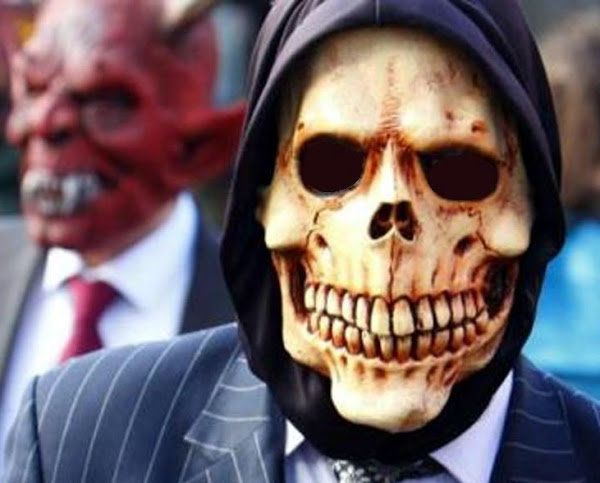




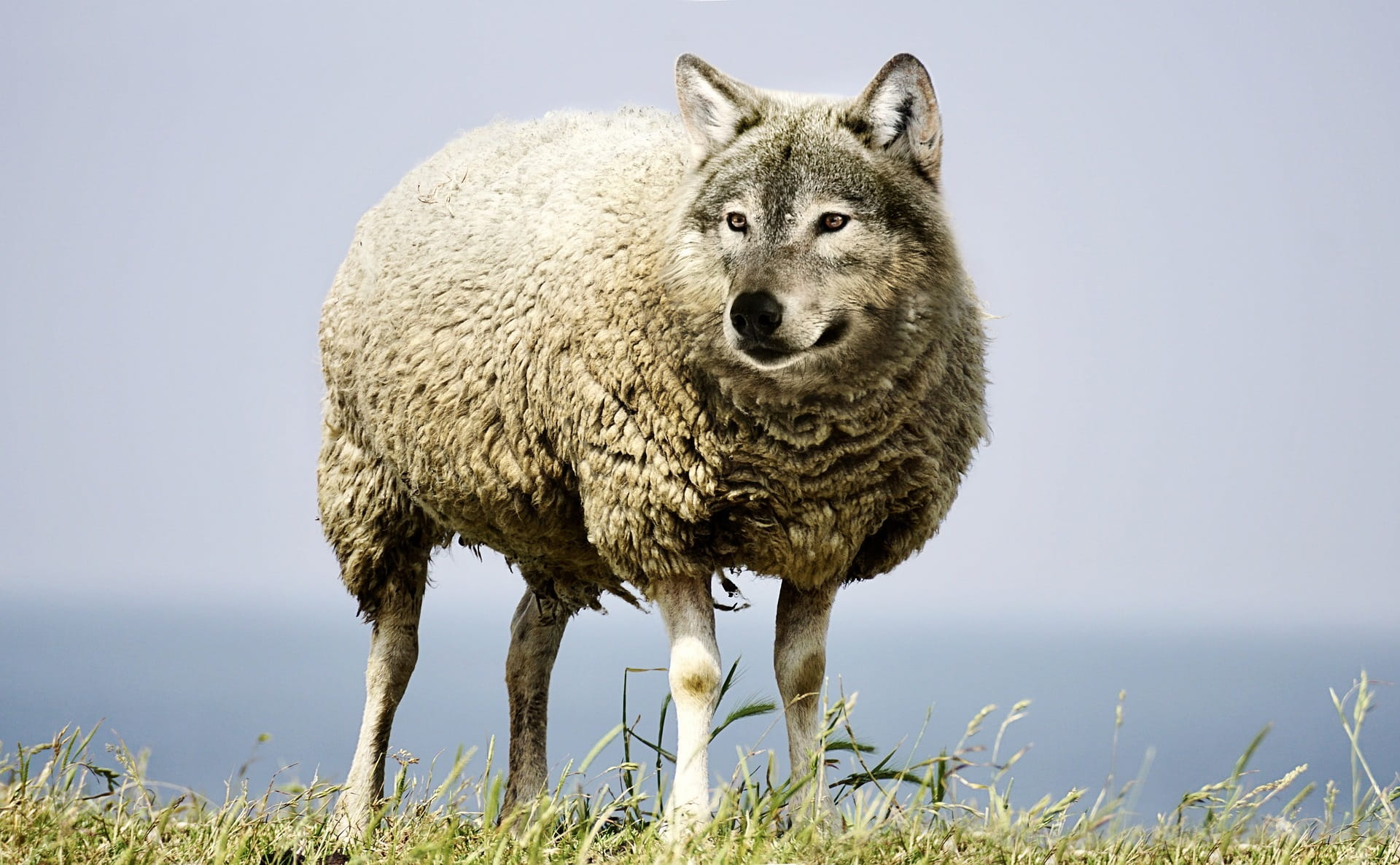 How to
Spot a Wolf in Sheep's Clothing: 5 Reminders from God's Word 1. Watch out.
"Beware of false prophets, who come to you in sheep's clothing but inwardly are ravenous
wolves.
How to
Spot a Wolf in Sheep's Clothing: 5 Reminders from God's Word 1. Watch out.
"Beware of false prophets, who come to you in sheep's clothing but inwardly are ravenous
wolves. 





 This comment was deleted.


