Financial Skeptic Bulletin, September 2008
Prev |
Contents | Next
- 20080930 : French and German anger misses the fact by Charles Wyplosz ( September 29 2008 19:14 , FT.com )
- 20080930 : Are Banks Too Big to Save ( Are Banks Too Big to Save, Sep 30, 2008 )
- 20080929 : As the storm rages, only governments can save us by Gerard Baker ( September 29, 2008 , Times Online )
- 20080927 : Fat cats fall to earth as golden parachutes jettisoned Business ( guardian.co.uk )
- 20080927 : US treasury secretary begged Democratic leader on one knee to save his plan to rescue Wall Street Business ( The Guardian )
- 20080927 : Roubini- Why the Treasury TARP bailout is flawed ( Roubini- Why the Treasury TARP bailout is flawed, Sep 27, 2008 )
- 20080927 : "Even Hank Paulsons bail-out plan cannot detox global banking" ( "Even Hank Paulson's bail-out plan cannot detox global banking", Sep 27, 2008 )
- 20080927 : Junk Bond Spreads Are Distressed for First Time in Six Years by Alan Goldstein and Bryan Keogh ( Junk Bond Spreads Are Distressed for First Time in Six Years, Sep 27, 2008 )
- 20080926 : German Finance Minister Blames US for Financial Crisis Germany ( Sep 25, 2008 , Deutsche Welle )
- 20080926 : German Minister: US Over as Financial Superpower ( German Minister: US Over as Financial Superpower, Sep 26, 2008 )
- 20080926 : Tim Duy: Economy Downshifting, Bailout or No ( Tim Duy: Economy Downshifting, Bailout or No, Sep 26, 2008 )
- 20080925 : "Asia Needs Deal to Prevent Panic Selling of U.S. Debt" ( naked capitalism )
- 20080925 : Marc Faber Calls the Fed a "Liquidity Drug Dealer" ( Marc Faber Calls the Fed a "Liquidity Drug Dealer", Sep 25, 2008 )
- 20080925 : Congress delay on Paulson rescue plan hits money markets - Times Online ( Congress delay on Paulson rescue plan hits money markets - Times Online, Sep 25, 2008 )
- 20080924 : Asia Times Online Asian news and current affairs ( Asia Times Online Asian news and current affairs, Sep 24, 2008 )
- 20080924 : Online The end of an [another] gilded age by By Steve Fraser ( Online The end of an [another] gilded age, Sep 24, 2008 )
- 20080923 : Another Mad Rush To Judgment ( Another Mad Rush To Judgment, Sep 23, 2008 )
- 20080923 : Inky99 ( Inky99, Sep 23, 2008 )
- 20080923 : More Questions than Answers ( More Questions than Answers, Sep 23, 2008 )
- 20080923 : 14 Questions for Paulson & Bernanke by Barry Ritholtz ( 14 Questions for Paulson & Bernanke, Sep 23, 2008 )
- 20080923 : How much financial CEOs got paid to ruin their companies - Network World ( How much financial CEOs got paid to ruin their companies - Network World, Sep 23, 2008 )
- 20080921 : Paulson Missed the Bubble and Understated the Financial Crisis at Every Point ( Paulson Missed the Bubble and Understated the Financial Crisis at Every Point, Sep 21, 2008 )
- 20080921 : NY Times Makes a Funny Statement ( NY Times Makes a Funny Statement, Sep 21, 2008 )
- 20080920 : Decades of greed and hubris. A week of shock and panic. But what comes next ? by Peter Koenig ( Decades of greed and hubris. A week of shock and panic. But what comes next ?, Sep 20, 2008 )
- 20080920 : Think Progress " The Fish Oil Salesman McCain Pushes Offshore Drilling Because Fish 'Love To Be Around' Oil Rigs ( Think Progress " The Fish Oil Salesman McCain Pushes Offshore Drilling Because Fish 'Love To Be Around' Oil Rigs, Sep 20, 2008 )
- 20080920 : The Business Desk with Paul Solman PBS ( The Business Desk with Paul Solman PBS, Sep 20, 2008 )
- 20080920 : #1 - Osama Bin Laden, #2 - Alan Greenspan ?? ( The mess that greenspan made )
- 20080920 : Rescue Plan Seeks $700 Billion to Buy Bad Mortgages ( Rescue Plan Seeks $700 Billion to Buy Bad Mortgages, Sep 20, 2008 )
- 20080919 : The "New" New Deal by Barry Ritholtz ( September 19, 2008 , The Big Picture )
- 20080919 : Bond Insurers Are Facing Downgrades ( Bond Insurers Are Facing Downgrades, Sep 19, 2008 )
- 20080919 : M of A - McCain and Cox ( M of A - McCain and Cox, Sep 19, 2008 )
- 20080919 : Heckuva job, Greenie ( Heckuva job, Greenie, Sep 19, 2008 )
- 20080919 : Hirsh Greenspans To Blame for Wall Street Woes Newsweek Voices - Michael Hirsh Newsweek.com ( Hirsh Greenspan's To Blame for Wall Street Woes Newsweek Voices - Michael Hirsh Newsweek.com, Sep 19, 2008 )
- 20080919 : Congressional Leaders Stunned by Warnings - NYTimes.com ( Congressional Leaders Stunned by Warnings - NYTimes.com, Sep 19, 2008 )
- 20080919 : Kondratiev wave - Wikipedia, the free encyclopedia ( Kondratiev wave - Wikipedia, the free encyclopedia, Sep 19, 2008 )
- 20080918 : FT Alphaville " Blog Archive " So what's the biggest risk faced by global financial insitutions ( FT Alphaville " Blog Archive " So what's the biggest risk faced by global financial insitutions, Sep 18, 2008 )
- 20080918 : How SEC Regulatory Exemptions Helped Lead Banks to Collapse ( How SEC Regulatory Exemptions Helped Lead Banks to Collapse, Sep 18, 2008 )
- 20080917 : John McCain Made the World Profitable for Canadians? ( John McCain Made the World Profitable for Canadians?, Sep 17, 2008 )
- 20080917 : Wall Street turmoil changes campaign fortunes as Palin factor is devalued ( Wall Street turmoil changes campaign fortunes as Palin factor is devalued , Sep 17, 2008 )
- 20080917 : Times Online ( Times Online, )
- 20080917 : The Big Picture Bailout Nation, Soviet Style Russian Trading Halt ( The Big Picture Bailout Nation, Soviet Style Russian Trading Halt, Sep 17, 2008 )
- 20080917 : Barack Obama is going to win. Its the economy, stupid by Iain Martin ( Barack Obama is going to win. It's the economy, stupid, Sep 17, 2008 )
- 20080917 : A tribunal must tell us what to fix. And whom to punish Comment is free The Guardian by Simon Jenkins ( A tribunal must tell us what to fix. And whom to punish Comment is free The Guardian, Sep 17, 2008 )
- 20080917 : Henry Paulsons Frankenstein - Mergers, Acquisitions, Venture Capital, Hedge Funds -- DealBook - New York Times ( Henry Paulsons Frankenstein - Mergers, Acquisitions, Venture Capital, Hedge Funds -- DealBook - New York Times, Sep 17, 2008 )
- 20080917 : Scott Adams Blog What Good are Economists 08-22-2008 ( Scott Adams Blog What Good are Economists 08-22-2008, Sep 17, 2008 )
- 20080916 : A Sense That Wall St.'s Boom Times Are Over - NYTimes.com ( A Sense That Wall St.'s Boom Times Are Over - NYTimes.com, Sep 16, 2008 )
- 20080915 : Brace for the Tsunami- Fitch, S&P Downgrade AIG (Updated) ( Brace for the Tsunami- Fitch, S&P Downgrade AIG (Updated), Sep 15, 2008 )
- 20080914 : U.S. banking woes seen hitting Wall St. Financial News - Yahoo! Finance ( U.S. banking woes seen hitting Wall St. Financial News - Yahoo! Finance, Sep 14, 2008 )
- 20080914 : Lehman may face failure, Merrill may be bought U.S. Reuters ( Lehman may face failure, Merrill may be bought U.S. Reuters, Sep 14, 2008 )
- 20080914 : The Big Picture Weekend Bailouts and Subsequent Market Reactions ( The Big Picture Weekend Bailouts and Subsequent Market Reactions, Sep 14, 2008 )
- 20080914 : Roubini and the Bail-in this weekend ( Roubini and the Bail-in this weekend, Sep 14, 2008 )
- 20080912 : Angry Bear ( Angry Bear, Sep 12, 2008 )
- 20080912 : CRE: More on the Mall Glut by CalculatedRisk ( CRE: More on the Mall Glut, )
- 20080910 : Wages are Falling for Just about Everybody ( Wages are Falling for Just about Everybody, Sep 10, 2008 )
- 20080910 : Europe predicts UK will fall into recession ( Europe predicts UK will fall into recession, Sep 10, 2008 )
- 20080909 : Washington Wants Oil Down, Stocks Up Before Election, Harrison Says ( Washington Wants Oil Down, Stocks Up Before Election, Harrison Says, Sep 09, 2008 )
- 20080908 : Welcome to the U.S.S.R. (United States Socialist Republic) ( Welcome to the U.S.S.R. (United States Socialist Republic) , Sep 08, 2008 )
- 20080908 : US Is More Communist than China Jim Rogers Financial News - Yahoo! Finance ( US Is More Communist than China Jim Rogers Financial News - Yahoo! Finance, Sep 8, 2008 )
- 20080905 : Unemployment Hits 6.1% ( Unemployment Hits 6.1%, Sep 5, 2008 )
- 20080905 : Gabelli Says Theres Reason to Worry About Earnings (Update1) by Eric Martin and Carol Massar ( Gabelli Says There's Reason to Worry About Earnings (Update1) , Sep 5, 2008 )
- 20080904 : A Whiff of Panic Returns to Wall Street - Floyd Norris - Business - New York Times Blog ( A Whiff of Panic Returns to Wall Street - Floyd Norris - Business - New York Times Blog, Sep 4, 2008 )
- 20080902 : Quote du Jour ( Quote du Jour, Sep 2, 2008 )
- 20080902 : More Bank Woes- Spreads on Credit Card Securitizations Rise ( Sep 2, 2008 )
- 20080902 : Kirk Shinkle ( Kirk Shinkle, Sep 02, 2008 )
- 20070928 : From Enron to the Financial Crisis, With Alan Greenspan in Between - US News and World Report ( From Enron to the Financial Crisis, With Alan Greenspan in Between - US News and World Report, Sep 28, 2007 )
- 20070928 : The Economy Why It's Worse Than You Think by Daniel Gross ( June 16, 2008 , Newsweek.com )
| Capital must protect itself in every way... Debts must be
collected and loans and mortgages foreclosed as soon as possible.
When through a process of law the common people have lost their
homes, they will be more tractable and more easily governed
by the strong arm of the law applied by a central power of leading
financiers. People without homes will not quarrel with their
leaders. ... By dividing the people we can get them to expend
their energies in fighting over questions of no importance to
us except as teachers of the common herd.?
J.P. Morgan a private communication to a group of US Bankers
in 1934 |
September 29 2008 19:14 | FT.com
Anger runs deep. It is aimed at financiers, who first earned huge
and conspicuous bonuses and now successfully force taxpayers to pay
for their mistakes. It is also aimed at financial markets, whose merits
have been oversold.
The mantra that financial markets always allocate resources better
was never true. Financial markets suffer from very serious failures,
chiefly information asymmetry. The subprime saga started with beneficial
risk diversification until it became a channel for contagion. The saga
also revealed the depth of herding among financial institutions – the
exact opposite of risk diversification among them. Having followed the
same strategy, they all suffered simultaneous losses.
Financial operations are about risk-taking, which means uncertainty
and, occasionally, crashes.
On this ground, anger is universal. US congressmen compete with themselves
to lash out at the financiers who created this mess. But, outside the
Anglo-American world, we see an outburst of resentment against the US
and British approach to finance and banking. With people angry and scared
at what may happen next, political leaders find it more difficult than
usual to resist populist tendencies and seek to distance themselves
from a possibly serious downturn. With market failures crudely in the
limelight, they feel pressed to reassert the role of government. Nationalism
is always a convenient spare wheel for difficult times.
Once again, Anglo-American capitalism is a bad word and globalisation
is next in line. Speeches at this year's United Nation General Assembly
by leaders from every continent reveal the depth of contempt that has
been lying low, buried underneath the apparent success of the globalisation
process.
A first reason for this backlash is the delicate balance between
individualism and solidarity. Americans are famously known to encourage
and practise individual responsibility. In many other countries, solidarity
is more highly valued and individualism is seen as the other side of
egoism. Generous welfare states do not just reflect this view, they
also create incentives to support collective insurance arrangements,
even if they are inefficient. Adam Smith's invisible hand, the assertion
that individualism delivers the common best, is not popular: we know
that his assertion is only approximately correct because it assumes
that markets are perfect, which is not the case in practice.
Where individualism is considered a virtue, deviations from the ideal
outcome are seen as a regrettable side-effect. But in most parts of
the world, where individualism is considered morally wrong, the law
of the market is tolerated as long as it delivers prosperity. When it
fails, its legitimacy is soon questioned. The world's major financial
markets are in New York and London. No wonder, then, that anger is aimed
at Anglo-American capitalism.
The second reason is related to the way financial markets operate.
The US and the UK have championed arm's-length finance, the financing
of corporations through issuance of shares and bonds to anonymous stakeholders.
Continental Europe – and south-east Asia – has long favoured face-to-face
deals between entrepreneurs and bankers. Deals can be shoddy and cliquish,
but they provide for some stability. Over the past two decades, arm's-length
finance has made headway in continental Europe, beating back the old
boys' networks. No wonder that the old boys are now hitting back.
Strikingly, Nicolas Sarkozy, the French president, and Peer Steinbrück,
the German finance minister, have both announced
the end of Anglo-American financial supremacy. It is not clear what
their prediction is based upon.
They have denounced excesses, such as bonuses, but that does not
even begin to address the root cause of the crisis. They have described
financial markets as unregulated. This is simply wrong. Financial markets
are tightly regulated. The problem is not just that the regulation is
inappropriate, but also that supervisors have not enforced it.
We knew of the hundreds of billions of dollars in dubious claims
parked off bank balance sheets in a clear effort at circumventing existing
regulations. Regulatory arbitrage, as this is called, has gone unchecked
for years.
Both leaders had harsh words for "speculation", but this misses the
fact that finance is speculation. Both zeroed in on short selling. Short
selling is like cars. Drivers can be reckless; disciplining them seems
more reasonable than banning cars. Denouncing market short-termism runs
against evidence that markets better predict companies' long-term performance
than their own managers.
Mr Sarkozy and Mr Steinbrück may be simply captured by their own
old boys, but the fate of Fortis, the Belgo-Dutch banking and insurance
group, may give them second thoughts. Pain is travelling across the
Atlantic and could hurt more good European banks. Mr Sarkozy promised
that no French depositor would ever suffer any loss from any French
bank. He might soon find the price tag pretty steep.
So will Anglo-American capitalism fade away? Maybe, but that will
be decided in Washington, not Paris and Berlin. One thing is sure, neither
France nor Germany can mount a serious challenge, at least as long as
their people and leaders mistrust and misunderstand finance.
An excellent comment in the Financial Times by Wolfgang Munchau discusses
how the gold standard for handling banking crises, the Swedish model,
would take even more discipline to implement in the US and how we are
dong the reverse of what is needed.It is a levelheaded analysis which
stands in stunning contrast with a
bit of advocacy masquerading as economics from Larry Summers in
the same section of the FT today.
But in the course of his discussion, Munchau makes the observation that
none have dared face up to: the financial system is too big for governments
to rescue. We've given the weaker form of that argument: the US, or
even the US plus all the world's central banks, cannot keep a massive,
multi-market asset bubble from deflating. But not only can the current
financial system not be saved, it shouldn't be saved. The debt binge
means it is at an unsupportable, bloated scale. It needs to be trimmed
down to a more viable size, and only that level should get government
support.
From
Munchau:
Last week's dramatic events hold two transatlantic lessons in opposite
directions, one from Europe to the US and one the other way. The
first comes from Sweden, which suffered its own financial crisis
during the early 1990s. The Swedish
lesson is that bank bail-outs should be handled conservatively and
should come in the form of direct capital injections.
As in the US, the Swedish financial crisis was also preceded by
a property bubble, which was pricked by a rise in real interest
rates. Severe stress in the financial
system and the economy were to follow. In each of the three years
1991, 1992 and 1993 Swedish gross domestic product fell in real
terms, at an accumulated rate of about 5 per cent.
In response, the Swedish government set up an agency to recapitalise
the financial sector. Bank shareholders were not compensated. But
the Swedish government did not bail out all banks, only a subset.
They used a microeconomic model to determine which of the banks
had a chance to survive, and which did not. Those that did not were
liquidated or merged. And those that were bailed out had to write
off their bad debts first. All depositors were covered by an explicit
government promise of compensation. The goal was to minimise the
cost to the taxpayer, and it succeeded. It turned out as one of
history's most successful financial system bail-outs.
There are naturally important differences between the situation
in Sweden then and the US today. The most important is that our
most recent bubbles surpassed anything we have ever seen before.
We do not only have to deal with a bursting property bubble,
but also with the huge leverage effects through the credit markets.
The US has a much bigger problem today than Sweden did then. Like
Sweden, the US needs to shrink its financial sector before saving
it. The difference is that the US needs to shrink it a lot more,
and wants to shrink it a lot less.
In this context, Daniel Gros and Stefano Micossi last week made
an astute observation on these pages: several European
banks have become so large that their
governments could no longer save them. Banks once
considered as too big to fail have become too big to save. Unlike
the German government, the US administration is in a position to
save its largest bank, but is not big enough to save its entire
financial system...
The US is already in a recession that, even if financial conditions
returned to normal today, would still be very unpleasant. In the quarter
that ends tomorrow, it seems almost certain that US total output declined.
Consumer spending and investment have been alarmingly weak in the past
two months. On Friday we are quite likely to get another depressing
report on the labour market, expected to show the ninth straight month
of job declines in September. The housing market still seems to be getting
worse, with sales falling faster than new construction, adding to the
excess supply.
Worrying about inflation in times like
these is like worrying about how you're going to borrow the money you
need to get out of town when the hurricane hits. If you wait too long,
you may not survive in any case.
... ... ...
It is already too late to avoid a period of real economic misery.
But there may still be time to avoid a catastrophe.
401K donors will be paying for Wall Street excesses... They are caught
in the middle of massive asset depreciation and will be hurt on three fronts:
direct losses in 401K, lousy job market, rising cost of living.
If there's one silver lining on an otherwise unremittingly bleak
cloud over the economy, it is the possibility that the crisis will change
the obscene culture of self-enrichment among the top echelons of financial
institutions. Both on Wall Street and in London's square mile, soaraway
remuneration has closely correlated with a shift towards reckless financial
"innovation" over the last decade.
The figures are absurd - when Merrill Lynch's Stan O'Neal was ditched
last year for encouraging a culture of risk which led to $12bn (£6.6bn)
of losses on mortgage-related securities, he took $161m of stock and
options with him into retirement.
Citigroup's Chuck Prince, who went a similar way, took $39.5m. Even
Lehman's Dick Fuld, whose bank has actually gone bust, received $35m
to reward him for his wonderful work last year.
About the only one who could truly claim he had a successful year was
Goldman Sachs' boss, Lloyd Blankfein, who duly scooped $68.5m, as the
bank profited by betting that lots of struggling families would lose
their homes.
True to its laissez-faire philosophy,
the Bush administration has been extremely reluctant to do anything
about this. This reluctance must have a little bit to do with the fact
that both Paulson and the White House chief of staff, Joshua Bolten,
are former senior executives at Goldman Sachs.
At Congressional hearings this week, some of the wriggling on the
issue was truly ludicrous. At one point, the Senate banking committee's
Democratic chairman, Christopher Cox, asked the Federal Reserve's chairman
why pay limits weren't in the government's initial draft of its plan
to buy up distressed assets from struggling banks.
"We can't impose punitive measures on institutions which choose to
sell assets," replied Bernanke. "That would discourage companies from
participating and it would cause the program to fail."
Let's analyse that for a moment. Bernanke
was suggesting that senior bankers might jeopardise the future of their
organisations by refusing to participate in a rescue plan simply in
order to protect their personal pay packages. What worse indictment
could there possibly be of the habit of doling out big bonuses?
Given that the banking sector has been highly instrumental in wrecking
the US economy, it has become impossible to defend nonsensical pay policies.
The US Chamber of Commerce gave up - its vice-president of government
affairs, Bruce Josten, admitted this week that remuneration would need
to be addressed. He told the Wall Street Journal: "If we're taking huge
infusions of your money and my money, there's got to be some limitations."
... ... ...
Tim Johnson, a fellow Democratic senator, said the government's bail-out
should not simply be a "gift". It was right and proper, he argued, to
ask for something in return: "When you make mistakes, as many of these
companies have, you should be held responsible for those decisions."
In the face of scepticism, Paulson, Bernanke
and the White House's press secretary, Dana Perino, have kept up a constant
(albeit deliberately vague) mantra about the "dangerous" and "devastating"
economic consequences of failing to act quickly.
To some, it was an all too familiar message from an administration
which has cried wolf before. Luis Gutierrez, an Illinois congressman,
said it reminded him of the all-out propaganda war waged by the White
House to bully Congress into backing the Iraq war.
"It's hard being trusting," he said.
"You feel like you're always getting hoodwinked, because they say the
consequences if you don't do it is a complete demise and collapse of
the system."
So did HSBC's chairman, Stephen Green, who told the BBC: "There has
been far too much focus on payments that are very short-term focused,
people who pick up the tab for short-term profits, without having to
bear the costs of long-term impairments."
Anger about Wall Street's excesses has been palpable for years -
and it spilt over this week. Sherrod Brown, a Democratic senator from
Ohio, demanded: "Why are we bailing out
companies whose leaders got rich while gambling with our economy?"
Maybe men don't bite dogs, but banks do rob people. New York Times
columnist Bob Herbert put it nicely. "Does anyone think it's just a little
weird to be stampeded into a $700 billion solution by the very same people
who brought us the worst financial crisis since the Great Depression?"
It was, according to accounts filtering out of the White House, an
extraordinary scene. Hank Paulson, the US treasury secretary and a man
with a personal fortune estimated at $700m (£380m), had got down on
one knee before the most powerful woman in Congress, Nancy Pelosi, and
begged her to save his plan to rescue Wall Street.
... ... ...
"This sucker could go down," Bush is
said to have told the group - referring to the teetering US economy.
... ... ...
By yesterday afternoon, angry Democrats were accusing McCain of sabotaging
the deal to further his own presidential campaign - and even some Republicans
were inclined to agree. "Clearly, yesterday, his position on that discussion
yesterday was one that stopped a deal from finalising," the Republican
whip, Roy Blunt, told reporters.
Christopher Whalen of Institutional Risk Analytics, a brave conservative
critic, put it plainly: "The joyous reception from Congressional Democrats
to Paulson's latest massive bailout proposal smells an awful lot like yet
another corporatist lovefest between Washington's one-party government and
the Sell Side investment banks."
From Professor Nouriel Roubini:
Why the Treasury TARP bailout is flawed
Specifically, the Treasury plan does not formally provide senior
preferred shares for the government in exchange for the government
purchase of the toxic/illiquid assets of the financial institutions;
so this rescue plan is a huge and massive bailout of the shareholders
and the unsecured creditors of the firms; with $700 billion of taxpayer
money the pockets of reckless bankers and investors have been made
fatter under the fake argument that bailing out Wall Street was
necessary to rescue Main Street from a severe recession. Instead,
the restoration of the financial health of distressed financial
firms could have been achieved with a cheaper and better use of
public money
Moreover, the plan does not address the need to recapitalize
badly undercapitalized financial institutions: this could have been
achieved via public injections of preferred shares into these firms;
needed matching injections of Tier 1 capital by current shareholders
to make sure that such shareholders take first tier loss in the
presence of public recapitalization; suspension of dividends payments;
conversion of some of the unsecured debt into equity (a debt for
equity swap).
The plan also does not explicitly include an HOLC-style program
to reduce across the board the debt burden of the distressed household
sector; without such a component the debt overhang of the household
sector will continue to depress consumption spending and will exacerbate
the current economic recession
Thus, the Treasury plan is a disgrace: a bailout of reckless
bankers, lenders and investors that provides little direct debt
relief to borrowers and financially stressed households and that
will come at a very high cost to the US taxpayer. And the plan does
nothing to resolve the severe stress in money markets and interbank
markets that are now close to a systemic meltdown.
They are trying to get us to pay twice for this mess: first via taxes
and then via inflation.
- Some readers would have a go at me whenever I'd post articles
by the Telegraph's Ambrose Evans-Pritchard. Although he has a tendency
to hyperventilate and sometimes oversimplifies, he regularly points
to data and research that I haven't seen covered elsewhere.
More important, his major calls this year have been correct.
He predicted the oil price decline, was vehement that deflation,
not inflation was the risk to the global economy, and pointed to
evidence of near zero money supply growth in major economies, an
early warning that the credit crunch was intensifying.
Today, Evans-Pritchard and the Financial Times editorial page
are in agreement on the the dangers of the debt crisis and the need
for swift action, although Evans-Pritchard spends more time on the
long-term outlook.
First, from the
Financial Times (boldface ours):
- Banks are not to be trusted.
This is not just the view of the public and policymakers, but
that of the banks themselves. Spreads on unsecured
inter-bank lending have reached unprecedented levels, particularly
in dollars and, to a lesser degree, sterling. Such stresses
cannot continue for long, without serious damage to both the
financial system and the economy...
Comments
- Richard Kline said...
-
-
The stated fact that the top 20 US
banks have $3T worth of 'assets' to offload is exactly why buying
these assets is an exceedingly stupid and unproductive way to deal
with the capital erosion and in many cases insolvency of those firms.
Which is better, $150B of public equity infusion and/or seizure
for control with no purchase, or $3T of expense with zero (0) guarantee
of the improvement of any significant vector in the US financial
economy besides insider profits? The Paulson Bullrush is an attempt
to roll the US Government, but it is not a credible engagement with
our problems: that is perhaps its worst aspect, its copious delusion
where cool heads and shrewd schemas are needed.
Don't bail 'em, fail 'em.
From
Times article on the same theme "As a result, the economy would
be virtually stalled over the next year, we forecast that the unemployment
rate will rise to at least 7% in 2009, and therefore core inflation is likely
to fall next year. On a "cash-deficit" basis, the budget deficit is likely
to soar to USD1.2trn for 2009, we estimate."
Sept. 27 | Bloomberg.com
Yields on speculative-grade bonds rose to distressed levels for the
first time since 2002 as the turmoil sweeping Wall Street led investors
to shun all but the safest government bonds.
Investors demand 10.25 percentage points more in yield to own junk-rated
securities than Treasuries, according to Merrill Lynch & Co.'s U.S.
High Yield Master II index. Bonds that trade at a so-called spread of
10 percentage points or more are considered distressed.
The last time spreads were so wide was in the aftermath of Enron
Corp.'s collapse earlier this decade. Now, a slowing economy and failures
of some of the largest U.S. financial institutions are driving investors
away. Distressed bonds default within one
year 22 percent of the time, compared with 1 percent for non-distressed
junk bonds, according to Fridson Investment Advisors in New York.
``Any credit perceived as exhibiting a higher level of default risk
is at risk of significant price depreciation,''
Peter Acciavatti, a credit strategist at JPMorgan Chase & Co. in
New York, wrote in a report yesterday. Acciavatti was the top- ranked
high-yield strategist in Institutional Investor magazine's annual poll.
High-yield spreads have climbed 1.89
percentage point this month, the steepest monthly rise since September
2001, as the government seized the two largest U.S. mortgage-finance
companies, Fannie Mae and Freddie Mac; Lehman Brothers Holdings Inc.
was forced to file for bankruptcy; Merrill Lynch agreed to sell itself
to Bank of America Corp.; American International Group Inc., the nation's
biggest insurer, was taken over by the Treasury; and
Washington Mutual Inc. was seized by regulators in the biggest U.S.
bank failure in history.
Rescue Plan
Congressional leaders pressed toward a deal on a $700 billion financial
rescue plan proposed by Treasury Secretary Henry Paulson. President
George W. Bush said yesterday any disagreements would be resolved.
High-yield, high-risk, or junk, bonds
are rated below Baa3 by Moody's Investors Service and BBB- by Standard
& Poor's.
Financial industry failures are causing ``massive'' amounts of debt
to be downgraded, S&P said in a report yesterday.
``Although credit-quality erosion can be expected during cyclical
downturns, the enormity of debt amounts affected is disconcerting,''
Diane Vazza, the head of S&P's fixed income research group in New
York, said in a statement.
Default Rate
The default rate among high-yield, high-risk,
non-financial borrowers may rise to 23.2 percent by 2010, the highest
since 1981, S&P said in a report Sept. 25. The ``worst-case
scenario'' estimate suggests 353 junk-rated borrowers outside the financial
sector may default in the next two years, S&P said.
Spreads on junk bonds widened 38 basis
points yesterday, according to the Merrill high-yield index. A basis
point is 0.01 percentage point.
Yields over benchmark rates on investment-grade bonds also widened
yesterday, climbing 23 basis points to a record 459 basis points, according
to Merrill's U.S. Corporate Master index.
High-yield new issuance this month has fallen to $845 million, from
$5.9 billion in the same month last year, according to data compiled
by Bloomberg. Since Aug. 1, seven issuers have tapped the high-yield
market.
German Finance Minister Peer Steinbrueck deemed the US banking
crisis an "earthquake" that will cost the US its role as a superpower
of the world financial system. He stressed that German banks can cope
with losses.
"Wall Street and the world will never again be the way they were
before the crisis," said Steinbrueck in a speech to the German parliament,
the Bundestag, on Thursday, Sept. 25. Write-downs and write-offs of
bad credit spawned by "a blind drive for double-digit profits" have
so far totaled $550 billion and no end to the crisis is in sight, he
added.
The world financial system will consequently become more "multi-polar,"
he predicted.
Steinbrueck told the Bundestag that the Group of Seven (G7) finance
ministers would be meeting in Washington next month to discuss how to
tighten regulation of capital markets.
The German federal government, meanwhile, would continue efforts
to trim spending, but would also make some moves to stimulate the economy.
He reiterated Germany's refusal to set up its own bank bail-out scheme,
saying the crisis was principally a US problem.
Irresponsible moves
Reiterating Berlin's push for tighter regulation, Steinbrueck accused
the US of blunders.
"The cause of the crisis was the irresponsible exaggeration of the
principle of a free, unrestrained market," he told the Bundestag.
Washington has been reluctant to increase minimum equity rules and
has too many competing regulators over US investment banks.
"This system, which in many ways is inadequately regulated, is now
collapsing," he said, adding that Germany's banking system remained
"relatively robust," with German regulators confident they can absorb
losses.
"New rules of the road" for the financial markets were needed, he
said.
Plans to be debated when the finance ministers of the G7 meet will
include tightening cooperation between the International Monetary Fund
(IMF) and the Financial Stability Forum (FSF).
The agencies were created by western nations as an early warning
system.
Steinbrueck also renewed his call for fusion across Germany's state
bank sector. The country's big commercial lenders, the so-called "Landesbanken,"
have been hard hit by the financial crisis.
The next move needs to be made by the individual states, as co-owners
of the leading state banks, said the Social Democrat minister: "They
need to overcome regional political pride and embrace pan-regional co-operation."
This, he said, would strengthen the German banking system and boost
its sustainability.
"Financial support from the government in mopping up problems in
this sector should not be expected," he added.
Given that past attempts to fuse the "Landesbanken" have failed,
Steinbrueck proposed a redefinition of their business models in order
to avoid excessive risk and to increase returns.
The financial crisis has, however, shown that both savings banks
and cooperative banking institutions are stable and reliable, said Steinbrueck.
"Injecting throughout the world financial
system their bogus and unregulated financial instruments, like collateralized
debt obligations and credit-default swaps, the big New York financial houses
have taken the world economy hostage. The president and Congress should
strive to save the hostages, not the kidnappers."
The unravelling that started with the Freddie and Fannie conservatorship
has exacted a toll not just on dollar-denominated paper but on financial
assets around the world. As they have fallen, so too has the standing
of the US, which zealously promoted liberalized capital markets and
saw US firms establish dominant positions when those rules were adopted.
America already had few friends thanks to our prosecution of the
war in Iraq, and our reputation is testing new lows. From the
Telegraph:
In a remarkable outburst at the German parliament, Mr Steinbrück
said the world would never be the same after "Black September".
He demanded a sweeping code of regulations to "civilise the financial
markets" and clamp down on speculators.Mr Steinbrück announced
a swingeing eight-point plan to reorder the global markets - which
will heighten fears in the City of London of interference by the
European Commission.
"The US will lose its superpower
status in the global financial system," he said,
predicting a new multi-polar order where power is spread across
the globe.
"The financial crisis is above all
an American problem. The other G7 financial ministers
in continental Europe share this opinion," he said, a pointed turn
of phrase that excludes Britain's Alistair Darling.
"This inadequately regulated system
is now collapsing, with far-reaching consequences for the US financial
market and contagion effects for the rest of the world,"
he said....
Senior politicians in France and Germany have in recent weeks
called for a radical shake-up of the market system. A powerful EU
faction that has always been hostile to the City of London –
which is known in Brussels as "the casino"
– see this crisis as a rare chance to ram through irreversible changes.
"They want to regulate the capital levels of every firm and partnership,
limit takeovers and regulate asset stripping. In short, they want
to regulate the Anglo-Saxon version of capitalism out of existence,"
said John Whittacker, MEP and UKIP's economic spokesman.
Mr Steinbrück said the deft response
of the world leaders in recent days had averted catastrophe. "Crisis
management worked. We did not have a collapse of the international
financial system," he said.
Mr Steinbrück said the drive for short-term profit and huge bonuses
in the Anglo-Saxon world was the root cause of the gravest crisis
in decades. "Investment bankers and
politicians in New York, Washington and London were not willing
to give these up," he said.
Update 3:45 AM: More on the same
speech from the
Financial Times:
He later told journalists: "When we
look back 10 years from now, we will see 2008 as a fundamental rupture.
I am not saying the dollar will lose its reserve currency status,
but it will become relative."The minister, who
has spearheaded German efforts to rein in financial markets in the
past two years, attacked the US government for opposing stricter
regulations even after the subprime crisis had broken out last summer.
The US notion that markets should remain as free as possible
from regulatory shackles "was as simplistic as it was dangerous",
he said.....
The US, Mr Steinbrück said, had failed in its oversight of investment
banks, adding that the crisis was an indictment of the US two-tier
banking system and its "weak, divided financial oversight".
He blamed Washington for refusing to consider proposals Berlin
had made as it chaired the Group of Eight industrial nations last
year. These proposals, he said, "elicited mockery at best or were
seen as a typical example of Germans' penchant for over-regulation"....
Mr Steinbrück's proposals include
a ban on "purely speculative short selling"; a crackdown
on variable pay for bank managers, which had encouraged reckless
risk-taking; a ban on banks securitising more than 80 per cent of
the debt they hold; international standards making bank managers
personally responsible for the consequences of their trades; and
increased co-operation between European supervisors.
Tim Duy at Economist's View tells us that
the economy is slowing down markedly, and that that will lead to
a lot of false causality. Whether the bailout plan gets
done in some reasonable form or not, the slowdown will be blamed on
its failure, or the fact that the rush to get it done meant an ineffective
program was put in place.Duy also addresses one of our pet issues:
a slowdown is inevitable because US consumption has been at an unsustainable
level. Lowering consumption will reduce growth, and with the economy
at barely above a stall, any further reduction means recession. But
in America, recessions are not supposed to be inevitable. Permanent
growth is our God-given right. But it looks like we have fallen out
of divine favor of late.
===
Vijay said...
It has been conventional wisdom that China, Japan, and other countries
that run trade surpluses with the US, which means they fund our overconsumption
by buying assets like US Treauries, would never restrict the flow of
credit to us because it would lower their exports and hurt their growth.
We've long been leery of the idea that unsustainable trends will have
a life eternal, and Brad Setser has a simple reason why this process
is self-limiting. Our foreign funding sources aren't just lending us
money to buy their goods;
they are also providing
the funding for interest on the loans extended for past imports.
At a certain point, the interest payments become so large relative to
the value of the exports that the deal no longer makes sense.
The day of reckoning may be approaching well before Setser's tipping
point. And the trigger is much simpler. We look like a lousy risk. The
Freddie/Fannie conservatorship, the Lehman bankrutpcy, and the rescue
of fallen Asian powerhouse AIG has, not surprisingly, lead to a reassessment
of the US's creditworthiness.
Was Greenspan a drag dealers boss ?
Anyone nicknamed Dr. Doom is likely to be a man after my own heart,
and Marc Faber is no exception. The Swiss investor has a good record
of market calls (for instance, he was a staunch commodities bull till
late in the spring, when he reversed his view) and perhaps as important,
has a broader historical perspective than most of his peers and a propensity
to be blunt.
... ... ...
Other sources of funding, such as
foreign reserves of resources-rich countries, are also likely to
dry up, Faber said. "I think sovereign wealth funds are going to
be very busy supporting their own markets, they won't have much
money to buy assets around the world."
Volatility comes from the fact that, as the private sector tightens
lending conditions to adjust its risk management, central banks
are injecting liquidity in the money markets to grease the system,
he said, adding that banning short-selling will not contribute to
reducing volatility and was a "stupid measure."
"Short sellers are not responsible for current problems. The
current problems are caused by the US Fed (Federal Reserve), that
was sitting there and letting credit growth go out of bounds," Faber
said.
"We have to see very clearly that the cause of the problem was
excess leverage. The biggest hedge funds were Fannie Mae, they had
the leverage of one over 150 and under the eyes of Congress, under
the eyes of the SEC and everybody… and nobody did anything about
it. Then, people go and bitch about the short sellers," he added.
The fact that the rules on short-selling are changing nearly
daily, with new names added to the list of securities in which short-selling
is banned or with specific rules regarding hedging and confidentiality
contributes to adding uncertainty, he said.
The problem is also exacerbated by the fact that nobody knows
how long the emergency measure will last or what is next.
"The next emergency measure will be that Americans are not allowed
to buy foreign currency and transfer money overseas, and the next
measure will be not permitting Americans to buy gold and so on and
so forth…. It creates even more uncertainty in the market place
when you continually change the rules," Faber said.
Buying opportunity for bonds or a trap ?
Global money markets were racked by fresh convulsions yesterday as
Henry Paulson, the US Treasury Secretary, and Ben Bernanke, Chairman
of the Federal Reserve, struggled to persuade America's sceptical lawmakers
to pass their $700 billion (£378 billion) bailout plan for Wall Street.
However, Mr Buffett sounded a warning that markets remained in a
"dangerous situation". "I am, to some extent, betting on the fact that
the Government will do the rational thing and act properly," he said.
This is now a national disaster for the United States. The centrality
and import of inexpensive and available credit to America's function
is total.
We have moved well beyond a subprime crisis. We have moved well beyond
a financial industry crisis. The position of the US economy is in jeopardy
and the employment security and wealth of the nation is now very much
in play.
Like the nations of East Asia in the aftermath of the Asian financial
crisis of 1997-8, or Eastern Europe after the collapse of the Soviet
Union in 1991, our way of economic life - warts and all - is imperiled.
No matter what happens as the week comes to a close our lives have changed.
Shock waves are emanating out from the debt collapse ground zero. US$3.6
trillion in global stock market wealth has evaporated this week. The
job losses and macro effects are not far off.
Over the past 14 months one assumption after another has been proven
unsound. Why? We have been waiting and working
toward a return of normality. The normalcy of the past six years is
illusion. Credit conditions designed to keep the macro-economy
and asset prices at peak levels filtered into balance sheet leverage,
government debt and consumer debt levels well beyond prudence. This
happened because credit easing does not and cannot substitute for earnings,
wages or tax revenues.
Well beyond the US's oft-discussed addiction
to oil is its never-mentioned addiction to foreign credit.
In 2007, America imported 49% of total global reported imported capital,
the lowest US percentage in several years. Thus, our 25% reported share
of oil consumption is much lower than our share in imported capital.
We became addicted to debt - especially foreign debt - and that addiction
becomes an illness in a credit constriction.
Leading US banks and financial firms grew large and reaped huge
profits writing, packaging, trading and rewriting, repackaging and retrading
all that borrowed money. Thus, the boom created the bust.
To move forward we need coherent national policy from leading firms,
regulatory agencies and pundits. We need to move forward toward lower
debt, higher earnings and sustainable government spending. We need drastic
and proactive reform of regulatory bodies. We have a patchwork of overlapping
regulation in some areas with giant gaps of under-regulation and absent
regulation. This has created a situation where actions are piecemeal
and graceless in the midst of a crisis.
What is sad is that institutional memory was wiped out and recklessness
returned in volume that probably exceeded the previous gilded age. Institutional
memory lasted just two political generations. After that policymakers forgot
that "Wall Street, after all, had been convicted in the court of public
opinion of reckless, incompetent, self-interested, even felonious behavior
with consequences so devastating for the rest of the country that government
was licensed to make sure it didn't happen again."
Asia Times
President Franklin D Roosevelt's New Deal did, as a start, engage
in some bail-out operations. The Reconstruction Finance Corporation,
actually created by president Herbert Hoover, continued to rescue major
railroads and other key businesses, while some of the New Deal's efforts
to help homeowners also rewarded real estate interests.
The main emphasis, however, now switched to regulation. The Glass-Steagall
Banking Act, the two laws of 1933 and 1934 regulating the stock exchange,
the creation of the Securities and Exchange Commission, and other similar
measures subjected the financial sector to fairly rigorous public supervision.
This lasted for at least two political generations. Wall Street,
after all, had been convicted in the court of public opinion of reckless,
incompetent, self-interested, even felonious behavior with consequences
so devastating for the rest of the country that government was licensed
to make sure it didn't happen again.
The times call for a new departure. The next administration, which
will surely enter office under the greatest economic pressure in memory,
must confront reality. The financial system is out of control and has
led the economy into a wildly turbulent sea of heavily leveraged speculation.
It's time for a reversal of course. Stringent
re-regulation of FIRE is not enough any more. Washington's mission may,
at this late date, be an even greater one than Roosevelt's New Deal
faced. The government must figure out how to deploy its power to shift
the flow of investment capital out of the minefields of speculative
paper transactions and back into productive channels that will help
meet the material needs of American society.
Real value must be created in place of chimeras. In
the meantime, we all have ringside seats - in fact, far too close to
the action for comfort - as another gilded age is ending. What comes
after is, in part, up to us.
Mish's Global
Economic Trend AnalysisMarketWatch is reporting "Echoes
of Iraq in Bush handling of mortgage crisis"
News analysis: Another 'trust me' remedy is getting rushed before
lawmakers."You can draw some valid parallels between the prosecution
of the war under the Bush regime and the way the financial sector
has operated in recent years," said Tom Schlesinger, head of the
nonprofit research group Financial Markets Center in Howardsville,
Va."It fails the most basic test of democratic accountability,"
Schlesinger said.
It boils down to "give me the money and trust me," Schlesinger
said. James Angel, a professor of finance at Georgetown University,
said the White House appears to be "flying by the seat of their
pants."
[Sep 23, 2008] Ben Stein almost lets out the Big Secret by
Inky99
Ben Stein, a man whose character and politics I find to be despicable,
has a column today that I noticed on Yahoo Finance. A good buddy
of mine, who stays closely abreast of these kinds of financial shenanigans,
told me the other day that Ben Stein, in spite of his character flaws,
had some really astute observations on this whole mess. So out
of curiosity today, I clicked on the link.And I have to admit, I
am astounded by what he said. And even more by what he didn't
say. The Big Question he leaves unanswered. It's seriously
mind-blowing.
Here is the article:
Everything You Wanted to Know About the Credit Crisis But Were Afraid
to Ask
And here is the meat of his article, which leads to the huge gaping
hole which he leaves unfilled:
The crisis occurred (to greatly oversimplify) because the financial
system allowed entities to place bets on whether or not those mortgages
would ever be paid. You didn't have to own a mortgage to make the
bets. These bets, called Credit Default Swaps, are complex. But
in a nutshell, they allow someone to profit immensely - staggeringly
- if large numbers of subprime mortgages are not paid off and go
into default.
The profit can be wildly out of proportion to the real amount
of defaults, because speculators can push down the price of instruments
tied to the subprime mortgages far beyond what the real rates of
loss have been. As I said, the profits here can be beyond imagining.
(In fact, they can be so large that one might well wonder
if the whole subprime fiasco was not set up just to allow speculators
to profit wildly on its collapse...)
These Credit Default Swaps have been written (as insurance is
written) as private contracts. There is nil government regulation
of them. Who writes these policies? Banks. Investment banks. Insurance
companies. They now owe the buyers of these Credit Default Swaps
on junk mortgage debt trillions of dollars. It is this liability
that is the bottomless pit of liability for the financial institutions
of America.
Did you see that bolded section?
In fact, they can be so large that one might well wonder
if the whole subprime fiasco was not set up just to allow speculators
to profit wildly on its collapse...
Many of us have already said that, including a LOT of prominent economists
like
Michael Hudson. These people knew the loans they
were making were bad loans. They knew the money wouldn't
be paid back. Which has always bothered me -- why did they make
bad loans on purpose? For short term gain? Well, yes, at
least as far as some of the people involved go, like mortage agents
in banks who worked on commission. But the people in charge were
letting them make these loans. Why?
Now that is what leads to the real meat of what he's saying, the
"Elephant in the Room", That Which Shall Remain Unspoken:
They now owe the buyers of these Credit Default Swaps
on junk mortgage debt trillions of dollars. It is this liability
that is the bottomless pit of liability for the financial institutions
of America.
Somebody, somewhere, is blackmailing the economy. Because somebody,
somewhere, is owed these TRILLIONS of dollars. And it is THEY
who are holding a gun to the economy and demanding payment, and all
of Wall Street, and even the Fed, cannot pay this debt.
So WHO is this Tony Soprano-like world figure? Who are these
people? Why are we not identifying them, and talking to them,
and negotiating with THEM, whoever they are, to keep from bankrupting
the American economy in their favor?
Somebody, somewhere, is blackmailing the entire United States economy.
Somebody, somewhere, has a gun to our head. And to the head of
the American government.
I want to know who they are. I want them identified.
Who are they? And why are we willing to bankrupt the entire
country in order to pay them off?
Somebody, somewhere, has way more power than they should have.
Who?
Financial Armageddon
The oldest technique for the usurpation of power by the executive
from the legislative is the manufacture of a state of emergency.
Sep 23, 2008 | The Big Picture
Treasury Secretary Hank Paulson and Federal Reserve Chairman Ben
Bernanke are scheduled to testify today before Congress on their massive
bailout program.
Here are some questions I would like to hear asked:
5. You have said that "The Housing
correction is the root cause of market stability." What about
leverage -- how significant was that as a root cause?
6. Your initial estimates for the
cost of this were $700 billion dollars. Yet you also asked for a
blank check, an unlimited ability to spend more "as needed."
What is your worst case scenario for the total costs of this bailout?
7. The original version of this
bailout package requested no judicial, administrative, or budgetary
review of the spending of this bailout, What was the thought process
behind that extraordinary, extra-constitutional request?
8. In 2004, your former firm, Goldman
Sachs, along with 4 other brokers, received a waiver of the net
capitalization rules, allowing these firms to dramatically exceed
the 12-to-1 leverage rules. How much was this waiver responsible
for the current situation?
... ... ...
10. The Securities and Exchange
Commission has been AWOL during much of the problems we now face.
What do you think is the proper role for the SEC in terms of supervising
or regulating securities markets? Doesn't your plan usurp
SEC authority and move it to the Treasury?
11. How significant are derivatives
and credit default swaps to the current crisis? Why weren't they
regulated the way other insurance products are?
12. The current proposal has the
US bailing out foreign banks. Has the USA become the insurer of
the worlds financial assets?
Another sign of the return of populism...
09/18/08 | Network World
Wall Street fat cats: How much they made last year
With the
failures of Lehman Brothers, Fannie Mae and Freddie Mac this month,
reams of Wall Street IT executives are out of work or soon will be.
While financial services CIOs and their staff polish their resumes and
ponder what's left of their retirement savings, we thought it might
be interesting to look at how much money their bosses made last year.
Read on to find out what 9 Wall Street chiefs cost their companies in
2007, once their salaries, bonuses, stock awards and more are added
together.
It does not matter that Paulson exaggerates things. That's part of the
job description of the Secretary of Treasury. More important question is
"Can Paulson deal with a pile of immense interlocked, incestuous borrowing
?" In Stephen King opionin
"The Paulson plan is, in effect, a taxpayer
bailout designed to protect the US banking system from the consequences
of foreign aversion towards US assets."
"Bad money" (bad capitalism) destroyed good money (good, technological
advantage capitalism). Enormous transformation of the USA with raise of
financial sector to became "the economy". Since 1980th the financial
sector gradually hijacked the American economy with explicit government
support. Greeenspan turned on the spigots. During Greenspan tenure total
credit market debt quadruped and Greenspan would do nothing to disturb finance
industry. Essentially he gave finance industry what they wanted under the
smoke-screen of statistical cover-ups. That was very bi-partial destruction
of US economy with Clinton continuing policy of Reagan and Bush I (Clintonites
were in the pocket of Wall Street). Financial services displaced manufacturing
as a share of gross domestic product... And Treasury Secretary Henry Paulson's
clearly knew about the government's "numbers racket" with everything including
inflation numbers manipulated on a large scale "to look good". Paradoxically
a part of Obama support base are Chicago and Wall Street financial moguls
(he got quite a bit of money from Fannie Mae and Freddie Mac)
Beat
The Press The American Prospect
Treasury Secretary Henry Paulson is telling Congress that if it doesn't
give him a $700 billion blank check the financial system is going to
collapse. It would be reasonable for reporters discussing this request
to present some background on the track record of the person asking
for this enormous blank check.In March of 2007, after the first shock
waves of the housing meltdown had already hit, the
Associated Press reported Mr. Paulson's view that the credit difficulties
linked to the housing slump would be limited.
In August of last year, after the second round of financial shock
waves disrupted markets worldwide, Paulson
commented, "We have the strongest global economy I've seen in my
business lifetime."
Just last March
he warmly endorsed a reduction in the capital requirements for Fannie
Mae and Freddie Mac, saying "additional capital [invested in mortgages
by Fannie and Freddie] will enable the companies to help more homeowners
and will strengthen the underlying fundamentals of the mortgage market."
At every point along the way, Secretary Paulson has failed to see
the extent of the crisis resulting from the collapse of the housing
bubble. This raises serious questions about his judgment. Reporters
should be discussing Paulson't track record in the context of this bailout
proposal.
--Dean Baker
Comments
One way to pay off the assumed debt would be a tax on wealth, which
has been the most direct beneficiary of the bailout. Aggregate family
net worth is about $56 trillion per Federal Reserve. A 1% tax on that
would retire the debt in 1-2 years.
Since aggregate family net worth is about 7 times aggregate personal
income, servicing and paying off the assumed debt through the income
tax would a much bigger burden--as well as being a misplaced burden.
This is not an end of the world but this can well be became a bailout
at the expense of taxpayers. Some think that "It is nothing less than a
coup d'êtat for the class that FDR called
banksters. " Financial capitalism has taken over the economy
and replaced the industrial capitalism.
From David Herszenhorn at the NY Times:
$700 Billion Is Sought for Wall Street in Massive Bailout
The ultimate price tag of the bailout is virtually impossible to
know, in part because of the possibility that taxpayers
could profit from the effort, especially if the market
stabilizes and real estate prices rise.
emphasis added
I hope you laughed. I did. A little gallows humorComments
Bush/Cheney Doctrine for Idiots- Preemptive Bailouts/Preemptive
Wars/Deficits Don't Matter. We can't take a chance, debate, or think
this thru, things have gotten worse so quick!!! Anyone remember
Katrina or Saddam Hussein.
If we buy into this, I think these are the results: Greatest
Ever Destruction of American Freedoms and Way of Life, Lower Standard
of Living (except for the rich), Higher Inflation and Interest Rates
, and Two to Three More Generations of American Debt Slaves(your
kids and your kids' kids). We get what we vote for. The Fed can't
control deflation; therefore they have to inflate to regain control.
They were the cause of the problem, and we stupidly trust them for
the solution....their proposed solution is a blank check from the
govt after they just blew $800 billion of their own reserves. Of
course it only took their predecessors a hundred years to build
it up. Let's slow down and debate this!!!!!
I'm an American Tax Prayer, and I approved this message
cesqy | 09.20.08 - 5:38 pm |
#
Aleister Perdurabo
writes:
There is no sincere plan by this administration
to help America or Americans. There is only a plan to slow the financial
collapse until after the November elections by throwing a politically
palatable amount of money at it and a plan to continue to blame
it on a housing bust.
If we, the American people, allow this to happen,
we're enablers to the unintelligent design model. Before one more
penny of our taxes are spent on this ruse, we must demand a seat
at the table (I think Ralph Nader should occupy that seat) to discuss
breaking up Wall Street, crushing this model, innovating a sensible
model that serves the individual investor and deserving businesses,
and promises our children a future of more than a banana republic.
http://www.counterpunch.org/ mart...ns09202008.html
Aleister Perdurabo |
09.20.08 - 5:38 pm |
#
Moderator writes:
I am from the government. I am here to help you moderate your
opinions.
There is no problem. The economy is strong. Very strong. Shopping
is good for you.
Moderator | 09.20.08 - 5:39 pm |
#
John Stark writes:
Many months ago, Dr. Hamilton at Econbrowser wrote of his frustration
that so many in government and the press were talking as though
the Fed could find some safe course to guide the economy through
the storm, by charting the safe course between inflation and recession.
He suggested that, in the wake of so many billions in real losses,
there may not be any safe course that avoids significant economic
distress.
I suspect that Paulson and Bernanke know this to be true. Maybe
the first, necessary step that has NOT been taken is the political
step: Tell us the friggin' truth. Stop trying to reassure us as
if we were children. Stop pretending that Daddy will make sure everything
is okay.
John Stark | 09.20.08 - 6:03 pm |
#
Anonymous writes:
It's a Bull Market in Government Intervention
It's worth repeating the reality that prices want to fall and
interest rates want to rise. It's not clear that the government
can change that reality. And while the government theoretically
has access to unlimited amounts money to throw at problems, in practice
there's a limit if only because the dollar is regularly valued vis
a vis other currencies and gold.
At some point, cranking up the printing presses to bail out Acme
Finance is self-defeating because the marginal gains of injecting
liquidity are more than offset by a slump in the purchasing power
of the buck.
http://seekingalpha.com/article/...nt- intervention
Anonymous | 09.20.08 - 6:20 pm |
#
"Bank for International Settlements warned
that the next decade could parallel the great slumps of the 19th and 20th
centuries. ". ..."ignore Friday's relief rally in the stock
markets: it's overdone." " Isn't the root cause of the problem, the culture
of de-regulated buccaneer capitalism, which all of these political parties
have supported, celebrated and even courted?" Ordinary workers had
been "left to carry the can" by banking executives.
On Tuesday, in the middle of the worst financial panic since the
Great Depression, the kings of Wall Street held their last jamboree.
... During these few days, the global financial market has been fundamentally
reordered. If the new system fails, some fear we could face another
Great Depression.
... ... ...
"The best thing would be for people to stay home next week. Avoid
making investment decisions. Wait a while and review the situation with
a cold eye. An end to financial shocks, if it is the end, doesn't mean
the downturn is over. There are deep-seated problems in the Western
economies. It's impossible to say how long
it will take to sort them out."
Senility, incompetence or corruption ? We report you decide ;-)
Yesterday in his town hall meeting with Gov. Sarah Palin (R-AK), Sen.
John McCain (R-AZ) advocated offshore oil drilling by pushing three
myths: 1) Hurricanes won't damage oil rigs, 2) Fish love oil rigs, and
3) Cuba is allowing China to drill near the U.S. coast:
McCAIN: An oil rig off of the Louisiana coast. It survived
hurricanes. It is safe, it is sound, and to somehow -
And by the way, on that oil rig - and I'm sure you've probably
heard this story - you look down, and there's fish everywhere! There's
fish everywhere! Yeah, the fish love to be around those
rigs. So not only can it be helpful for energy, it can be helpful
for some pretty good meals as well. […]
As far as China and Cuba are concerned, we continue to hear that
there is negotiations or conversations or - I'm not exactly
sure what the state of play is, but it's not a healthy thing, obviously.
MYTH #1: Hurricanes won't damage oil rigs. The U.S.
Minerals Management Service estimates that Hurricanes Katrina and Rita
destroyed
113 offshore oil platforms and
caused 124 offshore spills for a total of 743,700 gallons. In fact,
damage to offshore producers accounted for
77 percent
of the oil industry's storm costs. In the wake of Hurricane Ike,
there are at least
three offshore oil rigs missing and "presumed to be total losses."
MYTH #2: Fish love oil rigs. McCain is pushing an
oil industry talking point. While marine biologists have seen fish congregating
around oil rigs, it doesn't mean they are good for wildlife. "That's
like taking a
picture
of birds on a telephone wire and saying it's essential habitat,"
said the Environmental Defense Center's Linda Krop. Without the platforms,
fish would likely return to natural reefs.
MYTH #3: Cuba is allowing China to drill near the U.S. coast.
The Congressional Research Service has unequivocally concluded that
Cuba has not permitted
China to drill near the U.S. coastline in the Gulf of Mexico. Even
Vice President Cheney has
admitted this talking point is false.
McCain's second claim is especially silly. Not too long ago, conservatives
were also trying to argue that the United States should start drilling
in Alaska's Arctic National Wildlife Reserve because oil pipelines would
"become a meeting ground and 'coffee
klatch' for caribou." (HT:
AMERICAblog)
Crisis explanation for dummies. questions are really good, but
as for explanations your mileage can very. Despite drift of PBS to
the right, at least they have honesty to mention market fundamentalism as
the source of the problems.
In throwing Lehman to the dogs, Hank Paulson is stated clearly that
all Greenspan's and other Fed cowards dire warnings of "contagion", "systemic
risk" and "domino effect" are little more than special pleading from fake
Masters of the Universe who would like the taxpayer to save their over-priced
skins and skins of Wall street bankers they represent (as in Fed --
Wall Street insurance corporation). It is quite a punt.
Across the political spectrum in Europe, the former fed chief's name
keeps popping up when the discussion turns to "root cause", and Italy's
finance minister sets the bar quite high, putting the world's most famous
terrorist in the same company as the world's most famous central banker,
as
reported in the LA Times.
It's a rare day when finance officials, leftist intellectuals and
ordinary salespeople can agree on something. But the economic meltdown
that wrought its wrath from Rome to Madrid to Berlin this week brought
Europeans together in a harsh chorus of condemnation of the excess
and disarray on Wall Street.The finance minister of Italy's conservative
and pro-U.S. government warned of nothing less than a systemic breakdown.
Giulio Tremonti excoriated the "voracious selfishness" of speculators
and "stupid sluggishness" of regulators. And
he singled out
Alan Greenspan, the former chairman of the U.S. Federal Reserve,
with startling scorn.
"Greenspan was considered a master," Tremonti declared. "Now
we must ask ourselves whether he is not,
after [Osama]
bin Laden, the man who hurt America the most. . . . It is
clear that what is happening is a disease. It is not the failure
of a bank, but the failure of a system. Until a few days ago, very
few were willing to realize the intensity and the dramatic nature
of the crisis."
Krugman: "We look for weak economy for the next year."
The Bush administration is asking Congress to let the government
buy $700 billion in toxic mortgages in the largest financial bailout
since the Great Depression, according to a draft of the plan obtained
Saturday by The Associated Press.
The plan would give the government broad power to buy the bad debt
of any U.S. financial institution for the next two years. It would raise
the statutory limit on the national debt from $10.6 trillion to $11.3
trillion to make room for the massive rescue. The proposal does not
specify what the government would get in return from financial companies
for the federal assistance.
''We're going to work with Congress to get a bill done quickly,''
President Bush said at the White House. Without discussing details of
the plan, he said, ''This is a big package because it was a big problem.''
... ... ...
In a briefing to lawmakers Friday, Paulson and
Federal Reserve Chairman
Ben Bernanke painted a grave picture of an economy on the edge of
a major recession and telling them that action was urgent and imperative.
In a session with House Democrats, they described a plan where the government
would in essence set up reverse auctions, putting up money for a class
of distressed assets -- such as loans that are delinquent but not in
default -- and financial institutions would compete for how little they
would accept for the investments, said Rep. Brad Sherman, D-Calif.,
who participated in the conference call.
''You give them good cash; they give
you the worst of the worst,'' Sherman said. A critic of the plan, he
complained that Bush and his economic advisers were trying to panic
lawmakers into rubber-stamping it.
"To paraphrase
Floyd
Norris, we have become Marxists, but of the Groucho, not Karl, variety
. . . "
I am having a hard time keeping up with all of the bailouts and special
facilities created for dealing with this crisis. Am I missing
any?
- Bear Stearns
- Economic Stimulus progam
- Housing Bailout Program
- Fannie & Freddie
- AIG
- No Short selling rules
- Fed liquidity programs (Term Lending facility, Term Auction facility)
- Money Market fund insurance program
- Special Loans for GM & Ford
- New RTC type program
MBIA and the Ambac Financial Group may have their debt rankings cut
several grades by the credit ratings company Moody's Investors Service
after Moody's raised its forecast for losses on securities backed by
subprime mortgages.
Syncora Guarantee, the Financial Guaranty Insurance Company and CIFG
Assurance North America will also be evaluated for the effect of the
higher loss projections, Moody's said.
... ... ...
MBIA, based in Armonk, N.Y., and Ambac are the two largest bond insurers.
Five of seven formerly AAA-rated bond insurers have been stripped of
their top rankings this year after straying into securities backed by
subprime mortgages from backing the debts of cities and states.
Throwing friends under the bus is time honored political tradition,
but here McCain forgot his own role in Enron debacle ;-)
CHRIS Cox for VP?
Former conservative colleagues in the House of Representatives
are Christopher Cox, chairman of the Securities and Exchange
Commission since 2005, boosting to be Sen. John McCain's
vice presidential running mate.
ROBERT D. NOVAK - Syndicated Columnist, March 18, 2008
---
Republican presidential candidate John McCain, in remarks prepared
for delivery Thursday, said he thought Christopher Cox,
chairman of the Securities and Exchange Commission, should be dismissed.
...
In a speech in Cedar Rapids, Iowa, Sen. McCain said the SEC allowed
abusive short-selling, or bearish bets on a company's
stock, to turn "our markets into a casino."
McCain Says Cox Should Be Fired As SEC Chief Amid 'Casino' Markets
McCain is right that Cox should be fired. (Still unlike McCain assumes,
Cox can not
be simply fired on a Presidents say so.) But Cox should certainly not
be fired for allowing short selling.
If you allow people to act on expected increases of a products price,
like filling up the car before a Gulf hurricane hits because gas will
likely be more expensive the next day, why not allow people to act on
an expected decrease of a product's price? Why should there be an asymmetry
between up- and downside risk?
This is the real reason why Cox should be fired:
The events of the past year are not a mere accident, but are
the results of a conscious and willful SEC decision to allow these
firms to legally violate existing net capital rules that, in the
past 30 years, had limited broker dealers debt-to-net capital ratio
to 12-to-1.
Instead, the 2004 exemption -- given only to 5 firms -- allowed
them to lever up 30 and even 40 to 1.
Who were the five that received this special exemption? You won't
be surprised to learn that they were Goldman, Merrill, Lehman, Bear
Stearns, and Morgan Stanley.
Blaming short sellers is in vogue these days. But financial markets
did not go down because of short sellers. They did and do go down because
rampant fraud allowed after zealous deregulation. Something McCain and
Cox both have favored and are still favoring.
Lost in the shuffle this week were three stories laying more blame for
the current mess at the feet of former Fed chairman Alan Greenspan.
They are worthy of a brief note here, late in the day on Friday, as
we await more bank failure news or government rescue news over the weekend.
First up is Greenspan's
Folly by Michael Hirsch in the current issue of Newsweek, from whence
the title of this post was culled.
Greenspan was reckless, dangerous (really Politburo-style) apparatchik
mostly concerned with preserving his position. But the main problem is that
Institutional memory is probably only 20 years. that means that people who
understand the lessons of Great Depression were already retied creating
a fertile ground for financial adventurists and their enables in cf blame
goes back to one man:
Alan Greenspan. People mainly fault the former
Fed chief, who once enjoyed a near-saintly reputation because of his
reputed "feel" for market conditions, for ushering in an era of easy credit
that accelerated the mortgage mania. But the much bigger problem was Greenspan's
Ayn Randian passion for regulatory minimalism. Under the Home Ownership
and Equity Protection Act enacted by Congress in 1994, the Fed was given
the authority to oversee mortgage loans. But Greenspan kept putting off
writing any rules. As late as April 2005, when things were seriously beginning
to go wrong, he was saying that
subprime lending would work out for the common good-without government
interference. "Lenders are now able to quite efficiently judge the risk
posed by individual applicants," he declared at the time. So much for his
feel. New regs didn't get put into place until this past July-long after
the crash had come, under Greenspan's successor, Ben Bernanke. The new Fed
chief's "Regulation Z" finally created some common-sense rules, such as
forbidding loans without sufficient documentation to show if a person has
the ability to repay.
Greenspan has tried to defend himself repeatedly, though as bank after
bank has failed he's retreated to the shadows. But in a 2007 interview with
CBS he admitted: "While I was aware a lot of these practices were going
on, I had no notion of how significant they had become until very late."
This, from a man who once told me, in an interview, that he most enjoyed
scanning economic reports for hours in his bathtub. Now, with Tuesday's
$85 billion bailout of AIG adding to the hundreds of billions the government
has already put up to rescue Bear Stearns, Fannie Mae and Freddie Mac, this
apostle of free-market absolutism has realized his worst nightmare. He has
given us the largest government intervention into the markets since FDR.
Heckuva job, Greenie.
To be sure, there were other regulators who failed. The federal
Office of the Comptroller of the Currency and
Office of Thrift Supervision in 2002 pre-empted all states from regulating
banks and thrifts. The regulator of Fannie Mae and Freddie Mac had almost
no power at all. In addition, Fannie and Freddie are both funded by Wall
Street, just as the OCC and OTS get their funding from industry fees. That
created conflicts of interest: the "government-sponsored entities," as Fannie
and Freddie were known, and the regulators of banks and thrifts were vested
in boosting the profits that kept them going. "At the national level, the
view prevailed that diversifying risk is a good thing, and markets can solve
most problems," says Kathleen Engel, a finance expert at Cleveland State.
"Advocates in the states were saying the markets weren't, but the federal
agencies just sat on it." These regulators also encouraged the industry
they so loosely oversaw to send battalions of lobbyists into state capitals
to gut regulation at that level, as well. Tom Miller, the Iowa attorney
general who successfully sued Ameriquest over irresponsible lending practices
nationwide, told me over the summer that the OCC's director spent so much
of his energy on turf battles-fighting state efforts to regulate-that he
barely paid attention to what the banks were doing in subprime securitization.
"He kept saying the states are too strong in regulation, and telling the
banks, 'We're not going to be as tough on you'." OCC spokesman Robert Garsson
defends his boss, saying that "almost everybody agrees that predatory lending
is not a problem in the national banking industry." Now, that may be true.
Still, any banks bought plenty of the securities that predatory lenders
were helping to create.
... ... ...
The one who should have known most of all was Greenspan. Rokakis, the
Cuyahoga treasurer, recalls when he first sensed the beginnings of the storm:
way back in 2000. The foreclosure rate in the Cuyahoga County had doubled
in one year, the treasurer noticed. That suggested, very early on, that
lending practices were becoming irresponsible and very often fraudulent.
In October of that year, Rokakis led a local delegation to the Federal Reserve
Bank of Cleveland asking for help. After much pleading the Fed scheduled
a daylong conference in March 2001, titled, "Predatory Lending in Housing."
"We asked them to step up and take action," Rokakis recalled recently in
his office in downtown Cleveland. Nothing was done. At the national level,
Greenspan even stymied marginal efforts to put innocuous restrictions in
place, like protections for Habitat for Humanity borrowers. "He was just
philosophically opposed," says Mike Calhoun of the Center for Responsible
Lending in Washington. "Here's what I learned about the Fed: They do wonderful
lunches. Their cafeteria is really good," says Rokakis. "But the Federal
Reserve Bank is not there to protect us. It's there to protect the banks."
And now the banks are helping themselves to vast amounts of taxpayer money.
Enjoy your retirement, Alan.
As Senator
Christopher J. Dodd, Democrat of Connecticut and chairman of the
Banking, Housing and Urban Affairs Committee, put it Friday morning
on the ABC program "Good Morning America," the congressional leaders
were told "that we're literally maybe days away from a complete meltdown
of our financial system, with all the implications here at home and
globally."
Mr. Schumer added, "History was sort of hanging over it, like this
was a moment."
When Mr. Schumer described the meeting as "somber," Mr. Dodd cut
in. "Somber doesn't begin to justify the words," he said. "We have never
heard language like this."
"What you heard last evening," he added, "is one of those rare moments,
certainly rare in my experience here, is Democrats and Republicans deciding
we need to work together quickly."
Although Mr. Schumer, Mr. Dodd and other
participants declined to repeat precisely what they were told by Mr.
Bernanke and Mr. Paulson, they said the two men described the financial
system as effectively bound in a knot that was being pulled tighter
and tighter by the day.
"You have the credit lines in America, which are the lifeblood of
the economy, frozen." Mr. Schumer said. "That hasn't happened before.
It's a brave new world. You are in uncharted territory, but the one
thing you do know is you can't leave them frozen or the economy will
just head south at a rapid rate."
Can this be an end of Kondratiev cycle
Most cycle theorists agree, however, with the "Schumpeter-Freeman-Perez"
paradigm of five waves so far since the industrial revolution, and the
sixth one to come. These five cycles are
- The Industrial Revolution--1771
- The Age of Steam and Railways--1829
- The Age of Steel, Electricity and Heavy Engineering--1875
- The Age of Oil, the Automobile and Mass Production--1908
- The Age of Information and Telecommunications--1971
According to this theory, we are currently at the turning-point of
the 5th Kondratiev. Some scholars, particularly
Immanuel Wallerstein, argue that cycles of global war are tied to
Capitalist Long Waves. Major, highly-destructive wars tend to begin
just prior to an output upswing
The couple of previous days looks like a warm-up for 2009 action as
far as 401K investors are concerned...
"For the global financial institutions sector, we expect weak mortgage
credit trends to continue into mid- to late-2009 with lenders suffering
elevated mortgage-related losses that gradually subside in late 2009
and 2010. This scenario assumes very slow growth, if not recessionary
economic conditions," said Standard & Poor's credit analyst Victoria
Wagner.
The U.S. clearly is facing the most severe
mortgage credit stress, as losses posted in subprime, prime, and second-lien
mortgages have reached new industry-high loss rates.
"We do not expect credit losses to be of the same magnitude in other
key global mortgage markets, given that subprime and second-lien mortgages
were much less established outside the U.S.
However, credit losses will gradually rise from minimal levels
reached in recent years, following the sharp correction in a number
of housing markets and simultaneous economic slowdown after several
years of spectacular boom in mortgage lending," added
Ms. Wagner.
It remains to be seen whether the degree of stress both in these
countries and elsewhere will be the same as in the U.S. markets.
"The SEC who was in large part responsible for the reckless leverage
that led to the current crisis." "Ultimately chairman
of SEC William H. Donaldson was responsible. Heck of a job Donaldson."
"While its been a perfect storm of ineptitude, this oversight or lack thereof
on the part of the SEC is really significant."
The Big Picture
The losses incurred by Bear Stearns and other large broker-dealers
were not caused by "rumors" or a "crisis of confidence," but rather
by inadequate net capital and the lack of constraints on the incurring
of debt.
--Lee
Pickard, former director, SEC trading and markets division.
Is Financial Innovation just another word for excessive and reckless
leverage?
Apparently so.
As we learn this morning via Julie Satow of the
NY Sun, special exemptions from the SEC are in large part responsible
for the huge build up in financial sector leverage over the past 4 years
-- as well as the massive current unwind
Satow interviews the above quoted former SEC director, and he spits
out the blunt truth: The current excess leverage now unwinding was
the result of a purposeful SEC exemption given to five firms.
You read that right -- the events of the past year are not a mere
accident, but are the results of a conscious and willful SEC decision
to allow these firms to legally violate existing net capital rules that,
in the past 30 years, had limited broker
dealers debt-to-net capital ratio to 12-to-1.
Instead, the 2004 exemption -- given only to 5 firms -- allowed them
to lever up 30 and even 40 to 1.
Who were the five that received this
special exemption? You won't be surprised to learn that they were Goldman,
Merrill, Lehman, Bear Stearns, and
Morgan Stanley.
As Mr. Pickard points out that "The proof is in the pudding -
three of the five broker-dealers have blown up."
So while the SEC runs around reinstating short selling rules, and
clueless pension fund managers mindlessly point to the wrong issue,
we learn that it was the SEC who was in
large part responsible for the reckless leverage that led to the current
crisis.
You couldn't make this stuff up if you tried.
Here's an excerpt from The Sun:
"The Securities and Exchange Commission
can blame itself for the current crisis. That is the allegation
being made by a former SEC official, Lee Pickard, who says a rule
change in 2004 led to the failure of Lehman Brothers, Bear Stearns,
and Merrill Lynch.
The SEC allowed five firms - the
three that have collapsed plus Goldman Sachs and Morgan Stanley
- to more than double the leverage they were allowed to keep on
their balance sheets and remove discounts that had been applied
to the assets they had been required to keep to protect them from
defaults.
Making matters worse, according to Mr. Pickard, who helped write
the original rule in 1975 as director of the SEC's trading and markets
division, is a move by the SEC this month to further erode the restraints
on surviving broker-dealers by withdrawing requirements that they
maintain a certain level of rating from the ratings agencies.
"They constructed a mechanism that simply didn't work," Mr. Pickard
said. "The proof is in the pudding - three of the five broker-dealers
have blown up."
The so-called net capital rule was created in 1975 to allow the
SEC to oversee broker-dealers, or companies that trade securities
for customers as well as their own accounts. It requires that firms
value all of their tradable assets at market prices, and then it
applies a haircut, or a discount, to account for the assets' market
risk. So equities, for example, have a haircut of 15%, while a 30-year
Treasury bill, because it is less risky, has a 6% haircut.
The net capital rule also requires that broker dealers limit
their debt-to-net capital ratio to 12-to-1, although they must issue
an early warning if they begin approaching this limit, and are forced
to stop trading if they exceed it, so broker dealers often keep
their debt-to-net capital ratios much lower.
Chalk up another win for excess deregulation . .
.
Al Gore moment for McCain ?
And the Blackberry is made by that fine American company
Research in Motion, based in
Waterloo, Ontario.
I can't wait to hear how John McCain invented
WATFOR and
WATFIV as well.
A very interesting revelation. Who can ever suspect that
"old-boy network and corruption
in Washington is involved" ? In the same line of reasoning
Justin Webb thinks "Nothing Sarah Palin and her followers can do will
prevent America's steady movement away from social conservatism". Looks
like old slogan "It's
economy, stupid !" got the second life...
Mr. McCain called for an inquiry modeled on the 9/11 Commission
"to find out what happened" as he alleged
that the "old-boy network and corruption in Washington is involved".
He added: "I know how to fix it."
... ... ...
Mr McCain, a former chairman of the Senate Commerce Committee, has consistently
opposed government interference with market forces, telling The Wall
Street Journal earlier this year: "I'm always for less regulation".
In Tampa, Florida, he pinned much of the blame on "regulatory agencies
in Washington" which "haven't been doing their job right".
Those who did not extensively travel or used to live in this part of
the globe usually see differences pretty well, but are unable to see deep
similarities ;-). Is not most wealth originates from special tax privileges
these days (in pre-Kennedy days unearned income over $200K was taxed at
rate 93%) ? Is not Wall-Street slogan regarding AIG: complete socialization
of means of protection ? and "All the power to the unbreakable election
block of preachers and brokers, comrades" ? :-)
Here in the US, we may be well meaning interventionists Socialists
-- but at least our markets are open !
Comments
Posted by: b_thunder | Sep 17, 2008 12:57:23 PM
This too shall pass.
We're witnessing a radical revolution and reorganization of the
global financial structure. EVERYTHING YOU BELIEVED about the U.S.
(perhaps an outmoded notional nation?) and what it stands for is
undergoing a transformation. EVERYTHING YOU BELIEVED about the nature
of "money," "labor" and "economies" is undergoing a shift. Change
is never easy, and a lot of you are whining about it, but it's happening
due to forces beyond anyone's control.
The harder you cling to old ways of thinking, the more painful
and disorienting will be the shift. As far as I can tell, no one
really understands the situation fully. But I also trust that, like
some brokers, banks, governments and insurance companies, humanity
itself is "too big to fail."
Now THAT's a Big Picture!
===
Barry, you sound like a complete idiot when you say this. I think
the real criminals are on Wall Street, not just in Russia. It just
comes to prove that the brainwashing you underwent has done a great
damage to your international understanding. Otherwise, I love your
work.
Sara, the Trojan moose, might be only of limited help in this situation
;-)
Rapacious Wall Street is a largely Republican animal and McCain's
efforts to disassociate himself from it and his party's legacy is forcing
him into all manner of contortions.
... ... ...
Now there are to be
congressional hearings within weeks, with Bush administration officials
being grilled along with disgraced Wall Street former masters of the
universe such as Dick Fuld. I cannot wait for the public hearing involving
Fuld, the Lehman Brothers chief executive and financial ex-genius.
One of the best features of muscular American
capitalism is the ritual humiliation served up to the powerful when
they lose lots of other people's money in a questionable fashion.
Get ready for another round of punishment in public and Congress laying
the ground for an overhaul of financial regulation.
Comments
... ... ...Meanwhile the Bush administration are coping with disaster
and have become nationalisers of Banks in the best State Capitalist
tradition-who would have thought it?
Where is there for Obama to go on the economy? His obvious territory
is already occupied. What would he do differently?
... ... ...
Davidjay
September 17, 2008
===
Penscot- At some moments I could almost agree with your assumptions
on McCain and Palin but those less than desirable qualities are almost
attractive to the American voter as they can be construed as bravery
and conviction rather than weakness.
I would also suggest that many Americans think that the current Sheriff
of Tombstone, George Bush, is not to blame for the problems of Wall
Street, Iraq/Afganistan, education/healthcare/pensions, etc., but that
there are others who are more hated than the White House such as: Congress,
New Yorkers, the "effete snobs of the Northeast US", Jews/Catholics/non-Evangelicals,
anyone who went to a top-rate university especially if they followed
it with law school and of course anyone who is African-American, Asian
or Hispanic, as they represent evil, crime and wasted public support
dollars.
So while "change" is given lip-service, it really does not matter
at all to the majority of Americans as they might actually like to see
Bush stay in power and in the White House, a few nukes dropped on the
sand-rats in "Eye-ran" or anyone else who is not like them and/or who
they are told to actively fear and hate, particularly the dark-skinned
ones who blew up the World Trade Center or the Oklahoma City building
or killed Bobby Kennedy or whatever they did.
America views this division as being like a Yankees vs Red Sox game:
it doesn't matter how the game is played as long as the "home team of
the majority present" wins.
By the way any next round of Congressional hearings and financial
services regulation will be as totally meaningless as the last one was.
None of this works to Obama's benefit at all and maybe not to the benefit
of the voter... as if the voter really ever mattered.
Henry
Cave Devine September
17, 2008
Can't we just reopen Alcatraz to create a cozy prison for all those
investment bankers and former Fed staff ;-)
The GuardianWho are they? Where are they now? They said it could
not happen again. They said they were masters of the universe. They
had conquered history itself and had that wily monster quivering at
their feet. There would be no more crashes, no more recessions, no more
booms and busts, just moonbeams and rainbows and jam for tea.
...But those responsible for our finances can apparently vanish into
the forest like Cheshire cats, leaving only gold-plated grins. Not for
them a Hague tribunal or a Hutton inquiry. They are not just good at
shedding risk - they shed blame.
We are seeing what historians of ideas call a paradigm shift. In
the last century, the necessities of war and the rise of socialism thrust
government intervention to the fore. When that failed in the 60s and
70s, the "Reagan-Thatcher revolution" turned the emphasis back to private
enterprise and deregulation. That era has ended with astonishing abruptness.
Governments in Britain and the US have been
nationalizing and spending public money with a will that would have
made Attlee or Roosevelt blush.
Those of us who learned economics in the old days
were taught that banks had to be regulated
oligopolies because their role in a capitalist economy was crucial.
It relied on the sustenance of public trust which only
government, backed by the citizen as taxpayer, could dispense. In Britain,
retail banks, merchant banks and building societies were legally distinct,
separated by barriers to prevent cross-pollution of the sort that caused
the 1929 crash.
JK Galbraith's book on that crash is the Dr Strangelove of financial
holocaust. If it offers one lesson, it is that crashes are not acts
of God; they are caused by the interaction of corporate behaviour and
state regulation. Nor does the market supply its own discipline. Understanding
that, wrote Galbraith, "remains our best safeguard against recurrence".
Such lessons learned in youth tend to stick. Hence I remember feeling
queasy when Thatcher's "big bang" of 1986 demolished the firewalls and
permitted the trading of risk and reward across the entire financial
sector. It was a reform repeated in the US with the repeal of the post-depression
Glass-Steagall law. The same nervousness greeted each subsequent shock
to the system - the 1991 housing crash, Lloyd's of London, Barings,
Enron, Northern Rock. Each time we were assured that new lessons had
been learned. Light-touch regulation was working fine, even if sometimes
boys will be boys.
The naivety of all this is now exposed.
Politicians encouraged the public to treat home ownership as a "right";
property became the citizen's gilt-edged stock. Bankers
encouraged staff to speculate with depositors' money by awarding them
huge bonuses to maintain turnover. Those
charged with the guardianship of other people's savings behaved, in
effect, like thieves. Sheer greed drove young men and women mad. Nobody
in authority batted an eyelid.
At the same time Gordon Brown "set free" the Bank of England to fix
interest rates. I recall one commentator telling me that I should be
"overjoyed your children and grandchildren will now never have to experience
inflation". No, they are just unemployed.
It was a charade. On the back of low inflation, the Bank fuelled a credit
boom that was clearly vulnerable if prices rose and/or credit collapsed.
Both have occurred.
There is no such thing as a "non-political" official rate of interest.
The Bank is now under pressure both to cut rates to beat recession,
and yet raise them to beat inflation. It cannot do both. Since it would
be 1929-style lunacy to increase rates just now, Brown must in effect
tell the Bank to reduce them by shifting his inflation target. It is
a blatant and properly political decision.
There is no perfect market. Markets need
regulation, just as communities need law. Yet as Galbraith again wrote,
regulators may start life "vigorous, aggressive, evangelical, even intolerant",
but mellow with age and become "an arm of the industry they are regulating
- or senile".
To ignore the danger in 125% mortgages or the City bonus culture
showed both industry capture and senility. The first was loan-sharkery,
and the second was obscene. So distorting to sound finance are year-end
bonuses that they should simply be banned. Those with the responsibility
of gambling with other people's savings should do so on salary.
While naive Thatcherism may have taken a pasting, there is no reason
why capitalism should protest the presence of big government in what
is its proper realm. We do not curb state power when the security of
the state is at risk. Nor should we do so when the security of the economy
is equally jeopardised.
The strangest phenomenon these past few days has been the eagerness
to enforce "moral hazard", a concept regarded by the governor of the
Bank of England as a deterrent to risk-taking. This is absurd.
The collapse of Enron was no deterrent to
Lehman derivative traders. The psychology of money does
not work that way. The victims of the credit crunch are not just a few
wild traders. They are all participants in the UK economy. I cannot
see the sense in letting Northern Rock or Lehman or any other deposit-holding
institution go bust just so regulators who have failed in their jobs
can seem macho after the event.
This is not a question of blowing taxpayers' money on fat cat financiers.
I would happily arrest and try all those whose stupidity and greed are
about to cause untold hardship to millions - if I could find a law they
had broken. Dr Johnson was quite wrong to say a man is "never more innocently
employed than in getting money".
[email protected]
Meanwhile, the necessary debt funding is placed
at a politically appropriate level. The debt
can't go too high in the capital structure of
the company being rescued, because that might
cause more turmoil or tick off foreign buyers.
Rather, the debt must go in just right, like
porridge - sufficient to knock out the security
holders it is politically acceptable to dilute
(usually preferred and common stock holders),
but keep other interests happy.
Then, you probably want to replace management;
after all, they are the ones that got you into
this mess. (It will be even better if the government
actually takes a stab at fighting moral hazard
by stripping the executives of their pay packages.)
The details of the bailout of American
International Group are
still emerging, but it is already clear
that it follows these lines - similar to the
rescues of Fannie Mae and
Freddie Mac.
Comments
Forum www.SciAm.com/onthewebThe Economist Has No Clothes
Unscientific assumptions in economic theory are undermining efforts
to solve environmental problems
BY ROBERT NADEAU
The 19th-century creators of neoclassical economics "the theory that
now serves as the basis for coordinating activities in the global market
system "are credited with transforming their field 9HM& JHP into a scientific
discipl ine. But what is not widely known is that these now legendary
economists " William Stanley Jevons, Leon Walras, Maria Edgeworth and
Vilfredo Pareto "developed their theories by adapting equations from
19th-century physics that eventually became obsolete. Unfortunately,
it is clear that neoclassical economics has also become outdated. The
theory is based on unscientific assumptions that are hindering the implementation
of viable economic solutions for global warming and other menacing environmental
problems. The physical theory that the creators of neoclassical economics
used as a template was conceived in response to the inability of Newtonian
physics to account for the phenomena of heat, light and electricity.
In 1847 German physicist Hermann von Helmholtz formulated the conservation
of energy principle and postulated the existence of a field of conserved
energy that fills all space and unifies these phenomena. Later in the
century James Maxwell, Lud-wig Boltzmann and other physicists devised
better explanations for electromagnetism and thermodynamics, but in
the meantime, the economists had borrowed and altered Helmholtz's equations.
The strategy the economists used was as simple as it was absurd "they
substituted economic variables for physical ones. Utility (a measure
of economic well-being) took the place of energy; the sum of utility
and expenditure replaced potential and kinetic energy. A number of well-known
mathematicians and physicists told the economists that there was absolutely
no basis for making these substitutions. But the economists ignored
such criticisms and proceeded to claim that they had transformed their
field of study into a rigorously mathematical scientific discipline.
Strangely enough, the origins of neoclassical economics in mid-19th
century physics were forgotten. Subsequent generations of mainstream
economists accepted the claim that this theory is scientific. These
curious developments explain why the mathematical theories used by
mainstream economists are predicated on the following unscientific
assumptions:
- The market system is a closed circular flow between production
and consumption, with no inlets or outlets.
- Natural resources exist in a domain that is separate and distinct
from a closed market system, and the economic value of these resources
can be determined only by the dynamics that operate within this
system.
- The costs of damage to the external natural environment by economic
activities must be treated as costs that lie outside the closed
market system or as costs that cannot be included in the pricing
mechanisms that operate within the system.
- The external resources of nature are largely inexhaustible,
and those that are not can be replaced by other resources or by
technologies that minimize the use of the exhaustible resources
or that rely on other resources.
- There are no biophysical limits to the growth of market systems.
- If the environmental crisis did not exist, the fact that neoclassical
economic theory provides a coherent basis for managing economic
activities in market systems could be viewed as sufficient justification
for its widespread applications. But because the crisis does exist,
this theory can no longer be regarded as useful even in pragmatic
or utilitarian terms because it fails to meet what must now be viewed
as a fundamental requirement of any economic theory "the extent
to which this theory allows economic activities to be coordinated
in environmentally responsible ways on a worldwide scale. Because
neoclassical economics does not even acknowledge the costs of environmental
problems and the limits to economic growth, it constitutes one of
the greatest barriers to combating climate change and other threats
to the planet. It is imperative that economists devise new theories
that will take all the realities of our globalsystem into account.
Robert Nadeau teaches environmental science and public policy at
George Mason University.
SCIENTIFIC AMERICAN
April 2008
The question is whether those who stole so much money during the financial
services bubble will be allowed to keep their bounty. In most case
their behavior can be characterized as criminal negligence... Hopefully
this demise Cult of executives. Since early 1980's we had been fed the entirely
false notion that these greedy jerks needed mega bucks to motivate them;
ignoring that they have short term focus and were mostly concerned with
lining their own pockets. For a genuine executive the challenge and achievement
and the hundreds of million of millions in bonuses are the real motivator.
Investment banks will be smaller. Their profits will be leaner. Jobs
in finance will be scarcer. And the outsize role of Wall Street in the
nation's economy will shrink.
... ... ...
"We've gone from a golden era of banking and financial services,"
Kenneth D. Lewis, the chief executive of Bank of America, said in
a press briefing on Monday, as the bank he heads prepared to buy Merrill
Lynch.
... ... ...
At its peak last year, investment banks had borrowed $32 on average
for every dollar of their assets, according to research from Ladenburg
Thalmann.
"This is a bubble in financial services that was very similar to every
other bubble," said Olivier Sarkozy, the head of financial service investing
at the
Carlyle Group, a private equity firm.
Whatever the case, the financial sector seems poised for lower paydays
across the board. "They can't borrow, so they're going to have cut down,"
said Peter J. Solomon, chairman of an independent investment bank that bears
his name. "As they cut down, they will have to fire people."
The weekend's events already increased analysts' expectations of job
losses. Most of Lehman's 24,000 employees could lose their jobs, and Bank
of America, the new owner of Merrill, is known for cost-cutting. Moody's
Economy.com raised its New York area job-loss figures on Monday by 20,000
people, to 65,000 by 2010.
"Massive leveraging created massive financial wealth, and that's over,"
said Orin Kramer, a partner at a hedge fund called Boston Provident and
chair of the New Jersey State Investment Council.
Timely reminder for 401K investors that bottom fishing in this situation
can be harmful for their financial health. Wall Street now understand
that for some assets fire sell in the only way out. Lack of transparency
and level of leverage complicates the picture... This is not the time
to take risks. You might having better chances during the next six months.
Earning will be disappointing for a long time... Please ask yourself
the question: can it get worce ? Can is be hockey stick recovery ? Financial
stock continue to be under pressure and new victims are possible: among
candidates widely discussed in blogs are WaMu, Wachovia. Roublini mentioned
Morgan Stanley because of broken business model of all investment banks:
in his opinion they cannot survive on their own.
naked capitalism
I have no idea what the morrow will bring, but if it is only as bad
as Monday's trading, we should all consider ourselves lucky
... ... ...
The is going to lead to massive counterparty defaults in the credit
default swaps market, an event we and others had warned about for some
time. The CDS market was the most likely culprit to cause a systemic
unwind. God help us if the authorities are not prepared.
... ... ...
The is going to lead to massive counterparty defaults in the credit
default swaps market, an event we and others had warned about for some
time. The CDS market was the most likely
culprit to cause a systemic unwind. God help us if the authorities are
not prepared.
... ... ...
Lehman is the warmup to what we will see with AIG. With Lehman, the
issue is the ability of the counterparties on Lehman CDS to make good
on their commitments. Because allegedly most of these exposures were
hedged with offsetting CDS contracts, the gross amount at risk may considerably
overstate the net.
AIG is a completely different beast. It was a massive protection
writer, and the belief (we'll hear more details soon enough) is that
it has considerable net exposure. If Bear
could not be permitted to fail due to the possible impact on the CDS
market, multiply the impact by three or five times for AIG.
Further meltdown of equities. S&P 500 futures are down 37.1
(2.5%)
U.S. stock index futures tumbled late on Sunday, pointing to
a sharply lower Wall Street open on Monday on fears the meltdown
in asset values in the U.S. banking system could impact the broader
U.S. economy as credit is restricted further while U.S. house prices
continue to fall.
Mish: "If futures hold, the long bond will make a new all time low in
yield tomorrow".
Reuter: "NEW YORK (Reuters) - A bankruptcy by Lehman Brothers (NYSE:LEH
- News) may prompt the
sale of its $32.6 billion of commercial real estate investments, and that
just may be the jolt the U.S. property market needs to get sales started
again, some real estate executives said." Telegraph
stated "Data from Bloomberg suggests that Pimco, Vanguard Group
and Franklin will be among the investment companies facing losses of at
least $86bn."
The Lehman news pushed U.S. stock index futures sharply lower on
Sunday, with the S&P500 futures down 36.40 points at 1222.10
... ... ...
Lehman has hired law firm Weil Gotshal & Manges to prepare a potential
bankruptcy filing, the Wall Street Journal reported on Saturday, citing
a person familiar with the matter.
Blogger naked capitalism - Post a Comment
ruetheday said...
http://www.reuters.com/article/newsOne/idUSN0927996520080914?sp=true
At Lehman's headquarters in midtown Manhattan, employees were coming
and going throughout the day.
Some entered with what looked like empty duffel bags and gym bags
and emerged an hour or so later with full bags."
Everything that isn't bolted down, folks.
"What form of free markets have we evolved
into? It is not Capitalism, it is not Socialism, it is not intelligent
regulation. WTF is this?!? ". Statism ? Neo-feudalism ?
Six observations/questions/takeaways from the past of weekend rescues
history:
1. A strong rally lasts for a while,
but it eventually fades and makes a new lower low;
2. Each "rescue rally" has been
shorter in duration and weaker in intensity than the immediately
prior one;
3. Friday's close becomes your new
line in the sand; If and when that is breached, look out below.
4. The pre-Asian open news pattern
reveals the Asset price focus is a large part of these issues; It
also speaks to our overseas creditors/Overlords;
5. What form of free markets have
we evolved into? It is not Capitalism, it is not Socialism,
it is not intelligent regulation. WTF is this?!?
6. During the prior 5 interventions,
the VIX was at cyclical record highs. This time, the VIX was at
a much more modest level (22)
Lastly, who wants to bet me that this will be the very last bailout?
Any takers? Any?
Comments
Taking money from the poor to give to the rich is Feudalism. What's
funny is that most people don't realized that they are being robbed
because this is a form of deferred pilfering. The mainstream media either
doesn't understand, or is unwilling to tell people exactly what kind
of a disaster this is, nor do you see the finger of blame being pointed
to Wall Street or the Federal Reserve. Mostly, what you hear is that
this will lower mortgage rates and help support housing, therefore this
is a "good thing".
Posted by:
newjerseydoc | Sep 8, 2008 8:16:30 AM
===
dblwyo, are you willing to personally pay for it though? Are you willing
to forfeit 10% of your income so that the people that run Fannie Mae
and Bear Stearns and Lehman Brothers can keep operating? Frankly, I'm
not. I know it'll happen though. Again, the middle class gets hosed.
Perhaps the key is to make sure no company ever gets large enough to
the point that it requires government intervention if it goes feet up.
Not sure how you do that however.
Posted by: rj | Sep 8, 2008 8:16:40 AM
===
I am not American, nevertheless it is very painful for me to see a once
great country go down the drain IN LESS THAN A SINGLE GENERATION.
I am european, but not of the socialist kind, rather a Mises, austrian
economics guy. Reading this and other similar blogs, I am amazed at
the overconfidence, naivete, blindness of the american public opinion,
even of the ones writing in or reading blogs like this one, blogs that
are critical of the present abuse and mismanagement of the american
economy.
I am amazed because I believe things are way worse than what is expressed
in very critical blogs like this one. It is not only whether there will
be a Great Depression or not (very likely)...even more important than
that is what brought America to this point.
It is about the incestuous relationship between the financial elites
of Wall Street (well the West Coast too courtesy of PIMCO and friends)...and
the supposedly servants of the american people, the USA Government,
and its institutions (among them in a remarkable role the FED).
Americans, instead of being told the truth, that for decades the
country been spending beyond its means, continue to be induced to consume
in order to maintain the Ponzi Scheme of american finance running a
bit longer. All for the benefit of the Masters of the Universe that
milk the american economy to self-destruction. And when this self-destruction
has finally arrived, very basic principles of decency and accountability
have been and continue to be disregarded in an attempt to protect the
elites from the terrible mistakes, crimes, that they have inflicted
on America.
This goes way beyond subprime, alt-prime, CDOs, etc. etc....starting
in earnest perhaps with the Greenspan tenure at the FED, the whole american
economy has been used as a backstop for a bunch of thugs in the financial
sector...socialism for the rich but on a scale big enough to ruin the
present day's (already yesterday's) Rome.
It is not only Republicans (although they certainly have earned the
first place) that are at fault, Democrats too. I do not see neither
in McCain or even Obama, the kind of clear thought that can stop and
attempt to reverse the damage done. It is
as if the whole country had become victim of an Orwellian nightmare.
Land of the Free? Where are the economics PhDs denouncing this economic
crime? Paul Vocker has been perhaps the only one saying what has to
be said (and in my view not strongly enough)…but who listens? Anybody
with power or influence, has been bought one way or another by the financial
elite.
I believe that, when in the future historians write about this age,
they will conclude, among other things,
that a financial mafia took over the US Government, political parties
(both), academia, etc., so that a tiny elite could syphon huge profits
at the cost of destroying the american economy. They
infiltrated everything, from academia, to the methods used to compute
inflation and other macroeconomic variables, to how financial information
is disseminated (CNBC Ministry of Truth), in order to confuse and misinform,
to deceive a whole nation. That the nation had become decadent, complacent
and lazy certainly helped.
Now, this is not a socialist point I am trying to make...only an
old fashioned classic capitalist one. America today is not a capitalist
country, not even a democracy, not the Empire of the Law. It is a semi-mafiose
country in which ordinary, decent, hard-working americans, are being
taken to the slaughterhouse by a tiny elite of crooks that have corrupted
the whole country. A fascist state.
Do something for God's sake!. Wake up! We europeans also belong to
a common Western heritage...it saddens me to see the USA go to hell
because of a bunch of financial terrorists.
Posted by: WakeUpAmerica | Sep 8, 2008 8:34:21 AM
"If Lehman collapses expect a run on all of the other broker dealers
and the collapse of the shadow banking system"
Angry Bear
If Lehman collapses expect a run on all
of the other broker dealers and the collapse of the shadow banking system
Nouriel Roubini | Sep 13, 2008
It is now clear that we are again – as we were in mid-March at
the time of the Bear Stearns collapse – an epsilon away from
a generalized run on most of the shadow
banking system, especially the other major independent
broker dealers (Lehman, Merrill Lynch, Morgan Stanley, Goldman Sachs).
If Lehman does not find a buyer over the weekend and the counterparties
of Lehman withdraw their credit lines on Monday (as they all will
in the absence of a deal) you will have
not only a collapse of Lehman but also the beginning of a run on
the other independent broker dealers (Merrill Lynch
first but also in sequence Goldman Sachs and Morgan Stanley and
possibly even those broker dealers that are part of a larger commercial
bank, I.e. JP Morgan and Citigroup).
Then this run would lead to a massive systemic meltdown of the
financial system. That is the reason why the Fed
has convened in emergency meetings the heads of all major Wall Street
firms on Friday and again today to convince them not to pull the
plug on Lehman and maintain their exposure to this distressed broker
dealer.
Let me elaborate in much detail on these issues…
This bail-in of investors is the opposite of a bailout of investors
like the one that was done in the case of Bear Stearns and Fannie
and Freddie. It is thus akin to the bail-in of investors that was
done in the case of LTCM in the summer of 1998 and the bail-in of
the interbank creditors of Korean banks in the winter of 1997. I
wrote in 2004 with Brad Setser an entire book titled "Bailouts versus
Bailins: Responding to Financial Crises in Emerging Markets" that
discusses these policy tradeoffs in financial crises where you have
runs on the liquid liabilities of either illiquid and/or insolvent
countries. Those were the international equivalent of the banks
runs and financial crises that we are now seeing in the cases of
Bear Stearns, Lehman and Fannie and Freddie.
Since government bailouts put at risk public money and create
moral hazard Treasury and the Fed decided that they need to draw
a line somewhere after the bailouts of Bear Stearns creditors, of
Fannie and Freddie and all the other actions aimed at backstopping
the financial system. These actions have included the creation of
the TAF, TSLF, PDCF, the use of the FHLBs to provide liquidity to
distressed mortgage lenders, the provision of Treasury liquidity
to the FHLBs, the outright purchase of agency MBS by the Treasury,
the swapping of two thirds of the safe Treasuries of the Fed for
toxic illiquid securities of banks and non banks, etc.
So after having created the mother of
all moral hazard with their actions (including the biggest bailout
of all, i.e. the rescue of Fannie and Freddie) the Fed and Treasury
are playing a chicken game with the financial system.
Tim Geithner told clearly to the heads of all the major Wall Street
firms that if they pull the plug on Lehman and Lehman collapses
they are next in line for a run on their institutions. So if a buyer
for Lehman is not found (or even if it is found and the counterparty
lines are still pulled) not only Lehman will collapse but the run
will extend to all of the other major broker dealers and banks that
are the counterparties of Lehman.
The Fed may delude itself in thinking – as its stress models
suggest – that the systemic risk of a collapse of Lehman are less
serious than those of Bear Stearns: afterall Lehman is less involved
into CDSs than Bear was and now both Lehman and the other major
broker dealers have access to the discount window with the PDCF.
A collapse of Lehman instead will have
as much of a systemic effect as the collapse of Bear for many reasons:
- Lehman is larger than Bear was;
- Lehman is a major player in a variety of key financial markets;
- all the other major Wall Street institutions are interconnected
with Lehman in dozens of different types of counterparty activities;
- the PDCF support of the Fed is neither unlimited nor unconditional,
i.e. investors cannot assume that Lehman or any other broker
dealer can borrow unlimited amounts with no conditions from
the discount window.
Thus, a collapse of Lehman would trigger a panic and a potential
run on all sort of other broker dealers and also on other distressed
financial institutions like banks (WaMu) and insurance companies
(AIG) and smaller member of the shadow financial system (distressed
and highly leveraged hedge funds, etc.).
"Another 4 years of Bush or not" is an
important strategic consideration for 401K investors. Right now it looks
like we might have them in the form of McCain-Palin duo (my favorite candidate
Ron Paul do not support McCain but whether his endorsement is critical or
no remains to be seen). As for Biden see
http://atbozzo.blogspot.com/2008/09/joe-biden-on-fire.html
(also YouTube - Joe
Biden On Fire)
In the Washington Post,
E.J. Dionne writes an op-ed piece that captures Obama's dilemma:
The campaign is a blur of flying pieces of junk, lipstick and
gutter-style attacks. John McCain's deceptions about Baracks views
and Sarah Palin's flip-flopping suggest an unedifying scuffle over
a city council seat.
The media bear a heavy responsibility
because "balance" does not require giving equal time to truth and
lies. So does McCain, who is running a disgraceful, dishonorable
campaign of distraction and diversion.
But Obama bears responsibility, too: His task is to remind Americans
that the stakes in this election are far higher than the matter
of who said what and when about Palin. He isn't doing that.
Nonetheless, it's clear that Obama
has lost control of this campaign. And he will not
seize back the initiative with the sometimes halting, conversational
and sadly reluctant sound bites he has been producing. The excitement
Obama created at the beginning of the year has vanished.
Here's the problem: Few voters know
that Obama would cut the taxes of the vast majority of Americans
by far more than McCain would. Few know Obama would
guarantee everyone access to health care or that McCain's health
plan might endanger coverage many already have. Few know that Obama
has a coherent program to create new jobs through public investment
in roads, bridges, transit, and green technologies....
It should not be hard for Obama to use crisp, punchy language
to force the media and the voters to pay attention to the basic
issue in this election: whether the country will slowly continue
down a road to decline, or whether, to invoke a slogan from long
ago, we can get the country moving again.
===
Obama has forced McRelic to dance to his tune. McCain has been trying
to be he change candidate who is running against Bush. With regard to
Palin, her lipstick is wearing thin. And finally, McCain peaked too
early.
Ardie | 09.12.08 - 8:35 pm |
#
===
I am hearing and seeing more and more commentary in the MSM about
the abhorrent campaign McCain is conducting. I think in a short time
people will see what McCain really stands for and that will turn this
race around. Of course, if more than 50%
of the voting public is truly ignorant and stupid, then nothing will
stop the precipitate decline of our nation .
Sootytern | 09.12.08 - 8:58 pm |
#
===
During the primaries both my wife and I were impressed by Obama's
vigor and message. Hillary seemed to represent old school Washington
politics and was hobbled with her support of Bush's war.
But since the primaries Obama has stagnated. Now he looks like just
another democrat who believes he will win because he is more intelligent,
more caring and has better policy proposals. Alas, in America it doesn't
work like that.
Even before the convention it was clear that Obama would win if he
picked Hillary as his running mate and lose if he didn't. And now we
see it happening. McCain has degenerated into another power-crazed foolish
old man. Surrounded by a sea of lobbyists
and cronies he, like Bush, is just a front man for big-money corporate
interests.
It is so absolutely crystal clear that McCain would be a disaster for
this nation at this point. But he's going to win because only the Republicans
understand that 80% of the voting public can't see past their personal
basket of gender, identity, racial and special-interest politics.
Binko | 09.12.08 - 9:21 pm |
#
===
Obama is running the same lousy campaign as Kerry. Both are weak men
who ran as Bush lite. Obama worries more about reassuring the power
elite that he can run their empire, then he does about the working man.
For instance Obama would win votes if he announced that America was
done with foreign adventures, and was going to bring the troops home.
He would win votes if he started bashing NAFTA again, and claimed to
champion free trade. He would win votes if he called for a time out
of immigration during this time of rising unemployment.
The Democrats need to field a candidate,
who does not kowtow to the same interests as the Republican. When you
loose, it's not because the Republicans cheated or were mean, its because
you've got lousy candidate with a lousy message.
cursed | 09.12.08 - 9:23 pm |
#
===
Bah, no one here really knows what it's like to run a presidential
campaign. Obama needs more then the blogosphere to win, he needs a majority
of the know-nothing undecideds. And that
means not crossing the rich and powerful, who can Bork any Democrat
with a few phone calls to news producers.
It's damn near impossible. The fact that
Obama has gotten as far as he has is evidence of his talent and hard
work.
Sure, you can say "he should do this," and "he should do that," but
you're not ignorant and shallow. Get to
know some ignorant and shallow people, spend some quality time with
them. Then consider how hard it is to thread this needle.
Joey Giraud | 09.12.08 - 10:10 pm |
#
The WSJ has some updated statistics on malls in this article:
Mall
Glut to Clog Market for Years
Developers have built one billion square feet of retail space in
the 54 largest U.S. markets since the start of 2000, 25% more than
what they built during the same period of the 1990s, according to
Property & Portfolio Research Inc. of Boston. U.S. retail space
now amounts to 38 square feet for every person in those 54 markets,
up from 29 square feet in 1983, the firm says.
...
David Simon, chairman and chief executive of Simon Property Group
Inc., the largest U.S. mall owner with 323 malls, sees "a decade
of little new development" and a shakeout. "There were a lot of
projects that shouldn't have been built" in recent years, he said.
Update:
The NY Times has a mall article too: A Squeeze on Retailers Leaves Holes
at Malls
Some 6,500 chain stores are expected to close this year, the largest
number since 2001, according to the International Council of Shopping
Centers, a trade group.
Not only are there too many new projects being built, but vacancy rates
are rising. Reuters reported for Q2:
US retail property 2nd-qtr worst in 30 yrs - report
Strip malls ... saw average vacancies
spike 0.5 percentage points to 8.2 percent, a level unseen since
1995 ...
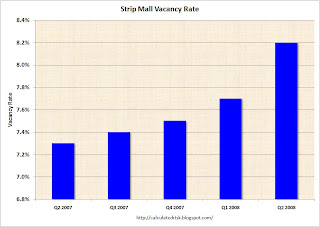 Click on image for larger graph in
new window.
Click on image for larger graph in
new window.This graph shows the strip mall vacancy
rate since Q2 2007. Note that the graph doesn't start at zero to better
show the change.
Too many new projects and rising vacancies rates suggests new mall
construction will decline sharply. This is one of the three areas of
new construction of Commercial Real Estate (CRE) were I expect a significant
decline in investment over the next several quarters; there are investment
in
Malls, Hotels, and Office space.
It's pretty funny the under the current administration the country is
sliding into socialism ("education does not pay" was the situation in the
USSR with its "red necks rules" mantra).
This is the type of issue the election should be about. The conversation
has been steered elsewhere, the focus is no longer on the economy, and
that's to the detriment of those who need help,
especially if the connection between the
economic policies of the Bush administration, policies that will continue
under McCain-Palin, and the economic outcomes people have experienced
are not fully recognized:
Wages are falling for just about everybody, by Kathy G.:
Chart from the Wall Street Journal
Today, the Wall Street Journal
reports the sobering news that, since 2000, real wages have
fallen for every educational group in America except folks with
professional degrees (doctors, lawyers, and the like). All other
groups, even those with master's degrees and Ph.D.'s, saw declining
wages over this period. The WSJ piece is based on recently released
Census data (you can find the most recent Census Bureau report on
income and earnings
here).
In recent years, the college earnings premium has decreased
substantially. As the Journal points out:
In 1975, for instance, workers with college degrees earned
60% more per year on average than workers with high-school
diplomas only, according to the 2006 Economic Report of
the President.
Workers with a college degree saw their
earnings premium grow steadily over the next quarter century,
and by 2000 their average earnings were roughly double what
workers with a high-school diploma made. Over the next four
years the trend reversed: By 2004, workers with a college
diploma only were earning about 80% more than high-school
grads, on average.
The Journal article identifies globalization (including the
outsourcing of both blue- and white-collar jobs) and rising
health costs as possible causes for the decline in wages. One
reason workers' wages aren't keeping up with inflation is that
health care costs have risen dramatically in recent years, so
employers are shelling out more for health coverage, and less
in wages.
For most Americans, these data paint a fairly bleak picture
of their economic prospects. About the only good thing I can
say about this is that, given this economic climate, I find
it almost impossible to believe that the Republicans triumph
this November. The seven-year period during which wages have
been in freefall just happen to be seven years in which a Republican
was president and Republicans, for the most part, controlled
Congress. There's no way in hell that the Republicans should
be able to get away with this. If, in spite of everything, they
end up winning this fall, it will be the con job of the century.
I'm guilty of this too with recent side trips to discuss elitism
and other cultural issues, but can we steer the conversation back
to the issues that are important? Can the press and everyone else
stop fanning the flames of side issues that are nothing but a distraction
from what matters to struggling households? It's time to change
to conversation, to go on the offensive with these kinds of issues,
but how? My opinion is that there's only so much we can do, it's
up to the campaigns to set the national conversation, and
right now the Democrats are in response
mode - playing defense - rather than setting the conversation by
aggressive attacks on Republican economic policy,
attacks that make it clear how those policies have worked to the
detriment or simply ignored the needs of typical households.
You can win playing defense, especially
if you are already way ahead, but most of the time it's offense
that scores the big points.
comments
paine says...
yikesthe pundits cry intensifies
as the top 1 percent fly away from us all
"higher percentages of higher ed is our only hope for national
salvation..." and the premium collapses
===
Denis Drew says...
To help the people on the income bottom is simply a matter
of resetting the checks and balances in the labor market --
boom or bust or whatever:
You can increase the pay of minimum wage workers 100% for
3% increase the cost of output -- probably less in retail prices.
Since this would probably start a push up of other (nothing)
wages we could seriously bolster the income of half the country
for maybe 6% increase in prices for the top half.
The next 40 percentile (50-90) could recover their 6% --
and hopefully a lot more with the legislative introduction of
sector-wide labor agreements. Wal-Mart would have to pay what
Costco pays (Wal-Mark just abandoned the German market, 88 stores,
because it could not make out paying equal wages).
The top 10% enjoyed 40% of all income as of 2001 (my only
figures* -- they are doing even better now), up from 27.5% in
1973 (when the inequality slide began), so there is plenty of
headroom there for the 50-90s to get their money back from both
ends by raising their labor prices.
In economics the poorest should be the easiest to help because
it takes so little from those above to multiply their incomes
-- a convenient triage. Doubling the minimum wage (to where
it should have been all along) and establishing sector-wide
labor agreements (practiced in third, second and first world
economies) are just boiler plate solutions -- nothing crazy
or radical. You don't have to look any further, but the more
the merrier.
S Brennan says...
With apologies to Martin Niemöller
"In America, they came first for the union blue collars, And
I didn't speak up because I wasn't a union blue collar;
And then they came for the skilled trades, And I didn't speak
up because I wasn't a skilled trademan;
And then they came for the engineers, scientists and code writers,
And I didn't speak up because I wasn't an engineer, scientist or
code writer;
And then . . . they came for me . . . And by that time there
was no one left to speak up."
http://ontodayspagelinks.blogspot.com/2008/08/income-share.html
ken says...
How many times does it have to be said: you can't fight something
with nothing.
Democrats run away from liberalism while Republicans embrace
conservatism.
Even now, after a lifelong committment
to New Deal/Great Society liberal ideas I doubt if any Democrat
in office or currently running for office shares my values.
Why is this? The answer is because our so called party leaders
have repeatedly let Republicans define what liberalism means in
a negative sense. What do democrats do in response? They embrace
the republican formulation and respond with a lack of conviction
that, really, Americans prefer our policies. Oh Yeah? Then why do
we still keep losing elections?
anne says...
http://www.cbpp.org/9-5-08ui-stmt.htm
September 5, 2008
The Labor Department's most comprehensive alternative unemployment
rate measure - which includes people who want to work but are discouraged
from looking and people working part time because they can't find
full-time jobs - stood at 10.7 percent in August, its highest level
since June 1994.
The IMF said today that the credit markets are still deteriorating and
the problem is spreading to developing countries.
UK, Spain and Germany are heading for a full-blown
slowdown according to the EC which cut eurozone forecasts
With the
nationalization
of Fannie Mae and Freddie Mac, it's impossible to argue the Federal
government isn't playing a crucial and growing role in the financial
markets."Call it socialism, manipulation, intervention, [or] desperation.
Call it what you will but don't underestimate the mandate," says Todd
Harrison, CEO of Minyanville.com.
"The agenda [of policymakers] is very clear," he continues. "They
need to stabilize the system [to] avoid the unthinkable -- a crash that's
going to suck global capital markets in the abyss."
Certainly there's an economic benefit to avoiding a global financial
market collapse. But Harrison has long argued policymakers had
two major goals ahead of the election they are still pursuing: lower
oil prices to $100 or below, and get equity prices higher.
Given all that's transpired in the past year, from the bailout of
Bear Stearns to the Fed's special financial vehicles for Wall Street
to this weekend's intervention, one thing is clear:
The
"invisible hand"
in the markets these days belongs to Uncle Sam.
"Putting lipstick on a recession makes it look quite attractive."
Big Picture
First of all let's
all get serious. Did anybody really believe that FNM and FRE would become
anything other than de-facto nationalised???Was this a shock and surprise
event? Has "bazooka" Hank just saved the World????
We are not credit people and we will leave the credit
analysis of this to the experts but we struggle to see how translating
the exposure of a major part of the U.S. mortgage industry to the U.S.
consumer is something we should be jumping up and down for joy about.
Neither is the fact that yet another financial institutions(s) has common
stock effectively worth nothing and a realisation that preferred stock
is not a risk free investment. Tell the guy who is part of Friday's
6.1% unemployment rate how a few basis points improvement in his mortgage
(If that is actually what happens) makes everything o.k. Do we honestly
believe that another sleight of hand from the Treasury/FED suddenly
makes all the problems go away? Do U.S. consumers realise that they
have just involuntarily doubled-down on the U.S. mortgage/housing market?-because
if this bet does not work they will be "carrying the can" for this.
===
Is anyone willing to consider the alternative case here ? Not just
the catastrophe if Frannie was allowed to fail but that intervention
is a necessary government function. Even more broadly that markets don't
exist without a government institutional framework on which to build
them. One doesn't get upset over having publicly provided police, fire
or ambulance services. Or state highways or any of a myriad other public
services including a legal system,a military and so on. Ask yourselves
would markets even exist without private property rights, without a
court system to resolve disputes, without a regulatory framework to
define standard measures of product and acceptable behaviors. The question
is not whether regulation and intervention is necessary but it's nature,
timing and extent. Consider that we've all wallowed in the benefits
of Frannie's excesses and greeds since we all were likely investors
who rode the bull markets up since '04, which wouldn't have happened
without the Housing put which was enabled to a great degree by Frannie.
For anybody who makes their living off of markets to object to regulation
is a tad disingenuous. Not least of the reasons being that letting Frannie
go would not only collapse the markets but would indict the credit-worthiness
of the US itself:
http://tinyurl.com/5qbc44
A review of all the inter-connections and consequences plus some
good readings. But if you read nothing else read Bob Solow's review
of Kevin Philips book "Bad Money" here: http://tinyurl.com/56ojml
One of the world's great economists takes apart a very bad polemic and
in the process explains how and why markets work and what kind of reforms
you ought to be pushing for.
The nationalization of Fannie Mae and Freddie Mac shows that the U.S.
is "more communist than China right now" but its brand of socialism
is meant only for the rich, investor Jim Rogers, CEO of Rogers Holdings,
told CNBC Europe on Monday.
"America is more communist than China is right now. You can see that
this is welfare of the rich, it is socialism for the rich... it's just
bailing out financial institutions," Rogers said.
"A Huge Mess"
However, despite the rally in Asian and European markets, the decision
to take over Fannie and Freddie is likely to cause more volatility and
needs careful consideration by investors, according to Rogers.
It's rarely good to jump in a moving bus and right now you got a
lot of buses moving. I might short some more investment banks in the
US, depending on how they rally over the next week, but other than that,
I'll just sit and watch," he said.
Rogers, who is short on U.S. bonds, said these are likely to fall
while commodities may rally. The two government-sponsored
enterprises don't have good loans on their books, because "everybody
else took the good stuff and dumped the bad stuff onto Fannie and Freddie,"
he said.
From 2010, Fannie and Freddie will have to shrink their portfolios
by 10 percent a year until they reach $250 billion, to reduce the risk
to the taxpayer, according to the Treasury plan. But this may put additional
pressure on the housing market, Rogers said.
"That's going to also ensure that house prices continue to go down.
It's going to be harder and harder to get a mortgage."
Investors should not pin their hopes on this year's presidential
election for a solution to the problems, as none of the candidates is
likely to find one, Rogers said.
"This is a big huge mess and neither
one of them has a clue what to do next year. It's going to be a mess."
With no rate increases on the horizon, bonds probably will go up for
the rest of the year. I think that the interest rates either will
be stable or even might go slightly down if unemployment hit 7%.
Wow. And remember, the prior release's ncrease, to 5.7%, was hoped to
be due to anomalies. There was discussion at that time that it might
fall back with the next month's announcement.
This may put a nail in the coffin as far as rate increase talk
at the Fed is concerned.
Comments
Matt Dubuque
Unemployment figures are NOT a leading indicator and they are
NOT a coincident indicator. They are a LAGGING indicator of future
economic activity. There is MUCH more to come on this front
This is typical negative feedback loop: lower salaries -- lower earning
-- higher delinquencies and bankruptcies. The increase in delinquencies
and foreclosures up to this point is most likely due to poor/fraudulent
underwriting. But in 2009 and 2010 the weak economy and weak labor market
will became increasingly important driver of delinquencies
Sept. 5 | Bloomberg
Slower consumer spending may drag down
profit at U.S. companies next year and overshadow growing
demand from developing markets, investor
Mario Gabelli said.
... ... ...
The
Standard
& Poor's 500 Index has lost 16 percent in 2008 as subprime-related
losses at banks topped $500 billion worldwide and the U.S. economy teetered
on the brink of a recession. This week's retreat pared the rebound in
the benchmark stock index to 1.8 percent from an almost three-year low
set on July 15. Trading in stock-index futures today indicate the S&P
500 may sink to a new low.
Earnings Estimates
Companies in the S&P 500 will report a 1.7 percent drop in profit
during 2008, before posting a 24 percent increase next year, according
to the average of analyst estimates in a Bloomberg survey.
The U.S. lost more jobs than forecast in August and
the unemployment rate climbed to a five-year
high of 6.1 percent, heightening the risk that the economic slowdown
will worsen. The Labor Department said today that payrolls
fell by 84,000 in August, and revisions added another 58,000 to job
losses for the prior two months.
401K investors should be away that Americans no longer have the purchasing
power to keep the economy going and this situation is a structural shift,
not a temporary blip. 15 year of credit splurge came to an abrupt and painful
end. Weakening labor market adds insult to injury. New claims
jumped 15,000 last week, to a seasonally-adjusted 444,000. We'll know tomorrow
is seven months long decline in jobs continues.
It was not much more than a year ago that people confidently said
"liquidity" would keep prices from falling.
Now, the opposite is feared. David Henry and Matthew
Goldstein had an interesting
article in Business Week discussing the possibility that the banks
would be forced to sell assets without any buyers being available. That
would drive market prices down, forcing more write-offs and more sales,
and so on and on. And then today Bill Gross of Pimco sounded the
alarm about something similar. His solution is for the government
to step in and buy.
Most financial stocks are still well above the lows reached in the
panicked trading of July 15, but once again there is talk about massive
write-offs as the quarterly numbers come out in coming weeks. Listening
to all that, you could easily forget that profit margins for banks on
new business are great.
If you could somehow start a large, well-capitalized
bank today, with no legacy loans to deal with, you could rake in the
money. So what we have now is a see-saw between hopes
for current business and worries about the old business. Add in rapidly
changing views about prospects for inflation and global recession, and
you have a recipe for volatility. A strong jobs number on Friday could
bring in plenty of buyers.
In my
column in Friday's paper, I argue that
more defaults and more losses are coming as corporate loans go bad.
But even if you think I am right about that, it does not necessarily
follow that financial stocks are overpriced. Some bad news is in the
stock prices.
Still, it takes a lot of nerve to step in and buy either the strange
securities being dumped or the shares of the banks doing the dumping.
The sovereign wealth funds that put cash up a few months ago now look
like chumps. The banks say they are being forced to write securities
down to levels well below what they will eventually be worth, but the
fact that the banks have been so wrong about values in the past does
not inspire confidence that this time they are right. Even if you think
they are correct, you might decide to wait to see if prices will fall
further.
Some bankers argue that "mark-to-market" accounting is the culprit,
by forcing those unreasonable write-downs. The fault may lie more with
the banks themselves, for creating and buying opaque securities that
would be so difficult to value when investors went from credulous to
cautious. Would you be more willing to buy bank stocks if you knew they
were deliberately carrying securities at well above market value?
It will take buyers who seem to be well informed and smart to persuade
the bulk of investors that the worst is over. Complaints that market
prices are ridiculous will be more believable when Mr. Gross wants to
buy for his own accounts, rather than suggest the government do so for
its accounts.
From the
Nattering Naybob:
Shares in the S&P 500 have climbed to an average 25.8X reported
profits....The last time that happened
in 2001, the S&P 500 fell 38%.
As they like to say, past performance is no guide to future return,
but be warned.
[Sep 2, 2008] More Bank Woes- Spreads on Credit Card Securitizations
Rise
New York-based American Express had a credit-card delinquency rate
of 3.42 percent as of July, Bloomberg data show. Uncollectible debt
rose to 5.3 percent of loans from 2.9 percent a year earlier and will
climb as the year progresses, American Express Chief Executive Officer
Kenneth Chenault said on July 21.
Consumer purchases slowed to an increase of 0.2 percent in July,
one-third the pace in June, the Commerce Department said Aug. 29.
Incomes dropped 0.7 percent, the first decrease
since August 2005.
U.S. consumers borrowed more than twice
as much as economists forecast in June. Consumer credit rose by $14.3
billion, the most since November, to $2.59 trillion, according to the
Federal Reserve..
[Sep 02, 2008] Adviser: Get Out of Index Investing By
Kirk Shinkle
September 2, 2008 | usnews.com
J. Michael Martin, president and CIO of
Financial
Advantage, a Columbia, Md., fee-only financial planner, says there
is still lots of risk in the market and that now isn't the time to be
lashing your investment future to U.S. stock indexes. He argues that
when markets are in bad shape for a long stretch, it's more important
to target healthy bits of the market rather than seek safety by playing
the whole field.
Related News
His typical portfolio is up an average of 7.2 percent over the past
eight full years, compared with 1.7 percent for the S&P 500, and he
offered the edited comments below on his cautious stance:
We've had a little recovery in stocks this month. Why aren't
you optimistic?
Everyone is saying the future is so unsettled, but I think it's much
clearer than it usually is. If you think
about the credit problems bigger picture, what you see is really clear.
The current turmoil is just a symptom of a huge macro change that's
going on. For a generation, credit has been very easy.
Markets over the last 25-year cycle have been productive with modest
volatility. It's been a great time to be an American citizen. You didn't
have to save because your house was increasing in value. You could spend
more than you make, and that's exactly what we did. Our wealth still
increased due to the rising value of our real estate.
In that environment, passive investing became the standard. If you
owned a little bit of everything, then lo and behold, you had double-digit
total returns and made money almost every year. It was wonderful. In
that environment, the best thing you could have done is own index funds.
It was popular because it worked.
Passive index investing has a pretty sound long-term track
record. Why is going with a more active management style a good idea
when markets are in flux?
So much has changed now. Economic growth is becoming harder because
of credit turning from easy to more expensive and harder to get. The
collapse of all the "stupid" loans was just the start of it. Now commentators
are saying we're almost finished, but I say those bad loans-which were
$400-to-$500 billion write-offs globally-were just the turning point.
Eighty percent of banks are tightening [credit] now. Now it's the reversal
of a generation-long expansion of credit. The market is not ready for
that.
It's the opposite of what you want when you own indexes. When you
own an index, you necessarily own the most competitive companies and
the least competitive ones-the ones who do OK because the environment
is easy. When the business environment is more competitive, it starts
to separate the men from the boys. It's not an environment where you
want to have to own the least competitive companies. When they're all
priced similarly after a long period of a good economic environment,
the market doesn't distinguish between the weak and the strong. A shakeout
period does make that distinction. Even though it worked for 20 years,
now you want to be selective. "Active" investing doesn't mean trading
a lot. It means being selective.
Will index funds beat inflation over the next five years?
I think not. The Federal Reserve is far, far more concerned about letting
a deflationary economic environment get under way than it is about inflation.
It'll make efforts to stop a slowdown in economic activity. My concern,
then, is more inflation. Inflationary times like the '70s were not good
for stocks or corporate earnings.
Earnings expectations have come down quite a bit, though.
The real question is what about the [earnings] part of the [price-to-earnings]
ratio. There's a lot of risk in broad corporate earnings because the
business environment and consumer spending will be much more competitive.
Profit margins are at all-time highs, and they've always cycled down.
Profit margins [for the S&P] averaged between 5.5 percent and 7.5
percent over the last 50 years. Recently, they've been around 8.5 percent.
They're unsustainably high, and if they do their usual reversion to
the mean, there's a lot of room on the downside for earnings that is
not in the expectations.
Should investors still be in "protection" mode for most of
their assets?
To preserve capital when securities prices are too expensive, we try
to be more discerning about being more global and less U.S. focused.
It's pretty clear to us financial power is shifting in the world. That's
not news to anybody, and it's important your portfolio reflects the
understanding that growth is going to be Asian. We also have just a
lot less equity exposure than if we thought we were in a more ordinary
time. Instead of owning everything to be defensive, we think it's more
important to be selective, because the business environment is tougher.
In the wake of the Enron bankruptcy-which was briefly the biggest failure
in U.S. history-two key lessons were obvious: Financial regulators needed
lots more funding and personnel, and derivatives markets that were allowed
to operate without proper regulatory oversight and reporting paved the
way for financial engineers to privatize profits and socialize costs.
Today, less than seven years after Ken Lay and his accomplices drove
their once solid company into the ground, the United States is facing
a financial disaster that makes Enron look quaint. The
bankruptcy of Lehman Brothers Holdings, America's fourth-largest
investment bank, involves a whopping $613 billion in debt. When Enron
failed, it claimed assets of just over $63 billion.
The implosion of Lehman-along with the federal takeovers of mortgage
giants Fannie Mae and Freddie Mac and insurance behemoth AIG-is symptomatic
of the same lack of oversight that existed in December 2001 when Enron
failed. And that lack of oversight can most easily be understood by
looking at the budget of America's single most important financial regulator,
the Securities and Exchange Commission, which oversees financial markets
worth tens of trillions of dollars.
But this downturn is likely to last longer than the eight-month-long
recession of 2001. While the U.S. financial system processes popped
stock bubbles quickly, it has always taken longer to hack through the
overhang of bad debt. The head winds that drove the economy into this
dead calm- a housing and credit crisis, and rising energy and food prices-have
strengthened rather than let up in recent months. To aggravate matters,
the twin crises that dominate the financial news-a credit crunch and
the global commodity boom-are blunting the stimulus efforts. As a result,
the consumer-driven economy may not bounce back as rapidly as it did
in the fraught months after 9/11.
As it seeks to regain its footing in the second half, the U.S. economy
faces two significant obstacles, neither of which was evident in 2001.
The first is entirely homegrown: the self-inflicted wounds of the promiscuous
extension and abuse of credit in the housing and financial sectors.
The second is a global phenomenon that has comparatively little to do
with American behavior: rampant inflation in commodities such as oil,
food and steel. These trends have conspired to inflict genuine economic
pain and deflate consumer confidence. The Conference Board's Consumer
Confidence Index in May slumped to a 16-year low.
Society
Groupthink :
Two Party System
as Polyarchy :
Corruption of Regulators :
Bureaucracies :
Understanding Micromanagers
and Control Freaks : Toxic Managers :
Harvard Mafia :
Diplomatic Communication
: Surviving a Bad Performance
Review : Insufficient Retirement Funds as
Immanent Problem of Neoliberal Regime : PseudoScience :
Who Rules America :
Neoliberalism
: The Iron
Law of Oligarchy :
Libertarian Philosophy
Quotes
War and Peace
: Skeptical
Finance : John
Kenneth Galbraith :Talleyrand :
Oscar Wilde :
Otto Von Bismarck :
Keynes :
George Carlin :
Skeptics :
Propaganda : SE
quotes : Language Design and Programming Quotes :
Random IT-related quotes :
Somerset Maugham :
Marcus Aurelius :
Kurt Vonnegut :
Eric Hoffer :
Winston Churchill :
Napoleon Bonaparte :
Ambrose Bierce :
Bernard Shaw :
Mark Twain Quotes
Bulletin:
Vol 25, No.12 (December, 2013) Rational Fools vs. Efficient Crooks The efficient
markets hypothesis :
Political Skeptic Bulletin, 2013 :
Unemployment Bulletin, 2010 :
Vol 23, No.10
(October, 2011) An observation about corporate security departments :
Slightly Skeptical Euromaydan Chronicles, June 2014 :
Greenspan legacy bulletin, 2008 :
Vol 25, No.10 (October, 2013) Cryptolocker Trojan
(Win32/Crilock.A) :
Vol 25, No.08 (August, 2013) Cloud providers
as intelligence collection hubs :
Financial Humor Bulletin, 2010 :
Inequality Bulletin, 2009 :
Financial Humor Bulletin, 2008 :
Copyleft Problems
Bulletin, 2004 :
Financial Humor Bulletin, 2011 :
Energy Bulletin, 2010 :
Malware Protection Bulletin, 2010 : Vol 26,
No.1 (January, 2013) Object-Oriented Cult :
Political Skeptic Bulletin, 2011 :
Vol 23, No.11 (November, 2011) Softpanorama classification
of sysadmin horror stories : Vol 25, No.05
(May, 2013) Corporate bullshit as a communication method :
Vol 25, No.06 (June, 2013) A Note on the Relationship of Brooks Law and Conway Law
History:
Fifty glorious years (1950-2000):
the triumph of the US computer engineering :
Donald Knuth : TAoCP
and its Influence of Computer Science : Richard Stallman
: Linus Torvalds :
Larry Wall :
John K. Ousterhout :
CTSS : Multix OS Unix
History : Unix shell history :
VI editor :
History of pipes concept :
Solaris : MS DOS
: Programming Languages History :
PL/1 : Simula 67 :
C :
History of GCC development :
Scripting Languages :
Perl history :
OS History : Mail :
DNS : SSH
: CPU Instruction Sets :
SPARC systems 1987-2006 :
Norton Commander :
Norton Utilities :
Norton Ghost :
Frontpage history :
Malware Defense History :
GNU Screen :
OSS early history
Classic books:
The Peter
Principle : Parkinson
Law : 1984 :
The Mythical Man-Month :
How to Solve It by George Polya :
The Art of Computer Programming :
The Elements of Programming Style :
The Unix Hater’s Handbook :
The Jargon file :
The True Believer :
Programming Pearls :
The Good Soldier Svejk :
The Power Elite
Most popular humor pages:
Manifest of the Softpanorama IT Slacker Society :
Ten Commandments
of the IT Slackers Society : Computer Humor Collection
: BSD Logo Story :
The Cuckoo's Egg :
IT Slang : C++ Humor
: ARE YOU A BBS ADDICT? :
The Perl Purity Test :
Object oriented programmers of all nations
: Financial Humor :
Financial Humor Bulletin,
2008 : Financial
Humor Bulletin, 2010 : The Most Comprehensive Collection of Editor-related
Humor : Programming Language Humor :
Goldman Sachs related humor :
Greenspan humor : C Humor :
Scripting Humor :
Real Programmers Humor :
Web Humor : GPL-related Humor
: OFM Humor :
Politically Incorrect Humor :
IDS Humor :
"Linux Sucks" Humor : Russian
Musical Humor : Best Russian Programmer
Humor : Microsoft plans to buy Catholic Church
: Richard Stallman Related Humor :
Admin Humor : Perl-related
Humor : Linus Torvalds Related
humor : PseudoScience Related Humor :
Networking Humor :
Shell Humor :
Financial Humor Bulletin,
2011 : Financial
Humor Bulletin, 2012 :
Financial Humor Bulletin,
2013 : Java Humor : Software
Engineering Humor : Sun Solaris Related Humor :
Education Humor : IBM
Humor : Assembler-related Humor :
VIM Humor : Computer
Viruses Humor : Bright tomorrow is rescheduled
to a day after tomorrow : Classic Computer
Humor
The Last but not Least Technology is dominated by
two types of people: those who understand what they do not manage and those who manage what they do not understand ~Archibald Putt.
Ph.D
Copyright © 1996-2021 by Softpanorama Society. www.softpanorama.org
was initially created as a service to the (now defunct) UN Sustainable Development Networking Programme (SDNP)
without any remuneration. This document is an industrial compilation designed and created exclusively
for educational use and is distributed under the Softpanorama Content License.
Original materials copyright belong
to respective owners. Quotes are made for educational purposes only
in compliance with the fair use doctrine.
FAIR USE NOTICE This site contains
copyrighted material the use of which has not always been specifically
authorized by the copyright owner. We are making such material available
to advance understanding of computer science, IT technology, economic, scientific, and social
issues. We believe this constitutes a 'fair use' of any such
copyrighted material as provided by section 107 of the US Copyright Law according to which
such material can be distributed without profit exclusively for research and educational purposes.
This is a Spartan WHYFF (We Help You For Free)
site written by people for whom English is not a native language. Grammar and spelling errors should
be expected. The site contain some broken links as it develops like a living tree...
Disclaimer:
The statements, views and opinions presented on this web page are those of the author (or
referenced source) and are
not endorsed by, nor do they necessarily reflect, the opinions of the Softpanorama society. We do not warrant the correctness
of the information provided or its fitness for any purpose. The site uses AdSense so you need to be aware of Google privacy policy. You you do not want to be
tracked by Google please disable Javascript for this site. This site is perfectly usable without
Javascript.
Last modified:
March 12, 2019


Anyone care to address this issue?
JM
- Posted by john michel