|
|
Home | Switchboard | Unix Administration | Red Hat | TCP/IP Networks | Neoliberalism | Toxic Managers |
| (slightly skeptical) Educational society promoting "Back to basics" movement against IT overcomplexity and bastardization of classic Unix | |||||||
| Jan | Feb | Mar | Apr | May | June | July | Aug | Sep | Oct | Nov | Dec |
|
|
This is pretty educational reading along the line of Bernard Show: experince keeps the most expensive school, but fools can't study in any other.
Enjoy !
Dr. Nikolai Bezroukov
|
|
naked capitalism
Rubin refuses to take an iota of responsibility for the bank's tsuris (and that also comes from the Goldman playbook. The firm always circles the wagons and admits nothing). Get a load of this:
Robert Rubin said its problems were due to the buckling financial system, not its own mistakes, and that his role was peripheral to the bank's main operations even though he was one of its highest-paid officials."Nobody was prepared for this," Mr. Rubin said in an interview. He cited former Federal Reserve Chairman Alan Greenspan as another example of someone whose reputation has been unfairly damaged by the crisis.
naked capitalism
You simply cannot make this up. I found a section of this priceless commentary from the Reserve Bank of Zimbabwe via Marc Faber's latest newsletter (hat tip reader Dean), and had to verify it. The original provides an even richer mine of material.
From the Reserve Bank of Zimbabwe (boldface theirs):
As Monetary Authorities, we have been humbled and have taken heart in the realization that some leading Central Banks, including those in the USA and the UK, are now not just talking of, but also actually implementing flexible and pragmatic central bank support programmes where these are deemed necessary in their National interests.That is precisely the path that we began over 4 years ago in pursuit of our own national interest and we have not wavered on that critical path despite the untold misunderstanding, vilification and demonization we have endured from across the political divide.
November 28 2008 | ft.com
It no longer makes headlines when bankers turn down this year’s bonus or pay rise. But when ex-bankers at UBS – including the former chairman Marcel Ospel and the former chief executive Peter Wuffli – volunteer to pay back some of last year’s haul, the world has changed.
One is reminded of shoplifters surrendering their ill-gotten gains to try to win clemency from the judge. But Mr Ospel and Mr Wuffli are accused, not of any crime, but of incompetence. They face only the court of Swiss public opinion. Small wonder that the Swiss former executives have been quicker than the non-Swiss to announce their gestures of atonement.
The Big Picture
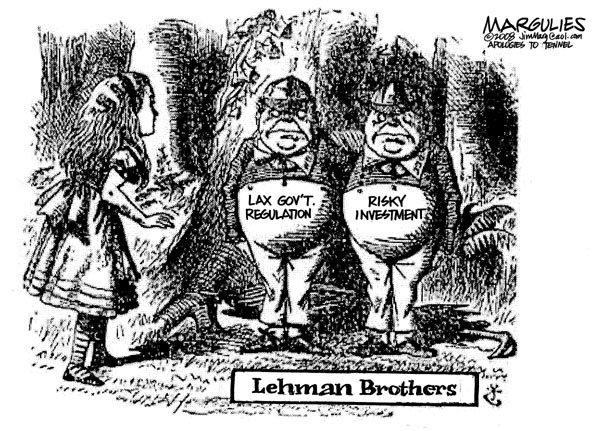
This cartoon, from Jimmy Margulies of the Record, is probably the most ominous I have seen regarding Legman Brothers collapse:
The Daily Reckoning
"You can understand how fraudulent most economic analysis is," Nassim explained, "just by looking the life of the turkey. The animal is fed for 1000 days…and then it is killed. So, if you plotted out the turkey's life on a chart, it would look great for 1,000 days…each day, the food arrived reliably, and each day, the turkey gained weight. The turkeys would look around and say they were enjoying growth and a bull market. Momentum investors would see it as an opportunity. The quants would run linear regressions on the data and prove that the risk was minimal. "Ben Bernanke would describe the turkey's life - with no setbacks - as the product of a "great moderation." Turkey stockbrokers would assure their clients that nothing had ever gone wrong in the turkey's life. Turkey econometricians and theorists would come up with explanations for why the turkeys' growth would continue forever and they'd pat each other on the back for having finally mastered the "turkey cycle." Turkey politicians would run for re-election on the grounds that they had helped create a better world. And turkey economists would project further weight gains…until the turkey was the size of a hippopotamus
Then, come Thanksgiving, and all of a sudden, something goes wrong. Alas, all the turkeys' theories, models, and conceits were for the birds.
FT.com
Players can pick up a card that reads: “Go to demonstrate at parliament, stop to buy some eggs to throw, only to realize that prices have gone up so much you can’t afford them.”
Despite the humor, the game does convey a serious message, argues Mr Antonsson. “Things can’t continue like they were.”
naked capitalism
How can you give cash compensation to an executive, yet claim it is not a salary or bonus? You call it a "retention bonus," No, I am not making this up.
CNN.com
Is it ironic that the revolution of this country was due to taxation without representation and the overextending central bank?
The reason we have deflation is that it is difficult to pump money into an airplane with a hole in its side.
Goldman... Citigroup ... and JPMorgan ..., which helped turn bets on company defaults into a $47 trillion market, are among banks offering wagers on the amount investors may recover from bonds after borrowers go bankrupt.Credit-recovery swaps are trading on the debt of about 70 companies, including automaker General Motors Corp. and bond- insurer MBIA Inc. That’s up from 40 during the summer, according to Mikhail Foux, a strategist at Citigroup in New York.
Also known as recovery locks, the agreements are bought as insurance by sellers of credit-default swaps, such as banks, hedge funds and insurers.
“The market definitely has potential to grow,” Foux said.
(snip)
America's 401K investors are being taken further and further out to sea without a life jacket. And all they will be hearing from the crew when the boat go overboard, are going to be recommendation like "have a nice swim, suckers".
McSweeney's Internet Tendency
"Damn it, Dagny! I need the government to get out of the way and let me do my job!"
She sat across the desk from him. She appeared casual but confident, a slim body with rounded shoulders like an exquisitely engineered truss. How he hated his debased need for her, he who loathed self-sacrifice but would give up everything he valued to get in her pants ... Did she know?
"I heard the thugs in Washington were trying to take your Rearden metal at the point of a gun," she said. "Don't let them, Hank. With your advanced alloy and my high-tech railroad, we'll revitalize our country's failing infrastructure and make big, virtuous profits."
"Oh, no, I got out of that suckers' game. I now run my own hedge-fund firm, Rearden Capital Management."
"What?"
He stood and adjusted his suit jacket so that his body didn't betray his shameful weakness. He walked toward her and sat informally on the edge of her desk. "Why make a product when you can make dollars? Right this second, I'm earning millions in interest off money I don't even have."
He gestured to his floor-to-ceiling windows, a symbol of his productive ability and goodness.
"There's a whole world out there of byzantine financial products just waiting to be invented, Dagny. Let the leeches run my factories into the ground! I hope they do! I've taken out more insurance on a single Rearden Steel bond than the entire company is even worth! When my old company finally tanks, I'll make a cool $877 million."
Their eyes locked with an intensity she was only beginning to understand. Yes, Hank ... claim me ... If we're to win the battle against the leeches, we must get it on ... right now ... Don't let them torture us for our happiness ... or our billions.
He tore his eyes away.
"I can't. Sex is base and vile!"
"No, it's an expression of our highest values and our admiration for each other's minds."
"Your mind gives me the biggest boner, Dagny Taggart."
He fell upon her like a savage, wielding his mouth like a machete, and in the pleasure she took from him her body became an extension of her quarterly earnings report—proof of her worthiness as a lover. His hard-on was sanction enough.
"Scream your secret passions, Hank Rearden!"
"Derivatives!"
"Yes!"
"Credit-default swaps!"
"Oh, yes! Yes!"
"Collateralized debt obligation."
"YES! YES! YES!"
Perhaps the meaning of TARP should be changed from Troubled Asset Relief Program to Troubled American Relief Program because in reality what they are doing now is TWIRP - Troubled Wealthy Investor Relief Program.
I have noticed that many commentators on this site have delusions about understanding the financial world. The reality is that those trained in economics and finance are often the most ignorant of the true nature and scope of their actions.
What is the purpose of money or economic activity? I am suggesting that the true purpose of such concepts and activity is to prevent people from killing each other. The fringe benefits of money and economic activity such as as trade, "progress" and wealth creation are secondary.
However many economists and financial types believe that money is real. Though many of them profess to believing that money is merely a medium of exchange and storage of commercial activity, their actions suggest otherwise. It is curious that kids stop believing in santa claus and the easter bunny as they grow up but start believing in the "realness" of money. Money whether gold based or fiat based is not real. Neither is debt, your favorite economic model or theory. Money is worthless if it cannot create new wealth or keep people from killing each other.
The concept of money, as most people understand it, was created in a feudal and mercantile age when the majority had a subsistence level existence. It is therefore not surprising that it evolved mainly to keep people from killing each other and simultaneously control people (we are just smart apes who seek short term dominance over long term gains).
However the full fruits of industrialization, various historical events and widespread multi-generational acceptance of concepts like fiat currency have made the consumption of the average person the only dominant driver of the economy (consumer economy). While some people express moral misgivings about such a transformation, the reality is that people who advocate a move away from materialism, towards conservatism, fiscal discipline, frugality are the merely the priests of a new religion. They seek to control and dominate the lives of other people just like the 'priests' of every religion from catholicism to environmentalism and "capitalism".
Many educated people harbor subconscious fantasies about a return to a world where their less well educated peers are peons, serfs and slaves. The problem with this approach is quite simple- the level of complexity and hidden supports that keep our society functioning will collapse and we will cease to live in a functional society.
Many educated people also harbor the fantasy that they can return to a medieval age where the level of complexity was "about right" for the "human brain". This belief is mistaken for a few reasons-
a] We have no comprehension about the full capability and potential of the human mind. For most of history we have lived in tribes of less than 200 people, however given the right conditions we have been able to repeatedly form large complex societies. The same minds that are supposed to be capable of only forming medieval societies at best also create complex mathematical models that can ruin the world (as you might have heard recently). While our motivations may be base, our ability to perform complex tricks to obtain those base aims is rather surprising. Complex scams are hardly restricted to the financial sectors- the entire medical industry, construction industry and pretty much any regulated/licensed/ union job is essentially based on a complex scam.
b] Living in medieval society was no picnic. People who visit heritage parks or attend renaissance fairs have a rather incomplete understanding of the hardships in those periods. This situation is not unlike many outdoors enthusiasts who rail against development but who depend on the gear, technology and laws of modern society.
c] Western (white majority) societies are in decline. Throughout history, the intelligentsia of declining societies have always rationalized their downturns as natural, global , inevitable and understandable. The common thread through such declines has always been the belief that "we have reached the peak of human achievement and it is downhill for every human from here on". History suggests otherwise. However this phenomenon has never hit western societies on this scale and scope- until now.
d] Emergent systems guided by chaos and evolutionary pressures are unlikely to return to their starting point- or even retrace their steps. Much has changed in the 70 odd years since GD1, especially in regards to the permutations and combinations of possibilities.
I believe that the best way forward for us a species is to think about the following concepts.
1] What is money? Why should it retain its value? What is the use of money if it cannot buy you wealth. What use is your 1913 pre-fed dollar if it cannot buy you a circa 2008 - 4 dollar walmart prescription for your kids strepthroat. Do you have any clue about how many kids got rheumatoid arthritis or pneumonia from then untreatable strepthroat. Most people who died in the 1918 flu epidemic died from seconday bacterial pneumonia not the virus.
Gold based or strict credit economies cannot create the infrastructure and technological breakthroughs we are accustomed to. We are quite pathetic at predicting the effects and potential of any any new innovation/ product or service- nothwithstanding the beliefs of of famous and clever white (and asian) men who have proved so wrong about the future of the areas in which they were considered to be experts. Rationing money for innovation would be rather similar to the soviet practise of command economics. In any case it is possible to employ 30-60 people for the total yearly income of an average mid-level investment banker who plays paper games, misjudges opportunities, screws over innovators and also loses your investments.
2] Do banks have any "real" money in a fiat currency based world. Given that the vast majority of banks are either insolvent, propped up zombies or the walking dead- why do we need them (in their current form)?
I believe that banks in a fiat currency world are best operated as utilities, not as the fiefdoms and the extortion rackets they have been to date. The biggest problem with this alternative model is that bankers cannot make obscene amounts of money by shuffling contracts and sucking money from the consumer economy.
I propose that we pay for sending the current crop of bankers on a one way trip to the sun. It would be cheaper to put bankers and their families in launch vehicles directed towards the sun, than bail them out of their fictional mathematical games. The 'Zenit' rocket system can put one kg of stuff in orbit for less than three thousand dollars- You could put a family of bankers in orbit for less than a million. Building the launchers for putting bankers in orbit would create more real jobs than the trillions wasted in the futile efforts to make banks lend to consumers.
3] Large misguided credit expansions, abuses and bankruptcies are inevitable in a species like ours. We like to screw our fellow human for a quick buck. The real question then is how we mitigate the negative effects of such abuses. I believe that any abuses which do not exceed a certain % of GDP should be watched but not intervened in - the dotcom boom created a very good high speed network that we are only now using to it's full potential. The factors that should prompt intervention are high relative size of the bubble to the GDP) and the low potential to create jobs or useful capabilities (housing- we already had a surplus).
I, for once, would welcome a bubble in space exploration, engineering, chemistry, biotechnology or anything else that produces lots of jobs with the small prospect of big unexpected breakthroughs.
4] In a system where the future is unpredictable, can credit be repayed completely or even partially? Given the factors I have listed in 3], periodic widespread debt forgiveness might be necesary to keep the system from collapsing. What do bankers lose anyway? Paper, ink, electrons? They certainly do not lose their previous paychecks, commisions, fees and other assorted loot made from the issuance of bad credit.
Would 1.2 Trillion to repay credit cards + 1 Trillion to repay student loans + 1.5 trillion to pay other personal debt have stimulated economic growth better than pissing the money in a black hole to honor CDS bets (and keep apperances in this nonsensical paper game). Hell, yes!!
5] Maybe we should accept that the two major roles of money are 1] keep people employed / civilized 2] create new wealth through innovation in the non-financial world. It might be time to give up on ideas such as full repayment of debt, money having a constant value and paying sociopaths to manage your wealth. Honestly, how many people who invested in the financial world are gonna make more money (inflation adjusted) than they put in- any guesses on gross percentages.
But first we must put the banksters and their handmaidens into incinerators- heating water in boilers might be the most productive thing they have done in their lives.
Shortly after President-elect Barack Obama is sworn-in to the Chief Executive's office, plans will be announced for the swift closing of Gitmo's sordid chapter in the so-called war on terror. But in a shocking about-face of opinion (to those and readers who think they know me), I will beg to differ with Obama about the imminent policy reversal.
Not, of course, that I think the chapter shouldn't be closed. It should and non-too-soon. But America's little breeze-block, barbed-wired gites-in-the-sun for the morally-compromised and legally-challenged may yet have some legs and alternative uses. I am certain I am not the only one to conjure up alternative uses, but I will nonetheless put them to you. First, Gitmo would be a just place to deliver [many] of the lamest (and I haste to call them "public servants") decision-makers in America's history who've past or presently mal-served the American people. Legal luminaries (ahemmm...) such as Alberto Gonzales, the Dark Lord, Mr Rove, Scooter Libby, as well as Gulf War architects Wolfowitz, Feith, and Perle. Then of course there could be a wing reserved for Delay, Lott and Jack Abramoff, and the original enablers of the Bush-presidency-fiasco, brother Jeb, and Florida's DARling Katherine Harris.
And there is no shortage of solitary cells, suitable for the likes of Mozillo, Cassano, Fuld, in addition to the host of negligent officials at the SEC, Fed, and Treasury (and Congress) who promulgated and defended the lack of public interest as a policy unto itself. Can't you see it: Friday night movies replaying for their edification Michael Douglas' rendition of "Greed is Good". Torture? I do have objection to the physical kind, but see nothing wrong with the loud unceasing piping-in 24-7 of Limbaugh, Savage, Hannity and O'Reilly.
Surely there are others to fill the ranks: the new administration could rendite Gordon Brown and his former cohort enablers who, contrary to current belief, have wrecked the economy of Great Britain on a scale on par with that achieved by the Luftwaffe, by encouraging, permitting, justifying and apologizing for a leverage-binge equivalent to - if not greater than - that of the of the former colonials.
Surely you'll all have a few personal favorites you think worthy of an extended all-expense paid "holiday" in the sun...
Asia Times
Jim Sinclair of jsmineset.com had a link to the essay "Before Saving the US" at ChinaStakes.com, written by a guy named Xiang Songzuo, which starts out, "The nature of the current global financial crisis is the biggest crisis in America's history", which is certainly not news.
Then the article gets right in our American faces and keeps hammering at us: "Statistics show that America's internal and external debt exceeds $60 trillion, over 400% of the country's annual GDP of a bit over $14 trillion. Of that total, family debt (including mortgages), financial and non-financial firms' debt, and municipal and national debt come to about $15 trillion, $17 trillion, $22 trillion, $3.5 trillion, and $11 trillion, respectively, though it is hard to tell how these debts have been split up among foreign governments, financial firms, companies, and individuals."
Naturally, as a proud American, I take the aggressive approach and sneer, saying, "So? Tell us something that we don't know! Hahaha!"
In an apparent response, he goes on, "To relieve the crisis, the US must repay its debts, and to do that it needs to live a more frugal life instead of asking others to continue lending it the money to maintain its over-consumption."
So, still being a smug American, I say, "Says who? You? Hahaha! We're Americans, and we have a fiat currency, and we can just print up all the money to pay you off! And everybody else, too, suckers! How do you like them apples? Hahaha!"
Asia Times
...the "cold turkey" treatment of credit being withdrawn from habitual borrowers, much like taking away drugs from crack addicts.
naked capitalism
The great German poet and playwright Bertolt Brecht would have agreed and once said it was "easier to rob by setting up a bank than by holding up (one)."
Reagan restored the equity market to trend by cutting taxes, suppressing inflation and easing some regulations. The private equity sharps were fleas traveling on Reagan's dog. They simply rode the trend with the maximum of leverage.
Now that the stock market has collapsed, the private equity strategies cannot repay their debt, and their returns have evaporated. Note that equity investors spent a decade in the cold, from 1973 to 1983; it may be even worse this time. The maturities on debt issued to finance private equity deals will come due long before the recovery.
Over the long term, we know that the average investment cannot grow faster than the economy, for investments ultimately are valued according to cash flows, and cash flows stem from economic growth. Real American gross domestic product grew by 2% a year on average between 1929 and 2007. Whence came the enormous returns to the Ivy League? Some of them surely came from betting on the right horses, but most came from privileged access to leverage.
One recalls Ferdinand I of Austria (1793-1875), deposed for incompetence after the 1848 Revolution, who apocryphally shot an eagle, and said: "It's got to be an eagle, but it's only got one head!" Ferdinand thought the two-headed bird of his family crest was the norm, just as the pink-shirted, suspender-wearing Ivy Leaguers thought that two-digit returns were the norm for their investments.
November 21 2008 | FT.com
“Capital is money, capital is commodities,” some well-stodgy writer called Karl Marx put in this book, called Das Kapital. “It has acquired the occult ability to add value to itself. It brings forth living offspring, or, at the least, lays golden eggs.”
Whoever this Marx geezer is – and I can’t find his Facebook account anywhere – he sure hasn’t been watching telly recently. Capital, so far as I can make out through reading my dad’s FT and stuff, has acquired an occult ability to go down the toilet. If capital is laying anything, mate, I can think of a lot choicer terms than “eggs” to describe it.
I haven’t actually read Das Kapital. I came across it when my dad took me to Tokyo recently. This Japanese kid showed me a comic (they call it manga over there) that’s about to come out. The Japanese are crazy about comics. Even their prime minister reads volumes the size of telephone books.
Anyway, in Tokyo, they’ll be queuing up for this Das Kapital manga. That’s partly ’cos they’ll read anything if it’s got speech bubbles. And partly ’cos they were never that fond of capitalism in the first place. My friend told me they really like to make stuff – cars and i-Pods and lacquer bowls and stuff – but they don’t like the idea of making money from money. I guess making money from money sort of sums up how capitalism works – or how it was supposed to work anyway.
The Japanese love their manga characters, like Astro Boy and Charisma Man. But I think the publishers of this Marx book have missed a trick. If they wanted to take a crack at capitalism, even I know there are more interesting characters out there. What about Tarp-man, for instance? A banker-turned government man who strings a huge net between the Wall Street skyscrapers to catch his old buddies jumping out the windows. Only he keeps moving the Tarp, so that lots of bankers smash their head on the pavement anyway.
Or Bubble-man, who used to have a top job at the Federal Reserve. Everyone thinks he’s really smart at first ’cos he cuts interest rates to almost nothing and they all make tonnes of dosh. But then it all goes wrong and he makes a speech about how, maybe, he had made a mistake, and then they all hate him. Or you could do a guy called Dick-man, a kind of anti-hero who used to run this mega bank. But he refuses to sell it, so it bursts into flames.
Or you could do Flash Gordon. He’s a drab kind of bloke who says regulations are bad and that London is great ’cos it doesn’t have any. Then, when the golden eggs hit the fan, he takes off his kilt (his usual getup) and turns into a superhero. He explains why he always said everything would go wrong and how he is the only man to fix it. He’s pretty cool.
But my favourite of all is Maynard-man. In all the stories, whenever something goes wrong – and something always does go wrong – he swoops in on a helicopter or something and drops money from the sky. That one would be great. Everyone would love that one.
The writer is the FT’s Asia edition editor
The American Prospect
This is a gathering of Voodoo priests who realize that their magic rituals don't work but they no of nothing else, so they keep on performing them.
November 22, 2008 | NYT
This is the real “Code Red.” As one banker remarked to me: “We finally found the W.M.D.” They were buried in our own backyard — subprime mortgages and all the derivatives attached to them.
Bloomberg
Alan Greenspan can stop worrying about “irrational exuberance” in the U.S. stock market, 12 years after he warned investors that share prices were rising too fast. The S&P 500 fell below 744.38 today, its closing level on Dec. 5, 1996, the day then-Federal Reserve Chairman Greenspan used the phrase in a speech on “The Challenge of Central Banking in a Democratic Society.”
I guess there’s not a whole lot of Protection at work in the Plunge Protection Team! Worst annual decline in eight decades? Geez, how incompetent must a secret, market-manipulating organization be before someone gets fired?
Comments
It brings to mind that famous passage from “Jaws”….We are going to need a bigger boat.
SPECTRE of Deflation writes:
I'm still waiting for oil to hit their $200 price target. END SARCASM for GS! People actually pay for these clowns twith their money.
SPECTRE of Deflation | 11.21.08 - 9:50 am | #Comrade Kristina writes:
Does this mean the rally is cancelled?
Comrade Kristina | 11.21.08 - 8:51 am | #Yancey Ward writes:
Whew, what a relief! Only 9% unemployment. No wonder we are rallying across the world.
Yancey Ward | 11.21.08 - 9:19 am | #kurtyboy writes:
The question is, my crude hairy-eyeball models do not account for acceleration. The Wile E. Coyote effect is poorly understood.
32 feet per second squared ought to be about right...
kurtyboy | 11.21.08 - 9:21 am | #
Comments
Anonymous said...
The [key] question is, is he a good liar? Q. Is the US banking system insolvent?
A. Hell noQ. Are you monetizing the debt?
A hell noQ.Will SS and Medicare pyments be sustainable
A Hell Yes fully fundedQ.Will the budget be balanced
A.Hell yesQ. Does the US want a strong dollar?
A. Hell Yes
Anonymous said... Was Angelo Mozilo not available or something?
Anonymous said... Maybe the Clinton people will be better with a new boss. Like Michael Dukakis once said "A fish rots from the head first".
Anonymous said... > "It is obvious Bill Clinton has gotten a 3rd term." If it's the third Clinton term then who is going to be the first bimbo?
Rudy Perpich said
Geithner worked for Kissinger & Associates for 3 years after graduation. Then he moved to Treasury under Bush 1. He stayed on at Treasury to work for Rubin. Then to the Federal Reserve under Greenspan. Of course he did not agree with his bosses, and he has been waiting quietly for a chance to undo the damage they did.
Timothy Geithner, American Hero.
Chronicle.com
cross-posted from howtheuniversityworks.com
Available from here Hint: drag cursor to 4:40. I don’t know about you, but I’m always looking for help with dislodging the market fetish, whether I’m talking to undergraduates or economists. Some regular Brainstorm contributors have all been expending a ton of energy on recent posts like this one and this one trying to get finance prof “James” to loosen a white-knuckled grip on his Ronald Reagan prayer shawl. Without much success.
So this one’s for valiant Brainstorm regular commenters Lucky Jim, drj50, Unemployed Academic, Joe Erwin, George Karnezis, Maria, “me,” “k,” angry, Annie, Henry C. Frick, Amanda Huggenkiss, David Yamada, and the rest. You know who you are.
Tonight we’ll let Colbert take a shot at explaining the relationship between voodoo and the business curriculum.
The relevant portion begins at 4:40; the rest is set-up. Elaborately inserting tongue in cheek, he begins:
“We’re in a bit of an economic pickle here, but one thing we can’t blame is the free market. Systems governed by self interest will always keep us safe — that’s why I’ve never understood traffic lights. Self-interest would obviously keep America’s four-way intersections accident-free. And I’m not the only one who thinks the free market is not to blame here. CLIP: BUSH 43…So there’s no need to start regulating and turn ourselves into Europe. CLIP: SARKOZY: “The idea that markets are always right is a crazy idea.”With the set-up out of the way, he quotes the DSM IV on diagnosing delusion: “If a belief is accepted by other members of a person’s culture or subculture, it is not a delusion.”
What this means, Colbert explains:
is that our collective cultural belief that the free market will take care of us is not delusional. No, it is actually a religion. … On judgment day, Ronald Reagan will return on a cloud of glory to take us up to money heaven — that’s what I think will happen if we just believe in the “free market” hard enough. And I can’t possibly be deluding myself — when so many others agree with me.
Calculated Risk
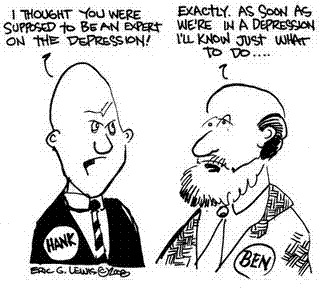
This cartoon from Eric G. Lewis, a freelance cartoonist living in Orange County, CA. was inspired by Professor Duy's post last night: Fed Watch: Policy Adrift
Angry Bear
Reader Bear points us to a great essay by Michael Lewis in Condi Naste Portfolio.com:
...Why bother to overturn your parents’ world when you can buy it, slice it up into tranches, and sell off the pieces?
A: It's only logical. there is nobody else to trust now. Are you suggesting we should trust Fed or government ?
CalculatedRisk
For those that miss all the yelling from the talking heads during the political season, the Onion panel debates if the government should stop dumping money into a hole (1 minuted 56 seconds). (hat tip jb)
Trust me, I'm a bank holding company." Darth Paulson
Does this mean that "3.5% annualized decline in GDP for Q4" is the new definition of the "soft landing" we should be hoping for? DCRogers #
Citigroup management message to employees: employment IS your bonus
Calculated Risk
Calculated Risk
Whichever ... it seems there are many ways to leave your lender!
Just slip out the back, jack
Make a new plan, stan
You don't need to be coy, roy
Just get yourself free
Hop on the bus, gus
You don't need to discuss much
Just drop off the key, lee
And get yourself freePaul Simon, 50 ways to leave your lover
November 14, 2008 | The Big Picture
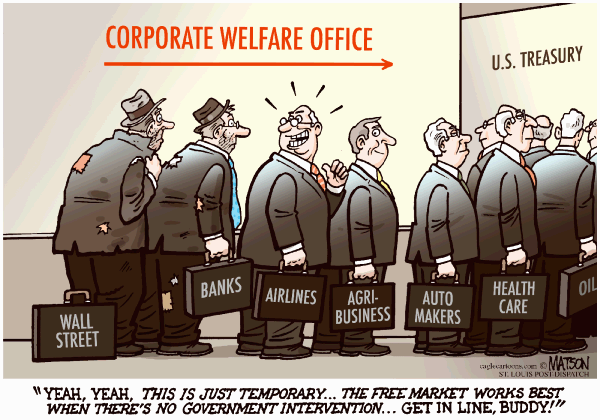
Get in line!
Corporate Welfare by R.J. Matson
I bet most of the Republican diehards are on Medicare, or about to go on it.
Lafayette says...Payback time
reason: He new the big crash was coming and wanted to be in a position to protect his mates.Spot on.
I'll bet his booking for speeches is full for the next two years. He'll be getting $75K a pop for telling his cronies how he saved their bonuses as their house of cards was falling down about them.
It's payback time!
===
"Anything Wall Street wants, Wall Street gets."
You know, there is an old proverb that says life's greatest curse can be answered prayers. Be careful what you ask for: you might get it.
===
His legacy is going to be the "giant sucking sound" of trillions of dollars flowing from the treasury and federal reserve to banks that can't show us where the money has gone.
===
"The harsh reality of American politics is that, in the House Republican caucus, and in greater Appalachia and the white Deep South, on right-wing talk radio and cable news, there exists the political core for a populist revolt, home-grown terrorism and even fascist takeover. The right-wing is deranged, well-armed and well-primed for violence."
Bruce:
You need to cut down on the caffeine. Wow.
FT Alphaville
New car - $ 40,000
Doing up your house - $ 100,000
New clothes - $ 15,000
Expensive foreign holidays - $ 25,000There are some things in life that money can’t buy, but personal bankruptcy isn’t one of them.
FT Alphaville
A bank’s most previous asset is its reputation
naked capitalism
Willem Buiter once said that US regs permitted the Fed to lend against any collateral, including a dead dog. We are getting perilously close to that.
... ... ...
“the brand and the aura of inexorable success”
When Arthur Andersen were our accountants, that was their great kudos too…whatever happened to Arthur Andersen..?
Advice from BBC gardening on looking after your hedge:
Once your hedge is trimmed to the desired shape, water and mulch the plants to keep them in good condition. Occasionally a hedge plant can die or become damaged through disease: if it’s not possible to save the plant, wait until autumn and replace it.
November 05, 2008 | The Big Picture
A pretty good Onion headline: Nation Finally Shitty Enough To Make Social Progress:
Although polls going into the final weeks of October showed Sen. Obama in the lead, it remained unclear whether the failing economy, dilapidated housing market, crumbling national infrastructure, health care crisis, energy crisis, and five-year-long disastrous war in Iraq had made the nation crappy enough to rise above 300 years of racial prejudice and make lasting change.
"Today the American people have made their voices heard, and they have said, 'Things are finally as terrible as we're willing to tolerate," said Obama, addressing a crowd of unemployed, uninsured, and debt-ridden supporters. "To elect a black man, in this country, and at this time—these last eight years must have really broken you."
Added Obama, "It's a great day for our nation."
Heh heh . . . That is, unfortunately, only a sleight exaggeration as to the landscape. Of course, for wit, prescience, and humor, nothing beats the Onion's 2001 pre-inauguration headline:
Bush: 'Our Long National Nightmare Of Peace And Prosperity Is Finally Over'
"My fellow Americans," Bush said, "at long last, we have reached the end of the dark period in American history that will come to be known as the Clinton Era, eight long years characterized by unprecedented economic expansion, a sharp decrease in crime, and sustained peace overseas. The time has come to put all of that behind us."
A classic: So witty, so foresighted . . .
The Big Picture
The highlight of the evening: I met, and got to speak with, former FOMC Chairman, and current Obama economic advisor, Paul Volcker. (Paul Volcker!). Even better, I got to tell him my favorite Bush joke (actually, a quote from Allan Mendelowitz):
“The Bush administration, which took office as social conservatives, is now leaving as conservative socialists.”
It really cracked him up!
Comments
christofay | Nov 5, 2008 3:58:06 AM
And I do have a problem with the Washington/Wall St shuffle as done by Greenspan, especially with Greenspan, "The Age of Flatulence: How I turned the dollar from solid to liquid to gas."
truthout"...I am shocked - shocked, there is gambling going on in this establishment...."
"...here are your winnings..."
-- exchange between Humphrey Bogart & Claude Rains in Casablanca
Portfolio.com
Recently, on the front page of Section C of the Wall Street Journal, a hedge fund manager who was also closing up shop (a $300 million fund), was quoted as saying, "What I have learned about the hedge fund business is that I hate it." I could not agree more with that statement. I was in this game for the money. The low hanging fruit, i.e. idiots whose parents paid for prep school, Yale, and then the Harvard MBA, was there for the taking.
These people who were (often) truly not worthy of the education they received (or supposedly received) rose to the top of companies such as AIG, Bear Stearns and Lehman Brothers and all levels of our government.
All of this behavior supporting the Aristocracy, only ended up making it easier for me to find people stupid enough to take the other side of my trades.
God bless America.
There's a guy who lives in Ohio. One morning, he hears a voice in his head. The voice says,
"Quit your job, sell your house, take all your money, and go to Las Vegas."He ignores the voice.
Later in the day, he hears the voice again.
"Quit your job, sell your house, take all your money, and go to Las Vegas."Again, he ignores the voice.
Soon he hears the voice every minute of the day.
"Quit your job, sell your house, take all your money, and go to Las Vegas."He can't take it anymore. He believes the voice.
He quits his job, sells his house, takes all his money, and flies to Las Vegas.
As soon as he steps off the plane, the voice says, "Go to the roulette."He goes to roulette table.
The voice says, "Put all your money on black"
He puts up his all money on black.
The game ends with red winning.The voice says, "Fuck."
The Mess That Greenspan MadeIt is not at all clear how (or if) the investing public is going to recover from the 2008 plunge in equity markets following the ongoing plunge in home prices that began in 2006. Many were led to believe that, in a worst case scenario, stock appreciation and real estate appreciation would alternate indefinitely into the future.
If one went down, the other would go up.
If they both went up, well, that was a bonus.
No one thought too much about what it would feel like if they both went down.
About every other day now, another story comes my way about a friend or relative who says, "Yeah, I sold everything in October. I couldn't take it anymore".
It's not difficult to understand that decision making process. There are enough things in life for ordinary citizens to worry about that overcoming the "fight or flight" instinct that makes us all such lousy investors doesn't rise very high on the list.
You have to wonder how they're handling it over at Money Magazine. The perma-bull staff has toned down their rhetoric in recent months as it became clear that no quick reversal was forthcoming. Last month's cover story was about keeping your money "safe" while you're waiting for the rebound.
Unless somehow we see Dow 14,000 again sometime soon (or at least Dow 10,000), the mainstream financial media and Wall Street firms are going to have a lot to answer for as it becomes increasingly clear that the ownership society that has been thrust upon Americans has not produced the results that were expected.
This well-done piece in the Wall Street Journal tells the story of how Wall Street has failed the individual investor, a concept that more and more people are beginning to realize.With retirement accounts tumbling and millions of homeowners struggling to pay their mortgages, a realization is dawning on many Americans: The banks, brokerage firms, insurance companies and other players in the financial-services industry have failed them.
Thirty years ago, a typical consumer had a fixed-rate mortgage, a life-insurance policy, a bank account and an employer-paid pension plan. Nowadays, that same consumer may have a payment option adjustable-rate mortgage, a 401(k) retirement-savings plan, a home-equity line of credit and perhaps even a health-savings account instead of traditional employer-sponsored health insurance.
In the process, risks previously borne by big banks and employers have been placed squarely on the shoulders of consumers. Individuals increasingly bear the risk of interest-rate fluctuations, rising health-care costs, stock-market gyrations and outliving their retirement savings.Adam Gamradt, 31 years old, of Bloomington, Minn., believes the market slide has created a great opportunity to buy stocks, but he contributes only enough to his employer's retirement-savings plan to get the full company match. That's because he is dismayed by the plan's pricey investment options and lack of information on total plan costs.
"If I'm going to buy a BMW for anybody, it should be me," says Mr. Gamradt, an information-technology worker. "I wouldn't exactly say the financial-services industry is at war with your average American consumer, but it's d- close."The financial-services industry sold this personal-responsibility revolution by claiming that complex offerings like adjustable-rate mortgages and health-savings accounts would empower consumers to manage their ever-expanding portfolio of risks.
The new products created billions of dollars in fees that have powered Wall Street's growth -- even in recent years as the stock market stagnated. The financial sector's share of total U.S. corporate profits jumped to 35% in 2007, up from 10% in the early 1980s, according to investment research firm BCA Research.
Now, of course, many of the products cooked up by Wall Street are exploding -- and dragging down the financial-services industry with them. Whether the industry will return to record profit levels again is a question mark. If the public veers away from such products, the financial sector could shrink drastically.
3 comments:
Al Czervik said... "Most people probably shouldn't control the timing of their market moves."
Perhaps, but it's a pet-peeve of mine that the paternalists who run my 401-K plan don't give me as many investment options as I have in my IRA accounts. A lot of companies offer a brokerage window, but not mine.
Wall Street has been selling the "buy and hold" philosophy to the public for decades, now. Nowhere is that more evident than in the 401-K industry. Buy and hold is great in a secular bull market. It hasn't worked well over the past 10 years and it may be a long time before that is a workable strategy.
I'd like to see brokerage window options widely available to those employees with the know-how and desire to use them. And the employees who use them should be required to pay any reasonable additional costs for providing that service.
It's only fair since no one is guaranteeing me a comfortable retirement. It's my money. I earned it, I saved it and I'm going to be spending it.
Nov 21, 2008 | yahoo.com
In the aftermath of the corporate scandals earlier this decade, investor confidence was (partially) restored by a parade of "perp walks" of fallen chieftains like Ken Lay, Bernie Ebbers, and Dennis Kozlowski.
But nearly two years into the bursting of booms in housing and mortgage securities, scant few related arrests have been made — and most of those have been focused on individual mortgage brokers vs. major industry leaders.
"There is no poster child [for the housing scandal] because you need to investigate, and you need to bring cases and we haven't done either against the major players," says William Black, Associate Professor of Economics and Law at the University of Missouri — Kansas City and a former federal regulator.
Black, who was counsel to the Federal Home Loan Bank Board during the S&L Crisis and blew the whistle on the "Keating Five" in 1989, says investigations have shown fraud incidence of 50% at (once) major subprime lenders like IndyMac and Countrywide.
But even though the FBI warned of an "epidemic" of mortgage fraud in 2004, they subsequently made a "strategic alliance" with the Mortgage Bankers Association, which serves the major industry players.
In this case, the foxes truly were guarding the hen house.
Black notes it was only this year that the total number of FBI agents devoted to mortgage-fraud investigations rose to more than 200. By comparison, during the S&L and Enron investigations in the 1980s and '90s, respectively, multiple task forces totaling hundreds of agents were employed.
"The DOJ has refused to emulate its successes in the S&L debacle, and even dealing with Enron, by creating a large task force that would take on the major fraud participants," Black said. "In this context, that would mean creating a large task force to investigate major, nonprime lenders."
Comments
Whit Chambers - Friday November 21, 2008 01:00PM EST
Perhaps it is reality when you consider: (1) Government identifies absurd Corporate salaries, yet bail out so continue their huge salary with tax dollars. (2) Senators arrogantly chastising the Big Three, yet not acknowledging massive Government debt risk to the populace is in far more troubling. (3) Government Pensions are far worse ticking time bomb, but will divert the public’s attention to credit card debt instead. (4) Government at the Federal and State Level corruptly violate the Constitution, yet give standing ovations to convicted felon Senators. Sorry folks the upside-down pyramid is in collapse.
Yahoo! Finance User - Friday November 21, 2008 01:12PM EST
Hmmm... well... we have to show some patience so that we do not end up putting a Prez in jail before he becomes ex-Prez. And then Alan Greenspan looks too old to go to jail... Agree though... that we need to start rounding the wall street crooks!
chubach47 - Friday November 21, 2008 01:12PM EST
I am reminded of the "Golden Rule" Those with the Gold make the Rules. If Wall Street wasn't such a large contributor to the political parties, would they still be walking around free?
Yahoo! Finance User - Friday November 21, 2008 01:15PM EST
Fraud? What fraud? Their armies of lawyers have made sure everything they do adhere to the fine prints of the laws. It is you -- the common people -- who are to ignorant to read the fine prints of the contracts. Welcome to America! (And wants to execute these crooks on vague charges, go to China or other non-democratic lawless counties. Those places, of course, have different problems.)Yahoo! Finance User - Friday November 21, 2008 01:15PM EST
I'm in jail for holding up a 7-11. I got $125 dollars. Damn, should have been a overpaid, useless CEO.rzeemain - Friday November 21, 2008 01:17PM EST
Think about this folks. Paulson and the current Administration is in power, then suddenly around mid-September, Paulson rushes over to the WH and Congress and says:"I need a Trillion dollars in 72 hours. Don't ask me any questions, no court or body is to audit what I do with it". But the day before, and the day before, and the week before, and the month before, no warning to the public. Ah, but Nov. 4 was only a few weeks away. Keep the lid on. Then, bam, it all came unwound. Obviously, this meltdown was long in coming. We have been conned.jpstud1 - Friday November 21, 2008 01:23PM EST
top 3 fraudsters: 1. JP Morgan Chase 2. Goldman Sachs 3. Henry Paulson Get rid of these parasites and our economy will flourish.Yahoo! Finance User - Friday November 21, 2008 01:25PM EST
They'll roll out a few sacrificial lambs as usual.. but the big boys will walk.. nothing out of the ordinary here....Grace - Friday November 21, 2008 01:25PM EST
No one is going to jail because the same people who would be convicting the Wall Street culprits are culprits themselves. Barney Frank, Chris Dodd, Pelosi, Paulson, Bernacke, Cox, etc, are all responsible for this mess.Publius - Friday November 21, 2008 01:29PM EST
Let's not get carried away with the corruption thing. I am sure some people are corrupt on Wall St. just as some people are corrupt on Main St. But the greed was not just on Wall St. People who paid ridiculous amounts of money for houses they couldn't afford thinking they would continue to appreciate in value share some blame. Real Estate people who kept claiming that housing prices would continue to climb forever, even though 25% of new homes sales were 2nd, 3rd and 4th homes purchased by speculators just before teh bubble burst. Banks are to blame for creating the pyramd scheme backed by sub-prime mortgages. They were buying this crap without even looking at it. Most of all, congress is to blame for pushing banks to lend money in ways it would never have done in the past. 90% and 100% financing of over-priced homes, affordable housing for everyone, Fannie and Freddie buying trillions in bad mortgages, etc. Its easy to point to one person and then hang that person, but the blame for this one is spread among a lot of people. Something this catastrophic required a numbers of things to happen all at the same time and those things were teh responsibility of different people. That's why putting the stuff back in the horse is so complicated now.
November 26, 2008 | FT.com
Angela Merkel, the German chancellor, turned the tables on her international critics on Wednesday by accusing the US and other governments of making “cheap money” a central tool of their economic management, thus planting the seeds of a similar crisis in five years.
“Excessively cheap money in the US was a driver of today’s crisis,” she told the German parliament. “I am deeply concerned about whether we are now reinforcing this trend through measures being adopted in the US and elsewhere and whether we could find ourselves in five years facing the exact same crisis.”
Comments
Nuke writes:satan writes:Satan. I kinda agree with you.
I am an engineer by trade. My first inkling that things were horribly wrong in the US economy was when my piers started leaving solid engineering and science jobs to work in real estate, finance and consulting. We are about to see a fundamental shift in our economy away from FIRE into, well, who knows.
It will be every bit as traumatic as the shift from manufacturing, perhaps worse.
Nuke | 11.28.08 - 1:57 am | #
Just accept that the true purpose of money is to keep the world from killing each other. Accept that debts are not repayable and periodic debt forgiveness is necessary.
First, look at these three comments on consumer spending:
From the WSJ: Data Indicate Faltering DemandSpending is declining in the consumer and capital sectors, as demand for expensive goods took its biggest spill in two years in October and consumption dropped at the sharpest rate in seven years.From Professor Roubini wrote:Another batch of worse than awful news greeted today Americans getting ready for the Thanksgiving holiday: free falling consumption spending, collapsing new homes sales, falling consumer confidence, very high initial claims for unemployment benefits, collapsing orders for durable goods.And from Bloomberg: Consumer Spending in U.S. Falls 1%, Most in 7 YearsSpending by U.S. consumers dropped in October by the most since the 2001 contraction, signaling the economy is sinking into a deeper recession.emphasis added
...
The biggest consumer spending slump in three decades is likely to persist as home prices fall and job losses mount, threatening the holiday sales outlook ...
Sounds pretty bad, and the numbers from the BEA were definitely ugly - but the numbers were slightly better than I expected. The monthly data is pretty noisy and may be revised significantly, but the reported numbers showed a 3.9% annualized real decline in personal consumption expenditures (PCE) from July to October (the period that matters for GDP), and that was somewhat better than 4.5% to 5.0% decline I was expecting. This is just one month of 4th quarter data - and PCE could get revised or decline more in November and December - but this suggests the more dire predictions (worse than 5% annualized real GDP decline) for Q4 GDP might be excessive.
Hey, a 5% annualized decline in real GDP is bad enough!
CNN.com
Forbes magazine President and CEO Steve Forbes called Treasury Secretary Henry Paulson “the worst treasury secretary we’ve had in modern times”, citing, among other things, the government’s handling of the housing crisis.
Comments
Jim November 24th, 2008 10:07 am ET
Stop The Insanity November 24th, 2008
I'm a 50 year old graduate from The Wharton School of Business. I'm one of the most capitalistic guys you'll ever find. I believe in the American free enterprise system.
However, the risk versus reward equation is skewed in this country. Our senior-most executives are paid far in excess of the value that they create. In some cases, they are NO VALUE ADDED.
I can't justify paying ANYBODY ….. and I mean ANYBODY more than $2M per year as a salary and total compensation (salary, stock, options, deffered cash) should be limited to $4M per year and should be at risk for at least 5 years.
Nobody is worth more than that. Nobody does that much good for the country or an organization that they need more than $2M. How many Ferraris can a guy buy, how many 8,000 ft2 mansions?, how large a diamond should he buy for his supermodel girlfriend that he keeps on the side?
If shareholders won't put bounds on this then the government should. It is determental to the nation's interest for these types of inequities to exist.
Honestly, CEO's making 100 times what the floor worker makes is absurd. 10-to-20 times … reasonable … 100-times-to-5,000 times …. that's IDIOTIC
mary dale November 24th, 2008 9:54 am ET
A question rather than a remark denigrating Mr. Paulson or the current administration. How is it that all the people in high places in DC (economic advisors to the government) did not have any idea that these problems were on the forefront? Why are we still paying exorbitant salaries to these people and not removing them from their positions.
Relative to the bailout of "The Big 3″, why not bring back the ability of taxpayers to write off the interest on new car loans as it was several decades ago, but limit it only to those vehicles built in the US. It seems that would be more practical than just giving them 25 billion at taxpayer expense without seeing a benefit to those paying the money (the taxpayer).
It seems it might help stimulate sales of new cars and continued employment of those in the industry.
Sam November 24th, 2008 9:52 am ET
I think this financial failure was Bush's final gift to the American people. It fits the bill - it put fear into Americans. Was there really the need to come out that Friday in September that said if we didn't come up with $700b by Monday that the whole economy would fail.
The media (like always only having one story at a time to repeat over and over and over) kept the fear growing until something really does have to be done. Paulson was just an arrogant tool used to give more money to the rich people before a sensible administration came into power.
Leah from FL November 24th, 2008 9:47 am ET
I did vote for Obama but I am cynic (and pessimistic) enough to believe that things may get better but not by a whole lot…
That's because there are too many cooks in the kitchen and too many hands in the pot (and too many egos in the administration)…and too little time (say 18-20 months) before the next election cycle begins…
Sorry if I sound too gloomy…
I have lived in the US for three decades and I never felt as bad about state of affairs as I do now.
A Kickin' Donkey November 24th, 2008 9:43 am ET
The healing is coming - we're in the painful scabby part right now, but soon the new skin will emerge and the healing will commence! bye-bye -bush and your posse too.
Indiana Steven November 24th, 2008 9:41 am ET
Elect more engineers to Congress … they think for a living …. they are trained to contemplate the bad "what ifs" and take mitigating steps. Engineers in Congress would prevent this stagnation we're experiencing.
We need some intelligence in Congress. We've got women engineers, black engineers, hispanic engineers, and white male engineers. We don't have to sacrafice diversity for brains.
All Congress does is point fingers after the fact. They don't add any value … and certainly don't worke to prevent graft, corruption, mismanagement, etc.
A Kickin' Donkey November 24th, 2008 9:38 am ET
Quite a downfall in 2 short years: from Master of the Masters of the Universe to the most reviled man in America not in a prison.
In fairness, he cannot disclose that he has encumbered the Treasury with contingent liabilities in excess of $2 trillion and rising with each new takeover. Every takeover means that AIG, Citicorp, etc. cannot be allowed to default on any of their claims since the US has stood in.
If these failures went through bankruptcy court, there would be some severe haircuts given to the hedge funds, etc. that brought them down. Can't let that happen!
Let's see if Congress cancels the capital gains tax treatment on hedge fund managers payouts. That is a no-brainer but cuts right to the quick on how corrupt Congress is.
You can't really fault Barney Frank for wanting to drop a paltry $25 billion on the auto industry when Treasury is throwing $100 of billions out the windows.
Pat in Atlanta November 24th, 2008 9:24 am ET
Let's drop the myth that these guys are rare geniuses that have to be given wide latitude in both their authority and the blind trust that Congress places in them.
There are thousands of highly intelligent Ivy-leagure graduates (Columbia, Harvard, Dartmouth, Wharton) MBAs with many years of experience in industry, finance …(not just banking) … that know far more than the current members of Congress and are far more trustworthy, and less selfish, than the current crop of executives on Wall Street, including Paulson.
Put a team of smart outsiders in a room and they will figure it out. With a team, any "pitfalls" will be revealed ahead of time.
Paulson is fruit of the posioned tree and is only interested in feathering the nest of his country club buddies …. we saw the same thing with Bush, Cheney and their oil-industry buddies. When will Congress wise up and expect graft & corruption FIRST from these revolving names instead of writing these blank checks?
We need a bunch of early 40 somethings that are unknown to the popular press but that are brilliant and we need to incentivize them with a life long pension for 12 years of good work. Give them the kind of golden parachutes that Congress has. In exchange for that, we can get them to leave their Vice President & Director level jobs at America's best run corporations.
Over it November 24th, 2008 9:12 am ET
Much of the financial mess has come from financial executives misleading others until no one has faith in anything. Unfortunately, the ever shifting bailout looks like more lies and misrepresentations
The total failure of leadership from the administration is frightening. Lame duck yes, but it doesn't have to be this lame.
Secretary Paulson makes a fine target for our frustrations, but he does have a boss, somewhere. Has anyone seen George W. Bush around?
Ken in Dallas November 24th, 2008 8:57 am ET
I agree the Paulson is bad, but what about Congress? They didn't require anything of him.
It's ultimately their responsibility what is done with our tax money. Quit bashing Bush…what about Reid and Pelosi who did not require any plan from Paulson and will still be there after January 20th??
Are you still gonna blame Bush for it???
John Brock, New York November 24th, 2008 8:38 am ET
The ridiculous thing about this exchange is that Forbes and Paulson are both trying to live out the same laissez-faire magic-market fantasy as got us into this mess in the first place. Make no mistake, this is another vivid example of Republicans eating their own.
The truth is that neither one of these clowns understands markets. They ignore the fact that there's an essential tension in the market system, that "free markets" are always an ideal and never an actuality. If you don't regulate the operation of markets, especially in regard to anti-trust actions, economies of scale will tempt market players to consolidate, until a small number of players controls the market. Either you compromise market freedom a little by regulation, or you end up with a private player, accountable to no one, in control of the market.
Consolidation is also a trade-off. It enables players to gain strength and efficiency, but it also consolidates risk, and raises the prospect of individual players growing so essential to the market's operation that they are de facto public trusts, companies like AIG, Lehman, and Citi that can take the whole economy with them if they fail. When we allow such de facto public trusts to exist without being recognized, we fact the worst of all possible outcomes: corporations enabled to hold the government hostage
It's too late to rail about the unfairness of it all, the mistakes have already been made, the blind eye already turned. There's nothing left to do but put in the hard work it will take to fix this. We might at least hold our leaders responsible for learning from this fiasco, though.
ed November 24th, 2008 8:28 am ET
I and anyone that has left a comment on this article, in all probability is unqualified to properly judge how any person in the position of secretary of the treasury manages the position, especially in financial times such as these. So please do readers a favor, and focus on solutions instead of bashing. Everyone knows how poor of a leader Bush is. Get over it. It's time the country stops acting like an abused ex-spouse, constantly living life vicariously through the very person that made one miserable.
Peter Thatcher November 24th, 2008 8:08 am ETcharlie in maine November 24th, 2008 8:06 am ETSteve Forbes is a fanatical proponent of the free-market religion that has, as it was practiced, failed our nation and the world so miserably, He has real guts to surface as a reborn critic of Paulson, a saint of his former Wall Street religion. It is time for silence on his part and on the parts of others who have fostered the ridiculous idea that business should be left to do whatever it wants, with no input from the societies in which it flourishes. I guess the system is only imperfect when Forbes loses money. This is not the time for belated recognition that the Bush administration has been staffed by incompetents who poked fun at anyone who thinks. Forbes should express his support for the Obama administration, which will have to confront the train wreck created by people wjho share his beliefs. Name-calling seems to be a hard habit to break; it's easy, while finding solutions is difficult.
Forbes gives Paulsen a very bum rap. It is only because of Paulsen's steady hand in dealing with this totally unprecedented series of financial events (the "Perfect Storm" of financial phenomena?) that the World is not in total chaos. The team in place, Paulsen, Geithner, Bernacke, but particularly Paulsen and his very personal clout, make a positive outcome of these terrible events possible and likely.
Bad guy: Rubin. Best guy: Paulsen. I've never met an unimpressive Goldman Sachs guy.
Ernie November 24th, 2008 7:52 am ET
lieNoMore November 24th, 2008 7:48 am ETThat's a little like the captain of the Exonn Valdeze accusing the captain of the Titanic of being a bad driver. I have a timeline to offer for things to start getting better…. in 57 days 3 hours and 55 minutes we get another chance. I used to think of 01-20-09 as Bush's last day and that gave me some joy.
But now I see it as Obama's first day and I can't wait.
Amber November 24th, 2008 6:09 am ETI disagree with Forbes and most of the postings here. Paulson has been Treasury Secretary for just over 2 yrs. This mess has been brewing for decades. There have been many more recent contributors to the current problems who have played a much bigger part. How about Reagan, Clinton, Greenspan, and Lil' Bush? Paulson has always believed in reigning in free market cowboys as opposed to the Bush admin where free market is a mantra but that's certainly something he didn't have the time or authority to pursue.
I do agree that Paulson needs to be more transparent with his actions, his rationale for those actions, and the long term plan.
XXX November 24th, 2008 6:09 am ETSteve Forbes is just plain full of it and just as WRONG about the economy as Bush, Paulson, and their hero Reagan was. Forbes supported and indeed advocated for most of the policies that have gotten us here.
We have had 30 years of the wealthy getting wealthier (like Forbes) while American industry has been frittered away on junk bonds, S&L, dotbomb, Enron, and now banking bomb paper pushing/manipulation.
Meanwhile, increasingly Americans have come to devalue industrial and productive work and take part –along with so-called leaders like Forbes– in the drift toward phony paper nation…
Paulson is one of the main people responsible for the banking meltdown. He should absolutely be investigated and ultimately be behind bars. He told everyone that Fannie and Freddie were fine and that no oversight was needed. He didn't want the audit (money) trail to lead to him and his cronies. Despicable! He's a fox in charge of the hen house. You watch, when the time is right he'll pick up residence in a foreign country somewhere. What a slime ball.
guardian.co.uk
The following is an abridged text of an open letter [PDF] by John Maynard Keynes to the US president.
Dear Mr President,
You have made yourself the trustee for those in every country who seek to mend the evils of our condition by reasoned experiment within the framework of the existing social system. If you fail, rational change will be gravely prejudiced throughout the world, leaving orthodoxy and revolution to fight it out. But if you succeed, new and bolder methods will be tried everywhere, and we may date the first chapter of a new economic era from your accession to office. This is a sufficient reason why I should venture to lay my reflections before you, though under the disadvantages of distance and partial knowledge.
At the moment your sympathisers in England are nervous and sometimes despondent. We wonder whether the order of different urgencies is rightly understood, whether there is a confusion of aim, and whether some of the advice you get is not crack-brained and queer. If we are disconcerted when we defend you, this may be partly due to the influence of our environment in London. For almost everyone here has a wildly distorted view of what is happening in the United States. The average City man believes that you are engaged on a hare-brained expedition in face of competent advice, that the best hope lies in your ridding yourself of your present advisers to return to the old ways, and that otherwise the United States is heading for some ghastly breakdown. That is what they say they smell. There is a recrudescence of wise head-waging by those who believe that the nose is a nobler organ than the brain. London is convinced that we only have to sit back and wait, in order to see what we shall see. May I crave your attention, whilst I put my own view?
You are engaged on a double task, recovery and reform - recovery from the slump and the passage of those business and social reforms which are long overdue. For the first, speed and quick results are essential. The second may be urgent too; but haste will be injurious, and wisdom of long-range purpose is more necessary than immediate achievement. It will be through raising high the prestige of your administration by success in short-range recovery, that you will have the driving force to accomplish long-range reform. On the other hand, even wise and necessary reform may, in some respects, impede and complicate recovery. For it will upset the confidence of the business world and weaken their existing motives to action, before you have had time to put other motives in their place. It may over-task your bureaucratic machine, which the traditional individualism of the United States and the old "spoils system" have left none too strong. And it will confuse the thought and aim of yourself and your administration by giving you too much to think about all at once.
My second reflection relates to the technique of recovery itself. The object of recovery is to increase the national output and put more men to work. In the economic system of the modern world, output is primarily produced for sale; and the volume of output depends on the amount of purchasing power, compared with the prime cost of production, which is expected to come on the market. Broadly speaking, therefore, and increase of output depends on the amount of purchasing power, compared with the prime cost of production, which is expected to come on the market. Broadly speaking, therefore, an increase of output cannot occur unless by the operation of one or other of three factors. Individuals must be induced to spend more out of their existing incomes; or the business world must be induced, either by increased confidence in the prospects or by a lower rate of interest, to create additional current incomes in the hands of their employees, which is what happens when either the working or the fixed capital of the country is being increased; or public authority must be called in aid to create additional current incomes through the expenditure of borrowed or printed money. In bad times the first factor cannot be expected to work on a sufficient scale. The second factor will come in as the second wave of attack on the slump after the tide has been turned by the expenditures of public authority. It is, therefore, only from the third factor that we can expect the initial major impulse.
Now there are indications that two technical fallacies may have affected the policy of your administration. The first relates to the part played in recovery by rising prices. Rising prices are to be welcomed because they are usually a symptom of rising output and employment. When more purchasing power is spent, one expects rising output at rising prices. Since there cannot be rising output without rising prices, it is essential to ensure that the recovery shall not be held back by the insufficiency of the supply of money to support the increased monetary turn-over. But there is much less to be said in favour of rising prices, if they are brought about at the expense of rising output. Some debtors may be helped, but the national recovery as a whole will be retarded. Thus rising prices caused by deliberately increasing prime costs or by restricting output have a vastly inferior value to rising prices which are the natural result of an increase in the nation's purchasing power.
The set-back which American recovery experienced this autumn was the predictable consequence of the failure of your administration to organise any material increase in new loan expenditure during your first six months of office. The position six months hence will entirely depend on whether you have been laying the foundations for larger expenditures in the near future.
I am not surprised that so little has been spent up-to-date. Our own experience has shown how difficult it is to improvise useful loan-expenditures at short notice. There are many obstacle to be patiently overcome, if waste, inefficiency and corruption are to be avoided. There are many factors, which I need not stop to enumerate, which render especially difficult in the United States the rapid improvisation of a vast programme of public works. But the risks of less speed must be weighed against those of more haste.
The other set of fallacies, of which I fear the influence, arises out of a crude economic doctrine commonly known as the quantity theory of money. Rising output and rising incomes will suffer a set-back sooner or later if the quantity of money is rigidly fixed. Some people seem to infer from this that output and income can be raised by increasing the quantity of money. But this is like trying to get fat by buying a larger belt. In the United States to-day your belt is plenty big enough for your belly. It is a most misleading thing to stress the quantity of money, which is only a limiting factor, rather than the volume of expenditure, which is the operative factor.
It is an even more foolish application of the same ideas to believe that there is a mathematical relation between the price of gold and the prices of other things. It is true that the value of the dollar in terms of foreign currencies will affect the prices of those goods which enter into international trade. In so far as an over-valuation of the dollar was impeding the freedom of domestic price-raising policies or disturbing the balance of payments with foreign countries, it was advisable to depreciate it. But exchange depreciation should follow the success of your domestic price-raising policy as its natural consequence, and should not be allowed to disturb the whole world by preceding its justification at an entirely arbitrary pace. This is another example of trying to put on flesh by letting out the belt.
These criticisms do not mean that I have weakened in my advocacy of a managed currency or in preferring stable prices to stable exchanges. The currency and exchange policy of a country should be entirely subservient to the aim of raising output and employment to the right level. But the recent gyrations of the dollar have looked to me more like a gold standard on the booze than the ideal managed currency of my dreams.
You may be feeling by now, Mr President, that my criticism is more obvious than my sympathy. Yet truly that is not so. You remain for me the ruler whose general outlook and attitude to the tasks of government are the most sympathetic in the world. You are the only one who sees the necessity of a profound change of methods and is attempting it without intolerance, tyranny or destruction. You are feeling your way by trial and error, and are felt to be, as you should be, entirely uncommitted in your own person to the details of a particular technique. In my country, as in your own, your position remains singularly untouched by criticism of this or the other detail. Our hope and our faith are based on broader considerations.
If you were to ask me what I would suggest in concrete terms for the immediate future, I would reply thus.
In the field of domestic policy, I put in the forefront, for the reasons given above, a large volume of loan-expenditures under government auspices. It is beyond my province to choose particular objects of expenditure. But preference should be given to those which can be made to mature quickly on a large scale, as for example the rehabilitation of the physical condition of the railroads. The object is to start the ball rolling. The United States is ready to roll towards prosperity, if a good hard shove can be given in the next six months.
I put in the second place the maintenance of cheap and abundant credit and in particular the reduction of the long-term rates of interest. The turn of the tide in great Britain is largely attributable to the reduction in the long-term rate of interest which ensued on the success of the conversion of the War Loan. This was deliberately engineered by means of the open-market policy of the Bank of England. I see no reason why you should not reduce the rate of interest on your long-term government bonds to 2.5% or less with favourable repercussions on the whole bond market, if only the Federal Reserve System would replace its present holdings of short-dated Treasury issues by purchasing long-dated issues in exchange. Such a policy might become effective in the course of a few months, and I attach great importance to it.
With these adaptations or enlargements of your existing policies, I should expect a successful outcome with great confidence. How much that would mean, not only to the material prosperity of the United States and the whole World, but in comfort to men's minds through a restoration of their faith in the wisdom and the power of government!
With great respect,
Your obedient servantJM Keynes
Originally published as "An open letter to President Roosevelt" in the New York Times, December 31, 1933.
Biggs also offers advice on portfolio diversification, keeping some gold and jewelry, some farmland, as well as currency diversification. He also analyzes what worked and didn't work for survivors of World War II.
Mostly it was luck, coupled with healthy paranoia. Those who didn't believe that things would get worse oftentimes stayed back and perished. They were too greedy, or reluctant to leave healthy businesses, or to sell at a loss, ended up losing everything, including their lives.
In some sense this is the same behavior people face in a bear market.
Only in the case of war, invasion and occupation by an enemy, history has shown that those who were willing to cut their losses and escape to a safer country, even with the loss of most of their wealth, were able to survive whereas those who dawdled or were in denial, lost everything.
naked capitalism Willem Buiter is never one to mince words, and today his message is that the financial system is not operating:In a decentralised market economy, financial intermediation between economic agents with financial surpluses and those with financial deficits (or, more accurately, between economic agents who would like to run financial surpluses and those who would like to run financial deficits) is an essential economic activity. If this task if not performed effectively, it will still be the case that, ex-post, the sum of all realised financial surpluses equals zero, that is, realised saving equals realised investment - accounting identities are very insistent - but both are likely to be far from their optimal levels. In addition to channelling resources from financial surplus units to financial deficits units, the financial system performs, through risk trading, a significant part of the total risk sharing that takes place in a society. It also performs the portfolio management of much of the stock of financial wealth in existence.Buiter does not address this issue, and I do not recall seeing it parsed anywhere, but it also seems that a disproportionate amount of effort in the financial system has been devoted to portfolio management, with effects anticipated by Warren Buffett in his stories about the Gotrocks.The .... last two tasks of the financial system (risk trading and portfolio management) are being performed abysmally, and the first, the intermediation of financial surpluses and deficits, has effectively ceased...Financial intermediation has all but ground to a halt....Yves here. That point is essential and seems to be lost in most commentary. Back to Buiter:
We have no longer just a crisis in the financial system....The western (north-Atlantic) financial system we knew has collapsed. If I may paraphrase that great ensemble of Nobel-prize winning financial wizards, Monty Python’s Flying Circus:“This financial system is no more! It has ceased to be! ‘It’s expired and gone to meet its maker! ‘It’s a stiff! Bereft of life, it rests in peace! If you hadn’t nailed ‘it to the tax payer’s perch it’d be pushing up the daisies! ‘Its metabolic processes are now ‘istory! ‘It’s off the twig! It’s kicked the bucket, it’s shuffled off its mortal coil, run down the curtain and joined the bleedin’ choir indivisible!! THIS IS AN EX-FINANCIAL SYSTEM!!”Getting financial markets for illiquid assets going again will require public intervention...It makes no fundamental difference whether this happens along the lines originally proposed for the TARP, or by the government insuring the value of illiquid assets, as the US Treasury has now agreed to do for Citi Bank. In both cases the government and the current owner of the illiquid asset have to agree on a price or a valuation. The main practical ‘advantage’ of the insurance proposal over attempts at price discovery through auctions and similar mechanisms, is that the insurance plan hides the problem of valuing the illiquid assets behind non-transparent bilateral negotiations about the insurance premium paid and the level of the price guaranteed in the insurance contract. Opaqueness and lack of transparency are obviously at a premium when tax payer resources are being funnelled into the black holes that are our leading banks and other financial instutition.
Getting banks to lend again is even more essential than getting primary and secondary markets for illiquid structured financial products going again. It may be even more important than getting the regular commercial paper market going again, important though that is. Small and medium enterprises rely overwhelmingly on banks for external finance. Without access to bank loans, credit lines and overdraft facilities, countless SMEs that would be perfectly viable with a functional financial and banking system are threatened with bankruptcy. Without working capital, businesses go out of business. Banks are essential. But they are not lending. Why? A number of possible explanations suggest themselves.(1) Normal commercial prudence has finally resumed its rightful place, after many years of excess. Sound commercial judgements, made on a case-by-case-basis, produce the right supply of credit for each particular risky venture requesting financing. These individual lending decisions aggregate into an entirely appropriate volume of economy-wide lending that happens to be very low. Don’t blame the banks. Blame the entrepreneurs for not coming up with more creditworthy projects.I would put zero weight on (1) and roughtly equal weights on the other four possible explanations.
(2) In a world with multiple and quite different self-fulfilling equilibria, we somehow have ended up in the lousy equilibrium. Here each bank, believing the state of the aggregate economy to be lousy, decides not to extend credit to a would-be borrower that would be viewed as an acceptable risk, but for the dim view the bank takes of the aggregate economy. When all banks act this way, they will, by severally and jointly witholding credit, produce the lousy aggregate economic environment that they assumed/feared when they individually turned off their credit spigots. We just have to find some way of changing the focal point that coordinates individual banks’ actions to the good equilibrium. In the favourable equilibrium each bank, believing the state of the aggregate economy to be good, decides to extend credit to a quite reasonable would-be borrower the bank would not have lent to had it believed the state of the overall economy to be lousy.
(3) After years of excess and anything goes, the bean counters and risk controllers now rule supreme in the banking world. There is little upside to lending and taking a risk, but a lot of downside. Rolling over an old loan or extending a new one won’t help your bonus and it may cost you your job.
(4) Blind fear and panic rule the roost in the banking sector. Bankers are shell-shocked and paralyzed. More Prozac please.
(5) Banks hoard cash and liquidity to retain or regain their independence... Banks where the state has acquired a preferential equity stake or another equity interest are often subject to dividend limits and restrictions on executive remuneration. Paying down these government capital injections to regain full discretion over dividend payments and executive remuneration is a key pre-occupation. Banks seek out new private investors, trampling the pre-emption rights of existing shareholders and at higher financial cost to the bank than would have been attached to a capital injection by the government. All this just to retain their independence. Whose interest is being served you may ask? Not the existing shareholders. Not the other stake holders, the banks’ customers or creditors. Not the tax payers. Could it be the incumbent top management? Surely not!
What is to be done? Banks that don’t lend to the non-financial enterprise sector and to households are completely and utterly useless, like tits on a bull. If they won’t lend spontaneously, it is the job of the government to make them lend. Banks have no other raison d’être.I can think of three ways to get them to lend using the coercive powers of the state.(A) All domestic non-financial enterprises that currently have access to bank financing and whose loans, overdraft facilities, credit lines or whatever other financial arrangements expire during the coming year, have the right to an automatic one-year extension of the expiring arrangements on the same financial and non-financial terms as the expiring arrangements. This mandatory ‘creditor standstill’ helps existing borrowers by providing them with a breathing space. It does, however, do nothing for new enterprises or enterprises that are not currently borrowing.It would have to be made clear that state ownership of a bank does not mean that the bank’s existing or new debt is sovereign-guaranteed. Limited liability applies even when the state is the only shareholder. Whether existing or new bank debt of state-owned banks benefits from the full faith and credit of the sovereign government can be decided on a case-by-case basis.
(B) Aggregate lending targets for lending to the domestic non-financial business sector are set by the government for each bank (last year’s total plus five percent, say). The banks themselves can decide who to lend to and on what terms. Any shortfall of actual lending from the target is translated pound for pound into a Deficient Lending Tax. Since not meeting the target amounts to throwing money away, the banks will lend.
(C) Nationalise the banks (paying as little as possible to the existing shareholders), fire the existing management and board of directors, and have the government appoint a new executive and a new board that are serious about meeting lending targets. With 100 percent share ownership by the state, there is no risk of lawsuits about the executive or board of the bank not meeting their fiduciary duty to the shareholders....
With both Alistair Darling and Mervyn King hinting darkly at the possibility of nationalisation of the remaining privately owned banks as a possible remedy for the bank lending strike, these proposals cannot even be considered radical.
Things are critical. Unless the banks start lending in normal volumes very soon, this recession could indeed become another Great Depression. We cannot wait for the banks to find their juju. The government may have to take it to them.Comments
- Don said...
- In an economy for which the greatest imperative is capital accumulation, all circulation of capital is intermediated by a private, profit seeking banking system. In this vein, the problem of capital intermediation must be understood as symptomatic of the larger economic context.
In this respect, never does Buiter address the most crucial issue: for what purpose would such lending/borrowing take place? Conceiving of the problem as one in which more lending/borrowing is needed to produce and consume more, is to miss the larger context, one in which the problem is that production and consumption are based on a fundamental - and global - system of inequality (that is, too much of the labor of production is limited to those who produce cheaply, and the consumption to those who consume too richly). It cannot be overcome by producing and consuming more in the same system of inequality.
In the end, other than the temporary nationalization of the financial system, all that Buiter proposes is to re-start the system as it is, that is, attempting to kick start the economic system without any truly significant change in that system of global inequality of production and consumption.
As for nationalization, should it materialize, then why, I wonder, should we (the public) accept that it be done so to bring about a temporary state whose aim is to eventually take us back to a system of intermediation being privately owned. Why not ensure that it remain publicly owned, and the service provided by intermediation be in the public interest, rather than in the interest of private capital accumulation?
November 26, 2008 1:24 AM
- alexblack said...
- Strong-arming and screaming at banks to lend, because "it's their sole reason for existing" in this environment, is like screaming at a taxi driver that he has to start picking up passengers because that's HIS sole reason for existing - except this taxi driver has just spent 4 days straight picking up every crazy passenger he could find, driving around the city at 90 MPH the whole time, and snorting coke to stay awake so he could pick up more and more passengers. And now he's crashed, nodding off for some much needed sleep as he sits as the curb, trying to let his brain cells recover, and along come economists yelling at him to wake up and go pick up more passengers dammit!! While they ignore the clouds of steam eminating from his overheated engine.
Yell away, this guy is so burned out that he can't understand a word you're saying.
November 26, 2008 1:31 AM
- YK said...
- alexblack, are the passengers paying the driver?
November 26, 2008 1:42 AM
- Dave said...
- "and snorting coke to stay awake so he could pick up more and more passengers" ... Now that's what *I* call a stimulus package ;)
November 26, 2008 1:48 AM
- Anonymous said...
- I like option "D" as well....banks that are insolvent go bankrupt!!!
The moment we dropped down the bailout rabbit hole was when it was clear how fascist the government has become. We are seeing America bankrupted before our eyes.
Why doesn't the govt promote some regional banks or smaller that are not derivatoxicated into bigger versions that are not guided by the stupidity that derivatoxication brings. These banks would be comparably easy to push funds through to deserving borrowers.
November 26, 2008 1:49 AM
- spare some change? said...
- A bank's sole purpose is, like every other business, to make money.
If they can't make money lending then they won't do it.
If there is so much money to be made lending, to the extent that banks are foolishly overlooking this opportunity to make money, surely others would rush in to capitalize on this market need?
To put it another way, if you had billions in cash would you be lending it?
If lending is 'vital' to capitalism as we know it then why are we leaving this vital function in the hands of privately held enterprises?
Could it possibly be that they know more about lending than the government?
Banks lent recklessly in the last few years, but why wouldn't they? With the GSE's buying up mortgages, there is no risk to lending. The government created this problem in the first place.
November 26, 2008 2:13 AM
- Micahel Fiorillo said...
- Since the origin of the crisis lay in the decline of housing prices, caused by the disparity between personal incomes and the cost of one of life's necessities, I'd like to propose a free market solution: unions.
Yes, unions. If the rate of unionization were to rise from it's current lower-than-the-1920's level - caused by a government enthralled and captive by neo-liberal ideology - you'd see the reflation of the economy.
By the way, you'd also see a resurgence in democracy, since ordinary people would become re-engaged in the nexus between economics and politics. I know it's a terrifying thought for some, since it would mean a smaller percentage of the national income going to finance capital, but it would work.
Just imagine what it would mean if Walmart were to become a union shop and the billions of dollars that are currently flowing to members of the Walton family - some of which is funding their foundation-led effort to privatize public education and further constrict democratic practice - were instead redirected to lifting the employees of the country's largest private employer above poverty level.
Unions improve lives, and not just for their own members; they raise the tide for all workers in the respective industries, to use a Reagan-era cliche- Chris said...
- Ndk: actions
Black Swan Goosed? That ought to do the trick.
Banks and others aren't capable of valuing the paper because of effect on shareholders, effect on balance sheets, maintaining face.
Therefore someone or something else has to. Bankruptcy court is the fairest way. It ought to protect owners and others including tax-payers from seeing their interests destroyed through what looks more and more like fraud and cronyism and probably worse.November 26, 2008 5:46 AM
- CityUnslicker said...
- There is a big reason do nothing is not an option.
When the deleverage tails off in a few months all Western Governments will look at their balance sheets and weep.
- So will the banks.
There is too much debt to repay. There is only one solution; inflate it away.
0% interest rates, lack of currency support, consumption tax cuts, forced lending - it all points in the same direction- ruetheday said...
- Perhaps folks are finally starting to understand what Keynes (the real Keynes, not the phony, misrepresented IS/LM, AS/AD, and deficit spending Keynes of the textbooks) meant when he talked about investment under uncertainty as the driver of instability in the economy and called for greater socialization of investment.
- Anonymous said...
- Banks are in the business of making as much money with as little risk as they can for their share holders which is quite often anyone who has a pension. The balance between making lots of money and risk alters with circumstance, but when the opportunity arises to make a little bit of money at virtually no risk this is probably an opportunity not to be missed. Why would any bank lend lots of money when they can park their money at the FED and make a profit.
For all those who are calling for full nationalisation of the banks then what do you think will happen to the shares in the banks and what happens to your pension fund which holds those shares. What happens to foreign banks when the credit default swaps need to be settled, do you honestly think the rest of the world will continue to trade and play ball with the US.
On the assumption that banks will not lend and quite frankly looking at quarterly statements that is not clear, then the easiest solution might be to resurrect the first domino to fall. The simplest solution from my point of view would be for the US government to act as a monoline insurer. This transfers risk to the government from the banks at a cost to be determined by the government. The treasury would of course have to stop paying interest on deposits at the same time. This all started with the threatened ratings downgrades on the monolines what better place to start to fix things.- Richard Kline said...
- Buiter: "If they won’t lend spontaneously, it is the job of the government to make them lend. Banks have no other raison d’être." Hear, hear. Oh, the purpose of the _banks_ is to make dough, but the purpose of society is to make progress. If the banks can't make it, society needn't take it.
Spare some change: "If lending is 'vital' to capitalism as we know it then why are we leaving this vital function in the hands of privately held enterprises?" Because we're stoopid in this country. Supposing that we follow through on Buiter's C, we try the alternative for a time.
Michael Fiorillo, I'm with you; unfortunately the American sheeple don't think collectively, they just watch TV concurrently. Walmart should have been unionized yea long since, but then they wouldn't be the cheapest game in town.
As far as sinking the Guvmint's full-faith-&etc. by nationalizing the banks, that's true only if the obligations of those banks are paid off at face. Guvmint: "I'm the sovereign; you're the mark; here's the mark to market; deal, baby, and the squealing is optional." If we _buy_ the banks, the government's bust. If we seize the banks, the capitalists are bust, but the country's economy has a floor under it. Quite a few stories lower, but a floor. Every dime we waste paying into the pockets of financial system plutocrats, and attempting to prop up nonsensical face prices on financial assets is wasted, aggregate burnt offerings to Mammon the Dead, not even non-solutions, but dys-solutions on the path to dissolution. CUT OUT THE FAILED INTERMEDIARIES, and row hard for the nearest shore.
It's impolitic to say so, but I for one and damned glad that the financial system we know it is _dead_. The last fifteen years have been excruciating. There is no guarantee that we get a better society out of crisis, and our transit through fascism may be more prolonged and injurious than a best case scenario, but the Cocaine Economy has sucked for anything of lasting value in this country and this world. If we can't turn the page, then burn the page, and write a new one. The sun still comes up; children still get made and mostly fed; the blackbird whistles, the crows cart off the carrion. It's illusions which have died more than anything---so far.
Why are we in the mess we are in? There are lots of proximate causes: overleverage, global imbalances, bad financial technology that lead to widespread underestimation of risk. Readers can no doubt improve on that list.
But these still are all symptoms. Until we isolate and tackle fundamental causes, we will fail to extirpate the disease.
I will confess to not having addressed this particular line of thought directly, even thought it has crossed my mind plenty of times. Many readers have noted, and I agree completely, that the financial sector has become too large relative to the real economy. But many commentators, your humble blogger included, have failed to probe deeply how such a distorted economy came to be seen as a good policy outcome.
In 1980, financial firms accounted for 8% of S&P earnings. During the peak of our last stock market cycle, their profits were over 40% of the total.
Now consider: finance is a necessary function, but is represents a tax, a drain on the productive economy, just as defense and lawyers do (aside: I had a lawyer from an entrepreneurial family who was refreshingly aware of that issue, and would write off hours before sending bills to clients, recognizing that the amount of time her firm had spent on certain matters simply wasn't worth it from an economic standpoint to the client). It is ironic that free market fundamentalists have so vociferously argued for unfettered markets, without understanding (or perhaps understanding all too well) that the house always wins.
When I was a kid and had my first serious jobs on Wall Street, there was no explicit formulation of that conundrum, but the firms understood their place. You could make a very very nice living on Wall Street. The barriers to entry were high enough to allow for oligopoly pricing, but that meant for rich pay packages rather than an easy life. You do not know how hard you can work, short of slavery, unless you have been an investment banking analyst or associate. It is not merely the hours, but the extreme time pressure. Priorities are revised every day, numerous times during the day, as markets move. You have numerous bosses, each with independent demands and deadlines, and none cares what the others want done when. You are not allowed to say no to unreasonable demands. The time pressure is so great that waiting for an elevator is typically agonizing. If you manage to get your bills paid and your laundry done, you are managing your personal life well. Exhaustion is normal. One buddy stepped into his shower fully clothed.
And exhaustion and loss of personal boundaries is an ideal setting for brainwashing, which is why people who have spent much of their career in finance have such difficulty understanding why their firm and their world view might not be the center of the universe, and why they might not be deserving of their outsized pay.
But I digress. There is a remarkable failure to acknowledge a key element of the task before us, that is, that the financial system HAS to shrink. Its current size is based on an unsustainable level of debt, a big chunk of which will go bust or be renegotiated. Yet rather than trying to figure out what a new, slimmed down version of banking ought to look like, to ascertain which pieces should be preserved and which jettisoned, the authorities are instead reacting in a completely ad hoc fashion, rushing to put out the latest fire. And in the process, they keep trying to validate overly inflated asset values (a measure straight out of the failed Japan playbook) rather than try to ascertain what their real value might be so as to determine how much recapitalization might ultimately be needed (if you doubt me, Exhibit One is the pending Citi bailout, in which lousy assets will be guaranteed at phony values). Is this denial? Do the authorities fear that if they work up this analysis, it will leak out and the markets will panic? This seems to be the first, most important order of business, yet here we are more than a year into the crisis, still tip-toeing around one of the very biggest issues.
And why is that? Back to the cult issue. Willem Buiter has chastised the Fed for what he calls "cognitive regulatory capture," that is, that they identify far too strongly with the values and world view of their charges. But it isn't just the Fed. The media. and to a lesser degree, society at large has bought into the construct of the importance, value, and virtue of the financial sector, even as it is coming violently apart before our eyes. Why, for instance, the vituperative reaction against a GM bailout, while we assume Citi has to be rescued? A GM bankruptcy would be at least as catastrophic as a Citi failure. but GM elicits attacks for the incompetence of its management and the supposedly unreasonable posture of the UAW (the same free market advocates recoil at a deal struck by consenting adults). The particular target for ire is the autoworker pensions and health plans, as well as their work rules. But the pension plans being underwater is the fault of GM management for not providing for them in the fat years; I personally have trouble with the idea that health care should vary by class; and for the work rules, German and Swedish automakers have strong unions and yet can compete. I see the UAW as having correctly seen GM management feeding at the trough and doing a good job at extracting their share.
And yet the specter of incompetent, and worse, DISHONEST management elicits far less anger. GM may not make the best cars, but Citi and other banks sold products that were terrible, destructive, that resulted in huge losses and are wrecking economies, damage crappy cars could never inflict (environmentalists might quibble, but never has so much seeming wealth evaporated in so little time, and with the main culprits readily identified). They paid huge bonuses, yet their 2004-mid 2007 earnings have been wiped out by subsequent losses. But while UAW workers will have to give up on deals cut earlier, in terms of health care and pension promises (entered into, by the way, to bridge difference over wage levels), I guarantee no Wall Street denizen of the peak years will have to cough up one penny of his bonus from those days.
I don't know how to convey a sense of how deeply indoctrinated we all have been. This Independent story may give a sense of how banks have completely lost sense of their place.:
High-street banks are continuing to hit businesses with punitive interest rates for loans and overdrafts and are resorting to more severe measures to ensure they are paid.There are several issues conflated in this story that need to be picked apart. One is that there were a lot of loan made in the frothy years that were not sound. Some people who had access to a lot of credit will correctly have a lot less, and that on dearer terms. But there are also perfectly worthwhile businesses and individuals who are also caught in the meat grinder of indiscriminate reduction of loan balances. And because government support has been extended with the explicit understanding that banks would make loans, the punitive treatment of high quality borrowers is indefensible.Some are demanding that owners of small businesses put up personal assets as collateral in return for a business loan. Others are changing conditions of loans by sending emails rather than meeting in person, and giving borrowers just 48 hours to comply with unilaterally-rearranged overdraft and lending agreements.
The Business Secretary, Lord Mandelson, said he was alarmed by the banks' behaviour: "That is not the sort of constructive relationship that is sustainable between banks and businesses...
Paul Cox, from Surrey, was also asked for his personal property to be put up as collateral against a business loan by the Royal Bank of Scotland just last month – despite an excellent record with the bank. "I'm fortunate – I could walk away," said Mr Cox. "Others have to accept punitive terms." RBS received the biggest slice of the Government's bailout deal – up to £20bn.
The Federation of Small Businesses (FSB) said that when some members approached banks to discuss loan agreements, their accounts were reissued under harsher lending terms.
Chief executives of Britain's big banks, who have been regularly meeting with the Government and small business groups, have all made positive noises about ensuring viable small businesses have the access to finance that they need. But branch managers are often reluctant to return to relaxed lending policies which may put their branches in a perilous position.
But those are not my main focus. What stuck we was the subtext of the piece: times are bad, and any efforts to extract more revenues from customers, even if it is blood from a turnip, or worse, even if it puts a viable business under, is warranted. The idea that the needs of the financial sector can trump those of the productive sector are dangerous and destructive to our collective well being, and need to be combatted frontally.
Comments
- Anonymous< said...
- Kevin Phillips wrote extensively about the outsize influence of finance in powerful developed economies as they begin their decline (he calls this the "financialization" of the economy). He covered this concept extensively in his book Wealth and Democracy.
http://en.wikipedia.org/wiki/Kevin_Phillips_(political_commentator)
- PeakVT said...
- Good rant, though I disagree with this:
Now consider: finance is a necessary function, but is represents a tax, a drain on the productive economy
I wouldn't call it a tax. Finance adds value by acting as an intermediary in various ways, thus connecting capital and investments in ways that wouldn't happen otherwise. But what has happened is that finance has become WILDLY overcompensated compared to value it adds because it controls of the flows of money. The over-compensation IS a tax. And the specialists haven't bothered with sober reviews much lately. The over-concentration of finance in New York and London has added to the problem by allowing finance to withdraw into its own self-referential world.
Kevin Phillips has been talking about late capitalism and the financialization of everything (think GM and GMAC) for a while. Reading at least one of his books is worthwhile.
- Yves Smith said...
- I am deliberately taking an extreme position on the value of the finance function precisely because it is so seldom questioned in our society.
The Japanese see the financial function as a frictional cost on the productive elements of society, and banks being highly profitable is not seen as a good thing.
- Yves Smith said...
- Anon of 12:48 AM,
Thanks for the vote of confidence re TV. Various people have been trying to get me on TV in a serious way since 1999, and it never gelled (some of it was timing: no one wanted skeptical commentary in the dot com bubble, and when it burst, there was no money for new programming).
As for pressure. I actually do have to beg to differ, I know residents put in brutal hours, but one of the distinguishing features of the Wall Street sweat shop is the extraordinary time pressure, as in multiple intra-day deadlines that change as the day goes on. You are expected to get a ton done, for multiple masters, in response to changing market conditions and clients priorities. I don't know what it is like today, but I had 30+ clients. On each client, there were at least 2 people who could ask me to do stuff, plus clients would sometimes call directly if they couldn't reach the senior guy right away. That meant I had 100 people who could give me work, and they didn't care what the other 99 wanted me to do.
Waitressing, particularly short order waitressing, is consistently found to be one of the highest stress jobs because of the constant demands and lack of control. Now add that the job is error-intolerant. Errors, even seemingly trivial mistakes in client communictions are career limiting events.
I am not saying that these guys deserve sympathy, they are hugely well paid, but I am trying to get you to appreciate why they think they deserve it. The work is actually quite miserable until you get to be very senior.
Nov 19, 2008 | MarketWatch
By 2011? No recovery? No new bull? "Hey Paul, why do you keep talking about a bigger crash coming by 2011?" Readers ask that often. So here's a sequel to my predictions of 2000 and 2004, with a look three years ahead:
First. Dot-com crash
We pinpointed the dot-com crash at its peak, in a March 20, 2000 column: "Next crash? Sorry, you won't see it coming." Bulls-eye: The dot-com bubble popped. The economy went into a 30-month recession. The stock market lost $8 trillion.
And today, over eight years later, the market is still roughly 40% below its 2000 peak.
Factor in inflation and the average stock has lost well over 50% of its value. Stocks have proven to be a very big loser, a bad investment for Americans, thanks to Wall Street's selfish greed, plus the complicity and naiveté of politicians, press and public.
Second. Subprime meltdown
We reported on warnings of another crash coming as early as 2004, wrote a sequel, also titled "Next crash? Sorry, you won't see it coming." Yes, we were early, but in good company. We wrote many more warning columns. Few listened.
Subsequent events, notably former Fed Chairman Alan Greenspan's admission of his failures in congressional testimony, prove that if he and other Reaganomic ideologues weren't so myopic and intransigent about proving their free-market deregulation theories, they could have acted earlier and prevented today's colossal mess. Instead, their ideology kept the bubble blowing, delayed the pop, making matters worse.So once again, as history proves over and over, ideology trumps common sense, reality and the facts. Greed drives ideologues to blow bubbles. They pop. Crashes happen. The public is collateral damage.
Third. Megabubble cyclesWe also detailed the broader, accelerating macroeconomic sweep of cycles last summer in columns like "20 reasons new megabubble pops in 2011." We summarized a long list of major warnings from financial periodicals -- Forbes, Fortune, the Wall Street Journal, Economist -- and from the voices of Warren Buffett, Bill Gross, a sitting Fed governor and a former Commerce secretary. Multiple warnings "hiding in plain sight," beginning with a Fed governor warning Greenspan in 2000 about subprime risk.
But the big shocker came from the new Treasury secretary two years before the meltdown: Bloomberg News reports that shortly after leaving Wall Street as Goldman Sachs' CEO, Henry Paulson was at Camp David warning the president and his staff of "over-the-counter derivatives as an example of financial innovation that could, under certain circumstances, blow up in Wall Street's face and affect the whole economy."Yes, they knew. And still both Paulson, a Wall Street insider, and Greenspan's successor, Ben Bernanke, a Princeton scholar of the Great Depression, stayed trapped in denial and kept happy-talking the public for months after the meltdown began in mid-2007. Get it? While they could have put the brakes on this meltdown years ago, our leaders were prisoners of their distorted, inflexible views of conservative Reaganomics ideology.
As a result, once again the "best and the brightest" failed America and now they and their buddies in Washington and Corporate America are setting up the Crash of 2011.Now it's time for my 2008 update, a look into the future where things will get far worse during the next presidential term. And given human behavior, especially in the deep recesses of Wall Street's "greed is good" DNA, it seems inevitable that no matter how well-intentioned the new president may be Wall Street and Washington's 41,000 special-interest lobbyists will drive America into the Great Depression 2.
30 'leading edge' indicators of the coming Great Depression 2Every day there is more breaking news, proof Wall Street's greed is already back to "business as usual" and in denial, grabbing more and more from the new "Bailouts-R-Us" bonanza of free taxpayer cash and credits, like two-year-olds in a toy store at Christmas -- anything to boost earnings, profits and stock prices, and keep those bonuses and salaries flowing, anything to blow a new bubble.
... ... ...
Perhaps some of the first 29 problems may be solved separately, but collectively, after building on a failed ideology, they spell disaster. So listen closely to "leading indicator" No. 30:
At a recent Reuters Global Finance Summit former Goldman Sachs chairman John Whitehead was interviewed. He was also Ronald Reagan's Deputy Secretary of State and a former chairman of the N.Y. Fed. He says America's problems will take years and will burn trillions.He sees "nothing but large increases in the deficit ... I think it would be worse than the depression. ... Before I go to sleep at night, I wonder if tomorrow is the day Moody's and S&P will announce a downgrade of U.S. government bonds." It'll get worse because "the public is not prepared to increase taxes. Both parties were for reducing taxes, reducing income to government, and both parties favored a number of new programs, all very costly and all done by the government."
Reuters concludes: "Whitehead said he is speaking out on this topic because he is concerned no lawmakers are against these new spending programs and none will stand up and call for higher taxes.'I just want to get people thinking about this, and to realize this is a road to disaster,' said Whitehead. 'I've always been a positive person and optimistic, but I don't see a solution here.'"
We see the Great Depression 2. Why?
Wall Street's self-interested greed. They are their own worst enemy ... and America's too
Nov. 21, 2008 | Bloomberg
Federal Reserve Bank of Richmond President Jeffrey Lacker said the economy could begin a recovery in 2009 as low interest rates, falling energy prices and a diminished drag from housing shore up spending.
``Many analysts expect the U.S. economy to regain positive momentum sometime in 2009,'' Lacker said today in a speech in Bethesda, Maryland. ``That strikes me as a reasonable expectation.'' The economy will probably contract this quarter, Lacker told reporters afterward.
Inflation Outlook
``Inflation may not moderate obediently during the downturn, and may firm with the ensuing recovery,'' Lacker said. ``It is crucial that we not allow expectations of future inflation to creep higher during this recession.''
November 22, 2008 | NYT
This is the real “Code Red.” As one banker remarked to me: “We finally found the W.M.D.” They were buried in our own backyard — subprime mortgages and all the derivatives attached to them.
Yet, it is obvious that President Bush can’t mobilize the tools to defuse them — a massive stimulus program to improve infrastructure and create jobs, a broad-based homeowner initiative to limit foreclosures and stabilize housing prices, and therefore mortgage assets, more capital for bank balance sheets and, most importantly, a huge injection of optimism and confidence that we can and will pull out of this with a new economic team at the helm.
The last point is something only a new President Obama can inject. What ails us right now is as much a loss of confidence — in our financial system and our leadership — as anything else. I have no illusions that Obama’s arrival on the scene will be a magic wand, but it would help.
Right now there is something deeply dysfunctional, bordering on scandalously irresponsible, in the fractious way our political elite are behaving — with business as usual in the most unusual economic moment of our lifetimes. They don’t seem to understand: Our financial system is imperiled.
“The unity seems to be gone. The emergency looks to be a little less pressing,” Bill Frenzel, the former 10-term Republican congressman who is now with the Brookings Institution, was quoted by CNBC.com on Friday.
I don’t want to see Detroit’s auto industry wiped out, but what are we supposed to do with auto executives who fly to Washington in three separate private jets, ask for a taxpayer bailout and offer no detailed plan for their own transformation?
The stock and credit markets haven’t been fooled. They have started to price financial stocks at Great Depression levels, not just recession levels. With $5, you can now buy one share of Citigroup and have enough left over for a bite at McDonalds.
As a result, Barack Obama is possibly going to have to make the biggest call of his presidency — before it even starts.
“A great judgment has to be made now as to just how big and bad the situation is,” says Jeffrey Garten, the Yale School of Management professor of international finance. “This is a crucial judgment. Do we think that a couple of hundred billion more and couple of bad quarters will take care of this problem, or do we think that despite everything that we have done so far — despite the $700 billion fund to rescue banks, the lowering of interest rates and the way the Fed has stepped in directly to shore up certain markets — the bottom is nowhere in sight and we are staring at a deep hole that the entire world could fall into?”
If it’s the latter, then we need a huge catalyst of confidence and capital to turn this thing around. Only the new president and his team, synchronizing with the world’s other big economies, can provide it.
“The biggest mistake Obama could make,” added Garten, “is thinking this problem is smaller than it is. On the other hand, there is far less danger in overestimating what will be necessary to solve it.”
Conventional wisdom says it’s good for a new president to start at the bottom. The only way to go is up. That’s true — unless the bottom falls out before he starts.
So much dialogue to many places by so many people (myself included!) and yet this sums it up. Those in the know say this 50 different ways or hint at it for the people with weak stomachs, but why? Why report the daily headlines? How about if we all just report the generational-headline because it's the only one that matters.
Deflation vs. inflation are two-sides of the same wooden coin and the end result is the same - default which will make that coin good for nothing but firewood.
Note that the report itself argues that the US will have a "contained" depression, with deep recession conditions for a protracted period and an anemic recovery. It does not believe the zero operating profits pattern of the Great Depression will be repeated.
Comments
- alexblack said...
- That's a nice little counterpoint to the clowns who are screaming, "We've never seen P/E ratios this low in...in... TEN YEARS!!!!! Buy! Buy!"
- ndk said...
- I'm beginning to worry our policy responses are totally broken and doing more harm than good.
* Protectionism, particularly abroad
* Fed's balance sheet is full of garbage, and likely insolvent, especially factoring in decreased seigniorage with interest paid on deposits
* Intervention in markets wiping out, competing with, and discouraging private asset holders
* Dramatically increased government spending further raising real interest rates, potentially making the liquidity trap that much deeper
* Dogged protection of unprofitable industries and companies
* Inconsistent rescue of and abandonment of companies based on unclear, possibly personal criteria
* Faith lost in bankrupt Fed, Treasury, Gov't as they vacillate in policy responsesI am not at all convinced that Mellon and Samuelson were wrong. I don't think there is a policy response that will help at this point. We just keep chaining our lifeboats back up to the Titanic in hopes that, together, through all their buoyant power, they might keep it afloat and save everybody.
- Richard Kline said...
- We will have depression in some parts of the country and recession in most others. Whether depression is 'contained,' a mysterious designation, likely depends upon which areas are depressed, and whether their extent is limited. Industrial Midwest, Florida, Gulf Coast, SoCal, Greater Arizona (including S Nev) get Depression; start worrying, I suppose, if that list lengthens noticably. Even making that analogy has an odious flavor of 'quarantine zones' left to the zombies. *blecchh*
I suspect that the crowding out of private lending by Fed 'asset' swaps will become an issue much studied as an example of unintended consequences. In this case, of abject failure, since the Fed's stated policy goal from this kind of action and the innovative facilities involved was to 'promote liquidity;' exactly the opposite has resulted.
The other Great Mistake of the crisis response to this point in my view has been the wasted time and effort in propping up insolvent moneycenter financial shops. It is easy to see why this was tried---they are Politically Powerful---but the results have been delaying the inevitable at the cost of choosing a softer spot and way to land. The economy is like a thin window washer with a fat plutocrat on his back, plummeting toward the pavement from the 35-to-1 floor. The plutocrat is banking on only breaking a leg, using the window washer as a cushion---and Tres & Fed Co. have done everything to make that possible. Spending the Guvmint's spending power rushing money into flaming insolvent citadels will be condemned in hindsight by everyone who doesn't profit from it, meaning everyone who has no voice in the effort.
I am also of the view that an active policy nets more than doing nothing. If we 'do nothing' where the financial system is now, has been for a year and a half, and his heading, then, yes, we get deflation. That is not going to be the outcome because policy will be active going the other way. We have deflat_ing_ bubble prices to this point. We have not entered surging unemployment and consumption collapse, which are demand-suppressive, and in that respect the first fully deflationary vector of change. Also, and example of 'doing something' with regard to failed money centered banks would look more like seize-and-section, while an example of 'doing nothing' is a whole lot more like More Easy Swaps, i.e. what is being done. Nothing may prevent severe economic disruption, and in many cases economic contraction. How much we get, and what the outcome looks like matters a very great deal, and those levels are impacted by active response.
There are no perfect solutions, probably, but some solutions are more imperfect than others. If you know the analogy, you know which ones and why. Follow me the other way, sez I!
- john bougearel said...
- ndk,
I like your analogy of lifeboats chaining themselves to the titanic.
Positionally, that is about where we are. The displacement of the Titanic actually sinking has led to RK's surging UE rate and consumption collapse.The fact is the size of the displacement of the Titanic was aided and abetted by the series of missteps coming from our lawmakers and the Treasury in the past two months.
It was not inevitable that the stock market had to crash the way that it did. It could only have happened by the mishandling of LEH, AIG, TARP, and the latest 'failure to act' with regard to the automaker crisis. These missteps actually accelerated the loss of investor confidence in the market. The utter and total collapse of the stock market is a strong signal that really shines the light on there being a total absence of strong capable leadership throughout the country, not just at the Treasury and Capitol Hill, but a priori amongst the top execs of our biggest companies and financial institutions. We are in shit shape folks.
As a student of stock market history, this crash models the 1973-1974 stock market collapse. But in economic terms, we are smack dab in the early 1930's. Like the 1930's, there were a series of missteps by policymakers that made the outcomes far worse than they had to be.
It would take another 8 years beyond 1974 and the measures of the Volker Fed to arrest inflationary pressures, right the economy and thus the stock market.
But in economic terms, where are we in the 1930's. There are three options to ponder. We could be in 1930, 1932, or 1938. 1932 would be a political correlation because of the regime change from Hoover to FDR and Bush to Obama. But, the political correlation seems weak. A much stronger correlation can be made for 1930, when everyone began to realize the real economy was imploding, the UE rate was accelerating, so that by 1931 the guess was that the national UE rate was something like 16% and still rising. And the deflationary spiral in 1930, like now, only compounded the woes.
1938 was like a second-round effect of the Great Depresssion. We can't possibly 1938, yet.
That’s as in “news interpreted negatively,” according to the strategy team at Goldman Sachs.
We get the sense that sentiment is so bad that many market watchers have all but given up on dispensing investment advice.
Here’s the latest snap commentary from Gerald Moser, Peter Oppenheimer, et al:
Equity markets continue to face a steady stream of bad corporate and macroeconomic news. What is worse, the market still sells off on such news, suggesting that it is not all in the price. We would wait until the market stops falling on bad news before we turn positive.
Bloomberg
In a research note released this morning, Goldman Sachs slashedg article) that unemployment will rise to 6.8% in November with 350,000 in reported job losses.
This isn't quite the "just awful" scenario, but it is pretty close.
Comments
blackhat writes:With half of stocks being driven by institutional investors, and the other half by robo-buying 401ks and Simple IRAs, we will see the roof and floor decompose into the stock-market sinkhole as the unemployment numbers radically accelerate upward. Less robo-buying without jobs, less capital going into markets, less institutional investors getting their fees--it will be vicious, as though it has not been already.
As an earlier observer noted, the bear has broken the leash...and that bear now has a taste for man-meat and is in pursuit.
I can see markets sizzling up like the electrocuted blackcat, smell of burning fur and all, but the cat will fall when the utility finally cuts off the power after the final delinquency notice has been served...
blackhat | Homepage | 11.21.08 - 9:12 am |comrade swan writes:
Government Sachs is calling for 2009 S&P earnings to be $65.Overlaying this earnings forecast with previous bear market bottoms results in:
1974 low of 7.9 P/E returns (2008/2009)+ S&P low of 514.
1982 low of 6.6 P/E returns (2008/2009)+ S&P low of 429.
1932 low of 5.6 P/E returns (2008/2009)+ S&P low of 364.
comrade swan | Homepage | 11.21.08 - 9:29 am | #
Nov. 17, 2008 | The Washington Post
Conservatism's current intellectual chaos reverberated in the Republican ticket's end-of-campaign crescendo of surreal warnings that big government -- verily, "socialism" -- would impend were Democrats elected. John McCain and Sarah Palin experienced this epiphany when Barack Obama told a Toledo plumber that he would "spread the wealth around."
America can't have that, exclaimed the Republican ticket while Republicans -- whose prescription drug entitlement is the largest expansion of the welfare state since President Lyndon Johnson's Great Society gave birth to Medicare in 1965; a majority of whom in Congress supported a lavish farm bill at a time of record profits for the less than 2 percent of the American people-cum-corporations who farm -- and their administration were partially nationalizing the banking system, putting Detroit on the dole and looking around to see if some bit of what is smilingly called "the private sector" has been inadvertently left off the ever-expanding list of entities eligible for a bailout from the $1 trillion or so that is to be "spread around."
The seepage of government into everywhere is, we are assured, to be temporary and nonpolitical. Well.
Probably as temporary as New York City's rent controls, which were born as emergency responses to the Second World War, and which are still distorting the city's housing market. The Depression, which FDR failed to end but which Japan's attack on Pearl Harbor did end, was the excuse for agriculture subsidies that have lived past three score years and 10.
The distribution of a trillion dollars by a political institution -- the federal government -- will be nonpolitical? How could it be? Either markets allocate resources, or government -- meaning politics -- allocates them. Now that distrust of markets is high, Americans are supposed to believe that the institution they trust least -- Congress -- will pony up $1 trillion and then passively recede, never putting its 10 thumbs, like a manic Jack Horner, into the pie? Surely Congress will direct the executive branch to show compassion for this, that and the other industry. And it will mandate "socially responsible" spending -- an infinitely elastic term -- by the favored companies.
Detroit has not yet started spending the $25 billion that Congress has approved, but already is, like Oliver Twist, holding out its porridge bowl and saying, "Please, sir, I want some more."
McCain and Palin, plucky foes of spreading the wealth, must have known that such spreading is most what Washington does. Here, the Constitution is an afterthought; the supreme law of the land is the principle of concentrated benefits and dispersed costs. Sugar import quotas cost the American people approximately $2 billion a year, but that sum is siphoned from 300 million consumers in small, hidden increments that are not noticed. The few thousand sugar producers on whom billions are thereby conferred do notice and are grateful to the government that bilks the many for the enrichment of the few.
Conservatives rightly think, or once did, that much, indeed most, government spreading of wealth is economically destructive and morally dubious -- destructive because, by directing capital to suboptimum uses, it slows wealth creation; morally dubious because the wealth being spread belongs to those who created it, not government. But if conservatives call all such spreading by government "socialism," that becomes a classification that no longer classifies: It includes almost everything, including the refundable tax credit on which McCain's health care plan depended.
Hyperbole is not harmless; careless language bewitches the speaker's intelligence. And falsely shouting "socialism!" in a crowded theater such as Washington causes an epidemic of yawning. This is the only major industrial society that has never had a large socialist party ideologically, meaning candidly, committed to redistribution of wealth. This is partly because Americans are an aspirational, not an envious people. It is also because the socialism we do have is the surreptitious socialism of the strong, e.g. sugar producers represented by their Washington hirelings.
In America, socialism is un-American. Instead, Americans merely do rent-seeking -- bending government for the benefit of private factions. The difference is in degree, including the degree of candor. The rehabilitation of conservatism cannot begin until conservatives are candid about their complicity in what government has become.
As for the president-elect, he promises to change Washington. He will, by making matters worse. He will intensify rent-seeking by finding new ways -- this will not be easy -- to expand, even more than the current administration has, government's influence on spreading the wealth around.
Nov 20, 2008 | Telegraph
Markets are spooked by three “Ds”.
Deleveraging, deflation and depression are feeding one another in a potentially vicious manner. With banks facing strain again, governments must rapidly complete existing recapitalisation plans and probably take further steps to prevent excessive belt-tightening.The most recent downward lurch in the markets has been driven by news of inflation turning negative in the US and fears that the main industrialised economies could face a depression rather than just a severe recession. Worries have also resurfaced about the banks. Citigroup’s shares dived 23pc on Wednesday, while spreads on bank credit default swaps – which measure the market’s view of the likelihood of going bust – have started to rise again.
A key component in this tangled story is deleveraging. Unfortunately, so much debt was built up in the good times that the deleveraging story has a long way to go. Between 1983 and 2007, the ratio of private credit to GDP in the Group of Seven large industrial economies plus China rose from 92pc to 155pc, according to a Nomura Securities calculation.
There are two main feedback loops between deleveraging and recession/depression.
- First, as banks cut lending, the prices of assets that have been financed by borrowing fall.
The fall in asset prices then hits banks' balance sheets – both because they own many of these assets themselves and because some of their loans have gone sour.
Between the beginning of the crisis and the end of September, there had been $580bn of asset writedowns, according to the IMF. But further falls in asset prices over the past six weeks mean there is more to come.As banks’ balance sheets get hit, they then cut their lending further. This deleveraging isn’t just affecting the speculative borrowing. As loans to companies are called and credit is withheld, the recessionary contraction mounts.
- Second, as the downturn gets more severe, banks will be hit by more losses. This next wave of recession-induced losses could reach 475bn euros ($600bn) for European banks alone over the next four years, according to Nomura.
US banks could lose even more, since house prices there have not stopped falling and the overall level of consumer debt is higher. The total losses that banks have yet to suffer globally could therefore easily be more than double the $580bn suffered so far.
Again, as banks stare into this recessionary abyss, they are becoming more cautious in their lending, adding a further twist to the deflationary ratchet.
The governments’ plans last month to inject capital into the banks did help stem the panic in the banking industry. But they have not done much to stop the cycle of deleveraging. Part of the problem is that both banks and markets have come to the view that the extra capital is there just to fill holes in balance sheets – rather than to keep the lending spigot open.
Another problem is that, in many cases, the governments’ plans are just plans. Much of the money hasn’t yet been deployed. In the US, for example, Treasury secretary Hank Paulson has pretty much put a pause on new capital injections after his first tranche of bailouts. Meanwhile, in continental Europe, the recapitalisations have so far been slow and patchy.
Governments should get their skates on and pump the required capital into the banks now. They should then rapidly examine whether even more will be needed to stop the deleveraging monster from devouring the real economy. The answer is probably yes.
Comments 26 |
NYTimes.com
Bob Prince of Bridgewater Associates is out with a piece today that has the best one-paragraph summary I’ve seen of what’s going on in corporate America:
The pressure on corporate margins is now passing through to employment cuts. Employment cuts will reduce incomes which will raise defaults. Rising defaults will hinder bank capital adequacy, which will constrain credit growth, which will slow spending, which will hurt profit margins, then employment.
This chain of events was virtually sealed when demand dropped off the table in October, although it was highly probable earlier this year when credit conditions deteriorated rapidly. We are now in the middle of it and there really isn’t much that anyone can do besides hang on.
November 21, 2008 | WSJ
Mr. Whitman and Mr. Jensen see some of the best opportunities in high-yield bonds. "There are unprecedented opportunities in the distressed debt market," Mr. Jensen said. "You are able to buy very senior securities today (offering) equity-like returns." That means bonds backed by collateral or strong covenants, with priority claims in the event of insolvency, that in some cases still offer likely yields to maturity "in the high teens" or higher, in Mr. Jensen's view.
Examples include certain bonds issued by General Motors Acceptance Corp and by the trucking company Swift Transportation. Mr. Jensen's Third Avenue Small Cap Value bought the Swift bonds at about 60% of par value, and he expects either a yield to maturity of 19% -- or a valuable slice of equity in the firm if Swift is forced into a financial restructuring.
The last time Third Avenue saw such opportunities was in the early 1990s, he adds.
Mr. Whitman, writing to shareholders, said some of the distressed loans bought recently might offer yields to maturity as high as 54%
Third Avenue disclosures show that in the past few months the firm's funds have been aggressively buying certain bonds issued by General Motors Acceptance Corp., among others. Mr. Jensen, in his Third Avenue Small Cap Value, has bought IOUs issued by the trucking company Swift Transportation at about 60% of par value. He expects a yield to maturity of 19% -- or a valuable slice of equity in the firm if it is forced into a financial restructuring.
November 21, 2008 | WSJ
Down in the morning, up in the afternoon. Or is it the other way around? The topsy-turvy stock market is tough to read.
In the last year, the Dow Jones Industrial Average has briefly been over 13,000 and below 8,000. The past month has felt like the Cyclone roller coaster on Brooklyn's Coney Island -- lots of ups and downs, the whole rickety thing feeling like it's going to crash at any minute.
Great investors are taught to listen to the market. Each tick of the tape has something to say about expectations for growth, inflation, policy changes and looming recessions. The stock market is like a giant mass of pulsing plasma doing price discovery and a game of hot potato, getting stocks into the correct hands with the right risk profile. It's way too big for any one person to manipulate, let alone touch directly. Instead, millions of us provide input with our buying and selling decisions.
When it's at its most efficient, with buyers and sellers neatly matched up at the right price, it's a pretty good predictor. The Crash of 1929 announced a recession, and the wake-up call unheeded might have caused many of the bad policies leading to the Great Depression. The Crash of 1987? Not so much.
You see, the market is a great manipulator. In September, the Dow dropped 700 points intraday after the House of Representatives voted down the Treasury's TARP bank-rescue bill. Spooked, the House passed the bill the next week. Or how about this? The Dow was up 300 points on Election Day applauding an Obama victory and then down 1,600 points since.
The market can also be a bold-faced liar. On Jan. 22, the Fed announced an emergency 75-basis-point rate cut in response to huge drops in European markets. A few days later, it came out that a rogue trader at Société Générale lost them $7 billion and the bank was unwinding his positions. Oops.
So which is it now: an efficient mechanism or a manipulating liar? Should you listen to it warning of doom or anticipating renewal? I'd say stick wax in your ears and don't listen to the market until February.
Don't get me wrong. The freezing of the credit markets is wreaking havoc on the world economy. Corporate profits are dropping. Central banks are fighting off deflation and may not turn off the spigots fast enough -- which could ignite runaway inflation. But because of the credit mess, I am convinced the stock market is at its least efficient today. Don't read too much into any move. Here are the five biggest dislocations taking place:
- Tax-loss selling: Whenever you have a loss in a stock -- and who doesn't -- it's always tax smart to sell it, take a tax loss and either buy something similar or wait 30 days and buy the original one back. December can be an ugly month of indiscriminate selling. The December effect will be huge this year.
- Mutual-fund redemptions: Mutual funds are also dumped for tax losses. When the stock market is down in the morning, it's usually because of mutual-fund redemptions.
Fidelity's giant Magellan fund, down 56%, is one of many in the $6 trillion stock-fund business having an awful year. As investors call or click to get out of these funds, Fidelity and the others have to unload shares the next morning to raise cash. This forced-selling overwhelms the system. New York Stock Exchange specialists, who are supposed to maintain an orderly market, stop buying and back away. You get huge drops, which can unnerve even more investors and cause them to redeem.
- Mutual fund cap-gain distributions: To make matters worse, in December mutual funds do capital-gains distributions. In a down year like 2008, you would think there are no taxes to pay. Think again. Legg Mason's Value Trust, run by Bill Miller, outperformed the market for 15 years by buying many "unvalue" names like Amazon. As investors redeem, he is forced to sell many of these stocks originally purchased at very low prices, triggering huge capital gains in a year his fund is down 62%. You can almost guarantee investors also will sell more of these funds to pay their unexpected tax bill.
- Hedge-fund redemptions: Instead of overnight selling like mutual funds, hedge funds typically require 45 days' notice for investors to get out of a fund. They've been furiously selling since September to raise cash to pay investors. This usually shows up as a set of stocks that just go down and down and down with no obvious explanation.
Rubbing salt in hedge-fund wounds is the fact that Lehman Brothers was a prime broker to many hedge funds, holding their shares. While Lehman's bankruptcy was not a problem in the U.S., in England the policy is to freeze accounts until the mess can be sorted out. There are billions in assets locked in this bankruptcy, and hedge funds are forced to sell positions in the U.S. and elsewhere to raise cash, exacerbating the downside here.
By the way, when hedge funds are down for the year, they work practically for free until they make up the loss. We'll see hedge funds close and stocks liquidated as -- no surprise -- hedge-fund managers like to get paid.
- Margin calls: Whenever stocks go down sharply, you quickly find who owns them with debt. We have seen spectacular margin calls, a requirement for more capital to cover share losses. Chesapeake Energy CEO Aubrey McClendon unloaded 33 million shares to cover losses. Viacom CEO Sumner Redstone had a forced sale of $400 million in Viacom and CBS shares because of a margin call on other stocks. You can bet many not-so-public margin calls are behind many huge price drops. These usually take place in the last 30 minutes of trading.
So won't January be alright once these dislocations weighing on the market are lifted? The January effect is supposed to be positive.
Well, often money managers are fired at the end of disastrous years. A new manager comes in, looks at the existing positions and dumps them all and remakes the portfolio with new stocks that he likes, thus generating more selling. My favorite Wall Street adage suggests that the stock market trades to inflict the maximum amount of pain. Remember, you can only ignore the stock market for so long. Once everyone thinks it can only go down . . . it might go up.
Mr. Kessler, a former hedge-fund manager, is the author of "How We Got Here" (Collins, 2005).
Chronicle.com cross-posted from howtheuniversityworks.com
here id the recording. Drag cursor to 4:40.
I don’t know about you, but I’m always looking for help with dislodging the market fetish, whether I’m talking to undergraduates or economists. Some regular Brainstorm contributors have all been expending a ton of energy on recent posts like this one and this one trying to get finance prof “James” to loosen a white-knuckled grip on his Ronald Reagan prayer shawl. Without much success.
So this one’s for valiant Brainstorm regular commenters Lucky Jim, drj50, Unemployed Academic, Joe Erwin, George Karnezis, Maria, “me,” “k,” angry, Annie, Henry C. Frick, Amanda Huggenkiss, David Yamada, and the rest. You know who you are.
Tonight we’ll let Colbert take a shot at explaining the relationship between voodoo and the business curriculum.
The relevant portion begins at 4:40; the rest is set-up. Elaborately inserting tongue in cheek, he begins:
“We’re in a bit of an economic pickle here, but one thing we can’t blame is the free market. Systems governed by self interest will always keep us safe — that’s why I’ve never understood traffic lights. Self-interest would obviously keep America’s four-way intersections accident-free. And I’m not the only one who thinks the free market is not to blame here. CLIP: BUSH 43…So there’s no need to start regulating and turn ourselves into Europe. CLIP: SARKOZY: “The idea that markets are always right is a crazy idea.”With the set-up out of the way, he quotes the DSM IV on diagnosing delusion: “If a belief is accepted by other members of a person’s culture or subculture, it is not a delusion.”
What this means, Colbert explains:
is that our collective cultural belief that the free market will take care of us is not delusional. No, it is actually a religion. … On judgment day, Ronald Reagan will return on a cloud of glory to take us up to money heaven — that’s what I think will happen if we just believe in the “free market” hard enough. And I can’t possibly be deluding myself — when so many others agree with me.Posted at 10:29:21 PM on November 20, 2008 | All postings by Marc BousquetComments
- Good work, Marc!
— Joe Erwin · Nov 21, 06:11 AM · #
- If the free market is so terrible, then how come there are no “freeway flyers” among the finance Ph.d’s? There is not a class of significantly underemployed finance Ph.ds and the reason is not because of collective action or any of your activism. While, you certainly have the right to try and organize faculty members, I am sure you can understand why such organization will provide little benefit to some members of the faculty.
— James · Nov 21, 07:05 AM · #
- Nothing would make you Lefties happier than the collapse of the free market and capitalism, eh? Then you could join some form of the politburo and let your huge brains decide what’s best for the economy. Those five-year plans were so successful for the Soviets. And what a jewel is the island of Cuba.
— jk · Nov 21, 07:51 AM · #
- Right, JK, because if you believe that free markets should be even moderately regulated, you’re somehow automatically a Stalinist.
I’ve had it with people like you on this board. Jumping to accuse someone you disagree with of being a full fledged communist does nothing but encourage petty arguments and shouting matches. Please go away.
— crazy horse · Nov 21, 08:10 AM · #
- Who among us is is seeking an end to capitalism? None that I know of. Nor is anyone trying not to allow market forces to work within reason. What we need is an end to economic idological extremism. We do not need or want communist collectives or a centrally planned socialist economy. But we do need some modulation, including goals, some planning and guidance, and some federal and state involvement in the provision of public services and shared infrastructure. We need a BALANCED economic system, rather than one that wobbles all over the place and tips over from time-to-time.
Total control is not the only alternative to complete lack of control.
Hmmm. Let me ask a silly question. Is the Ph.D. a Ph.d when it is in finance, or is that form to emphasize the “philosophy” and de-emphasize the “doctor”? James, we seem to have been giving you credit for being a Professor of Finance. Are you really? Do you have information on how many Ph.d degrees in finance are awarded each year and what the demand for them is? We are not including all econ or business degrees under finance are we? Just wondering…. I’m guessing that quite a few finance grads don’t go into academia and that academia has some difficulty attracting them away from nonacademic careers.
There are some lessons for other fields, as far as developing alternatives to academia—or not producing more graduates in a discipline than the market can absorb.
— Joe Erwin · Nov 21, 09:23 AM · #
- “Who among us is is seeking an end to capitalism?”
Me for one. Capitalism is already responsible for WWI and WWII. And if Krugman was right in stating that it was WWII that got the US out of the Depression, what does that mean for our current predicament?
— Louis Proyect · Nov 21, 09:40 AM · #
- Belief in free markets is not a religion—it is precisely the opposite. Apparently, some people believe that in a capitalist system, everyone is greedy and stupid, but in a goverment controlled system, everyone works for the common interest, and nobody ever makes mistakes. People are sometimes greedy and stupid because they are people, not because of any economic system. The difference is that in a free market system, power is decentralized, and people who make mistakes pay for it themselves (which is why the current bailouts are a terrible idea). If the people at GM can’t run a car company, I can always buy from Toyota. If the people who run Social Security mess up, there is nothing I can do about it because the government forced me into the system against my will. The ultimate argument for the capitalism is moral: I just don’t have the right to take somebody’s property or tell them how to run their lives.
Capitalism started WWII? I thought it was the National Socialist Party.— chemprof · Nov 21, 10:34 AM · #
- People like me who seek a more just society do not long for Stalin, Mao, or Castro! Please!
Finance people, let me ask you this. If all the people like me were go into finance, thus increasing the labor supply, what would that do to your job security? You have vested interest in the existance of a pool of under and unemployed academics in other fields. While you teach finance and economics, who is teaching your students general education classes?
There is a duality to labor in a free market economy. Labor is a resource to be exploited, and the cost of labor is lower when the supply is high. Therefore an excess of labor holds down the cost of doing business and supports profit.
On the other hand, labor itself is a market for jobs. Those who make up the labor pool compete for the more rare jobs. It is in the best interest of capital to keep the supply of jobs lower than the demand for those jobs.
But here in lies the rub. Labor is not simply a resource. Labor is made up of human being with human needs, needs that cannot be met on an individual basis. Individualists: like it or not, we live in a society, and there are limits to individual effort. There is this thing called “opportunity structure.” Thatcher was wrong when she said that there is no such thing as society, just individuals and families. Wrong, wrong, wrong.
The Canadian philosopher Charles Taylor noted the irony of individualism. It takes a social order to grant social value to the individual.
— Maria · Nov 21, 10:39 AM · #
- “Finance people, let me ask you this. If all the people like me were go into finance, thus increasing the labor supply, what would that do to your job security? You have vested interest in the existance of a pool of under and unemployed academics in other fields.”
If all of you humanities types were to go into finance, the on thing that we know is that salaries would go down. Would that necessarily be a bad thing? Not for society as a whole. Some finance professors who get pay cuts may not like it, but then again most of them are free market types, so for them that would just be the way the market works. I am not sure how we benefit from low humanities salaries though. I also don’t think it is the finance professors who are pushing people into humanities Ph.ds in order to keep our salaries high.
— James · Nov 21, 11:16 AM · #
- Free markets are like democracy: the worst system devised, except for all of the others.
— Winston · Nov 21, 11:20 AM · #
- Those of who who are blasting socialism are forgetting such places as North Korea, Cambodia under Pol Pot, today’s Cuba, Albania, Ethiopia in the 1970s and 1980s, etc. etc.
— Don't forget · Nov 21, 11:24 AM · #
- Capitalism does in fact centralize power but into the hands of big business and their lobbyists rather than govt. chemprof is wrong.
— Mark Hilliard · Nov 21, 11:30 AM · #
- Let’s get real. The basic reason why Haitians sail in unsafe boats all the way by the coastline of Cuba to get to Florida, where they are horribly exploited by employers and work at minimum wages and have no health insurance, is because they have had so little education. Who can doubt that those who have had the chance to have some education in Haiti and have had their consciousnesses raised sail their boats right into Cuban harbors, where they quickly enjoy the fruits of their labors free from any kind of oppression. So there!
— Educated · Nov 21, 11:40 AM · #
- Wow. It’s amazing how entrenched the free-marketeer religion is, even among those who ostensibly disagree with it. As Prof. Bousquet has argued till he is blue in the face, there is no shortage of jobs in academia. There is, however, a shortage of GOOD jobs in some disciplines. Why is this? Well, as the army of adjuncts cobbling together full-time or more-than-full-time hours attests, there is no shortage of work. It’s not because there isn’t money available: tuition has been increasing at a rate three times the rate of inflation and until recently, endowments were doing really well. Though state support has been declining, it has not been declining at three times the rate of inflation and this says little about the tuition increases at private institutions anyway. The extra money isn’t going into existing infrastructure, which is crumbling at an alarming rate due to ‘deferred maintenance’. We get some hint about the money available when we look at the fact that coaches are paid astronomical sums and gargantuan stadiums are built to support money-losing sports programs. So, it’s clear that the lack of good jobs is not really an overall money problem. But, James points out something important: there is only a dearth of good jobs in some disciplines. Is this because business-school types can simply get jobs outside academe, creating a shortage of workers? Probably not. After all, there are tons of science adjuncts (often called post-docs) who could get jobs as corporate researchers. They get paid a bit more than humanities adjuncts, but not really all that much more. As far as I can tell, the real difference seems to come in the structure of the different careers tracks. Executives, the reigning elites in our society, have collectively determined that people who study in the business disciplines study valuable disciplines. As a result, the career track for a professor from one of these disciplines can be very different from someone in the humanities or research sciences. Business types can have their masters degrees subsidized by the corporation for which they are working (though I do suspect that there is a difference between a MBA and a MS). Business professors can double-dip by consulting for corporations. Trustees are generally connected to the world of elite business and are willing to fund business schools and fellowships. Business profs can pop in and out of academe relatively easily, and can make a case that their work in business is germane to what they can teach. Thus, the line between business and academe is almost non-existent. Compare that to a humanities discipline, in which the decision to enter the ‘real world’ is more often the kiss of death to an academic career. It’s not because the same sort of — uh — ‘synergies’ don’t exist (just look at what advertisers have done with postmodernism). It’s because the reigning elites have an interest in protecting the value of the ideology that makes them an elite. This creates a class of vulnerable workers in the rest of the academy, and the ideologues who set the values by which universities are run then take full advantage of these structures to exploit people in certain disciplines.
And, chemprof has it exactly wrong. In a society that accepts capitalist values, corporations are structured to take power away from the average individual. They are, in fact, plutocracies. If one is talking about the US (as opposed to China), the government is likely the only place where the average individual can have any real power.
— Unemployed Academic · Nov 21, 12:20 PM · #
- Unemployed Academic, I truly lament the factors that led to your unemployment. I am near the end of a career that is nearing 50 years, and many times during the past couple of decades I have looked at colleagues at my institution and other institutions who lost their jobs for one reason or another and said, “There but for the grace of God go I.” At least a couple who lost their jobs at my institution literally slide back to horrible situations in chaotic developing countries, and as far as anyone here knows one simply disappeard there.
I am in a discipline that does not command first-rate salaries. As I see it, however, it truly is a matter of supply and demand. For example, some of my colleagues who are in business and finance are able to leave academia for jobs that pay far, far more than they earn here. Therefore, to attact these people to come here and to keep them here, higher salaries and other “benefits” must be placed before them. Similarly, some colleagues here are in disciplines in which there is little chance of their ever making it on the “outside” world. Moreover, they often attract relatively few students, sometimes the total enrollment in all their courses in a full year does not top 40. Within the last few years I have that many in one class. I do not begrudge their having few students, but I know that some colleagues say they are not pulling their “fair share” of the load. I do not look at it that way. In any case, these colleagues in disciplines that don’t enable them to enter with east the “outside” world and that attract few students command lower salaries. Everyone knows this, and most people see it as just.
Again, I am truly torn when I learn of good people who have skills and a good attitude but who cannot find employment in their disciiplines. I do wish you well.
— about to retire · Nov 21, 12:58 PM · #
- “And, chemprof has it exactly wrong. In a society that accepts capitalist values, corporations are structured to take power away from the average individual.”
Actually, in many cases the opposite is true. Individuals can often take power away from corporations. For example, twenty years ago, it was very common for credit card companies to charge their card holders a $20 annual fee. Now, such fees are very rare. The fee was eliminated because individuals called up their credit card companies and threatened to cancel them unless they got rid of the fee. Having the ability to take your business elsewhere puts a lot of power in the hands of consumers.
— James · Nov 21, 01:03 PM · #
ChronicleReview.com
The depression of 1929 is the wrong model for the current economic crisis
By SCOTT REYNOLDS NELSON
As a historian who works on the 19th century, I have been reading my newspaper with a considerable sense of dread. While many commentators on the recent mortgage and banking crisis have drawn parallels to the Great Depression of 1929, that comparison is not particularly apt. Two years ago, I began research on the Panic of 1873, an event of some interest to my colleagues in American business and labor history but probably unknown to everyone else. But as I turn the crank on the microfilm reader, I have been hearing weird echoes of recent events.
When commentators invoke 1929, I am dubious. According to most historians and economists, that depression had more to do with overlarge factory inventories, a stock-market crash, and Germany's inability to pay back war debts, which then led to continuing strain on British gold reserves. None of those factors is really an issue now. Contemporary industries have very sensitive controls for trimming production as consumption declines; our current stock-market dip followed bank problems that emerged more than a year ago; and there are no serious international problems with gold reserves, simply because banks no longer peg their lending to them.
In fact, the current economic woes look a lot like what my 96-year-old grandmother still calls "the real Great Depression." She pinched pennies in the 1930s, but she says that times were not nearly so bad as the depression her grandparents went through. That crash came in 1873 and lasted more than four years. It looks much more like our current crisis.
The problems had emerged around 1870, starting in Europe. In the Austro-Hungarian Empire, formed in 1867, in the states unified by Prussia into the German empire, and in France, the emperors supported a flowering of new lending institutions that issued mortgages for municipal and residential construction, especially in the capitals of Vienna, Berlin, and Paris. Mortgages were easier to obtain than before, and a building boom commenced. Land values seemed to climb and climb; borrowers ravenously assumed more and more credit, using unbuilt or half-built houses as collateral. The most marvelous spots for sightseers in the three cities today are the magisterial buildings erected in the so-called founder period.
But the economic fundamentals were shaky. Wheat exporters from Russia and Central Europe faced a new international competitor who drastically undersold them. The 19th-century version of containers manufactured in China and bound for Wal-Mart consisted of produce from farmers in the American Midwest. They used grain elevators, conveyer belts, and massive steam ships to export trainloads of wheat to abroad. Britain, the biggest importer of wheat, shifted to the cheap stuff quite suddenly around 1871.
By 1872 kerosene and manufactured food were rocketing out of America's heartland, undermining rapeseed, flour, and beef prices. The crash came in Central Europe in May 1873, as it became clear that the region's assumptions about continual economic growth were too optimistic. Europeans faced what they came to call the American Commercial Invasion. A new industrial superpower had arrived, one whose low costs threatened European trade and a European way of life.
As continental banks tumbled, British banks held back their capital, unsure of which institutions were most involved in the mortgage crisis. The cost to borrow money from another bank — the interbank lending rate — reached impossibly high rates. This banking crisis hit the United States in the fall of 1873. Railroad companies tumbled first. They had crafted complex financial instruments that promised a fixed return, though few understood the underlying object that was guaranteed to investors in case of default. (Answer: nothing). The bonds had sold well at first, but they had tumbled after 1871 as investors began to doubt their value, prices weakened, and many railroads took on short-term bank loans to continue laying track. Then, as short-term lending rates skyrocketed across the Atlantic in 1873, the railroads were in trouble. When the railroad financier Jay Cooke proved unable to pay off his debts, the stock market crashed in September, closing hundreds of banks over the next three years.
The panic continued for more than four years in the United States and for nearly six years in Europe.
The long-term effects of the Panic of 1873 were perverse. For the largest manufacturing companies in the United States — those with guaranteed contracts and the ability to make rebate deals with the railroads — the Panic years were golden. Andrew Carnegie, Cyrus McCormick, and John D. Rockefeller had enough capital reserves to finance their own continuing growth. For smaller industrial firms that relied on seasonal demand and outside capital, the situation was dire. As capital reserves dried up, so did their industries. Carnegie and Rockefeller bought out their competitors at fire-sale prices. The Gilded Age in the United States, as far as industrial concentration was concerned, had begun.
As the panic deepened, ordinary Americans suffered terribly. A cigar maker named Samuel Gompers who was young in 1873 later recalled that with the panic, "economic organization crumbled with some primeval upheaval." Between 1873 and 1877, as many smaller factories and workshops shuttered their doors, tens of thousands of workers — many former Civil War soldiers — became transients.
The terms "tramp" and "bum," both indirect references to former soldiers, became commonplace American terms. Relief rolls exploded in major cities, with 25-percent unemployment (100,000 workers) in New York City alone. Unemployed workers demonstrated in Boston, Chicago, and New York in the winter of 1873-74 demanding public work.
In New York's Tompkins Square in 1874, police entered the crowd with clubs and beat up thousands of men and women. The most violent strikes in American history followed the panic, including by the secret labor group known as the Molly Maguires in Pennsylvania's coal fields in 1875, when masked workmen exchanged gunfire with the "Coal and Iron Police," a private force commissioned by the state. A nationwide railroad strike followed in 1877, in which mobs destroyed railway hubs in Pittsburgh, Chicago, and Cumberland, Md.
In Central and Eastern Europe, times were even harder. Many political analysts blamed the crisis on a combination of foreign banks and Jews. Nationalistic political leaders (or agents of the Russian czar) embraced a new, sophisticated brand of anti-Semitism that proved appealing to thousands who had lost their livelihoods in the panic. Anti-Jewish pogroms followed in the 1880s, particularly in Russia and Ukraine. Heartland communities large and small had found a scapegoat: aliens in their own midst.
The echoes of the past in the current problems with residential mortgages trouble me. Loans after about 2001 were issued to first-time homebuyers who signed up for adjustablerate mortgages they could likely never pay off, even in the best of times. Real-estate speculators, hoping to flip properties, overextended themselves, assuming that home prices would keep climbing. Those debts were wrapped in complex securities that mortgage companies and other entrepreneurial banks then sold to other banks; concerned about the stability of those securities, banks then bought a kind of insurance policy called a credit-derivative swap, which risk managers imagined would protect their investments. More than two million foreclosure filings — default notices, auction-sale notices, and bank repossessions — were reported in 2007. By then trillions of dollars were already invested in this credit-derivative market. Were those new financial instruments resilient enough to cover all the risk? (Answer: no.) As in 1873, a complex financial pyramid rested on a pinhead. Banks are hoarding cash. Banks that hoard cash do not make short-term loans. Businesses large and small now face a potential dearth of short-term credit to buy raw materials, ship their products, and keep goods on shelves.
If there are lessons from 1873, they are different from those of 1929. Most important, when banks fall on Wall Street, they stop all the traffic on Main Street — for a very long time. The protracted reconstruction of banks in the United States and Europe created widespread unemployment. Unions (previously illegal in much of the world) flourished but were then destroyed by corporate institutions that learned to operate on the edge of the law. In Europe, politicians found their scapegoats in Jews, on the fringes of the economy. (Americans, on the other hand, mostly blamed themselves; many began to embrace what would later be called fundamentalist religion.)
The post-panic winners, even after the bailout, might be those firms — financial and otherwise — that have substantial cash reserves. A widespread consolidation of industries may be on the horizon, along with a nationalistic response of high tariff barriers, a decline in international trade, and scapegoating of immigrant competitors for scarce jobs. The failure in July of the World Trade Organization talks begun in Doha seven years ago suggests a new wave of protectionism may be on the way.
In the end, the Panic of 1873 demonstrated that the center of gravity for the world's credit had shifted west — from Central Europe toward the United States. The current panic suggests a further shift — from the United States to China and India. Beyond that I would not hazard a guess. I still have microfilm to read.
Scott Reynolds Nelson is a professor of history at the College of William and Mary. Among his books is Steel Drivin' Man: John Henry, the Untold Story of an American legend (Oxford University Press, 2006).
Vanguard is estimating big capital gain payouts for Fund Analyst Pick Vanguard Precious Metals and Mining (NASDAQ:VGPMX - News) ($1.95 or 19.4% of its Nov. 19 NAV), Analyst Pick Vanguard Health Care (NASDAQ:VGHCX - News) ($8.03 or 8.2% of NAV), Vanguard International Growth (NASDAQ:VWIGX - News) ($0.90 or 7.9% of NAV), and closed large-growth Analyst Picks Vanguard Capital Opportunity (NASDAQ:VHCOX - News) ($2.03 or 10.3% of NAV) and Vanguard PRIMECAP (NASDAQ:VPMCX - News) ($3.64 or 8.4% of NAV).
Vanguard has estimates posted for its other offerings as well.
The Labor Department reported the Consumer Price Index dropped a full one percent in October, the biggest decline in 61 years, driven largely by tumbling energy prices.... ... ...
Core consumer prices, excluding food and energy, declined 0.1 percent, the first decline in over a quarter century. Unfortunately, food prices did not go down.
2009 will be the nightmare on Main Street, by Nicholas Bloom, VoxEU.org: Every horror movie fan knows the scene before the attack. Creepy electronic music plays. The victim is shown from behind. The camera scans around the bushes, in the dark, to the sound of heavy breathing. You know something evil is going to happen, but not when, where or how.
Right now the world economy feels a lot like that. Every economist is predicting a macabre 2009 (Philadelphia Federal Reserve 2008). But nobody quite knows where the blows will fall, how bad things will get or who will survive.
In this piece I want to provide one way of predicting the impact of the credit crunch on US and UK growth. This is the methodology behind my claim that output will contract by up to 3% in 2009 which I made in a VoxEU piece on October 8th.
Bad omens for growth
In my academic research I have been looking at the impact of large uncertainty shocks on the US economy over the last 40 years.1 These events – like the Cuban Missile Crisis, the Assassination of JFK, the Gulf War and 9/11 – typically double stock-market volatility and reduce stock-market levels by 10%. Their average impact is to reduce GDP growth by 1.5% in the following 6 months, with a recovery within 12 months.
In comparison, the credit crunch is a monster of a shock. It has generated an incredible six-fold increase in stock-market volatility and a 30% fall in the stock market level – three times the average impact of the previous uncertainty shocks. Based on these numbers my central prediction is that GDP growth will be reduced by 4.5% in 2009 because of the credit crunch. Since the consensus forecast2 before the credit crunch for US and UK growth was +1.5%, this reduction in growth leads me to predict a -3% contraction in 2009. Forecasting 2010 is even less accurate, but my central prediction is a return to about +1.5% growth.
WSJ.com
It now is highly likely that the United States will face several quarters of negative growth to be followed by several years of low growth. Less and less are we hearing of V- or U-shaped economic recoveries.
The immediate future looks like an L: sharp contraction followed by not much in the way of a quick rebound.
WSJ.com
The global economy is in recession. Will this lead to depression? And if not, how long and deep will the recession be? The answers to both questions depend on the extent of deleveraging by financial institutions.
The amount of risk-free or "tier-one" capital a bank is holding is a good reverse indicator of how leveraged it is. Globally, financial institutions had about $5 trillion of tier-one capital on the eve of the credit crisis. Those in the United States and European Union had about $3.3 trillion of tier-one capital supporting a loan book of some $43 trillion.
Then came the crisis.
How much did they lose? There are three answers. If mark-to-market rules are applied, global financial sector losses are estimated to amount to 85% of tier-one capital. But mark-to-market rules are extreme and assume the banks are insolvent and that all their assets will have to be fire-sold for whatever they can fetch in today's dysfunctional markets.
If economic value, a concept based on the present value of future cash flows of the assets, is used instead, current losses are about half the amount calculated using mark-to-market rules.
Finally, if we use only the losses that have been recognized by the institutions themselves so far, we are a touch short of $700 billion.
Despite these losses, the loan books of banks have grown, not shrunk during the credit crisis. Only the balance sheets and leverage of the nondeposit-taking institutions, such as hedge funds, investment banks and prime brokers have shrunk, probably by 40%-60%.
All the bank losses have been offset by capital raisings of $420 billion from private sources and the promise of state capital injections of about $250 billion. The leverage of the U.S. and EU financial systems was 13 times tier-one capital before the crisis broke. Using mark-to-market rules, it is now more than double that. But using economic value or declared losses reveals that leverage is now back to what it was before the crisis began, thanks to capital raisings and the (assumed) full injection of promised state capital.
Why then is all not well and credit growth ready to resume? There are three reasons.
The first is that financial-sector leverage was too high before the credit crisis began, which is one good reason the credit bubble collapsed. All official reports that focus on "never again" prescriptions recommend a reduction in financial-sector leverage.
Second, the world economy has become accustomed to using $4 to $5 of credit for every $1 of GDP growth. Even if this profligate use of capital is halved, it still means credit expansion of 10%-15% is needed to achieve real GDP growth of 2%-3%. The recapitalization of financial institutions so far is only enough to maintain existing credit assets, but not expand them; ergo the credit crisis continues.
Third, the current bank-asset losses do not include any allowance for future losses which will result from global recession in (nonmortgage) consumer credit, leveraged buyouts and emerging-market, corporate foreign-currency debt. I estimate that, based on economic values, these losses will amount to a further $800 billion to $900 billion, putting total credit losses north of $1.7 trillion for the whole period of the crisis. Such future losses would eat up all the fresh capital contributions and reduce U.S. and EU financial institutions' tier-one capital to around $2.3 trillion yet again. That implies a leverage ratio of more than 18 times.
It seems likely that leverage, and therefore credit, of the financial system will shrink, even with state capital injections of two to three times what we have already seen.
State injections are temporary, expensive and impose constraints on existing shareholders and management. The injection of state capital is therefore not really an attractive base for even maintaining current leverage and credit.
Also, there is a need to reduce the banks' "customer funding gap." In other words, banks will need to focus on deposit rather than loan growth. That is a slow process in a recessionary environment. So closing the customer funding gap in the initial years can only be achieved by reducing assets and liabilities. This means cutting credit on the asset side of the balance sheet.
Then there is continued risk aversion in wholesale money markets, as well as in longer-term debt markets. This will deny banks easy finance to grow assets. Finally, regulation will reduce bank leverage to well below what it was before the credit crisis.
The bottom line is that, assuming further credit losses from global recession take U.S. and EU tier-one bank capital back to where it was before state injections and capital raisings, then financial-sector credit would have to shrink 37% just to keep leverage constant at precrisis levels -- that's how you get global depression.
But government is now part of bank management. Government intervention could manage to limit the credit decline to less than 10%, at the cost of more capital injections, further longer-term guarantees of liabilities, tolerance of higher leverage within socialized banks, and not a little credit "dirigisme," i.e., directing banks to lend.
This will avoid the global depression that many fear, but at the high long-term cost of a socialized financial system. And it still heralds a very long, gray, global recession as the world learns to use less capital to meet its needs.
Mr. Roche is president of Independent Strategy, a London-based consultancy, and co-author of "New Monetarism" (Lulu Enterprises, 2007).
WSJ
Op-Ed “global depression”
David Roche has an interesting op-ed in Saturday’s WSJ:
The bottom line is that, assuming further credit losses from global recession take U.S. and EU tier-one bank capital back to where it was before state injections and capital raisings, then financial-sector credit would have to shrink 37% just to keep leverage constant at pre-crisis levels — that’s how you get global depression.
But government is now part of bank management. Government intervention could manage to limit the credit decline to less than 10%, at the cost of more capital injections, further longer-term guarantees of liabilities, tolerance of higher leverage within socialized banks, and not a little credit “dirigisme,” i.e., directing banks to lend.
This will avoid the global depression that many fear, but at the high long-term cost of a socialized financial system. And it still heralds a very long, gray, global recession as the world learns to use less capital to meet its needs.
I haven’t seen anything published on the Journal editorial/op-ed pages that articulated even the possibility of a “depression,” much less a “global” one. As recently as this past Spring, they were still publishing op-eds saying the economy was fine and would continue growing.
I caught a little flack back in March ‘07 when I published an op-ed that mentioned the “D” word. Still, I concluded that the worldwide economy was probably too strong for another G.D. to occur. I hope I was right.
Financial Armageddon
... In "Depression 2009: What Would it Look Like?" the Boston Globe's Drake Bennett details his particular vision -- which is, quite frankly, more benign than mine -- of life on the 21st century boulevard of broken American dreams.
Lines at the ER, a television boom, emptying suburbs. A catastrophic economic downturn would feel nothing like the last one.
OVER THE PAST few months, Americans have been hearing the word "depression" with unfamiliar and alarming regularity. The financial crisis tearing through Wall Street is routinely described as the worst since the Great Depression, and the recession into which we are sinking looks deep enough, financial commentators warn, that a few poor policy decisions could put us in a depression of our own.
It's a frightening possibility, but also in many ways an abstraction. The country has gone so long without a depression that it's hard to know what it would be like to live through one.
Most of us, of course, think we know what a depression looks like. Open a history book and the images will be familiar: mobs at banks and lines at soup kitchens, stockbrokers in suits selling apples on the street, families piled with all their belongings into jalopies. Families scrimp on coffee and flour and sugar, rinsing off tinfoil to reuse it and re-mending their pants and dresses. A desperate government mobilizes legions of the unemployed to build bridges and airports, to blaze trails in national forests, to put on traveling plays and paint social-realist murals.
Today, however, whatever a depression would look like, that's not it. We are separated from the 1930s by decades of profound economic, technological, and political change, and a modern landscape of scarcity would reflect that.
What, then, would we see instead? And how would we even know a depression had started? It's not a topic that professional observers of the economy study much. And there's no single answer, because there's no one way a depression might unfold. But it's nonetheless an important question to consider - there's no way to make informed decisions about the present without understanding, in some detail, the worst-case scenario about the future.
By looking at what we know about how society and commerce would slow down, and how people respond, it's possible to envision what we might face. Unlike the 1930s, when food and clothing were far more expensive, today we spend much of our money on healthcare, child care, and education, and we'd see uncomfortable changes in those parts of our lives. The lines wouldn't be outside soup kitchens but at emergency rooms, and rather than itinerant farmers we could see waves of laid-off office workers leaving homes to foreclosure and heading for areas of the country where there's more work - or just a relative with a free room over the garage. Already hollowed-out manufacturing cities could be all but deserted, and suburban neighborhoods left checkerboarded, with abandoned houses next to overcrowded ones.
And above all, a depression circa 2009 might be a less visible and more isolating experience. With the diminishing price of televisions and the proliferation of channels, it's getting easier and easier to kill time alone, and free time is one thing a 21st-century depression would create in abundance. Instead of dusty farm families, the icon of a modern-day depression might be something as subtle as the flickering glow of millions of televisions glimpsed through living room windows, as the nation's unemployed sit at home filling their days with the cheapest form of distraction available.
The odds are, most economists say, we will yet avoid a full-blown depression - the world's policy makers, they argue, have learned enough not to repeat the mistakes of the 1930s. Still, in a country that has known little but economic growth for 50 years, it matters to think about what life would look like without it.
... ... ....
There is, in fact, no agreed-upon definition of what a depression is. Economists are unanimous that the Great Depression was the worst economic downturn the industrial world has ever seen, and that we haven't had a depression since, but beyond that there is not a consensus. Recessions have an official definition from the National Bureau of Economic Research, but the bureau pointedly declines to define a depression.
What sets a depression apart, most economists would agree, are duration and the scale of joblessness. To be worthy of the name, a depression needs to be more than a few years long - far longer than the eight-month average of our recent recessions - and it needs to put a lot of people out of work. The Great Depression lasted a decade by some measures, and at its worst, one in four American workers was out of a job. (By comparison, unemployment now is at a 14-year high of 6.5 percent.)
In a modern depression, the swelling ranks of the unemployed would likely change the landscape of the country, uprooting people who would rather stay where they are and trapping people who want to move. In the 1930s, this took the visible form of waves of displaced tenant farmers washing into California, but it also had another, subtler effect: it froze the movement of the middle class. The suburbanization that was to define the post-World-War-II years had in fact started in the 1920s, only to be brought sharply to a halt when the economy collapsed.
Today, a depression could reverse that process altogether. In a deep and sustained downturn, home prices would likely sink further and not rise, dimming the appeal of homeownership, a large part of suburbia's draw. Renting an apartment - perhaps in a city, where commuting costs are lower - might be more tempting. And although city crime might increase, the sense of safety that attracted city-dwellers to the suburbs might suffer, too, in a downturn. Many suburban areas have already seen upticks in crime in recent years, which would only get worse as tax-poor towns spent less money on policing and public services.
"You could have a sort of desurburbanization phenomenon," suggests Michael Bernstein, a historian of the Depression and the provost of Tulane University.
The migrations kicked off by a depression wouldn't be in one direction, but a tangle of demographic crosscurrents: young families moving back to their hometowns to live with the grandparents when they can no longer afford to live on their own, parents moving in with their adult children when their postretirement fixed incomes can no longer support them. Some parts of the country, especially the Rust Belt, could see a wholesale depopulation as the last remnants of the American heavy-manufacturing base die out.
"There will be some cities like Detroit that in a real depression could just become ghost towns," says Jeffrey Frankel, a Harvard economist and member of the National Bureau of Economic Research committee that declares recessions. (Frankel does not, he emphasizes, think we are headed for a depression.)
... ... ...
At the household level, the look of want is different today than during the last prolonged downturn. The government helps the unemployed and the poor with programs that didn't exist when the Great Depression hit - unemployment insurance, Medicaid, food stamps, Social Security for seniors. Beyond that, two of the basics of existence - food and clothing - are a lot cheaper today, thanks to industrial agriculture and overseas labor. The average middle-class man in the late 1920s, according to the writer and cultural critic Virginia Postrel, could afford just six outfits, and his wife nine - by comparison, the average woman today has seven pairs of jeans alone. So we're less likely to see one of the iconic images of the Great Depression: Formerly middle-class workers in threadbare clothes lining up for free food.
If we look closely, however, we might see more former lawyers wearing knockoffs, doing their back-to-school shopping at Target or Wal-Mart rather than Banana Republic and Abercrombie & Fitch. Lean times might kill off much of the taboo around buying hand-me-downs, and with modern distribution networks - and a push from the reduce-reuse-recycle mind-set of environmentalism - we might see the development of nationwide used-clothing chains.
In general, novelty would lose some of its luster. It's not simply that we'd buy less, we'd look for different qualities in what we buy. New technology would grow less seductive, basic reliability more important. We'd see more products like Nextel phones and the Panasonic Toughbook laptop, which trade on their sturdiness, and fewer like the iPhone - beautiful, cleverly designed, but not known for durability. The neighborhood appliance shop could reappear in a new form - unlicensed, with hacked cellphones and rebuilt computers.
And while very few would starve, a depression would change how we eat. Food costs remain far below what they were for a family in the 1920s and 1930s, but they have been rising in recent years, and many people already on the edgcolor="#FF0000">soup kitchens are already seeing an uptick in attendance. At the high end of the market, specialty and organic foods - which drove the success of chains like Whole Foods - would seem pointlessly expensive; the booming organic food movement could suffer as people start to see specially grown produce as more of a luxury than a moral choice. New England's surviving farmers would be particularly hard-hit, as demand for their seasonal, relatively high-cost products dried up.
According to Marion Nestle, a food and public health professor at New York University, people low on cash and with more time on their hands will cook more rather than go out. They may also, Nestle suggests, try their hands at growing and even raising more of their own food, if they have any way of doing so. Among the green lawns of suburbia, kitchen gardens would spring up. And it might go well beyond just growing your own tomatoes: early last month, the English bookstore chain Waterstone's reported a 200 percent increase in the sales of books on keeping chickens.
At the same time, the cheapest option for many is decidedly less rustic: meals like packaged macaroni and cheese and drive-through fast food. And we're likely to see a move in that direction, as well, toward cheaper, easier calories. If so, lean times could have the odd effect of making the population fatter, as more Americans eat like today's poor.
. . .
To understand where a depression would hit hardest, however, look at the biggest-ticket items on people's budgets.
Housing, health insurance, transportation, and child care are the top expenses for American families, according to Elizabeth Warren, a bankruptcy law specialist at Harvard Law School; along with taxes, these take up two-thirds of income, on average. And when those are squeezed, that could mean everything from more crowded subways to a proliferation of cheap, unlicensed day-care centers.
Health insurance premiums have risen to onerous levels in recent years, and in a long period of unemployment - or underemployment - they would quickly become unmanageable for many people. Dropping health insurance would be an immediate way for families to save hundreds of dollars per month. People without health insurance tend to skip routine dental and medical checkups, and instead deal with health problems only when they become acute - meaning they get their healthcare through hospital emergency rooms.
That means even longer waits at ERs, which are even now overtaxed in many places, and a growing financial drain on hospitals that already struggle to pay for the care they give uninsured people. And if, as is likely, this coincided with cuts in money for hospitals coming from cash-strapped state and local governments, there's a very real possibility that many hospitals would have to close, only further increasing the burden on those that remain open. In their place people could rely more on federally-funded health centers, or the growing number of drugstore clinics, like the MinuteClinics in CVS branches, for vaccines, physicals, strep throat tests, and other basic medical care. And as the costs of traditional medicine climbed out reach for families, the appeal of alternative medicine would in all likelihood grow.
Higher education, another big expense, would probably take a hit as well. Students unable to afford private universities would opt for public universities, students unable to afford four-year colleges would opt for community colleges, and students unable to afford community college wouldn't go at all. With fewer applicants, admissions standards would drop, with spots that once would have been filled by more qualified, poorer students going instead to wealthier applicants who before would not have made the cut. Some universities would simply shrink. In Boston, a city almost uniquely dependent on higher education, the results - fewer students renting apartments, going to restaurants and bars, opening bank accounts, buying books, taking taxis - would be particularly acute.
A depression would last too long for unemployed college graduates to ride out the downturn in business or law school, so people would have to change career plans entirely. One place that could see an uptick in applications and interest is government work: Its relative stability, combined with a suspicion of free-market ideology that would accompany a truly disastrous downturn, could attract more people and even help the public sector shake off its image as a redoubt for the mediocre and the unambitious.
. . .
In many ways, though, today's depression would not look like the last one because it would not look like much at all. As Warren wrote in an e-mail, "The New Depression would be largely invisible because people would experience loss privately, not publicly."
In the public imagination, the Depression was a galvanizing time, the crucible in which the Greatest Generation came of age and came together. That is, at best, only partly true. Harvard political scientist Robert Putnam has found that, for many, the Depression was isolating: Kiwanis clubs, PTAs, and other social groups lost around half their members from 1930 to 1935. And other studies on economic hardship suggest that it tends to sap people's civic engagement, often permanently.
"When people become unemployed in the Great Depression, they hunker down, they pull in from everybody." Putnam says.
That effect, Putnam believes, would only be more pronounced today. The Depression was, famously, a boom time for movies - people flocked to cheap double features to escape the dreariness of their everyday poverty. Today, however, movies are no longer cheap. Nor is a day at the ballpark.
Much of a modern depression would unfold in the domestic sphere: people driving less, shopping less, and eating in their houses more. They would watch television at home; unemployed parents would watch over their own kids instead of taking them to day care. With online banking, it would even be possible to have a bank run in which no one leaves the comfort of their home.
There would be darker effects, as well. Depression, unsurprisingly, is higher in economically distressed households; so is domestic violence. Suicide rates go up in tough times, marriage rates and birthrates go down. And while divorce rates usually rise in recessions, they dropped during the Great Depression, in part because unhappy couples found they simply couldn't afford separation.
In precarious times, hunkering down can become not simply a defense mechanism, but a worldview. Grant McCracken, an anthropologist affiliated with MIT who studies consumer behavior, calls this distinction "surging" vs. "dwelling" - the difference, as he wrote recently on his blog, between believing that the world "teems with new features, new things, new opportunities, new excitement" and thinking that life's pleasures come from counting one's blessings and appreciating and holding onto what one already has. Economic uncertainty, he argues, drives us toward the latter.
As a nation, we have grown very accustomed to the momentum that surging imparts. And while a depression remains far from inevitable, it's as close as it has been in a lifetime. We might want to get a sense for what dwelling feels like.
Calculated Risk
Goldman Sachs has a research note out tonight asking: Fourth-Quarter GDP – How Bad Could It Be? Their answer: pretty bad.
The Goldman forecast is for a 3.5% annualized decline in GDP for Q4. But in the research note tonight they calculate some alternative scenarios.
In a "just awful" scenario, Goldman estimates GDP could decline by 6% annualized in Q4, and in a "worst case" scenario by 7.8% (either would be the worst quarter since the early '80s). GDP was -7.8% annualized in Q2 1980 and -6.4% in Q1 1982.
Looking at the details, I think the "just awful" scenario is possible (with consumer spending off 5%), but the worst case is very unlikely. We will know more as PCE is released monthly.
Compare that to the National Association for Business Economics (NABE) forecast released this morning, from the WSJ NABE: ‘Prolonged’ Recession Expected:
According to NABE, 96% of survey respondents said the U.S. is in recession, with respondents split on whether it began in late 2007 to early 2008 or in the third quarter of this year. Gross domestic product contracted 0.3%, at an annual rate, during the third quarter. The NABE panel expects GDP to fall at a 2.6% rate this quarter and 1.3% in the first quarter of 2009.Even though most NABE economists finally recognize the recession, I think they are still too optimistic. But the consensus could be correct - guessing inventory changes, government spending and even net exports is always tricky.But the number could be shockingly bad, even for those of use that expect a really bad number.
Comments
Doc at the Radar Station writes:
I think this one is like earthquake tremors. You had several smaller precursors:
1) Residential investment began diving in 2006.
2) March '07 when Bear Stearns tried to auction off MBS and only got 30 cents on the dollar and they halted it.
3) The first mini-panic in July '07.
4) The first major panic in January (MLK freakout)
5) BS failure in March '08
6) Commodity inflation sapping discretionary spending.Then the large major shocks finally hit in September and October.
The Big Picture
- Ethel-to-Tilly Says:
November 17th, 2008 at 12:06 pmYou should be a little more careful of historical accuracy - both the 1999 and 2000 bills were passed by Congress and signed by Clinton well after the impeachment - not “in the midst of the impeachment scandal” as you assert.
The impeachment trial was early 1999 - the Senate vote was in February - after that it was pretty much a dead issue. The Gramm-Leach-Bliley Act was passed by Congress and signed by Clinton in November 1999 - well after the “impeachment scandal”.
The Commodities Futures Modernization Act was not introduced until Dec 14, 2000, in a lame duck session of Congress, the day before recess ,and was included as part of a 21,000 page omnibus budget bill and never debated in either house of Congress - it was signed by Clinton on Dec 21, 2000 - also well after the “impeachment scandal”.
The fact that Gramm engineered such a wide-ranging and potentially destructive bill on the last day of Congress, and tucked it neatly inside a huge thumbs-up or thumbs-down budget bill where it would never be considered or addressed on it’s merits says a whole lot about the Republican way of government. The fact that Gramm is proud of and unapologetic as to his achievements says a whole lot about Gramm as a person.
- Ideology pushed too far is bad. Any ideology. That is what Greenspan did. And that is what Phil Gramm seems to be guilty of. People like them will NEVER grown up. And the recognition is important. Without recognition of past mistakes, we will never fix the problem.
With Fed funds rate (effective) now around 20-30bps, we have effectively cut rates to zero and are sowing the seeds of the next bubble or inflation (think massive moral hazard inducing bailouts AND monetary inflation).
November 16, 2008 | WashPost
President-elect Barack Obama will soon face the extraordinary task of saving capitalism from its own excesses, much as Franklin D. Roosevelt had to do 76 years ago. Up until this point in the crisis, policymakers have appropriately applied the rules of triage -- Band-Aids and tourniquets, then radical surgery -- to keep the global financial system alive. Capital infusions, bailouts, mega-mergers, government guarantees of unimaginable proportions -- all have been sought and supported by officials and corporate chief executives who had until now opposed any government participation in the marketplace. But put aside for the moment the ideological cartwheel we have seen and look at the big picture: The rules of modern capitalism have been re-written before our eyes.
The new president's team must soon get to the root causes of the mistakes that have brought us to the economic precipice. Yes, we have all derided the explosion of leverage, the failure to regulate derivatives, the flood of subprime lending that was bound to default and the excesses of CEO compensation. But these are all mere manifestations of three deeper structural problems that require greater attention: misconceptions about what a "free market" really is, a continuing breakdown in corporate governance and an antiquated and incoherent federal financial regulatory framework.
First, we must confront head-on the pervasive misunderstanding of what constitutes a "free market." For long stretches of the past 30 years, too many Americans fell prey to the ideology that a free market requires nearly complete deregulation of banks and other financial institutions and a government with a hands-off approach to enforcement. "We can regulate ourselves," the mantra went.
Those of us who raised red flags about this were scoffed at for failing to understand or even believe in "the market." During my tenure as New York state attorney general, my colleagues and I sought to require investment banking analysts to provide their clients with unbiased recommendations, devoid of undisclosed and structural conflicts. But powerful voices with heavily vested interests accused us of meddling in the market.
When my office, along with the Department of Justice, warned that some of American International Group's reinsurance transactions were little more than efforts to create the false impression of extra capital on the company's balance sheet, we were jeered at for attacking one of the nation's great insurance companies, which surely knew how to balance risk and reward.
And when the attorneys general of all 50 states sought to investigate subprime lending, believing that some lending practices might be toxic, we were blocked by a coalition of the major banks and the Bush administration, which invoked a rarely used statute to preempt the states' ability to probe. The administration claimed that it had the situation under control and that our inquiry was unnecessary.
Time and again, whether at the state level, in Congress or at the Securities and Exchange Commission under Bill Donaldson, those who tried to enforce the basic principles that would allow the market to survive were told that the "invisible hand" of the market and self-regulation could handle the task alone.
The reality is that unregulated competition drives corporate behavior and risk-taking to unacceptable levels. This is simply one of the ways in which some market participants try to gain a competitive advantage. As one lawyer for a company charged with malfeasance stated in a meeting in my office (amazingly, this was intended as a winning defense): "You're right about our behavior, but we're not as bad as our competitors."
No major market problem has been resolved through self-regulation, because individual competitive behavior doesn't concern itself with the larger market. Individual actors care only about performing better than the next guy, doing whatever is permitted -- or will go undetected. Look at the major bubbles and market crises. Long-Term Capital Management, Enron, the subprime lending scandals: All are classic demonstrations of the bitter reality that greed, not self-discipline, rules where unfettered behavior is allowed.
Those who truly understand economics, as did Adam Smith, do not preach an absence of government participation. A market doesn't exist in a vacuum. Rather, a market is a product of laws, rules and enforcement. It needs transparency, capital requirements and fidelity to fiduciary duty. The alternative, as we are seeing, is anarchy.
One of the great advantages U.S. capital markets have enjoyed over the decades has been the view -- held worldwide -- that there was an underlying integrity to the representations market participants made, because the regulatory framework in which they were made was believed to provide genuine oversight. But as we all know, the laws requiring such integrity are meaningless without a government dedicated to enforcing them.
Second, our corporate governance system has failed. We need to reexamine each of the links in its chain. Boards of directors, compensation and audit committees, the trio of facilitators (lawyers, investment bankers and auditors) whose job it is to create the impression of legal compliance, and shareholders themselves -- all abdicated their responsibilities.
Institutional shareholders, in particular mutual funds, pension funds and endowments, must reengage in corporate governance. Over the past decade, arguably the sole challenge to corporate mismanagement and poor corporate strategies has come from private-equity firms or activist hedge funds. These firms were among the few shareholders or pools of capital willing to purchase and revamp encrusted corporate machines. So it shouldn't be surprising that the corporate world has taken a skeptical view of them -- especially short-selling hedge funds, which have often been a rare voice raising the alarm.
Boards of directors were also missing in action over the past decade; not only did they not provide answers, they all too often failed even to ask the appropriate questions. And the roles of compensation committees, of course, must be totally rethought. No longer can Garrison Keillor's brilliant observation about our kids -- that they are all above average -- apply to CEOs and propel failed leaders' paychecks through the roof. Today's momentary public oversight and outrage over executive compensation, while long overdue, is no substitute over the long term for firm standards set by compensation committees and boards of directors.
Finally, we need to completely overhaul the federal financial regulatory framework.
Let's leave aside the ideological hesitancy that has long hamstrung regulatory agencies. Today's balkanized regulatory framework for financial services no longer matches in any way the needs of a fully integrated global financial system. The divisions of the past -- commercial banking vs. investment banking vs. insurance vs. hedge funds vs. private equity -- have become distinctions without a difference. But these old boxes and formalities still determine how entities are viewed and regulated. It should surprise nobody that capital found the crevices in the regulatory framework. That is what capital is paid to do. But we failed to respond with a regulatory framework flexible enough to plug the leaks.
We do not need additional fragmented areas of federal regulation to handle hedge funds, sovereign wealth funds or derivatives. We need a unified approach that addresses the underlying issues: what kinds of leverage we wish to tolerate, how to measure risk, how much disclosure various trading products should provide. We cannot survive with the current system: the SEC, the Office of the Comptroller of the Currency, the Federal Deposit Insurance Corporation, the Fed, the Office of Thrift Supervision and on and on. We must go from the Rube Goldberg structure we now have to a sleek iPod design that is cleaner, has better operating software and may even look good.
We began to try to craft such a unified model in New York, as did Treasury Secretary Henry M. Paulson Jr. in Washington last year. But it is urgent that we finish the job. Having flooded the market with cash and seen the government take a chunk of many of our largest financial institutions, we now need to craft the rules that will apply to all market participants.
Three overarching priorities should guide government actions in the new structure. First, we need better control of systemic risk. The currently splintered federal regulatory authority, the continued presence of off-balance-sheet transactions for financial entities (even post-Enron) and the failure to subject major players to any government oversight means that nobody can really understand the full risk facing the financial system.
Second, investors must be protected with adequate, accurate information. Firms must offer transparency both to individual investors and to government regulators.
And third, as Eric R. Dinallo, the superintendent of the New York State Insurance Department, has wisely pointed out, we will have to step back from the current environment in which government has become a guarantor of all major risk. The so-called moral hazard will serve to devalue risk in the market, and this too will have a debilitating long-term effect on capital flows. Only if private actors have to bear the real risks they incur will the market function properly. We are now perilously close to nationalizing risk.
As the rules of modern capitalism are rewritten over the next year, those who benefit from the enormous flow of cash being spread throughout the U.S. economy must be expected to compete within a system of rules that creates a true market -- based on sound, skilled regulation, vigorous corporate governance and transparency.
Although mistakes I made in my private life now prevent me from participating in these issues as I have in the past, I very much hope and expect that President Obama and his new administration will have the strength and wisdom to do again what FDR did.
Eliot L. Spitzer was governor of New York from 2007-08 and state attorney general from 1999-2006.
Contrarian Stock Market Investing News
Economics professor, former Clinton advisor and perma-bear forecaster Nouriel Roubini says the “severe systemic financial crisis” ripping through the markets will get worse before it gets better.
He warned investors on Bloomberg TV that the US now faces a meltdown in financials that Hank Paulson’s bailout bill won’t fix. Roubini says the bill is merely a way of “privatizing gains and socializing losses.”
He also warned investors that stock prices could fall another 20% and trigger a period of severe deflation.
Watch Roubini discuss the financial crisis on Bloomberg TV.
· With consumption being over 71% of GDP a sharp and persistent contraction of consumption all the way through at least Q4 of 2009 implies a more severe recession than otherwise. Consumption did not fall even a single quarter in the 2001 recession and one has to go back to 1990-91 to see a single quarter of negative consumption growth...
Monetary easing will not stimulate durable consumption and demand for residential housing as demand for such capital goods becomes interest rate insensitive when there is a glut of capital goods; monetary policy becomes like pushing on a string. In the previous recession the Fed cut the Fed Funds rate from 6.5% to 1% and long rates fell by 200bps. In spite of that capex spending of the corporate sector fell by 4% of GDP between 2000 and 2004 as there was a glut of tech capital goods and it took years to work out such a glut. Today there is a glut of housing, consumer durables and autos/motor vehicles; so it will take years to work out this glut...
While policy rates are sharply falling the nominal and real rates faced by households are rising rather than falling.... together with less availability of credit are severely dampening the ability of households to borrow and spend.
To bring back the household savings rate to the level of a decade ago (about 6% of GDP) consumption will have to fall – relative to current GDP levels – by almost a trillion dollar. If all of this adjustment were to occur in 12 months GDP would contract directly by 7% and indirectly (including the further collapse of residential and corporate capex spending in a severe recession) by 10%, an exemplification of the Keynesian “paradox of thrift”. If such an adjustment were to occur over 24 months rather than 12 months you would still have negative GDP growth of 5% for two years in a row with a cumulative fall in GDP from its peak of 10% (note that in the worst US recession since WWII such cumulative fall in GDP was only 3.7% in 1957-58). One can thus only hope that this adjustment of consumption and savings rates occurs only slowly over time – four years rather than two. Even in that scenario the cumulative fall of GDP could be of the order of 4-5%, i.e. the worst US recession since WWII. Note that the cumulative fall in GDP in the 2001 recession was only 0.4% and in the 1990-9 recession was only 1.3%. So, the current recession may end up being three times as long and at least three times as deep (in terms of output contraction) than the last two and worse than any other post WWII recession.
The NYT reports on how some wealthy elderly families fear tougher times with the market downturn. While it is an interesting piece, it implies that the people discussed in the article are typical retirees.
According to the Social Security Administration, two-thirds of retirees rely on Social Security for more than half of their income. Only around 10 percent of the elderly have more than $1 million in stock.
Reuters
By Joseph A. Giannone
The economy faces a slump deeper than the Great Depression and a growing deficit threatens the credit of the United States itself, former Goldman Sachs chairman John Whitehead, said at the Reuters Global Finance Summit on Wednesday.
Whitehead, 86, said the prospect of worsening consumer credit woes combined with an overtaxed federal government make him fear that the current slump is far from over.
"I think it would be worse than the depression," Whitehead said. "We're talking about reducing the credit of the United States of America, which is the backbone of the economic system." Whitehead encountered plenty of crises during his 38 years at the investment banking firm and was a young boy during the 1930s.
Whitehead warned the country's financial strength is at risk due to the sweeping demand for tax relief and a long list of major government spending plans.
"I see nothing but large increases in the deficit, all of which are serving to decrease the credit standing of America," said Whitehead, who served as chairman of the Lower Manhattan Development Corp after the World Trade Center was destroyed during the September 11, 2001 attacks.
Whitehead, who helped make Goldman a top-tier Wall Street firm and led its international expansion, left in 1984 to become a deputy secretary of state under Ronald Reagan.
He warned that the country's record deficit is poised to balloon as the public calls on government for more support.
"Before I go to sleep at night, I wonder if tomorrow is the day Moody's and S&P will announce a downgrade of U.S. government bonds," he said. "Eventually U.S. government bonds would no longer be the triple-A credit that they've always been."
There are at least ten "trillion dollar problems," facing the United States, he said, including social security, expanding health insurance, rebuilding infrastructure and increased spending on green energy. At the same time, the public does not want to pay for it.
"The public is not prepared to increase taxes. Both parties were for reducing taxes, reducing income to government, and both parties favored a number of new programs -- all very costly and all done by the government," he said.
Large deficits can weaken the country's credit and increase its borrowing costs, which already constitute a significant part of funding to cover expenses. Whitehead said it could take "several years" for the current problems to be resolved.
Whitehead said he is speaking out on this topic because he is concerned no lawmakers are against these new spending programs and none will stand up and call for higher taxes.
"I just want to get people thinking about this, and to realize this is a road to disaster," said Whitehead. "I've always been a positive person and optimistic, but I don't see a solution here."
(For summit blog: summitnotebook.reuters.com/)
(For more on the Reuters Global Finance Summit, see [ID:nN10403323])
(Editing by Jeffrey Benkoe)
Reuters
WASHINGTON (Reuters) - George Soros, chairman of Soros Fund Management, testified at a House Oversight and Government Reform Committee hearing on Thursday. Highlights:
- Said "a deep recession is now inevitable and the possibility of a depression cannot be ruled out."
- Said hedge funds were an integral part of the financial market bubble which now has burst.
- Said hedge funds will be "decimated" by the current financial crisis and forced to shrink their portfolios by 50-75 percent.
- Said Fed, Treasury Department and the SEC must accept responsibility to prevent market bubbles from growing too big in future.
- Said impossible to prevent market bubbles from forming, but they can be kept within "tolerable bounds."
- Said financial engineering should be regulated and new products approved by regulators, and that such regulation should be a high priority of the new Obama administration.
- Said a recent IMF credit facility not large enough to stabilize markets.
Econbrowser
Your retirement nest egg might have lost 40% of its value since this summer and 10% the last 2 weeks. What should you do? Here's the advice I've been giving to friends who ask, as well as what I've been doing with my own portfolio.
First, let me begin by stating that I make no claim whatever to be able to predict whether stock prices will go up or down over the near term or when the market bottom might be reached. In part that humility is inspired by a large academic literature demonstrating that it's very hard to predict stock prices with formal statistical models.
The one element of predictability for which I do see some support in the academic literature is the claim that the price/dividend or price/earnings ratios do not wander too far from their long-run historical averages. The implication of that finding is that when prices are high relative to dividends and earnings, you can expect below-average stock returns. The graph below, which I've updated from Robert Shiller's historical data base, conveys some sense of that relation and where we stand at the moment.
Ratio of value of S&P 500 to the average earnings of those companies over the previous 10 years, adapted and updated from Shiller. Blue line: ratio of monthly average S&P 500 index (deflated by current CPI) to 10-year average of most recent monthly earnings (each deflated by CPI for that month). April-June 2008 earnings from straight-line monthly interpolation of 12-month as reported quarterly earnings from Standard & Poor's. November 2008 value for S&P is the November 12 close. Red line: historical average (16.34).
We're currently at a P/E around 14, a bit below the historical long-run average P/E of 16.3, meaning you could expect a slightly above-average return from buying stocks now. Specifically, if companies were to pay their shareholders all the income to which they're entitled in the form of a dividend, that dividend would give you better than a 7% immediate return, and over the long run, the dividend would grow at least at the rate of inflation. That's a return that proved more than sufficient compensation to investors for the extra risk they faced from stocks over the last century and a half, which included plenty of times tougher than those we're going through at the moment. To me, a 7% real yield sounds like an attractive investment, despite the risk, and certainly dominates most other alternatives as a long-run vehicle for saving for retirement.
But isn't it possible that the P/E will decline further, to much below the historical average, before the carnage is finished? Sure it is. But here's another way to look at that. Companies in fact don't turn over 100% of their profits to the shareholders as dividends, but re-invest some of those profits in the hope that future earnings will increase faster than inflation. The typical stock in the S&P 500 today is giving you a 3% dividend, which you could hope will grow 3% faster than inflation over the long run as a consequence of the reinvested profits. That again to me sounds like a very nice investment. You can buy and hold for the long term with the philosophy that it's that stream of growing dividends that you really want and are going to get. Let the market price of the stock go up or down from here wherever the psychology of the market may take it-- you've still received what you paid for, and it's a reasonable deal.
But if stocks really weren't such a good bargain a few years ago, why was the market valuing them as highly as it did? Shiller's view is that investors simply miscalculated, misled by the fact that everybody else seemed to think they were worth that much. According to that philosophy, recessions and market busts are the time you should be buying. Here's how Warren Buffett described how he put that into practice last month:
I've been buying American stocks. This is my personal account I'm talking about, in which I previously owned nothing but United States government bonds....
A simple rule dictates my buying: Be fearful when others are greedy, and be greedy when others are fearful. And most certainly, fear is now widespread, gripping even seasoned investors.
John Cochrane instead attributes the big swings in the historical P/E to changes over time in the compensation that investors require for risk. According to Cochrane's view, people understood that they'd be getting less than a 6% expected real yield on stocks if they bought a few years ago, and that stocks purchased today offer you better than 6%. John summarizes his investment advice this way:
If you're less leveraged, less affected by recessions, and have a longer horizon than the average, it makes sense to buy [now]. If you're more leveraged, more affected by recession or have a shorter horizon, it might be the time to sell, even though you might be cashing out at the bottom.
As for which stocks to hold, one unquestionably sound investing principle is the benefit of diversification. But if you pay a big fee to somebody to manage your portfolio, you're out that fee before you start, and the evidence is to me unpersuasive that high-priced fund managers can systematically outperform the market. So my advice for most people is to use broad funds that mindlessly, mechanically, and cheaply do something simple like try to hold a portfolio mimicking the S&P 500. Broader diversification into smaller companies and internationally is also an extremely good idea. My 403(b) invests 1/4 each in the following funds:
Yes, they've all tanked this year, but here's the bright side-- those monthly payments I'm still putting in are now more likely to get me something for my money!
We've also been saving some money beyond the 403(b) limits, and we've always just had this in T-bills. I felt pretty silly describing this part of my portfolio as a professional economist, but I was fearful of putting any more into stocks, given the graph above. Now I'm feeling pretty proud of myself for being so silly.
But my wife and I also feel that now is the time to move that money out of Treasuries and into the stock market. Outside of a 401(k) or 403(b), one disadvantage of stock index funds is that you're taxed on realized capital gains as they arrive, whereas if you buy and hold individual stocks, you can postpone the capital gains tax. Because of compound interest, this can make a big difference. For example, if you face a 50% tax rate assessed every year on the gains from your 6% return, after tax you're re-investing 3% for a 20-year cumulative return of [(1.03)^20 -1] or an 81% total return. On the other hand, if you can hold that 6% as unrealized capital gains and only pay the 50% tax when you sell, you've got 0.5[(1.06)^20 - 1] = 110% total return.
So we've been buying stocks over the last month, and greeted yesterday's carnage as good news for us in that the downturn allowed us to execute two more of our outstanding limit buy orders. I didn't do nearly enough research on individual stocks, but know the kind of equities I wanted-- a P/E of maybe 11, dividend of at least 3%, long record of strong growth, a solid balance sheet, and a company that I knew at least something about personally. Here's what we've bought (some of which meet those criteria better than others) along with some brief annotations on each:
- 3M COMPANY (MMM). Growth comes from continually developing new products-- a lot more than Scotch tape.
- Apache Corp (APA). Yes, I know spot oil is below $60, but once the world recovers from this downturn, there's room for quite a few more cars in China, and Apache should actually have some oil to sell.
- AT&T (T): I'm a sucker for the 6% dividend.
- Delhaize Group (DEG): Owns a number of grocery store chains; the ones I've used I like.
- Home Depot (HD): They should survive, and when growth resumes, they have a very successful strategy.
- Eli Lilly (LLY): Downside is likely legislation targeting drug company profits. But I like the long record of profitable R&D and 5.5% dividend.
- Walgreen (WAG): Drugstores too will survive.
- Johnson Controls (JCI): Downside: U.S. auto industry will be absolutely hammered. Upside: I don't think Congress will allow domestic manufacturing to be completely eliminated, and JCI will be one of the survivors. Also may benefit from Obama's green investments.
We plan on buying more next month. One thing that's clearly underweighted in the little portfolio above is stocks in the financial sector. But in the brief time I've spent looking at a dozen or so of these, I didn't find one that didn't have some bad smell to it. What I'd really like is a regional bank that's been run with a paleolithic conservatism during the go-go years. Any such entity would be in a good position to profit mightily from the current mess.
I look forward to hearing other suggestions or investment philosophy from our readers in the comment section below.
Comments
too believe earnings are going to decline very substantially. I also believe that a direct effect of that will be to further destroy bullish sentiment and force the P/E down.Stocks aren't going to bottom until we see another "Death of Equities?" cover on Business Week, with no waiting cheerleaders on the sidelines shouting that we've finally seen the capitulation and, "It's time to buy!" The real capitulation will consist of all the cheerleaders going home and leaving the playing field in a deathly silence.
Posted by: jm at November 13, 2008 11:52 AM
A shorter lifespan would really stretch that nest-egg dollar...Posted by: Keith at November 13, 2008 12:00 PM
On the earnings decline, note that the denominator in the graph above is a 10-year average. It takes a lot to whack that 10-year average down.Posted by: JDH at November 13, 2008 12:04 PM
Professor, we are going into a depression. Some seasoned hands are now seeing the light:http://www.reuters.com/article/ousiv/idUSTRE4AC5IN20081113
http://www.reuters.com/article/Finance08/idUSTRE4AB7HT20081112Earnings will be getting killed through 2012.
There are two ways to make money in this Greater Depression: short sell the market and hold gold for when the dollar fails.
I have been 2.0-3.5X short the S&P 500 since Mar. '07. As of yesterday, my portfolio was up 90% in the last six weeks.
After the forthcoming crash (within weeks), I will switch to holding gold and gold mining stocks (UNWPX).
So far, so good.
Posted by: jg at November 13, 2008 12:13 PM
I wouldn't take investment advice from Buffett. He has so much money that he has no risk aversion. If he loses 50% of his money, not a single thing in his life would change.Posted by: Keith S at November 13, 2008 12:19 PM
Taking an earnings estimate of 77 the fwd P/E on S&P500 is at 11. The recent fiscal year earning is at 46. That implies an impressive earnings growth (>~85%). Just plot estimated eps on the index against its actual eps. So either we are going to see impressive growth in earnings going fwd or the earnings estimates are going to be significantly cut. Make your pick!Posted by: Jug at November 13, 2008 12:53 PM
Jim,I apologize in advance - I'm going to bombard you with links!
P/E ratios really aren't a particularly good way to measure the proper valuation of stocks in the stock market, especially with Shiller's ten-year average for earnings. Here's why, along with an introduction to a better method for gauging proper valuations for the market.
Building on that, here's a way you can use stock market data to measure the level of distress in the market. Speaking of which, here's a look at the correlation between distress in the stock market (such as we're seeing today) and recessions.
Going beyond that, here's how you can recognize disorder in the stock market, as well as how to recognize when order re-emerges. The latter post gets to the meat of describing how the market acts during disruptive events, such as we have going on now.
Now, since I keep discussing using normal distributions to define stock market performance in those posts, yes, I'm well aware that's wrong and that stock prices do not follow a normal distribution. As it happens, it's wrong, but useful. Here's a practical example of that in action!...
Finally, I'm going to leave you with two key data references. Here's a tool you can use to extract stock market metrics for the S&P 500 for any two calendar dates between January 1871 and September 2008, and use to find the rate of return, both with and without dividend reinvestment and with and without the effect of inflation between the two dates you select (I'll be updating that tool later this month to go through October 2008.)
The second is a brand new tool, which allows you to see how a series of investments in the S&P 500 would have fared through the worst of the Great Depression.
Enjoy!
Posted by: Ironman at November 13, 2008 01:10 PM
JDH,Your analysis would be great if these were normal times but the $2trillion bailout screams that these are not normal times. The stock market crash was caused by concerted bad economic policy from the President and congress.
Our President-elect has already signaled that he will follow a Keynesian take-from-the-producers give-to-the-indolent economic policy.
Realize that the Democrats have been bought and paid for by the unions and so unions will get special privilege and the result will be higher than market wage rates. This will drive down earnings and as others have noted PE ratios will become basically useless.
Also realize that the $2trillion plus bailout will have to be paid somehow. If AIG is any example the government will not make any money off of their brilliant investments in nearly bankrupt companies.
We are in for a long season of despair.
If you want to make money play the short side until real supply side policies begin to come out of congress.
Posted by: DickF at November 13, 2008 01:19 PM
I'm curious as to why you chose the actively-managed, high expense Fidelity Emerging Markets rather than the much lower expense, passively managed DFA Emerging Markets that is available in the UC plan.Also why you chose to put tax-efficient stock funds in your 403(b) and tax inefficient T-bills in your taxable accounts.
Finally why you believe your stock picks will outperform the broad market. (The academic literature also calls into question the stock-picking ability even of professional money managers.)
Posted by: Avo at November 13, 2008 01:25 PM
I too believe earnings are going to decline very substantially. I also believe that a direct effect of that will be to further destroy bullish sentiment and force the P/E down.Stocks aren't going to bottom until we see another "Death of Equities?" cover on Business Week, with no waiting cheerleaders on the sidelines shouting that we've finally seen the capitulation and, "It's time to buy!" The real capitulation will consist of all the cheerleaders going home and leaving the playing field in a deathly silence.
Posted by: jm at November 13, 2008 02:20 PM
Policy rebalancing is the way to go. A fixed percent in bonds and a fixed percent in stocks - implemented using a mix of good index funds. The ones from DFA are the best. Stocks smash and bonds don't. Therefore, rebalance back to policy weights - which means selling bonds and buying stocks. Do it in reverse when the market soars. It saves a person from thinking - and from following emotions, or silly advice from the TV.Posted by: Jim at November 13, 2008 02:45 PM
I read Prof. Shiller's book four years ago, and it convinced me to stop blindly, monthly, buying index funds (I took Prof. Fama's two-quarter finance class at Chicago, and was a firm believer in the EMH, until I read Prof. Shiller's book).I use trailing twelve months earnings to look at P/Es. This site updates such weekly (S&P 500 is 20.1 as of last Friday):
http://online.wsj.com/mdc/public/page/2_3021-peyield.html?mod=topnav_2_3000
The historic S&P 500 TTM P/E since '36 is average 15.8/median 15.5: http://www2.standardandpoors.com/spf/xls/index/sp500pe_ratio.xls
And, corporate earnings continue to come in horrible (down 38% year over year for the 60% of publicly held reporting companies that have reported Q3 results):
http://online.wsj.com/mdc/public/page/2_3024-industryearn.htmlDon't go long yet, Professor! Unless you are going to play trading games, wait until the market troughs in three years or so.
Just my read of the data.
Posted by: jg at November 13, 2008 03:09 PM
I think PE is a good piece of info, but it will lead you way off target if you use it as a primary tool. Investing based on PE would have you sell early in all rallies, and then buy well before the bottom in all declines. However, it is probably better than a blind dollar cost averaging plan.If you use to mildly color your outlook I think it is helpful.
I think it is better to follow monetary policy and the yield curve - in an effort to anticipate cycle turning points.
Based on this during 2006 I became very nervous about a coming recession. So during 2007 I sold into rallies reducing my stock holdings by about 75%. I am so glad that I did that.
Posted by: Zephyr at November 13, 2008 03:46 PM
A very good source of both data and its investing implications is John Hussman, who is a former economics professor. His current weekly article is at http://www.hussmanfunds.com/wmc/wmc081110.htm I have no funds invested with Hussman, and am not an owner. I simply find his weekly articles to be useful. JDH, he has a similar perspective as you, but qualifies by saying the market could well go significantly lower before it goes higher, in the long term.Posted by: Mike Laird at November 13, 2008 03:46 PM
S&P500 at 900 is indeed a good price, though not a great price. Corporate profits have taken an above-average percentage of GDP for the past 15 years, due to the low savings rate. As the savings rate declines, profits will decline as well. I expect earnings to revert to mean, as a proportion of GDP, which means the trailing 10 years of earnings is not a good guide to the future. Nevertheless, I bought heavily into the market back on Oct 10, because I don't see any better alternative to stocks (other than junk bonds and other distress situations, but that is a market for professionals only), provided you can buy the S&P500 at under 900. I'm hoping to get the S&P500 at under 700 for the remaining 50% of my money (which is currently in short-term corporate bonds), but that is a gamble on Mr Market's manic-depressive antics, since there is no guarantee that the market will fall that low.Posted by: Fred at November 13, 2008 04:02 PM
I think we can agree that 900 is a good, but not great price. At the same time, brief swings to 700 or less could happen.By 2020, there is a good chance that the S&P500 could be above 3000 (with dividends on top of that). But what happens in between, no one knows.
Posted by: GK at November 13, 2008 06:20 PM
Using your consummate interpersonal skill set, (in part honed by your attentions demanded by your blogging audience), find an insider...I don't see one yet here.Failing that, dig over the boulevard --despite the immediate reaction of your neighbors...who will see the light soon enough,
and plant potatoes, onions, cabbages --whatever will grow.
Posted by: calmo at November 13, 2008 06:26 PM
Ooops! I meant that corporate profits will likely decline as a percent of GDP as the savings rate increases back to the normal 10% or so, versus the very low or even zero savings rates of the past 10 years. Low savings rates don't directly cause high corporate profits, of course, nor vice-versa. However, the phenomena which gave rise to low savings rates, once reversed, will likely also give rise to increased wages as a percent of GDP but lowered profits as a percent of GDP.Posted by: Fred at November 13, 2008 06:27 PM
The key is to dollar cost average through the remainder of the expected life of the recession (1 year is a conservative estimate). This is basically Hussman's approach as well.
Posted by: anon at November 13, 2008 07:55 PM
Canadian banks are also an excellent value now; unlike the Americans, and notwithstanding choppy times ahead, they will almost certainly maintain their dividends.
Posted by: anon at November 13, 2008 07:59 PM
My investment strategy is not to have one. I've always kept the bulk of my money in the bank. During the Internet bubble, the justifications I heard people giving me for what was happening really reinforced my feeling that the stock market is where the stupid go to get fleeced. Yeah, the interest rates' not much, but over the long run, it's done as well as any investment fund, all of which lose money eventually. The markets go up and down and it doesn't affect me very much one way or the other.Posted by: Moopheus at November 13, 2008 08:17 PM
Naseem Nicholas Taleeb, the author of Black Swan, advises people to keep 90% of their portfolio in safe fixed investments and keep only 10% in the stock market, mainly in technology companies. Of course he made a lot of his money by buying put options just before the 1987 crash.jg,
Gold has also been volatile and could fall suddenly. You may be successful for a time in market timing, but or you could lose a lot in one bad step.
Posted by: TedK at November 13, 2008 08:54 PM
Why use P/E ratios rather than EV/EBIT (or EBITDA)? Also why focus on dividends? Think about it...if dividends were really the only determinant of value, and news is widely available on them, wouldn't there be easy arbitrages?Posted by: Andrew B. at November 13, 2008 08:57 PM
Professor,
Try BBT for a solid US regional bank with a steady yield.Posted by: pick at November 13, 2008 09:26 PM
James, what the graph you present shows is that PE ratios can get very low-- as low as 5--and stay low for a very long time. Your strategy may work well because you have a stable outside source of income and reasonably deep savings. But it's a risky strategy for people who may have emergencies or less deep savings.Furthermore, as you know, past behavior is not necessarily predictive of future behavior. If the US changes from being primarily a consumer economy toward one based more on export, one could see some PEs remain low for a very, very long time, even as the average PE rises toward the historical norm.
Posted by: Charles at November 13, 2008 09:59 PM
Wow. You are (mostly) such smart people but are incredibly uninformed on reality. Taking historical returns and performing analysis on them is the hallmark mistake of economics. Growth this past century has been based on energy gain, which we no longer have, or have much less of. There is no natural law that says stocks will go up 10% over time, or even go up over time period. In fact, I suspect the alltime highs for all stock market indices are now in the past. Depletion eventually trumps technology and human ingenuity-second law guarantees there is always a heat 'loss' - so 'renewable' energy will not be able to replace fossil fuels on any reasonable time scale (unless we dramatically lower consumption, which will kill growth faster).Since 2004 I have been between 150-200% invested, always net short, and all of my longs have been energy companies (except for BCST which makes internet compression tech). I'm up 112% ytd (after a 35% retracement since July) and 60% annualized since 2000. I have taken 25% of assets out of market entirely in last month and am investing in real capital (land, etc.)
I suspect that in the next 18 months, 401ks will become the next HELOCs, even with the penalty. I think the current currency malaise highlights how financial capital is only a marker for real capital (natural, built, social and human). Any long term future of public financial markets functioning will have to reconcile this. Otherwise currencies will drop one by one.
Buffet was a black swan. I used to talk with him in the early 90s at Salomon. Brilliant man. Spinning the dopamine circuitry to increase his pile - but the rules by which he learned the game, and the rules that economists and business students learned about CAPM, etc. (I have MBA), are bogus. They don't take into account ecology and don't recognize that economic predictions are based on correlation not causation.
Depending on what feds do, we COULD see nominal highs in stocks again, but those earnings will buy far less than 2008 dollars would. This is the beginning of end of financial markets - I suspect they won't exist by 2020, possibly much sooner. 2009 will be the year of deflationary panic.
My advice is to not assume patterns of monthly allocation to equities will continue to work. Look at your fundamental assumptions on that one...
Posted by: njh at November 13, 2008 11:32 PM
I'm surprised no gold or heavy commodity asset plays.njh makes some interesting assertions, but 'end of financial markets' sounds a little bit silly. What are you proposing? The power plants stop powering the computers and we all stop trading things? The markets will run as long as we are alive.
I'm absolutely convinced personally that there will always be pockets of opportunity, and winners will appear random due to this. Place your bets and hope for the best.
Near term deflation is baked in. But past that ... Either the meltdown accelerates and economy goes bust, triggering a government debt default and currency implosion, which makes internationally traded commodities do very well in relation to US dollars.
Or the fed is successful and gets enough money in the system to resume our inflationary ways. Wonder if monetary velocity will ever return to previous levels. If it does, there will be a lot of mopping to do.
Posted by: Michael Krause at November 14, 2008 12:10 AM
Also on ETF's:KRE and RKH are decent regional bank ETFs if you don't feel like name picking. For you, is it even worth name picking in this sector for a small portfolio when you can get high beta and amplified returns more easily in other sectors (refiners, commodities, emerging market ETFs)?
Another idea... RSX (Russia) looks like a fun high beta ride, offering plenty of upside if the ruble doesn't take too much a haircut and oil supply creation keeps falling back.
Posted by: Michael Krause at November 14, 2008 12:14 AM
Great post, professor! Your advice is sound and it's always nice to be able to observe a mind like yours put his money where his mouth / mind is.Two comments:
1) Re: "the evidence is to me unpersuasive that high-priced fund managers can systematically outperform the market."
Please also take into account that many, perhaps most of the best performing active funds are not in the samples of academic performance studies! Klarman's Baupost, for an example at one end of the spectrum of investment philosophies, or Renaissance Tech's flagship fund at the other end. and many, many others I could actually name from the top of my head.
2) Re: "It takes a lot to whack that 10-year average down."
Hm, maybe. But it seems to me these are extraordinary times. How much more do you think it needs before a change in 10-year average gets nontrivial probability assigned from you? Also, I agree with Soros's notion, last laid out in his testimony, of a "superbubble" coming to an end. So the latest 10-year average of earnings may well be special, also taking the changes in tax and accounting legislation in the period into account, if you take "as reported" values!
Posted by: Hyun-U Sohn at November 14, 2008 01:43 AM
Since I make a living doing this, let me give you a quick run-down on some stocks that you might want to buy: Note that since the sell down has been across the board, quality is on sale. I think it is hard to argue that the following stocks are overvalued.SCI. Funeral Home 13% Free Cash Flow yield. Some downside eps due to slowdown in pre-pay cemetery, but people will die.
JWN. John Wiley. Academic publisher with a huge accretive deal with Blackstone. 12% Free Cash Flow yield. Highly unlikely that earnings or cash trade go down more than 10%.
All property casualty reinsurance stocks with good balance sheets. ACGL, AXS, RNR, PRE, VR, AHL.
All sell
Along these lines, buy RGA less than book-a huge market share life reinsurer without exposure to equity markets (no variable annuities). Variable annuties and associated write-downs (HIG, MET) have destroyed capital here. So eps is going up here a lot. RGA has an issue raising enough capital to meet demand!
AON corp is a broker with no financial risk except for a pc reinsurer (nice timing, they just bought it!). 4% free cash flow yield and they are still restructuring from the Spitzer investigation years ago. Margins are going up.
Posted by: toddleem at November 14, 2008 07:42 AM
Thank you JDH,It is important that intelligent people like yourself post important views like this post. It reinforces for many of us that agree with these views, that there is reasoning behind what we believe.
It is easy to get caught up in ignorant reporter headlines or anonymous blogger postings, but what you do is important and appreciated by many of us.
Posted by: me at November 14, 2008 08:06 AM
Ted, my bet on gold is this: I think we are going back to the gold standard, after the failure of the dollar and the Federal Reserve system.I will be a long-term holder of gold, i.e., until it reaches $3,600-5,500 per ounce, which will be its price if every dollar in M2 requires gold backing.
People thought I was nuts when I passed on buying La Jolla real estate in '04 (median price has fallen 25% from peak). People thought I was nuts when I double/triple shorted the S&P 500 in '07.
If you think that we are headed right into a Greater Depression, with real risk of failure of government taxation --> inability to sell/rollover Treasuries, gold makes great sense.
Yesterday's Treasury auction was a harbinger of things to come:
http://acrossthecurve.com/?p=2089Posted by: jg at November 14, 2008 08:24 AM
Great post James. I am 100% on board. Keep nibbling away at these low and fair stock prices but keep some cash in case even better deals are to be had. Pretty much anything is a good buy right now provided, as you say, it can survive and you are thinking long term (three years or more out).Of course, the world might end in a total catestophic financial meltdown but then who cares - whatever you do you will be sunk.
Those who keep waiting for "bargains" generally miss them ...it is best to keep buying a little on the way down.
I agree Canadian banks are a good choice - you can buy the index through Barclay's ishares XFN-T. Will they be hurtin' for a while - sure - but like you said about Wallgreen's - everybody needs banks so they ain't going to disappear. You get about 3% yield too on XFN.
Posted by: Anon at November 14, 2008 08:45 AM
to be down 40% you have to have invested rather agressively.I have to back this up. Last I checked, my bond index fund was up year-to-date. Not a lot, but still up, which is saying something in an environment like this.
I think some people -- okay, a lot of people -- are finding out that they misoverestimated their risk tolerance.
Posted by: Dan Weber at November 14, 2008 09:44 AM
JG offers sage advice. Financial markets will remain in chaos until the bulk of Alt-A and Adjustable Rate mortgages reset (by early 2012), and the losses are recognized via forclosure and security devaluation (bond and CDO losses). Earnings will deteriorate precisely because $13 Trillion in credit has thus far been vaporized in the U.S. equitiy and real estate markets spawning a world-wide recession.
Opportunities are available (for less sophisticated investors), in shorting the market via ETFs...
http://seekingalpha.com/article/92349-double-short-proshares-etfsThe same will go for US Treasury debt when rates rise in response to massive deficit spending...
http://seekingalpha.com/article/105775-shorting-treasuries-what-s-the-rationale?source=article_lb_themes
We are in the throes of a full-bore banking crisis which inevitably comes at the end of the business cycle. Credit expands until it can no longer be serviced... losses are taken, demand slackens, prices moderate and presto - We again have conditions for capitalization, growth, and profitability.
Posted by: MarkS at November 14, 2008 09:58 AM
"misoverestimated"? like sticking the fork right into my foot?
Ok, back to diggin my potatoes...Posted by: calmo at November 14, 2008 10:05 AM
I'm impressed by the average performance of inflation-indexed bonds (TIPS in the US.) While riskier than t-bills since they are longer maturity, they have a much lower beta than conventional bond funds. I think of them as a close substitute for zero-beta assets, and one with better returns than t-bills.Posted by: SvN at November 14, 2008 10:08 AM
the 7% 'real yield' you talk about is not a real yield. it fails to take into account the current level of inflation. if for instance inflation is 2%, our real yield is 5%. it is this real yield that will be preserved if dividends grow at the rate of inflation.Posted by: guest at November 14, 2008 11:25 AM
Thank you for sharing your investing plan, Professor. I'd like to know as follows since your issue is economics. Could you say what the size of the economy is today compared to 11 years ago, period in which stock indexes remained nominally flat?The reason I ask it's because I once read that in a rare public speech Warren Buffet asked the public what was the difference between 1964 and 1982, period in which stocks remained flat (same nominal value after 18 years). The difference was that the economy had grown 10 fold (I may not remember the exact multiple), thus -he informed his audience- stocks were now cheap!
Posted by: Roberto Rosenfeld at November 14, 2008 11:27 AM
Irving Fisher, Sep. 5, 1929There may be a recession in stock prices, but not anything in the nature of a crash. Dividend returns on stocks are moving higher. This is not due to receding prices for stocks, and will not be hastened by any anticipated crash, the possibility of which I fail to see...
J.D. Rockefeller, Sr. Oct. 30, 1929
Believing that the fundamental conditions of the country are sound and that there is nothing in the business situation to warrant the destruction of values that has taken place on the exchanges during the past week, my son and I have for some days been purchasing sound common stocks. We are continuing and will continue our purchases in substantial amounts at levels which we believe represent sound investment values.
Posted by: BAJ at November 14, 2008 12:25 PM
njh,If your claim of having got 60% annualized returns since 2000 is true, that should put you ahead of famed investors and many top-rated hedge funds. I am skeptical, but if you did in fact get those returns, you can share more details with us.
And how do you justify buying land at the moment, when the possibility of a depression is upon us, and land values are likely to decline even further?
jg,
Thanks for your explanation.
It is good that you didn't buy real estate; many of us shared your view. But the problem I have with gold (and currencies) is that its price is based on complex, global factors that are harder to analyze compared to the factors that affect local real estate and domestic stocks.Going back to the gold standard is something I cannot rule out, but I wouldn't put a high probability on that. Anyway, even if we assume gold will soar, how do you plan to have physical gold? With an agent or at your home? How about the probability of theft, need to purchase insurance, etc.? I don't like to lose sleep over such things.
I moved to 70% cash and 30% equities( mainly the mutual funds in my 401K) early in 2008, but even that 30% got whacked starting in September. One fund that I had, Neuberger Berman Genesis Trust, actually held up pretty well until this September/October. I am content to do a little playing in options to partially make up for the loss in my 401K, but am otherwise staying in cash for now.
Professor,
Oil and natural gas prices have fallen, but the few companies that own the pipeline assets like Kinder Morgan (KMP), appear to be not as sensitive to gas/oil prices, and also have a high dividend yield, something like 11%, when I last checked. Even the put/call option ratio is very small--so options traders are bullish on this stock. I am not sure if that should be taken as a contrarian indicator, but I believe such companies should be included on any list for long term plays.
Posted by: TedK at November 14, 2008 12:52 PM
November 13, 2008 | The Mess That Greenspan Made#fullpost{display:inline;}body.dp {} div.singlecolumnminwidth { min-width: 920px; } * html div.singlecolumnminwidth { width: expression((document.body.clientWidth < 920) ? "920px" : "100%" ); } div.buying { padding: 0.25em 0em; font-size: .86em; } div.bucket { padding: 5px 0em; } div.bucket { padding: 5px 0em; } div.bucket div.content { margin: 0.5em 0px 0em 25px; } .main .widget { border-bottom:1px dotted #cccccc; margin:0 0 .5em;/*1.5em;*/ padding:0 0 .5em;/*1.5em;*/ } .main .Blog { border-bottom-width: 0; } .post { margin:.5em 0 .25em;/*1.5em;*/ border-bottom:1px dotted #cccccc; padding-bottom:.5em;/*1.5em;*/ padding-left:3%; } #main { padding:0; width:640px; } .widget { } .post-body { border-left: none !important; border-right: none !important; padding-right: 20px; padding-top:10px; padding-bottom:1px; padding-left:10px; } .MainTable { background-color: #FFFFFF; } * {margin:0; padding:0;} #main .widget { margin: 0px 0px 0px 0px; padding: 0px 0px 25px 0px; }As if retirement planning (in general) and faith in equity markets (in particular) didn't have enough working against them right now, it seems a small, but growing, number of businesses are foregoing their 401k matching contributions in order to conserve cash (and jobs).
Having left the confines of traditional employment almost two years ago, those year-end five percent matching contributions are sorely missed.
What is not missed, however, are the restrictions that most 401k plans impose along with the constant prodding to fill up those Morningstar style boxes with more U.S. equity funds.
How's that workin' for ya, as Dr. Phil would say.
It seems that the 401k industry is in a rough patch at the moment with world-leader Fidelity Investments announcing huge layoffs and a growing number of plan participants opting to scale back or stop contributing to their retirement account.
Those stable value funds may be their only saving grace in the period ahead.
News comes in this BusinessWeek story about the growing number of companies that are eliminating their matching contributions.
When times are tough, companies find cost savings wherever they can. Now some employers are doing away with the 401(k) match, a benefit once considered almost sacred.
The list of companies that have suspended or cut back corporate matching in their defined-contribution retirement plans this year is not trivial. It includes General Motors, Frontier Airlines, car-rental company Dollar Thrifty Automotive, broadcaster Entercom Communications, newspaper chain Lee Enterprises, and real estate brokerage Cushman & Wakefield. A recent study by benefits consultant Watson Wyatt of 248 U.S. companies found that 2% had already reduced or eliminated the match and another 4% expected to do so within the next 12 months. The national number could creep higher, however, if the economy continues to worsen. "It depends how long this goes on," says Pamela Hess, director of retirement research at benefits consultant Hewitt Associates. "In another year, you could have another 3% to 5% [cutting back on matches], or you could have 10%."
...
The trend away from pensions—many of which are now underfunded—leaves retiring employees increasingly reliant on their 401(k)s. In the Watson Wyatt study, for example, 11% of companies said they had frozen or closed their pension plans this year, and another 4% said they expected to do so in the next 12 months. That throws even greater weight on matching plans as part of the nest egg.
What does this trend signify for employee savings behavior? Academic studies show that the existence of a 401(k) match increases contribution rates among employees, but the research doesn't address what happens when a match is cut. Brigitte Madrian, a professor of public policy and corporate management at Harvard University, has studied 401(k) design and behavior. She thinks the end result will be a "small fall" in 401(k) participation as fewer new employees sign up and existing employees stick with the status quo, neither pulling money out of the plan nor adding to contributions. Says Madrian: "You will find the biggest effect on new employees walking in the door. Employees who were already signed on for the plan aren't going to drop out because there's not a match."
Investors have spent the past few weeks bemoaning the devastation to their portfolios caused by the stock market downturn, which if it does not produce recovery by year-end will have made 2008 the worst stock market year since 1937. Their misery would be compounded if they knew that next year, while it may avoid more than moderate stock market mayhem, is likely to produce the worst bond market carnage in US history.
By bond market carnage, I am not referring to carnage in the market for securitized subprime mortgages, defaulted credit card receivables, Russian subordinated debt and Venezuelan trade paper. That has by and large already happened, although only a portion of the losses in those markets have already been admitted
The rest of the market is taking Blackstone's Steven Schwarzman's approach of demanding that "mark-to-market" accounting rules be reversed immediately. Tough, guys, you were happy enough to have the spurious mark-ups from mark-to-market in good years, which enabled you to pay yourselves fat bonuses without actually having earned anything. It's only fair that the inflated prices at which your portfolios were valued at the top of the bubble should be marked down to reflect the new and unpleasant reality.
Next time, perhaps we can stick to the old rule that assets don't get marked up in value until they are sold, but that clear impairment in value results in a mark down. It will mean fewer bonuses for Wall Street traders, but never mind, they'd only have to pay them all away in taxes - making Wall Streeters pay more tax was the principal "change" president-elect Barack Obama and his supporters have been calling for.
British experience in 1973-75, long before mark-to-market had been thought of, was that eventually all excesses in financial institutions' balance sheets must be paid for, and that once recession hits it's quite possible to go bankrupt while presenting a balance sheet of unspotted solidity to the unsuspecting public.
The $2.5 trillion to $3 trillion loss from value impairment of junk debt is however less than the value impairment that can be expected in the next year from the decrease in value of Treasury bonds and other prime quality debt. This prime debt has been used as a safe haven by investors for the past 20 years, and it is nothing of the kind.
At present, the 10-year Treasury bond yields a pathetic 3.78%, well towards the low end of its long-term historic range and well below the US inflation rate of about 5%. Including the $5 trillion or so debt of housing finance agencies Fannie Mae and Freddie Mac (which is now explicitly government guaranteed) and the $4.3 trillion held in the social security trust fund, there is about $15.6 trillion of US federal debt, a total that increased by over $1 trillion in the year to September 2008 and is increasing even more rapidly currently.
Add about $9 trillion of home mortgage debt and $6 trillion of high quality corporate debt (and ignoring debt of financial institutions, which can be expected to be largely matched against other debts) and you have a total outstanding amount of $30 trillion of debt subject to interest rate risk, excluding the junk and near-junk that is currently in the process of defaulting.
There are a number of reasons why Treasury bond yields and the yield curve in general are likely to rise sharply in 2009:&
Thus Treasury bond and other prime bond yields can be expected to rise sharply in 2009. This will cause losses to their holders. To the extent that such holders are foreign central banks, the United States probably doesn't need to worry. Foreign central banks have been gentlemanly holders of US debt through periods such as 2002-08 when the dollar has depreciated; a rise in interest rates simply gives them another way of making a loss. Personally, if I were the chairman of the People's Bank of China and Treasuries had lost me the kind of money they have in the last five years, I'd probably declare war on the US, but fortunately central bankers are a phlegmatic and tolerant lot!
- Borrowing requirements. The US Treasury borrowed over $1 trillion in the year to September 2008; it is expected to borrow close to $2 trillion in the year to September 2009. That's 13% of US gross domestic product. Not all of this is deficit; about $500 billion is refinancing and another $500 billion is for bailout schemes, some of which the US taxpayer may eventually see back. Still, in terms of GDP, that's far more debt than the US capital market has ever been asked to absorb, other than during World War II. At some point, "crowding out" must occur; we certainly cannot assume that Asian central banks will want to take the entire load, at interest rates less than zero in real terms.
- Inflation. The Fed appears to believe that the current recession will bail the United States out of its inflation problem. The example is given of Japan in the late 1990s, after which the Fed explains that it will avoid the mistakes of the Bank of Japan, thus preventing damaging deflation.
Actually that seems to be wrong on two counts. The main mistake in 1990s Japan was not monetary but fiscal; government spending was allowed to expand inexorably, producing ever larger and larger deficits. That mistake appears to be only too likely to be repeated here. The difference is that the United States currently has a 1% Federal Funds rate and 5% inflation, the approximate opposite of Japan in the early years of its slump. With M2 money supply (the one the Fed will divulge) up at an annual rate of 18.3% since the beginning of September it seems likely that inflation will accelerate - as it did in the recessions of 1973-74 and 1979-80.
- Rising real rates of return. The yields on Treasury Inflation Protected Securities (TIPS) have already risen from just over 1% to nearly 3% since the beginning of 2008. Given the excess of bonds coming to the market, it makes sense that real yields should rise. That in itself suggests that conventional Treasury bonds are hopelessly overvalued - with the 10-year TIPS yielding 2.82% and the 10-year Treasury 3.78%, the implied rate of US inflation over the decade to 2018 is 0.96% per annum, for a total rise in prices by 2018 of less than 10%. If you think that's likely, I can get you a deal on Brooklyn Bridge!
However, domestic holders are a more serious problem. To the extent that pension funds have losses on their holdings of bonds, they will need to raise contributions; to the extent that insurance companies have such losses they will need to raise premiums. Some entities will be hedged, but by doing so they will have simply transferred the interest rate risk to somebody else; by definition of derivatives the total outstanding derivatives position must be zero, however large the individual positions taken.
Assuming the $30 trillion state, mortgage and private corporate debt outstanding has an average duration of five years, a fairly conservative assumption, and neither the shape of the yield curve nor the premiums payable for risk alter significantly by the end of 2009, a 1% rise to 4.74% in Treasury bond rates by December 2009 would cause a total loss to investors in the $30 trillion of Federal, agency, mortgage and prime corporate debt of 3.9% of the debt's principal amount, or $1.17 trillion.
That is not as bad as the credit losses. However, once rates start rising, they are likely to rise much more than 1%. To cause a loss of $3 trillion, the same as the estimated credit losses, 10-year Treasury bond yields would have to rise to 6.43%. Hardly an excessive assumption; 10-year Treasuries yielded 6.44% on average during 1996, at the beginning of the Fed's money bubble, in which year inflation was 3.4%.
More extreme moves are certainly possible. In 1990, 10-year Treasuries yielded an average of 8.55%, while inflation in that year was 6.3%. A rise in the yield curve to an 8.55% 10-year Treasury yield would cost investors $5.06 trillion, almost double the credit losses from subprime and its brethren. Should we revert fully to the days when Paul Volcker was Fed chairman and get the 13.92% 10-year Treasury yield of 1981, a year in which inflation was 8.9%, the cost to investors from the interest rate rise alone (we can assume a few additional bankruptcies, I think) would by $9.33 trillion, about two thirds of the current value of common stocks outstanding and more than three times expected credit losses.
One can debate the probability of the various outcomes above. Inflation is already around 5% and is unlikely to drop much, so the 1996 estimate for the peak 10-year Treasury yield would seem low. On the other hand, while inflation could well reach 8.9%, it seems unlikely that we will need to push Treasury yields quite up to 1981's Volckerian levels, at least not within the next year. So the 1990 estimate is perhaps the best, involving a loss to investors of around $5 trillion or a little over. Such a loss will produce fewer calls for bailouts than the $3 trillion credit losses, but just as much economic damage, albeit much of it unnoticed by the general public.
And it is still ahead of us!
Martin Hutchinson is the author of Great Conservatives (Academica Press, 2005) - details can be found at www.greatconservatives.com.
George Magnus, senior economic adviser to UBS, is out with a new book - “The Age of Aging: How demographics are changing the global economy and our world.”
Its warning is pretty harsh. The next great financial crisis to hit the world will not be credit cards, revolving credit facilities or China. No, what the world should really be worrying about are pension deficits, as well as the demographics affecting pensions.
According to Magnus, $2tn has been wiped off the values of 401k US pension plans in less than a year. This means governments and individuals will be even more poorly prepared for the implications of changing demographics than ever before, making the adjustment even harder.
The crisis is heightened by the number of people who had depended on their homes as a pension plan.
Inevitably, Western governments’ ability to generate the large resources needed for age-related spending programmes will be seriously affected. How will they be able to makeup the shortfalls?
According to Magnus it could be bad news for women, and those aged over 65:
Women and older workers, who could participate more in the labour force, may be among the major victims of the economic downturn. Skilled immigrants may not come, or they may go home. Productivity growth will stall, and the resources we need to put into human capital via education and skill formation may not be seen as the priority which they are.
Seeking Alpha
While the corporate bond market has collapsed, the 10-year Treasury yield has been range-bound between 3.5% and 4%. Despite the stock market crash and the widespread fears of a multi-year deflation, the T-note yield has been unable to penetrate this lower bound, which is perfectly understandable given estimates of a $1 trillion budget deficit in 2009. Whether funded through new supply or through Fed money printing, a deficit of this scope is bearish for longer-term Treasuries.
Remarkably, five-year inflation protected Treasuries (TIPs) are today yielding 2.57%, which is more than the 2.47% yield on nominal five year Treasury notes. This suggests that Treasury bond investors expect no CPI inflation over the next five years! This is a very grim outlook indeed, and one that reflects no faith in the ability of the Fed and the Treasury to generate positive inflation despite a long history of success.
Even more interesting than TIPs are the values available in corporate bonds, both investment-grade and high-yield. Junk bond yields and spreads to Treasuries have never been as high as they are today. Since the bond market risk reassessment (flight to quality) began in early June 2007, junk bond yields have spiked over 11%.
Junk bonds are currently priced to deliver double-digit, equity-like returns over a multi-year time horizon, even assuming default rates on par with the worst recessions. Another way to take advantage of record high corporate bond spreads, while reducing the degree of correlation with equities is to purchase investment-grade, rather than high-yield, corporate bonds. The most attractive ETF choices in this category are the iShares 1-3 Year Credit Fund (symbol: CSJ) and the iShares iBoxx Investment Grade Fund (symbol: LQD) - see table below.
FT Alphaville
Persistent rumours — and some more hard evidence - of deepening difficulties at Goldman Sachs are fuelling debate over whether the investment bank will attempt another fund raising ahead of its fourth quarter results next month. The shares hit a five-year low, down 8.5 per cent to $71.21, on Monday after analysts at Barclays became the latest to forecast a Q4 loss for Goldman, citing in part its exposure to private equity. They were already diluted just six weeks ago by an offering that coincided with a sale of a convertible preferred stake to Warren Buffett, as John Carney notes on Clusterstock.
FT Alphaville
Sourcing an estimated 4 trillion yuan ($586bn) is no mean feat — even for China.
There are a few theories floating around. The prospect of China dumping a vast portfolio of Treasuries is one that has struck fear into the hearts of investors for some time now. It was being mentioned again yesterday:
‘For starters, China must of course finance its plan, which could mean it will have to either sell its holdings of U.S. Treasury and agency securities or slow its rate of accumulation in these securities,’ [Miller Tabak strategist Tony] Crescenzi wrote in a note… Massive selling of those securities, at a time when the U.S. government is already expected to issue large amounts of debt to finance its own economic stimulus measures, could further raise borrowing costs, such as mortgage rates, which are benchmarked to bond yields.
A flood of treasuries coming onto the market would have massive implications for US interest rates, as well as the Tarp, which is entirely dependent on demand for Treasury issuance.
Bank of America economists Lawrence Goodman and Christy Tan, for one, think China should be able to finance much of the package from its own pockets:
The authorities have run extremely small deficits over the last several years and government debt as a percent of GDP remains at around only 20%. So the authorities clearly have capacity and scope to expand the economy via fiscal stimulus. In fact, close to all of previous deficits have been financed internally with very little reliance on external markets hence public external debt is less than 1% of GDP. Even total external debt including private sector obligations is around a total of 10% of GDP.
All that is based on BoA’s estimates, of course, given China’s rather secretive public balance sheet:
... ... ...
Furthermore, would China’s own funding of the stimulus package unleash inflationary pressures at home? Peter Schiff, president of Euro Pacific Capital, argues it would. He says the Chinese simply can’t hoard trillions of USDs, buy new debt being issued by the US government and borrow or print their own stimulus funding without suffering dire inflationary consequences. As a result, it makes much more sense for the Chinese to sell-off their treasury reserves.Selling down their vast reserve of U.S. debt in order to spend on domestic infrastructure (or anything else for that matter) is vastly superior to ‘lending’ it to Americans. If the Chinese authorities finally figure this out, the United States will suffer the consequences.
Bad news for the Tarp then.
Telegraph
Even were President Bush not a lame duck, it is hard to see how he would have much credibility. This is not only a crisis that wears the "made in America" label, it is a result of the deregulatory philosophy and economic policies that he has pursued for eight years. But the absence of leadership from the US gives others an opportunity to step in to fill the gap.
France and the UK have recognised this as a new "Bretton Woods moment." This is their chance to push not only for the new regulations needed to restore confidence now and prevent this kind of global financial crisis from happening again, but also for a new global financial order. These reforms are necessary if we are to make financial market globalisation work, or at least work much better than it has been.
Clearly, we need a new, strong, global regulatory system. Wall Street tell us that light regulation encourages innovation but the financial innovation that we have seen in recent years has mostly been directed at regulatory, accounting, and tax arbitrage, figuring out ways to deceive investors about the true value of the company, or to get around regulations designed to ensure that banks act in a prudent way.
Instruments were created that were so complex that not even their creators knew their full implications. They didn't help manage risk; they created risk. Meanwhile, financial markets didn't engage in the kind of innovation that would have enabled our economy to manage the risks which it faces better. They didn't create products that would help ordinary Americans stay in their home in the face of changes in interest rates or other economic circumstances.
In Europe, they have resisted innovations, like the Danish mortgage bonds which have proven so successful in that country for more than two hundred years. They resisted innovations, like GDP bonds, which help countries and investors handle the risks associated with economic volatility. When I was in the Council of Economic Advisers, I pushed for inflation indexed bonds, of the kind that Britain has long had.
Many on Wall Street opposed it - they were worried that these bonds would not be traded over and over again, but instead people would hold them to retirement. They were more worried about their commissions than the well-being and security of pensioners. (America eventually did issue the bonds, over that opposition.)
Good regulation will encourage good innovation - creative energy might be devoted to addressing society's needs, rather than to figuring out how to exploit loopholes, or taking advantage of ill-informed borrowers. Regulatory harmonisation would be helpful to all market participants, and institutions from countries who don't comply with basic standards should be treated as pariahs Good financial institutions should not be allowed to deal with them.
Regulation begins with transparency and disclosure, but goes much further. The complaint about banks' compensation schemes is not just the level of pay, but the form, designed to encourage short sighted behaviour that was excessively risky, that encouraged bad accounting - putting too much off the balance sheet, to drive up reported profits, stock prices, and hence the value of stock options.
Conflicts of interest have been pervasive - from rating agencies paid by those whose products they rate, to mortgage companies that owned their own appraisal companies. Commercial banks and pension funds, entrusted to care conservatively with assets of others, should not be allowed to gamble with other people's money.
But that is what they have been doing, and taxpayers are now being asked to pick up the tab. These institutions need to be ring-fenced, not allowed either to gamble (which means that derivatives can only be purchased when they can be explicitly related to reducing a specific risk exposure) or to be exposed to risks from those that do. They should, for instance, not be allowed to lend extensively to unregulated non-transparent hedge funds.
There will need to be deeper reforms in the global financial system, of the kind suggested three quarters of a century ago by John Maynard Keynes. The dollar-based reserve system is inherently unstable, and is already fraying. But a euro-dollar, or a euro-dollar-yen system is likely to be even more unstable. We need a global reserve currency, based on a market basket of currencies, to reflect the multi-polar world of today. Such a system would help prevent a recurrence of the dangerously large deficit the US has had for the last 25 years. The global financial system is unbalanced in other ways and if we don't restore the balance we will have continued global financial instability.
Currently, emerging markets are hostages to the vagaries of the markets. But when the market decides they are too risky, money flows out and, more often than not, they call in the IMF which makes them cut spending, reduce deficits and raise interest rates.
These policies make the resulting downturn worse. No wonder then that developing countries are viewed as risky; it is a self-fulfilling prophecy. That is why, strange as it seems, money is leaving developing countries, that didn't cause the current problems, and going to the US, which did. It is an unjust world, and Europe's leaders should do what they can to correct the situation.
That means dealing with the IMF and the World Bank. It is at times like these that we recognise the importance of such multilateral institutions. But the IMF did nothing to prevent the crisis, and may not even have the resources necessary to help the poorest countries.
But given its flawed governance and its lack of credibility, why should those with pools of liquid capital, in Asia or the Middle East, provide more funding to the IMF, rather than work directly together with the developing countries? It is clear that reforms in governance are imperative, but in the past, such reforms have been too little, too late.
Ten years ago, at the time of the Asian financial crisis, there was much discussion of the necessity of reform to the global financial architecture. Little - too little, it is now evident - was done. It is imperative that we not just respond adequately to the current crisis, but that we begin the process of the long run reforms that will be necessary if we are to have for a more stable and more prosperous global economy.
This is a Bretton Woods moment. I hope Europe's leaders seize the moment. Much will depend on it.
Joseph Stiglitz, Noble laureate in economics and former chair of the US Council of Economic Advisers in the Clinton Whitehouse.
November 10th, 2008 | The Big Picture
Front page article in the Washington Post today, calling attention to a highly questionable aspect of the $750 billion bailout plan: A Quiet Windfall For U.S. Banks.
We learn from WaPo that the Treasury Department slipped through a $140 billion tax windfall to US banks — in theory repealing 1986 legislation, passed by Congress and signed by President Reagan.
The likely illegal change was aggressively lobbied for by banking officials, who sought to take advantage of the market turmoil and credit crisis.This is an ongoing issue we have witnessed in every prior bailout: Opportunism knows no sense of decency.
WaPo:
The financial world was fixated on Capitol Hill as Congress battled over the Bush administration’s request for a $700 billion bailout of the banking industry. In the midst of this late-September drama, the Treasury Department issued a five-sentence notice that attracted almost no public attention.
But corporate tax lawyers quickly realized the enormous implications of the document: Administration officials had just given American banks a windfall of as much as $140 billion.
The sweeping change to two decades of tax policy escaped the notice of lawmakers for several days, as they remained consumed with the controversial bailout bill. When they found out, some legislators were furious. Some congressional staff members have privately concluded that the notice was illegal. But they have worried that saying so publicly could unravel several recent bank mergers made possible by the change and send the economy into an even deeper tailspin.
“Did the Treasury Department have the authority to do this? I think almost every tax expert would agree that the answer is no,” said George K. Yin, the former chief of staff of the Joint Committee on Taxation, the nonpartisan congressional authority on taxes. “They basically repealed a 22-year-old law that Congress passed as a backdoor way of providing aid to banks.”
This should come as no surprise to long-time watchers of the Bush White House. From their extra-legal signing statements (they took them seriously, but legal scholars said they had no legal standing) to the abuses at the Justice Department, there was very little respect ever paid to the US Constitution.
How typical of the rogue elements within the outgoing administration.
Look for litigation about this shortly . . .
Source:
A Quiet Windfall For U.S. Banks
With Attention on Bailout Debate, Treasury Made Change to Tax Policy
Amit R. Paley
Washington Post, November 10, 2008; Page A01
http://www.washingtonpost.com/wp-dyn/content/article/2008/11/09/AR2008110902155.html26 Responses to “WAPO: Treasury Illegally Repeals Tax Law”
- Archiphage Says:
November 10th, 2008 at 7:09 amThis also comes as no surprise to anyone who knows the nature of all states in all times and places. The disregard for its own rules is by no means a unique feature of this particular band of violent criminals who claim ownership over my life and yours. Do you really expect anything different from the incoming group of miscreants? I predict that anyone who does is in for a large measure of disappointment.
~~~
BR: While your statement may be true as a generality, this outgoing group of American leaders has been extremely, unusually, and deeply disrespectful of the rule of law: Think Habeus Corpus, Geneva conventions, signing statements, etc.
- wisedup Says:
November 10th, 2008 at 7:32 amThe next question is do we have enough people with sufficient morals to be able to run this economy?
We may have a new president but Wall Street still seems infested with the people who drove us into this mess.- peachin Says:
November 10th, 2008 at 7:56 amObviously this will be a wonderful test of the Tax System. Business as usual cannot be tolerated - or we are going nowhere in the future. There is no question, Lobbying (payola) has to be curtailed by special interests - either by law or outrage. Congressional ignorance, payola, against the tide loyalty - all has to be eliminated. Conservatism in an absolute survival change are the “brakes” applied to an economic machine
that has to accelerate. The next subject that has to be dealt with - absolutely is “Pork” - a mantra of “Expose, Isolate and Shoot the Pig” has to prevail. And, Finally, Surgery has to replace stimulants as a no look back solution.- Archiphage Says:
November 10th, 2008 at 8:00 amBR: Time will tell whether the rule of law will fare any better under our new Guardians of Freedom and Bringers of Goodness and Light. I am not getting my hopes up, especially not as long as ‘law’ is whatever 9 black-robed bozos, 535 nattering nincompoops, or one Blessed Savior says it is.
wisedup: I think I need to first see justification for an affirmative answer to this question:
Is this economy something that can and should be ‘run’ by anyone?- Carlomagno Says:
November 10th, 2008 at 8:12 amAccording to the WAPO article “According to tax attorneys, no one would have legal standing to file a lawsuit challenging the Treasury notice, so only Congress or Treasury could reverse it.”
So if true, no litigation BR.
- jmborchers Says:
November 10th, 2008 at 8:24 amStock market crash is coming. The signs are here. We have many stocks ludicristly up and just as many down. When the market gets this undecided on what to do things quickly turn to panic generally.
- deanscamaro Says:
November 10th, 2008 at 8:44 amHow did we breed that many crooks in the generation presently running our government? There must be something to this global warming that is effecting their brains (if they had any).
- Stuart Says:
November 10th, 2008 at 8:51 amMore and more the Constitution is becoming little more than a door mat. The Public deserves that with which it allows to take place under its nose. Apathy deserves and invites corruption.
- Mannwich Says:
November 10th, 2008 at 9:29 amThis kind of behavior has been par for the course for this administration during its entire 8-year history - take advantage of a crisis to push through special goodies for its cronies under the radar. Not a surprise, unfortunately.
@jmborchers: I fear you may be right. This sucker’s going to down, maybe not today, or even this week, but it’s going down big at some point. I fear there are definitely many more big “surprises” in the offing re: the credit meltdown and combine that with the overall deteriorating economic climate, and we have the makings of at least another big leg or two down.
- Archiphage Says:
November 10th, 2008 at 9:32 amFor wisedup;
In that case, I think the answer is ‘No’, and will remain so until there is no longer a little larceny in the heart of every man. People respond to (admittedly imperfectly) perceived incentives. I don’t see that changing anytime soon.- jmborchers Says:
November 10th, 2008 at 9:50 amFord and GM credit is done. The banks will lock up any cash they have left. Just like when LEH failed. It will cause the crash.
- rww Says:
November 10th, 2008 at 9:56 amThe new administration will be able to undo this with an executive order, no?
- jmborchers Says:
November 10th, 2008 at 10:01 amI believe the big fall in the markets last week was because someones assets were locked by a bank, just like with LEH. It’s either AIG, F or GM or maybe all.
Market’s don’t go down 8% in 2 days for no reason.
- dead hobo Says:
November 10th, 2008 at 10:16 amOur crooks are best of breed. We’re number one and no damn Democrats will do much to stop that.
We perfected ‘borrow and spend’ and even Obama is embracing that, only with a more middle class emphasis. We invented ‘Supply Side Economics’ where you can lower receipts and increase revenues, and lots of people with credentials will swear on a stack of bibles it’s true! One half of the population embraces stupidity and will believe almost anything they are told if it’s presented in the right way. Our crooks can lose trillions on bad derivative bets, and Uncle Sam will cover the bet. Our investment banks operate as executive level bookies and they get cash from Uncle Sam when the house loses.
The Republicans aren’t stupid. Not even a little. They are exceptional thieves who pretend to be stupid in order to allow theft on a massive scale. They call it the ‘freeing the market place from excessive regulation.’ Others would call it removing the fence around the hen house and letting the biggest thieves take whatever they can get. The first in were probably the first out and are massively wealthy as a result. The chumps got left holding the bag and the government is reimbursing them.
Don’t kid yourself. Organized crime has left the neighborhoods to an underclass of thieves. The big money is in crimes of massive proportion that, mysteriously, aren’t even illegal of approached in the right way. I have no doubt new scams are being concocted at this very moment. Democrats will allow them to occur if they are packages as ’social equity’.
- Winston Munn Says:
November 10th, 2008 at 10:17 amThe Titanic is sinking, and the lifeboats are being used to save the rats.
If the representatives of We the People do not wish to get their hands dirty and stop the looting of the Treasury by these thieves, there is always the French Solution.
“The people have no bread and no credit - Then let them eat cake.” - Hank Antoinette
- jlj Says:
November 10th, 2008 at 10:45 amThe new administration/congress needs to make all the tax losses retroactive for five years as regards the calculation of all bonuses. Then scrape back the bonuses paid to all the “Masters of the UnderVerse”. If the firms did not really make any profits the last 5 years then they should all have to forfeit the bonuses paid. They can even apply to the IRS and NY State etc. for refunds on the taxes paid on the bonuses they recieved. Of course they might have to sell everything to pay off some/most/all of the money they owe - but they were “Subprime Bonuses” anyway. The total amount of bonus money to be paid back might well be greater than the $700 Billion Bailout to begin with - an even better way to recapitalize the banks!
- CB Says:
November 10th, 2008 at 11:26 amThe change in tax law may create a perception of stronger banks buying up weaker banks (even due to rather extreme tax incentives) and is probably less destabilizing than constant outright bank failures. Clever or desperate?
- Pool Shark Says:
November 10th, 2008 at 12:01 pmIt’s a darn good thing Obama opposed this illegal bailout package….
What’s that?… He supported it?…
Oh,…
Nevermind.
- Pat G. Says:
November 10th, 2008 at 12:30 pmHey, we all know that we have the best crooks money can buy! The whole world knows that.
- Bruce N Tennessee Says:
November 10th, 2008 at 12:44 pmWell, even though there wasn’t much “real” news this morning, there was real news:
An analyst finally has the guts to say the price of GM is going to 0. I know everyone noted that..
Roubini, still the only man who has read this overwhelmingly right, says we have 20-25% more to go on the downside in stocks in 2009…I know everyone noted that too….
The AIG mess just gets worse and worse as Barry posted…
A bailout of the car companies will not make them more competitive, therefore the end result will be AIG-like…as I posted earlier, the Asian car companies are now building in the US and beating us (Detroit) with American workers and workplace rules…
There seems to be an increasing number of people whose basic message is: Liquidity is not a cure for insolvency…I see this everywhere today.
Therefore, will stick to my short term callable cd’s for now….with the thought that inflation COULD be a factor, although not in the near future….but I wouldn’t rule it out…
My wife and I had a great weekend, went back to my hometown and danced in the same place we danced after a football game years ago, our first date, and with the same band…! Got to see all my old buds…amazing how much everyone but me had gotten on in years…
- 10 cc Says:
November 10th, 2008 at 12:55 pmAs Naomi Klein (for one) has noted, perhaps it is time to stop talking about the big bailout in terms of a partial nationalization of banks by the Treasury since it seems to more closely resemble a partial privitization of the Treasury by Wall Street.
More from Klein…
“It didn’t have to be this way. Five days before Paulson struck his deal with the banks, British Prime Minister Gordon Brown negotiated a similar bailout — only he extracted meaningful guarantees for taxpayers: voting rights at the banks, seats on their boards, 12 percent in annual dividend payments to the government, a suspension of dividend payments to shareholders, restrictions on executive bonuses, and a legal requirement that the banks lend money to homeowners and small businesses.
In sharp contrast, this is what U.S. taxpayers received: no controlling interest, no voting rights, no seats on the bank boards and just five percent in dividend payouts to the government, while shareholders continue to collect billions in dividends every quarter. What’s more, golden parachutes and bonuses already promised by the banks will still be paid out to executives — all before taxpayers are paid back.”
- Winston Munn Says:
November 10th, 2008 at 1:06 pmIn a related question, why would Bloomberg need to file a Freedom of Information Act-based lawsuit to find out what collateral the Federal Reserve is accepting for the $1.5 Trillion in loans they have made so far that are backed by the taxpayers? Could there be something there to hide?
http://www.bloomberg.com/apps/news?pid=newsarchive&sid=aKr.oY2YKc2g
- dogjawbull Says:
November 10th, 2008 at 1:09 pmNaomi Klein, people. Another Shock opportunity to steal money from the taxpayers. Or in this case from future taxpayers. These people are so frikkin’ dirty! I’d add that Reuben Jeffery III, who is on the board overseeing the free flow of tax bucks from the Treasury, also was the executive director of Paul Bremmer’s Provisional Coalition Authority in Iraq….you know, the guy that gave out billions in cash, and tens of billions in contracts for which there is no accounting? Right. That Reuben Jeffery III. This is the most corrupt government we have ever had the pleasure of getting ass f*cked by.
Scott in Chicago
- batmando Says:
November 10th, 2008 at 2:30 pmWholesale looting by the ancient regime
naked capitalism
...We said in our title that the AIG case constitutes looting. We refer to notion as set forth by Nobel prize winner George Akerlof and Paul Romer in their 1994 paper, "Looting: The Economic Underworld of Bankruptcy for Profit." Its abstract:
During the 1980s, a number of unusual financial crises occurred. In Chile, for example, the financial sector collapsed, leaving the government with responsibility for extensive foreign debts. In the United States, large numbers of government-insured savings and loans became insolvent - and the government picked up the tab. In Dallas, Texas, real estate prices and construction continued to boom even after vacancies had skyrocketed, and the suffered a dramatic collapse. Also in the United States, the junk bond market, which fueled the takeover wave, had a similar boom and bust.This is precisely what happened at AIG. Executives there are handsomely paid, yet senior management cast a blind eye as one unit earned outsized profits while taking risks that would have driven AIG into bankruptcy were it not for the Fed's rescue. Before you say, "Well, it was just a few bad apples," the biggest single job of senior management in a financial institution ought to be to assure the health and survival of the entity, which means risk management and control is top of the list (it was at Goldman when it was a private firm). Anytime a unit starts reporting very large profits, managers should be all over it like a cheap suit to make sure the earnings are not the product of massive risktaking. It only takes one aggressive trader plus inattentive management to bring down an entire firm, as Nick Leeson demonstrated with Barings.In this paper, we use simple theory and direct evidence to highlight a common thread that runs through these four episodes. The theory suggests that this common thread may be relevant to other cases in which countries took on excessive foreign debt, governments had to bail out insolvent financial institutions, real estate prices increased dramatically and then fell, or new financial markets experienced a boom and bust. We describe the evidence, however, only for the cases of financial crisis in Chile, the thrift crisis in the United States, Dallas real estate and thrifts, and junk bonds.
Our theoretical analysis shows that an economic underground can come to life if firms have an incentive to go broke for profit at society's expense (to loot) instead of to go for broke (to gamble on success). Bankruptcy for profit will occur if poor accounting, lax regulation, or low penalties for abuse give owners an incentive to pay themselves more than their firms are worth and then default on their debt obligations.
But the worst is that not only was the initial AIG de facto bankruptcy a case of looting, the government has now decided to aid and abet AIG management in further looting. What pro-taxpayer purpose is there in the improvement of terms above? None. As we pointed out, there were only a couple of reasons for easing up on AIG, and they could have been provided for with minor changes that would not leave the taxpayer materially worse off. Instead, major concessions have been made to AIG, all to the detriment of the taxpayer. AIG management now has job security for five years (and AIG top brass is very well paid) and better odds of salvaging something for themselves when the five years are up thanks to the government giving them an unwarranted subsidy.
When the TARP was announced, we called it "Mussolini-Style Corporatism in Action." Sadly, it looks as if events are panning out as foretold.
- River said...
- Yves, great post. AIG is a good example of why 'too big to fail' will always bring out the worst in company executives...GREED.
From the company execs point of view there were few possible outcomes of their actions, none of them bad for people that had already collected enough money to live well the rest of their lives.
The company is liquidated in bankruptcy. Small chance because of blowups of CDSs (I suspect that some of these are synthetic with little or no value). Prosecution for negligence? Little chance because so many Friends of Paulson would become subject to prosecution. Legal nightmare would ensue.
The Fed Gov steps in and pulls their fat cat fat out of the fire. Home free plus operations continue with parties and paychecks.
So, the risks that the AIG fat cats took for big bonuses and paychecks were very small compared to the rewards. The fat cats might not be able to evaluate the risk of a CDS but they certainly could evaluate the small risk they took for large personal reward.
This is why 'too big to fail' is allowed to continue...It is for TPTB only, not the unwashed masses. Lord Acton was right, the real battle is between the banks and the people.
naked capitalism
A front page story in the Wall Street Journal discusses how continued forced selling by hedge funds was the proximate cause of the sharp selloff of the last two days (um, the simply lousy economic news. such as lousy payrolls, horrific retail sales, no sales of credit card bonds in the last month, and similarly not-so-cheery news from overseas had nothing to do with it).Deleveraging is destructive to asset prices. Some had hoped with the big credit default swap settlements October credit default swap settlements past (Freddie, Fannie, Lehman, WaMu) that the big impetus for hedge funds dumping assets would be largely past. We weren't so certain. First, most hedge funds have quarterly redemptions, and their investors were expected to ask for their money back in large numbers, in many cases because performance has been bad, but others factor are that investors want to reduce risk and (quelle surprise!) may need the cash. I am told typical arrangements are that withdrawal notices are due by 45 days after the end of the quarter and payment is to be made no later than 45 days after that. And unless the funds are very heavily in cash (not likely given their return ambitions), they need to sell SOMETHING to pay investors back.
However, that pressure may not be as great as thought because some hedge funds are refusing or limiting redemptions. Why this does not fatally tarnish the entire concept is beyond me (I take honoring contractual agreements seriously), but All About Alpha tells us in "Stigma of redemption gates fading fast":
Apparently, the stigma associated with closing redemption gates is quickly disappearing. As Thomson reports,Guess I am old fashioned. "Fool me once, shame on thee, fool me twice, shame on me." Anyone who sticks with a firm that unilaterally changed the rules and abused their position of privilege once they have the freedom to take their money gets what they deserve.Blocking investors’ exits, even if only briefly, was once a highly unusual move that often signaled a hedge fund was on the verge of collapse, managers and investors acknowledged…That is changing now as ever-more managers and investors engage in a tug of war over who can receive money right now.”Wealth Bulletin cites 6 hedge fund managers that have suspended redemptions and several that have offered “sweeteners” for investors to stick around. The list of new gates includes: Centaurus Capital, Polygon Investment Partners (old news), Gottex Fund Management, Wermuth Asset Management, Auriel, and Atlantis Investment Management. According to the publication, favorable fee sweeteners have been offered in exchange for locking-in capital at: RAB Capital, Ramius Capital, BlueBay Asset Management and Henderson Global Investors.But back to the main event. Even if hedgies have managed to hold calls for dough in abeyance, they still have more CDS related stresses buffeting the markets. The Iceland settlement is in the wings, and GM may go into bankruptcy. And any time a big hedge fund barfs and takes down a market, other firms can be forced to sell by virtue of margin calls on assets whose prices just tanked.
From the Wall Street Journal:
Hedge funds are selling billions of dollars of securities to meet demands for cash from their investors and their lenders, contributing to the stock market's nearly 10% drop over the past two days.The Dow Jones Industrial Average fell 443.48 points on Thursday, bringing its two-day drop to 929.49 points, its biggest two-day decline since Oct. 20, 1987. Coming amid steep drops in the retail and auto sectors, the decline wiped out a strong rally that ended on Election Day, and now the market is only 6% away from its lowest close of the year.
One of the biggest hedge funds, $16 billion Citadel Investment Group, is being asked by several major banks to post additional collateral to cover big losses on its investments, according to people familiar with the situation.
Citadel, which is run by Kenneth Griffin, was until recently considered a possible savior for troubled Wall Street firms. But his biggest hedge fund has fallen nearly 40% this year, prompting the firm to hold conversations with lenders including Goldman Sachs Group Inc., Deutsche Bank AG and Merrill Lynch & Co. that finance Citadel's trades.
Citadel executives say the calls for more cash are a normal part of business when securities they hold fall in value, and they emphasize they have significant amounts of cash to satisfy their lenders. They say they have met all the demands for collateral....
Hedge funds have emerged as the latest serious problem in the global financial system. As their losses mount, they're selling off securities to meet demands for cash from lenders and investors. Compounding the problem is a surge in notices from investors indicating they want out. Some hedge funds have been hoarding cash in preparation for these withdrawal requests. Hedge funds are sitting on a record amount of cash, estimated at about $400 billion, money that eventually could make its way into the market....
Withdrawals from hedge funds and from mutual funds are one factor weighing on stocks, says Mary Ann Bartels, Merrill Lynch's chief strategist. "It's an overhang for the market," she says.
The recent rush of withdrawal notices to hedge funds comes as investors, including endowments, pension funds and wealthy individuals, see other investments shrink; in some cases these investors need cash to meet their own obligations. It also marks a sharp reversal of sentiment among these big institutional investors, which jumped into hedge funds and similar investments in recent years. The University of Virginia, with an endowment of $4 billion in mid-October, recently said it plans to sell $400 million of its $1.8 billion in hedge funds in the next couple of years to fulfill commitments to other investments.
The result is a downward spiral where hedge funds sell off thinly traded securities such as convertible bonds and corporate loans, driving down their prices, and leading to bigger losses and more demands for cash. Some $4.28 billion worth of corporate loans have been put up for sale in the past month, according to Standard & Poor's. When hedge funds can't meet the demands for cash, lenders seize their assets and try to sell them, further driving down prices and putting more funds in trouble...
"In mid-October, redemption levels were in the 5% range but all of a sudden now it's cranking up to as high as 25% for some funds," says Gregory Horn, president of Persimmon Capital Management, a $500 million Blue Bell, Pa., firm that invests in hedge funds. The firm has asked for about 20% of its total investments back. This "is the highest level of redemption requests" for the industry in at least 17 years, Mr. Horn says.
Some investors are withdrawing because they're more wary of hedge funds, which fell 20% this year, through October. That beats the 34% drop for the Standard & Poor's 500 but is nonetheless disappointing for an industry that has returned 13.8% annualized since 1990, above the 10.5% return of the S&P 500. San Francisco hedge-fund firm Farallon Capital Management LLC, which oversees about $27 billion, has seen its biggest hedge funds fall between 23% and 29% on investment declines this year, according to investors..
FT.com
Recession will compound looming issue of rapid ageing
By George Magnus
The economic and financial effects of rapid ageing in western countries start to become more evident from now, as the leading edge of the baby boomers leads the long march into retirement.
Dealing with the so-called demographic transition poses challenges for which governments, not least that of President-elect Obama, and citizens are still largely unprepared. For at least three reasons, the financial crisis and the ensuing recession could not be happening at a worse time.
First, our economies face an extended period of rising unemployment and bankruptcies at a time when we should be devising changes in legislation and in business practices, designed to increase the overall levels of employment participation, and standards of educational attainment, both of which are key determinants of poverty and productivity.
The recent performance measures of both have been disappointing, and are expected to deteriorate further during the coming downturn.
The recession is self-evidently bad when it comes to employment and participation levels, especially for women, and people aged over 60, many of whom work in part-time and lower skilled positions that are often most at risk in major business downturns. However, they are also the groups for whom higher participation levels are achievable over the next few years, given the right policy incentives and conducive workplace routines and arrangements.
Second, governments should be preparing for the surge in age-related spending, which will average about 7% of GDP in advanced countries over the next 3-4 decades, but may be as high as 11-15% of GDP in countries including the US. However, fiscal spending and public debt are surging, due to the banking system rescue plans, the recession, and discretionary fiscal management.
There isn’t a choice. It is clear, however, that the burden of age-related spending over the next few years will pose an even greater challenge than had already been envisaged.
Adequate and affordable healthcare provision in some countries, especially the US, is a particularly sensitive part of the ageing agenda. The US records nearly 47 million people, or about one in six, without any health insurance, a rise of about 7 million since 2000, and a rising proportion of whom are middle-income earners and middle aged. Far more have inadequate health insurance. The debate about public spending priorities and about the burden and distribution of taxation is about to become much more vocal.
Third, recent pensioners and those counting the time to retirement are particularly at risk from slumping housing and pension asset values that may not recover for a considerable time. Official data indicate that US pension plans had lost $1,000bn in the year to June 2008, a number that might have doubled by now.
In the UK, Aon has reported that defined contribution pension plans had lost nearly 30% in the year to October 2008. Losing retirement savings is bad enough but around 50-60% of the oldest baby boomers in OECD economies do not have adequate retirement savings anyway.
Although it is true that savings rise with age, and that the highest concentration of savings resides with people aged 50-64, the aggregate national data for savings and wealth mask a highly unequal distribution of savings in favour of higher income households.
Even so, average savings measured as a share of disposable income, are less than 1% in the UK, about 2% in the US, and 3% in Japan. Many boomers, whether they like it or not, are going to have to save more, and may find that they have little option but to try to stay at work for longer than they might have planned or desired.
The recession unquestionably demands urgent policy attention. However, we need a plan for ageing because the issues aren’t going to go away. Out of the financial and economic crisis, the culture of debt is likely to be replaced by a culture of thrift and greater financial literacy. This would be beneficial for personal behaviour in an ageing world. The reversion to bigger government in the economy could also be advantageous, since we shall most likely look to government for more holistic and equitable solutions to ageing issues, than market mechanisms might offer.
The economic and social reboot that seems to be underway could also be an opportunity to do two other things to improve our societies and prepare better for the consequences of rapid ageing: first, to change business practices and legal and institutional barriers that restrict employment; and second, to act decisively to arrest the creeping trend for people to retire with higher skill and educational attainment levels than people now entering the work force. These don’t really compete with the recession for headlines, but if we don’t address them, they could do so all too soon.
George Magnus is senior economic adviser, UBS Investment Bank, and author of The Age of Aging: How Demographics Are Changing The Global Economy And Our World
Telegraph
Stephen Pope, strategist at Cantor Fitzgerald, said the IMF had been behind the curve at every stage of this crisis, so this belated recognition that matters are serious may prove a turning point. "The IMF is a lagging indicator," he said.
Times Online
A stark warning from the IMF that the world's developed economies are collectively set to endure their first full-year contraction since the Second World War, triggering a global recession, sent shares plummeting again on both sides of the Atlantic.
In its bleakest assessment yet of rapidly worsening global prospects, the International Monetary Fund predicted that industrial economies as a whole will shrink through next year by 0.3 per cent, in the worst such slump of the postwar era.
The IMF said that the toll imposed by the downturn across the West would sap the strength of the world economy and cut global growth next year to an anaemic 2.2 per cent. That is down 0.8 points from its last forecast, made only a month ago, and is below the 2.5 per cent threshold at which the world economy is judged to be in the grip of global recession.
Shares plunged on Wall Street, in London and across Europe as the IMF's grim prognosis fuelled alarm among investors about the economic peril now confronting the world.
Nov 05, 2008 | Telegraph
This will not happen again. The interregnum has been reduced to two months. The campaign machinery of Barack Obama is the most disciplined in US political history. The transition is being run by John Podesta, a former White House chief of staff who remembers how the Clinton team squandered weeks in Little Rock before starting to assemble a government.
Mr. Obama knows he has no such luxury in this fast-moving crisis. He takes over a country that is now losing almost half a million jobs a month, and may soon lose much of its car industry.
The budget deficit is likely to reach $1.2 trillion (£750bn) – or 8pc of GDP – when all the Bush bail-outs are totted up. So far foreigners are continuing to fund America's debt needs, although Taiwan has fired a warning shot by refusing to roll over holdings of Fannie Mae and Freddie Mac agency bonds. Any false step by Mr. Obama that causes foreigners to withhold capital could quickly set off another round of this crisis.
As soon as next week the leaders of the G20 bloc gather in Washington to construct the new financial order, a revived Bretton Woods. The summit is a minefield, camouflaged with interregnum pieties. Bretton Woods means a fixed exchange-rate system, that is to say the antithesis of the floating currency regime that is so deeply linked, in so many subtle ways, to flourishing free markets.
Thankfully, Mr. Obama is well advised – by Paul Volcker, Warren Buffett and George Soros – notwithstanding Rupert Murdoch's jibe that his economic plans are "rubbish".
His likely pick to replace Hank Paulson at the Treasury is Tim Geithner, the head of the New York Fed, the crisis fireman of the last year and perhaps America's safest pair of hands.
Whoever is chosen, we are about to see a strategic shift in US economic policy. Mr. Obama's first stimulus package of $200bn will not be used to prop up middle-class spending. It will go on roads, bridges, ports, and the like, the start of a public works blitz to employ people and build things.
"Some 30pc of the 570,000 bridges in the US are unsafe," said Felix Rohatyn, former Lazard chief and now a Democrat elder, epitomized by the Minneapolis collapse in 2007. "We have a terrible infrastructure problem, which is unforgivable for the world's leading power. We have the potential for an economic relaunch similar to that of Roosevelt in the 1930s."
Companies will face tax penalties if they shun Mr. Obama's scheme to extend health coverage to the 47m Americans without insurance. He means it: his mother spent the last months of her life dying from ovarian cancer struggling to pay for treatment. Moreover, the full might of a Democratic Congress stands behind him.
The president-elect is not a hard-core protectionist, although he tilted that way to survive the Democratic primaries against Hillary Clinton. He is a disciple of Professor Jagdish Baghwati, who thinks the Smoot-Hawley tariff act of 1930 caused the Wall Street crash to metastasize into a global slump.
Even so, things are going to change for America's trading partners. Europe's EADS will have a tough time under this Congress winning a share of the Pentagon's $35bn military tanker contracts. Countries that repress trade unions or breach eco rules will face the risk of tariffs.
Mr. Obama has debts to the labor movement. He backs the Employee Free Choice Act, which eliminates the free ballot in union elections. "If enacted, it will bring about the most revolutionary change in the law governing union organizing in the past 50 years," said Maurice Baskin, chair of Venable's employment group.
There are plans for a windfall tax on oil, stiff rises on fuel duty, and a $150bn fund to bring solar and wind power and green energy to the point of critical mass. He backs nuclear power, but new coal plants may not be viable under his swinging carbon trading charges. The aim is to vastly reduce America's reliance on oil imports.
Taxes will go up as the Bush cuts expire in 2011, or before, hitting the rich with a triple whammy of higher rates on capital gains and dividends, and a surtax on incomes over $200,000.
Taken together, the Obama "manifesto" may prove as far-reaching as the Reagan revolution. The pendulum has swung back. At first glance it looks like a switch to European social democracy, but Washington's "permanent government" always finds a way of moderating change.
Mr. Obama inherits an almighty mess. It is the result of pushing US domestic debt from 130pc of GDP to over 220pc in a half a century of rising leverage. This game has run its course. There will be a slow, painful purge over coming years.
By dint of lucky timing, however, he may take office just as the economy starts to carve a long bottom. The Fed's drastic rate cuts have greatly reduced the chance of calamity next year. There are glimmers of hope in US housing as the stock of unsold homes falls from 11 months' supply to 9.9. Libor lending rates have come down to a four-year low. The credit freeze is starting to thaw.
Nothing can prevent a deep recession, but Mr. Obama will not be blamed. Indeed, he is perfectly placed to capture the political bonanza of recovery.
U.S. stocks moved lower Wednesday after a sharp drop in U.S. private payrolls in the monthly ADP report for October, as well as a decline in October's ISM nonmanufacturing index, suggested Friday's nonfarm payroll report might be more negative than originally thought.
Nov 1, 2008 | BusinessWeek
"Are you better off?" It's a question the candidate of the challenging party asks during each Presidential campaign. The economy, of course, is the No. 1 issue this election, and that question has been raised in cities, suburbs, and small towns across the country. With the recent stock market meltdown and the collateral damage to 401(k) plans, many voters are indeed poorer. But in terms of real wages and the cost of consumer goods, are we truly worse off? For most Americans, the answer is, sadly, yes.
On Jan. 22, 2001, when President George W. Bush took over the White House, the Nasdaq was in the midst of a post-dot-com freefall. Bush had the bad luck of taking office just before the economy went into a recession that March. But after a mini downturn, the American economy experienced a period of recovery and expansion, with the gross domestic product growing at a steady clip and productivity surging 22%. That measure of prosperity, however, hasn't translated into gains for most families.
In 2000 the median U.S. household income was $50,557 (adjusted for inflation), according to the U.S. Census Bureau. Seven years later, the median income fell to $50,233. "That might not sound too bad," says Edward Wolff, professor of economics at New York University, "but normally, median income increases. That's not good news for the middle class." Consider that the median household income would be almost $64,000 had paychecks kept pace with the GDP.
Overblown Claims?
While workers' paychecks have stagnated, corporate profits jumped an average of 10.8% per year, according to data from the Bureau of Economic Analysis. "The fact that middle-income households ended up below where they were in 2000 despite strong productivity growth—that's the heart of the problem," says Jared Bernstein, an economist at the Economic Policy Institute, a liberal think tank. "It's one thing if you're looking at a period like now, when the macroeconomy is dysfunctional, but for most of this decade the economy has been pumping along." However, economists at the conservative American Enterprise Institute counter that claims of income stagnation are overblown, pointing out, for example, that household income data does not take into account total compensation, including companies' burgeoning contributions to employee health insurance.
Even though inflation has not been severe for most of the decade, the cost of living has outpaced wages. The consumer price index has risen by 25% since January 2001, while core inflation jumped 18%. But the core consumer price index can be deceptive because it excludes food and energy. Once, after reporting that core inflation had been relatively tame that quarter, Conference Board economist Ken Goldstein came back to the office to find an irate e-mail: "Hey, dummy, what the hell do you think we spend our money on?" The point was taken: When energy and food skyrocket, families feel it.
And skyrocket they have. In early 2001 you could fill your car with regular gas for $1.47 a gallon. But on Oct. 24, three months after regular unleaded peaked at $4.11 a gallon, the average cost was leveling off around $2.78, according to the AAA online Daily Fuel Gauge Report. Grocery store sticker shock has been almost as acute. Take, for example, the price of a dozen eggs, which has risen 97% since 2001, from a nationwide average of $1.01 to $1.99. "You could look at inflation and think it hasn't been that much of a problem, but in fact, if you look at the components of the middle-income consumption basket—tuition, housing, childcare, gas, food—all of those have been rising a lot more quickly," says Bernstein.
Retirees Are Really Feeling It
There are consumer goods that have come down in price. And some economists don't buy the argument that families are being hit where it hurts most. "People are more attuned to price increases than declines, so their perceptions are biased," says Wolff. He points out that the price of goods such as toys and clothing have remained fairly stable because we have benefited from inexpensive imports. Electronics have come down, too, especially when adjusted for advances in technology. In 2001 the base model of Apple's iBook, with its paltry 500MHz chip and 10GB hard drive, sold for $1,499. Today, the basic white 13-inch MacBook laptop will run you $999 for a 2.1 GHz chip and 120GB drive. That's $500 less for nearly four times the speed and 12 times the storage capacity.
For consumers, there's no argument over the impact of the current economic crisis. They're feeling it, especially retirees. Take Patricia Wehrs, a Washington State resident who retired from her federal government job in 2000. She and her husband were all set for a comfortable, though modest, retirement. Then their retirement fund started losing money every month, while the cost of living crept up. "Our basic bills—electric, telephone, water, and cable—went up, in some cases 90%, over the past two years. I've kept the food bills under control with a budget and a diet," jokes Wehrs. "However, fuel costs have drained any extra money, so no more theater, no dinners out, and smaller gifts to the grandchildren for special occasions."
See BusinessWeek.com's slide show for examples of today's higher cost of living.
Now that Barack Obama will be our 44th president, it’s time to take a closer look at how his proposals could impact Americans. With a slumping economy and bearish financial markets taking a bite out of nest eggs, retirement issues are at the forefront of many Americans’ minds.Even before the financial crisis dominated the campaign trail, Obama offered proposals to make Social Security more financially sound and encourage Americans to save more for their golden years. More recently, he has put forward temporary measures designed to ease the pain of the market downturn for retirees and workers alike.
Here are the key elements of his plans:
Temporary Assistance
Obama proposes allowing working Americans to make withdrawals of up to 15% from IRAs and 401(k)s during 2008 and 2009, to a maximum of $10,000, without triggering the standard early-withdrawal penalty of 10%; the withdrawals would still be subject to income taxes. Obama supports temporarily suspending mandatory minimum withdrawal rules for retirees over 70. He also proposes to temporarily waive taxes on withdrawals for those who do withdraw up to those minimums.
Retirement Plans
Obama proposes matching 50% on the dollar for the first $1,000 of retirement-plan contributions for families earning less than $75,000 a year, to encourage savings. He also has proposed requiring employers that don't sponsor employee retirement plans to set up automatic contributions to IRAs for employees, with provisions allowing workers to opt out.
Taxes
Obama proposes eliminating income taxes for seniors making less than $50,000, which the campaign estimates will save 7 million seniors an average of $1,400.
Social Security
Obama supports increasing payroll taxes on annual income over $250,000, perhaps by 2% to 4%, to improve Social Security's financial position; currently, only income under $250,000 is subject to the 12.4% withholding tax, which is split between employers and employees. He opposes increasing the age at which Social Security benefits may be collected, which is another commonly cited fix for the program, and also opposes privatizing benefits.
Whether Obama will be able to enact his proposals remains to be seen, but in the wake of the economic crisis, the next four years could prove to be landmark years for reform.
vox
Investing in foreign markets may seem a good strategy for reducing risk. But this column shows that financial globalisation has resulted in increased correlation amongst international asset prices, thereby eliminating the diversification opportunities it was supposed to let investors harness.
NYTimes.com
The dismissive response, Mr. Lo said, was not really surprising because Wall Street was going to chase profits in the good times. The path to sensible restraint, he said, will include not only better risk models, but also more regulation. Like others, Mr. Lo recommends higher capital requirements for banks and the use of exchanges or clearinghouses for the trade of exotic securities, so that prices and risks are more visible. Any hedge fund with more than $1 billion in assets, he added, should be compelled to report its holdings to regulators.
Financial regulation, Mr. Lo said, should be seen as similar to fire safety rules in building codes. The chances of any building burning down are slight, but ceiling sprinklers, fire extinguishers and fire escapes are mandated by law.
“We’ve learned the hard way that the consequences can be catastrophic, even if statistically improbable,” he said.
October 27, 2008 | Robert Reich's Blog
When even the chairman of the Federal Reserve Board says Congress should pass a stimulus package we know we're in trouble. The last stimulus of tax rebates stimulated lots of people to pay off some of their debts, which hardly stimulated the economy at all.
The coming stimulus package could be even more nonsensical. It will be voted on by a lame-duck Congress, many of whose members will want to reward campaign donors with juicy pieces of pork. Other lawmakers will see it as their last opportunity to include their pet project or tax perk, and some who won't be accountable because they'll be out of office in a few weeks anyway. In other words, it'll be less a stimulus than a Christmas Tree.
Instead of this, Congress should do just one thing when it returns right after Election Day: Extend unemployment benefits.
October 28, 2008 | FT.com
This is the worst global asset bubble and financial panic since the Great Depression of 1929–33. Still, almost all argue that it cannot become equally bad, because we have learned those lessons.
Analytically, that statement does not hold. True, our policymakers are not likely to repeat the same mistakes of the Great Depression, but they may commit other mistakes. Bank deposit insurance has come to stay for good, but not all advances represent progress, and many create new vulnerabilities.
One 1930s mistake was to defend exchange rates by all means. Today, most exchange rates float freely. Right now, we are seeing an unprecedented US dollar surge, which is not w and destabilizing exchange rate fluctuations caused by financial panic. If so, the major financial powers need to intervene to stabilize exchange rates.
Milton Friedman attacked the Fed for allowing the nominal monetary supply to contract sharply during the Depression, and John Maynard Keynes argued for more public expenditures through budget deficits, while the prevailing policy was budget surplus. The monetary expansion and budget deficits may become excessive this time.
Deficit spending and monetary expansion are supposed to boost demand, but people spend less in a financial panic, rendering increased public expenditures rather ineffective. We learned the limitation of Keynesianism in the 1970s. In recent decades, some former communist and Latin American countries have shown how the expansion of public expenditure beyond the permissible can lead to state default.
In the 1930s, states did not go bankrupt, fearful of the consequences of those who had done so in the wake of the First World War.
Now, major states, such as Italy, have public debt of more than 100 percent of GDP even before the crisis, rendering major state bankruptcies a real danger. Fiscal and monetary stimulation are needed and deflation must be avoided, but currently fiscal considerations are disregarded altogether, which is a recipe for disaster. State default can easily lead to hyperinflation, which is far worse than deflation.
The global financial system is so much deeper and more sophisticated than in the 1920s, but that is a problem. The 1920s had its version of subprime loans, but it did not have nontransparent collateralized debt obligations. The many derivatives have created the mother of all bubbles. The deeper the financial system, the harder we may fall.
Although the Great Depression had worldwide reach, it largely emanated from two countries, the United States and Germany. Never before has the world seen such a monstrous and truly global bubble. The real estate bubble is probably worst in the Persian Gulf and Moscow, while also extreme in Britain, Spain, and Ireland.
Never have big financial institutions been as overleveraged as Fannie Mae and Freddie Mac or the former US investment banks, not to mention the hedge funds. The excessive leverage is now being unwound by financial panic, apart from what is countered with recapitalization.
The 1930s protectionism must not be repeated, but frozen finances have already left countries such as Iceland and Ukraine temporarily outside of the world financial system. Such exclusion must not be allowed to become permanent.
In the 1920s, both the US dollar and gold were unchallenged sources of value. Today, the US dollar is neither stable nor an uncontested world currency. At 10, the euro is too young to be a debutant, and the biggest question is will it hold together in this rough financial weather, especially if one or several euro countries default.
Everybody from Milton Friedman to John Kenneth Galbraith has criticized the Federal Reserve and US President Herbert Hoover for their policies during the Depression, but at least they were policymakers and stood for principles. As if to illustrate their impotence, President George W. Bush is assembling the political leaders of the group of 20 large countries for a photo opportunity in Washington on November 15.
Their failure to come up with anything but vanity could unleash untold financial panic. This crisis envelops the whole world, but global financial governance is missing.
Finally, the 1920s had neither television nor the internet. Information, decisions, and implementation can now be carried out in seconds, which harms the quality of decisions and nerves. Transparency is usually preferable, but unmitigated speed might be harmful. CNBC and Bloomberg can spread worldwide panic instantly.
We must not repeat the mistakes of the Great Depression, but we need to ascertain that new policies are not even worse.
Financial Armageddon
One failing of at least some of those who inhabit the academic world is a relentlessly popular and hopelessly arrogant delusion that human behavior can be reduced to formulas that others can or should rely on.
Economists and finance experts seem especially guilty in this respect, having dreamed up models that regularly fail to predict anything that might be of value to those who must make decisions about what the future holds.
One of the funniest example of analytical incompetence is hearing some of these so-called experts explain away equity, commodity, credit and other bubbles as if they were "exceptions" -- or didn't really exist at all.
In my view, any economist who claims, for example, that there was never a bubble in housing -- and plenty of these deniers exist -- should be stripped of their credentials and sent to live in one of those down-and-out communities where foreclosures are rampant for a bit of reality training.
Along similar lines, today's Wall Street Journal features a report by Carrick Mollenkamp, Serena Ng, Liam Pleven and Randall Smith, entitled "Behind AIG's Fall, Risk Models Failed to Pass Real-World Test," that helps explain how reckless academics and their bogus theories contributed to the collapse of what was once the world's largest insurer.
Gary Gorton, a 57-year-old finance professor and jazz buff, is emerging as an unlikely central figure in the near-collapse of American International Group Inc.
Mr. Gorton, who teaches at Yale School of Management, is best known for his influential academic papers, which have been cited in speeches by Federal Reserve Chairman Ben Bernanke. But he also has a lucrative part-time gig: devising computer models used by the giant insurer to gauge risk in more than $400 billion of devilishly complicated deals called credit-default swaps.
AIG relied on those models to help figure out which swap deals were safe. But AIG didn't anticipate how market forces and contract terms not weighed by the models would turn the swaps, over the short term, into huge financial liabilities. AIG didn't assign Mr. Gorton to assess those threats, and knew that his models didn't consider them. Those risks have cost AIG tens of billions of dollars and pushed the federal government to rescue the company in September.
The global financial crisis is studded with tales of venerable financial firms failing to protect themselves against the unexpected. In the case of AIG, as with many other firms, the financial horrors were hidden in the enormous market for credit-default swaps, which are a form of insurance against defaults on all sorts of debts.
A close look at AIG's risk-management operations, and the rapid-fire chain of events that crippled the firm, raises questions about the run-up to the financial crisis: Did firms like AIG plunge into lucrative but perilous new markets without thoroughly understanding the pitfalls? Had the sheer complexity of the financial products made it all but impossible to fully calculate the risk? And did firms put too much faith in computer models to assess dangers?
The turmoil at AIG is likely to fan skepticism about the complicated, computer-driven modeling systems that many financial giants rely on to minimize risk. As chief executive of Berkshire Hathaway Inc., which owns insurance companies, Warren Buffett has been sounding the alarm about the issue for years. Recently, he told PBS interviewer Charlie Rose: "All I can say is, beware of geeks...bearing formulas."
Last December, at a meeting with investors, Martin Sullivan, then AIG's chief executive officer, told investors concerned about exposure to credit-default swaps that models helped give AIG "a very high level of comfort." Mr. Gorton explained at the meeting that "no transaction is approved" by the chief of AIG's financial-products unit "if it's not based on a model that we built."
Now, a federal criminal probe in Washington is examining whether AIG executives misled investors at that meeting, and whether any of its executives misled its outside auditor last fall. AIG itself has been forced to post about $50 billion in collateral to its trading partners, largely to offset sharp drops in the value of securities it insured with the credit-default swaps. These payments have continued to balloon after the bailout -- raising the specter that the government will eventually have to lend more taxpayer money to AIG.
This account of AIG's risk-management blunders is based on more than two dozen interviews with current and former AIG executives, AIG's trading partners and others with direct knowledge of the firm, as well as internal AIG documents, regulatory filings and congressional testimony. Mr. Gorton, who continues to be a paid AIG consultant, referred questions about his role to AIG. Mr. Sullivan declined to comment.
AIG's credit-default-swaps operation was run out of its AIG Financial Products Corp. unit, which had offices in London and Wilton, Conn. In essence, AIG sold insurance on billions of dollars of debt securities backed by everything from corporate loans to subprime mortgages to auto loans to credit-card receivables. It promised buyers of the swaps that if the debt securities defaulted, AIG would make good on them. AIG executives, not Mr. Gorton, decided which swaps to sell and how to price them.
The swaps expose AIG to three types of financial pain. If the debt securities default, AIG has to pay up. But there are two other financial risks as well. The buyers of the swaps -- AIG's "counterparties" or trading partners on the deals -- typically have the right to demand collateral from AIG if the securities being insured by the swaps decline in value, or if AIG's own corporate-debt rating is cut. In addition, AIG is obliged to account for the contracts on its own books based on their market values. If those values fall, AIG has to take write-downs.
Mr. Gorton's models harnessed mounts of historical data to focus on the likelihood of default, and his work may indeed prove accurate on that front. But as AIG was aware, his models didn't attempt to measure the risk of future collateral calls or write-downs, which have devastated AIG's finances.
The problem for AIG is that it didn't apply effective models for valuing the swaps and for collateral risk until the second half of 2007, long after the swaps were sold, AIG documents and investor presentations indicate. The firm left itself exposed to potentially large collateral calls because it had agreed to insure so much debt without protecting itself adequately through hedging.
The credit crisis hammered the markets for debt securities, sparking tough negotiations between AIG and its trading partners over how much more collateral AIG should have to post. Goldman Sachs Group Inc., for instance, has pried from AIG $8 billion to $9 billion, covering virtually all its exposure to AIG -- most of it before the U.S. stepped in.
Such payments continued after the government bailout. AIG already has borrowed $83.5 billion from the Federal Reserve, a little more than two-thirds of the $123 billion in taxpayer loans made available to AIG so far. In addition, AIG affiliates recently obtained from the government as much as $21 billion in short-term loans called commercial paper. Much of the $83.5 billion has been used to meet the financial obligations of the financial-products unit. If turmoil in the markets causes prices of many assets to fall further, the government might have to cough up more money to help keep AIG afloat. Cutting it off would risk renewing the market upheaval the policy makers have struggled to tame.
Mr. Gorton, the son of a Phoenix psychiatrist, took a circuitous route to academia. He studied Mandarin, considered becoming an actor and briefly drove a cab in Cleveland, where he carried a gun for protection, he later told acquaintances. Eventually, he collected multiple degrees, including a Ph.D. in economics, and joined the faculty of the Wharton School of the University of Pennsylvania.
He drove an old Volkswagen Beetle, lived in a gritty North Philadelphia row house and accumulated a vast trove of jazz records, which he would cue up at night on two turntables to keep the music coming, recalls his wife at the time, Rachel Bliss.
He was passionate about mathematics, engaging in late-night conversations with fellow teachers, says Ms. Bliss. One of his academic interests was how banks could unload risk and sell loans to investors.
In 1987, AIG launched its financial-products unit with Howard Sosin, a math expert and former Drexel Burnham Lambert executive. Among his hires were Joseph Cassano, a former Drexel colleague. After Mr. Sosin left, Mr. Gorton joined as a consultant in the late 1990s. Mr. Cassano later took over the unit.
Early on, Mr. Gorton billed AIG about $250 an hour, which likely would have netted him about $200,000 a year, says a former senior executive at the unit. Eventually, his pay was far greater; another former colleague estimates it at $1 million a year.
Mr. Gorton collected vast amounts of data and built models to forecast losses on pools of assets such as home loans and corporate bonds. Speaking to investors last December, Mr. Cassano credited Mr. Gorton with "developing the intuition" that he and another top executive had "relied on in a great deal of the modeling that we've done and the business that we've created."
AIG began selling credit-default swaps around 1998. Mr. Gorton's work "helped convince Cassano that these things were only gold, that if anybody paid you to take on these risks, it was free money" because AIG would never have to make payments to cover actual defaults, according to the former senior executive at the unit. However, Mr. Gorton's work didn't address the potential write-downs or collateral payments to trading partners.
AIG became one of the largest sellers of credit-default-swap protection, according to a Moody's Investors Service report last week. For years, the business was extremely lucrative. In a 2006 SEC filing, AIG said none of the swap deals now causing it pain had ever experienced high enough defaults to consider the likelihood of making a payout more than "remote, even in severe recessionary market scenarios."
AIG charged its trading partners a fraction of a penny a year for every dollar of credit protection. The company realized, of course, that it might have to post collateral if the market values of the underlying securities declined. But AIG executives believed that such price moves were unlikely to occur, according to people familiar with AIG's operation.
As the debt securities created by Wall Street became more complicated, so did the swaps AIG offered. Around 2004, it began selling swaps designed to provide insurance on securities called collateralized-debt obligations, or CDOs, that were backed by securities such as mortgage bonds. Merrill Lynch & Co., then a major seller of the CDOs, was a big client.
So-called multisector CDOs, in particular, were exceptionally complex, involving more than 100 securities, each backed by multiple mortgages, auto loans or credit-card receivables. Their performance depended on tens of thousands of disparate loans whose value was hard to determine and performance difficult to systematically predict. In assessing their risk, Mr. Gorton constructed worst-case scenarios that factored in the probability of defaults on the underlying securities.
In late 2005, senior executives at the unit grew worried about loosening lending standards in the subprime-mortgage market. AIG decided to stop selling credit protection on multisector CDOs, partly due to "concerns that the model was not going to be able to handle declining underwriting standards," Mr. Gorton told investors last December. But by the time it stopped, in early 2006, its exposure to multisector CDOs had ballooned to $80 billion.
By mid-2007, as the housing slump took hold, the subprime mortgage market was weakening and many mortgage bonds were sinking in value. Ratings agencies began downgrading many mortgage securities, a departure from the historical pattern, Mr. Gorton later explained to investors. Concern began mounting about AIG's credit-default swaps, even though AIG didn't have large exposures to subprime-mortgage bonds issued in the worst years of 2006 and 2007.
AIG's trading partners were worried. Goldman Sachs held swaps from AIG that insured about $20 billion of securities. In August 2007, Goldman demanded $1.5 billion in collateral, arguing that the assets backing the securities were falling in value. AIG argued that the demand was excessive, and the two firms eventually agreed that AIG would post $450 million to Goldman, this person says.
Late last October, Goldman asked for even more collateral, $3 billion. Again, AIG disagreed, and it ultimately posted $1.5 billion. Goldman hedged its exposure by making a bearish bet on AIG, buying credit-default swaps on AIG's own debt, according to one person knowledgeable about this move.
When AIG's outside auditor, PricewaterhouseCoopers LLP, learned about Goldman's demands, it reviewed the value of the swaps, according to a Pricewaterhouse official cited in minutes of a meeting of the audit committee of AIG's board. Last November, when AIG reported third-quarter results, it took its first major write-down on the swaps, lowering their value by $352 million.
That same month, collateral calls came in from Merrill and Société Générale SA, says the person familiar with AIG's finances. It's not clear how much those two banks asked for, or how much they got.
AIG decided to talk to investors last Dec. 5 about the financial-product unit's exposure to the mortgage market. A Pricewaterhouse official said his firm told AIG's then-CEO, Mr. Sullivan, and a deputy six days before the event that AIG might have a "material weakness" in its risk management, according to minutes of a Jan. 15 meeting of AIG's audit committee. Pricewaterhouse declined to comment.
In his presentation to investors, held at New York's Metropolitan Club, Mr. Sullivan praised the unit's models as "very reliable" in analyzing many mortgages, saying they had helped give AIG "a very high level of comfort."
Mr. Gorton was introduced. "The models are all extremely simple," he said. "They're highly data intensive." He said he didn't rely on the default-risk predictions of credit-rating services, and instead came up with his own estimates of what was safe enough for AIG to insure.
Mr. Cassano, the unit's head, told investors: "We believe this is a money-good portfolio....As Gary said, the models we use are simple, they're specific and they're highly conservative."
But the collateral calls kept coming. By the end of 2007, at least four other banks that had purchased swaps from AIG -- UBS AG, Barclays PLC, Credit Agricole SA's Calyon investment-banking unit and Royal Bank of Scotland Group PLC -- had asked for money, according to people familiar with collateral calls. Deutsche Bank and Canadian banks CIBC and Bank of Montreal also have demanded collateral at various points, a person familiar with AIG's finances says.
In February, AIG disclosed that Pricewaterhouse had found a "material weakness" in its accounting controls. Late that month, AIG announced a $5.3 billion fourth-quarter loss, its largest ever, driven largely by write-downs on the swaps. It also said it was "possible" that actual losses on the swaps could be material.
Mr. Sullivan told investors that Mr. Cassano, the unit's head, was retiring. He remained a consultant, receiving, until recently, $1 million a month, according to a document later released by Congress.
In May, AIG announced another record quarterly loss, of $7.8 billion, largely driven by write-downs of the value of the swaps. That same month, Yale's School of Management announced it had hired Mr. Gorton away from Wharton.
Mr. Sullivan was ousted in June. As of July 31, AIG had handed over $16.5 billion in collateral on its swaps, according to a regulatory filing.
By August, AIG had increased its estimates for what it might ultimately lose on the swaps in the case of defaults to as high as $8.5 billion. (The estimates are distinct from potential losses on write-downs and collateral calls.) That same month, Mr. Gorton attended the Federal Reserve Bank of Kansas City's annual gathering in Jackson Hole, Wyo. He presented a 92-page paper, "The Panic of 2007," which explained how the financial markets came unglued after a series of unexpected events, such as when clients of financial firms suddenly sought to reclaim assets put up as collateral. "It is difficult to convey," he wrote, "the ferocity of the fights over collateral."
Credit markets worsened in late August and September, and AIG's trading partners demanded additional collateral. When Lehman Brothers Holdings Inc. filed for bankruptcy protection on Sept. 15, bond markets essentially froze. That same day, rating agencies slashed AIG's credit ratings. Company executives figured the downgrade would require AIG to post more than $18 billion in additional collateral to its trading partners, according to a person familiar with the matter. Worried that a bankruptcy filing could roil markets world-wide, the government stepped in with a bailout.
The rescue didn't stop the collateral calls, which have eaten up much of the government's initial $85 billion loan commitment, which on Oct. 8 it boosted to $123 billion.
On a rainy morning last week, Mr. Gorton briefly discussed with his Yale students how perplexing the struggles of the financial world have become. About 30 graduate students listened as Mr. Gorton lamented how problems in one sector caused investors to question value all across the board. Said Mr. Gorton: "There doesn't seem to be a fundamental reason why."
With some notable exceptions, it is rare to see lawyers, accountants, doctors and members of other groups that some might describe as professional fraternities coming out and publicly challenging the competence of their peers.
I'm not totally sure why. Among other things, I guess there must be some innate fear that criticism leveled at someone who has, in theory, received a similar level of training and who has been vetted in some comparable fashion raises the risk that the person who is shooting his mouth off will have doubts cast about his (or her) own capabilities.
There is also the possibility that others in the club may rally around the individuals being targeted in a kind of mindless, knee-jerk attempt to protect their own, thus alienating the individual who dared step out of line and leaving him exposed to the threat of blackballing or other harm.
Whatever the reasons, I admit that my ears always perk up when I catch wind of somebody who has decided to take that risk, come what may, and expose what they perceive as the failings of other members of their particular tribe.
It's even more interesting -- for me, at least -- when the criticizer and the intended targets are so-called financial experts, especially economists, who I've long railed against because of their fondness for ivory theories that have nothing to do with reality -- and who encourage others to believe in fairytales that usually end up costing them a lot of money.
Such was the case when I came across the punchy New York Times interview by Deborah Solomon that follows, entitled "Questions for James K. Galbraith: The Populist."
Do you find it odd that so few economists foresaw the current credit disaster? Some did. The person with the most serious claim for seeing it coming is Dean Baker, the Washington economist. I saw it coming in general terms.
But there are at least 15,000 professional economists in this country, and you’re saying only two or three of them foresaw the mortgage crisis? Ten or 12 would be closer than two or three.
What does that say about the field of economics, which claims to be a science? It’s an enormous blot on the reputation of the profession. There are thousands of economists. Most of them teach. And most of them teach a theoretical framework that has been shown to be fundamentally useless.
You’re referring to the Washington-based conservative philosophy that rejects government regulation in favor of free-market worship? Reagan’s economists worshiped the market, but Bush didn’t worship the market. Bush simply turned over regulatory authority to his friends. It enabled all the shady operators and card sharks in the system to come to dominate how we finance.
So you claim in your recent book, “The Predator State,” but will President Bush actually be leaving Washington a richer man? Presidents don’t make money in office; they do so afterward. In his case, I hope he won’t. Maybe his friends will abandon him.
What do you think the future holds for Vice President Cheney? I suspect that Cheney will spend much of his life fending off legal challenges, but that is a different area. I’m quite sure that the human rights issues will follow him for the rest of his life.
Any thoughts on Treasury Secretary Henry Paulson, who engineered the bailout? He is clearly not a superman. This is the guy who had the financial crisis on his plate for a year, and when it finally became so pervasive that he couldn’t handle it on a case-by-case basis, the best he could do was send Congress a bill that was three pages long.
What’s wrong with that? Maybe he’s pithy. It shows he wasn’t adequately prepared. The bill did not contain protections for the public that Congress had to put in.
Regulation is the new mantra, and even Alan Greenspan in his mea culpa before Congress seemed to regret he hadn’t used more of it. I would say a day late and a dollar short. Greenspan blotted his copybook disastrously with his support of deregulated finance. This is a follower of Ayn Rand, an old Objectivist. His belief was you can’t really regulate and discipline the market and you shouldn’t try. I think Greenspan bears a high, high degree of responsibility for what has happened.
As a longtime professor at the University of Texas, where you hold a chair in the LBJ School of Public Affairs, what do you do with your own money? As little as possible. I am in the happy position of not having too much.
That sounds vaguely communistic. Well, maybe academic life has a touch of that, but it’s comfortable compared with the real thing.
Over the years, you’ve stayed loyal to the liberal ideas of your celebrated father, John Kenneth Galbraith. That’s right.
Did you go through any kind of Oedipal crisis when you were younger? No, I went through the non-Oedipal crisis of having a father who was always one step ahead.
Now that the economy has tanked, do you think that progressive economists will come to enjoy a new glamour? I personally never suffered a deficit of public attention.
That sounds a little smug. That’s true. Let’s add that a great many other progressive economists have basically suffered a deficit of attention, and these events should raise their profile enormously.
The Big Picture
The highlight of the evening: I met, and got to speak with, former FOMC Chairman, and current Obama economic advisor, Paul Volcker. (Paul Volcker!). Even better, I got to tell him my favorite Bush joke (actually, a quote from Allan Mendelowitz):
“The Bush administration, which took office as social conservatives, is now leaving as conservative socialists.”
It really cracked him up!
Comments
mace | Nov 5, 2008 8:32:39 AM
Long Live Free Markets! Anyone who believes President-Elect Obama will be different than Johnson, Nixon, Ford, Carter, Reagan, Bush I, Clinton, Bush II is really drinking the Kool-Aid. Obama can't change anything. Only the people can change and I really doubt our collective capacity to change our habits.
The only thing that can save us is the free market system where sensible people can look for opportunities.
BTW - anyone who wants to read a great book about the American Presidency should read the "The Limits of Power: The End of American Exceptionalism" by Andrew Bacevich. Even if Obama wants change, he will pander to the spoiled children in all of us.
Robert | Nov 5, 2008 11:12:40 AM
I can't quite understand the folks who hate a Democrat president who they assume will take money from the rich to give to the poor but love a Republican president who took money from all of us to give to the rich. But then I am a poor Democrat and look at the world through different perspectives.
Times Online
There's a slightly postdiluvian feel about the world this week. Across the vast, soggy floodplain of global finance, small knots of financial refugees are emerging from their emergency shelters, sharing war stories, bucking each other up, perhaps even permitting themselves a smile or two as they look back with a shudder on the events of the past month.
The waters haven't receded completely, of course. But they have stopped rising. The mother of all lifeboats, the bank recapitalization and debt guarantee measures, launched on a massive international scale last week, seem to have stopped the panic just in time — as it threatened to get completely out of control.
The credit markets remain in a highly unusual state of stress, but, at least as measured against the wild and terrifying movements in things such as Libor of the past few weeks, they are calmer. A deep and potentially long recession, the worst in at least a quarter of a century, seems inevitable. Yet the risk of something even worse, the much-heralded Son of the Great Depression, seems much smaller.
It is wise to wait until we know that the storm really has passed before we begin assessing what went wrong with the emergency response. Even if, God forbid, there might still be worse to come, we can surely at least begin making some tentative assessments about how we got here.
One question that is already much exercising policymakers and their critics is whether the crisis of the past few weeks was exacerbated by crucial policy mis-steps, or whether in some sense the rot in the financial system was already so extensive that, no matter what the authorities did, some sort of disaster on something like this scale was more or less inevitable.
This is not to get into the longer-term arguments about whether we have lived too long in a laissez-faire regulatory environment. People will have to decide whether more regulation is needed. My own view, as I've argued here before, is that the idea that there has been insufficient government involvement in finance these past 15 years or so is not really right. The regulation should and could have been smarter, better-focused and more co-ordinated, but that does not necessarily mean that there should have been a lot more of it.
The immediate question is rather whether the US authorities have screwed up in the past few weeks in a material way; that is, in a way that will make the long-term economic damage much worse than it would otherwise have been.
At least chronologically speaking the critical moment at which the crisis appeared to go from manageable mess to near-complete meltdown was the weekend of September 12-13. It seems about a year ago now but that was, you will recall, when the American authorities spent a lost weekend of financial triage, leaping between the disintegrating bodies of Lehman Brothers, Merrill Lynch and AIG.
It has become almost axiomatic that the decision to let Lehman go was what led to the seizing-up of the credit markets that began in earnest over the following few days.
Certainly, it appears that investors suddenly had to revise their assumption that, à la Bear Stearns, the Government would step in and stop creditors from losing everything in an investment banking collapse. And it seems that the uncertainty created by the “Lehman can fail but AIG and Bear can't” message that weekend was followed by a general flight from any sort of risk.
As a senior financial official put it: “The Treasury was determined to show it had the guts to let Lehman fail. It should, instead, have been showing it had the guts not to let Lehman fail.”
US officials acknowledge that the chronology is right — that the near-collapse of the financial system occurred in the days following the Lehman failure — but they say it is simplistic to argue that the Lehman decision was somehow the catalyst for the bigger crisis that followed it. They point out that the credit markets were already deteriorating rapidly in the days leading up to that fateful weekend. That was, after all, why not only Lehman but Merrill and AIG were in the terminal stages of their own crises.
Of course, we will never really know what would have happened if a deal had been done to save Lehman that weekend. There must be something to the argument that, as with Bear six months earlier, another sticking-plaster approach to the crisis would merely have deferred, not resolved it.
Perhaps the bigger criticism is that it became clear to the authorities only after the Lehman collapse that a fully systemic solution was the only one that would work.
For that, the US authorities surely carry two burdens of responsibility.
- The first is the failure to recognize that need much earlier. Henry Paulson, the Treasury Secretary, was still insisting in July that he had a bazooka in his pocket that he would not have to use.
- The second is the dithering that seemed to be necessary to get to the solution that, in fairness, many had been arguing for all along - the bank recapitalization plan. From what I hear, Ben Bernanke and his Fed colleagues were skeptical all along about the Treasury idea of buying toxic assets from the banks and wanted recapitalization from the start.
The Treasury's defense is twofold. Political conditions made it hard for it to propose what amounted to the nationalization of the banking system, and talk about a government plan to buy equities in banks might have further undermined confidence (and the stock prices) of the nation's financial institutions.
One other point in its (muted) defense. At least it got to the right place in the end. That ought to mean that mistakes made were smaller than the catastrophic policy errors that led to the Great Depression.
At least, as far as we know.
Society
Groupthink : Two Party System as Polyarchy : Corruption of Regulators : Bureaucracies : Understanding Micromanagers and Control Freaks : Toxic Managers : Harvard Mafia : Diplomatic Communication : Surviving a Bad Performance Review : Insufficient Retirement Funds as Immanent Problem of Neoliberal Regime : PseudoScience : Who Rules America : Neoliberalism : The Iron Law of Oligarchy : Libertarian Philosophy
Quotes
War and Peace : Skeptical Finance : John Kenneth Galbraith :Talleyrand : Oscar Wilde : Otto Von Bismarck : Keynes : George Carlin : Skeptics : Propaganda : SE quotes : Language Design and Programming Quotes : Random IT-related quotes : Somerset Maugham : Marcus Aurelius : Kurt Vonnegut : Eric Hoffer : Winston Churchill : Napoleon Bonaparte : Ambrose Bierce : Bernard Shaw : Mark Twain Quotes
Bulletin:
Vol 25, No.12 (December, 2013) Rational Fools vs. Efficient Crooks The efficient markets hypothesis : Political Skeptic Bulletin, 2013 : Unemployment Bulletin, 2010 : Vol 23, No.10 (October, 2011) An observation about corporate security departments : Slightly Skeptical Euromaydan Chronicles, June 2014 : Greenspan legacy bulletin, 2008 : Vol 25, No.10 (October, 2013) Cryptolocker Trojan (Win32/Crilock.A) : Vol 25, No.08 (August, 2013) Cloud providers as intelligence collection hubs : Financial Humor Bulletin, 2010 : Inequality Bulletin, 2009 : Financial Humor Bulletin, 2008 : Copyleft Problems Bulletin, 2004 : Financial Humor Bulletin, 2011 : Energy Bulletin, 2010 : Malware Protection Bulletin, 2010 : Vol 26, No.1 (January, 2013) Object-Oriented Cult : Political Skeptic Bulletin, 2011 : Vol 23, No.11 (November, 2011) Softpanorama classification of sysadmin horror stories : Vol 25, No.05 (May, 2013) Corporate bullshit as a communication method : Vol 25, No.06 (June, 2013) A Note on the Relationship of Brooks Law and Conway Law
History:
Fifty glorious years (1950-2000): the triumph of the US computer engineering : Donald Knuth : TAoCP and its Influence of Computer Science : Richard Stallman : Linus Torvalds : Larry Wall : John K. Ousterhout : CTSS : Multix OS Unix History : Unix shell history : VI editor : History of pipes concept : Solaris : MS DOS : Programming Languages History : PL/1 : Simula 67 : C : History of GCC development : Scripting Languages : Perl history : OS History : Mail : DNS : SSH : CPU Instruction Sets : SPARC systems 1987-2006 : Norton Commander : Norton Utilities : Norton Ghost : Frontpage history : Malware Defense History : GNU Screen : OSS early history
Classic books:
The Peter Principle : Parkinson Law : 1984 : The Mythical Man-Month : How to Solve It by George Polya : The Art of Computer Programming : The Elements of Programming Style : The Unix Hater’s Handbook : The Jargon file : The True Believer : Programming Pearls : The Good Soldier Svejk : The Power Elite
Most popular humor pages:
Manifest of the Softpanorama IT Slacker Society : Ten Commandments of the IT Slackers Society : Computer Humor Collection : BSD Logo Story : The Cuckoo's Egg : IT Slang : C++ Humor : ARE YOU A BBS ADDICT? : The Perl Purity Test : Object oriented programmers of all nations : Financial Humor : Financial Humor Bulletin, 2008 : Financial Humor Bulletin, 2010 : The Most Comprehensive Collection of Editor-related Humor : Programming Language Humor : Goldman Sachs related humor : Greenspan humor : C Humor : Scripting Humor : Real Programmers Humor : Web Humor : GPL-related Humor : OFM Humor : Politically Incorrect Humor : IDS Humor : "Linux Sucks" Humor : Russian Musical Humor : Best Russian Programmer Humor : Microsoft plans to buy Catholic Church : Richard Stallman Related Humor : Admin Humor : Perl-related Humor : Linus Torvalds Related humor : PseudoScience Related Humor : Networking Humor : Shell Humor : Financial Humor Bulletin, 2011 : Financial Humor Bulletin, 2012 : Financial Humor Bulletin, 2013 : Java Humor : Software Engineering Humor : Sun Solaris Related Humor : Education Humor : IBM Humor : Assembler-related Humor : VIM Humor : Computer Viruses Humor : Bright tomorrow is rescheduled to a day after tomorrow : Classic Computer Humor
The Last but not Least Technology is dominated by two types of people: those who understand what they do not manage and those who manage what they do not understand ~Archibald Putt. Ph.D
Copyright © 1996-2021 by Softpanorama Society. www.softpanorama.org was initially created as a service to the (now defunct) UN Sustainable Development Networking Programme (SDNP) without any remuneration. This document is an industrial compilation designed and created exclusively for educational use and is distributed under the Softpanorama Content License. Original materials copyright belong to respective owners. Quotes are made for educational purposes only in compliance with the fair use doctrine.
FAIR USE NOTICE This site contains copyrighted material the use of which has not always been specifically authorized by the copyright owner. We are making such material available to advance understanding of computer science, IT technology, economic, scientific, and social issues. We believe this constitutes a 'fair use' of any such copyrighted material as provided by section 107 of the US Copyright Law according to which such material can be distributed without profit exclusively for research and educational purposes.
This is a Spartan WHYFF (We Help You For Free) site written by people for whom English is not a native language. Grammar and spelling errors should be expected. The site contain some broken links as it develops like a living tree...
|
|
You can use PayPal to to buy a cup of coffee for authors of this site |
Disclaimer:
The statements, views and opinions presented on this web page are those of the author (or referenced source) and are not endorsed by, nor do they necessarily reflect, the opinions of the Softpanorama society. We do not warrant the correctness of the information provided or its fitness for any purpose. The site uses AdSense so you need to be aware of Google privacy policy. You you do not want to be tracked by Google please disable Javascript for this site. This site is perfectly usable without Javascript.
Last modified: March 12, 2019